Skip to content
  • Home
  • Subscribe / donate
  • Events calendar
  • News
    • Local
    • National
    • Israel
    • World
    • עניין בחדשות
      A roundup of news in Canada and further afield, in Hebrew.
  • Opinion
    • From the JI
    • Op-Ed
  • Arts & Culture
    • Performing Arts
    • Music
    • Books
    • Visual Arts
    • TV & Film
  • Life
    • Celebrating the Holidays
    • Travel
    • The Daily Snooze
      Cartoons by Jacob Samuel
    • Mystery Photo
      Help the JI and JMABC fill in the gaps in our archives.
  • Community Links
    • Organizations, Etc.
    • Other News Sources & Blogs
    • Business Directory
  • FAQ
  • JI Chai Celebration
  • JI@88! video

Recent Posts

  • Story of Israel’s north
  • Sheltering in train stations
  • Teach critical thinking
  • Learning to bridge divides
  • Supporting Iranian community
  • Art dismantles systems
  • Beth Tikvah celebrates 50th
  • What is Jewish music?
  • Celebrate joy of music
  • Women share experiences 
  • Raising funds for Survivors
  • Call for digital literacy
  • The hidden hand of hate
  • Tarot as spiritual ritual
  • Students create fancy meal
  • Encouraging young voices
  • Rose’s Angels delivers
  • Living life to its fullest
  • Drawing on his roots
  • Panama City welcoming
  • Pesach cleaning
  • On the wings of griffon vultures
  • Vast recipe & story collection
  • A word, please …
  • מארק קרני לא ממתין לטראמפ
  • On war and antisemitism
  • Jews shine in Canucks colours
  • Moment of opportunity
  • Shooting response
  • BC budget fails seniors
  • Ritual is what makes life holy
  • Dogs help war veterans live again
  • Remain vital and outspoken
  • An urgent play to see
  • Pop-up exhibit popular
  • An invite to join JWest

Archives

Follow @JewishIndie
image - The CJN - Visit Us Banner - 300x600 - 101625

Category: News

Investing in community

Investing in community

Leonard Brody talks about The Great Rewrite at the Jewish Family Services Innovators Lunch April 24. (Rhonda Dent Photography)

Sitting in the JFS client base are this community’s greatest and most hopeful assets,” said Jewish Family Services Innovators Lunch keynote speaker Leonard Brody. Donating to JFS is not charity, he said, but rather an investment with high returns.

The 600-plus attendees at the JFS’s main annual fundraising event obviously agreed. At press time, more than $350,000 had been raised for the agency’s work, and donations were still coming in, making this year’s lunch the most successful Innovators yet.

Event co-chairs Shannon Ezekiel and Candice Stein Thal welcomed those gathered at the Hyatt Regency Vancouver on April 24, and gave a brief overview of the JFS and of the organization’s new logo and look, which, they said, “inspired the theme for this year’s lunch: ‘Uplifting Lives.’”

Rabbi Jonathan Infeld of Congregation Beth Israel, who is the Rabbinical Association of Vancouver representative on the JFS board, did the blessing over the bread. “This week’s biblical portion is Acharei Mot-Kedoshim,” he said. “Kedoshim is really the essence of why we are here – ‘You shalt be holy,’ the portion begins, and then it gives us a litany of laws in which we are able to bring holiness into this world. A number of those laws do not ask, but demand, that we take care of those who are in need. And one of those laws in particular demands that we feed those who are hungry. Many of us here are hoping to make a difference in this world. We are here, maybe with the idea in mind of a business connection, but, really, the essence of what the JFS is all about is bringing holiness into this world by helping those who are in need.”

After a video, which told the stories of three individuals who were helped by JFS in some way, JFS board chair Bill Kaplan said a few words, stressing that, “most importantly, our volunteers and staff treat our clients with a respect and warmth that uplifts them, makes them feel part of the community and, if you ever visited, you’ll see, it becomes a social highlight for their week.”

All of the lunch guests were given a bag full of items – including some packaged food, toiletries, a poncho and gloves – and asked to give it to someone on their way to work or to a JFS client. The bags were packed by more than 80 kids and their families at Beth Israel a few weeks earlier.

Among those who Ezekiel and Stein Thal thanked were the event’s corporate sponsorship committee, chaired by Audrey Chan; the more than 40 sponsors at the lunch, who had “helped contribute over $183,500 … a record in sponsorship for this event”; the 28 table families; day-of-event chair Dr. Sherry Wise; and JFS’s Maya Dimapilis and her team. The lunch was co-presented by the Diamond Foundation, Austeville Properties Ltd. and Shay Keil; Neil and Michelle Pollock matched every new or increased portion of a donation raised through the lunch, up to $25,000, which was dedicated for the Jewish Food Bank.
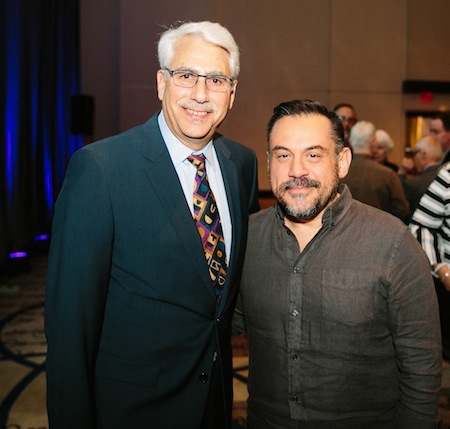
photo - Jewish Family Services executive director Richard Fruchter, left, and entrepreneur, venture capitalist and author Leonard Brody
Jewish Family Services executive director Richard Fruchter, left, and entrepreneur, venture capitalist and author Leonard Brody. (Rhonda Dent Photography)

JFS executive director Richard Fruchter spoke about JFS, its history and the expanding services it provides. It is because of this growth in the demand for JFS’s services, he said, that “it became important for us to be more visible in the community and tell our story to a much wider audience …. we’ve updated our logo and our name to reflect that. Our logo is a simple, elegant symbol – it conveys the warmth and heart of what we do here at Jewish Family Services.”

“For me, this is not just an amazing lunch with a marquee speaker,” said Keil before he introduced Brody. “It’s an opportunity for me to stand before you and proudly announce my support of the Jewish Family Services, and to thank the army of staff and volunteers … [for their] work in the community.”

Brody’s talk was on The Great Rewrite, a book he is creating with Forbes Magazine, based on a documentary series they produced. “Really what we’re doing this morning,” said the entrepreneur, venture capitalist and author when he took to the stage, “is talking about an evolution, an evolution in us, in our human story.”

Based on about a decade’s worth of research, he said, The Great Rewrite began with the question, “How is this moment in time different? We’ve been through a lot of innovation cycles, from the web and mobile, and now entering into AI and robotics… Is this vast amount of change that we’re all experiencing … substantively different from anything we’ve been through before? Is this a fourth industrial revolution?”

Humanity is “literally rewriting this planet from the ground up,” he said, arguing that we are currently undergoing “pretty much the largest institutional shift in the history of our species.”

The co-founder of four companies, Brody said, “The concept of this rewrite has nothing to do, for me, with just theory – it started as a theory but it’s really what we do and what I do every day for a living at CAA [Creative Artists Agency].”

Before looking at what we can expect in the next 730 days – the next two years – Brody explained how we, the humans of today, are nothing like the people of 100 years ago. For example, he said, the average person now lives 2.7 times longer and is three to four inches taller; the rate of poverty has been reduced from 90% in 1900 to 10% now, literacy increased from 12% to 85% and access to basic education risen from 17% to 86%. We are also “living in the lowest point of human death [caused by any factor] since we could record it, since 1400,” he said, and “the average human being living on this planet works about half the number of hours than someone living in 1900.”

We are fundamentally different people now, said Brody, and herein lies the challenge. “The houses we built don’t fit the people who live here any more,” he said. “We built institutions – I’m talking about all the institutions that govern your life, education, government, religion, work, the family unit – they are all going through massive pressure points today because they are structures based on assumptions, often technological, some patriarchal, that are just no longer true.”

So, he said, “The whole essence of this rewrite is you are living in the disconnect between the people we have become, the technological tools available to us today and the failure of our institutions to keep pace with that.”

One of the reasons for this, he explained, is “inversion.” Most of our institutions are organized as pyramids, with, for example, a head of state or religious figure at the top; however, the internet has flipped this power structure. Up to the mid-1990s, all the methods of communication, from radio to the telephone, had limited reach and were regulated by government, he said, but, with the internet, it “was the first time where millions of people could speak with millions of other people with virtually no hit on their disposable income” and where it was “impossible for governments to regulate.”

With respect to the internet, said Brody, “the average North American spends two-thirds of their working day in their virtual identity and not their physical one. The average Canadian, by the way, spends 63% of their time with close friends and family in their virtual identity and not their physical one, meaning not face-to-face. So, the virtual form of yourself is now the predominant human form, not the physical.”

And our behaviours are different online than in person. “You do things in your virtual identity that you would never dream of in your physical and vice versa,” he said. For example, the average internet user is four times more trusting than they are in person. He illustrated this using a question he asked his 83-year-old uncle: “When your children were babies, would you post their baby pictures on the lamp posts in your neighbourhood?” The response was an emphatic no. “So, then, why do you post hundreds of photographs of your granddaughter on Facebook and Flickr, which is a globally open, searchable and highly manipulated light post, and his face just went totally blank.”

As for how the internet has changed our institutions, Brody gave the example of marriage. As of the end of 2017, he said, “two-thirds of all new marriages in the Western world originated online” – and, for those who met their spouse online, the likelihood of divorce is 15 to 20% less. “The algorithms on these dating sites work from a data perspective,” he said. And, connected to the institution of marriage, he noted that, in the 2016 census, about 40% of Canadian adults reported themselves as living alone, while, in 1955, that statistic was four percent.

Brody went on to explain what CAA was doing in the field of entertainment with virtual reality and how, “in the next decade, roughly 30% of all ‘live’ entertainment will come from performers who are no longer living. You will take your children to go watch the Beatles and Michael Jackson and Elvis Presley – in fact, the Elvis tour has just begun; the estate just signed off on it.”

Currently, there are up to three-and-a-half billion people on the internet, he said, and, over the next two years, another billion people will join. This new billion will be “one of the most significant economic events in human history, if not the most significant,” he said, noting the amount of money to be made from e-commerce.

This coming two-year period, he added, “is the very beginning of a long journey in the rewrite of currency.” He said that traditional wealth generators, such as home ownership and the stock market, will not be profitable in the future, so currency “will become the new stock.”

Brody spoke about the fact that we’re about a decade away from creating machines able to think for themselves, and how computers can now create, for example, a Rembrandt painting that can fool the computers that detect fraud at top auction houses. “The reason I share that with you,” he said, “is because the very thing that makes us human is art. And, once machines begin to make art, you get a very clear indication of how different this world is going to be, and very clearly that we are on a path where humans may no longer be the predominant species on this planet. So, we have very important decisions to make in the next decade about how we regulate the ethics of artificial intelligence.”

He concluded, “Why are we talking about The Great Rewrite and the rewrite of this planet at a JFS Innovators Lunch? There are two specific reasons. The first is this massive shift in institutional power that’s coming…. And the second has to do with math, pure math; in particular, the number 70. Why 70? According to StatsCan, 70% of all charitable donations in this country come from primary donors – 70% come from a small group that make up the vast majority of the donations. So, I started to do a little bit of digging and I brought in my friends and partners at Forbes to help me out on it. It turns out, if you look through the Forbes millionaire and billionaire list, which many Canadians sit on, it turns out that … 70% of that [primary donors] group came from nothing” and could have been clients of an organization like JFS at one point in their lives.

“Benevolence and charity were the wrong lens” with which to look at giving, Brody said. “The right lens was investment. If it’s true, which it is, that the vast majority of donations to charitable causes in this country … and the vast majority of those individuals [who are giving] were, at some point in their lives, disadvantaged and downtrodden, then the math and the investment is very simple. An investment made in JFS today has the greatest statistical likelihood of identifying the next pillars in this community and the next great funders.”
Format ImagePosted on May 4, 2018May 2, 2018Author Cynthia RamsayCategories LocalTags Forbes, Innovators Lunch, Jewish Family Services, JFS, Leonard Brody, The Great Rewrite, tikkun olam
Operation Ezra update

Operation Ezra update

Khalaf and Gawre’s family is the 10th to come to Winnipeg thanks to Operation Ezra. (photo from Michel Aziza)

What started as a small local initiative has grown to be a leader, by example, and a reminder of what can be achieved when an intention is set and action is taken.

About a year ago, the Jewish Independent ran a story about Operation Ezra in Winnipeg that, at the time, was aiming to sponsor five Yazidi refugee families. Led by Michel Aziza, a local businessman and once a refugee himself (from Morocco), and a small group of individuals connected to the Jewish community, the initiative was a response to the plight of the Yazidi people being viciously persecuted by ISIS in Iraq.

Nafiya Naso, now a young woman, who came to Winnipeg as a child with her family, has been an instrumental figure in Operation Ezra.

“She was reaching out to people outside their community to raise awareness of the genocide that was going on, March of 2015,” said Aziza, recalling Naso’s early involvement. “I was semi-retired and looking for something to occupy myself, and this was a good opportunity for me to get involved with a volunteer-type of project. Essentially, that’s what I have been involved with over the last almost three years.

“At the beginning,” he said, “we knew nothing about the Yazidi people. After talking with Nafiya, we identified a family of eight people and thought we could raise the necessary funds to submit a sponsorship application. We started lining up a few speaking engagements for Nafiya…. We started speaking to people, making calls, and … the original target was $34,000 for this family of eight … [and] within three or four weeks, we raised $34,000. And that number kept on growing as people talked to other people.”

To date, with the generous help of people in Winnipeg and elsewhere, Operation Ezra has raised just over $500,000. This has made it possible for them to sponsor 10 Yazidi families – 55 people – with the last family having arrived in March.

“As soon as we realized this was bigger than a grassroots project, we decided to incorporate Operation Ezra within the organized Jewish community,” said Aziza.

Jewish Child and Family Service (JCFS) saw this as an opportunity to do something in line with what they were already doing – helping with the settlement of immigrants and refugees – so they came on board, gradually reaching out to other organizations and agencies.

Gray Academy of Jewish Education and the Jewish Foundation of Manitoba joined the effort and, currently, Operation Ezra is an umbrella group of some 20 different agencies and organizations. Most of the members are Jewish, but not all. There are two churches involved, the Salvation Army and a number of corporate partners, with IKEA being the biggest name.

Many volunteers help Operation Ezra in various aspects of the settlement process. Naso has been hired by JCFS to manage everything.

One service Operation Ezra offers is an English-as-an-additional-language (EAL) program, which takes place at a synagogue every Thursday, with 70 to 80 refugees attending and about 20 volunteer teachers. Some Yazidi participants are government-sponsored.

Out of the total 250 refugees who are government-sponsored, about 100 have asked for help from Operation Ezra. “So, we are touching the lives of about 200 people,” said Aziza. “We have organized and have helped organize many community events for the Yazidi people. We celebrated Yazidi New Year’s 6768 on April 18, 2018, with a very large number of people coming out for that dinner,” he said by way of example. “We’re trying to help this group of newcomers to get organized, and to organize themselves as a community … to socialize and to help each other and so on.”

According to Aziza, Operation Ezra is the only multifaith group doing this work in North America.

One recipient family of Operation Ezra is Majid and Safya, along with their children. They shared their thoughts on their experience to date, with translating help as needed from Naso.

“My name is Majid. I was born and raised in a small village…. I am married with two kids – one boy who is 4 and one girl who is 6. My wife, Safya, and I are currently enrolled in EAL classes, hoping to learn English and find work in the near future.

“On August 3rd, 2014, at around 9 a.m., my family, community members and I fled to Mount Sinjar. We were lucky to have escaped when we did. If we had stayed any longer, I would be in a mass grave with many other Yazidis. I can still hear the rapid gunfire as ISIS members surrounded everyone who wasn’t able to flee and started shooting.

“We then reached Mount Sinjar, where we stayed for seven days with little to no food or water. As we were coming down the mountain closer to the Kurdistan region, we were able to hop into a truck. But, soon after, we saw ISIS members driving at us, firing round after round. I still don’t know how we escaped that day. Everything was such a blur. All I really remember was covering my kids and wife, hoping they would make it. Fortunately, we all made it to a refugee camp in Dohuk.

“The conditions in the camp were very scary. We were always worried about getting enough to eat, drink … about medical treatment. And we stayed for a few months, but couldn’t make it. So, we left for Turkey hoping for better living conditions.

“After spending almost two years in Turkey,” he said, “we heard about Operation Ezra and reached out. And, by some miracle, we were sponsored. Everything felt like it was going to be OK after we received confirmation we would be coming to Canada.

“I will never forget the welcome we received coming down at the airport. I was in awe of all the people who had come to greet us and welcome us into their community.”

Majid said they arrived in Canada in December 2016. “My experience in Canada has been great and could not be any better!” he said. “I have many friends and family who are in refugee camps in Iraq and Turkey who call me and tell me that the situation in the camp is getting worse by the day. My dreams are that my family and I are able to live in Canada without the fear we faced back home – the constant fear for our lives, hate and discrimination we faced because of our religious beliefs.

“I encourage all Canadians to reach out to Operation Ezra and learn about this amazing program, the only program of its kind in the world today. We have thousands of Yazidi still living in segregated refugee camps, fearing for their lives and waiting for anyone to reach out and lend a helping hand. I also encourage the Canadian government to support groups like Operation Ezra to help out more refugees.”

Khalaf and Gawre’s family are the most recent Operation Ezra arrivals to Winnipeg. (Although they were the last family Operation Ezra had planned to sponsor, the group has unanimously decided to continue their efforts.)

“My name is Khalaf and I arrived in Winnipeg on March 29th with my mother, who is 83 years old, my wife, and five kids – two boys and three girls, ages ranging from 12 to 24. I was ripped away from my four older kids after ISIS attacked our village (Dugere).

“At 8 a.m., we heard gunshots and got calls from other Yazidi villages that ISIS had murdered hundreds of men and was kidnapping all the women and young girls. Ten minutes later, my family and I started walking toward the mountain. My mom and dad were so lucky they were able to get rides to the refugee camp in Dohuk. My wife, Gawre, and five children were stranded on the mountain for seven days.

“We were able to escape the mountain with the help of PKK [Kurdistan Workers’ Party]. We lived in a refugee camp on Dohuk for six months. The conditions were horrible and heartbreaking. Many people died in the camps, because there was no humanitarian aid, no water and no medical care. My father passed away, because we could not get him the medical attention he needed.

“Shortly after, we decided to go to Turkey. It was no better there, but we did not have a choice and could not afford to move back to Iraq again.

“My sister and her family were sponsored by Operation Ezra just over a year ago. We got on the list when we heard about this amazing project from the people in the refugee camp.

“Months after contacting Nafiya [Naso] and Asmaeil, we were told we would be sponsored! My family and I definitely won the lottery here. We will always be grateful for everyone who made this possible.

“My dream is to see my family and Yazidis around the world live free of persecution. We hope and encourage all Canadian and other countries around the globe to support groups like Operation Ezra and help them in saving lives.”

Naso added, “Operation Ezra is working to raise more funds and keep sponsoring Yazidi refugees. There are thousands waiting who are in desperate need of help. They have no voice, so we must be a voice for them and speak out for them.”

For more information and to make a donation, email [email protected] or visit jewishwinnipeg.org/community-relations/operation-ezra.

Rebeca Kuropatwa is a Winnipeg freelance writer.

Format ImagePosted on May 4, 2018May 2, 2018Author Rebeca KuropatwaCategories NationalTags immigration, Iraq, ISIS, Michel Aziza, Nafiya Naso, Operation Ezra, refugees, terrorism, tikkun olam, Winnipeg, Yazidi

Abuse comes in many forms

In the second of a series of articles on sexual harassment and violence in the Jewish community, the Jewish Independent speaks with Dr. Alan Stamp, clinical director at Vancouver’s Jewish Family Services.

The #MeToo movement, founded by Tarana Burke in 2006, is based on the concept that empowerment for scores of survivors is possible through empathy – from survivors knowing they are not alone. The movement aims to achieve radical community healing and disruption of all systems that have allowed sexual violence to flourish.

Dr. Alan Stamp, clinical director at Vancouver’s Jewish Family Services, stressed the particular need to protect children. From a psychological standpoint, around the age of 9, there is nothing worse than what is called a “boundary violation” of a young person inflicted upon him or her by an adult.

“Adults, parents, caregivers … are meant to keep kids safe,” Stamp told the Independent. “And when a child is abused by an adult figure, it breaks the trust that the child has – not only in that person, but it breaks their trust in the world. The world becomes an unsafe place to be.”

Stamp went on to explain that children have simple intellectual lives, in that they expect to be cared for in a way that is warm, nurturing and attentive. “When abuse happens, this is stripped away,” he said. “The impact on the developing psyche is that … I have to be vigilant, watchful, that there could be danger all around me…. And, it could be a teacher, an adult and/or a family member.

“The child puts a lot of focus on being vigilant rather than what they are meant to do, which is to learn through play, through relationships. So this is a very injurious act, probably the most injurious act a child can experience.”

Young people who have had this kind of experience develop all kinds of coping strategies – from withdrawing, to acting out, being aggressive and developing learning problems. These coping mechanisms can last a lifetime.

photo - Dr. Alan Stamp
Dr. Alan Stamp (photo from JFS)

“I’ve had many clients over my life who, when they are in their 60s, 70s or 80s, they tell me they’ve never told anyone this story before … and they launch into a story about being harmed … and that it has had an effect on all the relationships they’ve gone on to have in their lives,” said Stamp. “This is why it’s so injurious to a child. If you’re an adult and you have the horrible misfortune of being assaulted or abused, you have had more life experience to be able to manage it. If abuse happens to a youth, while not a child any more, they’re still at a tremendous disadvantage. For young people, getting help, intervening as soon as possible for an extended period of time, really increases the potential for people to do better later in life.”

Outside of explicit sexual abuse, other forms of abuse include emotional abuse, which can involve behaviour that is berating, condescending, hostile or threatening.

“This can be telling a young person that, if you don’t get a top mark in your class, you’re going to ‘suffer these consequences’ – like withdrawing food, be sent to the basement as punishment, neglect, or any manner of things,” said Stamp.

Another form of abuse is physical. “I’ve seen kids who’ve been hit by cast-iron frying pans on their head,” said Stamp.

“I can tell you what parents are meant to do,” said Stamp. A parent “is meant to provide their child with guidance, affection, warmth, food, shelter and education. And, when a parent or caregiver is withholding things, punishing without a clear reason, disciplining inappropriately for the offence – all of these things are felt as abuse to a child.

“This is different than simply being a strict parent by sticking to boundaries, having guidelines, curfews and insisting that homework or chores are done,” he clarified. “This may be strict, but it’s not abusive. It’s abuse when an act or reaction is an inappropriate response to behaviour. A child may think she or he is being treated unfairly, but it is not necessarily abuse. Abuse is something that will shake up the developmental life of the child and will cause them to look at the world through a different lens. Being a strict or controlling parent isn’t necessarily abuse, but the line can be crossed.”

Financial abuse is more often seen among adults, when someone is in a relationship – a spouse, significant other or adult child, for example – takes control of the other’s bank account. Stalking is a form of psychological abuse, making a person feel threatened and unsafe in their own home, neighbourhood or community. And there is sexual harassment. Violence can be two-sided, where both parties are abusive toward each other, or one-sided.

“Elder abuse is now happening with tremendous frequency, where adult children are abusing their elderly parents,” said Stamp. “This is something that’s almost a pandemic, I think, in many – even North American – societies.”

For people who are in an abusive relationship, it is often difficult to leave an abuser. Violence against women is a form of very fierce oppression, according to Stamp. “It oppresses their spirit. They often will say that they should have left and that they knew they had to, but that they couldn’t – that they felt paralyzed with fear for themselves or of harm coming to them, their child or to other family members … or that they didn’t have the confidence to leave,” he said.

“The psychological or physical abuse of a spouse or partner is very systemic,” he explained. “It affects them in many ways. Often, women will take up to eight years to leave an abusive relationship – that’s a very telling stat. When they do leave, they can look back on it and say that they should have left earlier. What I advise is, ensure that you are safe, that you have a safety plan … that you can get up and out of the house with your child within minutes.”

Stamp advises people in abusive relationships to always include in their escape plan talking to family and friends about the situation, as well as to identify resources in their community, just in case. “There are many resources in the community for women fleeing domestic violence,” he said. “It’s a very scary proposition, but, to get what you want, you have to give something up. You have to fight for yourself and become your own hero in many ways, your own best friend. There is help, there are resources…. Life is not meant to be lived being oppressed, threatened or being fearful for your safety.”

Stamp said it is important to remember that abuse is often passed down in families. If you were raised in a home where your parents yelled at each other, hurt each other, used foul language or were otherwise disrespectful, you have a much greater chance of being abusive yourself.

“Using one’s anger is a way of trying to gain control and to oppress others,” said Stamp. “Abuse is something that tends to be systemic, so it can be familial…. It can go back in time and come back to haunt us in the present.

“I’ve seen and worked with many men who were abusive and I’d say that 85% of those men came from homes where they were abused. So, unless we’re addressing that kind of family situation and the people who use abuse as a way to control or manage themselves and others, we’re going to continue to see this pattern throughout time.”

Stamp said the only way to create change is by means of awareness and education – through campaigns, schools, reporting, and by having community services that can positively intervene.

For more information about the counseling services offered by JFS, visit jfsvancouver.ca or call Stamp at 604-637-3309.

Rebeca Kuropatwa is a Winnipeg freelance writer.

Posted on May 4, 2018May 2, 2018Author Rebeca KuropatwaCategories NationalTags abuse, Alan Stamp, children, harassment, Jewish Family Services, JFS, seniors

The value of memoirs

This academic year marks the second session of Writing Lives, a two-semester project at Langara College, coordinated by instructor Dr. Rachel Mines. Writing Lives is a partnership between Langara, the Vancouver Holocaust Education Centre, and the Azrieli Foundation. Last fall, students learned about the Holocaust by studying literary and historical texts. In January, students began interviewing local Holocaust survivors and are now in the process of writing the survivors’ memoirs, based on the interviews. Students are keeping journals of their personal reflections on their experiences as Writing Lives participants. They used their most recent journal entry to reflect on the topic of The Importance of Memoirs. Here are two excerpts.

Memories are our experiences: our interactions with people we love or hate, our communication with the ever-changing world. Our memories remind us of our moral values, our knowledge, our appreciation of our own lives, and perhaps our own inadequacy in being the person that we wanted to be. Our memories are a true reflection of who we are, and that is exactly why they are our most valuable asset.

Writing down our memories is a great way to retain them and, hence, it is meaningful to write a memoir on behalf of David, a man who has experienced one of the most controversial and complex events in history – the Holocaust – so that his memories will be retained in concrete form and can be passed on to many generations. I believe David’s descendants, and anyone who cares about other human beings, will be inspired by what David fought for in the past and will be grateful for what they have. Sometimes, we take food and safety, peace and dignity, the privilege to love and to be loved, for granted, and we forget about the unfortunate ones.

Most importantly, memoirs of Holocaust survivors are a stern reminder of the fact that we humans can turn into perpetrators for not so obvious reasons. It would be wrong for us to think that, since we are civilized, rational, educated people, we cannot become perpetrators. We have come to realize that it is not the case that only psychotic or inherently evil people can harm others in callous and appalling ways. The Holocaust has demonstrated that hatred, racism, conflicts between religions and a sense of insecurity can easily be used to justify our wrongdoings. With the real-life experiences of survivors recorded in memoirs, hopefully people will never forget this painful lesson in human history.

– Bonnie Pun

Storytelling is a phenomenon that all manners of societies and cultures have practised since the hominid species first learned to communicate. We use stories to convey social values and wisdom. In Western society, thanks to pioneers such as Sigmund Freud and Carl Rogers, storytelling forms the bedrock of modern counseling practice. The intimacy of sharing a story with a compassionate and safe person can literally transform a life. Stories transmit meaning, both individually and socially. It’s as simple and complex as that.

Memoirs are a place where individuals can encounter and transform their experience into one that has larger meaning. On a societal level, projects like Writing Lives present the human experience and personal costs of the atrocities that have occurred. The personal narrative transforms historical facts into real and impactful events that can be felt, if not fully understood.

The Holocaust is so often constructed and taught as an historical anomaly, a mysterious evil; however, the fact of the matter is that it is a story of social relationships. Sadly, “stories” such as this have occurred far too frequently over the last 70 years. Globally, we have seen genocidal processes of hate in countries such as former Yugoslavia, Rwanda, Cambodia, Russia, Sudan … the list goes on. As our neighbour to the south, the United States, struggles with an ideological divide that has become so significant it is now one of the countries monitored by the NGO Genocide Watch, memoirs from the Holocaust become particularly important here in the Western world. I think it is sometimes easy to look at racially motivated brutality in the second and third worlds and feel a certain sense of safety. These memoirs confront us with a different reality, one which is too important to ignore.

– Ann Thomas

Posted on May 4, 2018May 2, 2018Author Writing Lives studentsCategories LocalTags Azrieli Foundation, education, Holocaust, Langara College, memoir, survivors, VHEC

Basic facts not known

During the week of Yom Hashoah (Holocaust Remembrance Day), the Conference on Jewish Material Claims Against Germany (Claims Conference) released the results of a comprehensive national survey of Holocaust awareness and knowledge among adults in the United States. The survey found that there are critical gaps both in awareness of basic facts as well as detailed knowledge of the Holocaust, and that there is a broad-based consensus that schools must be responsible for providing comprehensive Holocaust education. In addition, a significant majority of American adults believe that fewer people care about the Holocaust today than they used to, and more than half of Americans believe that the Holocaust could happen again.

Major findings of the survey include that 70% of Americans say fewer people seem to care about the Holocaust than they used to, and a majority of Americans (58%) believe something like the Holocaust could happen again. The study also found a significant lack of basic knowledge about the Holocaust:

  • Nearly one-third of all Americans (31%), and 41% of millennials, believe that fewer than two million Jews were killed during the Holocaust, as opposed to the six million Jews who were killed.
  • While there were more than 40,000 concentration camps and ghettos in Europe during the Holocaust, almost half of Americans (45%) cannot name a single one, and this percentage is even higher among millennials (49%).

At the same time, there are encouraging notes in the survey. In particular, there are key findings underscoring the desire for Holocaust education. More than nine out of 10 respondents (93%) believe all students should learn about the Holocaust in school and 80% of respondents say it is important to keep teaching about the Holocaust so it does not happen again.

The findings show a substantial lack of personal experience with the Holocaust, however, as most Americans (80%) have not visited a Holocaust museum.

“This study underscores the importance of Holocaust education in our schools,” said Greg Schneider, executive vice-president of the Claims Conference. “There remain troubling gaps in Holocaust awareness while survivors are still with us; imagine when there are no longer survivors here to tell their stories. We must be committed to ensuring the horrors of the Holocaust and the memory of those who suffered so greatly are remembered, told and taught by future generations.”

The Holocaust Knowledge and Awareness Study was commissioned by the Conference on Jewish

Material Claims Against Germany. Data were collected and analyzed by Schoen Consulting with a representative sample of 1,350 American adults via landline, cellphone and online interviews. Respondents were selected at random and constituted a demographically representative sample of the adult population in the United States.

The task force led by Claims Conference board was comprised of Holocaust survivors as well as representatives from museums, educational institutions and leading nonprofits in the field of Holocaust education, such as Yad Vashem, the United States Holocaust Memorial Museum, American Jewish Committee, the Jewish Agency and George Washington University. Claims Conference president Julius Berman noted, “On the occasion of Yom Hashoah, it is vital to open a dialogue on the state of Holocaust awareness so that the lessons learned inform the next generation. We are alarmed that today’s generation lacks some of the basic knowledge about these atrocities.”

For more information, visit claimscon.org/study.

Posted on May 4, 2018May 2, 2018Author Claims ConferenceCategories WorldTags education, Holocaust, United States, Yom Hashoah
Groves in their honour

Groves in their honour

Belkin Forest Grove was dedicated in Baal Shem Tov Forest on March 27. (photo by Lilah Weiss)

On March 27, Keren Kayemeth LeIsrael-Jewish National Fund held a special event in memory of JNF Canada friend and philanthropist Elliot Belkin. About 20 family members arrived from Canada for an organized tour of Israel during Passover. As part of their trip, they traveled to the north of Israel for a special ceremony honouring Belkin’s contributions to KKL-JNF.

When Belkin’s father, Morris, also a generous donor, passed away, Belkin created a forest grove in his memory in Biriya Forest, and brought his nephews, Kostia and Aurore Belkin, to Israel together with him. When Belkin passed away, his nephews continued the family tradition by donating a forest grove in his memory in Baal Shem Tov Forest.

“Aurore and I thought that it would make him very happy that there would be a forest grove in Israel in his name, and that’s why we’re here today,” said Kostia Belkin. “This is a modest gesture compared to what he did in his time, but we’re happy to be part of the tradition.”

The Belkin nephews unveiled a plaque honouring their uncle, and were presented a framed KKL-JNF certificate of appreciation. After the ceremony, the group planted cedar trees in the young forest grove.

About half the trees in Baal Shem Tov Forest were damaged in 2013 by a heavy snowstorm. New species of trees are being planted to ensure greater diversity, making the forest more resilient against weather damage.

Referring to the ceremony and tree planting, Belkin’s family said, “This has been one of the high points of our visit. These trees are like the children that Elliot never had.”

Kostia Belkin summed up the visit to Biriya Forest: “This has been an event that we will always remember,” he said. “We want to express our thanks to KKL-JNF for organizing this visit. Through their deeds, Morris and Elliot taught us about love of Israel and its people, and the symbolical meaning of planting trees in this soil.”

Format ImagePosted on May 4, 2018May 2, 2018Author Jewish National Fund Pacific RegionCategories IsraelTags Baal Shem Tov Forest, Belkin, Biriya Forest, JNF, KKl-JNF, trees
זוועה בטורונטו

זוועה בטורונטו

עשרה הרוגים וארבעה עשר פצועים בטורונטו – מרביתם קשה מרכב שפגע בהם בכוונה תחילה. (צילום: Linda Ward/CBC)

אחד האירועים הקשים ביותר בתולדות טורונטו העיר הגדולה בקנדה, שהתרחש ביום שני בצהריים לפני כעשרה ימים, גבה מחיר כבד מאוד. עשרה הרוגים וחמישה עשר פצועים, מהם תשעה במצב קריטי. זאת כתוצאה מרכב מסחרי שכור מסוג ואן לבן בו נהג אלק מינסיאן (סטודנט בן 25 מהעיר ריצ’מונד היל), שפגע בהם בכוונה תחילה. דווקא שסוף סוף בא האביב על העיר וחום השמש הורגש אחרי חורף קשה, התרחשה בטורונטו זוועה נוראית.

מינסיאן נסע ברחוב יאנג הסואן ובצומת עם שדרות פינ’ץ שבצפון טורונטו, הוא עלה עם רכבו על המדרכה והחל לנהוג במהירות רבה, תוך שהוא פוגע בהולכי רגל ללא הבחנה. ובעיקר מחפש נשים כך התברר. הנהיגה הרצחנית של מינסיאן נמשכה לאורך שני ק”מ (מספר בלוקים), ולאחר כעשרים ושש דקות הוא נעצר ע” המשטרה, לאחר שניסה להימלט. לשוטר שהתקרב אליו עם אקדח שלוף הוא צעק: “הרוג אותי, יש לי אקדח בכיס, הרוג אותי”, וממש התחנן למות. במשטרת טורונטו ציינו לשבח את השוטר שעצר את הרוצח בקור רוח ומבלי שירה אפילו פעם אחת.

מניעיו של מינסיאן שלא היה מוכר למשטרה לא ברורים עדיין והשר לביטחון פנים בממשלה הפדרלית, רלף גודייל, שלל את האפשרות שמדובר בפיגוע טרור. הוא ציין בצורה חד משמעית כי קנדה לא נמצאת בשום סכנה ביטחונית.

הנהג הרוצח סבל מבעיות נפשיות לאורך שנים. הוא לא הצליח להשתלב בחיים החברתיים ונחשב לבודד מאוד. זאת לטענת סטודנטים שלמדו עימו בבית הספר וכן שכניו. לפי העיתונות המקומית מניסיאן לפני שיצא למסע ההרג הנוראי, בירך בפוסט בפייסבוק את אליוט רוג’ר מקליפורניה, שבשנת 2014 רצח שישה איש, פצע ארבע עשר ולכן מכן והתאבד. זאת לטענתו כיוון שנידחה ע”י נשים. רוג’ר נחשב לגיבור לאומי אצל קבוצת גברים שמקושרים באון- ליין ויוצאת נגד נשים וגברים מצליחים. כפי הנראה גם מניסיאן נדחה קרוב לוודאי על ידי נשים וזה היה המניע העיקרי למעשיו המסוכנים.

תחילה חשבו בטורנטו עם קבלת מידע אל האירוע החמור כי לאור אופיו מדובר באירוע טרור, כפי שקרה באירופה בשנים האחרונות, לא מעט פעמים. רכבים שימשו כלי לפיגועי טרור ורבים נהרגו. יש לזכור שמפגש של מדינות הג’י-7 התקיים ממש באותה שעה בטורונטו, דבר שהוסיף לחששות כי מדובר בפיגוע טרור. מהר מאוד התברר כי אין קשר בין הנהג הדורס לארגוני טרור, שהוא לא גוייס על ידי אף אחד, הוא לא התאסלם ומניעיו אינם פוליטיים.

בתי החולים שקלטו את הפצועים הפעילו את מערך החירום “קוד כתום” (דבר הנדיר בקנדה), לאור כמות הגדולה של הנפגעים שהגיעו לחדרי המיון, ומשם הובלו במהירות לחדרי הניתוח.

המשטרה ממשיכה בחקירה מואצת להבין מה המניע את מינסיאן להרוג כל אך הרבה אזרחים חפים מפשע. השוטרים פשטו על ביתו לפחות פעמיים והחרימו מכל הבא ליד, כולל מסמכים, תמונות ומכשירים אלקטרונים. במקביל מינסיאן הופיע לראשונה בבית משפט (מיוצג על ידי הסנוגוריה הציבורית), כדי לשמוע מהשופט כי כתב האישום נגדו כולל עשרה סעיפים של רצח מדרגה ראשונה וארבעה עשר סעיפים של כוונה לרצח. כך או כך ברור שהוא ימשיך את חייו עד יומו האחרון בין כתלי הכלא. זה מה שמגיע לצעיר שהשתגע, הרגיש מקופח והחליט לנקום בחפים מפשע. יש שטוענים כי פעילותו של מינסיאן לא שונה מפעולת טרור גם עם המניעים אחרים.

Format ImagePosted on May 2, 2018May 2, 2018Author Roni RachmaniCategories עניין בחדשותTags Alec Minasian, terrorist attack, Toronto, אלק מינסיאן, טורונטו, פיגוע טרור
Brier biannual campaign

Brier biannual campaign

“Louis Brier is in a pivotal point in planning for the future through its redevelopment activities,” said David Keselman, chief executive officer of the home and hospital. (photo from Louis Brier)

The Louis Brier Home and Hospital was started in 1945 by what was then the Hebrew Men’s Cultural Club. The club dreamed of creating a home for Jewish seniors in Vancouver and, in 1946, opened its doors to accommodate 13 residents. Since that time, the facility has grown, changed locations and expanded its services. The Louis Brier is now home to 215 residents, is in contract with Vancouver Coastal Health and is part of a continuum of care known as the Snider Campus, which includes the Weinberg Residence next door.

“Louis Brier is in a pivotal point in planning for the future through its redevelopment activities,” said David Keselman, chief executive officer of the home and hospital. “We are forging relationships with major funders, politicians and academic organizations to facilitate research and best practices.”

Keselman, a registered nurse by training, has been working in the healthcare industry for almost 30 years. He has held a range of progressively more complex and complicated roles, and has worked across the entire spectrum of care – from academia, to acute care, home and community care, public health, and long-term care.

Over the last couple of years, Keselman has been leading the Louis Brier’s efforts to become a leading force in elder care in British Columbia. To help achieve this goal, the Louis Brier Jewish Aged Foundation runs a biannual campaign to raise funds to support the Louis Brier’s work and activities.

“Louis Brier offers a range of services across a continuum of care and provides assisted living services as part of the Weinberg Residence,” explained Keselman. “With the exceptional and generous help of the foundation and with the auspice of a resident- and family-centred care philosophy, Louis Brier Home and Hospital offers a range of unique and significant culturally relevant programming … as well as recreational and rehabilitation activities that are available in very few, if any, other long-term care facilities, custom-tailored to the needs of the residents, their health goals and wishes.”

Regarding this year’s campaign, which started April 16 and runs to June 4, Keselman said, “Of course, we’d like to raise as much as possible. However, as this is a biannual campaign, the goal is to raise at least $1 million.”

He said that, “with the support of the Louis Brier board and the foundation board,” the home has been able to launch “unique and essential programs aimed at supporting the delivery of high-quality care, ensuring that we follow best practices and evidence-informed practice for the best outcomes. Examples of these programs are the quality and risk and resident experience portfolio, and the infection prevention and control practitioner…. We established both of these, signalling a significant change in focusing on the delivery of quality care.”

photo - David Keselman, Louis Brier Home and Hospital CEO
David Keselman, Louis Brier Home and Hospital CEO. (photo from Louis Brier)

The Louis Brier has also continued to develop their recreational, rehabilitation and chaplaincy services. It has purchased a range of equipment to ensure its residents are safe, including wander guard alarms, and it has improved the library and updated the furniture in its lobby and lounge.

“We continue looking for opportunities to enhance the resident experience at the Louis Brier, and are planning to renovate the clinical space, with specialty services provided, such as, dental, ophthalmology and podiatry,” said Keselman.

“There was also a significant investment in staff education and resident programming to ensure we deliver the best care possible and expose our residents to the best available resources, programs and activities,” he added.

Although the Louis Brier does not currently have any vacancies, it also does not have a waiting list.

Access to the home’s publicly funded beds is managed by Vancouver Coastal Health and, although Jewish residents do have priority for cultural and religious reasons, the beds are open to all elderly individuals who require the services and environment of a long-term care facility within Vancouver Coastal Health’s catchment area.

The Louis Brier “is an organization that lives its vision and mission daily and without any hesitations,” said Keselman. “And, despite limited resources, the Louis Brier can proudly say that its services, resources and activities are second to none while, through its foundation, board of directors, physicians, staff and leadership, it continues to search for ways to constantly improve and be a leader in elder care. I’m extremely proud of being the CEO and part of this organization.”

For more information, visit louisbrier.com and, if you go to the bottom right-hand corner of the screen, you can submit a request for a tour.

Rebeca Kuropatwa is a Winnipeg freelance writer.

Format ImagePosted on April 27, 2018May 2, 2018Author Rebeca KuropatwaCategories LocalTags fundraising, health, Keselman, Louis Brier, seniors
Experiencing a renewal

Experiencing a renewal

More than 100 people came out to Burquest Community Association’s Purim carnival this year. (photo from Burquest)

At the end of a short, upward-sloping driveway in Port Coquitlam, what was originally a Jehovah’s Witness centre was converted into a Jewish community centre a couple of decades ago. The community the centre houses, Burquest, has been active since 1973. As the Jewish presence in the Tri-Cities grows, it is playing an increasingly essential role in providing services and connecting Jews to one another and to our culture and traditions.

The Burquest Jewish Community Association is dedicated to the “religious, social, cultural and educational needs of the Jewish population of the Fraser Valley,” with a membership of around 70 families, according to their website. The membership is diverse, with roots in five continents and a wide variety of Jewish backgrounds and interests, ranging in age from infants to grandparents. Yet, two years ago, the community’s future was uncertain – the board was considering continuing under the auspices of the Jewish Federation of Greater Vancouver, until Shoshana Szlachter stepped up to offer new leadership. She became board president just over a year ago.

“We were suffering from an onerous debt, it didn’t look like there was enough membership to keep it going,” Rudy Rozanski, Burquest vice-president, told the Jewish Independent. “A few of us got together, and Shoshana was at the head of that, and we decided that we do believe in the future of Burquest and we decided we did want to re-invigorate it. We had many ideas and they were instituted by Shoshana in a clear and positive way. We transformed it into a centre for Jewish learning, as well as being a community centre.”

Part of Burquest’s new success seems to lie in going back to their origins. “When I first joined Burquest, we were non-denominational, and then went Reform. But that didn’t work out as an experiment,” said Rozanski. “In a sense, we’ve returned to our roots.”

A year into Burquest’s renewal, things are looking up.

“Financially, we’ve come along really well,” said Szlachter. “When I came in, I thought, there’s still some life in this old donkey, let’s give it a kick and see what happens.”

The community reduced the cost of seats for the High Holidays and gave free memberships to those who bought tickets – this tripled membership. The centre has also gotten key grants, including from Federation, the Waldman Foundation and the City of Coquitlam. They have partnered with PJ Library to offer activities for children, as well as expanding their programming overall. For example, Burquest now has a Seniors on the Go program, covering yoga for seniors, mah jongg, art and piano gatherings, and a lunch-and-learn program on Jewish genealogy. There is a women’s class led by Devorah Brody, a teen club, Maccabee Kids (with optional Hebrew lessons) and a parent-and-tot drop-in program called Coffee and Knishes. Cantor Steve Levin leads religious services, and holiday events have been well-attended, with some 100 people joining the Chanukah and Purim celebrations.

“For a small community, our calendar is pretty full,” said Szlachter.

“I really enjoy the wide range of programming that Burquest is now offering,” said Sandra Hochstein, who has been involved with Burquest for 20 years. “When my daughters were young, I participated in all the child-oriented activities and am glad to see they are still there and going strong. Now that I am an empty-nester and newly retired, I love being able to participate in the adult activities, such as lunch-and-learn sessions and Monday morning yoga. I still appreciate the sense of community that I feel when attending Shabbat or High Holiday services.”

Asked about Szlachter’s role in Burquest’s “renewal,” Rozanski said, “Shoshana is an outstanding leader who is genuinely effective and concerned about our community, and her decisions regarding Burquest’s future have been unanimously applauded. Renewal is the right word for what our community is going through.”

More information about Burquest can be found at burquest.org.

Matthew Gindin is a freelance journalist, writer and lecturer. He is Pacific correspondent for the CJN, writes regularly for the Forward, Tricycle and the Wisdom Daily, and has been published in Sojourners, Religion Dispatches and elsewhere. He can be found on Medium and Twitter.

Format ImagePosted on April 27, 2018April 25, 2018Author Matthew GindinCategories LocalTags Burquest, family, Judaism, Rudy Rozanski, Sandra Hochstein, Shoshana Szlachter, Tri-Cities
Zwicker’s one-stop

Zwicker’s one-stop

Jordan Zwicker (photo from JZE)

If there’s one Jewish personality in Vancouver that almost everyone knows, it’s Jordan Zwicker. The man behind many of the city’s Jewish celebrations, Zwicker, 42, has been enlivening Vancouver parties since 2003, when he first arrived here from Toronto, seeking a change of pace. Recently, he rebranded his company as Jordan Zwicker Entertainment and is now exclusively offering interactive parties that promise to get everyone excited, and onto the dance floor.

Previously, Zwicker’s roster of services included DJ-driven events with music but no interactivity with guests. He has changed up the format, with positive results.

“The kids we’re entertaining at most Jewish events are age 12 and they need motivation to create atmosphere and have a great time,” he explained. “In a personality-driven show like ours we bring a motivator who creates an experience that engages everyone. By comparison, a purely DJ-driven event doesn’t lend itself to a great, engaging environment because, without anyone running the show, the kids don’t know what to do.”

Zwicker and his team – five DJs, two dancers and a party planner – have relaunched the company’s crew with a group of dancers from Dance Play who will lead the parties. “We’re coming up with the newest songs and creating our own choreographed moves to teach to kids at parties,” he said. “Every event will have at least one new flavour to distinguish it and we’re constantly coming up with new ideas for games and including them in our shows.”

Thanks to 25 years in the business, a passion for parties and a deep understanding of how they work, Zwicker knows how to engage kids and adults at a party.

“We look at an event as a produced show with lots of elements and coordination required,” he reflected. “There’s dinner, kids’ games, interactive dance sets, slide shows, speeches, dessert and more dancing. We’re always doing something because we’re running the party. We also offer other entertainment options, like photo booths with a magic mirror, a graffiti wall, an airbrush artist and a magician. Basically, we’re a one-stop shop where you can take care of everything with one call.”

Today, bar and bat mitzvahs constitute up to 60% of business, with weddings, corporate events, schools and private events comprising the remaining 40%. Zwicker works in Metro Vancouver, Victoria, Calgary and Winnipeg but says he loves the parties so much, he feels like he’s never worked a day in his life. Getting to know families in the Jewish community is an essential part of his work and one he thoroughly enjoys.

“As an entertainment company, we are friends with the parents and the kids, because the kids are our business. We take the time and effort to get to know them and learn their preferences because, when we do a party, we’re all in this together,” he said. “The kids appreciate the fact that we’re on their level and we ensure that they and their friends enjoy their event and that we don’t lose their attention. We charge what we charge for that very reason: there’s a value behind it – the experience and expertise that’s kept us as the entertainment leader in Vancouver.”

For more information, visit jzentertainment.ca.

Lauren Kramer, an award-winning writer and editor, lives in Richmond. To read her work online, visit laurenkramer.net.

Format ImagePosted on April 27, 2018April 25, 2018Author Lauren KramerCategories LocalTags entertainment, Jordan Zwicker, music, simchot

Posts pagination

Previous page Page 1 … Page 185 Page 186 Page 187 … Page 322 Next page
Proudly powered by WordPress