רבים מתושבי קנדה משאירים את מקלות ההוקי שלהם מחוץ לביתם לאות הזדהות עם קבוצת המבולדט ברונקוס. (צילום: Andrew Scheer)
תאונת הדרכים מהקשות בתולדות קנדה: שישה עשר הרוגים מרביתם שחקני הוקי צעירים וארבעה עשר נוספיםנפצעו
קנדה חוותה בראשית החודש (ה-6 באפריל) את אחת מתאונות הדרכים הקשות ביותר בתולדות המדינה, עת נמנו שישה עשר הרוגים, וארבעה עשר נפצעו מרביתם קשה, כאשר אחת מהפצועות נפטרה מפציעותיה. כל זאת כתוצאה מהתנגשות חזיתית בין אוטובוס של קבוצת ההוקי המבולדט ברונקוס, שהכיל עשרים ותשעה נוסעים: עשרים וארבעה שחקנים צעירים (בגילאי 16-21), ארבעה מלווים בהם טראפיסטית והנהג, לבין משאית עם סמי-טריילר. התאונה התרחשה בצומת חשוכה של בכביש המהיר 35 באזור צפון מזרח של מחוז סיסקצ’ואן. במקום קרו כבר תאונות בעבר אך עד עתה לא בוצעו עבודות לשיפור המצב של הצומת.
מבין שש עשרה ההרוגים: עשרה הם שחקנים, מאמן הקבוצה (42), עוזר מאמן הקבוצה (28), סטטיסטיקאי של הקבוצה (18), הטראפיסטית של הקבוצה (24, שהייתה כאמור אחת מהפצועות הקריטיות ונפטרה בינתיים מהפציעה), עיתונאי מקומי (29) והנהג (59). שלושה מהפצועים שוחררו כך שעשרה פצועים נמצאים עדיין בבית החולים, בהם שניים במצב קריטי והשאר במצב קשה עד בינוני. בסוף השבוע החולף החל מסע הלוויות של שישה עשר הרוגי התאונה הקשה. חמש עשרה הלוויות נערכות בהמבולדט (עיירה קטנה בת ששת אלפים תושבים) ומחוז, והלוויה נוספת תתקיים באלברטה.
שחקני הוקי של המבולדט ברונקוס (הקבוצה נוסדה בשנת 1970) היו אמורים להשתתף במשחק חצי גמר, במסגרת הפליאוף בהוקי לצעירים של אזור מערב קנדה. כל ההרוגים והפצועים שהו באוטובוס, ולעומת זאת נהג הסמי-טריילר לא נפצע. הוא זוכה לטיפול נפשי צמוד בשלב זה. הנהג עבד רק שבועיים בחברת ההובלה שהיא הבעלים של הסמי-טריילר. משרדי החברה נמצאים בקלגרי ובבעלותה שתי משאיות בלבד. שר התחבורה של מחוז אלבטרה הודיע כי בשלב זה רשיון התפעול של חברת ההובלה הושעה. וזאת עד לברור נסיבות התאונה המדוברת.
נשיא קבוצת המבולדט ברונקוס, קווין גרינגר, הוציא הודעה קצרה לעיתונות בעקבות התאונה הקשה: “מחשבותינו ותפילותינו עם המשפחות של העובדים והספורטאים שלנו, כמו גם עם כל מי שהושפע ונפגע מהטרגדיה הנוראה הזו. משפחת ברונקוס שלנו שרויה בהלם כאשר אנו מנסים לעכל את האובדן המדהים שלנו”.
גם ראש ממשלת קנדה, ג’סטין טרודו, הגיב על האירוע הקשה, באמצעות חשבון הטוויטר שלו: “אני לא יכול לתאר לעצמי מה עובר עתה על משפחות וההורים של הנפגעים. ליבי יוצא לכל אלה שנפגעו בטרגדיה הנוראה הזו, בקהילת המבולדט ומעבר לה”.
אחד מהשחקנים שנהרגו תאונה זו, לוגן בולט, תרם את איבריו להצלת חיים של לא פחות משישה חולים קשים. לאור זאת קמפיין תרומות האיברים ברחבי קנדה זוכה מעתה לתשומת לב רבה, ומספר האזרחים שמוכנים לתרום את האיברים שלהם להצלת אחרים גדל משמעותית מראשית החודש.
במקביל מספר התרומות הכספיות לטובת המשפחות השכולות ומשפחות הנפגעים גדל בהתמדה כל הזמן. את הפרוייקט התחילה תושבת המבולדט, סילביה קלינגטון, והוא זכה להתייחסות בכל העולם. בסוף השבוע האחרון מספר התרומות הגיעו כבר ליותר מאחד עשר מיליון דולר. יותר ממאה ועשרים אלף איש מרחבי העולם (מלמעלה משמונים מדינות), תרמו כספים למטרה חשובה. זאת באמצעות אתר ‘גו פאנד מי’. מדובר בקמפיין התרומות הגדול ביותר של האתר בקנדה, והשלישי בגודלו מאז הוא נוסד. צפוי שמספר התרומות הכספיות ימשיך לגדול עוד ועוד.
יצויין עוד שרבים רבים מתושבי קנדה משאירים את מקלות ההוקי שלהם מחוץ לביתם לאות הזדהות עם קבוצת המבולדט ברונקוס והאסון הכבד שקרה לה ולעיירה המבולדט.
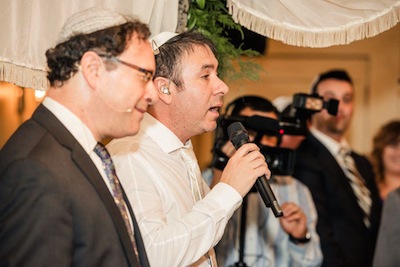
When A.J. Edelman was training in Whistler, he was the guest cantor for Chabad of the North Shore’s Yom Kippur services. (photo from A.J. Edelman)
Chabad of the North Shore community members had a more personal reason to cheer on A.J. Edelman at the 2018 Winter Olympics in PyeongChang, South Korea. Israel’s only skeleton athlete to have made it to the Games, Edelman was training in Whistler around the High Holidays last year. While there, he participated in community life, stepping in as guest cantor on Yom Kippur.
“Although he [Edelman] could have attended services at a larger synagogue in Vancouver, he was committed to spending Yom Kippur where he could be useful and have an impact,” said Rabbi Mendy Mochkin, spiritual leader of Chabad of the North Shore. “We had a cantor during Rosh Hashanah, but not for Yom Kippur.
“It worked out great. Our community was very excited to learn that a skeleton athlete representing Israel was training locally and was very touched that he chose to join us. They were very moved by his … melodies and heartfelt prayers. We all prayed together with him that he should attain his dream to be an ambassador for Am Yisrael. Our prayers were answered!”
Edelman was born and raised in Boston, in a Modern Orthodox, Zionist family, and he attended an Orthodox Jewish day school. When he was 2, his parents strapped a pair of skates onto his feet. By 22, he was a good hockey player, but not good enough to become a professional.
“I decided that, if I wanted to continue doing sports, it had to be on a high, elite level that could really give a platform to whatever I would choose to do afterward,” Edelman told the Independent. “So, I decided to represent Israel, because it was going to be the only way I was going to do it. As it happened, as I was thinking about this, skeleton appeared on the TV for the team trials for the United States for Sochi. And I thought it looked like a terrific sport – eye-catching.”
For some athletes, they become good at a sport and then look for a country that will let them compete under its flag. In Edelman’s case, he was mainly spurred by the idea of representing Israel. Then, he began searching for a sport.
“It could certainly help me achieve my goal of inspiriting people,” said Edelman. “I didn’t know how difficult it was or how painful it was. I didn’t know how bad, at first, I would be at it. But, I did dive full on into it.”
Edelman had to go from zero to 100, so to speak, in less than four years. While many along the way tried to tell him his goal was unattainable, the naysayers only fueled his resolve to succeed.
“It’s not like swimming or other sports where you have to hit a time relative to previous Olympics times, you have to hit an absolute performance standard of world ranking in that specific year. It’s a quota system,” explained Edelman of skeleton.
Edelman had to become one of the top 30 skeleton athletes in the world in about 48 months. His last year of training was focused – with help from the other athletes on the Israeli skeleton team – on maximizing his point collection at competitions.
“Positioning Israel to be the beneficiary of one of 10 single-sled nations through points I accumulated through specifics results and races was important – and it involved a lot of mathematical calculation,” said Edelman.
Edelman finished 28 out of 30 at the Winter Olympics.
A.J. Edelman was Israel’s only skeleton athlete to make it to the 2018 Winter Olympics in PyeongChang, South Korea. (photo by Joern Rohde)
“Making the Games was an insane accomplishment in that we were the only ones who did it without any coaching,” said Edelman. “We had absolute zero coaching for the first two years of my journey…. It took a huge physical toll and mental toll, and a massive financial toll. So, yes, 28 out of 30, I was very pleased.”
Edelman learned the sport from YouTube videos, and fundraised the money he needed to participate in competitions, buy equipment, and cover hotel stays and training facility fees. As far as trying to compete at the next Olympics, Edelman said, while he’d like to do that, it’s just not feasible.
“The financial strain is insane – $40,000 a year,” he said. “And only about 40% of it was covered from over the last four years by sponsors, family, friends – and complete random strangers. Doing it for another cycle would be too much of a financial strain. And I think I’ve accomplished what I was looking to accomplish, and am able to remain involved in Israel’s sports and help the next generation achieve their goals. I now have that platform.”
Although Edelman was at the Games – or maybe because he was at the Games – he said he felt disconnected from the Olympics as a whole.
“I only saw my own thing,” he said. “Otherwise, the experience at the end, or during the competition, of representing Israel, it was an honour unparalleled to anything in my life. There were a few moments I felt like I could cherish forever – the thoughts and feeling that this is what it’s like to represent a country and how it feels to be that individual. It was absolutely terrific.”
Edelman said he is not sure about what might come next for him, but that he is aiming big. For now, he is focused on transitioning from being a full-time athlete back into normal life. But life will never be the same for him, now that he has proven his potential to himself.
“If you apply yourself so completely and fully, and you just dedicate yourself the most you can, a lot can be accomplished,” he said. “But, not everything … I am never going to be able to make the NBA.
“I don’t usually tell people anything is possible. I tell them what I learned in the streets – that no one can tell you what you can’t do, and that you shouldn’t let others’ opinions dictate what you can do.”
As far as his experience with the Jewish community while training in Whistler, Edelman said, “My Jewish heritage is everything to me. It’s the entire reason why I did this. This journey was terribly difficult – it was the Jewish heritage aspect of it that kept me going.
“I cannot tell you how many times I wanted to give up, quit or just take days off,” he admitted. “But, then I’d remember I was representing the entire Jewish and Israeli community. Every night before I went to bed, I’d thank God for allowing me to be what’s called a Kiddush Hashem [sanctifying God’s name by living by example, in a holy way]. This means being a positive role model for my community and that means everything to me.”
Edelman connects with Jewish communities wherever he goes, seeing himself as an ambassador of the Jewish state. So, for him, joining the North Shore Jewish community when he was training in Whistler was a foregone conclusion.
The 2019 World Championship will be held in Whistler and, although Edelman has retired from athletic life, he wants to attend.
“When I tried out,” recalled Edelman of his first skeleton trial, “the Israel scouting report said that if I could just get down the track, that would be it … that I wouldn’t make it to the Games no matter how hard I tried. I think everybody can have that kind of moment … when they think they can’t do something or are told they can’t do something – but they should absolutely try and expect success.”
Businessman and philanthropist Samuel Belzberg died on March 30 in Vancouver, after suffering a stroke several days earlier.
Belzberg, 89, was the chair and chief executive officer of Gibralt Capital Corp., which is based in Vancouver.
After moving here in 1968, Belzberg formed Western Realty with his brothers, which they sold in 1973, according to the Vancouver Sun. In 1970, he formed First City Financial, which adapted through the years, operating until 1991.
In his 60s, Belzberg reinvented himself as a private equity investor, quickly amassing significant successes. He bought out and revived the Keg restaurant chain. He also financed a Quebec-based vaccine manufacturer called ID Biomedical and took on real estate projects in Nova Scotia, California, Oregon and elsewhere.
In his later years, he became more known for his generous philanthropy. Belzberg’s parents had immigrated to Alberta from Poland just before many of their friends and family were sent to Nazi concentration camps, and it was the immigrant experience that inspired him to help others.
“Mom and Dad lost so many of their brothers and sisters, yet Canada took them in,” he told the Sun in 2003. “This country takes people in, so why shouldn’t we help people? It’s our responsibility to help. I think about it every day.”
Belzberg headed the initial $13.5 million campaign to build Simon Fraser University’s (SFU’s) Downtown Vancouver campus, a space that has since become an integral part of the city’s urban life.
SFU president Andrew Petter told the Vancouver Sun that Belzberg will have a lasting legacy at SFU. “Sam was a larger-than-life figure,” said Petter. “He was one of the builders of SFU.”
Both Belzberg and his wife, Frances, have been honoured by SFU for their leadership and contributions.
Belzberg also donated the initial $500,000 to start the Simon Wiesenthal Centre in Los Angeles in 1977 and served as its founding chairman. “Sam was both a visionary and proud Jew,” Rabbi Marvin Hier, who founded the centre, said in a statement.
On top of that, Belzberg helped found Yeshiva University High School of Los Angeles and was an active supporter of the Jewish community in Vancouver.
“Countless organizations in our community benefited from his vision and his philanthropy, including ours,” said Ezra Shanken, chief executive officer of the Jewish Federation of Greater Vancouver. “He had such a youthful energy about him and, every time we met, he was always open to new ideas and new ways to help Jewish life flourish. He truly cared about this community and he appreciated others who valued tikkun olam and tzedakah as he did. He and [his wife] Fran were a team and they have instilled those values in their family from one generation to the next.”
In 2001, Belzberg created Action Canada, which, in partnership with the federal government, endows 20 fellowships each year to Canadians “who want to make a difference in the world.” He also founded the Dystonia Medical Research Foundation– a cause that was very personal to him. In the 1970s, his daughter, Cheri Belzberg, was diagnosed with the rare neurological condition, which impacted her mobility and speech. “Nobody knew the first thing about it in those days,” Belzberg told the Jewish Independent in 2014.
Belzberg received the Governor General of Canada Award in 1992 and, in 2002, was promoted to Officer of the Order of Canada. In 2009, he was awarded the Order of British Columbia for his extraordinary philanthropy and community leadership.
Belzberg is survived by Frances, his wife of 68 years, his four children, 16 grandchildren and 12 great-grandchildren.
Matthew Gindinis a freelance journalist, writer and lecturer. He is Pacific correspondent for the CJN, writes regularly for the Forward, Tricycle and the Wisdom Daily, and has been published in Sojourners, Religion Dispatches and elsewhere. He can be found on Medium and Twitter. A version of this article was originally published by CJN.
Ariella Kimmel, left, and Sophie Hershfield at last summer’s Winnipeg Pride Parade. Hershfield has been on CIJA’s LGBTQ+ Advisory Council since its inception. In that capacity, she is trying to break down barriers and clear up misconceptions about Israel within the LGBTQ community. (photo from Sophie Hershfield)
As part of the Limmud festival that took place in Winnipeg March 18-19, LGBTQ activist Sophie Hershfield gave a presentation.
A student at the University of Winnipeg, studying English and philosophy, Hershfield became active in the LGBTQ community when she was at Gray Academy of Jewish Education. She has been on the Centre for Israel and Jewish Affairs’ LGBTQ+ national advisory council since its inception last year.
“The talk I gave at Limmud was largely on advocacy within LGBTQ communities, because a lot of them are hostile towards Israel,” Hershfield told the Independent. “Last year, for example, at the Chicago Dyke March and the fallout from that … it was apparent that the LGBTQ community was hostile toward Israel and often to Jewish Zionists within their organizations. At the Chicago Dyke March, people who were on the Pride side were actually told to put their flags away, because of their connection to Israel.”
Hershfield is trying to break down barriers and clear up misconceptions about Israel within the LGBTQ community.
“One of the most successful things I think we did last year was we had an Israel-themed float in the Pride Parade,” said Hershfield. “And we had Jewish people and Israeli people on this float. We actually won best float in the entire parade. People were associating Israel with fun and happiness and being inclusive, those positive connections. There were definitely some positive responses. There were people saying, it was so cool, that Israel is so fun. I didn’t see any negative pushback, just positivity.”
Hershfield is already working with a planning committee on next year’s parade in Winnipeg.
Through CIJA, Hershfield plans to continue her efforts to improve inclusiveness within Jewish communities across Canada and to do Israel advocacy in LGBTQ communities.
“Halifax’s Pride board was incredibly hostile toward Jewish people and toward pro-Israel people – to the point where there were death threats to people who were involved,” said Hershfield. “I wanted to be more preventative, by building positive connections instead of negative ones.”
Jonathan Lerner favours a similar approach. He is assistant director of the Vancouver Holocaust Education Centre, and is also on CIJA’s LGBTQ+ Advisory Council.
Vancouver’s Jonathan Lerner, a member of CIJA’s LGBTQ+ Advisory Council, finds that many LGBTQ Jews “choose one or the other – either they’re involved in the Jewish community or the LGBTQ community, but not necessarily both.” (photo from Jonathan Lerner)
“Vancouver is a very welcoming place for LGBTQ people, with a society that is very diverse and welcoming,” he said. “The annual Pride Parade draws 600,000 people or more, and there is a month-long celebration. The municipal government is very supportive of these events and, while discrimination still exists, Vancouver as a whole is very welcoming.
“I’ve had great experiences with Vancouver synagogues, including the Reform and Reconstructionist movements,” he added. “I can say that even the Conservative synagogue in Vancouver has sponsored our booth at the Pride festival.”
Still, Lerner feels there remains a disconnect between the Jewish and LGBTQ communities.
“There are plenty of LGBTQ Jews and they’re often involved in Jewish or LGBTQ communities,” he said. “However, I find that most choose one or the other – either they’re involved in the Jewish community or the LGBTQ community, but not necessarily both. Sometimes, one may feel a necessity to choose an identity. For example, if one is associated with LGBTQ organizations, they may be anti-Israel … and so, one may choose to hide one’s Zionism or even Judaism.”
Lerner said that, while CIJA and the Jewish Federation of Greater Vancouver have worked hard at increasing collaboration and sharing between the communities – with recent workshops, training and outreach – more is always welcome.
“It has been challenging at times for LGBTQ people to be out in the Jewish community, and also for Jews to be open about their religion and Zionism in the LGBTQ community,” he said. “I’d like to see that change.”
Meanwhile, in Winnipeg, there have been other initiatives to increase awareness and inclusivity. On Feb. 21, Shaarey Zedek Synagogue hosted at the Jewish deli Desserts Plus an event called LGBTQ Jews: Sexuality, Gender Identity and Judaism, with some 20 attendees. It was led by the synagogue’s Rabbi Anibal Mass.
“Our vision is an inclusive space, a nonjudgmental environment, where you can express your Judaism pretty much your way,” Mass told the Independent.
Spiritual leaders of Winnipeg’s Shaarey Zedek Synagogue, Rabbi Alan Green, left, and Rabbi Anibal Mass. The synagogue is working to become more inclusive. (photo from Shaarey Zedek Synagogue)
An LGBTQ group had approached the synagogue, said Mass. Some people from the group attend Shaarey Zedek and were concerned about the level of acceptance at the shul.
“I don’t blame them,” said Mass. “We’ve been changing … the last few years, and some people are unaware of all the changes we went through. We thought that it would be a good time to share with this specific group of people our vision and our values, for them to have it clear. If they have any doubts or questions, they can ask a member of our clergy – what we stand for, what we’re willing to do or not do, etc.”
Mass sees rabbis of the Talmud as examples to follow in regards to being nonjudgmental and inclusive. “They speak about compassion, about loving your fellow human beings,” said the rabbi. “We feel empowered by the works of the rabbis to embrace all these people in our synagogue and make Shaarey Zedek their home.
“I was expecting to have lots of questions [at the event]. I didn’t have too many. I guess maybe they weren’t expecting me to say how open we are. Maybe people thought I would come there and preach … and to say, ‘Yeah, we accept you, but….’ But there was never a ‘but.’ We do accept you, period. So it was a great event.”
At that information event, a gay male couple from the synagogue shared their story with the group, about how they were turned down for a wedding from pretty much every synagogue in town – until they arrived at Shaarey Zedek. The couple said they could not believe how welcoming the congregation was.
“We ended up celebrating their wedding,” said Mass. “Many times, people complain that synagogues don’t offer the answers. The problem is, sometimes we don’t have the questions. We want to know what people in the LGBTQ group actually want, and to make that part of our vision.
“We also detect there will be some challenges for the future that we don’t know how to handle,” he admitted. “For example, how do you serve people who define themselves as non-binary? Do they have a bar or bat mitzvah? Both terms are appropriate.”
To keep things moving forward, Mass plans to start by hosting a group at his house. He understands that it might take awhile for some people to feel comfortable coming to a synagogue. “But, that’s OK,” he said. “If they don’t come to the synagogue, the synagogue will come to them. That’s my philosophy.”
Entrepreneur, venture capitalist, author and media visionary Leonard Brody is the keynote speaker at this year’s JFS Innovators Lunch April 24. (photo from JFS Vancouver
On Tuesday, April 24, Jewish Family Services (JFS) will be hosting its annual Innovators Lunch. The event, which encourages people to think as innovators and uplift lives to bring about meaningful and lasting social change, raises essential funds that go directly to serve JFS clients, programs and services. It has attracted more than 600 people in each of its 14 years.
This year, the keynote speaker is Leonard Brody, chair of Creative Labs, a joint-venture with Creative Artists Agency, the largest sport and entertainment agency in the world. He and his team are building new ventures and companies for some of the biggest celebrities and sports personalities in the world. He acts as principal in several venture capital funds throughout the world, and is behind the financing and creation of dozens of start-up companies every year. He is also one of the owners of Coventry City Football Club in England.
The award-winning entrepreneur, venture capitalist, bestselling author and two-time Emmy nominated media visionary has been called “a controversial leader of the new world order.” His upcoming book, in partnership with Forbes Magazine, is The Great Rewrite. In it, he addresses the rapid pace of change, innovation and disruption brought about by the internet and how to respond to its profound changes on our social and economic ways of life.
“Everything we do, from how we speak, how we buy, how we employ people, is being rewritten,” he told JFS. “The internet is the first time in our history where millions of people can speak directly to millions of other people at little cost, no regulation; the first time in our species that we have owned our communication at mass scale on a global level. The tools for innovation are nothing, the playing field is now level.”
Wherein lies the controversy? Brody argues that the resulting change in communication is “a massive disconnect between the institutions we’ve created and the people we’ve become.” He contends that it is the largest level of institutional shift in human history.
“Our world is inverted,” he explained. “We are fundamentally different than the people we were 100 years ago.” The institutions that run society are traditionally top down, he said. Take, for example, politics, with a prime minister at the top and the people at the bottom. Once the internet became ubiquitous, the power pyramids started to flip, or invert.
The pace can be disorienting, and Brody seeks to raise the level of our dialogue and provide a useful framework for action that people can look to and use. Through concrete stories, he provides many answers, ultimately offering a playbook on how we can engage in the world that’s being rewritten around us.
For tickets to JFS’s Innovators Lunch on April 24 at the Hyatt Regency Vancouver, visit jfsvancouver.ca/innovators. There is a limited number available, so book your space early.
Susan Barocas is one of 40 presenters at the April 14-15 “buffet for the mind.” (photo from Susan Barocas)
Among the many presenters at this weekend’s Limmud Vancouver is Susan Barocas, writer and filmmaker, Sephardi chef and expert on the history of Sephardi cooking.
Barocas, who was former president Barack Obama’s guest chef for White House seders, will give two presentations at this year’s Limmud. On April 14, 7:30 p.m., she will speak on Tastes Across the Centuries: The Enduring Influence of the Foods of Spain’s Medieval Jews. On April 15, 10:50 a.m., she will speak on The Long and Short of Noodles, a history of noodles from ancient China to the modern day.
Barocas lives and works in Washington, D.C., where she is an active and well-known foodie. She is a regular contributor to the Washington Post, Huffington Post, Lilith and Moment, and is a member of Les Dames d’Escoffier, a philanthropic organization of women leaders in the food, beverage and hospitality industries. She was the project director of D.C.’s Jewish Food Experience. Limmud Vancouver spoke with Barocas about her unusual career and interests.
LV: In Vancouver, you are speaking about classical Sephardi cuisine. Can you give us a little preview?
SB: I am really looking forward to talking about the food of the Jews of medieval Spain, putting it into historical context. Food played quite an important role in the Inquisition. (Hint: it goes way beyond pork!) Then, I will talk about what happened to the food of those original Sephardim and the surprising influences they have on contemporary Jewish and other cuisines. Of course, I’ll be sharing recipes, too.
LV: Can you tell us more about your heritage and its influence on your career?
SB: I grew up in a mixed household – Sephardic and Ashkenazic. On one side, my grandparents were from Russia-Poland and, on the other, from the Ottoman Empire, what is now Turkey and Macedonia, descended from Jews expelled from Spain in the Inquisition. My father and mother both cooked, so we ate both cuisines – tongue, borsht, gefilte fish and shmaltz, as well as lentils, feta and olives, baklava and stuffed grape leaves.
Over the years, I have become more and more drawn to my Sephardic heritage. It is something of a mission for me to share my view that Jewish food really is international cuisine. To think of it otherwise is to miss out on so much of Jewish culture and cuisine.
LV: You describe yourself as a home cook without formal training, and yet you’ve built a very successful professional career. How did your career develop?
SB: I’ve been cooking since I was a very young child. My first career was in nonprofit public relations. Whenever I would do a special event, food definitely got extra attention from me. When I moved to D.C. in 1993, I worked for food guru Joan Nathan for a few years. My second career included writing and producing documentary and organizational films; raising my son; and teaching a course called In Grandmother’s Kitchen at a local Hebrew high school. Next, I ran the Washington, D.C., Jewish federation’s Jewish Food Experience project. Now I am well into my third career, as a food writer, chef, caterer and teacher.
LV: How does the Jewish Food Experience bring people together?
SB: The Jewish Food Experience is an innovative project of the Jewish Federation of Greater Washington. It includes an award-winning website, jewishfoodexperience.com. The goals of JFE are to use food and culture to build Jewish identity and community, particularly with certain target audiences that research showed had the greatest needs – young professionals, families with young children and interfaith couples and families. The project has become very successful with the website and programs, bringing people together and closer to their Jewish identity in many different ways.
LV: What is your most memorable Jewish meal?
SB: My most memorable Jewish meal would have to be the seders in the Obama White House, where I served as guest chef for three years. Over time, I was able to bring some of my Sephardic food to the table, so to speak, along with the Ashkenazic dishes. Even though I was working and didn’t actually sit down to eat the meal, I still get goosebumps remembering the pleasure the president and first lady expressed about the food, and also hearing from the next room President Obama’s voice booming out “We Shall Overcome” during the seder.
Elizabeth Nichollsis a volunteer with Limmud Vancouver. Chef Susan Barocas is one of 40 presenters at the April 14-15 “buffet for the mind.” To register and for the full schedule, visit limmudvancouver.ca. The fee for the conference is $75, which includes a kosher dairy lunch. Onsite babysitting is available, along with special programming for children and teens. All sessions will be held at Congregation Beth Israel.
Orit Sulitzeanu, executive director of the Association of Rape Crisis Centres in Israel. (photo from Facebook)
Orit Sulitzeanu, executive director of the Association of Rape Crisis Centres in Israel, was invited to address the United Nations on March 29 about the issue of combating sexual harassment in the workplace. She presented Israel’s precedent-setting voluntary code against sexual harassment.
“We started working on this several years before the current #MeToo campaign,” Sulitzeanu told Israel21c. “The code is an interesting idea that could be adapted and implemented in other places in the world.”
Based on the Israeli law against sexual harassment in the workplace – be it an inappropriate look, remark, touch, text message or worse – the code provides concrete details on how to implement the regulations, which Sulitzeanu compares to “a quilt with a lot of patches missing.”
For example, the law requires every business or organization with more than 10 workers to designate a special ombudsman to deal with sexual harassment complaints, but it doesn’t specify details about training and supporting this ombudsman.
The Association of Rape Crisis Centres turned to the Standards Institute of Israel four years ago to help add definitions and explanations to the laws after winning a tender from the Israeli Ministry of Economics to draft a voluntary code to give managers a more exact tool for avoiding and handling sexual harassment incidents.
With this funding and additional funding from groups including the Hadassah Foundation in the United States, Israeli labour law experts from women’s organizations worked for two years on guidelines.
“We also developed, with Dr. Zeev Lehrer from Tel Aviv University’s department of gender studies, a tailor-made intervention that enables us to specifically understand the special characteristics of sexual harassment in a specific organization and then develop a prevention program suited to the organization,” said Sulitzeanu.
The priority is to introduce the voluntary code against sexual harassment in local municipalities, businesses and organizations that the association identifies as high risk – such as the military, police, healthcare organizations, airlines, media outlets and first-response networks – because of vulnerability factors such as big gaps in age and gender (usually, older men supervising young women), nighttime working hours and frequent operations outside the office environment.
The municipality of Ra’anana was the first to adopt the voluntary code for its thousands of workers, followed by a high-tech company (EIM). Magen David Adom, Israel’s national emergency response network, will adopt it next.
A leader in this area
Sulitzeanu’s invitation to the UN has its roots in a co-sponsored resolution that Israel spearheaded in March 2017, titled “Preventing and Eliminating Sexual Harassment in the Workplace,” in light of statistics showing that up to 60% of women worldwide have experienced harassment.
The resolution condemns sexual harassment in all forms, especially against women and girls, and emphasizes the need to take measures to prevent and eliminate it, raise awareness, educate, promote research, and collect and analyze data and statistics.
“Israel succeeded in passing this resolution in the UN and that positioned Israel as a leader in this area,” said Sulitzeanu. “That’s why they called me to talk about the voluntary code.”
As far as she knows, no other country aside from Australia has any similar code of conduct to address sexual harassment in the workplace.
“Just as Israel is the start-up nation for technology and science, we are also the start-up in social initiatives,” she said.
Harassment subculture
Israel’s voluntary code also applies to situations such as child athletes traveling to competitions accompanied by adult coaches, doctors and physical therapists. Sulitzeanu saw the danger inherent in such circumstances long before this year’s revelation of sexual abuse by the U.S. Olympic gymnastics team doctor.
“It’s not enough to talk about the law in at-risk organizations,” she said. “Some have a known subculture of sexual harassment and need tailor-made interventions.”
Sulitzeanu expects employers to be eager to embrace the code in order to avoid lawsuits and the loss of productivity that comes from sexual harassment allegations due to absences, emotional stress and office gossip.
“This is a precedent-setting way to deal with the problem,” she said. “I hope the government will compel every municipality to have this code, and I hope all organizations at risk will also adopt it. It is not complicated or expensive and it makes your workplace a caring, safe place for employees.
“Once these guidelines are embedded in the DNA of the organization, they become easy to implement.”
The Standards Institute of Israel will conduct an inspection of each participating workplace every two years to determine if the standards set out in the code are being upheld.
Israel21c is a nonprofit educational foundation with a mission to focus media and public attention on the 21st-century Israel that exists beyond the conflict. For more, or to donate, visit israel21c.org.
Itay Asaf, far left, with a group he led on a tour of Jaffa, where they visited the areas in which his dad grew up. This particular group was in Israel for eight days. (photo from Itay Asaf)
Esperanso is a recently established, socially responsible tourism company based in the United States that offers private tours to Israel. Created by Itay Asaf and his brother, Eyal, who are both are former kibbutzniks, the tours include a volunteering component.
“I led Birthright trips to Israel,” Itay Asaf told the Independent. “And I realized the trips are really nice and very fun for the students, but there was something missing for me, as an educator. I felt like the students are not really getting the true face of Israel, and they’re not really given the chance to give back.
“I wanted them to be very involved socially and to see sites they don’t usually get to see on trips. I found a social justice extension trip where I took the students, and I used tourism as a tool to empower local communities in south Tel Aviv, refugees and LGBTQ [for example]. And then I saw the impact and what it does for the students. Some even came back to Israel, and some are considering making aliyah.”
At that point, Eyal had a tourism company in Israel, so, together, the brothers built the concept for Esperanso. The name of the company reflects their family heritage – coming from Turkey and having a Spanish name – and it is a play on the word esperanza, meaning hope.
“One of the reasons I wanted to combine social work and social justice in everything I did, is my aunt,” said Itay. “She grew up in a village for people with special needs, Kfar Tikva. My brother and I wanted to take the experience we had with tourism and growing up with my aunt, and I saw the potential of the tourists that already come to Israel. We approach [them] and we say, ‘We welcome everyone. We accept groups. We accept youth. We invite people to celebrate bar mitzvahs.’ But, what we add is, ‘When you travel with us, you are actually empowering communities.’
“We took social organizations that we were personally connected to and we combined them into the itineraries with each of our trips,” he explained. “Not only do you support them by the activities during your trip, we also promise the organizations that five percent of the cost of your trip will go to one of them; that we will donate, based on your choice. This way, we ensure those organizations are empowered, socially and economically. We can take any trip you desire to do in Israel and make it into a socially responsible one.”
Esperanso connects with the various organizations ahead of time, with the goal of having participants get an inside view. The Asafs’ hope is that some visitors will make a deeper connection with the organizations and create partnerships, or set up longer-term volunteering with them.
“There are a variety of organizations just waiting for tourists to come and see what they do and support them,” said Itay. “That’s our pleasure – connecting and introducing you to those organizations.
“When I started,” he said, “I had a student who, two months after the trip, came to me and said she is going back to Israel to volunteer for a year. I almost cried I was so happy. This is what I wanted. It’s amazing to see. She was attached to it and she saw what she could do.”
The groups Esperanso leads vary in size, but, most important for Itay is connecting with interesting people and finding ways to create the trip they want together. So far, he has been on all the trips as the guide, but that might change. Depending on volume and availability, his brother might step in and guide some tours. As his brother lives in Israel, Eyal is the one taking care of everything on the ground until Itay lands with the group.
“We are very competitive cost-wise in the market,” said Itay. “We are aware that part of what we are making is going to these organizations, and we are completely, honestly, OK with that, happy with that.
“I’d say, if someone wants to go to Israel and do the journey with the hotels, the bus and everything, I think we are offering a very competitive package. They can just contact us, come to Israel and have everything ready for them in a socially responsible approach.”
The Asafs see Esperanso as something more than just a tourism company. For them, it is part of the future, of the new economy.
“I think we should support companies and organizations that care about the surroundings,” said Itay. “I think that, if everyone would care a little bit more, we could find ways to also profit the communities around us. If we make the right connections, we can change the world…. I urge everyone to look for ways to direct your money just a little bit to help people in need.”
Ramon International Airport in Eilat will begin service on Oct. 28. (photo by Gil Zohar)
With Ramon International Airport beginning service on Oct. 28, officials hope that the state-of-the-art facility will boost tourism to the once-sleepy Red Sea resort of Eilat. But will a gleaming airport bring the crowds?
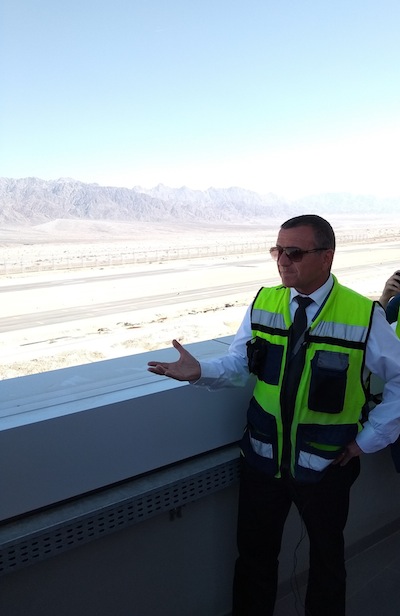
Perched on the 50-metre-high control tower during a March 19 media tour of the site, airport manager Hanan Moscovitz explained that the facility will replace Eilat’s Yaakov Hozman Airport, named after the founder of Arkia Airlines. While the current airport’s location is convenient for prop planes from Tel Aviv, it causes noise pollution and cuts off the city from its hotel district.
The new airport is named after aviation heroes Ilan and Asaf Ramon. The former was Israel’s first astronaut; he perished in 2003, when the Columbia Space Shuttle exploded while reentering earth’s atmosphere. His son, Asaf, also an Israeli Air Force F-16 fighter pilot, was killed six years later in a jet crash.
The Israel Airport Authority hired 160 construction workers from Moldova to build Ramon Airport. The total cost of the facility will be NIS 1.7 billion (more than $614 million Cdn). That investment will be partly recouped by the sale of the municipal airport’s land for hotels, condominiums and a convention centre.
But why build an international airport for a city of only 60,000 people? “There’s no de-icing,” Moscovitz quipped. Blessed with 330 days of sunshine annually, Eilat makes an ideal winter holiday destination.
Ramon International Airport manager Hanan Moscovitz at a March 19 media tour of the new facility. (photo by Gil Zohar)
A popular tourist stop in the 1990s, the city foundered after the Second Intifada broke out in 2000. As well, Eilat’s 12,000 hotel rooms couldn’t compete with the 100,000 budget rooms in the nearby Sinai’s luxurious resorts. But foreign visitors to Eilat have been on an upswing in recent years, Moscovitz explained, thanks to the Open Skies agreement with the European Union that was ratified in 2013.
Boosting airplane arrivals to Eilat – which should reach 55 flights weekly this winter – will be nothing less than a revolution, according to Eilat Hotel Association director Shabi Shai. While only 60,000 foreign tourists arrived in 2015, that number more than doubled to 130,000 in 2016, and then rose to 210,000 last year. In 2017, Israel as a whole had a record year for tourism, with 3.6 million visitors.
Some 400,000 people, the majority from Russia, are expected in the 2018/19 winter season, said Shai. In the past, many of those sun worshippers had preferred Egypt. But, on Oct. 31, 2015, a bomb smuggled onboard a charter en route to Saint Petersburg from Sharm El Sheikh exploded over Sinai. All 224 passengers and crew were killed.
The 32,000-square-metre Ramon Airport terminal was designed by Tel Aviv’s Mann Shinar Architects, and Moshe Zur Architects. The building will initially handle up to two million passengers annually, and the airport’s control tower is equipped with an instrument landing system for the rare day the airport is fogged in. A drainage ditch will keep the runway dry, even in a once-in-70-years flash flood.
Because of security concerns, the 3,600-metre-long tarmac will accommodate the largest commercial jumbo jets. During the 2014 Gaza conflict, known as Operation Protective Edge, a rocket fired from a Hamas-controlled coastal enclave toward Tel Aviv landed in Yehud, five kilometres from Ben-Gurion Airport. In response, the U.S. Federal Aviation Administration barred American carriers from landing at Ben-Gurion for nearly 48 hours. When foreign airlines followed suit, the Jewish state was effectively cut off because, with Ben-Gurion shuttered, Israel had no other airport with international capacity. To prevent this situation from happening again, Transportation Minister Israel Katz had Ramon Airport’s runway lengthened and increased the apron parking.
Located alongside the Jordanian border, Ramon Airport has special security needs of its own. The facility’s exposed eastern flank is girded with both a fence and a 30-metre-high, 4.5-kilometre-long electronic barrier. The high-tech hurdle features sensors and detection technology to protect incoming and departing planes from shoulder-launched RPGs (rocket-propelled grenades) and other unnamed threats.
For Tourism Minister Yariv Levin, Ramon Airport will support the continued revitalization of Israel’s southern city. “Incoming tourism to Eilat is breaking all records, and we are witnessing an extraordinary momentum of airlines opening new direct routes into the city,” he said.
Shai, however, acknowledged that tourists don’t go to an airport but a destination. All the carefully prepared tourism plans could unravel if war broke out, he cautioned. But everyone in Israel, including in Eilat, is hoping that doesn’t happen.
Akiva Gersh teaching a group in Israel. Gersh is the editor of, and a contributing writer to, the book Becoming Israeli: The Hysterical, Inspiring and Challenging Sides of Making Aliyah. (photo from Akiva Gersh)
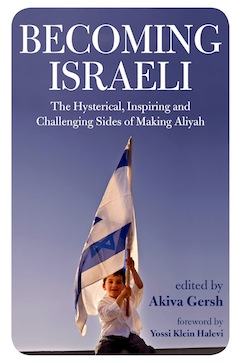
If you or someone you know is considering making aliyah, there is a book that offers a glimpse of the experience. Becoming Israeli: The Hysterical, Inspiring and Challenging Sides of Making Aliyah (Rimonim Press) is a compilation of blogs and essays written by 40 olim (immigrants), including the editor, Akiva Gersh.
“The book speaks about the various sides of aliyah, from the hysterical, to the challenging, to the frustrating, to the emotional,” Gersh told the Independent.
Gersh grew up in the New York area. He and his Philadelphia-born wife, Tamar, made aliyah about 13 years ago. As they were going through the process, Gersh wrote about it in a blog. When he realized others were doing the same thing, he was spurred to collect as much information as he could for publication in book form.
“I kept thinking, someone must have done this,” said Gersh. “People had written about their own aliyah experiences, but not a broad compilation of experiences … and that is what I wanted to do, what I wanted to share. I worked on it for about two years – finding the blogs, talking to the bloggers, telling them what I’m doing, and getting permission to use their posts in the book. And, after about two years doing all this compiling and editing, the book was born.”
In Becoming Israeli, said Gersh, there are the insights of (English-speaking) Jews who have made aliyah, as well as those who have been to Israel, but haven’t yet made the move. “In the book,” he said, “you can really sense the things they love about Israel. Above and beyond that, there is the general world … and much of that includes the Christian world who loves coming to Israel.”
The feedback has been good, especially from olim who have read the book and can relate to their fellow travelers. “They went, ‘Wow! Amazing!’” said Gersh. “Every page, they’re like, ‘This is my story!’ They’re laughing, they’re crying.
“I’ve read the book multiple times and I still laugh at the jokes and cry at the same emotional places,” he added. “It’s a really powerful book and I’ve had really positive feedback from olim who say ‘thank you’ and feel it is awesome … [and] exactly what they’ve been going through and experiencing.”
Gersh is a teacher by training and works in a private English-language school in Israel. He also connects with people using music, through a program he started in 2007 called The Holy Land Spirit.
As a musician and teacher, Gersh offers groups – mainly Christians – who visit Israel an evening program of music, prayer and spirituality from a Jewish perspective. “They love it,” he said. “We pray together, dance together, speak together.”
Gersh teaches at Alexander Muss High School, a study-abroad institution near Tel Aviv. There, kids from 45 different countries come to learn for a few weeks or up to a few months at a time, about Jewish history and Israel. They spend half their time in the classroom and half their time traveling around the country.
“So, it’s academic and hands on,” said Gersh. “It’s awesome. I’ve been there about 10 years now. The language of instruction is English and, for those who want to improve their Hebrew, there are opportunities.
“We have young Israelis who are fresh out of the army. And, for those who want the Hebrew experience, they can get it from them and also from being out and about in Israel.
“The kids are inspired, enlightened, pumped up about Israel,” he continued. “We’re not a religious program. We’re not a church denomination. We’re pluralistic. We have Jews on staff, but we don’t push Judaism. We just open up a space for kids to explore connections to Judaism.”
According to Gersh, many of the students are experiencing certain aspects of Judaism for the first time. This is something especially meaningful for him, he said, noting, “I had no connection to Israel growing up at all. I never thought about it, nor talked about it. It just wasn’t a thing in my community. I heard about it a couple times in Hebrew school, but it wasn’t on the radar at all. By the time I was done with high school, going into college, I was really done with anything Jewish…. In college, I began searching for something more cultural, meaningful, spiritual in my life.
“That journey, which was a three-year journey, took me to many different places, meeting different people, reading different books. At the end of the journey,” he said, “it brought me full circle to Judaism. But, I found a new side and a new expression of Judaism that I hadn’t seen before.”
Among the places Gersh traveled after college was West Africa, where he spent two months learning more about the drumming he studied in school.
“After traveling around there,” he said, “I went to Israel for the first time. I was about 22 years old at that point. I traveled around Israel for two months, backpacking and enjoying, taking a class here, a class there, doing a Shabbat and just really getting into it. After those two months, I realized I wanted to really explore my roots and see what Judaism was about. Still, at that point, I did not want to become religious.”
Eventually, Gersh did become religious. He spent some time in a yeshivah, both in Israel and in the United States, before making aliyah with his wife in 2004.
The foreword of Becoming Israeli was written by Yossi Klein Halevi, an Israeli author Gersh looks up to as a Jew, as someone who made aliyah and as a writer.
“We had a book launch at the beginning of the summer and we had a panel of me and a bunch of other bloggers from the book, and he was one of the panelists,” said Gersh. “It was amazing to have his voice and his perspective.”
Becoming Israeli is available on Amazon, and Gersh also has a website, becomingisraeli.com.