Skip to content
  • Home
  • Subscribe / donate
  • Events calendar
  • News
    • Local
    • National
    • Israel
    • World
    • עניין בחדשות
      A roundup of news in Canada and further afield, in Hebrew.
  • Opinion
    • From the JI
    • Op-Ed
  • Arts & Culture
    • Performing Arts
    • Music
    • Books
    • Visual Arts
    • TV & Film
  • Life
    • Celebrating the Holidays
    • Travel
    • The Daily Snooze
      Cartoons by Jacob Samuel
    • Mystery Photo
      Help the JI and JMABC fill in the gaps in our archives.
  • Community Links
    • Organizations, Etc.
    • Other News Sources & Blogs
    • Business Directory
  • FAQ
  • JI Chai Celebration
  • JI@88! video

Recent Posts

  • Hateful messages intensify
  • Creating entrepreneurs
  • Wrong choice to host Piker
  • Attack on Jewish kids
  • Multiple benefits of a break
  • Dialing up the perfect thriller
  • Empowerment & more
  • Songs in war of peace
  • Successful trip to Cuba 
  • Tackling antizionism head on
  • Thinking of leaving Canada?
  • Kindness as a matter of fact
  • Personal stories, vital lessons
  • Connecting generations
  • Vancouver to Vienna
  • Recipes a form of resistance
  • Community milestones … February 2026
  • Generations … It’s all yours!
  • נתניהו לא מתבייש להאשים את ביידן באחריות להרג חיילים ברצועת עזה
  • Last hostage home
  • New bill targets hate crimes
  • Concerning actions
  • Recipes not always required
  • Survivor urges vigilance
  • Seniors profoundly affected
  • Farm transforms lives
  • Musical legacy re-found
  • A range of Jewish literature
  • A concert of premieres
  • Variety telethon on Feb. 22
  • Victoria club’s many benefits
  • Avodah dedicated to helping
  • Artists explore, soar, create
  • Life’s full range of emotions
  • Community needs survey closes March 29
  • Jerusalem marathon soon

Archives

Follow @JewishIndie
image - The CJN - Visit Us Banner - 300x600 - 101625

Tag: Eilat

Build it and they will come?

Build it and they will come?

Ramon International Airport in Eilat will begin service on Oct. 28. (photo by Gil Zohar)

With Ramon International Airport beginning service on Oct. 28, officials hope that the state-of-the-art facility will boost tourism to the once-sleepy Red Sea resort of Eilat. But will a gleaming airport bring the crowds?

Perched on the 50-metre-high control tower during a March 19 media tour of the site, airport manager Hanan Moscovitz explained that the facility will replace Eilat’s Yaakov Hozman Airport, named after the founder of Arkia Airlines. While the current airport’s location is convenient for prop planes from Tel Aviv, it causes noise pollution and cuts off the city from its hotel district.

The new airport is named after aviation heroes Ilan and Asaf Ramon. The former was Israel’s first astronaut; he perished in 2003, when the Columbia Space Shuttle exploded while reentering earth’s atmosphere. His son, Asaf, also an Israeli Air Force F-16 fighter pilot, was killed six years later in a jet crash.

The Israel Airport Authority hired 160 construction workers from Moldova to build Ramon Airport. The total cost of the facility will be NIS 1.7 billion (more than $614 million Cdn). That investment will be partly recouped by the sale of the municipal airport’s land for hotels, condominiums and a convention centre.

But why build an international airport for a city of only 60,000 people? “There’s no de-icing,” Moscovitz quipped. Blessed with 330 days of sunshine annually, Eilat makes an ideal winter holiday destination.
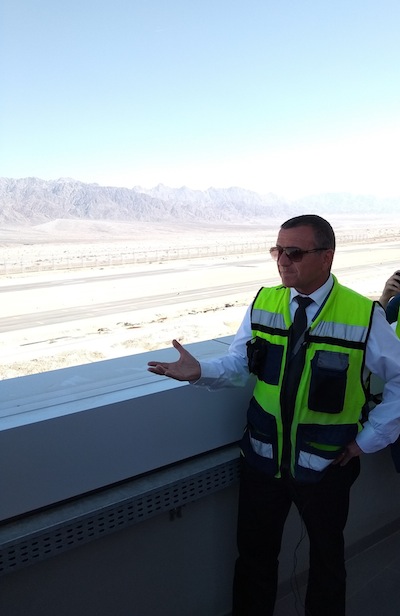
photo - Ramon International Airport manager Hanan Moscovitz at a March 19 media tour of the new facility
Ramon International Airport manager Hanan Moscovitz at a March 19 media tour of the new facility. (photo by Gil Zohar)

A popular tourist stop in the 1990s, the city foundered after the Second Intifada broke out in 2000. As well, Eilat’s 12,000 hotel rooms couldn’t compete with the 100,000 budget rooms in the nearby Sinai’s luxurious resorts. But foreign visitors to Eilat have been on an upswing in recent years, Moscovitz explained, thanks to the Open Skies agreement with the European Union that was ratified in 2013.

Boosting airplane arrivals to Eilat – which should reach 55 flights weekly this winter – will be nothing less than a revolution, according to Eilat Hotel Association director Shabi Shai. While only 60,000 foreign tourists arrived in 2015, that number more than doubled to 130,000 in 2016, and then rose to 210,000 last year. In 2017, Israel as a whole had a record year for tourism, with 3.6 million visitors.

Some 400,000 people, the majority from Russia, are expected in the 2018/19 winter season, said Shai. In the past, many of those sun worshippers had preferred Egypt. But, on Oct. 31, 2015, a bomb smuggled onboard a charter en route to Saint Petersburg from Sharm El Sheikh exploded over Sinai. All 224 passengers and crew were killed.

The 32,000-square-metre Ramon Airport terminal was designed by Tel Aviv’s Mann Shinar Architects, and Moshe Zur Architects. The building will initially handle up to two million passengers annually, and the airport’s control tower is equipped with an instrument landing system for the rare day the airport is fogged in. A drainage ditch will keep the runway dry, even in a once-in-70-years flash flood.

Because of security concerns, the 3,600-metre-long tarmac will accommodate the largest commercial jumbo jets. During the 2014 Gaza conflict, known as Operation Protective Edge, a rocket fired from a Hamas-controlled coastal enclave toward Tel Aviv landed in Yehud, five kilometres from Ben-Gurion Airport. In response, the U.S. Federal Aviation Administration barred American carriers from landing at Ben-Gurion for nearly 48 hours. When foreign airlines followed suit, the Jewish state was effectively cut off because, with Ben-Gurion shuttered, Israel had no other airport with international capacity. To prevent this situation from happening again, Transportation Minister Israel Katz had Ramon Airport’s runway lengthened and increased the apron parking.

Located alongside the Jordanian border, Ramon Airport has special security needs of its own. The facility’s exposed eastern flank is girded with both a fence and a 30-metre-high, 4.5-kilometre-long electronic barrier. The high-tech hurdle features sensors and detection technology to protect incoming and departing planes from shoulder-launched RPGs (rocket-propelled grenades) and other unnamed threats.

For Tourism Minister Yariv Levin, Ramon Airport will support the continued revitalization of Israel’s southern city. “Incoming tourism to Eilat is breaking all records, and we are witnessing an extraordinary momentum of airlines opening new direct routes into the city,” he said.

Shai, however, acknowledged that tourists don’t go to an airport but a destination. All the carefully prepared tourism plans could unravel if war broke out, he cautioned. But everyone in Israel, including in Eilat, is hoping that doesn’t happen.

Gil Zohar is a journalist based in Jerusalem.
Format ImagePosted on April 13, 2018April 11, 2018Author Gil ZoharCategories IsraelTags airport, Eilat, Ramon, tourism
Goodbye, airport

Goodbye, airport

An Arkia plane lands at Eilat Airport. (photo from Ashernet)

Ever since 1949, Eilat Airport has been an important link between the resort city of Eilat on the Red Sea and the busy central part of Israel. However, it is due to close later this year when the newly constructed Ramon Airport opens some 20 kilometres north of Eilat. The land that the Eilat Airport currently occupies will be used to build a new city centre consisting of hotels, shops and a residential area, as well as a new rail terminal.

Format ImagePosted on February 10, 2017February 8, 2017Author Edgar AsherCategories IsraelTags airport, Eilat
Oil spill heightens urgency

Oil spill heightens urgency

A ribbon-cutting ceremony to inaugurate the new Regional Collaboration Centre for Research and Development and Renewable Energy near Eilat. (photo from Jewish National Fund via jns.org)

The worst oil spill in Israel’s history was the unplanned backdrop for a recent international conference on green energy held in Eilat, the country’s southernmost city. A busy port and popular resort city located at the northern tip of the Red Sea, Eilat is at the epicentre of the Jewish state’s renewable energy industry.

The Eilat-Eilot Green Energy Sixth International Conference and Exhibition, held Dec. 7-9, was the culmination of six events that comprised Israel Energy Week and offered participants from around the globe a concentrated encounter with the emerging world of alternative energy in Israel. The conference focused on challenges facing the renewable energy industry, including storage and supply of electricity, development of methods to manage electricity flow and financing to advance projects.

It also focused on the key role renewable energy plays in the southern Arava, a stretch of Negev Desert from the Dead Sea to the Gulf of Aqaba in which Eilat and the Hevel Eilot Regional Council are located. This arid, sun-drenched area is Israel’s main locale for sustainable development and functions as an international showcase for Israeli innovation in the field of green energy.

“Renewable energy, with an emphasis on solar, is a major focus of our municipal activity and plays a key role in the region as a whole,” Meir Yitzhak Halevi, the mayor of Eilat, told conference attendees. “The city of Eilat and the Hevel Eilot Regional Council, which together account for 13 percent of Israel’s land area but less than one percent of the country’s population, have recognized the potential offered by the sunlight and open space that exist here in such abundance, and are concentrating on renewable energy as a catalyst for regional growth.”

According to Udi Gat, head of the Hevel Eilot Regional Council, the area has already reached nearly 60 percent daytime energy independence and in eight months will generate nearly 100 percent of the energy consumed each day in the southern Arava. By 2020, the municipality and regional council anticipate that the area will be completely energy-independent and free of fossil fuel and carbon emissions.

“We want to generate more electricity, even beyond the needs of Eilat and the regional council. We want to help the country produce electricity from an inexpensive source – the sun – and to be Israel’s electricity storehouse or ‘bank,’” Gat said.

The importance of achieving energy independence was conveyed to the conference in a dramatic way when, four days prior to the start of the gathering, an oil pipeline ruptured during maintenance work at a construction site about 12 miles north of Eilat. Five million litres of crude oil spilled out and fouled an estimated 250 acres of scenic desert, including a nature reserve. Delicate coral reefs beyond the nearby shoreline were also threatened.

Read more at jns.org.

Format ImagePosted on January 9, 2015January 8, 2015Author June Glazer JNS.ORGCategories IsraelTags Eilat, Eilot, environment, green energy, Israel, oil spill
Proudly powered by WordPress