Skip to content
  • Home
  • Subscribe / donate
  • Events calendar
  • News
    • Local
    • National
    • Israel
    • World
    • עניין בחדשות
      A roundup of news in Canada and further afield, in Hebrew.
  • Opinion
    • From the JI
    • Op-Ed
  • Arts & Culture
    • Performing Arts
    • Music
    • Books
    • Visual Arts
    • TV & Film
  • Life
    • Celebrating the Holidays
    • Travel
    • The Daily Snooze
      Cartoons by Jacob Samuel
    • Mystery Photo
      Help the JI and JMABC fill in the gaps in our archives.
  • Community Links
    • Organizations, Etc.
    • Other News Sources & Blogs
    • Business Directory
  • FAQ
  • JI Chai Celebration
  • JI@88! video

Recent Posts

  • Story of Israel’s north
  • Sheltering in train stations
  • Teach critical thinking
  • Learning to bridge divides
  • Supporting Iranian community
  • Art dismantles systems
  • Beth Tikvah celebrates 50th
  • What is Jewish music?
  • Celebrate joy of music
  • Women share experiences 
  • Raising funds for Survivors
  • Call for digital literacy
  • The hidden hand of hate
  • Tarot as spiritual ritual
  • Students create fancy meal
  • Encouraging young voices
  • Rose’s Angels delivers
  • Living life to its fullest
  • Drawing on his roots
  • Panama City welcoming
  • Pesach cleaning
  • On the wings of griffon vultures
  • Vast recipe & story collection
  • A word, please …
  • מארק קרני לא ממתין לטראמפ
  • On war and antisemitism
  • Jews shine in Canucks colours
  • Moment of opportunity
  • Shooting response
  • BC budget fails seniors
  • Ritual is what makes life holy
  • Dogs help war veterans live again
  • Remain vital and outspoken
  • An urgent play to see
  • Pop-up exhibit popular
  • An invite to join JWest

Archives

Follow @JewishIndie
image - The CJN - Visit Us Banner - 300x600 - 101625

Category: News

Crocheting as work

Crocheting as work

The label for an Iota rug and pouf hand-knit by Kefaya, a Bedouin woman. (photo from Iota)

Some of the best projects are born out of a desire for change – at least that was the case with Iota, an Israel-based textile company empowering unemployed women through the art of crochet.

Each one of the company’s rugs, pillows and home accessories is hand-crocheted by Bedouin women from their own homes, providing them with meaningful work and an independent source of income.

Bedouins are an Arab Israeli subgroup, located mainly in the south, with their own distinct culture and social norms. Historically, Bedouins lived a nomadic lifestyle, and many still herd livestock. Women traditionally tend to the house and children, resulting in high unemployment and poverty rates. A 2015 survey showed the employment rate among Bedouin women as 22%, compared to 32% for all Arab women.

Founded by Shula Mozes, an active social entrepreneur for more than 16 years, Iota aims to support the many women, all over the world, who are unable to work outside of the home due to cultural, religious and geographical reasons.

When she started the company in 2014, Mozes chose crochet, a self-taught hobby, as a means to create a business that could empower these women and fuel social change. With the help of creative director Tal Zur, she later discovered that not only is crochet a very versatile technique, but it has its own universal language that can be written and learned, like music notes.

“I realized that if I can learn to make things by crocheting small elements and putting them together, maybe we can teach women who don’t have work how to do the same,” Mozes said.
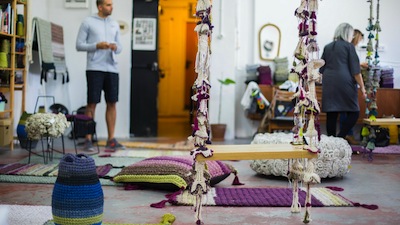
photo - Iota’s studio in Tel Aviv
Iota’s studio in Tel Aviv. (photo from Iota)

Iota now runs a small studio in Tel Aviv, where an all-female team of textile experts dreams up intricate designs. At least once a week, a member of the Iota team travels to Hura, a Bedouin village in southern Israel, to deliver raw materials to the women the company employs. Once complete, the finished products are transported back to Tel Aviv, each piece bearing a label signed by the woman who made it.

Currently, Iota employs three women in Hura, an intentionally small number, Mozes said, in order to maintain a strong commitment to each worker. “We have to respect their culture and empower the women slowly, so that they can work according to what they’re comfortable with,” she said.

Though centred on a 200-year-old technique, Iota’s designs are modern. The yarns used to create each piece are bespoke, developed in-house and produced in a local Tel Aviv factory. Mozes said that, by applying computerized designs, they’re able to create yarns that contain several different colours in the same thread, allowing the carpets to be made with one continuous string of yarn.

While Iota is currently only active in Israel, Mozes said she hopes to collaborate with other communities worldwide, which are experiencing high rates of female unemployment.

In January, Iota exhibited its collection for the third time at Maison & Objet, an international trade fair in Paris known for showcasing innovative design talents. The collection, ranging in price from 200 to 2,000 euros (from $315 to $3,150 Cdn), consists of colourful single-yarn rugs, oversized floor cushions, stools, one-of-a-kind swings and home accessories.

“I hope that, in the future, we will be able to take one of the women with us to an exhibition so she can experience the success of Iota firsthand,” Mozes said. “Without them, none of this would have happened.”

For more information, visit iotaproject.com.

Israel21c is a nonprofit educational foundation with a mission to focus media and public attention on the 21st-century Israel that exists beyond the conflict. For more, or to donate, visit israel21c.org.


Format ImagePosted on April 13, 2018April 11, 2018Author Rebecca Stadlen Amir ISRAEL21CCategories IsraelTags Bedouin, business, Iota, Shula Mozes, textiles, women
Too much food wasted

Too much food wasted

Millions more could be fed by the same resources if our diets changed. (photo from wis-wander.weizmann.ac.il)

About a third of the food produced for human consumption is estimated to be lost or wasted globally. But the biggest waste, which is not even included in this estimate, may be through dietary choices that result in the squandering of environmental resources. In a study published in the Proceedings of the National Academy of Sciences of the United States of America, researchers at the Weizmann Institute of Science in Rehovot, Israel, and their colleagues have found a novel way to define and quantify this second type of wastage. The scientists have called it “opportunity food loss,” a term inspired by the “opportunity cost” concept in economics, which refers to the cost of choosing a particular alternative over better options.

Opportunity food loss stems from using agricultural land to produce animal-based food instead of nutritionally comparable plant-based alternatives. The researchers report that, in the United States alone, avoiding opportunity food loss – that is, replacing all animal-based items with edible crops for human consumption – would add enough food to feed 350 million additional people, or more than the total U.S. population, with the same land resources.

“Our analysis has shown that favouring a plant-based diet can potentially yield more food than eliminating all the conventionally defined causes of food loss,” said lead author Dr. Alon Shepon, who worked in the lab of Prof. Ron Milo in the plant and environmental sciences department. The Weizmann researchers collaborated with Prof. Gidon Eshel of Bard College and Dr. Elad Noor of ETZ Zürich.

The scientists compared the resources needed to produce five major categories of animal-based food – beef, pork, dairy, poultry and eggs – with the resources required to grow edible crops of similar nutritional value in terms of protein, calories and micronutrients. They found that plant-based replacements could produce two- to 20-fold more protein per acre.

The most dramatic results were obtained for beef. The researchers compared it with a mix of crops – soya, potatoes, cane sugar, peanuts and garlic – that deliver a similar nutritional profile when taken together in the right proportions. The land area that could produce 100 grams of protein from these crops would yield only four grams of edible protein from beef. In other words, using agricultural land for producing beef instead of replacement crops results in an opportunity food loss of 96 grams – that is, a loss of 96% – per unit of land. This means that the potential gain from diverting agricultural land from beef to plant-based foods for human consumption would be enormous.

The estimated losses from failing to replace other animal-based foods with nutritionally similar crops were also huge: 90% for pork, 75% for dairy, 50% for poultry and 40% for eggs – higher than all conventional food losses combined.

“Opportunity food loss must be taken into account if we want to make dietary choices enhancing global food security,” said Milo.

Milo’s research is supported by the Mary and Tom Beck Canadian Centre for Alternative Energy Research, which he heads; the Zuckerman STEM Leadership Program; Dana and Yossie Hollander; and the Larson Charitable Foundation. Milo is the incumbent of the Charles and Louise Gartner Professorial Chair.

For more on the research being conducted at the Weizmann Institute, visit wis-wander.weizmann.ac.il.

Format ImagePosted on April 13, 2018April 11, 2018Author Weizmann InstituteCategories IsraelTags Alon Shepon, food, Israel, science, Weizmann Institute
Climate change heats up Israel

Climate change heats up Israel

Israelis and tourists enjoy the beach in Tel Aviv on a hot summer day. (photo by Miriam Alster/FLASH90 via Israel21c)

A new study says that, by 2100, climate changes will extend the summer season in the eastern Mediterranean – an area that covers Israel, Egypt, Jordan, Syria, Lebanon and southern Turkey – by two full months. Winter, the rainy season, will shorten from four to two months.

The study, published in the International Journal of Climatology, was overseen by Prof. Pinhas Alpert and conducted by Assaf Hochman, Tzvi Harpaz and Prof. Hadas Saaroni, all of Tel Aviv University’s School of Geosciences.

“Pending no significant change in current human behaviour in the region, the summer is expected to extend by 25% by the middle of the century (2046-2065) and by 49% until its end (2081-2100),” Hochman said. “The combination of a shorter rainy season and a longer dry season may cause a major water problem in Israel and neighbouring countries.”

Other serious potential consequences include increased risk of brushfires, worsening pollution and altered timing and intensity of seasonal illnesses and health hazards.

“One of the main causes of these changes is the growing concentration of greenhouse gases emitted into the atmosphere as a result of human activity,” said Hochman.

The research team is currently exploring the possibility of establishing a multidisciplinary regional centre for climate adaptation.


Format ImagePosted on April 13, 2018April 11, 2018Author ISRAEL21CCategories IsraelTags climate change, environment, Israel, science
עם או בלי נתניהו

עם או בלי נתניהו

קנדה תקלוט כאלפיים פליטים מישראל. (צילום: Wikimedia Commons)

ראש ממשלת ישראל, בנימין נתניהו, הוכיח שוב כי המדיניות שלו היא לא מדיניות באמת, וכי הוא משנה את דעתו על הזמן. וזאת בהתאם לכיוון שאליו נושבת הרוח. כך גם החלטתו האחרונה לשלוח למעלה משישה עשר אלף פליטים- מסתננים מאפריקה (ממדינות ארתיריה וסודן) שביקשו מקלט בישראל, למספר מדינות במערב. בהן לדבריו גרמניה, איטליה וקנדה. ולטענתו לאחר שכביכול הוא הגיע להסכם עם נציבות הפליטים של האו”ם בנוגע למשלוח המסתננים למדינות אלה, למרות שלהן לא היה ידוע על כך. מענין!

לפי ההסכם עם האו”ם 16,250 מבקשי מקלט מישראל יקלטו במדינות המערב. ישום ההסכם יבוצע בשלושה שלבים ויתפרש על פני חמש שנים תמימות. ובמקביל כ-16,250 מהפליטים יקבלו מעמד חוקי בישראל. הם יפוזרו באופן מאוזן ברחבי ישראל. וכן תוקם אף מינהלה מיוחדת שתעסוק בשיקום אזור דרום תל אביב הרעוע (וזאת על חשבון ההשקעה במתקן חולות לכליאת הפליטים שיסגר).

לאחר הודעתו כי הגיע להסכם ותוך שעות ספורות ביטל נתניהו בעצמו את החלטתו הקודמת, והחליט שלא לשלוח פליטים מישראל למדינות המערב. ומדוע? זאת לאור זעם במפלגות הימין בישראל שהביעו התנגדות נחרצת כי בעקבות החלטת נתניהו להעברת למעלה משישה עשר אלף הפליטים למערב, יקלטו במדינה השאר – כשמונה עשר אלף פליטים-מסתננים.

בקנדה החליטו שלא להמתין להחלטותיו התמוהות של ראש ממשלת ישראל וכיאה למדינה הקולטת כל הזמן הגירה ממדינות מצוקה, הוחלט לקלוט כאלפיים פליטים-מסתננים מישראל. וזאת במהלך עצמאי ללא בקשה של ממשלת ישראל, שהחליטה לפני מספר חודשים לגרש את הפליטים האפריקנים מישראל בחזרה לאפריקה. הארש ז’אסוול, עוזר מיוחד לשר ההגירה, הפליטים והאזרחות של הממשלה הקנדית, אחמד חוסיין, מסר את ההודעה הבאה בנושא: “הממשלה שלנו כבר הוכיחה שהיא מובילה עולמית לקבל בברכה פליטים שנמלטים ממלחמות ורדיפות. ישוב פליטים אלה הוא חלק בהמסורת ההומנטרית הגאה של קנדה. אנו מוכחים שוב כי יש לנו אחריות משותפת לסייע לאלה שנעקרו, שהם נרדפים ומרביתם זקוקים להגנה ועזרה. אנו עוקבים מקרוב אחרי המתרחש בישראל, ונמצאים בקשר ישיר עם ממשלת ישראל. הגענו להסדר עם הרשויות בישראל להשעות את גירושם ומעצרם של פליטים שהגישו בקשה לעבור לקנדה, בעזרת נותני חסויות פרטיות מקנדה – עד לשיושלם הטיפול בעניינם. אנו ממשיכים ביחד עם נותני החסויות הפרטיות שיתכן ובקשותיהם מושפעות ממה שקורה בישראל. נציגות של משרד ההגירה, הפליטים והאזרחות הקנדי בתל אביב, יספק מכתבים למבקשים בקרב הפליטים להגר לקנדה, במסגרת החסויות הפרטיות, כדי לאשר שבקשותיהם נמצאות בהליך של אישור על ידנו. הם יוכלו להציג את המכתבים האלה בפני הרשויות בישראל. נכון לשלושים ואחד בדצמבר אשתקד אנו מטפלים בקרוב לכאלפיים בקשות של פליטים אפריקנים לעבור מישראל לקנדה, כאמור במסגרת נותני חסויות פרטיות מקנדה. וללא קשר במקביל, אנו ממשיכים בהתאם להכרזת ממשלת קנדה, בקליטת כארבעת אלפים פליטים מאריתריה, עד לסוף הנה הנוכחית”.

לדברי סוכנות האו”ם לפליטים השוכנת באוטווה, יש הסכם שקנדה תקלוט השנה לא פחות מכעשרת אלפים פליטים. באופן כללי יתכן שחלקם של פליטים אלה יגיעו אפילו מישראל.

במרכז לענייני ישראל והיהודים בקנדה הזדרזו לברך את שר ההגירה, הפליטים והאזרחות הקנדי, אחמד חוסיין, על הסכמתו כביכול לקלוט פליטים מישראל. במרכז אמרו והוסיפו עוד כי: “ישובם מחדש של מבקשי מקלט מישראל, הוא אתגר בינלאומי המצריך פתרון בינלאומי. ואכן קנדה נטלה על עצמה תפקיד מוביל בנשיאה באחריות הבינלאומית לישובם מחדש”.

Format ImagePosted on April 11, 2018Author Roni RachmaniCategories עניין בחדשותTags asylum seekers, Canada, Israel, Netanyahu, refugees, UN, United Nations, או"ם, האו"ם, ישראל, מבקשי מקלט, נתניהו, פליטים, קנדה
Faculty boycott Hillel

Faculty boycott Hillel

Hillel House building at the University of British Columbia. (photo from Hillel BC)

The University of British Columbia Geography Students Association (GSA) recently canceled a gala that was to take place in rental space owned by UBC’s Hillel chapter, due to pressure from some of the faculty in the department of geography.

The faculty members said they insisted on boycotting the event because of what they called the “controversial” and “political” nature of Hillel, according to numerous reports. The faculty members had not been publicly identified as of press time and could, therefore, not be located to clarify their position.

The Centre for Israel and Jewish Affairs (CIJA) has accused them of boycotting the GSA gala based on the perception that Hillel supports the state of Israel, which CIJA is calling discriminatory.

“Boycotting Jews or a Jewish organization simply because you object to the state of Israel’s policies is classic antisemitism,” said Nico Slobinsky, CIJA’s director for the Pacific region.

“It is hard to believe that there is such blatant antisemitism on a Canadian university campus in 2018. There should be zero tolerance for any expressions of discrimination, racism and antisemitism on campus and anywhere else in Canada.”

Samuel Heller, the assistant executive director of Hillel BC, told the CJN that, “The actions of these faculty members have resulted in a de facto boycott of the Jewish student centre on campus. To boycott Jews based on one’s political views about Israel is discriminatory and antisemitic. Their actions have led to the resignation of the lone Jewish student on the executive of the GSA, as he felt marginalized and discriminated against because of his Jewishness.”

Addressing the claim that Hillel is a controversial and political space, Heller said, “Hillel doesn’t have any politics. What these faculty members really object to is Hillel’s support of Israel’s existence. We are a Jewish organization and Israel is a part of Jewish identity.… To demand that Jews disavow parts of our identity to placate faculty members is wrong and discriminatory.”

But not everyone accepts Heller’s characterization of Hillel as “having no politics.” The Progressive Jewish Alliance at UBC (PJA) released a statement on Facebook on March 16, saying: “While we recognize the right of the GSA to move the gala based on political considerations, we urge the GSA to recognize that Hillel is the physical Jewish space on campus, alongside having a political position. While we wait for a statement from the GSA, we would like to point out that the ramifications of their decision are alienating Jewish students on campus. Likewise, we encourage Hillel to consider how their political positions, such as an opposition to all boycotts of Israel, can alienate other Jewish and non-Jewish organizations and students.”

The PJA is referring to Hillel International’s Standards of Partnership, which state that Hillel will not partner with, house or host organizations, groups or speakers that deny the right of Israel to exist as a Jewish and democratic state with secure and recognized borders; delegitimize, demonize or apply a double standard to Israel; or support the boycott of, divestment from or sanctions against the state of Israel.

In 2012, concerns about Hillel’s refusal to partner with Jewish organizations that support the BDS movement led to the formation of Open Hillel, an organization that agitates for Hillel to end the Standards of Partnership.

Numerous controversies have broken out over Hillel boycotting groups or individuals in recent years. In one example, in March 2017, B’nai Keshet, a queer Jewish group at Ohio State University, co-sponsored a Purim fundraiser for LGBTQ refugees in the Columbus area. Because Jewish Voices for Peace, an organization that supports BDS, was one of the sponsoring groups, OSU Hillel cut ties with B’nai Keshet, due to pressure from Hillel International, prompting students on numerous American campuses to hold “solidarity Shabbats” with the LGBTQ group. In June, a letter calling for the end of the standards was signed by more than 100 rabbis and submitted to Hillel.

The UBC Progressive Jewish Alliance hopes that the controversy will not only provoke change in the GSA, but in Hillel, as well.

“We hope that both organizations take this opportunity to engage in genuine dialogue around the complexity of politics and place,” it concluded in a statement.

Philip Steenkamp, the vice-president of external relations at UBC, told the CJN that the university is “aware of concerns that have been expressed by CIJA” and “are looking into this matter and will follow due process to ensure it is appropriately addressed.”

Matthew Gindin is a freelance journalist, writer and lecturer. He writes regularly for the Forward and All That Is Interesting, and has been published in Religion Dispatches, Situate Magazine, Tikkun and elsewhere. He can be found on Medium and Twitter. This article was originally published by the CJN.

Format ImagePosted on March 30, 2018March 29, 2018Author Matthew GindinCategories LocalTags antisemitism, BDS, British Columbia, Hillel, Israel, UBC
Art and act of prayer

Art and act of prayer

Alden Solovy leads two sessions at Limmud Vancouver, which takes place April 14-15. (photo from Limmud Vancouver)

Alden Solovy would like you to fall in love with prayer. His own love of prayer has been fueled by his aliyah to Israel, learning Talmud and Torah in Jerusalem, and the liturgy of the siddur. It has been deepened by the tragedies he has experienced, including his wife’s multiple suicide attempts and her sudden death from catastrophic brain injury in 2009.

Solovy will present two sessions at Limmud Vancouver, the festival of Jewish learning that takes place this year on April 14-15 at Congregation Beth Israel. He will speak on An Israeli Life – in which he shares his experience of two wars, a refugee camp and of living in Israel as an older, liberal oleh (immigrant) – and offer Spiritual Chevruta, a workshop-style session in which participants will study a passage of prayer, then break into pairs to delve into personal prayer.

Prior to and in partnership with Limmud, Solovy will be a liturgist-in-residence at Temple Sholom. His program there will include his workshop The Art and the Act of Prayer.

Solovy grew up in Chicago and made aliyah in 2012. Living in Israel, he said, nurtures his emotional and spiritual well-being. When asked to elaborate, he highlighted a couple of the cultural differences between the United States and Israel. In the United States, he said, following a tragedy, people typically react with pity whereas, in Israel, his experience has been of empathy and of interest in the rest of his life. As well, he said, in the United States, independence is highly valued, while Israelis place more value on interdependence.

Solovy has faced some challenges in Israel. In 2015, he was attacked and injured as he celebrated Torah with women at the Kotel. In an opinion piece following the attack, he cautioned readers to not use his experience as justification for hate and prejudice. Instead, he asked them to continue to rally against misogyny and in favour of justice.

Solovy is a liturgist whose work has been used by people of all faiths. He has written nearly 700 pieces of liturgy and has an extensive publication list. His books are available on Amazon. (His most recent publication, This Grateful Heart, from CCAR Press, has enriched my own daily prayer practice.)

Solovy is a talented teacher and writing coach, and an award-winning essayist and journalist. He shares his work online at tobendlight.com and he also teaches at Hebrew Union College-Jewish Institute of Religion in Jerusalem.

Solovy has energized learners at Limmud conferences in the United Kingdom and in the United States. He loves the enthusiasm and joy of learning that bubbles through the conferences. He finds this energy whenever he engages with adults who are active in choosing what they want to learn, which is a central value of all Limmud conferences.

In addition to Solovy’s sessions, Limmud Vancouver offers more than 40 other learning opportunities, everything from current events to Torah, history, music, art and food. This year, Limmud also offers a full day of programming for children and youth. For more information and registration, visit limmudvancouver.ca.

Leora Zalik is a volunteer with Limmud Vancouver.

Format ImagePosted on March 30, 2018March 29, 2018Author Leora ZalikCategories LocalTags Alden Solovy, Judaism, Limmud Vancouver, liturgy

Be a builder, dreamer

Temple Sholom is hosting Inspired to Act. The event will feature the comedy of Yuk Yuk’s co-founder Mark Breslin, plus the music of young local artists Liel Amdour and Adrienne Robles, and will honour the winners of the 2018 Tikkun Olam Youth Awards.

This annual spring fundraising event will take place the evening of May 6 at Performance Works on Granville Island. It will be an uplifting night of entertainment and inspiration, and the recognition of Vancouver’s Jewish youth’s efforts to repair the world, or tikkun olam.

Yuk Yuk’s is the largest chain of comedy clubs in Canada, and Breslin will keep the audience in stitches. He will also share his view that comedy is a way of life. “You don’t just perform comedy; you live it,” he said. “It’s something you do onstage and off; whether you’re in the business or not.”

After Breslin’s performance, the 2018 Tikkun Olam Youth Awards will be presented to two teenage members of the Metro Vancouver Jewish community. These young community leaders will be honoured for their vision to heal and their passion to make the world a better place. The winner of the Dreamer category will have envisioned an action plan to address an issue in need of repair, while the winner of the Builder category will have volunteered at the grassroots level to cause change.

Community members have until April 9 to nominate a candidate, who is a member of the Jewish community between 13 and 19 years of age. The Dreamers Award is $1,800, while the Builders Award is $270, and the awards are funded by the generosity of the Neil and Michelle Pollock Family Foundation. For more information and the online application, visit templesholom.ca/youth-award.

The entire community is invited to Inspired to Act. For more information, tickets or to make a donation, visit templesholom.ca/inspired.

Posted on March 30, 2018March 29, 2018Author Temple SholomCategories LocalTags comedy, Inspired to Act, Mark Breslin, Pollock, Temple Sholom, tikkun olam, youth
$10K to Jewish Food Bank

$10K to Jewish Food Bank

Chabad Lubavitch BC’s 40th Annual Gold Plate Celebration raised $10,000 for the Jewish Food Bank. (photo courtesy)

photo - Chabad Lubavitch BC director Rabbi Yitzchak Wineberg and his wife, Henia
Chabad Lubavitch BC director Rabbi Yitzchak Wineberg and his wife, Henia. (photo courtesy)

Lubavitch BC held its 40th Annual Gold Plate Celebration on March 15, 2018. The dinner celebrated 43 years of Chabad Lubavitch service to British Columbia.

Instead of having a sit-down affair this year, Chabad Lubavitch BC had a cocktail reception and donated the money raised (the costs saved by not having a sit-down dinner) – $10,000 – to the JFS Vancouver Jewish Food Bank to help those in need.

There was also a raffle for the grand cash prize of $18,000.

Format ImagePosted on March 30, 2018March 29, 2018Author Chabad Lubavitch BCCategories LocalTags Chabad, Jewish Food Bank, tikkun olam
Vancouverites excel at Chidon

Vancouverites excel at Chidon

Left to right, Rabbi Yerachmiel Benjaminson, executive director of Tzivos Hashem, philanthropist George Rohr, Grade 7 gold trophy winner Mendel Bitton and his father, Rabbi Binyomin Bitton. (photo courtesy)

Out of some 4,000 kids from 96 schools worldwide, four B.C. students qualified to attend this year’s Chidon Sefer Hamitzvos Shabbaton two weeks ago in New York: Mendel Bitton (Grade 7) and Levi Bitton (Grade 5), Sholom Baitelman (Grade 5) and Mendel Kaplan (Grade 5). All of the boys did well, receiving plaques and medals, and Mendel Bitton took home the gold trophy for Grade 7, one of only 15 trophies awarded.

Students from the 96 schools competed over several months, roughly from September to February. During these months of study, they took three major tests. Based on the results, 853 qualified to attend the Shabbaton weekend and the grand finale in New York. These 853 students from grades 4 through 8 competed in the individual competition, where there were gold, silver and bronze winners in each grade.

“The competition was inspired by the Rebbe’s request to unite Yidden through the study of the 613 mitzvos of the Torah. The Rebbe repeatedly emphasized that this effort will hasten the coming of Moshiach,” explains chabad.org about the tournament.

Format ImagePosted on March 30, 2018March 29, 2018Author Tzivos Hashem VancouverCategories WorldTags Baitelman, Bitton, Chabad, Chidon, education, Judaism, Kaplan, mitzvot
Meron tops UBC Triathlon

Meron tops UBC Triathlon

Daniel Meron (photo courtesy)

In his first Olympic-distance triathlon, Daniel Meron placed first in the men’s 30-34-year age category. He topped his category in the University of British Columbia Triathlon March 10.

Olympic triathlons see participants swim one-and-a-half kilometres, cycle 40 kilometres and run 10 kilometres. In a sprint triathlon, which also took place the same day, participants swim, cycle and run half those distances. Meron competed in his first sprint triathlon last August.

“I did my first triathlon on a whim,” he said. “I take part in a local boot camp called November Project [a free fitness movement that began in Boston and has spread to other cities]. They exercise at Queen Elizabeth Park every Wednesday morning. I started going over the summer and just began to get to know some truly phenomenal people, people who regularly win or place in ultramarathons, which are 100-kilometre runs that take place over two or three days. I thought I would like to try some sort of event.”

Meron regularly cycles about 16 kilometres to work and has been a lifeguard and swimming teacher for the City of Burnaby since 2004.

UBC Triathlon participants were equipped with timing sensors that measured when they began and finished each segment of the competition. Results were not released on the day of the event, and Meron was pleasantly shocked when he checked his results online.

“It came as a bit of a surprise,” he said. “It was obviously a huge accomplishment just doing an Olympic distance for the first time and so, honestly, winning my age category was just gravy.”

Meron, a UBC alumnus, is a former Hillelnik and served as vice-president of the UBC chapter of the traditionally Jewish fraternity Alpha Epsilon Pi. He is also an actor and acting teacher.

He is slated to do three or four more triathlons in the coming months.

Format ImagePosted on March 30, 2018March 29, 2018Author Pat JohnsonCategories LocalTags British Columbia, Daniel Meron, health, triathlon, UBC

Posts pagination

Previous page Page 1 … Page 188 Page 189 Page 190 … Page 322 Next page
Proudly powered by WordPress