Skip to content
  • Home
  • Subscribe / donate
  • Events calendar
  • News
    • Local
    • National
    • Israel
    • World
    • עניין בחדשות
      A roundup of news in Canada and further afield, in Hebrew.
  • Opinion
    • From the JI
    • Op-Ed
  • Arts & Culture
    • Performing Arts
    • Music
    • Books
    • Visual Arts
    • TV & Film
  • Life
    • Celebrating the Holidays
    • Travel
    • The Daily Snooze
      Cartoons by Jacob Samuel
    • Mystery Photo
      Help the JI and JMABC fill in the gaps in our archives.
  • Community Links
    • Organizations, Etc.
    • Other News Sources & Blogs
    • Business Directory
  • FAQ
  • JI Chai Celebration
  • JI@88! video

Recent Posts

  • Zionism wins big in Vegas
  • Different but connected
  • Survival not passive
  • Musical celebration of Israel
  • Shoppe celebrates 25 years
  • Human “book” event
  • Reclaiming Jewish stories
  • Bema presents Perseverance
  • CSS honours Bellas z”l
  • Sheba Promise here May 7
  • Reflections from Be’eri
  • New law a desecration
  • Resilient joy in tough times
  • Rescue dog brings joy
  • Art chosen for new museum
  • Reminder of hope, resilience
  • The national food of Israel?
  • Story of Israel’s north
  • Sheltering in train stations
  • Teach critical thinking
  • Learning to bridge divides
  • Supporting Iranian community
  • Art dismantles systems
  • Beth Tikvah celebrates 50th
  • What is Jewish music?
  • Celebrate joy of music
  • Women share experiences 
  • Raising funds for Survivors
  • Call for digital literacy
  • The hidden hand of hate
  • Tarot as spiritual ritual
  • Students create fancy meal
  • Encouraging young voices
  • Rose’s Angels delivers
  • Living life to its fullest
  • Drawing on his roots

Archives

Follow @JewishIndie
image - The CJN - Visit Us Banner - 300x600 - 101625

Category: News

Beth Hamidrash celebrates

Beth Hamidrash celebrates

Congregation Beth Hamidrash is celebrating its 50th year with a gala dinner to raise funds to better serve the congregation’s increasing number of young families. (photo from Beth Hamidrash)

“I want this to go on and on,” Albert Melul told the Independent about Congregation Beth Hamidrash. The longtime member said, “We have something precious. I don’t want it to be lost.”

Beth Hamidrash celebrates its 50th anniversary this year with a gala dinner March 31. Melul, who hails originally from Tangier, Morocco, has been involved with the congregation from the beginning. In the early 1960s, when he worked as program director at the Vancouver Jewish Community Centre, he was approached by some other members of the Sephardi community, who were looking for a space at the JCC for services. Melul helped the fledgling congregation get started.

In recent years, the synagogue has seen an increase in the number of young families attending services, with an average of 25 children present on Shabbat. In September 2018, the congregation hired Shira Puterman to lead their children and youth programming. The upcoming 50th jubilee celebration will raise money for the building of an expanded multi-purpose room to better serve these, and other, families.

The fundraising dinner, which will offer a door prize of two tickets to Israel, will include the induction of Beth Hamidrash’s new spiritual leader, Rabbi Shlomo Gabay, by the chief rabbi of the United Kingdom, Rabbi Ephraim Mirvis. Gabay, who most recently worked as a high school teacher in the Sephardi community of Gibraltar, came into his position in the community following the departure of Rabbi Ilan Acoca in the summer of 2016. (See jewishindependent.ca/looking-to-the-future.)

“This is a huge honour and privilege. Frankly, to have such a distinguished personality visit us is incredible,” Gabay told the Independent.

Induction is common in the United Kingdom but may not be familiar to Canadians. “It’s when a senior rabbi officially welcomes a newer rabbi into a leadership position,” said Gabay. “The joke around the synagogue is that I’m going to be knighted.”

Mirvis, formerly the chief rabbi of Ireland, is known for his close connection to the British Royal Family – he took Prince Charles on a trip to Israel last year – as well as for his interfaith work, and he has a reputation for moderation and diplomacy. When a scandal broke out in the United Kingdom last year after an Orthodox day school censored all mention of homosexual victims of the Holocaust in its textbooks, Mirvis supported an initiative to introduce LGBTQ+ education into Jewish schools in the United Kingdom. In 2012, he appointed Lauren Levin as Britain’s first Orthodox female halachic (Jewish law) adviser at Finchley Synagogue in London.

In addition to Mirvis, several prominent local politicians are expected to be in attendance at the 50th jubilee, including Janet Austin, the lieutenant governor of British Columbia.
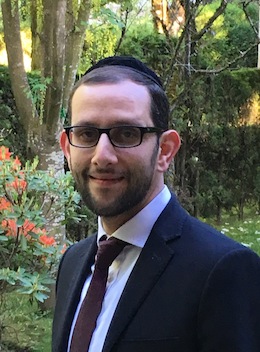
photo - Rabbi Shlomo Gabay will be inducted as part of Beth Hamidrash’s 50th anniversary celebrations on March 31
Rabbi Shlomo Gabay will be inducted as part of Beth Hamidrash’s 50th anniversary celebrations on March 31. (photo from Beth Hamidrash)

Beth Hamidrash is Vancouver’s only Sephardi synagogue, keeping alive the Jewish traditions of the Sephardim, the Jewish community whose roots go back to the expulsion of Jews from Spain in 1492. The Sephardim (from the Hebrew word for Spain, Sefarad) immigrated to North Africa, the Ottoman Empire and other parts of Europe, where they sustained their unique liturgies, customs and musical culture for centuries. Beth Hamidrash carries on these traditions, passing them onto each new generation.

The first meeting of the Sephardi community of Greater Vancouver was held in the late 1960s, followed by the first organized Sephardi prayer service. In 1973, the Sephardic Congregation was incorporated as a society in British Columbia, with the goal of establishing a synagogue. In the late 1960s and early 1970s, High Holiday services were held in the kindergarten classroom of the previous building of the JCC at 41st Avenue and Oak Street, and in the Vancouver Talmud Torah gymnasium. During the 1970s, the congregation began holding regular services at 3231 Heather St., in what was then a dilapidated former synagogue, which the congregation renovated and made into the beautiful congregational space there today.

The synagogue website notes that Beth Hamidrash congregants hail from Iraq, Morocco, Algeria, Libya, Egypt, Syria, Lebanon, Yemen, Israel, India, France, China, Japan, the United Kingdom, South Africa, Zimbabwe, Russia, and many other parts of Canada and the world.

“What we have here is very special,” said Melul. “When you walk in the door here, you are a somebody. Our community is very warm, and we share each other’s sorrows and joys. When you visit this shul, someone will welcome you, someone will give you a siddur, someone will tell you when is Kiddish, someone will want to get to know you.”

“I landed in a spectacular community,” added Gabay. “The people are so kind and generous and forthcoming – they want to grow and they want to do. I really feel blessed to be here.”

To RSVP for the March 31 afternoon induction ceremony, email [email protected]. For tickets to the dinner gala, call the synagogue office at 604-872-4222 or email [email protected].

Matthew Gindin is a freelance journalist, writer and lecturer. He is Pacific correspondent for the CJN, writes regularly for the Forward, Tricycle and the Wisdom Daily, and has been published in Sojourners, Religion Dispatches and elsewhere. He can be found on Medium and Twitter.
Format ImagePosted on March 15, 2019March 20, 2019Author Matthew GindinCategories LocalTags Albert Melul, Beth Hamidrash, Ephraim Mirvis, Judaism, milestones, Shlomo Gabay
Jewish fraternity at 20

Jewish fraternity at 20

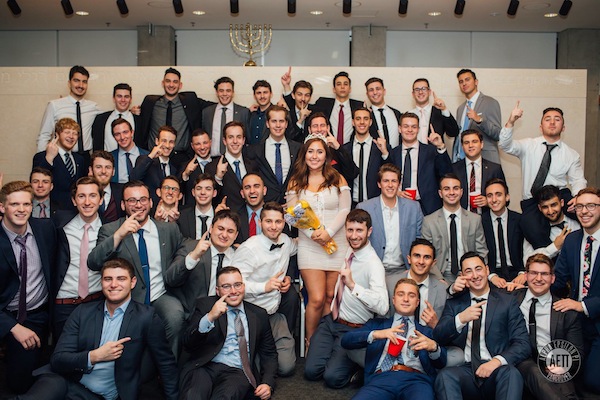
Alpha Epsilon Pi chapter members with the fraternity’s “sweetheart,” Rachel Meadow. A “sweetheart” is elected every year at the chapter’s formal. (photo from AEPi)

The Vancouver chapter of Alpha Epsilon Pi, the traditionally Jewish fraternity, is 20 years old this year. So is Benny Stanislawski, the chapter’s president, who will help oversee the anniversary celebrations next month.

AEPi, as it is commonly known, was not the first Jewish fraternity at the University of British Columbia. Another frat operated on campus in years past but eventually disbanded. In the summer of 1999, the former longtime international executive director of the fraternity contacted Jeff Waldman, a student at UBC, suggesting he consider founding a chapter. A group of eight “founding fathers” came together and Adam Propp, a high school friend of Waldman, also a UBC student, was chosen as the first president, or “brother master,” as the role is called internally.

Hillel has been on the UBC campus since 1947 and provided an avenue for Jewish fellowship and involvement for many students. But the founders of the fraternity saw advantages in creating the male-only society.

“I think all of us had different reasons,” Propp recalled. “For me, to be able to have an impact on the university experience for young Jewish men like myself was important. When I look back at it, Hillel appealed to many, but not all. [The fraternity] just appealed to a different set of people who might not have been attracted to Hillel right away. It was a way to get more people more active and involved in a Jewish experience on campus, especially since UBC is such a commuter school.”

Propp became philosophical reflecting on the chapter’s founding two decades ago, noting that, in the next few years, some sons of the original brothers will likely be pledging to the fraternity. In recent days, Propp has been reconnecting with many of the original brothers, as they plan to gather for the 20th-anniversary celebration with a series of events over the weekend of April 5-7.

photo - Benny Stanislawski, president of the Vancouver chapter of Alpha Epsilon Pi
Benny Stanislawski, president of the Vancouver chapter of Alpha Epsilon Pi. (photo from AEPi)

The relationship between AEPi and Hillel differs from campus to campus and, at UBC, it has generally been extremely strong, sometimes highly symbiotic.

Gabe Meranda, who was executive director of the Vancouver Hillel Foundation at the time the chapter formed, admits he had some trepidation about a Jewish fraternity, not having had any experience with what is called “the Greek system.”

“I was skeptical at first, since I was cautious about fraternities. But these first few guys were so excited about launching the chapter in B.C. that I decided I must get behind it,” Meranda recalled. “I remember the night of their first party at Hillel. I didn’t know what to expect, but all seems to have gone well and it’s taken off from there.”

The chapter made Meranda an honorary brother and he still proudly has the pin, he said.

While fraternities have a reputation for certain excesses, Canadian campuses tend to be a little more low-key, in part because the lower drinking age in Canada means access to booze is not a motivator to joining a frat. What is less obvious to the general public are programs of leadership development, philanthropic ventures and, in the case of AEPi, Jewish cultural activities and, to varying extents, Israel programming or education.

Stanislawski stressed that AEPi has no political or religious orientation. Jewish young men, as well as non-Jewish ones who want to pledge – of which there are usually a few each year – are welcome without concern for their religious affiliation (or lack of affiliation) or their approach to Zionism.

The chapter’s main annual philanthropic event is Hoops 4 Health, an all-day, three-on-three basketball tournament that takes place this year on March 31 at War Memorial Gym. The chapter’s charity beneficiary used to be different health causes, but the Heart and Stroke Foundation has a special meaning to the brothers. A couple of years ago, an AEPi member, Nitai Weinberg, suffered a stroke at the age of 18. Now fully recovered, he and his brothers raised $8,000 for the cause last year, and this year have significantly upped their goal to $25,000.

As an example of the range of programs, the chapter recently hosted a presentation on sexual assault awareness, led by the UBC Mental Health Network. They also host “Greek Shabbats” at Hillel House, where members of all the university’s fraternities are invited.

Fraternities, in general, are a place to nurture leadership.

AEPi has an added mission, noted Stanislawski: “Developing leaders for the Jewish community.”

Founded in 1913, the fraternity now serves 190 campuses in seven countries; it claims 90,000 living alumni. The UBC branch, officially called the Beta Chi chapter, welcomes students from Langara, Simon Fraser, Emily Carr, Capilano and all post-secondary institutions in the region. The chapter usually has 40-plus brothers in any given year, peaking last year at 49.

“I’d love to see the organization get into the 70s,” said Stanislawski. But, given the limited number of Jewish students on campus, slow, steady growth is the realistic goal.

Samuel Heller, the current executive director of Hillel at UBC, congratulated the fraternity and thanked them for their contributions.

“Both the Hillel community and wider campus community are enriched by this brotherhood of young men who exemplify leadership and champion Jewish values,” said Heller. “Brothers of AEPi are a positive force on campus … by creating a group of young leaders who are changing the face of UBC and who, in turn, will change the world.”

Pat Johnson is an honorary brother of Alpha Epsilon Pi Beta Chi chapter.

Format ImagePosted on March 15, 2019September 8, 2025Author Pat JohnsonCategories LocalTags Adam Propp, AEPi, education, fraternities, Gabe Meranda, Judaism, milestones, Sam Heller, tikkun olam, UBC
Adding to Einstein Archives

Adding to Einstein Archives

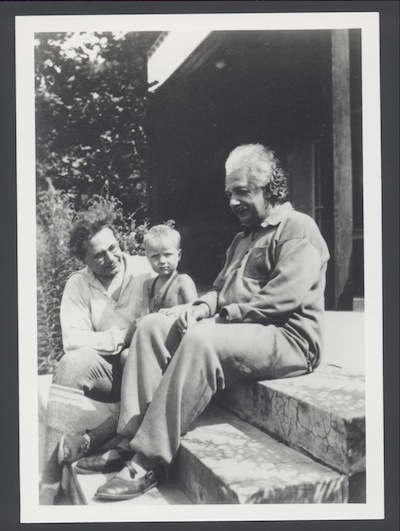
A newly acquired photograph of Albert Einstein, left, with his lifelong friend Michele Besso. (HU photo courtesy Ashernet)

photo - Albert Einstein, right, with his grandson Bernhard, centre, and son, Hans Albert
Albert Einstein, right, with his grandson Bernhard, centre, and son, Hans Albert. (HU photo courtesy Ashernet)

One hundred and ten pages of Albert Einstein’s handwritten notes and other documents and photos have been added to the Albert Einstein Archives at the Hebrew University in Jerusalem. This latest material (dating mainly from 1944 to 1948) was acquired by the university thanks to a donation by the Crown-Goodman Foundation, which bought it for an undisclosed sum from Gary Berger, a North Carolina doctor. After Einstein’s death in 1955, most of his more than 80,000 scientific and personal papers were left to the Hebrew University. Einstein, who was one of the founders of the university and a great supporter of the Jewish state, was invited to become president of Israel, but declined the offer, implying that he did not feel worthy of such honour.

Format ImagePosted on March 15, 2019March 14, 2019Author Edgar AsherCategories IsraelTags Albert Einstein, archives, Hebrew University, history
אנדרו שייר קורא לג’סטין טרודו להתפטר

אנדרו שייר קורא לג’סטין טרודו להתפטר

  (Andre Forget/OLO) ראש האופוזיציה, אנדרו שייר

ראש ממשלת קנדה, ג’סטין טרודו, הסתבך ולא ברור כלל אם יצליח להיבחר שוב בבחירות הכלליות שיערכו בחודש אוקטובר. זאת לאור טענת שרת המשפטים והיועצת המשפטית לשעבר, ג’ודי ווילסון-רייבולד, כי הוא, אנשי לשכתו ושר האוצר, ביל מורנאו, הפעילו עליה לחץ להתערב הליך המשפטי נגד חברת הבנייה וההנדסה אס.אן.סי לאוולין החשודה בשחיתות, ולמנוע את העמדתה לדין. החברה נחשבת למהגדולות בעולם והמטה שלה ממוקם בקוויבק.

ראש האופוזיציה, אנדרו שייר, מהמפלגה השמרנית קרא לטרודו להתפטר לאלתר בטענה “שאיבד את סמכותו המוסרית לשלוט”. שייר ביקש גם מהמשטרה הפדרלית לחקור את הפרשה. שייר שכנראה אין לו מה למכור לבוחריו השמרנים לקראת הבחירות הקרובות, ממשיך לטעון בכל הזדמנות כי על ראש ממשלה להתפטר. מרבית הפרשנים בתחום לא קונים את הטענות של שייר.

טרודו מצידו ממשיך להסביר: “אני והצוות שלי פעלנו בצורה הולמת ומקצועית. לחלוטין אינני מסכים עם תיאור האירועים האלה מצד היועצת המשפטית לשעבר”. טרודו הוסיף כי הוא ואנשיו לא עברו על החוק ואין מקום להמשיך ולדון בנושא. בכל מקרה הבוחר יאמר את דברו בבחירות שיערכו בקרוב.

ווילסון-רייבולד הופיעה לפני כשבועיים בפני ועדת המשפטים של הפרלמנט, שטחה את טענותיה וענתה לשאלות במשך שעות, כשהאירוע הועבר בשידור ישיר בטלוויזיה. שרת המשפטים והיועצת המשפטית של טרודו לשעבר, טענה כי הוא, אנשי לשכתו ושר האוצר, הפעילו עליה לחץ בלתי פוסק במשך כארבעה חודשים שנבע ממניעים פוליטיים, להתערב בהליך המשפטי נגד אס.אן.סי לאוולין החשודה בשיחוד אנשי ממשל בלוב, כדי לזכות בחוזים ממשלתיים. הניסיונות להשפיעה על דעתה כיועצת משפטית ועל התביעה העצמאית בקנדה, נועדו למנוע את העמדת החברה וראשיה לדין ולבקש לפטור אותה בקנס כספי בלבד. זאת כדי למנוע את החלטת הנהלת החברה להעביר את משרדיה למחוץ לקנדה, דבר שיגרום לפיטורי אלפי עובדים. טרודו שחושש שמהלך כזה יעיב על ההצלחה הכלכלית של ממשלתו הזכיר לווילסון-רייבולד לטענתה, כי גם אזור הבחירה שלו נמצא בקוויבק. עם זאת ווילסון-רייבולד טענה מפורשות כי טרודו ואנשיו לא עברו על החוק. אך למפתיע בסוגיה זו האופוזיציה שמאמינה לכל מילה שלה, ממשיכה לטעון כי טרודו עבר על החוק? שרת המשפטית לשעבר בשלה אך את האופוזיציה זה לא מעניין.

לאור התנגדותה להתערב בהליך המשפטי בעניין חברת הבנייה, טוענת עוד ווילסון-רייבולד, כי בינואר טרודו העביר אותה במתפקידה לתיק זוטר (השרה לענייני יוצאי הצבא), ולבסוף היא התפטרה מהממשלה במהלך פברואר.

טרודו דוחה גם את הטענה הזו של שרת המשפטי לשעבר שלו ומציין, כי היא הועברה לתפקיד אחר רק בגלל שהשר לענייני יוצא הצבא פרש מהממשלה. אחרת היא הייתה נשארת בתפקידה עד היום עד כמה שזה היה תלוי בו.

מעניין שווילסון-רייבולד טענה בחקירתה כי אולי יש מקום להפריד בין התפקידים שר המשפטים בממשלת קנדה והיועץ המשפטי לממשלה, כיוון שכפל התפקידים יוצר בעייה כמו זו של סוגיית אס.אן.סי לאוולין. אך מדוע היא לא חשבה על כך בטרם מונתה לתפקיד הכפול? או בזמן שהחלה למלא אותו?

יועצו הבכיר של טרודו לשעבר, ג’רלד באטס, שהתפטר מתפקידו לאור הפרשה, נחקר אף הוא בוועדת המשפטים של הפרלמנט. הוא דחה את טענותיה של שרת המשפטים לשעבר. לדבריו שתי פגישות או שתי שיחות טלפון בחודש בנושא אס.אן.סי לאוולין, לא היווו שום לחץ על ווילסון-רייבולד.

Format ImagePosted on March 13, 2019March 13, 2019Author Roni RachmaniCategories עניין בחדשותTags Andrew Scheer, Jody Wilson-Raybould, Justin Trudeau, אנדרו שייר, ג'ודי ווילסון-רייבולד, ג'סטין טרודו
Raising Jews with Israel literacy

Raising Jews with Israel literacy

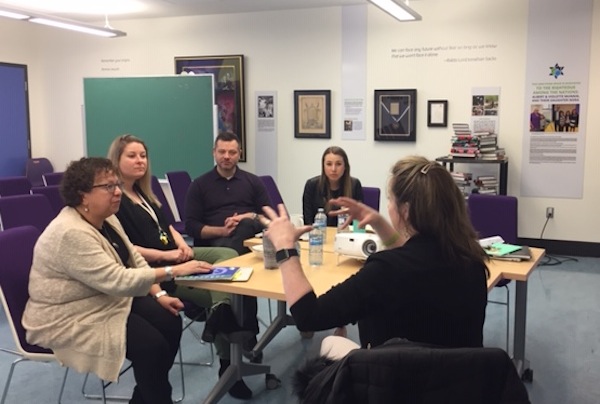
Tal Grinfas-David of the Centre for Israel Education speaks with educators at Vancouver Talmud Torah last month. (photo from VTT)

Educators at Lower Mainland Jewish day schools had the opportunity to consider the relevance of Israel literacy last month, when Tal Grinfas-David, the Centre for Israel Education’s day school specialist, was in town the week of Feb. 18 to deliver a talk on the subject and work with local teachers and administrators. Her keynote speech, titled Teaching Modern Israel – Challenges and Opportunities, was part of a community professional development day.

The CIE, which is based in Atlanta, Ga., received a grant for a three-year initiative to work with nine Jewish day schools across North America and help them enhance their Israel education efforts. Vancouver Talmud Torah and King David High School are two of the nine schools and Grinfas-David spent a day coaching educators at each of them. She will return for the next two years to reinforce the changes CIE is promoting.

The issue, she said, is that, across North America, many graduates of Jewish day school education don’t have enough Israel literacy to grapple with the world, to justify a strong connection to Israel and to inform their Jewish identity.

“The concept we’re promoting is to turn Israel education into something all teachers can support, not just Jewish studies faculty,” she told the Independent. The desire is there, she added. “The Vancouver community is very supportive and wants to see Israel education boosted and incorporated into different subject areas. But it’s going to be a long-term process.”

photo - Tal Grinfas-David
Tal Grinfas-David (photo from Centre for Israel Education)

No stranger to education, Grinfas-David comes to her role with a PhD in curriculum and instruction and 25 years as an educator in Israel and the United States. Over the next three years, she will move between Jewish day schools in Denver, Los Angeles, Detroit, New Jersey and Vancouver, coaching their educational teams.

“We’re thrilled to have this grant to visit the individual sites and get to know the different schools’ cultures,” she said. “Each school is different and unique, with strengths and challenges, and this grant allows us to customize and tailor our offerings to specific communities.”

The goal of Israel literacy is to graduate Jewish students who understand the relevance of Israel in their lives and feel confident in their knowledge. They need this, she said, because understanding Judaism means understanding it’s not solely a religion.

“It’s also a belonging to a peoplehood, a nation with a Jewish homeland,” she said. “To understand modern Israel today, we have to see it as a continuation of our Jewish history.”

Grinfas-David said she would need three days to address all the ways that Israel literacy counts significantly in the life of a Jew.

“Israel impacts how Jews live in other countries, like the U.S. and Canada, where we are free. Students at our Jewish day schools have never experienced powerlessness or persecution, as they have the good fortune of being born here and now, with many freedoms. But that’s all the more reason to have them understand it was not always like this for Jews.

“Being part of a nation means there is an obligation to support your people, because of your fortune,” she continued. “There’s a calling to engage and to reflect on what Israel means for these students in their lives. Israel literacy is about having a repertoire of primary sources under your belt, so that when students leave the school setting and hear different narratives, they’ll be critical consumers of information, and they’ll know the facts they need. At CEI, our goal is to give them the ability and the opportunity to have the confidence to be critical consumers.”

Lauren Kramer, an award-winning writer and editor, lives in Richmond. To read her work online, visit laurenkramer.net.

Format ImagePosted on March 8, 2019March 6, 2019Author Lauren KramerCategories WorldTags CIE, Diaspora Jews, education, Israel, King David High School, Tal Grinfas-David, Vancouver Talmud Torah
Helping Rose’s Angels

Helping Rose’s Angels

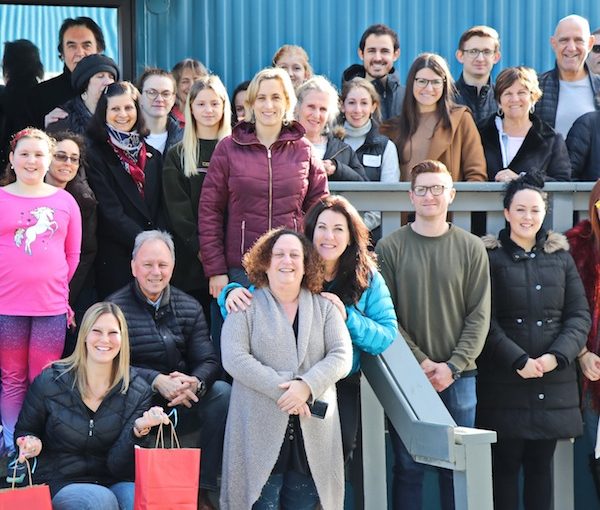
Some of the 70 volunteers who helped out at Rose’s Angels Feb. 17. Event founder Courtney Cohen is holding the bags and Kehila Society executive director Lynne Fader is standing in the front, with the long sweater. (photo by Lianne Cohen Photography)

For most people, getting out of the house and being somewhere by 9 a.m. might be no big deal. For me, especially on a weekend morning, it’s a challenge. But, at least once a year, it’s a challenge I enjoy.

As the owner and editor of the Jewish Independent, I’ve known of Rose’s Angels since it launched six years ago, but only first participated last year in the packing of the more than 1,000 care packages for Metro Vancouverites in need. Courtney Cohen, who created the annual event in honour of her grandmothers, Rose Lewin and Babs Cohen, with longtime friend Lynne Fader, was among the 18 Jewish community members under the age of 36 who were honoured by the Jewish Independent with a JI Chai Award in December 2017 for doing good. Having made the personal connection, I headed out to Richmond Jewish Day School a couple of months after the JI Chai Celebration to help out. It was such a fun experience that I went again this year.

The atmosphere at RJDS is like “Old Home Week.” This time around, I drove there with a friend – she brought the muffins and I made the coffee. As before, I ran into several people that I don’t see often. A well-organized venture, Rose’s Angels, which is run under the auspices of the Kehila Society of Richmond, provides coffee and pastry for those who can wait till they get to the school for their fix. Lists taped onto the wall tell volunteers at which station they’ll be working.

I must have done an OK job last year because I was once again assigned to putting together glove and sock bundles, wrapped in ribbon, colour-coded to indicate whether the bundle was for men, women or children. So absorbed was I in the work and conversation that I can’t say what others were doing, but there was much bustling about and, by noon, a big truck and several cars were stuffed with boxes to be delivered.

photo - Volunteers put together 1,200 care packages, which were distributed to those in need by various social services agencies and programs
Volunteers put together 1,200 care packages, which were distributed to those in need by various social services agencies and programs. (photo by Lianne Cohen Photography)

This year, said Cohen, 70 volunteers put together 1,200 packages, filled with necessities from toiletries to books to food to warm clothing, thanks to donations of items and money. The packages were distributed by a couple dozen organizations, including Turning Point Recovery Society, Heart of Richmond AIDS Society, Light of Shabbat program, Jewish Food Bank, Richmond Food Bank, United Way, Tikva Housing, Richmond Centre for Disability, Touchstone Family Services, St. Alban’s Drop-In Centre, Richmond Mental Health Society and Richmond Food Aid.

Scheduled to happen around Valentine’s Day, this year’s Rose’s Angels took place Feb. 17.

“Watching firsthand our community come together to give back on a long weekend, with family and friends is quite amazing,” Cohen told me when I asked her what was the most fun aspect of the day for her. “Seeing people of all ages working together to help package the care packages in such an organized manner is really something to behold.”

Fader, who is co-executive director of the Kehila Society, also enjoys the communal feel, as well as the diversity of the group that gathers to help. “It is always a fun, well-spirited, well-oiled machine that puts months of hard work gathering all the items together to produce a beautiful bundle of items,” she said.

In looking to the future, Fader would like to see the annual event become “bigger, better,” serving “more recipients in our community,” referring to Richmond as a whole, not only its Jewish community. “Although Rose’s Angels is an annual project,” she added, “the Kehila Society is daily working with our community agencies and partners to assist on a daily basis.”

“I see the success of Rose’s Angels growing from year to year with the involvement of the community partners and individuals,” said Cohen. “Personally, I already see the success and fulfilment that Rose’s Angels has given our community at large. Receiving thank you phone calls, emails and messages from the recipient agencies reminds me of the impact that Rose’s Angels is making to so many individuals.”

Format ImagePosted on March 8, 2019March 6, 2019Author Cynthia RamsayCategories LocalTags Courtney Cohen, Kehila Society, Lynne Fader, Rose’s Angels, tikkun olam
Local CTeens join Shabbaton

Local CTeens join Shabbaton

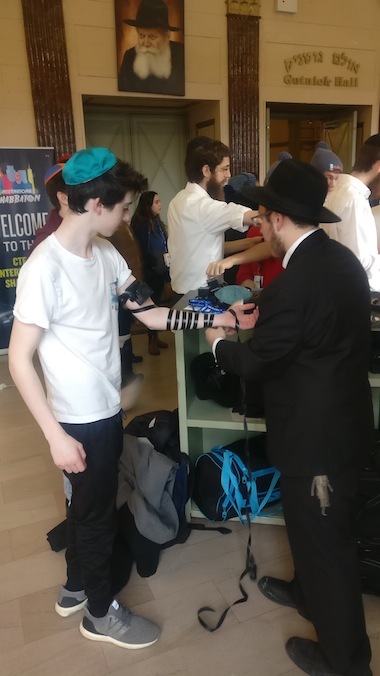
A contingent from Richmond Chabad CTeen joined the 11th annual CTeen International Shabbaton that took place in New York last month. (photo from Chabad Richmond)

Teens from around the world celebrated Jewish unity, heritage and pride at the 11th annual CTeen (Chabad Teen Network) International Shabbaton. The convention, which took place Feb. 22-24, drew more than 2,600 participants. From world-class speakers to a closing ceremony with a surprise appearance by WeWork founder Adam Neumann, the Shabbaton left the teens exhilarated and ready to share their Jewish pride with others.

The weekend included a traditional Shabbat experience in the heart of Crown Heights, the Chassidic neighbourhood of Brooklyn, hands-on workshops and lectures about Judaism, and the Times Square takeover, featuring Jewish pop star Yaakov Shwekey.

photo - The 11th annual CTeen International Shabbaton took place in New York last month
(photo from Chabad Richmond)

The theme of the Shabbaton was I-Matter. The theme was meant to empower teens to recognize and use their inherent, true value, which is not dependent on achievements or status. It’s a message that has resonated with many teens, who have found their voices and personal missions through their involvement in CTeen.

“The highlight of the CTeen International Shabbaton was getting to know fellow Jewish teens from around the world, and learning about their Jewish communities and what it’s like to be a Jew in their area. It was an experience of a lifetime and I can’t wait until next year,” shared Richmond teen Sarah Aginsky, Grade 10.

“The most meaningful part of my experience at the Shabbaton would be when we spent Saturday night in Times Square,” said fellow Richmond teen Aidan Wessels, also in Grade 10. “It really makes you feel at home, being surrounded by Jewish people, and you don’t have to be ashamed or anything to be who you really are. It really touched my heart when we were introduced, via video, to Rabbi Yitzy Horowitz, who has been diagnosed with ALS and chose to live with such a disease and still try to look on the bright side of everything.”

“The CTeen International Shabbaton was so meaningful to me,” added Jordan Wessels, Grade 12. “This is because we all have such a great Jewish experience, and meeting Jewish teens from all over the world. The amount of energy of so many people like you is truly amazing.”

photo - A contingent from Richmond Chabad CTeen joined the 11th annual CTeen International Shabbaton
(photo from Chabad Richmond)

Over the weekend, 15 teen speakers shared personal stories of struggle, triumph and strength in the face of adversity. The stories ranged from students who fought for Jewish rights at school, to those who dealt with alopecia (spot baldness) and subsequent bullying, to teens who lost family members to drug addiction.

Priest-turned-rabbi Yaakov Parisi shared his inspiration for living a Jewish life with teens in an animated story during Shabbat dinner. Prof. Binyamin Abrams, who lectures on chemistry at Boston University, answered questions about Torah and science, and ecouraged teens to seek knowledge while living Jewishly.

“The secret of my life and success is keeping Shabbat,” declared Neumann during the closing. “Disconnecting from the world for 25 hours and connecting to something greater than myself makes me who I am. There has never been a more relevant time in history to celebrate being Jewish. If you come away with one thing today, I hope it’s that you disconnect to connect.”

“You may find yourself alone, the only Jew in your public school, or you may feel like a minority, but remember: there is no such thing as a small Jew,” said Rabbi Moshe Kotlarsky, chair of CTeen. “I hope you take the energy you gained this weekend and carry it into every aspect of your lives back at home.”

“Our intrinsic worth is not based on achievements,” said Chabad Richmond’s Rabbi Yechiel Baitelman. “Every individual can connect to G-d, no matter the circumstances. It is because of this connection that every individual, in any situation, can make a significant difference. That is what CTeen is all about.”

With more than 500 chapters in 23 countries, CTeen Network’s mission is to empower tomorrow’s generation of leaders through Jewish education and by providing a strong Jewish network across the globe. Teens develop awareness and confidence, while connecting with individuals who share similar experiences and beliefs. They become an integral part of a group that focuses on building core values and stresses positive character development. CTeen is open to Jewish teens regardless of affiliation.

For more information, visit chabadrichmond.com/cteen or contact Baitelman at 604-277-6427 or [email protected].

Format ImagePosted on March 8, 2019March 6, 2019Author Chabad RichmondCategories WorldTags Chabad, CTeen, education, Judaism, youth
Personal robots help at home

Personal robots help at home

Can’t be home for bedtime? Temi lets you read a story to your child remotely. (photo from Temi)

In the fourth season of the sitcom The Big Bang Theory, theoretical physicist and all-around nerd Sheldon decides that he no longer wants to physically interact with his friends and colleagues. He cobbles together a telepresence robot with his face on its screen, which navigates around his home and office and turns toward whomever Sheldon is speaking. This fictionalized glimpse of a future filled with personal robots is simultaneously hilarious and creepy.

“We took the creepy factor into account when we designed our robot,” said Danny Isserles, chief executive officer of the U.S. division of Temi, an Israeli robotics firm that is building an almost functionally identical (but a whole lot spiffier) version of Sheldon’s telepresence unit.

Temi has a sleek, semi-rounded body – it looks a bit like a high-tech vacuum cleaner with a subtle human presence – and stands three-feet tall on its four wheels. Inside Temi are two main computers. The first comprises Temi’s “face,” made from a customized version of an Android tablet.

“It’s nothing special,” Isserles conceded in an anything but robotic conversation with Israel21c. As with most Android-based mobile devices today, the Temi tablet can display video, play music or call up the internet by voice command.

“We’ve done a demo of Temi controlling a smart home. It can turn the lights on and off,” Isserles said. Any Android developer could add other apps; for example, to make Temi control a smart home thermostat.

Temi’s “body” has a full Linux-based computer inside plus an array of sensors – LiDAR, 2D and 3D cameras, encoders measuring the wheel’s movements – that help Temi navigate smoothly.

“In order to get from one side of the room to the other, we humans instinctively choose the easiest path to follow with no effort, passing over small obstacles and around bigger ones,” explained cofounder and Temi Israel CEO Yossi Wolf. But this is a complex task for robots and the shortest way is not necessarily the fastest.

“For example, when you move from the kitchen to the living room, you can pass through sofas and slalom through all the kitchen chairs or you can bypass them the long way, which will be the fast and natural way.”

Temi’s sensors ensure it won’t fall down the stairs or run over your small dog. “We had a live case study in our office – my dog,” said Isserles. “I said, the first time this robot touches my dog, the robot is going out the window.”

Temi’s designers “built an algorithm to connect all the sensors together and enable Temi to construct a path through a space,” said Isserles. “Because of the navigation, we have a platform with abilities no one else has yet achieved.”

That may not last for long. Amazon reportedly is developing a robot known as Vesta, which follows users around like a mobile Alexa. Other home robots in the works include LG’s Hub bot, Mayfield Robotics’ Kuri, and Jibo out of technology powerhouse MIT.

Isserles said competition is good “because this will build the market, take the robot out of the niche and bring it into the mainstream.”

Temi formally launched sales at CES 2019 in January and expects first deliveries to be made this month. The robot can be ordered now on Temi’s website and through select retail outlets in the United States.

A half-dozen immediate applications for Temi come to mind.

In the office, a staffer on the controlling side of the robot can make like Sheldon and attend a business meeting without actually being there. A manager can stroll around chatting with colleagues and, unlike video conferencing, there’s no need to interrupt anyone’s workday to assemble in a meeting room.

Temi can serve as the host at a restaurant (“Hello, I’m Temi. Welcome to Applebees”), a hotel concierge, a sales clerk, an airport check-in agent, a museum docent, a remote yoga teacher, a playmate for the kids (imagine hide-and-seek with a robot), an aid for home-bound seniors and a remote-care physician. But the main idea is to provide a telepresence in the home.

“It’s not the same as being there, of course, but think of a deployed soldier in Afghanistan who can hop into a robot and hang out with his family for a couple of hours.”

“If you’re stuck at work, you can hop into your Temi, press ‘Bobby’s room,’ and Temi will go there so you can read Bobby a bedtime story,” Isserles said. “It’s not the same as being there, of course, but think of a deployed soldier in Afghanistan who can hop into a robot and hang out with his family for a couple of hours.”

But why do you need a robot for that? Couldn’t you just Skype from the computer or an iPad?

“This is a much better experience,” contended Isserles. “It’s more like hanging out. If I’m on a Skype call with my nephews, they say hi, then run away and my sister has to chase them to come back. The robot can hang out, explore, wander around, talk to different people.”

You can also ask Temi to initiate the video by tapping Temi on its head or saying, “Hey, Temi, call Mom.” Temi will lock on your position, plan an efficient path to get to you wherever you are in the house, initiate the call and then follow you around while you talk.

Isserles said Temi’s aim is to appeal to busy families where the parents work long hours, travel a lot and love technology.

It still sounds a bit creepy – would you want your robot father sitting at the dinner table with you, turning its Android head from side to side to keep the conversation flowing?

“My experience is that everyone who came in thinking it’s creepy, after a minute or two of demonstrating how it works, they ask, ‘How much is it?’” said Isserles.

The price is cheap by robot standards – just $1,500 US. That’s partly because Temi was not built, like most other robots, for defence purposes, where a single robot could run up to $200,000.

That said, Temi got its start from the defence industry. CEO Wolf previously cofounded Roboteam to build tactical robotic systems for reconnaissance, intelligence gathering, search-and-rescue and delivering payloads to soldiers in the field. Temi was originally part of Roboteam, but the companies decided to split, with Wolf going full-time to Temi and cofounder Elad Levy remaining at the helm of Roboteam.

Temi employs 65 people, most in the Tel Aviv research-and-development centre plus 10 people in New York and 20 in China, where the robots are manufactured. The company has raised $82 million, including $21 million in December 2018 from former Alibaba chief technology officer John Wu, Italy’s Generali Investments and Hong Kong-based internet-of-things company Ogawa. Temi and Ogawa have established a strategic partnership with an emphasis on selling in China.

“We could build a mechanical arm with an accurate and gentle grip, no problem, but then it would be a $20,000 product, not a $1,500 one.”

While Temi is being initially positioned as a roaming telepresence device, the robot can work without someone on the other side. Ask it to play a song and Temi will call it up using its built-in wi-fi connection, then blast out the tunes via 20-watt Harman Kardon speakers. Temi’s 10-inch touchscreen is great for playing YouTube videos, too.

Temi gets eight hours of continuous use per charge and has a docking station for repowering.

Temi has one more unique selling point: a tray. Tell Temi to fetch some tea from the kitchen and the robot will return with the chai, although a human has to load and unload the teacups.

“We could build a mechanical arm with an accurate and gentle grip, no problem,” said Isserles, “but then it would be a $20,000 product, not a $1,500 one.”

The tea tray turns out to have been the genesis for what would evolve into Temi. Wolf was visiting his grandmother and she offered him some tea.

“But her hands were shaking and he was worried,” Isserles recalled. Wolf asked her if she’d like a walking cane. “She said, ‘No, I’m not old.’ So he asked her, ‘Would you like a robot?’ That, she would go for. She wanted something cool.”

Every Jewish start-up “starts from the grandmother,” Isserles quipped. Even those building personal robots.

For more information, visit robotemi.com.

Israel21c is a nonprofit educational foundation with a mission to focus media and public attention on the 21st-century Israel that exists beyond the conflict. For more, or to donate, visit israel21c.org.

Format ImagePosted on March 8, 2019March 6, 2019Author Brian Blum ISRAEL21CCategories WorldTags home, Israel, robots, technology, Temi
Samaritan neighbourhood found

Samaritan neighbourhood found

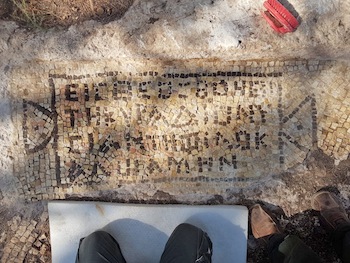
An inscription (top of above photo and below), written in Greek, was translated by Prof. Leah Di Segni of the Hebrew University of Jerusalem. Dated to the early fifth century CE, it says, “Only God helps the beautiful property of Master Adios, amen.” (photos from IAA courtesy Ashernet)

photo - Close-up of the inscription found
Close-up of the inscription found. (photo from IAA courtesy Ashernet)

New neighbourhood construction in the southern part of the Sharon Plain of central Israel has revealed an estate, some 1,600 years old, which was determined by Israel Antiquities Authority (IAA) archaeologists to have been the property of a wealthy Samaritan. The discovery reinforced evidence that, at one time, the area was extensively populated by the Samaritans, who claim they are Israelite descendants of the northern Israelite tribes of Ephraim and Manasseh. An inscription, written in Greek, was translated by Prof. Leah Di Segni of the Hebrew University of Jerusalem. Dated to the early fifth century CE, it says, “Only God helps the beautiful property of Master Adios, amen.” According to Dr. Hagit Torge, director of the excavation on behalf of the IAA, “The inscription was discovered in an impressive winepress [near the top of Tel Zur Natan, where remains of a Samaritan synagogue were found] that was apparently part of the agricultural estate of a wealthy individual named Adios. This is only the second such winepress discovered in Israel with a blessing inscription associated with the Samaritans. The first winepress was discovered a few years ago in Apollonia near Herzliya.” The Samaritans were originally brought to the region as part of Assyrian policy, and first settled on and around Mount Gerizim.

Format ImagePosted on March 8, 2019March 6, 2019Author Edgar AsherCategories IsraelTags archeology, history, IAA, Israel, Israel Antiquities Authority, Samaritans
פרשת וואווי

פרשת וואווי

מאנג וואנז’ו

סין יוצאת בחריפות נגד ארה”ב וקנדה לאור החלטת משרד המשפטים הקנדי, לפתוח בהליכי הסגרתה של סמנכ”ל הכספים וסגן יו”ר מועצת המנהלים של ענקית התקשורת הסינית וואווי, מאנג וואנז’ו, לארה”ב. הסינים טוענים כי ארה”ב פועלת נגד וואנז’ו וואווי משיקולים פוליטיים כיוון שהנשיא, דונלד טראמפ, ציין במספר הזדמנויות כי אם יראה שיש התקדמות במשא ומתן בין ארה”ב לסין להשגת הסכם סחר חדש, הוא יפעל לשחרורה של וואנז’ו. במקביל יביא לביטול האשמות נגדה ונגד החברה. בנוסף הסינים כועסים על ראש ממשלת קנדה, ג’סטין טרודו, שלדבריהם יש לו כנראה סטנדרטים כפולים. זאת כיוון שלטענתם בסוגיית וואנז’ו הוא טוען כי אין מקום להתערבות הדרג הפוליטי, ורק לבית המשפט יש סמכות לפעול בנושא. בעוד שבפרשת העמדה לדין של “מנהליה המושחתים” של ענקית הקנדית אס.אן.סי לאוולין, הוא ניסה להתערב משיקולים פוליטיים, ולמנוע את המשך הליך המשפטי נגד החברה. לפיכך כפי שפורסם לאחרונה ראש האופוזיציה, אנדרו שייר, דורש מיידית את פיטורי טרודו. כצפוי רבים מתנגדים לדעתו בנושא.

בסוף חודש ינואר ארה”ב הגישה בקשה רשמית לקנדה להסגרתה של וואנז’ו. ובית המשפט העליון של מחוז בריטיש קולומביה יקיים במאי דיון ראשון בנושא, אחד מתוך רבים שצפויים עוד לפנינו. כידוע הליך ההסגרה בין שתי המדינות יכול להימשך שנים רבות. וואנז’ו שוקלת לנצל את הזמן הרחב שיעמוד לרשותה כאן בוונקובר, ואף ללמוד באוניברסיטה של בריטיש קולומביה במסלול לתואר שני.

וואנז’ו נעצרה בשדה התעופה הבינלאומי של ונקובר בסוף חודש דצמבר. זאת בזמן שעצרה לחניית ביניים בטיסה שבין קונג קונג למקסיקו. שלטונות האכיפה של ארה”ב שקיבלו מידע על דבר הנחיתה של וואנז’ו בוונקובר, ביקשו ממשטרת הגבולות הקנדית לעצרה לאלתר. לאחר כשבועיים במעצר היא שוחררה בתנאים מגבילים על ידי בית המשפט העליון של המחוז. כתב האישום הפלילי של משרד המשפטים האמריקני כנגד וואווי, וואנז’ו ובכירים נוספים בחברה כולל עשרים ושלוש עבירות. ובהן: הונאת בנקים להסוות קשרים עם מסחריים עם איראן תוך כדי הפרת האמברגו עליה, גניבת סודות מסחריים וטכנולוגיות, זיופים, הלבנת הון, ניסיונות לשיבוש חקירה והשמדת ראיות.

בינתיים וואנז’ו היזדרזה להגיש תביעה נגד את קנדה על המעצר שלה לבקשת ארה”ב. וואנז’ו (בתו של מייסד וואווי) הגישה לפני מספר ימים תביעה אזרחית בבית המשפט העליון של מחוז קולומביה הבריטית נגד ממשלת קנדה, רשות

משטרת הגבולות הקנדית והמשטרה הפדרלית (האר.סי.אם.פי) – בשל טענתה “להפרות חמורות” של זכויות האזרח שלה. היא תובעת פיצויים כיוון “שהמעצר שלה שאינו חוקי הוא שרירותי, והחוקרים שלה לא עידכנו אותה בכוונה על הסיבה האמיתית של מעצרה, על זכותה לשמור על השתיקה ועל זכותה לקבל ייעוץ משפטי בהקדם”. עוד נכתב בתביעה של סמנכ”ל הכספים של וואווי, כי במקום לעצור אותה באופן מיידי, היא נחקרה שעות על ידי רשות הגבולות, תחת מסווה של בדיקת מכס שגרתית בשדה התעופה. וואנז’ו מציינת עוד כי שוטרי משטרת הגבולות החרימו את המחשב האישי שלה ואת הטלפון הסלולרי שלה, השיגו את הססיסמאות שלהם ובניגוד לחוק בדקו את התכנים שלהם.

יצויין כי וואווי הגישה בשבוע שעבר תביעה נגד השלטונות האמריקניים, בעקבות האיסור של הממשל על פקידיו ועל חברות אמריקניות להשתמש במכשירי החברה. התביעה תטען כי הממשל הפדרלי חרג מסמכותו ועליו לחשוף לבית המשפט, מדוע בישנתיים האחרונות הוא אסר על הפקידים והחברות האמריקניות להשתמש בציוד של וואווי.

Format ImagePosted on March 6, 2019Author Roni RachmaniCategories עניין בחדשותTags Canada, China, Huawei, Meng Wanzhou, trade, United States, ארה"ב, וואווי, מאנג וואנז'ו, סחר, סין, קנדה

Posts pagination

Previous page Page 1 … Page 162 Page 163 Page 164 … Page 323 Next page
Proudly powered by WordPress