Everything is political in Israel; there’s no escaping it. Pick a corner, a street sign, a building, there’s potential for argument. So, you can imagine what it’s like to take a tour of an area as contentious as the West Bank, which, thankfully, was quiet with respect to violence when we visited. Not surprisingly, our guide almost took on the role of spokesperson for the Palestinian Authority.
Abraham Hostel, in the heart of Jerusalem, offers a three-day West Bank tour. The tours include Nablus (biblical Schechem), Jenin and the refugee camp that borders it, Jericho, Ramallah and Bethlehem.
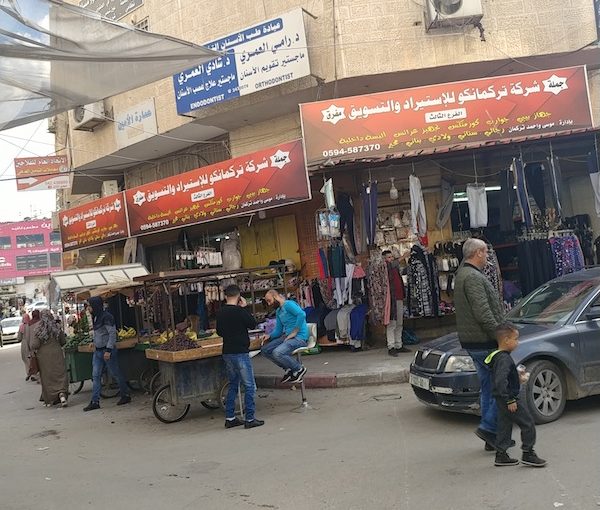
It was eye-opening for me. For one, the media frequently portrays Palestinians in the West Bank as living in squalor, often involved in conflicts with the Israel Defence Forces. We saw bustling markets, shopping centres, corporate plazas, sports cars, and plenty of American restaurant franchises, such as KFC and Pizza Hut.
Our tour guide was a wannabe biblical scholar and archeologist. “Personally,” he told us, “there could never have been a Jewish Temple.” It’s impossible, apparently, to build on top of solid rock, he explained.
He gave a brief history of the term Palestine, correctly stating that Roman invaders, Vespasian and Titus, in the first century, renamed the region from Israel/Judah. But why, particularly, call it Palestine? “Hmm,” he said, taking a moment to think. “Because they liked the name.” Not, as many scholars believe, because the Romans sought to call the area after the Jews’ sworn enemy, Philistines, to rub salt in the wounds.
While at Bethlehem’s Church of the Nativity, our guide gave his take on the Gospels, contending that it wasn’t the case that Jesus’s mother, Mary, couldn’t find a room at an inn – rather, the Jews forbade Mary to have a room because she was ritually unclean after childbirth. And that, he said, was the unwritten explanation of the manger/barn scenario.
He then proffered his views on Jews. “Since anyone can become a Jew,” he said, “they’re not really tied to the land.” Meaning that anyone who has converted, or was born to converts, has no connection to Israel.
And, he added, since the parcel of land called Judah, from which the name “Jew” was derived, was only a fraction of modern Israel, today’s Jews should only have rights to those ancient borders.
Quoting the Torah – “if you bless Israel, you are blessed; if you curse Israel, you will be cursed” (Genesis 12) – our guide insisted that the “Israel” referred to in this verse has never meant “the nation of Israel” (which it does), but only refers to the patriarch Jacob, who was later named Israel. The underlying message was that there was no concern about being cursed if you curse Jews.
For good measure, he asked, pointing toward the refugee camp, “Doesn’t it say ‘love your fellow’ in the Torah? That’s one of the top commandments.”
Almost no tour anywhere is complete without the commercial aspect – wandering through the souvenir shops and markets.
At the ice cream shop, our guide claimed, “Palestinian ice cream is made with real cream, not like the Israeli version!” At the spice store, he spoke about how Israelis use cheap ingredients in their Zaatar, but not Palestinians. And, he said, “Even Israelis agree that Palestinian beer is better than the sewer water in a can they make.”
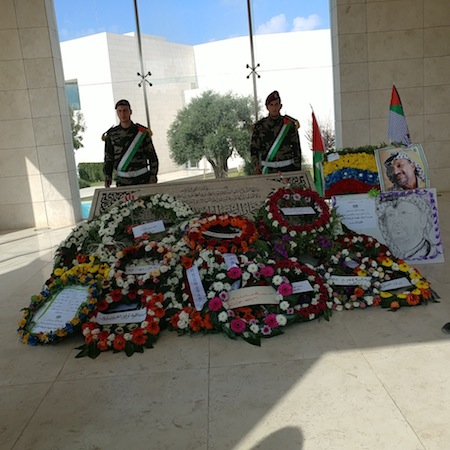
Yasser Arafat mausoleum in Ramallah. (photo by Dave Gordon)
The hero worship of Yasser Arafat was astounding. Virtually every street corner in Ramallah had a wall-sized poster of him. My trip was in November, so these displays were likely timed for the anniversary of his death. Schoolchildren took a field trip to his tomb in Ramallah for a commemoration and photo opportunities.
Our guide made every effort to politicize the tour, down to the free lunch. He said there wasn’t such thing as “Israeli couscous,” only co-opted “Arab-Palestinian couscous.” Scholars and culinary experts differ, saying that Israeli couscous was created in the 1950s in response to food rationing. Alas, more was still to come from our guide.
While he had our attention, he showed us illustrations of how Palestine in 1947 comprised modern Israel and the West Bank, while today, the Palestinians only have small, scattered autonomous dots in the Palestinian Authority. As for the Palestinian part in this development, he said, “just a couple of bus bombs” derailed the peace process, but only temporarily.
Dave Gordonis a Toronto-based freelance writer whose work has appeared in more than 100 publications around the world.
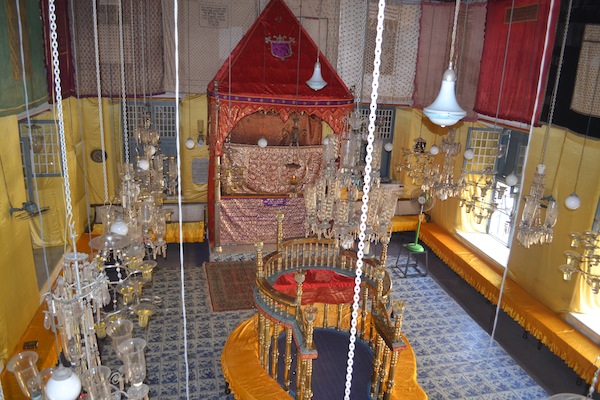
The interior of Paradesi Synagogue in Kochi, India. (photo by Lauren Kramer)
Dec. 6 marked an emotional homecoming for Canadian siblings Linda Hertzman and Kenny Salem. The pair were among some 180 Jews who returned to their birthplace in Kochi, India, to mark the 450th anniversary of the Paradesi Synagogue in the neighbourhood known as Jew Town. Three generations of families gathered from Israel, Australia, Canada and England to celebrate the milestone. They walked the ancient stone pathway of Synagogue Lane, spoke their native tongue of Malayalam and congregated in the synagogue for a festive celebration of the Jewish life that once flourished in this corner of southern India.
The festivities were tinged with sadness, however. For many, it would be their final visit to the beautiful Paradesi Synagogue. The shul is unique for its colourful oil lamps and a Torah scroll decked in a gold crown that was gifted to the community in 1802 by the maharaj of Cochin. (Kochi is the preferred term for the city formerly called Cochin.) The handpainted Chinese tiles on the synagogue floor have long since emptied of worshippers and the Jewish community of Jew Town now numbers just five – the oldest of them age 96. It’s tourists that stand beneath the oil lamps these days, visiting from dawn to dusk to marvel at the ancient Jewish history and try to comprehend its relevance. Opportunities for congregational prayer have been rare since most of the community left for other parts of the world from 1948 onwards.
On the Shabbat following the 450th anniversary, however, tourists were turned away from the Paradesi Synagogue and the sanctuary again echoed with Jewish prayer. The pews were filled with women in colourful dresses, reaching out to touch the ancient Torah scrolls as they were lifted joyfully from the aron hakodesh (holy ark) for morning prayers. Tears streamed down the faces of Jews for whom the synagogue was filled with rich memories. There were children who were seeing their families’ history for the first time and elders who were stepping into the synagogue for the last time. Adults in their 60s recalled their childhood memories of watching their parents pray in the synagogue, of riding their bicycles around the narrow roads of Mattancherry and of the warm, deeply religious and meaningful Jewish life that existed in Jew Town.
Paradesi Synagogue, also known as Mattancherry Synagogue, is the building in the back. (photo by Lauren Kramer)
The vibrant hub of Jewish life in Kochi, Jew Town was home to three synagogues, each serving different segments of the community. The “synagogue in the middle,” with a star of David still etched in its concrete, is now a repurposed building, while the southernmost shul is a ramshackle 900-year-old structure, its rafters occupied by nesting pigeons. Indentations on the side of many of the doors of homes and businesses in Jew Town mark the spot where mezuzot used to announce a Jewish home and the large Jewish cemetery a few minutes’ walk from the shul is unlikely to be filled with many more graves as the years roll by. The Jewish life that flourished here has become a lucrative business for antique dealers and souvenir shops selling scarves and trinkets, retailers loitering outside and using all their powers of persuasion to bring shoppers in.
Hertzman, who lives in Richmond, B.C., and Salem, from Richmond Hill, Ont., were the first guests to check into what was their family home, recently transformed into a boutique hotel called A.B. Salem House. It was named for their late grandfather, Abraham Barak Salem, an attorney known as the “Jewish Gandhi” for his negotiations with Israel that enabled the Jews of Kochi to make aliyah.
Kenny Salem left Kochi at age 25 in 1987 and returns to the city annually to see his childhood friends. “It was good to have everyone back here in Jew Town,” he said. “Friends and family were walking in and out of our house all day long, just like old times, when my mother had her door open to everyone. But the sad part is that, in the aftermath of the celebrations, Jew Town is silent once again.”
There are plans to fill that silence in the near future. David Hallegua, a spokesperson for the Cochin Synagogue Trust, announced plans to build a museum dedicated to the history of the Kochi Jews in the hall above the synagogue.
“It’s a dwindling community,” admitted Salem. “So, when there are no longer any Jews living here, we will hand the management of the synagogue and cemetery over to the Archeological Department of India. We need to tell the story of the Jewish community that once lived here and pass on this message to future generations.”
Lauren Kramer, an award-winning writer and editor, lives in Richmond. To read her work online, visit laurenkramer.net.
In Jerusalem, as soon as Purim is over, everyone begins to get ready for Pesach. Two-and-a-half weeks ahead, macaroons are already in the stores, as well as various other products for the holiday. Here are a few desserts you can make at home, from traditional to unusual.
CLASSIC ALMOND MACAROONS Makes 20 macaroons. This recipe is adapted from an American food magazine (not sure which).
Place almonds in a pan, cover with water and bring to a boil. Boil 10 seconds. Remove one almond and see if it slips out of its skin. If not, boil a few seconds more. Spread on paper towels and pat dry once ready.
Preheat oven to 325 °F. Line a baking sheet with parchment or wax paper.
Grind almonds with 1/4 cup sugar in processor. Add egg whites and extract and blend 20 seconds. Add the 3/4 cup sugar in two batches, blending 10 seconds after each addition.
Roll one tablespoon of mixture between moistened palms into ball. Repeat until all mixture is used, spacing cookies one inch apart on the prepared cookie sheet. Flatten each to half-an-inch high. Brush each with water. Sift confectioners sugar over each. Bake for 25 minutes.
Lift one end of parchment paper and pour two tablespoons water onto cookie sheet. Lift other end and pour two tablespoons water under. Tilt to spread water. When water stops boiling, remove macaroons.
CHOCOLATE BISCOTTI 3/4 cup margarine or butter 2 1/8 cup sugar 6 eggs 2 tbsp vanilla extract 3 1/2 cups matzah flour 1 1/4 cups potato flour 3/4 cup cocoa 1 tbsp Passover baking powder 5/8 cup ground almonds 2 cups chocolate chips
Preheat oven to 375°F. Spray a cookie sheet.
In a bowl, cream margarine or butter and sugar. Add eggs and vanilla.
In another bowl, combine matzah flour, potato flour, cocoa and baking powder. Gradually add to batter.
Add nuts and chocolate chips and combine.
Form into two logs and place on cookie sheet. Bake for 30 minutes. Let cool.
Slice. Return slices to cookie sheet and bake 15 minutes.
TOFFEE MATZAH This is my favourite sweet for Pesach but this version is an Andrew Zimmern contribution from Food & Wine magazine with a few of my changes.
1 cup salted butter or margarine 5 pieces of matzah 1 cup packed brown sugar 2 cups chocolate chips 1 cup mixed chopped nuts
Preheat oven to 350°F. Line a cookie sheet with foil and spray with vegetable spray. Line with parchment paper and spray again.
Arrange a layer of matzah on the sheet.
Melt butter or margarine with brown sugar in a saucepan. Cook five minutes. Pour over matzah. Bake five to eight minutes, until bubbling.
Remove from oven and spread chocolate chips on top, letting them melt for five minutes. Sprinkle nuts on top. Let cool or refrigerate to cool. Break into pieces.
MARILYN’S CHOCOLATE BRANDIED CANDY Marilyn is a longtime friend of mine who came from the Boston area and has lived in Israel since 1949.
3 1/2 ounces bittersweet chocolate (a candy bar works fine) 1 cup raisins, soaked in cherry brandy 1 cup chopped walnuts 1 cup matzah pieces
Melt chocolate in a saucepan. Add raisins, walnuts and matzah and mix well.
Drop by tablespoon into small cupcake papers. Refrigerate.
Sybil Kaplan is a journalist, lecturer, book reviewer and food writer in Jerusalem. She created and leads the weekly English-language Shuk Walks in Machane Yehuda, she has compiled and edited nine kosher cookbooks, and is the author of Witness to History: Ten Years as a Woman Journalist in Israel.
What food eaten during Pesach causes the most debates? If you guessed matzah balls, you’re right. Should they be hard or light? Big or small? What secret ingredient should be added to them?
From where did matzah balls, or kneidlach, originate? German Jews had a dumpling that they put into their soup called knodel. From this came the Yiddish term kneydl, singular, or kneydlach, in the plural. In Czech, it is known as knedliky. Dumplings have been in Central European cookery since the Middle Ages and then they came to Germany and Eastern Europe later.
So, just how many ways are there to make matzah balls?
Joan Nathan, a friend of mine, who has written a number of cookbooks and is considered a maven of American Jewish cooking, proposes adding chicken fat or vegetable oil plus seltzer, club soda or chicken broth, to make them light and airy. In Jewish Cooking in America, she also relates that some matzah balls, originating in Lithuania, use chicken fat or vegetable shortening and contain a filling made of onion, oil or chicken fat, matzah meal, egg yolk, salt, pepper and cinnamon. The filling is then placed in the middle of the matzah ball before they are cooked in salt water. After cooking in salt water, they are baked 30 minutes then placed in the soup for serving. Joan also has a recipe for matzah balls made in the southern United States, using pecans. In my research, I discovered that some Louisiana Jews add green onions and cayenne pepper.
In her cookbook Quiches, Kugels and Couscous: My Search for Jewish Cooking in France, Joan explains that, in France, matzah balls are called boulettes de paque, krepfle or kneipflich. They are the size of walnuts and not fluffy. They are made from stale bread or matzah soaked in water and dried, and they contain rendered goose fat, vegetable oil or beef marrow, eggs, water or chicken broth, matzah meal, salt, pepper, ginger and nutmeg.
In The New York Times Passover Cookbook, edited by Linda Amster, among the recipes for matzah balls is one by Mimi Sheraton, Times food critic at the time, who used chicken fat and cold water. Another is from Joan’s cookbook Jewish Holiday Kitchen, and she uses ginger and nutmeg. The winning recipe for the first Matzah Bowl contest in New York at the time the Times cookbook was published used vodka and club soda. A low-fat, low-salt version is made with egg whites and vegetable oil. Another style, which is airy, is made with beef marrow, instead of chicken fat, plus nutmeg.
Refrigeration and the temperature of the liquid seem to be key common denominators in many recipes.
Nina Rousso, an Israeli, in her book The Passover Gourmet, uses beaten egg yolks, lukewarm water, melted margarine, salt, parsley, matzah meal and stiffly beaten egg whites folded in. The mixture is refrigerated two hours before making.
In Passover Lite, Gail Ashkenazi-Hankin, an American, combines egg yolks, onion powder, salt, pepper, matzah meal, water and beaten egg whites and chills the mixture 30 minutes.
Zell Schulman, the American author of Let My People Eat, says the key to making light, melt-in-your-mouth, floating matzah balls is to beat egg whites until stiff then fold into the yolks with salt, pepper, cinnamon, matzah meal and optional parsley and refrigerate 15 minutes. A second version combines matzah meal with only the beaten egg whites until they hold peaks, plus parsley, cinnamon, grated carrot and oil, but no egg yolks.
Susan Friedland, the American author of The Passover Table, combines whole eggs with seltzer, salt, pepper, matzah meal and schmaltz, which she refrigerates for one hour. The schmaltz adds the flavour.
Marlene Sorosky, American author of Fast and Festive Meals for the Jewish Holidays, provides a recipe using ground almonds, ginger and chopped parsley. She chills the matzah balls for one hour.
Edda Servi Machlin, whose family has 2,000-year-old roots in Italy, says her family serves a mix between Italian Passover soup and Ashkenazi chicken soup. Her matzah balls are made of chopped chicken, egg, broth, olive oil, salt, pepper, nutmeg and matzah meal. The batter is refrigerated one hour before making.
Other Italian Jews, who call the matzah balls gnocchi di azzaima, add onions or mashed potatoes to the dough or grated lemon rind.
An aside: In 2001, Ariel Toaff, a professor at Bar-Ilan University, who is the son of Rome’s chief rabbi, came out with a book called Mangiare alla Giudia (Eating the Jewish Way). He devotes a chapter to Passover traditions, and writes that matzah was so popular that the Catholic authorities banned Jews from selling matzah to non-Jews and banned Christians from eating it.
Italian bakers also baked different kinds of matzah: plain for intermediate days, shmurah matzah for the sederim, and matzah made with white wine, eggs, sugar, anise and goose fat for those with more rich tastes.
Jews of Italy even developed sfoglietti or foglietti, a kosher-for-Passover pasta made with flour and eggs, which was then quickly dried and baked in a hot oven and served in soup or with a sauce.
Joyce Goldstein, an American fascinated by Italian Jewish cuisine, describes, in Cucina Ebraica, a combination of ground chicken, egg, matzah meal, salt, pepper and cinnamon, which she refrigerates before cooking in soup, but she does not say for how long.
Sonia Levy, a native of Zimbabwe, wrote a cookbook of her community, called Traditions. She describes luft kneidlach, light matzah balls, made with matzah meal, water, salt, nutmeg, cinnamon or ginger, eggs and oil. These must be refrigerated at least half a day. She adds that you can also make a pit with a finger and insert chopped meat that has been mixed with fried onions and spices. Another Zimbabwe version uses egg, cold water, chicken fat, salt, pepper, ginger and matzah meal.
Ruth Sirkis, an Israeli, in A Taste of Tradition, says “air” matzah balls have eggs, matzah meal, salt, chicken soup and chicken fat and are refrigerated two hours.
Another version, by Anya von Bemzen and John Welchman in Please to the Table: A Russian Cookbook, has walnut balls for soup, which are made by the Georgian Jews using ground walnuts, onion, egg, matzah meal, oregano, salt, pepper and a froth egg white.
A couple of last pieces of matzah ball trivia. In 2008, a New York kosher delicatessen held its annual matzah ball-eating competition to raise money for a shelter for the homeless. The winner ate 78 matzah balls in eight minutes. Although not in the Guinness Book of World Records, a few years ago, the largest matzah ball was measured at 17.75 inches across and weighed more than 33 pounds.
And, lastly, among some ultra-Orthodox Jews, matzah balls are not eaten because they expand when they cook, and they consider this reaction a form of leavening.
Regardless of the style of matzah balls you prefer, just make plenty for your guests!
Sybil Kaplanis a journalist, lecturer, book reviewer and food writer in Jerusalem. She created and leads the weekly English-language Shuk Walks in Machane Yehuda, she has compiled and edited nine kosher cookbooks, and is the author of Witness to History: Ten Years as a Woman Journalist in Israel.
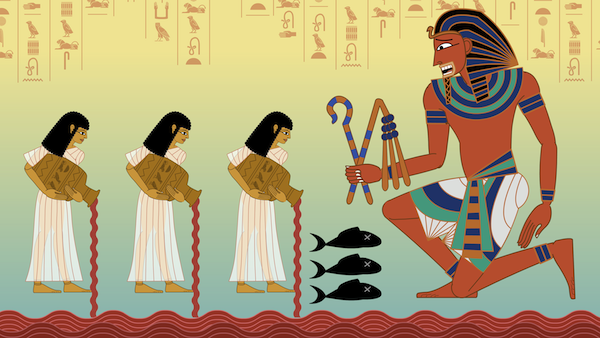
God Almighty Herself induces Egypt to give birth. We simply need to listen for the birth mother’s screams in the delivery room. We hear the screams throughout the plagues, as they become increasingly intensive, starting with the first plague, blood. (illustration by Nina Paley)
The idea of the Exodus as a birth story begins as Shemot (Exodus) begins. The first chapter brings us into the atmosphere of a giant delivery room. Things have gotten out of control: “And the Israelites were fruitful and increased abundantly and multiplied and grew exceedingly strong and the land was filled with them.” (Shemot 1:7)
The Israelites are having children all the time. There’s this anonymous, collective mass of people that are steadily spreading out. The only two figures mentioned by name are the midwives, Shifra and Pua, and there’s a reason for that. The book is telling us: “Pay attention, readers. We are entering a delivery room, and so the most important figures are the midwives. You will feel this sense of birth.”
If one didn’t get this sense from Chapter 1, take a look at Chapter 2. It begins with the personal birth story of Moses, the story of a natural, biological birth, in which a woman becomes pregnant and has a son. A few verses later, the mother places the baby in an ark, or basket, and, when Pharaoh’s daughter comes by, she takes him in and becomes his adoptive mother. She, too, has a birth story. There’s a womb – the ark. There’s water – the Nile. She sees the womb, the ark. She opens it and she sees the baby. She, too, is portrayed as having given birth. If we saw a portrait of the natural, biological birth by the Hebrew mother, we also have a portrait of the Egyptian adoptive mother who takes the child.
This “birth” mindset will intensify and be actualized through this grand metaphoric story we call the story of the Exodus from Egypt. There was a famine in Canaan, so the Israelites went to Egypt to buy grain and find seed. They stayed. Scripture tells us how they “were fruitful and increased abundantly and multiplied and grew exceedingly strong, and the land was filled with them.”
This little nucleus, the embryo that first descended, is developing within this large Egyptian womb, Israel’s “surrogate mother,” which nourishes this fetus. The time comes for the birth. As in any case of surrogate motherhood, there is difficulty. On one hand, it’s not my baby. I want it out. On the other hand, there’s emotional difficulty. I nourished that child. He’s part of my body.
From the perspective of the child, there will be problems, or challenges, of attraction and repulsion toward the surrogate mother in whom he developed. The Children of Israel grew and developed in that womb, and it must be taken out. But the Egyptian mother refuses to begin the birthing process.
Enter the most powerful midwife imaginable – God Almighty Herself. She induces Egypt to give birth. The entire story is described in this manner. We simply need to listen for the birth mother’s screams in the delivery room. We hear the screams throughout the plagues, as they become increasingly intensive. Blood. Frogs. Lice. Beasts. Pestilence. Boils.
We’re standing next to the birth mother, saying, “Push! Push! Scream! Scream! Let this baby out!” Just before the birth, a moment before the Children of Israel emerge, they are commanded to paint the doorposts with blood. Soon after, this people will pass through this doorway.
They will reach the waters. And the waters will descend, as well. Then the sea will split in two, and the Children of Israel will pass through the waters on dry land, through the birth canal that has opened for them. At the end of the birth canal, who will be waiting for them? The midwife, ready to grasp them and teach them to walk.
This story, this birth story, is the powerful story of the birth of a people. But, beyond the importance of hearing this story, it can also explain what happens later, during their travels in the desert.
Like any newborn baby, the people will cry and scream for their most immediate needs – water, food. Moses and God will provide for them because that’s how you take care of an infant. You give water and food. You can’t expect anything else. Slowly but surely, he will be taught to walk. Slowly, he will learn rules. He will be given laws to follow.
When we meet this child in Bamidbar (Numbers), once he has grown, he will make the same requests that he made in Shemot as an infant: water and food. But God’s response will be different, because we don’t have the same expectations of a little baby that we have from a growing child. We expect something different.
How do we connect this to the seder night? The Exodus, first, is a story. There is a strong emphasis on telling the story. It has all the detail it needs, and all the drama we want. These are what make this story a foundational story, one that can be transmitted generation after generation.
We sit around and tell our birth as a people. We try to impart it to the next generation. When we tell the story with all its detail, it excites us once more. But why is this done over matzah?
God planned the Exodus from the time of Abraham: “Know that your seed will be a sojourned in a land not theirs; they will serve them and be tormented by them for 400 years. But then they will go out with great wealth.”
It’s all planned, down to the moment. God tells them to have their loins girded, their bags packed and their food prepared and, when I say so, leave. Everything had been planned. So what happened? Why couldn’t the dough rise? Why couldn’t they have fresh rolls?
This is a precise dramatization of a birth story. If you want it to be credible, it has to be exact. As in the story of any birth, everything is planned. There’s a due date. There’s a packed suitcase, a list of phone numbers to call. If it’s not the first birth, there are arrangements for the older kids.
Yet labour will always be unexpected. It’s always sudden. The water breaks suddenly. Contractions come suddenly. Suddenly, it’s time to go. That’s birth. Everything is planned, but the moment arrives suddenly. This is the meaning of eating matzah. It’s as if we are saying, everything was there, everything was planned. This birth was a major event and, like every other birth, it was unexpected. Despite all the preparations, we had to run, we had to leave. The dough did not have a chance to rise. All that could be made from it was matzah.
Ilana Pardes’s book The Biography of Ancient Israel describes this as the story of a collective persona, the people of Israel: “The Israelites are delivered collectively out of the womb of Egypt. National birth, much like individual births (and all the more so in ancient times), takes place on a delicate border between life and death. It involves the transformation of blood from a signifier of death to a signifier of life. It also involves the successful opening of the womb, the prevention of the womb’s turning into a tomb…. God performs a variety of wonders in Egypt (the 10 plagues in fact are perceived as such), but the parting of the Red Sea seems to surpass them all. It marks the nation’s first breath – out in the open air – and serves as a distinct reminder of the miraculous character of the birth. Where there was nothing, a living creature emerges all of a sudden….”
As we sit around the seder table, around the matzah, telling the story of our birth each year, you may want to read from the poem, “Miracles,” by Yehuda Amichai: “From a distance everything looks like a miracle / But up close even a miracle doesn’t appear so. / Even someone who crossed the Red Sea when it split only saw the sweaty back of the one in front of him.”
Ask every participant at the seder to think of something that happened to them during the year, something that, because the individual was part of it, they “only saw the sweaty back of the one in front of him.” If we were to take a step back and look at things from a distance, we could have said to ourselves: “I’m living through a miracle. I’m passing through the sea, on dry land. I’m undergoing the process of birth, right now.”
It is worthwhile, and it even brings joy, to mention this miracle and think about it at this event celebrating the great miracle of the nation’s birth.
Dr. Orit Avnery is a research fellow at the Shalom Hartman Institute. She received her PhD in Bible studies at Bar-Ilan University. Her dissertation is entitled The Threefold Cord: Interrelations between the Books of Samuel, Ruth and Esther. This article is based on a talk she gave in Hebrew. Articles by Avnery and other institute scholars can be found at shalomhartman.org.
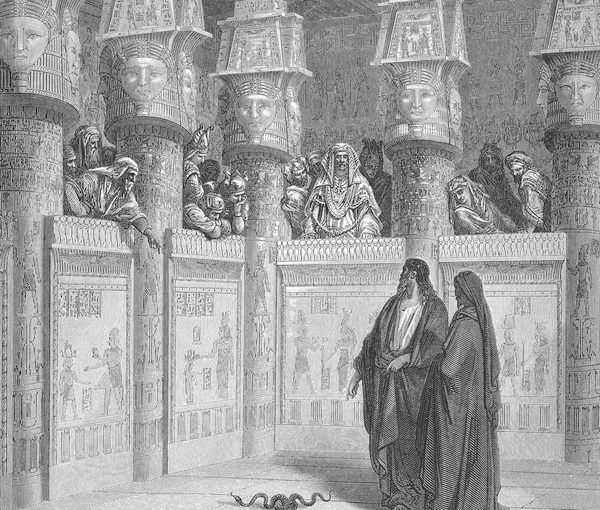
“Moses and Aaron Appear before Pharaoh,” from Gustave Doré’s English Bible, 1866. (image from Wikimedia Commons)
Stubbornness is a complex and harsh characteristic. It is no surprise, then, that Pharaoh, who is considered to be one of the most wicked characters in the Torah, is shown as being very stubborn. We see Pharaoh repeatedly refusing to engage with the reality that he is faced with and, stubbornly, over and over, refusing to send the Israelites out of Egypt.
Pharaoh is the paradigmatic stubborn person in the Exodus story, yet parashat Vayeira also points to other characters in the story who are not considered wicked in any way but who are nevertheless portrayed with this characteristic of stubbornness. This implies that perhaps stubbornness is not all bad. What can we learn about this character trait from our parashah and when it might make sense to employ it?
We’ll start with Pharaoh, the paradigm of stubbornness. Repeatedly, we see him refusing to yield, to listen to Moses and Aaron’s pleading, as the text says: “Pharaoh’s heart stiffened and he did not heed them.” (Exodus/Shemot 7:13) He appears equally stubborn in the conversations between God and Moses: “And God said to Moses, ‘Pharaoh is stubborn; he refuses to let the people go,’” (7:14) and in his response to the first plague: “Pharaoh turned and went into his palace, paying no regard even to this.” (7:23) Again and again, Pharaoh’s stubbornness – at least at a particular stage – is portrayed as having been almost thrust or forced upon him. God says as much to Moses: “But I will harden Pharaoh’s heart … and he will not heed you….” (7:3-4)
Indeed, as events are taking place and described, it appears that God is actively strengthening or hardening Pharaoh’s heart: “God stiffened the heart of Pharaoh, and he would not heed them, just as God had told Moses.” (9:12) This strengthens our resolve to discover what this stubbornness is really about, why it is so critical and what role it plays in the story.
Samson Raphael Hirsch suggests that this stubbornness or “hardening” that Pharaoh experiences can be divided into three types, based on the language that the Torah uses to describe it: “I will harden,” “I will make heavy” and “I will strengthen.”
1) Hard: being rigid, without registering any influences, without being influenced by anything that passes us.
2) Heavy: being a person of weight, able to be influenced, but with a significant gap between the actual impression and the willingness to act based on it. Sluggish.
3) Strong: steadfast, fully opposing to submit despite a full recognition, totally obliterating the influence.
Hirsch describes the three different, but similar, forms of this attribute and how it manifests itself in Pharaoh.
The first is characterized by rigidity, that is characterized itself by an ignoring of the environment, a rigidity that blocks any outside influences. This kind of behaviour can be seen when Pharaoh is completely unimpressed and unmoved by Moses’s pleading, the suffering of Israel, or even the plagues that affected him and his people directly.
The second is characterized by heaviness. This heaviness is not about ignoring – someone whose heart is heavy can absorb information from his surroundings, but this is insufficient to influence him, to get him to act upon those potential influences. They don’t propel him to act in the direction where the information points. This phenomenon is evident in the way that Pharaoh reacts to the second plague of frogs. This plague is described in all of its gross and gory details:
“If you refuse to let them go, then I will plague your whole country with frogs. The Nile shall swarm with frogs, and they shall come up and enter your palace, your bedchamber and your bed, the houses of your courtiers and your people, and your ovens and your kneading bowls.… The frogs died out in the houses, the courtyards and the fields. And they piled them up in heaps, until the land stank.” (7:27-8:10)
Despite this horrifying scene, Pharaoh is unfazed: “But when Pharaoh saw that there was relief, he became stubborn….” (8:11) He is not moved to eject the Israelites from Egypt. Instead, he is weighed down (perhaps wilfully) and unmoved.
Lastly, Pharaoh exhibits strength. According to Hirsch, behaviour that is defined by strength is self-aware and defiant. The lack of change in it is not defined by being weighed down or passive inertia, but rather an active refusal to be moved. He is aware that he doesn’t want to move or change because these actions are perceived by him as giving in. For example, during the third plague of lice (kinim):
“Then God said to Moses, ‘Say to Aaron, hold out your rod and strike the dust of the earth, and it shall turn to lice throughout the land of Egypt.’… The magicians did the like with their spells to produce lice, but they could not … and the magicians said to Pharaoh, ‘This is the finger of God!’ But Pharaoh’s heart stiffened and he would not heed them.…” (8:12-15)
Even when Pharaoh’s people tell him explicitly that they are all witnessing the finger of a mighty god, and all that Pharaoh needs to do to resolve the situation is let the people go, Pharaoh digs in his heels and will not give up and will not give in.
Pharaoh is not alone in his stubbornness, in his unwillingness to accept that the slavery is ending and the exodus is immanent. Even without a divine hardening of their hearts, the Israelites also show a stubbornness. It says about Pharaoh, “he didn’t heed” (e.g. 7:10-13) and it also says about the Israelites, “and they did not heed.” (6:9)
Even though it seems that Pharaoh and the Israelites are exhibiting the same behaviour – they both are stubborn in refusing to accept the reality that God is going to redeem the Israelites through Moses’s leadership – the contexts for their behaviour are quite different, almost opposite. Pharaoh is holding onto the Israelites and enslaving them. He is insisting on a continuation of the suffering and backbreaking labour, which he initiated. The Israelites, on the other hand, are described as refusing to listen because they themselves are suffering, “their spirits crushed by cruel bondage.” (6:9)
Pharaoh is mired in a lack of morality; Israel is mired in a lack of faith. What they have in common is that they refuse to accept what seem like the futile fantasies of Moses about the Israelites leaving Egypt with him, and moving from bondage to freedom.
Israel needs to be convinced that this idea of the exodus, of actually leaving Egypt, is real, implementable and viable. They need to believe in it. While deep in the heart of slavery, it’s hard for the Israelites to imagine a different reality. Their insistence on relying on the here and now as opposed to a promise for the future stems from despair. How much hope are they supposed to keep?
Pharaoh also refuses to accept the future as described by Moses and, in this way, his stubbornness, in all its strength, weight and difficulty, is close to the Israelites’ despair. Pharaoh refuses to see what the Israelites cannot.
In contrast to both of these images of stubbornness, Pharaoh’s refusal and the Israelites’ despair, there is a third image. This third character needs to be even more stubborn, strong and resolute – this character is God. God’s stubbornness is characterized by steadfastness, insistence and resoluteness in the face of those who don’t believe in his presence and his promise. God needs to stand against those who refuse him, who repeatedly reject the vision of the future that He presents.
At the very beginning of the story, God makes a promise: “God spoke to Moses.… ‘I appeared to Avraham … and I have remembered My covenant. Say, therefore, to the Israelite people: I am God. I will free you … and deliver you … I will redeem you … and I will take you … and I will bring you into the land….’” (6:2-8)
A few verses later, God speaks to Moshe again: “Go and tell Pharaoh, king of Egypt, to let the Israelites depart from his land.” (11)
God is always responded to with negativity and refusal. “The Israelites would not listen to me, how then should Pharaoh heed me?” (12) God continues with his own steady perseverance: “So God spoke to both Moses and Aaron in regard to the Israelites and Pharaoh, king of Egypt, instructing them to deliver the Israelites from the land of Egypt.” (13)
God’s stubbornness is instructive and holds a lesson for all of us who dream of a world that looks different than the one we now inhabit. Maybe anyone who dreams about a different reality, anyone who believes that it is truly possible that our existence can be transformed, needs a form of stubbornness. They need to be unrelenting and steadfast in holding onto their dreams, rejecting the people who resist change, on the one hand, and who are too beaten down to have faith, on the other.
God’s character in the story emerges for the benefit of dreamers, to call us to be constant and steadfast in our faith that, indeed, tomorrow can be different. And, if we are not dreamers but rather are those who listen, God’s voice is charging us to bear the difficulty, the heaviness, the strength of those who are dreamers. Because it is in the merit of those divine representatives, such as Moses and Aaron, that we became able, we became brazen enough, to imagine what a life beyond slavery would look like, to see it and even live it.
Rabbi Avital Hochsteinis president of Hadar Israel and a research fellow at the Shalom Hartman Institute. She received rabbinic ordination from the institute in 2016. Articles by Hochstein and other institute scholars can be found at shalomhartman.org.
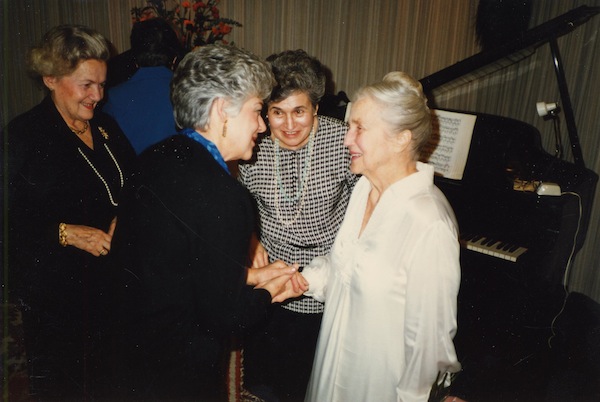
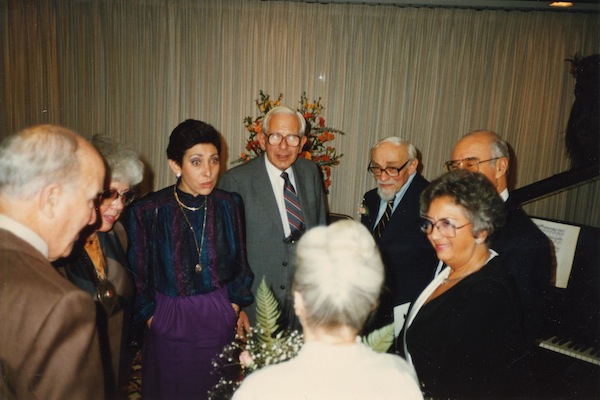
Photographs from an unidentified event, possibly a University of British Columbia event, likely in honour of Harry Adaskin, 1985. In the photo immediately below, of the women socializing by the piano, Shirley Kort is second from the right. (above photo JMABC L.13770)
Shirley Kort is second from the right. (JMABC L.13761)(JMABC L.13765)
If you know someone in these photos, please help the JI fill the gaps of its predecessor’s (the Jewish Western Bulletin’s) collection at the Jewish Museum and Archives of B.C. by contacting [email protected] or 604-257-5199. To find out who has been identified in the photos, visit jewishmuseum.ca/blog.
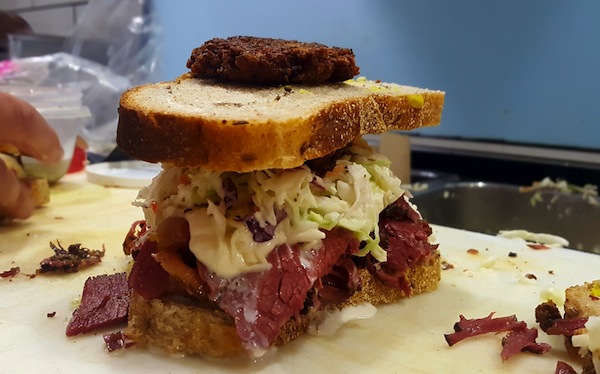
The Hungry Jew, one of the signature sandwiches at Buzzy’s Luncheonette. (photo by Adam Bogoch)
My friend, Adam Bogoch, pitched it as the “Smoked Meat Story.” Soon after that email, he would write his own review, for narcity.com, titled, “This smoked meat sandwich on Salt Spring Island in B.C. will actually change your life.” His friend and colleague, Howard Busgang, had opened a deli on the island, and not only did I need to meet Busgang, but I needed to get on a ferry and taste The Hungry Jew, one of the signature sandwiches at Buzzy’s Luncheonette.
Between the Independent’s annual summer publishing hiatus and the High Holidays, it was November before Adam and I headed to Salt Spring. The travel ran like clockwork and we were pulling up to 122-149 Fulford Ganges Rd. right in time for lunch. We shared a Hungry Jew – a Montreal smoked meat sandwich with homemade horseradish sauce, coleslaw and, I kid you not, two latkes – and the Rabinowitz, Buzzy’s take on a Reuben. They were both incredibly good, and the only reason I’ve waited this long to share the news is because I wanted to wait until better weather, when people would be more likely to take a day or weekend getaway.
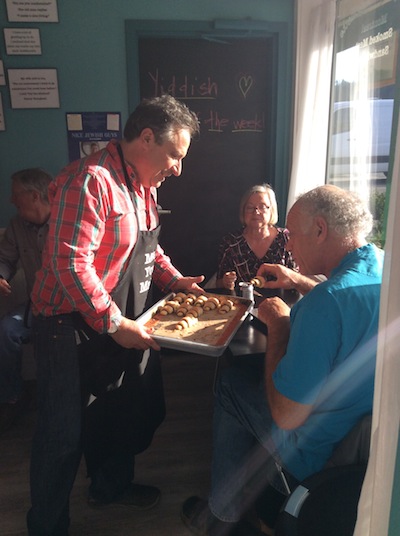
Howard Busgang serves customers rugelach on a sunny November afternoon. (photo by Cynthia Ramsay)
Even in winter, Buzzy’s was busy. Having arrived at prime feeding time, it was hard to get Busgang to sit down and, as we talked, he was constantly distracted – in a good way – by customers.
“Tell me, I’ll get you another sandwich before you go,” he said as he finally was able to join me at a table outside for the interview.
Born and raised in Montreal, stand-up comedy took Busgang first to Toronto and then to Los Angeles, where he met his wife, Melanie Weaver, and where he lived for 28 years, before returning to Canada.
“She’s Jewish-adjacent,” joked Busgang. “She was working for a rabbi when I met her.”
The two met on a blind date, he said, brought together by a Jewish comic who knew both of them.
When he started in comedy in the early 1980s, Busgang said, “There were not a lot of comics around. It wasn’t like today where every second person does stand-up, so it wasn’t that OK a profession,” as far as his parents were concerned. “It was kind of an oddity, like maybe he’ll grow out of this kind of thing.”
Busgang attended Jewish high school, then went to McGill University before heading to Toronto.
“You know where I started?” he said. “United Synagogue Youth, USY, that’s where I started. I was emceeing all their events and that led me to go professional.”
He recalled the first time he performed at amateur night in Toronto. “They packed the place with all these people from USY who knew me. It was packed, and it was great.”
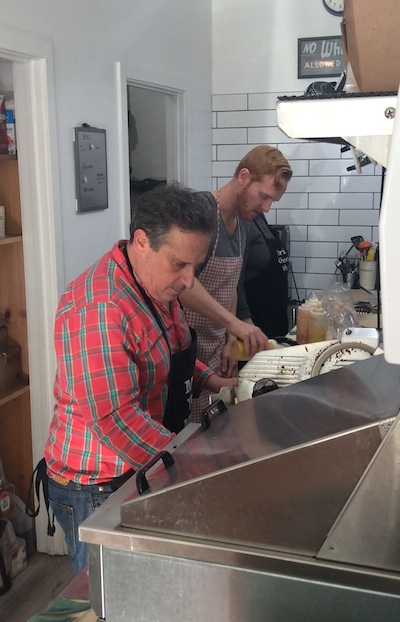
Howard Busgang, left, and Adam Bogoch prepare sandwiches. (photo by Cynthia Ramsay)
So great, he said, that he was put into regular comedy shows right away, “which wasn’t so easy, by the way, because it wasn’t my friends anymore in the audience.”
When he was a stand-up comedian, Busgang did a lot of Jewish material. “I was a very Jewish comic,” he said.
In Los Angeles, he moved from stand-up to comedy writing. “I just was a little tired of the road,” he said, and performing caused him some anxiety.
“Listen, I had a respectable career, I did well, but I would constantly punish myself by asking, why am I doing this? But I think I do that with everything. I do that with this place [Buzzy’s], I do that as a writer.”
As Busgang was in the middle of saying he might just be a miserable guy, he was called back into the deli to help make a sandwich.
Weaver took his place. Her recollection was that a woman from the synagogue set up that first date.
“I was the only non-Jew in the whole place,” she said. However, Weaver was raised Jewishly, with her family observing some of the holidays, hosting seders, for example, and she taught at a Jewish camp. Born and raised in New York, she moved to Los Angeles some 30 years ago. She and Busgang have been married for about half that time.
“Howard had this property on Salt Spring our entire marriage,” she said. “And so, our entire marriage, I kept hearing ‘Salt Spring,’ ‘Salt Spring,’ and all I kept seeing was this property tax bill every month. I was, like, how good could it be? Then the elections and everything started to happen in the U.S. and it just got bad. We took a trip up here in September [2016], I fell in love and then we came in July [2017].”
A blended family, the couple has three daughters: Alexandra, 30, in Toronto; Emma, 20, in Seattle; and Hannah, 10, who was dividing her attention between helping in the deli and playing with a local dog while her mother was being interviewed.
Neither Busgang nor Weaver had any restaurant experience before opening Buzzy’s. “It’s funny,” she said. “The night before we were open, we had to learn the cash and I was almost in tears.”
The ignorance was a kind of blessing, she said. “I don’t think we knew what could go wrong, so ignorance was bliss, in this case.”
Their first day, there were lineups out the door.
“We got thrown into it, which was great,” she said. “I think if we had opened in the winter, when it was slow, it would have been a different experience.”
Busgang’s love of cooking seemed to have come out of nowhere, said Weaver. “And then he started to smoke his own meat. So, we had that in our back pocket.”
But the couple still wasn’t planning on opening a restaurant, until the location became available. “It was basherte,” she said.
In addition to Busgang’s meat-smoking skills, Weaver’s desire for a good tuna sandwich was a motivation. “So, again, why not open a deli? Not the brightest of ideas, but it worked out.”
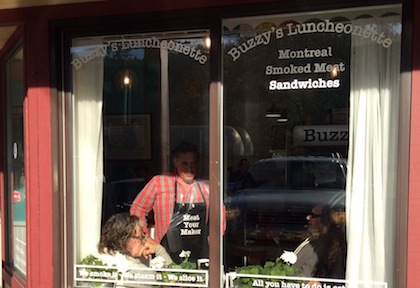
Howard Busgang’s father called him Buzzy, hence the deli’s name. (photo by Cynthia Ramsay)
And it’s hard work. There is only one staff member. Busgang smokes meat “around the clock,” said Weaver. “It’s like having a newborn. It’s a lot of work but the rewards – it’s a community, we’ve become part of a community and it means so much. My daughter gets to work the cash register. It’s crazy. We still can’t believe we have keys to this place.”
She said, “If we did anything right, it’s that we didn’t focus on the tourists, we focused on our people, and so we have a lot of loyalty here. I think people also come here [because] there’s a lot of cursing, a lot of bad behaviour, you can come here and just laugh, and that’s what we want. Come here, have a laugh, I’ll make you eat, you have to finish your plate or you go to your room. That was our business plan – make the community happy, hopefully make a few bucks.”
Since they opened, the menu has seen some additions; in particular, matzah ball soup and tomato soup. “We don’t want to get too big. We just want to stay like someone’s kitchen,” she said.
And the island has been very welcoming. “Someone knew that we want to make our own pickles, so they’re going to grow us cucumbers,” said Weaver as one example. “The love here,” she said, “it’s insane.”
Hannah, who had checked in a couple of times with her mother, joined the interview. In addition to sometimes working the cash, she delivers food to the Saturday market and to the bar a few doors down from the deli.
“That’s another thing,” said Weaver, “it’s a family joint.”
School runs four days a week and, while Hannah enjoys helping out, she was still getting used to living on the island. When she’s not working or at school, she’s probably at soccer or horseback riding; she had just received a paddleboard for her birthday. Though she has a couple of sandwiches named after her, her favourite is the grilled cheese.
“A lot of what we’re doing here has to do with taking the power back in our lives,” said Busgang, when he returned to the table. “It has to do with being in showbiz all those years and feeling like you had no control over anything and feeling like you’re handing over all the power to other people to validate you…. I was tired of it.”
Buzzy’s opened on June 22 last year. “Whereas, in show business, nobody wants to help you, in this business, I have so many people who want to help me.”
One of those people was William Kaminski, owner of Phat Deli in Vancouver, who Busgang described as a mentor.
“We’re not perfect but we’re figuring it out,” said Busgang.
The smoked meat he has got down to a science.
“We’re open till four o’clock and then I have to get my brisket ready for the next day, so I have to bathe the brisket,” he said. “We cure it for eight days – dry cure – and then I have to take the salt out, so we bathe it. I’m bathing a brisket right now and sometimes I sing to it. It’s very sweet. After I bathe it, then I put some rub on it and then I’ll take it home and we’ll smoke it for seven-and-a-half hours. And then it goes in the steamer for two, three hours.”
Finding rye bread was one of the early challenges.
“I knew I was in a special place,” he said, “because people would come by with bread and say, ‘Try this bread.’ They’d constantly come in and say, ‘What are you going to do about the bread?’ It became like a cause célèbre, the bread. It took me three months, and I got someone here on the island to make me an organic rye bread.”
Barb Slater makes the bread; Shigusa Saito, the knishes. Saito is now also “making a dark chocolate babka to die for,” wrote Busgang in a follow-up email. “If you’re not already dead, she’s also making us New York cheesecake, our soon-to-be-famous potato knishes, and rugelach.”
Meanwhile, Busgang – whose credits include having been a head Just for Laughs-gala writer, creating the award-winning sitcom The Tournament and writing for TV series Boy Meets World and Good Advice, among many others – is still writing, still pitching shows. Earlier that afternoon, he was slicing meat while plugged into his phone, listening to a meeting in which a producer was trying to put a deal together.
Weaver popped out to say that Busgang often has to go next door to finish his calls because the meat in the charger of his cellphone prevents his phone from charging. “There’s meat everywhere,” she said.
The November sunset as seen from the ferry, en route home. (photo by Cynthia Ramsay)
A couple of relatively new customers stopped to say hello to Busgang and Weaver. They said they were slowly adding Buzzy’s to their list of usual places to eat.
And, said Busgang and Weaver, local Jews have discovered, by going to Buzzy’s and meeting fellow Jews, that there actually is a Jewish community on the island.
“We’re blessed to have this,” said Busgang.
As he explained the deli’s name – his father called him Buzzy – Hannah returned, offering him a taste of a new salad dressing she had created. “Daddy, just try it.”
“Interesting,” he said, “I like it.”
“It’s gross,” she corrected him.
Three generations seemed present in that moment.
As the interview came to an end, Busgang asked, “Do you want some rugelach? I gotta keep feeding you.”
Owner Cynthia Miller in front of Sechelt Inlet at the Pacific Peace Retreat. (photo by Efraim Gavrilovich)
Travel can be one of the most stressful activities there is. The challenges of packing “light” so you don’t have to pay for a carry-on; getting to flights at ridiculously early times of the day; not to mention dealing with foreign currency, travel insurance, airport lineups, lost luggage, strange food and the fear of contracting some exotic illness while away.
When was the last time you took a trip that not only caused minimal anxiety but actually resulted in you coming home more relaxed and truly blissful? And, more than that, with the knowledge of how to maintain that calm once you’re back at home and the stress threatens to build again? Thankfully, we live in an area of the world where such vacations are an easy option within a day’s drive of the Lower Mainland.
Along the Sunshine Coast, less than two hours’ drive from Langdale, is the Pacific Peace Retreat, where owner Cynthia Miller enables visitors to learn how to shift their mindset by being mindful and aware in the moment.
“I help them see the bigger picture instead of focusing on the problem,” she explained. “Too many people talk about the problem without really seeing the deeper aspect of what’s holding them stagnant.”
Miller provides transformation and relaxation through hypnotherapy, reiki, yoga, aromatherapy, creative arts and mindset coaching.
“I believe that we inherently want to move forward and feel a sense of growth,” she said. “And, when you step back and see your life or past from a different viewpoint, you begin to open up to something new, and that’s when growth takes place. Being mindful of the energy you want to put into every situation – that’s what we practise here.”
Miller cautions that mindfulness does take repetition. “As you practise, it becomes automatic,” she said. “I think that’s why people come here.”
At Hollyhock Leadership Learning Centre on Cortes Island, guests can take one of 90 courses offered on everything from discovering your life’s purpose to mindful self-compassion. They range from several days to several weeks.
Hollyhock Garden (photo by Darshan Alexander)
“It’s learning about yourself and how you operate in the world,” said Loretta Laurin, Hollyhock’s communications manager. “We play a part in making the world better through our own development.”
Although many of the courses are geared toward people who are in a leadership or change-maker role, there are also courses that focus on health and wellness, such as cooking courses that help boost the immune system, pilates, qi gong, and self-expression with sound, as well as excursions such as sea-kayaking and nature walks. Everyone is welcome to attend, said Laurin.
Calling itself a “centre for transformative learning,” the Haven on Gabriola Island helps bring balance to people’s lives through coursework, meditation and yoga.
“There’s a real shift in energy level and transformation,” said Jo-Ann Kevala, a Haven faculty member. “People feel more connected to others.”
Even simple activities like walking can be very mindful and meditative and a way to relax into the present, said Kevala.
The Haven offers courses for women or men, couples or singles, those with high stress and those with addictions. Its signature five-day Come Alive program is an “opportunity to revitalize your life, discover and activate your resources and realize your full potential.”
Quantum Leaps Lodge in Golden offers a variety of practices that will get visitors in touch with their calmer selves. (photo from Quantum Leaps)
A little further afield, in Golden, visitors can participate in shamanic drumming, Buddhist philosophies and First Nations activities, such as sweat lodges or vision quests, at Quantum Leaps Retreats.
Owners Brian Olynek and Annette Boelman have accumulated a wide variety of self-discovery practices.
One of the more popular activities is the transformational labyrinth, with several spots to sit and think about specific ideas or create something, according to instructions at each spot. The concepts for the labyrinth are based on those of Buddhist monk and world spiritual leader Thich Nhat Hanh, known for his writings on mindfulness and peace. People are encouraged to walk the labyrinth as often as they want and not worry about time.
While much of the world encourages stress and materialism, at Quantum Leaps, said Olynek, “people step out of fear and stress and tap into their own happiness and joyfulness.”
Baila Lazarusis a Vancouver-based writer and principal media strategist at bailalazarus.com.
What is the origin of wearing costumes on Purim? One theory relates to the fact that the Jews in the Purim story live in the galut (“exile,” outside of Israel). Haman says to the king: “There is a certain people scattered abroad and dispersed among the peoples in all the provinces of thy kingdom and their laws are diverse from those of every people; neither they keep the king’s laws.” One might say, these Jews in Shushan are the minority in a Christian country who disguise themselves or mask their identity by trying to dress like the majority and blend in.
Probably the closest explanation as to why we wear costumes is because Esther masqueraded as a non-Jew and dressed up as a queen. Esther also hid her assertiveness and her strength – and her Jewish identity – until she had no other choice. One source has said wearing costumes is to imitate the costume parties of the court mentioned in the story.
Another source says traditional Jews believe that G-d is hidden behind all the events of the Megillah. Although there is no mention of G-d in the Book of Esther, we believe he had a hand in the saving of the people. In a sense, he was masked or disguised and rabbis referred to G-d’s role as “hester panim,” or “hiding of the face,” which is also said to be a play on the words Megillat Hester, rather than the Hebrew name for the Book of Esther, Megillat Esther.
Philosophers and scriptural commentators believe that G-d’s name is omitted to emphasize the very point that G-d remained hidden throughout the story, but was nonetheless present and played a large role in its outcome. Megillat Esther may show that, although G-d may not be conspicuously present at times, he nevertheless plays an important role in everyone’s lives and that of the Jewish nation. In remembrance of how G-d remained hidden throughout the Purim miracle, Jews dress up on the holiday and many hide their faces.
Another explanation is in the Book of Esther’s eighth chapter, verse 17: “And many from among the peoples of the land became Jews, for the fear of the Jews was fallen upon them.” Non-Jews converted or perhaps pretended or disguised themselves as Jews for fear of Haman’s fate befalling them.
We do know for sure that the Book of Esther and the Talmud never discuss Purim costumes.
One source says the costumes and masks originated at the end of the 15th century among Italian Jews, influenced by the country’s carnivals. From there, the custom spread across Europe and to other countries where Jews lived, except perhaps the Far East.
Another source contends the custom could have originated in the medieval period in Germany and was an imitation of Christian carnivals, which took place around the same season.
Judah ben Eliezer ha-Levi Minz was a Venetian codifier of the 15th century, known as the “Mahari Minz”; he died in Padua, Italy, in 1508. In his responsa No. 17, quoted by Moses Isserles, the 16th-century rabbi and talmudist, in his book Orach Chayim (696:8), the Mahari Minz expresses the opinion that, since the purpose of the masquerade is only merrymaking, it should not be considered a transgression of the biblical law regarding dress, but he does not provide the origin of wearing Purim costumes. Furthermore, he permitted men and women to wear clothing of the opposite gender, even though this violates the biblical prohibition of cross-dressing (Deuteronomy 22:5). Some have speculated that it commemorates when Mordechai was dressed in regal clothing and escorted by Haman (Esther 6:11), a clear turning point in the plot of the story.
Although some authorities issued prohibitions against the custom of dressing up in costumes, people did not heed them and the more lenient view prevailed. Jews of the Middle East, however, did not start this custom until the 19th century.
Whatever its origins, dressing in costumes has been a tradition for many a Purim now, for adults and children alike. Purim sameach!
Sybil Kaplanis a journalist, lecturer, book reviewer and food writer in Jerusalem. She created and leads the weekly English-language Shuk Walks in Machane Yehuda, she has compiled and edited nine kosher cookbooks, and is the author of Witness to History: Ten Years as a Woman Journalist in Israel.