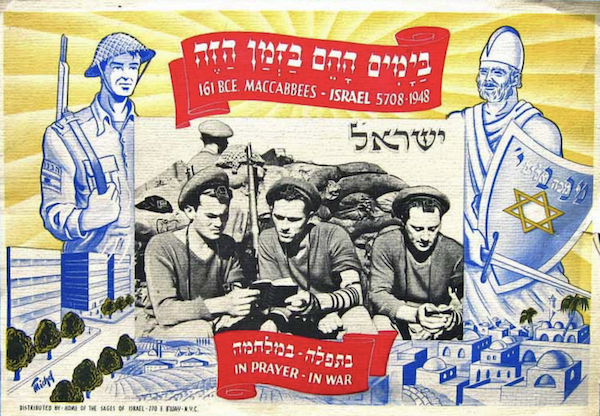
A postcard featuring the work “In Prayer – In War” by Polish-American artist and cartoonist Mitchell Loeb (1889-1968). (internet photo)
Of all the Jewish holidays, Hanukkah is the one most intimately connected to Israel and the Zionist dream. It mirrors the struggle to reestablish the Jewish state, and is perhaps more political in nature than religious.
Hanukkah represents Jewish military power and Jewish independence, which, in the case of the Hasmoneans, lasted 80 to 100 years. The Hasmoneans and their fellow second-century BCE Judeans were able to establish a state despite having had to face a strong and well-equipped empire. The odds were heavily stacked against them, yet they prevailed. This is why some people say that the Hanukkah story parallels the struggles and achievements of Israel’s first Jewish residents and founding pioneers, surrounded as they were by hostile neighbours.
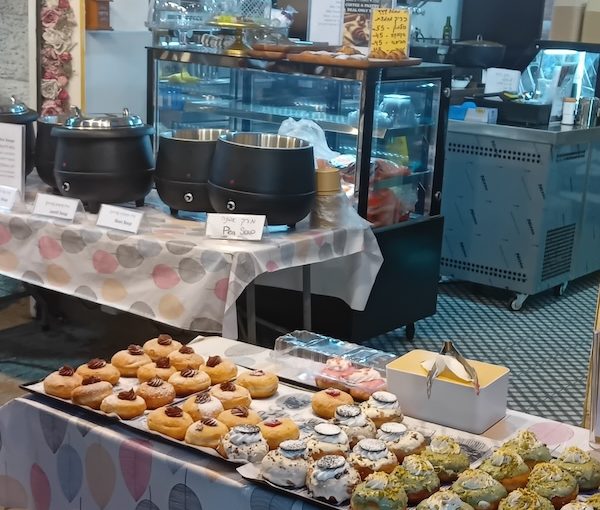
It is hard to claim that the miracle in which a tiny bit of oil lasted, not for one day, but for eight days, is a critical part of an Israeli Hanukkah. However, oil is a crucial part of the holiday. Sufganiyot (filled donuts), fried in oil, go on sale at least a month before the first candle is lit. (I saw them on sale in a Tel Aviv bakery on Nov. 10!) Nowadays, Jerusalem coffee houses and bakeries even have their sufganiyot rated by the media.
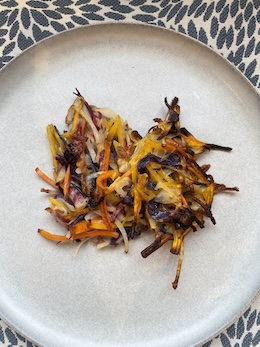
Potato pancakes (levivot, in Hebrew; latkes, in Yiddish) take second place to sufganiyot. Perhaps because levivot are generally products of one’s private kitchen, rather than a bakery, or perhaps because, as an historically Ashkenazi Eastern European food, it appeals to only half the Jewish population in Israel. The other half is Sephardi, meaning people whose long-ago origins were in Iberia, while, in the United States, no more than 10% of the Jewish population is either Sephardi or Mizrachi (Jews who came from Muslim-ruled lands). I couldn’t find any recent figures for Canada’s Jewish population by these measures.
As for levivot, they are no longer made just with potatoes. There might be additions or substitutions like sweet potatoes or zucchini, featuring spices such as cumin and paprika.
As many know, Israel’s climate is well suited to growing olives, and olive trees have grown here for centuries. The trees like the semi-arid climate, with our long, hot, sunny summers and mild, cool winters, as well as Israel’s rocky terrain. Generally, Israeli-grown olives are ready for picking starting just before Hanukkah. There are olive-picking festivals and such events highlight another difference between diasporic and Israeli observances of Hanukkah.
Those living in pre-state Palestine knew what Hitler was doing in Europe. According to historian Benny Morris, the Jewish population in Palestine was reading several newspapers at the time, like Ha’aretz, Davar and Do’ar ha-Yom.
The pre-1948 cultural products reflect not only what Palestinian Zionists knew about the fate of European Jewry, but also an ideological effort at creating a new national character. This “new” Jew would not be a victim. He would be a kind of new Maccabee. According to historian Reuven Firestone, the new Zionist Jew would be strong, confident and effective, and the very act of developing the land of Israel would, in turn, develop the Jewish psyche and person.
So, Hanukkah songs written in either the pre-state or early statehood days focus on the success of Zionist fighters more than they do the accomplishments of the Maccabees. In 1936, Menashe Ravina composed the song “Mi Yimalel.” Its lyrics are: “Who can retell the mighty deeds of Israel, who can count them? / In every generation a hero will arise, a redeemer for the people. / Listen! / In those days in this time / The Maccabee saves and redeems / And in our day the whole people of Israel / Will join together and arise and be redeemed.”
In the 1940s, Sara Levi Tanay wrote the words and Emanuel Amiran wrote the music for “Ba’anu Choshech Legaresh.” The idea is that, by banding together, the state can survive: “In our hands are light and fire. / Each person is a small light, / And all of us a great light. / Go away darkness, away, obscurity! / Make way for the light.”
Starting in the 1940s, the Young Maccabees organization began a torch race on Hanukkah. This race was unique to Israel’s celebration of the holiday. It began in the Modi’in area, where it is believed the Maccabees are buried, and was held in all kinds of weather. In December 1954, for example, when the runners reached Jerusalem, it was pouring rain. Israeli youth organizations like the Scouts hold marches and hikes on Hanukkah.
Ironically, the original torch races, called lampadedromia or lampas, took place in ancient Greece, as part of religious festivals honouring the gods of fire. I say ironically, as the Maccabees fought for their independence from the Syrian Greeks of the Seleucid Empire, which was a Greek successor state to Alexander the Great’s empire. The Seleucid empire, under Antiochus, ruled over Judea. It desecrated the Temple in Jerusalem and sought to forcefully impose Hellenistic culture and religion on the Jewish population.
Today, in both Israel and in the diaspora, chocolate coins, usually wrapped in gold or silver foil – the 1920s brainstorm product of Loft Chocolate Company – are given to children during Hanukkah. Probably not too many people are aware of this, but, according to Rabbi Deborah Prinz, this edible gelt (money, in Yiddish) recalls the booty, including coins, that the Maccabees distributed to Jewish widows, soldiers and orphans, possibly at the first celebration of the rededication of the Jerusalem Temple. Also, in ancient Israel, striking, minting and distributing coins expressed Hanukkah’s message of political autonomy. The Maccabees’ descendants, the Hasmoneans, ruled Judea, as mentioned above, and issued their own coins.
Finally, a column in the Great Mosque of Gaza once bore inscriptions in Hebrew and depicted a seven-branched menorah (like the one used in the Temple), a shofar and an etrog, indicating a Jewish community in the area during the Roman/Byzantine and talmudic eras. These inscriptions apparently disappeared after the First Intifada in 1987. The Hanukkah menorah, or hanukkiyah, by contrast, has nine branches, commemorating the eight days the oil burned in the rededicated Temple, plus a shamash (helper) candle to do the lighting of the symbolic candles.
Deborah Rubin Fields is an Israel-based features writer. She is also the author of Take a Peek Inside: A Child’s Guide to Radiology Exams, published in English, Hebrew and Arabic.