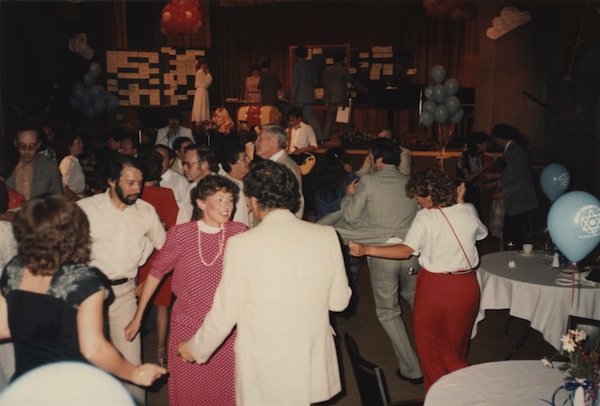
Dancing at a Jewish Community Centre party, 1984. (photo from JWB fonds, JMABC L.11733)
If you know someone in these photos, please help the JI fill the gaps of its predecessor’s (the Jewish Western Bulletin’s) collection at the Jewish Museum and Archives of B.C. by contacting [email protected] or 604-257-5199. To find out who has been identified in the photos, visit jewishmuseum.ca/blog.
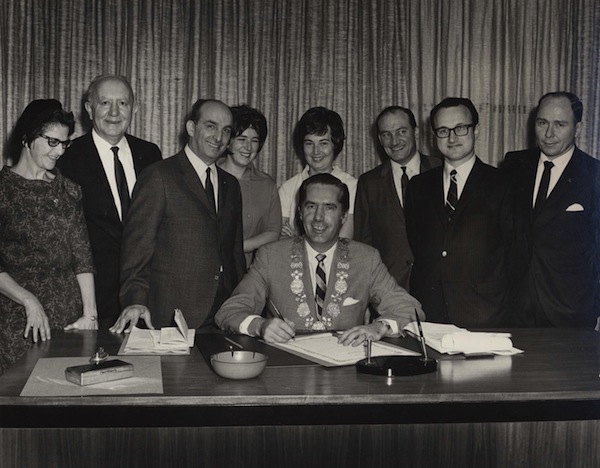
Then-mayor of Vancouver Tom Campbell, centre, with a group of unidentified people, with the exception of Alec Jackson (third from left) and Dave Jackson (sixth from left), in 1968. (photo from JWB fonds, JMABC L.12174)
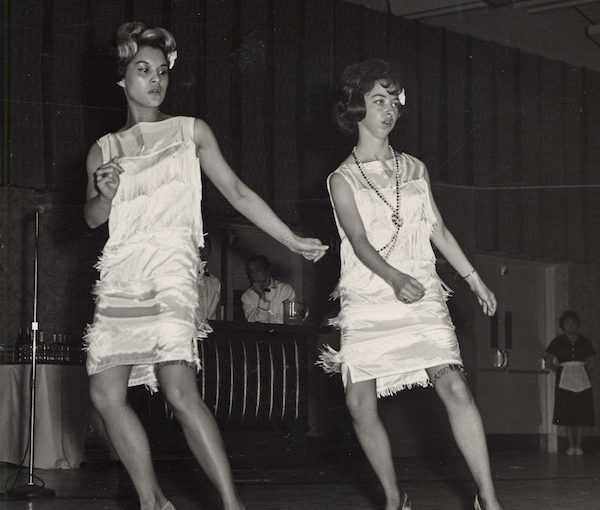
Two women dancing, 1965. (photo from JWB fonds, JMABC L.13986)
If you know someone in these photos, please help the JI fill the gaps of its predecessor’s (the Jewish Western Bulletin’s) collection at the Jewish Museum and Archives of B.C. by contacting [email protected] or 604-257-5199. To find out who has been identified in the photos, visit jewishmuseum.ca/blog.
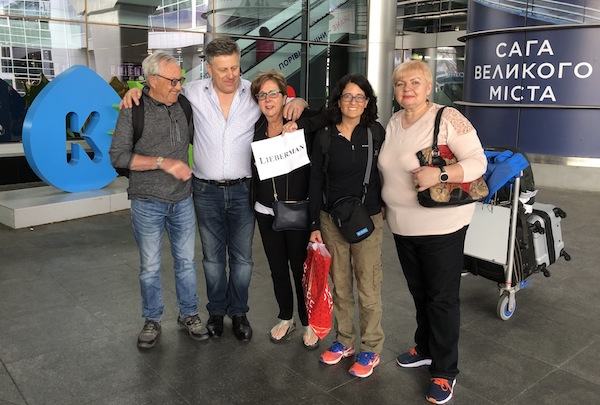
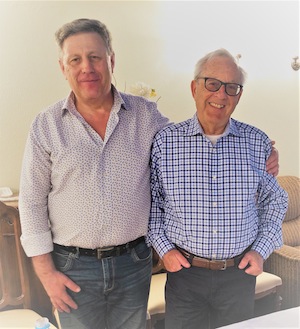
Left to right: Lucien, Grisha, Carole, Leanne and Svetlana at the airport in Kyiv, Ukraine. (photo from Carole Lieberman)
My husband Lucien, our daughter Leanne and I recently traveled to Kyiv, Ukraine, to meet Lucien’s first cousin and his family for the first time.
History has an interesting way of unfolding. Lucien’s father was one of 10 children born in Russia. The oldest daughter Sophie immigrated to Canada in 1912, to marry a farmer living in Rumsey, Alta. In 1923, Lucien’s grandparents, along with four of their children, including Lucien’s father Leo, made the cross-Atlantic journey from Russia to Alberta. Sadly, in 1927, their daughter Lucy, for whom Lucien was named, ended her life there at age 25 and, in another tragedy, their daughter Sophie, mother of five young children, was widowed.
Shortly after these tragedies, their daughter Manya chose to return to Russia on her own. And, in 1928, the grandparents were determined to return to Russia. And so, in November of that year, two brothers – Leo Lieberman, 33, and Sam Lieberman, 29 – embraced at the Calgary CPR station. Sam was escorting their parents back to Russia. Since their parents were in their 60s and were considered elderly, they could not manage the trip on their own. Sam expected to return to Canada once their parents were settled in Kharkov, but he never did. The brothers’ last words were about Leo’s new winter coat. “Leo, I like your coat. Where I am going you can’t find such a coat.” So, the brothers exchanged garments. They did not meet again until 1966, when Leo and his wife Clara went to the Soviet Union to try and find family.
Cousins Grisha, left, and Lucien. (photo from Carole Lieberman)
Lucien grew up in Calgary aware that his parents had both left large families in the Soviet Union and that the Second World War had devastated those families. Sam’s story was tragic. He worked in Moscow in the 1930s as a translator. When the war came, he was taken into the army and survived four years in combat roles. He was wounded and, in 1946, he was arrested, charged and tried for the offence of being “anti-social to the regime” and sent to the Gulag, where he laboured for 10 years in a camp beyond the Arctic Circle. After Stalin’s death, Sam was discharged and allowed to return to his city of last residence, Chernivtsi in the Ukraine. There, at the age of 57, Sam married a younger woman and fathered a son, Gregory (Grisha).
The next generation of family in Canada always knew about Uncle Sam and Cousin Grisha. We had heard that Grisha lived in Madagan, which is closer to Anchorage than to Moscow. Decades passed without any contact but finally, in 2016, we learned that Grisha, his wife Svetlana and their two children were living in Kyiv, the capital of Ukraine. We met our new cousins on Skype in 2017 and began to catch up on decades of this lost connection.
Grisha and Svetlana’s son, Stanislaus Lieberman, is married to Natasha, has a 2-year-old daughter and is a lawyer in Kyiv. Their daughter,
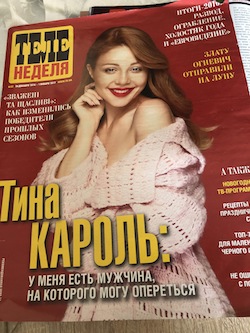
Tatiana Lieberman is known throughout Ukraine as Tina Karol. (photo from Carole Lieberman)
Tatiana Lieberman, affectionately called Tinotchka, is known throughout Ukraine as Tina Karol (tinakarol.com). Tina is a renowned singer who represented Ukraine in the 2006 Eurovision competition at age 21. She is the “face of Ukraine,” with billboard ads throughout Kyiv for Huawei and many cosmetic companies, and has the largest fan club in all of Ukraine. Her 10-year-old son Veniamin attends school in England and returns to Kyiv frequently. Tragically, Tina’s husband, Eugeny Ogir, who was her manager, died in 2013 at the age of 33, shortly after being diagnosed with an aggressive form of cancer.
Grisha speaks a reasonable amount of English and, thanks to Google Translate, we communicated well. We came to feel very close to our cousins after many Skype visits and plans were made to visit. There was no discussion – they insisted that we stay with them in their apartment so we would really get to know one another. It certainly was not our custom to stay with people we had never met in their two-bedroom, 1.5-bathroom apartment for eight nights but the visit was incredibly memorable and very special. Days before our arrival, Svetlana wrote that “they were trembling with anticipation.” We felt the same.
Our daughter Leanne, a teacher and a published author, met us at the airport in Kyiv. We were welcomed at the airport with a “Lieberman” sign and the warmest hugs and happiest tears. Throughout the visit and several times every day, Grisha would grab Lucien, hug and kiss him, saying, “You are my dear cousin.” Despite the 18-year age difference, there was a very strong cousin connection between the two men, cemented further by the traditional home-cooked Ukrainian food that we were so generously fed each day. We awoke to the smell of kreplach, borscht, haluptsi, cheese latkes and potato pancakes prepared by Svetlana and we enjoyed eating delicacies such as forshmuk, a chopped white fish salad. It was food that was so reminiscent of what Lucien’s mother had prepared for him when he was growing up in Calgary. We all laughed together when we were offered barbecued “kitchen.”
Our entire week was planned in advance and included not only family visits and meals, but a visit to a wonderful Ukrainian folk dance show at a huge auditorium where we were seated in the president’s box, welcomed with a champagne reception and presented with traditional Ukrainian outfits for Vishivanka, all arranged by Tina. Tina’s driver took us to a 26-acre monastery for a private tour and we were taught how to make varenikes in a private master class at lunch.
We gained a good sense of Tina’s personal life when we visited her stunning home and gardens, complete with a 24-hour armed security guard. Tina’s fans adore her and swarm her when they see her out in public.
Kyiv is a stunning city, with the Dneiper River running from north to south. The climate is warm in spring and the air is often beautifully fragrant with the scent of acacia trees, stronger in the morning and in the evening when we all strolled along the river. It has beautiful kashtana (chestnut) and lilac trees and a number of impressive bridges and lookouts. There are many parks, huge squares and an excellent subway system, accessed with the longest imaginable escalators. Like so many cities, it has far too much traffic (propka).
Tina arranged a private guided tour of Babi Yar for us with an English-speaking local woman. Babi Yar is now a beautiful treed park approximately a kilometre square in the northwest outskirts of Kyiv. On Sept. 29, 1941, Nazi troops rounded up Kyiv’s 34,000 strong Jewish community and massacred them all within 48 hours. Victims were shot and buried in the ravine. The Nazis then rounded up the local Romany people and residents of mental hospitals and extended the killing. During the two-year Nazi occupation, more than 100,000 bodies were dumped into the Babi Yar ravine. When the Red Army recaptured the city in 1943, there were only 80,000 people in Kyiv, one-tenth of its former population.
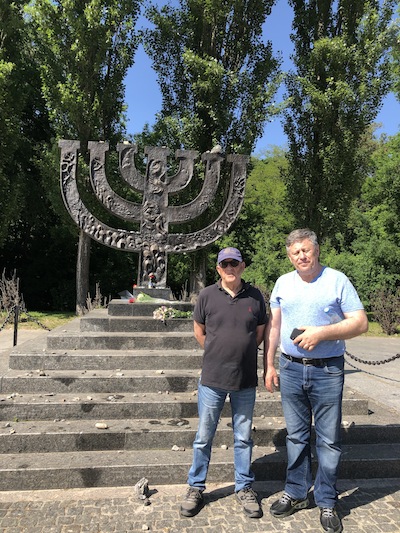
Lucien, left, and Grisha at Babi Yar. (photo from Carole Lieberman)
Today, there is little evidence of a deep ravine, only undulating terrain. There are numerous monuments, some remembering the many children killed, several with Hebrew inscriptions, and a beautiful bronze wagon, which depicts a typical Roma caravan. After the dissolution of the Soviet Union, the Ukrainian government invited the state of Israel to erect a monument, which was done in the form of a large menorah. Babi Yar is possibly the most prominent site representing the Holocaust in the former Soviet Union.
During the week that we were in Kyiv, a new president was sworn in. With Svetlana, we watched the televised inauguration of President Volodymyr Zelenskiy, a 41-year-old former comedian and the first Ukrainian president with a Jewish background, and we loved seeing Svetlana proudly sing the national anthem, in tears.
We visited Maidan, the central square of the city, saw the parliament buildings and surrounding Marinsky Park. We toured a fascinating military museum, visited an old synagogue and were taken to the famous opera house, where we thoroughly enjoyed seeing the ballet.
Every day was full of memorable moments. We spent several evenings sharing family photos – it was fascinating to see photos of us from the 1970s and ’80s, which were mailed to them by my in-laws and other relatives before we lost contact. We laughed, hugged, cried and shared stories, always with “Grishinke” grabbing and kissing “Lucienke” and proudly saying, “you are my cousin.” Together Grisha and Lucien enjoyed shemiskes, aka sunflower seeds, that only people who were raised by siblings would enjoy the same way.
We celebrated our last night together at a beautiful restaurant overlooking the river and marveled that the restaurant, like many other quality restaurants, had an excellent playroom where Stanislaus’s daughter Vesta played while we dined.
When we finally hugged everyone goodbye and thanked them for a visit that exceeded every expectation, Grisha responded, “I am the son of Sam.”
In 1951, after spending five years in the Gulag, a fellow prisoner was released and Sam asked him to please send a letter to his brother Leo informing him that he was still alive, giving him the address – Leo Lieberman, Calgary, Alberta, Canada. When the man was able to mail the letter, he omitted “Calgary” and the letter ended up in the Edmonton post office. The letter was sent to a Mr. Lieberman in Edmonton by a caring employee and was subsequently forwarded to Leo Lieberman in Calgary.
Carole Lieberman, a longtime Vancouver resident, is originally from Montreal. She is a mother of three, grandmother of four, and has enjoyed selling Vancouver real estate for almost 30 years.
There’s no denying that food is an insanely large part of Jewish life. Whether we’re cooking it, eating it or writing about it, our lives inexorably orbit around it. It’s true that most religions celebrate their holidays, at least partially, through food. But we Jews have taken the concept to nosebleed-worthy stratospheric heights. If someone tells you their son is becoming bar mitzvah, our first question is not “Which shul?” but “What are you serving?” A bris? We don’t ask: “What time?” but rather, “What can I make?”
It’s not that modern-day Yiddishkeit revolves around food, but it kinda does. I’m fully aware that we’re supposed to focus on blessing and elevating the food we eat, since it is meaningless on its own. From a religious perspective, food is merely the vehicle to give us the strength to do mitzvahs and study Torah. I get it. But how can you ignore the deliciousness of a rock-star chicken soup or a melt-in-your-mouth brisket?
When you pair Rosh Hashanah and food, what do you get? Pure joy. And maybe a little indigestion, if there’s excess onion and garlic on the guest list. We all know that the High Holidays are a time to relax with family, eat lovingly prepared meals and go to shul. And, while shul is certainly important, for some, the highlight is the food.
From many years of observation, I’ve deduced that there are three main contenders at the Ashkenazi Rosh Hashanah table: matzah ball soup, brisket and gefilte fish. And maybe chicken. Or salmon, if you’re a true Vancouverite. Anything else is considered “alternative.” Seriously, when was the last time someone served tofu or sunomono at Rosh Hashanah dinner? Asked and answered.
Being firmly entrenched in the carnivore camp, I decided I’m going to make a pot roast for Rosh Hashanah this year. Being a pot roast virgin, until recently I knew next to nothing about this cut of meat or how to cook it. How did I get to be 63 years old without knowing these things? Rhetorical question. Anyway, I did what any self-respecting Accidental Balabusta would do – I Googled it. I found a recipe from the Food Network by Ree Drummond, called Perfect Pot Roast! I followed the recipe religiously (OK, minus the sheitel), except I made a mini-roast (one-and-three-quarter pounds) in case I screwed it up. And I used beef blade roast, which is the same as chuck roast, apparently. I cooked it at 275˚F for two-and-a-half hours. It turned out as scrumptious as something a bubbe would make. Only better. Modesty, wherefore art thou?
Over the years, I’ve heard gossip about pot roast: that it calls for a cheap, tough cut of meat (true); that it’s not really a Jewish cut of meat (see Snobbery 101); and that only goyim eat it (see Racism 101). I’m living proof that pot roast is a very Jewish thing. And, excuse me if I brag, but my newfound pot roast is beyond delicious. Or, to use the vernacular, a mechaye.
I feel compelled to mention something a little odd at this juncture. When I brought my first pot roast and took it out of the package, I noticed it had heavy twine wrapped around it. I wondered whether I’d purchased the B&D variety by mistake. Googling the twine part set my mind at ease. I mean, who wants to serve a kinky Rosh Hashanah pot roast?
Call me clairvoyant or, on second thought, don’t (that’s really not a Jewish thing), but I think you might be chomping at the bit for this recipe. Wait no longer. Allow me to introduce you to the Perfect Pot Roast by Ree Drummond. BTW, it calls for a Dutch oven, but any deep, covered roasting pan will do just fine. (Don’t feel bad, I had to Google Dutch oven, too.) Go ahead, cook it and tell me if this doesn’t taste Jewish.
PERFECT POT ROAST
Salt and ground black pepper One 3-5 pound chuck roast (same as beef blade roast) 2-3 tbsp olive oil 2 whole onions, peeled and halved 6-8 whole carrots, peeled and cut into 2-inch pieces 1 cup red wine (doesn’t need to be anything fancy) 3 cups beef broth 2-3 sprigs fresh rosemary 2-3 sprigs fresh thyme 2-3 potatoes, peeled and cut into pieces
Preheat oven to 275˚F.
Generously salt and pepper the roast.
Heat the olive oil in a large fry pan or Dutch oven over medium-high heat. Add the halved onions to the pot, browning them on both sides. Remove the onions to a plate.
Throw the carrots into the same fry pan or Dutch oven and toss them around a bit until slightly browned. Set aside the carrots with the onions.
If needed, add a bit more olive oil to the fry pan or Dutch oven. Place the meat in the fry pan or Dutch oven and sear it for about a minute on all sides, until it is nice and brown all over. Remove the roast to a plate.
With the burner still on medium-high, use either red wine or beef broth (about one cup) to deglaze the fry pan or Dutch oven, scraping the bottom with a whisk. Put the roast back into the Dutch oven (or deep, covered roasting pan) and add enough beef broth to cover the meat halfway.
Add in the onions and the carrots, along with the fresh herbs. Add potatoes, too (optional).
Put the lid on, then roast it.
The original recipe says to roast a three-pound roast for three hours or a four-to-five-pound roast for four hours. I personally don’t think this is nearly time enough. When I cooked two two-pound roasts in a single roaster at once, it took six-and-a-half hours to cook. The roast is ready when it’s fall-apart tender. I think the longer you cook it, the more tender it gets. It’s hard to screw this up, unless you undercook it.
Important note: don’t get too close to your Dutch oven when you lift the lid during cooking or you’ll get what I call the “pot roast facial.” I’m not sure your pores will appreciate all that meaty steam. But who am I to say? Just don’t blame me if you get third-degree facial burns. Bon appetit! Or, eat it and weep. From joy, that is.
May you all have a happy, healthy, prosperous and peaceful New Year!
Shelley Civkin, aka the Accidental Balabusta, is a happily retired librarian and communications officer. For 17 years, she wrote a weekly book review column for the Richmond Review, and currently writes a bi-weekly column about retirement for the Richmond News.
As I get older, I look forward to my childhood memories of the High Holidays with my original family. This year, Rosh Hashanah begins before sundown on Sept. 29 and ends on nightfall Oct. 1, Yom Kippur.
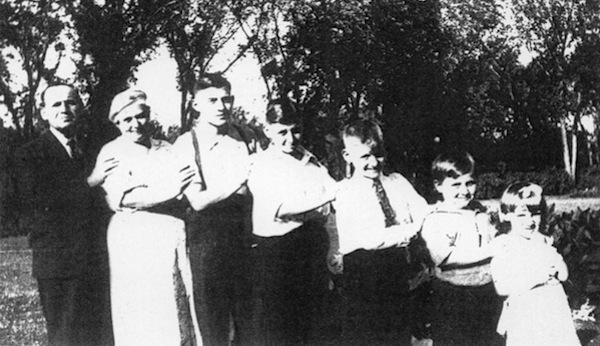
My parents, four older brothers and I had moved to several rental houses after our arrival in Winnipeg’s legendary North End, but the one on Robinson Street is the earliest in my awareness as a preschooler. The neighbourhood was refuge for a host of other immigrant Jewish families who came from the same geographical area and shared the same culture, language and religion. This bond and kinship brought these landsleit together and they congregated around the Talmud Torah Hebrew Free School, where my father taught the children, and the Chevra Mishnayes Synagogue, directly across from our house, giving us the opportunity to attend services in a building that also acted as an unofficial community centre.
Papa attended all Shabbat services at the shul, which was the centre of many family weddings, bar mitzvahs and funerals. Since we observed the Orthodox Jewish religion, women and men did not sit together, so, while the men were seated on the main floor, the women were sequestered in an upstairs oval-shaped balcony overlooking the activity below. Not particularly interested in the liturgy, they tended to talk to one another about their children, their homes and other areas of interest, especially cooking on the High Holidays. This “noise” often interfered with the men as they recited the prayers. At some point, the shamas (the person running the service) would look upward, pound on the podium and shout “Schveig, viber!” (“Quiet, women!”) as if we were all one big family. Things subdued for awhile until the chatter swelled again, requiring intermittent reminders with more pounding, and a commanding, “SHHAA!”
Our old, wood-framed house had a screened veranda where I played and sometimes slept on warm summer nights. Once I was old enough, on Saturday mornings, I was allowed to cross the street to join Papa after a bar mitzvah celebration. There were always treats after the service, and he would prepare a small plate of schmaltz herring and chickpeas for me, and a piece of honey cake for dessert. I loved schmaltz herring and would devour it quickly while Papa looked on with a broad, proud smile.
But clouds of the Great Depression hung heavy over this North End community and there was widespread poverty. Most women did not work outside the home and, like many other men, my father lost his teaching job for a period during the Depression.
When I accompanied Mama to the grocery store or the kosher butcher shop, I didn’t understand why her face flushed and her eyes looked away as she stammered out in Yiddish, “I need food for the children. Can you put this on credit? We will pay you as soon as we can.” Her embarrassment and humiliation collided with my father’s shame, and resulted in many heated arguments between them over money.
The stress was particularly hard on Mama because she wasn’t well and had a large family to care for. She developed a “milk leg” while pregnant with my youngest older brother, Matty. It created a painful swelling of the leg after giving birth, which caused inflammation and clotting in the veins and affects some postpartum women. I vividly recall the too-numerous times when an ambulance came tearing down Robinson Street to our house with wailing warnings. Big men dressed in white would rush in, lift Mama onto a stretcher and take her away amid the shrieking sirens that were now competing with the high-pitched howls of her two frightened preschoolers, Matty and me.
Back then, children were not allowed to visit in hospitals, for fear of transmitting disease, so we could not see our mother for intermittent periods. On one such occasion, my father had enough money to take us to the ice cream store a few blocks away. Holding Papa’s hand on one side, with Matty on the other, I felt safe as we all walked together. And the tears subsided.
Canada declared war on Germany in September 1939 after Hitler invaded Poland, and, although my parents’ family was safe in Canada, their hearts and minds were with the loved ones they had left behind. Yet, our home was filled with joy and laughter.
My mother played happy, lively Russian, Yiddish and Hebrew songs at the black upright piano that held a place of honour among the flowery wallpaper and sagging couches of our living room. The eldest of the five children would lead us in a conga line with me at the other end, and we would dance from room to room, up and down the stairs, and all around the house. Sometimes, he would pick me up, throw me over his shoulder and call out “A zekele zaltz!” like a peddler. “A sack of salt, I have a sack of salt for sale! Who wants to buy my little sack of salt?” Or sometimes I was “potatoes.” Whether salt or potatoes, he would haggle with whichever of my other brothers offered to “buy” me.
Although I was still a preschooler, I knew that Papa was listening to “the news on the radio.” The worry was in his eyes, his face, his body, and his words expressed his extreme concern for our families back in the homeland. But the true catastrophic human saga that was unfolding, even as he listened, would not emerge until the war ended. We would learn much later that most of the relatives left behind, including my maternal grandfather, died in the Holocaust.
Even Papa’s fears could not have fathomed such destruction. The radio had become so much a central focus and source of news that, when the war ended in 1945, I recall asking, “Papa, now that the war is over, will they close the radio?”
“Why do you think they will close the radio?” he asked with a puzzled look.
“Because what else would they have to talk about?”
Libby Simon, MSW, worked in child welfare services prior to joining the Child Guidance Clinic in Winnipeg as a school social worker and parent educator for 20 years. Also a freelance writer, her writing has appeared in Canada, the United States, and internationally, in such outlets as Canadian Living, CBC, Winnipeg Free Press, PsychCentral and Cardus, a Canadian research and educational public policy think tank.
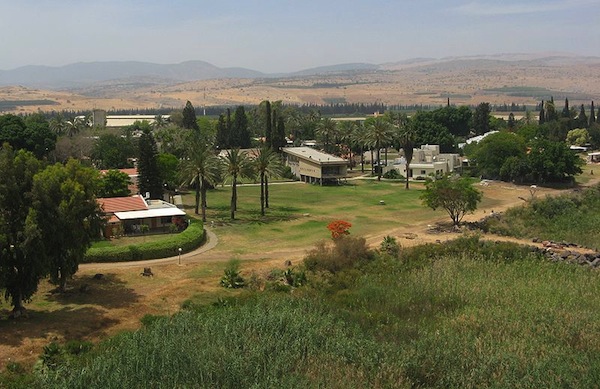
Planning a three-week trip to Israel last year, I booked a short kibbutz stay near the Sea of Galilee, the Kinneret. I chose Kibbutz Ginosar for no other reason than its location right on the water and ease of access to the various attractions in the area.
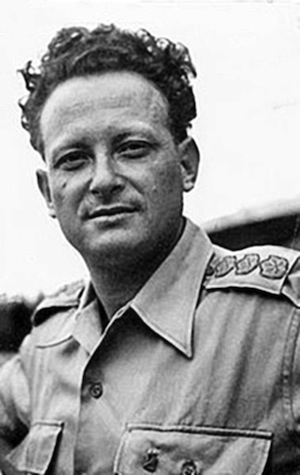
When I mentioned to an Israeli-Canadian friend the name of the kibbutz, she said, “Isn’t that Yigal Allon’s kibbutz?”
I like to imagine I have at least a passing knowledge of Israeli history, but the name meant nothing to me. As I have asked around since, I find the man’s name and reputation are not as widely known as they should be.
To back up: I did not go through the conventional kibbutz booking process. I found the charmingly comfortable but rustic cottage on Airbnb, a development around which the socialist Zionists of the Youth Aliyah who founded the place would doubtless have had trouble wrapping their heads.
In any event, I soon learned that Allon, who was born in 1918 in the Yishuv, was one of the founding leaders of the Labour movement. In the 1930s, he commanded field units of the Haganah during the Arab revolt and, during the Second World War, worked with British forces fighting in Syria and Lebanon. He later helped found the Palmach, the elite fighters of the Haganah, becoming deputy commander in 1943, and he was, from 1945 until the creation of the state, its commander. It was on Allon’s orders, received from David Ben-Gurion, that the Haganah shelled the Irgun ship Altalena, in June 1948, a pivotal moment in the creation of a unified Israeli military and, indeed, in Jewish and Israeli history.
Yigal Allon (photo from wikicommons)
During the War of Independence, Allon commanded forces in many major operations. In 1955, he was elected to the Knesset, serving 25 years until his death in 1980. He served, variously, as minister of labour, immigrant absorption, education and culture, as well as deputy prime minister. And here is a footnote to history with which you can entertain guests at your upcoming holiday celebrations: Allon served as prime minister of Israel.
Well … interim prime minister. In the three weeks between the death of Levi Eshkol, in 1969, and the ascension of Golda Meir to the Labour Party leadership and the prime minister’s office, Allon filled in.
Perhaps as intriguing, though, Allon was, in a way, the northern analogue to the southern Ben-Gurion. Ben-Gurion recognized the necessity of planting both human roots and agricultural roots in the Negev. Allon was an advocate for populating the northern part of the country after the War of Independence.
The Yigal Allon Centre, located on the kibbutz, celebrates “The Man in the Galilee.” In addition to telling the story of his life and career, the museum features an unrelated attraction that has become a must-see on Christian pilgrimages in the area.
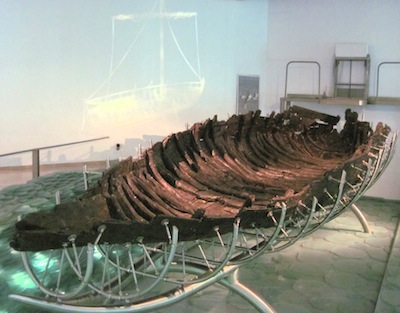
Somewhat serendipitously – bashert might be the better word – the kibbutz has enjoyed a giant spike in Christian tourism after the discovery, in 1986, of an ancient boat. During a terrible drought, when the waters of the Kinneret receded, local fishermen – brothers Moshe and Yuval Lufan – discovered the remains of a boat about 27 feet long and seven-and-a-half feet wide. Carbon dating indicated that it was probably from around the first century CE.
A 12-day, around-the-clock operation excavated the boat from the mud and prevented exposure to the atmosphere by wrapping it in insulating foam, which allowed the vessel to be transported safely and buoyantly. It was then submerged in a bath of wax for a dozen years, preventing the internal water and external air from disintegrating the structure.
There is not, of course, any evidence to say that the boat was ever touched by Jesus or his disciples, but the carbon dating to that time period has allowed entrepreneurial tourism officials to market the exhibit as of particular interest to Christian visitors.
The Sea of Galilee Boat or “Jesus Boat” on a metal frame in the Yigal Allon Museum in Kibbutz Ginosar, Tiberias, Israel. (photo by Travellers & Tinkers/wikicommons)
In Christian tradition, Jesus called on another pair of brothers – Peter and Andrew, fishermen on the Sea of Galilee, later beatified – to follow him and become “fishers of men,” proselytizers for the new religion, Christianity.
In the way that public relations can sometimes stretch credulity, the admittedly intriguing ancient find is sometimes marketed as “the Jesus boat,” which does nothing to discourage the backlog of tour buses that pile into Kibbutz Ginosar any given day of the week and whose passengers pack the adjacent gift shop.
With Ginosar as a base, travelers can easily drive south to Tiberias or north to the mesmerizing holy city of Tzfat, a centre of mysticism and kabbalah. The laid-back atmosphere of the kibbutz can also be a refuge from the hectic pace of Israeli tourism. Ginosar is home to Israel’s legendary Jacob’s Ladder music festival.
On our visit, our host invited us to an open-mic night. Not sure what to expect, we were greeted with one of the most memorable celebrations of our entire trip. Apparently, almost every kibbutz resident, human, canine and feline, plus visitors, showed up for a multigenerational celebration that seemed not so much about the music, although that was great, but about the utter joy of community.
The mountains of Sitka, Alaska. (photo by Deborah Rubin Fields)
“You have to look at Jews like Bina Gelbfish, to explain the wide range and persistence of the race. Jews who carry their homes in an old cowhide bag, on the back of a camel, in the bubble of air at the centre of their brains. Jews who land on their feet, hit the ground running, ride out the vicissitudes and make the best of what falls to hand, from Egypt to Babylon, from Minsk Gubernya to the district of Sitka.” (from Michael Chabon’s The Yiddish Policemen’s Union)
Unlike Bina Gelbfish, Lisa Busch is not a fictional character living in Sitka, Alaska. The executive director of the Sitka Sound Science Centre, she has lived in the city for 30 years. She and her husband have two daughters and are active in the local Jewish community. Busch described her congregation as laid-back.
A Tlingit totem pole on grounds of Sitka’s Totem Park. (photo by Deborah Rubin Fields)
The congregation functions out of people’s homes. It does not have its own building. What it lacks in a physical facility, however, it makes up for in creativity. “We share Shabbat and holidays,” said Busch. “When my kids were little, we had a tot Shabbat group of moms and kids and the kids did mitzvot, making challah for neighbours, etc.”
Also when her “kids were little, we put on a Purim play every year,” she said. “My family hosts a Passover seder every year and my husband makes homemade gefilte fish out of rock fish or halibut.”
Both of Busch’s daughters had bat mitzvah celebrations. They learned Hebrew via Skype and the family brought up a rabbi to oversee. Accordingly, the ceremonies were a mix of Jewish traditions and local ones.
Busch said Hebrew lessons are taught by whomever “we could find in town who was willing. For example, we have a Coast Guard air station and buoy tender here and, sometimes, someone was just in town for a few years and willing to pitch in with the teaching. Also, one of the more observant Jews here, David Voluck, spent time with my kids when they were older and met with them over Torah studies and Jewish ideas.”
Busch said, “I am so very appreciative of all the community members who helped educate our kids. I was raised a humanist Jew and, while I am confident in our Jewish values, there is always so much more to know, and having people around us who were willing to share what they know was so wonderful. I’m not sure I could have accessed those kinds of people or those kinds of lessons in a larger city.”
When asked who leads the congregation’s prayers and/or Torah reading, Busch said it’s the task of the person who suggests the event.
The Sitka Jewish community has contact with the congregations in Juneau and Anchorage. The city has had visiting rabbis from both places.
Nowadays, with her daughters grown up, Busch participates in Shabbat and holiday gatherings. What she likes best about her congregation is it casualness and flexibility.
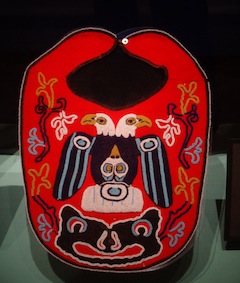
A Tlingit bib from a display at Sitka’s Sheldon Jackson Museum. (photo by Deborah Rubin Fields)
The flexibility of the Jewish congregation is reflected in the town as a whole, as today’s Sitka honours diversity. While this was not always the case – especially during the period of Russian rule (1799-1867) and when Alaska was a United States territory (statehood was achieved in 1960) – the culture of the indigenous Tlingit people is now highly respected.
There are examples, though, of acceptance that hearken to the past. One of the more humourous incidents involves St. Peter’s by the Sea, a small Episcopal church that is more than 100 years old. Before it opened in 1899, Bishop Peter Trimble Rowe and his congregants decided to include a rose window in the construction of the sanctuary. They placed an order with a glass company located in the eastern United States. They waited many months for the window to arrive. When the window finally came, they found that, instead of the Christian symbol that had been ordered as the focal point, there was a six-pointed Star of David. Considering the time it took to manufacture the window and the window’s complex dimensions, they decided to keep it. The church’s website notes that the Star of David window reminds congregants that Christianity grew out of Judaism.
The United States used Sitka as a defensive base in the Second World War. Ammunition magazines, gun emplacements and the headquarters command centre may still be seen at Fort Rousseau historic site. (photo by Deborah Rubin Fields)
Jews apparently began to live in Alaska shortly after the United States purchased the territory from the Russian Empire. A small group of Jews opened up shops in Sitka and, in 1868, a year after the U.S. purchase, Emil Teichman sailed to the city on behalf of the London Fur Co. He wrote in his diary: “the traders, keepers of billiard saloons and dealers in spirits … were mostly of the Jewish race and carried on a more or less illicit trade with the soldiers and Indians, evaded customs and excise duties, and were liable to prosecution at any moment had the administration of the law not been so lax.” (A Journey to Alaska) Interestingly, one Friday night, by chance, he passed a warehouse where some 20 Jewish men were conducting Sabbath eve prayers. Teichman commented: “Jews everywhere, even in the most remote countries, practise their devotional exercises. I should scarcely have expected it in Sitka among a community which engaged in such very disreputable occupations.”
Surrounded by water, temperate rainforests, wildlife and mountains, Sitka (visitsitka.org) is a very pleasant, picturesque and friendly town. It is not hard to understand why Jews have chosen to make it their home.
Deborah Rubin Fieldsis an Israel-based features writer. She is also the author of Take a Peek Inside: A Child’s Guide to Radiology Exams, published in English, Hebrew and Arabic.
***
Historic decision
In 1938, Harold L. Ickes, U.S. secretary of the interior department visited various parts of Alaska. He wanted to see whether the Alaskan territory could be used as a resettlement sanctuary for persecuted German Jews. Ickes maintained much of Alaska was uninhabited and underdeveloped. He believed that mass Jewish resettlement could potentially strengthen security in a U.S. territory then deemed vulnerable to attack. He had interior undersecretary Harry A. Slattery write a report, The Problem of Alaskan Development. The proposal advocated for the relocation of incoming European refugees into four main parts of Alaska. Opposition came from both within the American Jewish community and from without. Ultimately, the proposal failed, as President Franklin Delano Roosevelt did not give it his backing. Knowing today what happened to European Jewry over the next seven years, this was indeed a sad decision. See Gerald S. Berman’s article, “Reaction to the Resettlement of World War II Refugees in Alaska,” Jewish Social Studies 44 (Summer- Autumn, 1982): 271-282.
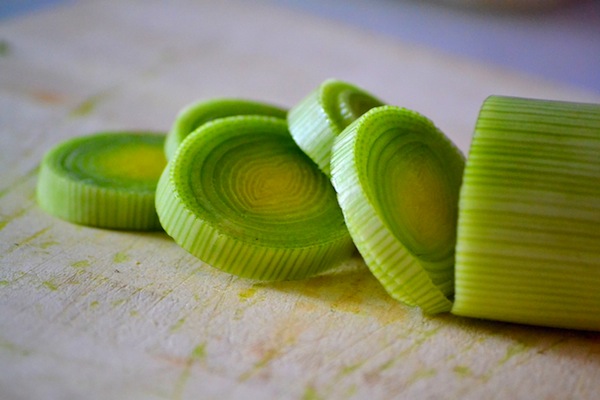
At a Sephardi Rosh Hashanah seder, one of blessings, over leeks (or cabbage) is the request, may “our enemies be destroyed.” (photo from Wikimedia)
Food customs differ among Ashkenazi and Sephardi Jews. For example, whereas Ashkenazim dip apple in honey at Rosh Hashanah, some Sephardim traditionally serve mansanada, an apple compote, as an appetizer or dessert, according to The World of Jewish Desserts by Gil Marks, z”l.
Just as gefilte fish became a classic dish for Ashkenazi Jews, baked sheep’s head became a Rosh Hashanah symbol for many Sephardi Jews, dating back to the Middle Ages. Some groups serve sheep brains or tongue or a fish with head, probably for the same reasons, for fruitfulness and prosperity and wishes for the New Year of knowledge or leadership.
The Talmud mentions the foods to be eaten on Rosh Hashanah as fenugreek, leeks, beets, dates and gourds, although various Jewish communities interpret these differently.
According to Rabbi Robert Sternberg, in The Sephardic Kitchen, Sephardi Jews have a special ceremony called the Yehi Ratsones (Hebrew for “May it be Thy will”), where each food is blessed. There are foods that symbolically recognize God’s sovereignty and our hope He will hear our pleas for a good and prosperous year.
The Hebrew word for gourds is kara, which sounds like both the word for “read/proclaim” and the word for “tear.” When we eat the gourd or pumpkin, there are two possible Yehi Ratzons that can be said. The first one goes: “May it be your will, Hashem, that our merits be read/proclaimed before you.” The other is that the decree of our sentence should be torn up.
The second food mentioned is fenugreek, or rubia, which sounds like yirbu, the Hebrew word for “increase.” Therefore, we say a Yehi Ratzon that contains the request, may “our merits increase.”
The word for the third food, leeks or cabbage, is karsi, krusha or kruv, which sounds like kares, or the Aramaic word karti, to cut off or destroy. The Yehi Ratzon asks, may “our enemies be destroyed.”
The fourth food, beets or beet greens, silka or selek, sounds like siluk, meaning removal, or she’yistalqu, to be removed, or the Aramaic word silki. The Yehi Ratzon requests that “our adversaries be removed.”
The last food is dates, tamri or tamar, which sounds like the Hebrew word sheyitamu and the Aramaic word tamri, to consume. Hence, we say a Yehi Ratzon that asks, may “our enemies be consumed.”
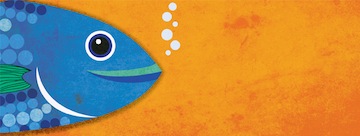
For many Jewish cultures, the fish head is a symbol on the Rosh Hashanah table. (image from chabad.org)
All of these foods, which grow rapidly, are also symbols of fertility, abundance and prosperity. Among other items that might be on a Sephardi table at Rosh Hashanah, Sternberg includes baked apples dipped in honey or baked as a compote with a special syrup; dates, which were among the seven species found in Israel; pomegranates, which have many seeds, or black-eyed peas, to represent our hoped-for merits; rodanchas, a pastry filled with pumpkin whose spiral shape symbolizes the unending cycle of life; and a fish head, symbolizing a wish to be the head in life, a leader, and not the tail. The main course might feature stuffed vegetables, symbolizing a year full of blessings and prosperity.
Some communities ban sharp, bitter or black foods for Rosh Hashanah, such as black olives, eggplant, chocolate or coffee.
In The Classic Cuisine of the Italian Jews, Edda Servi Machlin, z”l, who grew up in Pitigliano, Tuscany, explains that her father held a seder for Rosh Hashanah around the theme of growth, prosperity and sweetness. On the seder plate were a round challah, a boiled rooster’s head, fish such as anchovies, boiled beets, figs and pomegranates. In the centre was a dried, round, sourdough cake with an impression of her father’s right palm and fingers, and fennel weed growing on each side.
The foods were then blessed – “May we grow and multiply like fish in the ocean, like the seeds of a pomegranate, like the leavening, grain and fennel of the bread. May the year be sweet like beets and figs.”
The meal consisted of soup, fish, salad, chicken and fruit. Italian Jews also often serve at Rosh Hashanah desserts made with honey and nuts; stick or diamond-shaped cookies; strufali, cookies made of fried dough balls in honey; or ceciarchiata, cookies that resemble chickpeas and are made from bits of dough like the Ashkenazi teiglach.
A Greek cookbook writer from Ioannina (Yahnina) wrote that the people of her area made koliva, a thick porridge of wheat berries flavoured with cloves, cinnamon, walnuts and honey for eating on the eve of Rosh Hashanah. According to Marks in The World of Jewish Desserts, wheat berries are unprocessed whole wheat with the outer husk removed, leaving a nutty flavour and chewy texture. Jews of Yahnina also ate kaltsoounakia, a half-moon-shaped cake stuffed with ground walnuts, honey, cinnamon and cloves. For the main course, dishes in Yahnina were influenced by the Turkish occupation and included stuffed tomatoes, stuffed squash and stuffed vine leaves – filled with lamb, rice and parsley, as well as okra stewed with chicken.
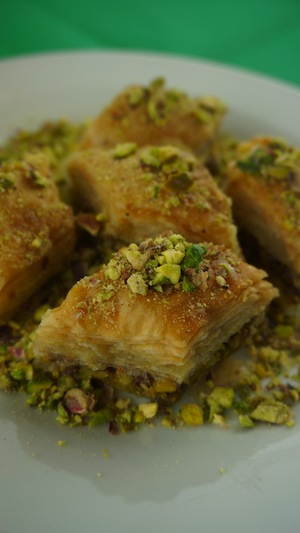
Instead of honey cake, Greek Jews might have baklava for Rosh Hashanah dessert. (photo from Wikimedia)
Other Jews of Greece have different customs. Nicholas Stavroulakis, author of Cookbook of the Jews of Greece, writes that some people soak apples in honey or eat quince or rose petals cooked in syrup as the New Year sweet. Fish is often the main course and, in place of honey cake for dessert, Greek Jews use almonds or pumpkin in making turnovers, as a symbol of abundance. Other desserts include semolina cake in syrup, pastry triangles filled with nuts or dried fruit, or baklava.
Among Jews of Syria, sugar or honey is substituted for salt at the table, and many families do not serve any dishes that are sour. For the second night Shehechiyanu blessing, the fruit used may be quince, prickly pear, star fruit or figs. Instead of, or in addition to, dipping apples in honey, Jews of Syria often dip dates in honey.
Many Jews from Muslim countries also eat autumn foods cooked with sugar and cinnamon; the food names contain a symbolic allusion to prayers in Aramaic and, through alliteration, are recited over the vegetables and fruits. Syrian Jews use the same prayers but over different vegetables: leek, Swiss chard, squash, black-eyed peas, pomegranate and the head of an animal. This idea of wanting people to be smart, as symbolized by the head or brain, is observed by Jews of Tunisia in their serving of a cake made with chicken and calves brains.
Moroccan Jews take sesame seeds, warm them in the oven and eat them with apple dipped in honey to symbolize that Jews should be fruitful and multiply like the seeds and have the sweet year. They also eat the pomegranate because of its alleged 613 seeds, which symbolize the 613 mitzvot. Moroccan Jews identify the seven autumnal foods as pumpkin, zucchini, turnip, leek, onion, quince and Chinese celery, and sprinkle these with sugar and cinnamon to eat at the beginning of the meal.
Some Moroccan Jews also serve cooked lamb head as an appetizer for Rosh Hashanah. Other lamb dishes served might be lamb with prunes and almonds or lamb intestines filled with rice, meat and tomato, seasoned with cinnamon and cardamom.
Another popular dish served by Moroccans for Rosh Hashanah is couscous, the traditional North African grain, or farina. It is steamed above a stew made with meat or chicken, chickpeas, pumpkin, carrots, cinnamon and raisins. Baked fish with the head, made with tomatoes and garlic, tongue with olives, or meat and rice rolled in Swiss chard are other Moroccan New Year’s dishes. Two soups that may be served are vegetable soup with pastels, a meat-filled turnover similar to kreplach, and potakhe de potiron, a yellow, split-pea and pumpkin soup. The evening may be completed with honey-dipped “cigars,” filled with ground almonds and traditional hot mint tea.
“Cigars” are traditional for Moroccan events and can be made sweet or savoury. The sweet version is a slim roll of Phyllo pastry filled with almonds, pistachio nuts or walnuts, baked or deep fried and sprinkled with confectioner’s sugar. Savoury cigars may be filled with cheese, chicken, meat, potatoes or tuna.
For Rosh Hashanah, Jews of Egypt make loubia, a black-eyed pea stew with lamb or veal, to symbolize fertility.
Jews of Iraq cook apples with water and sugar like applesauce, as a symbol of a sweet New Year. Some also prepare a special, pale-green bottle-shaped squash, which they eat with whole apple jam and sugar. They also make the blessings over leek, squash, dates, pomegranate and peas and place the head of a lamb on their Rosh Hashanah table.
Yemenite Jews, who do not consider themselves Ashkenazi or Sephardi, dip dates in honey instead of apples; others mix sesame seeds and anise seeds with powdered sugar and dip dates in this mixture. They also eat the beet, leek, pomegranate and pumpkin, as well as a salted fish head. The main meal for Yemenites would be a soup made of chicken or meat, carrots, potatoes and the spice hawaj (a combination of black pepper, cumin, coriander and turmeric). Meat stew, cooked chicken, rice, dried fruit and nuts complete the meal.
Whatever your family’s origins, why not try something from another Jewish culture this Rosh Hashanah?
Sybil Kaplan is a journalist, lecturer, book reviewer and food writer in Jerusalem. She created and leads the weekly English-language Shuk Walks in Machane Yehuda, she has compiled and edited nine kosher cookbooks, and is the author of Witness to History: Ten Years as a Woman Journalist in Israel.
Ought is one of the 3,000 most frequently used words in English. We say one ought to do something as an indication that some action is good, proper, expected or owed. The word should carries many of the same implications. In recent years, should and ought have been criticized as being negative words, engendering guilt and removing individual initiative from people. People have begun to say, “I don’t like shoulds” or “Religion is too full of shoulds.”
The contemporary psychological pushback against ought and should is rooted in efforts to help people feel better about themselves. Moreover, it is suggested that, to liberate ourselves from should statements, we must more clearly express what we want and why we want it. It is important to fill in the gap between, “You should take out the garbage,” with the reasons why such an action is desired.
In many ways, the contemporary discussion is based in the work of David Hume (1711–1776), the great Scottish philosopher. He noted that many people make factual observations, describing events or people, and then make a casual transition from statements about what is to claims about what ought to be. In his Treatise of Human Nature, Hume cautioned against using descriptive statements (about what is) as the basis for prescriptive statements (about what ought to be). For example, the observation that locally grown produce is readily available in the market and the claim that one ought to eat local are not connected. What is missing is the explanation of why eating local might be environmentally beneficial, economically justified and morally desirable. The present situation may be described as it is. But if we think that something should (according to our values) be changed, we can begin to think about how to change things that are into what we believe they ought to be.
The claim that there is a smaller Jewish community now because of the Holocaust does not immediately lead to the conclusion that one should financially and politically support the state of Israel. Making the moral claim is not enough. We must be able to give reasons to fill in the gap between the demographic implications of the deaths of so many Jews and the importance of Israel to the continuation and rebuilding of the Jewish people.
Yet ought and should are also ways of thinking aspirationally, articulating what we hope or want to be. My colleague, Rabbi Harold Schulweis, has written about the is/ought dilemma in a way that reminds us of the power and possibility of ought (and should):
“Think ought. Not what is a Jew, but what ought a Jew to be. Not what is a synagogue, but what ought a synagogue to be. Not what prayer is, but what prayer ought to be. Not what ritual is, but what ritual ought to be.
“Focus from is to ought, and our mindset is affected. Is faces me toward the present; ought turns me to the future. Ought challenges my creative imagination, opens me to the realm of possibilities and to responsibilities to realize yesterday’s dream.
“Ought and is are complementary. Without an is, the genius of our past and present collective wisdom is forgotten. Without an ought, the great visions of tomorrow fade. Ought demands not only a knowledge of history but of exciting expectation. Is is a being, ought is a becoming. Ought emancipates me from status quo thinking. Ought is the freedom of spirit.”
The Torah tradition is built around the idea of ought and should. “Barukh atah … Praised are You who commanded us” is a core concept of Judaism, critical to who we are as Jews. This idea is at odds with contemporary sensibilities that seek to discard shoulds and oughts. We recognize responsibilities, obligations, mitzvot, as essential to the building of individual character and collective community. Whether those obligations are interpersonal or directed toward the Holy One, they encourage us to look beyond ourselves to see a greater good.
Many times during the Days of Awe, we will use the words should and ought. Instead of thinking of these words as ways of placing guilt on others, let us try to explain why something – attending shul with the family, marrying within the Jewish community, giving tzedakah – is important. Let’s try to fill in the reasons for our claims of should and ought.
As well, the Yamim Nora’im lead us to see statements of should and ought as moral claims that extend beyond past history. We might hear such comments as indications of our responsible aspirations and our hopeful desires. Then should and ought can be motivational terms. They push us forward toward making the world, our society, our family and our closest relationships a bit better.
Rabbi Baruch Frydman-Kohl is rabbi emeritus of Beth Tzedec Congregation in Toronto and is a rabbinic fellow of the Shalom Hartman Institute of Jerusalem. He is the author of scholarly articles in the area of Jewish philosophy and mysticism.For more articles from the SHI, visit hartman.org.il.
The Zohar, that classic mystical text from the 13th century, describes the High Holidays as a developmental process of female empowerment, which culminates in Yom Kippur.
According to the Zohar, the place we return to when we repent is our supreme mother, the Sephira, and we receive understanding from the Tree of the Ten Sephirot. Returning to our mother means to be gathered to the mother’s womb, a sort of death in order to be reborn, a self-nullification for gaining a new life.
This inversion has to do with the complex relationship between a mother and her children: she gives them life and they establish her motherly essence; she gives them life and they mark the beginning of her end, as “one generation passes and another generation comes.” Children return to their mother to understand their origin, and thus reveal their future.
Thanks to these paradoxical relationships between the generations, the mother has the power to heal, to sweeten and to explain every question and shattering in our lives.
“Returning to the mother” is not always an absolute, unequivocal and affixed teshuvah (repentance). It is a teshuvah that is coming into being, the same way that the world to come is coming into being, and the status of which is always (a world) “to come.”
According to Shaarei Orah by Rabbi Joseph ben Abraham Gikatilla, “the world to come” is also another name of the sephira (kabbalistic attribute) Understanding. Understanding is constantly giving birth to souls and, thanks to her, we are renewed and recreated every day, especially at the beginning of the year, at Rosh Hashanah.
At Rosh Hashanah, the new moon is revealed. The year begins with coverage and concealment, due to a cloud that covers the sun. In the kabbalah, the sun is the male. The moon, which is usually identified as the Shechinah (divine presence) and is also the lowest sephira, called Malchut (kingship), gets her light from him. When the sun is not shining, the Shechinah is hidden as well, and our world is in darkness. How can the light of Genesis be lit? The Zohar says:
“… Through teshuvah and the sound of the shofar, as it is written: Happy the people who know the blast. Then, O YHVH, they will walk in the light of Your presence (Psalms 89:16).
“Come and see: on this day, the moon is covered and does not shine until the 10th day, when Israel turns back in complete teshuvah and Supernal Mother returns, illumining Her. On this day, Mother embarks on Her journey and joy prevails everywhere.
“Thus it is written, Yom ha-kippurim hu, it is the Day of Atonement (Leviticus 23:27) … the verse should read Yamim Kippurim, Days of Atonements … because two radiances shine as one, Upper Lamp illumining Lower Lamp. This day, She shines from the upper light, not from light of the sun; so it is written, ba-keseh le-yom haggenu, on the covering until our festival day.”
The Zohar emphasizes that the only way to cleave the cloud is with the sound of shofar and teshuvah – both mental and supernatural ways to reach the supreme source and attract new life out of it. The Zohar teaches, symbolically, that this task is assigned on every New Year: to cleave the cloud with repentance, to cancel the decree by the voice of the shofar.
Only then, after the 10 days of repentance, will the light illumine Yom ha-Kippurim. It is a double light: that of the supernal mother (Understanding) which illumines her daughter (Shechinah), and the two will reunite into one. That is why this day is called Yom ha-Kippurim, the day of two feminine lights illumining together, without the aid of any masculine light from the outside.
According to another commentary in the Zohar, unlike at Rosh Hashanah, when the masculine God appears, exposing and lifting His left hand in a gesture of sentence and vengeance, on Yom ha-Kippurim, we realize that this same hand is meant to support Shechinah and lift her from the dust, as is written in the first part of Song of Songs: “Let His left hand be under my head.” (2:6) On this day, Shechinah, the female hero, appears as a bride and we all are her bridesmaids, accompanying her to “Mother river” of the sephira Understanding, to immerse in it and clean her from our sins.
Finally, after being atoned, the dance of sephirot culminates in Sukkot, and the celestial couple is united. The second part of the verse – “and His right hand embrace me” – is implemented, and light and happiness fill the world. At Rosh Hashanah and Yom ha-Kippurim, we pray facing Shechinah and Understanding, and their light envelops and shields us after the cloud is cleaved.
***
The Book of Zohar sees King David as “The Hero with a Thousand Faces”: the archetypal sinner, the court jester and, eventually, also the partner of teshuvah herself. In Psalms 130, King David says: “Out of the depths I cry to you, Lord / Lord, hear my voice / Let your ears be attentive / to my cry for mercy / If you, Lord, kept a record of sins / Lord, who could stand? / But with you there is forgiveness / so that we can, with reverence, serve you / I wait for the Lord, my whole being waits / and in his word I put my hope / I wait for the Lord / more than watchmen wait for the morning / Yea, more than watchmen wait for the morning / Israel, put your hope in the Lord / for with the Lord is unfailing love / and with him is full redemption / He himself will redeem Israel / from all its sins.”
This psalm begins with calling to God out of the depth, continues with asking God’s forgiveness, ends with yearning and anticipation that grow out of God’s absolution, and reaches the point of redemption and salvation. There are hidden words of praise to God and, as in other psalms, David’s ability to turn his supplications into poetry and to converse with his soul, so bound up with the divine soul, is outstanding.
According to King David, forgiveness is possible only when we are “with God,” and the mercy and redemption are in Him and “with Him” and, therefore, are in us, when we are attached to Him. The space that enables us to undergo the process of “making teshuvah” is created, and we are able to “return to the place” that is our origin and the root of our soul.
King David is not only a great poet, but also the archetypal sinner who, according to our sages, was born to set up “the yoke of repentance.” The sages deal a lot with David’s sins, justify him and even declare radically: “Whoever says that David sinned is merely erring.” (BT Shabbat 56a)
At one point, a scene is described in which David enters the Beit Midrash during a dispute about the world to come, the scholars taunt him about Batsheva and he reproaches them about a flaw in their morality: “… when they are engaged in studying the four deaths inflicted by beit din [court], they interrupt their studies and taunt me [saying], ‘David, what is the death penalty for he who seduces a married woman?’ I reply to them, ‘He who commits adultery with a married woman is executed by strangulation, yet he has a portion in the world to come. But he who publicly puts his neighbour to shame has no portion in the world to come.’” (BT Sanhedrin 107a)
It is evident that our sages were deeply engaged with questions of evil inclination, reward and punishment and, mostly, they identified with King David’s image. This colourful hero – the fighter, the fallen, the worldly, the dancer, the poet – seems to them the most likely to repent and to be fully pardoned either by men or by God. In fact, it might be said that each generation has its own King David. They see him in a different light and cast upon him their own personal traits, their fractures and their hopes to be redeemed.
The Zohar regards David as the hero with a thousand faces. David of the Zohar is poor and deficient, empty and, therefore, filling up and being a penitent (ba’al teshuvah). He knows how a man’s bruised and low soul can be elevated from the depths to a level of joy and thankfulness.
According to the Zohar, the place we return to when we repent is our Supreme Mother, the Sephira, and we receive understanding from the Tree of the Ten Sephirot. Returning to our mother means to be gathered to the mother’s womb, a sort of death in order to be reborn, a self-nullification for gaining a new life.
And what has King David to do with this feminine process? Surprisingly, the Zohar identifies King David as the Shechinah, the same Shechinah that seemingly has nothing of her own, even though the other sephirot depend on her, and she is the most concentrated and colourful of them all. David is like a hero returning from a voyage, radiating myriad lights collected from all his sins and fractures. Had they remained in the form of fractures alone, darkness would have prevailed in the world. Thanks to Understanding – the mother and the wife – they have turned into a spectacular kaleidoscope of lights.
David refuses to hide his sins. After having confessed, acknowledging his deeds and admitting them, the sin loses its form, returns into its raw essence and finally turns into praise to the Lord. God, on his part, forgives our sin and gathers us to Him. Thus, David turns his soul into a lever of teshuvah out of love. Precisely these factors – his feminine side, his majestic quality and his skill to turn a confession into praise – enable David to ascend to mother Understanding and immerse us in the river of forgiveness.
Dr. Ruth Kara-Ivanov Kanielis a research fellow at the Shalom Hartman Institute and was ordained as a rabba by the Hartman-HaMidrasha at Oranim Beit Midrash for Israeli Rabbis in 2016. These articles are based on her originals in Hebrew and are meant to be read together. For more articles from the SHI, visit hartman.org.il.