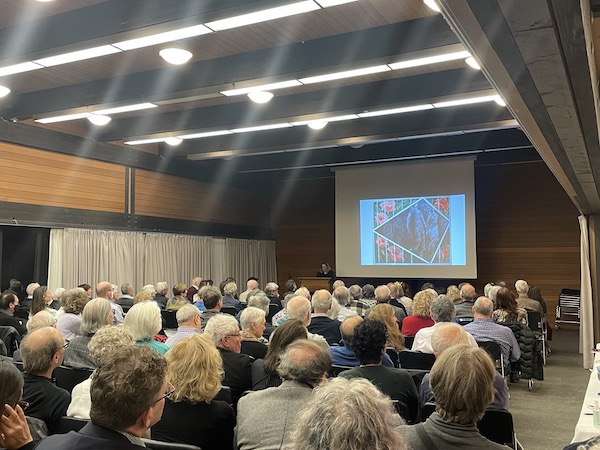
Left to right: Wendy Bross Stuart, Jessica Stuart and Katey Morley in a Joan Beckow Legacy Project performance at Holy Blossom Temple, Toronto, on Nov. 19. (photo by Robert Saxe)
The Joan Beckow Legacy Project performance at Holy Blossom Temple, Toronto, on Nov. 19, included a preview screening of the documentary Unsung: the Joan Beckow Story. The project features 30 musicians from across Canada who got together to make the first-ever professional recording of Joan Beckow’s music. (See jewishindependent.ca/beckows-music-will-live-on.)
To purchase the double-CD set of 22 songs, representing a cross-section of Beckow’s vast catalogue, visit joanbeckowlegacy.com.
Zlatomir Fung (cello) and Benjamin Hochman (piano). (photo from vanrecital.com)
The Vancouver Recital Society (VRS) presents American cellist Zlatomir Fung and Israeli pianist Benjamin Hochman at the Vancouver Playhouse Jan. 15. Fung has racked up a slew of awards: in 2019, he was the first American in four decades and youngest musician ever to win first prize at the International Tchaikovsky Competition, cello division, and was the recipient of an Avery Fisher Career Grant in 2020 and a Borletti-Buitoni Trust Fellowship in 2022.
The Juilliard alum was originally booked for the VRS in 2020 but the pandemic thwarted plans. In January, Fung will perform with Hochman, who first performed in a VRS series in 2003, with violinist Elisabeth Batiashvili. Hochman is a graduate of the Curtis Institute of Music, where he studied with Claude Frank, and the Mannes College of Music, where he studied with Richard Goode.
The concert repertoire will feature the music of Yuri Shaporin (6 Pieces, arranged for cello and piano by Viktor Kubatsky), Nikolay Sokolov (Romance for Cello and Piano, Op. 19), Leo Ornstein (6 Preludes for Cello and Piano), Alexander Glazunov (Entr’acte from Raymonda, Op. 57, arranged for cello and piano) and Dmitri Shostakovich (Cello Sonata in D minor, Op. 40).
Tickets for the Jan. 15, 3 p.m., concert can be purchased at vanrecital.com.
Az Yashir is an original Jewish music album of songs for Shabbat from singer and composer Yair Rosenberg. As a journalist, Rosenberg has interviewed White House officials, profiled Israeli prime ministers, covered Jews in baseball, and even chronicled the translation of Harry Potter into Yiddish. But, for the last seven years, he has been working on something different.
Az Yashir takes listeners through the experience of the Jewish Sabbath, combining centuries-old lyrics with contemporary musical influences ranging from Irish folk to EDM. With this debut album, Rosenberg follows in the footsteps of his grandfather, Rabbi Israel David Rosenberg, a Chassidic composer who escaped the Holocaust through Shanghai and whose songs from that time are still sung to this day.
Az Yashir features eight original compositions and two new adaptations, performed by Rosenberg, backed by 20 different musicians and produced by Charles Newman of Mother West.
One of the ways to prepare a child for a vacation is to start small. For example, take them to a local aquarium or other nearby attraction to get them used to the idea of touring. (photo from Dawn M. Barclay)
Planning a successful vacation when you have a child with ASD, ADHD, bipolar disorder and similar issues takes time, patience and practise but, in the end, you can build good memories that will last a lifetime. More great news: these tips can work for neurotypical families as well.
Here are the basics:
Understand the challenge. All children crave routine and predictability; it’s their comfort zone. Travel draws them out of their zone and into the realm of the unfamiliar, leaving even neurotypical children anxious and inflexible. Your goal is to help the child preview aspects of the vacation long before the vacation begins, in order to establish expectations of a new routine with elements now made familiar.
Start small. Introduce the concept of travel by reading children picture books featuring their favourite characters in travel situations. (Your local librarian can recommend some.) Role-play various travel scenarios, such as going through airport security or hotel check-in. Programs like Wings for Autism can provide a dress rehearsal before the main event. Watch videos on YouTube or those provided by the travel supplier that show each aspect of the vacation, including the hotel. Consider creating a social story about each aspect of the trip and review it with the child regularly. And try “mini experiences” like an overnight stay at a relative’s house before a hotel stay, or “tours” to local zoos, aquariums or even a flea market – now relabeled as a scavenger hunt.
Get buy-in. Another way to create predictability is to give the child some say in aspects of the trip. Discuss potential autism-friendly or autism-certified hotels, resorts, theme parks and other venues with a professional who has done the research for you, such as a certified autism travel professional. Then present a few parent-approved vacation options to the child and ask them to choose. You can do the same for daily activities as you prepare your itinerary (either written or in picture form). That gives you a new “routine” the child can anticipate, one where they have a personal stake in its success. Also allow the child to choose some of the clothing they’ll bring and let them help you pack. Make them active participants in their own holiday.
Make it child-centric. Traveling with youngsters, be they neurotypical or neurodiverse, can never match the pace you set when traveling before they arrived. It’s no holiday for you if you’re lugging an exhausted child on your back through a theme park. Instead of trying to cram four or five stops into your itinerary each day, plan for one or two. Try to make some of those stops extra-special by feeding into the child’s unique interests. There are specialized museums around the country for lovers of trains, insects, dinosaurs, or whatever their passion. Then set aside the afternoon to decompress at the pool or in front of the television.
Weed out potentially upsetting stimuli. Many children on the autism spectrum have sensory issues. Try to anticipate potential overload and introduce some of the unique sensory experiences in advance. For example, if you live in warmer climes and you’re heading somewhere like Alaska, practise wearing heavier and layered clothing. Or, if your child hasn’t experienced a beach, buy some sand at a crafts store, lay out a tarp and let the child feel the sensation of walking on sand before leaving on your trip.
Pack a “go-to bag.” Pack a customized bag containing the child’s favourite toys, snacks, a change of clothes and a trash bag (for any soiled ones), anti-nausea medication, noise-canceling headphones, surprises in gift bags (think Silly Putty, pens, an Etch-a-Sketch), and a preloaded iPad with kid-friendly shows and games. Keep your bag accessible and dole out the surprises to provide distractions if overwhelm sets in or plans go awry.
Remember, kids are kids. Any child can grow bored, weary and have a meltdown. Parents who think ahead, prepare their child for the new experience and are equipped to alleviate any anxiety, will be able to smooth the way while traveling.
Dawn M. Barclayis an award-winning author who has spent a career working in various aspects of the travel industry. She started as an agent with her parents’ firms, Barclay Travel Ltd. and Barclay International Group Short-Term Apartment Rentals, and then branched out into travel trade reporting with senior or contributing editor positions at Travel Agent Magazine, Travel Life, Travel Market Report and, most recently, Insider Travel Report. Her new book is Traveling Different: Vacation Strategies for Parents of the Anxious, the Inflexible and the Neurodiverse (Rowman & Littlefield Publishers, 2022). Learn more at travelingdifferent.com.
Gloria Levi’s recently published creative memoir The Hotelkeeper’s Daughter is a tribute to her family. And not just the family from whom she comes – the people who inhabit the main part of this story – but also the family she has made herself, the family members in the book with whom she shares her memories and those outside of it, who will read the story.
The memoir is “creative” because memory, almost by definition, is unreliable, and, with this book, the 90-plus-year-old Levi is going back to her childhood. The character Gilda, her avatar of sorts, is trying to make sense of her past:
“They are all gone … Jerry, Macey, Sadie … and Ida and Leo … Bubbie … I, Gilda, at the age of 90, am the only one left of my family of origin. I am the Omega generation, the last letter of the Greek alphabet. I remember so vividly the sweetness of family togetherness, extended family visits, our tight-knit community. How I loved them and felt loved by them: their vitality, their enduring values, their struggles, losses and successes, their remarkable resilience. They are a deep part of me. They are the heroes of a bygone era.”
Speaking to her son and great-grandson, Gilda takes us to Powell Street, in Brooklyn, N.Y., 1938. She is 7 years old. She vividly describes her community, the neighbourhood of Brownsville. Her parents, grandmother and three siblings live downstairs in a duplex shared with her uncle and aunt and their family, who live upstairs. Money is sparse.
“During their usual pinochle card game one Saturday evening in March,” writes Levi, “my father turned to his cousin, Big Eliezer, and said, ‘Eli, I really need to make a change. I don’t want to go on like this. I know I can do better than my chicken store. What do you think, if you, Sammy and I were to rent a summer hotel? My brother Benny runs a hotel with partners. He’s doing just fine. You know, with your catering experience, Eli, and the younger energy and determination of Sammy and me, I think we could make a go of it. What do you think?’ Sammy nodded in agreement. Uncle Shimon closed his hand of cards and stared.”
And the rest, as they say, is history – and the meat of this memoir. Life isn’t easy as the daughter of hotelkeepers. Gilda had been happy on Powell Street, had many friends and her favourite activities. She was very close to her grandmother, who didn’t initially go with the family, and her parents were absorbed in the business. Gilda was lonely and often felt invisible. She has a challenging relationship with her mother, Ida.
Through Gilda’s story, we see how families like hers – an Eastern European Jewish family who immigrated to the United States – struggled and succeeded in their new homeland, through the Great Depression and the Second World War. We also see how Gilda grows into herself and begins to find her own way. The memoir ends in 1948, as Gilda starts university.
As 90-year-old Gilda looks back at this foundational decade of her life, relating her story to her son Daniel and great-grandson Lenny, she ultimately reflects not only on what has passed, but what is yet to come.
“To the Lennys of today and the Idas of yesterday, I want to affirm their vision, their energy, and their inspiring dedication to build a fairer, more just and loving society.”
I had the privilege of seeing Mark Leiren-Young’s play Bar Mitzvah Boy when it premièred at Pacific Theatre in 2018. It was funny, edgy and insightful, and well-acted by Gina Chiarelli and Richard Newman. It contained a lot of local references, making it even more special.
What I see from the Playwrights Canada Press edition, which was published in 2020 and arrived at the JI sometime in 2021, is that Leiren-Young’s notes on various aspects of the play allow productions to change certain references and pronunciations to localize the action, thereby making it special no matter where it is performed. For instance, the audience first meets Rabbi Michael Levitz-Sharon, who is in her mid-30s to maybe 45 years old, on a jogging path, “dressed in sweats and a ball cap for a local sports team.”
The next scene: in the rabbi’s office, there sits a man in his mid-60s or older, Joey Brant, “decked out in prayer regalia – including tefillin, which are on incorrectly.” This is our first hint that he, despite initial appearances, is not a rabbi or a religious Jew. When Michael arrives, Joey assumes that the relatively young woman in running gear doesn’t belong at the synagogue – and certainly isn’t the congregation’s spiritual leader. This exchange sets the tone for the essentially two-person play that unfolds. The other cast member is Sheryl, the receptionist, who is never seen, only heard. As described by Leiren-Young, the actor of this role (which was Jalen Saip in 2018 at Pacific Theatre) should have “the accent you want the woman who runs your local deli to at least pretend to have.”
I love having these types of stage direction “made public.” It is a completely different experience to read a play than to attend it in person. It’s almost like listening to the acoustic version of one of your favourite pop musicians – if they are able to sing on key and play their chosen instrument skilfully, they really are excellent at their craft. Similarly, if the words of a play still make you laugh and cringe and move you emotionally in other ways, with no cues from actors or audience members, it is a very well-written play. Bar Mitzvah Boy in book form made me do all those things – I chuckled a lot throughout, and also got teary near the end. Michael and Joey (the bar mitzvah “boy,” btw) are both dealing with some serious, raw issues.
Since I finished the book, I’ve been revisiting some of the many topics it covers. I’ve thought about my own beliefs about Judaism and faith, what happens after we die, what makes a good friend, parent or spouse, how people navigate challenges differently, the ways in which a congregation (or any other group) can be both supportive and trying at the same time.
Leiren-Young dedicates the publication to his mother, Carol Leiren: “I guess it was worth sending me to Talmud Torah.” For viewers or readers of Bar Mitzvah Boy, it certainly was worth it – thank you.
A basketball game may not be able to bring about world peace, but at least one game has acted as a bridge to increasing mutual understanding and empathy.
The graphic novel The Basketball Game (Firefly Books, 2022) is based on the National Film Board of Canada animated short of the same name. Written by Hart Snider and illustrated by Sean Covernton, it is based on Snider’s memories of his first year at Jewish summer camp. It proved to be a unique experience.
It was July 1983. The camp was Camp BB Riback in Pine Lake, Alta. Snider was 9 years old and “totally homesick,” finding refuge in the comic books he had brought with him. That is, until he meets Galit. (The book is dedicated to his “partner, collaborator, inspiration and best friend, Galit,” his daughter and his parents.)
For young Hart, Camp BB made him feel at home. “Even both my parents went to this camp,” he writes. “It was a tradition in the community. It was a place to just be ourselves … and that was important because back then, growing up Jewish in Alberta wasn’t always so easy.”
Back then, in Eckville, Alta., the winter before Snider’s first summer at camp, teacher Jim Keegstra, “also the town’s mayor, was fired by the local school board.
“Believing the curriculum was ‘incomplete,’ Keegstra had been teaching Holocaust denial and antisemitic conspiracy theories in his classroom – that Jewish people had an international plot to control the world and were to blame for everything that’s wrong.”
But one Eckville parent, Susan Maddox, “noticed her 14-year-old son had some strange new opinions.” She looked through his notebooks, then filed a complaint with the school board.
Meanwhile, more than a thousand people attended a rally at the Edmonton Jewish Community Centre to figure out how to respond to the situation. One of the ideas proposed – by then Camp BB director Bill Meloff, z’’l – was to invite some of Keegstra’s former students to the camp for a “day of fun and fellowship,” which included the title’s basketball game.
(Text by Hart Snider / illustrations by Sean Covernton)
In a brilliantly drawn sequence, the team players are depicted as their negative stereotypes, how they see one another. Blue Team – a horned demon, a world-controlling banker and an evil wizard – versus Red Team – a skinhead, a Nazi and a member of the KKK. The game is intense. Then, an opposing player compliments Hart’s shot. “Thanks, man,” says Hart. The game continues, kids versus kids, no more monsters.
“Looking back, it’s amazing that it happened at all,” writes Snider. “That Keegstra’s students were invited to the camp, and they actually came.”
(Text by Hart Snider / illustrations by Sean Covernton)
That’s the thing. Someone had to extend the invitation, and someone had to accept. An illustrated reproduction of an actual newspaper clipping from 1983 notes that attendance at the camp was voluntary and that a preliminary survey indicated that about 10% of Eckville Junior-Senior High School’s 186 students “would be willing to attend.”
Here we are, almost 40 years later and, as Snider notes in his introduction: “Racism, conspiracy theories and antisemitism are spread every day on social media and other platforms. The hate that Keegstra taught in his classroom is now found in memes, videos and forums. Over and over again, we are challenged with the question, how do we deal with fear and prejudice?
“I hope we can continue to find common ground and have empathy for each other, but, most importantly, I hope that parents and kids keep talking to each other.”
The book, intended for readers 12 years old and up, includes more on the Keegstra trial, discussion questions and a glossary.
When Toronto poet Simon Constam emailed me with a request to read his debut collection of poetry, Brought Down, he described it as “notable because it addresses people’s daily experience of God and the Jewish religious tradition.” He noted, “it is provocative and well-written as can be attested to by the reviews of it thus far.” Indeed, the reviews I’ve read have been highly complimentary – and justifiably so.
I am neither religious nor a poetry buff, yet I found Constam’s poems engaging. I liked his challenging and questioning manner. At 70+ years old, he has wisdom gained from life experience that includes approximately a decade in which he followed Orthodox Jewish observance. His knowledge of Judaism infuses his writing and I had to look up a few names and concepts, even though there is a glossary at the end of this 61-page volume.
What I greatly appreciated about these poems is the theme that runs through most, if not all, of them: the title idea of “brought down,” as it refers to what we inherit from our ancestors, whether we’re talking about traditions, rituals, genes, coping mechanisms, etc. The lens through which Constam explores these ideas is his Jewishness. In “Yerushalmi,” for example, he writes:
“Today I seem to have the face of a man I briefly stared at, on a bus on Rehov King David in the fall of 1969. / I wear the same clothes, dark jacket, dark shirt, rough tan trousers, dust-scuffed brown boots. / The mirror shows me, grizzled, unkempt, stocky, stoic, almost seventy. / My face is the face my grandfather wore. / My parents, aunts, and uncles swore the resemblance is uncanny. My history is clear. / I was one of Titus’s captives marched through Rome in chains. I collected all my things in a sack to flee from Ferdinand and Isabella along the Jew-choked roads. I missed my fate in Kielce and Bialystock. I hid in the forests by Kishinev.” It ultimately concludes: “I am the inheritor of a furious history that only in this place can I never deny or forget.”
In his struggles with God, Constam contemplates what it means to be Jewish, what it means to be human. While this all sounds quite serious, and it is, there is humour in this collection and, ultimately, it is hopeful. As much as he takes God to task, Constam is calling on all of us to question ourselves, and to accept our responsibility for the state of the world.
I always look forward to reading whatever Adeena Karasick writes, even though I know I won’t understand all of it. To be generous to myself, I’d say at least 20% of her latest publication, Massaging the Medium: Seven Pechakuchas (Institute of General Semantics, 2022), went over my head – or will require a few more reads and some discussions with friends to get the most out of it.
Massaging the Medium is part of the Institute of General Semantics’ Language in Action series, which “publishes books devoted to creative modes of expression that can open the doors of perception and foster better understandings of the nature of language, symbols, communication and the semantic, technological and media environments that we inhabit.”
The preface is written by Maria Damon of the University of Minnesota. She explains, “For anyone still unfamiliar with the format, pechakucha – Japanese for ‘chitchat’ – is a highly stylized presentation form that comprises a public speech accompanied by 20 slides for visual demonstration, each of which is shown for 20 seconds, while the speaker addresses their (his/her) topic. Initiated in 2003 by a pair of architects working in Japan, the format (trademarked and copyrighted, by the way, in true contemporary entrepreneurial style) has spread to encompass a worldwide enthusiasm for a storytelling/info delivery style that relies on the visual as much as, or even more than, on the verbal.”
Given Karasick’s “dazzling linguistic pyrotechnics on page and stage,” writes Damon, the pechakucha format is ideal, “as the propulsive energy that characterizes her writing and reading style is given sharper urgency for being trapped in a small temporal space…. These seven tours de force of serious play celebrate meaning and unmeaning, communication and miscommunication, the happy errors/eros of semantic and sonic slippage, the glories of the im/p/precise.”
This description is better than I could ever give. I had to look up several terms, such as ’pataphysical – “a ‘philosophy’ of science invented by French writer Alfred Jarry intended to be a parody of science,” according to Wikipedia. “Difficult to be simply defined or pinned down, it has been described as the ‘science of imaginary solutions.’”
I also had to look up some of the names of people Karasick cites as if they’re old friends. While I’ve heard of folks like Jacques Derrida and Marshall McCluhan, and of Jewish texts such as The Zohar, my knowledge barely touches the surface. I think that’s part of why I have such fun with Karasick – I’ve no preconceptions going into my reading of her work and, while I don’t take it all in, I do feel as if my mind expands from the experience. She is at once academically rigorous, poetically versatile and sensically nonsensical, or nonsensically sensical (I’m not sure which would be most accurate).
In her introduction, Karasick notes that the seven pechakuchas comprising this book were originally created for and presented at academic literary conferences that took place during the period of 2013 to 2019. For a printed publication, she had to adapt them.
“The visuals,” she notes, “consist of both found and original collaged material which both speak to and against the text. And each of the original slides were embedded with audio and video clips, gifs, other forms of kinetic digital media such as montages of sound poetry,” pop songs, movies and more. “What is illustrated here, however, are stills from the digital live motion presentation and, although originally all consisting of 20 separate components, they are now of slightly varying length.”
I can’t even begin to simplify any of the pechakuchas, in order to give an example of their content and form. Best to experience them yourself. Not everything will land – I enjoyed the first few most – but they do offer the possibility of changing how you think about many things. The list includes but is not limited to language, technology, physiology, time, space, cyberspace, mysticism, consumerism, reality, truth. As does any good Jewish text, it will raise more questions than it answers.
It’s been eight years or so since I reviewed Mark Binder’s The Brothers Schlemiel, which recently has been reissued by Light Publications with the title The Village Twins, and written under Binder’s pen name, Izzy Abrahmson. I knew this story of Chelm would withstand the test of time for two reasons. First, we regularly publish a Binder/Abrahmson story in our holiday papers. Second, the stories are written in the style of Yiddish folk tales, which have proven staying power.
As Abrahmson explains in The Village Twins, Chelm is “a tiny settlement of Jews known far and wide as the most concentrated collection of fools in the world.” According to The YIVO Encyclopedia of Jews in Eastern Europe, the “first publication of Chelm-like stories appeared in Yiddish in 1597, and were tales of the town of Schildburg, translated from a German edition. Hence, these stories first entered Jewish culture as Schildburger stories, and it is unclear when they became connected to the town of Chelm. During the 19th century, a number of other Jewish towns figured as fools’ towns, including Poyzn. Over time, however, Chelm became the central hub of such stories, the first specific publication of which occurred in an 1867 book of humorous anecdotes, allegedly written by Ayzik Meyer Dik. Later, particularly in the early 20th century, dozens of collections of Khelemer mayses (Chelm stories) were published in Yiddish, as well as in English and Hebrew translations.”
The Village Twins is one of the latest such collections, and it does honour to its literary ancestors, providing wisdom in the guise of absurdity. The novel can be read on many levels, including as pure entertainment, as the story of a particular family living in a particular era and as a series of parables (it’s 414 pages long, which, I admit, was a bit lengthy for me). It is part of Abrahmson’s Village Life series, which includes several publications and a podcast, but can be read as a standalone novel. I am proof that a person might enjoy, but does not have to, read or listen to the other stories to follow this tale of the Schlemiel family that is centred around twins Abraham and Adam, who cause trouble from the day they are born.
The brothers make full use of their physical similarity throughout their life, from incidences as harmless as pranks around town to more serious situations, such as avoiding being drafted into the Russian army. What I wrote in my 2014 review still stands: Abrahmson “has created characters with whom we empathize…. He ably manages some fine balances: writing about silliness without the story becoming stupid, and evoking sentimentality while not becoming saccharine….. As well, through the vehicles of comedy and fantasy, [it] touches on many serious topics, from poverty to racism, to ethics in business, to whom people choose to be, and more.”
According to the press release, The Village Twins has been updated and revised, though I can’t speak to how, as my copy of The Brothers Schlemiel has long since been passed on. Along with this reissue came Binder’s pen name “to distinguish the series from his other work. By combining his Hebrew name, Isaac, with his father’s Hebrew name, Abraham … Izzy Abrahmson was born.”
As an editor, dealing with a writer with two names is a little unwieldy and I sometimes feel like the villagers of Chelm, who, for “many, many years” couldn’t tell Abraham from Adam. But that doesn’t diminish my enjoyment of Abrahmson’s – or is it Binder’s? – storytelling. He has won multiple awards for a reason. Anyone who likes a good folk tale will delight in The Village Twins.