Skip to content
  • Home
  • Subscribe / donate
  • Events calendar
  • News
    • Local
    • National
    • Israel
    • World
    • עניין בחדשות
      A roundup of news in Canada and further afield, in Hebrew.
  • Opinion
    • From the JI
    • Op-Ed
  • Arts & Culture
    • Performing Arts
    • Music
    • Books
    • Visual Arts
    • TV & Film
  • Life
    • Celebrating the Holidays
    • Travel
    • The Daily Snooze
      Cartoons by Jacob Samuel
    • Mystery Photo
      Help the JI and JMABC fill in the gaps in our archives.
  • Community Links
    • Organizations, Etc.
    • Other News Sources & Blogs
    • Business Directory
  • FAQ
  • JI Chai Celebration
  • JI@88! video

Recent Posts

  • Last hostage home
  • New bill targets hate crimes
  • Concerning actions
  • Recipes not always required
  • Survivor urges vigilance
  • Seniors profoundly affected
  • Farm transforms lives
  • Musical legacy re-found
  • A range of Jewish literature
  • A concert of premieres
  • Variety telethon on Feb. 22
  • Victoria club’s many benefits
  • Avodah dedicated to helping
  • Artists explore, soar, create
  • Life’s full range of emotions
  • Community needs survey closes March 29
  • Jerusalem marathon soon
  • Historic contribution
  • Chronicle of a community
  • Late-in-life cartoonist
  • Cashflow vs growth portfolio
  • My new best friend is Red
  • ישראלים רבים ממשיכים לתמוך בטראמפ ועדיין אינם מבינים במי מדובר
  • עשרים ואחת שנים בוונקובר
  • Supporting the Iranian people
  • The power of photography
  • A good place to start
  • When boundaries have shifted
  • Guitar virtuosos play
  • Different concepts of home
  • Broadway’s Jewish storylines
  • Sesame’s breadth and depth
  • Dylan Akira Adler part of JFL festival
  • Mortality learning series
  • A new strategy to brighten up BC
  • Sharing latkes and light

Archives

Follow @JewishIndie
image - The CJN - Visit Us Banner - 300x600 - 101625

Category: Arts & Culture

Just for Laughs coming soon

Just for Laughs coming soon

Ben Schwartz and Jessica Kirson are on the lineup of this year’s Just for Laughs Vancouver.

Just for Laughs Vancouver, which runs Feb. 15-24 at various venues in the city, features several members of the Jewish community.

All three of Brett Goldstein’s shows Feb. 16-18 at Queen Elizabeth Theatre have almost sold out. Goldstein was a co-executive producer, co-writer and co-star of Ted Lasso. He is also the creator and executive producer of the comedy Shrinking, alongside Jason Segel and Bill Lawrence, and of Soulmates, with Will Bridges. Goldstein is host of the podcast Films to be Buried With, which finds him in conversation with guests as they discuss the films that have shaped them.

Rafi Bastos performs at the Rio Feb. 17-18. Many of his viral stand-up clips come from nightly performances at the Comedy Cellar. In his home-country of Brazil, he was one of the first comedians to pioneer the art of American-style stand-up comedy. He has starred in movies, had his own talk show, been an infield journalist and hosted reality show Ultimate Beastmaster. He is co-founder and owner of Comedians, the largest comedy club in South America. 

Ben Schwartz and friends take to the Orpheum stage Feb. 18. Schwartz is part of the cast of The After Party, as well as the second season of Space Force. He was in the comedy series House of Lies and Parks and Recreation. As a writer, he has published four books and written television shows and movies for many major studios.

Jessica Kirson is at the Vogue Feb. 18. Her countless comedic character videos have racked up more than 200 million views on social media. She produced the feature-length documentary Hysterical. In addition to her one-hour special, called Talking to Myself, she is a regular on This Week at the Comedy Cellar and has appeared on many other shows.

At the Rio Feb. 23-24 is Catherine Cohen, best known for her comedy special The Twist…? She’s Gorgeous. She can be seen in the feature film At Midnight and in the upcoming series What I Was Doing While You Were Breeding. In 2021, she published her first book, God I Feel Modern Tonight, a collection of comedic poetry.

Comic, podcaster, writer and actress Annie Lederman will be at the Biltmore Feb. 21-22. Lederman is co-host of the podcast Trash Tuesdays. Most recently, she can be seen in the documentary miniseries The Comedy Store, alongside Jay Leno, David Letterman, Joe Rogan, and many other Comedy Store legends. She wrote and starred in Stand Ups, Impractical Jokers and Borat, among other things.

The full JFL lineup and tickets are available at jflvancouver.com. 

– Courtesy Just for Laughs Vancouver

Format ImagePosted on January 26, 2024January 24, 2024Author Just for Laughs VancouverCategories Performing ArtsTags comedy, Just for Laughs, standup

Putting the fun in dystopia – Steven Mayoff’s The Island Gospel According to Samson Grief

For all intents and purposes, it shouldn’t work, but Steven Mayoff’s The Island Gospel According to Samson Grief is a grand work of, let’s say, magical fiction that uses humour in large measure to elicit some very serious thoughts about art, politics, law, love, faith, community and more.

Mayoff takes part in two events during the Cherie Smith JCC Jewish Book Festival: on Feb. 11, he presents at Burquest Jewish Community Association in Coquitlam and, on Feb. 12, he is at the Jewish Community Centre of Greater Vancouver, along with Jeffrey Groberman, author of Globetrotting Strikes Again! Groberman also presents at Har El in West Vancouver on Feb. 11.

image - he Island Gospel According to Samson Grief book coverIt is hard to describe simply the plot of The Island Gospel According to Samson Grief. The title character is a middling artist who, when we meet him, is struggling to finish a painting. Outside his window, he has just seen – after a break of 13 years – three figments of his imagination. The Figs, as he calls them, present themselves in the forms of Judas, Fagin and Shylock, and they have returned with an important mission for Grief.

“The Supreme One,” who the Figs represent, was impressed by Grief’s scandalous, and most famous, painting of Prince Edward Island icon Anne of Green Gables as a Holocaust survivor, which Grief described in an interview as a statement “on the post-911 world we’re living in, where nobody is safe anymore and the primary victim is the delusion of our collective innocence.” Despite that Grief has not had much artistic or other success in the years since that painting – and that he is not actively involved in the island’s Jewish community – the Supreme One wants Grief to build PEI’s first synagogue. Once complete, the province will be consecrated as the new Promised Land, according to the Figs.

Among Grief’s many challenges – once he decides to take on the mission – is that the Supreme One has decreed that the synagogue must be built on a particular plot of land, a once-sacred place that has become a garbage dump and the focus of much political intrigue. It is hard to keep track of all the political manoeuvrings in this novel, but they sadly resonate, with some reality in their self-serving and unscrupulous nature.

It takes Mayoff awhile to set up the many pieces of his narrative puzzle. The characters are numerous, and quirky only begins to describe them. The societal issues that arise as Grief tries to achieve his mission, the role played by the media – both conventional and unconventional – in what ends up happening, the reliability and unreliability of friendship and love … so many factors are up in the air and changing as the story progresses. Somehow Mayoff juggles them all in a way that allows readers to follow along, discovering various elements as Grief does, and losing our naiveté as he does.

The Island Gospel According to Samson Grief is an ambitious novel that delivers beyond its promise. 

For the Cherie Smith JCC Jewish Book Festival guide, visit jccgv.com/jewish-book-festival. 

Posted on January 26, 2024January 24, 2024Author Cynthia RamsayCategories BooksTags fiction, humour, JCC Jewish Book Festival, Steven Mayoff

“Best goddam madam” – Madam: The Biography of Polly Adler, Icon of the Jazz Age

The immigrant experience is rarely if ever easy. It is hard to imagine sending a 13-year-old girl from Russia to the United States on her own, but, in 1913, the year that Pearl (“Polly”) Adler came through Ellis Island, “the Hebrew Sheltering and Immigrant Aid Society estimated that 13,588 ‘unaccompanied Jewish girls’ came through the port of New York, out of the 101,330 Jews who immigrated from eastern Europe,” writes Debby Applegate in Madam: The Biography of Polly Adler, Icon of the Jazz Age.

image - Madam book coverThe revelations abound in Madam and most do not centre around statistics, though there are some intriguing ones, like the fact that, in 1925, New York’s White Light District, with Times Square at its core, had “more than 2,500 speakeasies and 200 nightclubs, up from 300 saloons before Prohibition, all vying to offer the youngest girls, bawdiest songs, and hottest dance bands.”

Polly Adler was a major part of this scene, having entered the world of prostitution when she was 17. She had managed to avoid the lechers who recruited girls coming off the boats, and even got a couple years of education living with extended family in Springfield, Mass. But, once the minimum amount of schooling required was reached – a fourth-grade level of English – she had to work. And working in a factory wasn’t a way to get oneself out of poverty. So, with a little help from unscrupulous men, she started on a different career, one that would have her become the most well-known madam in New York, with clients that may even have included President Franklin Delano Roosevelt.

It was a harsh world, though, filled with gangsters, crime, violence, and it wasn’t even that lucrative because of all the payoffs and the immense levels of corruption at every turn: police, lawyers, judges, politicians. But Adler could literally take the punches, and she was “determined to be the best goddam madam in all America.” She achieved her goal and was successful, if measured by fame and money. However, she never achieved the approval and acceptance she sought, having been cared for as a child but never really loved.

Applegate’s biography of Adler is a page-turner, which is an accomplishment given its comprehensiveness and the amount of detail she covers: there are 33 pages of notes and the bibliography runs 13 pages. Readers will really feel as if they’ve met Adler and walked a few feet in her shoes. 

Applegate will talk about Madam in the Cherie Smith JCC Jewish Book Festival event on Feb. 11, which she shares with Roberta Rich, author of The Jazz Club Spy (see jewishindependent.ca/mysteries-to-be-solved). 

Posted on January 26, 2024January 24, 2024Author Cynthia RamsayCategories BooksTags Debby Applegate, gangsters, history, immigrant story, New York, Polly Adler, prostitution

Celebrating two new years 

It would be fun to be a fly on the wall at Vancouver Talmud Torah on Feb. 14 as Richard Ho reads from his book Two New Years, illustrated by Lynn Scurfield, and discusses it with the children. Being that the story is based on his own life experience, he will likely be quite animated (pun intended) and his enthusiasm, combined with Scurfield’s bright, colourful and joyful art, will no doubt hold their attention.

image - Two New Years book coverHo has several kids books to his credit and, according to his website, more on the way. Two New Years highlights the differences and similarities between Rosh Hashanah and the Lunar New Year, both of which he celebrates.

The book notes the differences first: Rosh Hashanah takes place in the fall, is based on the Jewish calendar and began in the Middle East, and the Lunar New Year generally falls in spring, is based on the Chinese calendar and began in East Asia. “They represent different peoples with different histories, cultures and traditions,” he writes. “But in many ways they are also alike.” The many similarities include that each holiday is a chance to “try on new beginnings,” to “bring family home” and “remember the ancestors who live in our hearts,” to eat “foods that symbolize togetherness and the heartfelt sharing of good wishes,” among several other things.

In the author’s note, Ho shares that he converted to Judaism as an adult and that “the blending of two cultures was a conscious choice” for him. These days, he revels in experiencing both new years through the eyes of his children. “The best part?” he asks. “They’re not alone! All over the world, families with mixed backgrounds are blurring the barriers between cultures and customs. With the guidance of parents, grandparents and extended family on all sides, many children are weaving an increasingly diverse tapestry of celebration.”

The book features an eight-page illustrated glossary that’s as interesting to read as the story: it explains what a lunisolar calendar is, and some of both holidays’ rituals and symbols. It is followed by questions that readers can use to facilitate a discussion with others about their own traditions.

Ho’s presentation at VTT is part of the Cherie Smith JCC Jewish Book Festival (jccgv.com/jewish-book-festival). 

Posted on January 26, 2024January 24, 2024Author Cynthia RamsayCategories BooksTags children's books, Chinese heritage, culture, Jewish heritage, Lunar New Year, Lynn Scurfield, Richard Ho, Rosh Hashanah
Sculpturing with wood

Sculpturing with wood

“Constellation” by Rosamunde Bordo. (photo by Sol Hashemi)

Every true artist at the start of their career undergoes a period of intense search: for their voices, for their themes, for their artistic expressions. Rosamunde Bordo is at that exciting stage now. She is searching. Her show at the Zack Gallery, Morning Star, reflects her creative explorations. 

A professional artist today, Bordo has always loved art.

“As a child, I went to a school with a strong art program. I painted. I played saxophone. My parents always encouraged my interest in art,” she said in an interview with the Independent. 

photo - Rosamunde Bordo’s solo exhibit, Morning Star, is at the Zack Gallery until Feb. 7
Rosamunde Bordo’s solo exhibit, Morning Star, is at the Zack Gallery until Feb. 7. (photo from Rosamunde Bordo)

After a bachelor’s in liberal arts and print media at Concordia University in Montreal (2014) and master of fine arts degree in visual art at the University of British Columbia (2020), Bordo teaches printmaking at UBC. But her artistic interests range much wider than printmaking. Her newly emerging passions include the creation of installations and woodworking. 

“I started woodworking last spring,” she said. “In this show, I use different woods: maple, cherry, walnut. I’m fascinated by the process of turning wood into sculptures. In a way, woodworking is similar to printmaking. Both use technology but, unlike two-dimensional printmaking, woodworking offers three dimensions. In woodworking, I try to find the story of the material, try to immerse in material-based research to investigate the self as a created subject.”

Bordo began woodworking when she started her ongoing installation project, The Denise File.

“It is almost a work of detective fiction, written through physical space,” she explained. Using found postcards written to someone named Denise, Bordo “wanted to reconstruct who the elusive Denise is, to figure out what the letters meant, to show her essence through objects, sculptures and drawings.”

She built some wooden furniture for The Denise File – a screen and a chair – and wanted to do more, to explore all she could do with wood. Her current show, comprised mostly of several sculptures, has its roots in a Jewish magic class she took at her synagogue in 2021.

“I wanted to understand Jewish history, its mysticism and its superstitions,” she said.

Each figure on the gallery wall could have originated from the ancient writings of many nations.

“It could be ancient Hebrew or Aramaic or even Greek,” Bordo mused. “All the cultures in that region were interconnected. I see the entire show as a healing amulet, but I didn’t want to assign my own meanings to the individual figures. I wanted them to be mysteries for my viewers to investigate. I wanted the viewers to be detectives and I didn’t want to influence them with my personal vision, didn’t want to limit their imagination.”

That’s why she titled every “Constellation” figure with a number. “They could be stick figures – they are very simple – but I see them as constellations, stars connected to each other,” she said. “That’s why the show is called Morning Star. The world is a difficult place right now, and the morning star is a symbol of renewal.”

Bordo’s constellations are deceptive, looking a bit like wooden hieroglyphs, or perhaps molecular structures, each with its own character.

“The one with a leg sticking out of the wall – it wanted to be playful, maybe escape from the wall,” she said. “I was looking for harmony when I worked on them, but I didn’t want to force them into locked shapes. I wanted to give them their own personalities. Besides, I try to respect the wood I work with. It is alive. There are many ways one could interpret a wooden sculpture.”  

In addition to the constellations on the gallery walls, there is also a video called Potion, which comprises four minutes of rotating green abstract patterns. Postcards with a single image from the video form another part of the installation. The text on the back of the postcards reveals the artist’s motto for this show: “Ideas are to objects as constellations are to stars.”  

There is also a small table with a slab of pink salt on it.

“Placing salt in your pockets and in the corners of rooms was a well-known Jewish superstition to ward off malevolent spirits,” Bordo said. The table with the salt stands in the corner of the gallery, hopefully repulsing malice. We all need that in our troubled times, she explained.

The show opened Jan. 5 and will be on display until Feb. 7. To learn more, go to the artist’s website, withoutimages.com. 

Olga Livshin is a Vancouver freelance writer. She can be reached at [email protected].

Format ImagePosted on January 12, 2024January 10, 2024Author Olga LivshinCategories Visual ArtsTags Rosamunde Bordo, sculpture, The Denise File, woodworking, Zack Gallery
CANCELED – See The Runner at PuSh

CANCELED – See The Runner at PuSh

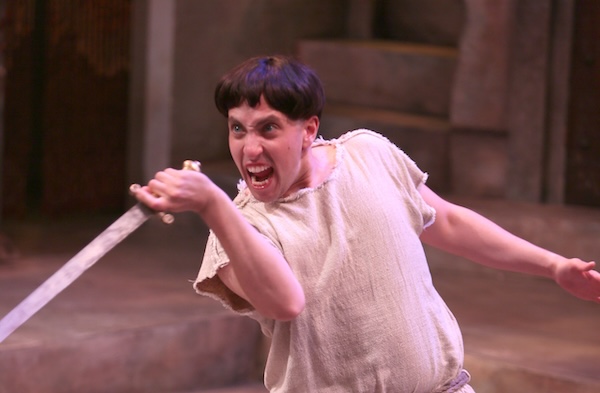
Christopher Morris as Jacob in The Runner, which is at Fei and Milton Wong Experimental Theatre Jan. 24-26. (photo by Dylan Hewlett)

Since this article was published, PuSh has canceled the production. For the statement, click here.

Among the offerings of this year’s PuSh International Performing Arts Festival is Christopher Morris’s The Runner, which runs Jan. 24-26 at Fei and Milton Wong Experimental Theatre.

The one-man play is dedicated to Jakoff Mueller, a ZAKA member in Israel who died in 2018. The main character is Jacob, an Orthodox Jew with the Israeli volunteer emergency response organization. In one of the emergencies depicted, Jacob helps an injured Arab woman before he tends to a soldier, and his choice has significant repercussions. The actor in the role – in Vancouver, it will be Morris – performs the whole 60 minutes of the play while walking/running on a treadmill.

The Jewish Independent interviewed Morris by email before the playwright stepped back from doing media after a scheduled Victoria run of the play was canceled due to pressure from protesters, who objected to the story being told “from an exclusively Israeli perspective.”

JI: Can you share more about your relationship with Jakoff Mueller, how you came to meet him, to be invited into his home, and how he contributed to writing of The Runner?

CM: I first met Jakoff in 2009 at a small get-together in the house I was staying at in Jerusalem. This was during my first research trip to Israel to write this play. The owner of the house was a friend of Jakoff and she thought it would be interesting for me to speak with him, seeing as I was doing research about ZAKA. Jakoff was an incredibly thoughtful man with a great sense of humour, and we hit it off. He invited me to come and visit him where he lived in northern Israel and I did, over many occasions during the research trips I made to Israel. Though no event or fact from Jakoff’s life is represented in the play, his compassion for valuing all human life and his spirit of questioning is in the play. The world was a better place with him in it.

JI: When did you start writing The Runner and when and where did it première?

CM: My curiosity with ZAKA began when I was a teenager in Markham, Ont., in the 1990s. I heard a media interview about the work ZAKA did and it really struck me. I kept thinking that ZAKA’s work would be an interesting premise for a play but didn’t know how to do it. So, in 2009, I made my first trip to Israel to begin researching the play. I spent nine years (on and off) writing it and it premièred at Theatre Passe Muraille in Toronto in 2018.   

JI: You’ll be playing the role of Jacob, but I see in much of the material Gord Rand as the actor. Are you stepping in for him, does the role rotate, is he no longer part of the production?

CM: Yes, I’ll be playing the role of Jacob in Vancouver. The show had critical success when it premièred in Toronto, winning three Dora Mavor Moore Awards (best script, best production and best direction for the late Daniel Brooks). We were receiving a lot of interest to tour the show, so we rehearsed in multiples of every role in the production (actor, stage managers, director, designers) in the event that one person from the original team may not be available. Daniel Brooks rehearsed me into the role so I could play it when Gord wasn’t available. Over the years, I’ve played it on and off a few times and am really looking forward to performing the role in Vancouver.

JI: You’ve written a one-pager offering guidance for venues presenting The Runner. Is there anything you’d add to that, given the Israel-Hamas war? Not only because tensions are higher, but, for example, there are direct parallels in the description of victims in the mass grave in Ukraine [where ZAKA members, including Jacob, travel in the play] and what happened to Israelis on Oct. 7, which could be triggering.

CM: It’s always been important when presenting The Runner in collaboration with theatres to give some social context when the show is being presented. I am always available to the staff at the theatre to offer any specific insight about the play in the context it’s being presented in. PuSh and I have been in constant contact about how to support the play and the audiences who will see it in January.  

JI: When were the PuSh shows booked and, if there have there been other productions mounted since Oct. 7, what has reaction been overall?

CM: We’ve been discussing doing this show with PuSh for over a year and it was officially booked last May. We completed a run of the show from Nov. 2nd to the 19th, 2023, at the Thousand Islands Playhouse in Gananoque, Ont., and the reaction to the show was extremely positive. A few hours ago, it was publicly announced that the Belfry Theatre will not be presenting The Runner in March.

I support the conversations taking place in response to The Runner right now, I always think it’s important to discuss things. It’s hard to know how audiences will experience any play right now, let alone one set in Israel, like The Runner. But the power of this production, and why so many people have connected with it since it premièred in 2018, is that it’s a nuanced and thoughtful conversation about the preciousness of human life.

JI: Are you a member of the Jewish community? Either way, why did you choose to write a play about terrorism from the perspective of an Orthodox Jewish man?

CM: I’m not a member of the Jewish community. I was brought up Catholic but regard myself as an ex-Catholic (since the age of 13). I wrote a play about medical triage in the perspective of an Orthodox Jewish man because I wanted to write a play about ZAKA.

JI: I’m struck by what I interpret, perhaps mistakenly, as calls for humanity/morality only from Jews/Israelis, not from terrorists or people who see terrorism as a valid form of resistance. In the thinly veiled Gilad Shalit reference, for example, Jacob bemoans the un-Jewishness of Israel keeping the remains of dead terrorists in case of an exchange but he doesn’t seem to question the morality or humanity of the terrorists. Similarly, the only ones who seem to be called to account for killing in this play are Jews – presumably an Israeli shot the Arab woman in the back, an Israeli shooting an Arab protester leads to an Israeli boy being killed, a Jewish Israeli accidentally shoots another Jew when trying to shoot a terrorist, and another gunshot by a Jew, after a vehicular terrorist attack, has fatal consequences for a Jew.

CM: Because it’s a one-person show, Jacob’s view is a singular perspective, and I wrote about the unique situations he would be facing as a ZAKA member. Jacob is dismayed by all the violence that surrounds him and, throughout the play, he advocates for seeing all human life as equal. As a disempowered, isolated person, with limited interactions to people outside of his community, I believe Jacob feels his best bet to effect change is by addressing those around him.

JI:  While ZAKA prioritizes victims over terrorists, other Israeli medical professionals are supposed to triage patients. In the play, an ambulance takes the Arab girl away and obviously keeps her alive. Why does no Jew in the play support Jacob or show him kindness?

CM: It is true that Israeli medical professionals give care to patients, like the ambulance described in the show that takes the Palestinian teenager away and a hospital which no doubt helped her with her wounds. When writing the complex character of Jacob, it was important to include examples in the play of how hard it was for him to connect to other people before he offers medical care to the teenager. This was important to create a complex human being and an interesting dramatic context. Jacob’s mother supports him and shows him kindness. As does the Palestinian teenager when he arrives unexpectedly at her door, and the Palestinian man who saves him by helping Jacob get to his car.

JI: There is a line in the play that has been highlighted by reviewers as powerful, and that’s [Jacob’s brother] Ari’s dictate about why he’s a settler on the land – “because it’s mine!” Again, this doesn’t come up in your play, but is relevant: the chant for Palestine to be free from the river to the sea. What hope do you see, or does Jacob see, if you’d rather – can one get off “the treadmill” alive?

CM: Though my play is set in Israel, I feel I lack the experience or expertise to offer a fully informed answer to the complexities of the overall conflict. But the biggest hope for me in the play and the only statement about life I feel I wrote (as opposed to the numerous questions I ask in the play) is Jacob’s description of how the Palestinian teenager treated him with kindness:

Her hand on my shoulder.
Are you alright.
That’s all that matters.
Kindness.
An act of kindness.

This is my offering for the complex world we live in. 

To read my op-ed on the Belfry Theatre’s cancelation of The Runner, click here. To read other statements on the cancelation, including from Morris, click here.

For tickets to the PuSh Festival, which includes BLOT, co-created by Vanessa Goodman, and Pli, co-presented by Chutzpah! Festival, go to pushfestival.ca.

Format ImagePosted on January 12, 2024January 12, 2024Author Cynthia RamsayCategories Performing ArtsTags Belfry Theatre, Christopher Morris, Israel, PuSh Festival, terrorism, The Runner

CANCELED Statements on The Runner

The Jewish Independent received the following statements regarding the play The Runner after the Belfry Theatre in Victoria canceled the scheduled March performances of the play, which is set to run as part of the PuSh Festival in Vancouver Jan. 24-26.

Since this article was published, PuSh has canceled the production. For the statement, click here.

Christopher Morris, artistic director of Human Cargo and playwright of The Runner:

As a playwright who values the role of theatre as a platform to explore ideas about the complexities of life, I was disappointed to learn that the Belfry removed The Runner from its programming. I also empathize with the challenging situation they were facing. I am saddened that people in Victoria – especially those with very divergent views and those traumatized by the atrocities in Israel and Gaza – will be denied the opportunity to come together in a theatre to explore their common humanity, share their grief and perhaps discover a flicker of solace and hope. 

Since it premièred in 2018, my play The Runner has been seen by audiences in six cities, received numerous awards and unanimous critical acclaim. I am humbled that theatre companies have produced this play, which is a nuanced and thoughtful conversation about the preciousness of human life. Their endorsement tells me that they also see its effectiveness in creating a dialogue with their audience.  

I am deeply traumatized and saddened by humankind’s capacity to wage war. As a Canadian, I want our politicians to do all they can to make the violence in Gaza and Israel stop. I hope theatre companies and playwrights do all they can to give audiences the opportunity for dialogue and to build bridges between our silos. I believe The Runner is an excellent opportunity for those things to happen. And Vancouver audiences will get the chance to experience this production in a few weeks, at the upcoming PuSh Festival.

***

Gabrielle Martin, director of programming, and Keltie Forsyth, director of operations, PuSh Festival:

The PuSh Festival recognizes the pain of those watching or connected to the conflict in Gaza and Israel and the feelings of hurt and helplessness, knowing our experiences here in Vancouver are nothing like those who are suffering direct violence or who have lost homes, friends and family members.

We understand the objections to our programming of The Runner as a part of that shared hurt. When we see death, particularly civilian death, on this scale, we feel the injustice and the inhumanity at work, and we want to do something about it. Here in Canada, far from the conflict, it’s easy to feel helpless, to feel like contacting politicians, rallying or protesting isn’t enough. At PuSh, what we do is present live art, and sometimes we share the feeling that what we do isn’t sufficient. 

Art reflects the world and the times in which we live. At its best, it’s an essential cultural force that builds empathy and understanding. Our aim is that PuSh brings us together and inspires us to have complex conversations; to challenge ourselves and each other not only to think differently, but to feel differently. The festival experience is greater than the sum of its parts and defined in how each piece sits in conversation with the other. These pieces share a sense of cultural urgency and, together, welcome generative friction through plurality as a cultural strategy. 

The Runner is situated within a program that explores our shared humanity in ways that transform the political into the personal, intimate and domestic. This play, by Canadian playwright Christopher Morris, is a story about triage that’s set in Israel. It is not funded by the Israeli government, and Christopher has no direct ties to any country in the region. The play unpacks one character’s dilemma between humanist impulse and socially imposed morals, as he advocates for seeing all human life as equal. In its commitment to examining the polarizing tensions and conflicting ideologies at work within its Israeli protagonist, it exposes painful racism behind the dehumanizing sentiments encountered by the character. Christopher shares: “I lack the experience, or expertise, to speak on or write a play about the extremely complicated conflict that’s happening right now in that part of the world. And what I’ve been offering since 2018 is a play, from my Canadian perspective, that explores the complexities, and limitations, of empathy and kindness.” Ultimately, he frames The Runner as “an offer for discussion.”

We believe this work offers one voice in a diversity of perspectives that diverge in specifics of identity and experience, but that all advocate for empathy and compassion. Dear Laila, playing parallel to The Runner, offers an autobiographical perspective on the forced displacement of Palestinians through one family’s experience of war and exile. Basel Zaraa, the artist behind the project, is a Palestinian refugee who grew up in Yarmouk refugee camp in Damascus, Syria. Dear Laila features a miniature model of his destroyed family home in Yarmouk camp, and three stories that represent the three generations who lived in the house. Intimate and interactive, the experience invites each audience member to connect with this story of “[a] family, like many families of our communities, who are stuck in a loop of losses.” Basel further frames it as “a way for me to face and express and understand the trauma that we live with.”

These two works form part of the wider 2024 festival ecology, and each plays an integral role to a balance that has been curated with care. In the face of violence and atrocity, presenting live art can feel small. We hope that, collectively, the performances and multimedia experiences of this year’s festival offer opportunities for self-reflection, better understanding others’ experiences, and dialogue – actions that, in our view, can sometimes offer building blocks for meaningful political change.

***

The Jewish Federation of Victoria and Vancouver Island is disappointed by the decision of the Belfry Theatre to cancel its production of the acclaimed play The Runner. 

It is regrettable that the Belfry Theatre felt the need to cancel an artistic production, for the first time in its 46 years of existence, because it featured an Israeli Jewish man. 

It is regrettable and disheartening that, when the Belfry Theatre attempted to have an open dialogue, it was vandalized and threatened by a “pro-Palestinian” mob, which ultimately led to a very quick decision without any meaningful consultation. The Belfry’s stated reasons for this decision were: “we believe that presenting The Runner at this particular time does not ensure the well-being of all segments of our community … this is not the time for a play which may further tensions among our community.” This decision does not reflect the wishes of the community as expressed in competing petitions: 1,400 against showing the play vs. 2,400 wanting the play to proceed.  

We fear this decision will lead to other cultural events being canceled, as other venues may also give in to mob mentality and bullying. This is not what we expect from our cultural institutions, nor our community. It is not too late for the Belfry Theatre to reconsider their actions, as we hope they will. 

The decision does not bode well for artistic and cultural expression in Victoria and Vancouver Island. It matters to stand up for what is right. 

To read the Jewish Independent’s interview with playwright Christopher Morris, click here. To read the Independent’s op-ed on the Belfry Theatre’s choice to cancel its March run of The Runner, click here.

Posted on January 12, 2024January 12, 2024Author Community members/organizationsCategories Op-Ed, Performing ArtsTags Christopher Morris, Gabrielle Martin, Jewish Federation of Victoria and Vancouver Island, Keltie Forsyth, PuSh Festival, The Runner

Pinsky pens family memoir

In his ambiguously titled book Ordinary, Extraordinary: My Father’s Life, Vancouver lawyer and community leader Bernard Pinsky shares the biography of Rubin Pinsky. As the pages turn, the reader realizes that ordinariness and extraordinariness really do describe the tale of a life that veers from historically monumental to surprisingly, and gratefully, commonplace. 

image - Ordinary, Extraordinary book coverAt 1 p.m., Jan. 28, Pinsky will officially launch the book, in honour of International Holocaust Remembrance Day, at a prologue event to the Cherie Smith JCC Jewish Book Festival. He will present in conversation with Marsha Lederman.

Pinsky’s book is based on videotaped testimonies that his father, Rubin, gave in 1983 and 1990 to the Vancouver Holocaust Education Centre (which is co-presenting the Jan. 28 event), as well as family memories and what is clearly intensive research.

Rubin was born (probably) in 1924, about 100 kilometres north of Pinsk in what is now Belarus but was then Poland. Pinsky sets the stage beautifully, evoking shtetl life, where the smallest of the children slept atop the bakery oven in the tiny home after his father, Baruch, had baked challah and cakes during the day to eke out a meagre living.

After the German occupation, the Nazis quickly identified the men in the Jewish community who had leadership qualities and said they were needed for an important mission in a nearby area. They were marched just out of earshot and mass murdered. In a later selection, Baruch, his wife Henya and 10-year-old Rachel were marched off and never seen again.

Rubin and his sister Chasia were deemed useful for forced labour and spared the executions. Older brother Herzl had earlier been conscripted into the Red Army.

Every survivor narrative includes a series of unimaginable interventions, coincidences and happenstances, often made possible by acts of incredible daring by the survivor. Through a series of audacious escapades – they weighed off what appeared to be likelihood of certain death with the faint hope of survival – Rubin, Chasia and a few others escaped a selection process and fled to the forest. They lived off berries, roots, tree bark and what small game they could capture. In one instance, Rubin slew a timber wolf in a competition for the same rabbit. 

The group connected with a diffuse but apparently well-organized network of Jewish and other partisan fighters. Despite the challenges of mere survival, Rubin and Chasia participated in anti-Nazi actions that included cutting telephone lines, destroying railway tracks and undermining the establishment of Nazi garrisons.

Typhus swept through the Jews in the forest. In the winter of 1943/44, Rubin was delirious with fever and expected to die. In one of the terrible choices people were forced to make in such situations, the partisan cadre decided to leave him behind to save the group. Chasia refused to go. The two siblings hid in a ditch and, to the best of her ability, she nursed him back to comparative health.

Each of these unlikely survival stories makes one wonder how many similar stories did not have the relatively happy ending Rubin’s did, how many survivor testimonies or second generation narratives were never written because the fever did not break, or the hero did not take a risk on a faint hope, or any of a million chance escapes or saving miracles did not occur in time.

In July 1944, the forest in which Rubin and Chasia had hid, fought and barely survived was liberated by the Soviet army. Concentration and death camps were repurposed into displaced persons camps after the war and Rubin and Chasia were in Bergen-Belsen. Chasia left and searched for three weeks, eventually finding Herzl and bringing him with her to Bergen-Belsen, where the three surviving members of the family were reunited.

Zionists tried to recruit them to go to Palestine, but Rubin knew that would be a continuation of the conflict, uncertainty and fighting he wanted to put behind him. 

“Rubin therefore made up his mind,” writes Pinsky. “He needed a skill or trade in demand in America. He and Herzl made a pact. They would study together, each in a different trade, and go together to the New World. They would help each other and never be separated again.”

The story of how Rubin and Herzl (in the New World, he would be known as Harry) were able to migrate to Canada is another example of chutzpah – an hilarious drama of subterfuge – that has to be read to be believed. Chasia, whose marriage in the DP camp did not last, joined them soon after.

Rubin married Jenny Moser in 1951 and they would have three children: the author, Bernard, his older sister Helen and younger brother Max – all now mainstays of the Vancouver Jewish community. Rubin’s life in Canada was that of a hardscrabble entrepreneur – and not without its seemingly miraculous near-misses and fortunate endings.

As an appendix, Pinsky shares writings from a 2012 family roots trip back to Gzetl, where a dedicated teacher is keeping alive the memory of Gzetl’s Jews.

Pinsky’s memoir is indeed a story both extraordinary and ordinary, of what human resilience can summon in a world turned upside-down – and how the strength developed in unimaginable adversity can carry a survivor through challenges when life becomes, in comparison, ordinary. 

Register for the event at jccgv.com/jewish-book-festival/events.

Format ImagePosted on January 12, 2024January 11, 2024Author Pat JohnsonCategories BooksTags Bernard Pinsky, family, history, Holocaust, Jewish Book Festival, memoir, survivors
Ventanas return to city

Ventanas return to city

Tamar Ilana & Ventanas play at the Rothstein Theatre Feb. 3. (photo by Ali Wasti)

The Chutzpah! Festival and Caravan World Rhythms co-present Tamar Ilana & Ventanas on Feb. 3, 8 p.m., at the Rothstein Theatre.  Founded in 2011, Ventanas interweaves flamenco, Sephardi and Balkan music and dance. They have released three albums and have toured extensively throughout North America. They have been nominated for four Canadian Folk Music Awards.

The six-piece Toronto-based music ensemble is fronted by vocalist and dancer Tamar Ilana. They perform in more than 20 languages, including Ladino, Spanish, Bulgarian, Macedonian, Hebrew, French, Romani and Arabic, drawing inspiration from worldwide themes such as migration and the questioning of one’s identity.

Ilana is a powerful and versatile Canadian singer and flamenco dancer of mixed descent, renowned for her ability to sing in multiple languages and collaborate with various artistic communities from around the world. Her childhood was spent gathering songs from small villages on the edge of the Mediterranean and dancing flamenco. (For more, see jewishindependent.ca/ventanas-come-to-b-c and jewishindependent.ca/ventanas-to-play-at-folk-fest.)

Ventanas’ band members are from across the globe and, together, in true Canadian fashion, they and Ilana intertwine their musical cultures to create an all-encompassing world of their own in which they lead audiences down the less-traveled paths of the Mediterranean, mixing in contemporary interpretations of ancient ballads, original compositions and new choreographies, inviting audiences of all backgrounds into their music.

For tickets to Tamar Ilana & Ventanas ($40 regular, $34 senior/student), visit chutzpahfestival.com or call 604-257-5145. 

– Courtesy Chutzpah! Festival

Format ImagePosted on January 12, 2024January 11, 2024Author Chutzpah! FestivalCategories MusicTags Caravan World Rhythms, Chutzpah! Festival, Tamar Ilana, Ventanas, world music
What is life’s purpose?

What is life’s purpose?

In her graphic memoir, Artificial: A Love Story, Amy Kurzweil tackles many existential questions, framed around her father’s quest to resurrect his father using artificial intelligence. Kurzweil participates in the Cherie Smith JCC Jewish Book Festival Feb. 12.

The purpose of life, of art, what it means to be human, to love and be loved, the value of relationships, our mortality. In a very personal story, cartoonist and writer Amy Kurzweil explores not just universal questions but the biggest of questions in her new book, Artificial: A Love Story.

Kurzweil participates in the Cherie Smith JCC Jewish Book Festival Feb. 12 in two separate sessions: one about the choice of the comic form to tell a story, the other titled Art & Artificial Intelligence.

In Artificial, readers are invited into another part of Kurzweil’s world. Her debut graphic memoir, Flying Couch, was also family-focused, centring around her maternal grandmother’s story. As she writes on her website, “At 13 years old, Bubbe (as I call her) escaped the Warsaw Ghetto alone, by disguising herself as a gentile. My mother taught me: our memories and our families shape who we become. What does it mean to be part of a family, and how does each generation bear the imprint of the past, its traumas and its gifts? Flying Couch is my answer to these questions, the documentation of my quest for identity and understanding.”

image - Artificial: A Love Story, by Amy Kurzweil, page 21
Artificial: A Love Story, by Amy Kurzweil, page 21.

Kurzweil continues to grapple with these questions in Artificial, this time from the paternal side. Her father, Ray, an inventor and futurist, is building an AI tool that will allow him, basically, to resurrect his father, who died of a heart attack in 1970, at the age of 57. Ray has saved letters, articles, music and other material relating to his father, Frederic, a pianist and conductor, who fled Austria in 1938, a month before Kristallnacht, to the United States, saved by a chance encounter. Amy is helping her father sort through boxes upon boxes of material and computerize the information. She even chats with “her grandfather,” as the AI program is being developed.

“My father taught me … that, someday, robots would be made of memory,” writes Kurzweil. Of course, the creation of a Fredbot has functional, ethical, emotional and other challenges, and Kurzweil – in words and images – presents them with sensitivity, intelligence and creativity. Each page of Artificial is attention-grabbing and the level of detail on some pages is remarkable. Kurzweil meticulously re-creates correspondence, typed and handwritten, newspaper articles and other documents, emails and texts, but she also captures, for example, the doubt on her father’s face during a conversation and the concern she has for her partner when he’s undergoing some medical tests. Readers learn about the people asking the questions, not just the questions themselves.

As for the answers? There are multiple ones. Of her father’s project, his quest to conquer mortality using technology, Kurzweil writes that her father’s definition of infinity is, “Computers become so small and dense that they become intelligence itself. Humans who do not grow up or grow old and seal our stories. Our stories wake up and keep writing themselves. This future sounds like liberation from the sadness of a story’s end. But it also sounds terrifying.”

That Kurzweil isn’t completely convinced of the merits of her father’s project, even though she loves him dearly and is helping him try and accomplish it, makes Artificial a satisfyingly complex and relatable story. It is a love story on many levels, and one well worth reading. 

The Cherie Smith JCC Jewish Book Festival runs Feb. 10-15. For the program guide and to purchase event tickets, visit jccgv.com/jewish-book-festival.

Format ImagePosted on January 12, 2024January 11, 2024Author Cynthia RamsayCategories BooksTags AI, Amy Kurzweil, artificial intelligence, creativity, Frederic Kurzweil, graphic memoir, identity, Jewish Book Festival, Ray Kurzweil

Posts pagination

Previous page Page 1 … Page 22 Page 23 Page 24 … Page 161 Next page
Proudly powered by WordPress