Skip to content
  • Home
  • Subscribe / donate
  • Events calendar
  • News
    • Local
    • National
    • Israel
    • World
    • עניין בחדשות
      A roundup of news in Canada and further afield, in Hebrew.
  • Opinion
    • From the JI
    • Op-Ed
  • Arts & Culture
    • Performing Arts
    • Music
    • Books
    • Visual Arts
    • TV & Film
  • Life
    • Celebrating the Holidays
    • Travel
    • The Daily Snooze
      Cartoons by Jacob Samuel
    • Mystery Photo
      Help the JI and JMABC fill in the gaps in our archives.
  • Community Links
    • Organizations, Etc.
    • Other News Sources & Blogs
    • Business Directory
  • FAQ
  • JI Chai Celebration
  • JI@88! video

Recent Posts

  • Sharing her testimony
  • Fall fight takes leap forward
  • The balancing of rights
  • Multiple Tony n’ Tina roles
  • Stories of trauma, resilience
  • Celebrate our culture
  • A responsibility to help
  • What wellness means at JCC
  • Together in mourning
  • Downhill after Trump?
  • Birth control even easier now
  • Eco-Sisters mentorship
  • Unexpected discoveries
  • Study’s results hopeful
  • Bad behaviour affects us all
  • Thankful for the police
  • UBC needs a wake-up call
  • Recalling a shining star
  • Sleep well …
  • BGU fosters startup culture
  • Photography and glass
  • Is it the end of an era?
  • Taking life a step at a time
  • Nakba exhibit biased
  • Film festival starts next week
  • Musical with heart and soul
  • Rabbi marks 13 years
  • Keeper of VTT’s history
  • Gala fêtes Infeld’s 20th
  • Building JWest together
  • Challah Mom comes to Vancouver
  • What to do about media bias
  • Education offers hope
  • Remembrance – a moral act
  • What makes us human
  • המלחמות של נתניהו וטראמפ

Archives

Follow @JewishIndie
image - The CJN - Visit Us Banner - 300x600 - 101625

Byline: The Editorial Board

About the Summer 2023 cover

About the Summer 2023 cover

image - JI June 9/23 Summer issue coverSinging Creek Campground (photo by Ingrid Weisenbach)

This year’s Summer issue cover was taken at Singing Creek Campground in Garibaldi Park over the May long weekend. It was a relatively easy hike to the campsite, and gorgeous, as can be seen by the images below. All the photos were taken by Ingrid Weisenbach, wife of JI publisher and editor Cynthia Ramsay, who also got to enjoy this getaway.


photo - View along the hike at Garibaldi Parkphoto - Hiking at Garibaldi Parkphoto - Cheakamus Lake

Format ImagePosted on June 9, 2023June 8, 2023Author The Editorial BoardCategories From the JITags camping, Garibaldi Park, Ingrid Weisenbach, photography

Deep, dangerous bias

The sale by George Soros of a (comparatively) modest holding in Elon Musk’s Tesla car company seems to have sent Musk into a Twitter tirade last week.

“He wants to erode the very fabric of civilization,” Musk tweeted in a reckles overreaction. “Soros hates humanity.”

The context of the smear is worth a moment of consideration. A man who sinks a chunk of his estimated $185 billion US pile into a space flight hobby says that a man who has donated (at a minimum) $32 billion US into building civil society in the former Soviet bloc and other countries “hates humanity.”

Beyond this context is a whole lot of subtext.

There is nothing essentially wrong with a public figure criticizing another public figure. If the target feels he has been libeled, there are legal recourses available. That’s not really the issue here.

As one of the world’s foremost funders of liberal causes, Soros draws criticism from plenty of people who don’t agree with his politics. Fair enough. But “Soros” has become a shorthand. Generations of people have used the name “Rothschild” to invoke a conspiracy of Jewish wealth and power. “Soros” is a 21st-century update of that conspiracy.

This is a bit dicey. It is fair to criticize someone who dumps billions of dollars into causes you disagree with. If the person happens to be Jewish, that doesn’t make you antisemitic. If you use that person’s name as a stand-in for a complex of ideas about Jews more generally manipulating events with wealth and the manipulative force that can come with it, that is antisemitic. But, of course, getting into the head of a suspected bigot is impossible. One person can accuse another of racism, the accused can deny it and neither is any further ahead. Sometimes the accused may not even be conscious of what they have done.

But Musk tipped his hand. He launched his outburst with: “Soros reminds me of Magneto.”

Magneto is a villain in the Marvel Comics franchise X-Men. Like Soros, Magneto is a Jewish survivor of the Holocaust.

The idea that Soros “hates humanity” is an especially laden accusation. It seems like a peculiar assertion – unless one is familiar with centuries of slander against Jewish people, which has posited that Jews are the embodiment of Satan, the enemy of all things good. In Christian theology, including official Catholic doctrine until the mid-1960s, Jews were accused of deicide, of literal God-killing, of destroying what is most sacred to humanity. To accuse a Jew in 2023 of hating humanity – and all that implies in the context of funding social change movements – is to invoke (intentionally or not) millennia of deadly ideas about Jewish evil-doing. To also invoke a (Jewish) cartoon villain in the process makes Musk’s playing to pervasive tropes about Soros, money, Jews and power seem more deliberate.

This is what is so confounding about racism and bigotry in general, and antisemitism in particular: it so often manifests not as outright intolerance and hatred but as unconscious or barely conscious bias that motivates our beliefs and actions without us knowing it. In some ways, this is the more frightening prospect. It is easy to identify and condemn the most overt acts of racism or hatred. Parsing and reproving harmful, unconscious ideas is much more challenging.

We are not all in a position (thankfully!) to have our Tweets or other late-night brainwaves analyzed by millions. Musk hosts a powerful platform and his speech can move financial markets and mobilize followers. Ideally, he may take time to reflect on whether he carries unconscious biases that need examining.

For us, there are at least two lessons. First, we are reminded that confronting antisemitism is not as easy as condemning those who exhibit the most obvious signs. Second, while we are critical of one of the most prominent people in the world letting slip what appear to be deep-seated conspiratorial ideas that project onto a single individual a host of negative characteristics attributed to the group to which he belongs, we would do well to consider how we use the platforms we each have in our daily lives in the service of justice, anti-racism and truth.

Posted on May 26, 2023May 25, 2023Author The Editorial BoardCategories From the JITags antisemitism, Elon Musk, George Soros, social media, Twitter

A family metaphor

As British Columbia’s Jewish community and friends come together Sunday to celebrate Israel’s 75th anniversary – a concert at the Queen Elizabeth Theatre, capping a multitude of celebratory events over the span of weeks – no one doubts that this moment is unlike any in the short history of the state, or in the relations between the Jewish state and the Diaspora.

The General Assembly of the Jewish Federations of North America took place recently in Tel Aviv and the news service JNS headline noted modestly: “Jewish Federations’ annual conference becomes embroiled in political battles.”

It is true that the umbrella of the Federation system has generally tried to steer clear of internal Israeli politics. This is part of a larger family dynamic in which the instruments of the Diaspora are expected to not rattle the cage of Israel and Israeli officials are expected to retain a level of polite distance in commenting on Diaspora affairs. This separation has always been porous, especially when it comes to issues that directly affect Diaspora Jews, such as recognition of non-Orthodox conversions, egalitarian prayer at the Kotel and similar matters. But fears that proposed judicial reforms, and other plans of the new governing coalition, will alter the fundamental democratic DNA of the state have lowered the bar for engagement by overseas mishpachah. Indeed, weekly demonstrations in cities across North America and Europe, including in Vancouver, by the group UnXeptable represent a new wrinkle in the stay-in-your-lane status quo.

It is interesting how little criticism we have heard of this phenomenon. Time was, such behaviour would have been seen as “airing dirty laundry in public.” Israel (and Jews) have enough people criticizing them that we don’t need to add to the pile-on ourselves, the thinking has tended to go. It may be a sign of the widespread revulsion to the proposed judicial reforms themselves that have eclipsed this long-held reluctance to publicly criticize. Or it may be something more fundamental. Perhaps Diaspora Jews and Israelis are now engaging on a more equal footing.

Of course, we should not overstate our influence. Like buttinsky in-laws, we may significantly overestimate the weight of our interventions. Israeli officials have long chided overseas critics for their uninvited advice. And indications are that average Israelis don’t think a great deal about us at all.

Michael Steinhardt, the American philanthropist who cofounded the Birthright Israel program, wrote in the online journal Sapir recently that we may be seeing a complete inversion of the Israel-Diaspora relationship. The paradigm since 1948 has been that the Diaspora’s role is to “build” and “save” Israel.

“Israel is doing just fine,” Steinhardt writes. “We non-Orthodox Diaspora Jews, on the other hand, are not. ‘Supporting Israel’ has become a kind of narcotic, giving us a sense of self-worth and achievement that allows us to ignore the tempest that has put our own future in doubt.”

While Israel still faces challenges, Steinhardt seems to argue that it has evolved to a point where it can handle them on their own. At the risk of taking the family symbolism to its extreme, Diaspora Jews may be behaving like empty-nesters, their role now diminished, struggling to find a new identity.

He specifically cites assimilation, disengagement from Jewish life, declining Jewish education and synagogue attendance, which was already in decline before being pummeled by the pandemic.

“And then there’s the increasing pressure of antisemitism on campuses, city streets, and in public institutions,” writes Steinhardt. “Taken together, these constitute a well-documented existential threat to Diaspora Jewry that is far more immediate and profound than anything Israel faces today.”

It may be hyperbole to suggest that these crises facing the Diaspora, however serious, are “far more immediate and profound” than Iran’s nuclear ambitions, continuing terrorism or, perhaps, even the self-inflicted divisions caused by overreach by the new government. But it deserves discussion.

When our family members grow up (there really is no end to the metaphor), we do not give up supporting them. We continue to offer advice and wisdom – whether they want it or not.

And perhaps this is the correct lesson from the metaphor: when the once-dependent member of the family reaches a level of maturity that they can engage in an equal footing with the rest of the kinfolk, the dynamic rightly changes to a discussion between equals, in which either side is freer to offer criticism and advice, and both sides are free to take or reject it.

Surely we can all agree on this: when you reach 75, you ain’t no kid.

Posted on May 12, 2023May 11, 2023Author The Editorial BoardCategories From the JITags Diaspora, Israel, Michael Steinhardt, politics

Countering lies and hate

Peter Julian, the New Democrat member of Parliament for New Westminster, recently tabled a bill to address what he suspects are algorithms that encourage online extremism. B’nai Brith’s annual audit of antisemitic incidents, released recently, said three-quarters of antisemitic incidents last year took place online. And, as the Centre for Israel and Jewish Affairs notes in their Not On My Feed campaign, “Online hate leads to real-world violence.”

Few people would disagree that online hate and incitement are problems. How we confront it – that’s where we get into the weeds.

It is possible to control what people read on the internet – countries like China and Iran have demonstrated that, in anti-democratic and oppressive ways. Democracies like Canada should not join the high-tech book-burning that is internet censorship by government. Governments and regulatory bodies, of course, do have a role, however. Setting parameters for acceptable online behaviour and then enforcing these to the extent possible must be a role authorities take on. Staffing limitations are obviously a challenge, but several precedent-setting cases could send a message to others.

Social media behemoths like Facebook and Twitter should take action where they can to delete the most dangerous incitement. These corporations have proven themselves either incapable, unwilling or incompetent at this task. Governments need to incentivize vigilance by making lack of response financially unsustainable. In Germany and France, for example, social media platforms have 24 hours to take down hate speech or risk fines. Likewise, internet service providers (ISPs) have a responsibility to monitor the independent sites housed on their networks, the places where hate groups recruit and train.

Interventions like these are important, but of limited impact. For example, ISPs are based everywhere and every country has different rules around online content. Even Canada and the United States – countries perhaps as comparable as any two on earth – have dramatically different ideas about limitations on freedom of expression.

Attacking online hate and incitement is a perpetual game of Whac-A-Mole. However, just because a task is difficult does not mean we should shy away from it. On the contrary. We must do more of what is difficult.

We are a mere two generations into a connected civilization. We are still babes in the online woods. Yet, in many ways, we behave as though we are in the world we once knew.

We are no longer in a world of three TV networks and two daily papers. We are on a planet of nearly eight billion people – and anyone with an internet connection has an ability to reach audiences exponentially greater than the most powerful voices of a century ago.

It is simply not possible to effectively police online content – though we are correct to monitor and identify the worst of the worst.

There are two things that democratic societies that seek social peace and coexistence must strive toward. First, we need to empower individuals and organizations to counter untruths with truths. We must make it as easy to access the facts as it is to stumble upon misinformation and disinformation.

Google News, for one, has taken to adding a fact-checking section to their search results pages. The site Snopes.com provides a compendious analysis of online truths and fictions (although it has had its own veracity issues, involving a plagiarism controversy in 2021.) On issues of antisemitism, a veritable constellation of organizations exists to identify and correct misinformation, including HonestReporting, the Committee for Accuracy in Middle East Reporting and Analysis (CAMERA) and the Middle East Media Research Institute (MEMRI).

But we also need to attack this problem at the other end, on the “consumer” side. We must do a better job of educating and equipping people in democratic societies to critically discern fact from fiction, news from commentary, legitimate criticism from unfounded bias and hate. In a time when parents and others are concerned that education systems are not effectively teaching what are collectively, if imprecisely, called “the basics,” anyone asking teachers to also become instructors in the complexities of media bias and online incitement is going to come up against preexisting groups calling for more life skills training, more “three Rs,” more economic literacy, more mathematics and science, more physical fitness, etc. There is only so much that can be fit into a six-hour school day.

We live in a time and place where one of the most watched “news” networks routinely feeds falsehoods to viewers, even if a cost of doing business is a legal settlement of $787 million. Those lies led to an insurrection that tested the strength of American democracy more than anything probably since that country’s Civil War. That was an early warning signal for every democracy about the price of disinformation. We cannot hope this problem goes away, because what is likely to go away in such a scenario are our most cherished societal values.

We must do more of everything we are already doing. We must confront and contest the lies and hatred online (and in other media). We must allocate our philanthropic funds to organizations that counter lies and incitement. We must include everywhere we can – in formal and informal educational settings – lessons on identifying facts from falsehoods.

In an online world where conflict and hatred get algorithmic kicks to the front of the line, we must teach the young (and the older and less tech-savvy) to value that which unifies and enriches. In the simplest formulation, we need to remind our children, our grandchildren and ourselves of that old truism: don’t believe everything you hear or read.

Posted on April 28, 2023April 26, 2023Author The Editorial BoardCategories From the JITags free speech, hate speech, internet, online hate, Peter Julian

Measuring happiness

Amid the miasma of glum news from Israel is a light to be celebrated.

A scan of the headlines reveals existential worries. Proposals from the governing coalition of Israel are derided as threatening the democratic foundation of the country, an overthrow of the rule of law and a move that gestures to a dictatorship. The strife, which includes hundreds of thousands of Israelis protesting in the streets for more than 14 weeks, now is piled upon by more conflict – a resurgence of the intermittent terrorism that plagues the country and its peoples. Individual acts of terror against civilians, as well as cross-border violence in the form of rocket fire from Syria, Lebanon and the Gaza Strip, have unsettled Israelis already distressed by domestic affairs. Conflict in Jerusalem between the Israel Defence Forces and Muslims who barricaded themselves inside the Al-Aqsa Mosque disrupted Passover, Ramadan and Easter commemorations over the weekend.

And yet, when an annual report on the happiness measurements of citizens around the world was released last month, Israelis had spiked to become the fourth happiest people in the world, up from ninth last year. Admittedly, the data were from 2020-2022, and so were not collected during the current upheavals, but they do cover the worst years of the pandemic and implicitly take into account other periods of terror, political turmoil and challenging times.

“The happiness movement shows that well-being is not a ‘soft’ and ‘vague’ idea but rather focuses on areas of life of critical importance: material conditions, mental and physical wealth, personal virtues and good citizenship,” according to Prof. Jeffrey D. Sachs, who is director of the Centre for Sustainable Development at Columbia University and is involved with the study. (Simon Fraser University’s Dr. Lara Aknin is also part of the World Happiness Report team.)

For the sixth year in a row, Finland topped the list as happiest in the survey, which measures life expectancy, GDP per capita, social support, corruption levels, generosity, people looking after each other, and freedom to make key life decisions. Canada came 13th.

One of the world’s foremost academic experts in the science of happiness is the Hebrew University’s Prof. Yoram Yovell, who is a well-known figure on Israeli TV and who visited Vancouver in 2019. Canada ranks high (though not as high as Israel), along with the Nordic countries, Switzerland, the Netherlands, Canada, New Zealand and Australia, he explained during his visit here, in part because they share a developed world economy with social stability, fundamental freedoms, basic infrastructure like clean water, and supportive social welfare and healthcare systems.

Happy people, Yovall has noted, also tend to experience a sense of social cohesion and purpose. In Israel, some of that cohesion comes from the shared experience of military and national service and, for many, the decision to live in the Jewish state, which reinforces membership in a collective identity.

There may be something reassuring to Diaspora Jews about the happiness of our Israeli cousins. Many of us read the news and fret over the well-being of our family and friends overseas. It is a curious comparison to see Jewish Canadians wringing our hands while the objects of our concern are leaving us in the dust when it comes to the annual happiness rankings. Of course, it is not quite so clear-cut. A sense of well-being, happiness and overall contentment are slightly varying concepts and are not the same as carefree bliss. The meaning of life is a life of meaning, it has been said, literally or in effect.

As we celebrate the 75th anniversary of renewed Jewish self-determination in the state of Israel, despite all the concerning news, we can be happy that Israelis – and Canadians – consider themselves, overall, to be happy. And we can contemplate the conditions that contribute to happiness – and what changes are needed to improve those measures in other countries. Everyone has a right to well-being.

Posted on April 14, 2023April 12, 2023Author The Editorial BoardCategories From the JITags Canada, Diaspora, happiness, Israel, Yoram Yovell

Gallup poll concerning

A Gallup poll released last week shows that, for the first time, Democratic voters in the United States sympathize more with Palestinians than with Israelis.

Among Democratic voters contacted, 49% sympathize more with the Palestinians and 38% with Israelis. Among Republicans, sympathy for Israel remains overwhelming, at 78%.

The poll should raise concerns – but not only for the most obvious reasons.

Halie Soifer, head of the Jewish Democratic Council of America, hit the nail on the head when she told the Jewish Telegraphic Agency that the question paints a false dichotomy. (First, though, she noted that the Democratic Party’s leadership is overwhelmingly pro-Israel, whether that is reflected across the grassroots or not.)

“Democrats – from President Biden on down – strongly support Israel’s safety and security,” she said. But, crucially, she added: “There is no contradiction between being pro-Israel and supporting Palestinian rights, which is why Democrats continue to support a two-state solution to the Israeli-Palestinian conflict, as well as security assistance for Israel and humanitarian assistance to the Palestinians. The Israeli-Palestinian conflict is not a zero-sum game, and thus polling that presents it as a binary choice is inherently flawed.”

Calling people on the telephone at dinnertime to ask them how to solve an intransigent international conflict is not likely to advance the most constructive ideas for resolution. Simplistic formulations are inevitable, nuance flies out the door. Questions become self-reinforcing, a sort of unintentional “push poll.” (A push poll is an unethical strategy used sometimes in political campaigns intended not to gauge public opinion but to influence it: “If you knew that Candidate A had a history of drowning puppies and pulling wings off flies, would that make you more or less likely to vote for them?”)

This is not to blame Gallup, an established and respected polling firm. Their question unfortunately, reflects a common narrative, an either/or. That, as Soifer said, is a false dichotomy.

To be genuinely pro-Israel demands we be pro-Palestinian because finding a resolution to 75-plus years of conflict requires some sort of resolution to the statelessness of Palestinians. Equally, being pro-Palestinian demands we be pro-Israel, because compromise and coexistence is the only thing that will result in Palestinian self-determination.

Of course, acknowledging this is the easy part. How to behave in “pro-Israel” and “pro-Palestinian” ways is the muddy part. Those who call themselves “pro-Palestinian” often behave in ways that preclude the very thing they claim to advance. By denying Israel’s right to exist, for example, they ensure that compromise is taken off the table and, since that is the route to Palestinian self-determination, they betray the very definition of “pro-Palestinian.”

Those who are “pro-Israel” also need to temper their extremes. It is fair to say that, during the Oslo process, Israelis demonstrated a consensus toward coexistence that has understandably waned since the violence of the Second Intifada. But, for example, the common and senseless mantra we see from some commentators on social media that “there is no such thing as a Palestinian people” is a fruitless – and racist – squabble. Deny their history, reject the legitimacy of their land claims – there are still people there whose present and future demands a serious form of address and dignity.

To be clear: the sometimes-stated idea that the status quo cannot hold is simply not true. It has, by and large, held since 1967 and it could continue for another generation or more unless mutual compromise emerges to change that. The status quo arguably harms Palestinians more than it harms Israelis, which has led to an assumption that Israel must be in favour of the status quo. As a consequence, overseas activists have blamed Israel for the situation on the assumption that, as the perceived powerful party, it is the only one that can break the impasse. This is partly, if not mostly, untrue. Compromise must come from both sides and chants like “From the river to the sea …” and “Intifada! Revolution! There is only one solution!” the latter of which echoes Nazi slogans, will not “free Palestine.” They will, however, influence public opinion.

We should be concerned by the results of the Gallup poll – it indicates that decades of building multilateral support for Israel’s security among Americans (and, by extension almost certainly Canadians and Europeans) is failing. But, we should be concerned for another reason. It reinforces a false belief that we can only call ourselves pro-Israel or pro-Palestinian. Until we can legitimately call ourselves both, none of us deserves to call ourselves “pro-peace.”

Posted on March 24, 2023March 22, 2023Author The Editorial BoardCategories From the JITags bias, Democrat, Gallup, Israel, Palestine, peace, polling, prejudice, Republican, surveys, United States
About this year’s Passover cover art

About this year’s Passover cover art

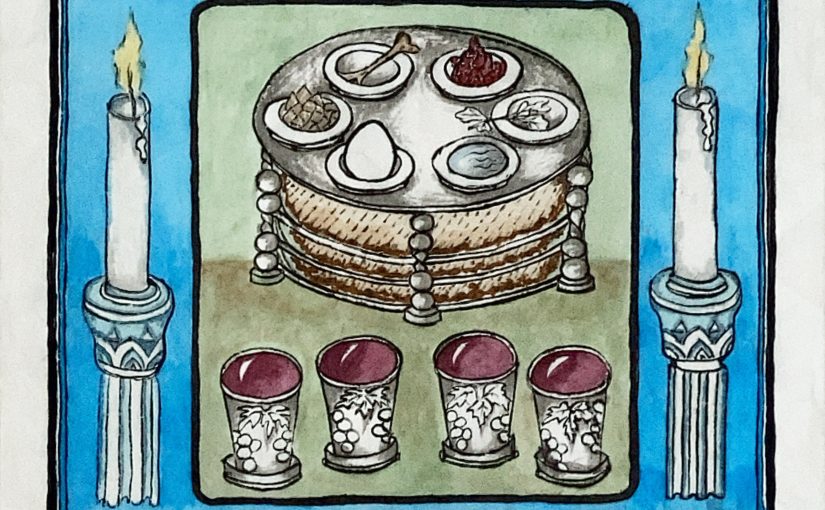
For theimage - Jewish Independent’s 2023 Passover cover by Merle Linde this year, Steveston, B.C., artist Merle Linde, chose to create a Haggadah cover that would look old and hand drawn. To achieve this authentic feeling, Linde used Taiwan linen paper, traditional Chinese watercolour paints and brushes.

The calligraphy letters in solid black Hebrew-like text feature peacock blue flashes, often seen in antique manuscripts. Yom Tov candles sit on candleholders that borrow their design from ancient Egyptian columns. The traditional Four Cups of Wine are inspired by a set of old silverware featuring raised grapevine leaves and grapes. And a silver seder plate holder has space for the three traditional shmura matzot, the shank bone, the burnt egg, haroset, bitter herbs, green vegetable and salt water for dipping.

Chag Pesach sameach.

Format ImagePosted on March 24, 2023March 22, 2023Author The Editorial BoardCategories From the JITags art, Haggadah, Merle Linde, painting, Passover, Pesach, seder, symbolism

Standing by our family

If a member of your family were in crisis, would you abandon them? Even if the crisis were partly self-inflicted, of course you would stand by them.

In a metaphorical way, this is the issue facing Diaspora Jews in considering Israel right now. Whether you agree or disagree with the direction of the new government, it is undeniable that Israel is in a crisis. Each weekend, for several weeks, between 100,000 and 300,000 people have marched in the streets in opposition to a range of government policies, particularly proposed judicial “reforms” that many critics view as a threat to the fundamental democratic character of the country.

Watching from afar, these events are discouraging and worrying – and these emotions mingle with what might already be a degree of ambivalence, disappointment and many other sentiments. It is not always easy to be a supporter of Israel overseas. We have struggled in the face of decades of condemnation, some legitimate, some outlandish exaggerations. It would be easier, for some of us, to walk away.

Israelis do not have the luxury of walking away. And if one looks at Israel today and says, “That does not reflect my Judaism, my politics, my values,” remember: it does not reflect the Judaism, politics or values of most Israelis either.

The Israeli government we see today is the result of a tail wagging the dog, a reality facilitated by coalition politics and the desperation of Binyamin Netanyahu to regain power at almost any cost.

In many instances, people who voted based on concerns about national security find themselves appalled at policies around women’s equality, LGBTQ+ rights, the place of minorities in the country, the treatment of Palestinians in the West Bank and, of course, the overriding threats perceived in the attempts to meddle with the infrastructure of the Israeli judiciary – the wellspring from which much of Israel’s liberal character has come.

Most Israelis did not knowingly vote for leaders who would see the settler violence against Palestinians in the village of Huwara and endorse it, vindicate the perpetrators and incite further, even more destructive and possibly murderous violence. This latter example – of politicians (or anyone else, for that matter) openly celebrating and inciting racist violence – should disgust everyone, no matter their political stripe.

Overseas organizations that are connected with Israel – not least the Jewish Federations of North America – have spoken out officially in ways that are unprecedented in the history of Israel-Diaspora relations. Some of these statements have been comparatively mild in the minds of many observers, who view this as genuinely a time for full-throated disapproval. The fact that they are speaking out at all, however, is significant.

One of the side effects of all this is the debunking of the popular accusations that the tendency to keep negative comments within the family reflects “uncritical support for Israel.” This idea, that Zionism is a form of congenital disorder unrooted in reason, has never been true but it is now discredited. For what that’s worth.

Relatedly, individuals and groups who for years have been slandering Israel with hyperbole are now learning that they have exhausted the arsenal of vocabulary when actual events call for some strong language.

There is some reason for optimism. Isaac Herzog, Israel’s president, who has been cast by events into a role unlike the relatively ceremonial function that the office usually carries, said this week that a compromise may be in the offing on the contentious judicial reforms. Moreover, the resignation from cabinet last week of Avi Maoz, a far-right extremist, appears to be evidence that the government is wearying of fighting a multiple-front war. It is believed that Maoz realized the government wasn’t going to impose his racist, misogynistic and homophobic policies and so took his marbles home. There are reports of more turmoil in the ranks, which could drag the government and the country back toward a little sanity.

On the one hand, this should not invite a slackening of the pressure. There is a movement afoot among Diaspora Jews (and others) to discourage world leaders from meeting with extremist members of the Israeli government. Whether or not that will have much effect on anything, it is a valuable expression of revulsion for people who, like Bezalel Smotrich, incited (and then walked back) his call to “wipe out” the Palestinian village where Jewish settlers recently attacked innocent civilians.

On the other hand, anyone who is considering walking away from Israel, of abandoning the emotional energies of this fight, should consider who it is they would be abandoning in the process. A government is fleeting – although the lasting damage a single government can do is significant. But, Israel is the embodiment of the Jewish people’s national self-determination. To walk away from that is to walk away from more than bad government policy. It is to walk away from history. To walk away from everything that one’s ancestors hoped for, prayed for and built.

More importantly, it is to abandon to their own devices the very people in Israel with whom we probably most closely agree, who are struggling nobly to preserve the vision of Israel that many or most of us believe to be an ideal.

When a family member is in crisis, we do not abandon them. We engage. We help. We confront and intervene, if necessary. We do not walk away. In fact, this is precisely the moment when we dig deepest into our resources and do everything we can to make right what is wrong.


Posted on March 10, 2023March 9, 2023Author The Editorial BoardCategories From the JITags Diaspora, elections, governance, human rights, Huwara, Israel, Netanyahu, settlers, violence

Calling out antisemitism

When news broke that a Jewish person had been shot near a Los Angeles synagogue on Wednesday a week ago, the police statement said there was “no evidence” that the shooter had been targeting Jewish people. When another Jewish person was shot the next day, near the same synagogue, police repeated that these appeared to be separate incidents and that there was again no evidence that Jews were being targeted. Both victims were injured but survived.

When a single suspect in both shootings was arrested Friday, it turned out he has a long history of bombarding Jewish acquaintances and others with violent antisemitic threats.

There is nothing to be gained by having police or anyone else speculate on motives during or in the immediate aftermath of a crime. But if police are going to venture in that direction anyway, why err on the side of randomness? Denying the possibility of antisemitic intent until evidence makes it impossible to do so is a too-common response. It has happened around the world.

In 2015, two days after terrorists murdered 12 people at the offices of the French magazine Charlie Hebdo, ISIS-affiliated extremists took hostages and murdered four people at a kosher supermarket in Paris. Then-U.S. president Barack Obama referred to the attack on an explicitly Jewish store as “a bunch of violent, vicious zealots who … randomly shoot a bunch of folks in a deli in Paris.” There was, of course, nothing random about the “deli” that was chosen.

It happened again during an antisemitic attack in Jersey City, N.J., in December 2019, when six people were murdered. Police initially said they believed the kosher market was randomly chosen and there was no evidence of terrorism. Within hours, they acknowledged that the perpetrators had “targeted the location they attacked.”

In 2022, there was an 11-hour hostage-taking at a synagogue in Colleyville, Tex., in which there were thankfully no casualties but the perpetrator. A police spokesperson said immediately after the incident that the hostage-taker’s demands were “specifically focused on issues not connected to the Jewish community” and, two days later, officials amended this to “a terrorism-related matter, in which the Jewish community was targeted.”

The reality was less oblique. The perpetrator chose that synagogue because it was closest to the federal penitentiary holding a terrorist he sought to free. He chose a synagogue because that would be the surest way to get his demands met since, as he told the hostages, the U.S. “only cares about Jewish lives” and because “Jews control the world.”

What is this instinct to deny that antisemitism is a cause of antisemitic violence until the evidence makes denial untenable?

In her book People Love Dead Jews, Dara Horn posits that efforts at Holocaust education in recent years may be having the opposite of the intended effect. Rather than making people sensitive to anti-Jewish ideas or crimes, it may set the bar too high. When a few people are murdered in Paris or shot in Los Angeles, after all, it’s not the Holocaust. If the only thing a person (or a society) knows about antisemitism is the Holocaust, then cases of hate crimes involving a couple of people are, well, nothing to get too concerned about.

There may be a denial not only of the magnitude, but of the very existence of the phenomenon itself. We are in a time of reckoning about race and racism. These issues are a central fact in our collective discourse. But antisemitism does not fit neatly into this narrative. When skin colour is the defining factor, white-passing Jews are excluded from the discourse and non-white Jews are made even more invisible than they too often already are. Moreover, the outcomes by which racism is measured are, to some extent, economic inequities. Proof of racism is seen in reduced economic outcomes: higher unemployment, lower household wealth, fewer opportunities. These are not, collectively, how antisemitism manifests. Ergo, in some eyes, this means antisemitism does not exist – or does not have the serious, quantifiable impacts other forms of racism have.

Antisemitic incidents, including violent crime, are at alarming levels, according to every survey and measure available. The least that law enforcement, media and ordinary people can do under the circumstances, when a Jewish individual or community is attacked, is avoid retrenching into a defensive position that defaults to the assumption that anything but antisemitism is at work.

Posted on February 24, 2023February 22, 2023Author The Editorial BoardCategories From the JITags antisemitism, Dara Horn, police, racism, terrorism

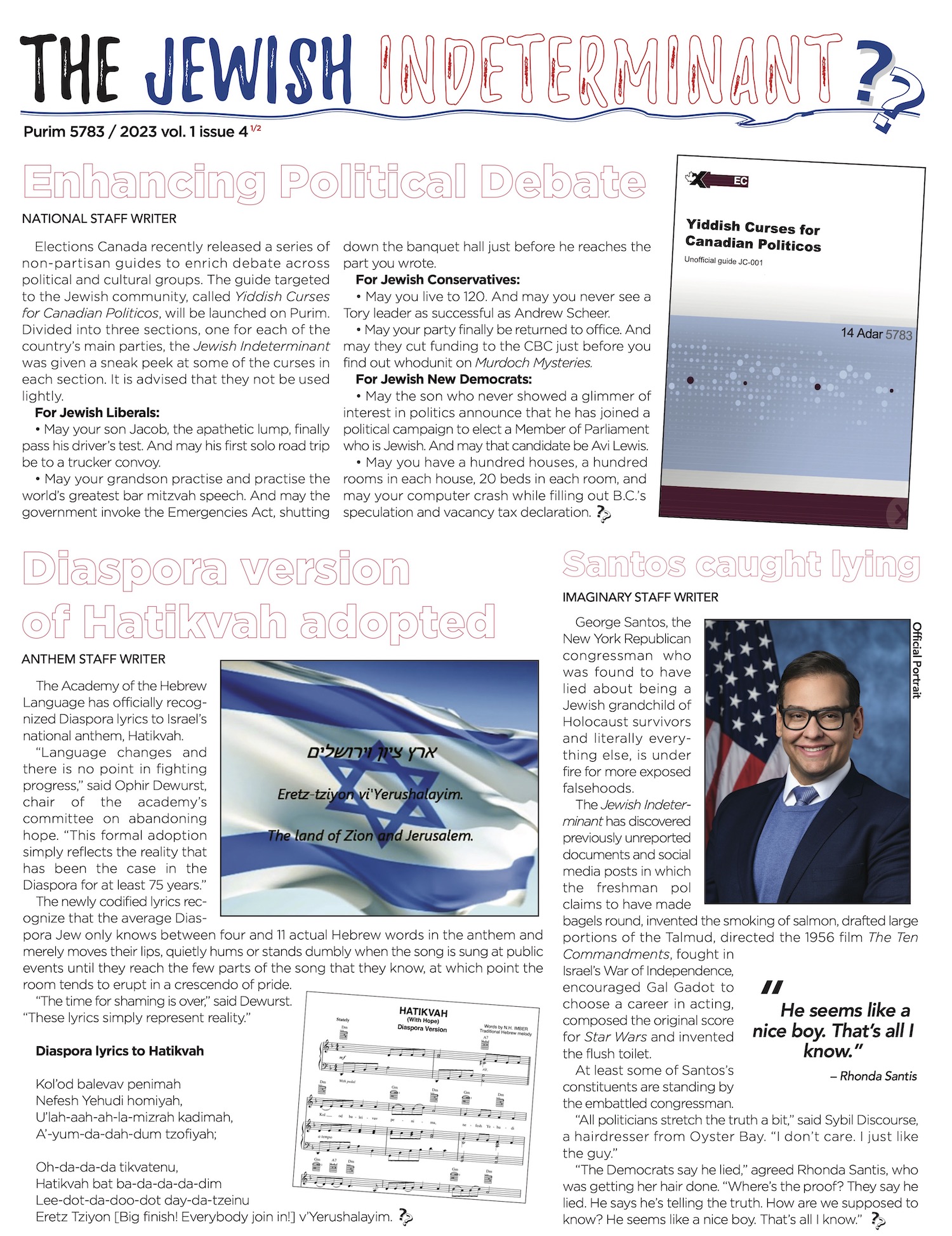
Happy Purim 5783 / 2023!

image - 2023 Purim Spoof page

Posted on February 24, 2023February 22, 2023Author The Editorial BoardCategories Celebrating the Holidays, From the JITags fake news, Purim, satire

Posts pagination

Previous page Page 1 … Page 7 Page 8 Page 9 … Page 49 Next page
Proudly powered by WordPress