Skip to content
  • Home
  • Subscribe / donate
  • Events calendar
  • Business Directory
  • FAQ
  • News
    • Local
    • National
    • Israel
    • World
    • עניין בחדשות
      A roundup of news in Canada and further afield, in Hebrew.
  • Opinion
    • From the JI
    • Op-Ed
  • Arts & Culture
    • Performing Arts
    • Music
    • Books
    • Visual Arts
    • TV & Film
  • Life
    • Celebrating the Holidays
    • Travel
    • The Daily Snooze
      Cartoons by Jacob Samuel
    • Mystery Photo
      Help the JI and JMABC fill in the gaps in our archives.
  • Community Links
    • Organizations, Etc.
    • Other News Sources & Blogs
  • JI Chai Celebration
  • JI@88! video

Recent Posts

  • SFU honours Gloria Gutman
  • Lifting people’s spirits
  • Wedding a ray of light
  • Indigeneity and Zionism
  • Rule of law broken: councilor
  • Football and its roles
  • The burden of defence
  • Fish Café returns after fire
  • All right in what goes wrong
  • Nuns & mermaids at TUTS
  • Camp offers holiday retreat
  • Students and mentors inspire
  • Once-in-a-lifetime trip
  • 100 dancers, one heart
  • Money for the sciences
  • What “Jewish food” means
  • Have a cookie, schnitzel too
  • Federation now across BC
  • Israel fighting for its existence
  • Deal strengthens Iran
  • Patriotic belonging diminishes
  • A campaign to engage
  • Upstanders’ first live event
  • Responding to Carney
  • Having your own home
  • Music a family tradition
  • Musical to warm heart
  • Community milestones … June 2026
  • Sharing her passion for Israel
  • Or Shalom reopens its doors
  • JFS from past to future
  • Need holistic approach
  • Sharing stories, advice
  • Journalist shares fears
  • Skills to live together
  • Road to independence

Archives

Follow @JewishIndie
image - CJN box ad Rockowers 2026

Byline: Rebeca Kuropatwa

Immersed in Hebrew

Immersed in Hebrew

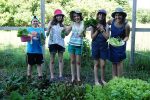
Friends at Camp Shomria show off the fresh vegetables they picked in the camp’s garden. The produce was used to make a salad for one of the meals. (photo from Camp Shomria)

It is said that there is no better way to learn something than by immersing yourself in it. And for kids who want to learn Hebrew in Canada, camp is one of the best and most accessible ways of doing that. But, while there are many Jewish camps in Canada that promote Hebrew language, Camp Massad in Manitoba is the only camp where all the activities and programming are carried out in Hebrew.

“They are not allowed to speak English outside the cabin,” said Danial Sprintz, the camp’s executive director. “Inside the cabin, they speak in whatever languages they want to. But, if they are outside, they are not allowed to speak in English to each other. The kids are all trying to speak Hebrew. So, when everybody’s doing it, you fall in line. Our camp is run completely in Hebrew and there isn’t any other camp that is doing that.

“Not all the kids that come to the camp can speak Hebrew when they arrive. About 50% of the kids don’t go to Hebrew day school, so they are learning Hebrew at camp. We don’t sit them down in a classroom, but we teach them the essentials they need to ask the basic questions. We teach Hebrew through song.”

With repetition, and everyone being together for three meals a day and programming, the kids start picking up the ability to communicate with each other as they go.

Most of the staff has grown up going to the camp and, each year, there are also a number of staff who come in from Israel.

The camp also prides itself on being 100% inclusive. No matter what a child’s situation – if they are autistic, use a wheelchair or are developmentally delayed, or if they are completely secular or ultra-Orthodox in Jewish observance – Sprintz said the camp is dedicated to finding a way to make the experience work for all campers.

Sprintz was executive director of Congregation Emanu-El in Victoria for a number of years, when he and his wife were going to school in British Columbia, before returning to Winnipeg and taking on his role at Camp Massad.

“When I arrived in Victoria, the rabbi was on sabbatical in Israel,” said Sprintz. “I approached the board about helping them with the programming while he was away, and then just stayed on after.”

This experience helped Sprintz develop ways of introducing the children at Camp Massad to Judaism. “We make it fun,” he said. “And we make it something the kids look forward to, as we make the tunes and the process of it all fun. We have tefillin club in the morning for kids who want to try something out, and for kids who need to. But, when it comes down to it, we provide all the religious and traditional cultural components that kids would need to come to camp, to a certain point – we don’t want to separate boys and girls, as we want everybody to be together.”

Camp Massad encourages the children to write their own songs and to put on plays for others in the camp – all in Hebrew.

Winnipeg’s Aviva Tabac has been sending her two daughters, Chaya, 15, and Sara, 13, to Camp Massad for the last three years.

“I didn’t go to camp growing up,” said Tabac. “My parents took us on a summer vacation each year, and the rest of the time was spent at the beach with family and friends. Since I didn’t grow up going to summer camp, I felt it would be a good idea for the girls to try it. Just from my immediate circle of friends who all went to Massad, there’s a special bond they have with one another that carries over into adulthood. All my friends still talk about their fond Massad days and I wanted to give the girls the chance to experience that for themselves.”

Both Chaya and Sara attend public school, so they do not get a lot of other opportunities to speak Hebrew. Tabac said, “When my girls return from camp, they continue to speak in Hebrew, sing Hebrew songs and reminisce. They hang onto their Massad memories and feelings for as long as they can.

“The Hebrew is a big component,” she continued, “but, more so, the celebration of Shabbat, day-to-day celebration of Jewish culture and being proud of being Jewish. The lov[ing], understanding and caring staff and councilors [are] amazing. My girls feel at home when they’re at Massad. They come back rejuvenated, independent and confident. I know that, when they’re there, I have nothing to worry about because they’re in good hands.”

Meanwhile, Lilach Golan moved with her family to Vancouver last fall. She has been sending her four daughters to Camp Shomria in Ontario for years, and plans to continue doing so. She does it with the hope of them picking up some of the values that she grew up with on kibbutz in Israel, including Hebrew.

“For us, the Hebrew language and culture were extremely important and it was very difficult to speak in Hebrew at home all the time … because, when children live in English, they want to speak English and want to be part of the culture around them,” said Golan.

While Camp Shomria operates in English, Hebrew is everywhere at the camp, and the different areas in the camp have Hebrew names, like the chof (beach), cheder ochel (dining room) and moadon tarbut (culture club). Hebrew is also spoken during many of the activities, which include singing and dancing, and at different presentations.

“They do have a lot of Israelis and people who speak Hebrew,” said Golan. “And that’s a big push for the Hebrew – kids love to talk Hebrew with them and the Israelis come every summer. And the songs they sing, there is a lot of language happening there.”

Sharon, 14, is Golan’s youngest daughter. For her, the best part of camp is getting to spend time with her kvutza (group).

“We use Hebrew terminology in contexts where they make sense to me and I can use them meaningfully,” said Sharon. “I also remember better what they mean when I’m not at camp anymore because I can remember the context in which we used them. Hebrew constructs a lot of what and how we do things at Camp Shomria and it’s that culture, atmosphere and values that make me want to come back.

“Even if the Hebrew we use at camp is not new to me,” she said, “it adds so much value to the camp environment and my experience of it. It helps me develop the connection to the three pillars of Hashomer Hatzair [The Young Guard, the Zionist-socialist youth movement] and the core values we share.”

Rebeca Kuropatwa is a Winnipeg freelance writer.

Format ImagePosted on January 12, 2018January 10, 2018Author Rebeca KuropatwaCategories LifeTags Camp Massad, Camp Shomria, education, equality, Hashomer Hatzair, Hebrew, socialism, summer camp, Zionism
Walking Israel National Trail

Walking Israel National Trail

On Canadian Friends of Hebrew University trips to the Israel National Trail, travelers will take their time and enjoy the landscape. (photo from Ami Dotan)

The Vancouver chapter of Canadian Friends of Hebrew University has plans to walk the Israel National Trail (Shvil Yisrael).

As it would take too long to walk the entire 1,000-kilometre trail, CFHU Vancouver will only walk its highlights, dividing them into five separate trips. The week-long excursions will be led by Ami Dotan, CFHU scholar-in-residence and a professional tour guide. The walks will take place each spring, beginning with a trip March 5-11, 2018.

“Generally, the main core of tour guiding in Israel involves going to Jerusalem and some of the holy sites and history and so on, which I totally love,” said Dotan. “But, whenever I get the chance to do some trekking, then I gravitate to it…. It’s my favourite thing. And, doing it on the INT – which was defined by National Geographic as one of the top 20 holy grails of treks in the world – it’s amazing.”

Dotan decided to kick the walks off by exploring Israel’s desert, as it provides such a contrast to the lush forests and lakes that most Canadians are used to at home.

“There’s something special about the desert,” he told the Independent. “There is no makeup of rivers and vegetation, just the essence, the core of things, the rocks and the ground…. Since I was a child, I loved the desert. Alone sometimes, with no cellphones, it touches your heart I think.

“If you ask yourself, ‘Why go to the desert?’ just think, the three major Western religions were conceived in deserts: Judaism, Christianity and Islam.”

Growing up in Jerusalem, Dotan recalls having stepped out of his home as a child and walking to the Kidron Valley from Jerusalem, making his way to the Dead Sea. Eventually, his father would come with their old car to bring him back home after dark. “That’s when I began developing a love for the desert,” said Dotan. “And, then, of course, during military service, walking in the desert.”

The trip Dotan will be leading in March will begin with an overnight in Mitzpe Ramon, going down into the crater and walking across it to the other side. This is a 12- to 13-kilometre stretch of serious desert.

The group will then bus to the Arava for a night. Dotan described this area as being “in between Israel and Jordan, but very safe. The next day, we’ll go do a trek called Maale Palmach (Palmach Ascent). This is an ascent nobody knew was possible to do … and the Bedouin who met them at the other side said it couldn’t be done…. Therefore,” he said, “it was named ‘the Ascent of the Jews’ by the Arabs. We’ll do part of the trek, including climbing up a ladder, to be able to [get up] this cliff that they walked up.”

The third day will have participants heading into sand dunes, to Kibbutz Ktura for the night. And, on the fourth day, they will go to the colourful sand rocks near Eilat and spend the night in Eilat.

“Lastly, on Saturday, for people who want to walk on Saturday, we’ll go up the mountain and then down through the INT,” said Dotan. “Then, for those who want to go on to Petra, we’ll spend three more days and continue to Petra.

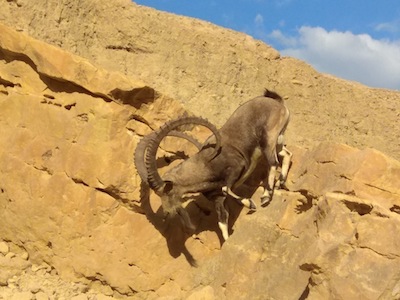
photo - Hopefully travelers will see some of the Shvil's residents, such as mountain goats, which have their babies in the spring
Hopefully travelers will see some of the Shvil’s residents, such as mountain goats, which have their babies in the spring. (photo from Ami Dotan)

“The trip will involve special activities around the walks, to better understand the culture and the character of the people who live there, and things we do in the desert. And, we have a Bedouin evening with local people – an amazing way to get to know the desert geographically, but also the people who’ve lived there for so long and how their life changes in a modern country, which is fascinating subject on its own.

“Next year [2019], we will do less desert, instead going to the north, which is also beautiful. I think, what you get in the north is more the human diversity. You have the Jews – Orthodox, secular and Modern Orthodox – and Arabs, Christians and Druze. In the desert, you have a Jewish population and Bedouin.”

Dotan chose to have the trips in March for two reasons. One is because they will take place before Passover, so participants will have time to return home for holiday preparation. The other reason is that, in March, the desert may have some flowers blooming, as well as some vegetation and grass.

“I hope we’ll even get to have an appointment with some mountain goats that have their babies that time of year – amazing to see,” said Dotan. “Hopefully, we’ll find natural water pools in the valleys filled with water. Not Canadian-scale quantities of water, but, after you’ve walked all day and have been sweating and warm, you’ll get to jump into this cold, fresh natural water … before it disappears in a few months.

“Also, of course, March is the time that birds migrate from Africa back to Europe. Twice a year, we have half a billion birds flying all over Israel, and many of them fly over the Syrian-African rift (which is the border between Israel and Jordan … just over our heads). So, you’ll be able to see swarms of all sorts of birds – birds of prey, storks and pelicans, whatever you want.”

According to Dotan, the trip is designed for people who have good mobility, but it won’t be extreme. There will be walks of roughly 12 kilometres a day, but, as Dotan said he has learned from experience, “It’s not a question so much how many kilometres you walk, it’s about what type of kilometres you walk. Yes, we are going to go down sometimes very steep rocks, but, obviously, it’s doable. It’s part of the excitement of walking in the desert. If you’re reasonably fit, you can do it…. I’ve had people 80 years old doing this trek. It’s not a matter of age. It’s a matter of if you’re enjoying the walk. We’re not going to rush. On the contrary, we have a lot of time to do it calmly and enjoy the landscape, nature, and excellent logistics.”

The tour group will get to stay in unique hotels at the end of each day, with a bus taking them to the beginning of the trails and picking them up at the end. “Every night, you will get to enjoy a hot shower, a good dinner, and so on and so forth,” said Dotan.

“This experience isn’t for those who rush. Rushing in the desert isn’t a good idea. I’ve done most of these treks with my 10-year-old son, and he’s not Superboy. It’s for anybody who loves nature and is reasonably fit for walking in the mountains, not just in a park. Even if you need to not participate for a day because you need the rest, then that’s possible and no problem.”

For more information about the CFHU Shvil tours, contact Dina Wachtel, Western Region executive director at 604-257-5133 or [email protected].

Rebeca Kuropatwa is a Winnipeg freelance writer.
Format ImagePosted on December 1, 2017November 29, 2017Author Rebeca KuropatwaCategories TravelTags CFHU, Israel, Shvil
Immersed in Judaism

Immersed in Judaism

Abigail Pogrebin, author of My Jewish Year: 18 Holidays, One Wondering Jew. (photo from Abigail Pogrebin)

A few years ago, author Abigail Pogrebin spent an immersive year studying the Jewish calendar and attempting to observe it. She chronicled her experience in a column in the Forward and, subsequently, in the book My Jewish Year: 18 Holidays, One Wondering Jew (Fig Tree Books, 2017). On Nov. 19, she was in Winnipeg for the city’s Tarbut Festival.

“I did not approach this as a gimmick,” she told the Independent. “It was really a sincere stab at an understanding I never had, which is the origins for all of these chaggim [holidays] … and also, not just the origins, but the underpinnings, because these are obviously … human-created milestones that have endured for thousands of years. I wanted to understand both how and why they were conceived – what they’re supposed to mean for us today, not just to our ancestors. I definitely had a hunch that, for something to have endured for as long as it has, it has to resonate wherever you are in your life – at least for a large swath of people who live by this calendar.”

Pogrebin recognizes that there is a segment of the population that adheres to it simply because they inherited it, without questioning. Yet, for many people, Jewish observance, particularly of holidays, is a deliberate choice.

Pogrebin grew up in New York City. Her mother, writer and activist Letty Cottin Pogrebin, was instrumental in promoting women’s rights in the 1970s, and her writing includes analyses of what it means to be Jewish and female.

“I was not someone who celebrated nothing before this,” said Abigail Pogrebin. “I had sort of the five or six tent poles of Jewish holidays in my life…. I grew up with Shabbat…. It wasn’t enforced, but it was observed when we were together as a family. I went to synagogue on the High Holidays. We had always lit the menorah for eight nights, and I went to two seders back-to-back. Then, also, the feminine seder, which was a tradition that was started in mid-1970s by a group of women, including my mother.

“So, those were the basics that I’d grown up with. But, obviously, I was missing the majority of the signposts of the Jewish year. It bothered me that I didn’t know [them]. I also wanted to experience them in a way that might lead me to more meaning in my life.”

book cover - My Jewish Year: 18 HolidaysAs examples of what she learned on her journey, Pogrebin said she had never understood before that the process of atonement and introspection needs to start far in advance of Rosh Hashanah and Yom Kippur.

“During the month of Elul, we’re supposed to do what is called, in Hebrew, cheshbon hanefesh (accounting of the soul). And, when I asked various rabbis how I might go about that, because there’s not a clear blueprint for observance, quite a few suggested taking the middot (characteristics) and breaking them down, exploring one a day. So, I chose to do that for 40 days leading up to Yom Kippur.

“I did this with a friend, a study partner, essentially. So, my friend, Catherine, and I took these 40 middot that a rabbi had posted online. One day, you’d do anger, another you’d do courage, another envy, another humility.”

As the women went through the days, they aimed to look at themselves as deeply and honestly as they were able and to write their reflections on each characteristic at the end of each day.

“By the time I got to synagogue on Rosh Hashanah and Yom Kippur, I felt like I was in a very different zone for reflection,” said Pogrebin. “On Yom Kippur, I went to a mikvah [ritual bath] for the first time, and that was extremely meaningful.”

Pogrebin spent Sukkot in Los Angeles, interviewing four rabbis in two days, with each one discussing a different aspect of Sukkot that she never had understood before.

“One emphasized the fragility, the impermanence of our structure, and our shelters in our lives,” she explained. “How resonant that is today, with natural disasters and poverty, and all kinds of things that should shake our foundations, both literally and metaphorically.

“Another talked about the fertility, the imagery that is in Sukkot – the shaking of the lulav and etrog, which was much racier than I ever understood. Another talked about agriculture, and the land and connecting – reconnecting with the earth in ways we don’t do in other times of the year.

“Another rabbi talked about wandering, the importance of being lost and being comfortable with being lost; embracing the idea of the most important lessons and reckonings when we don’t know where we are going.”

Pogrebin also mentioned Yom Hashoah, which commemorates victims of the Holocaust. According to her, not many people know when it takes place. “I think it’s just not in the fabric of how many of us were raised, but it seems to me to be a crucial holiday, even though it could never be adequate to mark such a vast and devastating history and persecution,” she said.

“I went to B’nai Jeshurun, which is a Conservative synagogue on the Upper West Side that, in partnership with the JCC in Manhattan, does something called the naming of the names, where they have this book from Yad Vashem … devastating lists of families who perished. Starting at 10 p.m. and going all night into the next day, people tak[e] turns reading those names,” said Pogrebin.

About how the yearlong experience has changed her and her family, Pogrebin said, “In a way, it’s changed completely and, in a way, it hasn’t changed radically. I’d say it’s changed completely in the sense that I don’t look at time, relationships, obligations, the same way anymore. I think, if the holidays do anything, they are constantly reminding us to ask ourselves who we are in the world and whether we are doing what we could be doing to alleviate someone else’s suffering or pain.”

Pogrebin is always looking for ways to bring the lessons of her journey into her day-to-day life, to make them come alive in a way they didn’t for her when she was a child.

About the book, she said, “If one wants to understand the arc of the year, you will. It’s not that there are not people who might disagree with this or that, but it was researched and tested with people who live this and teach this at a very high level. So, it’s not just Abby saying it to be true. It’s me putting on my journalist hat and making sure when I explain something that it’s definitely rooted in scholarship. I hope … it’s an enjoyable and entertaining book.

“The people who read it are coming along with me and my experience with the holiday for the first time. They are also getting, I think, a fairly thorough template of what a Jewish year involves and demands. I think that, whether you’re Jewish or an interfaith family that wants to explain or introduce … some of these holidays in your own home and you’ve never done them before, it’s absolutely a door into learning how.

“There is something magical,” she said, “about not just living by someone else’s clock, but by an ancient roadmap…. I think there’s something very powerful about embracing … whether it’s Judaism or any religion, what it imposes on you, in terms of [laying out] what you should be thinking about besides your own needs and wishes – to me, that’s an important takeaway that I think other people should explore.”

Rebeca Kuropatwa is a Winnipeg freelance writer.

Format ImagePosted on December 1, 2017November 29, 2017Author Rebeca KuropatwaCategories BooksTags Abigail Pogrebin, Jewish life, Judaism
Reuniting in Winnipeg

Reuniting in Winnipeg

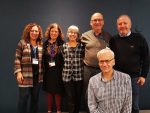
Among those at the reunion were, left to right, Helen Pinsky (Vancouver), Barbara Moser (Montreal), Chana Thau (Winnipeg), Avrum Rosner (Montreal), Cecil Rosner (Winnipeg) and Zev Cohen (Israel). (photo from the reunion)

Anyone who went to a Jewish day school in Winnipeg in the 1950s and 1960s was invited to a reunion recently – and 220 former students attended.

The Oct. 6-9 reunion was organized by Avrum Rosner, who now lives in Montreal, Zev Cohen, who now lives in Israel, and Eileen Margulius Curtis and Bert Schaffer, who both still live in Winnipeg.

Rosner started posting high school photos on Facebook. A closed Facebook group followed and then Rosner created a page inviting people to share photos from Winnipeg Jewish schools.

“So, some genius – Zev Cohen – asked on the Facebook group, ‘How about a reunion?’ And he then started laying the groundwork,” said Rosner. “It went viral after that.”

Rosner and his wife, Marnie Frain, both attended the reunion.

“There were many different Jewish schools in Winnipeg in the 1950s and ’60s, of diverse languages, attitudes to religion, attitudes to Israel, left and right,” said Rosner. “And, what was a thriving community, with unique cultural and social institutions, that reached its numerical peak around 1960, has been drastically diminished by emigration ever since.”

The main venue of the October reunion was Holiday Inn West Airport, where some of the out-of-towners stayed. But, on the Sunday, Gray Academy of Jewish Education (GAJE) hosted the reunion. The academy is the entity into which nearly all the Jewish schools have amalgamated.

The first reunion event was a dinner on Friday evening that included speeches. There was a discussion on Saturday; a brunch and greetings by GAJE staff and students, as well as a bus tour and dance party, on Sunday. On Monday, there was a farewell brunch with live entertainment, performing Hebrew, Yiddish and klezmer songs and 1960s/70s rock ’n’ roll.

Participants included students, and a small number of former teachers, from Winnipeg’s Talmud Torah, Joseph Wolinsky Collegiate, I.L. Peretz School, Rosh Pina, Herzlia, Ramah, and Sholem Aleichem School.

“For me, the highlights are not hard to identify – renewing half-century-old friendships. For me, and for many, it restored my belief in magic,” said Rosner. “Personally, I think I gained the pure pleasure of reconnection with childhood friends. Also, the confirmation of the importance and ongoing vitality of the social, cultural and ethical values … and principles many of us absorbed – not solely through formal education, but by growing up in a unique-in-many-ways Jewish community in an isolated prairie city. It was what I expected and hoped for, though exponentially better.”

Vancouver reunion attendee Helen Pinsky said, “I watched the whole thing happen on Facebook. And, despite the fact that I’d heard very little from other people who I’d gone to school with, the reunion appealed to me a lot. I made arrangements to see all my cousins in Winnipeg, and booked the trip. I attended with my boyfriend, Yossi Amit, who, at that point, knew none of my Winnipeg relatives and had never been to that city.”

Pinsky and Amit stayed at the reunion’s “official” hotel and, though the schedule for the weekend had looked quite bare, that was a plus for them, as it allowed for personal visits. “In the end, most of my cousins attended the reunion, too,” said Pinsky. “Then, we made plans for spending our free time together. The programs were well-received and gave us all a structure from which to build other plans.”

Pinsky enjoyed many aspects of the weekend, including the talk about the history of Winnipeg Jewry, the music and food at Hops, the band Finjan and reminiscences at brunch. “There were lots of photos, laughter, warmth, memories sharing, good feelings and catching up,” she said.

Helen Nadel also attended the reunion. Nadel met Vancouverite Tevy Goodman in Winnipeg in 1975, and the couple were married at what was then Rosh Pina Synagogue.

“My childhood stories of growing up in North End of Winnipeg have always interested my children,” said Nadel. “I heard about the reunion when I was in Winnipeg in April for a reunion of my high school Grade 12 class [of 1952] who all turn 65 this year. I also knew I’d have a 40th-year medical school reunion this year [Sept. 15-17]. So, I decided that this was the year to make it a trifecta.”

When Nadel and her husband decided that he would accompany her, Nadel invited her daughter, Daniella, along, too.

“For me, it was fun to see the older girls who were my cousins’ age, as I was the tag-along with my cousins when I was at Peretz School,” said Nadel. “After pointing out that I was the little pisher who was with Carol and Sandi, recognition was achieved. Reminiscences were exchanged. It was remarkable that, by the end of the weekend, people no longer looked unfamiliar. I remembered them as they were some 50 years ago.

“My daughter loved seeing me with my grade school mates. She loved hearing the stories and began texting her posse about what fun this was, wondering what they might be doing when they are our age. She particularly loved seeing us reminisce when we stopped at the two schools, Peretz and Talmud Torah. I had goose bumps when a few of us spontaneously started singing the Peretz School anthem a cappella in front of the school, although only one in the group – Pam – really remembered all the words.”

Nadel was taken aback by how close Peretz School and Talmud Torah were to one another. She had remembered them as being very far apart – not only ideologically, but in distance.

“All in all,” she said, the reunion was “a chance to re-form and strengthen our bonds and ties to Winnipeg and the wonderful community we all grew up in.”

For Myron Calof, word of the reunion reached him about a year ago, when his wife, Ros-Lynn Sheps, called him at the office to say that she had just checked their voicemail and there was a message from Bert Schafer.

“Although I had not heard that name for over 50 years, I instantly put the name to a face and called Bert,” said Calof. “After confessing that, as a kid, I had routinely stolen crab apples off his parents’ crab apple tree, Bert told me a Winnipeg Jewish schools reunion was in the works and asked if I’d attend. I didn’t hesitate for a second to say that both my wife and I would be there.”

Calof anticipated that the reunion would be a positive experience, but, he said, “It was far better than that. First, although I don’t know when I’ll see them again, I feel reconnected with old friends. Second, the experience made me realize that my classmates and I played a vital role in continuing and strengthening Jewish education – not just in Winnipeg, but in the many North American, Canadian cities where we eventually settled. We carried with us the spirit, value and importance of a Jewish education which, in the raising of our children and through participation in community endeavours, we’ve helped perpetuate.”

Calof noted the similarities between his early Talmud Torah years – less than 10 years after the founding of the state of Israel and the end of the Holocaust – and the threat the world and world Jewry face today with the rise of nationalism, antisemitism, xenophobia and challenges to liberal democracy. “I hope history is not repeating itself, especially where Jews are concerned,” said Calof. “But, if it does, I hope and I truly think, we and the generations of Jewish students who have followed us will be better prepared to oppose and push back our enemies.”

The best part of the weekend for Calof was Monday morning, when so many former students from different years and schools had the opportunity to express their gratitude to teachers, parents and school founders for helping enrich the lives of thousands of students who attended a place of Jewish learning.

Anyone who attended Jewish school in Winnipeg in the 1950s and 1960s can still add their name to the organizers’ contact list by e-mailing [email protected] and can join the 800 others in the closed Facebook group facebook.com/groups/winnipegjewishschools.

Rebeca Kuropatwa is a Winnipeg freelance writer.

Format ImagePosted on November 24, 2017November 23, 2017Author Rebeca KuropatwaCategories NationalTags Helen Nadel, Helen Pinksy, Jewish school, memory, Winnipeg
Women lead way to peace

Women lead way to peace

Yael Deckelbaum is using her musical talents and connections to help Israelis and Palestinians press for peace. (photo from Yael Deckelbaum)

Yael Deckelbaum is using her musical talents and connections to help lead thousands of Israeli and Palestinian women to peacefully press for the end of the fighting between their two peoples via March for Hope.

Deckelbaum’s celebrity status in Israel and around the world – through performances with known local artists and bands such as Shlomo Artzi and Machinah, as well as her career with Habanot Nechama and solo albums – helps draw a crowd. Her involvement in the cause began when she joined forces with Daphni Leef, an Israeli activist for social justice.

“I’d sit with her and tell her she’s a better person than I am,” said Deckelbaum. “She was always talking about how we have to change things in Israel – going around in many places in Israel, meeting people, listening to them and trying to learn … what’s wrong and trying to fix things. I decided to take a caravan, go through Israel, sell CDs, maybe bring a sound system, perform … see people from a different angle. Daphni decided to join me. From this idea, it became 20 people, two caravans … a journey we did for 45 days in 40 different places across Israel.”

They met many Israelis from various cities and villages, and Deckelbaum gained a new perspective. Everywhere they went, she would sing and Leef would speak to the people after every show.

“That’s when I decided I would dedicate myself, using music as an instrument, toward change … not just be an instrument for supporting my existence … but to spread a message and how I believe this world should be. [It] was a big turning point in my path,” Deckelbaum told the Independent.

A year later, one of Deckelbaum’s friends shared an email about Women Wage Peace.

“A lot of times, us musicians, we get invited, we go, sing and leave,” said Deckelbaum. “We feel good about it. But, this time, I felt like I had to meet them. A few days later, I was sitting at a table with women from Women Wage Peace. They told me about this march they were planning – a group of mothers who, in the period of military operation, were experiencing terror at home, fear … mothers sitting at home, knowing their sons are somewhere and not knowing if they’d come home from war.

“One of the founders told me she said to herself that she would never forget this feeling of terror, that she can’t sit anymore and do nothing about it. She urged us to do something radical, extreme, because something had to change. She couldn’t live with the feeling of helplessness anymore.”

At one point, Women Wage Peace fasted for 50 days outside the prime minister’s house, demanding a mutual agreement between Israel and Palestine be made.

“They told me they were already connected with Palestinian women who feel the same,” said Deckelbaum. “And then, on Oct. 19, 2016, 1,000 Palestinian women marched with us together in the Dead Sea [area] – the lowest place of the earth. I started to cry, as it touched me in a deep place.

“Many years ago, I had this vision of women marching together … not something I can explain…. Then, I met these women [who] told me about this, and it was coming true. And, it has an energetic meaning that it happened in the lowest place on the earth – women marching to the belly of the earth. So, I cried and offered to give my music to the cause.”

Deckelbaum invited more artists to join and sing, and became the march’s artistic director. She began with songs like “Give Peace a Chance” and “Hallelujah,” and then wrote originals herself. “The melody and the lyrics just came,” she said. “And the ‘Prayer of the Mothers’ was born, directed by Astar Elkayam.”

Deckelbaum was inspired by a message that had been sent to march organizers by Leymah Gbowee. Gbowee is a Liberian woman who led a women’s peace movement, which helped bring an end to the Second Liberian Civil War in 2003, after 13 years of fighting.

“I felt something very real is happening, that I have a chance to do this,” said Deckelbaum. “I put it into the song clip, so you can hear her speaking. And she sang, ‘As the world we live in, peace is possible / Only when women of integrity and faith stand up for the future of their children.’”

This year, Women Wage Peace planned a second march, dubbed, “The Journey to Peace,” which started in the south of Israel near the Gaza border on Sept. 24 and ended in Jerusalem. Other events have followed, and will continue, throughout Israel. The peak of it was on Oct. 6 in Jaffa/Tel Aviv, with a march that Deckelbaum helped organize, “colourful with dancers, musicians, and drummers – happy and hopeful,” she said.

On Oct. 8, there was an event in the desert with Palestinian women. The previous year, 1,000 Palestinian women came. This year, there was twice that number, and the hope is that, each year, it will grow.

“These are the miracles we’re all waiting for – peace between Israel and Palestine, and between and within ourselves and amongst us as people,” said Deckelbaum. “Women Wage Peace isn’t only about making peace with Palestinian women. It’s about making peace between all kinds of women in our society and different places.”

Deckelbaum learned there is a global women’s revolution. She heard of a march in Washington, D.C., in which she participated, and another in Zurich, at which she was invited to sing.

After the video of “Prayer of the Mothers” was released, more marchers all over the world were set into motion. Deckelbaum is now working on a project called Women of the World Unite.

“I believe that women from all over the world are sharing this message, a hope for peace – a message that’s inclusive of all human beings,” she said. “We need women to be more involved in managing the ways of the world – not only by raising children, but also by engaging in the system and how things will work.”

The Jewish Independent spoke over the phone with Deckelbaum when she was in Switzerland doing concerts with an ensemble of religious and secular Jewish, Muslim and Christian women called Prayer of the Mothers Ensemble. It involves 14 women, carrying the message of female empowerment, revolution, evolution and peace.

Rebeca Kuropatwa is a Winnipeg freelance writer.
Format ImagePosted on November 24, 2017November 23, 2017Author Rebeca KuropatwaCategories WorldTags Israel, Israeli-Palestinian conflict, peace, women, Yael Deckelbaum
NCJW Canada is honoured

NCJW Canada is honoured

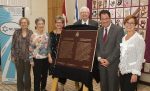
At the Oct. 23 ceremony for the unveiling of a plaque honouring National Council of Jewish Women of Canada’s 120 years of service are, from the left, Sharon Allentuck, Gloria Roden, Debbie Wasserman, Dr. Richard Alway, Councilor James Pasternak and Eva Karpati. (photo from NCJWC)

On Oct. 23, National Council of Jewish Women national president Debbie Wasserman accepted a plaque honouring the work of NCJW. It was from Parks Canada and the Historic Sites and Monuments Board of Canada and it was unveiled at the Toronto offices of NCJW Canada. The recognition came on the council’s 120th anniversary.

“NCJWC in Vancouver has an enviable track record of working with disadvantaged elementary schools, funding programs of nutrition, hygiene, cooking, farm visits and street safety,” NCJWC Vancouver’s Debby Altow told the Independent. “We have received heart-stopping letters of thanks from the kids and their teachers; they inspire us to do even more in our fight to alleviate poverty…. Our Operation Dressup delivers thousands of items of good clothing, plus shopping certificates for teens every year, and our Books for Kids program reaches into daycares, preschools, doctors’ offices and other sites…. We hope to expand these programs into other nearby communities.”

Altow said, “Vancouver section president Catherine Stoller is following in the footsteps of her mom, Sheilah, serving as president of the section for the past three years. Our section has been an integral part of the community for over 90 years, and the Heritage designation, while it rests in Toronto, really applies to every province where council has been active.”

Of the Oct. 23 event, Wasserman said, “The ceremony was very moving. We began by proceeding into the auditorium…. The Canadian flag was dominantly displayed and the plaque was draped. We all sang O Canada. The master of ceremonies then introduced all the dignitaries and all spoke about the importance of NCJWC over its 120-year history. The ceremony’s highlight was when we all came off the stage to unveil the plaque displayed on an easel.”

Wasserman and NCJWC Toronto president Eva Karpati unveiled the plaque. Ena Cord, immediate past president of the Toronto section, read the inscription in English and Dahlia Rusinek, a past Toronto section president, read it in French. There were many photos taken, and a reception followed.

“Parks Canada contacted us earlier this year to tell us that NCJWC was to be recognized as an organization of national significance to Canada, seeing that we were the first Jewish women’s organization in Canada,” explained Wasserman. “The plaque will be permanently installed at 44 St. George St. in Toronto, the former head office of NCJWC.”

Dignitaries at the ceremony included Eric Nielsen of Parks Canada (master of ceremonies), Dr. Richard Alway of the Historic Sites and Monuments Board of Canada, Toronto City Councilor James Pasternak (York Centre), NCJWC Toronto member and historian Gloria Roden, and Sharon Allentuck, NCJWC immediate past president and Winnipeg section member.

“As a passionate advocate for social justice and equality since 1897, the National Council of Jewish Women of Canada has forged an enduring legacy of community service across Canada,” Nielsen noted in his remarks. “It’s incredible to think that the council was founded right here in Toronto and has been growing steadily for over a century.

“The birth of the council came at a truly interesting time in Canadian history,” he continued. “During the late 19th century, urbanization, industrialization and immigration were causing social disruption in many cities across Canada. It was at this time that a pioneering group of Jewish women united to effect social change. Led by Meldola de Sola, wife of a distinguished Montreal rabbi, women of the Holy Blossom Synagogue in Toronto began meeting in private homes to study Genesis and the teachings of Judaism in preparation for beginning philanthropic activities in their communities.

“At the time of its founding in Toronto, the National Council of Jewish Women of Canada focused on supporting young girls and new immigrants. They provided shelter, training, and other forms of assistance, all while strengthening the Jewish community.”

Nielsen said that, through NCJW, Jewish women across the country “gained a voice in Canadian society and the women’s movement.”

The oldest Jewish women’s organization in Canada, NCJWC has evolved, said Nielsen, “to meet the changing needs of the most vulnerable in society.” And it “continues to work tirelessly to promote social justice, freedom, equality and tolerance at home. Equally concerned with the well-being of people outside of Canada, the council’s members have also collaborated with aid organizations, such as the Red Cross, to contribute to humanitarian efforts abroad.

“Thanks to their efforts, we are creating a rich mosaic portraying the greatest moments of our nation’s history. Future generations will better understand their history through this mosaic and, hopefully, better understand themselves and the values of our country.”

Nielsen congratulated NCJWC. “The council’s invaluable legacy,” he said, “is a source of inspiration for all who work to promote meaningful social change, at home and abroad.”

Noting that NCJWC “began in 1897 with 20 women studying and learning Bible,” Roden said the council “realized there was an urgent need to help immigrants arriving daily in Toronto. And so, by 1909, a place was needed for the growing group to expand their activities. Two rooms on Walton Street in the Ward were rented, but, by 1913, there was a move to new larger headquarters on McCaul Street.

“With the outbreak of the First World War,” she said, “young council members took an active part and McCaul Street was transformed into a Red Cross centre, providing hospital supplies and other necessities for wartime aid. In 1918, with the Spanish flu epidemic, council volunteers carried meals to 800 flu victims from our kosher kitchen and provided home nursing care.

“In 1919, council women became big sisters to children and working girls, and bought Fairview Cottage at Whitby Beach to provide these girls with an oasis for much-needed fresh air and sunshine. By 1937, council continued their involvement with the Jewish Camp Council to included Camp Camperdown near Orillia.”

The offices on St. George were “purchased with a modest down payment,” said Roden. “It was called Community House, with the Jewish community using the much-needed premises for a variety of activities. It operated classes, including cooking, sewing, journalism, language, dance and art. Sports teams were formed … [to help newcomers to Canada], a daycare centre, English classes, and even a legal storefront service was established. A club for handicapped girls was formed to teach sewing and social skills, and there were interpreters to translate for the newly arrived.

“The NCJW has continued with our motto of ‘Faith and Humanity,’ and the voluntary participation as our civic responsibility as citizens of our great country. We continue to study, educate ourselves and participate with pride.”

Rebeca Kuropatwa is a Winnipeg freelance writer.

Format ImagePosted on November 17, 2017November 15, 2017Author Rebeca KuropatwaCategories NationalTags National Council of Jewish Women of Canada, NCJW, tikkun olam, women

Grandparent parents

This past summer, the topic of grandparents parenting their grandchildren was front and centre at the Jewish Child and Family Services Winnipeg (JFCS) annual general meeting. The Independent spoke recently with a couple of the participants in the June event.

Corinne Ackerman, 73, was joined by her husband, Harvey, 75, at the AGM. The couple has two grown children – a son who lives and works in Auckland, New Zealand, and a daughter who lives in Winnipeg. Seven years ago, their daughter’s family began experiencing difficulties, to the point that Manitoba Child and Family Services (CFS) became involved.

“Harvey and I were aware there were problems in their home, but we didn’t know how bad,” Corinne told the Independent. “We got a phone call from our daughter, saying that CFS was coming to the school to apprehend their three boys. And, of course, when I heard that, I just was absolutely stunned…. I grabbed my car, went to the school and met the social worker. I said, ‘You’re not taking them. I’m their grandmother and they are coming with me.’”

Everyone ended up at CFS, which then evaluated the possibility of the Ackermans taking charge of their grandsons. “They came to our apartment. They checked it,” said Corinne.

By that evening, all three boys were with their grandparents in their apartment. However, said Corinne, “We had them here with us for about 10 to 12 weeks. They [CFS] wouldn’t let us keep them. You can’t have three children in a two-bedroom apartment.

“At that point, friends of mine … and even the principal at the kids’ school called me … and said to call JCFS. It took a lot for me to do that. You become so embarrassed. Harvey and I were just mortified.

“I did, and God bless Emily Shane [who was then at the helm of JCFS]. She sent workers and the process began. They found a foster home for the three boys, but it very quickly deteriorated. It was just awful.”

Ian, now 14, the youngest, was having the most trouble. He also needed some major dental work. All of those involved decided it would be best if Ian went back to live with his grandparents. Ian’s brothers are now 18 and 20.

“I don’t even remember how it all happened, but the agreement was, the boys were going to another foster home and Ian would stay with us,” said Corinne. “And he’s been with us now since he was 7 years old.”

The Ackermans have made a point of assuring Ian that his parents and brothers love him.

“I think that he knows that he’s loved and that we still love his mom, dad and brothers,” said Corinne. “Ian would like to be home with his mom and dad if it was possible. But, I think he’s pretty happy here. And, for as long as he needs us to be here, we are going to try to take care of him.”

While there were some hurt feelings within the family when all of this happened, of course, everyone has made amends for Ian’s sake. They all speak regularly, and Ian visits his mom and dad regularly.

When asked about the difference between raising your own kids versus raising your grandchildren, Corinne said, “Well, when you raise your grandchildren, you get a better appreciation for the love you have. I love my daughter, I love my son, I love my in-laws, but you love your grandchildren on a different level, and we just adore Ian. At times, he’s very difficult, but at times, he’s an absolute blessing.”

The Ackermans have had to realign their lives in order to parent their grandson. It was a drastic change and they depend on JCFS for respite.

“We are not people who go out all the time, but it does cut down on the freedom to do so,” said Corinne. “But, we’re OK with that. Ian is important enough to us that it’s worth it.

“Ian has some challenges in school and that makes it quite difficult for any parent. We’ve done our best to get him the help he needs, and I can say that JCFS has been fabulous. Ian had a reading clinician, as he had a little speech impediment, and now it’s gone. JCFS has been wonderful with whatever Ian has needed.

“There are issues when a child is taken from their parents, and issues before that, and they’ve been very helpful throughout,” she continued. “As far as Harvey and I, when I really have it up to my head … I’ll give the social worker a call and she’s always there to help and give advice.

“Ian is the most invaluable young man because, whatever we do for him, he does back for us tenfold. He’s a wonderful kid. A million foster homes are wonderful, but family is family and there’s a difference.”

The other panelist at the JCFS AGM was Karla Berksen, 73, who also took in her two grandchildren seven years ago. Berksen was awarded custody because her daughter was unwell and her husband could not care for the kids.

Berksen and her partner of many years, Arthur Chipman, took in the children when Paige was 4 and Jacob was 8. At the time, Berksen was a newly retired financial planner and was spending part of her winters in Mexico.

“My daughter was still alive when I got the kids,” Berksen told the Independent. “She wasn’t a very well person, so we spent a lot of time with her. When they came to me, they were just dropped off. Arthur’s been quite amazing, because people my age don’t think this is something they want to do for their retirement. But, this is what we’re doing, although Arthur is still working.”

Both children attended and graduated from Brock Corydon School’s Hebrew immersion program. “Jacob had his bar mitzvah two years ago and Paige will have her bat mitzvah in March,” said Berksen.

“I feel very grateful to have the kids. It makes me a little tired sometimes. But, as I said at the JCFS AGM, I’ve only had two anxieties in my whole life. One was nine months after I stopped smoking – I had an anxiety attack realizing I wasn’t going to have a cigarette again. The other one happened a couple years after I got the kids, and I realized that I’m going to have teenagers again. That’s my biggest fear – going through the teen years again. You can only build them up, but they have to take charge and you never know what will happen.”

Berksen said both of her grandchildren are very talented. Her grandson is a gifted musician who is self-taught on the saxophone, drums, guitar and piano, with plans to one day become a studio musician and music teacher; he also enjoys playing hockey. Berksen’s granddaughter loves the arts and curling. Both kids spend part of their summers at Camp Massad.

Although Berksen hopes one day to again spend time in Mexico, her current priority is to raise her grandchildren up through their university studies. “I don’t see it as my life being on hold,” said Berksen. “This is it. This is my life and I enjoy it for the most part. I enjoy watching these two kids grow up. They keep me alive and busy.”

Rebeca Kuropatwa is a Winnipeg freelance writer.
Posted on November 10, 2017November 9, 2017Author Rebeca KuropatwaCategories NationalTags family, JCFS, parenting, Winnipeg
Keeping children safe

Keeping children safe

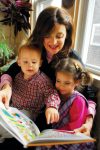
Bracha Goetz reads from one of her recent books to her two grandchildren. (photo from Bracha Goetz)

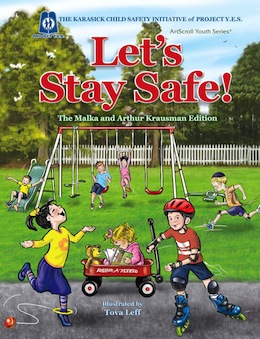
Many of us were raised to not talk to and be wary of strangers, but the sad fact is that kids are much more likely to be taken advantage of or abused by someone they know and think they can trust. This reality was the driving force behind Bracha Goetz’s book Let’s Stay Safe, which was published in English in 2011, and just came out in Yiddish this summer, as Zai Gezunt.

Born in Queens, N.Y., Goetz graduated from Harvard and started on the road to becoming a psychiatrist before heading to Israel for what was to be one summer. However, while in Israel, she become observant, and ended up staying. There, she did a further 11 years of study, got married and had a family.

Goetz and her family have since moved to Baltimore, where she coordinates a Jewish Big Brother Big Sister (JBBBS) program. As well, she writes children’s books and, to date, has published 36 of them. “They are all spiritual children’s books,” she said. “Originally, I was just writing Jewish children’s books, but now I’m also writing spiritual children’s books for anybody.

“I always wanted to write spiritual books for everyone, but I just recently found a publisher that was interested. It’s not easy. It took a long time, but I’m very happy to do that, because, although these are Jewish concepts, they are also actually universal concepts that I’d love to share with any child.

“I try to write books that I wished I could have read as a child, to answer the spiritual questions I had as a child that weren’t answered,” she continued. “They were answered for me when I was 22, but I try to write about the deepest spiritual concepts on a simple level so any child can understand them. I also try to do it in a joyful, delightful way, so that it can go right into their soul.”

In her role at JBBBS, Goetz witnesses firsthand how sexual abuse affected children. This made her think about how she was teaching her own children about such dangers.

“I realized that I didn’t raise my children with an awareness about it,” she said. “I taught my children about ‘stranger danger,’ but, when they were little, we weren’t as aware as we are today that, with most sexual abuse, the perpetrators are known to the children; that’s how they get access. It’s rare that it’s a stranger. It’s most commonly someone the child already knows. There was no book like this in the Orthodox community and some of the books (in the general community) are not culturally relevant for Orthodox people.”

photo - Let’s Stay Safe, which was published in English in 2011, and just came out in Yiddish this summer, as Zai Gezunt
Let’s Stay Safe, which was published in English in 2011, and just came out in Yiddish this summer, as Zai Gezunt.

Goetz wanted to write a book that would be accepted by the Orthodox Jewish community specifically, as the subject tends to be less discussed in these communities. So, she wrote Let’s Stay Safe, but could not find a publisher. That is, not until Rabbi Yakov Horowitz, dean and founder of Yeshiva Darchei Noam in Monsey, N.Y., agreed to help and got the book accepted by ArtScroll.

“He really worked at it, and it was a really groundbreaking book,” said Goetz. “There was nothing like it out there. We wanted readers to understand that these were additional normative safety rules that needed to be adhered to by children to be safe. Of course, the book is also for parents, because, when parents read it to their children, they also gain an awareness.

“It’s not a good idea to leave the safety responsibility of children up to the children. It’s the parents’ responsibility. But, the parents also need to teach the awareness to their children and remind them about it every so often. As they come upon new circumstances, they need to review the guidelines.”

To take the book a step further, especially in Chassidic communities, Horowitz spearheaded a Yiddish version. “In certain Chassidic communities,” explained Goetz, “their mother tongue is Yiddish. We wanted to reach as many people as possible, so that they would bring this book into their homes and share it with their children. Even the pictures were altered to be more Chassidic-looking. We don’t want anything to stop the Yiddish-speaking population from getting this information.”

One of the concepts Goetz wanted to stress in the book was that children speak with a parent even if somebody touched them inappropriately a long time ago. It is important for these experiences to be told, she said, so that survivors can heal, and also so that the perpetrators cannot continue abusing children.

Another concept she wanted to convey clearly is not to trust someone just because she or he is dressed in Orthodox clothing, as that does not automatically mean they are safe people.

“There’s one picture of an older teenaged boy at a camp,” Goetz said, by way of example. “Many times, it’s a familial problem, where it’s an older brother, an uncle, a step-brother who is the perpetrator. Just this week, I was in a community different than I was usually in, but the people knew I was the author of the book … and, this happens a lot, people come to me with questions. I was outside watching my grandchildren and a mother came by and said, ‘Does this seem right? There’s a teenaged boy and he’s playing with all these little children. He’s playing ball with them. He doesn’t live in this community. And why is he here? He’s Orthodox, as well, just as the children, but he didn’t know any of them. Why was he playing with them?’ I said that’s definitely a red flag.

“This kind of awareness was not typical before the Let’s Stay Safe book was published. The incident illustrates the impact that the book has had. Now, there is a general awareness in our community, because there has been consciousness-raising on the issue of child sexual abuse.”

Books written by Goetz are appropriate for kids ages 2 and up, but are better starting at the ages of 3 or 4.

“This book is often read to 4- to 8-year-olds but, the truth is, older children love reading this book, too,” said Goetz. “And what I find so interesting is that a lot of children tell me it’s their favourite book of mine, which I never expected because it’s all about rules and guidelines. But, they love it. It gives them a sense of safety and security, and children ask for it as their bedtime story.”

Other books written by Goetz touch upon topics like eating healthily (and enjoying it), teaching children sensitivity, and teaching people how to interact more naturally with children with special needs.

Rebeca Kuropatwa is a Winnipeg freelance writer.
Format ImagePosted on November 10, 2017November 9, 2017Author Rebeca KuropatwaCategories BooksTags abuse, children's books, health
Talk of death is healthy

Talk of death is healthy

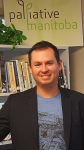
Mike Goldberg, community outreach and education coordinator at Palliative Manitoba. (photo from Mike Goldberg)

Despite the fact that the vast majority of us have lost a loved one, fear and misunderstanding often complicate the grieving process, according to Mike Goldberg, community outreach and education coordinator at Palliative Manitoba.

“Death is not a part of our culture,” said Goldberg. “We tend to revere youth and vitality over age and wisdom, as opposed to Eastern cultures.”

Goldberg, who grew up through the Jewish school system in Winnipeg – attending Ramah Hebrew School and Gray Academy of Jewish Education – earned his master’s degree in gerontology from the University of Regina. He gives many presentations and talks to people in different communities about palliative care and what he describes as “our death-denying society” – and how we can positively change that culture. He also facilitates educational programs at Palliative Manitoba for healthcare aides and support workers; assists people with intellectual disabilities; works with members of First Nations communities; and facilitates grief support groups for kids ages 9 to 12 (called Kids Grieve Too) and 13 to 17 (called Teens Grieve Too).

There was a time when people “just aged in place and the family took care of them at home … and there was nothing else to say about it,” said Goldberg. “That was just the way things were done. But, now it’s more commonplace to see somebody who is getting older being supported in a healthcare facility, a seniors care home.

“It certainly has to do with technology and the economy. You don’t see a lot of people with families that have one primary breadwinner, while the others are able to support family members who are elderly or sick in the family. Everybody seems to have to work, right?”

He said that more Eastern cultures, and sometimes South American ones, can be “more communal and more of a collective society.” He said, “I think we’d like to think we’re communal and collective in Canada, but we’re very much individualistic and self-reliant here. And, we’re very similar to the U.S. in that way.

“We don’t really have a lot of space to care for our elderly family members when it comes to the aging process, so we’ve established these support systems outside the home. And then, it sort of perpetuates itself – this cycle of having the aging experience happen outside the home … and the dying experience happens outside the house. And that has contributed to a fear or denial of death. It just doesn’t happen in our purview.

“If a person is approaching end-of-life, if they have a terminal illness or if they simply have a life-limiting illness … if they need extra supports at their place of residence, we can connect a worker to them to meet with them at home and to provide a supportive presence, to be a companion with them,” he said about Palliative Manitoba.

“For those looking for grief support,” he continued, “we have volunteers that can call you and have a conversation over the phone with you about once a week. Again, they’re not there to provide advice, they’re just there to listen and provide a supportive presence. We find the most appropriate way to support somebody through grief is to listen to them.”

Goldberg is a proponent of inviting open conversations about death and dying, and of exposing kids to death, grief and loss at a young age, not sheltering them. He suggested being as direct as possible with kids and with anyone you meet in terms of language, while also being hyper-aware of word usage – not using euphemisms and metaphors concerning death.

“It’s difficult to talk about death, because it’s something that is going to happen to all of us and represents this unknown,” he said. “But, it’s universal and, to better support each other, we need to talk about it.

“We also need to educate professionals working in this field, who are supporting those approaching end-of-life. These are the people on the ground, experiencing life and death every day. They need to have a high quality of understanding of how to communicate, what the right and wrong things are to say, and being better listeners.

“That’s really crucial,” he stressed. “It doesn’t matter what role you have in society – a nurse or whoever – if we just became better at listening to each other, then that would go a long way in having more direct conversations about death and dying, and changing the culture around it.

“The thing that I’ve come to understand working in this field is that it’s not homogenous emotions we experience. It’s a wide variety of emotions and sometimes a rollercoaster of emotions. The grieving process is not the five-step staircase we tend to think it is. It’s a fluid process that you could go back and forth between the stages.

“There’s certainly a lot of hope in grief and in death,” he said, “and I see that when people tell me that they couldn’t imagine doing what I do, because of the sadness that comes along with grief. I just tell them that I’m able to be with people in one of the most important and sacred times of their life, at the end of life. And, to be able to work with somebody and hear their stories and be with them is a privilege.

“The reality is, everybody grieves differently. There’s no right or wrong way. It’s just however you’re able to make sense of what’s going on.”

Rebeca Kuropatwa is a Winnipeg freelance writer.
 

Format ImagePosted on November 10, 2017November 9, 2017Author Rebeca KuropatwaCategories LocalTags death, end-of-life, family, health
Eat bugs to repair the world?

Eat bugs to repair the world?

Burgers made with insect protein, and no meat. (photo from Eran Gronich)

While the thought of eating insects or worms may sound outlandish or disgusting to many of us, there is growing support for doing just that.

In less than 25 years, the world will have nine billion people living on it. As things stand, there is not enough space or resources to support conventional protein production – beef, chicken, fish, etc. – for that many people. One solution that has been brought to the fore is that we can start eating insect protein. And now, the Israeli company Flying Spark is raising capital to make this a reality.

Leading the charge is Eran Gronich, a serial entrepreneur, and his partner, entomologist Dr. Yoram Yerushalmi.

“When I was looking for my next project, looking into all kinds of ideas, start-ups, etc., I came across a TED Talk in which this university professor was talking about the world having nine billion people by 2040,” said Gronich. “He was talking about all the damages of livestock farming – causing global warming, [using] 70% of growing seed, oceans over-fished…. He was saying the best solution is switching to insect consumption … and, I don’t know why, but I was fascinated. I started to learn about it…. When I realized I don’t know anything about insects, I found my partner, Dr. Yerushalmi, and together we started Flying Spark.”

They chose the larva of fruit flies to work with because it has a number of benefits, such as high values of protein, iron, calcium and magnesium. Its fat is unsaturated and, unlike some other insects, a fruit fly has no cholesterol.

The fruit fly uses less than one percent of water and land resources, has hardly any waste and 100% of the larva can be used. The lifespan of the larva is only six days and it multiplies 15 times in that time.

As it’s a vegetation-eating fly, it is a safe insect to use. No antibiotics, hormones or additives are used in the growing process, and the insect does not share any diseases with human beings.

photo - Flying Spark’s Eran Gronich
Flying Spark’s Eran Gronich. (photo from Eran Gronich)

Gronich and Yerushalmi’s project was chosen as the winner of a mass accelerator challenge in Boston. “We spent four months in Boston working on accelerating the growth of the company,” said Gronich. “We raised some money there from investors and sent it to Israel. We developed the farming and ecosystem technology around farming the larva, reducing the cost.

“In the food lab, we developed the process that’s basically taking the larva and turning it into high-quality, 70% protein powder and high-quality oil. Also, we worked on all kinds of applications and the functionality of the protein powder. We made all kinds of products just to prove the point that you can make almost anything out of our materials – bread, pasta, cereal, cakes, whatever. And, also, achieve meat replacement, even milk, with more protein than cows.”

As it turns out, the larvae will be fed by fruit surpluses, which, according to Gronich, exist everywhere. “They are in every country and also throughout the supply chain – surplus that the farmer or grocery chain has,” he said. “It’s good food, but doesn’t look so good anymore. So, we developed this formula – based on feeding software – to calculate the right percentage … to get the nutritional diet needed.”

Gronich is working with several major food manufacturers, trying out various applications, with varying degrees of success.

According to Gronich, the product is not kosher and his market is not yet in Israel, though he does have some Israeli and Jewish backers. One of his backers is the Strauss Group, which invested money and provides support with offices, labs and a lot of technical support for marketing and networking with institutions worldwide.

“For Strauss, it’s a financial investment,” said Gronich. “Strauss believes insects will be a part of the human diet in the near future and decided to invest in the best company.”

Another important collaboration in which Flying Spark is involved is with IKEA. “IKEA, eight months ago, [invited] all kinds of start-ups to apply for special programs focused on making the world a better place, especially sustainability aspects. Thirteen hundred companies applied from about 80 countries around the world; they chose 10. We were lucky enough to be one of those 10 companies. So, we started a three-month program. My partner is in Sweden right now, in the IKEA centre, and the goal of the program in the end is to have a product made from our material in the IKEA restaurant.”

Gronich is currently working on designing Flying Spark’s first production facility in Israel, with operations scheduled for the end of 2018. “Now, we are raising three and a half million dollars to build the facility, which will be in Ashdod,” said Gronich.

While selling the product to the Western world is a bit tricky, in the Eastern world or in South America, insects are eaten regularly. So, heading east with their product is an obvious choice.

As for the West, Gronich said, “Now, people from Western countries … when I’m explaining to them about the larva – about how it cleans itself and its nutritional value – people understand it. They get that it is one of the best sources of protein. If you’re comparing it to shrimp or other kinds of seafood, it looks much better. It definitely looks much better than a dead chicken. And millennials are very much aware of what they put into their bodies, and aspects of food and farming, so it’s easier.”

Flying Spark was very happy with their positive reception in Boston. There, more than 85% of millennials told them they had no problem tasting it. And, when they gave people samples, the reaction was positive.

“Now, we’re working with companies that have heard about us through PR,” said Gronich. “Multinational companies approached us and the conversations with them have all been focused on nutritional value – source of the protein, they don’t care about it…. We call it the industrial approach. We’re not serving the insect in its original form. We’re turning it into a white powder and are selling it to regular, traditional food manufacturers – and there is a need for this product.”

Rebeca Kuropatwa is a Winnipeg freelance writer.
 

Format ImagePosted on October 27, 2017October 25, 2017Author Rebeca KuropatwaCategories WorldTags environment, Eran Gronich, Flying Spark, IKEA, insects, Israel, science

Posts pagination

Previous page Page 1 … Page 12 Page 13 Page 14 … Page 31 Next page
Proudly powered by WordPress