Skip to content
  • Home
  • Subscribe / donate
  • Events calendar
  • News
    • Local
    • National
    • Israel
    • World
    • עניין בחדשות
      A roundup of news in Canada and further afield, in Hebrew.
  • Opinion
    • From the JI
    • Op-Ed
  • Arts & Culture
    • Performing Arts
    • Music
    • Books
    • Visual Arts
    • TV & Film
  • Life
    • Celebrating the Holidays
    • Travel
    • The Daily Snooze
      Cartoons by Jacob Samuel
    • Mystery Photo
      Help the JI and JMABC fill in the gaps in our archives.
  • Community Links
    • Organizations, Etc.
    • Other News Sources & Blogs
    • Business Directory
  • FAQ
  • JI Chai Celebration
  • JI@88! video

Recent Posts

  • Sharing her testimony
  • Fall fight takes leap forward
  • The balancing of rights
  • Multiple Tony n’ Tina roles
  • Stories of trauma, resilience
  • Celebrate our culture
  • A responsibility to help
  • What wellness means at JCC
  • Together in mourning
  • Downhill after Trump?
  • Birth control even easier now
  • Eco-Sisters mentorship
  • Unexpected discoveries
  • Study’s results hopeful
  • Bad behaviour affects us all
  • Thankful for the police
  • UBC needs a wake-up call
  • Recalling a shining star
  • Sleep well …
  • BGU fosters startup culture
  • Photography and glass
  • Is it the end of an era?
  • Taking life a step at a time
  • Nakba exhibit biased
  • Film festival starts next week
  • Musical with heart and soul
  • Rabbi marks 13 years
  • Keeper of VTT’s history
  • Gala fêtes Infeld’s 20th
  • Building JWest together
  • Challah Mom comes to Vancouver
  • What to do about media bias
  • Education offers hope
  • Remembrance – a moral act
  • What makes us human
  • המלחמות של נתניהו וטראמפ

Archives

Follow @JewishIndie
image - The CJN - Visit Us Banner - 300x600 - 101625

Author: Janet Nicol

Feminism needs mentioning

While a recent panel called Israel, Canada and Me in the Age of Trump covered many topics well, there was a noticeable omission – feminism.

Three of the four panelists at the Peretz Centre on April 9 were women – Dr. Shayna Plaut, Ofira Roll and Rabbi Susan Shamash, with Eviatar Bach. But most participating audience members were male, with moderator Stephen Aberle having to solicit a question from a woman near the end to provide a semblance of balance. Perhaps the aggressive tone coming from the floor, not to mention the police protection, was stifling for some women.

The event sponsor, Independent Jewish Voices, Vancouver, requested the police presence because of a threat by another Jewish political group to disrupt the event. Thankfully, while some of the other group’s members were in the audience and were quite outspoken, a stimulating, heartfelt and combative exchange between the panel and an audience of about 40 people took place without incident. Unfortunately, the emotionally charged atmosphere shut down exploration of two pressing questions regarding the rights of Palestinians in Israel: the two-state solution and the ongoing Jewish settlements in East Jerusalem and the occupied territories.

It was noted that, at the core of the tensions for Jews is a fundamental contradiction: the injustices experienced by the Palestinians in Israel go against Jewish values and teachings. As well, while Prime Minister Binyamin Netanyahu’s support of President Donald Trump may be politically expedient, it is morally questionable. Separate from the panel discussion, an American news commentator caught my attention with the suggestion that German Chancellor Angela Merkel now stands as the most seasoned and capable leader among Western democratic nations. I would add a third adjective to describe her – compassionate.

Perhaps just as practising Christians who voted for Trump in the American election last November were able to close their eyes to the “unChristian” aspects of his words and actions, so too has a segment of Jewish people who support “part” of what Trump stands for. All these diverse outlooks and allegiances fit with Plaut’s assertion: despite our conflicted and incongruent ideas, it is important to wade in and “engage in the messy.”

As hard as this is to do within ourselves, the difficulty is magnified when we try to maintain or reach a respectful dialogue. Tolerance is all good and well, but what happens when some voices become intolerable – that is, in denial of the truth and in support of racism, bigotry, misogyny? What happens when power – even democratically elected power – is used to exploit and oppress?

The panel fully addressed the fears many of us are feeling, including the danger of making decisions based on this emotion and the fact that fear can lead to a “them versus us” mentality. Surprisingly fascism, rooted in this negative feeling, was only mentioned once during the afternoon talk, when Bach used it to describe his view of Israel’s body politic as the left becomes more “lethargic.”

On the whole, we can’t afford to become lethargic and we can’t exclude women’s voices in favour of a “muscular” political agenda. The Women’s March on Washington on Jan. 21, held in conjunction with hundreds of solidarity marches elsewhere, gave us a taste of our collective power, as I personally witnessed by participating with about 15,000 women and men in Vancouver. We garnered praise for a day that was peaceful, inclusive, positive – and global.

That historic action has since faded into a grim reality, as women (along with LGBTQ people and visible minorities) witness Trump, who has a lengthy record of misogyny, working alongside his almost exclusively white male cabinet, take backward steps on human rights. Government actions have included an executive order to block funding to organizations that support abortion services, a travel ban targeting some Muslim countries and the appointment of a Supreme Court justice that could lead to legal changes regarding women’s reproductive rights.

In contrast, Canadian feminists and their allies’ success in decriminalizing abortion remains uncontested. To his credit, Prime Minister Justin Trudeau pledged $650 million in March for women’s sexual and reproductive health around the world, stating “a lack of choices in reproductive health mean that they [women] either are at risk of death, or simply cannot contribute and cannot achieve their potential.”

But, when Trump applauded Trudeau’s initiative to organize a joint women’s entrepreneur project in February, many questioned how sincere this “pro-women” gesture was. A diversity of board members not only benefits women, but expands business approaches and ideas. And women are underrepresented at this level, only holding 18.8% of Fortune 1000 company board seats in 2015 and 20.6% of the seats on Fortune 500 boards. The Trump-Trudeau roundtable with North American businesswomen may have raised awareness on women’s value in the workplace, but did the session result in a significant step toward equality or simply provide an image-boost for the male leaders involved?

Certainly in stark contrast to Trump’s male-dominated inner circle is Trudeau’s cabinet, with half of its members female, appointed from a caucus where women comprise 27% of Liberal members of Parliament. However, Canada only ranks 50th out of 190 countries on proportion of national-level female politicians. As well, five of the 15 women in Trudeau’s cabinet are in junior positions.

In Israel, women have also been elected in greater numbers over time but men are still at the helm. Economic equality also eludes Israeli women at every level. This appears to be the narrative for women in most democracies, Scandinavian nations providing some important exceptions.

Systemic, rather than cosmetic, changes need to be made within institutions – including provisions for harassment-free parliamentary debate so female politicians can thrive without being subject to intimidation and emotional abuse. Indeed, all forms of violence faced by women from all walks of life must be addressed, most urgently among indigenous women in Canada, a long-ignored and tragic reality.

When policies impacting the vast majority of women are implemented, the ramifications are significant. Consider that women continue to be the primary childcare provider: according to Statistics Canada, women comprise 80% of single parents with a child and three quarters of part-time workers are women.

So why, again using Statistics Canada figures, do women make 87 cents for every man’s dollar – a gap even wider for visible minorities and immigrant women? Pay equity legislation is a move in the right direction and provinces that do not have this, such as Alberta, are shown to have a wider gap.

The spread of part-time, precarious jobs affects all workers, but especially women, and has led to a groundswell of campaigns across North America to raise the minimum wage. In British Columbia, 63% of minimum wage earners are women, according to the B.C. Federation of Labour, and these are not only teenagers – 80% of all minimum wage earners are over 20 years old.

Malala Yousafzai was recently bestowed with an honorary Canadian citizenship by the Trudeau government, her bravery and powerful messages to girls and women inspiring global admiration. She would undoubtedly agree that, in these politically uncertain times, we must strive for a climate of respect and tolerance and ensure women are an integral part of dialogues and policies.

Janet Nicol is a teacher at Killarney Secondary School in Vancouver, freelance writer and local historian. She has written previously about an early-20th-century Jewish-Canadian human rights lawyer, Israel Rubinowitz, for the Jewish Independent.

 

Posted on April 28, 2017April 26, 2017Author Janet NicolCategories Op-EdTags equality, feminism, Trudeau, Trump, women

Israel at 69 – “love forever”

Jews all over the world celebrate Yom Ha’atzmaut, Israel’s Independence Day – even those who have no intention of ever making aliyah and many of whom have never even visited Israel.

“It’s a kind of insurance policy,” one overseas friend told me. “By supporting Israel financially and emotionally, I know that its sanctuary is available to me or my children or grandchildren should the need ever arise.”

I find this kind of thinking very sad, because Israel is so much more than a refuge for persecuted Jews. Not every immigrant who has built a life here was escaping from the horror of the Holocaust, the tyranny behind the Iron Curtain or the cruelty of life in an Arab country. Many of us – the ones Israelis refer to as “Anglo-Saxim” – lowered their standard of living significantly when they settled in Israel, yet found something here that enhanced our quality of life even as we struggled with inflation, mortgages and trying to make miniscule salaries stretch to the end of the month.

We have found here a family – our own people. Of course, just like any family, we fight – about religion, politics, the settlements. The fights can be very bitter yet, at bottom, we care about each other and bond together when we face a common problem or enemy. We celebrate together and sometimes even have to grieve together. Basically, when the going gets rough, we are on the same side. We express our identity as Jews in different ways, but it is the same identity.

We have found here a beautiful country, unique in the variety of its scenery and climate. Mediterranean beaches banded by azure and indigo water and white sands, coral reefs, dense forests, wooded mountains, deserts and rivers and waterfalls, the shimmering mirrored glass of the Dead Sea, fields carpeted with wildflowers – and Jerusalem, the priceless jewel.

Some of us have found here a spirituality that we would never have been able to achieve abroad. Anyone who has been in Israel on Yom Kippur, when the whole country comes to a standstill for the day, cannot doubt the kedushah, the holiness of Eretz Israel. It is intangible, yet it is an undeniable presence.

We have found here a pride in the remarkable achievements of our relatively smaller and less-developed nation. We teach agriculture to the world, and come to other people’s rescue in times of natural or human-made disasters. We are rich in poets, writers, musicians, actors and artists. We can boast industrial and high-tech entrepreneurs and brilliant scientists. When any new Israeli invention captures the world’s imagination, somehow we all bask in the reflected glory.

Israelis have always been compared to the sabra, the cactus with the thorny exterior but the soft heart. We celebrate Yom Ha’atzmaut in many ways: campfires and singing, picnics, a Bible quiz, concerts, music and dancing in the streets. We spend the day with family and friends and relish every moment of it. But it is more than just enjoyment.

On every building and on almost every balcony flies the Israeli flag, its blue stripes and Magen David bright against the white background. For days beforehand and a week afterwards, the flag flies from every car on the road. Ceremonies open with the singing of Hatikvah, The Hope, Israel’s national anthem. Most of us sing it standing straight and proud, and often with tears in our eyes as we remember the broken people who found a safe haven here, and those who never managed to reach its shores and died with the dream of Zion in their hearts. And we also remember the brave men and women who gave their lives in all of Israel’s wars and in the pre-state days, the fighters and pioneers who fashioned this wonderful land that we have inherited.

Shin Shalom, one of Israel’s greatest poets, expressed it for all of us in “Mother Jerusalem Singing,” which he wrote a day after the Yom Kippur War in 1973: “Love forever, glow forever / cherish, yearn, preserve the kernel / of an everlasting nation, of a heritage eternal.”

Dvora Waysman is a Jerusalem-based author. She has written 14 books, including The Pomegranate Pendant, which was made into a movie, and her latest novella, Searching for Sarah. She can be contacted at [email protected] or through her blog dvorawaysman.com.

Posted on April 28, 2017April 26, 2017Author Dvora WaysmanCategories Op-EdTags aliyah, Israel, Yom Ha'atzmaut
Levi’s first haircut

Levi’s first haircut

Levi Mochkin celebrated his third birthday and his first haircut last month. (photo by Shula Klinger)

On March 26, Mendy and Miki Mochkin of Chabad North Shore celebrated their son Levi’s upshernish (or “cutting”). This occasion marked both Levi’s third birthday and his first haircut.

In the Orthodox tradition, a boy’s hair is not cut until his third birthday. This is because the Torah compares the little boy to a tree – the tree does not bear fruit until it has grown for three years. The upshernish is a community affair; all of the guests are invited to cut off a section of the child’s hair.

With the start of his formal education, the 3-year-old can begin to share his unique gifts with his family and community. And, just like the tree, a child must be nurtured consistently if he is to flourish in later life.

This is the time when the son receives his kippah and tzitzit. He also begins his Jewish studies in earnest. Along with learning the aleph-bet, he is taught to recite blessings and say the Shema.

At Levi’s upshernish, a booklet shared Torah passages from Deuteronomy and Genesis. These were a selection from the 12 verses that the Lubavitcher Rebbe taught children to recite each day. According to Rabbi Mochkin, “they contain many of Judaism’s foundational beliefs and principles.”

The Mochkins hosted the upshernish at their West Vancouver home, with members of their extended family from New York. Members of the Chabad community from Vancouver, East Vancouver and the University of British Columbia were also present, along with many local families.

Shula Klinger is an author, illustrator and journalist living in North Vancouver. Find out more at niftyscissors.com.

Format ImagePosted on April 28, 2017April 26, 2017Author Shula KlingerCategories LocalTags Chabad, Judaism, Lubavitch, upshernish
Mystery photo … April 28/17

Mystery photo … April 28/17

Jewish National Fund, 1980. (photo from JWB fonds; JMABC L.11965)

If you know someone in this photo, please help the JI fill the gaps of its predecessor’s (the Jewish Western Bulletin’s) collection at the Jewish Museum and Archives of B.C. by contacting [email protected] or 604-257-5199. To find out who has been identified in the photos, visit jewishmuseum.ca/blog.

Format ImagePosted on April 28, 2017April 26, 2017Author JI and JMABCCategories Mystery PhotoTags Jewish museum, Jewish National Fund, JMABC, JNF
Yom Hashoah in Israel

Yom Hashoah in Israel

Vehicles at a standstill alongside the ancient walls of Jerusalem’s Old City on April 24, as drivers honor the memory of the six million Jews who were murdered in the Holocaust. At 10 a.m., sirens sounded throughout Israel, and pedestrian and car traffic stopped to remember. (photo from Ashernet)

Format ImagePosted on April 28, 2017April 26, 2017Author Edgar AsherCategories IsraelTags Israel, Yom Hashoah
מספר היהודים החיים כיום בעולם

מספר היהודים החיים כיום בעולם

נתוני הלשכה המרכזית לסטטיסטיקה בישראל: 14.4 מיליון יהודים חיים בעולם ומהם כארבע מאות אלף נמצאים בקנדה. (צילום: Cynthia Ramsay)

הלשכה המרכזית לסטטיסטיקה בישראל פירסמה בימים האחרונים דוח על מספר היהודים החיים כיום בעולם. הנתונים בנויים על הערכות בלבד של המדור לדמוגרפיה וסטטיסטיקה של היהודים באוניברסיטה העברית בירושלים, מתבססים על שנת 2015, ומתפרסמים כרגיל לרגל יום הזיכרון לשואה ולגבורה.

אם כן כיום לפי הערכה של המדור לדמוגרפיה וסטטיסטיקה באוניברסיטה העברית, חיים בעולם כ-14.4 מיליון יהודים. זאת לעומת 16.6 מיליון יהודים שהיו בעולם ערב מלחמת העולם השנייה ומאורעות השואה הקשים. לפיכך העם היהודי למרות השנים שעברו שבעים ושתיים שנים, לא הצליח לחזור לגודלו לפני אירועי השואה, שהביאו להשמדת שישה מליון יהודים. יצויין כי גם בשנות העשרים של המאה הקודמת חיו בעולם כמו כיום כ-14.4 מיליון יהודים.

מטבע הדברים ריכוז היהודים הגדול בעולם (44 אחוז) נמצא בישראל ועומד על 6.33 מיליון. אחריה המדינה השנייה עם מספר היהודים הגדול ביותר כרגיל היא ארצות הברית, שבה גרים עם 5.7 מיליון יהודים. המדינות הנוספות בעולם בהן יש את הריכוז הגבוה ביותר של יהודים אחרי ארה”ב הן: במקום השלישי צרפת עם כ-460 אלף יהודים, במקום הרביעי קנדה עם כ-388 אלף יהודים, במקום החמישי בריטניה עם כ-290 אלף יהודים, במקום השישי ארגנטינה עם כ-181 אלף יהודים, במקום השביעי רוסיה עם כ-180 אלף יהודים, במקום השמיני ברזיל עם כ-120 אלף יהודים, במקום התשיעי גרמניה עם כ-117 אלף יהודים, במקום העשירי אוסטרליה עם כ-113 אלף יהודים. לפי הערכות לא מבוססות במקום האחד עשר נמצאת דרום אפריקה ובה חיים כ-80 אלף יהודים.

והיכן קיימות הקהילות הקטנות של יהודים בעולם: באיראן למשל חיים כעשרת אלפים יהודים, בבירוביג’ן חיים רק כחמשת אלפים יהודים, ביפאן חיים כאלף יהודים בלבד, בבהאמס חיים רק כשלוש מאות יהודים ואילו בקוריאה הדרומית יש כמאה יהודים בלבד.

על פי סקר של ההסתדרות הציונית העולמית שנעשה לאחרונה יש גידול משמעותי ביותר באנטישמיות ברחבי העולם, ואחד מכל שלושה יהודים חש את הצורך להסתיר את יהדותו. ועוד ממצאי הסקר: 85 אחוז מהיהודים היו עדים לאנטישמיות במהלך חייהם, 50 אחוז מיהודי המערב (מדובר על מדינות אירופה וצפון אמריקה) חוו אירוע אנטישמי במהלך השנה האחרונה, 73 אחוז היו עדים לאלימות פיזית ו-70 אחוז מיהודי אירופה חגגו לבד את החגים בשל הפחד מפעילות אנטישמית.

יש לזכור שיש גם כיום בישראל המפוצלת מאוד מבחינה חברתית כיום יהודים שונאים יהודים ובצורה גלויה. להלן סיפור מזעזע: יהודי תושב ירושלים בן 55 נחקר החודש במשטרת ירושלים לאחר שהביעה תמיכה ברורה בהשמדת יהודים אשכנזים. אותו ישראלי נחמד כתב בין היתר בדף הפייסבוק שלו: “אני מדמיין שיש לי את הכוח של היטלר, יושב על כסא עם בקבוק יין ומכניס אותם אחד אחד לתנור של אלף מעלות, ודואג שייצאו אפר. כמה שאני שונא אותם אלוהים”. האזרח הירושלמי לא התבייש להוסיף עוד מילות חמות על היהודים האשכנזים: “היטלר צדק שעשה מאימא שלכם סבון, והוא צדק שחיסל אתכם זבלים בני זבלים”. חברת פייסבוק חסמה מייד את הפרופיל של האזרח היקר. המשטרה המשיכה לחקור אותו והודיעה כי יוגש כתב אישום חמור נגדו.

ומהן תגובות הגולשים לאור הנתונים על מספר היהודים בעולם?: “הדת היהודית מזמן סיימה את דרכה. זה רק שאריות”. “בגלל ההתבוללות של היהודי בעולם. לולא זאת היה מספר היהודים כפול! ההתבוללות הגדולה ביותר באמריקה!”

Format ImagePosted on April 26, 2017April 26, 2017Author Roni RachmaniCategories עניין בחדשותTags antisemitism, Holocaust, Jewish population, World Zionist Organization, אנטישמיות, ההסתדרות הציונית העולמית, העם היהודי, שואה
Diverse DOXA festival offerings

Diverse DOXA festival offerings

In the very talented ensemble of The Road Forward by Marie Clements are Michelle St. John, left, and Jennifer Kreisberg. (photos from National Film Board of Canada)

This year’s DOXA Documentary Film Festival features several films with Jewish community connections. They explore a wide range of topics: First Nations activism, Fort McMurray and the oil sands, real-life mermaids, bigotry against larger people, and being a freelance journalist in the Middle East. They will make you question your assumptions, ponder the various ways in which humans find connection, and introduce you to ideas, people and places you probably didn’t know existed.

Opening the festival, which runs May 4-14, is The Road Forward. In the very talented ensemble of this musical documentary by Marie Clements are Michelle St. John and Jennifer Kreisberg. As many of us do, St. John and Kreisberg have multiple cultural heritages that form their identity; in their instances, First Nations and Jewish are among them. In addition to performing, Kreisberg also composed and/or arranged many of the songs; the main composer is Wayne Lavallee.

The Road Forward began as a 10-minute performance piece commissioned for the Aboriginal Pavilion at the 2010 Olympics, and premièred as a full-length theatre show at the 2015 PuSh Festival. The documentary has mostly traditional components – interviews, archival footage, news clips – but these are broken up by a number of songs, which add energy and emotion to the film.

The documentary uses as its starting point the Native Brotherhood and Sisterhood, which were established in the 1930s, when First Nations people were not permitted to meet and organize. The groups’ “official organ,” the Native Voice, was the first indigenous-run newspaper in Canada.

“The idea was to honour B.C.’s history, so I started researching and reading online and came across the archives of the Native Brotherhood and Sisterhood, the oldest Native organization in the country. Their parent organization, the Native Fishing Association, is located in West Vancouver, close to me,” explains Clements in the press material.

The Road Forward touches on many issues along its journey to current-day First Nation activists, who carry on in their ancestors’ paths. Though their goals are varied – some fight for particular legal or policy changes, others for restitution and reconciliation, yet others for their own voice and place in the world – they are all seeking justice, equality, understanding.

The songs highlight the immense struggles. As but two examples, “1965” is about the decades upon decades that First Nations have been denied the basic rights that most other Canadians have long enjoyed, and “My Girl” is a heartbreaking tribute to the aboriginal women who have been murdered along British Columbia’s Highway 16, the “Highway of Tears.” The Indian Constitution Express, a movement organized by George Manuel in 1980-81 to protest the lack of aboriginal rights in then-prime minister Pierre Trudeau’s plans to patriate the Canadian Constitution, receives somewhat more attention than other activist achievements, and the song “If You Really Believe,” based on a speech by Manuel, is quite powerful.

The May 4 gala screening of The Road Forward is the official launch of Aabiziingwashi (#WideAwake), National Film Board of Canada’s Indigenous Cinema on Tour. For the length of 2017, NFB is offering films from its 250-plus collection to all Canadians via [email protected]. The film also runs on May 10 and Clements will participate in a Q&A following both screenings.

* * *

Limit is the Sky follows a handful of 20-somethings who have moved to Fort McMurray to follow their dreams. A few years before the price of oil plummeted in 2015 and the 2016 wildfire decimated the northern Alberta city, the average family income in “Fort Mac,” was $190,000 a year, according to the film. Working on the oil sands was where the real money lay, but others were drawn to the college or to places that serve the oil workers (and others), such as hairdressing salons and restaurants.

photo - The seven young dreamers featured Mucharata, from the Philippines, who had to leave her 2-year-old son behind initially (for fours years)
The seven young dreamers featured Mucharata, from the Philippines, who had to leave her 2-year-old son behind initially (for fours years). (photo from NFB)

Most striking about the population we meet in Limit is the Sky is their diversity: they not only come from other Canadian provinces and the United States but from much further afield. The seven young dreamers featured include Max, from Lebanon; Mucharata, from the Philippines, who had to leave her 2-year-old son behind initially (for fours years); and KingDeng, a former child soldier from South Sudan, who had to help support his wife and children (in Edmonton) while at school in Fort McMurray.

“I was looking for young people who’d just recently arrived in Fort Mac, full of hopes, dreams and naïveté,” says filmmaker Julia Ivanova in the press material. “I wanted to walk the viewer through their ups and downs in a place where the men seem tough and the women even tougher. I wasn’t looking for tough characters, though: sensitivity and beauty – both inner and physical beauty – were important to me.”

Ivanova, who has Jewish roots, migrated to Canada from Russia many years ago.

“Being an immigrant myself,” she notes, “I could feel what was at stake for these young people and the challenges they face on a very intimate level.”

The main filming ran from fall 2012 to spring 2015. She felt welcomed by the people in the city, though not by the industry. “That was a brick wall I hit over and over again,” she says. “There was no filming of anyone allowed, anywhere, period.”

By the end of the film, most of the millennials featured had left the city, along with many others. “The town felt almost deserted, compared to how I had seen it in 2012 and 2013,” says Ivanova. “So many people were leaving. There was so much anxiety. I went to all the places I loved – and they’d all changed.”

Ivanova’s film shows the hope, the drive, the challenges, the loneliness of her interviewees. The dynamics are much more complex than one might assume of a city that relied on the oil sands for its prosperity. The environment is of crucial importance, obviously, but people matter, too, and this documentary shines a necessary light on that fact.

Limit is the Sky screens May 5.

* * *

Falling into the who-ever-would-have-thought category, Ali Weinstein’s Mermaids introduces viewers to real-life mermaids, of a sort.

photo - Rachel’s underwater job at the Dive Bar in Sacramento, Calif., helps her deal with a family tragedy
Rachel’s underwater job at the Dive Bar in Sacramento, Calif., helps her deal with a family tragedy. (photo from DOXA)

Rachel’s underwater job at the Dive Bar in Sacramento, Calif., helps her deal with a family tragedy. Vicki and a group of former Weeki Wachee Resort (in Florida) swimmers recall their mermaid days, including a show for Elvis and a 50th anniversary performance. Being a mermaid helps Cookie, who was abused as a child and has mental health issues, manage life, and she and her soulmate, Eric, who makes her mermaid tails, are married in a mermaid wedding, after being together for some 30 years. Last but not least, Julz, a transgender woman who was bullied as a child and disowned by her father, discovers acceptance and love in a Huntington Beach, Calif., mermaid group.

Weinstein intersperses these stories with brief summaries of long-told mermaid tales, “from the 3,000-year-old Assyrian figure of Atargatis to the Mami Wata water spirits of West Africa.”

It really is a fascinating documentary, showing just how resilient and resourceful the human spirit is.

Mermaids plays twice during DOXA, on May 6 and 13, and Weinstein will be in attendance at both screenings.

* * *

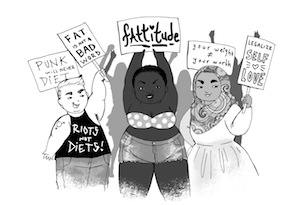
Think of the cartoon villains and the hapless sidekicks. How are they often portrayed? As fat, dumb and/or oversexed? If those weren’t your first thoughts, think again. The documentary Fattitude convincingly shows how widespread bigotry against larger people is – so much so that it can be overlooked, until pointed out. Then, you wonder how you ever missed it.

image - From the age of 3, the film notes, we are already programmed with negative stereotypes
From the age of 3, the film notes, we are already programmed with negative stereotypes. (image from DOXA)

From the old woman in the candy house that eats Hansel and Gretel, to Star Wars’ Jabba the Hut, to the evil squid in The Little Mermaid, these are just a few of the villains. Then there is the heavyset and dumb Hardy, sidekick to thin, smart Laurel; the stereotypical chubby best friend in so many movies; and the archetypal black nanny, forever cast in the caring, subservient role. Miss Piggy is a more complex character, both strong and confident in herself, but also sex-crazy over Kermit. And, in the entire Star Trek franchise – where have the larger people gone?

From the age of 3, the film notes, we are already programmed with negative stereotypes. When all put together, it’s quite depressing. However, Fattitude is a rather upbeat documentary, as its interviewees are spirited, determined and intelligent enough to effect some change, mainly via social media.

Filmmakers Lindsey Averill and Viridiana Lieberman speak to almost 50 people and, to a person, they provide an interesting perspective, connecting the body images depicted in films, television shows, cartoons, magazines and advertisements with their effects on viewers and on our perceptions of ourselves and others. The film discusses the links between race, socioeconomic status and weight, as well as the reasons why Michelle Obama’s campaign to end childhood obesity was misguided.

Fattitude screens May 9.

* * *

Being a journalist in a war zone seems dangerous and frightening, and it is. But it is also tedious and lonely. At least this is what it seems from watching Santiago Bertolino’s Freelancer on the Front Lines.

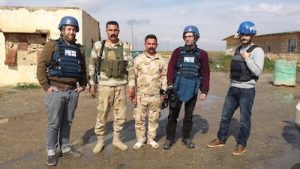
photo - Jesse Rosenfeld with peshmerga combatants, Santiago Bertolino and Ayar Mohammed Rasool
Jesse Rosenfeld with peshmerga combatants, Santiago Bertolino and Ayar Mohammed Rasool. (photo from NFB)

Bertolino follows Toronto-born, Beirut-based freelance journalist Jesse Rosenfeld as Rosenfeld hustles to get story ideas and budgets approved, waits in sparse hotel rooms for fixers to connect him with interviewees, and ventures into Egypt during its post-Arab Spring elections, the West Bank during an Israeli-Palestinian conflict, a Syrian refugee camp in Turkey and to Iraq, where they witness the fight against ISIS from the front lines.

Some of the more disturbing images are of the bodies of Palestinians gunned down in a home by undetermined executioners and the corpses of dead ISIS fighters dumped in the back of a truck, as well as tied to its back bumper. In another memorable part, Rosenfeld yells questions to a caged Mohamed Fahmy, when Fahmy and two fellow Al Jazeera journalists were on trial in Cairo. (Fahmy, who holds both Canadian and Egytian citizenship, spent almost two years in jail of a three-year sentence.)

Rosenfeld has strong views and isn’t afraid to share them, though he struggles to make eye contact with the camera when he makes his pronouncements. Some of the best exchanges in the film are between him and Canadian-Israeli journalist Lia Tarachansky, who hold different opinions on the Israeli-Palestinian conflict.

Freelancer on the Front Lines screens May 13 at Vancity and will include a post-film discussion.

For tickets and the full DOXA Documentary Film Festival schedule, visit doxafestival.ca.

Format ImagePosted on April 21, 2017April 20, 2017Author Cynthia RamsayCategories TV & FilmTags activism, culture, documentaries, DOXA, First Nations, journalism, mermaids, Middle East, National Film Board, NFB
Dialogue needed

Dialogue needed

Robert Singer, chief executive officer of World Jewish Congress, addressed more than 100 Jewish Federation of Greater Vancouver donors at an event hosted by Gary Averbach and sponsored by Garry Zlotnik of ZLC Financial. (photo from WJC)

The professional head of World Jewish Congress says Diaspora Jews and Israelis are too wrapped up in their own worlds and need to strengthen the dialogue between the two components of the global Jewish community.

Speaking to the Independent during his first-ever visit to Vancouver, Robert Singer said relations remain strong in terms of Diaspora support for Israeli organizations. Programs like Birthright, through which young Jews experience Israel, and Masa, which offers young adults gap-year, study-abroad and other opportunities, also enhance connections. But there must be more person-to-person contacts like these, he said, which foster real conversations across the divide.

“I’m not sure that both sides are talking,” said Singer. “I think both sides are busy with their own stuff. Israelis are busy with stuff in Israel and Diaspora Jews are today busy with their survival, in many cases, both financial and community survival.”

World Jewish Congress is an organization that can facilitate dialogue, he added.

WJC was founded in Geneva in 1936 and now represents Jews in 100 countries, focusing on issues including protecting the memory of the Holocaust, advocating for the recognition of the experiences of Jews from Arab lands, combating antisemitism and encouraging interfaith dialogue. The Congress is headed by Ronald Lauder, president of the executive committee. Singer, who has been the chief executive officer of WJC since 2013, previously served 14 years as the director general and CEO of World ORT, one of the largest nongovernmental education and training providers in the world. Singer was born in Ukraine and made aliyah at age 15.

While in Vancouver, Singer met with rabbis, representatives of the Centre for Israel and Jewish Affairs, Jewish Federation of Greater Vancouver and other communal organizations. He also met with Russian-speaking members of the community and said he was impressed with Vancouver’s flourishing Jewish life. He acknowledged that British Columbia’s Jewish community faces challenges common to many similar-sized communities.

“The main thing that struck me is the issue of assimilation and how to deal with this,” he said. “Being more inclusive, bringing more people of non-Jewish faith into the community, issues of education, issues of fighting BDS and antisemitism on campuses, and issues of relations between Israel and the Diaspora.”

Interviewed days after many young Jews blockaded the AIPAC conference in Washington, D.C., Singer rejected the idea that younger Jews are alienated from Zionism.

“It’s very different,” Singer said of the way young Jews relate to Israel. Previous generations, he said, were Holocaust survivors or their descendants who knew a world without Israel. “For somebody who is now 20 years old, all this is now either history or they just don’t remember the situation where there was a world without a Jewish state.” This generation cannot be expected to have the same visceral connection to Zionism, he said. “I think it’s just a different approach. Different technologies, different approach.”

He compared the suggestion of declining Zionism with the situation among young Israelis.

“In Israel all the time they say that the previous generation was much more patriotic,” he said. Yet, when young people are conscripted into the Israel Defence Forces today, more – not fewer – are requesting assignment to the most difficult combat and elite units, he said.

“It shows that this generation of young Israelis is at least as good as the people before them and I think it’s the same in the Diaspora,” Singer said, citing the Jewish Diplomatic Corps, a WJC program of about 200 young adults from 43 countries, including international lawyers, businesspeople, parliamentarians, professors and others who meet with government leaders and international agencies.

“They are outstanding young people,” said Singer. “I’m sure that, on an intellectual, Jewish and pro-Zionist level, they are at least as good as the leadership of the people who went before.”

On external threats, Singer said it is too soon to make a determination about long-range impacts of contemporary antisemitism. A new WJC study indicates an antisemitic comment is posted to social media every 82 seconds.

“It’s very bad,” he said. But, he added, it may be less a matter of growing antisemitism than attitudes that were already there merely finding expression.

The situation in Europe is concerning, he said. Antisemitic and neo-Nazi parties are seeing unprecedented public support in France, Germany, Hungary and Greece. “This is a real danger,” Singer said.

On the impacts of U.S. President Donald Trump’s policies, Singer said it is too soon to judge. He is impressed, however, that Trump’s appointee as U.S. ambassador to the United Nations, Nikki Haley, has adopted a very different approach from her recent predecessors.

While the United Nations General Assembly is a wasteland at present, Singer said, Canada and the United States should remain active there, “because there is a stage there and you can have some influence.”

Of the new Canadian government, Singer said he is pleased that relations between Israel and Canada remain close and that this is something that transcends politics.

Format ImagePosted on April 21, 2017April 20, 2017Author Pat JohnsonCategories WorldTags antisemitism, Diaspora, Israel, WJC
First Vancouver Opera Festival

First Vancouver Opera Festival

Caitlin Wood and Alex Lawrence star in Vancouver Opera’s The Marriage of Figaro. Jewish community member Leah Giselle Field performs the role of Marcellina in the production. (Emily Cooper Photography)

I am thrilled and honoured to have been chosen to lead Vancouver Opera into a new era,” said Jewish community member Kim Gaynor when her appointment as general director was announced prior to the start of this season. “Vancouver Opera already has a long history of excellent productions and a well-deserved reputation for innovation under Jim Wright’s exemplary leadership.”

As part of its vision for the future, Vancouver Opera is holding an inaugural opera festival April 28 to May 13. The event features a variety of vocal offerings for audiences, as well as workshops and other activities.

“Opera seasons are planned years in advance, so this festival was planned long before I joined VO,” Gaynor told the Independent. “However, I have brought 10 years’ experience managing the Verbier Festival in Switzerland and I am using this experience to shape the festival-going experience here. For example, we will have lots of opportunities to follow the development of young singers, and for audience participation, two things which were very popular in Verbier.”

Her resumé prior to managing the Verbier Festival includes managing director and co-founder of Austria’s Festival Retz, administrator of London, England’s Yehudi Menuhin International Violin Competition and head of marketing administration at London’s Royal Opera House. She has worked at Les Grands Ballets Canadiens de Montréal, the National Arts Centre Orchestra in Ottawa, L’Opéra de Montréal and Canada Council for the Arts.

photo - Vancouver Opera general director Kim Gaynor
Vancouver Opera general director Kim Gaynor. (photo from VO)

Gaynor, who was born and raised in Ontario, returned to Canada from Switzerland last year, arriving in Vancouver in September. She was here in time for another recent Vancouver Opera innovation – the smaller-venue, family-friendly production of Hansel and Gretel in November.

“Hansel and Gretel was a huge success with people of all ages,” said Gaynor. “The whimsical, enthusiastic performances from our young artists and the wonderful puppets charmed everyone who came. I heard so many stories about young people being literally on the edge of their seats throughout the whole performance, and this could lead to a lifelong love of opera. One thing I learned was that the intimacy of the smaller Playhouse theatre really appeals to audiences. They want to be nose-to-nose with the performers – up close to the action.”

The upcoming festival will offer more opportunities to get up close to the action, including a performance at Vancouver Public Library – called Opera Tales – featuring singers from VO’s Yulanda M. Faris Young Artists Program, who the audience will have a chance to meet after the show. One of these singers is Jewish community member Leah Giselle Field, who also will be performing the role of Marcellina in The Marriage of Figaro. (For more on Field, see jewishindependent.ca/fairy-tale-reimagined.)

Among the other festival offerings are a video installation by artist Paul Wong, performances by vocal stylist Ute Lemper and Inuit throat singer Tanya Tagaq, an evening sing-along with the Vancouver Bach Choir, a film night, master classes for young singers, forums and discussions, preview talks and happy hours.

“We believe that the festival format will attract a new and younger audience who likes fast and furious action, because there will be something going on all the time during the 16 days of the festival,” said Gaynor. “At the same time, we are convinced that our main-stage operas, Otello, Dead Man Walking and The Marriage of Figaro, will appeal to our traditional audiences, who may only want to attend for an evening or two. In our next season, 2017/2018, which has just been announced, we are offering a season and a festival, starting with the ever-popular Turandot in the fall and closing the season with a spring festival.”

Further explaining why the festival concept is being embraced by VO, she said, “Festivals are, by definition, a celebration and people, in general, love to celebrate. We will not only be celebrating opera, but the human voice and all of its expression, from throat singing to choral. Festivals offer the chance to mingle and meet lots of other people who share the same passion. This chance to come together with like-minded people creates an atmosphere which is hard to create in a normal season. But I don’t think festivals are a more attractive model, just a different model, and VO is in the mood for change.”

One of the attractions of moving back to Canada was that Gaynor would be closer to her mom, who lives in Oakville, Ont. One of the appeals of moving to Vancouver was the opportunity to be outside. While circumstances have made that difficult so far, she has found other fun things to do around town.

“Honestly,” she said, “it seems like it has either rained or snowed every day since I arrived (until about two days ago)! I am normally a person who loves the outdoors, so my highlights have been discovering the North Shore mountains and walks along the Seawall with my dog (a 3-year-old border collie). That was before I broke my leg badly at the end of January falling off my horse! I am also finding some great spots for brunch in my neighbourhood around Main and 12th, and have been discovering all of the fantastic cultural organizations in town.”

Gaynor was born in Hamilton, Ont., but the family moved to nearby Burlington when she was six months old.

“We lived almost in the country in Burlington, in a house with a big yard with a small forest behind. More importantly, we were less than a kilometre from a horse farm, where I discovered my passion for riding. My father was a passionate amateur pianist and we had a baby grand piano at home. I got my love of classical music from him.”

Gaynor’s father was a Holocaust survivor.

“My father was one of the 10,000 Jewish children who escaped from Western Europe to England on the Kindertransport,” she said. “He lived in London from 1938 until 1954, when he emigrated to Canada and met my mother, who is not Jewish. He even changed his family name, which was Geier, but sounded too German in postwar Canada and that, combined with his accent, was a handicap. So, he took the last name of his movie star idol – Mitzi Gaynor. Unfortunately, he died quite young, only 53 years of age.

“I know my father’s life was in every way coloured by having lost his family in this way but, like many Kindertransport children, he spoke very little about it to his children. I learned much later, after his death, that a part of his family escaped Austria and made it to Palestine. I was able to find them and went to meet them in 1996. I have often wondered how life would have been different if I had been born and raised in a Jewish family in Austria, or in London. But I have close ties still to the family who adopted my father in London, and to his relatives in Israel and this has enriched my life immensely.”

While she doesn’t “practise any religious traditions in a formal way,” Gaynor said, “I feel quite close to Jewish culture and traditions because of my family and friends, but also I have participated many times in Jewish celebrations, weddings, a few bar mitzvahs and even a bat mitzvah. I also remember some very poignant things from my childhood, such as my father criticizing my mother for not being able to make good matzah ball soup. Clearly, he had some things he missed from home!”

For festival tickets, call 604-683-0222 or visit vancouveropera.ca. For Tanya Tagaq tickets, contact Ticketfly at 1-888-732-1682 or ticketfly.com/purchase/event/1412206.

Format ImagePosted on April 21, 2017April 20, 2017Author Cynthia RamsayCategories Performing ArtsTags Holocaust, Kim Gaynor, music, opera
Joni Mitchell for millennials

Joni Mitchell for millennials

Left to right, Andrew Cohen, Sara Vickruck, David Z. Cohen and Anna Kuman are among the cast of Circle Game: Reimagining the Music of Joni Mitchell. (photo by Tyler Branston)

Andrew Cohen and Anna Kuman, a Vancouver-based husband-and-wife team who are both composers and choreographers, will debut Circle Game: Reimagining the Music of Joni Mitchell this month at the Firehall Arts Centre.

The genesis was Mitchell’s 70th birthday in 2013, Cohen told the Jewish Independent.

“There was a lot of press that caught our attention,” said Cohen. “After that, it seemed like her music started following us around, popping up everywhere. We started researching her – her music, her lyrics, her impact on Canadian art and culture. We opened that can of worms and very much found a spark of something. We decided to see if we could take her poignant and meaningful and topical lyrics and reimagine them.”

The pieces Cohen and Kuman came up with are diverse re-arrangements of Mitchell’s material.

“We sat down on the piano to dissect and distil her songs,” said Cohen. “We threw in some harmony or a different drum beat. We came up with 20 different arrangements. Some are mash-ups, some are whole but more acoustic and unplugged, some are indie rock sounding or Latin.”

“We made a conscious effort to make the songs sound as if they were released today,” explained Kuman. “It’s the music of our parents’ generation, but we realized how poignant it still is for us. The social and political issues are repeating themselves. We wanted to change the sound so people could leave their preconceptions about the music of baby boomers behind.”

Kuman points to “Fiddle and the Drum” as a song that really resonates with today’s news cycle. “In that song, the line, ‘once again, America my friend,’ resonates powerfully,” she said.

The song lyrics include the following lines: “And so once again / America my friend / And so once again / You are fighting us all / And when we ask you why / You raise your sticks and cry and we fall / Oh, my friend / How did you come / To trade the fiddle for the drum? / But we can remember / All the good things you are / And so we ask you please / Can we help you find the peace and the star?”

While working on the project, both had songs they found personally meaningful. A song that sticks out for Cohen is “A Case of You.”

“The way we do it is very unique and will be unlike anything you’ve seen or heard before,” he said.

For Kuman, it was “Down to You,” which she described as “a story song.” In the lyrics, Mitchell “really painted a picture, a specific narrative. The way that we staged it in the workshop is that movement really evokes the emotion of the song. The arrangement that Andrew came up with is totally a cappella, yet really full.”

Cohen and Kuman are both in their 20s and are “proud East Vancouverites.” Cohen grew up going to Congregation Beth Tikvah in Richmond, and his parents were longtime members of the Beth Tikvah choir. Both he and his brother were in Perry Ehrlich’s ShowStoppers.

“We grew up at the JCC,” Cohen said, referring to the Jewish Community Centre of Greater Vancouver. “Anna taught tap at the Dena Wosk School [of Performing Arts], and we both taught there for years at Gotta Song! Gotta Dance!”

Both Cohen and Kuman are members of Temple Sholom, where they were married by Rabbi Dan Moskovitz.

When Cohen and Kuman started the process of composition, they were dating and not yet married. They did a workshop together, pitched it to Capilano University and were given a three-week residency and the time and space to experiment. This is their first foray as co-directors and co-collaborators.

“We got great feedback from the musicians and did a workshop presentation and invited people in the industry that we respect and we wanted to hear what they thought,” said Cohen. “The feedback was overwhelming and amazing. We knew we definitely had something – the spirit of our generation with the words of Joni Mitchell. There was some constructive criticism that we took and incorporated, too. It was great to have the roses and the thorns of a feedback session.”

“We will be the first to tell you how lucky we feel to be able to work with this calibre of talent,” said Kuman, referring to the musicians they are working with. “They are all multi-instruments who wail like nobody’s business and will sing to break your heart. We had a fairly extensive audition across the country, a ton of incredible talent came out for the show, but we settled for this six because they have the right skills and the right mix.”

The ensemble features Rowen Kahn (Superman: Man of Steel), Scott Perrie (Godspell), Adriana Ravalli (Rock of Ages), Kimmy Choi (Avenue Q), Sara Vickruck (Love Bomb) and David Z. Cohen (Heathers: The Musical). Together, they will play 18 instruments.

“We’d both like to encourage everyone to come out and see the show, whether you’re a Joni fan or not, or whether your mom is a Joni fan or not!” said Kuman. “We think it will be a great way to bridge the generation gap. What we hope we’ve accomplished is making the hits of 30 or 40 years ago sound like the hits that you’d hear on the radio.”

Circle Game runs April 29 to May 20. For tickets and showtimes, visit firehallartscentre.ca.

Matthew Gindin is a freelance journalist, writer and lecturer. He writes regularly for the Forward and All That Is Interesting, and has been published in Religion Dispatches, Situate Magazine, Tikkun and elsewhere. He can be found on Medium and Twitter.

Format ImagePosted on April 21, 2017April 20, 2017Author Matthew GindinCategories Performing ArtsTags Andrew Co, Anna Kuman, Firehall Arts Centre, Joni Mitchell, musical theatre

Posts pagination

Previous page Page 1 … Page 447 Page 448 Page 449 … Page 667 Next page
Proudly powered by WordPress