Skip to content
  • Home
  • Subscribe / donate
  • Events calendar
  • News
    • Local
    • National
    • Israel
    • World
    • עניין בחדשות
      A roundup of news in Canada and further afield, in Hebrew.
  • Opinion
    • From the JI
    • Op-Ed
  • Arts & Culture
    • Performing Arts
    • Music
    • Books
    • Visual Arts
    • TV & Film
  • Life
    • Celebrating the Holidays
    • Travel
    • The Daily Snooze
      Cartoons by Jacob Samuel
    • Mystery Photo
      Help the JI and JMABC fill in the gaps in our archives.
  • Community Links
    • Organizations, Etc.
    • Other News Sources & Blogs
    • Business Directory
  • FAQ
  • JI Chai Celebration
  • JI@88! video

Recent Posts

  • Sharing her testimony
  • Fall fight takes leap forward
  • The balancing of rights
  • Multiple Tony n’ Tina roles
  • Stories of trauma, resilience
  • Celebrate our culture
  • A responsibility to help
  • What wellness means at JCC
  • Together in mourning
  • Downhill after Trump?
  • Birth control even easier now
  • Eco-Sisters mentorship
  • Unexpected discoveries
  • Study’s results hopeful
  • Bad behaviour affects us all
  • Thankful for the police
  • UBC needs a wake-up call
  • Recalling a shining star
  • Sleep well …
  • BGU fosters startup culture
  • Photography and glass
  • Is it the end of an era?
  • Taking life a step at a time
  • Nakba exhibit biased
  • Film festival starts next week
  • Musical with heart and soul
  • Rabbi marks 13 years
  • Keeper of VTT’s history
  • Gala fêtes Infeld’s 20th
  • Building JWest together
  • Challah Mom comes to Vancouver
  • What to do about media bias
  • Education offers hope
  • Remembrance – a moral act
  • What makes us human
  • המלחמות של נתניהו וטראמפ

Archives

Follow @JewishIndie
image - The CJN - Visit Us Banner - 300x600 - 101625

Author: Michael Fox

The reach of humour

The reach of humour

Director Ferne Pearlstein with Mel Brooks. (photo from Tangerine Entertainment)

Woody Allen’s Crimes and Misdemeanours marked the first time that many people heard the philosophical proposition, expressed by Alan Alda’s character, that “comedy is tragedy plus time.”

I’ve always cited “the Woodman” as the source of the insight, probably because it’s consistent with a Jewish worldview. In fact, another Allen, the late, great comedian, composer and TV host Steve Allen, described the phenomenon in a 1957 magazine interview. Maybe he picked it up from somebody else; in any event, this is what he had to say: “When I explained to a friend recently that the subject matter of most comedy is tragic (drunkenness, overweight, financial problems, accidents, etc.), he said, ‘Do you mean to tell me that the dreadful events of the day are a fit subject for humorous comment?’ The answer is ‘No, but they will be pretty soon.’”

Ferne Pearlstein’s wonderfully entertaining and provocative documentary The Last Laugh asks a gaggle of comedians, as well as the viewer, if there might be one subject that defies Allen’s thesis. Seventy years on, is the Holocaust still off limits for purveyors of punchlines? Are there subjects that cannot and should not be the subject of jokes? Or are some of the functions of humour – healing, confronting uncomfortable truths from oblique angles, challenging stereotypes – applicable even in the case of targeted genocide? Finally, as the great wit Hillel famously asked his students at a late-night yeshivah improv set, “If not now, when?”

Pearlstein puts the question to a group of sharp Jewish humourists, interspersing their incisive comments with a parade of clips from films and TV shows that comprise a kind of Rorschach test for the viewer. The expert witnesses include Rob Reiner, Harry Shearer, Gilbert Gottfried and Larry Charles, who grapple with the topic with both hilarious and discomfiting results. As you’d imagine, given their ethnic backgrounds and line of work, they’ve given the matter considerable thought over the years.

Mel Brooks, who displayed unimaginable chutzpah and courage in conceiving and producing The Producers 50 years ago, cites Charlie Chaplin’s brilliant The Great Dictator to illustrate the power of mockery and ridicule to cut the Nazis down to size. Another interviewee provides a reminder that humour played an important role in the camps, providing a brief escape from bleak reality and a way of maintaining one’s humanity and dignity.

But it’s another matter altogether to mine the camps or victims for laughs. (Here’s where the late Joan Rivers makes an appearance with a jaw-dropping one-liner from some archived late-night show.)

Of course, one of the jobs of comedians is to step over the line, in order to impel us to consider where the line is. (Come on down, Sarah Silverman.) And, given the prominence of the Holocaust in shaping the identity of at least two generations of American Jews, it is a taboo that needs to be examined.

Too soon (to use the catchphrase du jour)? About time, I’d say.

Pearlstein implicitly acknowledges two important caveats, however. The reality of the Holocaust can’t be ignored or subsumed in a theoretical discussion of contemporary attitudes, and those who endured the camps should be allowed to comment on what’s funny.

Stalwart survivor Renee Firestone acts as a thread and guidepost throughout The Last Laugh, reminding us of the deadly toll of the Holocaust as well as the determination and, yes, good humour required to create a satisfying life after the darkness of Europe.

Firestone inspires us to consider the highest and best use of memory and, in the context of the film, to see humour as a constructive way of remembering and revisiting tragedy that instils strength. Over and over, The Last Laugh eschews glib analysis in pursuit of deeper truths. And those are always the best punchlines.

The Last Laugh airs on PBS April 24 (check local listings).

Michael Fox is a writer and film critic living in San Francisco.
Format ImagePosted on April 21, 2017April 20, 2017Author Michael FoxCategories TV & FilmTags comedy, Ferne Pearlstein, Holocaust
Fighting for children

Fighting for children

Bernard Richard, left, Cindy Blackstock and Jerry Nussbaum. (photo from Janusz Korczak Association of Canada)

As executive director of the First Nations Child and Family Caring Society of Canada, Dr. Cindy Blackstock initiated a human rights complaint against the Government of Canada, alleging that the country discriminates against First Nations by consistently underfunding child welfare services on reserves, a complaint her agency filed jointly with the Assembly of First Nations. After nine years of waiting for a decision, Blackstock, who is also a professor of social work at McGill University, was attending a graduation ceremony when she received an email with an attachment bearing the decision of the Canadian Human Rights Tribunal.

“I read the first words of the decision and it said, ‘This decision is about children,’ underlined. I knew it was a good decision,” Blackstock told an audience at a Richmond hotel April 12, where she was honoured with the Janusz Korczak Medal for Children’s Rights Advocacy.

She left the ceremony and went home to put on her gumboots and collect a teddy bear, named Spirit Bear, who she said had witnessed the nine-year process with her. Then she bought a bouquet of flowers and drove to Ottawa’s Beechwood Cemetery.

“I walked through the snow down a little valley to a modest tombstone with the name Peter Henderson Bryce on it,” she recalled. Bryce was a federal civil servant in the Indian Affairs Department at the turn of the last century who blew the whistle on Canada’s treatment of indigenous peoples, particularly alerting the government and the public to the mortality rate of 14% to 24% at residential schools and a 42% infant mortality rate on reserves. His report, The Story of a National Crime: Being a Record of the Health Conditions of the Indians of Canada from 1904 to 1921, was never made public by the government and Bryce was fired.

“He sacrificed his career and was retaliated [against] for it, but he would not be silent,” said Blackstock. “He kept talking even if nobody was listening because he knew that it was our job as adults to stand up for kids, to love children more than we fear for ourselves.”

At the cemetery, she read the tribunal decision, which determined that Ottawa discriminates against children on reserves by spending less on child welfare solely because of race and national or ethnic background. As a result, the decision stated, First Nations children suffer adverse impacts from funding service gaps, delays and denials.

After she read the ruling at the gravesite, she looked back up the hill from where she had just walked.

“And I saw the one set of footsteps in the snow and although those were made with me and my gumboots and the Spirit Bear, I knew that they also had the spirits of people like Dr. Korczak, of all the families who had stood up to protect their kids and hide them in the bush or prayed for them when they were in the schools, of the people, the non-aboriginal people like Dr. Bryce, who had been allies of justice for the children. So, I hugged his tombstone and I said, ‘Justice, Dr. Bryce, finally justice.’”

Blackstock, a member of the Gitxsan nation in northern British Columbia, said she was honoured to have her name mentioned in the same sentence as Korczak, who is viewed as the founder of children’s rights. Before she was presented with the medal by Jerry Nussbaum, president of the Janusz Korczak Association of Canada, Korczak was described by Lillian Boraks-Nemetz of the Korczak association as “a children’s advocate, their doctor, their friend and teacher.”

“He penned his own index of children’s rights, which is reflected in the United Nations Charter,” she said. “His Warsaw Ghetto diary and other writings inform us how he, through self-examination and experience, became a man with deep concern and compassion for a child’s welfare, a child’s healing not only of the body but also of the soul.”

Korczak ran his orphanage in Warsaw as a microcosmic laboratory, Boraks-Nemetz said, “where he practised and researched his philosophy on how to love a child and on children’s rights. There, he conducted a child’s court, where children expressed their grievances in front of the judges and jury made up of children.”

She spoke of her own experience implementing Korczak’s theories.

“When my children were small, my own children, I adopted this method partially and invited my own children to the family room once a week where they would express their grievances to us, their parents,” she said to laughter from the audience. “We would hear them out and discuss solutions to all sorts of problems and this worked very well, as our children needed to gain confidence in themselves and to express their feelings and thoughts, to be treated fairly with an acknowledgement of their rights to justice.”

Korczak’s philosophy, she said, was that 100 children are 100 human beings – “not some day, not ‘not yet,’ not tomorrow. They are human beings now.”

She then told the story of Korczak’s ultimate heroism.

“He would not desert the 200 orphans he cared for in the Warsaw Ghetto during the Second World War,” she said. “This was at the time when the orphanage was marked for Nazi deportations of Jews.… Korczak was offered a reprieve from being deported, but he said, ‘My children need me’ and went with them to Treblinka death camp, where they all perished.”

Boraks-Nemetz quoted Irena Sendler, a Polish rescuer of ghetto children, who said, “When, on Aug. 6, 1942, I saw that tragic parade in the street, those innocent children walking obediently in the procession of death and listening to the doctor’s optimistic words, I do not know why, for me and for all the other eyewitnesses, our hearts did not break.”

Bernard Richard, British Columbia’s Representative for Children and Youth, said some might think it difficult to make comparisons between a Polish Jewish man who died in the Holocaust and an indigenous Canadian woman who is still living – “and kicking, some would say.”

“But Cindy Blackstock is being given the medal for children’s rights advocacy because her work – and her life – has embodied the spirit of the man for whom the medal is named,” Richard said. Throughout the nine-year process, he added, “She was tenacious, and persistent, determined, passionate and committed, all characteristics shared with Janusz Korczak.”

Marvin Bernstein, UNICEF Canada’s chief policy advisor, said Canada has a longstanding pattern of underfunding child welfare services for First Nations children living on reserves, affecting 165,000 First Nations children and their families. The tribunal decision on Jan. 26, 2016, was a turning point for the country.

“It’s clear to UNICEF Canada that Cindy has been on the right side of history from the very beginning and has left an enduring legacy of advancing First Nations children’s rights.”

Format ImagePosted on April 21, 2017April 20, 2017Author Pat JohnsonCategories LocalTags children's rights, Cindy Blackstock, First Nations, Janusz Korczak Association

Beyond the binaries

The concept of intersectionality recognizes that multiple forms of oppression and discrimination can impact individuals at the same time. For example, African-Americans experience systemically and socially both economic disadvantage and racial discrimination. Black women face an addition layer of intersectional oppression and black LGBTQ people add homophobia to the mix.

Intersectionality can be problematic for the Jewish community. As we have discussed in this space previously and will again, despite historical realities, Jewish people are often perceived by others as an advantaged, rather than a disadvantaged, minority. It does not take long on the sort of online forums where the term intersectionality is commonly used before stereotypes of Jewish power show up. Similarly, Zionism is seen by some not as the realization of an indigenous rights movement for self-determination that it is, but rather as a form of colonialism.

In one of the most self-evident examples of intersectionality’s potential blind spots, the intersection of Palestinian rights and gay rights begets ludicrousness like Queers Against Israeli Apartheid, which makes common cause with extremists who throw homosexuals off roofs in order to condemn the perceived colonialism and myriad other “sins” of Zionism. Very frequently, in the discourse found in some far-left circles, antisemitism is dismissed because it does not fit the ideology of those who determine where the intersections are. Or, rather, it is made to not fit.

This is too bad, because selecting which humans are eligible for inclusion in a human rights movement based on immutable characteristic is, by definition, a human rights movement founded on false premises.

Of course, social theory and the real world are disparate points on a spectrum. A beautiful real-world example of something we might term intersectionality took place last week here in Vancouver.

Bernard Richard, British Columbia’s Representative for Children and Youth, spoke at the ceremony for the awarding of this year’s Janusz Korczak Medal for Children’s Rights Advocacy. He observed that it might be difficult for some people to see the parallels between a Jewish Pole who died in the Holocaust and a social worker and activist who is a Canadian First Nations woman. But the inspiring intersection of these two lives makes eminent sense.

Dr. Janusz Korczak, as regular readers know, was a hero of the Holocaust who chose to accompany the 200 children in the care of his orphanage to their deaths in Treblinka, despite the Nazis offering him a reprieve. But he is a hero not only for the way he died, but for the work of his life. Seen as the originator of the children’s rights movement, Korczak insisted on the recognition of children’s innate humanity – rather than merely their potential – and insisted on seeing children as individuals fully deserving of respect and self-determination.

Far away in time and place, Dr. Cindy Blackstock insisted on the rights of indigenous Canadian children. A human rights complaint she initiated, which took nine years to wend its way through the byzantine structures of federal institutions, resulted in a January 2016 decision that Canada has consistently discriminated against the 165,000 aboriginal children who live on reserves, and their families, by systemically underfunding services to those children and youth based solely on their identities.

Blackstock was awarded the annual Korczak medal for exemplifying the values of Korczak in advancing children’s rights.

In her acceptance speech, Blackstock spoke of walking in the footsteps of ancestors and others who came before. Korczak and Blackstock are both models for all who seek to advance the condition of children in the world. It is impossible to imagine what future greatness may be inspired by their examples. A Polish Jewish man, Korczak effectively invented a concept that is now entrenched in United Nations testaments to the rights of the child, affecting the lives of potentially every child on earth. An indigenous Canadian woman, Blackstock shepherded a human rights challenge that will improve the lives of every child living on reserves in Canada, and their families.

Someday, who knows when or where, these two examples will inspire some other individual to stand up where injustice and inequality intersect with some other group of people. Then that individual will themselves become a model for others.

Posted on April 21, 2017April 20, 2017Author The Editorial BoardCategories From the JITags antisemitism, children's rights, First Nations, Holocaust, intersectionality, Janusz Korczak

UBC votes no to BDS

Votes were tallied late Friday, April 7, for the referendum on the University of British Columbia campus, wherein students were asked if they supported their union in a BDS campaign – and the answer was no. The “no” vote numbered 1,513 while 1,396 students voted “yes” to “boycotting products and divesting from companies that support Israeli war crimes, illegal occupation and the oppression of Palestinians.”

It was the second time in two years that a BDS referendum on campus was defeated and Rabbi Philip Bregman, executive director of Hillel BC, said he was thrilled. “In all honesty, this referendum is nothing more than a call for the elimination of the state of Israel,” he noted. “We had students from all over the university, Jewish and non-Jewish, join in the fight against this, and what’s important is that this was a clearly made statement.”

Bregman said the “yes” side had started out with 1,000 votes in their pocket because they had needed 1,000 signatures to make the referendum possible in the first place. “In the final analysis, they didn’t have enough votes, and they didn’t make quorum because only 5.5% of the students voted. In order for the referendum to pass, they needed votes from eight percent of the student body, over 4,300 votes in their favour, and they had to beat the ‘no’ side,” he explained. “They got neither.”

Stephen Gaerber, board chair of Jewish Federation of Greater Vancouver, praised the work of Hillel BC, the Centre for Israel and Jewish Affairs and StandWithUs Canada. “Kol hakavod to the students and student leaders who worked so hard to make the truth evident to the student body and achieve this positive outcome,” he said in a press release issued April 9. “Their efforts were instrumental in helping maintain a welcoming and inclusive campus environment for everyone.”

Lauren Kramer, an award-winning writer and editor, lives in Richmond. To read her work online, visit laurenkramer.net. This article was originally published by CJN.

Posted on April 21, 2017April 20, 2017Author Lauren KramerCategories LocalTags BDS, boycott, Israel, UBC

New seniors campus?

Community leaders are looking to the future of the Dr. Irving and Phyliss Snider Campus for Jewish Seniors – the Louis Brier Home and Hospital and the Harry and Jeanette Weinberg Residence – with the realization that the aging buildings no longer support current standards and processes for delivery of health-care practices, technology and equipment. It’s been two years since the planning began, and the redevelopment committee is considering two options for the makeup of a new campus.

The first and preferred option involves relocating from the current four-acre property to the site of a new Jewish Community Centre of Greater Vancouver. By developing a mixed-use centre, its recreational and cultural programs and services would enhance healthcare and long-term care for seniors. It would also mean shared construction and operating costs.

The second option is to build stand-alone facilities for the seniors campus on a site close to the JCCGV. This would be smaller in size and design and entail a potentially shorter time frame for rebuilding, while maintaining proximity to the JCCGV for collaborative, intergenerational planning.

At the helm of the seniors campus is chief executive officer David Keselman. “Redevelopment is important because we are reaching the end of our ability – both [in terms of] infrastructure and operationally – to deliver care that is consistent with current and future healthcare delivery trends,” he said.

“There’s a push to keep seniors at home longer today, which means that, when they eventually require long-term services, they will be more fragile and require a higher intensity of services,” he continued. “But, whenever they need that care, this is the only Jewish healthcare delivery organization in B.C. and there’s nothing else unless you want to cross the U.S. border. It’s extremely important that the community supports this and that the government realizes that, for Jewish people, there’s nowhere else to go if they want to preserve their culture, customs and way of living.”

Rozanne Kipnes, a real estate development consultant with Tamarix Developments, was on the board of the Louis Brier for years and has been contracted to help secure a site, its legal structure and some financing opportunities. The big difference between the campus being planned and the current model, she said, is that the older model is based on a tendency to isolate seniors.

“The way we deliver care today is not the way it’s delivered in other countries around the world,” she explained. “We want to reengage and integrate seniors with the community, not isolate them. The government has seen this model tested in other communities and other countries and they’ve noted that when seniors’ long-term care is handled this way – with an integration of health and social needs – there’s a better quality of life for everybody and less burden on families.”

Kipnes noted that the Jewish community’s founding families “blessed” today’s community with land assets that can be leveraged “to support the redevelopment of an urban seniors care, health, wellness and cultural hub within the historical precinct of the Jewish community. We are hopeful it will also provide legacy operating and capital fund replacement to support collaborations going forward.”

Neither Kipnes nor Keselman would comment on the value of the land or the estimated costs of constructing a new campus. Kipnes said that how the land gets “leveraged” is all part of the discussion, and pivotal to that discussion will be how the City of Vancouver zones the land – for low-, medium- or high-density residential construction.

Right now, the volunteer redevelopment board is engaged in discussions, focus groups, market analyses and donor outreach. A study is underway to explore the number of units that will be required for residents of the campus, the current and future health services models of care and the facilities needed to support them. The study’s completion is expected by next month.

Whatever option is chosen, Kipnes said a new campus is at least eight years from reality. “If we’re successful in this endeavour as a community, it will be the largest community endeavour we’ve ever undertaken,” she said. “It’s well worth the collaboration and patience this project requires because the end will very much justify the means. On a new campus, we envision families from across the community reengaged and reunited. We see children with their grandparents engaging in activities between the JCC and the Louis Brier, combined with a host of other Jewish community agencies. A mixed-use project like this is very complicated and requires much more collaboration at all levels of the Jewish community. But it’s very doable.”

Lauren Kramer, an award-winning writer and editor, lives in Richmond. To read her work online, visit laurenkramer.net. This article was originally published by CJN.

Posted on April 21, 2017April 20, 2017Author Lauren KramerCategories LocalTags healthcare, Louis Brier, seniors, Weinberg Residence

Obligation to be hospitable

Imagine, for a minute, that you’re throwing an open house for a children’s sports team. You’ve invited a lot of people. You don’t know them all. Yet, you’re the host. It’s a beautiful, sunny, warm day. You’ve set up your yard for a party. The lemonade and cookies are out, the welcome banner is flapping in the breeze.

As people drift up your sidewalk, you see they’re nervous or ill at ease. “Welcome!” you say, and your family smiles at them. “Come on in. Join us.” You offer them food and drink. Then, you ask guests gentle, kind questions. “How long has your kid been playing soccer with our team?” or “Where does your kid go to school?” “Have you met our dog?” and so on.

Before long, you’ve learned new things about these strangers. You’ve made a few connections. As other people join the party, you lead a parent, Gabriel, over to talk to Morley, who shares Gabriel’s interests in dog training or hockey. You help all these people to relate to one another. Then, they can begin friendships. Soon, they will be hosting the next encounter – for their new friends and acquaintances.

Many people are rusty at this kind of face-to-face socializing. In the social media age, we “friend” people online long before we meet in person. We’re more likely to chat online than we are to approach strangers in person. It’s a cultural shift that can make people feel more awkward and self-conscious when they actually get together in person.

If you’ve never moved from one community to another, you’ve got family and friends built in – people who likely knew you in kindergarten or as a teenager with acne. These are longtime friends. You don’t have to do any work to know them. Why bother meeting new people?

Because we’re obligated as Jews to be hospitable. It’s our obligation to make new connections with others! (Both Jews and non-Jews.)

I recently heard a great story about a Passover seder. A young Jewish woman from Indiana was studying and working in London, and alone for the holiday. She followed the Twitter feed of London-based CNN reporter James Masters. He tweeted and asked if anyone needed a seder to attend. Samantha Gross, an intern with the Evening Standard, responded. She thought he was offering to find her a spot somewhere at a community event. Instead, he and his wife picked her up and brought her home to a Pesach table with grandparents and the kind of family love and embrace that really moved her. (To tears, although she claimed it was the horseradish!)

A Winnipeg congregation, Shaarey Zedek, is sponsoring a special speaker next week named Dr. Ron Wolfson. I could claim that I’d read everything he’s written (not true). I could boast that my mom has taken classes with him (true) and that he’s spoken at my parents’ Virginia congregation (true). I could mention that he’s collaborated with Rabbi Larry Hoffman (true) who came to speak at Winnipeg’s Temple Shalom recently (true), and whose daughter went to summer camp with me long ago (true). However, none of that background or Jewish geography matters.

What matters is that Dr. Wolfson is coming to Canada to speak – and it’s well worth reading his books or finding a way to hear him in person. Why?

What he teaches is a profoundly Jewish message. It’s about building relationships and connections that might be new, and take work. For many Jews, going to shul is like going home – most of the people there are your family and friends, you’ve known them forever. It takes no work to relate to them. However, our society is transient. There are a lot of newcomers at every congregation. We need to do both the right thing and the Jewish thing, and practise “audacious hospitality.”

What’s that? Well, in Genesis 18:1-18, there’s a story that is uniquely ours. Abraham and Sarah are in their tent when three strangers walk by. Abraham rushes out to them, welcomes them in and, with Sarah, he helps them wash and offers them food and hospitality. Abraham knows what it is to be a traveler and to be hot, tired and hungry. He knows that he should reach out, it’s the right thing to do.

The strangers (angels) bring messages to them. One is that even though they’re old, Sarah will have a child and Abraham will become the patriarch to a great and populous nation.

The message is clear. It’s incumbent upon us to be like Abraham and Sarah, and like Masters’ family, too. We need to welcome others, build real relationships with them, and offer them our (Jewish) hospitality. This may make all the difference. Will we be Abraham’s “great … nation” or lose Judaism to assimilation?

Ten years ago, I was invited to participate in an interfaith “green” religious service. The interim Anglican priest who ran the service bumped into me at the farmers market a few days later. I thanked her for the opportunity, and invited her to my Shabbat table. That was her very first dinner invitation in Bowling Green, Ky., and the start of many more happy hours at my table and hers. We are still good friends. She told me that it figured a Jewish person would be first to “invite her in,” as Abraham and Sarah did.

This pastor (and friend) both reminded me and taught me more about my obligation to be hospitable as a Jew. Abraham knew how to do this. It’s high time we did, too.

Joanne Seiff, a regular columnist for Winnipeg’s Jewish Post and News, is the author of a new book, From the Outside In: Jewish Post Columns 2015-2016. This collection of essays is now available for digital download, or as a paperback from Amazon. See more about her on joanneseiff.blogspot.com.

Posted on April 21, 2017April 20, 2017Author Joanne SeiffCategories Op-EdTags hospitality, Judaism, Ron Wolfson, Torah
Tackling affordability issues

Tackling affordability issues

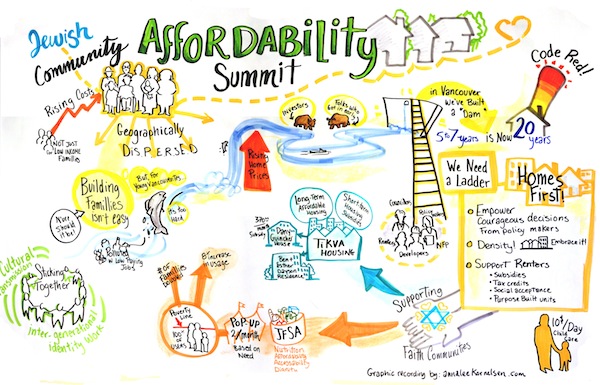
The main issues that were brought up at the Affordability Summit. (image by annaleekornelsen.com)

Vancouver is in the throes of an affordability crisis. It’s in the news, provincial politicians are talking about it as they campaign for the upcoming election, the city is implementing new taxes, but does anyone have the solution?

The Jewish Federation of Greater Vancouver decided it would seek some answers. On March 29, the first-ever Federation-sponsored Affordability Summit took place at Temple Sholom. Attended by more than 60 individuals, including New Democratic Party members of the legislature Selina Robinson and George Heyman, the goal was to give direction to Federation’s planning around affordability and being Jewish in Vancouver.

The evening, introduced by Temple Sholom Associate Rabbi Carey Brown, raised the pressing issue about why the Jewish community needs to deal with affordability beyond the basic human issues.

“This evening stemmed from the awareness that we all feel affordability impacting the sustainability our community,” she said. The other reality, she said, is that as Jews become more geographically dispersed, they are no longer near Jewish infrastructure like synagogues, day schools and the Jewish Community Centre of Greater Vancouver, so their participation in the community diminishes.

Participation in Jewish programming and activities is expensive in itself. Jewish community professionals are seeing a rise in requests for assistance for schools, summer camps and JCCGV activities. This also raises issues about the long-term sustainability of the community’s institutions if families cannot afford to live near enough to use them.

The event’s keynote speaker, Richard Fruchter, executive director of the Jewish Family Service Agency, addressed affordable housing, food security and a steep rise in demand for food banks, and raised some suggestions for solutions, including universal childcare, affordable transit and some novel taxation changes.

image - A graphic summary of the speakers’ main points at the summit
A graphic summary of the speakers’ main points at the summit. (image by annaleekornelsen.com)

Eric Fefer, chair of the Tikva Housing Society board, said his organization is in the process of expanding the number of subsidized housing units in its portfolio, with 10 new units called Storeys (Diamond Residences) opening this summer in Richmond.

Starting this fall, applications will be accepted for the Ben and Esther Dayson Residences, a project Tikva Housing is undertaking in conjunction with Vancouver Community Land Trust. The development will include 32 townhomes and apartments of two, three and four bedrooms. These homes, in the River District of south Vancouver, are expected to be available for occupancy in summer 2018.

These new homes will provide families with subsidized housing in the vicinity of Jewish amenities, but Fefer acknowledged this increased supply doesn’t begin to touch demand.

Following the event’s main session, breakout groups convened to discuss topics in greater depth. In addition to issues of food security and housing, affordable childcare advocate Gyda Chud presented solutions for universal childcare. A session on Jewish education was led by Daniel Held, executive director of the Julia and Henry Koschitzky Centre for Jewish Education in Toronto. He shared insights into the efficiencies Toronto is seeking in their Jewish education system to lower the cost of Jewish day school.

The Jewish education session was an example of using the experience of a community like Toronto’s, with greater breadth and depth of experience than ours, to identify ways to be more inclusive and to reduce costs so more Jewish children can access what Held referred to as “high impact Jewish education experiences.”

The Affordability Summit’s results were recorded by each breakout group moderator and then graphically represented by a talented artist who integrated the ideas for the group to see. Each group produced a few suggestions and this information will be used by the Federation’s planning council to help inform the way forward.

For more information on how to become engaged in activities surrounding affordability in Vancouver, contact Shelley Rivkin, vice-president, planning, allocations and community affairs at Jewish Federation at [email protected] or 604-257-5192.

Michelle Dodek is a freelance writer living in Vancouver and the president of the Hebrew Free Loan Association.

Format ImagePosted on April 21, 2017April 20, 2017Author Michelle DodekCategories LocalTags affordability, Jewish Federation
Value in mentorship

Value in mentorship

T-Jex after-school supplementary program is a partnership between Schara Tzedeck Synagogue and Shalhevet Girls High School, where the older students mentor the younger. (photo from Shalhevet)

When friends approached Gila Ross several years ago to start a new Hebrew school in Vancouver, Ross turned for inspiration to a program she had previously run in Calgary for college students, refitting it for children.

The program, T-Jex – the Jewish Experience – is built around mentorship and is based out of Schara Tzedeck Synagogue. Vancouver’s Orthodox Shalhevet Girls High School (grades 8 to 12) sends carefully selected mentor volunteers to T-Jex to work one-on-one with students or in groups of two or three. The mentors work predominantly on building Hebrew-language skills with the children. Children also learn as a class with Ross, who is the main teacher and program director, and takes the lead teaching Jewish values, holidays and Torah study.

T-Jex, now in its fifth year, involves about 10 students a year. “It is an amazing opportunity,” Rivka Abramchik, principal of Shalhevet, told the Jewish Independent. “A big part of the Shalhevet curriculum, and the goals we set for our students during the five years they are with us, is to stand up and take leadership. This is an opportunity to take responsibility, to learn the concept of giving back to the community.”

She added, “The girls get to really see how one person can make a meaningful impact. T-Jex so beautifully intertwines with the desire the girls have to be part of Jewish continuity and gives them a chance to give in a way which also gives to the girls themselves. It’s a big commitment – to give up 90 to 130 minutes on a Tuesday afternoon is give up a lot of time for these girls. You would think teenagers would be reluctant but, actually, the idea of teaching a child, students get more inspired than you might think. We have repeats every year.”

Ross gives a presentation at Shalhevet annually to introduce the program to the school’s new students. The importance of committing for a whole year is stressed, as is the importance of engagement, motivation and responsibility.

“I really enjoy working with the kids at T-Jex,” said Grade 11 student Hadassa Estrin. “The gratifying feeling you get when you see them learning about their heritage is so special … like nothing else I’ve ever experienced.”

“Most of our students have been coming from word of mouth, from all over Vancouver and from across the Jewish spectrum,” said Ross. “They have heard from others that kids enjoy coming.”

Ross started a Facebook group for Jewish moms a year or so ago, which has become a virtual community. The group has also helped spread word about the Hebrew school.

Ross, who has six kids of her own, is the youth director at Schara Tzedeck, where she has spearheaded the synagogue’s Families That Give social action projects. She also teaches at Torah High, an after-school program, and works with her husband, Rabbi Samuel Ross, the director of Vancouver National Conference of Synagogue Youth.

“The most wonderful thing to see,” said Ross, “is the students wanting to be here and having fun. To see them take joy in learning and Jewish activities is what it’s all about.”

For more information, visit scharatzedeck.com/education-learning/t-jex-2.

Matthew Gindin is a freelance journalist, writer and lecturer. He writes regularly for the Forward and All That Is Interesting, and has been published in Religion Dispatches, Situate Magazine, Tikkun and elsewhere. He can be found on Medium and Twitter.

Format ImagePosted on April 21, 2017April 20, 2017Author Matthew GindinCategories LocalTags education, Gila Ross, Judaism, Schara Tzedeck, Shalhevet, T-Jex
A new Camp Shalom

A new Camp Shalom

This August, JCC Camp Shalom will also take place at Burquest Jewish Community Centre. (photo from JCC Camp Shalom)

The Jewish Community Centre of Greater Vancouver’s JCC Camp Shalom for children and youth living in the Metro Vancouver area is coming to Burquest Jewish Community Centre Aug. 21 to Sept. 1.

Four years ago, a collaboration between JCC Camp Shalom and the Aleph in the Tri-Cities group began with the support of the Jewish Federation of Greater Vancouver. This made it possible for children living in regional communities to attend JCC Camp Shalom in Vancouver.

This year, thanks to a grant from the Jewish Community Foundation of Greater Vancouver, JCC Camp Shalom will venture into the Tri-Cities and run its first outreach session of the summer camp at the Burquest Jewish Community Centre.

This camp will look and feel just like JCC Camp Shalom: Jewish exploration and an Israel connection, while celebrating Canada 150; fieldtrips in nature and an overnight camping trip are included as well. The outreach camp also has free bus transportation and rates matching other camps in the area. Israeli and Jewish families living in Burnaby, New Westminster, the Tri-Cities (Coquitlam, Port Coquitlam and Port Moody) and beyond will be able to register their children ages 5-13 for one or two weeks of full-day camp. Registration opens May 5.

“This summer, we are finally going to have an outreach Camp

Shalom on our doorstep within our hometown!” said Yossi Dagan of the Aleph in the Tri-Cities group, who has been part of the project since its inception.

“As a community member living in the Tri-Cities, I am so excited to be able to send my children to a Jewish day camp so close to home,” said Tammy King, mother of three and program coordinator for Burquest. “For the first time, they will be able to participate in Jewish programming, learn about Israel and meet other Jewish kids their own age. This is definitely an exciting opportunity for Jewish families living outside of Vancouver.”

For more information, contact [email protected] or [email protected].

Format ImagePosted on April 21, 2017April 20, 2017Author JCC Camp ShalomCategories LocalTags Burquest, children, JCC, summer camp, Tri-Cities, Yossi Dagan
Exhibit for the 150th

Exhibit for the 150th

The ribbon-cutting at the launch of the Canadian Jewish Experience exhibit. From left to right: Dr. Mark Kristmanson of the National Capital Commission; Supreme Court Justice Michael J. Moldaver; Ottawa Police Chief Charles Bordeleau; Rabbi Reuven Bulka of Machzikei Hadas Synagogue; Catherine Bélanger, widow of the late member of Parliament Mauril Bélanger; Tova Lynch of CJE; Linda Kerzner of Jewish Federation of Ottawa; and Cantor Daniel Benlolo of Congregation Kehilat Beth Israel. (photo from CJE)

A new exhibit opened in Ottawa on April 2, to mark the contribution of Jews to Canada and to celebrate the 150th anniversary of Confederation. The Canadian Jewish Experience: A Tribute to Canada 150 is on display in the lobby of 30 Metcalfe St., just two blocks from Parliament Hill, and is open to the public daily from 9 a.m.-6 p.m.

The Canadian Jewish Experience is composed of specially created, bilingual exhibit panels illustrating nine major themes, such as contributions in war and diplomacy, public service, human rights, business growth, arts, culture and sport. A traveling version of the CJE exhibit will be available for display in other cities in Canada.

A parallel website has also been created to present more detailed information about the CJE exhibit topics and about many extraordinary Canadians. The website will provide information about venues for the lecture series and locations where the traveling exhibit can be viewed.

The Canadian Jewish Experience will also present a speaker series to highlight the contributions of Jewish Canadians to the development of Canada.

CJE has produced a special exhibit panel called Remembering Louis Rasminsky, which describes the work of Rasminsky, who was the first-ever Jewish person to be governor of the Bank of Canada. This will be on display at the Bank of Canada headquarters in Ottawa.

At the exhibit opening, CJE committee head Tova Lynch thanked donors from across Canada for the financial assistance they provided. In particular, she acknowledged its major donors: the Asper Foundation and Bel-Fran Charitable Foundation (Samuel and Frances Belzberg) from Vancouver.

“The CJE is an example of the tremendous love which Canadians have for our country,” Lynch added, praising the National Capital Commission for its cooperation. “Through our partnership with the National Capital Commission, CJE has an excellent downtown facility at the centre of events celebrating Canada’s 150th birthday.”

Lynch also noted, “Excitement is building as we approach Canada Day 2017. CJE will tell Canada’s Jewish story to many thousands of visitors to Ottawa in 2017.”

She pointed out that “Jewish Canadians have played a key role in all facets of life in Canada. Their accomplishments reflect the challenges and successes experienced by Canada in its first 150 years.”

The Jewish connection to Canada dates back to the mid-1700s. “The first Jewish Canadians arrived more than 100 years before Confederation,” noted Senator Linda Frum. “We’ve been here for a quarter of a millennium, but many Canadians don’t know the role we’ve played to make our country strong and vibrant. The Canadian Jewish Experience will help to change that.”

Ottawa Mayor Jim Watson said that the national capital is the appropriate home for the Canadian Jewish Experience. “In 2017, Ottawa will be at the centre of celebrating Canada’s 150th birthday and Jewish people have played a key role in all facets of life in the city. In fact, their accomplishments here reflect all the themes of the Canadian Jewish Experience, including being elected mayor.”

Other Jewish leaders and organizations who have assisted the Canadian Jewish Experience project include Victor Rabinovitch, former president and chief executive officer of the Canadian Museum of Civilization (now the Canadian Museum of History); the leaders of Jewish federations across Canada; and the Centre for Israel and Jewish Affairs. CJE is also supported by members of Parliament from all federal parties, Senator Frum, former senator Jerry Grafstein and Rabbi Dr. Reuven Bulka. Sandra Morton Weizman of Calgary is the curator of the CJE exhibit and virtual exhibit.

The CJE website is cje2017.com.


Format ImagePosted on April 21, 2017April 20, 2017Author Canadian Jewish ExperienceCategories NationalTags Canada, CJE, history

Posts pagination

Previous page Page 1 … Page 448 Page 449 Page 450 … Page 667 Next page
Proudly powered by WordPress