Avant-garde fashion designer Noa Raviv says her award-winning fashions were triggered by her interest in the power of mistakes.
Born in Tel Aviv in 1987, Raviv is currently developing her couture brand in New York City, after achieving global industry recognition for her Hard Copy garments combining hand-sewn, 3D-printed polymer synthetic tulle with laser-cut appliqués.
“Hard Copy was a really long process that came out of my thinking about the concept of originals and copies in our era,” she told Israel21c. “When I started working with 3D software and printing, I was intrigued by the mistakes I made. If you input a command that can’t be executed, you get unexpected results. It was kind of magical to me. I was fascinated by mistakes created by a perfect machine and started exploring how it could be my answer to designing something original – because a mistake is something you can’t replicate.”
Hard Copy features ribbed polymer shapes printed out on a Stratasys Objet Connex multi-material machine and stitched to voluminous pleated tulle, silk and organza.
Named Fashion Designer of the Year 2014 at the 3D Printshow in London, Raviv has exhibited in Carrousel du Louvre, Paris; Old Billingsgate, London; New York’s Metropolitan Museum of Art; and Boston’s Museum of Fine Arts, among other venues.
In November 2015, Raviv gave a keynote talk on The Power of Mistakes, at Futurescan 3, a conference organized by FTC (Association of Degree Courses in Fashion and Textile) at Glasgow School of Art in Scotland. She spoke on the same topic at the Museum of Design in Atlanta, Ga.
Raviv was one of four innovative Israeli women honoured at the 10th annual Israel Day at the New York Stock Exchange, Nov. 10, 2016.
Raviv, who appeared on Forbes Israel’s 2016 “30 Under 30” list, said she is “fascinated by the tension between harmony and chaos, tradition and innovation,” and wants to continue experimenting with technology.
Her current collection, Off-Line, was released in spring/summer 2016.
Noa Raviv’s Off-Line collection was released in spring/summer 2016. (photo by Ryan Duffin)
Though it’s not 3D-printed, Off-Line combines elements of complex handwork and machine work, beginning with graphic design software and topped off with Swarovski crystals.
Raviv’s collaboration with Swarovski involves sending design files to Austria, where the company custom-makes molds from which millions of tiny crystals are applied onto a flexible transparent material and sent back to New York for finishing.
“Once every crystal is in the right place, they’re applied by heat to organza,” said Raviv, acknowledging that the more complicated pieces take a few weeks to complete.
“Hard Copy explored computers and digital errors. Off-Line explores the more intimate side of the creation process,” she said.
Most of the pieces in Off-Line are ready to wear and others can be made to order. Prices start at $1,800 US.
“My collections are not meant for the masses,” she admitted. “I’m still establishing my clientele – women who appreciate art, fashion and quality and care a lot about uniqueness.”
Neither is 3D fashion for the masses. In fact, Raviv doesn’t believe it will be available on the retail level anytime soon.
“Maybe in the very far future,” she said. “Fashion is far too complex to make in one machine, technique or material. There are so many nuances and the technology isn’t there yet to create what people want to wear. For now, it’s a romantic idea.”
A 3D dress made by another Israeli designer, Danit Peleg, was worn in a dance performance by U.S. snowboarder Amy Purdy at the opening ceremony of the recent Paralympics in Rio.
An intuitive choice
Always captivated by art and fashion, Raviv wavered between art school and fashion school after two years of army service and another 12-plus months pursuing other interests, including learning to speak Spanish – a very practical skill, as she is married to an Argentine-born startup entrepreneur.
“At the last minute, I intuitively went for fashion,” she said.
Raviv graduated in 2014 from Israel’s Shenkar College of Engineering and Design. Hard Copy was her senior project. Her designs also were included in 2013’s Here Comes the Bride exhibition, which opened at Beit Hatfutsot-Museum of the Jewish People in Tel Aviv and traveled to other countries.
Raviv moved to the New York City borough of Queens a little more than a year ago and is getting used to the more formal work culture in the United States.
“Israel is very small and the fashion scene is small, and it’s hard to manufacture in Israel,” she explained. “It’s important for me to be very close to the development and production of my designs.”
Israel21cis a nonprofit educational foundation with a mission to focus media and public attention on the 21st-century Israel that exists beyond the conflict. For more, or to donate, visit israel21c.org.
Israeli app developer Uri Levine. (photo from Uri Levine)
This could be the year you start saving all kinds of money and time from using apps, and you may have Israeli Uri Levine to thank for it.
Levine, a computer programmer, investor and start-up guru, was a Waze co-founder (with two others), as well as president of the Israel-based company from 2007 to 2013.
Waze’s platform provides drivers an opportunity to post real-time alerts about any traffic situation for other drivers, anywhere in the world. Four years ago, Google bought Waze for a reported $1.3 billion US, said to be the largest buyout in the history of Israeli high tech.
“Waze had to be sold,” Levine told the Independent. “Only Google knew how to monetize it in a gigantic way that we could never be able to do.” Today, 50 million people use the app.
Since his Waze days, Levine has been hard at work producing other apps meant to help consumers. To name a few, Engie connects to your car’s diagnostic computer, informing you of precisely what needs repairs before going to the mechanic. For people looking for discounted hotel rooms, Roomer helps people who want to offload non-refundable hotel reservations. Then there’s Fairfly: once people have bought their airplane tickets, the service searches for a cheaper flight. Similarly, with FairSale, another after-purchase app, once you’ve already bought an item, you scan your receipt with your phone, and the service will keep tabs on when the store has a price guarantee. According to Levine, about $130 billion is lost by American consumers alone because they don’t know about, or they ignore, low-price guarantees.
In 2009, while still working at Waze, Levine launched the app FeeX with a $100,000 investment. The aim is to help people save money on financial services and investment funds. The idea came to him during the economic downturn, at a time when funds in his own investment portfolio lost a fifth of their value, and he had been charged what he thought was an unjust bank user fee.
“After I argued with them, they reimbursed me. That’s when I wanted to find ways to expose hidden financial fees,” he said. “FeeX examines people’s portfolios and suggests similar investments that have less expensive fees.”
In the United States, he said, people pay about $600 billion annually to investment managers for retirement and other funds. Today, there are about 30,000 users of FeeX in America and about 100,000 in Israel.
Levine holds a bachelor’s of economics from Tel Aviv University, but his love for programming came earlier. In 1981, at age 16, he acquired his first computer, a Sinclair ZX – in its day, it was one of the most popular computers globally, with just two kilobytes of memory. By way of example, most microwave ovens manufactured in 1982 had more functionality.
One of Levine’s first jobs was as a software developer in the Israeli army. Later, he became a developer at Comverse, a telecommunications company in Israel. About 20 years ago, Comverse was one of the largest employers of software engineers, and a high-tech industry success story.
“I would nearly say that the economics degree provided me with a point of view, but the real study was in the army and, later, on the job as a developer,” he said.
Often asked for his advice on how to launch a start-up, Levine offered a five-step approach: “First, fall in love with the problem – not the solution. Second, make mistakes fast; the biggest enemy of good enough is perfect. Third, focus – it’s very easy to defocus. You have to say no to everything else which is not solving the problem. Fourth, half of the startups fail because they realize that the team is not right and they don’t fix it. And, finally, understand who your users are, and what their perception of the problem is.”
As for apps, those wishing to create and launch one should have this goal in mind, he said: “Create value for the users, and make it simple to get to the value.”
Dave Gordonis a Toronto-based freelance writer whose work has appeared in more than 100 publications around the world.
B.C. Finance Minister Michael de Jong speaks at the Canadian reception in Tel Aviv, kicking off the Nov. 13-17 trade mission to Israel. (photo from flickr.com/photos/bcgovphotos)
In November, B.C. Minister of Finance and House Leader Michael de Jong led a provincial trade mission to Israel. The invitation to delegates was sent by the minister and Dr. Moira Stilwell, MLA for Vancouver-Langara.
“A lot of the impetus for this [mission] derived from the tech sector, the health sciences sector, the cybersecurity sector itself here in B.C., who said, look, we are seeing increasing opportunities and we’d like to explore those further, is the government prepared to work with us?” de Jong told the Independent in a phone interview. “And that led to a conversation between myself and Moira – of course, she has been, for many years, a big proponent of growing the bilateral relationship – and, out of that emerged this formal trade delegation.”
It was de Jong’s second mission to Israel. His first was about five years ago, during his tenure as the province’s minister of health.
“The role the government and a minister can play is to help facilitate partnerships and contacts between people, and this particular group had done a lot of that work themselves,” he said. “So, for example, the Rick Hansen Institute had already created the beginnings of a partnership with Hadassah [Medical Centre] and we saw that go to the next level in terms of formalization. We went out to Technion University, which is this world-leading institute – in their hallway, they feature Nobel laureates the way other institutions feature alumni – it’s quite remarkable…. [On] the cybersecurity side, some of the folks who were with us are even now actively pursuing with colleagues in Israel opportunities for exchange and for trade and, ultimately, that’s what this is all about.”
Finance Minister Michael de Jong at Yad Vashem during the November B.C. trade mission to Israel. (photo by Yuval Yosef)
Delegates on the Nov. 13-17 mission traveled to Tel Aviv, Jerusalem, Beersheva, Haifa and the West Bank to meet with various government, university and other stakeholders. Among those accompanying de Jong was Nico Slobinsky, director of the Centre for Israel and Jewish Affairs, Pacific Region. CIJA hosted an optional tour and Shabbat dinner on Nov. 18 for delegates who stayed after the mission was officially over, Slobinsky told the Independent.
“CIJA was delighted by the Government of British Columbia’s initiative to lead a trade delegation to Israel composed of B.C. entrepreneurs and professionals involved in life sciences and cybersecurity,” he said. “This mission assisted in cementing existing relationships, creating new partnerships and promoting opportunities in the province by deepening the economic, cultural and academic ties between Israel and B.C.”
One of those ties was with the Centre for Health Evaluation and Outcome Sciences (CHÉOS), a centre of the Providence Health Care Research Institute and the University of British Columbia faculty of medicine.
“Israel is viewed as a world exemplar in science, technology and commercialization – a place where we can learn, but also can share best practices from B.C.,” said Prof. Robert Sindelar, who, among other things, serves as an advisor to CHÉOS. He added, “Having participated in valuable and hugely beneficial B.C. trade missions previously to China and India, I said yes immediately when I had received the invitation to consider participating in a B.C. trade mission to Israel from the B.C. Ministry of International Trade.”
About the November trip, he said, “From our very first meeting in Israel to the very last meeting, I was continually impressed by our Israel hosts’ efforts to: 1) openly and candidly share valuable insight and details of their successes and endeavors with our delegation, and 2) the immediate connection in person or via email within 24 hours of an event to further explore potential opportunities and collaborations. Thus, we are already working together on several possible collaborations between Israel and B.C.”
Being a multidisciplinary health research centre, CHÉOS looks “to partner and collaborate with synergistic and like organizations researching at the cutting-edge of health and wellness,” said Sindelar. “Thus, true partnerships and collaborations with the best health-outcomes organizations in the world – sharing knowledge, skills and new methodologies – is a continuing goal for us. Each and every life-science event planned for the B.C. trade mission to Israel provided an opportunity and unique ideas for possible collaborations for CHÉOS health scientists and clinicians at a world-class level.”
Of course, the relationship with Israel extends beyond British Columbia to all of Canada.
“There is this very strong political and cultural tie,” said de Jong. “I think we still underachieve with respect to trade. I think there is genuine room for growth on the trade front. There are some emerging opportunities, as Israel begins to explore offshore energy potential.”
As well, “we have room to learn from the ‘start-up nation,’” said de Jong. “You go down to Beersheva, for example, and see how they have managed to create a technology hub in concert with the university there and the community there, and you see elements of that beginning to develop in British Columbia, in the Lower Mainland, in Victoria, but there are some real lessons to be learned.
“Frequently, the conversations began with the Israeli representatives reminding us of the unique challenges that they face and how innovation is borne out of necessity – smaller population base, smaller country, neighbors that aren’t always particularly friendly and, in some cases, are downright hostile, and, out of that, out of necessity, innovation has emerged. At one point, I replied to a group, acknowledged that and said I want you to think about another form of necessity. Imagine four-and-a-half million people in an area the size of Europe … well, that’s our circumstance. That breeds a different kind of innovation … 35 million people in a country that’s the second-largest country in the world. And so, we have to innovate in order to achieve a standard of living that is amongst the highest in the world, with vast distances and a very small population base, and we may have something to teach you about that. Different circumstances, both have required a degree of unique innovation, and two countries that have performed remarkably well economically.”
The cost of the trip, which included travel to Israel and England for the minister and his chief of staff, came in slightly below the ministry’s $25,000 estimate, said de Jong.
“It costs money,” he said. “You go to these hotels and, if you can find one that’s below $300 a night, you’re lucky. It’s not cheap.”
But, he explained, “It’s well spent if it facilitates business and trade. If it doesn’t, then it is not a sound investment. We try to track the trade stats and the partners that came with us and do the follow-up.”
Regarding that follow-up, he said, “Well, the trade ministry, who were also represented on the trip, will be following up with the members of the delegation; in some cases, providing additional information to folks we met in Israel. In a couple of cases, there are groups there who have indicated a desire to come here to follow-up. The ultimate test of success is the degree to which investment flows out of Israel into British Columbia and out of B.C. into Israel, and we see increased levels of commerce and trade in goods and services. We can dress it up any way we want, but that’s the measure of success. If, a year or two from now, our trade levels remain the same, then it hasn’t been a success.”
To those who support the boycott, divestment and sanction movement, de Jong said, “I disagree with the approach. I see benefits for British Columbia in developing and enhancing the trade relationship, benefits for Canada; I see benefits for Israel, I see benefits for the region. I met with the finance minister for the Palestinian Authority, went into Ramallah, had a conversation, obviously got a perspective on some of the economic challenges that they are facing. I had met earlier that day or the day previous with the Israeli health minister. There is a vexing challenge there, and I’m not going to pretend to have the recipe for resolution, but I do know that Canada and Canadians are well-regarded within Israel and, my impression was, amongst the Palestinian officials. To the extent that we can encourage or influence the prospect of negotiations and resolution, so much the better.”
After the mission to Israel, de Jong stopped in London, where British Columbia was honored by the London Stock Exchange for innovation in financial capital markets.
“As finance minister over the last five years, there’s a bit of a pattern,” said de Jong of his international travel in general. “After the budget, I’ll usually do a tour involving the North American markets, so Toronto, Montreal, New York, Boston, Chicago, that sort of triangle, if you will. We also have a lot of investors in Europe, so every second year, there will be a European show.
“As forestry minister, those were the years we were opening up the China market and were very active there, happily. It’s paying dividends now. And, more recently, we were the first government anywhere in the world to issue what are called ‘dim sum and panda bonds,’ one is offshore, one is onshore, Chinese currency bonds.
“Earlier, I mean just before I was in Israel, I was in India. We were the first government anywhere in the world to issue what are called ‘masala bonds,’ rupee-denominated bonds. We’re able to do these things because we’re triple-A … so we can go where no one has gone before … and break new ground. On the way back from Israel, I stopped in London, and the reason the stock exchange wanted to honor British Columbia was for creating an entire new trade through this masala bond. We issue it out of London and now, of course, others are following.”
According to Jewish Federation of Greater Vancouver chief executive officer Ezra Shanken, in his Nov. 18 e-newsletter, other local Jewish community members who joined the B.C.-Israel mission were Candace Kwinter, who is on Federation’s Israel and overseas affairs committee and CIJA-PR’s Local Partnership Council; Paul Goldman, who is CIJA’s immediate past chair; and Eli Mann, chief executive officer of Shield4UC, who also serves on Federation’s community security advisory committee.
I knew the printer wasn’t working when no typed pages flew out of its up-front opening where typed pages are supposed to fly out. Great! I spend a week feeding it $18 cartridges of yellow, magenta and black, and now that its appetite had been sated, no output. And, by the way, what marketing genius conceived of the scam where the color “black” demands yellow and magenta. It makes as much sense as filling your car with gas but the car won’t go unless you also buy a six pack of beer and two bags of potato chips.
Clearly, I needed a new printer. This clever machine announced its death in a dialect that even I understood. After some 10 years of service, it had gone to that junkyard in the sky where you could print black without magenta or yellow.
I needed a new printer. Even worse, I would have to properly introduce the printer to the computer. I’m a scribbler not an engineer. But then relief, as I thought of my great-grandchild in kindergarten. He was already 6 – he knew all about ’puters, as he called them. No, not a good idea – better my third-grade grandchild – much more experienced.
That thought cost me a quart of strawberry ripple ice cream, and alarm at his mature and loud vocabulary as failure followed failure. Then inspiration lightened the room as I thought of an engineering friend who loved key lime pie. My wife, who didn’t know a printer from a nuclear reactor either, had just made a key lime pie! What followed was the shortest marketing phone conversation on record.
“Henry, come on over and help me share a key lime pie.”
He came. Ate three pounds of key lime pie. We finished. The pie was as dead as the printer. Henry, though, full of pie, was – as I planned – in a jovial mood. I showed him around our house. And, somehow, we ended in the computer room.
“Hey Ted, the wire between the computer and printer isn’t connected.” (My third grader never noticed that! Public schools today are atrocious.) At this point, I hung my head and confessed the whole key lime pie inducement scheme. Nonetheless, my friend – what a friend! – jumped in the driver’s seat. He pushed buttons, tied wires, cursed, sweated. He condemned every printer you could imagine, as my chaste computer wouldn’t mate with the printer.
I didn’t get the whole picture but it had something to with it being a new printer and the ’puter having an old operating system. Such snobbery. It was age discrimination. That lousy printer should end up in court for rejecting the advances of my senior computer.
Not to worry, however. As in most fairytales – though this story is the absolute truth – we somehow found a happy ending. My friend, his forehead wet with frustration, mentioned that he saw another printer in my bedroom.
“Yeah, it’s an old one,” I said. “Somebody gave it to me.”
The word “old” rang in the room like a bell. His eyes lit up like he’d just drained a fifth of champagne.
“Go get it!” he screamed.
Sure enough, the old printer loved that old operating system. The two devices mated in front of our eyes. In fact, together they made this love story.
Ted Roberts is a freelance writer and humorist living in Huntsville, Ala. His website is wonderwordworks.com.
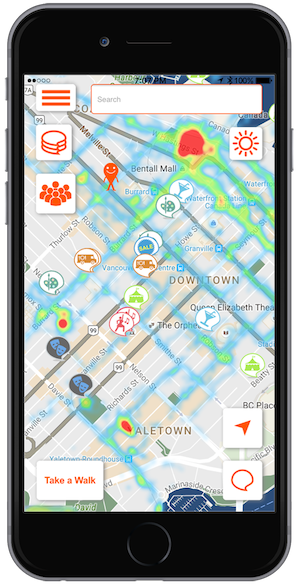
The Go Downtown app helps users find out what is happening in town right now.
Go Downtown has launched a public pilot of its real-time urban mapping mobile application in the Metro Vancouver area. The app is now free to download at the Canadian App Store and Google Play.
The new app helps users in large cities find out what is happening around town right now, and where to go to participate. The app indicates the location of live events and highlights crowd hot spots using a live foot-traffic heatmap.
The main mapping platforms like Google, Apple or Bing present mostly static data, while the information about live urban events – such as bands, parties, shows, etc. – is fragmented across the net and hard to find. Go Downtown changes the way we plan our hangouts and find out where the action is, by visualizing the live city. The social app aggregates information about events – such as festivals, shows, live music, food truck locations, happy hours and more – from user reports and other sources and displays them on the map. Users can share the details of an event they like and the app produces a walking route to take them there.
Go Downtown also features a live foot-traffic heatmap. The app aggregates the location and speed of its users to generate a real-time foot-traffic “synoptic map.” The heatmap highlights pedestrian hot spots and helps users find where the action is and where people are going. Users can even filter the map to find hot spots of specific groups of people based on their demographic and common interests.
In addition, the app offers themed walking routes – like “tourist attractions,” “shopping spree,” “pub crawl” and other things near the user – that enable the user to explore the city by walking.
“The concept of real-time urban mapping is powerful,” said Yaron Bazaz, co-founder and chief executive officer of Go Downtown. “Waze revolutionized mapping by using real-time user reports to map current traffic congestions and help drivers. Go Downtown takes real-time mapping further by utilizing user inputs to depict urban life. Where are people hanging out right now, what cultural events are taking place today? The ability to digest all this information, visualize it and analyze patterns will have enormous impact on users, businesses and local authorities.”
In addition, the real-time foot-traffic data and live urban events information generated serves a wide range of markets: from leading retail chains and car-sharing ventures that would like to understand foot-traffic patterns, to universities and cities that can use it for better planning. Go Downtown predicts that live foot-traffic data pattern analysis and forecast will play a key role in many Smart City initiatives and will be widely used by urban planners to plan more pedestrian-friendly cities.
Earlier this year, the startup ran a successful pilot at the University of British Columbia with the support of the faculty and the student organization. During the pilot, the app aggregated the foot traffic of hundreds of participants and mapped the main walking routes students were using throughout the campus.
Following the public pilot in Vancouver, the company plans to expand the service to more cities in Canada and the United States. To participate in the Vancouver pilot, visit godowntown.mobi to download the iOS version from the App Store or the Android version from Google Play.
On Oct. 22, 200 teachers from across British Columbia and Ontario participated in Code Class, a one-day coding and computational thinking crash course.
The inaugural class was hosted by coding education experts Lighthouse Labs, which partnered with Kids Code Jeunesse, a nonprofit dedicated to empowering kids and teachers through code, and Computer Using Educators of British Columbia (CUEBC).
Code Class is a free, full-day workshop designed specifically for K-12 educators that aims to introduce educators to computational thinking and inspire them to bring code into the classroom. It supports teachers by removing barriers and fostering an understanding of computational thinking, technology and basic code.
Computational thinking is problem solving; it’s understanding larger structures with both human and technological systems. It could be as simple as following a recipe, or as advanced as coding a website. Computational thinking is to computers as astronomy is to telescopes; it’s about how people conceptualize information, and how they put those concepts into practise.
With the introduction of code into the new ADST (Applied Design, Skills and Technologies) curriculum across British Columbia, Code Class organizers believe that it is more important than ever to invest in teachers and to give them the tools and resources needed to bring code into the classroom.
“Lighthouse Labs is proud to support teachers across Canada,” said Jewish community member Jeremy Shaki, co-founder of Lighthouse Labs. “We believe that great education starts with great teachers and grows from there. The best solution for incorporating technology into the classroom is to provide teachers with the tools and resources they need to inspire their students.”
“By educating children with the tools needed to create and communicate within the 21st century, we are providing them with the skills needed to build their own future success,” said Kate Arthur, founder and co-director of Kids Code Jeunesse, which is based on the belief that coding is a basic literacy as important as reading, writing or math.
K-12 teachers of all subjects who attended the 2016 CUEBC conference could participate in the free-of-charge one-day workshop held at School District 43’s École Riverside Secondary School in Port Coquitlam. More than two dozen software developers from local technology companies mentored participants during the workshop, and no previous coding experience was required to attend.
Computational thinking already exists within some key aspects of teachers’ classrooms, said Jon Hamlin, president of CUEBC, an organization of volunteer teachers in the province dedicated to promoting the educational uses of technology in schools. “We hope to reframe their understanding of the subject, see how it connects in cross-curricular ways, and see computers and coding from a new perspective. Together with Lighthouse Labs, we aim to support all K-12 teachers in their adoption of the new ADST provincial curriculum.”
For more information about Lighthouse Labs, its approach to teaching web and mobile software development, and the courses it offers, visit lighthouselabs.ca.
Rowan Jang provides an example of the zombie-vampires audiences can expect to encounter in The Zombie Syndrome: Dead in the Water. (photo by Emily Cooper Photography)
Last year, I was one of a group of “specialists” who gathered outside Trout Lake Community Centre to embark on our mission, which related to a downed alien spaceship. While the details of that mission must remain confidential, one aspect can be revealed – it was loads of fun. It was also a great cardio workout, not just because of the running from zombies, but the screaming, both from fear and excitement.
This year, the Virtual Stage is gathering teams (audiences) of 18 on Granville Island every 30 minutes from 6:30 to 8:30 p.m. nightly until Oct. 31 to help find Special Forces operative Frank Johnson. As per the mission description, Johnson “was hunting down former government geneticist Mattias Van Cleave when he fell off the radar. Van Cleave, a suspected vampiric psychopath, is believed to be responsible for a string of recent murders, and the sudden appearance of zombie-vampire mutants across the Lower Mainland. The audience must determine Johnson’s whereabouts and ensure his mission to stop Van Cleave is completed at any cost.”
As with the four previous Zombie productions, The Zombie Syndrome: Dead in the Water makes use of the latest technology – this year, it’s Apple’s new location-based iBeacon.
“I am very interested in how emerging technologies can excite live audiences and breathe new life into theatre as an art form,” Virtual Stage artistic director, Zombies series creator and Jewish community member Andy Thompson told the Independent. “I am very narrative-driven as an artist, and the iBeacons have been a delightful tool in the creation of The Zombie Syndrome: Dead in the Water.”
The decision about what technology to use, Thompson said, “involves a process of questioning what is readily accessible and available, not only for myself as a producer, but also for today’s audiences. What is free within smartphones today? What is new and exciting? How can these gadgets drive a story forward? What can people afford? What can our company afford?
“I am also constantly imagining what the next big thing in technology might be, as well as its potential future societal impact,” he added. “My vision of concern for the future with ‘social media on steroids’ in my musical Broken Sex Doll is one example of this. I am also assessing what exciting new technologies are present today and how they may aid in live storytelling. In the particular instance of this show, the iBeacons roll out narrative content in a very interactive and engaging way as the audience moves from site to site.”
As the audience moves quickly along – both because they are “racing against the clock” and because there are scary things lurking in the dark – the possibility of an accident, miscue or technical glitch is much higher than for a standard production.
“We rehearse as many possibilities as we can,” said Thompson, “but the most important preparation we have is to be ready for anything: the ‘known unknowns,’ as Donald Rumsfeld might say. So far, the audiences have been completely surprising to us in how they navigate the problems we present to them. So, it is fresh and exciting every performance. The personalities of the individual audience members also greatly affect the flow and feel of each show. We did a lot of improvising in the rehearsal process so the actors are very prepared and on their toes.”
One unexpected moment – of which Thompson said “there have been many” – took place during last year’s mission, “when the entire site flooded on our closing performance at Trout Lake. We had about one hour to physically relocate most sites to higher ground, rehearse it in the new areas, and get as many technical elements in place as we could. We managed to pull off a derivative of the show, which was a miracle and a testament to our amazing crew and performers.”
As to what participants can expect this year, Thompson said, “Audiences will be traveling by sea at one point, which we are thrilled about. They will be confronted with a new breed of mutant zombie-vampires that cannot be killed. The iBeacon technical aspect to the show is also a Canadian theatre première, so people will be testing that tech out with their smartphones in a live entertainment environment like they have never done before. And yes, there might be running….”
For mission tickets, visit thevirtualstage.org/zombies. Participants should dress for the weather and moving quickly; the show is rated PG-13.
Isaac Waldman Jewish Public Library librarian Helen Pinsky, left, and master’s student Alisa Lazear, who is working on the library’s audiobooks collection. (photo by Olga Livshin)
In past centuries, reading aloud was an integral part of family life. People gathered in their parlors to read books to friends and family. In the 20th century, the experience migrated towards radio. When favorite personalities read new novels or classics on the radio, it was a unique pleasure in many communities, especially where access to live entertainment was limited. Then came the TV and the internet. But reading aloud is seeing a comeback – with audiobooks.
The Wall Street Journal ran an article recently about how audiobooks are the fastest-growing sector in the book business today. In 2015, audiobook sales in the United States and Canada increased 21% from the previous year.
The Isaac Waldman Jewish Public Library has reacted to this latest development by expanding their audiobook stacks.
“The modern libraries have to change to keep up with the times,” said Helen Pinsky, Waldman’s head librarian, “but they also stay the same. As ever, they answer the patrons’ curiosity, provide access to information. They are the source of knowledge, whether on their shelves or through their computers. The changes come from different angles. For example, some libraries in the Greater Vancouver area explore novel ways of organizing books: by theme or by the time of publication instead of alphabetically by the author’s name. Such a method is especially convenient for teachers – who could find books on a particular theme grouped in one spot of the library – or for researchers.”
Pinsky also expressed concern about the negative impact of technology, however. With internet search engines, in particular Google, and sites like Wikipedia, people have stopped coming to libraries for information.
“They Google their questions and get a thousand websites as the answers,” she said. “But who could guarantee that the data they find in the first 37 hits is correct? Google is dangerous. It is destroying the value of encyclopedias, while librarians know where to find the right stuff. It is specifically true for the medical or legal areas.”
Of course, there are positive technical innovations, and Pinsky emphasized those, especially the digital formats. After ebooks became a huge segment of publishing in the last decade, and audiobooks followed a few years later, public libraries had to adapt to the new demands, although print books still dominate in the Waldman Library catalogue by a ratio of approximately 20 to one.
“It might be a different ratio for the city libraries,” Pinsky mused. “The exclusive supplier of digital books to Canadian libraries is Overdrive. There were a few smaller companies before but they’ve all gone out of business by now. Unfortunately, Overdrive doesn’t have much interest in the Jewish content, so their selection of Jewish-themed books in both epub format and audio format is rather narrow. They don’t have anything in Hebrew either. It might change in a few years, or publishers might start distributing digital content themselves.”
Still, there are some books available through Overdrive that are of specific interest to a Jewish readership, and the Waldman takes steps to broaden its digital choices.
“Audiobooks are trendy now,” said Alisa Lazear, who is working on the Waldman’s audiobook collection.
Lazear is studying for a master’s degree in library and information studies at the University of British Columbia.
“I need to do 120 hours of professional experience as part of my program. It’s an equivalent of one course,” she explained. “I approached Helen to do my professional experience at the Waldman because I love the library. It was Helen’s idea that my focus should be the audiobook collection. We already have some audiobook CDs, so I concentrated on the online streaming from Overdrive. I had to figure out how to download their books, choose which ones would interest our readers, and integrate them with the main catalogue. Then I had to design flyers to educate the patrons how to use such audiobooks.”
In Lazear’s opinion, the current popularity of audiobooks has to do with people’s chronic shortage of time.
“Audiobooks are great for multitasking,” she said. “You can drive, do chores, work out at a gym, and listen to an audiobook at the same time. A narrator also plays a huge role. He is part of the experience, almost like a friend reading to you. Some narrators have a huge following; people would listen to anything by them.”
Lazear thinks that the new digital formats are accessible across the generational spectrum.
“My young cousins enjoy listening to their favorite audiobooks before bed or in a car,” she said. “Some older people develop visual impairment, and audiobooks might be the only choice for them as a form of reading.”
Regarding this latter point, Lazear created an audiobook program, Coffee & Stories, for the Louis Brier Home and Hospital.
“We had our first meeting on Aug. 7,” she said. “Several people came to the activity room. I brought cookies and selected two different audiobooks. We listened to 10-minute clips from each and then discussed them. It was a very active discussion.”
Olga Livshinis a Vancouver freelance writer. She can be reached at olgagodim@gmail.com.
A scene from Migdal David’s The Night Spectacular: the Queen of Sheba with her entourage. (photo by Amit Geron)
While growing up in the United States, my friends and I never seemed to tire of asking each other, “Who is the Lincoln Memorial named after?” and “Who is buried in Grant’s Tomb?” The point of asking these silly questions seemed to be their obvious answers. When you grow up, however, you learn that the truth is not always so clear. Take, for example, Jerusalem’s Tower of David, also called David’s Citadel. King David, for whom it is apparently named, had nothing to do with the tower or any other part of this historic structure.
The tower is actually part of a medieval fortress that contains architectural additions from later periods. It is located near Jerusalem’s Jaffa Gate, which is the most trafficked entrance to the Old City. The tower is so well-recognized, it appears emblematically in countless Jerusalem paintings and photographs.
Early Byzantine Church fathers misinterpreted Josephus Flavius’ writings, ascribing the Tower of Phasael, from King Herod’s time, to King David. To further complicate the issue, Muslims also associated the Herodian tower with King David. They named their mihrab (prayer niche) Nabi Daud, David the Prophet. Later still, 19th-century Western Christians labeled the Turkish minaret added to the Mamluk mosque the Tower of David. This wrong name is what the tower is still called.
Tower of David Museum’s mission, in contrast, has evolved over time and various administrations. When the museum first opened in 1989, the aim was to present Jerusalem in all the years of its existence. Today, that is still a large part of the museum’s objective, but staff now creatively focus on familiarizing the public with the building complex’s amazing and lengthy physical presence. No easy job in an historic structure bound by preservation guidelines, in a city that has supreme importance to several of the world’s major religions and dates back to the second millennium BCE.
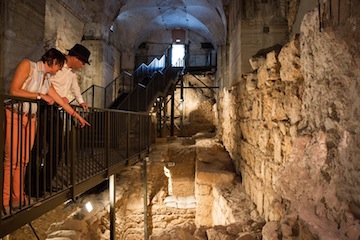
One of the new must-see additions is the Kishle. The discovery of the Kishle – when the Turkish Ottomans built a prison there in the mid-1800s, the Kishle referred to soldiers’ barracks – was accidental, but the follow-up to this archeological find has been careful and meticulous. What has recently been opened to the public is a continuous cut-away, or time line, of Jerusalem. The excavations reveal Jerusalem from as early as the sixth century BCE. It likewise shows walls from the time of King Herod – some of Herod’s huge building stones from the last quarter of the first century BCE are also still in place to the right of the museum’s main entrance by Omar Ibn El-Khattab Square – as well as evidence from the Middle Ages. Of particular importance is the discovery of a wall from the First Temple period, which adds to our knowledge about the city wall’s ancient route. Walking outdoors to the Kishle exhibit is an adventure in and of itself, as visitors traverse a dry moat that surrounds the Citadel. Also outdoors are finds going all the way back to the Second Temple period.
Excavations of the Kishle. (photo by Oded Antman)
The museum makes an effort to present Jerusalem from a variety of angles. Take, for example, the current temporary exhibit, Camera Man. In this wonderful photo display, we are able to see Jerusalem over 50 critical years of existence, a time in which its rulers switched hands three times, from Turkish rule to British rule to state of Israel rule. But the beauty of this show is that it zeroes in not on the wheeler-dealers of these various administrations, but rather on the daily life of the average Jerusalemite.
Relatedly, the museum seeks ongoing public involvement. Hence, it has taken two rather bold steps: it has taken part of the Camera Man exhibit out of the museum complex, mounting some of the photos in the centre of town, in close proximity to busy Machane Yehuda Market. A second significant step – that dynamically changes the exhibit, even as it is being shown – relates to the museum’s invitation to Jerusalem residents to send photos from their own family albums. Thus, with this participation, the exhibit is frequently being updated.
But the museum has not limited itself to just presenting Jerusalem’s history through photography. In the past year, it has gone digital in a big way. Families with elementary school-age children may now pay a small additional fee to tour the museum with enhanced iPad technology. In the Hebrew version of the award-winning Swipe the Citadel – an English version is in the pipeline – the family joins in the search for an archeologist’s young missing daughter. The virtual family and the real visiting family travel through the museum’s many old stone corridors looking for the girl. At the end of the adventure, virtual father and child are reunited, and visitors have been exposed to Jerusalem’s long and amazing history. There are currently six other apps for improving the on-the-grounds museum experience, including a digital detective game to discover who built the tower. A preview of what is available can be seen at tod.org.il/en/todigital.
The museum is always thinking of new ways to reach families. With this in mind, it has started hosting a new outreach program that allows families with children with special needs to participate as a family unit. The whole family attends and each member of the family engages to the extent to which he or she can. The museum already has a quiet room and a time-out room, and has been consulting with specialists to further develop meaningful family experiences.
While the Night Spectacular is an established program for Jerusalem tourists, readers might not know that there have been incredible outdoor evening concerts in the museum complex. These concerts have varied, from large events of hundreds of people listening to classical music, to smaller events of international liturgical music.
In the past, Tower of David Museum has hosted some incredible events for Jerusalem’s ethnically diverse population. For example, in 2000, Washington state artist and craftsman Dale Chihuly put this question to the people of Israel: “What’s incredibly hard to make, but all too easy to break?” Through his installation at the museum, Chihuly showed there is more than one way to solve this riddle, but his simple, yet thoughtful, answer was: “glass and peace.” The artist has donated some of his work to the museum.
While there may be a question about the museum’s name, there is no question you have to check it out the next time you are in Jerusalem.
Deborah Rubin Fieldsis an Israel-based features writer. She is also the author of Take a Peek Inside: A Child’s Guide to Radiology Exams, published in English, Hebrew and Arabic.
Museloop’s app that it created for Israel Museum. (photo from Museloop via Times of Israel)
How do museums and other purveyors of history attract visitors and make the past relevant, especially as people come to expect more and more digital experiences?
Perhaps surprisingly, Werner W. Pommerehne and Bruno S. Frey recognized the problem more than 36 years ago. In their article “The museum from an economic perspective,” which was published in the International Social Science Journal in 1980, they stated:
“Museum exhibitions are generally poorly presented didactically. The history and nature of the artists’ work is rarely well explained, and little is offered to help the average, uninitiated viewer (i.e., the majority of actual and potential viewers) to understand and differentiate what is being presented, and why it has been singled out. Accompanying information sheets are often written in a language incomprehensible to those who are not already familiar with the subject. There is no clear guidance offered to the collections, and little or no effort is made to relate the exhibits to what the average viewer already knows about the history, political conditions, culture, famous people, etc., of the period in which the work of art was produced.”
Keren Berler, chief executive officer of Israeli start-up Museloop recently put the problem into current perspective. Younger visitors, she noted in an Israeli radio interview this past June, find museum visits passive and boring. She said, especially when seeing museum art exhibits, young people need something more to draw them into what they are seeing. So, her company has designed a museum-based application for iPhone and Android use. The application includes games, such as find-the-difference puzzles, plus information about the artist, all of which will hopefully make the visitor better remember the art and some facts about it.
Interestingly, in describing the games, two of the attributes she mentioned were competitiveness and the ability to take “selfies.” Children as young as 8 or 9 years old can use the app on their own, but younger children would need an adult to assist them.
Right now, the Museloop app focuses on Israel Museum’s under-appreciated (read: under-visited) permanent art collection. This exhibit includes the works of a number of “heavies,” such as Marc Chagall, Claude Monet, Pierre-Auguste Renoir, Paul Cézanne and Paul Gauguin. The goal is to make the experience so appealing that young visitors will then want to visit other museums. Since Israel Museum is paying the start-up for the development and use of the app, visitors benefit by having free use of it.
In contrast, Tower of David Museum has its own in-house digital department. This department has developed its own applications for heightened exhibit viewing.
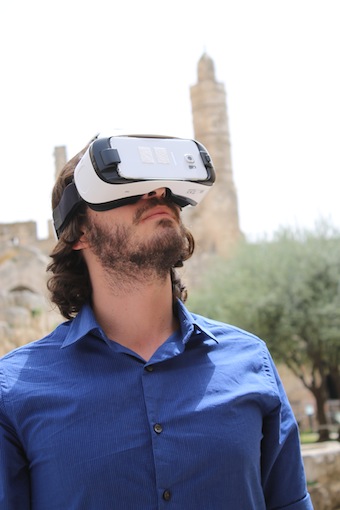
Virtual reality in the actual reality of Tower of David Museum. (photo from Tower of David Museum)
According to Eynat Sharon, the head of digital media, her department takes into consideration the visitor’s total museum experience. This experience consists of three overlapping circles: the pre-visit, in which a person visits either the museum’s website or mobile site; the actual physical visit; and the post-visit, in which the person digitally shares with friends and family on Facebook, Instagram and other social media what they encountered at the museum. The museum’s technical equipment and apps may be rented by museum visitors for a small fee.
Are these new applications then to be applauded? Some people still need convincing. Last year, art critic Ben Davis reflected on news.artnet.com, “For many, many viewers, interfacing with an artwork through their phone trumped reflecting on its themes. In effect, now every art show is by default a multimedia experience for a great portion of the audience, because interaction via phone is a default part of the way people look at the world.”
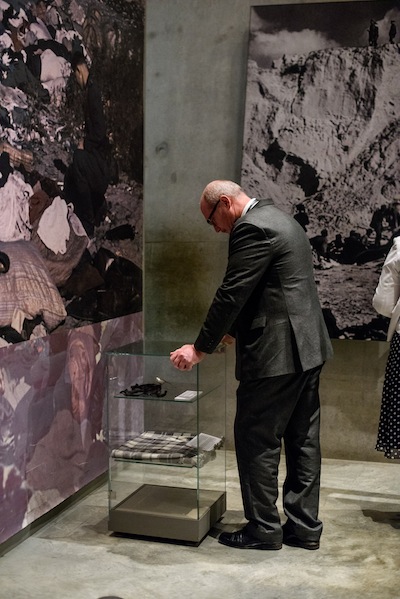
Dan Reich, who is the curator and director of education for the St. Louis Holocaust Museum and Learning Centre, said, “Personally, I am not big on technology. You end up with lots of button-pushing but not necessarily a lot of education. As a museum, we are pretty low-tech. We have an audio tour of the permanent exhibit, several stops in the museum where you can press buttons and hear testimony, an interactive map and – more recently – added an interactive screen entitled ‘Change Begins With Me,’ which deals with more recent or contemporary examples of hate crimes and genocide. We have been digitizing our collection of survivors’ testimonies. We have testimonies edited to different lengths. Generally, survivors like to be recorded, knowing their words are being preserved.”
And recent comments on TripAdvisor show that museums don’t necessarily have to be high-tech to succeed in their mission.
Visitors, for example, gave the St. Louis Holocaust Centre high marks.
Other Holocaust learning centres, however, have started taking current technology through uncharted waters. The USC Shoah Foundation now uses holographic oral history. According to Dr. Stephen Smith, the foundation’s executive director: “In the Dimensions in Testimony project, the content must be natural language video conversations rendered in true holographic display, without the 3-D glasses. What makes this so different is the nonlinear nature of the content. We have grown used to hearing life histories as a flow of consciousness in which the interviewee is in control of the narrative and the interviewer guides the interviewee through the stages of his or her story. [Now] with the … methodology, the interviewee is subject to a series of questions gleaned from students, teachers and public who have universal questions that could apply to any witness, or specific questions about the witness’ personal history. They are asked in sets around subject matter, each a slightly different spin on a related topic.” One educator confided that, while the technology is “creepy,” the public apparently likes it.
So, how do museums cope with the possibility that the medium in and of itself becomes the message? In other words, how do museums keep their audiences from being distracted by the technology? At the same time, how can museums survive financially if they follow goals that differ substantially from those of visitors, funders and other supporters?
A few months ago, Canadian entrepreneur Evan Carmichael offered guidelines at an Online Computer Library Centre conference. His suggestions seem applicable to museum administrators as well: express yourself, answer their questions, offer guidance, involve the crowd, “use your audience to create something amazing … create an emotional connection, get personal, and hold trending conversations, go to where things are happening, be there.
Time will tell whether the advent of museum-related high-tech will realize Don McLean’s 1971 tribute to Vincent Van Gogh’s art: “They would not listen, they did not know how. Perhaps they’ll listen now.”
Deborah Rubin Fields is an Israel-based features writer. She is also the author of Take a Peek Inside: A Child’s Guide to Radiology Exams, published in English, Hebrew and Arabic.