
Tag: technology

אמזון מגייסת עובדים
אמזון מתכוונת בשלב זה לגייס כשלוש מאות עובדים לסניף המפואר בבניין ‘טאלס גארדן.’ (צילום: telusgarden.com)
תופסים קנדה: אמזון מגייסת עובדים מישראל לסניף החדש בוונקובר
ענקית המסחר האלקטרוני האמריקנית – אמזון, מגייסת בימים אלה עובדים בין היתר מישראל, לסניף החברה החדש בוונקובר. נציגי החברה האמריקנית הגיעו לאחרונה לישראל במטרה לגייס עובדים לתפקידים שונים ובעיקר מהנדסים. זאת כדי לבנות מוצרים חדשים ולהעניק תמיכה לשירות הענן ‘אמזון ווב סרוויס’.
אמזון מתכוונת בשלב זה לגייס כשלוש מאות עובדים לסניף המפואר בבניין ‘טאלס גארדן’ ברחוב ג’ורג’יה בדאון טאון, שמשתרע על פני כ-91 אלף סקוור פיט. בהמשך מצוות כוח האדם תגדל לכאלף עובדים, והחברה תממש כנראה את האפוציה להכפיל את שטחו של הסניף. באמזון מקווים שיופיה של ונקובר וכידוע איכות החיים גבוהה שלה, תעזור לגייס עובדים לכאן. עם זאת רק לפני מספר שבועות התפרסם דוח בינ”ל על עליית מחירי הנדל”ן בשנה האחרונה בערים מובילות בעולם, ממנו עולה כי ונקובר נמצאת במקום הראשון עם עלייה גבוהה מאוד של 36.4%.
לאמזון שני סניפים נוספים בקנדה באוטווה וטורונטו והיא מתכוונת עד סוף השנה לפתוח סניף רביעי במונטריאול.
בשנים האחרונות ונקובר הופכת להיות מרכז טכנולוגי משמעותי, שמשמש בית לחברות בינלאומיות כמו מיקרוסופט, פייסבוק, טוויטר, סיילספורס ועוד.
זחל לפרסום: נחש נמצא בבור ביוב מתחת לכביש
שבוע שלם לקח לעובדי מחלקת עיריית ויקטוריה לתפוס את הנחש הכי מפורסם בתולדות עיר הבירה של בריטיש קולומביה. הנחש שאורכו חמישה פיט (שהם כ-1.5 מטרים) מסוג כרכן תירס, נמצא בבור ביוב מתחת לאחד הכבישים הראשיים בעיר. עובדי העירייה שפתחו את מיכסה הבור במסגרת עבודות תחזוקה רגילות (בפינת הרחובות קוואדרה ובלמורל), נדהמו לראות שנחש מסתובב לו חופשי בתוך הבור העמוק. הם הורירו מצלמה לבור שתיעדה את תנועת הנחש שתחילה חשבו שהוא ארסי. לאחר שהוזעק למקום לוכד נחשים התברר שמדובר בנחש לא מסוכן ולא ארסי – מסוג כרכן תירס.
הנחש כרכן תירס זכה לכינוי זה כיוון שעל גחונו יש משבצות שמזכירות קלח תירס, והוא נמצא בדרך כלל בשדות ואסמי תירס. הנחש טורף לילי שניזון ממכרסמים, ציפורים, צפרדעים ולטאות. כרכן התירס נפוץ באמריקה התיכונה והדרום מזרחית ובעיקר בפלורידה. לכן לא ברור כיצד בכלל הגיע לבור של מערכת הביוב בויקטוריה. לפי הערכה הנחש שכאמור לעיל אינו מסוכן לבני האדם וניתן לגדלו כחיית מחמד (בשל אופיו הנוח), נזרק על ידי בעליו ובצורה כלשהי הגיע למערכת הביוב העירונית. יצויין כי כל הנחשים ובעיקר כרכן התירס ינצלו כל הזדמנות לברוח מהשבי.
אם כן עובדי העיריית ויקטוריה נזקקו לשבוע ימים לתפוס את הנחש שמצא בית חדש בביוב. הם ניסו לפתות אותו בעזרת מלכודות עם עכברים ואביזרי חימום – אך ללא הצלחה. לבסוף הצליח אחד העובדים שירד אל בור הביוב לתפוס את הנחש העקשן. הוא הועלה על פני הכביש ונקשר. ולאחר מכן הועבר למתקן בעלי חיים ושם אגב השיל את עורו. עם תפיסתו מיהרה מחלקת הדוברות של העייריה לפרסם הודעה על כך, כדי הרגיע את הציבור המבוהל.
במהלך הימים בהם פורסמו באמצעות התקשורת תמונות של הנחש בביוב, התקשרו מספר אזרחים למוקד העירייה ודיווחו, כיבכול שהנחש שלהם. הגדילה לעשות ניקול פנרייס שטענה כי הנחש הוא שלה, שמו ‘מיקו’ והוא נעלם מביתה בדרך לא ברורה לפני כשלוש שנים.
אגב בוושינגטון הסמוכה לבריטיש קולומביה התברר בימים האחרונים, שבור ביוב שימש מגורים לא לנחש אלה לשני ילדים. הם הצליחו לברוח ולמשטרה אין מוסג מדוע הפכו דווקא את המקום הזה לביתם.

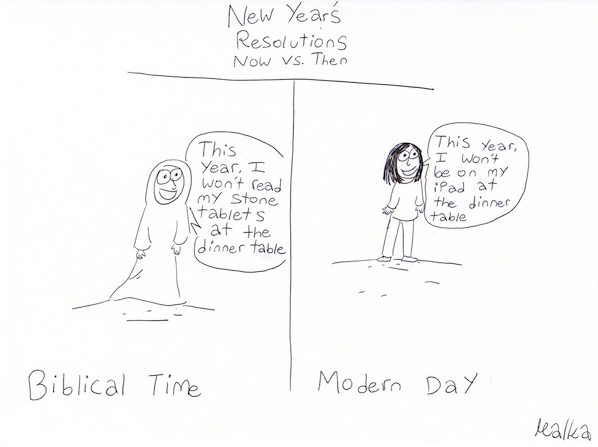
The future of tech, media
A concert at Deer Lake Park gets Matty Flader thinking about social media. (photo from deerlakepark.org)
King David High School’s creative writing course, taught by Aron Rosenberg, partnered with the Jewish Independent for their final unit of the school year. Students were challenged to write articles reflecting on their identity as young Vancouverites in the Jewish community. After brainstorming topics, the students agreed to focus an article on technology or print media, and how these things are changing and will continue to transform in the future. Here are some of their thoughts.
Phone-y confidence
by Matty Flader
Last night, I went to a concert in Deer Lake Park, an outdoor venue, with my sister. We went to see the Lumineers, a folk band that has become fairly popular since their debut album in 2013. I was rather excited to see the show, as I am a big fan of the band’s music and unique style.
It rained throughout the concert, which was a major annoyance. Getting soaked and standing in the mud for a few hours is not everyone’s ideal evening, but it was worth it for the music. The band was excellent at performing live and it was an amazing show. One thing that almost did ruin my experience, however, was the sea of cellphones raised above people’s heads filming the concert. Almost everyone at some point had their phones out to film the concert to share with their friends over social media.
One thing I think our parents do not understand about our generation is that social media is a competition. We constantly compete by sharing statuses, photos and videos of anything significant we do. The goal is simple acknowledgement or validation from our peers; we want them to be jealous of how amazing our lives are. The most famous of our friends – the one with the most likes and shares – is the most successful among us, though we wouldn’t admit that aloud. Our generation lives in constant fear of being forgotten or ignored, and we use social media as a way to remind our friends of how exciting we are.
It is no longer innate to live in the moment. Now that everything is expected to be documented, we live our best moments through the small screens of our phones. Concerts are just the tip of the iceberg. I have encountered this issue at graduations, parties, hanging out with friends, and even spending time with one’s parents. Although I love modern technology, sometimes I wish I could exist without the ominous anxiety of social media.
Technology today
by Eli Friedland
We live in a world where technology is the new alcohol. Rather than face reality, people stare at their screens, lost in the lives of others. Picture perfect images captured for eternity. Model-worthy smiles lighting up the screen. Are they real? That is the question most people fail to ask themselves when they zealously peruse the photos that flood their news feeds.

We live in a world where, rather than make conversation with those in front of us, we choose to talk to an online persona. We have closed the gap from those distant to us, yet we have distanced the gap from those closest to us. We ride the bus in silence, the only sound, fingers tapping away at screens. We receive validation from ambiguous “likes” and take pride in meaningless comments. We allow the world to pass us by as we scroll through the news in far off lands. We only see the perfect that happens to others, that which is posted online. Tired eyes scroll through vast oceans of pictures that have no end.
Constant alertness and comparisons are our 10 plagues. We need redemption from technology. I cannot bear to imagine a world in which people cannot talk, for technology has robbed us of our voices. I fear this more than anything and I know that G-d gave us a day of rest to prevent this plague from growing too large.
Every Friday at sundown, I power down. I turn my phone off, I put my laptop away and I put all electronics out of sight and out of mind. All week, I long for Friday, when I have a valid excuse to disconnect from technology. Rather than staring anxiously at my smartphone, I make myself smart. I read books, I learn from my family, friends and the rabbi’s lectures. I spend all week learning hacks for my phone but, come the weekend, I learn about people. Instead of awaiting a text or phone call that might never come, I knock on my friends’ doors and we go to the park, we walk, we talk. I play Bananagrams with my parents, I soak up the sun with my brother, I interact with humanity in a way unparalleled when phones are out. On the Jewish day of rest, I receive people’s undivided attention and they receive mine.
Death of print media
by Noah Hayes
In Canada, print media’s roots go back to the Halifax Gazette, started in 1752. Since then, print media has reigned as the dominant form of news media all over the world. But it’s no secret that digital streams of information are pushing aside the morning paper. The reality is that your kids will likely wake up in the morning and go on their electronic devices to see the latest happenings, rather than wake up to a freshly printed newspaper, waiting to be read and, eventually, discarded.
As a high school student who values media but rarely in print, I am often confronted with the question of why we don’t really need print media anymore. If you need a plumber, a painter, a lawyer or a car, you’re likely not looking in your newspaper these days. It’s not like word of mouth is a modern concept but, with the internet as a platform to share recommendations and spread ideas, newspaper advertisements are less relevant.
Some may suggest that print ads – and not just in newspapers – can be more effective because they target specific geographic regions or interest groups. For instance, if I know of a wealthier area in the city that has lots of nice cars and is mostly made up of younger people, I can advertise a more expensive car that younger people would be more interested in on a bus stop, or even on the side of a bus that goes through there. In a rougher area of the city, I can advertise an entry-level car because more people might be willing to buy it.
What’s becoming more and more the reality, however, is that the internet can do the same thing, with even greater accuracy and efficiency; data tracking in this day and age is limitless. If you’ve been searching for a new pair of shoes on a website, ads for that website can appear on the next site you’re on, even if it’s totally unrelated to shoes. You’re being tracked on most sites that you go on. It’s 2016 and, even with Edward Snowden’s notoriety, people are still unaware of the trail they create just by going on their computer. And this trail is analyzed for more than just advertising.
What about entertainment? Many read print media to stay up to date or see an interesting piece from their favorite columnist in the morning. These newspapers or magazines now almost always have websites where you can also read your favorite columnists. If you go on Twitter, you can get live updates from your favorite journalist or news source, along with a link to articles they publish. Your dearest sports team probably has a website, along with sites dedicated to covering it, and their beat writer likely has a sturdy online presence, too. If you just want a gob of information to delve into, try going on Reddit or Buzzfeed. Some sites go well beyond the impersonal newspaper and literally let you customize your own homepage to only get info on the things you’re interested in. Want pictures? Check. Want funny pictures? Check. Want funny pictures of cats doing awkward, cute poses? Check.
The biggest reason why people seem to be migrating away from print media towards the internet is cost. Though newspaper and magazine companies can still charge you for reading their websites, most digital media is free. For these companies, why produce a print version if they’re also going to put their content online? Perhaps the sense of familiarity and comfort that comes with print media is its most effective selling point. The digital world hasn’t hit its peak yet because the older generation still values the routine and ritual of the morning paper or magazines.
As morbid as it sounds, the only part of print media that doesn’t seem easily replaceable is the “In Memoriam” section of the newspaper. There are few ways to find out about lost loved ones in the community, or the anniversaries of their passing. However, the community of the internet is much larger than the local communities that find solace in the local newspaper’s “In Memoriam” section and, one day, the internet will provide this service, too.
Digital media is simply too powerful. It’s a tool that can be used in dozens of different ways, an unstoppable machine that will eventually show print media the door, and make sure that door hits its tuchus on the way out.
Print’s ironic future
by Leora Schertzer
Every day, more than two million news articles are published online. Millennials subscribe to a fast-paced lifestyle, making the internet a popular platform to read the news mere minutes after the fact. People share news and magazine articles with their friends and followers over Facebook, Snapchat, Twitter and beyond. If you were to ask the average young adult where she or he reads about the latest happenings, the answer would most likely be through the shared articles of her or his online peers. Perhaps a more cultured individual would name a specific news source that she or he frequents to maintain a sharp awareness of the world, which would also be online.
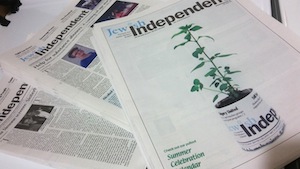
Though the future of print media seems dire, I would argue that not all hope is lost. Many people still prefer paper copies of newspapers, magazines and books. Some claim that a good old physical copy feels more personal and less distracting. With access to literally millions of other articles online, users could feel rushed or anxious, knowing that there are so many more articles to be read. A real newspaper feels like your own and, with one’s options limited to one paper, consumers could feel satisfied with the articles they have read, rather than feeling they have merely grazed the tip of the iceberg of daily news.
Another reason print media may live on is for the sake of esthetic and irony, similarly to vinyl records. People still love their vinyl record collections, even though far more practical and efficient ways of listening to music are out there. Some may hang on to print newspapers and magazines for the novelty, or because they believe the “original way” is the “best way.” For this reason, print media may make a comeback within the next 40 years. Though print media will become more of a niche market in the near future, as it becomes less common or mainstream, it may ironically become more highly regarded – what becomes less viable, becomes more valuable.

Anti-tunnel technology
(screenshot of IDF Twitter page via israel21c.org)
Smugglers of drugs and illegal migrants using tunnels along the U.S.-Mexico border may want to keep an eye on Israel. The American government, after all, is co-sponsoring the tunnel-detection technology now being developed by Israeli engineers.
Described by the Hebrew media as the underground equivalent of Iron Dome anti-missile defence system, this latest innovation made world headlines upon the announcement that the Israel Defence Forces (IDF) uncovered a two-kilometre-long, concrete-lined tunnel on Israel’s Gaza border.
While the Israeli government has been funding its development for five years, few details about the new system have been reported until now. News reports say that up to 100 companies – including Iron Dome’s developers, Elbit Systems and Rafael Advanced Defence Systems – are involved in assembling the detection system. Military units, Shin Bet security agency officers, civilian engineering, infrastructure contractors and tunnel construction experts are also credited with helping.
“The search for tunnels is at the top of our priority list … and we will not spare any efforts,” said Defence Minister Moshe Ya’alon, following the IDF announcement that it found a tunnel extending from southern Gaza into Israeli territory.
The fine details about how the anti-tunnel technology works are still under wraps but, according to Yedioth Ahronoth, dozens of Israeli-developed sensors gather information from the field and transmit it to a control system for analysis using advanced algorithms. The system, says the report, can identify the length of the tunnel and its exact location without false alarms.
“We do whatever we can to find a technological solution,” Maj. Gen. Nitsan Alon, head of the IDF operations directorate, said at a briefing. “Dealing with the phenomenon of tunnels is very complex, and the state of Israel is a world leader in this field. This battle demands from us persistence, creativity, and also responsibility and good judgment.”
According to a report in Defence News, Israel’s Ministry of Defence has invested more than $60 million in anti-tunnel technologies. In February of this year, the Financial Times reported that the United States will provide $120 million over the next three years to help develop complementary technologies.
An Israel Today report says Israel is building a counter-tunnel barrier along its Gaza border that “will also feature a state-of-the-art fence, complete with sensors, observation balloons, see-shoot systems and intelligence gathering measures, as well as an underground wall.”
A video of the IDF discovering a Hamas tunnel in southern Israel can be found at youtube.com/watch?v=yETrQXh2FZU.
Israel21C is a nonprofit educational foundation with a mission to focus media and public attention on the 21st-century Israel that exists beyond the conflict. For more, or to donate, visit israel21c.org.

Jewish dating app fills gap
Shapira began piloting JFiix in Israel a couple of years ago and it was launched recently in the United States and Canada with an English version. (screenshot)
In 1996, at a time when not everyone had a home computer, Joe Shapira started a dating website – JDate. Today, very few people in the Jewish community have not heard of it. Since its inception, it has been embraced by Jews around the world.
“When I started in the online dating business, I was one of the pioneers of this business on the internet,” Shapira told the Independent. “And I never anticipated it would become such a big business.
“There were a few other dating sites when I started. I hired the programmer and we launched the very first dating site where you could define your preferences. We started marketing and it took off like a fire.”
Shapira was living in Los Angeles at the time. From a conversation with a friend about the difficulty of meeting other Jews in a place where the majority of people are not Jewish came the idea of JDate. Shapira wanted to help Jews meet other Jews, reduce the rate of intermarriage and help ensure Jewish continuity.
Born in Tel Aviv, Shapira went to a technical high school before serving in the army. After he finished his army service, he became an entrepreneur. Four years later, he moved to Los Angeles, where he stayed for some 30 years before moving back to Israel several years ago to spend more time with his kids.
“I think that people, in general, adapted well to the internet dating world,” said Shapira. “It’s a very highly used internet service. I think, in the Jewish community, the need was there. You live in a certain community and, pretty much by the time you’re 25, your connection – whether it’s your mother, grandmother or through mutual friends – we’re expected to meet a Jewish mate there. It’s ingrained in us. But, sometimes, you just exhaust your ability.
“The internet became more and more [popular and] … the style of work that most people do [changed]. You used to meet more people at work and talk to people on the phone. Now, you don’t even go out to the stores to a certain extent. Instead of telephones, we use email or texting. The lifestyle of people created less interaction with others and the Jewish community had a distinct need.”
Although, technically, Shapira launched JDate in Los Angeles, he was quick to point out that it has always been accessible around the world. In fact, the first marriage through a JDate interaction was in Caracas, Venezuela.
“If you are single and looking and you found JDate somehow, you’re going to tell your friends,” said Shapira. “We Jews are a close-knit community. I loved JDate, because of my concern for Jewish continuity, but I left the company in 2006, before smartphones and Facebook.”
Over the last few years, Shapira has been noticing a gap in communication that computer-based sites are still struggling with – that younger people do all their communication via smartphones, not on laptops or in front of computer screens.
“Millennials use the smartphone more than desktop computers,” said Shapira. “You go to work and you have a desktop computer. You work on your laptop at home. Unless you are in your 20s … then, you use your iPhone for everything.”
Internet dating is “a lifestyle thing,” he said. For someone in their 20s, “online dating is like emailing or texting – very natural. When I started JDate 20 years ago, it was not completely natural. In Israel, it took awhile before it caught on.”
Because Jewish online dating sites were not adapting well to mobile phones, Shapira found that millennial Jews were going to non-Jewish sites and this raised again his concern for Jewish continuity. Hence, he started JFiix.
“If you look at the landscape, you have Tinder on one end of the spectrum and the hookup app,” said Shapira. “And then you have apps like JDate or Match.com that are just a smaller [version] of a website.
“One of the big advantages of having an app is you’re always available. You remember JDate – if you wanted to contact someone, you sent them a message and then it took them two to five days to reply. With a mobile, if a woman contacts you, you decide in seconds.”
Shapira began piloting JFiix in Israel a couple of years ago and it now has about 250,000 users. It was launched only recently in the United States and Canada with an English version.
“We are at the stage of acquiring the user base and marketing,” said Shapira. “I think it will be another four months before [we reach] a critical mass of users.”
Shapira promises to wow users with the app’s complex technology, which includes a matchmaker feature. “The matches we select for you are based on the people that you’ve had good communication or chats with,” he said. “We also do a deep learning of photos you submit, so we know your type. People are usually attracted to the same type.”
With JFiix, no nudity or provocative clothing is allowed. The software monitors what people write in their profiles and analyzes the chats, removing any inappropriate content in a manner that is several notches above the competition.
“The purpose of this is to maintain a very positive community, a positive customer experience,” said Shapira. “We can’t prevent non-Jews from being a part of it, as it would be illegal to discriminate based on religion, just as a synagogue can’t prevent non-Jews from joining. However, we provide certain features, especially for women. For instance, women can define who can see them – age, distance, religion – as, when you register, one of the data collected is if you’re Jewish or not. A woman can say she wants only Jews.”
JFiix communities in Canada, so far, include Toronto and Montreal, with only a few individuals in Vancouver, a community he’d like to see grow to allow JFiix to work best.
“I think we provide a very good solution for millennial Jews,” said Shapira. “With the continuity of the Jewish community so important to the Jewish people, I hope I will be able to make a dent in intermarriage’s growing numbers. I think most Jews want to marry a Jew to continue the tradition. In saying that, I hope to, at the very least, help some Jews find Jewish soulmates.”
Rebeca Kuropatwa is a Winnipeg freelance writer.

Applicable knowledge
Left to right: Gyda Chud (co-chair), Serge Haber, Jackie Weiler (co-chair) and Dr. Kendall Ho. (photo by Binny Goldman)
Jewish Seniors Alliance of Greater Vancouver’s annual spring forum – this year with the topic An App a Day Keeps the Doctor Away – drew a large and curious crowd to the Peretz Centre for Secular Jewish Culture on April 3.
JSA president Marilyn Berger welcomed attendees and thanked pianist Stan Shear for opening the forum. Shear would add the harmonica and his voice to his later performance, but first shared that his wife, Karon Shear, JSA coordinator, had suggested the opening song, “Accentuate the Positive, Eliminate the Negative,” by Johnny Mercer, as she thought it embodied the message JSA tries to instil in its approach to helping others.
Berger then surprised the audience by introducing Dan Ruimy, who is the Liberal member of Parliament for Pitt Meadows-Maple Ridge, where he owns and operates Bean Around Books and Tea.
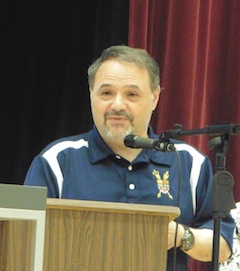
Ruimy said that living in Maple Ridge doesn’t give him much opportunity to meet many Jews, so it was only on a recent trip to Israel as a parliamentarian that he rediscovered his Jewish roots. He said he was especially happy, honored and touched to talk to a group of his “compadres,” referring to those gathered at the forum. He said that seniors have given their life, blood sweat and tears to the building of Canada and he hopes to help the government become better equipped to meet the needs of seniors.
JSA is run by volunteers, said Berger – from peer support to education programming to advocacy – and its membership is diverse. As she called upon Larry Shapiro to introduce the forum’s keynote speaker, Dr. Kendall Ho, she noted that Shapiro had been volunteering with JSA since his arrival in Vancouver from Montreal. Smiling, Shapiro denied he had volunteered to be part of JSA, but rather had been shlepped in – and now would have to be hauled away from doing what he loves.
A practising emergency physician at Vancouver General Hospital, Ho is founding director of Digital Emergency Medicine within University of British Columbia’s department of emergency medicine. He praised the creativity of the day’s topic title – An App a Day Keeps the Doctor Away – which was penned by Berger. Ho said he was turning to mobile apps as a way of helping patients help themselves. There are many new ones in the market, he said, that can help people achieve better health and even strive for excellent health. Some of these apps are free.
Mobile technology can also supply life-saving information and provide immediate access to life-saving help. About the use of such technology by seniors, Ho gave some of the statistics from a recent study: 63% use wearable data for monitoring, 76% read online reviews to select a doctor, 74% book online appointments and pay bills, 73% of doctors use mobile devices to share information, 61% are interested in 3-D printing for prosthetic and hearing aids, and 57% use cutting-edge devices.
In choosing an app, Ho advised asking yourself the following questions: Is this a worthy tool and how effective is it? Is this technology good for me? Is it safe? Is my privacy/identity protected? Is it easy?
Ho demonstrated how easy it is to download a free app and encouraged the audience to download it as he went through the procedure step by step.
Of the available free apps, he recommended:
- Canadian Red Cross’ First Aid app, which helps users maintain their life-saving skills
- Medisafe Medication Reminder, available for a free trial period, which helps people manage the pills they have to take, including sending an alarm to their phone or watch as a reminder
- MindShift, which was developed in British Columbia to track the symptoms of anxiety and offers ways in which to cope with anxiety
- BellyBio Interactive Breathing, for relaxation
- Instant Heart Rate, monitors users’ heart rate
- Sleeptime, detects users motion while they’re sleeping, and can be programmed to allow you to complete your dream, as it can detect when you are in REM
- My Fitness Pal, a calorie counter and diet plan, and one of Ho’s personal favorites – it helped him lose 10 pounds.
Ho also suggested some important websites: healthlinkbc.ca to connect to a nurse or a health professional, myehealth.ca to get the results of a blood test (deleted after 30 days) and medlineplus.gov (research) for basic health information written in everyday language.
He advised the audience to ask their medical advisor which apps would work best for them, and to discuss results with the medical professional, so as not to cause themselves unnecessary anxiety by misinterpreting the data.
There are sensors available now, he said, such as wristbands, orthotics, helmets that detect concussions, a UV patch, a wand that monitors hydration (for cyclists) and T-shirts with sensors in the fabric.
Patient engagement, said Ho, is the blockbuster “drug” of the century. Using these types of technology, 88% of patients feel engaged in their health care. Using wearables shows a reduction of cardiac-related deaths and there is a 76% reduction in overall mortality when a patient is involved in his or her own health care.
Ho said that studies show that two out of three seniors 65 and over want to use technology to support their own health and access outcome-related data. Seniors now are tech savvy, he said.
Ho would like to see the use of health-related technology spread to the entire province; involve doctors, nurses, patients, governments and tech companies; be studied for its benefits, patient satisfaction and safety; and be further developed, with new sensors and devices over time.
The audience was reluctant to allow Ho to end his talk. Nonetheless, event co-chair Gyda Chud, who along with Jackie Weiler convened the forum, stepped in to ask if there were any questions for the doctor.
Ho was visibly moved when Al Stein said he would be forever grateful to Ho, as Ho had saved his life when he was having a cardiac problem and was admitted to emergency. Others who had been similarly helped thanked Ho fervently, as well.
Questions included whether there was an app for drug interaction and, yes, there is, but only for professionals. Attendees were also concerned that apps would reduce the amount of time doctors would spend with them. Ho said that apps were there to help both patients and doctors, but there was still the need for the right doctor to guide patients on their health journey.
It is safe to say that many in the audience felt that Ho would be the best guide and that the best mobile app would be Ho.
Chud thanked Ho, coining a slogan that Ho enjoyed: “Beat the stats, use more apps.”
Barbara Bronstein and Shapiro organized the refreshments, which Chud provided, and countless volunteers were everywhere from set-up to shalom. Karon Shear and Rita Propp also were integral to the whole event, while Stan Shear not only performed but, with son David, recorded the proceedings. The video can be found at jsalliance.org.
Binny Goldman is a member of the Jewish Seniors Alliance of Greater Vancouver board.
Creating tech and jobs
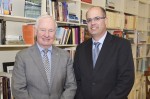
Governor General of Canada David Johnston, left, with Chief Scientist of the State of Israel Avi Hasson. (photo by Sgt. Ronald Duchesne, Rideau Hall)
On March 1, Governor General of Canada David Johnston met Chief Scientist of the State of Israel Avi Hasson to discuss innovation and how Canada and Israel can enhance cooperation in this field. During Hasson’s visit, the Canada-Israel Industrial Research and Development Foundation released its latest impact report.
Established in 1994 under a formal mandate from the Government of Canada and the State of Israel, CIIRDF-funded projects cross many scientific disciplines, technologies and industrial sectors. These include biotechnology, agriculture, information and communications technologies, automotive, natural resource management, public safety and aerospace.
With base funding of $1 million per year from each of the governments of Canada and Israel, CIIRDF stimulates collaborative research and development between companies in both countries, with a focus on the commercialization of new technologies; pools Canadian and Israeli know-how to provide both countries with improved market access, sustainable competitive advantage and long-term market opportunity in global economies; strengthens ties between Canada and Israel, and delivers economic benefits to both countries; and leverages additional regional and sector-based funding that is matched by the government of Israel.
CIIRDF has engaged more than 1,000 participants in partnership development activities, including more than 400 industry leaders who actively contributed to R&D collaboration discussions. It has processed more than 230 bilateral R&D applications and funded 110 projects engaging more than 200 companies from Canada and Israel.
These alliances have enabled the joint development, marketing and sales of more than 50 technologically improved new products for global markets; generated $60 million in initial sales, and $300 to $500 million in additional economic value to collaborating companies; and created hundreds of jobs in both countries.
For the full impact report, visit racineinc.com.

Technology for your home
Singlecue recognizes hand motions for remote control. (photo from Singlecue via Israel21c.org)
Bezeq, Israel’s largest telecom, set up in late 2015 a model “smart home” at its Tel Aviv headquarters and in the IKEA store in Netanya to demonstrate its Bhome subscription service – a package of wifi-enabled sensors and monitors to help keep out intruders and save energy. But you don’t necessarily have to live in Israel to take advantage of Israeli smart-home technologies. Here are some of the many options available now or coming soon.
SwitchBee is a Netanya-based startup that provides a platform including programmable switches, a central control unit, a smartphone/tablet application and cloud-based data services. The plug-and-play devices, featured in the Bhome model home, are designed to embed in existing outlets quickly and wirelessly. The company says you can convert a light switch into a smart switch in less than two minutes, or turn your whole house into a smart home in less than 90 minutes. Using the app’s secure dashboard, the user can program custom preferences for each SwitchBee-enabled light or device including on/off and fine adjustments.
Singlecue is made by eyeSight Technologies, a Herzliya company whose machine-vision systems have been built into devices made by OPPO, Lenovo, Toshiba, Hisense, Phillips and other manufacturers since 2005. It is a standalone device that lets you use touch-free gestures to control infrared- and wifi-enabled media and smart-home devices in its range of sight. You can do everything from lowering the thermostat to lowering the TV volume to lowering the blinds.
Ramat Gan digital health company EarlySense has released myEarlySense, an under-mattress automatic sleep-monitoring system designed to integrate with smart-home solutions. Users can adapt their home environment based on the sleep-cycle data collected from the myEarlySense sensor – for example, arming and disarming home security systems, turning off the TV, turning on the coffeemaker and adjusting the thermostat. The myEarlySense technology is built into Samsung’s new SleepSense IoT (Internet of Things) device.

Launched at Home Depot stores across the United States and also sold online, GreenIQ’s Smart Garden Hub allows you to adjust irrigation based on past, current and forecasted weather – without stepping outside – yielding water savings of up to 50%. The device connects to the internet via wifi or cellular connection and is controlled from an iOS or Android app. The Petah Tikva-based company’s app can also adjust outdoor lighting and can connect to a Netatmo weather station and rain gauge or a water-flow sensor for leak detection.
Sensibo’s tagline is “Give your old air conditioner a brain.” The system includes a pod that sticks onto your A/C and heating unit, and an intuitive app that lets you monitor and modify your settings from any smartphone, tablet or computer. If you’ve got a Samsung in the living room, an LG in the bedroom and a Friedrich in the study, Sensibo will control all of them with one interface. A new public API for developers will enable integration of a Sensibo device with other home appliances as well.
SmarTap’s digital shower system, currently available in Israel and the United Kingdom and next year in the United States, was chosen for Bezeq’s Bhome demo to show how the product can reduce water and energy use by enabling precise control of flow and temperature. An app lets users program actions such as preheating the shower, setting a maximum temperature and flow rate, and specifying how high to fill the bath. The Nesher-based company will be adding functions such as automatic leak detection, opening cold-water pipes to prevent freezing and monitoring usage patterns; the software will be upgraded remotely with each new feature. IBM Research in Haifa is now researching how SmarTap can help reduce water and energy use in commercial buildings.
Anything plugged into a power source can be connected to PointGrab’s PointSwitch product to enable gesture-controlled adjustments and on/off actions up to 17 feet away, even in full darkness. This Israeli gesture-control technology is already powering tens of millions of devices made by Fujitsu, Acer, Asus, Lenovo, Samsung, TLC and Skyworth. The company is based in Hod Hasharon.
ENTR is a battery-operated smart lock from Mul-T-Lock in Yavneh. It is designed to be retrofitted into existing doors and lets users control entry from a smartphone, tablet or other Bluetooth-enabled device. You can create or disable virtual keys immediately, lock or unlock the door at pre-programmed times and monitor the system remotely. The underlying algorithms were developed at the Israeli research and development facility of American chipmaker Freescale.
Evoz turns an iOS device into a virtual baby monitor. Its technology is built inside the Belkin-Evoz WeMo monitor (which stores and graphs baby’s cries and analyzes the information to provide parenting tips) and in British Telecom’s next-generation home video devices. Evoz also can be used for monitoring housebound seniors, detecting and sending alerts about safety and security, and evaluating electricity usage.
WeR@Home by Essence, a Herzliya-based company, is a cloud-administered wireless system that lets users manage and communicate with a large variety of third-party-connected home devices, such as lighting, thermostats and door locks.

Attach BwareIT’s SmartH2O home water meter to your sink or shower tap or your garden hose, download the app and you can see exactly how much water your household is using, how long the water is running and at what temperature, and how much it’s costing you. Now being incubated in Startup Scaleup, the European Commission’s IoT accelerator, the device could be on the market within a year to give conservation-oriented users an unprecedented awareness of water consumption. The app will also inform you of any leaks, and show how your water usage compares with the average in your region or country. If you’re proud of how you stack up to your neighbors, you can share your rating on social media.
Last but not least, Mybitat, an IoT company headquartered in Herzliya, is partnering with Samsung to develop a smart-home solution aimed at helping the elderly remain in their own homes longer and enhancing their quality of life. The technology combines advanced sensors, cloud-based software and behavior analytics to monitor an individual’s daily routine and wellness. If it detects changes in behavior or health, the system will send alerts to preselected family members or caregivers.
Israel21C is a nonprofit educational foundation with a mission to focus media and public attention on the 21st-century Israel that exists beyond the conflict. For more, or to donate, visit israel21c.org.
World is at your fingertips
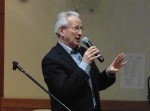
At the latest Empowerment session, co-hosted by Jewish Seniors Alliance and JCC Seniors on Jan. 27, Philip Morris offers advice on avoiding fraud, scams and identity theft. (photo by Binny Goldman)
It was interesting to me – a person who still enjoys using one of the “original computers,” namely, the pencil – that I was about to attend a workshop entitled Technology: Give us the Tools to Finish the Job.
On Jan. 27, about 100 people gathered in the Jewish Community Centre of Greater Vancouver’s Wosk Auditorium to hear three experts in the field of technology at a workshop hosted by Jewish Seniors Alliance in partnership with the JCC seniors department. It was the second session of the current season’s JSA Snider Empowerment series.
JCC seniors program coordinator Leah Deslauriers welcomed the audience and outlined the afternoon’s activities, while Gyda Chud welcomed everyone on behalf of JSA. Chud explained how she was introduced to JSA via the Peretz Centre for Secular Jewish Culture four years ago and that JSA is always looking for new partners in its aim to make its workshops easily available and accessible to all who may be interested. Chud added that she hoped the Technology session would help build her own confidence when it came to computers and other aspects of the tech world.
Noting that living is learning, the first speaker, Stan Goldman, demonstrated the simplicity of mobile technology. Once one learns how to use the iPad, the knowledge can be applied to the iPhone, which uses the same system, and one may watch free movies, read free ebooks and newspapers, and get email by accessing the right app. To illustrate, Goldman and Deslauriers used voice commands to ask for directions, dictate an email and do advanced math. Goldman offered a seemingly endless list of things that can be done with this technology, including Skyping with family and friends in other countries, enjoying music, playing games, etc. – all by using apps, many of which are free. The world is, indeed, at your fingertips.
Philip Morris, an expert on fraud, scams and identity theft, spoke next. He said that, once we have let the world in, so to speak, we must be cautious when using our devices – protecting them with passwords, and keeping private our personal information (social insurance numbers, birth certificates, passports, etc.) and not easily accessible to hackers. Morris advised shredding all discarded documents and, when buying a new cellphone, making sure all of the personal information has been deleted from the old phone, as hackers can retrieve data from seemingly wiped phones. It is important to be alert in public places, to keep wallets and purses out of easy reach and to ensure that you have received your own credit card from the server in a restaurant. He also suggested taking a photograph of passports and credit cards in case of theft.
New words have been coined, such as “smishing,” the ability to obtain information from people’s texts. Morris recommended changing passwords annually and, when writing cheques in payment for credit cards, to reference only the last four numbers of the card. To report a theft or loss, Morris gave two numbers to call to check your credit profile: 1-800-465-7166 (Equifax) or 1-800-663-9980 (TransUnion Canada). For instances of fraud, he said to call the Canadian Anti-fraud Centre, 1-888-495-8501.
Mark White, “the gizmo guru,” gave advice on the latest fun gadgets, including some lesser-known ones, and where to get them. As far as finding directions, however, he warned people to keep paper maps on hand in case the technology fails to connect. White added that he reads the Vancouver Sun’s online version, and that the library offers many newspapers online to members. In order to keep Skype conversations private, he suggested using earphones if Skyping in a public place.
Isaac Waldman Jewish Public Library librarian Rossana Caritey explained that the Waldman has an extensive collection of ebooks, which can be read on any device – ebook readers, laptops, for example. If someone brings in their device, a librarian or volunteer can show them how to download books. Waldman librarian Helen Pinsky handed out further information to attendees.
Chud thanked the speakers, noting that each of them had exhibited in their talks the mission and ideals of JSA – that of advocating for, inspiring, educating others to be the best they can be.
The audience retired to enjoy light refreshments. Long lines formed at the workstations set up in the auditorium, clearly showing the keen interest in the session. The workshop may have eased many fears, allowing timid souls to venture through the now-open doors leading to new technological possibilities.
Binny Goldman is a member of the Jewish Seniors Alliance of Greater Vancouver board.

Shaping Israel’s tech future
Nir Kouris addresses a Tomorrow Israel gathering. (photo from israel21c.org)
Nir Kouris is one of those hyper-accomplished young Israelis who cannot be described in a single phrase. Digital brand manager, tech evangelist, growth hacker, startup mentor, technology conference organizer, wearable-tech adviser, IoT enthusiast – these are all apt labels, but he prefers to call himself simply “a person who loves the future.”
He does not only mean that he loves futuristic technologies, though he really, really does. His passion is nurturing Israel’s future tech leaders by connecting them with peers and experts across the world.
In addition to NK Corporate Digital Strategy, the business he started in 2003 at age 20, Kouris got the ball rolling with eCamp, co-founded in 2008 to bring Israeli and overseas kids together for an American-style summer experience in technology. He founded Innovation Israel – a community for Israeli startups, entrepreneurs, investors, venture capitalists, angels and developers – together with Ben Lang, an American eCamper who moved to Israel five years later at age 18.
Kouris has organized Hackathon Israel, Tel Aviv Hackathon Day and World Hackathon Day, all attracting hundreds of young programmers. In 2014, he helped launch Israel’s first Wearable Tech Conference, headlined by Silicon Valley trendsetters.
Perhaps Kouris’ most ambitious endeavor is Tomorrow Israel, a movement to boost technology education and opportunities in Israel through worldwide collaboration.
“When I was 12, I read a book that changed my life, Dig Your Well Before You’re Thirsty,” Kouris told Israel21c. This bestselling guide to networking taught him, “If you want to be somebody, go to tech conferences.” And so he did.
“I was always the youngest person at these events and, at one of them, a Microsoft marketing manager asked me what I was doing there; I was only a kid. I promised myself to treat people equally, to listen to people of all ages, because nobody did that for me. That’s why I always dedicate time to young people,” said Kouris, who turns 34 in May.
At the Israeli Presidential Conference Facing Tomorrow, held annually from 2008 to 2013 at the behest of former president Shimon Peres, Kouris was dismayed to see no young faces among the distinguished presenters and few in the audience.
“I proposed creating Tomorrow Israel to take Peres’ vision into reality, a global movement connecting Israeli teens to others using the universal language of technology,” he explained. “I don’t believe in waiting for government officials and people with titles to take responsibility. I believe in regular people taking responsibility for our lives – not for fame, but because we really care and we love doing it.”
At first, Kouris rented venues to present workshops and lectures, and then Google Campus in Tel Aviv offered free space. Global technology gurus began accepting his invitations to Tomorrow Israel meetups, and he started sponsoring local and national conferences and hackathons for kids from Israel and elsewhere.
The Tomorrow movement has spread to Holland, the United Kingdom, India, America and Australia. Though there’s no official age limit, most participants are under 21.
“It’s not an age, but a way of thinking. We attract people wanting to make their countries better through entrepreneurship,” Kouris said. “It’s like a VC for people. Tomorrow is all about smart and good people because being a good person matters most.”
The Amsterdam municipality, Google for Education and other entities have approached Kouris about collaborating with Tomorrow. Members are forming teams and launching projects together via national and international Tomorrow Facebook groups. Kouris is proud that Israel is the nexus of this activity.
“Before Tomorrow, everybody heard the negative stuff about Israel and now they all want to come here to see our startup culture. We’re proving we can find new channels of communicating with the next generation of leaders and empower other nations to be startup nations,” Kouris said. “We have something strong and solid in our hands.”
eCamp becomes Big Idea
When Kouris was a teen in the early days of the internet, he’d sit at the computers in his school library in a village near Afula, earning money by registering and selling domain names.
During his military service, he was sent to work in American Jewish summer camps. “I was inspired to make something like that in Israel, combining the American camp experience with the Israeli tech story,” he related.
He co-founded eCamp after dropping out of college (“What I was learning in class was about the past, and I had to deal with the future”) and working briefly at a high-tech startup. Now called Big Idea, the camp is still going strong, but Kouris left after a year to build his branding consultancy and organize for-profit conferences supported by corporate sponsorships and ticket sales.
“Israelis usually don’t pay for conferences, so it has to be something exceptional you can’t get anywhere else,” explained Kouris, who says his favorite hobby is “meeting people smarter than myself.”
He’s persuaded big names like Robert Scoble, a top American tech evangelist, and Prof. Steve Mann, “the father of wearable technology,” to come to Israel along with participants from China, Europe and the United States. “They come on their own budget because they feel these conferences are the best,” Kouris said.
Kouris is planning two international confabs in Israel for 2016, one to present outstanding technologies to the world on behalf of Innovation Israel; the other a free Tomorrow gathering to introduce the established global tech community to the next generation.
The single Herzliya resident said he is “having great fun and traveling the world” as he helps shape the future of Israel.
Israel21C is a nonprofit educational foundation with a mission to focus media and public attention on the 21st-century Israel that exists beyond the conflict. For more, or to donate, visit israel21c.org. Visit israel21c.org/forget-tablets-the-next-breakthrough-is-wearable-audio to listen to Viva Sarah Press speak on TLV1 to Nir Kouris about Israel’s role in this trend.