Skip to content
  • Home
  • Subscribe / donate
  • Events calendar
  • Business Directory
  • FAQ
  • News
    • Local
    • National
    • Israel
    • World
    • עניין בחדשות
      A roundup of news in Canada and further afield, in Hebrew.
  • Opinion
    • From the JI
    • Op-Ed
  • Arts & Culture
    • Performing Arts
    • Music
    • Books
    • Visual Arts
    • TV & Film
  • Life
    • Celebrating the Holidays
    • Travel
    • The Daily Snooze
      Cartoons by Jacob Samuel
    • Mystery Photo
      Help the JI and JMABC fill in the gaps in our archives.
  • Community Links
    • Organizations, Etc.
    • Other News Sources & Blogs
  • JI Chai Celebration
  • JI@88! video

Recent Posts

  • Legal help for students
  • Revisiting myth of Lilith
  • Wrong person rebuked
  • Canada’s mixed messages
  • Questions for museum
  • Symposium on antizionism
  • Making soccer political
  • CJPAC lauds Pulver’s impact
  • City recognizes Vrba’s legacy  
  • Organ donation saves lives
  • Theodore’s March premiere
  • A healing Shabbaton
  • Supplying healthy food
  • A chime of metal tags
  • Yellowknife seder a first
  • Ishai energizes, unifies
  • A Lag b’Omer to remember
  • Expanding the healing
  • Hannah Senesh – a unique hero
  • Community milestones … May 2026
  • Sharing her testimony
  • Fall fight takes leap forward
  • The balancing of rights
  • Multiple Tony n’ Tina roles
  • Stories of trauma, resilience
  • Celebrate our culture
  • A responsibility to help
  • What wellness means at JCC
  • Together in mourning
  • Downhill after Trump?
  • Birth control even easier now
  • Eco-Sisters mentorship
  • Unexpected discoveries
  • Study’s results hopeful
  • Bad behaviour affects us all
  • Thankful for the police

Archives

Follow @JewishIndie
image - The CJN - Visit Us Banner - 300x600 - 101625

Tag: seniors

Writers inspire, support

Writers inspire, support

Carol Weinstock (photo by Olga Livshin)

Carol Weinstock only started delving into poetry a few years ago, around the time she joined a writing group. “I was a journalist before I retired,” she told the Independent. The group has motivated her try other forms of writing.

“The core is about five or six people,” Weinstock explained. “They come to almost every meeting. Others come and go. There are men and women, mostly retired. They write in different genres. Some write poetry, like me. Others write memoirs or short stories. One is writing a novel. One woman is a professional artist, but she wants to expand her creative output, to add writing to her range of expressions.”

Diane Darch, another member, recalled how it all started. “Sometime in 2012, people in the programming committee of False Creek Community Centre discussed the need for more programs for seniors, the 55+ group. Several possible programs were considered, including bowling and mahjong, but they finally settled on a writing group, a self-directed program. It officially began in January 2014 with a handful of enthusiastic people, each with an interest in writing for fun, for growth and for sharing a part of themselves.”

Darch has been with the group from the beginning. “I personally joined because I was interested in writing,” she said. “I learned from others’ types of writing and from critiques. It did put some pressure to write either at home or during the sessions. Sometimes, we arranged our own sessions, when the community centre was not available. Friendships were formed because we shared our personal writings. It is a fun group, non-threatening, and gives lots of encouragement to all levels. The group validated my writing.”

A year ago, she moved to Victoria. “I saw the group grow to a healthy dozen, change because of various commitments, then sadly go back to too few,” said Darch. “I’m no longer a regular member and I miss it. I do drop in when I’m back in Vancouver.”

Weinstock is one of the group’s first members, joining in its first year, and she’s been a steady participant since. “Our meetings usually have a structure. It’s flexible, not rigid, but it forces us all to write. First, we talk, share what’s happening in our lives, the books we read. Then someone brings a prompt, and we write for about an hour. Then anyone who wants can share their writing, and we all discuss it. It’s a very supportive environment.”

Weinstock attributes her writing of poetry to the group’s influence. “Poetry is a new form for me,” she said. “Before I retired, I worked as a freelance journalist for various California papers. I also taught journalism at a community college. I never wrote poetry or fiction. After I retired, I returned home to Canada. Then I joined this writing group and I wanted to try something different. And the group helps. It provides me with a scheduled time and place to write and the prompts. I might not have written so much if not for the group. I’m not sure.”

She doesn’t only write to the group prompts. “Sometimes, I would read a news article and a political or social problem would catch my attention. I would write a poem,” said Weinstock, whose journalistic inclinations frequently push her towards controversial or humanitarian issues, concerning some obscure corners of the world. She recalled one such occasion: “I read this story about the plight of the shrimp farms in Asia, and it touched me deeply. I wrote a poem. Other times, I would write something more personal but, in general, I don’t like writing about my personal stuff.”

Poetry is a way for Weinstock to express herself, her thoughts, emotions and ideas in a concise and organized way. A few months ago, the writing group came up with the prompt to write about what Canada means to each of the members, in celebration of Canada’s 150th birthday.

“I started with something different, but it didn’t work,” said Weinstock of the poem she wrote for the occasion. “Then I decided to go with concrete things: what we eat, what we wear, where we live, and the poem unfolded…. I showed it to my friends, and they liked it. One of my friends, Debby Altow, is active in the Jewish community in Vancouver. She regularly reads the Jewish Independent, and she asked if I would mind sending my poem to the paper. I read the paper sometimes, too. Of course, I said yes.”

Each group member participated in the exercise. Some wrote poetry. Others wrote essays. Now, all those pieces of Canada-inspired writing are on display at False Creek Community Centre. Everyone coming into the centre passes by them as they walk down the hallway leading to the reception desk. Some people even stop and read a few.

Olga Livshin is a Vancouver freelance writer. She can be reached at [email protected].


We are Canadian

Beret, turban, skullcap,
Babushka, hijab, headband.
No matter what hat we wear,
We are Canadian.

Fry bread, falafel, poutine,
Pizza, curry, Kraft dinner.
No matter what food we eat,
We are Canadian.

France, Britain, India,
Ukraine, China, Jamaica.
No matter where we come from
We are Canadian.

Ucluelet, Cape Breton, Moose Jaw,
Attawapiskat, Yellowknife, Flin Flon.
No matter where we live,
We are Canadian.

Teacher, nurse, farmer,
Reporter, welder, programmer.
No matter what work we do,
We are Canadian.

Blending, fusing,
Reconciling, adapting.
We work, sweat, dream together
To create one Canada.

– Carol Weinstock, June 2017

Format ImagePosted on September 15, 2017September 14, 2017Author Olga LivshinCategories Arts & CultureTags Carol Weinstock, poetry, seniors, writing
A time to socialize and lunch

A time to socialize and lunch

Most of the volunteers have been with the JFSA Seniors Lunch program for up to 15 years. (photo from Jewish Family Service Agency)

The Jewish Family Service Agency Seniors Lunch program held its annual volunteer appreciation event on Aug. 8. The volunteers were treated to lunch catered by Omnitsky and had the chance to share why they are involved in the program.

Most of the volunteers have been with this weekly event for up to 15 years. A close bond has formed among the volunteers and the warmth and camaraderie is what contributes to the success all around. They spoke movingly about how important it is for them to be involved in it, to give their time to it, week in and week out. They said they believe so strongly in what JFSA does and, therefore, want to be involved in some way.

When asked why they are so committed to this program in particular, the volunteers said they loved the seniors, that it felt so good being with them and that their own week went better when they were giving to others. Their longtime involvement is a testament to the importance of the lunch program – they want to help make sure that it continues to flourish.

The JFSA Seniors Lunch is completely volunteer-driven. It is a full-course, sit-down kosher lunch held every Tuesday at noon. It is held twice a month at Temple Sholom, once a month at Beth Israel and, the last Tuesday of the month, a movie is shown in cooperation with the Vancouver Jewish Film Centre at the Peretz Centre.

Seniors enjoy being with old and new friends from the Jewish community. Socialization and good nutrition are two primary determinants in healthy aging and the lunch program addresses both of these issues. For more information and reservations, please call JFSA at 604-558- 5709.


Format ImagePosted on September 15, 2017September 14, 2017Author Jewish Family Service AgencyCategories LocalTags JFSA, seniors, volunteering
Volunteer to tutor students

Volunteer to tutor students

Chabad Richmond is looking for seniors to teach English to Israelis. (photo from chabadrichmond.com)

Want to make a difference in the lives of Israeli teens? Consider Israel Connect, a volunteer program where Vancouver retirees engage via Zoom (it’s like Skype) with Israeli high school students who want to sharpen their English conversation and reading skills. The program, which starts after the High Holidays, is sponsored by Chabad Richmond.

“We are looking for retirees, seniors or adults with time available for volunteering. Volunteers do not have to be teachers, and the curriculum will be provided,” said Vancouver coordinator Shelley Civkin. “We’re looking for Jewish adults who are fluent English speakers, have basic computer skills and own a computer with a camera.” Volunteers can tutor from home – it will entail a half hour per week – and technical support will be available if needed. Volunteers will be trained in how to download and use Zoom.

“This is a meaningful way for community members to support Israel in a practical way,” said Rabbi Yechiel Baitelman of Chabad Richmond. “You’ll be doing a mitzvah, while investing in Israel and its young people.”

Time preferences of volunteers will be coordinated beforehand, but sessions will likely take place in the morning between 8 and 10 a.m. The Chabad Richmond Israel Connect program is asking for a one-year commitment from volunteers.

“English proficiency is crucial to Israeli students, since it accounts for a third of their entrance exam marks for university,” said Baitelman. “Partnering with the Israeli Ministry of Education, the Israel Connect program targets teens from the most disadvantaged neighbourhoods in Israel. The tutoring sessions are vital to students’ upward mobility in terms of education and jobs, which is why this program is so important.”

“Past volunteers really enjoyed helping their Israeli students, and made great connections with them. The students’ marks on their English exams prove that this kind of one-on-one tutoring makes a significant difference in their lives,” said Civkin.

For more information, contact Civkin at 604-732-6330 or [email protected].

Format ImagePosted on September 8, 2017September 5, 2017Author Chabad RichmondCategories LocalTags Chabad Richmond, education, Israel, seniors, youth

Ageism unacceptable

Contrary to popular belief, life as an older person is neither dull nor uneventful. We have experienced many things but have yet to see or hear it all.

A few years ago, my husband and I visited New York. We were in the process of checking into the hotel when our daughter arrived to greet us. The hotel clerk immediately shifted his attention to her. He explained how the elevator worked, how we could access hotel amenities, gave her the room keys and wished her a pleasant stay. In less than five minutes, blatant ageism had rendered my husband and me invisible, mute and incapacitated by age. Although we have endured strangers calling us dear, darling and sweetie in loud voices, the hotel episode left us stunned.

In his article “Ageism: I hope I (don’t) die before I get old,” Dan Levitt, adjunct professor at Simon Fraser University, defines ageism as “the stereotyping and discriminating against individuals or groups based on their age.” Ageist attitudes result not only in individual discrimination but they can also be found at the core of the design and implementation of services, programs and facilities for the elderly.

Lillian Zimmerman, in her 2016 book Did You Just Call Me an Old Lady?, takes a two-pronged approach to aging. First, she examines how medical interventions, technology and social programs have improved the quality of life for older people. Second, she cleverly unmasks the difficulties faced by an aging population living in a youth-obsessed culture and how these obstacles are reinforced and perpetuated.

Currently, the over-65 age groups are the fastest-growing population segments in Canada. The press has dubbed this “the Grey Tsunami.” Although many components are involved in reinforcing ageism and ageist attitudes, Zimmerman identifies language as one of the main preservers.

“Words are among the most insidious communication devices contributing to ageist attitude formation – tsunamis are catastrophes that bring death and destruction,” she writes. “As a metaphor for aging, it is simply not acceptable. We are now responsive and sensitive to demeaning and derogatory language. We need to take ageism out from the closet and ‘out it’ for what it is: a general dislike of older people. The list of unacceptable social attitudes should now read racism, sexism and ageism.”

Having a keen sense of humour is a highly desired quality. Throughout history, we have employed humour as a coping mechanism, a stress reliever and a route to gain social advantages. It is also used as a tool to manufacture “others,” and for them to appear less worthy and less capable. These jokes, whether narratives, cartoons or greetings, can be extremely hurtful and insulting. If heard often enough, they will become “alternative facts” and have the capacity to further cement negative stereotypes. Zimmerman cites a study of more than 4,000 jokes that found many in which older people were depicted as incompetent, forgetful, sexually frustrated, impotent males and infirm. As previously mentioned, ageism has not until recently been openly examined, so it is possible that the “jokesters” are not aware of imbedded ageist content.

The Ontario Human Rights Commission, in its research document Ageism and Age Discrimination, states that the first step to combat this derogatory ism is to “raise public awareness about its existence and to dispel common stereotypes and misperceptions about aging.”

Levitt concurs and goes a step further by citing a Slovenian project that has already been operationalized: “The Simbioza project’s goal is to improve e-literacy in seniors by young people volunteering to teach computer skills. Such a program is a win-win situation, as it puts technology in the hands of the elderly and instils social responsibility in the millennials.”

To quote Bob Dylan, “but times are a-changin’.” There is hope for the future. Through raising awareness of ageism and refusing to accept ageist discourse, the grips are loosened. The Ontario Human Rights research paper states, “The Supreme Court of Canada has made it clear that it is no longer acceptable to structure systems in a way that assumes that everyone is young and then try to accommodate those who do not fit this assumption. Rather, age diversity that exists in society should be reflected in design stages for policies, programs, services, facilities so that physical, attitudinal and systemic barriers are not created.”

Rita Roling is an executive of Jewish Seniors Alliance and a member of JSA’s Senior Line editorial committee. This article was originally published, as “We will not go quietly into the night,” in Senior Line, vol. 24 (2), which can be downloaded at jsalliance.org.

Format ImagePosted on August 25, 2017August 22, 2017Author Rita RolingCategories Op-EdTags ageism, discrimination, JSA, seniors
Enjoying food in story, song

Enjoying food in story, song

Caviar and Lace entertain the audience at the final Empowerment Series session of the season. (photo by Stan Shear)

The fourth and final session of this season’s Jewish Seniors Alliance Snider Foundation Empowerment Series was held in partnership with Kehila Society in Richmond and the Jewish Museum and Archives of British Columbia on June 26. About 150 people came out to Beth Tikvah Synagogue for what was called A Day in the Life of Israel.

The theme of the season was “Eating Our Way Through Jewish History: Food, the Doorway to Our Culture” and the lunch, catered by Stacey Kettleman consisted of hummus, falafel, pita, Israeli salad, couscous, and cake for dessert.

After lunch, everyone moved to the sanctuary, where JSA president Ken Levitt welcomed everyone, reiterating the new JSA motto, “Seniors, stronger together.”

Michael Schwartz of the Jewish Museum reflected on the JSA-JMABC partnership for this season’s series featuring Jewish food, and introduced the guest artists.

Caviar and Lace, featuring Saul Berson and Michele Carlisle, were superb. Carlisle on keyboard and Berson on clarinet, saxophone and flute, got everyone moving, clapping and singing to Hebrew and Yiddish melodies. There were renditions of “Hinei Ma Tov” in two parts and “Heiveinu Shalom Aleichem.” The concert ended with a medley of wedding songs.

Toby Rubin of Kehila Society thanked the guest musicians and everyone for coming. It was a fitting end to a great season, which started in November 2016 with Sholom Aleichem Seniors of the Peretz Centre for Secular Culture, and was followed by the second session in January with JCC Seniors and the third at the Unitarian Centre in April.

Shanie Levin is a member of the Jewish Seniors Alliance board.

Format ImagePosted on July 21, 2017July 19, 2017Author Shanie LevinCategories LocalTags JSA, music, seniors
Lunch with bestselling author

Lunch with bestselling author

Robin Esrock speaks at the Jewish Family Service Agency’s Seniors Lunch program. (photo from JFSA)

Well-known travel writer Robin Esrock gave an inspirational talk to the Jewish Family Service Agency’s Seniors Lunch program, which took place at Congregation Beth Israel on July 11.

Esrock has written for several publications, has been a TV host and his book The Great Canadian Bucket List was on the bestseller list in Canada and Australia. He told the approximately 40 guests the story of how his adventure-focused career began and how he has been very fortunate in the unorthodox path he has chosen. He also shared his philosophy, which is “you are just where you are supposed to be.”

JFSA’s Seniors Lunch program comprises a kosher meal once a month at Beth Israel and twice a month at Temple Sholom on Tuesdays at noon. All Jewish seniors are welcome. For more information and reservations, call Queenie Hamovich at 604-558-5709.

Format ImagePosted on July 21, 2017July 19, 2017Author Jewish Family Service AgencyCategories LocalTags Canada, Jewish Family Service Agency, JFSA, Robin Esrock, seniors, travel
Celebrating Nursing Week

Celebrating Nursing Week

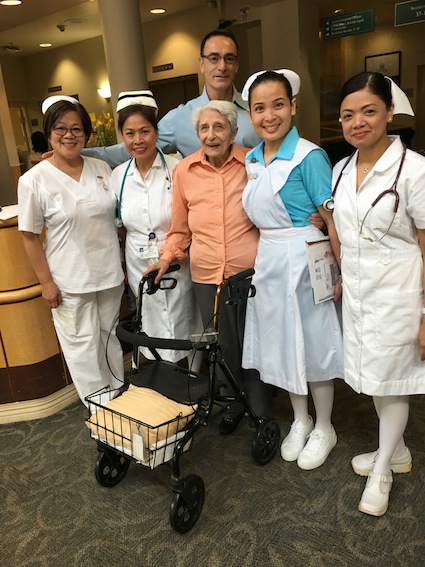
Left to right, Nicole Encarnacion, Rebecca Fernandez and Jennifer Belen were among those fêted at Louis Brier Home and Hospital on May 9 during Nursing Week. (photo by Dolores Luber)

“I think one’s feelings waste themselves in words; they ought all to be distilled into actions which bring results.” – Florence Nightingale

The Dr. Irving and Phyliss Snider Campus for Jewish Seniors – the Louis Brier Home and Hospital and the Weinberg Residence – held a party on May 9 to celebrate National Nursing Week.

Louis Brier chief executive officer David Keselman, at the helm for nine months now, initiated the celebration – the first time in its history that Louis Brier has marked the occasion. There are plenty of reasons to celebrate the profession daily, but National Nursing Week presents the chance to give back to these integral members of society. International Nursing Day, May 12, is the anniversary of the birth of Florence Nightingale, who is widely considered the founder of modern nursing.

photo - Chief executive officer of Louis Brier Home and Hospital David Keselman with, left to right, Leonora Calingasan, Rebecca Fernandez, Flora Hayward, Nicole Encarnacion and Jennifer Belen
Chief executive officer of Louis Brier Home and Hospital David Keselman with, left to right, Leonora Calingasan, Rebecca Fernandez, Flora Hayward, Nicole Encarnacion and Jennifer Belen. (photo by Dolores Luber)

In coordination with Angela Millar, executive leader, resident care services, at Louis Brier, the festivities honoured and expressed appreciation and affection for the nurses who support and care for the home’s 215 residents. The continuum of care includes assisted living and multi-level care. Louis Brier provides 24-hour nursing services for residents who require personal assistance or full nursing support, and also has a separate unit for those residents living with moderate to severe dementia.

Louis Brier’s goal is “excellence in geriatric nursing care.” As a teaching facility, Louis Brier regularly hosts students from accredited nursing schools, which helps them keep on top of current best practices.

Nicole Encarnacion, clinical care coordinator and educator, was my guide to the festivities, to the nurses, staff and residents. The Nursing Week event on May 9 had the theme of “This is Nursing: Unexpected Places, Real Impact.”

The home’s commitment to resident and family-centred care was evident throughout the facility. The entry hall was splendid with posters and banners created by residents and staff. The nurses were dressed in their formal white uniforms, with black, navy blue or green stripes on their caps. They were excited and pleased to be singled out, paid attention to and appreciated for their service. Millar gave out 30 certificates honouring their years of nursing, the longest being 39 years of service. Three nurses were given special consideration with a bouquet of flowers. In every corner, there were expressions of affection, cooperation and goodwill, hugs, smiles and group photos.

Dolores Luber, a retired psychotherapist and psychology teacher, is editor of Jewish Seniors Alliance’s Senior Line magazine and website (jsalliance.org). She blogs for yossilinks.com and writes movie reviews for the Isaac Waldman Jewish Public Library website.

Format ImagePosted on May 19, 2017May 18, 2017Author Dolores LuberCategories LocalTags Louis Brier, nursing, seniors, Weinberg Residence
Caring for our seniors

Caring for our seniors

Louis Brier Home and Hospital. (photo from cjnews.com)

“Louis Brier offers our residents variety in programming and services, as well as safe and quality care. Residents and families remain the primary decision-makers for the care received, as resident and family-centred care is at the core of our goals. All care is governed by our Jewish and professional values and standards of excellence,” Angela Millar told the Independent.

Millar is the director of quality and risk management, accreditation and resident experience for the Louis Brier Home and Hospital and Weinberg Residence. She was responding to questions from the Jewish Independent about the 2017 British Columbia Residential Care Facilities Quick Facts Directory, published by the Office of the Seniors Advocate (OSA). The directory “lists information for 292 publicly subsidized facilities in British Columbia that offer residential care services to seniors,” including Louis Brier.

The information was “gathered primarily from residential care facilities, health authorities, the Ministry of Health and the Canadian Institute for Health Information.” The data on licensing incidents and complaints is from the 2015-16 fiscal year, while the “inspection data was a snapshot taken on Dec. 7, 2016.” The 2017 OSA report can be found at seniorsadvocatebc.ca and the most recent inspection information from Vancouver Coastal Health at inspections.vcha.ca.

Millar explained, “Louis Brier is an affiliate of Vancouver Coastal Health, providing residential care for seniors. Vancouver Coastal Health provides an annual operating budget and Louis Brier Home and Hospital also receives donations from the Louis Brier Jewish Aged Foundation, which provides music and art therapy, Jewish culture and synagogue, kosher food and supplementation of medical equipment.”

The OSA directory mentions the Louis Brier Jewish Residence Society, as well as separate resident and family councils.

“The resident council represents the seniors who live at Louis Brier, ensuring they have a voice in how their home is run,” said Millar. “The council is supported by staff and meets monthly to discuss concerns, develop suggestions and plan activities. The executive director of resident care services and the chief executive officer attend meetings to provide updates, answer questions and develop plans to address concerns where needed.

“The family council is an independent group of family members and friends who meet monthly to support each other and advocate for the seniors residing at Louis Brier. A staff member liaises with the council and senior management team, who are often invited as guests. The family council acts as a forum to share experiences, learn and exchange information.”

In the 2017 OSA directory’s statistics on care services and quality, Louis Brier performed better than the B.C. average in percent of residents receiving physical therapy (34.3% versus 13.2%) and occupational therapy (10.3% versus 7.6%) but not in percent of patients receiving recreation therapy (1.1% versus 27.9%). With different percentages, Louis Brier fared similarly in the OSA’s 2016 report.

Noting that the data collected for the OSA report is “a snapshot at one time in a period,” Millar said, “I believe that the data is collected utilizing a seven-day observation tool throughout only one week in a quarter. Of course, my personal concerns are related to the validity and reliability of the data that is reported and thus the ability to generalize or glean valuable information from that data.

“My concerns aside, data collection is only looking at therapeutic interactions of the rehab team with residents – one PT/OT [physical or occupational therapist] per four residents and one rec therapist per eight residents – unfortunately rehab and rec resources [do] not abound, and our aim is to maximize the outcome and benefit to as many residents as possible given the resources that we have. As such, many of our programs and interventions are designed to accommodate larger groups of residents and most likely beyond the guidelines of the seniors advocate data collection parameters. It would help to understand how these parameters have been established and whether they have been evaluated for reliability in terms of producing valid data to help draw conclusions in relations to quality of care and residents’ outcomes.”

Millar emailed the home’s May recreation calendar, which can be found at louisbrier.com/events, “as an example of the plentiful and very rich programming that we are proud to provide our residents.”

In the 2017 directory, Louis Brier fares better than the provincial average in many areas: there were no substantiated licensing complaints and no reported incidents of disease outbreak or occurrence, abuse or neglect, food poisoning, medication errors or missing or wandering persons. With respect to falls with injury or adverse event, there were 5.1 per 100 beds, compared to a B.C. average of 11.9; and, in the category of other injury, 1.4 per 100 beds at Louis Brier compared to a provincial average of 1.6.

There is only one measure in which Louis Brier fared lower than the provincial average in the 2017 directory. In the year examined, there were nine reported incidents of aggression between persons in care at Louis Brier, or 4.2 per 100 beds, as compared to the provincial average of 1.5 per 100 beds; the 2016 OSA directory lists zero such incidents at the home.

With respect to four other quality measures, Louis Brier fared better or comparable to the provincial averages in three areas – percentages of residents diagnosed with depression, residents receiving depression medication and use of daily physical restraints. However, with respect to the percent taking antipsychotics without a diagnosis of psychosis, 40.8% of Louis Brier residents who were taking antipsychotic medications had not received a diagnosis of psychosis, compared with the B.C. average of 26.9% in the 2017 report, and 41% versus 31% in the 2016 report. As well, the OSA directory reports that, while 16.2% of Louis Brier residents had been diagnosed with depression, 48.1% of residents were receiving depression medication; in the 2016 directory, the respective figures were 21.1% diagnosed and 52.3% receiving depression medication.

“Your specific question with regards to prescription of specific treatments, medications and diagnoses is not something that can be responded to in a simple way…. While nursing staff are responsible to deliver care to the residents every day of the year, they, however, have limited control on what and how medications are prescribed and why,” said Millar. “Nurses advocate on behalf of the residents and may raise questions and awareness, however, changing physician practice or implementing best practices as it is related to the medical field and residential care are an entirely different area for discussion and attention. To understand and evaluate whether medications and treatment are prescribed appropriately requires a comprehensive approach by both the nursing and medical staff. We are certainly committed to ensure our residents receive safe, quality care and are continually monitoring medications and treatments as possible.”

Millar explained, “Louis Brier is regulated by the Community Care and Assisted Living Act, as well as the Hospital Act, which is enforced by Community Care Facilities Licensing.

“Currently the facility is showing its commitment to quality care by preparing for an Accreditation Canada Survey in May of 2018. Accreditation Canada will assess our organization against standards of excellence with regards to leadership, long-term care, medication management, infection control and governance.”

She described Accreditation Canada as “a significant wealth of information and resource for organizations in their quest to improve and achieve the highest level of care and quality possible within the industry” and invited the Independent and its readers to the Louis Brier Accreditation Fair on May 23 “to learn more and see how you can get involved.”

Millar noted that Louis Brier also has “just developed a quality and risk portfolio including a director of quality and risk management [QRM], manager of QRM, an infection control practitioner, as well as a QRM coordinator. Within this team, there are also individuals responsible for resident experience, including social work, volunteer coordinator and the manager of the companion program.”

As for staffing levels overall, Millar said, “I believe that there could never be enough staff and resources; however, we do have to work within our funding boundaries, given what we have. We can say with great confidence that Louis Brier has, most likely, more resources in terms of rehab and recreation staff than many other organizations (mainly because we are so greatly supported by the Louis Brier Foundation): we have over 300 volunteers and over 100 companions that help us deliver outstanding care to all of our residents. To that end, Louis Brier shares a common goal with the seniors advocate – of providing safe, quality care to our elders. Furthermore, Louis Brier certainly supports the efforts and intention of the seniors advocate in evaluating and advocating for additional resources to be allocated to the long-term care sector to help providers support and deliver excellent care to our seniors.”

Format ImagePosted on May 19, 2017May 19, 2017Author Cynthia RamsayCategories LocalTags Angela Millar, health care, Louis Brier, residential care, seniors
Docs cover range of topics

Docs cover range of topics

The Jewish Seniors Alliance Spring Forum featured Dr. Saul Isserow, left, and Dr. Larry Goldenberg. (photos by Binny Goldman)

“If I had known I was going to live so long, I’d have taken better care of myself” – Eubie Blake

Approximately 120 people attended the Jewish Seniors Alliance Spring Forum on May 7 at the Peretz Centre for Secular Jewish Culture. Called Ask the Doctors, it featured Dr. Saul Isserow and Dr. Larry Goldenberg, who were ready to answer the audience’s many questions.

JSA president Ken Levitt welcomed the crowd, thanked them for giving up a sunny gardening day to attend the workshop and support the JSA, whose new motto is “Seniors, Stronger Together.” He explained that, in joining together and striving for common causes, we are stronger.

photo - Jewish Seniors Alliance first vice-president Gyda Chud, left, president Ken Levitt at the JSA’s Ask the Doctors forum on May 7
Jewish Seniors Alliance first vice-president Gyda Chud, left, president Ken Levitt at the JSA’s Ask the Doctors forum on May 7. (photo by Binny Goldman)

Gyda Chud, first vice-president of JSA, introduced Isserow, who is the director of cardiovascular health at Vancouver General Hospital and of cardiology services at the University of British Columbia Hospital, as well as the medical director of Vancouver Coastal Health’s Healthy Heart Program, among other things. She also introduced Goldenberg, whose many credentials include the founding of several programs, such as the Vancouver Prostate Centre, where he is director of development and supportive care, and the Canadian Men’s Health Foundation; he is also a professor in the department of urologic sciences at UBC. Goldenberg was inducted into the Order of British Columbia in 2006, awarded the Order of Canada in 2009 and received the Queen’s Diamond Jubilee Medal in 2012.

Isserow’s topic was How to Stay Away from the Chevra Kadisha (the Jewish Burial Society). He started his talk with humour – saying that the man who asks the best question will win a finger up his tuches (bum) by Goldenberg, referring to a prostate exam – and used humour throughout to make the sad facts of aging more palatable.

Using slides to illustrate his points, Isserow stated that hardening of the arteries starts when we are young. He likened the process to a bagel, which begins to harden on the perimeter. When the blockage reaches the centre of the “bagel,” that is when the heart attack occurs. To keep things in perspective, he described life as “a sexually transmitted disease with 100% mortality.”

He discussed many risk factors: age, obesity, genetics, hypertension and smoking. He strongly suggested that diet and exercise could halt or reverse immediate risks but, unfortunately, there are no reliable warnings and heart attacks come out of the blue.

Movement is strongly encouraged, said Isserow. Just walking 10 minutes a day is a start to reducing the risk of diabetes and obesity. Walking one hour a day can reduce the risk of heart disease by 35%, he said, and the Mediterranean diet of fresh vegetables and fruit, healthy fats and whole grains, can improve health by 27%.

Isserow presented studies showing that aspirin reduces heart disease significantly. Although statins may be necessary, there are possible side effects, such as aches and pains, he said. He ended his talk by saying that health is up to the individual: walk once a day, eat well and take medications as required, when the risk is high.

Goldenberg said that one reason men die 4.4 years younger than women is the “I will not, cannot, Sam I am” syndrome, paraphrasing lines from the children’s book Green Eggs and Ham by Dr. Seuss. Many men are unwilling to reduce their drinking, smoking and/or poor eating habits, he said.

The government is trying to develop expertise in communicating effectively with men about their health, connecting with them in a way that creates the space, freedom and encouragement for positive changes in their health awareness, attitude and behaviours, said Goldenberg.

Doctors are increasing awareness with the slogan of “precision, prevention and preemptive,” he said, recommending precision and personalized communication in telling men what you want them to hear. Get males to engage in their health discussions, he suggested.

In an effort to increase engagement, Goldenberg initiated the website dontchangemuch.ca. He gave a few examples of small changes that would help: ordering half a salad and half fries, parking the car further away from your destination and walking an extra block or two.

He also referred to the Canadian Men’s Health Foundation’s youcheck.ca, “a health awareness tool built specifically for men,” according to its homepage, and he spoke of “manopause” – aging and a lower level of testosterone lead to a lower libido, crankiness, fatigue and the onset of heart and bone disease. Low testosterone has an impact on the body but there is no consensus as to solutions, said Goldenberg. Doctors need to monitor any symptoms that seem worrying, he said, adding that men need women to guide them and to emphasize that their behaviour can be changed.

An active question period followed. In no particular order, some of the responses included the following.

Aspirin can reduce blood clotting, as can diet and exercise. If you are doing all things right but your CT scan shows calcified plaque, then focus on diet, exercise and statins. People should have a base line for everything – having a colonoscopy or, for men, a test for PSA (prostate-specific antigen) levels, for example – and be aware of family history.

Tiredness could be the result of sleep disturbance, low mood or loneliness, but heart health should be checked. Beta blockers can cause fatigue because of a reduction of blood flow.

Stress management is critically important and stress levels can be related to many things: mental and physical well-being and reduction of cholesterol. Sex is healthy for overall well-being.

After the session ended, Larry Shapiro, second vice-president of JSA, presented the doctors with tokens of appreciation. Continuing with the humour that had been present all afternoon, he said, “Vive la différence!” referring to the many differences between men and women and their approaches to health.

Chud said she had seen a sign in the Weinberg Residence saying, “Never live in a community where there are no doctors,” and she wanted to add “a community without Drs. Isserow and Goldenberg.”

Stan Shear videotaped the forum, and JSA staff and volunteers deserve kudos for putting it all together.

Binny Goldman is a member of the Jewish Seniors Alliance of Greater Vancouver board.


Format ImagePosted on May 19, 2017May 17, 2017Author Binny GoldmanCategories LocalTags Dr. Larry Goldenberg, health care, JSA, Saul Isserow, seniors

New seniors campus?

Community leaders are looking to the future of the Dr. Irving and Phyliss Snider Campus for Jewish Seniors – the Louis Brier Home and Hospital and the Harry and Jeanette Weinberg Residence – with the realization that the aging buildings no longer support current standards and processes for delivery of health-care practices, technology and equipment. It’s been two years since the planning began, and the redevelopment committee is considering two options for the makeup of a new campus.

The first and preferred option involves relocating from the current four-acre property to the site of a new Jewish Community Centre of Greater Vancouver. By developing a mixed-use centre, its recreational and cultural programs and services would enhance healthcare and long-term care for seniors. It would also mean shared construction and operating costs.

The second option is to build stand-alone facilities for the seniors campus on a site close to the JCCGV. This would be smaller in size and design and entail a potentially shorter time frame for rebuilding, while maintaining proximity to the JCCGV for collaborative, intergenerational planning.

At the helm of the seniors campus is chief executive officer David Keselman. “Redevelopment is important because we are reaching the end of our ability – both [in terms of] infrastructure and operationally – to deliver care that is consistent with current and future healthcare delivery trends,” he said.

“There’s a push to keep seniors at home longer today, which means that, when they eventually require long-term services, they will be more fragile and require a higher intensity of services,” he continued. “But, whenever they need that care, this is the only Jewish healthcare delivery organization in B.C. and there’s nothing else unless you want to cross the U.S. border. It’s extremely important that the community supports this and that the government realizes that, for Jewish people, there’s nowhere else to go if they want to preserve their culture, customs and way of living.”

Rozanne Kipnes, a real estate development consultant with Tamarix Developments, was on the board of the Louis Brier for years and has been contracted to help secure a site, its legal structure and some financing opportunities. The big difference between the campus being planned and the current model, she said, is that the older model is based on a tendency to isolate seniors.

“The way we deliver care today is not the way it’s delivered in other countries around the world,” she explained. “We want to reengage and integrate seniors with the community, not isolate them. The government has seen this model tested in other communities and other countries and they’ve noted that when seniors’ long-term care is handled this way – with an integration of health and social needs – there’s a better quality of life for everybody and less burden on families.”

Kipnes noted that the Jewish community’s founding families “blessed” today’s community with land assets that can be leveraged “to support the redevelopment of an urban seniors care, health, wellness and cultural hub within the historical precinct of the Jewish community. We are hopeful it will also provide legacy operating and capital fund replacement to support collaborations going forward.”

Neither Kipnes nor Keselman would comment on the value of the land or the estimated costs of constructing a new campus. Kipnes said that how the land gets “leveraged” is all part of the discussion, and pivotal to that discussion will be how the City of Vancouver zones the land – for low-, medium- or high-density residential construction.

Right now, the volunteer redevelopment board is engaged in discussions, focus groups, market analyses and donor outreach. A study is underway to explore the number of units that will be required for residents of the campus, the current and future health services models of care and the facilities needed to support them. The study’s completion is expected by next month.

Whatever option is chosen, Kipnes said a new campus is at least eight years from reality. “If we’re successful in this endeavour as a community, it will be the largest community endeavour we’ve ever undertaken,” she said. “It’s well worth the collaboration and patience this project requires because the end will very much justify the means. On a new campus, we envision families from across the community reengaged and reunited. We see children with their grandparents engaging in activities between the JCC and the Louis Brier, combined with a host of other Jewish community agencies. A mixed-use project like this is very complicated and requires much more collaboration at all levels of the Jewish community. But it’s very doable.”

Lauren Kramer, an award-winning writer and editor, lives in Richmond. To read her work online, visit laurenkramer.net. This article was originally published by CJN.

Posted on April 21, 2017April 20, 2017Author Lauren KramerCategories LocalTags healthcare, Louis Brier, seniors, Weinberg Residence

Posts pagination

Previous page Page 1 … Page 9 Page 10 Page 11 Page 12 Next page
Proudly powered by WordPress