Skip to content
  • Home
  • Subscribe / donate
  • Events calendar
  • News
    • Local
    • National
    • Israel
    • World
    • עניין בחדשות
      A roundup of news in Canada and further afield, in Hebrew.
  • Opinion
    • From the JI
    • Op-Ed
  • Arts & Culture
    • Performing Arts
    • Music
    • Books
    • Visual Arts
    • TV & Film
  • Life
    • Celebrating the Holidays
    • Travel
    • The Daily Snooze
      Cartoons by Jacob Samuel
    • Mystery Photo
      Help the JI and JMABC fill in the gaps in our archives.
  • Community Links
    • Organizations, Etc.
    • Other News Sources & Blogs
    • Business Directory
  • FAQ
  • JI Chai Celebration
  • JI@88! video

Recent Posts

  • BGU fosters startup culture
  • Photography and glass
  • Is it the end of an era?
  • Taking life a step at a time
  • Nakba exhibit biased
  • Film festival starts next week
  • Musical with heart and soul
  • Rabbi marks 13 years
  • Keeper of VTT’s history
  • Gala fêtes Infeld’s 20th
  • Building JWest together
  • Challah Mom comes to Vancouver
  • What to do about media bias
  • Education offers hope
  • Remembrance – a moral act
  • What makes us human
  • המלחמות של נתניהו וטראמפ
  • Zionism wins big in Vegas
  • Different but connected
  • Survival not passive
  • Musical celebration of Israel
  • Shoppe celebrates 25 years
  • Human “book” event
  • Reclaiming Jewish stories
  • Bema presents Perseverance
  • CSS honours Bellas z”l
  • Sheba Promise here May 7
  • Reflections from Be’eri
  • New law a desecration
  • Resilient joy in tough times
  • Rescue dog brings joy
  • Art chosen for new museum
  • Reminder of hope, resilience
  • The national food of Israel?
  • Story of Israel’s north
  • Sheltering in train stations

Archives

Follow @JewishIndie
image - The CJN - Visit Us Banner - 300x600 - 101625

Tag: seniors

Medication alert innovation

Medication alert innovation

The system concept for CuePath’s sensor-monitored blister packaging for dispensing medications. (photo from CuePath)

When blister pack medication dispensing came onto the market years ago, it was hoped that it would solve the issue of people not taking their medication on time. However, while this plastic packaging method has become commonplace, people are still forgetting to take their medicine.

One Vancouver-based start-up has come up with a solution. CuePath Innovation is creating a sensor that monitors when each blister pack is opened – connecting the sensor to care providers wirelessly. CuePath’s Jeff Nider is charged with marketing the concept.

Nider grew up primarily in Richmond. “My late father, who passed away in 2014, was a pharmacist and he had a number of different pharmacies in the Vancouver area over the years,” he told the Independent. “I grew up in and out of the pharmacy – working with my bubbie, manning the cash register, or pre-packaging medications for nursing home customers. That’s where I spent most of my summers, working in the pharmacy with my father.”

Nider earned his degree in biology at the University of British Columbia, and then his father asked him to manage one of the pharmacy locations. When they came across the blister pack technology, which makes the administering of medications more safe, they jumped at the chance.

“At the time, we had one nursing home client, and so we saw a future for the technology and decided to purchase the machine required to package it,” said Nider. “At this point, I started my sales career, going and selling … to basically convince … nursing homes to allow us to be their pharmacy provider.

“Each nursing home needs to have a single pharmacy provider for all of their residents. So, we had this technology along with some other software…. We were able to grow the business from one nursing home client to over 40, representing 1,700 residents.”

In 2012, they sold their business to a Toronto-based company and Nider stayed on as the business development manager for Western Canada. Last summer, Nider left that role after having been introduced to CuePath Innovation.

“It’s a start-up for monitoring medication for seniors living at home and in retirement communities,” he said about CuePath. “Based on the expertise I had in the pharmacy and geriatrics business, it made sense to me to get involved. So, I was approached to be essentially the third employee of the company, aside from the two co-founders, who have no pharmacy backgrounds … to take it from an idea and approve the concept through pilots and its commercial launch, which will happen in the second quarter of this year.”

CuePath’s sensor monitors each individual cell of the pack and indicates whether or not a person has broken the seal.

photo - CuePath’s Jeff Nider grew up in and around his father’s pharmacy
CuePath’s Jeff Nider grew up in and around his father’s pharmacy. (photo from CuePath)

“We also provide an alert for seniors at home, when it’s time to take their medications,” said Nider. “If they don’t take them by the appropriate time, a text message will be sent to [a] family member, so they can call and remind the family member to take them.

“If you’re an 85-year-old woman living alone, your daughter might be in Toronto or Winnipeg and have no idea what’s happening – worrying about whether or not you’re taking your meds on time, because there’s a bunch of stats on our website in respect of medication adherence: less than 50% of medications are taken as prescribed, and 22% of nursing home admissions are a result of non-adherence to medication. So, it’s very important that people take their medications the way they’re prescribed and at the right time.”

According to Nider, in some cases, just before care providers come each week, seniors will punch out all the medication in the blister pack that they have forgotten to take during the week. Therefore, everything might appear to be fine when, in actuality, it is not.

“This happens because they know you come every Sunday,” said Nider. “So, on Saturday, they go and punch out the whole card. When you come, everything looks like it’s been taken – but, it’s been taken out the day before and flushed down the toilet.”

Nider pointed out that the CuePath sensor monitors the punching of the plastic only – it does not monitor whether or not the medication was ingested. Though that addition is on the horizon.

The CuePath technology is a clip on a Bluetooth transmitter connected to the back of the blister pack. “Basically, it’s a label that the pharmacist applies to the back, which has some conductive materials in it to send the transmission as to whether or not those have been opened,” said Nider.

The service has a monthly fee and an initial hardware cost but, considering the alternative – paying a care provider to administer the medication – it is much more affordable, according to Nider.

“It runs around $30 a month; $200 for the initial gateway hardware cost,” he said. “There’s a bunch of different models right now. We are still in pilot stages, running various pilots in various forms in different retirement communities.

“In a lot of ways, this will help you avoid needing to get a caregiver and finding a time when a caregiver is necessary. We’ve seen that medications are indicators of other things as well. So, if people are taking their medications on time, they’re probably able to manage many of the other tasks, too. But, as soon as they start to slip with taking them on time, it’s usually a good indication that they may not be able to manage their cooking, they may not be doing their laundry…. It also puts them at a higher risk for falls and other issues if they aren’t taking their medications properly. It’s a good indication that now’s the time to hire a caregiver. It gives you data to what is actually going on with the senior.”

The CuePath gateway unit does not need an internet connection, as it connects to the cellular network. Each gateway comes with three Bluetooth clip transmitters that will be rotated with the pharmacy. The app that accompanies the device allows caregivers access to statistics in terms of percentage of medications taken on time and other data.

“You can see how this month compares to last month,” said Nider. “Then, this information can be printed out and brought to the physician’s office … shared with the pharmacy … so they have the information.”

Rebeca Kuropatwa is a Winnipeg freelance writer.

Format ImagePosted on March 31, 2017March 31, 2017Author Rebeca KuropatwaCategories LocalTags CuePath, health, Jeff Nider, seniors
Baking bread together

Baking bread together

Grace Haan, JSA Peer Support trainer and supervisor, and Charles Liebovitch, JSA Peer Support coordinator, at the March 8 Food and Film Empowerment session. (photo by Binny Goldman)

The screening of Dough at the March 8 Food and Film session of the JSA Snider Foundation Empowerment Series continued the 2016-17 series’ theme of “Eating our way through Jewish history: Food, the doorway to our culture.”

Presented in partnership by the Jewish Seniors Alliance and the Jewish Museum and Archives of British Columbia, this latest session took place at the Unitarian Centre.

JSA president Ken Levitt greeted those gathered, taking the opportunity to introduce the alliance’s new motto – “Seniors, stronger together.” He emphasized the comma in the phrase, as it had been the topic of much discussion. He also credited me for the motto’s origin.

Gyda Chud, convener of this third session of the food-related Empowerment Series, said she was happy to see so many women in the audience as the event took place on International Women’s Day. Chud was wearing a scarf commemorating the World March of Women that took place in Montreal in 2000.

Michael Schwartz, JMABC coordinator of programs and development, noted how women were responsible for the existence of many organizations in the province. He stressed the importance of families contributing their own pieces of history to the museum to help future generations know the community’s origins and its past. And he asked audience members to become members of the museum, the benefits of which include receiving The Chronicle, which will keep them up-to-date on the museum’s events and research. One upcoming event, he said, is the Supper Club, which will take place at the Peretz Centre for Secular Jewish Culture, where the museum is housed. He concluded, “Without further a dough we hope you enjoy the movie Dough.”

Dough depicts the desperation that sometimes drives people together. Widowed and finding it hard to manage, Nat Dayan is desperate to save his London bake shop from closing – his grandfather had opened Dayan and Son 60 years ago. Customers are getting scarce, moving away or dying, and Nat’s son, a lawyer, is not interested in continuing the family business or helping it survive. In addition, competition is becoming a concern, with a shop next door that is selling baked goods, as well as groceries, and Nat’s apprentice has left to work for them.

Struggling to keep his kosher bakery open, Nat hires Ayyash, the teenage son of his cleaning lady. Ayyash has been selling drugs to help support his mother and himself and, when Ayyash accidentally drops cannabis into the challah dough mix, sales at Dayan and Son soar. Long lines appear and the closing of the shop seems far off.

A warm and special friendship develops between the Muslim boy and the Jewish baker, as Ayyash and his mother go to live at Nat’s when their home floods. A line in the film – Fiddler on the Roof meets West Side Story – helps describe what we see developing.

Tragedy is averted when a fire set by a competitor, instead of destroying the shop as well as Nat’s dream forever, serves to bring them closer together with mutual aspirations of continuing to exist. Dayan and Son survives with the “son” being Ayyash. The theme is an especially moving one – overcoming racial prejudice and bringing about closeness through the will for openness, acceptance and understanding, which can be found in unexpected places.

Chud thanked the delighted audience and invited all to enjoy baked goods – though not the cannabis-filled ones in the movie. The JSA staff worked hard to bring this event to the public, and Stan Shear was invaluable for all his technical work.

May we “break bread” together in the future. B’tayavon, b’shalom.

Binny Goldman is a member of the Jewish Seniors Alliance of Greater Vancouver board.


Format ImagePosted on March 24, 2017March 23, 2017Author Binny GoldmanCategories LocalTags film, food, Jewish museum, JMABC, JSA, seniors
Looking to Brier’s future

Looking to Brier’s future

Louis Brier Jewish Aged Foundation’s new executive director, Stephen Shapiro. (photo by Lauren Kramer)

It’s been awhile since Louis Brier Jewish Aged Foundation had an executive director, but the fundraising branch of the organization is in good hands since Stephen Shapiro took the position in January.

A Calgarian who moved to Vancouver in 2000, Shapiro comes with impressive credentials. He served as president and chief executive officer of St. Paul’s Hospital Foundation for five years, fundraised at the University of British Columbia with former university president Martha Piper for six years and was deeply involved in cultural affairs and youth direction at the Calgary Jewish Community Centre prior to that.

“I feel I’m at a point in my career when I’ve accomplished a lot in the non-Jewish community and I want to give back to my own community,” Shapiro told the Independent. “I really believe in the mission, philosophy and work this particular institution does. I think our Jewish seniors are a very important part of our community and, with the history they represent, they should be treated with dignity and respect in their later years.”

Shapiro intends to grow the foundation from its current annual fundraising target of between $1 million and $1.2 million. He hopes to at least double that target in the coming years and sees lots of potential opportunities to fundraise in the non-Jewish community.

“Much of Louis Brier is publicly funded,” he said. “There are 215 beds this side of the organization that are contracted through Vancouver Coastal Health Authority, and 40% of our population is non-Jewish. But 99% of the donors to this organization are Jewish. So, part of my mandate is to bring my knowledge of fundraising in the non-Jewish community to apply here.”

Louis Brier is at a crossroads, he added, with much of the building at the end of its lifecycle. Still, a complete redevelopment plan is a number of years away, which means two distinct fundraising efforts are required. “We’re raising money for what we need in the next five to seven years, as well as planning longer term down the road for a potentially new campus,” he said. “Right now, our job is to look after today’s needs and today’s current residents, until such a time that we can build a new facility.”

Immediate needs include improved lounges, better furniture, new freezers in the kitchen and updated security and computer systems, he said.

“The practice of care has changed and evolved and we have to change with that,” Shapiro explained. “Certain things are no longer acceptable – for example, parking people in a hallway to look out the window all day because there’s not enough lounge space. That kind of thing is not considered OK anymore. With some physical improvements and relatively minor renovations, we can do things that improve our lounges and public spaces.”

Because Louis Brier is the largest contracted facility within the Vancouver Coastal Health Authority, now is a crucial time to make these upgrades, he added. “Given the size and demographics of the Jewish community, there’s a whole generation of people who are going to need our services quite soon. If anything, given the aging of our population, I think the Jewish needs at Louis Brier will rise, not diminish.”

Shapiro hopes to motivate non-Jews who have family members at Louis Brier to give back to the institution by finding projects in research and best practices that might be of interest to them. “Whether it’s in partnership with UBC or other institutions, promoting excellence in research and clinical care is the way to go here,” he stated. “Everybody could potentially have an interest in that.”

Lauren Kramer, an award-winning writer and editor, lives in Richmond. To read her work online, visit laurenkramer.net.

Format ImagePosted on February 24, 2017February 21, 2017Author Lauren KramerCategories LocalTags fundraising, health care, Louis Brier, seniors

“Lost Tribe” in Canada

While I was completing my doctoral work examining the creative expression abilities of seniors with dementia and the therapeutic environment they lived in, I continued working in the Creative Expression Activities Program I had developed. Early in 2000, a group of six Jewish couples who had immigrated to Canada in their later years, asked me to conduct a series of creative expression activities with them. The participants had come from Mexico, South Africa and England to join their adult children and families in Canada. The group named themselves the Lost Tribe, after the Lost Tribes of Israel – the two tribes out of the 12 original biblical tribes that disappeared. The couples lived on the North Shore, away from the main Jewish centres in Vancouver, and strived to build a strong new community based on traditional Jewish Orthodox customs.

The group formed friendships based on common faith, customs, and the challenges of getting older and adjusting to a new country. They faced the potential loss of independence they had worked so hard to attain and the ever-increasing fear of becoming a burden on their adult children. To be successful, they knew they would need to merge the old world with the new. The group met regularly to share their spirituality and serve their social and religious needs. The couples took turns hosting our sessions at their homes and enthusiastically agreed to be filmed and recorded.

The participants were advised that this program was initially developed for seniors living with early to moderate dementia and that it would be adjusted to meet their abilities. The group was curious about the differences I observed of seniors with dementia, and I was happy to share my observations.

The Lost Tribe was a breakaway group from the main synagogue on the North Shore, based on more traditional Jewish observance during services, which members conducted themselves at a private home, occasionally joined by a professional cantor. During the High Holidays, the congregation swelled to 60 worshippers. However, on Friday and Shabbat services, it would shrink back to a handful of people, hardly enough for a minyan, where 10 males need to be present at prayer.

Members of the Lost Tribe were Lilia, late 50s, and Hilario, 65, from Mexico; Jeffrey, 82, and Greta, 72, from England; Aryeh and Rachel, both in their 60s, from Johannesburg, South Africa; Abe and Jean, both in their 70s, from Cape Town, South Africa; Mair from Morocco and Helene, from northern Alberta, Canadian by birth; and Ralph, 70, born in Turkey, who lived half his life in England, half in Canada, and Gillian, 67, who is English but lived half her life in Canada.

Creative expression

The approach to creative expression is based on nursing, psychology, social work, adult education, the arts and architecture. It aims to enhance a sense of fulfilment, personal growth and accomplishment and contributes to the appreciation of the arts in the healing process and in enhancing an individual’s quality of life. The award-winning program includes the visual and performing arts: discussion, poetry, music and dance.

The topics for discussions and the process were discussed in advance. The sessions themselves were loosely guided by me and by the group’s dynamics. Each session lasted for two hours and ended with lunch. Participants took turns providing food and snacks. No cost was involved and my services were free.

I found it remarkable that they were Jews from various corners of the world and, yet, I understood what they were talking about, I could sympathize with them, cry at their sad stories and laugh at their jokes.

As the program progressed and trust grew stronger, I realized I was recording very personal stories that were rich in details, in Jewish philosophy, thoughts on the Jewish religion, on aging and what life is all about. I was taken by surprise by the level of connectedness I felt with these perfect strangers. I noted all the familiar mannerisms, food, songs, beliefs, humour, hand gestures, life stories of great lessons and how we shared the same ethnic identity. I found it remarkable that they were Jews from various corners of the world and, yet, I understood what they were talking about, I could sympathize with them, cry at their sad stories and laugh at their jokes.

The four topics were: philosophical approaches to life based on strength versus weakness; relationships with family members (are we a burden, or is this inevitable as we grow older?); the meaning of being an elderly Jew in Vancouver and in their country of origin, and the impacts of the Holocaust in Europe; and spiritual connection to Israel. Key thoughts were highlighted and categorized into themes to demonstrate that Jewish identity matters, and these values are imbedded in the more general issues of aging, cognitive abilities and family relationships. Here are some of the participants’ thoughts.

Strength and weakness

Ralph: Strength means two things: physical strength and mental strength that goes down as you get older. Physical strength you need to survive. Mental strength is adaptability, which is the greatest thing to me. The other thing is peace. It appears to me that inner peace comes with age….

Aryeh: Unfortunately, we live in a world that there is no place for weakness … and, as we get older, we need to get stronger.

Jeffery: Not everything is strength. I will give you an example. Israel is very strong and she cannot do anything with it. Absolutely nothing….

Rachel: I believe in strength. I [have] always been strong; I [have] always been a strong believer of my faith…. People in Canada are more placid. I became quite placid. You are nowhere unless you fight. That is what I do.

Lilia: Sometimes we need to be weak in order to be strong. Like a huge tree, we need to be flexible.

Gillian: I learned to be strong at a very early age. I was shipped off to a boarding school when I was 9. I was one of four Jewish girls in the whole school and we had to stick together. We were tortured, literally. It helps to get together with others who feel the same way. It was a good lesson. I was a fighter.

Abe: I think we were all born with strength and weaknesses. There are two things that determine strength and the weakness. One is life experiences; the other, the genes that we inherit…. When being passive, it could be a show of inner strength not to react or respond to everything…. It is a delicate balance.

Family relationships

Rachel: Most older people don’t want to be a burden on their children…. The last thing they want to do is to have to live with their children.… But what happens when you are really ill?

Greta: In a twinkle of an eye, my children would look after us, but I feel my children spent many years looking after their children. When they have the freedom to live their lives, I don’t want to be a burden to them…. I like my independence.

Jean: Living with your children does not mean living in their living room.… It can be a suite or a basement and have the best of both worlds.

Abe: We need to look at the following three aspects. The state of our health at any given time, how much assistance we require from different sources, and our state of our finances…. It depends on our relationship with our children and the interplay between the parent and the child.

Aryeh: We all remember most of the 10 commandments but I believe that our children forget more than we did one really important commandment, “honour your parents that your days may be longer on earth that God has given you.” I don’t expect anything from my children. We are living in different times…. One of the concepts in Judaism is that we should be happy with our lot, whatever it is. My mother looked after her parents. It was not a question of a burden; it was accepted in those days.

Gillian: About children – they were not asked to be born. They came, you loved them with all your heart because this is what you do for children, and then you released them to have their own life…. I don’t think they owe you a thing. But, if they want to give you something, you should take it as a bonus.

Ralph: I agree with Gillian. When your children are born, you nurture them. It is an animal thing to do…. The children don’t owe the parents and the parents don’t owe to the children. Those children that want to maintain a relationship … being financial or sheer love, they do it because they want to. I feel that my grandchildren need me as much as I need them.

Being an elderly Jew

Abe: We were fortunate. Our daughter wanted us to come here since she wanted to look after us. We live in their building and we are very happy. Being close to a Jewish community is very important to us…. I was very active in the Jewish community in South Africa, all the time…. It was Orthodox almost 100%. Coming here, I had to adjust to a different set of circumstances.

Gillian: We were delighted to find this group here. We lived in many places in Canada with hardly any Jews around. It is very comforting to have other Jews around. They know your background, they understand your sense of humour. We may have arguments with them, but this is friendship and not cultural differences.

As a young boy, I grew up in the East End of London … in a violently anti-Jewish neighbourhood. So, my religious side is sadly lacking but my right arm was very strong.

Ralph: I am a reformed Jew, not a Reform Jew. Big difference…. I am not a particularly religious Jew, I do not follow all the commandments, as many as I should, but I am a Jew by birth, by faith, and a Jew by outlook. I feel much more comfortable amongst a group of Jews than in a group of non-Jews. As a young boy, I grew up in the East End of London … in a violently anti-Jewish neighbourhood. So, my religious side is sadly lacking but my right arm was very strong.

Rachel: When I was younger, I was like all mothers, I dropped off my children at the synagogue and did not go in myself and, as I became older, I became more Jewish…. Unfortunately, when we came here, there is not much Jewishness here, living on the North Shore…. Coming here, I realized what I had there and I missed it.

Greta: When I grew up, we moved to another Jewish area, probably the biggest Jewish community in London. Everywhere you went it was Jewishness, if you wanted it or not. I did want it…. It is not enough Jewish here like it was back home in London. We imparted our Jewishness with my children and they with their children. Amen.

Connection to Israel

Jean: Israel makes me proud because Israel is a country that belongs to all Jews. We can all go there any time and it is our country and it makes [us] grateful and proud. Also, it is a great source of comfort to know that it is there and, because it is there, we have got a much better standing in the world: we are not again [a] homeless, wandering people. And this tiny, tiny, little country has accomplished the greatest things, great discoveries, experiments and scientific things, winning wars. Phenomenal what this country has done, and that is why I appreciate having it as my country.

Aryeh: Having Israel is certainly one of the miracles. Going through the Holocaust, [approximately 40%] of the Jews worldwide were being destroyed, and then getting a country is unbelievable, and having to fight for this country. Israel hands us dignity.… One of the things for the messianic era is that we all will be gathered back to Israel…. The fact that America is a great ally of Israel is another modern-day miracle. Imagine if they were not.

Jean: I don’t have any dramatic stories. For me, Israel means a spiritual reality that will always exist…. Israel is the very framework for our civilization.

Greta: When Israel became a state, we were thrilled we finally at last have a country. Jews could hold their heads up when, prior to that, only a certain number of Jews could go to universities, antisemitism was everywhere. It changed a lot of things. Jews started to blossom where they were not allowed to [before]…. What I don’t understand – why the world feels sorry for what the Palestinians are going through, totally ignoring what the Jews are going through. If, God forbid, Israel did not exist, it would be the biggest tragedy that happened to the Jews.

Gillian: Israel, for me, is a beacon of light in a very darkening world. Like Greta, I was born in England, a granddaughter to Russians Jews. I was raised to put the pennies in the blue box for Israel to buy land. As I got older, I was sent to a boarding school, where I encountered for the first time really bad antisemitism…. If things got bad in Canada, we know we would have a home there. We need to protect them and we know they will protect us…. There must be always an Israel and it is up to us to make sure it always exists.

Ralph: I come from a community that up to 1939 really did not experience antisemitism for hundreds of years. A state of Israel was more in the religious context than the emotional context…. Israel since then became part of my life and being in many, many ways. I regret we did not go to Israel, partially from fear of not knowing the language, ignorance. By then, I had a wife and two small children and we needed to eat and pay the rent…. I walk with my head up, held high, because there are kids with guns in Israel. In my early years, one of the antisemitic thorns was why don’t you go back to where you came from, bloody kike? There was no place. Where could I go? From one part of London to the other. Today, there is [Israel].

I am pleased to be over 70 years old for one important reason, so I was old enough to understand what was going on when Israel was established as a state in 1948.

Abe: To me, Israel is about the most unique country in the world…. It is the modern-day realization of biblical prophesy…. I am pleased to be over 70 years old for one important reason, so I was old enough to understand what was going on when Israel was established as a state in 1948. Many, many Jews today did not go through this experience…. This was the first wave of emotion that swept me away, I just could not believe it was happening. The second time the importance of Israel to me came to the front was one week before the 1967 war. We were all sitting and praying and fearing for the annihilation of the state of Israel. How can Israel exist as she was ready to be attacked by the armies of three Arab countries: Syria, Egypt and Jordan?… Then came the Six Day War. We won wonderfully, Jerusalem was reunited. I just broke down in absolute tears…. And the third time was in 1976, when Israel conducted a raid on Entebbe, when Israel went out of its way to save Jews…. It brought home to me how terribly important the existence of Israel and its continuity is in all of us.

The tribe disbands

Eventually, two couples and their families succumbed to the attraction of joining a stronger Orthodox Jewish community and moved to Vancouver. Their move was hastened by an earlier breakdown in the group, resulting from disagreements about approach – should it be more liberal and embrace the Conservative way, or stay with the Orthodox approach. Other issues crept in – health problems, for example – and the group fell apart.

The experience with the Lost Tribe was emotionally therapeutic for all of us. This group did not differ from seniors of other cultures: staying engaged with others, coping with changes, maintaining physical, mental and financial health and learning were crucial for successful aging. Opportunities to practise religion, faith and spirituality were specifically important in coping with difficult situations. Although the seniors felt the sessions were rewarding and looked forward to each activity, tensions stemming from philosophical differences in Jewish worship and group dynamics contributed to the group’s demise after one year.

Dalia Gottlieb-Tanaka, PhD, chair of the Society for the Arts in Dementia Care, earned her PhD (2006) and post-doctorate (2011) from the University of British Columbia, and is a graduate of the Bezalel Academy of Arts and Design, Jerusalem. She developed the Creative Expression Activities Program for seniors with dementia, which won an award from the American Society on Aging and the MetLife Foundation, and continues to give presentations in the United States, Canada, Israel and Europe.

Posted on February 24, 2017February 21, 2017Author Dalia Gottlieb-TanakaCategories LocalTags creative expression, Israel, Judaism, North Shore, seniors
Food connects generations

Food connects generations

Ken Levitt, president of Jewish Seniors Alliance, and Leah Deslauriers, coordinator of JCC Seniors and L’Chaim Adult Day Centre. (photo by Binny Goldman)

On Jan. 25, a treat awaited all who attended the screening at the Jewish Community Centre of Greater Vancouver of filmmaker Julie Cohen’s The Sturgeon Queens, the story of New York City’s legendary fish store (and restaurant) Russ and Daughters.

The documentary was presented by the Jewish Seniors Alliance of Greater Vancouver in partnership with L’Chaim Adult Day Centre, and was the second session of the 2016/2017 JSA Snider Foundation Empowerment Series. With the theme of Nourishing Tradition: Food, the Doorway to our Culture, this year’s series is being co-hosted with the Jewish Museum and Archives of British Columbia.

JSA president Ken Levitt welcomed the crowd with a groissen dank, todah rabah, big thank you to all involved, which set the tone and taam (taste) for what was to follow. Michael Schwartz, coordinator of programs and development of the JMABC, shared the news that the museum will soon be starting a Supper Club, which will take place at the Peretz Centre for Secular Jewish Culture, where the museum resides. He noted the important role that food plays in keeping traditions alive, in passing them on to future generations.

photo - Michael Schwartz, coordinator of programs and development at the Jewish Museum and Archives of British Columbia
Michael Schwartz, coordinator of programs and development at the Jewish Museum and Archives of British Columbia. (photo by Binny Goldman)

Case in point is Russ and Daughters. Four generations have not only kept the appetizer shop alive – selling smoked fish, lox, herring and sturgeon – but grown it into a restaurant, as well. Stan Goldman introduced the film on behalf of JCC Seniors. He said it was at Russ and Daughters that he tasted smoked fish for the very first time.

According to the film, Cohen first discovered the renowned fish store in 2007. Upon realizing that “the daughters,” sisters Hattie (Russ Gold) and Anne (Russ Federman), were still alive, Cohen flew to Florida to interview them. The Sturgeon Queens is a feel-good documentary about the start of the shop, which Joel Russ founded in 1914. Russ had come to New York at age 21 and, starting in 1907, used a pushcart to sell his herring. He went on to sell the fish using a horse and wagon, before finally opening his store. He enlisted his daughters – who were in their early teens at the time – to help him. The sisters became full-time workers and eventually partners with their father in the business.

Russ’s addition of “and Daughters” to the name of the shop was unusual for those years. Ruth Bader Ginsburg (associate justice of the U.S. Supreme Court) states in the film that this move made her very happy, seeing this was an enterprise where daughters counted.

The Lower East Side, where Russ and Daughters has always been located, was the area in which immigrants arriving in New York first settled. And fish is what they ate – it was healthy and, more importantly, relatively inexpensive, as they struggled to make their way. Now, it is eaten not only because of its taste, but because it connects many to their ancestors; it is a comfort, or “emotion,” food, whose appeal goes beyond taste. Russ and Daughters customers sense this as they enter the shop, which seems to offer this same feeling.

The documentary was made to celebrate 100 years of Russ and Daughters, which survived many turbulent times, including the 1970s and 1980s, when things were most dire for them economically. The family still strives to maintain the traditions, quality and history of the shop, working to enrich the lives of their customers, who not only come to buy the food, but to linger and chat.

Nicki Russ Federman, who runs the establishment now, along with Josh Russ Tupper, said there was never anything glamourous about the store, that it was just hard work, but that Hattie and Anne had set the stage for their grandchildren to take over. Russ Federman was a health professional and Russ Tupper a lawyer, but they decided, after almost a decade away from the store, to return and make sure that Russ and Daughters continued.

Herman Vargas, who has been with the shop for almost 30 years now, is fluent in Yiddish and feels part of the family. The New Yorkers who frequent the shop also feel part of something, that they are connected to a living piece of the city’s history – some of the film is even narrated by several seniors who were gathered together by Cohen. Molly Picon, Zero Mostel and Morley Safer are just a few of the famous people who have come to the shop according to the documentary.

“It was powerful to watch the expression on my grandmother’s face as she watched the movie – she was watching her life affirmed,” says Nicki Russ Federman in the film. On Jan. 25, as the audience at the JCC watched, we, too, felt just how entwined are food, family, love and tradition.

When the JSA’s Shanie Levin thanked all those who made the screening possible, she asked if the film had been enjoyed and was greeted by a huge round of applause. Over coffee, tea and a nosh, comments overheard were “It warmed my heart!” and “It made me happy to be Jewish.”

The next session of the Empowerment Series takes place March 8, 11:30 a.m., at the Unitarian Centre and will highlight Israeli cuisine. For more information about it or the JSA, call Rita Propp at 604-732-1555, email [email protected] or visit jsalliance.org.

Binny Goldman is a member of the Jewish Seniors Alliance of Greater Vancouver board.

Format ImagePosted on February 3, 2017February 1, 2017Author Binny GoldmanCategories TV & FilmTags history, New York, seniors
Food in story and song

Food in story and song

Ken Levitt, JSA president, with Debby Fenson, who was one of the singers at the event. (photo by Binny Goldman)

On Nov. 25, Jewish Seniors Alliance’s first Empowerment Series in partnership with the Jewish Museum and Archives of British Columbia was held at the Peretz Centre for Secular Jewish Culture.

Gyda Chud, JSA vice-president and Peretz president, and Ken Levitt, president of JSA, welcomed the 65 people gathered, with Levitt thanking Chud and citing her as an example of koach, strength, in all she did.

The theme of this year’s series is Food: The Doorway to Our Culture, so the partnership with the JMABC was a natural fit, as its theme for the year is “Feeding the Community,” said Michael Schwartz, coordinator of programs and development of the JMABC, who briefly described how the museum functions and the extent of its collection.

As for its theme, Schwartz said the JMABC has created a new podcast, called Kitchen Stories. Episodes include stories about Sephardi Jews adapting to the culture of a different land, and that of a blended family from Ukraine and Rhodes. Schwartz highlighted the story of a family in Haida Gwaii, where, he explained, contact is usually made through an event; a shared feast celebrating the catching of fish, for example, the preparing of the meal and then the partaking of it, all instrumental to the success of the project itself.

Often a dilemma is faced when adapting to a new food culture and discarding the former, said Schwartz. Questions often arise, Which self am I? Does this diminish my former self? Food represents identity, acceptability and relationships, he explained, adding that a new JMABC venture planned for the coming year is a supper club at the Peretz Centre, where each get-together will focus on a different cultural theme: Persian, Israeli and Mexican.

Shanie Levin, a vice-president of JSA, then shared stories of food with those gathered. Formerly involved in amateur theatre and more recently in Yiddish reading groups at the Isaac Waldman Jewish Public Library, Levin said she collected stories from several different perspectives. The first she read was an excerpt from Rhapsody in Schmaltz by Michael Wex, in which he lists the various blessings to be said before and after consuming foods. In the passage, Wex also notes the problem of dealing with a spoonful of milk that falls into the chicken soup. Does it render the whole soup non-kosher? Or just the pot? What if the family is poor and there is nothing else to eat? Referring to Wex’s book, Levin discussed how Ashkenazi Jews have remained close to their customs of origin while Sephardi Jews more often have adapted their food preparation according to the country in which they found themselves.

A crowd favorite was The Chicken Tale by Rabbi Daniel T. Grossman, which had everyone laughing, hearing about the rabbi who, traveling with a group of Jewish choir singers, finds himself in a town that knows nothing about the customs of Jews. Hoping to impress him, his hostess does some research at the local library. When she meets the rabbi, she informs him that she knows rabbis kill chickens, therefore, there is a chicken in the yard and the townspeople are waiting to witness the kill. However, the horrified rabbi says that he is not that kind of rabbi, but a praying and teaching rabbi. So, that night, they all eat fish.

Another story, A Town Called Roosevelt by Moishe Nadir, illustrated that a preconceived notion can be changed gradually with each course of a delicious meal.

A personal favorite was Challahs in the Ark by Rabbi Zalman Schachter-Shalomi, written about the time the Jews were expelled from Spain, eventually to relocate to Tzfat. The shul caretaker was desperate to know if he had found favor in God’s eyes. Knowing his wife was an expert challah baker, he asked her to bake 12 loaves, which he then placed in the Torah ark, thinking that, if they were gone in the morning, then he would know God had accepted his offering. In the meantime, the shamash, who had not been paid for many weeks and had a hungry family, was pleading with God to show him a sign that his prayers were being heard. Imagine his joy upon discovering the loaves of bread at the ark, which he thought to be a definite sign. This joy was echoed by the caretaker the next morning. Seeing the challahs were gone, he felt God had accepted them.

photo - Serge Haber, Jewish Seniors Alliance emeritus president and JSA founder, left, and Larry Shapiro, second vice-president and executive board member of JSA, sit in the front row of JSA’s first Empowerment session of the year’s series
Serge Haber, Jewish Seniors Alliance emeritus president and JSA founder, left, and Larry Shapiro, second vice-president and executive board member of JSA, sit in the front row of JSA’s first Empowerment session of the year’s series. (photo by Binny Goldman)

The audience was reluctant to let Levin stop, so she read one more story, a short version of Sholem Aleichem’s Chanukah Gelt. Her delivery held listeners’ rapt; they could envision the action, as each story enfolded.

A musical program followed, featuring Debby Fenson, Deborah Stern Silver and accompanist Elliot Dainow. Fenson is ba’alat tefilah (Torah reader) at Congregation Beth Israel, where she teaches b’nai mitzvah students; Stern Silver is a trained soprano who sings with Fenson at Beth Israel; and Dainow is musical director of the Unitarian Church, as well as being an accompanist for soloists and various ensembles, including the Vancouver Jewish Folk Choir, which calls the Peretz Centre home.

Introducing their program, Stern Silver said the songs being presented were of Ashkenazi sources. They included “Tayere Malkeh,” a Yiddish drinking song, performed with a drinking cup and an empty bottle of wine, and a song about having to eat potatoes every day, which had the audience eagerly joining in with the chorus of bulbes (potatoes). The third song transported everyone to the Israeli marketplace, “Shuk HaCarmel,” and “Rozhinkes mit Mandlen” (“Raisins and Almonds”), a lullaby sung to children, brought tears of recognition and nostalgia.

Several instruments were handed out and those in the audience became participants in the performance of “The Latke Song” by Debbie Friedman. For the final song, “Finjan,” the audience enthusiastically clapped along.

It is impossible to capture the warm feeling of shared chavershaft (camaraderie) prevailing in the room; a fargenign, a pleasure.

In addition to Chud, who was the convenor, the event was made possible with the help of JSA staff, and Karon and Stan Shear filmed it for JSA’s website. Here’s to continuing the singing of our songs and sharing our stories m’dor l’dor, from generation to generation, af eybik, forever.

Binny Goldman is a member of the Jewish Seniors Alliance of Greater Vancouver board.

Format ImagePosted on December 16, 2016December 14, 2016Author Binny GoldmanCategories LocalTags food, JMABC, JSA, museum, seniors
A forum on rethinking aging

A forum on rethinking aging

Gyda Chud of Jewish Seniors Alliance with forum speaker Dan Levitt of Tabor Village. (photo by Binny Goldman)

On Sunday, Nov. 6, 175 people gathered at the Peretz Centre for Secular Jewish Culture for the Jewish Seniors Alliance of Greater Vancouver’s fall symposium, featuring Dan Levitt and his unique approach to residential living.

Ken Levitt, president of JSA, spoke briefly about the seniors organization, after which Gyda Chud, co-convener, greeted the crowd and introduced the Three Amigos, Yom Shamash, Ian St. Martin and Steve Glass, a musical trio who urged attendees to join in as they sang and played songs which included “Bei Mir Bistu Sheyn” – and Chud thanked the musicians with “bei undz bistu sheyn,” “in our eyes you are nice.”

Shanie Levin introduced Levitt.

“In continuing the theme of our Empowerment Series, ‘Thriving until 120,’ we have invited Dan Levitt, executive director of Tabor Village, an elder-care facility affiliated with Fraser Health Authority,” she said. “Levitt is also an adjunct professor in the gerontology department at Simon Fraser University, whose insights and leadership on seniors’ care are sought after in Canada, the U.S., Europe and Asia.”

Levitt challenges societal attitudes towards aging by introducing new approaches to residential living. The goal of his talk – Rethinking Aging: Not the Traditional Nursing Home Grandma Lives In – was to start a conversation that reframes elderhood as an exciting stage in human growth and development.

Levitt would like people to discard the stereotypes of aging that have been emphasized by the media. He wants people to remove the word “still” when praising someone who looks good at 75, to refrain from showing surprise at the ability of someone to work at 80, and for people to maintain high expectations as they age.

He cited an experiment in which each of the residents on the first floor of a seniors residence were given an African violet to water, while second-floor residents were told of a doll that was left in the care of the staff and that, together, they had to make sure it didn’t get lost. On follow up, it was discovered that those who were given the individual responsibility to care for the plants thrived, requiring less medication, and their moods were uplifted, whereas those with the collective responsibility did not fare as well.

Levitt said the idea of individual responsibility has been introduced at Tabor Village and the residents are flourishing, as they expect more of themselves and feel increased self-worth. Levitt mentioned one occasion, where a resident remembered her recipe for pancakes and proceeded to make pancakes from scratch for 20 diners. She then approached Levitt, saying: “You didn’t think I could do it, right?” He had to agree, as he looked around the spotless kitchen. She had not only cooked and served the food, she had cleaned up afterwards.

Statistics show that an average of nine medications are given to seniors in British Columbia. Some of these are chemical restraints – anti-psychotic medications – just to alter behavior and make the residents easier for staff to deal with.

One alternative method that has proven effective is music therapy, said Levitt. This therapy enables non-verbal residents to sing their thoughts when speech has failed.

Alive Inside is an experiment by Dan Cohen, which introduced iPods into a seniors home. Listening to the music, each with their own earphones, non-verbal residents experienced an unprecedented improvement. They readily responded to familiar music, singing along. Some were even able to hold a conversation afterward, saying the music gave them hope and happiness inside. Subsequently, a program called Music and Memory was instituted.

In addition, many residences have introduced computer classes, which benefit many residents.

Breaking old policies is indeed difficult but must be strived for, said Levitt. There are many books, videos and films on the subject of dementia and the stigma that is often associated with it. Still Alice and Glen Campbell: I’ll Be Me are two examples.

Levitt listed off some “super seniors”: one who had climbed Mount Kilimanjaro at age 90; another who golfed and had come close to beating the pros at age 90; and Olga Kotelko, who ran races, breaking records and winning medals into her 90s (she died in 2014).

There are many experimental and successful programs being carried out, said Levitt. One is Hogeweyk in Amsterdam, a village built and devoted to seniors with dementia. A small Ontario town, Penetanguishene, has recreated a village similar to Hogeweyk and relatives of the residents are reportedly pleased with how happy those living in this community are; residents are able to shop and walk to the market, for instance. In Florida, Miami Jewish Health Systems is seeking to create a similar program – Green House Project focuses on helping companies and individuals convert or build residential homes where every room would have a shower. These residences, which exist in several states in the United States, can provide a high level of care for those who do not wish to be in a nursing home.

Levitt ended his talk with a quote from Margaret Mead: “Never doubt that a small group of thoughtful, committed citizens can change the world. It is the only thing that ever has.”

Chud thanked Levitt for teaching the audience to think differently, and noted that the success of the event was made possible by the dedicated help of JSA’s office staff. A video taken by Karon and Stan Shear can be found at jsalliance.org.

Binny Goldman is a member of the Jewish Seniors Alliance of Greater Vancouver board.

Format ImagePosted on November 18, 2016November 15, 2016Author Binny GoldmanCategories LocalTags aging, JSA, residential living, seniors
Mystery photo … Oct. 28/16

Mystery photo … Oct. 28/16

Louis Brier Home, 1965. (photo from JWB fonds, JMABC L.12338)

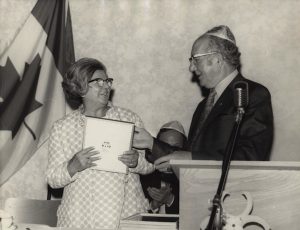
photo - B’nai B’rith, woman receiving an award, 1971
B’nai B’rith, woman receiving an award, 1971. (photo from JWB fonds, JMABC L.12175)

If you know someone in these photos, please help the JI fill the gaps of its predecessor’s (the Jewish Western Bulletin’s) collection at the Jewish Museum and Archives of B.C. by contacting [email protected] or 604-257-5199. To find out who has been identified in the photos, visit jewishmuseum.ca/blog.

Format ImagePosted on October 28, 2016October 27, 2016Author JI and JMABCCategories Mystery PhotoTags B'nai B'rith, JMABC, Louis Brier, seniors
JSA celebrates another year

JSA celebrates another year

At the recent Jewish Seniors Alliance annual general meeting, three volunteers were honored: Ralph Jackson, left, Bill Gruenthal, centre, and Milt Adelson. (photo by Binny Goldman)

The word used in praising or thanking someone in Hebrew is hodaya. Our foremother Leah said, “I will praise,” after the birth of her son and names him Judah (Yehuda), and todah comes from the same verb. On Sept. 15, the Jewish

Seniors Alliance of Greater Vancouver held its annual general meeting to say todah to its members and the community for helping it achieve its goals for the past year.

JSA president Marilyn Berger, along with Marshall Berger, opened the meeting, which took place at Congregation Beth Israel, with O Canada and Hatikvah, followed by a minute of silence for those members who died during the year.

Ezra Shanken, chief executive officer of the Jewish Federation of Greater Vancouver, spoke of connecting Greater Vancouver’s Jewish communities with organizations like JSA, which is playing a vital role in seeing that seniors can stay in their homes, and can live well into their “golden” years without fear of neglect.

Dan Ruimy, member of Parliament for Pitt Meadows-Maple Ridge, said that his trip to Israel reinforced his desire to get in touch with his Jewish roots. He said we need to work together to support Israel as well as our own local communities.

Adolf Zilbershtein, head of Most-Bridge Russian Jewish Seniors, works at connecting his 60 members to their Jewish roots, and integrating them into the larger Jewish community. He thanked JSA for the $1,500 grant Most-Bridge received and wished everyone a healthy 5777.

JSA treasurer Larry Meyer explained it is an ongoing effort to keep the books balanced, as grants are not constant, but that JSA maximizes the use of federal, provincial, municipal and private donations so that its programs, such as peer-support services, can continue to flourish.

Pam Ottem, chair of JSA’s peer support and senior counseling program, reported that the program is so well-known that there is a waiting list of people wanting to avail themselves of the vital service and those who wish to take the counseling course, which is offered at no cost. Thanks were expressed to Grace Hann and Charles Leibovitch who lead the program.

Lyle Pullan, membership chair, shared that there were 36 new members, 48 life members, 439 individuals, 128 Most-Bridge members and 20 affiliates. He encouraged attendees to pay their $18 membership fee and search out new members.

In her final report, Berger acknowledged the accolades she had received and the assistance of her “troika,” as she handed the gavel over to Ken Levitt. Bev Cooper was presented with a certificate in appreciation of her outstanding work.

Serge Haber, head of the nominating committee, read the slate of incoming board members and then welcomed Levitt as incoming president.

Levitt, in saying farewell to Berger, lauded her, stating that she had brought the care and concern of the needs of the community to each meeting, and that she will be a great role model for him to follow. Noting that Berger demonstrated every day her commitment to Yiddishkeit, Levitt presented her with a gift from JSA.

The dinner reception, which 185 people attended in the synagogue’s ballroom, was convened by Larry Shapiro and Barbara Bronstein and emceed by Jack Altman, who proved once more to be a master of wit and words, able to ad lib at will.

Three volunteers were honored for their time and service to others.

The first volunteer was Ralph Jackson, nominated by Royal Canadian Legion Shalom Branch 178. Jackson had served in many capacities and has now assumed the presidency. His twin granddaughters, in introducing the man they love as their grandfather, proudly announced that, although he turned 90 in August, Jackson still loves to dance and enjoy life.

He actually texts them on his iPhone and, occasionally, they even respond. Being of service to others has been a major part of Jackson’s life, including being president of the War Vets for many years – he can often be spotted selling poppies in November. Jackson said he truly appreciated the honor and sincerely thanked the legion and JSA for the evening.

Bill Gruenthal, nominated by the Jewish Museum and Archives of British Columbia, was introduced by Prof. Chris Friedrichs, who said seniors don’t suddenly wake up overnight and find themselves to be seniors but that they are part of a growing and giving community maturing along the way. Gruenthal was treasurer of Temple Sholom, where he also formed a 60-plus club. Born in Netanya and a staunch supporter of Israel, anyone traveling the forests of Israel will see the trees planted by Jewish National Fund because of Gruenthal. In thanking everyone for the honor given him, Gruenthal said he was especially glad that family had flown in from out of province for the AGM, making it a family reunion.

Before Levitt introduced the honoree nominated by JSA, Milt Adelson, who was treasurer of JSA for eight years, Beth Israel Rabbi Jonathan Infeld encouraged and praised JSA for doing all that it does for the Jewish community, and he encouraged everyone to heed the call to help when hearing the sound of the shofar this year.

In speaking of Adelson, Levitt said that stepping down from being JSA treasurer has allowed Adelson to take the many steps he takes daily, walking 8.5 miles a day – he counts his steps in miles and not kilometres. One of Adelson’s lesser-known feats is holding the record for the most French fries consumed at the Aristocratic restaurant. Adelson was also treasurer for L’Chaim Adult Day Centre and proudly advocates for people to “walk the talk,” and walk it with vigor. Saying that he is a doer, Adelson thanked JSA for honoring him, adding that no one can say no to Haber, a statement to which many can attest.

Because some of the dinner crowd had not been present at the AGM, Levitt again made a presentation to Berger for her dedication and service to JSA. He presented her with a collage of photos taken during her tenure as president – called “The Many Faces of Marilyn” – which was put together by Karon Shear and Jennifer Propp.

The salmon dinner was catered by Susie Siegel of Nava Creative Kosher Cuisine. Then, as part of the entertainment, Jackson serenaded his wife of 62 years with “Because of You,” which melted the hearts of the many romantics in the room. Lorraine Smith further tugged at people’s heartstrings by playing and singing special Jewish favorites.

The evening ended with wishes for a peaceful, productive and prosperous year ahead, and thanks to the conveners of the dinner, Shapiro and Bronstein, and to the office staff. The work of the many volunteers behind the scenes was also acknowledged. The video of the event, taken by Stan Shear, can be seen at jsalliance.org.

If it takes a village to raise a child, it takes community commitment and support to make sure that the world in which the child lives is secure and safe into its senior years.

Binny Goldman is a member of the Jewish Seniors Alliance of Greater Vancouver board.

Format ImagePosted on September 30, 2016September 28, 2016Author Binny GoldmanCategories LocalTags JSA, seniors
New hand chime choir

New hand chime choir

Chabad of Richmond’s new Chabad Hand Chime Choir is looking for additional members. (photo from Chabad of Richmond)

“We wanted to have more creative activities for seniors, something music-oriented,” said Rabbi Yechiel Baitelman about Chabad of Richmond’s new Chabad Hand Chime Choir. “Music helps with focus, builds concentration. Many of our seniors always wanted to have music in their lives, acquire musical skills, but they never learned to play, for various reasons. Now, with this choir, they can play wonderful music, be part of a team.”

The choir was formed after the federal government approved Chabad of Richmond’s application for a New Horizons for Seniors grant. The choir officially started in May and the first intake for members took place soon after; the second intake starts this month, and the third will begin in January.

The rabbi said that the first concert of the group was a big success. “They played at our annual summer barbeque,” he said. “The music included some Jewish tunes, popular songs. They are recording a CD now.”

Hand chimes were chosen, said Baitelman, “because most of our participants can’t read music notations. With hand chimes, each musician only plays one note on his chime, a part of a chord.”

Many music educators consider hand chimes the best instrument for beginners. Essentially, a hand chime is a percussion instrument, an aluminum tuning fork with a small mallet permanently attached to the handle. The length of the tines of the fork is responsible for the sound, which is one clear note. When a musician moves his hand holding the chime in a certain way, the mallet strikes the fork, and the chime resonates. The sounds produced are melodic and breathtakingly beautiful, and they last until the musician “damps” the chime by holding it to his hand or shoulder, thus stopping the vibrations.

Hand chimes are fun to play and easy to learn, which contributes to the self-esteem of the player, which is why they are often used in music therapy.

Hand chimes are cousins to hand bells and an ensemble of hand bells or hand chimes is called a choir, even though the musicians don’t sing. Like hand bells, hand chimes have a long history, dating back to China thousands of years ago. Those ancient chimes were made of bamboo, and the sound was created not by a mallet but by hitting the chime against a stationary object. Later, a musician would play his chime by striking it with a stick.

Since then, numerous inventors and manufacturers have strived to discover the best material for the chimes’ split fork and the mechanisms attaching the mallets. Amid these endeavors, between the two world wars, several radio stations used hand chime tunes – a few notes – as their audio signatures. By the early 1980s, hand chimes finally arrived at the design the Chabad Hand Chime Choir – and many other groups – are using today.

The Chabad choir includes seniors in their mid-60s to seniors 90-plus, and each rehearsal session usually counts 10 to 14 people. “Not everyone can come every week, for health reasons,” the rabbi said, “but all the members of the group are very enthusiastic about their music.”

Ron Philips, chosen to lead the new group, has years of experience in a variety of musical fields. “We wanted someone who knew not only music but also musical therapy and working with seniors, and Ron Philips answered all our needs,” Baitelman said.

“I wear many hats,” Philips told the Independent. “I’m a composer and a musician, an arranger and a voice teacher. I play several instruments – piano, guitar, bass, drums, flute – and I write music for films and various music projects.”

Having loved music in all its forms since childhood, Philips graduated from Douglas College with a music degree. He was the composer behind a number of locally produced films, including the award-winning Complexity (2011). He was involved with the Richmond Community Orchestra and Chorus and has worked on many other projects where music and community interests intersected. At the moment, he runs the Steveston Music Centre.

“When I was asked to conduct the Hand Chime Choir for Chabad of Richmond, I was glad to take on this new experience,” he said. “I believe this Hand Chime Choir gives the seniors participating in it a new connection to music.”

No prior music experience is required to be part of the choir. “We accept anyone who comes, as long as they have the love of music, the desire to learn and the willingness to participate in a team,” said Philips.

Anyone interested in trying out for the Chabad Hand Chime Choir should call Chabad of Richmond at 604-277-6427.

Olga Livshin is a Vancouver freelance writer. She can be reached at [email protected].

Format ImagePosted on September 2, 2016August 31, 2016Author Olga LivshinCategories MusicTags Baitelman, Chabad, choir, hand chime, Ron Philips, seniors

Posts pagination

Previous page Page 1 … Page 10 Page 11 Page 12 Next page
Proudly powered by WordPress