לא רואים סוף למשבר

ישראלים רבים לאור אירועי השבעה באוקטובר הפכו להיות פסימים ובצדק. הם לא רואים שום תמונה אופטימית באופק ופתרונות לסיום המשבר הבלתי נגמר

האחראי הישיר למשבר בישראל הוא ראש הממשלה בנימין נתניהו, שעושה הכל כדי להמשיך בתפקידו ולא מעניין אותו המחיר הכבד לכך. נתניהו כיום הוא אחד המנהיגים השנואים בעולם, כולל במרבית מדינות המערב וכן בישראל. היום רבים מבינים מיהו האיש, כיצד הוא פועל ומה האינטרסים שלו. מצער שהשבעה באוקטובר האירו בצורה רבה עד כמה ישראל לא היתה מוכנה, ועד כמה נתניהו מסוכן ולא יקח אחריות על מעשיו ומחדליו הרבים

בישראל העדיפו להגן על ההתנחלויות בשטחים הכבושים ואף לעבות אותן במקום להגן על גבולות המדינה. העדיפות ניתנה למתנחלים על חשבון תושבי ישראל. זו הקונספציה שנתניהו הוביל וזה מחדל אדיר שהוא לא יוכל להימלט ממנו

יש לא מעט שנוטים להעריץ מנהיגים שזה מנהג לא בריא שיכול להפוך למסוכן, כאשר מדובר באישים כמו נתניהו ודונלד טראמפ. הערצה לנתניהו לאורך השנים הרבות שבה הוא מעורב בפוליטיקה הישראלית, הפכה את תומכיו לעיוורים ואת נתניהו לנוכל. אהוד אולמרט נכנס לכלא על עבירות פחותות בהרבה מאלה של נתניהו, שמתכחש להן כמובן. נתניהו המכהן בתפקידוכשבעה עשרה שנים צבר עבירות רבות בתחומים שונים. הוא הפך לאיש עשיר, הוא מחזיק במספר נכסים וחשבונות בנק מנופחים. נתניהו ומשפחתו חיים ברמת חיים גבוהה והחשבונות מוטלים על משלם המיסים הישראלי

לאור שנותיו בפוליטיקה הבויל נתניהו מהלכים מסוכנים ביותר. הוא הוביל את ההסתה הרבתי שהביאה לרצח של יצחק רבין, הוא הוביל תוכניות רבות להרחבת והוספת  ההתנחלויות בשטחים שפוגעות קשות בעתיד של ישראל והפלסטינים. הוא לחץ על טראמפ לבטל את הסכם הגרעין עם איראן – כאשר המומחים לנושאי ביטחון בישראל טוענים שמדובר במהלך שגוי ומסוכן לישראל. נתניהו גם איפשר העברת כסף רב מקטאר לחמאס, ששימש לחימושו בממדים אדירים. עדיין לא ברור האם לנתניהו היה גם רווח אישי מהעברות כספים אלה

נתניהו בימי שלטונו – דאג במדיניות ההפרד ומשול שלו כמו דיקטטורים – ליצור וללבות שנאת אחים בתוך ישראל. המצב היום בחברה הישראלית הוא כה חמור שכבר אי אפשר לגשר על הפערים בין תומכי נתניהו למתנגדיו. התעמולה השיקרית המופצת על ידיי נתניהו, בנו יאיר ומקורבים אחרים ומכונה “מכונת הרעל” רק מוסיפה שמן רותח לסכסוך הפנימי בישראל. הגיעו הדברים לידי אבסורד כאשר תומכי נתניהו מאשימים את משפחות החטופים כאילו הן שייכים לשמאל. לא מעט משפחות החטופים הוכו ואויימו על ידי תומכי נתניהו. ומה תומכיו אומרים לישראלים יוצאי אירופה: תחזרו לאירופה כדי שהיטלר יחסל אתכם. דוגמאות אלה מוכיחות שמאז שנתניהו השתלט על ישראל, המדינה החלה להתפרק והתהליך המדאיג הזה רק מתעצם

תומכי נתניהו מעריצים דמות בעייתית לא פחות והיא טראמפ. הם מאמינים כי רק טראמפ ידאג לישראל. לעומתו המועמדת השנייה לנשיאות בארה”ב, קמלה האריס, לא תדאג לישראל. הישראלים התומכים בטראמפ עיוורים למעשיו המסוכנים ורצונו להפוך לדיקטטור. כידוע הישראלים ונתניהו בראשם לא מסתכלים על התמונה הכוללת, אלה רק על היום ומחר. מבחינתם טראמפ יפתור את הבעיות של ישראל היום ומחר. הם לא קולטים עד כמה טראמפ מסוכן לארה”ב ולמערב, ולכן גם לישראל. אם טראמפ יחזור לשלטון יחליש הדבר את ארה”ב וזה בדיוק מה שרוצים ברוסיה ובסין. בישראל כיוון שלא חושבים על העתיד לא מבינים עד כמה ארה”ב חלשה תחליש גם את ישראל

More than an edgy cabaret

Left to right: Shane Baker, Sasha Lurje and Michael Wex in The Last Night at the Cabaret Yitesh (Di Letste Nakht Baym Yitesh), which closes this year’s Chutzpah! Festival Nov. 9-10. (photo by Shendl Copitman)

“The final sketch in the show, ‘The Last Jew in Poland,’ is based on a real 1930s cabaret sketch of the same name that got Ararat, the famous Yiddish cabaret, closed down,” said creator Michael Wex of The Last Night at the Cabaret Yitesh (Di Letste Nakht Baym Yitesh), which plays at the Rothstein Theatre Nov. 9-10 as part of the Chutzpah! Festival.

“The sketch, however, hasn’t survived,” he continued. “Shimon Dzigan (of Dzigan and Shumacher), who was a member of the troupe, describes the general set-up of the piece in his autobiography, but doesn’t give many details, except to say that everybody involved expected to be arrested the next day (and was surprised not to be). I’ve tried to reconstruct something that would have bothered the censors of the 1930s as much as the original.

“‘Di Endekuvne,’ one of the genuine old songs in the show, was actually banned following its first performance,” he said.

The Last Night at the Cabaret Yitesh is set in Poland in the spring of 1938. With only one performance left before the censor’s office closes the cabaret, and with their visas secured to leave the country, the performers decide to put on a show of forbidden material and greatest hits.

The idea for The Last Night at the Cabaret Yitesh came from Andreas Schmitges of Germany’s Yiddish Summer Weimar, who called Wex with a request.

“Since 2019 was the 100th anniversary of the Weimar Republic, Yiddish Summer was planning a commemorative program and Andreas wanted to know if I could put together a Yiddish-language cabaret revue that would reflect the way Yiddish culture absorbed and was influenced by the zeitgeist of the Weimar era,” said Wex.

photo - Michael Wex
Michael Wex (photo by Zoe Gemelli)

Wex, who is Canadian, is an internationally recognized expert on Yiddish. He has many nonfiction books to his name, including Born to Kvetch: Yiddish Language and Culture in All of Its Moods, on the history of Yiddish, and Rhapsody in Schmaltz: Yiddish Food and Why We Can’t Stop Eating It. He’s also a translator, novelist, playwright, columnist, public speaker and performer. His creative process involves much research. For Schmitges’ proposed project, Wex first sought out surviving Yiddish cabaret material.

“I dove into scores of books, listened to even more recordings, in search of authentic material that would still resonate with a 21st-century audience,” he said. “Much of the older material just didn’t ‘read’ anymore: there were a lot of jokes about local politics and references to long-forgotten celebrities. There was fairly strong political censorship in interwar Poland, especially in the years following the Nazi takeover of Germany, which means that much of the surviving satirical material is pretty bland. I deliberately sought out lesser-known Yiddish cabaret songs, including at least one that was never recorded.

“My next resort was to see what was going on in non-Yiddish Polish culture at the time. I went through newspapers from the period to try to figure out how much international pop culture was available in 1920s and ’30s Poland and was delighted to find that Hollywood movies that would have played in Vancouver in, say, 1934, were playing in Warsaw at pretty much the same time, and that Louis Armstrong records were on sale in Warsaw record stores. I looked at the pop music charts: the most popular song in Poland in 1928 was ‘Ain’t She Sweet’ translated into Polish. This information widened the range of material that could plausibly be presented as being performed at the time and gave me the licence I needed to adapt and translate some well-known pop songs of the era into Yiddish.”

photo - Patrick Farrell in The Last Night at the Cabaret Yitesh (Di Letste Nakht Baym Yitesh), which is at the Rothstein Theatre Nov. 9-10
Patrick Farrell in The Last Night at the Cabaret Yitesh (Di Letste Nakht Baym Yitesh), which is at the Rothstein Theatre Nov. 9-10. (photo by Shendl Copitman)

Wex wrote some songs and sketches to round out the show, then came up with the storyline that adds context: the performers whose cabaret is about to be closed, but who have ship tickets and visas to leave the country.

“Suddenly, they’re free to perform what they want to, not only what they’re allowed to,” said Wex, who also directs and acts in The Last Night at the Cabaret Yitesh.

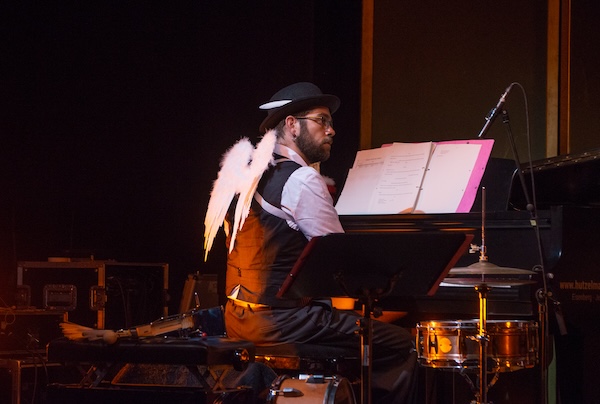
The other people involved – Shane Baker (United States; co-director, performer), Patrick Farrell (US/Germany; original music, arrangements, piano, accordion, percussion), Regina Hopfgartner (Austria; vocals), Daniel Kahn (US/Germany; vocals) and Sasha Lurje (Latvia/Germany; vocals) – “are the people for whom the show was written,” Wex said. “It’s like an A-list of contemporary Yiddish performers and I recall telling Andreas that I wouldn’t do the show without them. It was my one diva moment – but I think it worked.”

The current incarnation of the show premièred at the Ashkenaz Festival in Toronto in 2022. It had changed so much from the 2019 Yiddish Summer Weimar production that, Wex said, “Weimar could almost be seen as a workshop.”

For Wex, giving audiences an idea of what 1938 Poland was like is important “because the whole world is looking more like 1938 Poland with every passing day.”

“Arts and culture,” he said, “including but not limited to comedy and music, is really the best way we have of trying to find a common ground from which to understand conflict, stand up to tragedy and, ultimately, seek out ways to mitigate or ameliorate the feelings and attitudes from which such conflicts and their accompanying tragedies have grown. As we see every day, shouting slogans might make us feel good and brave and involved but it does nothing to establish the common ground necessary to arrive at any kind of understanding with our opponents. Arts and culture, comedy and music – they’re all bulwarks against dehumanization.”

The Last Night at the Cabaret Yitesh is in Yiddish with English supertitles. For tickets, go to chutzpahfestival.com – where you’ll find the whole Chutzpah! lineup – or call 604-257-5145. The festival runs Nov. 1-10. 

And the winner is …

The recent British Columbia provincial election was one of the closest in history – so close that the result is not yet certain. By press time, the incumbent New Democratic party was leading or elected in 46 seats, the Conservative party in 45 seats and the Green party held two. While 47 seats are needed for a majority government, that number would represent a very precarious situation from which to govern.

Recounts are taking place, as is the counting of 49,000 absentee ballots that have not yet been tabulated. With several ridings featuring races divided by just dozens of votes, it remains possible that either the NDP or the Conservatives could form government when the dust settles.

The likeliest scenario echoes the tight 2017 election, which resulted in a minority government. A supply and confidence agreement between the Green party and John Horgan’s New Democrats made Horgan premier and allowed him to govern for more than three years as if he had a majority.

Many Jewish voters took special interest in this election. Provincial and municipal elections have not generally carried the same level of interest around specifically “Jewish issues” as a federal election, but that is less true now. While Jews obviously share the same policy interests as other British Columbians, and have the full diversity of opinions as other voters, current events added gravity to this campaign.

There has been an alarming increase in antisemitic rhetoric and incidents. This has magnified attention on issues that fall at least partially under provincial jurisdiction, like public security, police enforcement and prosecution of hate laws, education and public sensitization around multiculturalism and intercultural harmony, and a host of other topics.

Regardless of who forms government, both parties have expressed commitment to the implementation of mandatory Holocaust education, something that was announced by the last NDP government.

Some Jewish British Columbians felt a sense of betrayal by the treatment of former NDP cabinet minister Selina Robinson, who was fired from cabinet after referring to pre-state Israel as a “crappy piece of land.”

The election of Nina Krieger, the NDP candidate in the riding of Victoria-Swan Lake, will certainly reassure Jewish voters that they have a voice if the New Democrats form government. Krieger is a member of the community and was a longtime executive director of the Vancouver Holocaust Education Centre. Her expertise will be invaluable as the province operationalizes the Holocaust education curriculum and as a liaison with the Jewish community.

The new Conservative caucus also has many vocal allies, including Claire Rattée, in the far northwestern BC riding of Skeena, who is Jewish, and many others who have made efforts to connect with the Jewish community over the past year especially.

Both Krieger and Rattée were profiled in the last issue of the Independent.

All parties made the right noises toward the Jewish community during the election campaign. Politicians, of course, are generally good at making the right noises. Follow-through is what matters.

We are encouraged that, during the campaign, the Jewish community and the Middle East conflict were not exploited as wedge issues by any party, a tendency we have occasionally seen at the federal level.

The apparent lack of polarization around issues important to Jewish people is a bright light in a deeply polarized province. With the collapse of BC United, the erstwhile BC Liberal party, the centre of the political spectrum became something of a vacuum. Not only did the Oct. 19 election indicate a stark binary between left and right in the province – not a particularly new phenomenon here – but urban/rural divisions have rarely been more pronounced. To look at a map of the province after the election is to see an ocean of blue, with the Conservatives having won almost every rural seat. New Democrats won all but a single seat in the city of Vancouver and the rest of their caucus is almost entirely from urban centres and the close-in suburbs.

There is an adage that has rarely been more apt: “In the Maritimes, politics is a pastime, in Quebec a religion, in Ontario a business, on the Prairies a cause and, in British Columbia, entertainment.”

By the time you read this, perhaps we will know who the premier will be. Perhaps not. In times of uncertainty, we can guarantee this: expect no dull moments. 

Politicians make their pitches

BC New Democratic Party candidate Kelly Greene, left, represented the incumbent party in Richmond-Steveston, and BC Conservative Party candidate Michelle Mollineaux, who is challenging Greene for the seat, spoke at a candidates forum last month, hosted by Beth Tikvah and CIJA.

British Columbia’s Oct. 19 election is now short days away. While provincial politics has not traditionally been a forum for issues of culturally specific concerns to Jewish voters, matters like public safety in response to rising antisemitism, and problematic developments in the education system, have focused attention for Jewish voters.

These concerns took centre-stage at a candidates forum co-organized by Beth Tikvah Congregation, in Richmond, and the Centre for Israel and Jewish Affairs Sept. 22. Hate crimes, British Columbia’s Anti-Racism Act, the definition of antisemitism, communal security, law enforcement and a host of other issues were addressed by election candidates representing the BC New Democratic Party and the BC Conservatives. The BC Green Party was invited to send a representative but did not.

Kelly Greene, the NDP member of the legislative assembly for Richmond-Steveston, represented the incumbent party. She said she has been having conversations with parents and students who are experiencing antisemitism.

“There is fear where there wasn’t before,” Greene said, declaring that schools need to be safe and welcoming for everyone. She pointed to the NDP government’s commitment to implementing mandatory Holocaust education and said the NDP government has instituted a “suite of actions,” including improved antiracism data collection, new hate crime policies for prosecutors to address wilful promotion of hatred, and the creation of a racist incident hotline.

More needs to be done, she acknowledged. “It is a work in progress, to be honest,” she said.

On the International Holocaust Remembrance Alliance (IHRA) Working Definition of Antisemitism, Greene said the government needs “to be nimble” and should avoid including specific definitions in legislation. She cited the spike in anti-Asian hate during the COVID pandemic as an example of unanticipated incidents, responses to which could be hindered by narrowly defined descriptions of the problem.

The Conservatives disagree on this point. Michelle Mollineaux, the Conservative candidate challenging Greene in Richmond-Steveston, said her party – win or lose – will bring the adoption of the IHRA definition to the floor on the first day of the new legislative session.

Mollineaux noted that her party has released a comprehensive antisemitism strategy, in which they promise a special advisor on antisemitism and Jewish community affairs, collaboration for safety in the community and schools, and an investigation into bias in classrooms.

“Antisemitism is the most heinous crime against the Jewish community,” said Mollineaux, who called for more antisemitism programs in schools and increased education about Jewish people, history and the Holocaust.

“Oct. 7 was a reflection of the ignorance of what the Jewish people have been facing,” she said.

No ideologies – or Palestinian flags – should be allowed in public school classrooms, Mollineaux said. “Children need to feel safe,” she said. “Students are not safe”

Mollineaux said, “Universities should limit the amounts of protests that are going on. Those kinds of ideologies have to stop.… What they’re doing is wrong because it breeds hate.”

Addressing legislation that would create “bubble zones” around sites such as Jewish schools and community centres to prevent disruptive protests, New Democrat Greene called it a “sad reflection” that any institution needs such protections, as hospitals did during the pandemic to prevent anti-vaccine activists from impeding access to facilities.

Mollineaux did not disagree with the possibility of using bubble zones but said there needs to be more focus on the underlying problems. Education, embracing all cultures and “understanding where we came from,” must be the means to making such bubble zones unnecessary.

“How many bubbles do we have to keep building?” she asked. 

Shane Foxman, a former journalist and now director of development for Vancouver Talmud Torah elementary school, moderated the forum, and asked why public expressions that seem to contravene hate crime laws are not resulting in criminal charges.

Greene responded that the New Democrat government has hired more prosecutors to reduce the workload and provided new guidelines to the Crown on suspected hate crimes.

Mollineaux said “police are under-resourced” and alleged that courts give “a slap on the hand” to perpetrators so that victims are revictimized and offenders “get off scot-free.” She called the court system a “revolving door.” She also called for mandatory antisemitism training for all police and politicians. 

“We need to get this under control,” she said.

On the cost of living and issues affecting children and families, both candidates agreed that more needs to be done. 

Mollineaux said children with special needs are not getting the educational supports they require and children in provincial care are aging out and becoming homeless adults. 

On housing, Greene noted that the most recent statistics show rental prices declining in Metro Vancouver, even as they rise across Canada. She said the speculation and vacancy tax has freed up 20,000 more units of housing, while the government is building more. 

Access to family doctors is improving, Greene added, with more than 800 family doctors hired in the last year alone.

Beth Tikvah’s Rabbi Susan Tendler delivered an Indigenous land acknowledgement and blew the shofar.

Another Jewish community election forum, featuring candidates in the riding of Vancouver-Langara, was to take place Oct. 9, after the Independent’s deadline.

The election landscape took a dramatic turn last month, when an agreement between Conservative party leader John Rustad and BC United leader Kevin Falcon resulted in BC United (formerly the BC Liberals) suspending their campaign in an effort to unite the right-of-centre vote. Some former BC United candidates are now running as independents, including two in Richmond.

Election day is a Saturday, but there are many ways to vote. Anyone can vote by mail. Advance voting is available at designated locations in every constituency Oct. 10-13 and Oct. 15-16 from 8 a.m. to 8 p.m. Voting is also possible at any district electoral office. Full details are available at elections.bc.ca. 

The Centre for Israel and Jewish Affairs has a BC Election Hub at cija.ca/bc_election_hub. This resource outlines community priorities and contains a range of other information. CJPAC, the Canadian Jewish Political Affairs Committee, has election-related information at cjpac.ca. 

Running on core values

Nina Krieger is the BC New Democratic Party candidate in the riding of Victoria-Swan Lake on Vancouver Island. (photo from ninakrieger.bcndp.ca)

Nina Krieger, former executive director of the Vancouver Holocaust Education Centre, will be the New Democratic Party candidate for Victoria-Swan Lake in the Oct. 19 provincial election. She will be vying for the seat vacated by the minister of transportation and infrastructure in the present cabinet, Rob Fleming, who announced this summer that he will not be seeking reelection.

Krieger told the Independent that her work at the VHEC and her decision to seek public office were inspired by having grown up in a family of teachers, with a father who was a union leader, and the values that permeated her home: education and helping others.

“In my household, I learned about the importance of institutions in society, such as unions, that support people when they are facing challenges,” said Krieger, who believes that the BC NDP have acted on this philosophy while in government.

Krieger was the VHEC’s executive director for 12 years and its education director for six. Under her stewardship in recent years, she has positioned the VHEC, located in the Jewish Community Centre of Greater Vancouver, to be part of JWest, the redevelopment of the JCC, which will mean increased availability of childcare, more seniors services, and expanded arts and cultural spaces, among other things. 

“The forward-looking and hopeful work of VHEC and the JWest project speak to the shared responsibility to uplift one another, which is at the heart of my values, Canadian values and the BC NDP’s values,” Krieger said.

Her choice to enter the political arena during this, in her view, critical election is led by a desire to bring people together in this era of increased social and philosophical polarization.  

“I would like to use my voice, and my experience as someone who has led and bridged communities, to work to build a better BC for all. Times are challenging right now, and I believe that we need a government that is fighting for you and your family and your ability to live a good life,” Krieger said.

Similar to ridings throughout the province, housing, health care and the cost of living are top-of-mind for voters in Victoria-Swan Lake. Krieger points to plans the NDP has put in place to build hundreds of thousands of new homes and dozens of new hospitals, to reduce ICBC rates and to lower the costs of childcare. Each of these items, she warned, could be on the budgetary chopping board were John Rustad and the BC conservatives to take power.

“We all want the same things: to afford the costs of everyday life, to have access to quality health care when we need it, and to have strong services that we can count on, from childcare to long-term care. We want to be part of strong, safe, prosperous and caring communities,” Krieger said.

One consistent thread in the NDP’s campaign has been to draw attention to the propensity of some in the BC Conservative Party to lend to too much credence to, if not openly adhere to, conspiracy theories. 

“As a Holocaust educator, I know about the danger of conspiracy theories. Students of history and observers of politics know that conspiratorial rhetoric has real consequences. It sows distrust in government and distrust between communities and between neighbours,” Krieger said. “Unfortunately, John Rustad and several BC Conservative candidates have a track record of peddling untruths and conspiracies, something that is dangerous to the fabric of civil society.”

Krieger is one of two Jewish candidates known to the JI among the more than 300 people competing for 93 seats in the 2024 race. In this capacity, and as someone who has led a Jewish organization, founded by Holocaust survivors, she believes she can serve as a connection between government and the Jewish community, so that government understands the experiences of Jews in the province, and can act in a way that is guided by this understanding. 

“I am committed to bringing my experience and insights to the vital task of building a more just and inclusive society, where the safety, security and well-being of Jewish people and all people are prioritized,” she said.

Amid the surge in antisemitism across the province and around the world since the Hamas attacks on Israel a year ago, Krieger sees a role for an MLA to connect with Jews in British Columbia. She said she has experienced the same pain and anxiety many in the Jewish community have felt in the wake of Oct 7.

“Countering antisemitism requires a whole-of-society commitment that includes the active participation of governments and civil society. If I am elected, I will do my part and will connect with Jewish constituents to ensure their lived experiences are brought forward in provincial discussions,” Krieger said.

Premier David Eby understands these concerns, Krieger said, pointing to a hate-crime prosecution policy that includes fighting antisemitism and the provision of anti-hate security funding to the Jewish Federation of Greater Vancouver. Nonetheless, she and Eby agree that more needs to be done to ensure everyone in the province feels safe.

Although foreign affairs are not a provincial matter, Krieger said MLAs play a critical role in listening to local communities affected by global conflicts and in supporting people in British Columbia by providing a sense of security. Moreover, she stressed, many in the province are deeply affected by the Israel-Hamas war and it is distressing for all people of good conscience to witness suffering and the loss of life.

“While the conflict in the Middle East will not be solved at the provincial level, there is a responsibility to counter antisemitism, Islamophobia and hate of all forms in our society, and to ensure that people feel safe in our public spaces and public institutions,” Krieger said.

As head of the VHEC, Krieger consulted with the Ministry of Education and Childcare about making Holocaust education mandatory for high school students in the province, starting in the fall of 2025.

“We know that learning about the Holocaust can help young people be more resilient to antisemitism, xenophobia and conspiracy theories,” she said. “If elected, I would welcome an opportunity to contribute to ongoing efforts to strengthen Holocaust education and combat antisemitism.”

Should she win a seat, Krieger imagines that she also will have a role to play in ensuring that there is a diversity of lived and professional experiences around the caucus table, and in bringing her expertise with intercultural work, as well as countering antisemitism and hate, to the role of MLA.

There is a great deal at stake in this election, Krieger said, and this was her motivation to seek office under the NDP tent. The NDP’s seven-year tenure, she said, has made strides in improving housing, health care and affordability. 

“Now is not the time for cuts to programs and services. Now is not the time to take away cost savings. Now is not the time to cancel initiatives that are starting to make a difference in the lives of people. Now is not the time to question climate science or make decisions based on conspiracy theories,” Krieger said.

Since its formation in 2009, the Victoria-Swan Lake riding has voted solidly in favour of the NDP, with Fleming obtaining a sizable majority in each of the last four provincial elections. 

Sam Margolis has written for the Globe and Mail, the National Post, UPI and MSNBC.

Issues close to heart

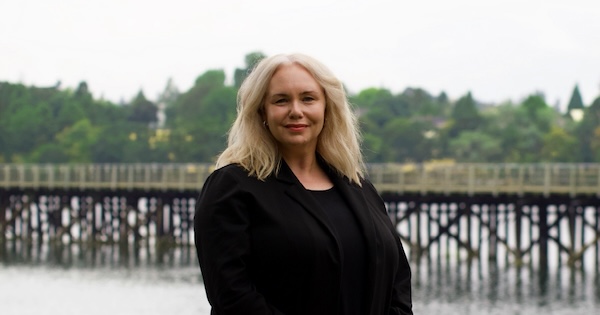
Policy priorities of Claire Rattee, the BC Conservative Party candidate in the riding of Skeena, include mental health and addictions, low-income housing, emergency weather shelters, economic development, and antisemitism. (photo from conservativebc.ca)

There is not much of a Jewish community in Kitimat, but Claire Rattee hopes that, if she is elected to the legislature in the northwest riding of Skeena this month, she will be able to raise the visibility.

Rattee originates from the Lower Mainland and moved to Kitimat 13 years ago. She served a term on Kitimat city council, ran twice for the federal Conservatives and is now seeking to be elected as the Conservative MLA for the sprawling riding, which encompasses Terrace, as well as Kitimat, and smaller communities along the Alaska border and in the interior of the region. The constituency has a history of swinging between parties. It has been won in the past two elections by Ellis Ross, who was elected as a BC Liberal and is leaving provincial politics to run federally as a Conservative. The Liberal party became BC United and subsequently folded its campaign. Rattee said the decision to unite the right-of-centre campaign was felt palpably in her door-to-door campaigning.

“We were already looking very good here in this riding at that point,” she said. “But that definitely changed things significantly.… Now, it’s essentially just going to be a two-way race between myself and the NDP candidate.”

Rattee is running against Terrace city councilor Sarah Zimmerman, who was nominated as the BC NDP candidate in June.

Close to Rattee’s heart are policies around support for people experiencing addictions.

“In my later years of high school, I basically had some problems with drugs … where I was in active addiction and my family was obviously trying to help me to get out of that and, eventually, I decided that I was ready,” she told the Independent.

Rattee turned 19 in treatment and then thought a change of environment would be helpful. After moving to Kitimat, she became an entrepreneur and sought to get involved in the community. 

“Obviously, with my background, I’ve got a lot of passion for addressing the issues of mental health and addictions,” she said. “The lack of treatment facilities in this region is extremely frustrating for me, just based on the experiences that I went through.” 

Low-income housing and emergency weather shelters for people experiencing homelessness are also priorities. Economic development in the region is an issue she championed on council, she said, and she wants the area recognized as the economic driver it is in the province.

Rattee’s parents converted to Judaism around the time she was born, she said, but sent the kids to Christian schools.

“We are not Orthodox,” she said. “My father ran a sort of church service and we had about 50 people that were a part of that organization and my father still runs Bible study every Saturday and I try to partake in that via Zoom when I can.”

Asked to clarify if she considers herself Christian or Jewish, Rattee said that she and her three siblings consider themselves Jewish.

“It’s a little bit confusing,” she said. “Not to get into the weeds on it too much, but I would essentially consider ourselves converts. My father was raised Catholic but he converted to Judaism when I was born and so we follow Torah, we respect the Talmud, but we’re not Orthodox.” Her mother also converted, she said, but returned to Christianity after the parents separated.

Rattee said she is proud that her party has released a “comprehensive antisemitism strategy.” The proposal, unveiled Sept. 20, calls for the adoption of the International Holocaust 

Remembrance Alliance’s definition of antisemitism; linking funding for universities to accountability on student safety, including that of Jewish students; launching an investigation into Samidoun, a Vancouver-based group with ties to extremism; increased provincial funding for JWest, the redevelopment of the Jewish Community Centre of Greater Vancouver; and an inquiry into the BC Teachers’ Federation on issues of Israel and Palestine, among other commitments.

“Particularly right now in this political climate, we’re seeing a significant rise in antisemitism,” said Rattee. “We’ve been very clear from the outset, our party leader has been clear from the outset, that we stand with the Jewish people, we stand with Israel.” 

Seniors advocates honoured

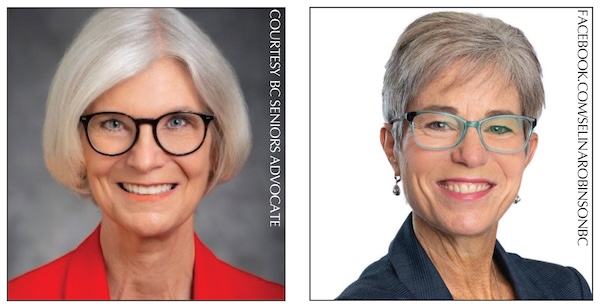
Isobel Mackenzie, left, and Selina Robinson will be honoured at Jewish Seniors Alliance’s AGM Nov. 3.

The Jewish Seniors Alliance of Greater Vancouver’s annual general meeting on Nov. 3 will serve as an opportunity to welcome the organization’s first-ever executive director, Jeff Moss, and to honour two prominent women in provincial politics who have been dedicated to seniors throughout their careers: Selina Robinson and Isobel Mackenzie.

JSA chair Tammi Belfer will introduce Moss, whose hiring marks a significant change in the alliance’s 21-year history. The shift, she said, will enable the board of directors to focus on policy-making and high-level planning, while collaborating with the new executive director and staff on implementation. 

“This transition is a gradual process, and I want to extend my heartfelt thanks and appreciation to each board member for their years of unpaid work,” said Belfer. “Together with our executive director, we can now strategically plan every event, raise much-needed funds, and improve and expand our services to our ultimate clients – the seniors of Greater Vancouver, the Lower Mainland, and the entire province.”

Moss told the Independent that he is looking forward to his first AGM as executive director, a job he started in July, and that, in his new position, he plans to recognize the past and look ahead to the future of the “modern, inclusive and dynamic charity.”

“I am pleased to work alongside our incredible community partners, with the support of our generous donors, a committed board and motivated staff,” he said. “I look forward to continuing to build on our strong reputation for positively impacting the lives of lonely and isolated seniors.”

Belfer praised Moss as JSA prepares for its move away from an operational board, noting that the coming year will not be an easy one, but it will be exciting.

“Jeff and I form a great partnership and I hope, together, we bring the name and extreme value of JSA to the forefront of all seniors. This population is growing and the need is increasing. Vancouver and BC can count on us to be there for seniors. We are seniors stronger together,” she said.

“Jeff’s caring nature and strong management skills are the exact combination we need for our first executive director,” she added. “When he reaches out to you, make a point of meeting with him – you are in for a treat.”

Robinson, who has been the member of the legislative assembly for Coquitlam-Maillardville since 2013, is not running for reelection on Oct. 19. She made the decision to retire for several reasons (jewishindependent.ca/the-aftermath-of-resignation) and is in the final stages of writing a memoir, which is set for release in November.

Before gaining a seat in the legislature, Robinson worked as a family therapist and was a city councilor in Coquitlam for two terms. Her career includes having been associate executive director of Vancouver’s Jewish Family Service Agency. As an MLA, she served as opposition critic on seniors, mental health and addictions, and other issues. In government, she served as minister of municipal affairs and housing, and as British Columbia’s finance minister. She was minister of post-secondary education and future skills until earlier this year.

“Representing people in my community and being their voice in government has been the greatest honour, and having JSA acknowledge that work warms my heart,” Robinson told the Independent. “Thank you, JSA, for being such great partners.

“Jewish Seniors Alliance understands that, in order to have a strong community, you need to make sure that the community has what it needs,” she said. “JSA engages Jewish seniors to provide them with services and supports, and to better understand their needs so that they can advocate for resources to better meet those needs.”

Mackenzie – who is nominated for a term this year on JSA’s board of directors – served for 10 years under both Liberal and NDP governments as the province’s first seniors advocate, before her retirement earlier this year. Her efforts won her widespread plaudits and dispelled initial skepticism concerning the effectiveness of the new office.

In a piece for the Orca in March, shortly after it was announced that Mackenzie would leave her role as seniors advocate, political commentator Rob Shaw wrote, “She left widely respected by all sides at the legislature, inside the Ministry of Health and even amongst the seniors care groups she has occasionally clashed with in her reports.

“Mackenzie’s work highlighting care hour shortages in long-term care homes, first-bed refusal policy problems, partners split up in assisted living, consent and admission concerns, and the underperformance of private long-term care facilities using public funding have all led to government reforms. She created a useful and relevant database on care homes. And she’s still fighting for a hike to the Shelter Aid for Elderly Renters (SAFER) rates.”

In the 1990s, long before she became the province’s seniors advocate, Mackenzie was chief executive officer of the provincial nonprofit Beacon Community Services, where she led a new model of dementia care that has become a national best practice, and established safety accreditation for home-care workers.

Jewish community member Dan Levitt is the new provincial seniors advocate, taking over from Mackenzie. 

The JSA AGM on Nov. 3 will be held at Congregation Beth Israel, starting at 5 p.m. Dinner tickets are $75 and attendees are requested to RSVP by Oct. 20 to office@jsalliance.org or 604-732-1555. 

Anyone who has made a donation to JSA of $18 or more in the past 12 months is considered a member in good standing and is eligible to vote at the AGM. 

Sam Margolis has written for the Globe and Mail, the National Post, UPI and MSNBC.

Relations at low ebb: Shamir

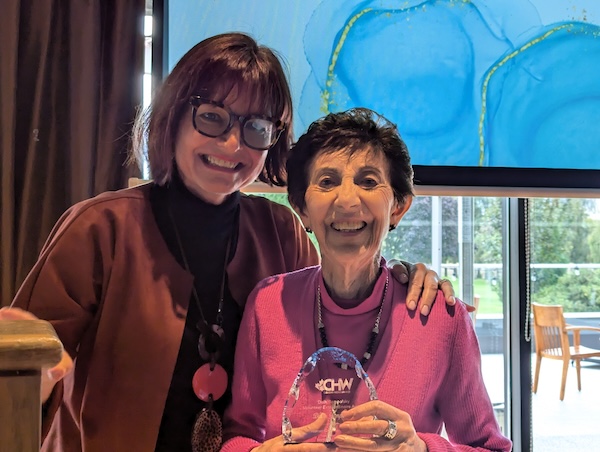
Claudia Goldman, left, presents Bev Corber with the Claudia Goldman Award for Excellence in Leadership. (photo by Pat Johnson)

Diplomatic relations between Israel and Canada have never been worse, according to Israel’s envoy to Toronto and Western Canada. 

“The relationship between Israel and Canada is at an all-time low,” said Idit Shamir, consul general of Israel for Toronto and Western Canada. “Canada, according to many, has abandoned Israel, the only democratic ally they have in the region.”

Speaking via remote video link to the opening event of the Vancouver branch of CHW (Canadian Hadassah-WIZO) Sept. 22, Shamir cited, among other things, the Canadian government’s legitimizing of Hamas information, rather than Israeli government sources, when commenting on the conflict.

“Many times, they have been proven as mistaken,” said Shamir. “Not as many times, they have taken the time to correct themselves.”

Canadian Jews are asking themselves if there is a future for their families in Canada, the envoy said. 

“This is a question that I don’t think was asked here before Oct. 7, and that’s very, very sad,” said Shamir.

Israelis and Canadians alike were shocked by the alarming spike in antisemitism in Canada and worldwide in recent years, but especially in the past 12 months, she said. 

Shamir addressed concerns about the climate on university campuses and even in public elementary and secondary schools. She spoke just after the controversy erupted over an officially sanctioned Toronto public school field trip to what evolved into an anti-Israel rally. 

Making Jews unwelcome on campuses will have negative repercussions for the entire society, she said.

“Jews have been instrumental in the university system here, and pushing them out is going to have a serious impact on the future of Canada,” she warned.

Regrettably, Shamir said, Canada has been the launchpad over the years for several negative developments, including Israel Apartheid Week, which began at the University of Toronto before spreading internationally, and, more recently, the concept of “anti-Palestinian racism,” which was adopted as policy by the Toronto and District School Board. The idea, she said, paints any expression that is critical of the prevailing Palestinian narrative as racist.

“When you see that happening already at the elementary school level, we can imagine the depth of indoctrination that is going on in the universities,” said Shamir.

On the positive side, the consul general said, opinion polls indicate that most Canadians support Israel. 

“Most Canadians can understand that … we didn’t choose this war,” she said. “We are fighting a war for our survival, for the survival of the only Jewish democracy and country in the world. And now we understand more than ever the need for a safe haven for Jews.”

Among the 101 hostages remaining in captivity, Shamir said, the Israeli government believes more than half remain alive. The body of Judy Weinstein Haggai, a dual Canadian-Israeli citizen who is known to have been killed, remains in Gaza.

“The hostages are the utmost priority,” Shamir said, “releasing the ones who are alive and returning the bodies of those who are not.”

She linked the Gaza conflict to wider geopolitical issues, pointing to Iranian-backed forces launching missiles from Lebanon, Iraq and even Yemen. She was speaking before Iran launched more direct attacks on Israel Oct. 1.

“We cannot forget that Iran is behind this, and we can see that rockets are coming from Iranian-sponsored sources in places we would not have imagined,” she said.

In response to these challenges, the consul general called for unity among the Jewish community and its allies, stressing the need for resilience and solidarity.

Noting that “Jews are coming together and becoming a united force to be reckoned with in Canada,” Shamir said members of the Jewish community must remain vigilant and continue to fight antisemitism and support Israel.

The envoy lauded CHW’s long-standing efforts to empower women and children, provide health care and assist displaced Israelis.

“It’s a labour of love that touches hearts and changes lives every single day,” she said.

The CHW Vancouver event, held at the Richmond Country Club, benefited the Michal Sela Forum, an Israeli organization dedicated to preventing domestic violence through innovative technology and collaboration.

photo - Toby Rubin, president of CHW Vancouver, presents the inaugural Dolly Jampolsky Volunteer Extraordinaire Award to Jampolsky
Toby Rubin, president of CHW Vancouver, presents the inaugural Dolly Jampolsky Volunteer Extraordinaire Award to Jampolsky. (photo by Pat Johnson)

Longtime CHW leaders Beverley Corber and Dolly Jampolsky were the honourees. Corber received the Claudia Goldman Award for Excellence in Leadership, and Jampolsky received the inaugural Dolly Jampolsky Volunteer Extraordinaire Award. Sylvia Cristall and Claudia Goldman were inducted into the CHW Lillian Freeman Society by Lisa Colt-Kotler, national chief executive officer of CHW, who spoke at the opening and interviewed the consul general. Toby Rubin, president of CHW Vancouver, emceed the event. 

Eby talks about record, plans

BC Premier David Eby says election is “about the values of who we are as a province and how we move forward on the big issues of our time.” (photo from news.gov.bc.ca)

David Eby, the incumbent BC premier and leader of the New Democratic party, assured Jewish voters that, if reelected Oct. 19, his government would have their backs.

Speaking with the Jewish Independent, Eby said the loss of Selina Robinson as a cabinet minister and then as a New Democrat caucus member earlier this year was a blow, but that his government is committed to the issues that are important to Jewish British Columbians.

“It was really tough for our caucus and for our government to lose Selina,” Eby said. “She was a major contributor to our team. It’s hard to really quantify that kind of emotional feeling that a lot of people on our team have around the loss, of not having her being part of our team going forward. But it hasn’t slowed down our work and our commitment to the overall Jewish community and our efforts to fill the role that she did as a critical bridge between our caucus and the broader Jewish community.”

Eby and his party have been working with community agencies to fight antisemitism and to increase security for Jewish institutions, he said. 

“We’ve been working closely with a number of Jewish organizations to identify ways that we can provide support in this incredibly challenging time where we see this rise in antisemitism and some really disturbing behaviour targeting Jews, everything from the horrific arson attack [against Schara Tzedeck Synagogue] to slurs that people are enduring in the street,” he said. “From increasing support for security for synagogues and Jewish community centres, mandatory Holocaust education deployment, making sure that that is a reality in our schools in the province, we’re working on that together.”

He also cited British Columbia as “having the strictest standards around hate crimes” and promised that prosecutors will ensure that hate crime cases make it to court.

“We’re going to continue to do that work,” he said.

Speaking just days before the official start of the campaign period, Eby predicted that affordability, particularly around housing, will emerge as a top concern for voters. 

“The availability of housing in the province, regardless of where, is a huge issue for so many people,” said Eby. “It’s a drag on our economy that we’re not providing adequate housing for people.”

Young people who cannot afford to own a home are questioning whether they have a future in the province, he said.

“I really think that housing will be, if not the issue, certainly one of the main issues, because there’s a fairly bright line between ourselves and the BC Conservatives on this issue,” Eby said. “They [the Conservative party] appear to think that people are best left to the market when it comes to housing, that government does not have a role to play in initiatives like using public lands to build more attainable housing or restricting the excesses of platforms like Airbnb or people buying vacant homes as an investment.”

Eby pointed to a recent report that said rental costs have increased across Canada by 5% while in British Columbia they have fallen by 5%.

“We are finally starting to see rents come down across the province,” he said. “The most recent report shows that we’re on the right track and we can’t stop now.”

Eby cited climate change as a topic where his party and the Conservatives have diametrical opinions. 

Last week, Eby announced that his party is now committed to eliminating the consumer carbon tax, a sudden reversal of an environmental policy that was first implemented by the BC Liberal government in 2008. While the NDP have altered course, putting them on the same side as the Conservatives on the future of the tax, Eby positions the shift as an affordability issue in a time of economic pressures for consumers and went on the offensive against what he characterizes as the BC Conservative leader John Rustad’s climate change denial.

“John Rustad has taken the very bizarre position that climate change is not real,” Eby said. “It is bizarre, but it’s also dangerous for British Columbians. Will a premier who doesn’t believe that climate change is real protect your community from floods or forest fires, make the necessary investments around infrastructure for protecting communities right across the province?”

Other issues likely to take centre stage in the campaign are the related topics of mental health, addiction and homelessness.

“A lot of people want to see the folks that they see suffering on the sidewalks in our communities get the care they need,” Eby said. “And they are also feeling anxious when people with mental health, brain injury, chronic addiction are banging on the hood of their car, or engaging in petty theft or, in some cases, quite dramatic and awful violent incidents.”

The upheaval among the opposition parties – with the folding of the BC United campaign and the unification of right and centre-right candidates under the Conservative banner – in some ways did not come as a surprise to Eby, he said.

“We were expecting a unified right-wing vote,” he said. “The surprise for me was really that the unification came around the far-right side of the political spectrum and not the centre-right side that the BCU [BC United party] represented.”

Eby said he has been reaching out to former BC United supporters who he said “feel quite abandoned.”

“I know these are people who don’t see themselves in a party where the leader is a climate change denier and who supported anti-vaccine convoys as they were rolling up their sleeves to get vaccinated,” he said. “I know those aren’t the values of British Columbians.”

He said former BC United supporters are sending emails, letters and donations, telling Eby, “I never thought I’d vote NDP but this time I will.”

Eby is asking those who do not feel comfortable in the BC Conservatives “to lend us their votes this election.”

The concept of “lending” a vote was employed by the late federal NDP leader Jack Layton in the 2011 Canadian election when that party made unprecedented breakthroughs, winning more than 100 seats and forming the official opposition for the first and only time. Asked if that was a deliberate echo of his former federal leader, Eby suggested this moment in BC politics is unique.

“I’m not asking for a commitment of lifelong fealty from these voters,” Eby said. “I want to prove myself as committed to British Columbians and their priorities and doing our best to address the big challenges. This election, in my opinion, has become less and less about partisan politics and more about the values of who we are as a province and how we move forward on the big issues of our time, whether we do it together and united as a province that welcomes everybody and ensures that we’re stronger together or whether we start to divide ourselves along culture war lines and use internet conspiracy theories as a compass for deciding how we address certain issues.”

Greens seek breakthrough

BC Green Party leader Sonia Furstenau wants to “make sure we have a province that is centred around well-being, that is centred around everybody’s basic needs being met and is centred around creating communities where everybody can thrive.” (photo from facebook.com/SoniaBCGreens)

Sonia Furstenau is hearing from Jewish voters that they feel abandoned. The BC Green Party leader wants to rebuild trust between the Jewish community and the province’s elected officials, she said.

“Trust comes from relationships, it comes from understanding and it comes from people really being reliable,” Furstenau told the Jewish Independent. “I think we have shown that we are committed to approaching the work we do from a place of building relationships.”

The Green leader, who hopes to exponentially expand her two-member caucus in the legislature in the Oct. 19 election, reflected on what she has heard from Jewish British Columbians recently.

“I’ve had many conversations in the past month with members of the Jewish community who have expressed to me … that people feel abandoned, that people are concerned about growing incidences of antisemitism,” she said. “It’s a recognition of the need to continue conversations and stay connected.

“But, at a provincial policy level, it’s education, education, education,” Furstenau said. “I know that the premier has made a commitment to [mandatory] Holocaust education and I think that is important and necessary. I want to expand that. We need every student in BC to graduate with a very firm and reliable fact-based understanding of 20th-century history. We need people to be able to withstand the disinformation that is now becoming so dominant in discourse, political and otherwise.” 

To address the challenges, Furstenau said students need to be equipped against disinformation so that they can navigate the contemporary world with a solid grounding in history and what it means to be an engaged citizen in a democracy. That means understanding the Holocaust in the context of the 20th century, she said, but also in the context of the antisemitism that has existed for centuries.

“The key piece is that we are building an informed and inclusive community here in BC that does not tolerate hatred or discrimination or racism of any kind,” she said.

As much as she wants voters to consider policies or issues, Furstenau is urging British Columbians to think first and foremost about representation. 

“When we go into the ballot box, we’re not voting for a party or a premier,” she said. “We’re voting for the person who is going to be our voice in the legislature.”

She is asking people to take seriously “the question of who is going to be the best representative for me in my community,” she said.

“We have a first-past-the-post system,” she said. “We elect, in this case, 93 representatives to the legislature and, in the best-case scenario, we have a diversity of voices and viewpoints and ideas and we have a legislature where people can find the capacity to work together and across party lines.”

In addition to a number of independent candidates, likely including a few incumbents made politically homeless by the suspension of the BC United party’s campaign, Furstenau hopes voters will consider Green candidates and elect enough members who do not belong to either of the two largest parties to result in a minority government.

“What I think would be an ideal outcome in this election is [a scenario where] no single party has all of the power,” she said, “that we have a legislature with a diversity of voices and representation and we are seeding the conditions where we’re working collaboratively, finding common ground and focusing on solutions for people.”

Furstenau is knocking on doors and the issue she hears about most from voters are affordable housing, cost-of-living, access to reliable health care and climate change.

“When people talk about housing, of course they talk about the fact that we have a growing homelessness crisis in this province,” she said. “The vast majority of people that I talk to about this want to see solutions so that we don’t have people who are living without homes in our communities. That’s a really key piece and some of the politicization and rhetoric that we are already hearing in this election misses the mark, as far as I’m concerned. We can solve this. We can make sure that nobody in our community is living without housing, and we should. For us, the key thing is that British Columbia could be the best place on earth to live. It’s a beautiful place, it’s full of extraordinary people, it’s got an enormous amount of richness and diversity and what we want … is to ensure that everybody here has the best chance to have a good life in British Columbia.”

The coalescence of right and centre-right candidates is not a positive development for democracy, in Furstenau’s view. 

“I don’t think that having fewer choices on the ballot is a good thing,” she said. “I think, in a democracy, more choice is better. I think this was an unfortunate loss for the people of BC and I think that suggesting that we should have concentration of political parties and fewer political parties is the wrong direction. We just have to look south of the border to see where that leads us. I was disappointed by the decision that Kevin Falcon and a small number of people apparently made to fold an entire political party. That’s not the kind of leadership that we need right now and it’s not an approach to democracy that we need right now.”

Barring unforeseen developments, there are three main parties to choose from, and Furstenau hopes for a Green electoral breakthrough.

“We are determined to elect the biggest Green caucus in history,” she said. “We have six or seven key ridings where we see that possibility.” In addition to her own riding of Cowichan Valley, she cites other Vancouver Island ridings as possible pickups, including Saanich, Courtenay-Comox, Esquimault and Victoria-Beacon Hill, as well as West Vancouver-Sea to Sky, which the party narrowly lost last election, and opportunities in the Kootenays.

“We’ve built our platform around the idea of well-being, that when we have a society that is rooted in the well-being of its citizens, of its communities and its natural world, we get to a place where we don’t have the kind of conditions to create more hatred and more discrimination,” Furstenau said. “We know that political parties will scapegoat groups of people, including Jewish people. We know that, when people don’t feel safe and secure, we get into political discourse that is dangerous and so our response to that is let’s make sure we have a province that is centred around well-being, that is centred around everybody’s basic needs being met and is centred around creating communities where everybody can thrive and we have to be focused on that and that’s what we are doing.”