Students across British Columbia have returned to the classroom. On university campuses, the activism that had roiled those spaces during the last academic year has returned to a boil. Jewish students are facing more of the horrible same.
Even public high schools are not immune, with reports of harassment of Jewish students and inappropriate comments by teachers and other students.
About a year ago, the government of British Columbia announced that Holocaust education would become a mandatory part of the Grade 10 curriculum. This came as a surprise to many people, who were shocked that it is still possible for a student to graduate from the public education system in this province without encountering anything about the Holocaust. To be clear, this is probably not usually the case, but what a student learns about that dark history has been left to the discretion of teachers.
Starting next year, that will no longer be the case. Students will have to study the Shoah. This is a positive development in many ways. Holocaust education is an entry-point to critical discussions about human rights, dignity, oppression, genocide, totalitarianism and a vast range of crucial topics.
From a Jewish perspective, at a time of increasing antisemitism, this is especially welcome. The dangerous potential of unchecked antisemitism is, of course, the ultimate and unique lesson of the Holocaust. Sensitizing young citizens to this message is an important part of addressing anti-Jewish racism.
The curriculum is still in development and we trust that educating about the Holocaust will be done in the context of a larger history of antisemitism. It would be a mistake to let students conclude that antisemitism is a product exclusively of a different place (Germany) and time (1933 to 1945). The Holocaust, students must understand, was part of a much longer trajectory of anti-Jewish racism and it must not be seen as anomalous in this larger context.
While there was much satisfaction at the announcement that this history would become mandatory in the curriculum, there is cause for concern.
When dealing with issues of extraordinary sensitivity – gender, race, sexuality, religion, treatment of historical events – parents, elected officials and the broader society depend on the ability and integrity of teachers to deliver this content in appropriate ways. This is where we have reasonable apprehensions.
While it is the government that mandates curriculum content, it is obviously teachers who deliver it. The teachers’ union, the British Columbia Teachers’ Federation, has a long history of disseminating anti-Israel materials and adopting biased approaches to the issues of Israel, Palestine and the conflict there.
This year, a group of (mostly Jewish) educators applied to the BC Teachers’ Federation to create a specialist group to help equip teachers to educate on the Holocaust. Astonishingly, the BCTF rejected the application for recognition – a recognition that is, apparently, almost rubberstamped for most other topic areas – without any suitable explanation. Given the history of the BCTF on this subject, many people have understandably come to their own conclusions about what was behind this rejection.
By the nature of their roles, teachers have a vast amount of leeway in transmitting information. The government will set out learning outcomes and expectations for this component, but the potential for inappropriate messaging in individual circumstances is great. Off the top of our heads, for example, we can imagine teachers equating the Holocaust to contemporary events and universalizing beyond the edges of what is reasonable given the uniqueness of the Holocaust in the context of antisemitism throughout the ages.
Not only does the government need to create a curriculum for the subject matter, it might do well to consider a curriculum for teachers to address appropriate and inappropriate ways of addressing the topics raised, including comments from students who have seen the inescapable propaganda accusing Israel of “genocide” and equating Israelis with Nazis.
In just over a month, British Columbians will elect a new government. Whichever party forms government will necessarily have to find a way to work with British Columbia’s teachers to ensure the useful delivery of this curriculum material.
When candidates call or knock on your door, it would be good to remind them that Holocaust education is an important issue for you (as are many other issues, addressed in the story here). Let them know that ensuring this new component of the curriculum is handled appropriately is something you will be watching for as a new government – NDP, Conservative or, given the bizarre upheavals in politics recently, some other group – sets course on this important initiative.
Israel’s Prime Minister Binyamin Netanyahu visited Washington this week, coincidentally in the aftermath of US President Joe Biden’s decision to not seek reelection. There is certainly no shortage of topics on their minds – and there are doubtlessly some unspoken subtexts. Given that one man is now officially in the final months of office and the other seems likewise approaching an end, the significance to each man’s country of a tête-à-tête is inevitably minimized.
This was hardly the only theatre happening in recent days. The Bibi-Biden meeting took place days after the International Court of Justice declared that Israel has perpetrated a “de facto annexation” and is preventing Palestinians from exercising their right to self-determination.
The decision by the World Court, as it is known, is “advisory,” rather than “binding,” which is effectively neither here nor there, since Israel will probably do whatever it chooses anyway. And so it should.
This is not to say the court’s decision is meaningless. But its impacts are not at all what the court or those trumpeting this decision think they are.
To be clear: the court is not wrong. Palestinians are experiencing human rights violations in the West Bank and East Jerusalem. They are being prevented from fulfilling their right to self-determination – for reasons well beyond Israel’s control, though Jewish settlements and other Israeli government decisions make a prospective Palestinian state more difficult to realize.
Two things, though, can be true at the same time. Palestinians are experiencing these violations. But, Israel will, and should, ignore the court’s ruling. The ICJ opinion was a political, rather than a judicial, expression, the culmination of a concerted campaign by some of the most despotic regimes in the world. Israel did not participate in the hearing, choosing not to legitimize the process. The decision deserves to be dismissed.
Likewise, the world should largely ignore a related provocation by Israel’s parliament.
The Knesset last week, for the first time, effectively voted against a two-state solution. The vote, which called the idea of a Palestinian state an “existential danger” to Israel, was every bit as much a political act as the ICJ decision. In fact, they are basically two sides of the same coin. The Knesset vote was a slap (along right-left party lines) against those who would presuppose an independent Palestine in the absence of what would be inevitably long and complex negotiations.
The entire situation is a tragedy. The tragedy of the ICJ decision is, first and foremost, for the United Nations broadly, the World Court specifically and the millions, if not billions, of people worldwide whose legitimate need for human rights and a global voice for justice is diminished by the politicization of the ICJ. It is another nail in the coffin of the United Nations’legitimacy.
Nawaf Salam, the chief judge who released the decision, is a two-time candidate for prime minister of Lebanon, having run with the imprimatur of the anti-Zionist and antisemitic terror group Hezbollah. His presence in this role is a mere illustration of a toxicity that has permeated some branches of the UN, not least the evidence that employees and leaders of UNWRA, the UN branch responsible for Palestinian refugees, were involved in the atrocities of Oct. 7. All of this is inevitable when a global parliament operating on democratic principles is made up primarily of autocratic member-states.
We must step back, though, and make a defence of the world body. Danny Danon, Israel’s former UN ambassador, who has undeniable Likud bona fides, is both a critic of the UN’s failures and a staunch defender of the necessity of its existence. He knows better than almost any other pro-Israel voice of the good work the UN does on too many fronts to abandon it. The idea of the UN is too important to terminate just because it is, in practice, falling woefully short.
Perhaps the best way to think of all these developments is as theatre. Like Netanyahu’s trip to Washington, the Knesset vote against a Palestinian state, the ICJ decision and all the hoopla around these events are just performances and, as Shakespeare said, all the people merely players. Only when all parties commit to laying the foundations for whatever form peace and coexistence might take, rather than simply making dramatic pronouncements, can substantive, positive change become reality.
The French elections Sunday resulted in a hung parliament, with no party coming close to forming a working majority in the lower house. Given the choices French voters faced, this may be the best possible outcome.
The results were a surprise. The far-right National Rally, led by Marine Le Pen and founded by her father on neo-fascist roots, was widely anticipated to win. This would have been a long-dreaded victory for far-right extremism in Western Europe.
Dissatisfaction with the moderate President Emmanuel Macron was a significant factor, but the failure of the president’s party also reflects a larger trend across Europe toward the political extremes and away from the centre. This shift forced French voters into what, for many, was an unpalatable choice. Sunday’s election was the second round in a two-part process, the first round having eliminated many of the Macron-aligned candidates and forcing voters to choose between Le Pen’s party and a coalition of centre-left and far-left parties.
While Le Pen attempted to convince many French that her party had abandoned its antisemitism roots, the far-left leader Jean-Luc Mélenchon, in some ways, has taken up the antisemitic baton. He has repeatedly picked fights with the main French Jewish communal agency, employed what many hear as antisemitic dog whistles and condemned Macron’s acknowledgement of the complicity of some French people during the Holocaust, including in the notorious Vel’ d’Hiv Roundup of Jews. He has even dug up the ancient allegation that Jews crucified Jesus. So long are the litany of Mélenchon’s affronts to Jews that indications are that many Jews, possibly a plurality, opted for the far-right in Sunday’s vote. Additionally, many Jews apparently felt betrayed by the urging of Macron and other ostensibly moderate French leaders to support the left-wing bloc over the right-wing bloc.
Imagine Jews feeling it was safer to vote for a party born in fascism than a leftist bloc that includes individuals who don’t even make pretenses that they reject antisemitism.
This sense of being squeezed from all sides is not a new or unfamiliar discomfort for French Jews, who have been abandoning that country for years. Terror attacks, often perpetrated by radicalized individuals originating or descended from former French colonies in North Africa and other Muslim-majority countries, have undermined what sense of security Jews had there. A litany of shocking crimes has occurred in the past two decades, including grisly antisemitic murders, a mass shooting at a kosher grocery store and, last month, the gang rape of a 12-year-old Jewish girl by perpetrators hurling antisemitic slurs.
Coincidentally, just three days before the French elections, a general election in the United Kingdom provided a dramatically different message.
In the previous election, the Conservatives, then under Boris Johnson, crushed the Labour Party, which was led by Jeremy Corbyn, a vocal anti-Israel voice and someone many British Jews perceive to be antisemitic. An internal party investigation and a government watchdog group denounced “a culture within the party which, at best, did not do enough to prevent antisemitism and, at worst, could be seen to accept it.”
While the Conservative government elected in 2019 stumbled from one disaster to another through a succession of failed party leaders and prime ministers, the Labour Party underwent what may prove to have been one of the most profound rehabilitations in modern political history.
The new Labour Party leader, Sir Keir Starmer, now the prime minister, promised he would “tear antisemitism out of our party by the roots.”
The party undertook an intensive process purging those accused of creating the antisemitic culture – and Corbyn himself was ousted from the party (though he was easily reelected as an independent in his longtime constituency).
After one of their worst defeats in generations an election earlier, the Labour Party emerged July 4 with one of the most whopping landslide victories in British history.
Among the 400 or so Labourites who will sit in the 650-seat House of Commons when the new government convenes, there are almost certain to be some who will demonstrate recidivist antisemitic tendencies. It will be up to the new prime minister and his team to demonstrate clearly and quickly that this sort of rhetoric and behaviour will not be accepted.
The uplifting message is not so much that the Labour Party won the election – we can agree or disagree on their policies and approaches. The nearly miraculous thing that has happened is that a democratic party has provided an example for reasonable politicians everywhere of how to pull a movement that had been dangling over a dangerous ledge of extremism back to a reasoned and tolerant position.
The fact that such a rehabilitation is even possible, let alone achievable by a single determined leader in a mere couple of years, should be a message of profound hope to people who value tolerance and inclusivity and who oppose antisemitism.
Perhaps we have too much naïve optimism. But it is worth clinging to.
If Starmer’s efforts at cleaning up the antisemitic mess he was left with proves successful in the long-term, people in democracies around the world should be flocking to Labour Party headquarters to find out how it’s done.
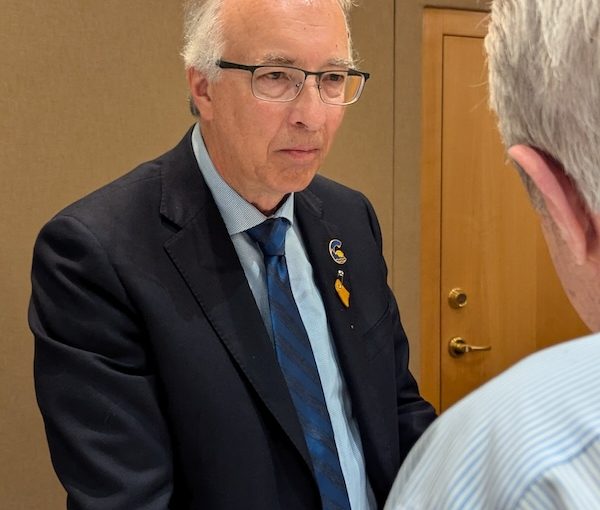
BC Conservative leader John Rustad speaks with an audience member at a June 20 event at Schara Tzedeck Synagogue. (photo by Pat Johnson)
It has been 96 years since the Conservative party won a provincial election in British Columbia. The last time a Conservative was elected to the BC Legislature was a 1978 by-election. So, the rapturous reception BC Conservative leader John Rustad and several of his local candidates received from a mostly Jewish crowd at Schara Tzedeck Synagogue recently may have been a phenomenon unseen in generations.
Public opinion polls over the last year have consistently put the BC Conservatives in second place, ahead of the BC United party, which was known as the BC Liberals before a rebranding last year. The four sitting Conservative MLAs, including Rustad, were all initially elected as BC Liberals and later crossed the floor.
The June 20 event was convened by Saul Kahn, a Jewish community leader who acknowledged he has not been politically active before. The synagogue, he noted, was a venue and the Conservatives’ presence there did not represent an endorsement.
Rabbi Andrew Rosenblatt, Schara Tzedeck’s senior rabbi, said he would welcome any politicians who want to meet and answer questions from the community. He noted that the event took place three weeks to the day after an arson attack on the synagogue and said the Jewish community is deeply concerned about developments in education in the province at all levels – primary, secondary and post-secondary.
Rustad, the MLA for Nechako Lakes, an enormous riding sprawling across central British Columbia, lamented the situation.
“We shouldn’t need to have security,” he said, noting that churches and other institutions rarely even have to consider the issue. “We’ve allowed antisemitism to take root. We are not standing up and saying it’s wrong. It starts in our schools.”
Anybody who is promoting hate in the province should be criminally charged, he said, and, if they are not Canadian citizens, the federal government should consider deporting them.
Schools should be “teaching kids how to think not what to think,” said Rustad, and he promised to rescind the provincial government’s policy on sexual orientation and gender identity, commonly called SOGI. While promising to remove SOGI, Rustad pledged to support all students and pursue anti-bullying policies.
The leader, who has been in the legislature since 2005 and served in cabinet under premier Christy Clark, promised to go through all material in the education system “with a very critical eye” toward issues of ideology, gender and the environment. He said he assumes the BC Teachers’ Federation will fight back on issues like SOGI, which he calls the “sexualization of our children,” but said some of the things being taught in school could not be put on television or said in the legislature.
The party leader condemned anti-Israel protesters on BC university campuses.
“How is it that this is OK?” he asked. “People do not have the right to incite hate.”
He floated the possibility of holding back funding or otherwise putting pressure on universities to respond to this sort of activism.
Rustad condemned the province’s approach to addiction, saying that safe supply is “creating the next generation of addicts.” He called for long-term care and supports that help people get off drugs.
“I don’t think it’s OK as a society to say it’s OK for them to live on the street,” said Rustad.
Addressing the physical addiction is one thing, he added, but providing supports so that people coming off substances do not fall back into old habits and relationships must be part of the recovery process.
Rustad would like the province to gain the sort of autonomy over immigration that Quebec has been granted, “not from the perspective of saying people can’t come, but identifying those with the skill sets we need,” he said.
Housing construction needs to be ramped up and immigrants who can work in those sectors need to be encouraged, he said. Likewise, the province should be working with post-secondary institutions overseas to address issues of credentials before new Canadians move so that people can integrate smoothly into the economy when they arrive.
The foreign buyers’ property tax allows British Columbians to, he said, point at others and say “they are the problem” for high housing costs.
The province’s new densification policies overrule municipalities’ official community plans, he said. These “sound great” in terms of housing, said Rustad, but do not consider sewers and other infrastructures.
Dallas Brodie, the Conservative candidate taking on BC United leader Kevin Falcon in Vancouver-Quilchena, shared her “Israel coming-of-age story.” She had practised law for 10 years and served as a legal aid criminal defender for young offenders before getting into broadcasting. She intended to do legal analysis but broadened her scope to become a producer for CBC in Toronto and Ottawa and later for CKNW talk radio in Vancouver. She noted a media double standard in which, for example, if a pro-Israel speaker were booked, management would demand equal time for an anti-Israel voice. The process became so onerous, she said, “you just stop covering the topic of Israel altogether.”
Eventually, Brodie became host of a weekly program on the University of British Columbia campus station CITR, which she refers to as a “viper’s nest of Marxist thought.” There, she said, she was told not to say the word “Israel” on the air because it is upsetting to people. This UBC connection put Brodie in touch with staff at the campus Jewish organization Hillel, who included Brodie on trip to Israel that she says presented a balanced introduction to the region.
“Even the Palestinian perspective was presented to us,” she said.
The next year, she participated in March of the Living, where participants visit the Nazi death camps.
Running for the provincial legislature, Brodie said some people suggested that including her strong support for Israel in her political biography might hurt her chances, but she insisted on including it.
“My party more than supports my position and stands firmly and strongly behind me,” she said. “I will never go wobbly.”
Vancouver-Langara Conservative candidate Bryan Breguet, an economist who teaches at Langara College, noted that his institution became “internationally famous” last fall after a colleague (later fired) celebrated the atrocities of Oct. 7.
Breguet reflected on a recent incident in which a Burnaby public school teacher engaged in a “thought experiment,” asking students whether Israel had a right to exist. He questioned what the public reaction would have been to a thought experiment asking whether slavery should or should not have been abolished.
Breguet said he traveled to Israel in 2007 and was shocked to see the separation barrier in the process of construction. What shocked him, he said, was that the wall “hadn’t been built decades earlier.”
John Coupar, the party’s candidate in the newly created riding of Vancouver-Little Mountain, cited his 12 years of experience as an elected Vancouver park commissioner and his efforts to save the Bloedel Conservatory.
He condemned the provincial government’s “failed experiment to legalize drugs” and called for “treatment, recovery and safe streets.”
He addressed antisemitism and condemned the governing New Democrats for their choice of candidate to run in the riding he is contesting.
“Your community is suffering deeply,” he said, before criticizing the governing NDP who he says “doubled down” by nominating Vancouver city councilor Christine Boyle as the NDP candidate in Little Mountain, “the only councilor to vote against IHRA [the adoption of a working definition of antisemitism] not once but twice.”
“This is absolutely appalling to me,” Coupar said.
A question from the audience addressed concerns that a failure to unite Conservative and BC United voters could result in a reelected NDP government. Rustad said discussions to fuse the parties, or to form some sort of electoral alliance, were unsuccessful, a failure Rustad placed on the other party.
He claims his party’s polling and analysis suggest that, if the two parties merged under the Conservative banner, the election would result in a six-seat majority for the Conservatives while, if they coalesced under the BC United banner, the NDP would win by 20 seats.
The Islamic Revolutionary Guard Corps is the world’s foremost state sponsor of terror. The IRGC’s Quds Force (“Quds” meaning “Jerusalem,” to note the ultimate priority of the corps’ aims), is effectively the international terrorism arm of the Iranian government and military.
Ottawa finally got the message. Last week, the Government of Canada designated the IRGC a terrorist entity under Canadian law.
“The Canadian Jewish community has persistently called for this decisive action against the IRGC, recognizing its role in promoting violence andinstability globally, including through its support for terrorist groups targeting Jews and others,” said a statement from Shimon Koffler Fogel, president and chief executive officer of the Centre for Israel and Jewish Affairs. “While we applaud this step, it is disappointing that it took so long for the government to act on its commitment.”
Iran has destabilized (the word seems profoundly modest) Lebanon, by backing Hezbollah, the terror group that has wreaked havoc by upending that country and turning it into a staging ground for attacks on Israel, and Syria, by supporting Bashar al-Assad, the strongman who has waged war on his own people for more than a decade. Terrorism by the Iranian regime has prevented Iraq from becoming a functioning state. Tehran’s long arm has also terrorized individuals and organizations in the large Iranian diaspora. In 2020, the IRGC shot down Ukrainian International Airlines Flight 752, killing all 176 passengers and crew, including 55 Canadian citizens and 30 Canadian permanent residents.
And still Canada’s government did not take the seemingly simple step of calling the IRGC what is so clearly is.
In 2020, the US State Department estimated that Iran was supplying Hamas and other Palestinian terror groups with $100 million per year in training and military and financial support. An Israeli source put that number, by 2023, at $350 million.
Part of the intelligence catastrophe of Oct. 7 was an apparent assumption by Israeli intelligence that Hamas did not have the capacity to organize as complex an attack as it did against Israel that day. This was a tragic intelligence failure on many fronts, but it was certainly a failure in Israel’s massive underestimation of the extent and complexity of what Hamas was capable of, thanks directly to the IRGC.
Canada is grappling with the fact that foreign actors have meddled in our politics, with China and Russia the prime suspects in this still-shrouded issue, but Iran has certainly had its fingers in our pie. The Iranian regime is also suspected of laundering money through Canada.
Iranian-Canadian human rights activist Nazanin Afshin-Jam addressed a parliamentary committee this month, putting a fine point of who we’re dealing with, not only internationally but domestically in Iran as well.
“Any time you have seen video footage of women in Iran being beaten and dragged screaming into police vans because of not properly wearing a hijab or of Christians arrested for worshipping in underground churches or Kurds being gassed or children being executed or peaceful protesters being intentionally shot at, blinded, raped or tortured, these are all the acts of the IRGC and its paramilitary subgroup, the Basij,” she said.
So why did Canada act now?
The announcement came less than a week before a pivotal byelection in Toronto. Voters in the riding of St. Paul’s, a Liberals stronghold since 1993 and considered one of the party’s safest seats in the country, went to the polls Monday.
The riding has one of the largest concentrations of Jewish voters – about 15%, which may not seem a lot but is 15 times the national Jewish population average and enough to swing a tight race, certainly. Another 1,500 of so residents list Farsi as a mother tongue and those, presumably Iranian-Canadians, know as well as anyone what the IRGC is capable of.
The very suggestion that a Canadian government would make a crucial, long-delayed decision like this based on crass political motivations is almost beyond the imagination.
Asked point blank by a reporter whether the decision was linked to the byelection – which many suggested could have existential implications for Prime Minister Justin Trudeau’s political career – Trudeau seemed to glass over and deliver a robotic reply.
Canada, he said, has already been “extremely preoccupied with the activities of the murderous regime in Tehran.” His government, he said, has “been working very, very hard on this for years.” He suggested that the delay was based on concerns for Iranian-Canadians and their families back home.
We are glad our government has taken this step. We are also revolted at the very suggestion that the decision could have been motivated by political expediency. It is unfathomably cynical – but who are the cynics? Is it reporters and commentators who accused the government of politicizing this move? Or is it a cadre of political advisors and elected officials who calculated that a few Jewish voters in midtown Toronto could save the prime minister’s hide if they were just thrown a bone?
We may never know exactly. But, if that was Liberals’ calculation, it failed. Conservative candidate Don Church upended tradition and won the riding. Liberals and others are still poking through the entrails to divine the wider implications for Canadian politics.
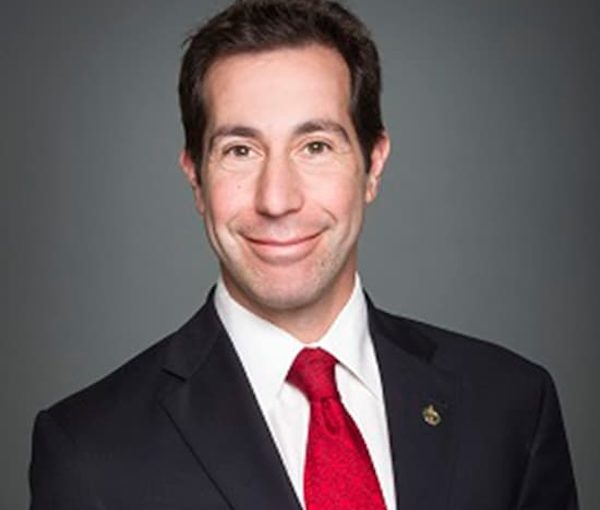
MP Anthony Housefather was in Vancouver last week. (photo from Government of Canada)
Anthony Housefather, the Liberal MP who openly considered joining the Conservatives, made an urgent plea during a presentation in Vancouver last week for Jews and pro-Israel voters to keep a foot on both sides of the political divide.
Housefather, member of Parliament for the Montreal riding of Mount Royal, was on the West Coast for a series of meet-and-greets with Jewish organizations and individuals. At Temple Sholom just before Shabbat on May 17, Housefather was open about the disappointments some Jewish Canadians – including himself – have felt with the current Liberal government.
“We’ve seen a government that has had an excellent record on Israel for the past eight years turn away from that excellent record that we all cherish so much,” he said before going into examples he said show his party has been a voice for Jews and Israel.
Since Justin Trudeau and the Liberal party came to power in 2015, Housefather said, Canada has had a better voting record at the United Nations than the previous Conservative government had.
“We voted against 87% of the anti-Israel resolutions at the UN, comparable only to the United States, at about 90%,” he said. “Most European countries were between zero and 10%.”
On antisemitism, Housefather said it was his party that appointed a special envoy on Holocaust remembrance and antisemitism – first Irwin Cotler and now Deborah Lyons – and adopted the International Holocaust Remembrance Alliance Working Definition of Antisemitism. The federal government apologized for this country slamming the doors on Jewish refugees before and during the Holocaust, initiated Jewish Heritage Month, and made antisemitism one of four pillars of the federal antiracism strategy, he said.
“I’ve been proud of the record of my party while we have been in government on these issues,” he said.
“Since Oct. 7, I think the Jewish community across the country has felt somewhat abandoned,” he said. In January, the government was “not able to articulate that Israel was not committing genocide,” he said. The decision to restore funding to UNRWA – the UN’s Palestinianrelief agency some of whose employees, evidence shows, were involved in the Oct. 7 terrorism – was a blow to many Jewish Canadians. The turning point for Housefather was the New Democratic Party motion that was widely seen as condemning Israel, including calling for an end to military trade with the country.
“Unfortunately, the decision was made to amend [the motion], which made the resolution better, but it was still bad,” Housefather said. In the end, only he and two other Liberals voted against the motion. What really hurt, said Housefather, was when the NDP member who moved the motion was given a standing ovation, including by Liberal MPs.
This combination of events led Housefather to question his place in the party and to publicly acknowledge he was considering crossing the floor. He decided to stay with the Liberals, in part because the prime minister tasked him with new responsibilities to address antisemitism, but also, he said, because he realized that his voice – and those of other Jewish and pro-Israel Canadians – is needed in the governing party.
“I need to be there to make our voices heard in the party,” he said. “Once you place all your eggs in one basket and you have no allies in the other party when it comes to power, then you’re screwed.”
Housefather has a list of actions he wants from the government and others. He is urging Criminal Code amendments to add “bubble legislation,” which would prevent protests within a certain distance from synagogues, Jewish schools and community centres, after protesters laid siege to a Jewish community building in Montreal and people inside were prevented from leaving for hours.
Police need to be told that they must enforce the law around harassment and hate speech, and university administrations need to act to keep students safe, he said.
Housefather pushed for parliamentary hearings on campus antisemitism, which have now begun.
He urged Jewish Canadians to develop relationships with their elected officials, and he passionately urged them to leave their hatred aside.
Housefather said he gets barraged by hate messages from antisemites and anti-Zionists – including death threats – but it’s the hate from Jews that really upsets him. No matter how much some voters agree with him on issues that are important to the Jewish community, he said, they nevertheless condemn him in extreme terms – “traitor,” “quisling” – for being part of the Liberal party.
“If our community wants MPs to support our community, you have to deal with them in a way that doesn’t send them hate, that doesn’t treat them like dirt.”
Above all, Housefather said, Israel and Jewish issues shouldn’t be a partisan issue.
“We should all fight for them and we shouldn’t be trying to create wedge issues that divide the Jewish community,” he said.
A federal bill to address online harassment, bullying and hate has aspects to admire and others to cause concern. What happens in the committee process will determine the success of the proposed law.
That is the take of two experts – including one who had a hand in drafting the legislation. The devil, as always, is in the details of balancing free expression with the right to be free from threats and harassment.
Dr. Michael Geist, the Canada Research Chair in Internet and E-commerce Law at the University of Ottawa, who also serves on the advisory board of the Electronic Frontier Foundation, was joined in a recent online panel by Dr. Emily Laidlaw, Canada Research Chair in Cybersecurity Law and associate professor in the faculty of law at the University of Calgary. Her recent work includes projects on online harms, misinformation and disinformation, and she co-chaired the expert group that advised the federal government on the development of the Online Harms Bill, which is known as Bill C-63. The virtual panel, on April 17, was presented by the Centre for Israel and Jewish Affairs and moderated by Richard Marceau, CIJA’s vice-president, external affairs, and general counsel. More than 850 people registered for the event, indicating what CIJA board chair Gail Adelson-Marcovitz indicated is a depth of interest, and perhaps concern, about the bill.
Geist explained that the new bill is a result of years of work, following the federal government’s withdrawal of an earlier attempt at addressing the problem of online harms.
Bill C-63 is really three separate concepts rolled into one. It would amend the Canadian Human Rights Act and the Criminal Code, as well as introduce a new Online Harms Bill. Together, the components would codify currently inconsistent approaches to the problems.
The bill would redefine “hatred” in the Criminal Code and define a new crime of “offence motivated by hatred.” That offence, as well as advocating or promoting genocide, could lead to life imprisonment.
Amendments to the Canadian Human Rights Act would add the “communication of hate speech” via the internet or other telecommunication technology as a discriminatory practice. Individuals would be empowered to bring a complaint before the Canadian Human Rights Commission, which could penalize offenders up to $50,000. The law, if passed, would affect public communications, like social media posts, not private messaging or emails.
Separate components of the bill would make it easier and quicker to address specific offensive content, such as “revenge porn” and posts that could harm children, encourage suicide or bullying or otherwise endanger young people.
A digital safety commissioner and ombudsperson would help guide individuals through the process of dealing with bullying or other issues related to the law.
On April 17, Dr. Michael Geist of the University of Ottawa spoke as part of a CIJA panel discussion on the Online Harms Bill. (screenshot)
Geist said many legal experts who seek to balance freedom of speech with freedom from abuse “breathed a sigh of relief” after the federal government abandoned earlier efforts and relied for the new bill on expert advice.
“It’s a pretty good starting point,” Geist said. “We know the broad brushstrokes of what that might include but there is a lot of uncertainty still, so it’s easy to like it when we don’t know the specifics.”
Geist and Laidlaw agreed on most points but had some differences around oversight. Geist said the bill appears to grant enormous powers to a new digital safety commissioner. The idea of life imprisonment for an online comment, he added, may be a sticking point. “I find that hard to justify,” he said.
Laidlaw said the new office of ombudsperson is an important step in helping individuals navigate online hate and harassment. The ombudsperson would be able to pass specific information on to the digital safety commission, whose mandate includes education and research supported by a digital safety office.
The bill would also place new obligations on corporations that run online platforms, like social media companies. At present, Laidlaw said, some companies, notably X (Twitter), are not taking the problem very seriously.
While Jewish advocacy organizations have long advocated for legal responses to hate speech, Geist warned of a double-edge sword.
“Could somebody who is supportive of Israel will be accused of promoting genocide?” he asked.
Geist upended the binary assumption of harassment and free expression, noting that the idea that limits on hate speech could chill expression ignores the existing, difficult-to-measure effects of online (as well as offline) harassment and bullying.
“There is already a chilling effect for anyone in our community and, frankly, in a number of communities, that speaks out on these issues,” he said. “The backlash that you invariably face causes, I think, many people to [reconsider] whether they want to step out and comment, and it’s not just online. There’s a chilling effect offline as well. These issues are very real and many of them will not be solved by legislation no matter what the legislation says.”
He fears a barrage of complaints, many vexatious, from all sides of many contentious issues.
While there is a needle-in-a-haystack challenge in addressing online harms, Geist said, addressing the problematic major players could have a broad impact, though no one believes online hate and bullying can be completely eradicated.
“The legislation talks about mitigating these harms, it doesn’t talk about eliminating them,” he said. Social media platforms, he believes, are looking for guidance on these issues and will be amenable to adhering to legislation. Moreover, he said, Canada’s proposals are somewhat belated responses that would put us roughly in line with the European Union, Australia, the United Kingdom and other jurisdictions.
Dr. Emily Laidlaw of the University of Calgary, who joined the CIJA panel discussion on April 17. (screenshot)
The inability to erase hate and harassment is not an excuse to do nothing, Laidlaw said.
“Enforcement has always been an issue,” she said. “But I don’t think it’s a reason not to pass laws.”
Laidlaw took exception to criticism that the new bill would represent government censorship. The proposed digital safety commissioner would be an independent body comparable with the existing privacy commissioner.
“Where there is some risk is in the fact that, in the end, government appoints the individuals,” she said. Still, the appointees would need to be approved by Parliament, not just the government in office.
“And remember,” she added, the commissioner’s “oversight is of companies, not of individuals. They’re not making individual content decisions or holding individuals accountable here.”
The commission would not be subject to legal rules of evidence, making it possible to immediately take down things such as child porn, encouraging suicide or other especially egregious posts.
Geist said this significant power demands that the government spell out more clearly the limitations of the commission.
“At a minimum, it seems to me that it is incumbent on the government to flesh out in far more detail where the limits, where the guardrails, are around the commission, so that we aren’t basically adopting a ‘trust us’ approach with respect to the commission,” said Geist.
Parliament is expected to take up consideration of the bill in committee soon and Laidlaw argued that some aspects deserve speedy passage while others require far more sober consideration.
“The Online Harms Bill could be passed with minor tinkering,” she said. The Criminal Code provisions, she said, give her serious concerns and deserve major revisions or complete scrapping. She also struggles with changing the Canadian Human Rights Act.
Geist agreed on taking the bill apart.
“I would separate out the bill,” he said. Criminal Code and Human Rights Act amendments deserve much deeper consideration, he said. The online harms piece, he said, could be tidied up and passed with tweaks.
Anthony Housefather has decided to remain in the federal Liberal caucus. Housefather, member of Parliament for the Quebec riding of Mount Royal, is one of only two Liberals to have voted against the NDP motion last month that called for a ceasefire, an end to Canadian military trade with Israel, as well as other positions about Israel and the current conflict.
As discussed in this space last issue, the New Democratic Party motion had some of its rough edges sanded down in order to make it palatable to almost all Liberal MPs. The rest of the House of Commons voted predictably. Conservatives unanimously opposed the motion, which they viewed as biased against Israel. The Bloc Québecois and the Green party sided with the NDP.
The daylong negotiations over amendments to the motion were a face-saving effort by the Liberal government to avoid the embarrassment of a serious schism in their caucus over foreign policy. In the end, a less inflammatory motion was passed.
Housefather, who is Jewish and represents a riding that has one of the largest concentrations of Jewish voters in Canada, was joined on the government side in opposing the motion only by Ontario Liberal MP Marco Mendocino.
Housefather was open about his frustration. Anyone who has found themselves in a place where they do not feel welcomed, based on their core identity, can certainly appreciate his feelings of isolation. However, we are pleased that he has decided to remain in the Liberal caucus.
Crossing the floor and joining the Conservatives, which he had said he was considering, would not have been advantageous to Jewish and pro-Israel voters. Since the administration of former prime minister Stephen Harper, at the latest, the Conservative party has been perceived as overwhelmingly pro-Israel. This approach has been welcomed by many Jewish Canadians.
However, this reality means that, were Housefather to switch parties, he would become just another pro-Israel voice in the Conservative caucus. By staying where he is, he will be a necessary voice for Israel and the Jewish community in the governing party. In an announcement a week ago, he said the prime minister has asked him to lead the government’s efforts in fighting antisemitism. This effort needs as much multi-partisan support as possible.
Anyone who has had difficult conversations with friends or family in recent months understands the emotional burden of being a voice for Israel in this challenging time. This, however, makes Housefather’s presence in the Liberal party that much more important.
We face a similar challenge at the provincial level. With the firing of Selina Robinson from cabinet, and her subsequent withdrawal from the governing New Democratic Party caucus, the Jewish community’s most outspoken ally, liaison and voice is gone from the government side of the legislature. Neither Robinson, who now sits as an independent, nor George Heyman, the other Jewish New Democrat in Victoria, are seeking reelection. It is entirely possible that the Jewish community will not have any community members in the next legislature.
This is not to say we do not have friends there.
Michael Lee, the MLA for Vancouver-Langara, has been a steadfast ally of the Jewish community and a stalwart presence at the weekly Sunday rallies for the Israeli hostages. Recently, when he addressed that audience, he went to lengths to warn against making Israel a political football. A community that can be taken for granted by one party and written off by another will find itself unrepresented in the halls of power. Lee reassured Jewish British Columbians that they not only have friends on the opposition side of the house, but in the governing NDP as well.
We know that there are allies for Israel and the Jewish people in the provincial NDP. It is a symptom of a larger concern that some of these people feel constrained around expressing that solidarity fully because of segments of their own party who would almost certainly single them out for that support.
As Robinson herself told theIndependent last issue, she has friends and supporters in the caucus – but she wouldn’t mention them by name for fear of putting a target on their backs. This is a serious problem, of course. But it is better to have quiet allies than no allies at all. Their presence can potentially moderate extreme elements in their party. Were they not there, restraining impulses might be minimized.
As we approach a provincial election this fall, and a federal election at some unpredictable date (remember, there is a minority government in Ottawa) Jewish Canadians and allies of Israel should not abandon the parties that include voices with alternative views. We should, like Housefather has chosen to do, make sure our voices are heard in all of Canada’s diverse political venues.
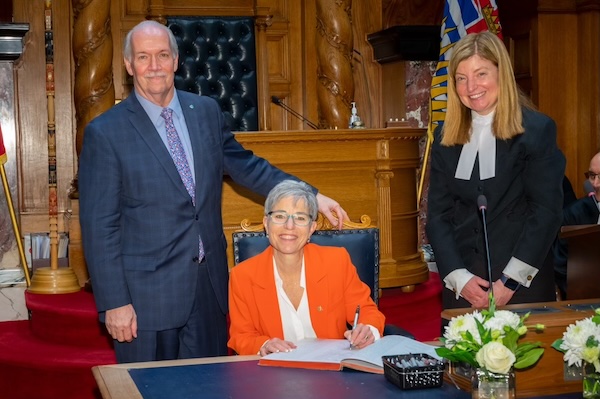
Selina Robinson, centre, with then BC premier John Horgan and Kate Ryan-Lloyd, clerk of the Legislative Assembly, at Robinson’s swearing-in ceremony in 2017. (photo from Selina Robinson)
Selina Robinson says she was fired from the British Columbia cabinet. Premier David Eby says she quit.
This is merely the tip of an iceberg in the conflicting stories that have roiled BC politics since Robinson’s cabinet career ended in February – and which burst into an even bigger storm when she left the New Democratic Party caucus March 6 with an incendiary letter to caucus colleagues.
Whether Robinson jumped or was pushed, Jewish community leaders and opposition politicians are denouncing what they say is a double standard, with multiple people – including the premier – getting second chances for remarks that were at least as impolitic as Robinson’s.
In a wide-ranging interview with the Independent, Robinson maintains the premier prevented her from doing precisely the work he called on her to do – another point that Eby contradicts. He thought her acts of contrition were proceeding just fine and suggests he was blindsided by her resignation from caucus.
Perhaps the prickliest aspects of the entire controversy are the motivations of the individuals involved. Robinson, opposition officials and many in the Jewish community see antisemitism at play. Government officials – including the cabinet minister Robinson says the premier “trotted out as the new Jew” – say that the evidence doesn’t amount to racial bias.
The bones of the story are familiar by now – but Robinson shared with the Independent personal reflections and sharp critiques of former colleagues, including Eby, fellow New Democrats who she accuses of profound insensitivity in the aftermath of the Oct. 7 Hamas terror attacks, a death threat that is now in the hands of international policing authorities, and how everything might have been different if John Horgan were still premier.
Poor choice of words
The drama began with words Robinson spoke in a Jan. 30 webinar organized by B’nai Brith Canada featuring Jewish elected officials from across Canada – or, at least, that is how most media coverage frames the controversy. Robinson said she has had a target on her back since much earlier, as a Jewish woman with emotional, spiritual and familial connections to Israel. That targeting came from within her own party, she claims, and she went into some depth about her fights with fellow New Democrats in recent months and years over the issue.
During the January webinar, Robinson said that the area designated for a Jewish state under the 1947 United Nations Partition Resolution was “a crappy piece of land with nothing on it.”
She immediately clarified in the webinar that there were people living there and she was referring to the arability of the land and the limited economic development in the region. But the genie was out of the bottle. Robinson told the Independent that what happened in the succeeding weeks – and continues roiling – is not so much a result of what she said, but of who she is.
Marvin Rotrand, the outgoing national director of B’nai Brith’s League for Human Rights, was host of the now-notorious webinar. In a statement afterward, he said that a small part of Robinson’s speech was distorted and taken out of context, leading to a campaign against her by groups and individuals “too well known for their hate of Israel.”
Within days, thousands had signed a petition calling for Robinson’s firing. Leaders of more than a dozen mosques and Islamic associations sent a letter to Eby warning that NDP representatives would not be welcome in their sacred spaces as long as Robinson remained in cabinet. Days later, her constituency office was vandalized – including with the words “Zionism is Nazism” – and she received a death threat that international police organizations deem credible.
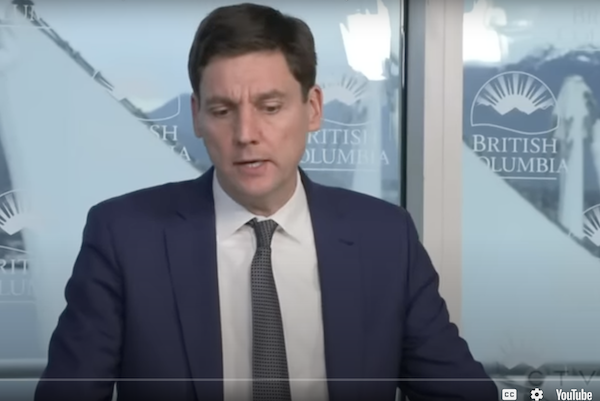
Feb. 5, 2024: Premier David Eby announces that Selina Robinson will step down from her cabinet position. (screenshot)
While pressure was building, Robinson and Eby both appeared to be feeling their way through uncharted territory. Robinson apologized – twice. She also offered to take anti-Islamophobia training.
“My words were inappropriate, wrong, and I now understand how they have contributed to Islamophobia and anti-Palestinian racism,” she said.
Parallels Robinson drew between Indigenous peoples in British Columbia and Jewish indigeneity in Israel also brought condemnations, and she specifically apologized for those remarks.
“The experiences of First Nations people are not mine to manipulate,” she said. “That was wrong and I am deeply sorry.”
“Her comments increase divisions in our province,” Eby told media. “They increase the feelings of alienation of groups of people, especially people of Palestinian descent and people who are concerned about the death and the destruction in Palestine that is happening right now.
“She has apologized unequivocally, as she should. And she’s got some more work to do,” Eby said. Robinson, the premier told media, was in the process of reaching out to community leaders to repair the damage her remarks caused.
What happened in those hours sowed the seeds for further conflict within the party, including, Robinson now says, the premier’s refusal to allow her to do what she could do – and wanted to do – torepair the damage she caused.
Was she wrong?
Some commentators have defended Robinson, saying that pre-state Israel was indeed a crappy piece of land in terms of arability. Robinson reflected on what she said and the reaction to it.
“I said things that I did not intend to hurt anybody,” she said. “I did not intend to make Arab, Muslim or Palestinian people feel like they are ‘less than.’ I understand that just the way I described Israel made them feel like they were poor land stewards, that they somehow were to blame for the conditions.”
Nevertheless, she said, she did not invent a narrative that Mandatory Palestine was a poor piece of land, she said.
“Other people have characterized [pre-state] Israel in that way,” she said. “I didn’t create that narrative. I was repeating a narrative that others had stated, from Mark Twain to land economists.”
For the purposes of historical accuracy, she said, she blames the Ottomans, whose empire had controlled the land for 400 years, for a lack of economic vibrancy in the region. That long-ago history, though, does not mean her words did not affect contemporary audiences, she acknowledged.
“Those words impacted them,” she said of people who expressed disappointment and other emotions at her remarks.
Criticism she rejects, though, are assertions that she espoused hate.
“I didn’t espouse hate,” she said, slowly, quietly and firmly. “I said words that hurt people. There was no hate in those words.”
These nuances, for what they may be worth, made no difference when it came to Robinson’s continuation as a cabinet minister.
Jumped or pushed?
“The depth of the work that Minister Robinson needs to do, in order to address the harms that she’s caused, is significant,” the premier told media Feb. 5. “[S]he screwed up, she made a really significant error and so we need to address the harm that was caused by that.”
At a news conference, Eby said a “joint decision” was made that Robinson would leave cabinet.
While she agreed to that wording, Robinson told the Independent, that is not a correct assessment of what happened.
“I didn’t think that I needed to leave cabinet,” she said. “That was not my choice. The premier was insistent that I had to.”
Robinson says Eby seized on something she said during discussions around her future.
“I said, ‘If you are asking me to step down from cabinet, if that’s what you want, I will,’” Robinson recalled. “It’s not what I want. And he said, ‘I can’t see a path forward for you in cabinet.’ So I said, ‘So you’re asking me to resign.’”
Robinson said she insisted the announcement from the premier’s office say that the premier asked her to resign.
“And they said, no, you offered your resignation,” Robinson continued. “And I said … the most you’ll get from me is that it was a joint decision and that’s what the press release [said], a ‘joint decision.’ But … let’s be really clear, as I said in my letter [resigning from caucus], I was told that there was no path back.”
Eby denies this.
“I did not remove her,” the premier told the Independent. “I can certainly believe that she didn’t want to do that, but I did accept her resignation.”
Leaving caucus
Robinson’s successive apologies and commitment to undergo anti-Islamophobia training didn’t save her cabinet job. But, she said, she was committed to making amends.
“The concept of teshuvah [repentance], for us as Jews, I take it seriously,” Robinson said, “It’s not enough to say you’re sorry, what are the deeds that go with it?”
Robinson came up with an idea she terms “The Project.”
In the aftermath of her firing, followed by the vandalizing of her constituency office and a death threat, Robinson and her family took off for a week in Mexico to recuperate.
“I called the premier from Mexico and said I have an idea, what do you think?” she recalled. “It was around outreach, working with the [Jewish and Muslim] communities, bringing them together … what did he think?
“And he said that’s a really interesting idea, let’s think about it,” Robinson said.
When she returned from Mexico, she talked to the premier’s chief of staff, Matt Smith. She fleshed the idea out some more, proposing that she and perhaps someone from the civil service – a Jewish person and a Muslim person – “would work with these communities and try to find ways to do dialogue and engagement and break bread and do the things that bring about peace and what could that look like,” said Robinson. She discussed the concept with Deborah Lyons, Canada’s special envoy on Holocaust remembrance and combating antisemitism, who was supportive and offered to do anything she could to support the effort, Robinson said.
After contemplating the idea, Smith came back with his decision: “Too political,” Smith said, according to Robinson.
The premier told the Independent that the idea that a civil servant would work on the project with an elected official is what was “too political.”
Robinson doesn’t believe that. “It was more, we’d prefer to be silent on the whole thing,” she said.
Silence, she contends, is a root of the entire problem – not just with her firing but around the government’s approach to antisemitism. The premier and the government, she contends, are more concerned with success in this fall’s election than with doing the right thing.
“We are in election mode,” she said. “And, frankly, we’ve been in election mode since [Eby] became the premier [in November 2022]. I get it. I’m a politician. I understand the gig, I know how these things work.
“However,” she said, “we are also government. We are a party trying to get reelected and we are government, and you have to be able to do both at the same time. It’s hard. I’m not saying it’s easy. But you can’t give up the governing part and just do campaign mode. You campaign and you govern simultaneously and I think what’s happened is they stopped governing. A government says, we have a problem, what are we going to put in place to help this community that is being terrorized? And it’s controversial, because there are others who think it’s appropriate to terrorize this community. I think what governments are supposed to do is bring people together. Right now, the actions are ripping people apart.”
The fact that the premier’s office would not allow her to engage her colleagues in a broader discussion about both antisemitism and Islamophobia led her to believe there was nothing she could do that would satisfy the government.
“I committed to a number of deeds and have acted on them and that still wasn’t good enough,” she said.
While the government seemed unsatisfied with her efforts, many Muslim people have been more forgiving, she said. Many have expressed forgiveness for her words and accepted her apologies – she has accepted Iftar invitations and extended seder invitations to Muslim friends and acquaintances, she said.
“There are Arab and Muslim leaders that I have had wonderful conversations with, heartfelt conversations,” she said. “I could hear the agony in their voice and they could hear the agony in mine.”
That kind of amity, though, was not something she found among her NDP colleagues. On March 6, her 60th birthday, Robinson released a statement resigning from the NDP caucus.
Harsh words for Heyman
The day after Robinson’s resignation, the premier’s office organized a news conference at the Legislature. George Heyman, BC minister of environment and climate change strategy, told the media that he took exception to the assertion that Robinson’s resignation represented “our government [having] lost the only Jewish voice in our caucus or cabinet.”
“They should know,” said Heyman, “that I’m also Jewish. I grew up as a Jew.”
His experience in the NDP, Heyman said, does not comport with Robinson’s perceptions.
“My experience is that our caucus and our cabinet are deeply committed to fighting antisemitism, to opposing hatred and I have found them to be personally supportive of me on an ongoing basis,” he said.
“He was trotted out as the new Jew, which was a shonda [shame], as they say, on so many different levels,” claims Robinson. “I believe George was put up to it. I know how things work. They didn’t want me to be the only Jewish voice.
“But George doesn’t identify as a Jew,” she said. “He’s told that to so many people. He’s not connected to the community.”
Robinson thinks Heyman allowed himself to be used.
“You thought it was OK? So, the premier asks you, you could have said I’m not going to do that.”
Heyman takes exception to Robinson’s comments about his identity and especially about the idea that he was put up to anything.
“People who know me know that I don’t do things that I don’t want to do,” he told the Independent. Heyman said he was moved to address the issue as soon as he heard opposition MLAs claim the government had lost its only Jewish voice.
On the larger issue of his identity, Heyman said it is up to individuals to self-define.
“I think it’s actually my and every Jew’s right and responsibility to determine in what ways they identify and connect with their own heritage, which is not the same as practising a particular religion,” he said. “My position as a child of Holocaust refugees and as a grandchild of Holocaust victims is, I think, fairly well known. I certainly haven’t hidden it. I may not be a member of the Jewish community in the same way that Selina is. I am not a practising Jew, but to say that I don’t identify as a Jew I think is simply inaccurate.”
Is it antisemitism?
Robinson said media have tended to misrepresent her comments about antisemitism in the NDP. She did not say the party was rife with antisemites. Her letter of resignation from caucus included several incidents – and most of these were matters of record. She herself has experienced antisemitism directly only from two colleagues, she said.
Immediately after the Oct. 7 terror attacks, Robinson said, she sent a message to her colleagues noting that the Jewish community in British Columbia was experiencing trauma as a result of what was happening, including the murder of a young Vancouver man, Ben Mizrachi, and expressions of solidarity and condolences were in order.
Days later, she said, two of her colleagues – Aman Singh, MLA for Richmond-Queensborough and parliamentary secretary for the environment, and Katrina Chen, MLA for Burnaby-Lougheed – responded to her message by stating that the government should express solidarity with Palestinians.
“Three days after, maybe four days after the massacre, [they] felt that it was appropriate to put out a statement about how Palestinians were treated,” Robinson said. “Ben Mizrachi hadn’t been buried yet. The [Israeli military] hadn’t responded.”
Robinson was outraged.
“This isn’t about that,” she said of responding to expressions of Jewish suffering with demands for solidarity with Palestinians. “Could you not take a moment – a moment – to reflect on how horrible it is that a terrorist group came in and slaughtered 1,200 people? Just acknowledge it. Just acknowledge that that was wrong and we need to fight against terrorism.”
Robinson does not understand how people cannot see antisemitism in the erasure of Jewish suffering.
“Jewish suffering is discounted,” she said. “It’s [perceived as] not real, it’s fake. It has no value and diminishes another group of people who are suffering.
“This isn’t a competition of who is suffering more,” Robinson said.
She called the premier immediately upon seeing the messages from Singh and Chen.
“I said, I can’t deal with this. I can’t deal with those two. I just can’t,” she said. “And he said, let me deal with it. I was grateful. It felt like he had my back.”
Robinson never heard from Chen, whose social media feed frequently shares Palestinian memes and messages. On the day Robinson released her resignation letter this month, Chen tweeted: “Not wanting to see more kids and people die in Gaza is not antisemitism.”
An hour after she took it up with the premier, Robinson said, she heard from Singh.
Neither Singh nor Chen responded to the Independent’s request for comment or clarification on Robinson’s version of events. However, the Independent has seen the text Robinson referenced and, in it, Singh called the Oct. 7 attacks “absolutely horrific” and said Hamas “should be brought down.” He also expressed empathy with Robinson and her family in Israel.
“I wanted us as a caucus just to recognize the pain in Gaza as well,” he wrote, adding that he was not calling on the government to make a statement in that regard, “[b]ut internally I felt that needed to be said.”
Additionally, the original email Singh sent was on Oct. 12 and, therefore, after the beginning of Israel’s military actions, not before, as Robinson had claimed.
While Chen and Singh did not comment to the Independent, Heyman defended them, also noting that the emails Robinson cited were “private communications within caucus.”
“It was disturbing to me that her interpretation of actions of a number of my colleagues were that they were antisemitic,” Heyman said. “These are colleagues I respect. I’ve had many conversations with them and I know how deeply committed they are to fighting antisemitism and to fighting all forms of hatred.”
Robinson, in any event, did not consider Singh’s text an apology and did not respond. Nor has she spoken to Singh since.
“If he had come up to me and said, ‘Selina, you never acknowledged my apology, can we talk about it?’ I would have,” she said. “But I really felt like he did not get it.”
Not getting it is, Robinson thinks, the problem. It is not that her colleagues are overt Jew-haters, but that they do not know what antisemitism looks like and refuse to take the time to find out.
“What I tell them is you don’t know enough about antisemitism in its newest form,” she said. “I think for them it’s name-calling, swastikas – I think that for them is really clear. The new form of antisemitism that we are seeing … [includes] the delegitimization of Israel, [the idea] that Jews are responsible for Israel’s political decisions or military decisions, Israel as colonizer, Jews as white people, therefore, the oppressor – I don’t think they have a frame for how to make sense of that.”
Criticism of Israel is not antisemitic, she said. Denying Israel’s right to exist, which is the position of many of the people who wanted her out of office, is.
“What you’re saying is Jews shouldn’t have a homeland, that their history of continually being pushed out of those lands over time, over millennia, you want that to continue,” she said. “If you don’t recognize the legitimacy of Israel as a nation-state, then that contributes to Jew-hatred.”
Taking the North American settler-colonialism model and applying that lens to Israel and Palestine is simply wrong, she said.
“It is inaccurate, it is a false narrative, it is patently not true. And, as a result, they are engaging in antisemitism,” said Robinson, whose own comparison of North American indigeneity to the Middle Eastern model drew condemnation. “I don’t think that they want to be antisemitic but they are, because they don’t understand and they’re not taking the time to learn how that history is different from this history here in North America. I think that’s where those folks are going wrong. What’s the solution? Education. Learn the history. And you’re not going to get it from TikTok and you not going to get it from Twitter, so you need to do some – I’ll use the premier’s words – you need to do some deep learning.”
When it comes to her former colleagues, Robinson believes their culpability comes from a combination of fear of failure and refusal to learn.
“They don’t recognize this form of antisemitism and so they are silent because they’re afraid of saying the wrong thing one way or the other,” she said. “But their silence is deafening and no one is saying, I want to learn more about this.”
Though that’s not quite accurate. One colleague, after she left cabinet, and another after she left caucus, reached out to Robinson and said they have been looking to learn more about antisemitism.
One asked her why they, as elected officials, are not trained in this.
“Well, you’d better ask the premier,” she responded.
Battling Zionists
In her letter of resignation from caucus, Robinson mentioned several colleagues by name, among them Mable Elmore, MLA for Vancouver-Kensington. Elmore’s example is one that has come up repeatedly among Robinson’s defenders in recent weeks as an example of someone who has gotten away with comments that are arguably worse than anything Robinson expressed.
In November, Mable Elmore rose in the house to make a routine statement. Instead, Robinson said, she went off script and delivered a two-minute talk about people dying in Gaza.
“But she never made reference to the massacre on Oct. 7,” Robinson said. “She never tied this as a response to terrorism.”
Elmore is parliamentary secretary responsible for antiracism initiatives under the attorney general.
Leaders in the Jewish community, Robinson said, have long been wary of Elmore. At the start of her political career, Elmore got in hot water for voicing a conspiracy about “vocal Zionists” in her workplace that she and other union activists had to “battle.”
“They were always anxious about Mable, given her history,” said Robinson of leaders in the mainstream Jewish community. “When she was made parliamentary secretary for antiracism, [Jewish communal leaders] expressed concerns to me but they said … we believe people can change [and] learn, and so they went along with it.
“Then, when Mable did her two-minute statement in November that sort of disconnected what’s happening in Gaza right now from the attack on Oct. 7 and left out a big chunk of the story, [Jewish community leaders] were outraged,” said Robinson. “They were absolutely outraged. I went to the premier’s office with my own outrage and then, of course, communicated the community’s outrage.”
Jewish leaders, according to Robinson, were asking for Elmore to be taken off the antiracism file completely. Instead, she said, the premier left Elmore in charge of antiracism initiatives but removed her responsibility for liaising with the Jewish community on issues involving racism. Dealing with the Jews on antisemitism and broader antiracism approaches would be handed over to Attorney General Niki Sharma.
“This is where the story gets really interesting,” Robinson said. Eight weeks after the premier removed antisemitism and liaising with Jews from the government’s point person on antiracism and handed those responsibilities over to the more senior attorney general, Robinson reached out to Sharma after the Vancouver Police Department released a report that anti-Jewish hate crimes in the city had spiked 62% in 2023.
“It’s been eight weeks now since [Sharma] has been responsible for the file. The Jewish community is reeling, numbers are through the roof,” said Robinson, who said she asked Sharma what the government was doing. “She had done nothing from November on. She hadn’t met with the [Jewish] community. She had no plan.”
Sharma promised to get Robinson a brief on how her department and the government intended to address the increase in hate-motivated crimes against Jewish individuals and institutions. Robinson never received it.
Disputed events
In the hours after Robinson released her letter to caucus, Premier David Eby addressed the controversy repeatedly with media.
“I wish she had brought her concerns to me directly so we could have worked through them together,” he said at one point. Later, he said, “She didn’t feel safe with me to bring forward her concerns and she felt she had to resign. So, I’ll examine that.”
Eby’s comments infuriate Robinson. “When the premier says that I never came to him – this is the part that really makes me crazy – I did,” she told the Independent. “I was even coming with solutions.”
Those solutions did not seem to move the dial in terms of any redemption Robinson might have expected for what she sees as good-faith efforts to make amends and her proposals to help address antisemitism and Islamophobia in government.
Target on her back
Robinson felt she had a target on her back – and not only since the “crappy piece of land” incident.
“There were targets even during convention,” she said. Before the BC NDP convention last November, Robinson warned the premier’s office that several delegates and groups were going to bring forward emergency resolutions about the war in Gaza.
“I kept saying, we are a subnational government, we don’t do international relations,” Robinson said. “I don’t even know why we would entertain international commentary.”
Convention organizers apparently felt there was a need to allow some delegates to blow off steam. Robinson said she and others then strove to create a relatively balanced resolution, “and that work happened behind the scenes.”
“But there were people calling for my head back then, back in November,” she said.
In her capacity as minister responsible for BC postsecondary institutions, Robinson gained the wrath in February of the Federation of Post-Secondary Educators of BC and the Canadian Association of University Teachers, who called on Eby to oust Robinson. The latter group accused Robinson of undermining “the democratic principles of freedom of expression, academic freedom, and a college and university system free of direct manipulation by the provincial government” because Robinson had retweeted a call for Langara College to fire Dr. Natalie Knight, an
English instructor who referred to the mass murders of Oct. 7 as “amazing” and “brilliant.”
As a result of Robinson’s vocal and visible presence on these issues, she said, there were people “paying very close attention to what I said, how I said it, when I said it. So, I was a target – I still am a target, I think.”
Warning signs?
While Robinson has felt a target on her back, including from some in her own party, there is a larger trend that has nothing directly to do with her, arguably going back to 1967 or before, when the Canadian left’s approach to Israel and Palestine began transitioning from a largely pro-Zionist position. With a few notable exceptions, NDP elected officials and rank-and-file members for several decades now have aligned more with the Palestinian cause than the Israeli one. While criticism of Israel may or may not be fair, depending on context, some people, including some longtime party members, have written the party off as poisoned by antisemitism.
Bernie Simpson is one of only a handful of Jewish British Columbians ever elected to the provincial Legislature. He was the New Democratic MLA for Vancouver-Fraserview from 1991 to 1996, but his roots in the party go back decades earlier. He was mentored by Dave Barrett, the first and still only Jewish premier of the province, and Simpson was at the upper echelons of the NDP from the 1960s.
Throughout that time, he told the Independent, he struggled against far-left “ideologues.” He eventually left the party about 25 years ago, in large part because of the prominence of anti-Israel voices like Svend Robinson and Libby Davies.
“I always felt, in the years that I was involved with the NDP, that there was underlying antisemitism,” he said. “I didn’t realize the extent of antisemitism in the NDP until Selina brought it to the world’s attention, and good for her.”
Simpson believes Eby is beholden to certain segments of his caucus.
“He has to appease the left-wing ideologues or else he’d have a revolt and probably they could undermine his leadership,” Simpson said. “They are quite capable of doing that, the left wing.”
“Can a party be antisemitic?” Robinson asked. “Well, people make up a party. So, it depends who is there.”
In 2021, she called on the resolutions committee of the federal NDP convention to get some perspective on foreign affairs.
“When they had their convention, they had the top 25 resolutions [and] 16 of them [or] 15 of them, were anti-Israel,” she said. “Really, people? Do you not care what’s happening in Chad, or the Congo, or to the Uyghurs? What is your obsession? I reached out to them and I called the people in charge of the resolutions committee and the response was, and I quote, ‘It has been ever thus.’ I was stunned.
“Can you not reflect on your obsession and where that’s coming from?” she asked. “I get it if you have one or two [resolutions about Israel]. I don’t like Israeli government decisions, what they’re doing. For sure, challenge this [Israeli] government in terms of the decisions that they are making. You only have so much time to debate your resolutions, but you want to spend three days debating Israel? Then you’re not a party I can take seriously to represent us as Canadians. Not on China, not on Iran, not on these really big, despotic nations. Nope. It’s just the Jews.”
Under the late Jack Layton, who was leader of the federal NDP from 2003 to 2011, Robinson said, things were not as bad as they are now.
“I blame Jagmeet Singh,” she said of the federal NDP leader. “I hold him completely responsible for the rhetoric and the outrageousness that we are seeing. He’s party leader. This is on him…. His attacks on me because I described Israel pre-1948 [Israel] as a crappy piece of land and his vociferousness towards me was vile.”
Singh had called Robinson’s comments “not only factually wrong, but offensive and irresponsible” and that “elected leaders must be voices for peace and justice.” The federal NDP leader said he had conveyed his “serious concerns” to Eby.
Singh’s office did not respond to the Independent’s request for comment.
Decision to retire
When Robinson left cabinet, she let it be known that she had earlier decided not to seek reelection in this fall’s provincial election.
She had planned to announce her retirement on March 6, her 60th birthday. After three terms as an MLA, following two terms on Coquitlam city council, Robinson thought it was time to leave public life after 16 years. In December, she shared the news with the premier.
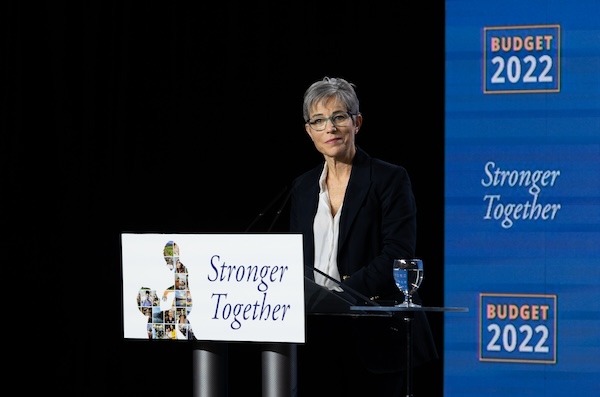
Selina Robinson taking part in the BC government’s 2022 budget announcement. Before the controversy that saw her resign from caucus, Robinson had decided, after 16 years in public service, to not run in this fall’s election. (photo from Selina Robinson)
There were lots of reasons to wind up her elected service, she said. Her (adult) kids are talking about having kids and she wants to be a hands-on bubbe. Her father turns 84 this year and she wants to spend more time with him, and with her husband’s parents, who are of a similar age. Her husband, Dan, wants to travel.
The premier, Robinson said, was kind when she shared her decision with him late last year.
“He was surprised I wasn’t running again,” she said. “He thought I’ve been a very competent minister. He had lots of nice things to say about me.”
But there was something else.
“I said, caucus hasn’t felt the same since Oct. 7,” she told Eby who, she said, opted not to ask her about that. “It just hung. He didn’t ask. He didn’t say, tell me more about that or what do you mean – he knew what I was referring to, of course – but he didn’t push, he didn’t pursue. It saddened me a little bit because I would have hoped he would have been at least a little bit interested to understand what that was about.”
Still, she acknowledges, the purpose of the call was to share her retirement decision and the conversation soon turned to logistics – when she would tell the party brass, whether she had groomed a successor, when to go public.
March 6 did involve a major announcement, of course, but it wasn’t about the decision that she wouldn’t run in the next election. Instead, she released an open letter to colleagues, telling them why she would no longer be sitting as part of the New Democratic caucus.
Death threat and vandalism
The hate Robinson experienced after her webinar comments went viral was extreme. At her offices, voicemail reached capacity. Staff were days behind keeping up with the bombardment of email.
It was a Saturday when an email came in threatening to shoot Robinson in the head, but staff didn’t discover it until four days later. They knew the procedure, having dealt with a similar incident a year earlier – a threat against Robinson not because she is a Jew but because she is a woman. Staff found the death threat email the same day they had arrived at the Coquitlam office to find it vandalized and festooned with hate messaging.
“The police have found the perpetrator,” Robinson said. The email came from the United States, so US Homeland Security and the FBI are involved. “It’s legitimate and it’s credible. It helps that it’s someone at a distance but it’s also in a place where guns are easily accessible, so it’s a bit of both.”
Robinson’s husband now keeps a baseball bat next to the bed.
Kindness amid chaos
To look at social media posts targeting Robinson is to dive down a rabbit hole of varying degrees of outrage and a great deal of hatred. In the real world, she said, she has experienced an outpouring of compassion.
An acquaintance sent her a bouquet of blue and white roses – Israel’s colours. Robinson was walking in the park with earphones in and a passerby made the heart sign. Heaps of cards, letters and emails have poured in. People have sent art, including a rendering of a woman reaching for the sky, which is displayed prominently in her office.
“I want to weep, actually, because it feels validating,” she said.
But that outpouring of support from the public is not mirrored in the reaction of her former cabinet and caucus colleagues, she said.
While Robinson’s experiences among the NDP officials with whom she spent more than a decade is a testament of profound loneliness, that is not entirely the case, she said. Some people have been dependable and supportive. She can count them, she said, on one hand. And she won’t mention them by name for fear of throwing them to the wolves.
“I’m not going to single them out, only because I’m worried about their backlash,” she said. “I want to protect them for being there for me.”
What ifs …
When she left cabinet, Robinson cleared out her personal possessions from her ministerial office. The day the Independent visited her, she had just been going through those boxes.
“I came across a card from John Horgan, when he stepped down,” she said, referring to the former BC premier, who retired in 2022, and was replaced by Eby. The card, she said, “just talked about how much he values my input and that I brought all of me to cabinet.
“He trusted my judgment vis-à-vis the Jewish community,” Robinson said. “He really wanted to understand that he was doing right by the Jewish community, so he would regularly check in with me about what did I think. I would say, ‘You were a mensch.’ He really took to that word, ‘Was I a mensch?’ ‘You were a mensch.’”
Might things have played out differently if Horgan had been in the top job when all this blew up? Robinson believes so.
“I think he might have heard my concerns differently earlier on,” Robinson said. “If I would have told him that, since Oct. 7, caucus hasn’t felt the same, he would want to know why. What’s changed? What’s it like for you? And that may have had a different outcome.”
When the webinar comment grew into a crisis, Robinson suspects the former premier might have responded differently than the current one did.
“I think he would have stood by me. I think he would have weathered the storm,” she said.
Second chances?
One of the things that Robinson’s defenders, including Jewish community leaders, have pointed out is that everyone seems to get second chances but the Jew. The offences outlined in Robinson’s letter of resignation, as well as documented incidents like Elmore’s multiple transgressions, suggest a willingness to forgive, if not forget.
When Robinson was hauled on the carpet for her comments and thrown out of cabinet within days, the official voices of the mainstream Jewish community noted that, mere days earlier, the Jewish community had been asked – and agreed – to overlook an egregious misstatement on the part of the premier himself.
On International Holocaust Remembrance Day, Jan. 27, the premier’s social media feed noted the occasion and declared: “We stand with the Muslim community throughout Canada on this sorrowful day of remembrance.”
The message was soon taken down and an apology posted.
“Do you know who managed that debacle for the premier’s office?” Robinson asked. “Me.”
Robinson was not the only one to catch the grievous error, of course. BC United, the official opposition party, screen-captured the post before it was deleted. Robinson, meanwhile, was on to her leader’s office to get to the bottom of it.
“I spoke to folks in the premier’s office,” she said. “I learned who made the error. I was assured it was an error.”
An apology is not enough, she told them. “You need to explain how this could happen.”
The explanation was that two days after International Holocaust Remembrance Day was the anniversary of the 2017 Quebec City mosque attack during which six people were killed and 19 were injured. A lower-level social media staffer had apparently mixed up the messages for the two separate days.
Until the clarification, some people wondered if the post was a deliberate act of baiting the Jewish community on one of the most solemn days of the year. Robinson is confident it was simple human error.
“I have to believe that, otherwise I’m way too cynical about the world,” she said. “I have to take people at their word … and that’s what I guess is heartbreaking for me, that people couldn’t take me at my word. They chose to think the worst of me, after all this time.”
Political fallout
Robinson’s departure – and the broader issues of antisemitism she raises – absorbed the Legislature and the press gallery for days.
Kevin Falcon, leader of the BC United official opposition (formerly known as the BC Liberals), has repeatedly called for an independent investigation into what he calls “the antisemitism that is rife not just within the government but within their own cabinet, caucus and party.”
Speaking with the Independent, Falcon raised what he and so many others have called a “double standard” in the treatment of Robinson, while there are members of the NDP who have not apologized for intemperate remarks and yet have suffered no consequences.
“I can’t help but note the worst that Selina could be criticized for is using perhaps a poor choice of words,” said Falcon. “But she did the honourable thing and fully withdrew the comments, apologized for the comments and, even after saying that she would go through anti-Islamophobia training, whatever that is, [it] still wasn’t enough for the premier to [not] drop her out of cabinet, which is in stark contrast to how they’ve dealt with other people within their own government who have made terrible statements in the past.”
Recent concerns about racism against Indigenous people in the healthcare system, Falcon said, resulted in quick action.
“They couldn’t move fast enough then to appoint an independent investigation into the allegations of racism in the healthcare system,” he said. “But, when it comes to investigating antisemitism within their own government, caucus, cabinet and party, well, nothing to see here. They just continue to delay.”
Another double standard, Falcon said, is the different reactions to claims of antisemitism versus other forms of racism.
“They’re always out there professing to be so concerned about racism, except when it comes to racism against the Jewish community,” he said. “The double standard is certainly so glaringly obvious. That’s the part that feels so remarkably different. That’s the part that none of us can just get over. It’s amazing to me that they say all the right things about [being] so concerned about this, we have thinking to do, we need to create safe spaces and this word salad of woke-isms that they can spew out very easily, but fail to address the two fundamental issues that concern us on this – the double standard as a result of Selina being fired out of cabinet and people who have said far worse antisemitic statements or tropes [but who] continue to serve, some of whom have never apologized.”
Falcon said that critics of Israel, like those who targeted Robinson, are missing crucial moral principles.
“In war, tragically, there are always innocent lives lost,” he said. “It is an unavoidable aspect of war. That breaks my heart when I see innocent people dying on both sides.
“We have to understand some important principles,” he continued. “One is that Israel has a right to exist and Israel has a right to defend itself.”
Politics, legendarily, makes strange bedfellows. Robinson seems to have few reliable friends among her former colleagues, but Falcon said her new seatmates are literally and figuratively on her side – she is now on the opposition side of the House, awash with BC United, Conservative and Green MLAs.
“She’s got a lot of supporters on the opposition bench,” Falcon said.
John Rustad, leader of the BC Conservative party, a long-moribund party that is showing surprising strength in opinion polls, said his heart goes out to Robinson.
“That Selina was brave enough to share that I think speaks volumes to what is going on within the caucus and within the [New Democratic] party,” Rustad told the Independent. “David Eby has known about this for months and he’s refused to take action. I think the province is not interested in having a premier that won’t stand up and defend British Columbians and Canadians.”
The Conservative leader echoes Robinson’s allegations that the premier is more concerned with politics than fighting antisemitism.
“I don’t think they are looking to doing what’s right,” he said, suggesting that electoral calculations based on the disparity of sizes of the Jewish and Muslim populations are driving their decisions. But, Rustad warns, this approach could blow up in their faces.
“I think, quite frankly, they are miscalculating where people in this province are because I think people are not interested in antisemitism, they’re not interested in hate, they want a government that’s going to stand up for everybody in this province,” he said.
The letter from Islamic leaders warning that New Democrats would be unwelcome in Muslim sacred spaces that came shortly before Robinson’s firing was concerning, Rustad said.
“When I saw it, the first thing that came to mind was government bowing to threats,” he said.
“It takes courage to do what Selina did, it takes courage for a government to stand up for what’s right and that’s where David Eby has failed,” said Rustad. “I was, I guess, a little shocked to see how quickly David Eby backed down and bowed to that pressure that was put out there. It was disappointing from my perspective because government sometimes has to do things that some people may be upset with because it’s the right thing to do.”
BC Green Party leader Sonia Furstenau called the Oct. 7 attacks “a devastating and terrible event,” and said that elected officials in this province have a responsibility to address the local repercussions of overseas developments.
“We really have to focus on the people of BC and that we are taking seriously the reality of antisemitism,” she said. The rise in hate crimes, which began most notably during the COVID pandemic, was addressed in a report from the Human Rights Commissioner in 2022. Furstenau believes the commissioner should consider actions to confront the growing prevalence of antisemitism now.
“It may be that the next steps could be for the Human Rights Commissioner to take on a project to help us recognize, address and reduce antisemitism in BC,” she said. “I think, given the very complicated nature of the war between Israel and Hamas, that we could be looking for the Human Rights Commissioner to look at antisemitism and Islamophobia and, really, how do we come out of this as a place that’s less divided and has less hatred?”
Responding to Robinson’s expressions about antisemitism in government, Furstenau said the former minister needs to be taken at her word.
“Selina is the expert on what Selina has experienced and we have to respect that,” said Furstenau. “When somebody indicates that they have experienced racism or discrimination, it’s not our place to question that.”
“I’m fine”
Robinson’s emotional health has been a concern for friends and supporters. Few people can imagine the impact of being at the centre of a public maelstrom like the one Robinson is enduring.
Amid all this, there have been physical health realities.
In 2006, Robinson was diagnosed with a rare form of intestinal cancer. She beat it. Then, in February 2023 – “February’s been a bad month for me the last few years,” she said – Robinson shared the news that routine screening indicated that cancer had returned.
After treatment, she got the good news eight months later that the tumour they had found in February was gone.
“I’m fine,” she said. “I’m on the chemotherapy that I’ve been on for years. I will be on this medication for the rest of my life.”
The treatment is not without side-effects.
“It makes me a bit more tired than most other people, although my husband says that might not be a bad thing in terms of people keeping up,” she said. “I get muscle cramps. They are inconveniences rather than serious implications. I really am fine.”
The joyful news that the cancer was gone came on Oct. 5.
“Lots of happy tears around that,” she said. Two days later, news from Israel turned those happy tears to something very different.
Selina Robinson with former BC premier John Horgan. Robinson believes the outcome of her remarks and apology might have been different if Horgan were still the party leader. (photo from Selina Robinson)
Points of pride
Although she didn’t share the news with the public until the controversy arose, Robinson was already planning for a life post-politics. She will not be the NDP candidate for Coquitlam-Maillardville in the election scheduled for Oct. 19. Every indication is that she would have been reelected easily. When she first ran provincially, in 2013, it appeared on election night that she had lost. When the final votes were counted in the days after, she squeaked in by 41 votes. Her next two elections were not at all close. In 2017, more than half the voters in the riding chose her and, in 2020, she nabbed just a hair under 60% of the vote.
During her first term, Robinson was an opposition MLA. When John Horgan formed government (under an agreement with the BC Greens), he appointed Robinson minister of municipal affairs and housing. This was a daunting role in one of the most expensive places to live in the world.
Several things really stand out for her from that time.
The BC government, under Horgan, with Robinson in the housing portfolio, was and remains the only provincial government to fund housing on Indigenous reserves.
“It’s a federal responsibility, but this is ridiculous,” she said. “They are British Columbians and they need housing.”
Another achievement she cites is that, when she became minister, she undertook to meet with officials from every municipality in the province – close to 200 local governments – and she said she still runs into current or former mayors and councilors who credit her for engaging with them.
After the election in 2020, Robinson was promoted to finance minister. Achievements from that gig? Robinson throws her arms in the air without hesitation: “The biggest surplus in the history of our province.”
Her control over the province’s wallet came in the midst of the COVID pandemic, with all that entailed. In addition to sound bottom lines, she said the government brought down “good budgets that delivered for people and that made a difference.”
When Eby replaced Horgan as leader and premier, Robinson was shifted to the ministry of postsecondary education and future skills.
In this role, she takes pride in removing the age limit for former youth in care to access postsecondary education. Those who age out of the foster system had been able to obtain tuition funding and additional supports – but only until age 26.
“If you’re a former youth in care, it takes a longer time to figure out how to adult,” said Robinson. Now, these young people (even if they are no longer so young) can access educational funding and cost of living supports to reach their academic or vocational goals.
It was also in her responsibility for postsecondary education that Robinson found herself on the frontlines of campus turmoil, with anti-Israel protests by students and pro-terrorism comments by some BC academics. She convened a meeting of the heads of all BC’s colleges and universities and laid out expectations for civil, peaceful dialogue on campus.
Voting advice?
The firestorm over Robinson’s comments, charges of antisemitism in the government and public service, complaints that the premier is not taking matters seriously enough and the related controversies come only months before British Columbians go to the polls. These crises are not coincidental to the proximity of the election, Robinson contends, but are a direct effect. The government is doing what they think is politically helpful, rather than what is right, she said.
So, where does that leave Jewish and sympathetic voters who would have cast a vote for Eby’s party in October but now feel adrift, wondering if the NDP represents their interests?
“I feel very adrift as well,” she said. “I think everyone has to make up their own mind. There is no perfect party. If you’re going to bring about change, then you need to use your voice to bring about change. That’s what this is all about.”
She puts the onus on members of her own (former) party.
“If people are silent, if New Democrats are silent on this, then you are complicit,” she said. “If you think this is wrong, if you think the direction the party is taking vis-à-vis Jews [is wrong], then you need to say something. You need to take action on it. That means challenge what’s become the status quo.”
Future plans
“Boredom terrifies me,” Robinson said.
Though boredom might seem a welcome respite from some of the emotions she has endured in recent weeks, Robinson insists she is not done contributing to the community. She just doesn’t know yet in what capacity.
“I don’t know what I’m going to do,” she said. “I’ll find something to do.”
“I’m learning to knit,” she said. She’s got local food maven Susan Mendelson’s classic cookbook Mama Never Cooked Like This and she’s thinking of pulling a Julie & Julia by trying every recipe in the book and posting them to social media.
Robinson has traveled across much of Western Europe but not Spain and she is reading about that country and its history.
She has promised her husband she will not make any long-term commitments before January.
Until the writ drops for the next election, she remains MLA for Coquitlam-Maillardville.
I am sorry that I could not join you in person for safety reasons, but I thank the organizers for sharing a few words on my behalf.
My heart has been with all of you these past five months. I join you in seeking release of the hostages now. I join you in seeking peace – peace for the Palestinians – peace for Israelis – peace for us all.
I am told the theme for this week is resilience and so I have spent the last few days reflecting on my own resilience – as the lone voice in government speaking up for the Jewish community and how difficult it had become while others remained silent. I also focused on how much more difficult it became after I was forced to resign, feeling punished for speaking up about Jew-hatred.
I reflected on where the strength, the koach came from to persist, when it would have been so much easier to be silent, to fade into the background, to go along with the others and to pretend that everything was okay.
So, from where do I draw the strength?
It comes from different places:
A husband outraged that his wife is poorly treated by her colleagues, forced from a role she loves and who now keeps a baseball bat in the bedroom because others are threatening her life.
A son who stopped going to his gym shortly after the massacre on Oct. 7 because the Port Moody gym owner and city councillor decided that putting up a large Palestinian flag in her gym demonstrating to the world that she suddenly cares so deeply about a complex geopolitical conflict thousands of miles away is more important than the hurt this causes friends, colleagues, and customers.
A daughter who now must find significant financial resources to make sure the Jewish children in her care are safe this summer.
My strength has also come from:
The two Jewish professional women who, as a requirement of their jobs, came to hear the Throne Speech at the Legislature in February. They were forced to find a safe route into the building as there were dozens of protesters aggressively calling for a unilateral ceasefire and the destruction of Jews.
The physicians who refuse to train Jew-hating UBC medical students.
The teachers who organize to push back on the Jew-hatred we are seeing in the [BC Teachers’ Federation].
The people working in the public service who are telling their stories of intimidation like being told that their Jewish star necklace is a symbol of genocide.
Resilience for me comes from the countless stories from people who talk about being fearful at work, from Holocaust survivors who say, “It’s happening again.”
Resilience comes from Jewish community leaders and volunteers who are doing everything they can to keep programs running, to push government to do the right thing, to care for their congregants who are scared and worried, and who lead by example.
Resilience comes from the emails and letters from hundreds of people, Jewish and non-Jewish alike, who remind me that even though I felt alone in my caucus and in government, I was not alone. I am not alone. We are not alone. Many were seeing what I was seeing, what we are seeing and are prepared to stand up to Jew-hatred.
Resilience comes from reaching out to others who are hurting too and finding out that they want to help heal our wounds together.
Resilience comes from seeing the Oct. 7 survivors of rape and torture pick up the pieces of their lives. It comes from seeing Israelis gather once again to protest their government. It comes from so many of you who have reached out with words of support, encouragement, and love.
Resilience comes from us gathering our collective strength as we lift each other up and remind ourselves that we are not alone – that together we will find the strength – the strength to bring peace.