Trump’s golden idol status

When Moses went up Mount Sinai, the Israelites grew restless and constructed a golden calf to worship. Every Jew and everyone with any theological literacy knows what happened next. So it came to pass that, last weekend at the annual convention known as the Conservative Political Action Conference in the United States, a giant golden statue of Donald Trump was wheeled around, drawing adulation and selfies. With an apparent absence of irony, the defeated president was transformed into a literal golden idol.

CPAC has been an annual shindig for Christian and other religious conservatives, libertarians, right-leaning economic thinkers and a big tent of the country’s centre-right. As evidenced by last weekend’s iteration, it is now, like so much of that country’s political establishment, in thrall to Donald J. Trump.

This is the latest in an avalanche of evidence that, despite losing the election, Trump maintains a stranglehold on the Republican party and much of the country. The literal idolatry he inspires deserves fresh consideration. It is the inevitable end-point (we hope) of a trend that was predictable.

It is easy – and not wrong – to view the perpetrators of the Jan. 6 insurrection at the U.S. Capitol as domestic terrorists who threatened the very foundation of American democracy. But these people view themselves – or, at least, some do, based on interviews after the incident – as saviours of democracy. They (or, at least, many of them) genuinely believe that the election of Joe Biden was a result of a rigged process; that millions of votes were stolen or some other jiggery-pokery ensured that the true voice of the people was thwarted.

They believe this because they have been told, repeatedly and as recently as last Sunday at CPAC, by Trump, the man they believe won the election, that the process was rigged, that American democracy has already collapsed and that the election was stolen. Thus, we observe people attempting to steal a free and fair election carrying signs demanding, “Stop the steal.”

Certainly, some recognize that the election was fair but hop on a bandwagon arguing otherwise simply because they dislike the outcome. But there are many who are absolutely convinced that corruption and trickery unjustly deprived Trump of a second term. More alarmingly, a subset apparently believes in an entirely alternate reality, in which Trump is still president, operating the “legitimate” government from his Mar-a-Lago retreat or, even more fancifully, that a series of events is yet to unfold in which the election will be proven wrong and Trump will triumphantly return to the White House.

Listening to the comments of some Americans on cable TV or in online sources is chilling. It is hard to decide whether the scarier position is the one that winks at the truth, as many Republican members of Congress do, claiming disingenuously that they merely want to investigate to make sure the election process was fair, or the one that is rooted in thin air, asserting, despite all evidence and scores of court decisions, that Trump was cheated.

There is much talk of the political polarization that the United States and other countries are experiencing, a result in part of a refraction of the media universe. We are now all capable of consuming a diet of news and information that completely reinforces our prejudices. Combined with a charismatic (to many, anyway) leader who repeats lies endlessly while stoking a narrative of grievances, this refraction has led not to differences of opinion but to incongruities about the very facts of history and current events. To use a condescending and clichéd construction, the people who are convinced Trump won are themselves victims of their leaders’ lies.

This is not to let either side entirely off the hook in this time of division. Much has been made of perceived snobbery that dismisses or diminishes the intelligence or goodwill of Trump supporters. Terms like “wokeness,” which suggest one side has awakened to incontrovertible truth while the rest of the world is mired in somnambulant ignorance, do not leave much room for constructive dialogue. The certainties of the left are visible online and on cable news as well, if for now at least founded more sturdily on a foundation of reality.

There is much talk of healing the divided society that Biden has inherited. Even this elicits disagreement, however, with some demanding accountability for the egregious oversteps of the Trump era before moving on to making nice.

This challenge runs deeper than politics. The United States may be an urgent example but all societies must confront the divisions created by the diffusion of information and contested ideas of “truth” in the internet era. This is a challenge for educators, for elected officials, for thinkers and activists and, significantly and problematically in a free society, for media.

A society requires some shared understanding of reality. When we are literally arguing over the definition of truth, when terms like “alternative facts” are uttered without a smirk, we have a problem. To say nothing of a chunk of the population who reject science, including denial around whether a virus that has killed more than 500,000 Americans actually exists. This is a desperately urgent, possibly existential, challenge for democratic societies. The first step may, as in other cases of human behaviour, be acknowledging we have a problem.

Trump exploited, and continues to exploit, a situation in which it is possible to convince large swaths of people that up is down and black is white. But, while he makes excellent use of the ambiguity of our time, he is a product of it. Whether Trump remains an influential figure or not, we have inherited a world where others like him will emerge from a miasma of mistruth unless we find some common foundations of fact.

Israel’s corona experience

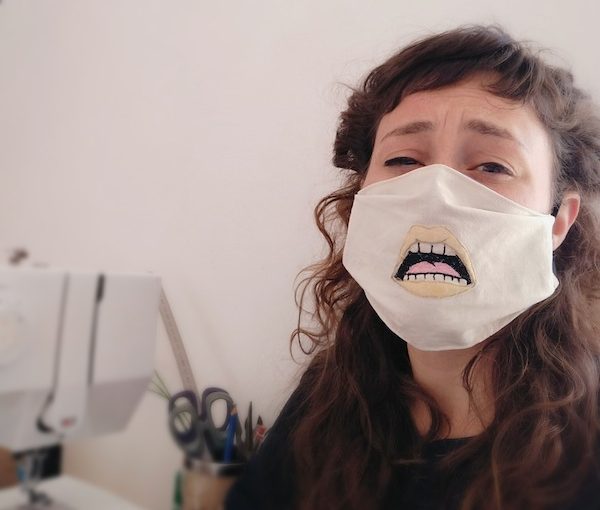
A Stitches by Orli mask, modeled by the designer Orli Fields.

A little over a year ago, Israeli radio news reported that Dr. Li Wenliang, an eye doctor in Wuhan, China, had tried to warn people that there were too many sick in his region. The report caught my attention because it stated that the doctor had been silenced by Chinese authorities.

When the coronavirus outbreak first became newsworthy, Israelis – from the prime minister on down – were sure we wouldn’t be seriously encumbered by it. We were in the mood to confidently assist others. I remember a man in front of me at the grocery checkout, turning around to ask if I knew why he was buying so many packages of toilet paper. When I said no, he told me he was sending toilet paper to family and friends in the United Kingdom.

In an unexpected turn of events, however, the virus became not just a key topic of discussion, but the manager of our daily lives. Over the long months of 2020, family visits and events were severely curtailed. In Israel, for religious and non-religious alike, Jewish holidays are always occasions for get-togethers, but not so this past year.

Some friends and acquaintances have become so nervous about catching the virus, they no longer want to converse, even outdoors, at a safe distance and from behind a mask. Fearing the spread of the pandemic, government officials, in turn, have put the kibosh on live cultural events.

Many people have learned to work from home and some have managed to re-create themselves, opening new businesses, such as those involving logistics, shipping and delivery. For example, a tour guide who used to lead groups through the colourful Mahane Yehuda Market now prepares and delivers baskets of shuk food items. Notably, during the pandemic, some lucky artists and galleries have found more of a demand for their work. Possibly this is due to the fact that people are home so much, staring at the walls, as it were. Yet, most artists-musicians, singers, actors and all the crews that keep theatres and other cultural facilities running have found themselves without work and without significant governmental bailout grants. All tolled, thousands of people have been laid off or have become unemployed altogether.

Whether because we were in lockdown or because we were anxious about being in situations where we might be exposed to people who have the virus, we have perfected online shopping to the level of an art. But some of us have also taken advantage of the farmers who are selling their produce directly to clients rather than through the now-quiet public markets.

We have learned to see ourselves as others see us, that is, in tiny boxes on Zoom. Some cultural institutions – such as the National Library of Israel, the Zionist Confederation House, Beit Avi Chai, Yad Izhak Ben-Zvi and others – have been broadcasting lectures and even some festivals on Zoom. I know one lecturer whose delivery has actually improved over Zoom.

photo - Another Stitches by Orli mask, also modeled by the designer Orli Fields
Another Stitches by Orli mask, also modeled by the designer Orli Fields.

Not only have we learned that we can talk and be understood with a mask over our nose and mouth, I have heard that there are people who, being self-conscious of their teeth and mouth, are now more confident in public because they are wearing a mask.

And masks have changed over the course of the pandemic. In Tel Aviv especially, you will see people wearing designer masks, even while most of us are dressing more simply. In my neighbourhood, for instance, the vast majority of people wear sweatpants and sweatshirts (called “training” in Hebrew) on a daily basis. Teenagers wear indoor-outdoor pajamas; sometimes, they venture outside in their slippers.

The pandemic has brought out lots of dark humour, something Israelis have always been good at. And people have become more cynical about government proclamations. As but one example, the “last lockdown we will have” has happened four times already.

The coronavirus has aided in dividing Israel even more, as certain segments of the population are singled out for their non-adherence to government policy, but are not held accountable for their non-compliance. As one doctor candidly told me, “healthcare decisions are hampered by political considerations.”

Until this pandemic, many discharged Israeli soldiers would travel to southern Asia or to South America to “clear their heads.” With the spread of corona, however, travel has no longer been a safe option, so, in the past year, some soldiers who finished their compulsory service decided to immediately enrol in colleges and universities.

Altogether, the pandemic has caused tremendous financial and emotional stress. We have learned that corona is the loneliest hospitalization and death. But government budget problems have left social service agencies and nonprofits with little or no funding to continue their work of easing the tension, so the psychological damage continues to spread, untreated.

On the brighter side, people have picked up new hobbies, such as gardening or building terrariums. Baking has become a big thing, too. Working on jigsaw puzzles is another activity going through a revival. There seems to be more appreciation of nature, as well, as people have been going out for walks or picnics near their homes as a way to cope. And there has been a significant rise in the number of people adopting dogs, which may help reduce or prevent stress disorders during the pandemic. (While the number of abandoned pets has not dropped in Israel, it has not increased.)

It is generally acknowledged that doctors, nurses and other hospital staff are on the frontlines of the pandemic, so they were the first to receive coronavirus vaccinations. However, there is no shortage of vaccines in Israel and two things happened just recently: “pop-up” inoculation stations opened, to accommodate both citizens and non-citizens, so that, basically, anyone who walks in with an ID can get one; and Israel’s prime minister began talking about vaccine diplomacy – selling or giving vaccines to other countries.

The few pluses of 2020 notwithstanding, however, I doubt most Israelis, if not all, would object to having skipped the past year.

Deborah Rubin Fields is an Israel-based features writer. She is also the author of Take a Peek Inside: A Child’s Guide to Radiology Exams, published in English, Hebrew and Arabic.


Human rights above all

A poster in Marseille, France, in July 2020, calling for Nasrin Sotoudeh’s release from prison.

The National Council of Jewish Women of Canada spotlighted the remarkable story of Iranian lawyer and human rights activist Nasrin Sotoudeh during a showing of the eponymously titled film, Nasrin, on Jan. 10.

Narrated by actress Olivia Colman, the film takes us into Sotoudeh’s life in Tehran, where she has been a stalwart in defending a wide array of people: political activists, women who refused to wear a hijab, members of the religiously oppressed Baha’i faith, and prisoners sentenced to the death penalty for crimes allegedly committed while they were minors. Her work has come with a tremendous amount of personal sacrifice, including prolonged periods in jail.

Among the notable cases brought up in the film is that of Narges Hosseini, who, in 2018, stood on an electricity box on Tehran’s Revolution Street and removed her headscarf to protest Iran’s mandatory hijab law. She was immediately arrested, and Sotoudeh soon took up her cause. At her trial, the prosecutor claimed she was trying to “encourage corruption through the removal of the hijab in public.”

Iranian filmmaker Jafar Panahi is another of Sotoudeh’s clients. In 2010, Panahi was given a 20-year ban on making films, but he has nonetheless continued to create widely praised cinematic works, such as Taxi, in which he played a Tehran taxi driver – Sotoudeh was one of his passengers. The movie won the top prize at the 65th Berlin International Film Festival in 2015. Together with Sotoudeh, Panahi was co-winner of the European Parliament’s Sakharov Prize for Freedom of Thought in 2012.

And there is the unassuming hero we encounter in Sotoudeh’s husband, Reza Khandan. His unflagging loyalty to his wife and family is underscored throughout the film. He, too, has been imprisoned several times, most recently from September to December 2018, after he wrote about human rights violations in Iran on Facebook. He was accused of operating against Iran’s national security by backing the “anti-hijab” movement. Khandan currently faces a six-year prison sentence.

The film relies on secret footage, made possible by intrepid camerapeople within Iran who took on incredible risk to record Sotoudeh in both her professional and private lives. In the midst of filming, in June 2018, Sotoudeh was arrested for representing several women protesting Iran’s mandatory hijab law. Due to health concerns, she was briefly released from prison late last year, but has since been incarcerated again.

During Sotoudeh’s furlough, she was scheduled to undergo tests to monitor her heart. At one time, she was moved to intensive care in a Tehran hospital after a 46-day hunger strike, protesting the conditions political prisoners in Iran have to endure. She also has pressed for their release during the time of the pandemic.

Shortly before her own release from the Qarchak women’s prison, Sotoudeh contracted COVID-19 but has since recovered.

Following the film’s presentation, a panel discussion took place with the film’s director, Jeff Kaufman; its producer, Marcia Ross; activist Shaparak Shajarizadeh; and former Canadian minister of justice Irwin Cotler. The discussion was led by NCJWC president Debbie Wasserman.

“One of the intents of the film is to say it is not just about Sotoudeh and Iran, it is about applying her standards to our countries and ourselves. Let’s take her example and make it global,” said Kaufman.

The filmmakers said they wanted to tell Sotoudeh’s story because she personifies a commitment to democracy and justice, and represents the power of women to shape society. Further, Sotoudeh holds a deep conviction that people of all faiths and backgrounds deserve equal opportunity and protection.

Both Kaufman and Ross spoke of the extraordinary caution taken to preserve the anonymity and security of those shooting the footage in Iran.

Asked about her reaction upon seeing the screening, Shajarizadeh said, “I cried the whole time. We could see ourselves in every minute of the movement.” Shajarizadeh, who now resides in Canada, was a women’s rights activist and political prisoner in Iran – she fought against the country’s mandatory hijab law for women.

“Nasrin is not only the embodiment of human rights in Iran, but a looking-glass into the persecution of all those who are imprisoned in Iran,” Cotler said.

Cotler advocated for “showing the film as much as we can, and [to] have the sort of conversations we are having now, and mobilize the different constituencies that she has been helping.”

Ross said the film will be out later in the year on Amazon and iTunes.

Established in 1897, NCJWC is a voluntary organization dedicated to furthering human welfare in the Jewish and general communities locally, nationally and internationally. To learn more, visit ncjwc.org.

Sam Margolis has written for the Globe and Mail, the National Post, UPI and MSNBC.

Klein speaks on climate crisis

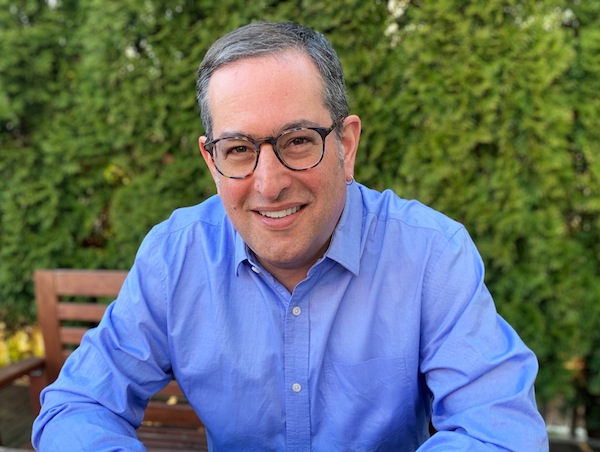
Seth Klein brings his book A Good War: Mobilizing Canada for the Climate Emergency to the Jewish Book Festival on Feb. 22. (photo by Erica Johnson)

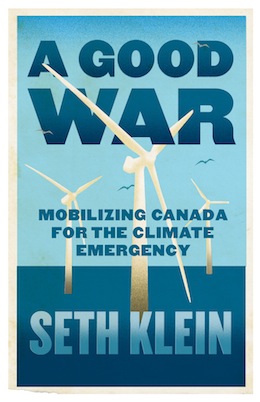
At this year’s virtual Cherie Smith JCC Jewish Book Festival, which runs Feb. 20-25, Seth Klein is among the many writers featured. He will talk about his new book, A Good War: Mobilizing Canada for the Climate Emergency, which came out last September.

Klein was the founding director of the B.C. office of the Canadian Centre for Policy Alternatives (CCPA), a position he held from 1996 to 2018, and was also a founder of the B.C. Poverty Reduction Coalition. He is a board member with the nonprofit Dogwood and an advisory board member for the Columbia Institute’s Centre for Civic Governance. He is a founder, advisor and instructor for Next Up, a leadership program for young people committed to social and environmental justice, as well. He spoke with the Independent in advance of his Feb. 22 book festival presentation.

JI: How did you come to write this book?

SK: When you spend 22 years at the CCPA, you’re forever in this place of what you think should happen versus what our governments are prepared to consider, but never more so than in the case of the climate emergency, where we all live in this harrowing space. I wanted to write a book that would tackle that, that would convince particularly our political leaders, specifically those who say they get it, to be more daring than they have been to date in tackling the emergency.

Originally, the book was to have a single chapter on the Second World War, as an example of rapid economic transformation, but the more I delved into that story, the more I saw parallels between the war and the current crisis – not just on the economic front, but well beyond that. I saw parallels in terms of the role of civil society, the mobilization of the populace, the role of Indigenous people and the need to take care of those who make sacrifices; for example, those working in the fossil fuel industry, who need a just transition, modeled after the care for returning soldiers. I also saw cautionary tales around the squashing of civil rights, the things we don’t want to repeat. To speak to a parallel to which the Jewish community has the most connection: the response to refugees.

JI: Can you say a little more about that last point?

SK: Despite Canada rallying to fight the good fight in Europe, we slammed the door on Jewish refugees before, during and after the war. Years ago, I heard Cindy Blackstock, the amazing Indigenous child welfare advocate, give a very simple definition of reconciliation: reconciliation means not having to say “sorry” twice – you learn from what you did. Canada’s behaviour towards the Jewish community during the Second World War was shameful. I believe that the issue of global climate refugees is going to be one of the defining issues of the next 50 to 100 years. We’re going to have to decide who we want to be this time.

image - A Good War book coverJI: You write that the Mackenzie King government resisted entering the Second World War until the last moment and, even after joining, was slow to ramp up efforts to what was needed. You note that the first nine months of the war are called by historians “the phony war,” and write that we seem to be in the “phony war” stage in our fight against the climate crisis. Can you elaborate on that?

SK: The comparison is really strong. The “phony war” is the period between when they declared war and when things got real. At the beginning of the war, the threat was not clear and present to most Canadians. The fall of France was the moment that the popular zeitgeist shifted. Today, we have the Trudeau government passing a bill acknowledging the climate emergency one day, in the summer of 2019, and then, the next day, re-approving the Trans Mountain pipeline expansion. That is what I call “the new climate denialism.” It manifests in all these governments who say they get it but don’t act like they actually do. In our province, it manifests most clearly in having the most robust climate plan in the country, which we do, and, at the same time, doubling down on fracking and LNG – and you can’t make the math work. That’s the phony war.

JI: What are the assumptions that block government progress on climate action?

SK: The measures that have been adopted so far are largely grounded in what are called “neoliberal” assumptions, which state that society should self-organize according to individual economic interests – the “free hand of the market,” as opposed to the idea that government should function to ensure what is in the best interests of all, so change is left to be voluntary. That’s not working now, and it wouldn’t have worked during the war. When something is an emergency, you don’t make it voluntary.

JI: There is an incredible parallel to COVID-19.

SK: Yes! How do you know when a government knows it’s in emergency mode? These are the four markers: 1) You spend what it takes to win; 2) You create new economic institutions to get the job done, like C.D. Howe, the Liberal cabinet minister [in King’s government] who created 28 new crown corporations to get the job done; 3) You move from voluntary, incentive-based measures to mandatory ones as needed; 4) You tell the truth about the nature and the extent of the crisis and what you have to do.

We did all four of those things in the war. In COVID, we can quibble about the extent that our government has done all four of those things, but I would argue that they have. We’re spending – though it still doesn’t hold a candle to what we did in the war, by the way, but we’re spending. We shifted to mandatory – we locked down the whole economy for some time. We’ve created audacious new programs like CERB that, 10 months ago, none of us would have imagined. Is it too slow sometimes? Yes, but they’ve shifted the mindset. And we have briefings every day, which tell us the truth about the severity of what’s happening. Yet, when it comes to the climate emergency, none of our provincial or federal governments hits any of those markers.

JI: You also describe some cautionary lessons from our wartime experience. Can you elaborate on those?

SK: Aside from the response to refugees, there were all kinds of shameful things, such as War Measures Act stuff, like interning political activists and making political parties illegal, and, most shamefully, the wholesale internment of Japanese-Canadians. There was also the poisoning of Indigenous lands by the very crown corporations whose formation I was so impressed by. These are all examples of state over-reach. The point in recalling these things is to go eyes wide open into the next emergency. To some extent, we have, in fact, already learned as a society – [Brian] Mulroney replaced the War Measures Act with the Emergencies Act, which has safeguards against those types of things. We need the leaders of today to be as bold and innovative as the leaders we had then – and we also need them to be different.

JI: What was the scale of the economic transformation during the war, and how did they pull that off? What are a couple of highest priority steps in your “battle plan”?

SK: The same four steps I’ve already outlined: spend what you have to spend to win, create new economic institutions, move from voluntary to mandatory as required, and rally the public by telling the truth. During the war, they increased government spending tenfold. When C.D. Howe was pressed about the amount of money being spent, he simply said, “If we lose the war, nothing matters.” He carefully controlled all of the supply chains to prioritize the war, including recruiting private businessman, big names like H.R. Macmillan, J.W. Woodward, who abandoned their private interests and served for years as “dollar-a-year men” to serve as controllers and head up these crown corporations because, in an emergency, you don’t leave the allocation of scarce resources to the market – you prioritize what has to be done.

Remember, from 1942 to 1945, the sale of private automobiles in the U.S. of A., the heart of car culture, was illegal. That didn’t happen due to the goodwill of the automakers. They were told. They were busy making stuff for the war effort, making money, but they didn’t decide what to make. We need to approach the climate emergency like C.D. Howe approached the war. We need to conduct an inventory. How many electric buses do we need, how many heat pumps, how many solar arrays, how many wind farms? And, if there is a gap – and there is – we need to decide how we’re going to fill it. Through contracts with the private sector? OK. And, if that’s not enough, we create a new generation of crown corporations to expedite what needs to happen.

JI: Do you think we can rise to the climate emergency in time?

SK: I am trying, in the book, to walk a line. I think, too often, for years, climate communication has been polarized between Pollyannas and pessimists. The leaders we most remember from the Second World War walked a careful line between telling the truth about the severity of the crisis and still imparting hope. Can we do this in time? We don’t know. The reminder I offer to readers is that Canada had a population of 11 million people in the Second World War and over one million Canadians enlisted. You know what they didn’t know? Whether they could win. We know how the story ended, but they didn’t [when they volunteered]. They did what they had to do anyway, and that’s what we have to do.

Matthew Gindin is a freelance journalist, writer and lecturer. He has been published in Philosophy Now, Tricycle, the Forward and elsewhere. He blogs on Medium and is master teacher at Or Shalom Synagogue in Vancouver.

Hope in the presidency

There is no perfection in human affairs. We are imperfect beings and our creations are always flawed. But this does not stop us from striving for perfection, knowing that our reach should exceed our grasp.

The preamble to the United States Constitution begins with, “We the People of the United States, in Order to form a more perfect Union …” and then sets forth the things that the founders agreed to aspire toward, knowing that perfection is unreachable but that aiming for a “more perfect” future is still an ideal to pursue.

This idea is central to Judaism also, that the world was created imperfect and unfinished because it is the role of humanity to complete that work – or, rather, to advance in the direction of completion/perfection even knowing it is unattainable.

This theme appeared also in the poem by Amanda Gorman, the first United States National Youth Poet Laureate, at the inauguration last week of President Joe Biden. “Somehow we’ve weathered and witnessed / a nation that isn’t broken / but simply unfinished,” she said.

That day, Inauguration Day, felt to many like a collective swerve away from an abyss. After the violence at the Capitol two weeks earlier, after four years of chaos and cruelty at the top of the U.S. administration, and at what we hope is the beginning of the end of the pandemic of our lifetimes, it felt like a move in the right direction, a reversal from the trajectory of spiraling rancour. The violence at the Capitol on Jan. 6, so horrific and deadly, may have been the wakeup call that enough Americans needed to recognize the destination to which the “Trump train” was always headed.

The most fundamental component of a democratic society – the peaceful transition of power – was assaulted on Jan. 6, a day most of us never dreamed we would see, an experience that people in autocratic societies know too well but we hoped we never would. We may never know how close the United States came to genuinely losing its democracy but we can hope that the shock of the violence and the widespread refusal to accept the outcome of a properly run election opened enough eyes to the dangers of that approach. As President Biden said, “enough of us have come together to carry all of us forward.”

Regardless of party affiliation, the transfer of power seemed to many like a return to the project of a more perfect union.

By the skin of their teeth, the Democratic party held the House of Representatives and reclaimed the White House and the Senate. The new Biden administration better reflects the diversity of the country’s racial, religious, gender and other components, not least of which is exemplified by the first female vice-president and the first one who is not white.

The refusal of the outgoing president and his wife to adhere to longstanding decorum and decency and their petulant retreat to Florida before the inauguration was a slap in the face for the very idea of democracy itself. To the credit of the vice-president, Mike Pence, he stepped up where the president would not. So, too, did all the living former presidents, three of them in person at the inauguration and the fourth, Jimmy Carter, calling Biden the night before the inauguration to offer wishes of support. This was a powerful show of respect for the office that Trump never exhibited when he held it and which he further despoiled while leaving it. But he is gone now from there, ideally forever, and we trust that a less divisive and corrupt government will carry that country forward.

It is notable that our hopes for 2021 focus so much on a vaccine. The idea of this science – that injecting a dose of a virus into a body to develop an antibody to a more destructive manifestation – might be extrapolated into our body politic. The virus of extremism, tyranny and violence that we saw on Jan. 6 may have inoculated some Americans to combat the spread of such threats. As we strive for herd immunity in our public health, we can perhaps seek a similar degree of protection in our public life. There will always be bad people and bad ideas. Ensuring that they are kept in check and not permitted to reach pandemic levels is as close to perfection as we can possibly attain. We can hope that, in the spirit of Biden’s words, enough people will come together in defence of the great values that country was founded on to carry all of us forward.

Interview insightful, fun

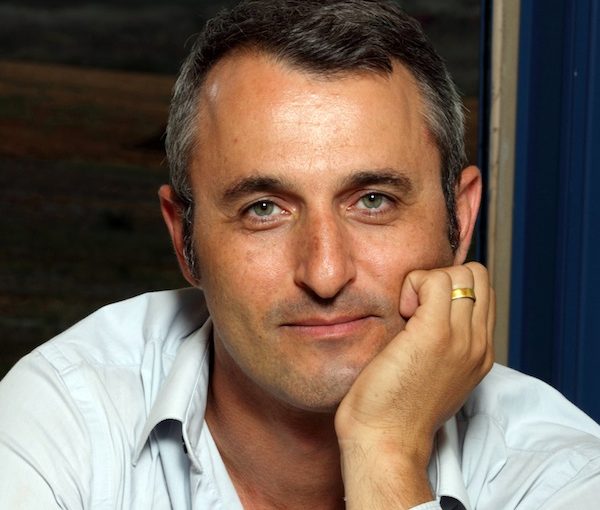
Israeli writer Eshkol Nevo, whose latest novel is The Last Interview, opens the JCC Jewish Book Festival Feb. 20. (photo from JBF)

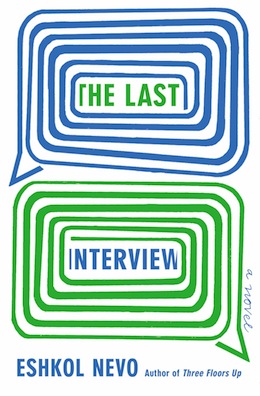
This year’s Cherie Smith JCC Jewish Book Festival opens online Feb. 20, with Israeli writer Eshkol Nevo, whose latest novel, The Last Interview, brilliantly sprinkles facts amid a lot of fiction and interjects humour into much pathos. It entertains, of course, and, as all good books do, it raises many salient points that will get readers thinking – and feeling – about, in this case, storytelling, marriage, truth, parenting, friendship, lies, family, identity, media, politics and relationships. So, life.

In The Last Interview, the protagonist, who is suffering from a chronic form of depression and writer’s block, responds to an interview sent to him “by an internet site editor who collected surfers’ questions.” He later notes, “It was supposed to be only an interview, nothing else, but slowly – it seems I can’t do it any other way – I’ve been turning it into a story. I was supposed to leave Dikla and the kids and the dysthymia out of it. And all of them are in it.” This inability to stop himself from telling stories about others in his published writing is an Achilles’ heal in his personal life, but a boon to his professional one.

His interview answers are sometimes short and direct:

“How do you manage to deal with the loneliness that’s part of writing?

“I don’t.”

But, most often, they are quite involved, going into more detail, retrospection and introspection than the questioners would ever have expected. We learn about his failing marriage, but also its sweet beginnings. We are privy to his feelings about his best friend, who is dying of cancer. We see how he struggles to be a good father to his three kids. We hear some of his travel adventures. We witness his attempts to extricate himself from an unwanted speech-writing gig. We share his discomforts with the Israeli-Palestinian situation. We find out a bit about his motivations for writing:

“If I don’t write, I have nowhere to put my memories, and that’s dangerous. I have a problem. I don’t forget anything. My forgetting mechanism is completely screwed up. All the partings, the deaths, the unexploited opportunities. They are all trapped in my body, and writing is the only way to release them … if I don’t occasionally unburden myself of the weight of some of those memories, I won’t be able to breathe. No air will enter my body. Or leave it.”

Part of his current creative block – “I was supposed to be writing a novel this year. Instead, I’m writing answers to this interview” – is that he and his wife are becoming more distant. “I can’t say that I became a writer to win Dikla’s heart, but I can assume that with another, less stimulating woman, I wouldn’t be writing.” He notes that, since his first letter to her, “In fact, everything I’ve written since then, eight books, is one very long letter addressed to her.” At the end of a lengthy response to the question, “All of your books are written in the same style. Have you ever thought of writing something completely different? Maybe science fiction? Fantasy?” he says that genre wouldn’t make any difference: “In any case, it would turn out that, once again, I wrote about an impossible love.”

image - The Last Interview book coverWhile the overall mood of The Last Interview is solemn, there are many funny parts. One especially hilarious section is the writer’s response to the question, “When will they produce a film adaptation of your latest book? When I read it, I could actually imagine the movie.” As the writer shares the details of an encounter with a filmmaker of a similar opinion, the conversation cynically – but with the ring of truth – moves from flattery to the many ways in which the movie will ultimately be unrecognizable from the book, yet concluding nonetheless with the filmmaker enthusing, “The minute I finished it, I said to my wife: This is a movie!”

With a writer as intelligent, sensitive and amusing as Nevo and an interviewer as experienced as the Globe and Mail’s Marsha Lederman, the book festival’s opening event should be well worth attending. For tickets to it, and for the full lineup of events, visit jccgv.com/jewish-book-festival. The festival runs to Feb. 25.

Chapter soon behind us

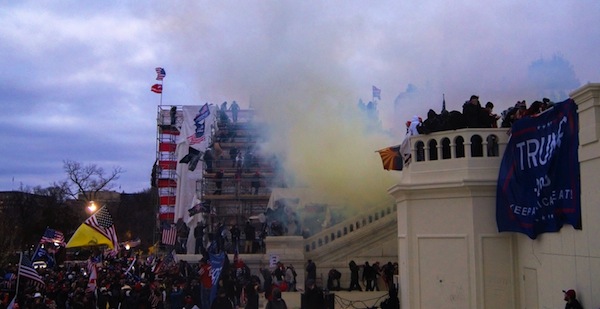
The violence at the U.S. Capitol on Jan. 6. (photo by Tyler Merbler/flickr)

Elect a clown, expect a circus. That has been a recurring meme over the past four years. As the reality show that is the Donald Trump presidency staggers into its final few days, the full fruit of the president’s years of bellicosity and violent language expressed themselves at the U.S. Capitol Jan. 6. Incited by the president, who repeated his utterly baseless claims of a stolen election, thousands of people marched on the seat of America’s democracy, smashed windows, stormed the building, threatened lawmakers and defaced and desecrated the premises.

Some observers, including many Republicans, expressed shock at a turn of events that was almost entirely predictable. After years of the most irresponsible rhetoric imaginable from the so-called leader of the free world, and after two months of undermining the most sacred facet of American democracy, the peaceful transition of democratically elected administrations, violence was a surprise only to those who have not being paying attention – or who observe through ideological blinders.

It seems to be a turning point. A growing, though still far too small, number of Republicans are finally saying they have had enough of the outgoing president’s petulance and possibly criminal irresponsibility. Listening to some, it appears they were looking for an opportune moment to break with their leader, and the violence – which killed five people – provided the ideal opening.

It is not enough for apologists to pretend that these elements are in any way peripheral to Trumpism. He has encouraged, abetted and refused to condemn the most evil strains in the American body politic, from the Ku Klux Klan to Proud Boys, referring to “very fine people on both sides” at Charlottesville – when one side was white supremacists with a sprinkling of neo-Nazis and anti-democratic thugs. Faced with the destruction his words and his supporters wrought at the Capitol, Trump uttered the least a president could possibly say, calling on the rioters to go home, while also repeating the lies that led to the violence in the first place. Then he added: “We love you. You’re very special.” He just can’t help himself.

Among the insurrectionists at the Capitol were overt Nazis, including at least one wearing a shirt with “Camp Auschwitz” emblazoned on it and another with the acronym “6MWE,” meaning “six million wasn’t enough.” These are the very special people Trump loves. Jews and others who were taken in by an embassy move and other ostensibly “pro-Israel” acts should know now the fire with which they were playing.

There must be accountability. At the top, those who abetted and encouraged the worst actions of the past years should be held criminally liable, if that is the extent of their culpability. At a lesser level, those who tacitly or explicitly permitted what has happened – Republican senators, congress members and party officials – will ideally suffer at the ballot box at the next opportunity. Among ordinary people, including some in Canada who have expressed support for this extremist and white nationalist approach, we should seek introspection around how we may have been drawn into a political disease that we should have recognized for what it was – yet let proceed along a path that almost inevitably led to the loss of human life and the shattered glass at the U.S. Capitol last week.

We might also hope that leaders of other countries will look at the American case as an instruction in the dangers of oratorical brinksmanship, division and scapegoating. One of Trump’s greatest allies, Israel’s Prime Minister Binyamin Netanyahu, is in an election (again) and it will be illuminating to see if his style softens at all. In Europe, where far-right populism is seeing a resurgence, perhaps the warning shots from Washington will inspire a little more moderation.

Barring more violence on Inauguration Day, God forbid, this chapter will soon be behind us. Joe Biden was not everyone’s first choice for president, he was more of a compromise pick. Based on decades of experience, he has been charged with picking up the pieces of a society shattered by four years of negligent and confrontational executive leadership. It doesn’t hurt that he has a grandfatherly demeanour and a history of consensus-building. While the outgoing president will not attend the swearing in – more proof that he abhors the core principles of democracy – beside Biden will be Kamala Harris, the first woman and the first Black and Asian person to assume the vice-presidency.

No humans are perfect. The Biden-Harris administration will make mistakes and we will criticize them. But we can rejoice in the arrival of a new future, led by people of goodwill, intelligence and moderation, who know the difference between right and wrong, between neo-Nazis and very fine people.

Olive trees have long history

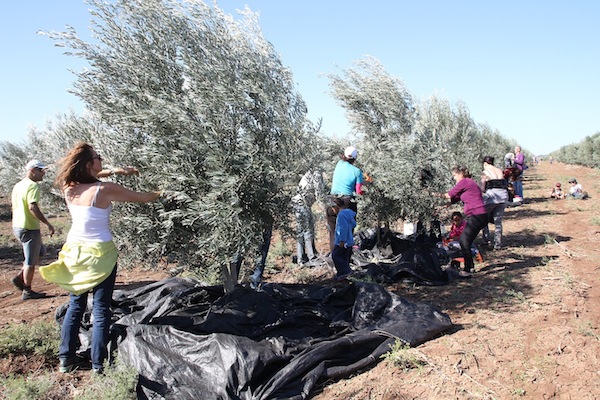
Volunteers help pick olives on a windy day in the fair trade grove of Emek Yizrael. (photo from Yoram Ron)

For thousands of years, olive trees have grown in Israel. Neolithic pottery containing olive pits and remnants of olives have been discovered in Israel’s Mount Carmel region, proving that early people produced olive oil by pulverizing the ripe olives in small pots. Some ancient trees reportedly still exist – in the Palestinian village of al-Walaja, residents claim they have the world’s oldest olive tree, supposedly 5,000 years old. More realistic is Beit Jala’s claim to an 800-year-old olive tree.

Olives for making oil are picked around December or January, so it is probably no coincidence that Chanukah comes so close to the picking season. As you know, Chanukah’s miracle revolves around the story that a very limited amount of olive oil burned in the Temple menorah for eight nights.

While the olive branch is a symbol of peace, the olive harvest in both Israel and the Palestinian territories is a challenging time. For Palestinian olive growers, extremist settlers and Israeli government policy have turned their harvest into an uncomfortable, if not a physically and economically dangerous event. Documented cases show some settlers assaulting Palestinian farmers – threatening them, driving them off their own land, physically attacking them or throwing stones at them. Sometimes, settlers vandalize Palestinian vehicles and damage farming equipment. In other cases, settlers jump-start the harvest, stealing the fruit from hundreds of trees. In the saddest of cases, settlers vandalized hundreds upon hundreds of Palestinian olive trees, in what appears to be a gross violation of Deuteronomy’s 20:19 bal tashchit precept. In this law, we may not uproot or cut down a fruit tree if we do not have an acceptable reason to do so. In the early part of last year’s harvest, the Office for Coordination of Humanitarian Affairs reported that 25 Palestinians were injured, more than 1,000 olive trees were burnt or otherwise damaged and large amounts of produce were stolen.

Since the construction of the separation barrier, some Palestinian olive growers have ended up with their groves located on the other side of the barrier and farmers must obtain special permits and go through special gates to get to their trees. The B’Tselem Organization has documented situations in which Israeli soldiers have blocked the access gates or held farmers up, and there have been reports that soldiers have used anti-riot material on the growers.

In a few cases, the separation between olive groves and homes means that growers have to travel some 25 kilometres round trip. Moreover, the growers are given fixed times to get to their trees and, sometimes, the periods available are not long enough to finish all the picking. Related, Palestinians are sometimes put into a situation in which they have to pick their fruit while the olives are still strongly attached to the branches. Olive picking is largely a manual procedure, so, to dislodge the unripened olives, growers either hit the trees with a rod or shake the trees very hard. This can result in damage to both the trees and the olives.

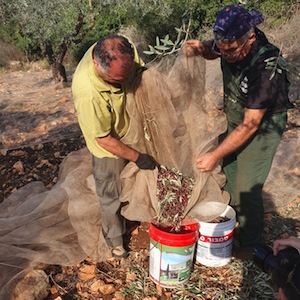
photo - Two men loading freshly picked olives in the organic grove of the Galilee’s Kfar Deir Hanna, November 2020
Two men loading freshly picked olives in the organic grove of the Galilee’s Kfar Deir Hanna, November 2020. (photo by Itiel Zion)

The current pandemic has caused financial havoc all over the world, including in Israel. This harvest season, Jewish Israeli olive growers have had tons of olives stolen. In the Emek Yizrael area, the Border Police found about 10 tons of olives in a nearby sheep pen. The olives had already been bagged and the gathering containers were standing to the side. The alleged thieves live in Zarzir, a village some 10 kilometres from Nazareth. Shomer Hachadash (the New Guard) tries to prevent these incidents using dogs and heat-sensing drones for nighttime surveillance. Some very bold olive thieves have even been spotted in daylight hours.

Despite this gloomy picture, however, there are promising things happening in Israel’s olive industry. Kfar Kanna’s Sindyanna is an olive oil producer. The Galilee operation is a certified fair trade establishment. In addition, it is a nonprofit organization with strong social and political commitments. Their olive oil bottles proudly say that the oil is produced by Jewish and Arab women in Israel.

Sindyanna aims to improve the working conditions and livelihoods of local Arab women, a clearly marginalized group. For example, Sindyanna provides employment training for Arab women. On the political level, Sindyanna is committed to inter-religious understanding by contracting Muslim, Jewish and Christian women. Moreover, the growers who sell their olives to Sindyanna, like the population of the Galilee itself, are a mix of ethnic groups.

Hadas Lahav, Sindyanna’s chief executive officer, said the company strongly affirms sustainable farming. Over the years, it has built strong connections with local farmers, buying olive oil directly from about 100 individual farmers and large family groups. Some of the farmers are organized into large family companies, like Al-Juzur’s seven families of the Younis clan. In Deir Hanna, the 2,500 organic olive trees belong to the Hussein family. In the Birya Forest, there are 10,000 organic olive trees maintained by Hussein Hib.

In the Jezreel Valley, there is a non-organic grove that belongs to Sindyanna in cooperation with the landowners, the Abu Hatum family from Yafi’a. In Iksal, the non-organic groves belong to the Dawawsha family. In Arabeh, the non-organic olive groves belong to the Khatib family and, at Moshav HaYogev, they belong to the Ashush family.

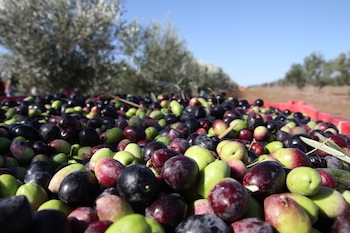
photo - Close-up of freshly picked olives in Sindyanna’s fair trade grove in Emek Yizrael
Close-up of freshly picked olives in Sindyanna’s fair trade grove in Emek Yizrael. (photo from Yoram Ron)

As Lahav pointed out, with olives, there are good years and less good years. The 2020 harvest was significantly smaller than the 2019 harvest. In a way, it was fortuitous that 2020 produced less fruit, as, with COVID-19, few permits were given to seasonal pickers entering Israel from the West Bank.

The olives picked for Sindyanna’s products are Coratina (this olive tree is highly adaptable and produces abundantly in hot dry climates, including rocky soils), Barnea (this olive was bred in Israel for oil production, but is also used for green or black table olives) and Souri (olives that are native to Israel and have been the major variety cultivated traditionally under rain-fed conditions in northern Israel). On average, in irrigated groves, a tree produces five kilograms of olive oil and, in a non-irrigated grove, a tree produces three kilograms of olive oil. The olive oil is kosher.

Here are some factoids about Sindyanna. Many of us are familiar with Dr. Bronner’s soaps, but did you know that Sindyanna of the Galilee’s organic olive oil is an essential ingredient in Dr. Bronner’s Magic Pure-Castile Soaps? KKL-JNF is also involved with Sindyanna of the Galilee – in KKL-JNF’s Birya Forest, the organic olive grove was once part of the now-defunct Qabba’a village. Not too long ago, another organic grove in Wadi Ara (planted on a former Israeli army firing range) was threatened by the construction of high-tension wires; following the protests of local farmers and the village council, the course of the power line was diverted.

Sindyanna of the Galilee sells its olive oil on Amazon and, this year, it will start selling its olive oil on select Canadian websites and in certain food stores.

Deborah Rubin Fields is an Israel-based features writer. She is also the author of Take a Peek Inside: A Child’s Guide to Radiology Exams, published in English, Hebrew and Arabic.

Thoughts on Bahrain

Nancy Khedouri, a member of the National Assembly of Bahrain. (photo from bahrainthisweek.com)

Nancy Khedouri, a Jewish politician, writer and businesswoman from Bahrain, provided insight into the history of the Jewish community in the small Gulf state and its recent normalization agreement with Israel, signed in September. She spoke at a Nov. 29 Zoom talk organized by Canadian Friends of the Hebrew University and moderated by Ambassador Ido Aharoni.

A member of the National Assembly of Bahrain since 2010, Khedouri is also the author of From Our Beginnings to Present Day, a history of the Bahraini Jewish community, which started at the end of the 19th century.

“Bahrain was known as a place that always embraced people of various religious and cultural backgrounds. The Jews of Bahrain were always allowed to practise their religion freely,” said Khedouri, a third-generation Bahraini and descendant of Iraqi Jews.

The Jewish community in Bahrain totaled close to 2,000 people a century ago. From the 1940s through the 1960s, many Jews left the country on their own volition; they were never expelled, she pointed out. These days, their numbers are rather small, with roughly a half-dozen resident families, or about 40 individuals, covering all age groups. Most Jews living in Bahrain now came from Iraq.

“Overall, the Jewish people worked in various professions, tobacco, olive oil, electronics, some were in the record business – both my grandfathers were involved in the leasing of cinemas. Some of those here today work in the money exchange business. We have integrated very well in the texture of society. We are highly respected,” she said

One famous member of Bahrain’s Jewish community in the 1940s was a midwife known as Um-Jan, in Arabic, whose story influenced a popular 2020 Arabic television series Um Harun. When the community was larger it had a shochet (ritual slaughterer), and it still maintains a Jewish cemetery.

These days, Jewish traditions and festivals in Bahrain are taught and celebrated at home. Bahrain’s synagogue, located in country’s capital, Manama, is not presently in use. Established in the 1930s, the shul was funded by a Jewish pearl trader from France who wanted to create a place of worship for local Jews. At that time, he entrusted a community member with the responsibility of looking after the title deeds of the property. The synagogue is currently under renovation, and the hope is to have it reopen by Purim.

On the question of the tolerance shown towards Jews in Bahrain, Khedouri highlighted the “open-mindedness” of the ruling family and Islam, “a religion that teaches coexistence, peace and respect for one another. They have embraced the true values of being Muslim.” She pointed out that other religions live in peace in Bahrain: in addition to the synagogue, Bahrain houses churches and the only Hindu crematorium in the Gulf.

Aharoni remarked on the prominent role women seem to have in Bahraini society and public life. “Bahrain took pioneering steps to empower women. We have reached advanced stages,” said Khedouri. “We have had women as ministers and leading roles through the years.” Khedouri’s cousin, Houda Nonoo, served as Bahrain’s ambassador to the United States from 2008 to 2013.

Since the 1950s, women have joined the workforce and, since the 1960s, have started companies, said Khedouri. They joined the police force in the 1970s, she continued. And, now, Bahraini women constitute a high percentage of those employed as doctors. Nonetheless, there is still room for improvement, she said.

On the newly formed ties with Israel, Khedouri commented, “We must remember that Israel never posed a threat to the Gulf countries or the region. Seven decades of lost opportunity is a long time. Everyone met the new agreement with great excitement. We believe both countries will benefit. Israel will benefit by having a great trading partner.”

She expects joint collaborations in many aspects. There are opportunities, she said, in technology, in cinema, arts and tourism. In Manama, much preparation is underway for the arrival of Israeli tourists to the country. A number of hotels and supermarkets are offering kosher menus and products.

Khedouri lauded outgoing American president Donald Trump and his son-in-law and senior advisor Jared Kushner for being instrumental in bringing about a peaceful arrangement with Israel. Bahrain followed the United Arab Emirates in normalizing ties with Israel; afterwards, Sudan and, later, Morocco established deals with the Jewish state. These agreements collectively have been referred to as the Abraham Accords.

Bahrain’s political system is a constitutional monarchy with two legislative chambers. Its Council of Representatives is elected while its Consultative Council (or Shura Council), on which Khedouri sits, is appointed by the king.

Sam Margolis has written for the Globe and Mail, the National Post, UPI and MSNBC.

Cautiously optimistic

The good diplomatic news keeps coming. Morocco and Israel have announced that they will begin normalizing bilateral relations. This comes on the heels of similar announcements between Israel and the United Arab Emirates, Bahrain and Sudan. There are rumours of more announcements to come.

More than 10% of Israel’s population has family roots in Morocco, adding to the emotional impact of the latest announcement.

In a year that has strained credulity in so many ways – few of them cheery – these diplomatic moves have been a bright spot. Even some longtime international observers and commentators are dumbfounded by the speed of the developments. For decades, the conventional wisdom of Middle East watchers has been that Arab recognition of and peace with Israel rests on a resolution of the Palestinian issue. Bypassing that step is a massive about-face for the countries that have made nice with Israel, and it is galling to the Palestinians and their representatives.

In most cases, the thaw in relations is a de jure recognition of de facto relations that have been in progress for years. Under-the-radar visits and economic ties have existed between Israel and some of these states long before they were officially acknowledged and celebrated. Bringing these relations out in the open was eased by a little self-interest, with a degree of cajoling and likely backroom dealing from the U.S. president and his administration.

The incentives for Arab and Muslim states to warm the cold shoulders they have given Israel include realities of geopolitics – countering the regional designs of Iran and Turkey – as well as the basket of inducements presented by the Americans. For example, the latest announcement – between Morocco and Israel – involves American recognition of Moroccan sovereignty over disputed territories of Western Sahara and American promises of billions of dollars of investments in the Moroccan economy.

Similarly, the American-brokered relationship between Israel and Sudan hinged on Sudan’s removal from the U.S. list of state sponsors of terrorism (contingent on Sudan’s provision of $335 million in compensation for victims of the Sudanese-related terrorist bombings against American interests and citizens).

The UAE and Bahrain agreements also had carrots attached. In exchange for their acquiescence, the UAE may obtain valuable American F-35 fighter jets.

All the states launching fresh relations with Israel open the opportunity for potentially lucrative deals with Israeli businesses and investors. In other words, the diplomatic thaw is not a consequence of a sudden awakening to the benign presence of what has been known by most of these states until recently as the “Zionist entity.” The trading of economic and military incentives – as well as the seemingly nonchalant abrogation of self-determination for the people of Western Sahara – suggest as much self-interest as affection for Israel.

The diplomatic isolation of Israel that began at the moment of its rebirth in 1948 was founded primarily on the rejection of the idea of Jewish self-determination – at least in the Jewish people’s ancient and modern homeland. The opposition to Israel’s existence was not premised on economic or diplomatic reasoning but, to a much greater extent, on anti-Jewish animus.

Israel’s isolation represented an abandonment of self-interest on the part of Arab and Muslim countries. Ghettoizing their own economies from the economic powerhouse of the region has been harmful to all people in the region. None have been harmed more than the Palestinians themselves, who have something to gain materially from good neighbourliness with Israel.

The series of announcements on diplomatic relations are not a result of any altruism. At least in part, they came about through old-fashioned horse-trading, including some morally questionable trade-offs, such as the forgiveness of terrorism and an internationally contentious occupation of a foreign territory, and weapons sales.

After 72 years of nearly universal rejection of Israel by its neighbours, a thaw motivated by self-interest is still a thaw. And it’s something about which to be cautiously optimistic. But it’s only a start, and there is much to be done to build the region into one that’s united in peace. It might be naive, but we still cling to the hope of Isaiah that all those weapons will eventually be exchanged for ploughshares and pruning hooks that, one day, the world over, “nation shall not lift up sword against nation; neither shall they learn war anymore.”