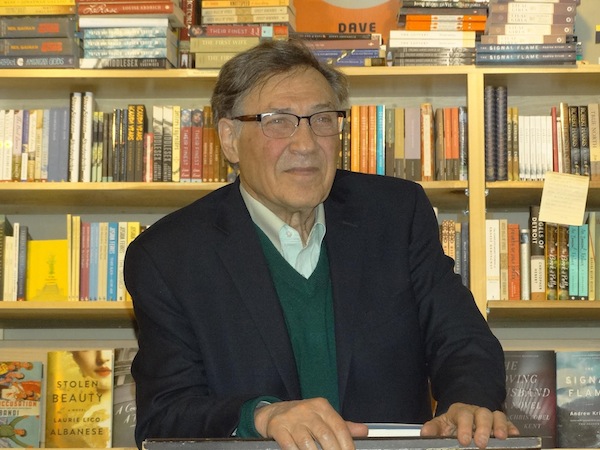
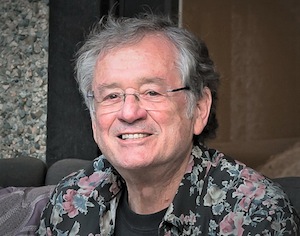
The exhibition Leonard Cohen: A Crack in Everything was the most popular in the history of the Musée d’art contemporain de Montréal (MAC), recording 315,000 visits over its year-long run. The massive multidisciplinary show, produced by MAC, opened in November 2017 on the first anniversary of the Montreal-born singer-songwriter’s death. A scaled-down version then went on an international tour planned through to 2022, first at the Jewish Museum in New York in 2019 and then at Copenhagen’s GL Strand art centre, where it ran until the COVID pandemic hit. Last month, MAC launched a virtual exhibition of the same name that will be up for three years and available free of charge, but within Canada only.
As was the case with the original, visitors can easily spend hours, if not days, trolling through this exhibit, which blends much of its real-world components with hundreds of related images and music, audio and visual extracts, texts and background information. About 50 artworks from MAC’s permanent collection are also imaginatively linked to Cohen’s poetry, songs, interviews and, sometimes, drawings of himself.
For the original show, MAC director John Zeppetelli and guest curator Victor Schiffman commissioned some 40 Canadian and international artists to find inspiration in Cohen’s life and work. Given a free hand, they produced visual and performance art that drew heavily on multimedia, using technology that often allowed the audience to interact. These unconventional tributes drew mixed critical reaction, but an adoring public, still mourning his loss, was just happy to immerse themselves in all things Cohen.
Cohen’s children, Adam and Lorca, cooperated with the MAC project, and the man himself is said to have given his go-ahead for the concept the year before he died.
With the virtual exhibition, visitors control how much they sample, as they meander through the different portals. The site’s main page has an otherworldly feel, as links drift in a black cosmos and (optional) ethereal soundscape. Visitors can explore the four main themes about Cohen: Poetic Thought; Spirituality & Humility; Love; and Loss & Longing. Or. they can head to the Gallery to search by contributing artist; the two other sections are Echo, audio and transcribed impressions offered by visitors to the original exhibition, and Context, a biographical sketch of Cohen.
With respect to navigating the site, if one wants, for example, to delve into the source of the title, which comes from Cohen’s 1992 masterwork “Anthem” (with the lyrics, “There’s a crack in everything / That’s how the light gets in”), a link under Spirituality & Humility leads to the Montreal electronic band Dear Criminals’ interpretation of the song. Related to that recording is a video of Cohen performing the song in London in 2008, a transcript excerpt of a radio interview he gave for Sony Music in 1992, explaining what the lyrics mean, and a video clip of his rendition of it that year on television in France.
The exhibition stresses how influential Judaism was to Cohen, who was born into a prominent Jewish family in 1934. “A strong spiritual presence inhabits much of Leonard Cohen’s work,” reads an entry. “Raised in the ancestral tradition of Judaism, Cohen discovered and developed an interest in poetry as a child while listening to the Hebrew Bible reading cycles and the sung prayers of the Jewish liturgy.”
Although he left Montreal in the 1960s, Cohen maintained a lifelong membership in Congregation Shaar Hashomayim in Westmount, where he grew up. He turned to its cantor, Gideon Zelermyer, and men’s choir for traditional backup to the title cut from his final album, the haunting “You Want it Darker,” released just weeks before his passing. The choir had a small part in the original exhibition, which has been carried over to the virtual. It appears in South African-born Candice Breitz’s panoramic video installation in which 18 elderly men, fans of Cohen but lacking his talent, were recorded covering “I’m Your Man.”
MAC invites visitors to continue the conversation via social media at #cohenetmoi. The virtual exhibition Leonard Cohen: A Crack in Everything is accessible at expocohen.macm.org until Feb. 12, 2024.
Jack Zipes gives the lecture Resurrecting Dead Fairy Tales on Facebook Feb. 17. (photo from MISCELLANEOUS Productions)
Some fairy tales are timeless in that they still have lessons to impart. For example, The Pied Piper, a story dating back to the Middle Ages, “is a tale of plague, greed, betrayal, conformity/confinement with allusions to child abuse,” explained Elaine Carol, co-founder and artistic director of MISCELLANEOUS Productions.
MISCELLANEOUS’s Plague project will have participating youth, along with professional artists, interpreting the Brothers Grimm’s The Pied Piper “from an intersectional, anti-racist, anti-oppression, queer feminist perspective.” In preparation, Carol told the Independent, “we have been reading our way through the mountain of brilliant writing by Jack Zipes, asking him many questions – even our film editor of Resurrecting Dead Fairy Tales is now reading two of his hundred or more published books.”
In Yussuf the Ostrich, political caricaturist Emery Kelen tells the story of a young ostrich who helps defeat the Nazis in northern Africa during the Second World War.
Zipes’ recorded Facebook Watch talk, Resurrecting Dead Fairy Tales, will be streamed Feb. 17, followed by a live Q&A with Zipes. Some of the lecture will be part of the documentary being created about the youth-centred theatre project, which will include various workshops and an eventual stage production at the Scotiabank Dance Centre in 2022.
“I have also been working with young professional artists Tiffany Yang, who was a youth in our Monsters production, national and international tours, and Julia Farry, our production assistant/outreach worker,” said Carol. “Tiffany has translated four indigenous Taiwanese folk tales that are stories of plague – mostly in coastal communities, including animal wonder tales of fantastical fishes and other fascinating narratives. Julia has translated three Japanese folk tales focusing on plagues. There are many plague stories that we still hope to collect, including the facts of disease spread by European settlers to the Indigenous people of Turtle Island, as research materials for our project-in-development.
“We are currently collecting these tales to bring to our youth cast after it is deemed safe to work with them in person,” Carol continued, “as we will be using theatre, hip hop/streetdance, contemporary dance, marimba and world music, urban music, performance art, etc., to co-create a new play. This play will be used as a vehicle for the youth to discuss their own experiences of living in a world pandemic.”
Zipes’ lecture was filmed in Minneapolis by MISCELLANEOUS Productions’ professionals. The professor emeritus of German and comparative literature at the University of Minnesota is an expert on folklore and fairy tales. He is a storyteller himself and the founder of the publishing house Little Mole and Honey Bear.
“My parents and grandmother always told me tales of different kinds,” Zipes told the Independent. “When I began studying for a PhD at Columbia University, I wrote my dissertation on ‘The Great Refusal: Studies of the German and American Romantics in the 19th Century.’ My interest in fairy tales grew as I realized that these imaginary tales hold more truth than the so-called realistic future. And I also was angered by Bruno Bettelheim’s book about fairy tales in which he imposed a Freudian interpretation on readers. Since then, I have been trying to reveal how relevant fairy tales are to our lives.”
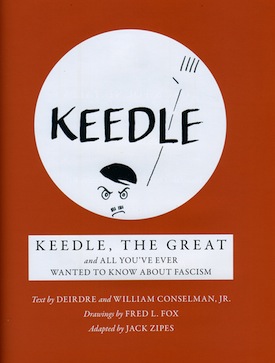
One of the fairy tales Jack Zipes has resurrected is Keedle, The Great, first published in 1940.
The examples given in the lecture’s press release are from two books Zipes has translated and published: “For example, in Yussuf the Ostrich, well-known political caricaturist Emery Kelen tells the story of a young ostrich who helps defeat the Nazis in northern Africa during World War II. In Keedle, The Great, first published in 1940, Deirdre and William Conselman Jr. sought to give Americans hope that the world can overcome dictatorships. To the authors, the title character Keedle represented more than Hitler, but all dictators then and now.”
Zipes said, “I don’t think that my being Jewish accounts for my interest in fairy tales. My Jewishness makes me a bit meshuggah, and this is why I try to think out of the box and have developed a storytelling program for children without sanitizing the fairy tales. The best of folk and fairy tales have never been sanitized, and I use tales to tell so that children will be enabled to tell their own miraculous tales.”
“My Jewishness is complex,” said Carol, “because I am mixed-race Sephardic-Romani and Ashkenazi. One of one million reasons I love Jack Zipes and think his work is crucial is his lucid critique of the Disneyfication of fairy tales and folklore.”
Resurrecting Dead Fairy Tales starts at 5pm on Feb. 17 and is intended for older youth and adult audiences. On the day and time, click here for link to watch.
Josh Epstein and Amanda Sum in do you want what i have got? a craigslist cantata, written by Veda Hille, Bill Richardson and Amiel Gladstone, and presented by the Cultch and Musical Stage Company. (photo by Emily Cooper)
Welcome back the cast of wild and wacky characters from the Craigslist community as they attempt to buy and sell online, all the while longing and searching for human connection – this time with a fresh, new perspective on social isolation, and livestreamed from all around the Cultch. The production features the original songs “300 Stuffed Penguins,” “Chili Eating Buddy,” “Decapitated Dolls,” and more. Joining actors Epstein and Sum in the cast are Meaghan Chenosky, Kayvon Khoshkam and Andrew Wheeler. Showtimes are Feb. 5-6, 4:30 p.m. and 7:30 p.m., and Feb. 7, at noon. Tickets ($25/$29/$58) can be purchased from 604-251-1363 or thecultch.com/event/a-craigslist-cantata.
Clockwise from top left: committee members Tanja Demajo, Michelle Dodek, Michelle Gerber, Stan Shaw, Renee Katz and Simone Kallner. (photo sextet from JFS)
Jewish Family Services has formed a food security committee. This team will be responsible for leading the transition plan of the JFS’s Jewish Food Bank to its new and dedicated facility near Main and East 3rd Avenue in Vancouver. The committee, which reports to the board of directors, will be focused on supporting the Food Security program development project as a steering committee for the move into the new facility; and assisting as content advisors on an ongoing basis in the areas of food programs planning, security, building management, partnerships and community engagement, and communication.
Committee members have served on the Jewish Food Security Task Force and sit on several committees in the community. The committee co-chairs – Simone Kallner and Stan Shaw – also serve on the JFS board.
This year, a Food Security Project website will be launched to keep people apprised of the committee’s work. It will also contain upcoming town hall meetings, with the most current community stakeholder engagement and input opportunities.
* * *
Created in 1967, the Order of Canada is one of our country’s highest civilian honours. Its companions, officers and members take to heart the motto of the order, “desiderantes meliorem patriam” (“they desire a better country”). Appointments are made by the governor general on the recommendation of the Advisory Council for the Order of Canada and, on Dec. 30, it was announced that Dr. Robert Krell was among the 61 new appointees.
Dr. Robert Krell (photo courtesy)
Krell was appointed Member of the Order of Canada for “his contributions to our understanding of mass ethnopolitical violence, and for his advocacy on behalf of Holocaust survivors.”
A professor emeritus of the University of British Columbia, department of psychiatry, Krell’s research and interests are the psychiatric treatment of aging survivors of massive trauma; and antisemitism, racism and prejudice education.
Krell was born in Holland and survived the Holocaust in hiding. The Krell family moved to Vancouver, where he obtained an MD from UBC and eventually became professor of psychiatry. In his psychiatric practice, Krell was director of child and family psychiatry and also treated Holocaust survivors and their families, as well as Dutch survivors of Japanese concentration camps.
Krell established a Holocaust education program for high school students in 1976 and an audiovisual documentation program recording survivor testimony in 1978 and assisted with the formation of child survivor groups starting in 1982. He served on the International Advisory Council of the Hidden Child Gathering in New York in 1991, and he is founding president and board member of the Vancouver Holocaust Education Centre, which opened in 1994 and which teaches 20,000 students annually. He has authored and co-edited 10 books, 20 book chapters and more than 50 journal articles. He continues to write and speak on Holocaust-related topics.
* * *
With thanks to HaShem, Schara Tzedeck Synagogue members Alexander Hart and Kathryn Selby are honoured and delighted to announce the engagement in Jerusalem of their son Shmuel Hart to Reut Rappoport, daughter of Rabbi Jason and Meira Rappoport of Alon Shvut, Gush Etzion, Israel.
* * *
An article on the mosaic work of Lilian Broca has been published in the international peer-reviewed academic magazine Journal of Mosaic Research, out of Izmir, Turkey. It can be found at dergipark.org.tr/tr/pub/jmr (click on English version or translation if necessary), scroll down to article 18, which is “From Virtue to Power: Explorations in Female Heroism – The Mosaics of Lilian Broca,” and click on PDF on the upper lefthand side. The article was written by Angela Clarke, PhD, of the Italian Cultural Centre here in Vancouver.
* * *
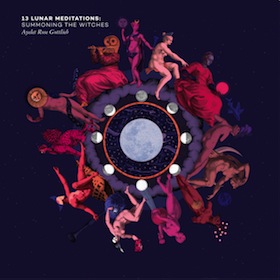
Jerusalem-born, Montreal-based composer and vocalist Ayelet Rose Gottlieb released the album 13 Lunar Meditations: Summoning the Witches on Jan. 12, the first new moon of the new year.
A collaborative project, this double-vinyl release includes poetry by more than 20 women and girls from around the globe, a choir of improvising vocalists conducted by DB Boyko, and features vocalist Jay Clayton. Through a multicultural approach, 13 Lunar Meditations is an acoustic exploration focusing on the moon, our relationship with it and its effects on us.
“The moon speaks to the universal and to the intimate female presence,” Gottlieb shared on her inspiration, from her personal journey as an artist and mother. “In this difficult time we live in, having a connection with each other, with the world around us and with the universe may be the most radical act of resilience.”
In 2015, Boyko commissioned Gottlieb to compose a new song-cycle for her VOICE OVER mind Festival in Vancouver. Gottlieb composed the first draft of this song-cycle for her own quintet and Boyko’s improvisers’ choir. Later that year, the piece was presented again at John Zorn’s the Stone, in New York City, where Clayton joined in for the first time.
Gottlieb’s song-cycle traces the phases of the moon, from birth to full glory and all the way back to emptiness. The compositions range in musical expression from wild and experimental, to melodic, rhythmic and light. All are laced with improvisation and rooted in jazz with Turkish and Armenian undertones. Primarily sung in English, also interwoven are Hebrew, German, French, Turkish, Arabic, Spanish and Japanese.
Gottlieb invited more than 20 women and girls to write texts on their personal relationship to the moon, which inspired her compositions. Ages 4 to 70, these contributors represent a global community from diverse backgrounds and nationalities – from Australia to Morocco, a poet, a gynecologist, a lawyer, an energy healer, a sex worker, a grandmother, and others.
Supported by Canada Council for the Arts and a Kickstarter campaign that concluded at 109%, the album was recorded in Montreal. On it, Gottlieb, Clayton and Boyko are joined by Coeur Luna, Turkish violinist Eylem Basaldi, guitarist Aram Bajakian, contrabassist Stéphane Diamantakiou and drummer Ivan Bamford.
The album and accompanying lunar calendar and box set of 13 postcards (with art by Sarit Evrani, designed by Dan Levi) are available for purchase at ayeletrose.com and ayelet.bandcamp.com.
On Jan. 28 and 29, Music on Main hosts the world première livestream of Graveyards and Gardens, co-created and co-produced by Caroline Shaw (composer and recorded sound) and Vanessa Goodman (choreographer). A PuSh Festival Partner Presentation, the performance takes place among 400 feet of orange sound cables and an arrangement of plants – nature and technology being another synthesis the artists explore. Things begin with a long passage featuring an array of sounds – some come from tape decks, some from a record player, some from old Edison wax recordings – and this production is, among other things, a powerful display of the creative process.
New York-based vocalist, violinist, composer and producer Shaw, the 2013 Pulitzer Prize for Music winner, was Music on Main’s composer-in-residence from 2015-2016. Vancouver choreographer Goodman is the artistic director of Action at a Distance Dance Society.
Members of the Recycled Orchestra of Cateura, Paraguay, are among those helping provide relief services during COVID-19 and after a devastating fire. (photo from IBB)
Times are tough for everyone, but that hasn’t stopped one Vancouver group from organizing an urgent fundraising drive to support an orchestra that is a testament to the transformative power of music.
Instruments Beyond Borders (IBB) is a registered Vancouver-based charity that supports music education in disadvantaged communities. The group is raising funds to support the Recycled Orchestra of Cateura, Paraguay (aka the Landfill Harmonic) as they are dealing with two major crises: not only the COVID-19 pandemic, but a devastating fire in the landfill, next to which they reside.
Since 2014, IBB has delivered donated instruments and funds to the Recycled Orchestra, which was borne out of a desire to teach music to eager children living in the marginalized landfill community of Cateura.
Compounding the hardships wrought by the pandemic, the Cateura landfill recently suffered a major fire, resulting in the destruction of many of the orchestra families’ homes. (photo from IBB)
The Recycled Orchestra of Cateura is internationally renowned, performing all over the world with their instruments made out of recycled materials from the neighbouring landfill. They deliver a resounding message of environmental stewardship and hope and endurance in the face of poverty.
The pandemic has suspended the capacity of the orchestra to travel internationally – which was a major source of their revenue. Compounding the hardships wrought by the pandemic, the Cateura landfill recently suffered a major fire, resulting in the destruction of many of the orchestra families’ homes. Consequently, this has all but eliminated the opportunity of the parents to derive much-needed income from the gathering of saleable recyclables from the landfill.
The students of the Recycled Orchestra, along with the Orchestra’s Parents Association, have become the hub of relief services. (photo from IBB)
In 2014, IBB donated $10,000 towards the building of a music school in Cateura. Fortunately, the school was not damaged by the fire, and today it is temporarily being used as a food relief centre – for the preparation and distribution of upwards of 5,000 meals daily to the devastated local community. Incredibly, the students of the Recycled Orchestra, along with the Orchestra’s Parents Association, have become the hub of relief services.
In the midst of these crises, Favio Chavez, the orchestra’s founder and director, is determined to keep both the orchestra and the hope of music alive, and to support the orchestra’s education program.
The IBB fundraising drive aims to assist the orchestra recover from these dire circumstances. To jumpstart this urgent appeal, the Ben and Esther Dayson Charitable Foundation has pledged to match the first $5,000 donated.
The Recycled Orchestra was the subject of an award-winning 2016 feature film Landfill Harmonic, the trailer for which can be watched on YouTube. Donations can be made at instrumentsbeyondborders.org.
Ben Caplan opens this year’s Chutzpah! Festival Nov. 21. (photo from Chutzpah!)
In the last issue of the Jewish Independent, Chutzpah! Festival artistic managing director Jessica Mann Gutteridge, festival host and stand-up performer Iris Bahr and event comedy closers Jess Salomon and Eman El-Husseini, aka the El-Salomons, were featured. This week, the JI offers a glimpse into the rest of the lineup, by order of appearance.
Musician Ben Caplan opens the festival on Nov. 21 with a recorded performance. Before the recent COVID restrictions, the show was to be presented live from the Rothstein Theatre.
Caplan was on stage here back in January, bringing Old Stock: A Refugee Love Story – which is based on the true story of two Jewish Romanian refugees coming to Canada in 1908 – to the PuSh International Performing Arts Festival (jewishindependent.ca/searching-for-a-safe-harbour). This show, Caplan will be performing songs from his album Old Stock, which is adapted from this music-theatre work.
“The story of Chaim and Chaya, and, by extension, that of a great number of immigrants and refugees who have come to Canada, is full of a great many hardships and tribulations,” said Caplan when asked what lessons from their experience might be relevant in COVID times. “Their story is not free from conflict, both with the outer world, with each other and with themselves. What we see in their story is that, through perseverance, they are able to cross the narrow bridge of their precarity into a sweeter time. It is a nice reminder that no matter how dark things get, there are always brighter moments ahead.”
* * *
Last Chutzpah! Festival, former Vancouverite Tamara Micner performed her one-woman show Holocaust Brunch here. On Nov. 22, she’s offering a first peek at a new work-in-progress from her current hometown, London, England.
Tamara Micner in Old Friends. (photo by Sam Micner)
“Old Friends is very much in the early days – I would say it’s in kindergarten,” admitted Micner. “I’ve been working on it this year and the Chutzpah! Festival streaming will be the first time I perform some of the piece with a public audience. I don’t know exactly what the performance will look like or exactly what will be in it. It’s ‘nervciting’! I look forward to sharing some of the work with Chutzpah! audiences and doing a Q&A afterwards to speak more about the show. I’m hoping and aiming to present the full show in 2021.”
A key inspiration for Old Friends is the music of Paul Simon and Art Garfunkel, and their relationship.
“I find Simon and Garfunkel’s music comforting and uplifting…. The combination of Paul’s songwriting, Art’s voice and their harmonies are beautiful,” said Micner. “I also find the themes in their music resonant at this time – including loneliness, isolation, hope and a yearning for connection…. I’m also intrigued by the on-again, off-again nature of their relationship and the Jewishness in that – how we have a tendency to cling to each other, leave each other, not talk for years, but not be able to fully stay apart or let go. There’s a lot to mine in that, I think – where that comes from, what it’s about and how we can free ourselves from that cycle.”
* * *
Also on Nov. 22, New York-based playwright Rokhl Kafrissen shares her new work-in-progress.
Rokhl Kafrissen’s Shtumer Shabes stars a drag performer as the Yiddish Theatre diva. (photo from Chutzpah!)
“Shtumer Shabes [Silent Shabbat] opens in the year 2000,” said Kafrissen. “A performance studies grad student named Jess is writing about the heyday of Yiddish theatre in Poland in the 1930s. Jess is studying what she calls the ‘hybrid potentialities of interwar Yiddish performance practices.’ How did Jews use their art to embody binaries like Yiddish and Polish, Jew and Catholic, urban and rural, capitalist and socialist? She argues that The Dybbuk is the ultimate expression of that hybridity.
“As the play opens, Jess stumbles into the chance to interview an honest-to-goodness Warsaw Yiddish diva. It turns out that Sonja, a 90-something veteran of the Polish-Yiddish stage, is living in her neighbourhood. Jess comes to believe that Sonja possesses a ‘lost’ play script: Shtumer Shabes. Her encounter with Sonja is also her opportunity to write history. But Jess is confronted by the elusiveness of ‘plain facts’ and the cost of writing history. For me, the encounter between Jess and Sonja represents two competing ways of understanding the past, through scholarship and through art.”
Imagining Sonja’s world wasn’t hard for Kafrissen, as she knows well Yiddish theatre, past and present, and the standard Yiddish reference sources. However, she did struggle with her protectiveness of the Yiddish past and her obligation as a journalist “to the people and productions I’ve been reading about, an obligation to tell their stories accurately and respectfully.”
“But, at some point, my inner journalist has to be thanked politely and shown the door,” she said. “If you’re going to write historically informed fiction (which is what I consider this piece), you have to be comfortable going beyond the facts. It gets even trickier because part of Sonja’s backstory … is flashback to the war, when she was imprisoned in the Warsaw Ghetto. I know enough about the Warsaw Ghetto to invent a plausible scenario. But depicting it feels daunting. The potential for kitsch or melodrama is high. My characters grapple with extremely sensitive issues, including allegations of collaboration with the Germans. It was important to me that if I was going to include such provocative topics, I had to stick closely to historical fact and stay within the realm of the possible. My characters would not be saints or holy martyrs, but real people, caught in the worst possible circumstances.”
Cast as Sonja is Shane Baker, who Kafrissen has known since she worked with him in 2009 on his one-man show The Big Bupkis: A Complete Gentile’s Guide to Yiddish Vaudeville.
“I quickly became a big admirer of Shane’s work,” she said. “He can go from the highest brow, as with his translation of Waiting for Godot into Yiddish, all the way to the lowest brow, as with his vaudeville show…. In the last few years, Shane had been working on a drag character called Miss Mitzi Manna. She was inspired in part by his close friendships with the last generation of Yiddish theatre grandes dames. So, when I got a 14th Street Y LABA Fellowship in 2019, I decided to write a play with a role for Shane in drag as my yearlong fellowship project. I knew from the beginning that the role wasn’t written for Mitzi Manna per se, but Shane’s development of the character was a huge inspiration. Writing the role of Sonja with a drag character in mind opened up a kind of playfulness and experimentation for me. Drag is such a dramatically rich device. It heightens our awareness of the artifice of theatre and interrogates the mimetic nature of theatre itself.”
A staged reading of Shtumer Shabes was supposed to have taken place last in April. “Unfortunately,” said Kafrissen, “that coincided with the world as we knew it collapsing. As I get ready to present excerpts from the play for the Chutzpah! Festival, I can see a tiny sliver of silver lining. Even with the pandemic, I’ve managed to sneak in some actor time in the last couple months, as well as getting thoughtful feedback on the script from folks both within my artistic circle and outside. The script is now so much better than the version I had in the spring, so I tell myself maybe it’s better that I didn’t present that earlier draft to the world.”
The Dybbuk by S. Ansky infuses Shtumer Shabes: Jess is obsessed with The Dybbuk and it’s why she went to grad school; and “Sonja’s career on the Warsaw Yiddish stage was tied up with the phenomenal, real world success of The Dybbuk,” said Kafrissen. “It was with a Dybbuk monologue that she auditioned for Yiddish drama school and the role of Leah (the young woman possessed by the dybbuk) was always her dream.”
This year marks the 100th anniversary both of Ansky’s death in November 1920 and the première of the Yiddish version of the play a month later. “I love the idea of having our Chutzpah! program serve as Sonja’s final tribute to Ansky and his creation,” said Kafrissen.
* * *
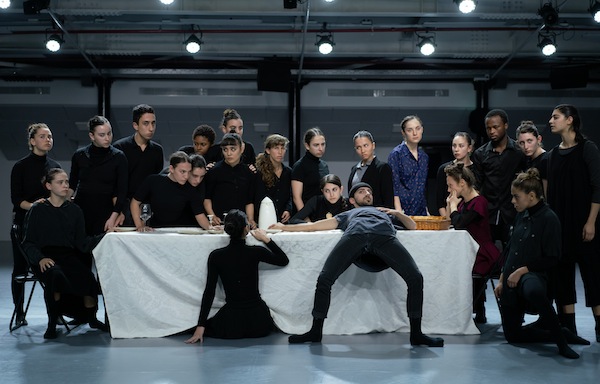
Ella Rothschild’s Pigulim unfolds against the backdrop of a meal at a long dining table. (photo by Efrat Mazor)
Death … and life are at the centre of Israeli choreographer Ella Rothschild’s Pigulim, which is described as “a cultural narrative [that] unfolds against the backdrop of a meal at a long dining table where three characters suffer from unbearable loneliness and battle their way between life and death. Each character travels between their individual materialistic being and their consciousness, revealing their essential humanity in relation to existence and the quest for happiness.” A pre-recorded performance of the work will be shown at the Chutzpah! Festival on Nov. 23.
In the summer of 2019, Rothschild was selected as one of the first artists-in-residence at Suzanne Dellal Centre. She started Pigulim there and continued researching it in “other places in the world with different scenarios and different cast members.” This year, back at the centre, the piece premièred in its video version.
Pigul (pigulim, pl.) “describes a law from the Jewish tradition,” explained Rothschild. “It refers to a sacrifice that was prohibited to be eaten because of a forbidden thought that the priest (kohain) had in the moment he was making the sacrifice. It can mean abomination or loathsome, and it’s not a word used in everyday Hebrew. The idea that a thought can change reality has a direct connection to what I tried to present in Pigulim. If the thought one can have determines the reality of another entity, how much from our consciousness is being present in our reality and our society?
“Another aspect of choosing this particular name is another gap that unravels between the sound of the word and its meaning. Pigulim has a nice way of rolling in the mouth. The letters are round and when you pronounce it, it almost sounds like a name of a rare flower – but the meaning of it is the opposite. It contains strong emotions and gravity. Once more, it holds this gap between what we experience and the reality.”
This gap – “a certain detachment between our body and mind” – is something with which we must live, said Rothschild, and its loneliness is not changed by “how many people are surrounding you in the space.”
“As I see it and experience it, it is a state of being, not only of certain individuals but as a mass society,” she said. “I have learnt, through working with others, more about how this gap appears and how we perceive it. We behave inside these structures that are determined for us and, yes, it leaves a gap or an absence that we don’t really understand, or we will forever try to make sense of.”
However, there is more than just absence. “I did find out that we share more than we think,” she said. “We share beauty, laughter, sadness and grief. We cry from the same things and we worry and we fear. But we also love. And that is an overwhelming thing to share.”
* * *
Israeli pianist and composer Guy Mintus – whose solo concert will be live-streamed on Nov. 24 – is about to release his third album with the Guy Mintus Trio: A Gershwin Playground.
Mintus’s study of piano didn’t follow a traditional path. “I didn’t start with classical piano,” he said. “I started on a little keyboard my parents got me, not an acoustic piano even, and I was studying a very mixed repertoire of adapted arrangements for beginning keyboard players. Among that repertoire were the Beatles, Israeli pop songs, Fiddler on the Roof and … two [George] Gershwin tunes: ‘It Ain’t Necessarily So’ and ‘Summertime.’ When I started playing those, my father handed me the Porgy and Bess album of Ella [Fitzgerald] and Louis [Armstrong]. That totally blew my mind and I started trying to emulate the arrangements on my keyboard (which had the ability to switch between different sound samples).
Guy Mintus will play songs from his upcoming album, which celebrates George Gershwin’s music. (photo by Ella Barak)
“To me, these songs are timeless – musically and lyrically. They’re very rich and have a strong musical character but yet they remain very open and flexible to let you in and bring yourself into them. The lyrics also mostly speak of things that will always be relevant. It’s not by accident that generations and generations of jazz musicians have been interpreting Gershwin.”
One aspect of the music’s continued importance is that, “unfortunately, we’re constantly reminded by these horrific events that keep happening that racism is still very much around; that the colour of your skin can easily become a disadvantage right off the bat,” said Mintus. “When I’m thinking of Gershwin, I’m also considering his background as a Jewish-American composer coming from a family of immigrants. Of all things he could be fascinated by, he was fascinated by Black American music and ended up writing the first jazz opera bringing this marginalized music to the heart of the consensus. More than that, he wouldn’t allow Porgy and Bess to be premièred at the Met Opera because, at the time, they wouldn’t allow Black performers. He made it mandatory that, if Porgy and Bess is ever performed, main roles have to be performed by Black people. Now, Porgy and Bess has its controversies in regards to race and representation but I believe in the essence of its coming from a place of great respect to the incredible culture its getting inspiration from.
“I think that the Jewish and African-American communities actually share quite a lot in common,” he continued. “There’s certainly a collective trauma we’re each dealing with. To me, Gershwin was standing right in the middle of that – in ‘Rhapsody in Blue’ (which is on the album, as well, in a solo version) you literally have a meeting point between klezmer and the blues. I want to echo that connection, which is still very relevant to me, through my own lens as an Israeli who lived, studied and worked in New York. It’s important to give back, acknowledge and show respect where it’s due. Last July, the trio and I did an online fundraiser concert called Gershwin Global. It was in order to raise funds for the Jazz Foundation, who takes care of elderly musicians and emergency cases. This music comes from people who gave their lives to it – if we benefit from it, we’ve got to find a way to also give back to its source.”
The new album will be launched on Nov. 27 and, given COVID, touring it is not an option. Nonetheless, Mintus said it is worthwhile to put it out anyway. “Life goes on, music goes on and, in my opinion, it’s as relevant, if not more, to release new music in this period,” he said.
With the internet, there are many ways to connect with people all over the world, he added. “This poses a creative challenge how to find interesting, experiential ways to share this music with the world; how to share the story behind the album. Each single has a unique artwork, there are videos, a bunch of online live events that are planned – all of this is going to be available through my Facebook page (facebook.com/guymintusmusic). The fact that I’m not switching countries so often as normal allows me a different kind of focus and attention on how to turn this release process into the most fun, meaningful and creative process it can be.”
* * *
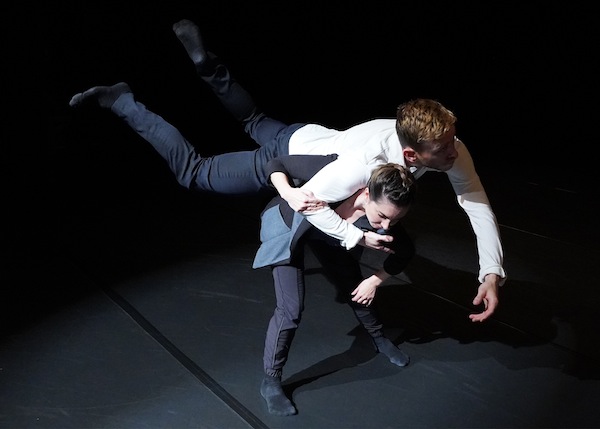
Racheal Prince and Brandon Lee Alley in Hourglass by Idan Cohen. (photo by Theo Bell)
Chutzpah! artist-in-residence this year is choreographer Idan Cohen (Ne. Sans opera and dance). The world première of his Hourglass, which is presented by RBC, will be performed and live-streamed from the Rothstein Theatre on Nov. 25.
“Both the residency and this opportunity to present at Chutzpah! are the best things that could have happened to me during a time when artists are facing difficult challenges,” Cohen told the Independent. “I believe with all my heart in the strength and importance of the arts for a healthy society. It is not a luxury but a necessity, especially within a specific culture. Judaism is not just a common history or a set of beliefs, but a diverse culture that needs to be ever-evolving, reinterpreted and recreated, respecting and learning from our common past while creating a shared future. Having Jessica [Mann Gutteridge] share some of the same core values, and acknowledge the importance of going forward with the festival this year, has been such an empowering force for me and my collaborators during these past few months.”
Hourglass is an exploration of aging set to music by Philip Glass. It is a duet with former Ballet BC company dancer Racheal Prince and returning Ballet BC company dancer Brandon Lee Alley.
“As dance artists,” said Cohen, “our focus is on our most intimate tool and instrument: the human body. When that body is extremely intelligent and qualified, as Racheal’s and Brandon’s bodies are, true magic happens on stage. It’s like an ancient fairytale told to you as a child: it represents both the past and the future, it’s exciting and haunting, and it teaches you something valuable through the most basic elements of storytelling. No need for fireworks or special effects.
“For this edition of the festival, we are presenting 30 minutes of dance to four out of 20 études composed by Glass played by the conductor and celebrated pianist Leslie Dala (Vancouver Opera, Bach Choir). Leslie was actually the one who first presented the idea of this project to me, and dancing and working with him has been a most gratifying experience. There are linear elements in the piece, but Glass’s music marries the abstract and the linear, the romantic and the intellectual, in a way that not many composers are able to do, and that’s what makes it so unique.
“Racheal and Brandon, who are young yet mature and highly experienced dancers, can embody different physical states in such a fascinating way,” said Cohen. “They had a significant role in our exploration of the theme of aging and time.”
Being a real-life couple means that Prince and Alley have been able to rehearse together safely during COVID, and the Rothstein Theatre is large enough for them to work with Cohen at a safe distance. “Since Leslie is also dancing (!) in the piece,” added Cohen, “we had to adapt in order to keep everyone safe, which is, of course, the priority. This has definitely been a great learning experience, and an immensely gratifying one.”
The Chutzpah! Festival runs Nov. 21-28. For tickets, which start at $18, visit chutzpahfestival.com or call 604-257-5145.
The new artistic managing director of Chutzpah!, Jessica Mann Gutteridge, faced unique challenges in presenting the festival. (photo from Chutzpah!)
“This has been a challenging time for all communities. I hope that this year’s Chutzpah! Festival can bring a sense of joy, and the communal spirit that comes from sharing performing arts experiences with others, whether at the theatre or from the comfort of home,” said artistic managing director Jessica Mann Gutteridge in a recent interview with the Jewish Independent.
This will be the first-ever Chutzpah! The Lisa Nemetz International Jewish Performing Arts Festival that people will be able to watch at home. Given the COVID-19 pandemic, all of the performances will be available online, Nov. 21-28, with a few opportunities to attend small-audience shows that are being live-streamed from the Norman and Annette Rothstein Theatre. Not only will this be the first Chutzpah! presented digitally in the festival’s 20-year history, but it will be the first directed by Gutteridge.
“I knew that I had an exciting and challenging year ahead of me when I took the helm of Chutzpah! from Mary-Louise Albert, who was artistic director before me for 15 years,” said Gutteridge. “I really could not have anticipated how much the world would change just three weeks later, when the pandemic shuttered the Rothstein Theatre and the entire performing arts sector. The first month or so was spent focusing on our staff’s well-being and helping the many users of our theatre to reschedule and replan all the events that had to be canceled.
“The first thing I did for the Chutzpah! Festival was to take some time to think,” she said. “My board was wonderfully supportive from Day 1 and assured me that whatever scale I felt was right would be all right with them – even if I wanted to postpone for a year. I spent a great deal of time just thinking about the purposes of the festival, how it serves the community and the relationships we have with our audiences and community of artists. Even before COVID, when I was thinking about what my first festival might look like in a transition time, I felt inspired to bring together artists who had performed in the festival in the past with new artists who I hoped would join us in the future. So, I began by reaching out to artists from both groups so that we could just start to get to know each other, and find out how everyone was responding to this unprecedented situation.”
By early summer, said Gutteridge, it became clear that the health-related restrictions with respect to the pandemic would still be in place in November, “so I began to think about how we might incorporate digital presentations into the festival, and to talk to artists who were exploring this form of performance in their work.
“I was thrilled to learn that Iris Bahr, who was in the 2019 festival, is not only a brilliant actor and stand-up comic, but is also a podcaster who interviews other artists and public intellectuals with much wit and insight. I invited her to perform her solo stand-up, but also to function as our festival host and conduct live interviews with all the festival artists,” said Gutteridge. “Because Iris divides her time between Israel, New York and Los Angeles, we knew she would have to appear digitally and, though this adds another layer of technical complexity, I think it’s such a special opportunity that the present moment brings us – to join artists from across the world and have a chance to learn more about how the pandemic is changing and shaping their creative work.”
The festival’s online-only shows will include Bahr’s stand-up comedy performance (click here for story); New York-based playwright Rokhl Kafrissen’s Shtumer Shabes (Silent Sabbath) and former Vancouverite-current Londoner (England) Tamara Micner’s Old Friends, both of which are works-in-progress; a concert by Israeli pianist and composer Guy Mintus; and Israeli choreographer Ella Rothschild’s Pigulim.
There will be two shows live-streamed from the Rothstein, where limited audiences will be permitted. Ben Caplan will perform music from Old Stock, which is adapted from his music-theatre piece Old Stock: A Refugee Love Story (see jewishindependent.ca/searching-for-a-safe-harbour). And Chutzpah! artist-in-residence Idan Cohen (Ne. Sans opera and dance) presents the world première of Hourglass. Closing out the festival are Jess Salomon and Eman El-Husseini (click here for story), who will be live-streaming from Brooklyn, joined by yet-to-be-announced local comedians performing at the Rothstein.
The lineup is a fraction of what it would have been if not for COVID, but Gutteridge thought it important to proceed with the event.
“Well, for starters, I’m stubborn and I like a challenge!” she said of the decision. “I also knew that we were well-positioned with staff and support to execute a creative and fulfilling festival, even though it would not look much like past festivals. In talking to colleagues inside and outside the JCC, and hearing from our community via a survey in July, I understood that there was a lot of enthusiasm to keep experiencing the kind of performing arts presentations that Chutzpah! has offered for 20 years now. And, looking ahead to dark November nights, I think we can offer a communal experience that will bring some much-needed joy.”
In addition to focusing on quality entertainment, health and safety has been at the forefront of the planning.
“We have worked carefully with health and performing arts sector experts to make sure that we are providing the safest possible experiences for audiences, staff and artists, including at our physically distanced, intimate live events at the Rothstein Theatre,” said Gutteridge. “I’m also very impressed by how our artists have risen to the challenge. Rokhl Kafrissen, the playwright of Shtumer Shabes, has been working with her cast via Zoom since April, when they presented a workshop of the play in lieu of the debut performance they were scheduled to have at LABA in New York. Our audiences will have a chance to meet the artists and see excerpts from the play, with context about the work’s meaning and creation, all performed from the artists’ individual locations. It’s a special opportunity for our audiences to peek inside the creative process.
“Idan Cohen’s Hourglass, a new dance piece with live piano accompaniment, is being created this fall at the Rothstein Theatre as part of our creative residency program. With 318 seats and a large stage, the theatre is large enough for physical distancing, and Idan is working with a skeleton crew – often just himself and the two dancers at work. The dancers, Brandon Lee Alley and Racheal Prince, are partners offstage as well as on, so they are already in a household bubble. The other dance piece, Ella Rothschild’s Pigulim, comes to us from the Suzanne Dellal Centre in Tel Aviv, where the performance was previously recorded in a studio theatre, so that health and safety protocols could be observed and the dancers could form their own bubble.”
Tickets for the festival start at $18 and are available online at chutzpahfestival.com or by phone at 604-257-5145.
Iris Bahr pulls double duty at the 2020 Chutzpah! Festival, as host and performer. (photo from Chutzpah!)
Comedien, writer, actor, director, producer and podcaster Iris Bahr will both host this year’s Chutzpah! Festival, Nov. 21-28, and perform her stand-up live Nov. 26.
Known for her eclectic characters, Bahr will call on many of them as she converses with the other festival artists as part of her hosting duties.
“I’ll be conducting these conversations either as myself or as some of my characters, depending on the artist I’m speaking to,” Bahr told the Independent. “My alter egos include Shosh, the salty Israeli who has become popular on Instagram, Rae Lynn Caspar White, my ‘Southern redneck intellectual,’ and Shuli, my Orthodox character who is beyond excited to ‘dive into the arts’ for the first time.”
Many JI readers will know Bahr’s stand-up from having seen her perform at last year’s Chutzpah! The show will be somewhat different this time around.
“My stand-up will involve more crowd work and storytelling versus just straight-on stand-up to camera,” she said. “I have found that to be a more captivating and enjoyable experience for everyone involved when the audience can also engage and experience each other’s presence, it’s the closest we can get to a communal live theatrical experience in these challenging times.”
Eman El-Husseini, left, and Jess Salomon with furry family member Esther Honey El-Husseini. (photo by Mike Bryck)
Jess Salomon and Eman El-Husseini, aka the El-Salomons, close out this year’s Chutzpah! Festival on Nov. 28. They will live-stream from Brooklyn, and local comedians will join the event from the Rothstein Theatre.
In performance, the married Jewish-Palestinian lesbian comedy duo leans into the things that make them unique. Their chemistry is not only evident on stage, but even comes out in an email interview, where the pair play off one another like, well, a couple who knows and loves each other well.
JI: You met when you were each performing solo routines and continued in that vein, I think, even after you were married. When and why did you team up professionally as well?
Jess: It didn’t really come from us. We weren’t out in comedy until we got engaged so it was only after that, that we started making jokes about our relationship. Sometimes, we’d follow each other on a show and it became obvious who we were talking about. Like how many Jewish-Muslim-Palestinian Canadian couples that moved to America from Canada are there? Another comedy couple might be able to be on a show together and say my boyfriend did this or my girlfriend did that, and no one would connect that they were referring to one another. So, we built in this reveal and, eventually, people started asking if we were going to share the stage together. We didn’t want to, but it’s a sacrifice we make for the fans!
Eman: The first time we shared the stage was at a gig in an old synagogue turned community centre in L.A. I went on first and introduced Jess for her performance. We bantered, unprepared, on stage for about 10 minutes. We had no idea a reviewer from Tablet was in the audience and, although we individually performed for about 30 minutes separately, that 10 minutes of banter stole the show…. We didn’t think much of it but, a year later, 2018, we were in our hometown of Montreal for the Just for Laughs Festival. The BBC World Service was in town to put on a comedy show. They called us and asked if we’d want to record a set together and we said, ‘absolutely not.’ First of all, they have a huge listenership and we wouldn’t be able to polish an act under such short notice and, second, no one wants or should want to work with their spouse. But, the British have a way to persuade, it must be the accent.
At the same time, because we were back in our hometown, Just for Laughs offered us two shows to do whatever we wanted. We decided to perform individually for 20 minutes and then 20 minutes together. We almost got divorced but the audience loved it! We sold out both nights and added a third. Who would have thought a duo act would be so sought after? We’ve been working together ever since, and we are still married! I think, at this point, if we ever separated, we’d have to be closeted about getting divorced.
JI: From where do you get the strength and confidence to be a stand-up comedian?
Eman: I have no idea why and how I’ve stuck with this career after my first set. I bombed so hard and, until today, continue to bomb at times, but there is truly an addictive element to making someone laugh. Even if it’s a single person in a room. Laughter is so genuine and isn’t easily had. I mean, even in our day-to-day life Jess and I will share with each other how we made a stranger laugh shopping for groceries or walking the dog. It’s so rewarding.
Jess: Making strangers laugh and then talking about it is 100% an Eman thing. Right now, we’re in an argument over a speech therapist I’m convinced she hired just to entertain while she insists she has a speech impediment that must be fixed.
Eman: I feel like my strength and confidence comes from my parents. Although my sister and I have a brother, I managed to be the favourite.
Jess: You do have a masculine energy they might be responding to.
Eman: A big reason I wanted to be a stand-up comic is because of how misrepresented and underrepresented Arabs, Muslims and particularly Palestinians are in the media. More often than not, I am the first Palestinian someone meets in real life. I feel like an ambassador of sorts, dispelling stereotypes about my people. Exposure is such a powerful tool in getting through to people and if you can make them laugh that’s a big bonus. Even if people are immediately turned off by what I represent, they are still curious to hear what I have to say. I remember headlining a show in Niagara Falls once. I had to be on stage for 45 minutes. Twenty minutes in, I realized I haven’t made a single person laugh….
Jess: I love that it took you 20 minutes! That’s confidence.
Eman: They were conservative-leaning so, I called them out, ‘Guys! I know you don’t like what I’m saying but I can tell you like me.’ That eviscerated the room! From that moment forward I knew I could never quit comedy even if I wanted to.
Jess: I tried to do a joke about the no smoking sign on the plane and quickly realized there were at least a few comics who had done the same joke. That’s when I realized it’s better when I pull from personal experience. Even if I’m not an ambassador like Eman. I’m not the first Jewish comedian people have seen.
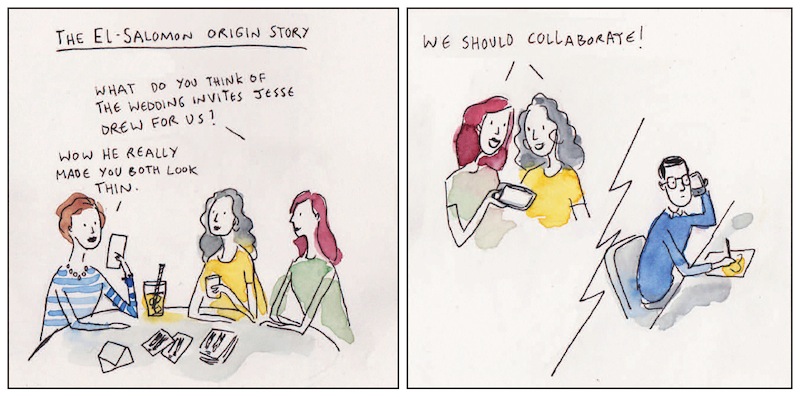
The El-Salomons have their own cartoon. (illustrations by Jesse Brown)
JI: How and when did your new Crave Canada special, Marriage of Convenience, come about?
Jess: After performing in Montreal for Just for Laughs and the BBC in 2018, we kept working on our duo act and growing our audience on Instagram for our comics (@theelsalomons). We sent a tape of what grew into an hour-long show to Just for Laughs and that’s how we got booked for the Crave special.
Eman: We realized people preferred us together than individually, which is insulting considering we had about a decade each of solo experience. It’s understandable, there are so many stand-up comics but rarely any duo acts.
Jess: There’s no one I’d rather lose my individual identity for.
Eman: Aw.
JI: What is the origin of the cartoons?
Eman: Jess came up with the idea. We would get such a huge response on social media when we’d write these back-and-forth status updates about each other.
Jess: Huge is relative.
Eman: People asking when the sitcom was coming out.
Jess: And, knowing that it would take awhile for us to find the time to write a pilot that was pitch-ready and be in a place where we could sell a series, a weekly cartoon on Instagram seemed like a manageable place to start to develop the character version of ourselves and, hopefully, an audience. We also have a close family friend, Jesse Brown, who just happens to be an incredible illustrator that wanted to work on this with us. So that’s how it was born.
Eman: The El-Salomons was the hashtag for our wedding, and Jesse drew us for our invitations … my mother-in-law saw them and said, “He made you look thin.”
Jess: Actually, yes, that is how it was born.
* * *
Chutzpah! starts Nov. 21. For the full lineup and tickets, visit chutzpahfestival.com or call 604-257-5145.