Skip to content
  • Home
  • Subscribe / donate
  • Events calendar
  • Business Directory
  • FAQ
  • News
    • Local
    • National
    • Israel
    • World
    • עניין בחדשות
      A roundup of news in Canada and further afield, in Hebrew.
  • Opinion
    • From the JI
    • Op-Ed
  • Arts & Culture
    • Performing Arts
    • Music
    • Books
    • Visual Arts
    • TV & Film
  • Life
    • Celebrating the Holidays
    • Travel
    • The Daily Snooze
      Cartoons by Jacob Samuel
    • Mystery Photo
      Help the JI and JMABC fill in the gaps in our archives.
  • Community Links
    • Organizations, Etc.
    • Other News Sources & Blogs
  • JI Chai Celebration
  • JI@88! video

Recent Posts

  • Federation now across BC
  • Israel fighting for its existence
  • Deal strengthens Iran
  • Patriotic belonging diminishes
  • A campaign to engage
  • Upstanders’ first live event
  • Responding to Carney
  • Having your own home
  • Music a family tradition
  • Musical to warm heart
  • Community milestones … June 2026
  • Sharing her passion for Israel
  • Or Shalom reopens its doors
  • JFS from past to future
  • Need holistic approach
  • Sharing stories, advice
  • Journalist shares fears
  • Skills to live together
  • Road to independence
  • Cutting grass with scissors
  • Zionism as a solution
  • Deceit, desire & the divine
  • Reclaiming sacredness
  • Creative project ideas
  • Summer squares and cobbler
  • Thou shalt … summer commandments
  • Legal help for students
  • Revisiting myth of Lilith
  • Wrong person rebuked
  • Canada’s mixed messages
  • Questions for museum
  • Symposium on antizionism
  • Making soccer political
  • CJPAC lauds Pulver’s impact
  • City recognizes Vrba’s legacy  
  • Organ donation saves lives

Archives

Follow @JewishIndie
image - CJN box ad Rockowers 2026

Tag: identity

I know who I am … or do I?

I know who I am … or do I?

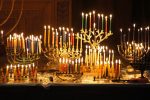
Moving into a condominium forced the writer to modify how she approached the holiday season, including the purchase of an electric chanukiyah. (photo by Libby Simon)

For Jews, the celebrations of Chanukah arrive on Sunday evening, Dec.2, and close on Monday evening, Dec.10. It is also a time when many people struggle with dissonance between religion and Western values. I know who I am, so it was not a problem – except, an epiphany struck.

I had a dream some time ago. I dreamed I was in the lobby of a hotel filled with a patchwork of people of different colours and garbs reflecting differences in religious, cultural and ethnic backgrounds. My eyes scanned the room searching for someone, or something, the object of my search unclear. No one took notice as I wound my way through the crowd and exited the area into a corridor. Turning to the right, I entered a room through an open door. My eyes were drawn to a box gift-wrapped with blue-and-white Chanukah paper sitting on a table. As I picked it up, a feeling of warmth wrapped around me. Suddenly, a non-descript, dark, threatening shadow loomed overhead, momentarily startling me. With outstretched arms, I handed my gift over to this strange apparition as if to appease it, and was immediately filled with a deep sense of inner peace and contentment.

This dream was so close to the surface, its meaning became readily clear. I was fully aware of a recent inner struggle triggered by the Christmas/Chanukah season in which I felt the very soul of my Jewishness being challenged from an external source. It was a strange and surprising experience because, as an adult, I have never been particularly observant. Although raised in an Orthodox Jewish family, my personal beliefs led me to a secular lifestyle. Following dietary laws, for example, was irrelevant in determining the quality of good character. Traditions were important more for benefit of family than in any religious sense. Rituals, such as lighting the chanukiyah candles on Chanukah did not seem necessary. After all, I know who I am. I define myself first as a human being, who happens to be of Jewish descent. But, after a lifetime of working and living in a dominant, multi-religious society, why now had it become an issue? As an empty nester, for whom do I practise it?

The answer was surprising but simple: the condominium lifestyle. Who would have anticipated that this popular and accepted way of life would create such a fall-out? I had long questioned this concept in which total strangers of diverse backgrounds would make a large monetary investment and enter into a common living arrangement – an arrangement in which they become inextricably bound to one another in some very basic ways. They accept the premise and agree to give up certain freedoms in exchange for reducing personal responsibilities. In doing so, they turn their decision-making powers and independence over to others who may have different opinions, qualifications, priorities, intelligences and abilities. Nonetheless, this is what I bought into without realizing that, as important as these issues are, others would run even deeper – such as ethnicity, culture and religion.

I have grown up with the symbols and celebrations of Christmas. As a child, I participated in school plays and choirs and Santa never asked your religion when he warmly handed you a candy cane. Feelings of deprivation or envy never entered my psyche because the love of family filled my needs. As an adult, I have continued to take in the festivities, in sharing the spirit of peace and goodwill with non-Jewish friends, neighbours and colleagues.

But something changed. Tolerance, appreciation and participation were all possible when “The Season” did not infringe on my personal turf. In the spirit of goodwill, it is important to accommodate and respect these symbolic religious expressions. However, some individuals threatened to extend these decorations over my personal unit and warned that any resistance on my part could be crushed by a simple vote of the majority. Canada is a multicultural country supporting the values and rights of freedom of religion, thus protecting minorities. Such intimidation threatens to swallow who I am.

As neighbours on a street, such a thought would never even materialize. Yet, in a condominium arrangement, boundaries become blurred. Such actions deny my very existence. They render me invisible and impose a choice – assimilation or alienation. Neither is acceptable and therein lies the conflict.

However, the dream did offer a resolution. It led me on a personal journey through the chaos of diversity. I turned towards what was right for me – the box, wrapped in blue-and-white Chanukah paper, that confirmed who I am. By walking through the open door in my dream, I received the reward of self-discovery. I realized that knowing who I am was not enough. It was only in giving my gift to the “faceless figure” of others did I feel a sense of inner peace and contentment. The dream revealed not only who I am, but who I am in relation to others. Until now, my identity had been like a one-way mirror. I could see through the glass while the other side only reflected the viewer’s own image. If others do not see me, I will disappear like a ghost in the morning light. Still, I cannot ask anyone to extinguish their light, for that is who they are, only not to impose it on mine.

What was the solution? Instead of the customary, small, coloured licorice-like wax Chanukah candles whose symbolic message of freedom dies quickly in a muted puff of smoke, I purchased and placed an electric chanukiyah in my window. Through the sustained bright light, the “mirror” becomes translucent, revealing the beautiful cultural mosaic that is Canada’s proud tradition, one that allows each of us to be who we are.

And, perhaps along with the glittering Christmas lights, we will all be enriched, as, together, they cast a far greater illumination in recognizing, respecting, accepting and even appreciating our differences: Just like the mirror on the wall / Silvered coats reflect us all / Strip bare the veneer of hypocrisy / A window reveals you are just like me.

Libby Simon, MSW, worked in child welfare services prior to joining the Child Guidance Clinic in Winnipeg as a school social worker and parent educator for 20 years. Also a freelance writer, her writing has appeared in Canada, the United States, and internationally, in such outlets as Canadian Living, CBC, Winnipeg Free Press, PsychCentral and Cardus, a Canadian research and educational public policy think tank.
Format ImagePosted on November 30, 2018November 30, 2018Author Libby SimonCategories Celebrating the HolidaysTags Chanukah, identity, memoir
Jewish identity and Chanukah

Jewish identity and Chanukah

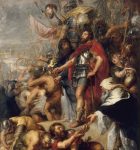
“The Triumph of Judas Maccabeus” by Peter Paul Rubens, between 1634 and 1636. (photo from Wikimedia Commons)

One of the richest statements found in the Talmud about the meaning of Jewish identity is the following: “He who does not feel shame and humility before others, does not show love and compassion or abundant kindness to others, such a person is not from the seed of Abraham.” According to this statement, Jewish “genes” are as nothing without Jewish ethics. To be counted among the seed of Abraham, one’s character structure must reflect the values by which Abraham lived.

Maimonides was fully in accord with the talmudic concern with action rather than descent, with purpose and commitment rather than race. He expressed it as follows: “The distinguishing sign of a child of the covenant is his disposition to do tzedakah.” Placing action at the centre of Jewish identity mirrors a fundamental characteristic of the Judaic tradition.

For Aristotle, the peak of human perfection was to be found in thought. Man perfected himself to the degree that the objects of his thought were perfect. God – the most perfect being – was engaged in thought upon His own perfect self. In the biblical tradition, human perfection was realized in moral behaviour. Not thought but action; not knowledge of the cosmos, but involvement in history. The prophets condemned the community not because of their failure to become intellectuals, but because of their failure to feed the hungry, clothe the naked, care for the lonely and protect the socially vulnerable.

In the Torah, God is an active being. He creates the world, He feeds the hungry, He is involved in the drama of history. Typical of the Judaic worldview is the midrashic “question: “What does God do now that he has created the world?” (Such a question could never have been asked by Aristotle.) The midrash answers: “He arranges marriages!”

In the Jewish tradition, God is the creator of life, and His message to humanity is expressed in the language of mitzvah (commandment). His presence in the world entails human responsibility to improve the conditions of society and history. In the Jewish tradition, we live in the presence of God when we hear a mitzvah that obliges us to act in a particular way. Maimonides wrote that God gave the 613 commandments so that a Jew can find one mitzvah that they can perform with love and complete devotion.

One of the distortions of modern existentialism is the exaltation of the virtues of sincerity, devotion, authenticity, etc., irrespective of their specific content. The sincerity of the Nazis in no way mitigates their barbarity and depravity. Subjective attitudes are important aspects of human behaviour, only if their content is worthwhile and significant. It is ludicrous to celebrate Maccabean courage without appreciating their commitment to monotheism, mitzvah and the dignity of Jewish particularity.

In celebrating Chanukah, therefore, we should direct our attention to the problematic issues involved in the spiritual survival of the Jewish community within the modern world. Many traditional Jews believe that Jewish particularity is incompatible with modern mass culture and that Judaic bonds holding together the community cannot bear the stress caused by exposure to the cultural rhythms of the larger non-Jewish society.

Those who accept this assessment of Judaism in the modern world turn to social and cultural separation in order to secure Judaism’s survival. There are others who are skeptical as to whether this ghettoization can succeed. Modern communication makes it impossible to escape acculturation to modern “Hellenism.” It is, in their opinion, futile to resist. We should accept our fate and accommodate ourselves to the inevitability of our eventual assimilation.

A third option, which defines the philosophy of the Shalom Hartman Institute, rejects the defeatism of the latter point of view and also the separatism of the former. We question the belief that Judaism has always survived because of its radical separation from the surrounding culture. Chanukah does not commemorate a total rejection of Hellenism but, as Elias Bickerman shows in From Ezra to the Last of the Maccabees, the revolt focused specifically on those aspects of foreign rule that expressly aimed at weakening loyalty to the God of Israel.

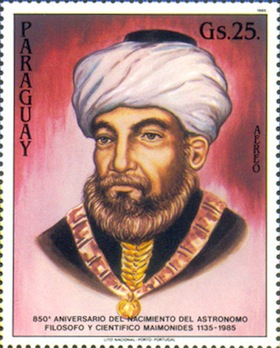
photo - A Maimonides stamp from Paraguay, 1985
A Maimonides stamp from Paraguay, 1985. (photo from Wikimedia Commons)

Maimonides’ thought was clearly enriched by his exposure to the writings of Aristotle and Plato and Islamic scholars such as al-Farazi and Ibn Baja. Rabbi Joseph B. Soloveitchik was enriched by Kant and Kierkegaard. These two great halachic teachers are living examples of the intellectual and spiritual enrichment that results from exposure to non-Jewish intellectual and spiritual frameworks.

The major question that we must ponder on Chanukah is whether the Jewish people can develop an identity that will enable it to meet the outside world without feeling threatened or intimidated.

Can we absorb from others without being smothered? Can we appreciate and assimilate that which derives from “foreign” sources, while at the same time feel firmly anchored to our particular frame of reference?

In order to determine what we can or cannot select, it is essential that the modern Jew gains an intelligent appreciation of the basic values of their tradition. Learning was not essential for our ancestors, because they were insulated by the cultural and physical Jewish ghetto. For the Jew to leave the protective framework of that ghetto, it is necessary for them to have a personal sense of self-worth and dignity.

In celebrating Chanukah, we remind ourselves that our Jewish identity must not be grounded in biological descent but in a heroic commitment to a way of life. Our past, the memories we bring from the home we came from, are only the beginning stages of our spiritual self-understanding as Jews. How we live in the present and what we aspire for in the future must be the major sources nurturing our identity as Jews.

On the holiday of Shavuot, we remember how our people pledged to live by the Ten Commandments. On Chanukah, we remember how that commitment inspired a nation to engage in a heroic battle against religious tyranny. Today, the battle for cultural and spiritual survival continues.

In the Western, free world, the battle is against indifference, anomie and cultural assimilation. In Israel, the challenge is to do battle against making nationalism a substitute for covenantal Judaism. For Jews who live in the different areas of the globe, the memory of the Maccabees can be an inspiration to persevere and believe that, ultimately, they will be victorious in their struggle.

Rabbi Prof. David Hartman (1931-2013) was founder of the Shalom Hartman Institute. This essay on Chanukah, one of several on the holiday, dates to 1984. This and other writings have been brought to light by SHI library director Daniel Price. Articles by Hartman, z”l, and other institute scholars can be found at shalomhartman.org.

Format ImagePosted on November 30, 2018November 30, 2018Author Rabbi Prof. David Hartman SHICategories Celebrating the HolidaysTags Chanukah, identity, Judaism, Shalom Hartman Institute
What does Chanukah mean?

What does Chanukah mean?

The light of our chanukiyot must shine as a commitment to discovering a Judaism of ideas and values as an integral part of our journey. (photo by David Williss/flickr.com)

Chanukah is a holiday with an identity crisis. From the beginning, the rabbis had difficulty pinpointing what it was that we were celebrating. Was it the Maccabees’ or God’s military victory over the Assyrians? Was it a spiritual victory of Judaism over Hellenism? Was it the miracle in which one small jar gave light in the Temple for eight days? Or is it a holiday celebrating a victory of the Jewish people against religious oppression?

What we often do when we have many options is that we pick all of them. Instead of clarifying, however, this creates confusion and a lack of focus and a relegating of the holiday away from values to the realm of ritual observance alone. We light candles without really knowing why and celebrate without a clear understanding of the cause of our joy.

The identity crisis of Chanukah, however, comes from an even deeper source. Many of the above potential meanings for celebration are no longer compelling or meaningful. Military victories are wonderful, especially when one takes into account the alternative, but in a world in which Jewish power is integral to the Jewish experience, the celebration of a victory more than 2,000 years ago is not particularly compelling or meaningful. For a military victory to be memorable, its outcome needs to have produced a tipping point. The Maccabean victory was no such tipping point in Jewish history.

Today, however, we face an even more substantive issue. When Chanukah became a holiday, we lived in a world of dichotomies between Judaism and Hellenism, in which the lights of Chanukah symbolized a purity of faith and commitment to Torah free from Hellenistic influence and corruption. We spoke of Athens and Jerusalem as two alternative and mutually exclusive paths. One’s identity was either grounded in and nurtured by Jerusalem or was rooted and guided by Athens. Each creates a distinct and mutually exclusive identity. The victory of one is the defeat of the other.

The essence of the modern era, however, may be encapsulated as the period in which such dichotomies have come to an end. A modern Jew is one who has multiple identities and multiple loyalties. He or she is a traveler in an open marketplace of ideas in search of new synergies and meanings. What a previous generation would call assimilation – that is, the penetration of “outside” ideas and cultures within a Jewish one – the modern Jew sees as essential to building a life of meaning and a Judaism of excellence.

Whatever Athens or Jerusalem might have signified in the past, today they represent the notion that to be a Jew is to live in the larger world and aspire to create a new dialogue with that world in which both sides learn from and impact each other. As a result, Jewish identity has changed. We no longer see our identity as singular and unique, but as integrated and complex. Jews today see themselves as citizens of both Athens and Jerusalem.

What then does Chanukah mean? For many, it acquires special significance as a buttress to Jewish identity during Christmas season, when Christian identity shines. The chanukiyah is the antidote to the Christmas tree, and we can give our children presents for eight days and not merely one.

Far from ridiculing the above, I actually believe that therein may lay the beginning of a new meaning for Chanukah. Not, however, in its commercial sense or as an antidote to anything, but in its aspirations to create a space for Jews and Judaism within a larger world. We do not yearn to reject Athens or to go back to a singular identity. We celebrate the possibilities of engaging one of our identities with the other, one idea with another, to the mutual growth and benefit of each. The challenge, however, in a multicultural, multi-identity world is how not to descend into mediocre notions of common denominators and superficial syntheses.

If the real gift of modernity is the moral and spiritual consequences of having a complex identity and living in both the metaphorical Jerusalem and Athens, the challenge is how to sustain all the various features of one’s identity. Assimilation today is no longer the removal of dichotomies, but the abandonment of difference.

Our enemy is not outside but within. The purpose of lighting a candle is not to celebrate a miracle of yesteryear but to declare a commitment to ensuring that to maintain a Jewish identity is a part of my being. One is obligated to place the chanukiyah in a window where passers-by can see it and, in so doing, make space within one’s public persona for Judaism to shine forth.

A “good Jew” is no longer one who fights Hellenism but one who maintains a Jewish core within the multiple facets of his or her life. It was often much easier to be a Jew when we were fighting “them,” whoever “them” may have been. To maintain a Jewish commitment within a world in which dichotomies are gone requires a level of Jewish education and knowledge unparalleled in Jewish history. A dialogue between Jerusalem and Athens in which the value of each is maintained will only be possible if one knows what Jerusalem means and what values and ideas Judaism can contribute to living a meaningful life.

We are free today to light our chanukiyot, but the light must not only shine outside as a wall between us and them, it must shine within as a commitment to discovering a Judaism of ideas and values as an integral part of our journey.

Rabbi Dr. Donniel Hartman is president of the Shalom Hartman Institute and author of the 2016 book Putting God Second: How to Save Religion from Itself. This article was initially published in 2010, and updated and syndicated by Religion News Service in 2017. Articles by Hartman and other institute scholars can be found at shalomhartman.org.

Format ImagePosted on November 30, 2018November 30, 2018Author Rabbi Dr. Donniel Hartman SHICategories Celebrating the HolidaysTags Chanukah, identity, Judaism, Shalom Hartman Institute

BDS’s lacrosse to bear

Before a soccer match with Maccabi Tel Aviv last week, the Hungarian football team Ferencváros Torna Club paid tribute to István Tóth in what is being heralded as a meaningful move against a creeping antisemitism that has permeated the European sporting world among other spheres.

Tóth was a Ferencváros Torna player and coach in the 1940s before joining the anti-Nazi resistance and saving hundreds of lives, including Jews who he helped escape detention and probable death. Tóth was captured and executed in 1945.

Last week’s game in Budapest was dedicated to Tóth’s memory.

North Americans who were swept up (or bemused) by global soccer mania at the height of the World Cup last weekend can almost appreciate the depths of feeling the sport evokes in much of the world. National feelings – and other high emotions – understandably permeate fan expressions. What is more baffling from afar is the manner in which antisemitism has seeped into the culture of European sport. Among other manifestations, fans from some teams will ridicule or intimidate those of opponents by implying the players or their supporters are Jews. In one instance, fans plastered a town with images of Anne Frank in the opposing team’s uniform. Elsewhere, fans suggested the opponents lacked foreskins. It’s difficult to wrap one’s mind around: that accusations of Jewishness have been used as a tool of intimidation on a playing field. The closest analogy, perhaps, might be the example more common in North American sports, in which opponents are accused of homosexuality. But, with Europe’s history of antisemitism, and the alarming growth of extremist politics across the continent, this hints at a deeper problem. This is why the Budapest event, which was coordinated with the assistance of World Jewish Congress, was as significant as it was. It was an official statement against antisemitism in sport and a testament to a hero of the Holocaust era.

Meanwhile, in a sports competition some distance away, a variant form of political activism, not unrelated to antisemitism, was playing out.

The BDS movement has been trying to isolate Israel in social, economic and cultural spheres. Athletes from Iran and countries with other Israel-hating governments have thrown matches rather than legitimize the Zionist entity, or athletes have refused to shake hands with Israeli competitors. There are even groups urging a boycott of the next Eurovision song contest because, as Israel’s Netta Barzilai was the 2018 victor, Israel will be the host country for next year’s round.

The latest attempt at a boycott, though, comes with a happy ending – and a Canadian twist.

The Iroquois Nationals lacrosse team recently arrived in Israel to participate in the World Men’s Lacrosse Championships. Soccer may be “the world’s game” and hockey may be where many Canadians’ invest our emotional energies, but lacrosse is, officially, our national game. (In a bow to popular demand, Parliament some time ago declared hockey our national “winter” sport and lacrosse our national “summer” sport, but details.) While many Canadians have an almost religious devotion to hockey, the Iroquois refer to lacrosse as “the Creator’s Game.”

The Iroquois team arrived at Ben-Gurion airport with indigenous passports. A few years ago, the team was forced to forfeit their games when the host country, the United Kingdom, refused to accept their travel documents. Israel, on the other hand, welcomed the Iroquois passports after interventions from the Government of Canada and the Canadian embassy in Israel.

While diplomats and respected figures like Irwin Cotler intervened to help, the BDS movement tried to prevent the team from attending. It was a particularly nasty effort, since the Iroquois invented the game. It may have been in this very fact that the BDSers smelled a potential symbolic victory, no matter how offensive the impact would have been on the individual players and the tournament more broadly had the First Nations team – one of the sport’s powerhouses – been excluded. And, as is often the case with the BDS movement, their success would have hurt Arabs as much as anyone. The Iroquois Nationals will lead a coexistence lacrosse clinic for Arab and Jewish young people.

There is a history of friendship, however unlikely, between the Iroquois and Israelis, both indigenous in their homelands. Earlier this year, the Seneca Nation, one of six groups that comprise the Iroquois Confederacy, celebrated Yom Ha’atzmaut, Israel’s Independence Day, issuing a proclamation stating that “the Seneca Nation and the state of Israel share in common a passion for freedom and a willingness to fight for and defend our sovereignty and our shared right to be a free and independent people.”

The lacrosse tournament, which brings together 46 teams in the largest-ever such event, culminates this weekend. It may not elicit the rapturous fandom we saw last weekend in the World Cup. But we certainly have our sentimental favourites.

Posted on July 20, 2018July 18, 2018Author The Editorial BoardCategories From the JITags antisemitism, Holocaust, identity, Israel, lacrosse, soccer, sports
Big dreams, challenges

Big dreams, challenges

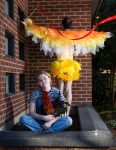
Eden Lyons as Emory (seated) and Nathan Cottell as Linda in Awkward Stage Production’s MilkMilkLemonade, which runs May 23-26 at CBC Studio 700. (photo by Javier Sotres)

True to form, Awkward Stage Production’s upcoming show, MilkMilkLemonade by Joshua Conkel, will challenge and entertain audiences.

“Eleven-year-old Emory dreams of two things – leaving his farm for Mall Town, U.S.A., and going on Star Search. His grandmother wants him to be a normal boy and be friends with Elliott, the tough boy from down the road. Meanwhile, Linda, his depressed best friend, dreams of surviving to the next dawn,” reads the synopsis, noting that Linda is a giant chicken who does stand-up comedy and that the show includes the music of Brittany Spears, Spice Girls and Nina Simone.

Jewish community member Eden Lyons plays Emory. With Arts Umbrella Pre-Professional Troupe, she played Mrs. Tottendale in The Drowsy Chaperone in 2016 and Hope Cladwell in Urinetown last year. Her resumé includes stilt walking as a special skill.

“I’ve been interested in acting and musical theatre for as long as I can remember, I was a very attention-hungry child,” Lyons told the Independent. Nevertheless, it wasn’t until her role in Urinetown that she knew she wanted to make a career of performing.

Born in Hamilton, Bermuda, Lyons has lived in Vancouver since she was 3 years old. She attended Vancouver Talmud Torah from preschool to Grade 7 and graduated from Point Grey Secondary School last June. When she left VTT, she said, “I felt somewhat disconnected to the idea of the Jewish community. Maybe because I didn’t feel I belonged from a gay perspective, because I always saw Judaism as more of a conservative traditional thing, as opposed to the ever-changing and loving thing I see it as now. In lots of ways, I feel my safest in the Jewish community.”

A sense of safety is particularly relevant to MilkMilkLemonade, which contains sensitive and explicit material. Producer and choreographer Erika Babins – also a member of the Jewish community – said the play “walks a fine line of comedy and heavy subject matter. Emory is subject to bullying at school because of his effeminate nature. Elliot attempts, and often fails, to reconcile his friendship and attraction to Emory with the internalized homophobia and misogyny that he was raised with. There are both scenes of intimacy and violence in the piece.

“We began rehearsing this play,” she said, “in the wake of controversy in the Canadian theatre community regarding directors and companies crossing professional boundaries in their rehearsal halls in the name of creating art. It brought to light a lot of practices that many theatre artists take for granted as part of the industry and certainly needn’t be. At the beginning of our rehearsal process, we outlined specifically what was deemed appropriate behaviour in rehearsal and what would not be tolerated, in order to create a safe environment for everyone. Actors have to be extremely vulnerable to create situations with physical intimacy and it is the job of the theatre company and the creative team to create and enforce that environment.”

Co-starring with Lyons are Demi Pedersen (Elliot), Stefanie Michaud (Lady in a Leotard), Sachi Nisbet (Nana) and Nathan Cottell (Linda). The producer is Sarah Harrison and the rest of the team is stage manager Laura Reynolds, light/sound designer Andie Lloyd, costume/prop/set designer Alaia Hamer, graphic designer Julia Lank and promotional photographer Javier Sotres.

“The age range of the cast is between 18-27,” said Babins. “All the cast members and creative team on this project are emerging artists.”

Winning the role of Emory came as a surprise to Lyons.

“When I went in for the MilkMilkLemonade auditions, I didn’t even think I would get cast at all, as I hadn’t yet been in a professional show and all I had gotten until then was a string of rejection emails,” she said. “When I got my email for MML, I was at work and I cried in the bathroom and called my parents saying, ‘Maybe I’m not a terrible actress after all!’ This is my first show with Awkward Stage, and I am really thankful that they are the first company I’m working with in my professional career.”

When asked what were the most challenging and fun aspects of playing Emory, Lyons said, “It was a challenge for me to get past my fear of being the youngest in a cast, especially since all of them have already graduated theatre school and worked professionally for years. It was also difficult to find the physicality for acting like a kid, and the balance between me being a woman, who’s playing a little boy, who is actually a little girl. Lots to unpack there. Emory is a really fun role because I get to play around and throw little tantrums and scream, and basically just be a kid. It offers me a lot of freedom to try new things.”

And Lyons is working on many new things in addition to this production.

“I’m currently assistant directing Oklahoma! with the Arts Umbrella Pre-Professional Musical Theatre troupe, which is playing at the Waterfront Theatre from May 18th to 26th, and I am assistant directing and associate producing Jasper in Deadland with Awkward Stage for the Vancouver Fringe Festival in September,” she said. “In the fall, I am moving to Toronto to attend Randolph Academy for Musical Theatre.”

While there is no specific target audience for MilkMilkLemonade – “There are pieces for all ages and walks of life in it,” said Babins – due to the subject matter, she said, “we do advise parental discretion for children under the age of 12.”

MilkMilkLemonade is at CBC Studio 700 May 23-26, 8 p.m., with a 2 p.m. matinée on May 26. Tickets ($20) are available at awkwardstageproductions.com/milkmilklemonade.

Format ImagePosted on May 11, 2018May 9, 2018Author Cynthia RamsayCategories Performing ArtsTags Awkward Stage, Eden Lyons, Erika Babins, gender, identity, LGBTQ, musical theatre

Being a young Jew in 2017

From the beginning, Jews have struggled to define ourselves within the societies we inhabit. Since the time of the Babylonian exile, we have carved out spaces in other peoples’ countries, walking the fine line between self-definition and belonging.

We have sacrificed much to belong. In becoming part of patriarchal societies, we lost knowledge of the sacred feminine goddess whose statues still stood in the Temple hundreds of years into its use. We lost countless songs and stories and figures of whose existence I will never know. We also lost members of our tribe, ancestors no one is descended from, in crusades, pogroms and massacres across Europe and elsewhere.

But still, we fought to belong. We, know that, above all else, community sustains us, so we infused our culture into traditions that keep us together and nourish us, like foods and songs. When we were exiled from one country, we found shelter in another. We did the jobs they allowed us to do, we lent money and became merchants and bankers. I was taught early that, in each generation, there are those who will oppose us, who will seek our demise. But, after each setback, we found a new place, we salvaged what we could and reinvented ourselves. This is what it is to be diasporic. We were silent about painful things as necessary, and we did what it takes to continue.

And now it is the year 2017. We live among Europeans and Americans, and everywhere in the world. The last genocide is still within living memory, my grandmother having witnessed Kristallnacht, her sister lost in the Holocaust. Now, my grandmother is hugely successful, she has the Order of Canada and never speaks German anymore. We are so adaptable.

They were persecuting us before the word genocide was even coined. Now, we almost sit at the table of whiteness. I have never walked on the street and been profiled for the way I look – any prejudice surfaces after I reveal my own identity. This is my privilege. We are meant to laugh at jokes about Jewishness, because they are not as potentially harmful as jokes about other races. They do not mask death tolls like jokes about our black or indigenous friends; Jews aren’t being murdered or incarcerated at the rates of other people. The jokes about Jews are about how supposedly wealthy we are, a thing we are expected to be proud of.

But still, we are afraid to be openly Jewish in many spaces, because we know we will be asked about Israel, held responsible for the actions of Israel, or at least asked if we have ever been to Israel. The word Jewish or a Magen David on a sign at a Pride march or other progressive gathering could well put us in danger, perceived by some as condoning colonialism or being Zionist, though displaying pride in our Jewishness in these instances has nothing to do with Israel. A minority, we are still tokenized, even by our progressive colleagues. Still proving we deserve to belong, we are used to comments like “you don’t even look Jewish.” What will we sacrifice in the search for belonging in a system that may never really accept us?

Our sages teach that our responsibility is to be a light in the world, that the world we were born into is fragmented and incomplete, and ours is the work of repairing it. I struggle with what this looks like. How can we seek to repair the world even while we ourselves are so broken? I feel very broken these days, astonished by the rise of public fascism in a world that needs healing in so many ways that call on me to help.

I remember, as a preteen, reading about neo-Nazi groups that existed in secret in Europe and being shaken to my core. Now they walk in our streets and our neighbours tell us it is rude to “fight hate with hate,” or they joke about “punching” the agitators, as if the heavy, daily history I carry in my body was as simple as a meme.

We are taught that, since all corners of our universe are fragmented, that means God is also that way. Perhaps then it is alright to be broken, to be incomplete but still trying. Our very name is our task – Yisrael, those who wrestle with God. Those who do even the hardest and most impossible work. Work that it is impossible to ever finish – no one can win against God. But we keep showing up, even as we struggle and break and repair ourselves.

Part of the task of my generation is healing the inheritance we received from elders who escaped the Holocaust or watched family perish, and parents who were raised by people with broken relationships to wealth, food and affection, among other things. We carry these legacies in our bodies and they manifest differently in each of us. For me, I see in my family the deep need to prove we deserved to be the ones to survive. I see the need for material success and productivity and external praise. I hold the grief in my body in moments when I don’t know where the small judgmental voice in my head is coming from, and I recognize the pain of my ancestors rising to the surface in me, now that it is safer to process it than it’s ever been before. My vow is that this healing will happen in my lifetime. It may not be completed, as we are taught that intergenerational trauma lives for generations, but I am not free to abandon the work. I will never tell my – or anyone else’s – daughter “you’ll do well with dating because you’re pretty for a Jewish girl,” as I was told.

Jews are supposed to question everything, our holy books are full of questions, discussions and interpretations. Let us use this training to continue to challenge the status quo. Perhaps being a broken vessel will help – perhaps if we were whole, we would not have such a capacity to hold fragments of others’ pain. Having lost so much and started over so many times in the last 2,000 years, can we not see that anything is possible? Can we not be the ones who discard systems that do not unify a fragmented world? We need to believe that anything is possible – there is nothing to lose in pursuing a world full of our own light, which reveals the light of others along the way.

Ariel Martz-Oberlander is a director, writer, teacher and community organizer seeking to find the personal in the global. As a Jewish settler on Coast Salish territories, her practice is rooted in a commitment to place-based accountability through decolonizing work.


Posted on September 15, 2017September 14, 2017Author Ariel Martz-OberlanderCategories Op-EdTags identity, progressive, tikkun olam
An accidental journey

An accidental journey

Salvador Litvak was in Vancouver for a Shabbaton at the Kollel last month. (photo from Salvador Litvak)

At a Kollel Shabbaton last month featuring Accidental Talmudist and filmmaker Salvador Litvak, no one was asking that age-old Jewish question, “When do we eat?” In fact, on the night of June 23, during the first of three sessions with Litvak, more than 100 attendees sat spellbound as he shared the love story of his Hungarian grandmother Magda, who survived the Holocaust in the Theresienstadt concentration camp.

Litvak, who was born in Chile and now lives in Los Angeles, recalled his grandparents’ story and how Magda’s death led to an epiphany that jump-started his spiritual journey. According to Litvak, witnessing his grandmother passing to the next world, where she was welcomed by his grandfather Imre (who was murdered in the Holocaust), was one of the seminal experiences of his life and it eventually resulted in his becoming an “accidental Talmudist,” with many detours along the way.

Litvak revealed his story in stages over the next two days at the Kollel, which brought him to Vancouver as part of its “focus on creating and promoting exciting and meaningful, social, cultural and educational programs that invite people to experience Judaism … in an inclusive, comfortable, joyful and nonjudgmental environment,” said Kollel director Rabbi Shmuel Yeshayahu.

Over the course of the weekend, Litvak shared a drash about the Torah portion, led an interactive workshop on Sunday about discovering one’s life’s mission and traced the stages in his life that led him to create the Accidental Talmudist blog, which attracts more than one million readers (Jews and non-Jews). He also spoke about how he came to embrace his Jewish and Hispanic roots.

Litvak’s journey has been an unconventional one. In fact, during the Sunday workshop, he jokingly claimed that “smoking pot got him into Harvard” because, after the incident, his father forced him to become a runner, which led to his becoming a champion cyclist. These extracurricular activities, said Litvak, helped him get into Harvard, where he took pre-med courses but ended up at New York University Law School. When he wasn’t in the classroom, he spent time in Greenwich Village. “I was a law student by day and a poet warrior by night,” he said.

Going back to his childhood, he said, “I was born in Santiago, Chile, that’s how I ended up with such a crazy name as Salvador Litvak, which is very similar to Jesus Goldberg.”

Like most kids, he was concerned about fitting in, despite several disadvantages. “I already had foreign parents, I was too tall, my hair was bright red, unruly, a mop, and there was no way I was going to fit in,” he said. So, while he agreed with his parents’ plan for him to go to Harvard to become a doctor, he made a decision in Grade 3 to use his middle name Alex instead of Salvador because “it made him feel more American.” It wasn’t until attending a Latino Students Association annual black tie gala at NYU that he would reclaim his Latino heritage.

Litvak had not attended any of the organization’s prior events because he had only felt nominally Hispanic. He attended this one with his girlfriend on a lark because he could wear his tux and get a free meal. When he found out, to his horror, that he would have to make a speech at the gala, he thought of leaving, but then realized that “all of the events of my life had actually coalesced into this moment for a reason.”

He seized the moment and shared with the audience how he’d been passing for 17 years as a white-bread American, and vowed to use his Spanish name, Salvador, from that day forward. Even though he wasn’t plugged into Judaism during his NYU days, this reclamation would be the first step for him to also reclaim his Jewish identity. “I let that moment be a key moment in my life,” he said, “because I knew that G-d was speaking to me and was saying to me, be who you are; you can’t do anything in this world if you aren’t who you really are.”

Litvak graduated, and practised corporate law for a short time before abandoning that career (much to the chagrin of his father) to become a filmmaker. This led to another milestone in his Jewish journey – producing and directing what is now a holiday comedy classic, the story of a Passover seder gone awry entitled When Do We Eat?, starring the late Jack Klugman in his final film role, as well as Lesley Ann Warren, Max Greenfield and Ben Feldman.

By his own admission, When Do We Eat? – which was realized with the help of his wife Nina and his Vancouver cousin Horatio – is a “very irreverent and raucous movie.” Even though the movie, which is about the “fastest seder in the West,” had a deep Jewish message based on sparks of kabbalah and Chassidut, it was panned by major media like the New York Times and Roger Ebert as being anti-Jewish. Nonetheless, word-of-mouth led to the film becoming a cult classic and a Passover tradition for many Jews around the world.

While Litvak had a bar mitzvah, he wasn’t particularly connected to his Jewish roots until the day he walked into a bookstore called 613 – The Mitzvah Store in the Pico Robertson district of Los Angeles and picked up a book called Berachos. It led him on the next leg of the spiritual journey that had begun with the passing of his grandmother.

He learned from the clerk at the bookstore that he had picked up the first book of the Talmud on a special day. The Talmud is read by many Jews all over the world as part of a worldwide program called Daf Yomi (literally, “Page of the Day”). It takes seven-and-a-half years to read the whole Talmud and Litvak had bought Book One on Day One of the program. He decided that this was not a coincidence and embarked on a seven-and-a-half-year talmudic journey, which led to one of his most memorable spiritual experiences: participating in a siyum (or concluding ceremony) at MetLife Stadium in New York with 93,000 Jews.

So, picking up that book of Talmud “accidentally” at a bookstore in Los Angeles set Litvak on a journey that inspired him to establish the Accidental Talmudist blog, which features Jewish wisdom and humour, and music from Jewish artists like Matisyahu, Peter Himmelman and the Moshav Band, as well as a live weekly show that is seen in more than 70 countries. Aside from connecting Jewish souls, the blog has introduced new fans to When Do We Eat? and there are plans for an Accidental Talmudist book and movie.

As we continue to ask that vital question, “When do we eat?”, Litvak will continue to connect Jewish souls one matzah ball and one page at a time.

For more information about the Accidental Talmudist, visit accidentaltalmudist.org. For information on the new Daf Yomi class at the Kollel, led by Asaf Cohen daily, at 8 p.m., visit thekollel.com.

David J. Litvak is a prairie refugee from the North End of Winnipeg who is a freelance writer, former Voice of Peace and Co-op Radio broadcaster and an “accidental publicist.” His articles have been published in the Forward, Globe and Mail and Seattle Post Intelligencer. His website is cascadiapublicity.com. He is not related to Salvador Litvak.

Format ImagePosted on July 21, 2017July 19, 2017Author David J. LitvakCategories TV & FilmTags Accidental Talmudist, film, identity, Judaism, Kollel, Salvador Litvak

Express your opinion

The good news is we’re again debating “who is a Jew.” This is good news, of course, only because it’s a topic that divides Jews mostly when external threats abate enough to allow the luxury of pilpul around denominational rights and definitions.

We can only assume that the state of the world – the Iranian threat, the unhinged American administration, Syria in collapse – looks fine enough from the Israeli prime minister’s office that we have the freedom to indulge in family squabbles.

A year-and-a-half ago, the Israeli government finally agreed to create an egalitarian prayer space at the Western Wall. The Charedim who legally control Israel’s Jewish religious character, including practices at the Wall, have imposed a strict gender division on prayer and ritual at the holy site. This has sent the message to Conservative, Reform and other non-Orthodox Jews that the holy site is not wholly theirs and, by extension, that their forms of Judaism are not authentic or proper. The creation of an egalitarian section was hailed as putting an end to a painful and divisive aspect of Israeli-Diaspora relations.

An egalitarian space would permit families to visit the Kotel together, allow girls to read from the Torah during their bat mitzvahs and give women the right to pray out loud, rather than following the existing rules by which women must pray quietly so that their voices may not be heard by men on the other side of the divided plaza. The agreement for a new egalitarian space would not alter the existing men’s and women’s areas, but rather add a new, third space, south of the traditional prayer areas.

At the time the agreement was reached, Anat Hoffman, chair of the board of Women of the Wall, a group that has been at the fore in advancing the goal of an egalitarian space and whose members are routinely arrested for praying at the Kotel with prayer shawls, said the decision by Israel’s cabinet was an acknowledgment “that there is more than one way to be Jewish.”

Last week, the Netanyahu government changed its mind and decided there is not.

Bending to pressure from the ultra-Orthodox members of his coalition, the proverbial tail that so often wags the dog in Israel’s political system, Netanyahu called a snap vote on whether the decision taken in January 2016 to create the egalitarian space should indeed proceed. Ministers who last year voted in favour last week voted against.

In for a penny, in for a pound, the government at the same time advanced a bill that would reinstate the Orthodox monopoly on conversions and lifecycle events, including marriage and burials. Among the implications is that Jews not converted under the auspices of the Chief Rabbinate – in other words, by Conservative, Reform or other non-Orthodox rabbis – would not be recognized as Jews.

On most issues, Israel should take Diaspora concerns into consideration only secondarily to what is right for Israel. We have said in this space before, for instance, that Israeli defence policies should be determined with the security of Israelis as the priority, not the comfort of Diaspora Jews who have to live with the political consequences, but not the life-and-death consequences facing Israelis.

This is different. Rules regarding prayer at the Western Wall – who, where and how – should be made with the interests of the Jewish people – not just Israelis – foremost in mind. Of course, if the rules were made with the majority of Israelis in mind, they would reflect the diversity of religious observance both in Israel and in the Diaspora. Instead, what we have is a narrow reflection of ultra-Orthodox priorities that is more a result of political realities in the Knesset than religious reality anywhere outside that chamber.

Ultimately, these decisions are a result of political, not religious, considerations. The political needs of the Netanyahu government’s coalition appear to be superseding the Jewish state’s respect for diversity and pluralism within the global Jewish peoplehood.

“We believe in Jewish unity, not uniformity,” states a letter to Netanyahu signed by scores of Canadian rabbis. “The spectrum of Jewish practice is diverse, but it need not lead to divisiveness. Our differences are eclipsed by all that unites us: millennia of shared history and a shared future. What happens to Jews today – no matter where they live or where they attend synagogue – invariably affects us all.… We are an indivisible people, which is why we are deeply concerned by these and any other actions that unnecessarily foment division within amcha.”

Most of us do not have a vote in Israel, but each of us has a voice. The Centre for Israel and Jewish Affairs is urging each of us to contact the Israeli embassy to express our views on this vital matter. Please do.

Posted on July 7, 2017July 5, 2017Author The Editorial BoardCategories From the JITags Centre for Israel and Jewish Affairs, CIJA, Conservative, Diaspora, discrimination, equality, identity, Israel, Kotel, Netanyahu, non-Orthodox, Reform, religion, ultra-Orthodox, women

Benefits from finding your I

What was your growing-up story like? If we are fortunate, we are in a nurturing environment as we scramble to make some sense of the world around us, with little sense of who or what we are. We are all the sensations we react to, hunger, cold, heat, pain, pleasure, more instinctive than rational. When do we develop a sense of self, an idea of what it is we might want rather than what those around us might wish for us?

For me, the smoke began to clear by the time I was in Grade 5, about the age of 11 or 12. Suddenly, it seemed to me, I had a sense of self, and opinions about what was going on around me in the world. Not only that. The opinions of others were less important. I had begun reading voraciously, learning of a world that had a past that had shaped my present. My immigrant parents’ views had begun to disappear as reference points; my feeling was that I knew more about the real world we lived in than they could possibly understand.

By the time I was in my mid-teens, I felt I was fully in charge of my life. I was under the family roof, but the things going on in my head, the plans and actions I contemplated, were formulated and carried out with almost no reference to parental guidance. I generated the funds to permit me independent action from an early age. Was it just me? Was I the only one who was obnoxiously opinionated by the time he was a teenager? I was fortunate that my parents did not stand in my way. It doesn’t happen to everybody like that.

Gaining a consciousness of oneself as separate from those around us, with an independent will, especially, independent from those in positions of authority, is a big thing. The sense of being an independent identity may come long before we achieve independence, but it surely must come first. We may begin by feeling a rising sense of rebellion, exasperation with the lack of understanding by those around us. We may begin to object to decisions made for us, about us, without consultation. We may begin to object to rules of the game, which we find erroneous, obtuse, nonsensical or unjust. We may say nothing, but a knot of resistance, even anger, may begin to form. Our I begins to take shape. We may even be wrong, lacking all the information needed to make a correct decision. We learn to negotiate those things.

An independent will can form at any age. Sensitivity on the part of those in authority, inviting expressions of opinion, can stimulate development. An authoritarian environment can delay it. Doesn’t it take some people a long time to achieve a sense of I? One wonders at the history behind that. How much goes on in the mind as part of this process? How much conflict does it generate? How many experience damaging environments that prevent a proper development, haunting their adult lives. Don’t some people spend a lifetime in counseling working through their feelings? Don’t some people take pills to quiet the questions? We really have to work through this stuff to become happy campers, to make a success of what we hope to do in life. How many people do I know who, even in their 50s and 60s, are agonizing about relationships with parents that still leave them anxious, angry and confused about their self-worth? How can we successfully interact with a life partner with this monkey on our back?

Yet some of us who have lived through the worst seem to get through it relatively unscathed. Perhaps a parent or family member saved the day. Or they met the right person early on who got them on the right track. Or they just had the right stuff to see beyond the sickest parts of the people they were in forced contact with and sloughed it all off. What we do know is that a healthy sense of I, a healthy sense of self-worth, a positive self-image, is crucial to making it through to adulthood with some chance of happiness. With it, we can handle being knocked down a peg or two by the inevitable reverses we will face over the years. We can pick ourselves up, dust ourselves off and step back into the fray.

Max Roytenberg is a Vancouver-based poet, writer and blogger. His book Hero In My Own Eyes has just been published.

Posted on December 16, 2016December 14, 2016Author Max RoytenbergCategories Op-EdTags aging, identity
Exploration of identity

Exploration of identity

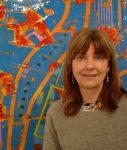
Ira Hoffecker’s Berlin Identities is at Zack Gallery until July 3. (photo from Ira Hoffecker)

Rarely does the Sidney and Gertrude Zack Gallery at the Jewish Community Centre of Greater Vancouver present exclusively a non-Jewish artist. This month, however, the gallery features Ira Hoffecker’s solo exhibit Berlin Identities.

Born and raised in Germany, the horrible history of Nazism and the Holocaust are part of Hoffecker’s identity, the identity she explores in this exhibition and in the entirety of her art. She looks at the Holocaust from the perspective of a German born after the Second World War.

“Germany is rich in history. There are so many layers,” she said in an interview with the Independent. “But the history of WWII and Nazism is different. The previous generations – my parents and grandparents – didn’t want to talk about it. My mother was a child during the war, and all she and her parents wanted after the war was to forget. But we can’t forget. We can’t deny our responsibility. For years after the war, there was a leaden blanket over the Holocaust, over what Germany did. But you can only move on if you accept the past, even such a horrible past as the Holocaust. It’s easy to say: it wasn’t me, I wasn’t born yet, but it’s our heritage. We have to accept our guilt, to acknowledge it, before we can start to heal as a society.”

That’s what her art is about: trying to understand and accept the painful enormity of the Holocaust and the guilt Germany carries, trying to discover her own definition of self underneath those national memories.

Another theme in her art, intertwined with the first, has to do with urban identities. “My paintings are informed by the different identities cities assume over time,” she explained. “History transforms cities, changes the urban space.”

All of the paintings in Hoffecker’s current show reflect her search for personal and urban identities. They are interpretations of maps: colorful, stylized and multilayered.

The layers represent the passing of time, as demonstrated by several paintings of Scheunenviertel, the former Jewish quarter in Berlin. “Before the Nazis came to power, over 150,000 Jews lived there. By the end of the war, none remained,” said Hoffecker.

Accordingly, the main layer denotes what the district looked like right after the war, while the overlaying layer, mounted on Plexiglas, corresponds with the map as it is currently. “The layers are a metaphor – of forgetting, of suppressing the past,” she explained. “Of the inevitable change.”

Two of the paintings look even scarier. One is covered by steel mesh, like a concentration camp fence. Another is concealed under torn tissue paper, where only fragments of the original map are visible, the rest is hidden – perhaps by those who don’t wish to remember. However, “we must remember,” the artist insists, and she tries to stir the memories by her imagery.

As is true for geographical maps, color and geometry play huge roles in Hoffecker’s creations.

“I’m fascinated by colors and I love maps,” she said. “As a child, my favorite book was an atlas. I like studying maps. I have a huge collection at home. My husband calls me a human GPS. I never have trouble navigating in any city, but only cities. I’m an urban person; I don’t do well in the wild.”

With her love for maps, it’s not surprising that she likes traveling. “Every city I ever visited has its own identity, its own atmosphere. I have been in many: all over Europe, India, Egypt, Peru. I’ve moved 26 times, but I hope I’ve stopped at last. I live in Victoria now and I don’t intend to move again.”

Her road from Germany to Vancouver Island was somewhat out of the ordinary.

“I always liked art, but when I lived in Germany, I worked in marketing and publicity for the movie industry,” she said. “Then, my husband and I had our own movie marketing company in Hamburg. Fifteen years ago, we came to Vancouver Island for a vacation. My children were young. We rented a mobile home and traveled together. We loved British Columbia, but the movie producers kept calling us, even though we were on vacation. They could call in the middle of the night, and I thought, What am I doing in this rat race? We needed a change.”

In 2004, they acted on the need for change and moved to Canada, settling in Victoria. “My children went to school there, and I went to school, too,” she said. “I decided to follow my old dream and change careers. I wanted to become an artist. Since we moved to Canada, I’ve been a student of the arts, but the career change is not easy or fast. It’s like a circus salto mortale, almost a free fall. It’s scary.”

But she hasn’t let the fear stop her. She has become an internationally known artist. In the last few years, she has participated in a number of solo and group exhibitions in Canada, England and Germany. She is studying for her master’s degree, and her paintings have started gaining recognition in artistic circles and among private collectors.

“I’ve sold over 170 paintings,” she said. “Recently, I was nominated, together with 53 other artists, for the British John Moore Painting Prize 2016. Our paintings will be shown within the Liverpool Biennal. They were selected from over 4,000 submissions.”

Another big change is coming soon for Hoffecker.

“We are not Canadian citizens yet,” she said. “Until a couple years ago, Germany didn’t accept dual citizenship, and I couldn’t give up my German citizenship either; I’m German. Now that it is possible to have dual citizenship, my family will receive our Canadian citizenship. It will happen on July 1st, on Canada Day.”

Berlin Identities will be on display at the Zack until July 3.

Olga Livshin is a Vancouver freelance writer. She can be reached at [email protected].


Format ImagePosted on June 17, 2016June 16, 2016Author Olga LivshinCategories Visual ArtsTags Germany, Hoffecker, Holocaust, identity, Zack Gallery

Posts pagination

Previous page Page 1 … Page 5 Page 6 Page 7 Next page
Proudly powered by WordPress