During the Yom Kippur War, the author had to learn how to fire an Uzi and other weapons. (photo by Victor Neuman)
In this eight-part series, the author recounts his life in Israel around the time of the 1973 Yom Kippur War. The events and people described are real but, for reasons of privacy, the names are fictitious.
Part 4: Training Day
We were two or three days into the war and the news was chilling. Egypt had overrun the defences along the Suez Canal and was pouring into the Sinai. Syria had breached the outposts in the Golan and was within striking distance of Tiberias. We were in shock to think that, a scant six years after the pummeling of the Six Day War, these countries were able to go to war again.
I think the nation was in disbelief as well. Soldiers, in large numbers, had been sent home to observe Yom Kippur with their families. The government had effectively demobilized much of the Israel Defence Forces prior to the attack. The trust in Moshe Dayan and Golda Meir would never be the same.
At first, the response of the average Israeli was cocky. Tamar thought the attack was stupid. “We beat them in six days … now it will be five.” Then, as the news came in, the optimism vanished. Kibbutzniks came around to ask me if I was tuned in to the BBC. They didn’t trust the government to give them the truth of what was going on. It was wartime after all and, at such times, every involved government lies through its teeth. There was not much to listen to, though. Everything was so sudden that the international news services hadn’t caught up with what was going on.
Then Gidon came by. The next day, I was to receive weapons training along with three other volunteers who had just enough Hebrew to say “Halt! Who goes there? Who are you? Stop or I’ll shoot.” The basic wartime jabber.
I don’t recall ever being asked if I wanted to join the fight. As a candidate for kibbutz membership, it was a given that I would step up and do anything required to help. And so it was. This was now my home and these people were my family. Not doing everything I could was never a question in my mind. But, truth be told, to me the fighting seemed far away and unreal and I had no real sense of personal danger. More oblivious than brave might be the way to put it.
Next day, the four of us and Gidon met in a field behind the kibbutz. Gidon had set up a target that consisted of a plywood board on two metal rods that were banged into the ground. There was a rise behind the target to stop the bullets from straying. On a table to the side, he had weapons. There was an Uzi, a bipod sniper rifle and three Second World War relics. Gidon apologized for the older guns, saying they were there just to give us the hang of things and he expected we would have better weapons soon. But, first, he addressed us with a sombre face.
“As you know, our kibbutz is located on Wadi Ara. This valley connects the West Bank territories to the coast of Israel. The military tells me that, if Jordan enters the war and opens a third front, there is a good chance they will come right down Wadi Ara and we are the first Israeli settlement past the West Bank. If that happens, I am told, we have to hold out for six days without help from the army. They are fully occupied in the Golan and the Sinai and will not be able to help us until they have solved their problems over there. Are we understanding?”
“We are,” we all said, a little unenthusiastically. I was thinking, “Worst pep talk ever, Gidon!”
Then came the practice shooting and I learned stuff that no graduate in English literature needed to know.
When sniping with a rifle, lie flat with elbows well anchored. The right leg should be extended back in a line with your rifle and your body to absorb the shock of the recoil. Your left leg is splayed out to the left for stability. Don’t breathe, take aim and squeeze the trigger. Our accuracy was rough, then better. But my main recollection is the kick of those rifles. We were basically lying in fine dirt and, when the round went off, the force pushed our whole body two or three inches backwards. The movement after every shot caused a small cloud of dust to rise up around us and we had to wait a moment before we could see well enough to shoot again.
An Uzi has 32 rounds in its clip. The sliding switch by your thumb has three positions: safety, single shot and automatic. Gidon told us to forget about the first two positions. In battle, you had to be quick. You had to be in automatic mode and learn to shoot from the hip without aiming. The dumbest thing you could do was to hold the trigger down. Doing that would empty your clip in three seconds and the recoil would twist your arm and body up and to the right. Gidon taught us that we had to squeeze off short bursts of around three rounds, see where they hit and adjust accordingly.
Our shooting with the Uzi was fairly awful. Shooting from the hip is really tricky. There were puffs of dust halfway up the hill behind the target, in the dirt just metres in front of us, way off to the left and right of where we were trying to aim. I thought the safest place to be on that range was standing in front of the target.
I had a little better luck than the rest. High with the first burst. Low with the second. Then I adjusted again and hit the target with a burst that knocked the whole thing over.
That evening, Gidon marched us into one of the bomb shelters and gave us all our assigned Uzis. Then he showed us how to disassemble them. We had to disassemble and reassemble our Uzis over and over again until we could do it in a matter of seconds. We were feeling pretty good about ourselves until suddenly Gidon turned off the lights and we had to do the whole thing in pitch dark. A bomb shelter, of course, has no windows. So, when the lights are out, you might as well be spelunking in the world’s deepest cave. We eventually learned to do it using only our sense of touch.
Training ended and so did my date nights in the banana fields with Tamar. She was needed elsewhere and I was approved for carrying a weapon, so I was on my own for going out to the fields at night and dealing with the irrigation. A scary business. Alone in the dark, banana trees making the fields look like a jungle, shadows everywhere and the possibility of infiltrators from the West Bank. I felt like I never breathed until I was in the Willis, job done and heading back to the kibbutz. Back at the kibbutz, I signed in to prove I was still alive. Sometimes I even looked at my own signature to make sure.
When I returned to our flat at 2 a.m., Tamar would be fast asleep. In another world, my girlfriend would leap out of bed and throw her arms around me, overjoyed at my safe return. Tamar would half-waken and say, “Shalom, shalom sweetie,” then go back to sleep. And I understood. It wasn’t that she didn’t care about me. This was Israel. The Yom Kippur War was not their first rodeo.
Victor Neumanwas born in the former Soviet Union, where his family sought refuge after fleeing Poland during the Second World War. The family immigrated to Canada in 1948 and Neuman grew up in the Greater Vancouver area. He attended the University of British Columbia and obtained a BA and MA with majors in English literature and creative writing. Between 1968 and 1974, he made two trips to Israel, one of which landed him on a kibbutz at the time of the 1973 Yom Kippur war. Upon his return to Canada, he studied Survey Technology at BCIT and went on to a career of designing highways for the Province of British Columbia. When he retired, he reconnected with his roots in creative writing and began writing scripts for Vancouver Jewish Folk Choir concerts and articles for the Jewish Independent. Neuman and his wife, Tammy, live in southeast Vancouver and enjoy the company of friends, their extensive extended family and their four sons.
Tamar on a visit to Canada. (photo from Victor Neuman)
In this eight-part series, the author recounts his life in Israel around the time of the 1973 Yom Kippur War. The events and people described are real but, for reasons of privacy, the names are fictitious.
Part 3: Dating, Israeli Style
After our kibbutz commander, Gidon, had given everybody their marching orders, Tamar and I went back to her flat and started hanging black plastic on all the windows. It was late afternoon. Darkness was on its way and it was going to be our first night of wartime blackout. I didn’t bother hanging plastic in the shack I was originally assigned. Days before the war, Tamar and I had begun living together at her place. I got the girl of my dreams and a room upgrade all at the same time.
As a kibbutz volunteer from abroad, I was on the lowest rung of the accommodation ladder. All such volunteers were given a room of their own but it was in a sreef (shack), which was no more than an old wooden cabin left over from the first days of the kibbutz. These were the slap-dash shacks occupied by the kibbutz founders, intended for shelter only until the kibbutz was able to get on its feet. Once crops were sold and the money was flowing, housing was built out of concrete and tile. Who got into the new units was purely a matter of seniority. You could hold the highest position in the hierarchy (kibbutz secretary) but you’d still live in a shack until it was your turn to upgrade.
Our kibbutz had around 250 members and all the members had newer homes that were on the small side, but clean, solid and agreeable. None of them had a tub. Too much of a waste of water and space. Instead, there were narrow-stall kerosene showers for those who preferred not to use the communal hot showers down the path. Tamar had one of these. You would start a kerosene fire at the base of the water tank and go away for 20 minutes while your water heated. Then you’d come back, turn off the kerosene and enjoy your three minutes of hot water. If you wanted to push it, you could leave the kerosene burner on while you showered and squeeze a couple of more minutes out of the hot water supply. There was a down side to that, however. Though the burner was screened from the shower water, things could go wrong. During one of my showers, water got into my kerosene burner. It overflowed and I had the disconcerting experience of washing my upper end while flaming drops of kerosene landed around my feet.
The evening we were hanging the black plastic, Lev, the banana boss, came by to tell me he was being called up to the war and I would have to do everything I could to maintain irrigation on my own. The rains hadn’t come yet and the bananas wouldn’t recover if an irrigation cycle was skipped. He was going to try to get an exemption from the army on the grounds that the all-important banana crop stood in danger of being devastated in his absence, but he was not sure if it would come through. It wasn’t a cop-out. It was true. Lev was a banana guru and he was single-handedly responsible for the establishment of the kibbutz’s most important cash crop. Without him, there was nobody to be the banana whisperer and make the damn things thrive the way he did. I could do irrigation on my own but, for the rest, I always looked to Lev for direction.
Irrigation was done around the clock. With several fields to supply and only enough pressure for one field at a time, I would have to be changing taps, cleaning filters and dumping fertilizer at various times of day and night. I would have to catnap between sessions and try to be awake enough to stay on top of the schedule. I told Lev I could do it and he went away satisfied. Tamar looked at me as if I was crazy to agree but she was an Israeli, she understood. Then Lev came back and told me I could use the Willis and I was much happier. The jeep would get me to the fields a lot faster than the tractor. More time to rest. More time to sleep.
But not that night. The war was edging closer to our ordinary lives and, all night long, vehicles of all kinds were coming and going. There was the noise of a truck pulling up, the sound of boots pounding past our window, loud voices giving orders, the truck driving away, then silence. The same sequence repeated over and over again.
By morning, the kibbutz wasn’t the same place. All our trucks and buses were gone and so were all the young men and some of the young women. Why not all the young women? Because, while the Israeli army gave weapons training to both sexes, there were still some traditional attitudes toward women in war. The women all knew how to handle weapons but, somehow, when push came to shove, they never ended up on the front lines or in tanks or in planes. In war – at that point in time – their duties were confined to nursing, communications and secretarial work. Most of the young women reservists, like Tamar, remained on the kibbutz, along with the older folks. With them was a ragtag bunch of hapless tourist-volunteers wishing they had picked another time to experience life on a kibbutz. And then there was me: a volunteer worker who had become a candidate for kibbutz membership. And now we were running the show.
Gidon dropped by to talk to me.
“Are you going to the fields after dark?” he asked.
“Yes, I have to change the taps.”
“Two things then. First thing. You have to sign out when you leave and sign in when you come back. Second thing. You have no weapons training, so you have to take Tamar with you as your guard. Are we understanding?”
“We are.”
Conversations with Gidon were never anything but straight to the point and businesslike. He never had much of a sense of humour at the best of times and he now had the safety of 250 people in his hands. He felt the weight of it deeply and I wasn’t about to make his job any harder.
The next night, Tamar and I signed ourselves out and headed for the fields. I drove. She sat next to me with her Uzi resting on her lap. When I got to the irrigation pipes, I got out and, in the glare of the jeep’s headlights, I cleaned the filters, dumped sacks of fertilizer into the tanks, reset the flow timers and hopped back into the vehicle. All the while, Tamar kept her weapon at the ready and scanned the shadows of the banana trees for trouble.
There was a beautiful full moon out. A lover’s moon, just for the three of us. A guy, a gal and her Uzi. This was dating, Israeli style.
Victor Neuman was born in the former Soviet Union, where his family sought refuge after fleeing Poland during the Second World War. The family immigrated to Canada in 1948 and Neuman grew up in the Greater Vancouver area. He attended the University of British Columbia and obtained a BA and MA with majors in English literature and creative writing. Between 1968 and 1974, he made two trips to Israel, one of which landed him on a kibbutz at the time of the 1973 Yom Kippur war. Upon his return to Canada, he studied Survey Technology at BCIT and went on to a career of designing highways for the Province of British Columbia. When he retired, he reconnected with his roots in creative writing and began writing scripts for Vancouver Jewish Folk Choir concerts and articles for the Jewish Independent. Neuman and his wife, Tammy, live in southeast Vancouver and enjoy the company of friends, their extensive extended family and their four sons.
Vancouver writer Aren X. Tulchinsky at the Aug. 16 unveiling in Toronto of Project Bookmark Canada’s plaque honouring his novel, The Five Books of Moses Lapinsky. (photo by Lisa Sakulensky)
The Canadian Literary Trail has a new bookmark – one honouring The Five Books of Moses Lapinsky by Vancouver writer Aren X. Tulchinsky. The 25th such plaque to be erected by Project Bookmark Canada across the country, the unveiling took place Aug. 16 in Dominico Field at Barton Avenue and Christie Street in Toronto. Tulchinsky took part in the ceremony.
“Last October, I received a phone call from Laurie Murphy, executive director of Project Bookmark Canada, letting me know my historical novel The Five Books of Moses Lapinsky was nominated for a bookmark,” Tulchinsky told the Independent. They chose to unveil the plaque on Aug. 16 because it is the day on which the 1933 riot in Christie Pits took place.
Surprised and thrilled to hear that Project Bookmark Canada and the City of Toronto would be erecting the plaque in honour of his book, Tulchinsky said, “I was particularly struck by the timing, when, right now, we are all being called upon to make sure that dark chapters of our history do not repeat themselves.”
He explained, “My novel is about a fictional Jewish Russian immigrant family, living in the Kensington Market neighbourhood in the 1930s and ’40s. The main character, Sonny Lapinsky, is a Jewish boxer. He is 9-years-old … when the riot in Christie Pits occurs and, on that night, he discovers he has boxing talent and goes on to become a professional boxer. That same night, tragedy strikes the Lapinsky family.
“Many Canadians are not familiar with the 1933 riot, which involved 15,000 people and is the largest race riot ever to occur in Canada. A group of British- and German-Canadian young men, members of the Swastika Club, set off the riot when they unfurled a huge, black and white swastika flag in Christie Pits during a packed amateur league baseball game on a hot August night. The Project Bookmark plaque in Christie Pits will bring greater awareness to this piece of Canadian history and, of course, to my novel.”
Project Bookmark Canada was founded by writer Miranda Hill in 2007, with the first plaque being unveiled in 2009 – for Michael Ondaatje’s In the Skin of a Lion, at the Bloor Street Viaduct in Toronto. There are bookmarks from British Columbia to Newfoundland. Vancouverites have easy access to Bookmark No. 12, which commemorates Wayson Coy’s The Jade Peony, at the southeast corner of Pender Street and Gore Avenue in Chinatown.
“Visitors are encouraged to read their way across Canada, online and in person,” said Project Bookmark board of directors president Hughena Matheson in the press release about Tulchinsky’s honour. “A launching place for conversation, collaboration and learning, the bookmarks provide a unique reading experience and a deeper understanding of the country and its people.”
“I think Project Bookmark Canada is an important organization,” said Tulchinsky. “Their goal is to get people to read Canadian books. It is vital to celebrate our unique Canadian history and, sadly, our country is constantly in the shadow of the U.S., with American books filling our bookshelves. With the loss of small independent bookstores across the country who used to promote Canadian authors, and with people buying books online from huge American corporations, many excellent Canadian books go unnoticed. As a Canadian and as a writer, I applaud the work Project Bookmark Canada is doing to bring Canadian stories to the forefront.”
The Five Books of Moses Lapinsky bookmark text. (photo by Don Oravec)
At the Aug. 16 unveiling, Tulchinsky read the excerpt of his novel – published under the name Karen X. Tulchinsky – that appears on the plaque. “It is the moment when, in 1933, the Swastika Club unfurled a huge swastika flag at the ninth inning of an amateur league baseball game in the park. All summer, the Swastika Club had been bullying Jews on the beaches of Toronto. On this day, they upped the ante and brought their antisemitism to the west side of town, which was mostly Jewish and Italian immigrants. After a summer of being kicked off the beaches, young Jewish men fought back. And, interestingly, the Italian men in the park joined the Jews in fighting against the Swastika Club and their allies, in what became the largest race riot ever to occur on Canadian soil.”
“Our past president, Don Oravec, spoke at the unveiling and said the novel was on his radar as a potential bookmark,” Project Bookmark’s Murphy told the Independent of how The Five Books of Moses Lapinsky was selected. “When Daniel Gelfant made an official submission to us to consider the book and its variety of Toronto settings as potential bookmarks, the wheels were set in motion. The board’s national bookmark advisory committee reviewed the proposal and approved it for development. Councilor Joe Cressy made a motion to the City of Toronto to provide funding in support of a bookmark for the Christie Pits ball field, on the anniversary of the riots in 1933. It was approved, and subsequently developed. Additional funds were raised by individual donors attending a bookmark fundraiser on Aug. 15, complete with a boxing demonstration by the author and the Toronto Newsgirls Boxing Club at Jazz Bistro.”
When he first started writing the novel, Tulchinsky, who was born in Toronto, said it “was loosely based on stories my grandfather had told me about his escape from Russia before the Second World War and his early days in Toronto, where his first home in Canada was in the Kensington Market area.
“When I started researching the Jewish community in 1930s Toronto, I discovered the riot that pitted young Jewish men and their Italian allies against the Swastika Club and their gentile allies…. As a Canadian Jew, I knew immediately that I would tell my story against this backdrop, an important piece of our history that had not yet been told in fiction. So, I created a fictional family, with four sons, all of whom get involved in the riot in different ways. On the night of the riots, one of the brothers is permanently injured in a way that shatters the family, especially the main character, Sonny, whose guilt over what happened to his brother causes a rift between him and his father, that sends the family into turmoil.
“The Five Books of Moses Lapinsky, which takes place … when Hitler first came to power in Germany, and continues through the Second World War years, is about antisemitism in Canada,” he said. “It’s about how hatred only leads to more hatred and violence. At the risk of sounding like the Vancouverite I am, I believe the only cure for hate is love. Sadly, history tends to repeat itself and, today, in 2019, we are seeing a rise in hate crimes in Europe, the U.S. and here in Canada against Jews, Muslims, South American migrants and the LGBTQ community. We are witnessing the president of the United States taking children away from their asylum-seeking parents and imprisoning them in what can only be called concentration camps. The themes in my novel, sadly, are just as relevant today as ever. I hope people see the parallels in the fascism that swept the world in the 1930s with what is happening today. I just keep hoping that humans will find a better way forward that does not repeat the mistakes of our past.”
And Tulchinsky continues to examine that past.
“I am currently working on a new novel, set in 1930s Berlin, in which I follow fictional characters (Jewish and non-Jewish) as Hitler first comes to power. In the story,” he said, “we watch as the Jewish characters are systematically stripped of their civil rights, then their livelihoods and, eventually, their lives. For my research, I have read hundreds of books on the Holocaust and the rise of the Nazis in the 1930s and I can tell you there are many policies the Trump administration is pursuing in the U.S. that are taken directly from Hitler’s playbook. In the current climate, with antisemitism, racism and homophobia on the rise, I feel particularly driven to finish and publish this new novel.”
The author was in the banana fields, working on the irrigation system, when the war started. (photo from Victor Neuman)
In this eight-part series, the author recounts his life in Israel around the time of the 1973 Yom Kippur War. The events and people described are real but, for reasons of privacy, the names are fictitious.
Part 2: The War Begins
Sometimes, war begins with a whimper and not a bang. It was Oct. 6, 1973. I was back on the kibbutz that I had been on with Suzanne, except Suzanne had never returned from Paris.
I was in the banana fields, working alone on the irrigation system, when I began to feel a strangeness in the air. At first, I couldn’t put my finger on what was different. I was alone – just me and my tractor – but that was nothing new. The bananas were not ready for harvesting, so no one else was supposed to be around. The pruning of new shoots was over with and the stripping of dead leaves had been done a couple of weeks before.
Not being able to determine what was bothering me in that moment, I went back to pondering the meaning of my life. I had been to Israel on a previous trip, spent a year or so on three different kibbutzim, done archeology in the Negev at a site called Tel Beersheva, worked on construction of a chemical pipeline near Arad, gone back to Canada to get my master’s in English literature, and now I was back in Israel, at the age of 28. I still had no clue as to what I wanted to do. Go back to Canada? Teach English at the University of British Columbia? Stay in Israel? Become a member of the kibbutz?
Skewing my thought process was my relationship with a kibbutz Sabra named Tamar. By all I hold dear, Tamar was the most beautiful creature I had ever laid eyes on. When I met her, I was gob-smacked and smitten. When I found out she kept an Uzi in her flat, I was gob-smacked, smitten – and careful. She had become an officer during her two years of military service. On her bookcase, there was a photo of her looking rather sternly at her platoon. They were standing stiffly at attention while she inspected their weapons. Definitely not a gal to be trifled with.
Complicating things more was the fact that Tamar was 26 and the first child born on the kibbutz after it was founded in 1949. She was the darling of the kibbutz and, at the same time, a big concern to everybody. After all, she was already 26 and, by the standards of the day, she was on the cusp of becoming an elderly single. She had a problem common to many kibbutz youths. Who was there to get it on with? Our kibbutz, like many others, had what’s called a beit yeladim (children’s house). All babies that are weaned are taken and put in the children’s house; there, they are raised until they are of high school age. They visit with their parents frequently but, at the end of the day, they return to their communal home to sleep and live. The result is that they grow up feeling that their peers are like their brothers and sisters. Romantic feelings are hard to come by and their best chance of finding a partner is to match up with somebody from outside the kibbutz.
The kibbutzniks liked me. I worked hard. I had a university education. I always volunteered when extra work needed doing and I had applied for membership. Everybody was pulling for me and Tamar. I told my kibbutz friend Aaron that my dating Tamar was still a thing in its early stages. He was having none of it. To make his point more emphatic, he switched to English and called me by my kibbutz nickname, Kanadi. “No, no, no, Kanadi. You marry 26!” It was a romance in a goldfish bowl but I didn’t mind. She was gold to me.
When my mind returned to what was happening in the banana fields, it hit me. The constant hum of traffic on the Afula road was missing. This road was a major corridor just below our fields and it was constantly abuzz with trucks, tractors and cars. Israelis called it the “Ruler Road.” As they put it, “It is straight as any school ruler and it even has a hole in the end – Afula.” (There was never much respect for the town of Afula.) But now the road was silent. I drove the tractor to the top of a hill to get a better look and was surprised to see the road deserted. Something was going on.
Suddenly, there was a horrific racket from above. A helicopter gunship roared overhead, heading straight up the Afula road at just above treetop level. It was so close I could see the barrels of guns bristling from every port on its side. In another second, it was gone. Then, a second gunship barreled through. Same height and same direction. I started to worry.
I hopped on my tractor and booted it back to the kibbutz. Same story all along the way. No traffic on the roads. Nobody working any of the fields. Nobody walking around. Just me. As I drove into the parking lot, the roads and walkways were deserted. It was as if a mysterious virus had devastated the earth and I was the only one left. I was starting to feel like I was living in an episode of The Twilight Zone.
Then, I heard voices coming from the dining hall, so I walked in that direction. When I entered, everyone was there. The voices had dropped off and now there was only one voice dominating. It was Gidon, our designated commander.
Gidon was a recent immigrant and a South African Jew. It never surprised me that he would be in charge of our defence. Every South African immigrant I met in Israel was trained in the military. Not by Israel but by South Africa. The British won the Boer War but the Afrikaners were running the show and they were determined to never let the blacks get the upper hand. It seemed that most South Africans knew one end of a gun from the other, even the many who were disgusted with the brutality of apartheid and had left the country. So, while most Jews immigrating to Israel were novices when it came to the art of war and had to be extensively trained, the South African Jews I met had come prepared.
Gidon’s voice wasn’t the loudest I’d ever heard but, in the hush of that room, it was loud enough. Thankfully, his Hebrew was as far along as mine and I understood everything he said: “… and there will be no more swimming in the pool. The swimming pool is now our emergency drinking water supply. All tractors and vehicles are to be filled up with fuel and oil. All tractors and vehicles are to be scattered around the kibbutz and not parked in one place. The bomb shelters are no longer discothèques. The kids have to clear out all the records, strobe lights and disco stuff.
“Before the day is over, I want white lines painted on all the shelter pathways. We are blacking out the kibbutz and we have to be able to find our way to the shelters in the dark. No lights on after dark in the rooms unless there is black plastic taped to the windows. Patrols by the shomer leila [night guard] around the kibbutz perimeter are to be carried out seriously. I don’t want to hear of any guards hanging out in the kitchen having food and coffee. They can pack their lunches and eat them as they do their rounds. No, we can’t double the patrols. They’ll just end up shooting one another. That is all. We are at war. Are we understanding? Then go do your jobs.”
I looked across the room at Tamar. She looked back and her expression was serious. We were at war.
Victor Neumanwas born in the former Soviet Union, where his family sought refuge after fleeing Poland during the Second World War. The family immigrated to Canada in 1948 and Neuman grew up in the Greater Vancouver area. He attended the University of British Columbia and obtained a BA and MA with majors in English literature and creative writing. Between 1968 and 1974, he made two trips to Israel, one of which landed him on a kibbutz at the time of the 1973 Yom Kippur war. Upon his return to Canada, he studied Survey Technology at BCIT and went on to a career of designing highways for the Province of British Columbia. When he retired, he reconnected with his roots in creative writing and began writing scripts for Vancouver Jewish Folk Choir concerts and articles for the Jewish Independent. Neuman and his wife, Tammy, live in southeast Vancouver and enjoy the company of friends, their extensive extended family and their four sons.
Apart from an ambiguous hint dropped by his mother just after his father died in 1990 – and subsequently denied – Mark Loudon, a Brit of Scottish, English and Irish ancestry (so far as he knew), had no idea that the man he grew up with was not his biological father. A DNA test in May 2017 revealed a completely different DNA profile than what he was expecting – instead of Scottish paternal heritage, it showed an Eastern European Jewish and Spanish one.
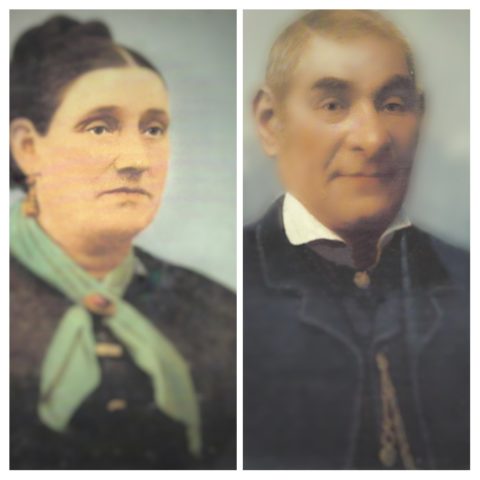
With only a third cousin DNA match to a stranger in Chicago and some childhood memories from his aunt, who was only 8 years old when he was born, Loudon set out on a search for closer relatives. This involved not only family history records, but diving into planning records and old photographs for clues. One such photo, shown here, is of Henry Naftali-Hirts Hart and his wife Elizabeth Mendoza.
Loudon will discuss his journey to discover his biological father and its impacts at the next meeting of the Jewish Genealogical Society of British Columbia (jgsbc.ca) on Oct. 1, 7:30 p.m., at the Peretz Centre. All are welcome to attend.
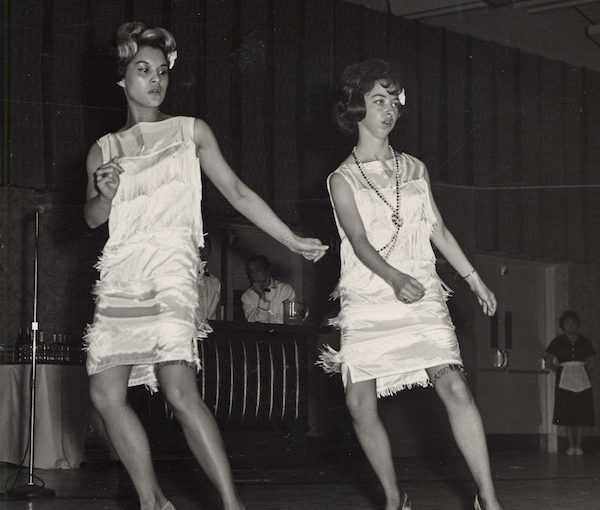
Two women dancing, 1965. (photo from JWB fonds, JMABC L.13986)
If you know someone in these photos, please help the JI fill the gaps of its predecessor’s (the Jewish Western Bulletin’s) collection at the Jewish Museum and Archives of B.C. by contacting archives@jewishmuseum.ca or 604-257-5199. To find out who has been identified in the photos, visit jewishmuseum.ca/blog.
Stan Shear has been on countless stages with figures Benjy, Jasper and his original puppet, Danny, now retired at the Vent Haven Museum in Fort Mitchell, Ky. (photo from Stan Shear)
To walk into Stan Shear’s studio at his Oakridge home is to take both a step back and a step forward in time. A portrait of a penny-farthing hangs on the wall, old manuscripts and books line the shelves, yet in among the memorabilia is the technology he believes will connect the past with the future.
Shear is launching My Audio Memories (myaudiomemories.com), a project in which he takes recordings – some made in his studio, others that may have been passed down within a family – and combines them into a high-quality MP3 file on a USB stick.
His service is directed at private individuals and, because it is based in his home, he can create recordings at a cost far below those of commercial services.
The process is straightforward but requires a seasoned hand to deal with the production side, which, with decades of musical and engineering experience behind him, Shear offers.
First, you would go to his studio with stories you would like to record, along with any other audio files or recordings you might already have. These are then mixed together with various inputs and accompaniments – i.e., music and other sound effects – to capture the perfect backing for the end result. Finally comes the mastering, the stage that distinguishes a professional from an amateur recording.
“I can bring a recording to the highest level with the resources and experience I have to create a unique sound that will bring out all the hidden qualities of a person’s talents and make them come alive,” said Shear.
The cost of an individual project will vary depending on the amount of production involved.
The man behind the sound
Born in Pretoria, South Africa, Shear was a well-known pianist in his younger days. He appeared on SABC (South Africa’s national radio) on several occasions and, at the age of 19, performed the Beethoven C minor Concerto with the Johannesburg Symphony Orchestra. Playing in concert halls around the country during his youth, he later became a licentiate in music.
At the same time, he studied electrical engineering at the University of Johannesburg, earning his master’s and doctor’s degrees, and specialized in information systems, working mainly on hospital communications systems. He would later teach information systems at the University of Cape Town until his retirement.
Shear, who came to Vancouver in 2004, remains a versatile entertainer and keeps a busy schedule. He plays a number of other musical instruments – guitar, harmonica, piano accordion and ukulele – and has had an active career as a singer, performing in solo concerts and singing with choirs.
In 1976, while still in South Africa, he became fascinated with ventriloquism after discovering a book at the library. Since then, he has been on countless stages, including the International Puppet Festival in Israel, with figures Benjy, Jasper and his original puppet, Danny, now retired at the Vent Haven Museum in Fort Mitchell, Ky. (See stanshear.com.)
He also has been officiating as a chazzan for 40 years, both in South Africa and Canada.
Together with his wife Karon, he is a practitioner of auditory integration training (AIT), a method for improving listening and cognitive skills. Their processes are used to help overcome learning disabilities and improve foreign language skills.
Shear has woven his own story into his new project. He divides his account into three periods, starting with his early, formative years, devoted to growing up, schooling and other events that shaped his life. This is followed by his post-secondary education and early career, and includes extracts from concerts and broadcasts.
The third stage comprises Shear’s mid-career to the present, a “mature” but nonetheless very fruitful time, with musical performances, ventriloquist shows and the My Audio Memories project, as well as his positive views on the future, as he sees it, in his senior years.
“I am following this up with a separate project of my memories of my parents, including recordings that I’m fortunate to have of my mom and dad and members of their families talking, singing and playing the piano,” said Shear. “My mom’s family were very musical and I’m lucky to have these recordings made on an early tape recorder by my dad, and transcripts of my dad’s memoirs, which he wrote.”
Sam Margolishas written for the Globe and Mail, the National Post, UPI and MSNBC.
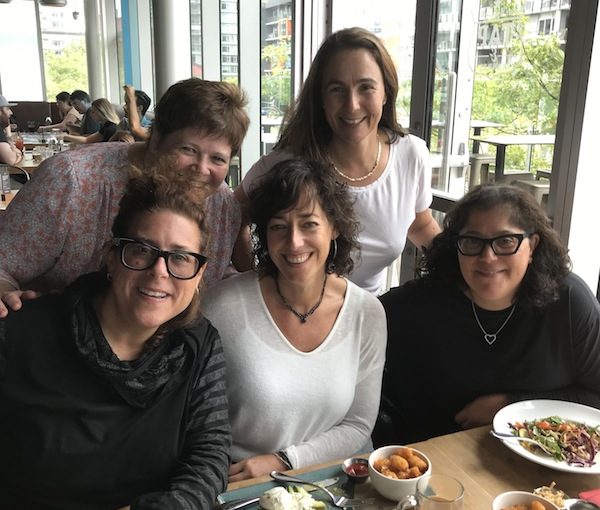
National Council of Jewish Women of Canada, Vancouver section, members. Seated, left to right, are Lisa Boroditsky, Jill Kipnis and Sandi Hazan Switzer. Standing are Heather Sirlin, left, and Jane Stoller. (photo from NCJWC Vancouver)
Members of National Council of Jewish Women of Canada, Vancouver section, have been busy close to home, not only supporting various initiatives for disadvantaged children in local schools – Books for Kids, HIPPY, Operation Dressup, and hygiene and nutrition school programs – but learning more about the Jewish history of the city.
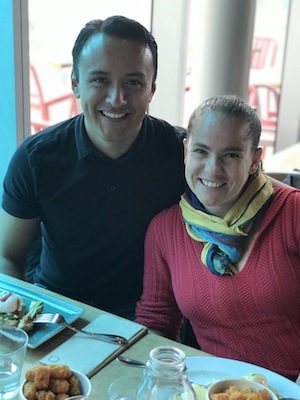
Newcomers to Vancouver, Guillermo and Debby Castillo from Mexico, who joined the NCJWC walk Sunday morning. (photo from NCJWC Vancouver)
On Sept. 8, more than 25 people participated in a sold-out walk through the “old city” of Vancouver, organized by Lisa Boroditsky, Jane Stoller and Sandi Hazan Switzer. Participants were enthralled by the stories of Harry Hammer, by the geographical and architectural details, to say nothing of the oral history of horse-drawn carts, family stores and tales of running to the bus for cheder.
NCJWC members also worked nationally, supporting successful efforts by CIJA (Center for Israel and Jewish Affairs) to get Parliament to adopt the International Holocaust Remembrance Alliance’s definition of antisemitism; and internationally, issuing a call to action to participate in the campaign to free human rights lawyer Nasrin Sotoudeh, who has been imprisoned in Iran’s Evin prison since June 2018.
In May of this year, Prof. Irwin Cotler, chair of the Raoul Wallenberg Institute in Montreal, addressed the executive of the International Council of Jewish Women on the issue of human rights. He made a compelling case for participation in the campaign to free Sotoudeh, sentenced to 38 years and 148 lashes in Iran because of her work defending women’s rights. She has been imprisoned four times since 2010.
Freedom of expression and peaceful assembly are integral to ensuring rule of law and the functions of democracy; they are fundamental principles clearly defined in international law and they are the inherent right of all people. These two democratic themes were betrayed in 2018 when, as part of peaceful protests, some women removed their hijabs and waved them like flags and then were prosecuted for this behaviour. For defending these women, Sotoudeh has been unjustly imprisoned.
The International Council of Jewish Women executive voted to support Cotler’s recommendation and Debby Altow, vice-president for Canada on this executive, circulated a backgrounder and sample letter of protest for 33 affiliates worldwide. Both email and postal addresses for United Nations Secretary-General António Guterres and UN Commissioner Michelle Bachelet, were distributed, making such protest letters easier to submit. For more about Sotoudeh and NCJW Vancouver section, visit ncjwvancouver.org.
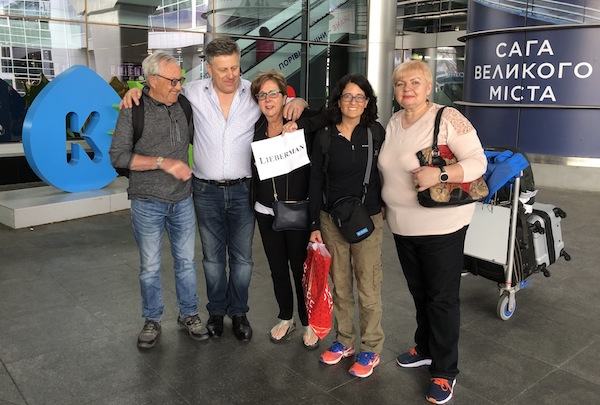
Left to right: Lucien, Grisha, Carole, Leanne and Svetlana at the airport in Kyiv, Ukraine. (photo from Carole Lieberman)
My husband Lucien, our daughter Leanne and I recently traveled to Kyiv, Ukraine, to meet Lucien’s first cousin and his family for the first time.
History has an interesting way of unfolding. Lucien’s father was one of 10 children born in Russia. The oldest daughter Sophie immigrated to Canada in 1912, to marry a farmer living in Rumsey, Alta. In 1923, Lucien’s grandparents, along with four of their children, including Lucien’s father Leo, made the cross-Atlantic journey from Russia to Alberta. Sadly, in 1927, their daughter Lucy, for whom Lucien was named, ended her life there at age 25 and, in another tragedy, their daughter Sophie, mother of five young children, was widowed.
Shortly after these tragedies, their daughter Manya chose to return to Russia on her own. And, in 1928, the grandparents were determined to return to Russia. And so, in November of that year, two brothers – Leo Lieberman, 33, and Sam Lieberman, 29 – embraced at the Calgary CPR station. Sam was escorting their parents back to Russia. Since their parents were in their 60s and were considered elderly, they could not manage the trip on their own. Sam expected to return to Canada once their parents were settled in Kharkov, but he never did. The brothers’ last words were about Leo’s new winter coat. “Leo, I like your coat. Where I am going you can’t find such a coat.” So, the brothers exchanged garments. They did not meet again until 1966, when Leo and his wife Clara went to the Soviet Union to try and find family.
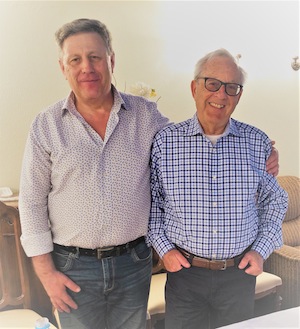
Cousins Grisha, left, and Lucien. (photo from Carole Lieberman)
Lucien grew up in Calgary aware that his parents had both left large families in the Soviet Union and that the Second World War had devastated those families. Sam’s story was tragic. He worked in Moscow in the 1930s as a translator. When the war came, he was taken into the army and survived four years in combat roles. He was wounded and, in 1946, he was arrested, charged and tried for the offence of being “anti-social to the regime” and sent to the Gulag, where he laboured for 10 years in a camp beyond the Arctic Circle. After Stalin’s death, Sam was discharged and allowed to return to his city of last residence, Chernivtsi in the Ukraine. There, at the age of 57, Sam married a younger woman and fathered a son, Gregory (Grisha).
The next generation of family in Canada always knew about Uncle Sam and Cousin Grisha. We had heard that Grisha lived in Madagan, which is closer to Anchorage than to Moscow. Decades passed without any contact but finally, in 2016, we learned that Grisha, his wife Svetlana and their two children were living in Kyiv, the capital of Ukraine. We met our new cousins on Skype in 2017 and began to catch up on decades of this lost connection.
Grisha and Svetlana’s son, Stanislaus Lieberman, is married to Natasha, has a 2-year-old daughter and is a lawyer in Kyiv. Their daughter,
Tatiana Lieberman is known throughout Ukraine as Tina Karol. (photo from Carole Lieberman)
Tatiana Lieberman, affectionately called Tinotchka, is known throughout Ukraine as Tina Karol (tinakarol.com). Tina is a renowned singer who represented Ukraine in the 2006 Eurovision competition at age 21. She is the “face of Ukraine,” with billboard ads throughout Kyiv for Huawei and many cosmetic companies, and has the largest fan club in all of Ukraine. Her 10-year-old son Veniamin attends school in England and returns to Kyiv frequently. Tragically, Tina’s husband, Eugeny Ogir, who was her manager, died in 2013 at the age of 33, shortly after being diagnosed with an aggressive form of cancer.
Grisha speaks a reasonable amount of English and, thanks to Google Translate, we communicated well. We came to feel very close to our cousins after many Skype visits and plans were made to visit. There was no discussion – they insisted that we stay with them in their apartment so we would really get to know one another. It certainly was not our custom to stay with people we had never met in their two-bedroom, 1.5-bathroom apartment for eight nights but the visit was incredibly memorable and very special. Days before our arrival, Svetlana wrote that “they were trembling with anticipation.” We felt the same.
Our daughter Leanne, a teacher and a published author, met us at the airport in Kyiv. We were welcomed at the airport with a “Lieberman” sign and the warmest hugs and happiest tears. Throughout the visit and several times every day, Grisha would grab Lucien, hug and kiss him, saying, “You are my dear cousin.” Despite the 18-year age difference, there was a very strong cousin connection between the two men, cemented further by the traditional home-cooked Ukrainian food that we were so generously fed each day. We awoke to the smell of kreplach, borscht, haluptsi, cheese latkes and potato pancakes prepared by Svetlana and we enjoyed eating delicacies such as forshmuk, a chopped white fish salad. It was food that was so reminiscent of what Lucien’s mother had prepared for him when he was growing up in Calgary. We all laughed together when we were offered barbecued “kitchen.”
Our entire week was planned in advance and included not only family visits and meals, but a visit to a wonderful Ukrainian folk dance show at a huge auditorium where we were seated in the president’s box, welcomed with a champagne reception and presented with traditional Ukrainian outfits for Vishivanka, all arranged by Tina. Tina’s driver took us to a 26-acre monastery for a private tour and we were taught how to make varenikes in a private master class at lunch.
We gained a good sense of Tina’s personal life when we visited her stunning home and gardens, complete with a 24-hour armed security guard. Tina’s fans adore her and swarm her when they see her out in public.
Kyiv is a stunning city, with the Dneiper River running from north to south. The climate is warm in spring and the air is often beautifully fragrant with the scent of acacia trees, stronger in the morning and in the evening when we all strolled along the river. It has beautiful kashtana (chestnut) and lilac trees and a number of impressive bridges and lookouts. There are many parks, huge squares and an excellent subway system, accessed with the longest imaginable escalators. Like so many cities, it has far too much traffic (propka).
Tina arranged a private guided tour of Babi Yar for us with an English-speaking local woman. Babi Yar is now a beautiful treed park approximately a kilometre square in the northwest outskirts of Kyiv. On Sept. 29, 1941, Nazi troops rounded up Kyiv’s 34,000 strong Jewish community and massacred them all within 48 hours. Victims were shot and buried in the ravine. The Nazis then rounded up the local Romany people and residents of mental hospitals and extended the killing. During the two-year Nazi occupation, more than 100,000 bodies were dumped into the Babi Yar ravine. When the Red Army recaptured the city in 1943, there were only 80,000 people in Kyiv, one-tenth of its former population.
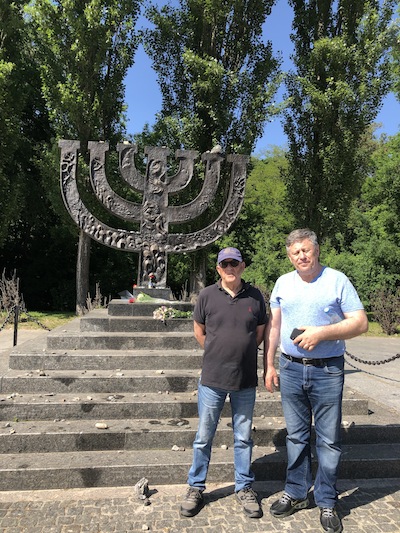
Lucien, left, and Grisha at Babi Yar. (photo from Carole Lieberman)
Today, there is little evidence of a deep ravine, only undulating terrain. There are numerous monuments, some remembering the many children killed, several with Hebrew inscriptions, and a beautiful bronze wagon, which depicts a typical Roma caravan. After the dissolution of the Soviet Union, the Ukrainian government invited the state of Israel to erect a monument, which was done in the form of a large menorah. Babi Yar is possibly the most prominent site representing the Holocaust in the former Soviet Union.
During the week that we were in Kyiv, a new president was sworn in. With Svetlana, we watched the televised inauguration of President Volodymyr Zelenskiy, a 41-year-old former comedian and the first Ukrainian president with a Jewish background, and we loved seeing Svetlana proudly sing the national anthem, in tears.
We visited Maidan, the central square of the city, saw the parliament buildings and surrounding Marinsky Park. We toured a fascinating military museum, visited an old synagogue and were taken to the famous opera house, where we thoroughly enjoyed seeing the ballet.
Every day was full of memorable moments. We spent several evenings sharing family photos – it was fascinating to see photos of us from the 1970s and ’80s, which were mailed to them by my in-laws and other relatives before we lost contact. We laughed, hugged, cried and shared stories, always with “Grishinke” grabbing and kissing “Lucienke” and proudly saying, “you are my cousin.” Together Grisha and Lucien enjoyed shemiskes, aka sunflower seeds, that only people who were raised by siblings would enjoy the same way.
We celebrated our last night together at a beautiful restaurant overlooking the river and marveled that the restaurant, like many other quality restaurants, had an excellent playroom where Stanislaus’s daughter Vesta played while we dined.
When we finally hugged everyone goodbye and thanked them for a visit that exceeded every expectation, Grisha responded, “I am the son of Sam.”
In 1951, after spending five years in the Gulag, a fellow prisoner was released and Sam asked him to please send a letter to his brother Leo informing him that he was still alive, giving him the address – Leo Lieberman, Calgary, Alberta, Canada. When the man was able to mail the letter, he omitted “Calgary” and the letter ended up in the Edmonton post office. The letter was sent to a Mr. Lieberman in Edmonton by a caring employee and was subsequently forwarded to Leo Lieberman in Calgary.
Carole Lieberman, a longtime Vancouver resident, is originally from Montreal. She is a mother of three, grandmother of four, and has enjoyed selling Vancouver real estate for almost 30 years.
The author took refuge from the perils of the streets by joining a kibbutz as a volunteer. (photo from Victor Neuman)
In this eight-part series, the author recounts his life in Israel around the time of the 1973 Yom Kippur War. The events and people described are real but, for reasons of privacy, the names are fictitious.
Before the War: Part 1
“The bomb shelters can no longer be used as discotheques.”
It was Oct. 6, 1973. Gidon, our kibbutz commander, was announcing that we were under attack and giving us our preparation instructions, including the immediate clearing out of bomb shelters for use in the event of air attack.
Syria had overrun the Golan defences and Egypt was pouring into the Sinai. I was in disbelief over the whole thing. Last year, I was writing my master’s thesis, analyzing Hawthorne’s The Scarlet Letter. Now I could be writing something more like Warfare: A Tourist’s Guide. How had my life gone so abruptly from pondering literature to pondering existence?
There’s an expression Israelis use: “I could sell you.” In other words, you are ripe for the plucking and I could easily take advantage.
When I arrived in Israel on my first trip, in 1968, I was totally pluckable. No knowledge of Hebrew. No knowledge of the country. No tour group guide to protect me. All I had was my curiosity about this country that had recently achieved a stunning victory in the Six Day War. I think that event had caught the attention of many like myself, and there was a huge influx of tourists and volunteers to visit this remarkable place.
I was bought and sold in the streets of Tel Aviv. Simply buying a prickly pear fruit was fraught with fraud.
“One-and-a-half lira please,” the street vendor told me. I paid him and started walking away. Then an Israeli stepped up to the stand.
“One-and-a-half lira please.”
This time, the buyer was having none of it. “Yes, one-and-a-half lira, but you’ll take 75 grush.” Leaving no opportunity for a response, he paid what he wanted and took the fruit. I had just paid double for the same thing.
At another time, I tried to be smarter. I needed to change my German marks into Israeli money. I was aware there was a black market for foreign currency and the street usually offered better rates than the bank. It didn’t take long to find a dealer. They can smell a tourist a mile away. One came up to me asking if I had foreign currency to change. I asked him what rate he was offering for German marks. He gave me a number that sounded pretty good and we agreed on a transaction. I handed over the Deutschmarks – he could have bolted but he was an older guy and I figured I could outrun him if I had to.
He took my money and began counting out Israeli currency. I thought there was something odd about the way he wrapped the money around one finger as he flipped the bills and counted them out to me. Later, when he was long gone, I recounted what he gave me and found I was several bills short. He had flipped the bills so that he had ended up counting the same ones twice and giving me less than we had agreed upon. In the end, I was “sold” again and had even less than I would have gotten at the bank.
You never really lose at these things because they always come with lessons. In most cases, you win some and you learn some. The only time you really lose is when misfortune befalls you and you’re sleeping through class.
I took refuge from the perils of the streets by joining a kibbutz near Haifa as a volunteer. Kibbutzim are basically communal societies where all wealth, housing and equipment are owned by the collective. Material perks like TVs or stereos are doled out on a seniority basis. No one – even those running the place – has any real power over others or more wealth than others. The top jobs are considered something to be avoided. You have all the responsibility and headaches of administering the mess without any particular rewards. In my experience, a kibbutznik generally takes the top job when it is their turn in the rotation and they simply can’t get out of it. Socialism in its purest form and no commissar overlords.
Kibbutz life was good. Nobody tried to rob me and, in return for picking grapefruit and oranges, I got accommodation, food, Hebrew lessons and free tours of the countryside. Sometimes, on my days off, I went further afield.
One of those forays was particularly memorable. My girlfriend, Suzanne, was a kibbutz volunteer from Paris and together we decided to attend Independence Day celebrations in Jerusalem. We booked a hotel room in the Arab quarter of Jerusalem’s Old City and thought about our plans for the evening. The debated options were hanging out in the room or going to the cinema to take in a movie that was a modern American take on Romeo and Juliet. Romance won the day and we left for the movie. The movie was mediocre. Things back at the hotel were less so.
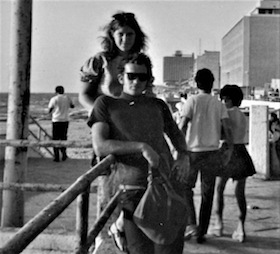
Victor Neuman and his then-girlfriend, Suzanne, in Tel Aviv. (photo from Victor Neuman)
When we got back, we were met by police and the hotel manager. The manager apologized for the inconvenience but we were being moved to another room and could we please collect our luggage from the original room. The sight of our old room was amazing. It was all sparkly. The windows were gone and every horizontal surface was covered with dust. Someone had set off a bomb in the alleyway outside our room.
You might think that a bomb blast would send great shards of glass flying across the room. A blast close by doesn’t. Instead, it pulverizes the glass into a fine dust and that’s what is blown across the room. Objectively speaking, the room looked beautiful – like a fantasy bed chamber decorated in fine diamonds. In reality, we were shaken, as we carefully swept the glass from our bags and began hauling them to our new room on the opposite side of the hotel. It was nice. It had windows.
And the movie? We upgraded its rating from mediocre to fantastic.
Suzanne and I had different travel plans and, after Jerusalem, she traveled to be with friends on a kibbutz north of Hadera. I was concerned that I didn’t have enough money to fly home if the need arose. I was also learning very little Hebrew from the kibbutz we had been on and it was getting annoying needing Suzanne to translate for me wherever we went. When we parted, I headed south to find work in Arad, hoping I could make some serious money and learn Hebrew by some kind of immersion method.
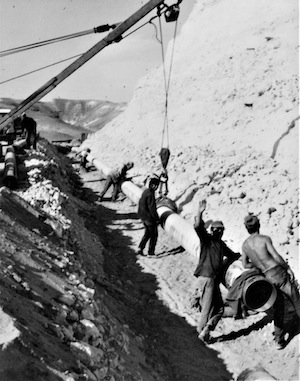
The immersion was profound. I was plunked down in an environment where nobody spoke English. The Arad employment office put me on a crew building a pipeline that would take Dead Sea chemicals to a refinery in Tishlovet. The crew consisted of central European Jews, Israeli Arabs, some local Bedouins and an assortment of thieves, bastards and criminals who were probably one step ahead of an Israeli SWAT team. One of them stole my camera (a beautiful Zeiss Ikon that my father had gifted me) and an assortment of items from all of the crew. We were put up in a motel and, the day the thief quit, he still had the key to the motel room. He made the most of it.
The crew on which the author worked, building a pipeline that would take Dead Sea chemicals to a refinery in Tishlovet. (photo from Victor Neuman)
On the job, I was low man in the pecking order. I had to fetch tools when yelled at and woe to me if I didn’t understand what was being asked for. With this bunch, everybody knew only enough English to swear, and little more. I was sworn at in English, Arabic, Romanian, Hungarian, Polish and Hebrew. It was somewhat typical of what I heard in other parts of the country. Israelis have a knack for adopting the choicest insults from all the languages they encounter. Understandable when you come down to it. Spoken Hebrew was basically invented by linguistic scholars around the time the state was created. They had the difficult task of updating ancient Hebrew to cover things like helicopters and toaster ovens. They didn’t spend a lot of time thinking up swear words. Israelis had to improvise and they did a fine job of it.
The upshot was that, in two months on the pipeline, I learned more Hebrew than in a year of kibbutz Hebrew school. I was getting pretty fluent and I had a good ear for the accent. I began to find that, when I spoke, I was often being mistaken for a Sabra. And, as a bonus, I could swear like a sailor.
* * *
Living in Arad, I now had a decent amount of money rolling in from my work. I decided to take an offer from a guy I’ll call Bad Lennie. Bad Lennie was a South African Jew who had immigrated to Israel with his brother, Good Lennie. Good Lennie lived in one part of Arad with his girlfriend; Bad Lennie had his own apartment. When the two of them were in the same room, I noticed Good Lennie seemed somewhat embarrassed around his brother and often cringed when his brother rambled on about his life in South Africa. In time, I found out that he had good reason to be embarrassed.
Bad Lennie was between jobs and needed money, so he offered me a chance to share his flat if I split the rent with him. I couldn’t pass up the chance to leave behind the den of thieves that were my pipeline crew, so I moved in with Bad Lennie.
Bad Lennie had some disturbing fantasies. He had undergone some military training in his home country. He had a lot of stories to tell me about his time in the military. According to him, he was a top-notch officer in command of hundreds of blacks. His favourite story was of the day one of his men questioned his authority in front of the others. Bad Lennie calmly walked up to the offending black soldier and put a bullet in his head. After that he never had trouble with the others. He told me many stories with pretty much the same theme. The den of thieves was starting to look better to me.
Bad Lennie had a revolver. I found out about it one day when he had this huge grin on his face and told me to feel under his arm. I wanted to pass but he grabbed my hand and stuck it in his armpit.
“What do you think? It’s a gun!” What did I really think? He was wearing a holstered gun under a turtleneck sweater! Not a bad James Bond look except that his turtleneck quick draw was going to need some work. I knew he was an idiot but now I was beginning to wonder how dangerous a one.
Bad Lennie pestered me to get him a job on the pipeline so I did. He lasted three days. On the third day, he came up to me and said, “Watch this.” Then he proceeded to go up to our Arab foreman and swear a blue streak at him in English. He turned back to me with that same stupid grin on his face. “It’s OK. The bugger hasn’t a clue what I’m saying.”
I had been on the pipeline long enough to know different. Everybody in this bunch was fluent in Swearese. Bad Lennie was fired. He still seemed confused about why but he was a goner nevertheless. And his problem became my problem. Bad Lennie was getting half the rent money from me but it was not enough and he started borrowing my money. I saw no chance of getting repaid because Bad Lennie now had no job. He spent most of his time hitting on his brother for money and going to the cinema in Beersheva to watch the latest Western. After coughing up a fair amount of cash, I cut him off. Then he offered to sell me some of his coffee table books on Israel. Truth be told, they were beautiful books but I was still living out of a backpack and couldn’t see myself schlepping all that weight.
I said, “No thanks.” He looked pissed but I didn’t care.
One day, I returned from work and walked through the door of our flat. There was Bad Lennie standing kitty-corner across the room with his gun pointed straight at my head. I just froze. I felt a powerful urge to say something but nothing came to mind. Then he pulled the trigger and there was this loud “snap.”
“It’s empty,” and he was grinning again. “I’m just kidding around. I wasn’t really going to shoot you.”
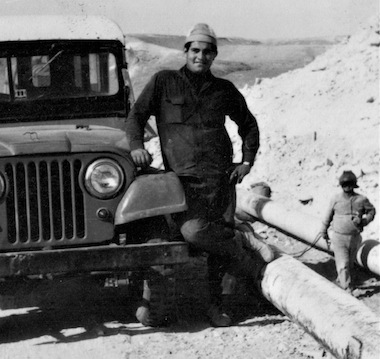
The Arab foreman of the pipeline who fired Bad Lennie after Bad Lennie swore at him. (photo from Victor Neuman)
I decided then and there that I had made enough money and my Hebrew would suffice. Bad Lennie’s gun was empty but I was sure he kept bullets somewhere. It was time to get out of Dodge. On the day I decided to leave, I left the job site early and headed for the apartment. I knew Lennie wasn’t around because they were playing a new Western at the cinema. I grabbed all my things and stuffed them in my bag. There was a little room left, so I grabbed Bad Lennie’s books and stuffed them in my bag as well.
Lastly, I wrote him a note: “Hi Lennie, I’m leaving town to go to a kibbutz in the north. Take care and best of luck. P.S. I’ve changed my mind about your books. I’ll buy them after all. Just deduct what they are worth from the money you owe me and we’ll call it even. Cheers.” Then I headed for the nearest road out of Arad and started hitchhiking north. It was a bit nerve-wracking. I wasn’t sure who would show up first – my ride or Bad Lennie. I was in luck. My ride came first and I was on my way to join Suzanne.
As I mentioned, Suzanne and I had met at our previous kibbutz, near Haifa. She was Jewish and, like me, had come to Israel to check it out and become a volunteer. She was a huge fan of Leonard Cohen and, as a consequence, had a real thing for dark, brooding, handsome Canadians. All I had going for me was the Canadian thing and, happily, she settled for that. For me, the trigger was her incredibly sexy French accent. It was like listening to music.
She also spoke her mind entirely with nothing held back. Tears or laughter came at the drop of a hat and you were never in doubt about what she thought or how she felt. It was a raw honesty of emotion that took some getting used to but, once you did, it was exciting in a scary kind of way. The ride was bumpy but never ever dull. And nothing frustrated her more than people suppressing their feelings. Once, when I was being particularly uncommunicative, she booted me in the rear to try to get me past it. I don’t recall if it worked but, after that, if I felt withdrawn, I made sure I was sitting down.
Suzanne worked in the children’s house and I had a steady job in the banana fields with a guy named Lev as my boss. Banana life was good but there came a time when I worried that I was spinning my wheels. I wasn’t sure I wanted kibbutz life forever and I thought I had the beginning of a career back in Canada. I had a BA in English literature, after all. It had to mean something. I felt I needed to return to Canada and see what I could make of my life there. I was in a dark, who-am-I kind of mood. When I told Suzanne I was going home, she was angry.
“I won’t be the one left behind,” she told me.
Before I knew it, she was on a plane bound for Paris and I was sitting in the middle of a very empty room. Worse than empty. The life had gone out of it. To my surprise, I actually wept. I never realized until then how much I would miss her. Typical of me. Why not save steps? Burn the bloody bridge while you’re still standing on it.
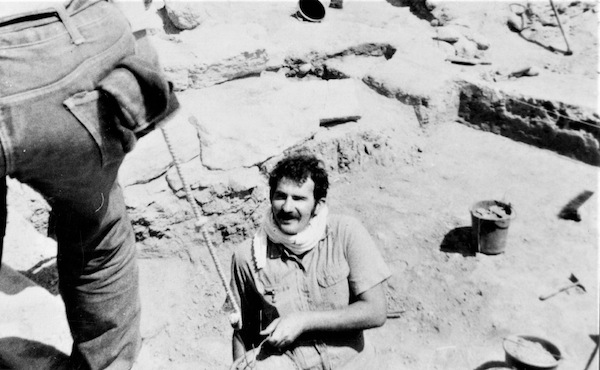
I couldn’t bear that empty room and so, in the time I had left before going home, I joined an archeological dig in the Negev near Beersheva. The work was hot, dirty and finicky. We had to move a lot of dirt to get down to the Iron Age town we were looking for and, at that point, the work had to be much more careful. Every find was scraped, brushed clean, surveyed for location, photographed and, finally, removed to our storage room at the base of the hill.
In the summer of 1969, the author worked on an archeological dig. Here, he passes up a bucket of dirt for disposal. In the background, partially covered with a rock slab, is a Bedouin grave dating to the Middle Ages. (photo from Victor Neuman)
I was particularly proud of finding an intact Iron Age kiln, circa 700-600 BCE – basically, a three-foot-wide, clay-walled cylinder standing on its end. I carefully brushed and excavated the kiln to its base, always careful to leave the dirt in the centre as support for the walls. After three days of clearing the outside of the kiln and the floor around it, I was told it was time to take it down and go deeper. It had been photographed, measured and catalogued and now it had to be removed. Strangely, my fellow volunteers had all dropped their tools to come and watch me take a pickaxe to the kiln. Not sure what was going on, I swung the pickaxe and buried it in the centre of the kiln. There was a horrible sound of glass breaking.
“Crap!” I thought. “I’ve just destroyed some 2,600-year-old glass artifact that was situated in the middle of my kiln.” Everybody who had gathered round gasped loudly in horror. Feeling disgraced, I dejectedly began pulling out bits of glass. But there was something peculiar. The glass had a colour that was unlike any ancient glass I had ever seen. In fact, it looked a lot like.… “Alright,” I said, “Who buried the frigging beer bottle in my kiln?”
Aside from the pranks, we did a lot of good work and, by the end of the season, I was standing on the streets of ancient Beersheva where Abraham once walked.
When the dig ended for the summer, it was time to go home. My first trip to Israel was over. I returned to Canada in 1970, got an MA in English literature by May 1972 and, damn me, I still didn’t want to teach. I was no further ahead in knowing what I wanted to do. Also, I missed the kibbutz. I decided to go back to Israel later that year. My thinking was that I’d spend some quiet time there deciding about my future. I didn’t realize that I’d have to do my contemplating in the middle of a war.
Victor Neumanwas born in the former Soviet Union, where his family sought refuge after fleeing Poland during the Second World War. The family immigrated to Canada in 1948 and Neuman grew up in the Greater Vancouver area. He attended the University of British Columbia and obtained a BA and MA with majors in English literature and creative writing. Between 1968 and 1974, he made two trips to Israel, one of which landed him on a kibbutz at the time of the 1973 Yom Kippur War. Upon his return to Canada, he studied survey technology at BCIT and went on to a career of designing highways for the Province of British Columbia. When he retired, he reconnected with his roots in creative writing and began writing scripts for Vancouver Jewish Folk Choir concerts and articles for the Jewish Independent. Neuman and his wife, Tammy, live in southeast Vancouver and enjoy the company of friends, their extensive extended family and their four sons.