Skip to content
  • Home
  • Subscribe / donate
  • Events calendar
  • News
    • Local
    • National
    • Israel
    • World
    • עניין בחדשות
      A roundup of news in Canada and further afield, in Hebrew.
  • Opinion
    • From the JI
    • Op-Ed
  • Arts & Culture
    • Performing Arts
    • Music
    • Books
    • Visual Arts
    • TV & Film
  • Life
    • Celebrating the Holidays
    • Travel
    • The Daily Snooze
      Cartoons by Jacob Samuel
    • Mystery Photo
      Help the JI and JMABC fill in the gaps in our archives.
  • Community Links
    • Organizations, Etc.
    • Other News Sources & Blogs
    • Business Directory
  • FAQ
  • JI Chai Celebration
  • JI@88! video

Recent Posts

  • Sharing her testimony
  • Fall fight takes leap forward
  • The balancing of rights
  • Multiple Tony n’ Tina roles
  • Stories of trauma, resilience
  • Celebrate our culture
  • A responsibility to help
  • What wellness means at JCC
  • Together in mourning
  • Downhill after Trump?
  • Birth control even easier now
  • Eco-Sisters mentorship
  • Unexpected discoveries
  • Study’s results hopeful
  • Bad behaviour affects us all
  • Thankful for the police
  • UBC needs a wake-up call
  • Recalling a shining star
  • Sleep well …
  • BGU fosters startup culture
  • Photography and glass
  • Is it the end of an era?
  • Taking life a step at a time
  • Nakba exhibit biased
  • Film festival starts next week
  • Musical with heart and soul
  • Rabbi marks 13 years
  • Keeper of VTT’s history
  • Gala fêtes Infeld’s 20th
  • Building JWest together
  • Challah Mom comes to Vancouver
  • What to do about media bias
  • Education offers hope
  • Remembrance – a moral act
  • What makes us human
  • המלחמות של נתניהו וטראמפ

Archives

Follow @JewishIndie
image - The CJN - Visit Us Banner - 300x600 - 101625

Movies that offer optimism

Movies that offer optimism

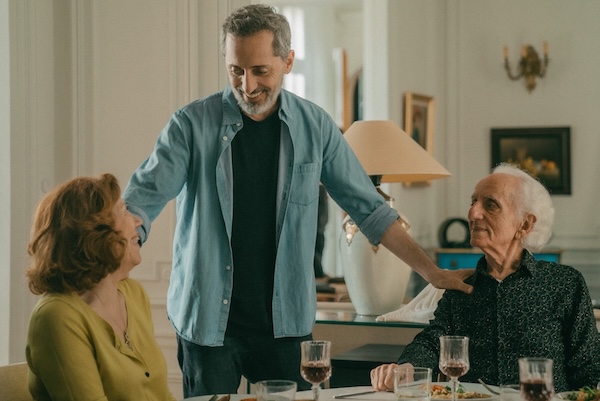
Stay With Us (still from the film)

Healing. Of body and soul. Of self, community, family, friends. This year’s Vancouver Jewish Film Festival offers many poignant films – dramas sprinkled with humour that invite contemplation, and hope that we flawed humans are capable of change and loving one another, despite our insecurities and differences.

Of the films the Jewish Independent reviewed this week, Stay With Us and Rose are among the films that will be screened at Fifth Avenue Cinemas in the main portion of the festival, April 4-12, which is followed by various screenings at the Rothstein Theatre April 13-14. No Name Restaurant will be both at Fifth Avenue, as well as online during that portion of the festival, which runs April 15-19.

Stay With Us is a sensitively written and well-performed movie that is based on Moroccan-born Canadian comedian Gad Elmaleh’s real-life fascination with the Virgin Mary. In the movie, he returns to Paris to visit his family, not sharing with them that he is in the process of converting to Catholicism. Perhaps because he’s dealing with his own actual emotional journey (though he co-wrote the script with Benjamin Charbit), Stay With Us delicately and thoughtfully explores some of the roles religion has in life and the effects a potential conversion can have on a family. 

Despite being an immensely personal film – Elmaleh’s real parents and sister play his family in the film and most of the cast are people close to him – Stay With Us will resonate with anyone who has questioned their purpose in life, or been curious about other religions and cultures. Elmaleh doesn’t disparage religion or the religious. Thankfully, he chooses to tackle the subject seriously, with well-timed comedy, his own stand-up act as part of the story, as well as other natural-seeming, unforced funny moments – the reaction of his parents when they find a statue of the Virgin Mary in his suitcase is hilarious, for example.

The movie Rose is similarly satisfying – serious but also light and amusing. In the first minutes, set at Philippe’s rocking, festive, friend-filled 80th birthday party, we learn that Rose and Philippe are still madly in love after decades of marriage, that their three adult children each have their own personal challenges and rivalries (between themselves and for their parents’ affection), and that Philippe is fatally ill.

Understandably, after Rose loses the love of her life, she grieves. Her children worry that she doesn’t answer the phone, that she’s not taking care of herself. When 78-year-old Rose does start to take care of herself, to focus on her needs, to rediscover herself after years of being a wife, mother and grandmother, her children worry even more.
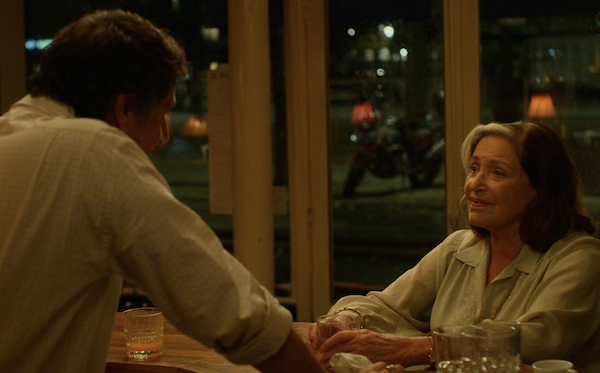
image - a still from the film Rose
Rose (still from the film)

Written by Aurélie Saada and Yaël Langmann, Rose is a charming, heartwarming film about how we choose to experience life, its happy, sad and other moments – and how it’s never too late to find joy. Saada is the film’s director, and she also composed original music for the film, which has a notably wonderful soundtrack. The movie is infused with her Tunisian Jewish background.

“It was important for me to put my first film in this setting because I didn’t want to cheat,” Saada says in the press material. “I wanted this film to resemble me and not to borrow anything from cultures that I hadn’t sufficiently mastered. Also, Eastern Judaism is often caricatured in French cinema. I wanted to show its more complex face, far from the clichés. But it remains a setting, a costume, a perfume because the heart of the subject is not there. This film may be imbued with Judeo-Eastern culture, but a friend of mine from Corsica, a Christian, told me a short while ago: ‘It’s crazy, it’s like home.’ I believe that we humans are much more alike than we imagine.”

This notion pretty much encapsulates the film No Name Restaurant as well. Written and directed by Stefan Sarazin and Peter Keller, the idea for the story apparently came from Sarazin’s “numerous travels to the Middle East” and was “inspired by an abandoned boat in the desert and the friendship to an elderly Bedouin.”

Ben, an ultra-Orthodox Jew from Brooklyn, has yet to marry. Within hours of arriving in Jerusalem, both to visit family but mostly to meet the matchmaker – who he purposefully misses by taking his time to get to his uncle’s shop from the airport – Ben eagerly agrees to Uncle Yechiel’s request to head right back to the airport to catch a flight to Egypt.
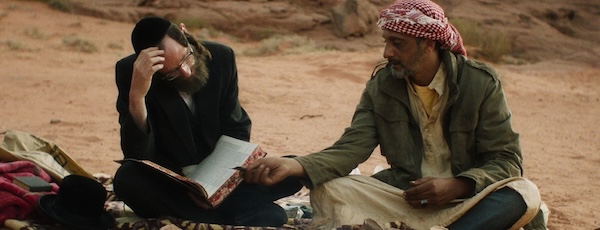
image - still from the film No Name Restaurant
No Name Restaurant (still from the film)

The Jewish community of Alexandria, the president of which is Yechiel’s brother-in-law, needs a 10th man to form a minyan before Passover. If they can’t observe the holiday, according to some written agreement, all the community’s property and possessions will have to be turned over to the state.

Ben seizes the chance to save the ages-old synagogue, but misses his plane and then is kicked off the bus to Alexandria by fellow passengers, putting the whole plan in jeopardy. Luckily, he is picked up in the Sinai Desert by Adel, a Bedouin searching for his lost camel. Unluckily, Adel’s truck breaks down and the two men must head out on foot. Short on water – much of which had been used by Ben for ritual handwashings along the way – and going only on Adel’s memory of a well his family had frequented when he was a kid, the journey is fraught with existential concerns, including what other Arabs might do to a Jew in their midst and to the Bedouin who is helping him.

No Name Restaurant is a buddy movie that delivers all that one would expect from such a movie and more. With respect and humour, it brings together Jews, Muslims and Christians in a novel way to optimistic effect. 

For the full Vancouver Jewish Film Festival lineup, go to vjff.org.
Format ImagePosted on March 22, 2024March 20, 2024Author Cynthia RamsayCategories TV & FilmTags Vancouver Jewish Film Festival, VJFF
Art as an anchor amid chaos

Art as an anchor amid chaos

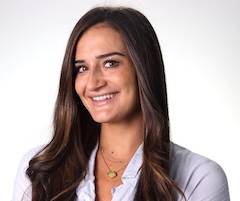
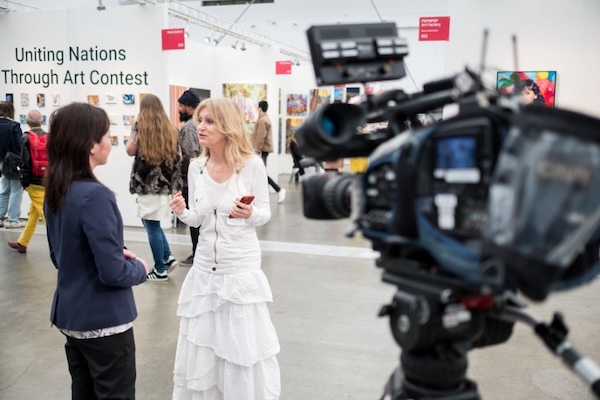
Lisa Wolfin, executive director and founder of Art Vancouver International Art Fair, which is at the Vancouver Convention Centre East April 11-14. (photo from Art Vancouver)

“Art serves as a vital anchor amidst the chaos of the world, both as a creator and a viewer,” said Lisa Wolfin, executive director and founder of Art Vancouver International Art Fair, which returns to the Vancouver Convention Centre East April 11-14.

“As a creator, it offers a therapeutic outlet to process complex emotions, providing a medium through which to express, reflect and make sense of the turbulence surrounding us,” she told the Independent, saying that, no matter the form of artistic expression, she finds solace in the act of creation, in addition to beauty and meaning.

“As a viewer,” she said, “art serves as a sanctuary, offering moments of escape and contemplation. It provides a lens through which to interpret and understand the world, offering insights, perspectives and opportunities for introspection. In both roles, art becomes a source of comfort, inspiration and resilience, offering a sense of connection and grounding amidst the uncertainty of our times.”

Wolfin and her daughters, Taisha Teal and Sky Lilah, who are also part of the Art Vancouver team, are among the Jewish community members participating in the annual art fair that drew more than 11,000 attendees last year. This April’s event is the eighth edition of the exhibit, which includes workshops, live demonstrations, a range of conversations, and is an opportunity for creatives to network and collaborate.

Wolfin is most looking forward to the sense of community and connection that Art Vancouver brings. “I’m eager to be a part of that vibrant atmosphere once again,” she said.

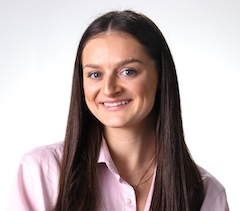
photo - Taisha Teal
Taisha Teal (photo from Art Vancouver)

Teal echoes that sentiment.

“I’m particularly excited about showcasing my art to a diverse audience of art enthusiasts and collectors,” said Teal. “Connecting with fellow artists, sharing insights and drawing inspiration from their work is another aspect I’m looking forward to. This event also provides a unique opportunity to engage with artists and galleries from around the world…. Moreover, I’m eager to receive feedback from attendees and potential buyers, which will contribute to my growth as an artist and refine my artistic practice.”

Lilah is looking forward to two main things: what she will create for the exhibit – “it is always a surprise,” she said – and, she shared, “Additionally, there’s immense enthusiasm surrounding hosting the opening night! Welcoming everyone to Art Vancouver is a true privilege, and having a significant role at the show is an honour.”

Art Vancouver, which was established in 2015, has been held annually, with the exception of the first two years of COVID.

“During the pandemic, I dedicated time to exploring new artistic styles,” said Teal. “Over the past couple of years, I’ve blended several styles together, continually evolving my approach. For instance, my ‘sparkle ladies’ series has undergone transformations with each passing year, featuring diverse female figures and introducing abstract faces. I particularly enjoy experimenting with abstract shapes and colours, and my upcoming collection will focus on incorporating textured elements using molding paste and various tools.”

photo - Sky Lilah
Sky Lilah (photo from Art Vancouver)

Following the pandemic, Lilah curated her inaugural solo art exhibition, unveiling a series of abstracts for the first time. “Instead of merely attempting to depict something, I sought to channel the divine through my creative process, crafting unique works of art that had never been realized before – pieces that were distinctly mine,” she said.

“Over the years, I’ve persisted in exploring abstract styles, seamlessly blending them with my previous series,” she added. “I’m currently amalgamating elements from several series, combining the favourite aspects of each into a cohesive whole. While I continually experiment with new styles, I often layer them upon the foundations of styles with which I am familiar – an ongoing ebb and flow of artistic exploration.”

Wolfin, too, has spent time developing and refining her existing style and techniques, while venturing into different areas. “This has allowed me to push the boundaries of my creativity and explore new avenues of expression,” she said, noting that her work is inspired by many sources, “including nature, emotions, personal experiences.”

“I find inspiration in the beauty of the natural world, the complexities of human emotions and the stories of people and cultures,” said Wolfin. “Each of these influences shapes my creative process and fuels my desire to express myself through art.”

Teal also has a deep love for nature – “Whether it’s the patterns in a leaf, the colours of a sunset or the textures of a rock formation, nature constantly offers fresh ideas and motifs that find their way into my artwork” – and points to multiple sources of creativity.

“Firstly, the diverse cultures, landscapes and experiences I encounter during my travels serve as a constant wellspring of inspiration,” said Teal. “Each new destination offers unique perspectives, colours, textures and stories that influence my artistic vision.

“Secondly, connecting with other artists allows me to exchange ideas, techniques and perspectives, fueling my creativity and pushing me to explore new artistic territories. Collaboration and dialogue with fellow creatives foster a sense of community and shared creativity that invigorates my artistic practice.”

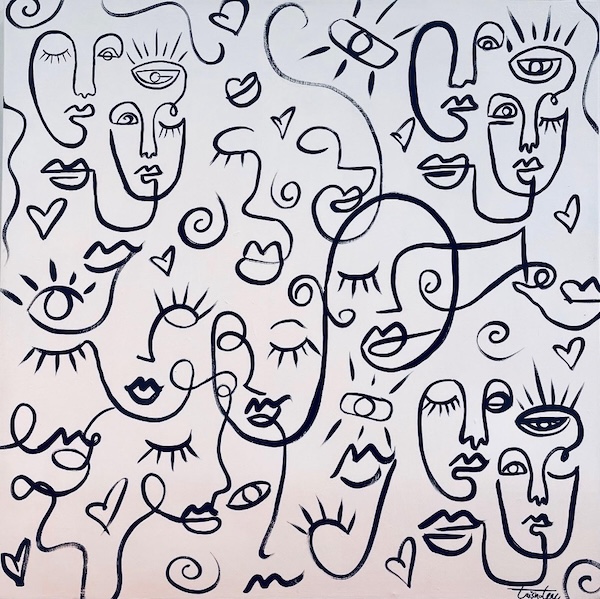
image - “A Thousand Expressions” by Taisha Teal
“A Thousand Expressions” by Taisha Teal.

Teal added that her “passion for experimentation with new materials adds another dimension.”

“Exploring unconventional materials and techniques challenges me to think outside the box and pushes the boundaries of my artistic expression,” she said.

“Art serves as a profound means of expression for me,” said Teal. “As a creator, it allows me to channel my emotions and immerse myself completely in the process. I infuse my art with love and happiness, aiming to evoke those feelings in my viewers. In a world filled with chaos, art becomes my sanctuary, a place where I find solace and peace. My intention as an artist is to spark positive emotions and inspire others with each brushstroke, inviting viewers to explore their own creativity and embrace the beauty within themselves.”

For Lilah, art embodies her very existence. “I’ve never known a life without it,” she said. “It serves as a means of creative expression, a harmonizing force for the diverse aspects of my personality and an invitation to embrace play, structure, freedom, love and acceptance.

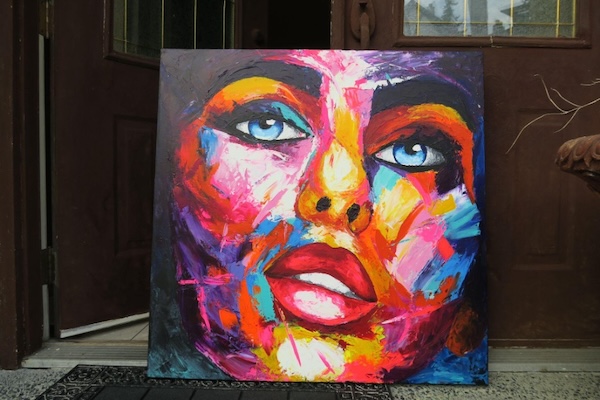
image - a portrait by Sky Lilah
A portrait by Sky Lilah. (photo from Art Vancouver)

“Through art, I learn valuable skills and life lessons, such as time management (as artistic endeavours require dedication), self-love (recognizing that my efforts are ‘good enough’) and the importance of experimentation. It teaches me that we don’t know the result before it happens, and that you have to start in order to get to the end. For my work, I rarely know what I’m going to paint before I start painting, I discover it on the canvas, and that is a life lesson for my role in business as well – when hosting a new event, I won’t have all the answers before. I simply just need to start.”

Transformations in her life and the “opportunity to explore diverse cultures, languages and symbols sparks a fire of creativity,” Lilah said, adding that she tries, in her art, to “communicate a message that embodies inner strength, love, exploration, confidence, authenticity and kindness,” creating works “in an abstract, pop art manner to challenge mainstream thinking.” 

Art Vancouver opens April 11, 7 p.m., and runs April 12, 1-9 p.m.; April 13, noon-9 p.m.; and April 14, 11 a.m.-5 p.m. For tickets and more information, visit artvancouver.net. 

Format ImagePosted on March 22, 2024March 20, 2024Author Cynthia RamsayCategories Visual ArtsTags Art! Vancouver
Sasha Velour speaks April 18

Sasha Velour speaks April 18

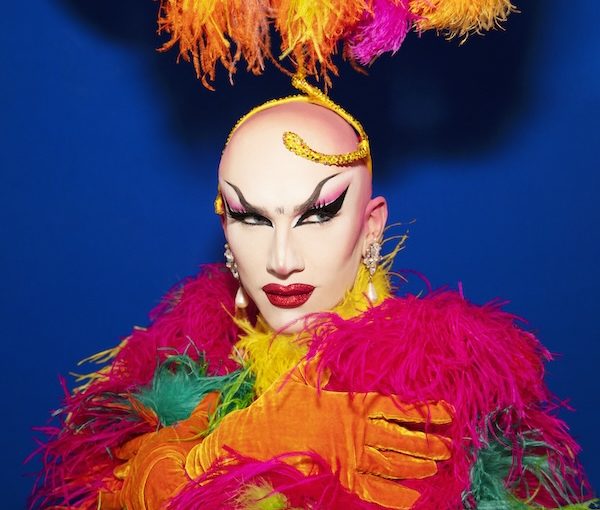
Jewish drag queen, visual artist, speaker, illustrator and author Sasha Velour. (photo from UBC)

The 2024 Phil Lind Initiative speaker series concludes on April 18 with Jewish drag queen, visual artist, speaker, illustrator and author Sasha Velour, winner of the ninth season of RuPaul’s Drag Race and a co-host of the current season of HBO’s We’re Here. Velour will give a talk titled The Big Reveal: Why Drag Matters. Exploring the intersections of pop politics and pop culture, she will delve into the roots of drag, its historical significance in queer culture and its evolution into a politically charged art form. “Drag embodies the queer possibility that exists within each of us, the infinite ways in which gender, good taste and art can be lived,” she said.

The Phil Lind Initiative is hosted by the School of Public Policy and Global Affairs in the faculty of arts at the University of British Columbia. The initiative’s mandate is to invite prominent US scholars, writers and intellectuals to UBC to share ideas on some of the most urgent issues of our time.

Velour’s talk takes place April 18, 6 p.m., at the Chan Centre for the Performing Arts. Tickets are free (maximum two per order), but registration is required. Audience members can attend in person or watch online via livestream. You do not need a ticket but you do need to sign up for the Phil Lind Initiative email list. For full details, go to lindinitiative.ubc.ca.

– Courtesy University of British Columbia

Format ImagePosted on March 22, 2024March 20, 2024Author University of British ColumbiaCategories Performing ArtsTags drag, Phil Lind Initiative, queer, Sasha Velour
Pride despite facing hatred

Pride despite facing hatred

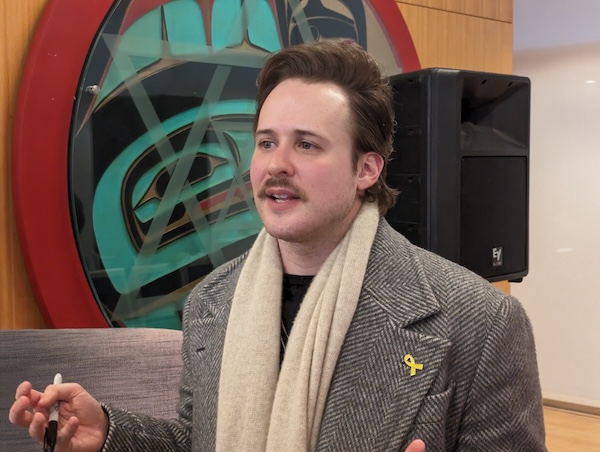
Ben Freeman (photo by Pat Johnson)

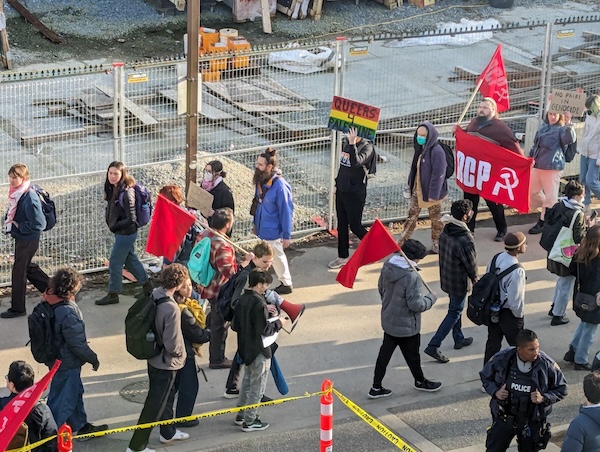
A couple of dozen loud and aggressive protesters accosted people arriving to an event at Hillel House at the University of British Columbia March 13. One masked woman raced up and screamed into the faces of those arriving. Another shoved her phone, presumably filming, into the faces of those trying to enter. Marchers, carrying communist banners and flags, screamed “You are on the wrong side of history!”

Inside, a packed audience listened to gay, Jewish, Scottish writer and activist Ben Freeman contextualize the state of world Jewry since Oct. 7. The author of Jewish Pride: Rebuilding a People and Reclaiming our Story: The Pursuit of Jewish Pride, in conversation with Vancouver media personality Shane Foxman, spoke while, throughout the entire presentation, the dull roar of protesters screaming provided background.

“We need to understand very, very clearly that we have done nothing to deserve that rabble outside,” Freeman said. “It is not our fault. This is their problem and not ours. Jew-hatred is a non-Jewish problem. We need our non-Jewish friends and allies to set up on the task of dismantling it. We have other work to do.”

Jews, of course, fight antisemitism, he said, but it is up to non-Jews to defeat it.

“This [protest] is not a commentary on Israel or Zionism,” he said. “This is an expression of Jew-hatred. We need to understand that.”

It is not only Jew-haters who try to separate diaspora Jews from Israel, said Freeman. Many Jews fall into the trap as well. The accusation of dual loyalty is a tool to dissuade Jews from expressing their natural connection to the land of Israel, he said.

“The canard of dual loyalty has led some Jews to say, ‘No, no, no, no, I’m not connected to Israel. I’m an American or I’m British or I’m Canadian’ or whatever the case may be,” Freeman said. “The reality is we are the diaspora. That word gives us a really incredible clue to the aspects of our identity. If we are in the diaspora, Israel is our home. You can be Canadian and Jewish, you don’t need to choose. That is what the non-Jewish world tries to make us do. They try to make us choose. Are you Canadian or are you Jewish? That’s the message that we get, you have to choose. But you don’t.”

He recounted a conversation with his dermatologist, a Briton of Pakistani descent, who said he was “going home” to Pakistan on vacation. 

“I said, oh, wonderful, were you born there? And he said, no, I was born here,” recalled Freeman. “And I thought, yes! You get it. And he’s allowed [to visit what he calls home], but somehow we are told we are not allowed.”

Freeman argued succinctly that it’s time Jews stopped fearing accusations of divided loyalties.

“I do have dual loyalty,” he said. “Suck it.”

In addition to refusing to succumb to false accusations, Freeman argued that Jews need to set boundaries on personal and professional relationships. 

“After Oct. 7, I spoke to Jewish friends who were in relationships with non-Jewish people and they said, oh, it’s hard, because my partner isn’t sure how they feel about Israel,” Freeman said. “My jaw kind of hit the floor. We have to have bottom lines. We have to have boundaries. There should be conversations we are willing to have and conversations we refuse to have. Each of us will make those ourselves but recognizing that Israel has a right to exist, Israel has a right to defend itself, that should be a bottom line. And I think I would encourage all Jews, whether it’s in romantic relationships, whether it’s in friendships, to be able to prioritize yourself, to be able to centre yourself and create those boundaries. We are not accepting half-assed empathy or friendship.” 

Probably all Jews have had difficult conversations with friends and others in recent months, he said, and Freeman urges a little more resistance.

“I say to my friends in those situations – it’s a little bit arsey, to be honest, but I am so done with being a nice Jew – I say to them, let’s be really clear before we have a conversation about Israel: I know more about this than you do, so don’t come for me. Have some respect. Not only is this my work, but I’m a Jew. That should be respected. And then, I care more about this. My friends are people in the world who might see a headline, they might see a tweet by those bozos outside, and they get enraged and inflamed. They can’t point out which river or which sea. We care deeply, we think about it.”

photo - As author Ben Freeman spoke at Hillel House at the University of British Columbia, the dull roar of protesters provided background
As author Ben Freeman spoke at Hillel House at the University of British Columbia, the dull roar of protesters provided background. (photo by Pat Johnson)

Ignorance should be challenged and invitations to learn extended, he said. “But there will be those who are malicious,” he added. “There will be those who think that we are bad, evil Zionists, we’re colonizers, we’re white oppressors and we are murdering the Indigenous people, we are committing genocide. There are people who believe those things and, if they do, those people are not interested in a conversation, so we block them…. They’re not worth our time. They’re not worth our energy. We’re not dealing with those people.” 

He admits, though, this can be easier said than done. All the hatred can get into one’s psyche.

“I’m the author of books about Jewish pride. I’m very proud to be Jewish. I love Israel,” said Freeman. “And there have been flickers of weakness in the past five months, when I have been weighed down by what is happening in the diaspora, what happened in Israel and what is said to me online and you do think, Are we the bad guys? What is happening? No. We are not. We have a right to be in that land. We have a right to defend ourselves. We need to make the world understand crystal clearly that you do not get to murder Jews and get away with it. Jewish blood is not cheap. We will defend ourselves and we have a country to do that. We lost our sovereignty.… We are not losing it again.”

Tight security ushered attendees out a back door and away from the still-chanting protesters circling the front of the building. 

Format ImagePosted on March 22, 2024March 20, 2024Author Pat JohnsonCategories LocalTags Ben Freeman, education, Israel-Hamas war, Judaism, Oct. 7, protesters, UBC, University of British Columbia

Ever-evolving notions

In a March 3 webinar, Rabbi Dr. Nachshon Siritsky reflected on understandings of the Divine and gender, exploring some of the ways that Judaism’s most ancient teachings can be relevant in current discussions. Their Zoom talk was part of this season’s L’dor V’dor: From Generation to Generation lecture series hosted by Victoria’s Kolot Mayim Reform Temple.

photo - Rabbi Dr. Nachshon Siritsky spoke on March 13 as part Kolot Mayim Reform Temple’s L’dor V’dor lecture series
Rabbi Dr. Nachshon Siritsky spoke on March 13 as part Kolot Mayim Reform Temple’s L’dor V’dor lecture series. (photo from Kolot Mayim)

Siritsky discussed the kabbalistic understanding of creation and humanity, which, they said, describes a process of progressive emanation, revelation, incarnation and embodiment. Whereas the standard concept of history, in the Western mind, is as a straight line of evolution, Jewish time is circular and cyclical, Siritsky explained, returning to the same points again and again, whether they be holidays or the weekly Torah portion.

More deeply, this is manifested in restorative practices such as teshuvah, which can be seen as forgiveness or returning to oneself. In other words, God works with people in completing the work of creation, and this happens through how we channel that light and energy into this world. “I firmly believe that the more we can reconnect with our ancestral wisdom that is contained in kabbalah, Jewish mysticism and tradition, the more we can work to liberate ourselves and realign with the larger rhythms of the universe,” Siritsky said.

Kabbalah, they explained, describes how there are two different ways that God’s energy flows through humans. It can flow through masculine and feminine aspects and each of us contains elements of both. Thus, our goal is to be in alignment with all the different ways in which God flows through us.

“The reason we were put on this planet was to complete the work of creation. When we do that, then we build within ourselves. The act of building is holy, but God dwells inside of us, not inside of our buildings,” Siritsky said. “The goal of our traditions, according to the rabbis, is this notion of making a place within our bodies for God to be present and to be expressed and to able to be articulated and shine forth back into the universe.”

Siritsky spoke about the notion of gender fluidity in Judaic texts. According to the rabbi, the Talmud identifies eight genders. “All eight of these are just the ways in which humans exist on this planet,” said Siritsky. “So, anyone who says that non-binary, agender or intersex doesn’t exist or is not Jewish is not fully speaking from the ancestral traditions of the Talmud and of our rabbis through the generations.”

Citing other theologians, Siritsky said we are always evolving in our understanding of who we are and what we know, and that we must make space to acknowledge that our spiritual understandings are also on that same path.

“Each of us, as we grow into ourselves and this world, we are always having to discard beliefs or understand them in new ways in that cyclical way that promotes healing and God’s progressive emanation into the universe and into ourselves,” they said.

Siritsky next addressed the use of they/them pronouns, arguing that, since the Talmud states that God speaks in human language, then we have to be constantly reinterpreting, re-translating and re-understanding what that language is in each generation – what is true in one generation may not be true in another.

“Ultimately, it leads us to this: we are created in the divine image and, when we see God in one another, we will know God,” Siritsky said, adding that the topic of gender diversity is not a new one in Judaism or other spiritual practices, and that binary thinking is not a Jewish way of thinking.

Siritsky pointed out that our understanding of God and gender is continually evolving, reflecting the ever-changing landscape of society and culture. “By exploring this evolution, we can better appreciate the richness and complexity of Jewish spirituality,” they said.

Siritsky is spiritual leader of the Reform Jewish Community of Atlantic Canada, serving all four Maritime provinces. Ordained by Hebrew Union College-Jewish Institute of Religion, they are also a board-certified chaplain with Neshama: Association of Jewish Chaplains, a social worker with advanced training from the Postgraduate Centre of Mental Health, and a doctorate in ministry and pastoral counseling with a focus on burnout in healthcare workers. 

The final talk in the 2023/24 L’dor V’dor series will take place April 7, 11 a.m., on Zoom. Cookbook author and food writer Bonnie Stern will, together with her daughter, Anna Rupert, present a talk titled Don’t Worry Just Cook: A Delicious Dialogue on Intergenerational Jewish Cuisine. Register for the free webinar at kolotmayimreformtemple.com.

For more information about Rabbi Siritsky, visit rabbinadia.com. 

Sam Margolis has written for the Globe and Mail, the National Post, UPI and MSNBC.

Posted on March 22, 2024March 20, 2024Author Sam MargolisCategories LocalTags education, gender, Judaism, kabbalah, Kolot Mayim, Nachshon Siritsky

Making meaning in diaspora

“We’re planning a family event in June.” That’s how I start nearly every contact with vendors while trying to arrange it. Sometimes, I say a “party with family and friends.” I avoid saying b’nai mitzvah. It’s just easier and safer.

One of my twins has a locker at junior high near a student who uses her body as a sign of protest. “Free Palestine” is written on her cheek. Other days, messages are emblazoned on a sweatshirt. My kid says she seems to stare at him, but I recommended he just stay away, don’t stare back, and don’t cause any kind of confrontation. “Do you know this person?” I ask him. “No,” he says, “she doesn’t know us.” What he meant is perhaps more obvious to us now – he doesn’t think she knows we are Jewish.

The transition from a bilingual Hebrew/English public elementary school to a junior high where Jewish kids are few and far between has been a big one. To my surprise, it went smoothly, but, over time, the ramifications have become clear. We knew our kids would figure out that we were, in fact, a small minority in Canadian culture. In elementary school, they would choose surprising moments to discuss Jewish things or use words in Hebrew with people at the dentist’s office or on public transportation. At first, our explanations about how people were different, with various religions and backgrounds were confusing. In their minds, they still believed everyone was Jewish.

On one hand, I loved that they didn’t have to learn to code-switch as early as I did. Code-switching is a way to describe how we switch between dialects, languages or personae in different settings. That is, a person might speak one language at home and another at work. In Jewish settings, one might use what linguists call “Jewish English,” English interspersed with Yiddish or Hebrew or other Jewish languages. At home, we might be encouraging someone to “daven at shul” with friends. We might shout “Dai, maspik!” (“Stop, enough!”) when someone misbehaves. In public, we might say “go to services” or “Behave yourself!”

Some people say that learning this kind of nuance takes maturity, but that doesn’t always ring true. I knew, by age 5 or 6 when my ethno-religious identity needed to be kept to myself. During times of extreme antisemitism, children were forced to keep this hidden, or even not told they were Jewish until old enough to manage the information. Giving my kids this extended time of safety felt like offering them a special oasis, a honeymoon that I missed.

Years ago, I worked with an editor and writer who shared with me that she had a Jewish background, although she was adamantly secular. I often felt the need to code-switch with her, as something made me feel like I was “too Jewish” for her comfort level. Since Oct.7, things have changed. She has become public in her Jewish identity, speaking out against antisemitism. Recently, she has been reading history and research for a book-length project. Today, she said, reflecting on an historic “golden age” for Jews in Polish history: “There is no safety in America now just because it’s been a golden age for my lifetime.” Yeah, I responded. I know.

Everyone copes differently. On social media and among friends, some dig into their Jewish identities. They’re consistently posting about their Jewish pride or activities and asking others to do so as well. One local friend who regularly attends synagogue told me that, if anything, this war has made her want to “do Jewish” even more, so she’s physically attending more services and gatherings than she had previously. Others decide to keep their kids home from school on days where there might be safety issues or have stopped attending anything at all connected with the Jewish community. They keep a low profile. Being loud and proud isn’t their way.

I have seen all these approaches (and many variations) from the Jewish people I know. And there are the minority Jewish viewpoints, too, on the political right and left. Those who claim more of an affinity with their progressive causes than with Jewish ones are often vocal on social media and at pro-Palestinian protests, either finding ways to disown their background or use their Judaism to explain their activism. Some particularly outspoken ones demonstrate, at least to me, that they don’t have a solid grounding in Jewish history and tradition, particularly as it relates to Israel, but instead embrace narratives around colonialism and apartheid instead.

Lately, I have been longing to ask where these “land back” Canadian Jewish activists live, if not in homes on occupied land taken from Indigenous communities. If homes here are on occupied ground, where do they believe it would be acceptable for Jews to live? I wonder how they mesh these theories with their everyday lives, or the archeological, historical and literary references to the Jewish past.

Living in grey areas of nuance is exhausting. There are so many references in Jewish texts to back this up. We have, after all, been struggling with these identity issues for millennia. We’re the ethnic group for whom the Greek word of “diaspora” was invented. Yet, this is one time where more evidence seems pointless. For those of us who feel this discord and disconnect, it’s not news. For others, who either manage to live wholly in the Jewish world or outside of it, these retellings of history aren’t useful. So many people have made their place, and it’s not in the margins of subtlety.

There’s no one response that suits. For me, I understand the value of having a rich interior and family life. The moment I’m absorbed in braiding challah and reciting the blessing blocks out some of this noise. Although I’m alone, it’s meaningful spending that small moment to send love and prayers for the hostages, the Jewish community and my family. I knit sweaters for ever-growing twins, anticipating their big birthday ahead this spring. I fall deep into intellectual arguments online, or into gazing at a pileated woodpecker whose rat-a-tat vibrates throughout the neighbourhood.

Finding one’s authentic self, the comfort zone where all the discord falls away, offers a brief respite. As we meet this complex moment in time, finding small outlets of escape can enable us to keep on going. Perhaps this is about good mental health or, as generations before us have explained, it’s nothing new. It’s about making a meaningful life in a diaspora, amid struggle. 

Joanne Seiff has written regularly for the Winnipeg Free Press and various Jewish publications. She is the author of three books, including From the Outside In: Jewish Post Columns 2015-2016, a collection of essays available for digital download or as a paperback from Amazon. Check her out on Instagram @yrnspinner or at joanneseiff.blogspot.com.

Posted on March 22, 2024March 21, 2024Author Joanne SeiffCategories Op-EdTags antisemitism, code-switching, education, Israel-Hamas war, mental health, Oct. 7, terrorism

To heal a fractured campus

Last November, I interviewed my grandmother for an oral history project – one I had been meaning to do for a long time – about her experience surviving the Holocaust. As the grandson of two Holocaust survivors, I can affirm the reality of intergenerational trauma. Yet, as I listened to her story, I realized she was teaching me valuable, timeless lessons which the University of British Columbia community can apply on campus. That is why I am obligated to share her story – so that we avoid repeating the mistakes of the past. 

My grandmother was 13 years young when her parents and most of her family were taken away from her and deported, either to be shot on their way to Bergen-Belsen or exterminated in the gas chambers of Auschwitz. My grandmother, my safta (as I call her in Hebrew), was a little girl, orphaned, vulnerable and left all alone. She had every right to be bitter and resentful, to identify herself as a perpetual victim and to rightfully blame the Nazis for her suffering. But she did not.

She could never forgive nor forget the evil perpetrated by the Nazis. However, with this in mind, she had to move on with her life. The way she redeemed tragedy was not to define herself as the victim of the past, asking, “Who did this to me?” but rather by taking responsibility for the future, asking, “Given these circumstances, how can I help to put this situation right?”

This is the greatest eternal lesson I have learned from my grandmother and all the Holocaust survivors I have met: never internalize a victim mentality. Otherwise, you will not only become consumed with hate but also enslaved to the past. As the late chief rabbi Lord Jonathan Sacks once said, “To be free, you have to let go of hate.”

My grandmother took the negative energy and elevated it toward a higher purpose: toward marrying my grandfather, toward raising a family, toward giving back to her community. Her all-encompassing identity, attitude and purpose in life has been not based on the hate of others. Rather, her identity is based on the love of her fellow Jews, of being grateful for her heritage and everything else she had. 

“No one can make you feel inferior without your consent,” Eleanor Roosevelt once said. There was one thing from my grandmother that even the Nazis could never take away: her will to be proudly Jewish. 

UBC campus today

For my grandmother, the Hamas massacre that took place on Oct. 7, 2023, triggered painful memories from the Holocaust. “Never again,” the lesson we learned from the six million Jews murdered, has now become “ever again.”

The amount of toxic hate I have seen on my campus (and other universities as well) since Oct. 7 has been both disheartening and overwhelming. From disrespectful comments on social media posts, to provocative posters on campus demonizing the other side, to verbal and physical harassment of students, there is a small, yet vocal, minority of students who create a highly flammable atmosphere on campus. 

At UBC, I have witnessed students chanting the phrase “globalize the intifada,” a term that has historically been used in the context of the Israeli-Palestinian conflict not for “peaceful resistance,” but for terrorizing Jews with suicide bombings, shooting attacks, stabbings and other means of armed violence. I have witnessed students blacklisting other students because they do not agree with their opinions. I have witnessed students rudely spamming hateful comments (which are now taken down) on UBC’s social media page to take advantage of International Holocaust Remembrance Day to push a political message. When I hear that “hate has no place on campus,” I unfortunately continue to observe the opposite.

This is the reason why I dropped my Middle East studies minor. Every time I walked into the classroom, the negative energy was palpable. I was walking on eggshells bringing up my Jewish identity or even mentioning the word “Israel.” Every day, I had to hide my kippa under my hat so that my classmates with different viewpoints would not identify me as Jewish and publicly shame me. In short, I did not feel welcome.

At a university, a safe space should not be a place where you are protected by those with whom you agree from those with whom you disagree – that is called groupthink. Rather, a safe space should be a place where you make space for those who disagree with you so that each can listen to the other with respect.

Whether or not you agree with Israeli, Jewish, Palestinian, Arab, Muslim or any other claims, there is no justification whatsoever to scream, silence or slander those with whom you disagree. Right now, the university needs more civility and calm for all students. 

Yes, we must acknowledge that there are significant casualties on both sides of the conflict. Yes, we must acknowledge each other’s suffering. At the very least, we can all agree that every human life is sacred with equal dignity.

While we cannot control external circumstances halfway across the world from us, we can control how we respond to it. We can choose to wallow in misery and demonize the other (asking “Who did this to me?”), or we can take action to recognize each other’s suffering and elevate it to something positive (asking “Given these circumstances, how can I help to put this situation right?”).

Now, how do we do that?

Listening, not labeling

Opening yourself up to someone whose colour, culture, class or creed is different from yours can seem daunting. In an age of echo chambers, filtered media and narrowcasting, we all have a tendency to tune in to that which aligns only with our own viewpoint, while tuning out others. However, it is precisely the people not like us that make us grow. 

From clubs tabling on campus to classmates sitting next to you, there are plenty of opportunities to actively seek out diverse perspectives. We need to learn how to listen for the sake of learning, not labeling.

If one has a monopoly on the truth, then why bother listening to others? Because, as a mystical Jewish saying goes: “A full vessel cannot receive.” It is only by acquiring humility, the sense of opening ourselves up to something beyond ourselves, that we realize our own perspective is merely one finite fragment of an infinitely fractured truth. Thus, I’ve reflected on three ideas worth sharing.

First: there is no justice for any person or people without listening to the other side.

Second: true peace, in our relationships with others and toward ourselves, comes as a result of active listening.

And third: in the words of C.S. Lewis, “Humility is not thinking less of ourselves, but thinking of ourselves less.”

Listening to the other is the first step toward recognizing the “dignity of difference.”

The antidote to hate

Hate, like COVID-19, is a virus. Viruses do not distinguish between different types of people, but rather fester and grow into an infectious force that threatens us all. Historically, for example, the Nazi regime may have started with targeting Jews, but it didn’t end with Jews. Nazis also targeted Roma, Sinti, LGBTQIA+, people with disabilities and political dissidents. Hate knows no bounds. 

With this in mind, I offer three practical suggestions for what each of us can do on an everyday level to bring more hope to campus – and perhaps other places.

First, take a moment to unplug your AirPods or headphones. Just do it! Whether it’s while sitting on the bus or walking on campus, withdraw from your isolated world for five minutes and acknowledge someone you don’t know by saying hello with a genuine smile. Give them your full, undivided attention and start a friendly conversation. Humanizing starts with acknowledging the other.

Second, take a class from a perspective you have never heard from before. I am a history major. I had never considered taking an environmental history course before simply because I was not interested. But it is precisely for this reason that I am taking the course. Now, I realize how I could see my preexisting knowledge and interests from a new, oblique angle I would never have seen otherwise.  

And third, follow social media accounts of people with different viewpoints from your own. Just like our earbuds, we are constantly using our phones. Every time we open Instagram or Twitter, we are training ourselves to focus on our interests and are quick to judge other accounts as not worth our time. Instead of judgment, be curious and interact with accounts to train yourself to learn from others, not label them.  

We are first and foremost a community, of students and professors, of friends and family, of human beings with human emotions. Divided, we are more susceptible to hate. United, however, we have the potential to become force multipliers of hope over hate.   

Each one of us should ask ourselves: Are we taking actions to further fracture our world, or heal it?

If we are to heal our fractured world, we must first recognize that each and every one of us has the power and influence to turn negative energy into positive energy, just like my grandmother did. If she could continue to spread light after going through the darkest chapter in human history, how much more so can every one of us dispel the darkness of hate by becoming beacons of light in our communities at UBC and elsewhere.

It all starts with one positive thought, one friendly compliment, one good deed. 

It all starts with you. 

Eitan Feiger is a fourth-year history student and the vice-president and treasurer of the University of British Columbia’s Chabad Jewish Student Centre. This article was originally published in the Ubyssey.

Posted on March 22, 2024March 21, 2024Author Eitan FeigerCategories Op-EdTags antisemitism, education, history, Holocaust, Ubyssey, University of British Columbia
Hearing from Nova survivor

Hearing from Nova survivor

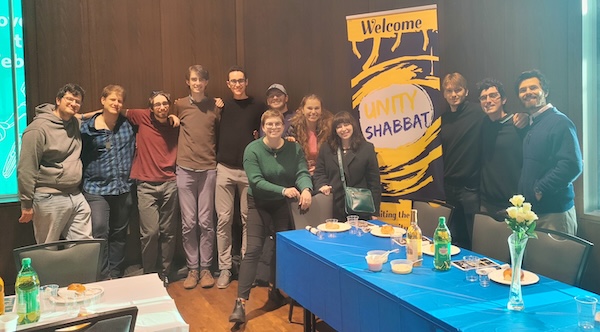
Volunteers and organizers of Unity Shabbat, which this year took place on March 1. (photo from Chabad UBC)

On March 1, more than 100 Jewish students and faculty came together for a Shabbat dinner on the University of British Columbia campus. The annual event, called Unity Shabbat, was organized by Chabad Jewish Student Centre-Vancouver in partnership with Hillel BC, Israel on Campus Club, Jewish Student Association, Jewish Law Student Association and the local chapter of the AEPi fraternity. It was co-sponsored by the Jewish Federation of Greater Vancouver.

The guest speaker was Shalev Biton, a 25-year-old man from Israel who survived the Nova festival terrorist attack on Oct. 7, 2023. You could hear a pin drop as Biton told the sequence of events, which included him running from the Hamas terrorists for hours and hiding in fields and then under a building while the terrorists searched the area. The building was on the property of an Israeli Arab who subsequently saved Biton’s life – and the lives of Biton’s friends – by telling the terrorists that there was no one there.

During those hours, Biton was sure he was about to die, and repeated the Shema Yisrael prayer over and over. He told of his gratefulness to be alive and his decision to follow his passion of pursuing a career in music. Those gathered on Shabbat were inspired by his message of hope and resilience despite everything that he has been through.

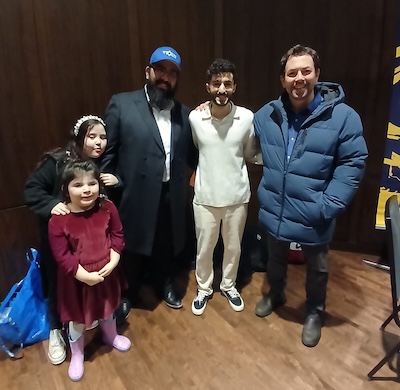
photo - Left to right: Chaya and Dassie Loeub; Rabbi Chalom Loeub of Chabad UBC; Shalev Biton, a survivor of the Oct. 7 terror attacks; and Ohad Gavrieli of Hillel BC
Left to right: Chaya and Dassie Loeub; Rabbi Chalom Loeub of Chabad UBC; Shalev Biton, a survivor of the Oct. 7 terror attacks; and Ohad Gavrieli of Hillel BC. (photo from Chabad UBC)

“These past few weeks have been a very difficult time for Jewish students at UBC,” said Rabbi Chalom Loeub, co-director of Chabad Jewish Student Centre. “Unity Shabbat could not have come at a better time. It was a chance for Jewish students and faculty members to get together in a safe, inclusive atmosphere and enjoy a traditional three-course dinner. It reminds us that, despite our external differences, we are one people and we need to stick together.”

To learn more about Chabad Jewish Student Centre-Vancouver visit chabadubc.com or follow them on social media. 

– Courtesy Chabad Jewish Student Centre-Vancouver

Format ImagePosted on March 22, 2024March 21, 2024Author Chabad Jewish Student Centre-VancouverCategories LocalTags Chabad UBC, Chalom Loeub, Oct. 7, Shalev Biton, terrorism, UBC

Fostering many skills

For the second year in a row, Richmond Jewish Day School hosted a STEAM-J Night for its families. The event involves an interdisciplinary approach, integrating knowledge, methods and perspectives from multiple disciplines – science, technology, engineering, arts and mathematics – all through a Jewish lens. 

As part of the STEAM-J Night, which took place Jan. 30, children in RJDS’s Early Learning Centre focused on exploring trees through art. The Early Learning Centre emphasizes a play-based philosophy and an emergent curriculum tailored to children’s interests. Inspired by Tu b’Shevat and the kids’ fascination with printmaking and tracing shapes, participants compared the lines on their hands with the lines on leaf veins. Using ink pads, each child created palm prints, observing the uniqueness of their own hands.

image - a portraitThe kindergarten and Grade 1 class explored various methods to learn Hebrew vocabulary. By combining Hebrew with art, students designed and created a game where Hebrew letters corresponded to pictures they drew. They then invited their parents and guests to participate and test their Hebrew knowledge. Additionally, the children crafted clay dioramas depicting the components of an Arctic biome. During this process, they learned about how animals adapt to changing weather and the climate.

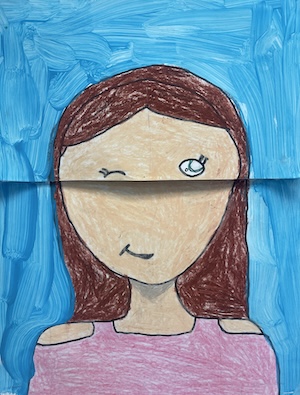
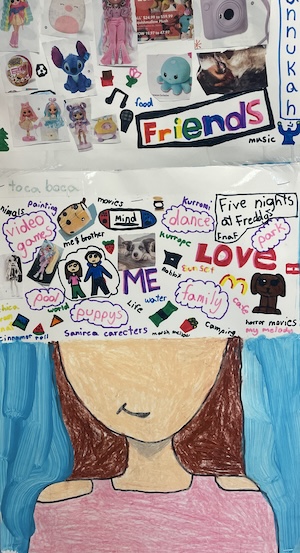
image - artwork of a portrait whose head opens up to reveal things important to the artist
Among the many projects on Richmond Jewish Day School’s STEAM-J Night was one in which the Grade 3 and 4 class painted self-portraits with a top part that lifts up so that people can see some of the students’ favourite aspects of life. (photos from RJDS)

The Grade 3 and 4 class learned a song written by an Israeli children’s author called “All About Me” and performed a dance to go along with it. Inspired by the same song, the students painted a self-portrait with a top part that lifts up so that people can see some of their favourite aspects of life, their individuality. They then put their graphic design skills to the test and created a PowerPoint presentation about early explorers and their contributions to the world. For their final STEAM-J project, the students put on their engineering hats and created a 3D scene with animal crossings built into different cityscapes to help wildlife thrive.

The upper grades demonstrated their learnings by taking their favourite games, such as Bingo and Rummikub, and translating them into Spanish. The goal of this project was to strengthen Spanish vocabulary, interaction, creativity and group work. They also honed their graphic design and research skills by creating digital comic strips on Jewish history, focusing on a Jewish prophet or king. They learned about Newton’s Laws of Motion through a hands-on activity where they demonstrated the centre of gravity by making a balancing heart. They experimented with their completed hearts by adjusting wooden skewers and clay balls to take the hearts from a balanced to unbalanced state and back to the centre of gravity point again.

A multi-disciplinary approach to education can help bridge the gap between different subjects and build students’ confidence in an increasingly complex and technologically advanced world. By integrating insights from the STEAM fields with Jewish culture and identity, students can develop a versatile skill set that fosters critical thinking, creativity and adaptability. 

– Courtesy Richmond Jewish Day School

Posted on March 22, 2024March 21, 2024Author Richmond Jewish Day SchoolCategories LocalTags education, Richmond Jewish Day School, RJDS, STEAM
A successful year for Angels

A successful year for Angels

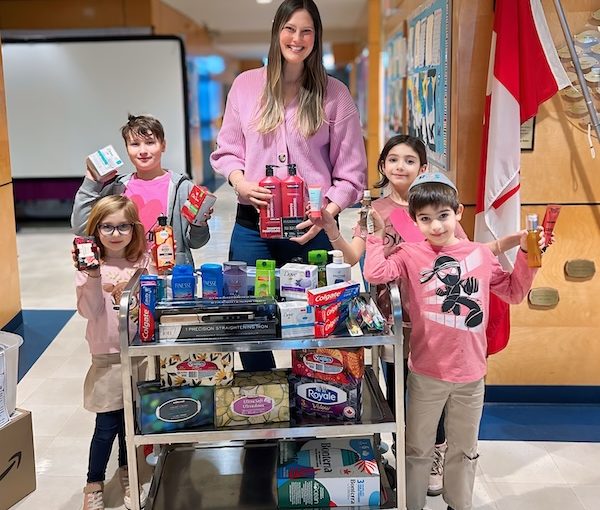
Courtney Cohen with Richmond Jewish Day School students, who generously collected personal hygiene items for this year’s Rose’s Angels. (photo from Rose’s Angels)

The 11th annual Rose’s Angels event just wrapped up. This year, the initiative was able to give donations to 15 not-for-profits in Richmond that service some of the most vulnerable people in the city, including Richmond Family Place, Mamas for Mamas, Turning Point Recovery Society, JFS Grocery Program (formerly the Jewish Food Bank), Richmond Food Bank, Tikva Housing and Pathways Clubhouse.

Rose’s Angels was created in 2012 by Courtney Cohen and Lynne Fader, in memory of Cohen’s grandmothers, Rose Lewin and Babs Cohen, both of whom modeled philanthropy and instilled in Cohen the importance of giving back within her community.  Rose’s Angels is run under the umbrella of the Kehila Society of Richmond.

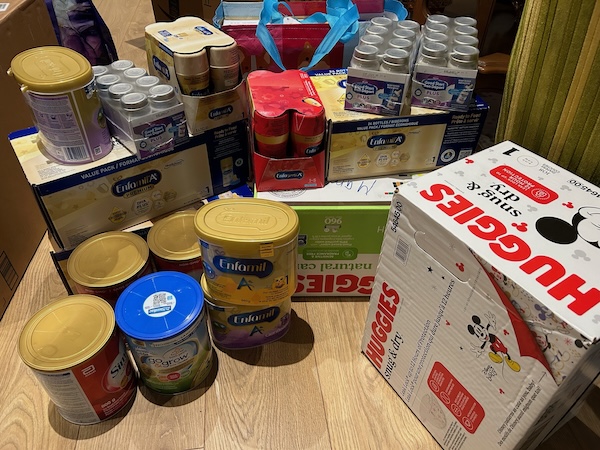
Among the goods donated were essential personal care items, non-perishable food, pet food, children’s arts and crafts, books and baby formula. For many of the receiving agencies, baby formula was one of the top priority items this year – Rose’s Angels was able to donate many 

baby formula cans and ready-to-feed bottles to Mamas for Mamas and the food bank, for instance.

“Being a new mom myself, I can’t imagine the feeling of not having the accessibility or means to get my baby formula,” said Cohen. “With the ever-rising cost of inflation and the toll it’s having on families and single parents, formula is becoming more of a challenge to obtain. We received this email post-event from one of our partner agencies regarding our donation of formula:  ‘I can’t tell you what it means to us and so many families!  We had another mom come in from the hospital yesterday.  They use one of the types of formula you donated, and she felt like her prayers had been answered!’ Stories like these make me so proud to carry on the Rose’s Angels legacy year after year.”

photo - For many of Rose’s Angels’ receiving agencies, baby formula was one of the top priority items this year
For many of Rose’s Angels’ receiving agencies, baby formula was one of the top priority items this year. (photo from Rose’s Angels)

The success of Rose’s Angels would not be possible without the support and dedication of donors, volunteers and community members. This year, donation letters were sent out to partner agencies, family friends and community members in January. In February, monetary and physical donations were collected, Richmond Jewish Day School hosted a hygiene items collection drive and grocery store gift cards were purchased. Earlier this month, donations were packaged and delivered with the help of volunteers to the 15 not-for-profits.

“My parents and grandparents taught me to recognize and respond to the needs of others with kindness and generosity,” said Cohen. “I hope to instil in my daughter the importance of tikkun olam (repairing the world), by focusing on one mitzvah at a time.”

If you would like to learn more about or donate to Rose’s Angels, email [email protected] or call the Kehila Society of Richmond at 604-241-9270. 

– Courtesy Rose’s Angels

Format ImagePosted on March 22, 2024March 20, 2024Author Rose’s AngelsCategories LocalTags baby formula, Courtney Cohen, fundraising, Richmond, Richmond Jewish Day School, RJDS, Rose’s Angels, tikkun olam

Posts pagination

Previous page Page 1 … Page 94 Page 95 Page 96 … Page 667 Next page
Proudly powered by WordPress