Skip to content
  • Home
  • Subscribe / donate
  • Events calendar
  • News
    • Local
    • National
    • Israel
    • World
    • עניין בחדשות
      A roundup of news in Canada and further afield, in Hebrew.
  • Opinion
    • From the JI
    • Op-Ed
  • Arts & Culture
    • Performing Arts
    • Music
    • Books
    • Visual Arts
    • TV & Film
  • Life
    • Celebrating the Holidays
    • Travel
    • The Daily Snooze
      Cartoons by Jacob Samuel
    • Mystery Photo
      Help the JI and JMABC fill in the gaps in our archives.
  • Community Links
    • Organizations, Etc.
    • Other News Sources & Blogs
    • Business Directory
  • FAQ
  • JI Chai Celebration
  • JI@88! video

Recent Posts

  • Sharing her testimony
  • Fall fight takes leap forward
  • The balancing of rights
  • Multiple Tony n’ Tina roles
  • Stories of trauma, resilience
  • Celebrate our culture
  • A responsibility to help
  • What wellness means at JCC
  • Together in mourning
  • Downhill after Trump?
  • Birth control even easier now
  • Eco-Sisters mentorship
  • Unexpected discoveries
  • Study’s results hopeful
  • Bad behaviour affects us all
  • Thankful for the police
  • UBC needs a wake-up call
  • Recalling a shining star
  • Sleep well …
  • BGU fosters startup culture
  • Photography and glass
  • Is it the end of an era?
  • Taking life a step at a time
  • Nakba exhibit biased
  • Film festival starts next week
  • Musical with heart and soul
  • Rabbi marks 13 years
  • Keeper of VTT’s history
  • Gala fêtes Infeld’s 20th
  • Building JWest together
  • Challah Mom comes to Vancouver
  • What to do about media bias
  • Education offers hope
  • Remembrance – a moral act
  • What makes us human
  • המלחמות של נתניהו וטראמפ

Archives

Follow @JewishIndie
image - The CJN - Visit Us Banner - 300x600 - 101625

משמרות המהפכה של איראן ארגון טרור

ממשלת קנדה הכריזה על משמרות המהפכה של איראן כארגון טרור. זאת לאחר שבמשך שנים הממשלה של ג’סטין טרודו סירבה לקדם את המהלך למרות לחצים מצד הקהילה האיראנית במדינה

לאור זאת בנקים בקנדה יוכלו להקפיא נכסים השייכים לפעילי הארגון, והמשטרה המקומית יכולה להעמיד לדין אנשים שתומכים בארגון מבחינה כלכלית או פיזית

ההחלטה הנוכחית מגיעה אחרי שבמשך שנים חברי פרלמנט מהאופוזיציה הקנדית וחברי הקהילה האיראנית בקנדה דרשו להכיר במשמרות המהפכה כארגון טרור – אך עד כה, הממשלה של ג’סטין טרודו סירבה לעשות זאת. הלחצים לפעול נגד משמרות המהפכה התעצמו בינואר לפני ארבע שנים, אחרי שכוחות הארגון הפילו מטוס קנדי שטס מעל טהרן, כשבאירוע נהרגו מאה שבעים וחמישה נוסעים כולל שמונים וחמישה קנדיים

שר החוץ של ישראל, ישראל כ”ץ, בירך על ההחלטה ואמר שאיראן ביחד עם תשתיות הטרור שלה, חייבת להיות אחראית לפשעים ולזוועות שביצעה ולטרור שהיא מפיצה ברחבי המזרח התיכון וברחבי העולם. חייבים לעצור את איראן עכשיו לפני שיהיה מאוחר מדי

ועוד בנושא המזרח התיכון הבוער: ארגון סטודנטים פרו-פלסטיני הודיע שישיק מחנות קיץ לנוער בקנדה. בתוכנית: פעילות גופנית, דיונים פוליטיים, לימודי ערבית, ושיעורי היסטוריה מהפכניים. בתוכנייה של מחנה הקיץ מופיעים רעולי פנים עטופים בכאפייה ומנופפים במקלעים. ארגון סולידריות למען זכויות האדם הפלסטיניותיערוך מחנה קיץ לנוער באוניברסיטת מקגיל במונטריאול.  יכללו בו אירועים של פעילות גופנית, לימודי ערבית, מלאכת יד תרבותית, דיונים פוליטיים ושיעורי היסטוריה המוגדרים מהפכניים

ארגון מצעד החיים הבינלאומי הפועל ממונטריאול, גינה בתוקף את מחנה הקיץ המתוכנן להתקיים בקמפוס האוניברסיטה. הארגון אמר שהוא מבוהל מההכרזה על הקמת המחנה, שבתוכנייה שלו מופיעים מחבלים רעולי פנים עטופים בכאפייה המנופפים במקלעים מהסוג שמשתמשים בו ארגוני הטרור חמאס, שיזם את המתקפה הרצחנית בשבעה באוקטובר, וחיזבאללה, שתוקף את צפון ישראל בימים אלה. עוד נמסר מהארגון כי פעילויות כאלה המכוונות לצעירים אינן מקובלות במוסד המוקדש לחילופי רעיונות חופשיים. יוזמה זו עלולה להכתים קשות את המוניטין של אוניברסיטת מקגיל, שהיא אחד מהמוסדות האקדמיים הוותיקים והיוקרתיים ביותר בקנדה, עם היסטוריה ארוכת שנים של מחקר ומלגות. הארגון הפציר באוניברסיטה לגנות את גילויי השנאה והאלימות המסוכנים הללו, ואף להסיר את המאהלים הבלתי חוקיים ברחבי הקמפוס. כמו כן, הארגון דורש להסיר מיד פוסטים מסיתים לאלימות נגד ישראלים ויהודים ברשתות החברתיות השונות

שמואל רוזנמן, יושב ראש מצעד החיים, ופיליס גרינברג היידמן, נשיאת הארגון, התייחסו למקרה ואמרו שחינוך לצעירים לעולם לא צריך לעודד שימוש באלימות. כאשר פעולות של סטודנטים, המקודמות על ידי מדיה חברתית, גורמות לניצולי שואה לחשוש מדריסת רגל בקמפוס וחשש לעתיד נכדיהם. זה ברור שגם האוניברסיטה וגם ארגוני מדיה חברתית איבדו את דרכם עכשיו. הגיע הזמן למצוא את הדרך חזרה

ניצולת השואה אנג’ל אורוש, תושבת מונטריאול, אמרה בעת אירוע מוזיאון השואה של העיר שמה שקורה היום במקגיל כל כך מפחיד אותה. היא נולדה באושוויץ-בירקנאו. והגיעה לקנדה באלף תשע מאות שבעים ושלוש כדי לברוח מהאנטישמיות. עכשיו הנכדים  שלה סובלים. ירו לעבר בית הספר ובית הכנסת שלהם. זה פשוט בלתי נסבל. היא מבועתת מהסטודנטים האלה. היא הוסיפה כי מדובר במוסד אקדמי ברמה הגבוהה ביותר. זה בלתי נסבל שהנכדים שלה צריכים לעבור את מה שהיא ברחה בגללו מהונגריה. היא כל כך מתוסכלת וכועסת ולא מוצאת את המילים לבטא את הרגשות שלה כאשר הדמעות זולגות

Posted on July 24, 2024July 9, 2024Author Roni RachmaniCategories עניין בחדשותTags antisemitism, Canadian government, Holocaust survivors, Iran's Revolutionary Guards, McGill University, Solidarity for Palestinian Human Rights, terrorist organization, אוניברסיטת מקגיל, אנטישמיות, ארגון טרור, ארגון סולידריות למען זכויות האדם הפלסטיניות, ממשלת קנדה, משמרות המהפכה של איראן, ניצולת השואה
Teachers file rights complaint

Teachers file rights complaint

A screenshot of the Anti-Oppression Educators Collective’s resources page. The AOEC is a provincial specialist association of the BC Teachers’ Federation.

A group of BC teachers has filed a complaint against their union with the BC Human Rights Tribunal, alleging a culture of discrimination against Jews.

BC Teachers Against Antisemitism filed a complaint last week, after the BCTF rejected a proposal to create a provincial specialist association devoted to developing resources around antisemitism and Holocaust education.

The provincial government announced last year that Holocaust education would become mandatory in BC public schools for the first time in 2025. Provincial specialist associations within the BCTF develop and disseminate resources on areas of relevance, such as social studies, culinary arts and Aboriginal education. The proposal to create a PSA to develop the materials teachers will need when Holocaust education becomes a mandatory part of the Grade 10 social studies curriculum next year was rejected by the branch of the BCTF that vets the groups.

Paul Pulver, the lawyer representing the teachers, said this is only part of the complaint. He did not provide the text of the complaint to media, as he is adhering to the letter of the tribunal’s regulations and waiting for the quasi-judicial body to formally make the documents in the case public.

“There is a whole raft of allegations,” he said. “They involve the fact that pro-Palestinian or anti-Israel groups and members within the BCTF are able to, and encouraged to, state their position and lobby for their position and encourage change in support of their position, and those who do not agree with them are silenced and oppressed and discriminated against.”

The rejection of the PSA focused on antisemitism and Holocaust education is but one example, he said. 

One PSA, called the Anti-Oppression Educators Collective (AOEC), with the imprimatur of the BCTF, is publishing and distributing and disseminating materials Pulver calls “quite anti-Israel, anti-Zionist, frankly anti-Jewish.”

“It publishes false accusations about occupation and genocide,” he said. 

The TeachBC website, an official BCTF platform advertised as “your go-to site for free downloadable lesson plans, posters and classroom resources,” contains no materials about the Holocaust or about antisemitism, Pulver said, but includes “some really harsh anti-Israel, anti-Zionist, anti-Jewish materials,” including a poster that says “Zionists, f*** off.” After controversy around some of these items, the BCTF appeared to remove some of the AOEC’s materials from the website.

“As a teacher who isn’t interested in putting on a keffiyeh and lobbying for pro-Palestinian goals and objectives, or pro-Hamas goals and objectives as the case may be, you’re persona non grata, you’re a second-class citizen,” Pulver said. “And they are sick of it,” he said of his clients.

Rich Overgaard, director of BCTF’s communications and campaigns division, told the Independent, would not comment on the substance of the complaint.

“The Federation values the critical role of the Human Rights Tribunal in upholding the BC Human Rights Code and, in respect for this process, as well as any members that may be involved, will not comment before the tribunal has reviewed the matter,” he said in an email. 

Pulver does not expect a speedy resolution, although the BCTF could resolve the case by entering discussions to find a solution.

“But, if that doesn’t happen, it’s just like any other human rights complaint,” he said. “It goes to the Human Rights Tribunal and information is exchanged and, ultimately, there’s a hearing and they make a decision.”

If the complaint goes to a hearing, the process could stretch late into the year or further.

“Unfortunately, the wheels of justice within a number of administrative bodies in the province grind slowly and the Human Rights Tribunal is no exception,” he said. “We are looking at months, plural.” 

The teachers’ complaint is a tip of the iceberg, in one professional area, of what Jews in British Columbia and beyond are experiencing today, said Pulver.

“This is a microcosm of what’s going on in our daily life and in the daily work life of people who are Jewish or have pro-Israel or pro-Zionist views,” said the lawyer, who is a partner with Pulver Crawford Munroe LLP. “They are facing discrimination, they’re facing oppression, intimidation, they are being ostracized. In this case, they are being prevented from exercising democratic rights that, as union members, they ought to have and be able to exercise. They are in fear on a regular basis because they hold views or have origins that are not well-received in the current climate. I think anybody who cares about that sort of thing – which should be everybody – would look at this and say they deserve to be treated fairly, and they are not right now.” 

Format ImagePosted on July 12, 2024July 10, 2024Author Pat JohnsonCategories LocalTags BC Teachers Against Antisemitism, BC Teachers' Federation, BCTF, Holocaust education, human rights, law, Paul Pulver
Bard plays with tradition

Bard plays with tradition

Nathan Kay as Sir Andrew in Bard on the Beach’s production of Twelfth Night. (photo by Tim Matheson)

Summer is here again and with it comes that perennial favourite, Bard on the Beach. This year, the BMO Main Stage hosts Twelfth Night and Hamlet, well into September.

First up, Twelfth Night, from Shakespeare’s later period, was written to provide light entertainment for the close of the 12 days of Christmas. Director Diana Donnelly’s adaptation for this comedy is to set it in a carnival-like atmosphere in Illyria, to take advantage of the chaotic shenanigans served up in the narrative (including a fight scene using table tennis paddles). As stated in the show notes, “Illyria is peopled with a bizarre mix of characters: a ringmaster, strongman, rocketman, clowns, pirates and several fortune tellers.”

In Twelfth Night, twins Viola (Kate Besworth) and Sebastian (Charlie Gallant) are separated after a shipwreck. Viola washes up on the shores of Illyria into the midst of the circus. Thinking that her brother has perished, she disguises herself as a man (Cesario) to work for magician Count Orsino (Aidan Correia). Meanwhile, the Count is trying to woo circus star Countess Olivia (Olivia Hutt) and sends Cesario out to do the deed. However, Olivia is not interested in the Count, being preoccupied with other tragic events in her life, and falls for the messenger while the messenger falls for the Count, making for an interesting love triangle.

Add to the mix Olivia’s drunk-but-well-meaning uncle Sir Toby Belch (Marcus Youssef) and his foolish sidekick Sir Andrew Aguecheek (Nathan Kay), cunning maid Maria (Evelyn Chew), the Fool (Anton Lipovetsky, doing double duty as musical director) and, in a gender reversal, the Countess’s puritanical, let-there-be-no-fun manager Malvolia (Dawn Petten), who secretly pines for the Countess, and the mayhem takes off. Amid all this, Sebastian reappears on the Illyrian scene, leading to comical mistaken identity scenarios. 

You might as well call this Bard iteration Twelfth Night: The Musical, as cast members often burst into song – terrific original ones by local composer Veda Hille – giving credence to a famous line in the play, “If music be the food of love, play on.” While I found the first act somewhat disjointed and confusing, trying to figure out what was going on when and with whom, the second act saved the day and the enthusiastic cast/music made up for any shortcomings in this adaptation.

To that end, kudos to understudy Besworth, who got the call a day before opening night to step into the shoes of Camille Legg and, without the benefit of rehearsal, gave a sublime performance. Hutt is charming as the Countess, Youssef is as good-humoured as you can get and Gallant does able double duty for the musical bits with guitar and drum work. Bard veteran Andrew Wheeler is the Ringmaster and controls the pace of the circus (when he can). Petten is a standout and takes the concept of emoting to new heights in a sparkly yellow cat suit when she is spun around on the “Wheel of Misfortune,” while being punished by Belch and his cronies for her kill-joy attitude. Very much an ensemble cast, special mention has to be made of the two Jewish community cast members, Kay and Lipovetsky, whose comedic timing and antics will keep you in stitches. 

Costumer Mara Gottler has scored a home run with costumes that can only be described as fabulous – particularly Hutt’s colourful sequined frock and a flowing, white, asymmetrically hemmed wedding dress (I want this dress!) complemented with black suede stiletto boots. All the costumes are suggestive of a carnival and set designer Pam Johnson gives the audience a multi-hued circus with colourful games, ladders, balls and banners. 

Purists may wince at the liberties taken with the original script but this production will be a hit with those in the summer crowd who are looking for a Shakespeare Lite experience.

For something completely different, there’s Hamlet. I loved, loved, loved it! I have seen many productions of Hamlet but this one is by far the one that gave me the most clarity in understanding the story. This is Shakespeare at his finest. 

Stephen Drover, adapter and director, in a brilliant twist of chronology, starts the play off with Hamlet on stage orating the suicide soliloquy (usually in the third act). Right away, we see the angst of the prince as he grapples with life and death (“to be or not to be”). His life is a mess – his uncle Claudius kills his father, the king of Denmark, and takes the throne; his mother, Queen Gertrude, marries Claudius; his best friends from university, uildenstern and Rosencrantz, betray him; and his girlfriend, Ophelia, kills herself. What’s left to live for? It is the dread of what might come after death that “makes cowards of us all” and so Hamlet chooses life on this “mortal coil.”

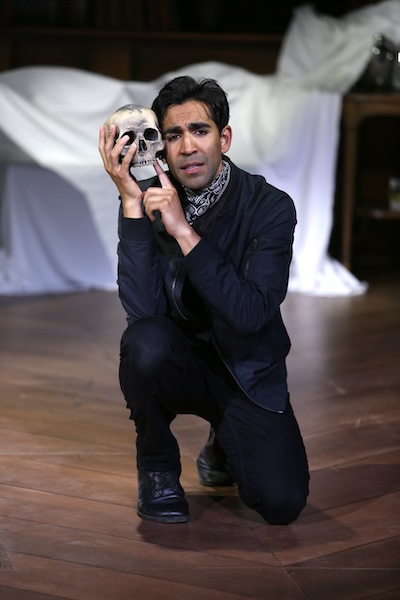
photo - Nadeem Phillip Umar Khitab as the title character in Bard’s Hamlet
Nadeem Phillip Umar Khitab as the title character in Bard’s Hamlet. (photo by Tim Matheson)

Hamlet is set on his fateful path by an eerie visit from the ghost of his father, who describes his murder most foul and importunes his son to avenge his death. Feigning madness, Hamlet sets off to right what is rotten in Denmark amid the wealth and power of the royal court. 

The action includes a foray into a graveyard where actor Lipovetsky injects some moments of lightness into an otherwise dark tale with his comedic take on the gravedigger. We also are privy to the funeral of Ophelia and, in the finale, an epic fencing duel culminates in multiple deaths, including a poignant farewell for Hamlet. Kudos to fight director Jonathan Hawley Purvis for his choreography of this sequence. Choreographer Lisa Goebels also provides some stunning freeze frame dance moments showcasing some fancy footwork by the older royals.

In another interesting staging twist, the original play-within-a-play device, which mimics the king’s death (poison in his ear), becomes a song from traveling performers, played by Christine Quintana and Lipovetsky.

Pam Johnson’s set is a cavernous library with floor-to-ceiling bookshelves and secret doors that allow the actors to enter and exit the stage seamlessly. A huge crown hangs from the ceiling and plays a critical role in the final scene. Being set in the present time allows for contemporary costumes – tattered jeans, T-shirts for the young, fitted dresses and pant suits for Gertrude and double-breasted suits for the older gents, courtesy of costume designer Barbara Clayden. 

While this is Hamlet’s story, it really is only made possible through the teamwork of a very skilled cast. Nadeem Phillip Umar Khitab is the quintessential Hamlet, with his physical presence and determination palpable as he undertakes his filial task of revenge. (Starting Sept. 2, Hamlet will be played by Chirag Naik.) Besworth is an ethereal Ophelia who sees no option but to take her life when both her brother, Laertes (Kay), and her father, Polonius (Wheeler), forbid her to have anything to do with Hamlet. Munish Sharma plays Claudius; Jennifer Clement, Gertrude; Ivy Charles and Aidan Correia, Guildenstern and Rosencrantz; and Youssef, the Ghost.

For tickets to any of the Bard productions, visit bardonthebeach.org or 604-739-0559. Comedy of Errors and Measure for Measure run on the smaller Howard Family Stage. 

Tova Kornfeld is a Vancouver freelance writer and lawyer.

Format ImagePosted on July 12, 2024July 10, 2024Author Tova KornfeldCategories Performing ArtsTags Anton Lipovetsky, Bard on the Beach, Hamlet, Nathan Kay, Shakespeare, Twelfth Night

Upheaval, good and bad

The French elections Sunday resulted in a hung parliament, with no party coming close to forming a working majority in the lower house. Given the choices French voters faced, this may be the best possible outcome.

The results were a surprise. The far-right National Rally, led by Marine Le Pen and founded by her father on neo-fascist roots, was widely anticipated to win. This would have been a long-dreaded victory for far-right extremism in Western Europe.

Dissatisfaction with the moderate President Emmanuel Macron was a significant factor, but the failure of the president’s party also reflects a larger trend across Europe toward the political extremes and away from the centre. This shift forced French voters into what, for many, was an unpalatable choice. Sunday’s election was the second round in a two-part process, the first round having eliminated many of the Macron-aligned candidates and forcing voters to choose between Le Pen’s party and a coalition of centre-left and far-left parties.

While Le Pen attempted to convince many French that her party had abandoned its antisemitism roots, the far-left leader Jean-Luc Mélenchon, in some ways, has taken up the antisemitic baton. He has repeatedly picked fights with the main French Jewish communal agency, employed what many hear as antisemitic dog whistles and condemned Macron’s acknowledgement of the complicity of some French people during the Holocaust, including in the notorious Vel’ d’Hiv Roundup of Jews. He has even dug up the ancient allegation that Jews crucified Jesus. So long are the litany of Mélenchon’s affronts to Jews that indications are that many Jews, possibly a plurality, opted for the far-right in Sunday’s vote. Additionally, many Jews apparently felt betrayed by the urging of Macron and other ostensibly moderate French leaders to support the left-wing bloc over the right-wing bloc.

Imagine Jews feeling it was safer to vote for a party born in fascism than a leftist bloc that includes individuals who don’t even make pretenses that they reject antisemitism. 

This sense of being squeezed from all sides is not a new or unfamiliar discomfort for French Jews, who have been abandoning that country for years. Terror attacks, often perpetrated by radicalized individuals originating or descended from former French colonies in North Africa and other Muslim-majority countries, have undermined what sense of security Jews had there. A litany of shocking crimes has occurred in the past two decades, including grisly antisemitic murders, a mass shooting at a kosher grocery store and, last month, the gang rape of a 12-year-old Jewish girl by perpetrators hurling antisemitic slurs.

Coincidentally, just three days before the French elections, a general election in the United Kingdom provided a dramatically different message.

In the previous election, the Conservatives, then under Boris Johnson, crushed the Labour Party, which was led by Jeremy Corbyn, a vocal anti-Israel voice and someone many British Jews perceive to be antisemitic. An internal party investigation and a government watchdog group denounced “a culture within the party which, at best, did not do enough to prevent antisemitism and, at worst, could be seen to accept it.”

While the Conservative government elected in 2019 stumbled from one disaster to another through a succession of failed party leaders and prime ministers, the Labour Party underwent what may prove to have been one of the most profound rehabilitations in modern political history.

The new Labour Party leader, Sir Keir Starmer, now the prime minister, promised he would “tear antisemitism out of our party by the roots.” 

The party undertook an intensive process purging those accused of creating the antisemitic culture – and Corbyn himself was ousted from the party (though he was easily reelected as an independent in his longtime constituency).

After one of their worst defeats in generations an election earlier, the Labour Party emerged July 4 with one of the most whopping landslide victories in British history. 

Among the 400 or so Labourites who will sit in the 650-seat House of Commons when the new government convenes, there are almost certain to be some who will demonstrate recidivist antisemitic tendencies. It will be up to the new prime minister and his team to demonstrate clearly and quickly that this sort of rhetoric and behaviour will not be accepted. 

The uplifting message is not so much that the Labour Party won the election – we can agree or disagree on their policies and approaches. The nearly miraculous thing that has happened is that a democratic party has provided an example for reasonable politicians everywhere of how to pull a movement that had been dangling over a dangerous ledge of extremism back to a reasoned and tolerant position.

The fact that such a rehabilitation is even possible, let alone achievable by a single determined leader in a mere couple of years, should be a message of profound hope to people who value tolerance and inclusivity and who oppose antisemitism.

Perhaps we have too much naïve optimism. But it is worth clinging to.

If Starmer’s efforts at cleaning up the antisemitic mess he was left with proves successful in the long-term, people in democracies around the world should be flocking to Labour Party headquarters to find out how it’s done. 

Posted on July 12, 2024July 10, 2024Author The Editorial BoardCategories From the JITags antisemitism, elections, extremism, France, politics, United Kingdom
Vigil marks nine months

Vigil marks nine months

The weekly rally at Vancouver Art Gallery marked nine months since the pogrom of Oct. 7. (photo by Anna-Mae Wiesenthal)

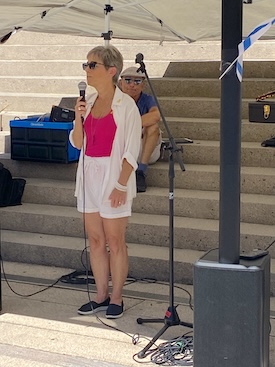
Selina Robinson, the former BC cabinet minister whose planned speech at Vancouver’s weekly rally for the hostages was canceled over security concerns earlier this year, was the surprise speaker Sunday at the vigil marking nine months since the pogrom of Oct. 7.

“I was out here nine months ago, representing government and the Jewish community … as we mourned together the slaughter of young people, the rape of women, the death of so many innocent people perpetrated by Hamas,” Robinson said. “I took it upon myself to make sure that we did right by the Jewish community and I took that honour with great reverence and commitment. I did so at the request of [then-premier] John Horgan and then I did it at the request of [current premier] David Eby and I did it diligently, as best I could. And we watched as a government what happens when hate goes unchecked. I never thought in my life, really, that I would see this level of hatred directed toward Jews.”

photo - Selina Robinson speaks at the July 7 vigil
Selina Robinson speaks at the July 7 vigil. (photo by Anna-Mae Wiesenthal)

She lauded fellow elected officials who stand with the Jewish community and said there should be unanimity.

“On this issue, we should not be divided,” said Robinson, a former minister of finance who was minister of postsecondary education when Eby, the premier, demanded her resignation after comments she made on a webinar calling pre-state Israel a “crappy piece of land.”

She credited Jewish organizations and allies for the work they are doing, but warned of a steep road ahead.

“We have a lot of work to do, my friends,” she said. “The antisemitism that has been unleashed is going to be hard to put back in the bottle.”

Congregation Beth Israel’s Rabbi Jonathan Infeld had harsh words for Robinson’s treatment at the hands of colleagues.

“Let’s tell the truth of why Selina was kicked out of cabinet,” Infeld said. “The reason is because Selina was the one representative of the Jewish people in cabinet. Selina was the one person in cabinet, in our government, willing to stand up not for some people’s human rights but for all of our human rights. Selina was kicked out of cabinet because she was a strong woman who stood for all that our province is supposed to stand for and she was kicked out of cabinet because she is a Jewish hero.”

BC Conservative Party leader John Rustad spoke, and was joined at the rally by fellow Conservative MLA Elenore Sturko and a number of Conservative candidates standing in October’s provincial election.

“I am proud to say that I stand here with you,” said Rustad. “I stand against terrorism. I stand against Hamas and what they have done.”

The government in British Columbia needs to do more to counter antisemitism, he said. 

“People who come to this province, to live here, come here with the expectation that they will live in peace,” Rustad said. “They come with the expectation to be able to raise a family, to be able to build the future, and what we are seeing today, with the antisemitism that is happening throughout our communities, I just find completely wrong.”

Ezra Shanken, chief executive officer of the Jewish Federation of Greater Vancouver, expressed pride in the community he serves. He urged elected officials to stand with the community. 

“We remember who was there on day one and we see who’s there now and that’s something that we have to stand up for here in our province and in our country,” he said. “We need them side-by-side by us and you need to be the ones to continue to tell them at all levels of government that we need them now more than ever.”

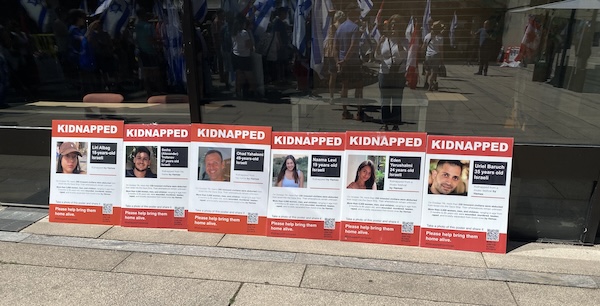
photo - Approximately 120 hostages are still being held in Gaza, more than nine months after the Hamas attacks on Oct. 7
Approximately 120 hostages are still being held in Gaza, more than nine months after the Hamas attacks on Oct. 7. (photo by Anna-Mae Wiesenthal)

Lior Noyman, an Israeli-Canadian educator and filmmaker, expressed sorrow for victims of violence in Israel and Gaza. He warned the audience to be vigilant against expanding antisemitism.

“Leaders, teachers, parents, Canadians, I am calling to you all,” he said. “Don’t let them walk us back in time.”

Dov (David) Rosengarten, a Vancouverite who is chief of staff for donor communications at United Hatzalah, Israel’s network of 7,000 volunteer first responders, brought greetings and gratitude from Israel. 

“Your display of unwavering solidarity every weekend here continues to give us strength through this difficult period,” he said. 

Noting the nine-month period since Oct. 7, Rosengarten drew parallels with the human pregnancy term, except that these past 40 weeks have been a time of unprecedented trauma. He sees hope in news of a ceasefire plan and hopes that “these painful birth pangs will end and the citizens of Israel and the Jewish people at large, including here in Vancouver, will be reborn again. After these many painful months, these cries of sorrow will be transformed to jubilation and we will finally hold our beloved hostages and loved ones again and celebrate the victory of unity and, like with a newborn child, we will shape for ourselves a bright future full of new dreams and possibilities.” 

Format ImagePosted on July 12, 2024July 10, 2024Author Pat JohnsonCategories LocalTags Dov Rosengarten, Ezra Shanken, hostages, Israel-Hamas war, John Rustad, Jonathan Infeld, Lior Noyman, Oct. 7, Selina Robinson, solidarity, weekly rally
Photos depict Oct. 7 trauma

Photos depict Oct. 7 trauma

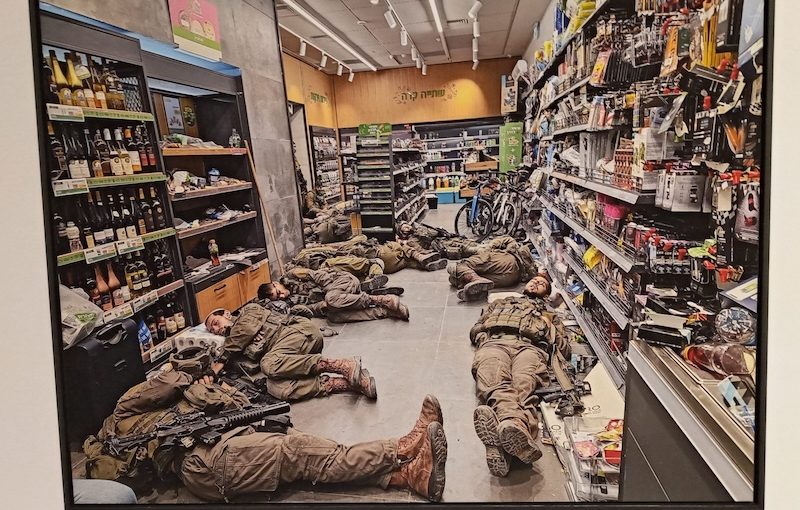
Batia Holini’s photo of Israeli soldiers sleeping on the floor of a grocery store near Kfar Aza on Oct. 8 is one of the works in the exhibit Album Darom. (photo by Gil Zohar)

Album Darom: Israeli Photographers in Tribute to the People of the Western Negev, which opened recently for a six-month temporary installation at the Petach Tikva Museum of Art, is the first group artistic endeavour in Israel to confront the tragedy of Hamas’s Oct. 7, 2023, massacre and the subsequent Gaza War, now in its 10th month. The ambitious tripartite installation Album Darom (Hebrew for Southern Album) incorporates a Facebook diary; a printed book of photographs accompanied by essays (published by Yedioth Ahronoth); and the museum exhibit.

Initiated by Prof. Dana Arieli, dean of the faculty of design at the Holon Institute of Technology, together with chief curator Irena Gordon, the project showcases 150 photographs, art installations and texts documenting the story of the western Negev region before and after Oct. 7. The exhibit includes the perspectives of 107 photographers and artists. Some of the participants in the album are world-renowned, others are amateurs. Lavi Lipshitz, the youngest featured photographer, lost his life fighting in Gaza. His mother penned the text accompanying his images.

The works in the album represent different photographic practices: artistic, personal and some staged, the intense images are upsetting. As well they should be in confronting mass murder.

Before walking around a corner to see Lali Fruhelig’s gruesome 3-D installation suggesting a corpse sprawled on the floor of a living room, a sign cautions: “The exhibition contains some potentially disturbing contents. Viewer discretion is advised.”

Arieli, a history professor and a photographer who explores remembrance culture and cultural manifestations of trauma, began the Album Darom project shortly after the Gaza war broke out.

“When something’s traumatic, you have to work or do something,” she said. 

Shocked by the murder of her friend Gideon Pauker from Kibbutz Nir Oz – who was killed just before his 80th birthday – she posted 100 daily historic and contemporary images of the Western Negev.

Initially, Arieli intended Album Darom to be exhibited at Kibbutz Yad Mordechai Museum just north of the Gaza Strip frontier. After the museum was damaged by rocket fire, this wasn’t feasible. Instead, she selected Petach Tikvah as the venue. She explained that the site – the first Yad Labanim memorial to fallen Israel Defence Forces soldiers from the War of Independence – is meant to be relevant to all Israelis. The museum offers free admission on Saturday, so observant Jews may visit on Shabbat.

Speaking to a group of journalists, Arieli compared Oct. 7 to the Nov. 4, 1995, assassination of then-prime minister Yitzhak Rabin. “Everyone is frozen in their memory of where they were,” she said.

Arieli and Gordon emphasized the intended cathartic nature of the exhibit. The two said the museum is a “safe space” and a “place for healing.” After experiencing the horrors of Oct. 7, Gordon found solace in this project, she added. “This is part of how we are coping with it all,” she said.

Miki Kratsman is one of the photographers whose depiction of his Oct. 7 nightmare is in the exhibit. Terrorists took his aunt Ophelia hostage from her home in Kibbutz Nir Oz. She was later released from Gaza in the November hostage exchange deal. 

Kratsman’s photograph, “In Aunt Ophelia’s Neighbourhood,” captures a modest kibbutz home collapsing as it is immolated in a fireball. 

“These are the kinds of things that need to be in a museum,” Arieli said of the photograph. “You’re looking at the destruction of Nir Oz.”

While vividly showing the devastation of the kibbutz, the burning home photograph is an enigma, and creates dialogue, she added.

But it is the human toll rather than the destroyed real estate that is most painful. Paradoxically, perhaps, Batia Holini’s peaceful photo of exhausted IDF soldiers sleeping on the floor of a grocery store near Kfar Aza on Oct. 8 hints at the savage warfare in which they have been engaged.

photo - “Funeral of Five Members of the Kutz Family who were Murdered in Kfar Aza,” a photo by Avishag Shaar-Yashuv
“Funeral of Five Members of the Kutz Family who were Murdered in Kfar Aza,” a photo by Avishag Shaar-Yashuv. (photo by Gil Zohar)

Avishag Shaar-Yashuv’s photograph, “Funeral of Five Members of the Kutz Family who were Murdered in Kfar Aza,” captures the searing emotion of the funeral of a family annihilated in the Hamas attack.

“I tried to focus and also wipe the tears at the same time,” Shaar-Yashuv said.

For this reviewer, the most symbolic part of the exhibit was a taxidermy display of a doe entitled “Bambi.” The exhibit references Felix Salten’s 1923 novel Bambi: A Life in the Woods and the 1942 animated movie produced by Walt Disney. Metaphorically, the hapless baby deer represents both the Six Million victims of the Holocaust and the 1,200 people murdered on Oct. 7.

Viewing Album Darom, one could conclude that the myth of the state of Israel protecting its citizens has been shattered. Arguably, Israelis today are no more secure than their ancestors were facing the Kishinev Pogrom of 1903, the Hebron Massacre of 1929 or the Farhud in Baghdad in 1941. 

Gil Zohar is a writer and tour guide in Jerusalem.

Format ImagePosted on July 12, 2024July 10, 2024Author Gil ZoharCategories Israel, Visual ArtsTags Album Darom, art, Israel, Oct. 7, photography, sculpture, South Album, trauma
Tory leader woos Jews

Tory leader woos Jews

BC Conservative leader John Rustad speaks with an audience member at a June 20 event at Schara Tzedeck Synagogue. (photo by Pat Johnson)

It has been 96 years since the Conservative party won a provincial election in British Columbia. The last time a Conservative was elected to the BC Legislature was a 1978 by-election. So, the rapturous reception BC Conservative leader John Rustad and several of his local candidates received from a mostly Jewish crowd at Schara Tzedeck Synagogue recently may have been a phenomenon unseen in generations.

Public opinion polls over the last year have consistently put the BC Conservatives in second place, ahead of the BC United party, which was known as the BC Liberals before a rebranding last year. The four sitting Conservative MLAs, including Rustad, were all initially elected as BC Liberals and later crossed the floor. 

The June 20 event was convened by Saul Kahn, a Jewish community leader who acknowledged he has not been politically active before. The synagogue, he noted, was a venue and the Conservatives’ presence there did not represent an endorsement.

Rabbi Andrew Rosenblatt, Schara Tzedeck’s senior rabbi, said he would welcome any politicians who want to meet and answer questions from the community. He noted that the event took place three weeks to the day after an arson attack on the synagogue and said the Jewish community is deeply concerned about developments in education in the province at all levels – primary, secondary and post-secondary. 

Rustad, the MLA for Nechako Lakes, an enormous riding sprawling across central British Columbia, lamented the situation.

“We shouldn’t need to have security,” he said, noting that churches and other institutions rarely even have to consider the issue. “We’ve allowed antisemitism to take root. We are not standing up and saying it’s wrong. It starts in our schools.”

Anybody who is promoting hate in the province should be criminally charged, he said, and, if they are not Canadian citizens, the federal government should consider deporting them.

Schools should be “teaching kids how to think not what to think,” said Rustad, and he promised to rescind the provincial government’s policy on sexual orientation and gender identity, commonly called SOGI. While promising to remove SOGI, Rustad pledged to support all students and pursue anti-bullying policies.

The leader, who has been in the legislature since 2005 and served in cabinet under premier Christy Clark, promised to go through all material in the education system “with a very critical eye” toward issues of ideology, gender and the environment. He said he assumes the BC Teachers’ Federation will fight back on issues like SOGI, which he calls the “sexualization of our children,” but said some of the things being taught in school could not be put on television or said in the legislature.

The party leader condemned anti-Israel protesters on BC university campuses.

“How is it that this is OK?” he asked. “People do not have the right to incite hate.”

He floated the possibility of holding back funding or otherwise putting pressure on universities to respond to this sort of activism.

Rustad condemned the province’s approach to addiction, saying that safe supply is “creating the next generation of addicts.” He called for long-term care and supports that help people get off drugs. 

“I don’t think it’s OK as a society to say it’s OK for them to live on the street,” said Rustad. 

Addressing the physical addiction is one thing, he added, but providing supports so that people coming off substances do not fall back into old habits and relationships must be part of the recovery process.

Rustad would like the province to gain the sort of autonomy over immigration that Quebec has been granted, “not from the perspective of saying people can’t come, but identifying those with the skill sets we need,” he said.

Housing construction needs to be ramped up and immigrants who can work in those sectors need to be encouraged, he said. Likewise, the province should be working with post-secondary institutions overseas to address issues of credentials before new Canadians move so that people can integrate smoothly into the economy when they arrive.

The foreign buyers’ property tax allows British Columbians to, he said, point at others and say “they are the problem” for high housing costs.

The province’s new densification policies overrule municipalities’ official community plans, he said. These “sound great” in terms of housing, said Rustad, but do not consider sewers and other infrastructures.

Dallas Brodie, the Conservative candidate taking on BC United leader Kevin Falcon in Vancouver-Quilchena, shared her “Israel coming-of-age story.” She had practised law for 10 years and served as a legal aid criminal defender for young offenders before getting into broadcasting. She intended to do legal analysis but broadened her scope to become a producer for CBC in Toronto and Ottawa and later for CKNW talk radio in Vancouver. She noted a media double standard in which, for example, if a pro-Israel speaker were booked, management would demand equal time for an anti-Israel voice. The process became so onerous, she said, “you just stop covering the topic of Israel altogether.”

Eventually, Brodie became host of a weekly program on the University of British Columbia campus station CITR, which she refers to as a “viper’s nest of Marxist thought.” There, she said, she was told not to say the word “Israel” on the air because it is upsetting to people. This UBC connection put Brodie in touch with staff at the campus Jewish organization Hillel, who included Brodie on trip to Israel that she says presented a balanced introduction to the region.

“Even the Palestinian perspective was presented to us,” she said.

The next year, she participated in March of the Living, where participants visit the Nazi death camps.

Running for the provincial legislature, Brodie said some people suggested that including her strong support for Israel in her political biography might hurt her chances, but she insisted on including it.

“My party more than supports my position and stands firmly and strongly behind me,” she said. “I will never go wobbly.”

Vancouver-Langara Conservative candidate Bryan Breguet, an economist who teaches at Langara College, noted that his institution became “internationally famous” last fall after a colleague (later fired) celebrated the atrocities of Oct. 7.

Breguet reflected on a recent incident in which a Burnaby public school teacher engaged in a “thought experiment,” asking students whether Israel had a right to exist. He questioned what the public reaction would have been to a thought experiment asking whether slavery should or should not have been abolished.

Breguet said he traveled to Israel in 2007 and was shocked to see the separation barrier in the process of construction. What shocked him, he said, was that the wall “hadn’t been built decades earlier.”

John Coupar, the party’s candidate in the newly created riding of Vancouver-Little Mountain, cited his 12 years of experience as an elected Vancouver park commissioner and his efforts to save the Bloedel Conservatory. 

He condemned the provincial government’s “failed experiment to legalize drugs” and called for “treatment, recovery and safe streets.”

He addressed antisemitism and condemned the governing New Democrats for their choice of candidate to run in the riding he is contesting.

“Your community is suffering deeply,” he said, before criticizing the governing NDP who he says “doubled down” by nominating Vancouver city councilor Christine Boyle as the NDP candidate in Little Mountain, “the only councilor to vote against IHRA [the adoption of a working definition of antisemitism] not once but twice.”

“This is absolutely appalling to me,” Coupar said.

A question from the audience addressed concerns that a failure to unite Conservative and BC United voters could result in a reelected NDP government. Rustad said discussions to fuse the parties, or to form some sort of electoral alliance, were unsuccessful, a failure Rustad placed on the other party.

He claims his party’s polling and analysis suggest that, if the two parties merged under the Conservative banner, the election would result in a six-seat majority for the Conservatives while, if they coalesced under the BC United banner, the NDP would win by 20 seats.

The election is on Oct. 19. 

Format ImagePosted on July 12, 2024July 10, 2024Author Pat JohnsonCategories LocalTags BC Conservatives, British Columbia, Bryan Breguet, Dallas Brodie, democracy, elections, John Coupar, John Rustad, politics
Non-Jews must speak out now

Non-Jews must speak out now

As a student at the University of British Columbia, I want the Jewish community to know that the encampments at universities across Canada do not reflect all students’ values. In my view – and I have spoken with many other students who feel the same way – these encampments are not places of peaceful protests but instead places that allow for the exclusion of students who hold different views and the spreading of antisemitism. Advocating for Jewish students on campus has become controversial, and I want to change that. 

The student protesters at these encampments have resolutely turned their back on any form of dialogue. The recently disbanded encampment at UBC, for example, was set up on April 29 and, as early as May 9, a statement from the encampment’s Instagram – Peoples University for Gaza UBC – read “F*** a discussion, we want divestment” in response to their perception of UBC president Dr. Benoit-Antoine Bacon’s handling of their demands.

At UBC, openness to discussion with Jewish students of differing views has never been demonstrated, and only self-proclaimed anti-Zionist Jews were allowed into the encampment. The anti-Zionist group Independent Jewish Voices was allowed in, with the group having taken part in protests against Hillel BC on campus. From what I saw, if a Jewish student identified as a Zionist and tried to engage in dialogue or enter the encampment, they were intimidated off the premises. 

On May 31, I created an Instagram post from my personal account (@zaranybo) titled “A Canadian non-Jewish ally’s response to the university encampments.” That post has received more than 1,200 likes and hundreds of shares. I prepared myself for an onslaught of hate comments, but, instead, I have received only support. 

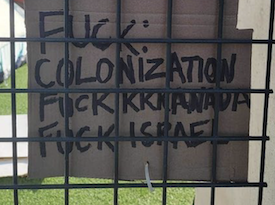
In the statement, I share two photos that were taken at the UBC encampment: a sign saying “Zionists F*** Off” and “F*** Colonization, another saying F*** KKKanada, F*** Israel.” These signs were prominently displayed on the outer fence for all passersby to see. The encampment was demonizing Israel and trying to convince my peers to believe Hamas propaganda and antisemitic rhetoric. 

photo - One of the signs that were posted on the fence of the encampment at the University of British Columbia
One of the signs that were posted on the fence of the encampment at the University of British Columbia. (photo by Zara Nybo)

I see such encampments as tiny, hypocritical echo chambers for my peers to radicalize in. It is my understanding that it is illegal to protest with a face mask or face covering under the Canadian Criminal Code and yet they do so. The encampment at UBC took university equipment and furniture to use as barricades. UBC is on unceded Musqueam land, thus the encampment was “colonizing” Maclnnes Field, against the law and on unceded land. The protesters were doing exactly what they contend Israel is doing to Palestinians.

From the response to my Instagram post, I realized that students across Canada are hungry for a community of students who are against the hypocrisy of the encampments and willing to speak out. I received a direct message from a student at the University of Toronto who felt they’d gone crazy, watching their peers spew pro-Hamas rhetoric. I also received an outpouring of support from many Canadian Jews, thanking me for standing against antisemitism.

After the first statement was so well received, I posted another one – “The time is now. Non-Jewish allies need to stand up.” We, as Canadian university students, have been silent for too long. I hold us collectively accountable for our silence. I know that it feels difficult for my peers to speak out. Understandably, they fear ostracization from their social circles and other repercussions. However, I challenge that, it should not be controversial to speak out against hate. 

What if social media had been around during the 1930s and 1940s? If we in Canada had seen the Jewish buildings being targeted then, saw that Jews were no longer allowed to attend school, and saw “no Jew” zones created, would we have said something? Would we have done something? 

Across Canada today, synagogues are being targeted, Jewish schools are being targeted, and the elders and children attending both are the target. If we believe we would have spoken up in the 1930s and 1940s, then we need to speak up now. We cannot let history repeat itself on our watch. 

It is vital that other non-Jewish students speak out, whether that is on social media or in their friend groups. Even though it feels nerve-racking to have a “controversial” or differing opinion from our friends, we must speak up nonetheless. Social media is a tool we can each use on an individual level to create a collective paradigm shift. 

To post or reshare support for Israel or call for the release of the hostages can create a rift in our friends’ online echo chambers. Social media algorithms work by showing users posts similar to what they have previously liked, reinforcing a certain worldview for users. This is what we call confirmation bias. If one person can alter that echo chamber, even with one post, it can begin to change what  individuals see on their feeds. With the amount of disinformation and terrorist propaganda circulating, this small action can make a difference. 

In the BC high school curriculum, we learned of the Nazis, antisemitism and the death camps. I always believed I would have risked my life to hide a Jewish family, but now I see it’s easier for most of us to be quiet in the face of antisemitism. 

After seeing my peers’ reactions and lack of courage to stand with the Jewish community after Oct. 7, I no longer believe that if social media had been around during the Second World War it would have made a difference. Many people knew then what was happening in Europe, even though media was less immediate and visually powerful, and people certainly know now what is happening. Yet, most of us are silent still. 

We’ve reached a point where standing up for Jewish people and against antisemitism seemingly require an in-depth understanding of the Middle East’s complex political history. This is a harmful conflation and double standard for fighting antisemitism – any other form of racism does not require this level of knowledge.

In my speech at the launch of Be An Upstander for Upstanders Canada on June 23, I said, “I’d like to tell you that the extreme anti-Israel rhetoric we are seeing on campus is not going to change the reality in the Middle East – but it is making life for Jewish students in Canada difficult and, in many cases, dangerous.” This is the truth. These protests aren’t going to change the outcome of this war, but they are creating a nearly unbearable campus culture for Jewish students. 

But I am hopeful. After the outpouring of support for my statements on Instagram from Canadian university students, I believe that, if more of us speak out against antisemitism, others will follow. There is still time to change the deafening silence of the non-Jewish community since Oct. 7.

Now is the time. Canadian non-Jewish allies need to speak up. How much more do our Jewish peers have to go through before we believe it’s gotten bad enough to sacrifice our comfort for our integrity? 

Zara Nybo is a third-year student at the University of British Columbia. Connect with Zara via Instagram: @zaranybo.

Format ImagePosted on July 12, 2024July 10, 2024Author Zara NyboCategories Op-EdTags antisemitism, encampments, UBC, University of British Columbia

Criticism is hard but vital

A year ago, for an important birthday, we bought a mature lemon tree. This perhaps sounds absurd because we live in Winnipeg, which has extremely cold winter temperatures. However, our home has a heated sunroom and the lemon tree, in its pot, blossomed and bore fruit. When warm weather came, we moved it outside to enjoy the summer. The outdoor location, against a wall, sheltered the tree and two lemons ripened.

My kibbutz year came back as I picked that first lemon. The lemon blossoms perfumed the indoor air as they came and went. Off-the-tree citrus, just like any other fresh produce, tastes so much better than anything bought at a grocery store. While lemons offer a sharp, puckery sour taste, their zest and juice absolutely make food sparkle. 

I posted about our “crop” of two lemons on social media. Immediately, I had a friend from Israel commenting on how lemons were her favourite fruit. Two other North Americans asked how we managed to grow them. I sensed their excitement through their onscreen responses.

This experience recalled another scenario, which plays out regularly in Jewish life – that of feedback, or constructive criticism. I was a blunt kid, accused of being not just assertive but aggressive at times. Instead of cloaking things in demure, “ladylike” manners, I said what I thought. I took to heart the idea that everyone can improve and that we should have high expectations. Yes, criticism can be difficult, and it’s sometimes unwarranted, but, without it, we sometimes can’t grow and improve as individuals or communities.

I recently took part in a Jewish business fair for newcomers at our Jewish community centre. Sponsored by Jewish Child and Family Services, it uplifted many who had moved from elsewhere. I loved the opportunity. I smiled and chatted with everyone who came to my writing and editing booth. One community member recognized me and took the time to let me know she was sorry nothing was good enough for me here. Her view of my work, written over many years for both Jewish and non-Jewish publications, was overwhelmingly negative. I responded cheerfully, suggesting that there were many good things about Winnipeg’s Jewish community, but that it was also a good thing to learn about other possibilities from elsewhere, reflect and improve. She sniffed disapprovingly and walked away.

This interaction reflected other times when I’ve been asked for suggestions or advice. The responses often included some version of “That’s not how we do things here” with a sneer, grumble or angry tone. Even when the feedback includes a lot of praise and support, including data or anecdotal evidence from other communities, some people are defensive and aren’t ready to hear it.

In some cases, I’ve heard “since I didn’t land that gig/volunteer position/award, I was just offering sour grapes.” Sour grapes are that metaphor for saucy words we offer when we’ve been rejected and react with impulsive hurt, though sour grapes make good wine. That pucker-up taste, just like with lemons, can do wonders, with time, to improve food and drink.

A wise friend, a Holocaust survivor in her mid-80s, asked for feedback after our family’s lifecycle event at our congregation. Akin to an exit interview, it’s important to have congregants’ thoughts on how the synagogue is doing, what went well and what could be done better. I took the time to respond. I sent the information to the people in responsible positions who should see it. I also wrote a separate gushing, positive note about the livestreaming feed, which is so inclusive for us when we cannot be in the building. I got a response from someone about the livestreaming feed email. I’ve received nothing so far about the constructive criticism.

It’s normal to feel defensive about criticism, especially if it hits hard or close to the bone. Yet, a professional should be able to respond. Feedback helps us grow, whether as a customer service-oriented synagogue or a business. I have struggled with this. Rejection and negative feedback are part of being a writer.

I used to joke that a swift, rude rejection didn’t reflect on my work. Instead, I imagined a grouchy editor who ate a burrito for lunch. He had bad indigestion and took it out on me. Then the rejection wasn’t such a big deal. The guy’s stomach trouble and bad manners became funny, rather than a reflection of my efforts.

In time, I’ve embraced the notion that a rejection, including a frankly critical one, offers positive opportunities. An editor’s simple “No, thank you” can result in a quick sale when I resubmit the piece elsewhere. Helpful feedback means I can improve my skills. Complete silence doesn’t mean anything – it doesn’t indicate that my work is awful or it’s still being considered.

Jewish tradition grows from a long rabbinic tradition of debate, discussion, criticism and reproof. It’s part of who we are. It’s sharp and puckery like that fresh lemon bite or the tannic pucker of sour grapes. It’s not easy to hear. Yet, when offered in good faith, thoughtful analysis only shows how much the respondent cares. Hearing nothing from a congregant, colleague or friend doesn’t mean everything is good. It may mean that they don’t care enough to respond. Or perhaps they say nothing because they can’t stand the rude response, defensiveness or silence that might follow.

It’s important, as part of a community, to offer effusive praise and support for one another whenever we can. It’s also key to our future to reflect, reevaluate and offer ways to improve. We often make a good salad spectacular with a squeeze of tangy lemon. Sometimes, we need to pucker up to improve things, so we may experience the huge flavour that can follow. 

Joanne Seiff has written regularly for the Winnipeg Free Press and various Jewish publications. She is the author of three books, including From the Outside In: Jewish Post Columns 2015-2016, a collection of essays available for digital download or as a paperback from Amazon. Check her out on Instagram @yrnspinner or at joanneseiff.blogspot.com.

Posted on July 12, 2024July 10, 2024Author Joanne SeiffCategories Op-EdTags critical thinking, Jewish tradition, lifestyle
Support Victory Square 100

Support Victory Square 100

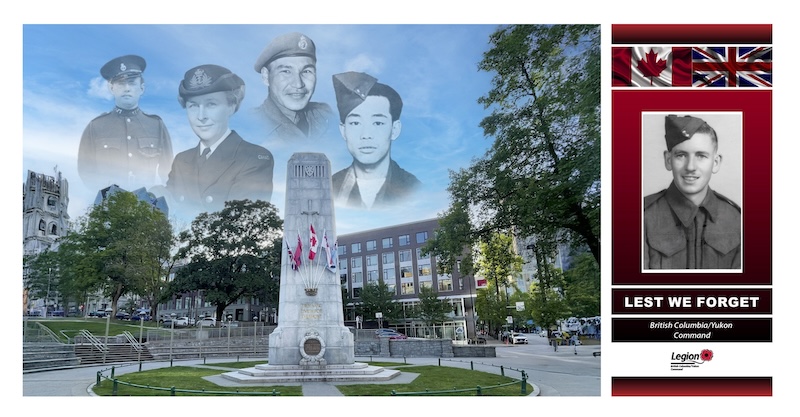
Victory Square 100 will create banners featuring photographs of veterans, which will be flown about Vancouver around the time of this year’s Remembrance Day commemorations, when the Victory Square Cenotaph in Vancouver turns 100. (images from RCL BC/Yukon Command)

Every year, from the last Friday of October to Nov. 11, tens of millions of Canadians wear a poppy as a visual pledge to honour Canada’s veterans. This year, the Victory Square Cenotaph in Vancouver will turn 100 years old and so the Royal Canadian Legion BC/Yukon Command has created the Victory Square 100 program.

Victory Square 100 invites all interested individuals and organizations to participate in creating banners adorned with pictures of veterans, which will be flown around the city of Vancouver.

If you are a veteran or if you have a loved one who served in the military, submit a high-quality picture of yourself, or the veteran, in uniform. Pictures need to be submitted digitally.

These photographs will be transformed into banners that showcase the faces of Canada’s veterans. Each banner will be crafted to ensure the dignity and respect befitting heroes.

There is a cost to creating and displaying the banners. The legion encourages the community, businesses and organizations to join them in the Victory Square 100 initiative and to sponsor a banner. If veterans or their loved ones who submit a photo choose to do so, they can also donate to the program.

There are a couple of options: a general donation to support the banner program (any amount), and $229 to support the banner program and have a veteran featured on the banner.

Victory Square 100 is more than just a gesture of appreciation – it’s a tangible expression of gratitude and respect for Canada’s veterans. By participating, you are helping ensure their legacy lives on and their service is never forgotten.

For additional information, visit legionbcyukon.ca or call Danny Redden, president of the Royal Canadian Legion’s Shalom Branch #178, at 604-739-1571. 

– Courtesy Shalom Branch 178

Format ImagePosted on July 12, 2024July 10, 2024Author Shalom Branch 178Categories LocalTags Canada, Royal Canadian Legion, Vancouver, veterans, Victory Square 100

Posts pagination

Previous page Page 1 … Page 80 Page 81 Page 82 … Page 667 Next page
Proudly powered by WordPress