Skip to content
  • Home
  • Subscribe / donate
  • Events calendar
  • News
    • Local
    • National
    • Israel
    • World
    • עניין בחדשות
      A roundup of news in Canada and further afield, in Hebrew.
  • Opinion
    • From the JI
    • Op-Ed
  • Arts & Culture
    • Performing Arts
    • Music
    • Books
    • Visual Arts
    • TV & Film
  • Life
    • Celebrating the Holidays
    • Travel
    • The Daily Snooze
      Cartoons by Jacob Samuel
    • Mystery Photo
      Help the JI and JMABC fill in the gaps in our archives.
  • Community Links
    • Organizations, Etc.
    • Other News Sources & Blogs
    • Business Directory
  • FAQ
  • JI Chai Celebration
  • JI@88! video

Recent Posts

  • Zionism wins big in Vegas
  • Different but connected
  • Survival not passive
  • Musical celebration of Israel
  • Shoppe celebrates 25 years
  • Human “book” event
  • Reclaiming Jewish stories
  • Bema presents Perseverance
  • CSS honours Bellas z”l
  • Sheba Promise here May 7
  • Reflections from Be’eri
  • New law a desecration
  • Resilient joy in tough times
  • Rescue dog brings joy
  • Art chosen for new museum
  • Reminder of hope, resilience
  • The national food of Israel?
  • Story of Israel’s north
  • Sheltering in train stations
  • Teach critical thinking
  • Learning to bridge divides
  • Supporting Iranian community
  • Art dismantles systems
  • Beth Tikvah celebrates 50th
  • What is Jewish music?
  • Celebrate joy of music
  • Women share experiences 
  • Raising funds for Survivors
  • Call for digital literacy
  • The hidden hand of hate
  • Tarot as spiritual ritual
  • Students create fancy meal
  • Encouraging young voices
  • Rose’s Angels delivers
  • Living life to its fullest
  • Drawing on his roots

Archives

Follow @JewishIndie
image - The CJN - Visit Us Banner - 300x600 - 101625

Keeping busy in lockdown

When someone suggested this as the title of an article I should write, I roared with laughter. Me, who has been climbing the walls, thinking of taking to drink, or killing myself or others. But, after all, I pride myself on being creative, so I decided to have a stab at it.

I am very communal-minded, so I thought I should entertain the neighbours. I don’t play any instrument, but I know hundreds of songs dating back to the 1940s. In my imagination, I saw all my Jerusalem neighbours coming out to join in, sending their children to the street below to dance, keeping their social distance, of course. Well, that’s not exactly what happened. After I began singing – I chose my favourite aria from Madame Butterfly, “One Fine Day” – what I heard was doors being closed with great force and windows being slammed down. But, I persevered, until all the birds in the trees outside my balcony decided to migrate early this year and flew off to Australia or Siberia (whichever was the furthest), and even the cats that hang around our building also disappeared.

I next decided I could keep busy by tidying up my office. I know I have a very nice writing desk. I haven’t actually seen it for a few years because my printer sits on it, plus a pile of ideas for articles and stories that I intend to use one day. I decided to be ruthless and get rid of them, but then I thought I should read them first, after which I decided maybe to keep them for happier times. At least, this activity kept me busy for a couple of hours.

By then, it was lunch time, and I decided to use my creativity to prepare a gourmet meal for my husband from the ingredients I could find, after not having gone shopping for about five weeks. I put things on the kitchen counter and looked at them: one sad-looking turnip, some potatoes, three packets of desiccated coconut (where did they come from?), a tin of chickpeas and a packet of potato flour left over from Pesach. This assortment really taxed my imagination, especially as my husband, these last few days, has been giving me looks that say, “You don’t really expect me to eat this!” I haven’t done violence to him yet, which is a tribute to my self-restraint. Oh, I’ve thought about it, and I think a good lawyer could get me acquitted if I did – I’m sure there’s something called “justifiable homicide.”

I did the laundry, and then made the mistake of looking in the mirror. My hair hasn’t had the tender ministrations of a hairdresser for more than a month. I’m reminded of the song “The Surrey with the Fringe on Top” from the musical Oklahoma. I now have a fringe – or “bangs,” as I think North Americans say – and a strange triangle of hair that sticks out on the side. It is very depressing, but, if I put on my facemask and use the elastic to push it away, it doesn’t look too bad. In fact, when I wear the facemask, I look quite good.

So, I guess I am keeping busy under lockdown after all. I would like to say that I keep a balanced diet – a block of dark chocolate in one hand and a block of milk chocolate in the other – but I don’t actually have any chocolate. I like the story of a doctor who told his elderly patient that it would be a good idea if she put a bar in her shower, and she did – with bottles of whiskey, brandy, wine and vodka. I can’t do it though, because my soap holder won’t support even a bottle of wine.

Nonetheless, I hope I’ve given readers some ideas of how to keep busy under the restrictions that COVID-19 requires. It’s just a matter of initiative and creativity, and the time will pass constructively. I wish everyone good health until this traumatic time comes to an end.

Dvora Waysman is a Jerusalem-based author. She has written 14 books, including The Pomegranate Pendant, which was made into a movie, and her latest novella, Searching for Sarah. She can be contacted at [email protected] or through her blog dvorawaysman.com.

Posted on May 29, 2020May 28, 2020Author Dvora WaysmanCategories Op-EdTags coronavirus, COVID-19, Israel, lifestyle, work

Thank you to all who contributed to the May 29/20 issue!!!

image - contributors to the May 29/20 issue
contributors to the May 29/20 issue
Posted on May 29, 2020May 28, 2020Author The Editorial BoardCategories From the JITags JI, journalism, philanthropy
ונקובר מתחילה להיפתח מחדש לאט לאט

ונקובר מתחילה להיפתח מחדש לאט לאט

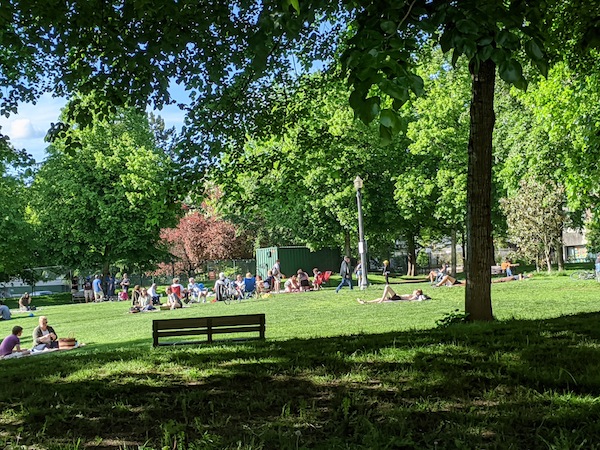
תושבים נהנים מהשמש החמה בפארק נלסון

(רוני רחמני) 

כבר למעלה מחודשיים שאנו נמצאים בסגר שלא היה כמותו מעולם. המראות מוונקובר ומשאר רחבי קנדה דומים למה שאנו רואים בעולם: רחובות ריקים, תורים ליד חנויות האוכל, הרבה שקט מסביב והטלוויזיות פועלות בבתים בהיקף שלא היה כדומתו מאז באו לעולם.

אני למזלי עובד מהבית מזה כשלוש שנים כך שלא הרגשתי שינוי משמעותי בגיזרה הזו, אם כי היקפי העבודה ירדו ובשלב זה קשה לאמוד את הנזקים הכספיים אצלנו בחברה. בתום יום העבודה במקום לקפוץ למכון הכושר בבניין ולרכב על אופניים ארבעים דקות, ולגמוע כאחד עשר עד שניים עשר קילומטרים, אני יוצא לצעוד ברחובות של ונקובר. אם אצעד בטיילת שליד הים אראה רבים רבים כמוני שהולכים להם, רצים, רוכבים על אופניים או סתם יושבים על הדשא ותופסים שמש. אם אחפש מקומות ריקים יותר אז אלך ברחובות העיר, מהדאון טאון החוצה דרך שלושת הגשרים שמחברים אותו עם החלק המערבי או המזרחי של ונקובר. אבל זה לא כל כך נעים נעים לצעוד היום ברחובות הכמעט ריקים של ונקובר. ההרגשה כבדה מה גם שמרבית חלונות הראווה של החנויות מכוסים בלוחות עץ כדי שלא יפרצו פנימה. ההומלסים נראים במספרים גדולים יותר וחלקם השתכנו להם בפתחי החנויות הסגורות. בערב רחובות העיר כל כך שקטים וריקים. נראה כאילו עוצר מלחמתי הוכרז על ידי השלטונות.

בפועל המלחמה היא מול אויב שאיננו רואים או שומעים אותו והוא עושה בנו שמות. אויב אכזרי מאין כמוה שגרם למותם של למעלה משלוש מאות אלף איש בעולם וגרם ליותר מארבעה וחצי מיליוני אנשים לחלות. מגפה של ממש.

ונקובר כמו ערים אחרות הפכה למשהו אחר, סיפמפטי פחות, נעים פחות, שקט הרבה יותר. אנו מתעוררים כל בוקר למציאות שלא הכרנו וכל הימים נראים דומים. לא פעם שאלתי את בת הזוג שלי האם היום זה יום שלישי והיא ענתה בפסקנות: “היום דווקא זהו יום רביעי”. בפעם אחרת חשבתי שמדובר ביום חמישי אך בפועל זה היה כבר יום שישי. החדשות הן אותן חדשות, הרעות הן אותן רעות והחיים כמעט עצרו מלכת.

לאור החדשות הטובות יותר שמספר המתים והחולים יורד בהתמדה במחוז בריטיש קולומביה שלנו, הממשלה המקומית הודיעה כי אנו מתחילים לפתוח את המשק לאט לאט. הממשלה קבעה תוכנית בת ארבעה שלבים כאשר בעצם השלב הראשון הוא השלב בו אנו מצאים כיום, כיוון שהמשק עבר לשעת חירום וכן מספר מגזרים המשיכו לפעול. כמו למשל תחבורה ציבורית, בניית ותיקון תשתיות, בניית ותיקון בניינים, חנויות מזון ועוד. השלב הרביעי והאחרון בתוכנית הוא פתיחה מלאה של המשק וזה יקרה שימצא החיסון היקר מפז לחיידק הקורונה הנוראי הזה. לכן אנו עוברים בימים הקרובים שלב השני בתוכנית הממשלתית. כבר בימים האחרונים ראיתי התעוררות ברחבי העיר. יותר אנשים ברחובות, בפרקים ובטיילות. יותר חנויות פתוחות. ההמשך יבוא.

לסיום שיר חדש שכתבתי לאחרונה:

אם אין מים נשתה חלב של פרה אדומה

אם אין חשמל נקושש עצים חומים ונעשה מדורה חמה

אם אין גז נעטוף את הבית בנילונים לבנים ארוכים ונרגיש כמו בחממה

אם לא נוכל לקרוא נתחיל לכתוב שירים ארוכים וסיפורים קצרים

אם לא נוכל לשמוע מוזיקה נתחיל להקיש במקלות רחבים על מחבתות וסירים גדולים

אם לא נוכל לצפות בטלוויזיה נעמוד במרכז החדר ונתחיל לנאום ארוכות על מה שקרה ועל עתיד המבריאים הרבים והחולים המעטים.

Format ImagePosted on May 20, 2020July 2, 2020Author Roni RachmaniCategories עניין בחדשותTags British Columbia, coronavirus, four-step plan, the economy, vaccine, Vancouver, בריטיש קולומביה, המשק, ונקובר, חיידק הקורונה, חיסון, תוכנית בת ארבעה שלבים
A virtual Yom Hashoah

A virtual Yom Hashoah

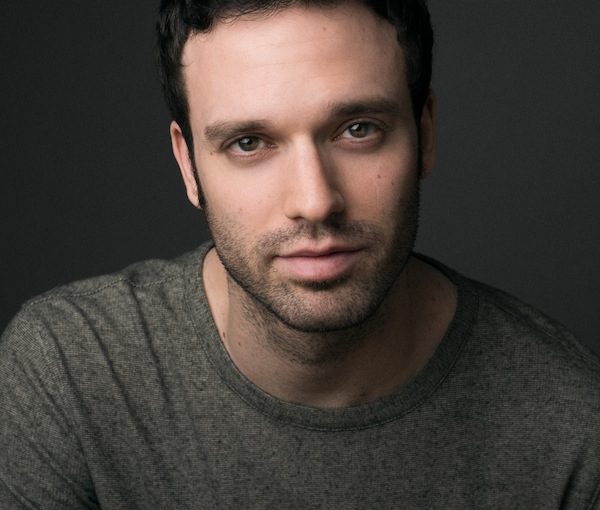
Toronto actor Jake Epstein hosted Canada’s online Yom Hashoah commemoration on April 20. (PR photo)

Days after many Canadian families celebrated Passover remotely using online platforms for virtual seders, Yom Hashoah was commemorated with a virtual ceremony that linked survivors and others across the country in an unprecedented, but deeply moving, program of remembrance and education.

The 27th of Nissan was set aside in 1951 by Israel’s parliament, the Knesset, as Holocaust and Heroism Remembrance Day. This year marked the 75th anniversary since the end of the Second World War and the end of the Holocaust.

Hosted live by Toronto actor Jake Epstein, the event, on April 20, featured prerecorded content from organizations across Canada and new footage broadcast live, including candlelighting from six locations across the country, among them the Vancouver home of Shoshana and Shawn Lewis and their children Charlie, Julian and Mattea.

In a recorded message, Prime Minister Justin Trudeau said Canada stands firm against antisemitism and with Israel and the Jewish people.

“The Shoah was undoubtedly one of the darkest periods in human history and these moments where we pause to remember matter, both to honour those who lived through these horrors but also to make sure these atrocities are never repeated,” Trudeau said. “Sadly, acts of antisemitic violence are more and more frequent today and Canada is not immune to this trend. For many Jewish Canadians, the rise in attacks is not only troubling, it’s downright scary. But, let me be clear, attacks against the Jewish community are attacks against us all. Let me be equally clear, Canada and Israel are partners, allies and close friends and we will continue to stand proudly with Israel. Attacks against Israel, including calls for BDS and attempts to single her out at the UN, will not be tolerated.… We will always condemn any movement that attacks Israel, Jewish Canadians and the values we share.”

The Yom Hashoah program also included recorded messages from Israeli diplomats in Canada and prerecorded musical components.

“During the war, music played an important role in lifting the spirits of ghetto inhabitants, camp inmates, as well as being used as a bargaining chip in negotiating small freedoms in the camps,” said Epstein.

Pieces were performed by the Toronto Jewish Chorus, participants in previous March of the Living programs and by shinshinim, young Israelis performing overseas duties after completing high school. Memorial prayers, El Maleh Rachamim and Kaddish, were offered by Cantor Pinchas Levinson of Ottawa.

Epstein, a grandson of Holocaust survivors, spoke of his family’s history, the good fortune of his grandparents’ survival and the resilience they showed in beginning a new life in a new land.

“Upon being liberated from the camps, survivors faced the inconceivable realization of the enormity of their loss,” Epstein said. “Recovery was a long road ahead. Survivors, like my grandparents, immediately searched for any other surviving family members, only to discover that they had lost everyone. And yet, somehow, they rebuilt their lives.

“My grandparents came to Canada through Pier 21 in Halifax before ultimately moving to Toronto. Even though they were free, the culture shock, the language, the difficulty in finding work, made life extremely hard. My grandfather, an architectural engineer in what was then Czechoslovakia, was lucky enough to find work as a bookkeeper for a lumberyard. My grandmother became a seamstress, working day and night, not only making clothing for customers, but making dresses for my mom as well. Somehow, they managed to connect with other survivors who became like family.…My grandparents’ story of resilience and adversity is a common one. They, like so many other survivors in Canada, raised families, found employment, learned new languages and contributed to Canadian society and Jewish communal life. Some even dedicated their lives, decades later, to speaking out against hate and injustice by sharing their Holocaust stories with students and the public.”

Survivors from across Canada, in video recordings, spoke of their liberation experiences and offered advice to successive generations.

Faigie Libman of Toronto recounted her moment of liberation.

“We saw a man on a horse, a Russian soldier, coming towards us,” she recounted. “He said he was a captain, that we are free. You cannot imagine the joy, you cannot imagine the exhilaration. I still see the picture in front of my eyes, women who could hardly walk, some were even crawling, pulled him down, they were kissing him, they were hugging him, and that day will always be in my mind – Jan. 21, 1945 – we were finally free.”

Sydney Zoltan of Montreal expressed concern about Holocaust awareness after the eyewitnesses pass.

“We, the youngest survivors, now stand in the frontline,” he said. “We often ask ourselves what memory of the Shoah will look like when we are gone. We depart with the hope that our fears are only imaginary.”

Another survivor asked younger generations to be vigilant.

“I want young people to remember, I want them to be politically aware, that their government should never preach hate,” said Elly Gotz of Toronto. “I want them to understand how damaging hate is to people.”

The commemoration, coordinated by the Sarah and Chaim Neuberger Holocaust Education Centre in Toronto, was presented in partnership with organizations across the country, including the Vancouver Holocaust Education Centre. Earlier the same day, a global Yom Hashoah memorial event took place from an eerily empty Yad Vashem in Jerusalem, again with video-recorded survivor testimony and messages from political, religious and civic figures.

Format ImagePosted on May 15, 2020May 14, 2020Author Pat JohnsonCategories NationalTags Holocaust, Jake Epstein, memorial, survivors, VHEC, Yom Hashoah
Dialogue across differences

Dialogue across differences

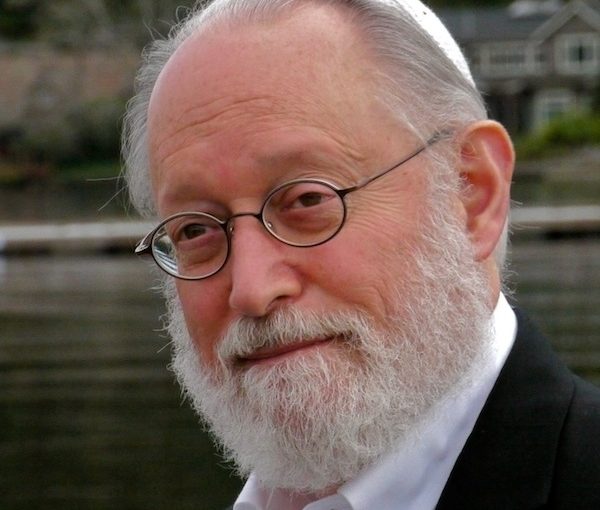
Rabbi Dr. Ted Falcon will be joined by Imam Jamal Rahman in a keynote address called Healing at a Time of Polarization, which the public can watch online by registering at vst.edu. (photo from Ted Falcon)

When beginning interfaith or intercultural dialogue, how much emphasis should be placed on similarities and how much on differences? According to a rabbi with decades of experience in the topic, the question puts the cart before the horse.

When Rabbi Dr. Ted Falcon, a Seattle spiritual guide, author, teacher and therapist, leads such interactive processes, he starts with something far more general: the basic humanity of the participants.

“We encourage people to begin a dialogue, a conversation process, not by focusing on similarities or differences in their religious views or nonreligious views, whatever they might be, but begin by creating contexts in which they can meet each other as human beings, meet each other as persons, which essentially is done through sharing stories,” said Falcon.

He uses “a series of questions that people can respond to either in dyads or around tables that elicit stories about important events in their lives, stories about concerns in their lives, stories about important relationships in their lives, so that the dialogue begins by appreciating a common shared human condition. That has made a tremendous difference because only after that do we encourage people looking at more specifically their religious or nonreligious concerns.”

Falcon will be part of a keynote address at a fifth annual multi-religious, multidisciplinary conference presented by Vancouver School of Theology, May 24 to 26. Due to the pandemic, the conference, titled Religious, Spiritual, Secular: Living in a Pluralistic Culture, will take place online. To virtually attend the entire event, registration fees apply, but the keynote and a Monday night concert are open to the public at no cost, although pre-registration is required.

Falcon is a member of the Interfaith Amigos, made up of himself, Pastor Don Mackenzie, a Christian minister, and Imam Jamal Rahman, a Muslim clergyman of the Sufi tradition. The three have published books and present together frequently. Rahman will join Falcon at the conference for the keynote, titled Healing at a Time of Polarization: Reaching Beyond Difference to What We Share.

Once the framework for constructive dialogue is in place, Falcon said in a telephone interview with the Jewish Independent from his Seattle-area home, interfaith exploration can begin to approach similarities that transcend religious differences. Among their Jewish, Muslim and Christian values, the amigos acknowledge some fundamental principles.

“We identified three basic core teachings that our traditions share,” said Falcon. “A core teaching of oneness, a core teaching of unconditional love and a core teaching of compassion. We can utilize those core teachings to then look at our texts, our traditions and our lives and evaluate how does this reflect in my life, how am I not living up to this, what do I need to do to live up to this more authentically? And it’s only after that discussion that we encourage people to engage in more difficult conversations, whether it’s conversations about Israel-Palestine, whether it’s conversations about desire to convert other people, whether it’s conversations about feeling your way is somehow better than other ways, whether it’s conversations about somehow being wary of allowing ourselves to truly appreciate the spiritual wisdom in another’s tradition.”

He admitted that interfaith dialogue is not always possible. But, even among people who acknowledge that they believe their theology to be unerring and people who may not be open to difference, there can still be dialogue, he said.

“In other words, if our conversation is based on my need to get you to change, there is no conversation.” But, he continued, if people recognize that neither they nor their interlocutor will change their minds, there is still a means and a purpose to engaging.

“We share the essential aspect of walking around in a human body with all its frailties and all its challenges and all its wonders,” said Falcon. “We have so much in common that that changes the energetic environment and allows a different kind of conversation to take place. Will you ever convince me that Jesus is the only way? No. But can I truly appreciate that that is your way and authentically support that? Yes, I can do that.”

Rabbi Dr. Laura Duhan-Kaplan, director of interreligious studies and a professor of Jewish studies at Vancouver School of Theology, is conference director. She acknowledged that the online, virtual format for the conference changes its nature, but with the drawbacks come benefits.

“We are well aware that people can experience Zoom fatigue and computer fatigue and perhaps don’t want to sit in front of the computer for two full days, no matter how much they are fascinated by the content,” Duhan-Kaplan said. As a result, all of the sessions will be recorded and participants can watch and join the conversation on message boards for 10 days after the conference weekend. This means that, unlike most in-person conferences where participants have to choose between breakout sessions, it is possible to virtually attend all of them.

While the event is an academic conference and it will naturally attract clergypeople, Duhan-Kaplan said it is appropriate for anyone who cares about the role of religion in the public sphere.

“One of the objectives, when it was an in-person conference, was, of course, to get people interested in religion and spirituality from different sectors of our community, to meet each other in person and network,” she said. “The dynamic may be very different online, so, aside from that goal, I’m really hoping that people will come away with a sense of the complexity of creating a community that has room for religious diversity.

“But I also want them to be able to see what some of the components of that complexity are, so that no one throws up their hands and says it can’t be done, but has a sense that by doing acts, whether it’s a group of multifaith chaplains supporting a prison population or whether it’s a group of people getting together to work on the Downtown Eastside or even religious communities twice a year doing outreach to someone of a different faith, I want people to get a sense of understanding that they are part of a larger project and what kind of difference what they do makes.”

For information, to register for the entire conference ($100/$50 students) or sign up to attend the keynote and concert (free), go to vst.edu by May 21.

Format ImagePosted on May 15, 2020May 14, 2020Author Pat JohnsonCategories LocalTags interfaith, Laura Duhan Kaplan, religion, Ted Falcon, Vancouver School of Theology, VST

Using past to improve future

Without interpretation, the world’s greatest art is little more than a lot of pretty pictures. Similarly, absent interpretation and thoughtful reflection, history is not much more than a litany of names and dates.

This month, we are marking many anniversaries. The end of the Second World War in Europe. The liberation of the last Nazi concentration camps. The beginning of Soviet-versus-Western tensions and proxy wars that lasted decades.

In some ways, we cannot begin to comprehend the Holocaust, or the world’s reaction to it, without reflecting on a different anniversary we mark this month. It was 60 years ago this week – May 11, 1960 – that Mossad operatives captured Adolf Eichmann, a prime architect of the Holocaust. The astonishing operation, which amazes observers even today with its bizarre twists and chutzpah on an international scale, stands out as a turning point in the way the world – Jews especially – view Holocaust history.

Holocaust survivors themselves understood the particularity of the Holocaust, while much of the world perceived the millions of Jewish lives lost as a part of the larger war casualties, not qualitatively different from the deaths of citizens of Dresden or Coventry or Stalingrad. It should need not be said that every human life lost is a tragedy. But, from the perspective of historical meaning, the murder of Jews, Roma, people with disabilities, homosexuals and others targeted for identities unrelated to the national conflicts, must be understood apart from the tragic consequences of war.

This is the consensus position today – that the Holocaust paralleled the Second World War but was substantively and morally different from broader contemporary events. This consensus emerged to a great extent from the Eichmann capture and trial.

Eichmann was living in Argentina, so confident in his security that, in retrospect, his subterfuge was minimal. Once tipped off, the Mossad had little trouble locating him.

Eichmann’s legendary defence, that he was merely following orders, was dismissed by the Israeli court. Whatever moral or military defence that argument posited was defied by the facts. Eichmann, according to eyewitnesses and documentary evidence, did far more than follow orders. He enthusiastically fulfilled directives beyond the letter or spirit of the command.

When the trial began, in 1961, it was said that one could walk through Tel Aviv and hear the proceedings on radio through every open window. The implications of the Eichmann trial for the world’s understanding of this history, and for Israeli and Jewish consciousness, was revolutionary.

Even among families that included survivors, or who had lost entire branches of the family tree, the historical context of the Holocaust was nebulous until this time. The small amount of survivor testimony that had emerged immediately after the war had largely dissipated, in part because the public did not want to face the most grotesque evidence of human depravity and because, in many cases, the survivors chose to sublimate their experiences and attempt to rebuild and move on with their lives.

It was only in the minutiae of the evidence at trial, the mind-boggling precision, industrial-style execution of diabolical plans and indescribable sadism of the Nazi war against Jews that people began to understand both the quantitative and the qualitative nature of the Shoah.

In addition to gaining insights into what their parents or other survivors might have experienced, younger Jews and Israelis intuited from the evidence a larger realization about their people. According to some historians, an idea persisted in the years after 1945 that the Jews of Europe had gone silently – “like sheep,” in the dehumanizing terminology too often employed – to their deaths.

Gaining an understanding of the inescapable precision and indefatigable determination of the Nazis to identify and murder every single Jew in their realm, younger Jews and Israelis came to know that their lost civilization did not go willingly. Indeed, among the earliest memorializations of the Holocaust – including here in Vancouver – were commemorations of the bravery and resistance of the Warsaw Ghetto uprising. The nuances of the historical record were enriched by this knowledge, with implications for the self-identity of Jews everywhere. The extent of the cataclysm was a result of the homicidal tenacity of the Nazis and their collaborators, not of the responses of their victims.

The Eichmann trial opened a floodgate. The contemporary era of Holocaust history, including survivor memoirs and public discussion of that time, really began then. A decade later, this new understanding led to a backlash of Holocaust denial and revisionism which, in turn, inspired yet more survivors to speak out to correct and add to the record.

Today, we struggle to keep this history alive and to challenge its diminishment and misuse. Even among well-intentioned people who would never mean to belittle this history, there is a tendency to invoke it in situations that by no measure are comparable.

Additionally, especially in Europe, public opinion polls reveal that there is a fatigue around the subject. In many countries, pluralities or even majorities say that too much attention is paid to the Holocaust. Incongruously, the same polls indicate that it is in countries where ignorance of this history is most pronounced that citizens contend there is too much focus on it. Try to square those results.

We always view the past through the changing lens of the present. We have seen transformations in the understanding of and responses to Holocaust history for 75 years now. One of the challenges of our generation and successive ones is to be active in addressing these changing perceptions and interpretations. Our desire to continue to delve into this difficult experience and our people’s enduring trauma cannot depend on other people’s ignorance or assessment of what’s considered “too much” or “too in the past.” Our obligation, as carriers of this knowledge and witnesses to the survivors, is to glean the lessons of the past that improve the future and help strengthen our community and our societies. We will continue to do this work and to honour our ancestors. And we will continue to share what we know to be true, as we search for ways to make “Never again” a reality.

Posted on May 15, 2020May 14, 2020Author The Editorial BoardCategories From the JITags education antisemitism, Holocaust, remembrance, resistance, survivors
Garden City’s new leadership

Garden City’s new leadership

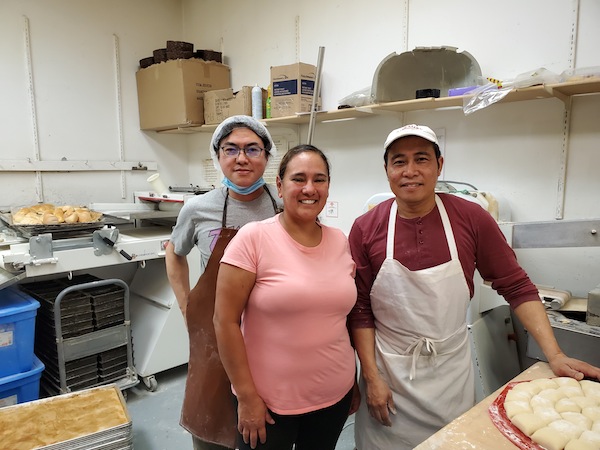
Garden City Bakery owner Steve Uy, right, with store manager Monica Flores and fellow baker Richard Caranto. (photo from Garden City Bakery)

If you’ve not set foot into Garden City Bakery for some time, you’re in for a surprise. The longtime Richmond kosher bakery at Blundell and Garden City roads came under new ownership in December 2019 and Steve Uy has infused the shop with his personal style and charisma. The interior has been updated and the bakery hums with an energy inspired by Uy’s friendliness and business acumen.

A Manila native, Uy moved to Vancouver in 1989 at the age of 20 and studied economics at Simon Fraser University. By 26, he’d returned to the Philippines, first importing Canadian food products and later immersing himself in the kitchen, where he baked steam buns for grocery stores. In 2017, when he returned to Vancouver with his wife and children, he was determined to continue baking for a living. An ingredient supplier introduced Uy to former Garden City Bakery owner Ivan Gerlach and, within two months, the transaction was complete and Uy was at the helm of the business.

“When I took over the shop, the only thing I wanted was an oven to bake things,” he admitted. “I didn’t even know what kosher was!”

Immediately afterwards, though, his kosher education began in earnest, first under Gerlach’s tutelage and then under the instruction of rabbis from BC Kosher. It was a steep learning curve but Uy was fiercely committed to two things: to respect the Jewish traditions of the bakery and to increase the availability of its signature challahs, challah buns, bagels and pita bread.

“Our goal is to be more visible and more available,” he told the Independent.

Expanding the availability of his baked breads wasn’t easy initially and, when Uy first approached Safeway at King Edward Avenue and Oak Street, he wasn’t met with open arms. “I wondered why a Safeway right beside a Jewish school wouldn’t want to carry kosher bread,” he said. It took four months of repeated meetings and encouragement before the grocery store agreed to carry Garden City Bakery challah and buns. But, as soon as they did, the items disappeared fast and the store increased their order. By January 2020, Safeway had invited Uy to set up his own bread rack in the store, where he could sell even more kosher breads, including pita, bagels and rye bread.

Today, Uy’s baked goods are available at Meinhardt Fine Foods, Stong’s Market, two Save-On Foods (Dunbar and Terra Nova), Omnitsky Kosher, Louis Brier Home and Hospital, two Superstore locations (Marine Drive and Richmond) and a FreshCo. And Uy is just getting started on his wholesale journey.

“We intend to expand into more Safeway stores, Superstores and Save-On Foods in the next year or two,” he said. “There’s a gap in the market we can fill here. Grain bread and artisan bread are popular, but I think there’s a market for kosher bread beyond the Jewish community, for anyone who appreciates a good bread. And, personally, I think challah is one of the best, most beautiful breads in the world. The dough itself is just fabulous.”

While expansion plans have been put on hold by the COVID-19 pandemic, Uy’s ambition has not tapered. A hands-on owner, he does much of the mixing and baking himself, “to keep our secret recipes and to ensure consistency of the product.” Uy also handles delivery of the products to the stores.

His baking repertoire remains much the same as it was previous to his leadership, but a couple of new items include a Filipino soft bun called Pandesal, and a sandwich loaf made from the same dough as challah but more suitable as an everyday bread. “The challah and challah buns are our mainstay and we worry that adding too much variety will bog down the bakery in terms of manpower,” he explained.

A great ambassador for the bakery, he emanates positivity and a can-do attitude. “When I bought the business, I could tell that the sales volume was not great, but I’ve always been a risk-taker and I’m confident in my own abilities,” he said. “I’m really enjoying the business, and owning a kosher bakery has exposed me to a new group of people, a different culture and unique traditions I didn’t previously understand.”

He added, “It’s my sales pitch when I go to new stores. I tell them we’re different because we’re kosher. We’re taking one step at a time, but we’re determined to open up more avenues for kosher bread in British Columbia. We know when people start believing in the product, they’ll buy it.”

Lauren Kramer, an award-winning writer and editor, lives in Richmond. To read her work online, visit laurenkramer.net.

Format ImagePosted on May 15, 2020May 14, 2020Author Lauren KramerCategories LocalTags baking, Garden City Bakery, kosher, restaurants, Richmond, Steve Uy
Soup still being served

Soup still being served

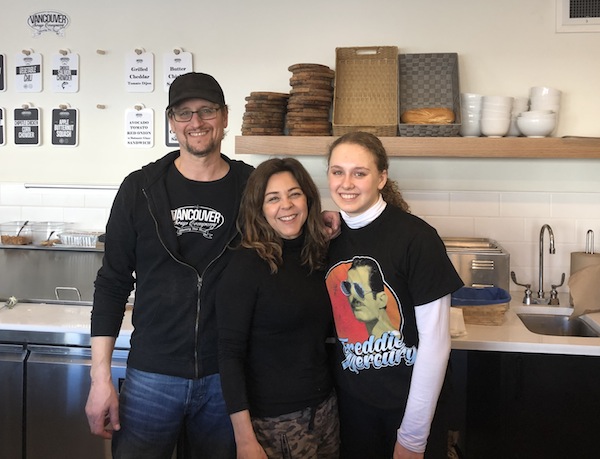
Vancouver Soup Company’s Steven Sloan with his wife Iona Monk and their daughter, Zoe Sloan. (photo by Michelle Dodek)

Soup is comfort food; great for lunch or dinner; light or hearty and always satisfying. Steven Sloan certainly thinks so. He is the owner and creator of the Vancouver Soup Company, a local wholesale business that he set up in May 2015 to serve a demand he saw in coffee shops.

A veteran of the food industry and an avid cook, Sloan’s first customer was Breka Bakery & Café, a 24-hour coffee shop owned by a Jewish family, the Granots. As Breka expanded – they now have five locations around Vancouver – so did the Vancouver Soup Company.

“I get nice comments from my customers. People like the soups…. I haven’t ever lost a client,” said Sloan.

As he pitched his soups to shops all over the city, taking samples with him everywhere he went, he found that his shared kitchen arrangement could no longer accommodate his needs. He took the leap to finding his own production facility in 2018.

He found a large kitchen at 292 East 1st Ave., three blocks east of Main Street. The facility also had an unused area facing the street that looked perfect for a restaurant, he said. “I thought a retail space would be great to generate extra revenue to help pay for the rent. It also helps to build the brand.”

The location is also great for retail, he added, because it’s near the new Emily Carr University of Art + Design campus and there are many offices in the area.

Sloan’s wife, Iona Monk, who works as a couples therapist, did the majority of the publicity the old-fashioned way when the store opened for lunch in early January.

“Iona went to local businesses and apartment buildings and put up fliers,” explained Sloan. “We offer a discount to Emily Carr students, so many of them started walking over for lunch.”

Serving five kinds of soups daily with fresh bread on the side, Sloan also offers two daily sandwiches (one vegetarian) and a salad as well. There is an assortment of baked goods to round off lunch.

Up until the COVID-19 pandemic hit, business was steadily growing, as more and more people heard about the lunch available at the Vancouver Soup Company. Sloan was preparing to open in the mornings starting at the beginning of April. He was going to have smoothies, a hot breakfast bowl and breakfast sandwich as well as freshly baked goods made in-house. But then, coffee shops were forced to close and he had to close his restaurant as well.

Assisted in the sales part of the business by his 15-year-old daughter, Zoe, who is off school indefinitely, Sloan began reaching out on social media. His contacts included Vancouver Talmud Torah, from which his daughter graduated two years ago. The family set up an online order platform for frozen soup with an option for delivery or pick up at the store.

“The community has been very supportive,” said Monk. “We’re doing OK. This terrible situation has forced Steve to grow the business in a way new direction. It shows the potential of this business and that the demand is there.”

In addition to vegetarian, vegan and meat soups, Sloan produces stews and chilis and in his words, a killer mac ’n’ cheese, now all available frozen to go. In this new paradigm, the family feels fortunate to have been able to find a new retail outlet for their business. However, they are hopeful that coffee shops and restaurants will soon be able to reopen so the business can continue to grow. In the meantime, this family continues to serve up the soup – and the comfort – as best they can.

Michelle Dodek is a freelance writer living in Vancouver. She also is the baker for the Vancouver Soup Company, recently incorporating her own business, called ess Baked Goods.

Format ImagePosted on May 15, 2020May 14, 2020Author Michelle DodekCategories LocalTags Breka, Iona Monk, restaurants, soup, Steven Sloan, Vancouver Soup Company
Sponsoring a refugee family

Sponsoring a refugee family

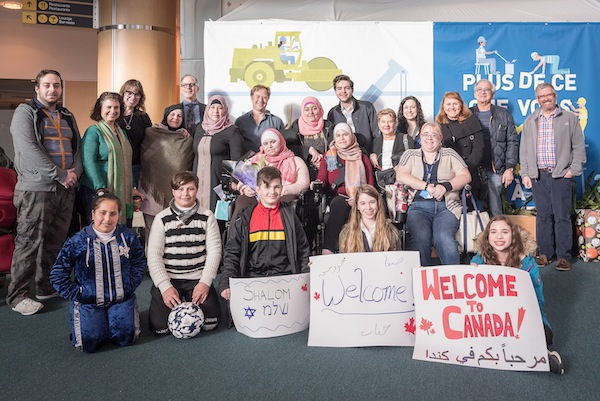
The Alsidawi family, sponsors and congregants at the Vancouver International Airport, January 2019. (photo by Adele Lewin Photography)

Canadian Jews have a long history of standing up for the rights and welfare of refugees. And while Jewish immigrants have often been at the receiving end of this generosity, Vancouver Jewish congregations have played a frequent and often crucial role in ensuring the safe relocation of many non-Jewish refugees as well. They have sponsored refugees from Tibet, families from Vietnam, as well as helped relocate Jews from North Africa and Hungary during times of political unrest. When Canada announced its intention to accept some 25,000 immigrants from in and around wartorn Syria in 2015, many Vancouver congregations once again stepped up to help.

The news of a little Syrian boy whose body had washed up onto a Turkish resort beach in 2015 became a haunting symbol of the war for many Canadians, Rosalind Karby and Miranda Burgess told the Independent. In November of that year, the two women, along with a small cadre of volunteers from congregations Beth Israel and Beth Tikvah, launched an appeal to sponsor a Kurdish family’s immigration to Canada. Karby, who is no stranger to philanthropic initiatives, said the decision to mobilize a sponsorship was a “no brainer” for her, and for many in the local Jewish community. “There’s no question. That [image] sort of galvanized us.”

By 2016, the effort to save Syrian civilians in peril had become an egalitarian issue: Orthodox, Conservative Reform and Renewal congregations here were finding their own ways to fundraise and reach out. In the Lower Mainland, Schara Tzedeck members voted to contribute funds to the Joint Distribution Committee’s humanitarian aid efforts, while Or Shalom, Temple Sholom, Beth Israel and Beth Tikvah applied to the federal government for permission to sponsor families to Canada.

Burgess said, for many, the decision to help fleeing Syrian families emanated from longstanding Jewish experience. “From wandering Aramaeans and other dispossessed Jews to post-Holocaust migrations, to a situation like this, it felt like a very direct line, I think, to a lot of people,” she said.

But, if the ethical decision to provide a lifeline for refugees was a “no brainer,” as Karby put it, the path to bringing that sponsorship to fruition was anything but simple. It was not merely a matter of overseeing their resettlement in Vancouver. There would be a long list of forms to fill out. There were meetings with immigration representatives and members of the Anglican Church archdiocese, which coordinated the sponsorship process for this program. And there were lengthy virtual meetings with the applicant family, who, for the time being, was living in a crowded refugee camp in eastern Jordan.

There was also an “exhaustive” number of details to collect, often over spotty wireless connections, to verify the family’s eligibility: education backgrounds, family histories, residences and connections for all adults. In all, about 40 pages of forms to fill out, said Burgess.

For the family, the application process had its own challenges. For Hanan Alsidawi, the mother, it meant repeated trips to the capital, Amman, an hour-and-a-half drive away from the refugee camp, to secure paperwork, signatures and permission. Her husband, who had been reported missing when the family fled Syria, had not been found. Making it to Canada safely now rested on Hanan’s own initiative and the kindness of strangers thousands of kilometres away in Vancouver.

Sponsoring a refugee family came with considerable financial responsibility. According to the Canadian government, the sponsors were in charge of covering all out-of-pocket costs for the family for one year, including food, lodging and incidentals. That meant the sponsors would need to have a minimum of $40,000 in the bank to qualify. Moreover, Burgess and Karby estimated, that was actually low: for a family of three, the cost of living would be closer to $50,000 a year. The team would need to raise at least $10,000 more than mandated by the government.

“At the time, BI had just completed five years of fundraising for the [synagogue’s] new building,” Karby said. It was also just wrapping up its annual High Holy Day Appeal, another important humanitarian project that relied on the congregation’s support. Asking the entire congregation to take on a third project – and quickly – seemed unrealistic.

After some thought, the sponsorship team decided to take a different tack: they would reach out to a smaller, select group of family and friends who might be able to cover the sponsorship. And they would put a top limit on each donation.

“We determined a maximum gift of $1,000 so that no one person would feel that they should just pay the whole thing and no one person could feel they had to meet up to some high standard,” Karby explained.

But that still meant coming up with at least 40 to 50 donations.

“So, we cast a wide net,” Burgess said. “We worked our networks.”

They appealed to donors both inside the congregations and out. They contacted people they knew had contributed to humanitarian initiatives before. And they appealed to friends far away.

“I went to graduate school in the United States and I have a big network south of the border,” Burgess admitted, noting that the idea struck a chord with American residents as well, “who, because of their own governmental circumstances weren’t able to do sponsorships but felt the same urgency.”

By the end of the appeal, they had received donations from as far away as Michigan, Massachusetts and Maryland. “All were very small, but contributed to the whole,” said Burgess.

They had met their goal – and then some. Karby said Beth Tikvah’s donation of $10,000, whose fundraising was coordinated by David Numerow, put the project over the top, bringing the total to just over $50,000.

Still, it took more than two years for the family to receive approval to immigrate. In January 2019, Hanan and her two children, Mahros and Safa, arrived at Vancouver International Airport to a fanfare of elated family and Jewish congregants. Some of the Alsidawi clan was already living in Vancouver, so Hanan and her children would be able to count on help with things like language interpretation and getting settled in their new city.

We were strangers, too

According to Congregation Beth Israel president Helen Pinsky, quite a number of BI congregants stepped up to support the initiative privately when it was announced. She said she chose to donate because the endeavour resonated with her values as a Jew.

“Many of us had been involved in sponsoring the Vietnamese refugees in the 1970s,” she said. “It had been a very happy, very successful experience for me.”

She said the experience taught her the value of such initiatives. The sponsorship, she said, “is certainly in keeping with our beliefs and how we should behave, according to our forefathers, and it seems like it is consistent with an organization of people who have strong feelings about pikuach nefesh, the saving of a soul.”

Rabbi Jonathan Infeld, who serves as Beth Israel’s head rabbi, said helping others is a core principle to the Jewish faith, specifically because of the historical experiences of the Jewish people.

“Torah tells us that we were foreigners in a foreign land and we need to care about foreigners, and people suffering,” Infeld said. That’s why the congregation – and other synagogues as well – felt it was essential to help Syrian families in distress. “We wanted to take up what the Torah told us in a very real, concrete way.”

Even though sponsors’ financial responsibilities ended in January, their bond with the Alsidawi family has not. Burgess and Karby continue to visit Hanan and her children and check up on their progress. By law, the sponsors are not permitted to offer further funding, and Karby admits that the transition will continue to take time for the small family.

For the volunteers, the past four years of effort was more than a gesture of generosity. It was crucial they help.

“You save one life, you save a world, and we were fated to do what, well, any human being should do, really,” said Karby. “But I think that our Jewish tradition of helping the needy, of trying to save a life definitely propelled Miranda and me.”

“Saving one life is as if you saved a whole world,” Burgess agreed. “And, now that geopolitics has intensified the Syrian crisis again and people are once again fleeing in vast numbers, I am so thankful we were able to help one family. I wish we could have helped all families, but to help one family is something and we were grateful we were able to do it.”

Jan Lee’s articles and blog posts have been published in B’nai B’rith Magazine, Voices of Conservative and Masorti Judaism, Times of Israel, as well as a number of business, environmental and travel publications. Her blog can be found at multiculturaljew.polestarpassages.com.

***

Note: This article has been amended to correct Rosalind Karby’s first name, which was misspelled in the original version.

Format ImagePosted on May 15, 2020June 5, 2020Author Jan LeeCategories LocalTags Alsidawi, Beth Israel, Beth Tikvah, Miranda Burgess, refugees, resettlement, Rosalind Karby, Syria, tikkun olam
Old and new favourite songs

Old and new favourite songs

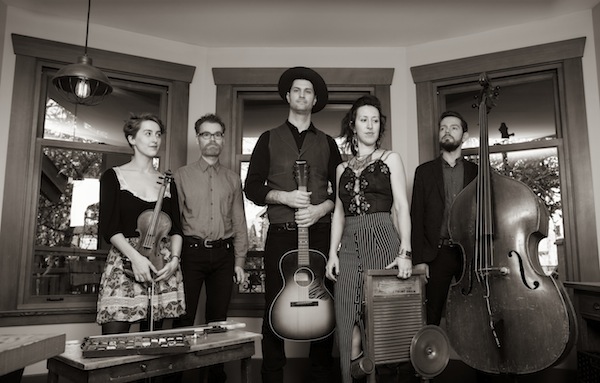
The Burying Ground core duo is Woody Forster and Devora Laye, centre. On their newest album, they are joined by, left to right, Clara Rose, Joshua Doherty and Wynston Minckler. (photo by Mary Matheson)

The Burying Ground had a busy spring and summer planned, with dozens of performances scheduled around the release of their new album, A Look Back, this month. Then COVID-19 arrived and all those shows had to be canceled. Nonetheless, the band has carried on, releasing two singles already, and the full album comes out today, May 15.

“It was hard to let go of all the plans we’d been looking forward to but there’s not much we can do about that part so we haven’t let it get us too down (yet),” Jewish community member Devora Laye told the Independent. Laye, who is part of the core duo of the band, with partner Woody Forster, was philosophical.

“I do think it is important to recognize that we are all grieving in different ways and having to accept the disappointment that comes with all plans changed, canceled or on hold,” she said. “I also want to acknowledge that these plans feel small and that is why I think for me, personally, I haven’t gotten too down about my/our situation. It is a small struggle in the overall picture. We are OK. We are grateful to have what we need, to have each other and to be in this beautiful place by ocean and forest. I feel very sad for people who are suffering the most from this pandemic.”

While yet to live stream a concert, Laye and Forster are making plans for online shows. In the meantime, they are working on new material, which Forster said they “are hoping to iron out in the coming months.”

“I’ve been playing some guitar and Woody has been playing mandolin, which has been really fun!” said Laye, who does washboard, saw and vocals. “We have also been spending more time working on harmonies … [and] finishing up some original songs…. We’re thinking we’ll have enough material for another album later this year or by early next year.”

Their new release, A Look Back, was recorded in January. Forster said the band – he and Laye, plus Wynston Minckler (upright bass), Clara Rose (fiddle and harmonies) and Joshua Doherty (harmonica and harmonies), who have been accompanying the duo on the road for the last couple of years – were planning to be touring with hard copies of it, starting in the spring, to help fund its creation.

“The plan was to hit the road with our new CD on May 1st to play a handful of gigs on Vancouver Island and release the album to those audiences first,” said Laye, who had spent hundreds of hours booking the album shows. “We were looking forward to a 10-day tour to California, starting May 15th, including Northwest Folklife Festival in Seattle. June 5th, we were scheduled to play our local album release show at the Rogue Folk Club at James Hall in Vancouver; we were over the moon to play our album release at one of the best venues around.

“Anyhow, to sum it up – we were expecting to raise enough to press the physical album through our March and early April shows, however, because those didn’t happen, we didn’t have the funds to press the album just yet.”

Hence, releasing the two singles in advance, as well as allowing people to pre-order the album. But pragmatism wasn’t the only deciding factor.

“We really miss playing with the band and playing for crowds and, to be honest, as soon as the final masters came in, I was very eager to share at least some of the music with our family, friends and fans ASAP!” said Laye. “It’s a way to connect with people during the quarantine – I miss the in-person connections and energy from live shows but, for now, we will hope that our songs and the songs we’ve chosen to cover will be a little taste of that connection. I like to imagine that people who are listening to our music are also dancing in their kitchens – or wherever else they like to dance, in a socially distant way.”
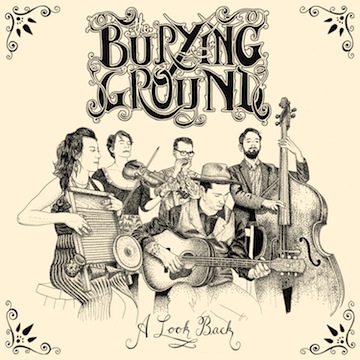
image - A Look Back CD cover, art by YannThe first single released, on April 17, was “How Long.” On the band’s Facebook page, Laye notes that it “is the very first song that we wrote for the Burying Ground. It’s a song about waiting for hard times to pass and better days to come.”

“‘How long ’til my luck’s gonna change’ is the chorus,” she told the Independent. “We typically play this one with crowd participation, which always puts a smile on our faces and helps us connect with the audience. It’s a relatable song about hard times and ‘bad luck.’ It’s a song that deals with struggle, not knowing when the struggle will end. We felt like it’s relatable to our times right now. When I chatted to our recording engineer, Marc L’Esperance, about our release plan/idea, he mentioned that ‘How Long’ is his favourite song off the album and thought it would be an appropriate song to release first.”

“How Long” was first recorded in 2014 and it appears on the Burying Ground first album, Big City Blues. Country Blues & Rags was their next recording, followed by The Burying Ground. (For more on the Burying Ground, see jewishindependent.ca/reinventing-old-time-music.)

On May 1, the band released the second single from A Look Back. Called “Please Don’t Talk About Me When I’m Gone,” Laye said she first heard the song on a Washboard Rhythm Kings recording made circa 1930. “I love it,” she said. “The music and the words. A couple years back, we heard Leon Redbone’s version (who happens to be one of Woody’s favourites). Redbone’s take on the song struck a chord with us and the rendition we’ve recorded is more in that vein.”

“Our music is and always has had a deep connection to older traditional styles that we love to pay homage to,” Forster added. He said the leading song on the new album, “Diving Duck,” was one of the first blues songs he ever learned, “so it felt like a fitting tune to kick the album off with. The recording I first heard of this song was with Sleepy John Estes and Yank Rachell, two great early blues musicians whose guitar and mandolin playing left an early mark for me musically.”

“Behind These Eyes” also has personal meaning for Forster and was one of the early songs that he wrote for the Burying Ground. “It stems from a story my grandfather had told me about his father and his two uncles, who went overseas to fight in the First World War in 1914,” explained Forster. “The war left one of his uncles unable to mentally deal with the things he had seen upon returning home. It was a powerful conversation for me and I feel like, with the current awareness now of PTSD that did not exist at that time, it made me really think about what he may have gone through.”

About the song “C Rag,” Forster said, “All of us being big fans of the guitar virtuosity of Gary Davis and his contribution to fingerstyle guitar, we felt that this instrumental number fit perfectly into the record.” And the Burying Ground pays tribute to another great American blues and ragtime musician on A Look Back, Arthur (“Blind”) Blake, doing their interpretation of Blake’s “Hey Hey Daddy Blues.”

The new album also includes the song “You Gotta Live So God Can Use You.”

“Early gospel music played such an important role in all of the music that we love from the early 20th century and we wanted to have this represented on our record,” said Forster. “The song may date back to the late 1800s, though I am not sure, but it is definitely the oldest tune we play.”

Rounding out the album is the Burying Ground’s take on “My Blue Heaven.”

“In the last couple years,” said Forster, “the band has been experimenting more with including early jazz songs into our repertoire and ‘My Blue Heaven’ instantly sat really well with the band. Devora’s saw playing gives it a dream-like quality, which seemed to suit the song so well and made it a fitting number to close the album with.”

In addition to A Look Back, Forster and Laye have put online for purchase the album Dire Wolves by the Dire Wolves.

“We’ve been wanting to put the album up online for awhile but, as we haven’t been a real band for some years now, it’s slipped our minds,” explained Laye. “When the quarantine time began and we had all this unexpected time on our hands, we figured it’d be a good time to get it up online. We love the album!”

The album was recorded in 2010, said Laye, but released in 2012. She, Forster, Doherty (who has been a member of the Burying Ground since the beginning) and Blake Bamford (lead vocals, guitar) comprised the group.

“Those boys played music together pre-Dire Wolves, in a group called the Whiskey Jacks (2004- 2007). I sat in on washboard for a handful of Whiskey Jacks gigs!” said Laye. “We also played with Joseph Lubinsky-Mast, who has become one of Vancouver’s finest and most in-demand upright bass players; he toured and recorded with the Burying Ground until the end of 2018. We’ve all been friends for a long time and, back then, we didn’t really know anyone else playing traditional styles of folk (blues, stringband) music.

“When Blake Bamford, aka Big Fancy, moved up north to a rural farm in Fort Fraser, B.C., the Dire Wolves split ways,” she said. “Woody and I were left without a band, without a guitar player and lead singer and wanted to continue playing music in a similar vein. That’s when he started learning guitar – and it became his main instrument. I got more serious about percussion and I started to sing (in public)!” Thus, the Burying Ground came into being.

While grateful for their relatively good situation, Laye admitted, “The uncertainty is tricky. Do we continue booking tours? Do we wait it out? All events have been canceled for the summertime. Will September be different? Woody and I are booked for a two-week tour (as a duo) in October. Will that happen? I would normally be contacting venues on our route to book, I haven’t. Artists are at a loss as to how to go forward…. So many venues don’t even know how they’ll make it through this.”

She concluded, “I hope we can come out of this to a better, more connected, world. A world where we take care of each other: humans, plants, animals and the planet that sustains us.

“We miss playing shows and connecting with people all over,” she said, “and really look forward to whenever it is that we can do that again.”

The band’s website is theburyingground.com.

 

Format ImagePosted on May 15, 2020May 14, 2020Author Cynthia RamsayCategories MusicTags blues, coronavirus, COVID-19, Devora Laye, ragtime, The Burying Ground, Woody Forster

Posts pagination

Previous page Page 1 … Page 262 Page 263 Page 264 … Page 664 Next page
Proudly powered by WordPress