Skip to content
  • Home
  • Subscribe / donate
  • Events calendar
  • News
    • Local
    • National
    • Israel
    • World
    • עניין בחדשות
      A roundup of news in Canada and further afield, in Hebrew.
  • Opinion
    • From the JI
    • Op-Ed
  • Arts & Culture
    • Performing Arts
    • Music
    • Books
    • Visual Arts
    • TV & Film
  • Life
    • Celebrating the Holidays
    • Travel
    • The Daily Snooze
      Cartoons by Jacob Samuel
    • Mystery Photo
      Help the JI and JMABC fill in the gaps in our archives.
  • Community Links
    • Organizations, Etc.
    • Other News Sources & Blogs
    • Business Directory
  • FAQ
  • JI Chai Celebration
  • JI@88! video

Recent Posts

  • BGU fosters startup culture
  • Photography and glass
  • Is it the end of an era?
  • Taking life a step at a time
  • Nakba exhibit biased
  • Film festival starts next week
  • Musical with heart and soul
  • Rabbi marks 13 years
  • Keeper of VTT’s history
  • Gala fêtes Infeld’s 20th
  • Building JWest together
  • Challah Mom comes to Vancouver
  • What to do about media bias
  • Education offers hope
  • Remembrance – a moral act
  • What makes us human
  • המלחמות של נתניהו וטראמפ
  • Zionism wins big in Vegas
  • Different but connected
  • Survival not passive
  • Musical celebration of Israel
  • Shoppe celebrates 25 years
  • Human “book” event
  • Reclaiming Jewish stories
  • Bema presents Perseverance
  • CSS honours Bellas z”l
  • Sheba Promise here May 7
  • Reflections from Be’eri
  • New law a desecration
  • Resilient joy in tough times
  • Rescue dog brings joy
  • Art chosen for new museum
  • Reminder of hope, resilience
  • The national food of Israel?
  • Story of Israel’s north
  • Sheltering in train stations

Archives

Follow @JewishIndie
image - The CJN - Visit Us Banner - 300x600 - 101625

Rabbi launches book at BI

Rabbi launches book at BI

Rabbi Paul Plotkin returns to Congregation Beth Israel for the Canadian launch of his new book, Wisdom Grows in My Garden. (photo from AIA Publishing)

In part to fill his need to nurture – his kids off to college and his congregation less reliant on him – Rabbi Paul Plotkin took up gardening. Not only has he produced some of the most expensive tomatoes, taking into account all the capital that goes into every one that makes it into a salad or sandwich, but he has produced a new book: Wisdom Grows in My Garden (AIA Publishing). And he will launch that book in Canada on May 10, 7:30 p.m., at Beth Israel Synagogue, where he began his rabbinical career.

“I started in the summer of 1976 as Rabbi [Wilfred] Solomon’s first assistant, and he left for Israel after breaking his Yom Kippur fast on the way to the airport, and the 26-year-old ‘kid’ took over. Rabbi [Marvin] Hier was away from the Schara Tzedeck for most of the year preparing to build what was to become the Simon Wiesenthal Centre, so I was thrust into the position of often being the Vancouver non-Reform senior rabbi. It was quite a ride. It was a good thing I didn’t know what I couldn’t do, or I would have been paralyzed with fear. Instead, I jumped in and went to work.”

While BI was his first pulpit, Plotkin said, “I had been a youth director of my home synagogue while in college and in New York while at the seminary. I learned a lot about programming and leadership from those jobs and translated it into heading a synagogue.”

He admitted that the experience “was not without mistakes but what I couldn’t entirely appreciate was the menschlichkeit of my members. They appreciated my enthusiasm, my passion and my sincerity and pardoned most of my excesses and faults. It was a truly Canadian thing. I know now how special it was because my other two congregations in Florida were a lot different. Years later, I would share privately that my ‘worst critics’ in Vancouver treated me better than my good friends in Florida. By being thrown into the fire and succeeding – succeeding was a low bar, if the shul was still standing when Rabbi Solomon returned, I would have been praised – I learned of the potential people had for change, of their desire for knowledge, and that I could actually help transform people into greater commitment to mitzvot and the Jewish people.”

Plotkin was born and raised in Toronto, but has lived in South Florida for more than four decades. He is rabbi emeritus of Temple Beth Am and served on the Rabbinical Assembly’s committee on Jewish law and standards for some 20 years. He is the founding chair of its kashrut subcommittee and also is in charge of kashrut for Ben’s Kosher restaurant chain. He loves food and cooking. And Canada still holds a special place for him – he and his wife own a townhouse in Whistler, “primarily as a new summer cottage for after retirement,” he said. “We will be there for four months this summer.”

An avid writer, publishing articles in various newspapers and magazines, Plotkin has a blog on medium.com. He published a book some 20 years ago – The Lord Is My Shepherd, Why Do I Still Want?: Ancient Wisdom for the Modern Soul (Eakin Press) – but waited until retirement to write his second.

“First, in those days, I had to triage my time and creative mental energy. I also needed more age and seasoning for all of the pieces to melt together. Pirkei Avot teaches us to see wisdom in the elderly. Great red wine isn’t great in its first year. It takes years to develop nuance and subtlety. Creation of the book was no different.”

The idea came to him in a dream, he said.

“Unfortunately, I was still in my active work years, with an 1,100-family congregation. Finding time to breathe was hard, let alone write a book, so I made it a priority in retirement. Over the years after the dream, new ideas would come to me in the garden and I would jot them down and throw them into a file with the dream material.”
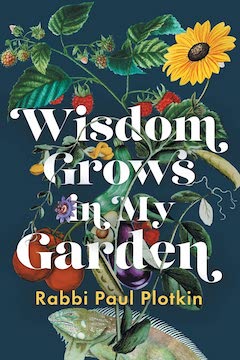
image - Wisdom Grows in My Garden book coverIn describing the book, Plotkin said, “Technically, it is a narrative memoir, because it is my story and told entirely from my perspective, but it is not in its heart a memoir. It revolves around the garden, but you won’t improve your tomato growing by reading the book. It is, in essence, a life lesson book (indeed, there are 25 life lessons in the book) that will help guide you to a better life. It is filled with humour and stories, two tools that featured prominently in 40 years of sermons. It will offer the reader some important guides to navigating a better life. I like to tell Jewishly knowledgeable audiences that the garden was my ‘Torah,’ my book is the Midrash.”

Plotkin said “gardening is a wonderful emotional and humbling pastime” and cited a recent article that “extolled its value as an alternative choice for exercising.”

“If you haven’t got time,” he said, “try a few herbs in a pot on the windowsill. If you have a black thumb, grow zucchini. In northern climates, everyone grows so many, they start to call friends they don’t have to offer them some. If you read the book, the irony of this last statement will become clear.”

Of the feedback he has received so far – from readers in his own demographic, as well as that of his mid-40s son, from Jews and non-Jews, from observant people and atheists – Plotkin said, “much to my shock, they all liked it and, yet, like a Rorschach test, they all found messages in my lessons that reflected their needs or interests. There is something in this book for everyone.”

Chapter 1 of Wisdom Grows in My Garden takes place at Beth Israel, said Plotkin. “I hope many readers and especially those who may remember me from their bar/bat mitzvahs and weddings that I officiated at will come out to the evening and say hello,” he said.


Format ImagePosted on April 28, 2023May 1, 2023Author Cynthia RamsayCategories BooksTags Beth Israel, education, gardening, lifestyle, Paul Plotkin
Celebration of Israeli culture

Celebration of Israeli culture

Mark your calendars for May 14. The Festival of Israeli Culture, a one-day free series of events at the Jewish Community Centre of Greater Vancouver, is a multicultural celebration of music, dance, art, sports, food and drink.

photo - Kids enjoying last year's Festival of Israeli Culture
Kids enjoying last year’s Festival of Israeli Culture. (photo by Galit Lewinski)

Get ready for community drumming by the Drum Café, Israeli dance, Mediterranean belly dancing, flamenco and the Israeli Choir, followed by a sing-along with well-known Israeli musician Elad Shtamer. And that’s not all! Join Maccabi-Mania with gym-based activities for all ages, the sassy sesame cooking workshop, intuitive painting, and calligraphy workshops.

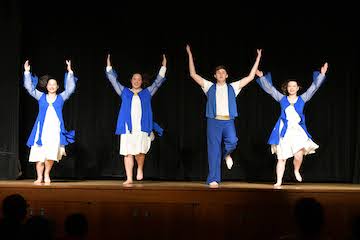
photo - Dancers at last year's festival
Dancers at last year’s festival. (photo by Galit Lewinski)

For adults, there is a range of 19+ programs, including an Israeli wine tasting and cocktail party to sample some arak-based cocktails (arak is an alcoholic drink made primarily with aniseed and grapes) followed by an exhibition of video art from Bezalel Academy of Art and Design in Israel.

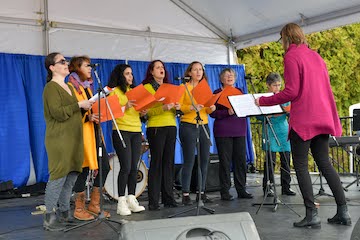
photo - Music is a part of the celebrations
Music is a part of the celebrations. (photo by Galit Lewinski)

In addition to the performances and activities, the festival will have a market featuring a variety of eats from local vendors and food trucks, along with hand-poured candles, jewelry, clothing, arts and crafts, Judaica, and more.

The Festival of Israeli Culture on May 14 runs from 11 a.m. to 5 p.m. at the JCC. While all events are free of charge, food donations to the Jewish Food Bank are encouraged. For more information, visit israelifestival.com.

– Courtesy Jewish Community Centre of Greater Vancouver

Format ImagePosted on April 28, 2023May 7, 2023Author Jewish Community Centre of Greater VancouverCategories Performing ArtsTags dance, food, Israeli culture, JCC, music
KDHS gala coming soon

KDHS gala coming soon

King David High School Golden Thread Gala co-chairs Heidi Seidman, left, and Sherri Wise. (photo from KDHS)

Heidi Seidman and Sherri Wise are excited to be back as co-chairs of the gala, which this year takes place May 18, 6:30 p.m., at Congregation Beth Israel. Having a combined three kids at the school, they recognize that Jewish high schools provide a unique environment for students to learn about their Jewish identity, while receiving an amazing education. An emphasis on values such as tikkun olam (repairing the world), social justice, community service, instilling a sense of responsibility and commitment to making a positive impact on the world, are just a few of the amazing things students learn.

This year, the annual Golden Thread Gala fundraiser celebrates 18 years of the school on Willow Street. For 18 years, the halls of KDHS have been filled with immersive Jewish and academic learning. This education is the golden thread that weaves the past and present together, shaping the next generation of students and alumni.

The gala evening includes dinner, entertainment, photo booth, silent auction, wine wall and raffle. For tickets, visit goldenthreadgala.com.

– Courtesy King David High School

Format ImagePosted on April 28, 2023April 26, 2023Author King David High SchoolCategories LocalTags fundraising, gala, KDHS
Powerfully against othering

Powerfully against othering

Into the Little Hill runs May 19 and 20 at SFU Goldcorp Centre for the Arts, Fei and Milton Wong Experimental Theatre. (photo by Flick Harrison)

“Into the Little Hill is a powerfully emotional opera,” soprano Heather Pawsey told the Independent.

Pawsey is the artistic director of Astrolabe Musik Theatre, which, with Simon Fraser University Woodward’s Cultural Programs, is presenting the opera’s Canadian première May 19-20. A multidisciplinary, modern take on the medieval story of the Pied Piper of Hamelin, Into the Hill features two singers, three dancers and live music. Written by English composer George Benjamin with libretto by Martin Crimp, Jewish community member Idan Cohen of Ne.Sans Opera and Dance is the local production’s director and choreographer.

“From the moment I first heard Into the Little Hill, I knew I had to have dancers in the production,” said Pawsey. “My company, Astrolabe Musik Theatre, has been experimenting with dance and movement in classical music, in varying degrees, for over 10 years now. Dance and movement are such normal, natural, innately human ways of expression, yet we see it so rarely in opera and classical music.”

When she heard Into the Little Hill, she said, “I literally saw the dancers in my mind … and knew that this was the perfect opera to intentionally incorporate them as amplifications of the characters, as commentators on the story, and as true partners with the singers (who are also precisely choreographed).”

After that, she was just “waiting for the perfect person with whom to work.” And she found that person in Cohen – his company, Ne.Sans, exists to reimagine and reconnect opera and dance.

“When Idan and I met in Amsterdam in 2018 on an opera I was singing and he was directing, I knew at the first rehearsal that he was the person I’d been waiting for: someone who knows music, who knows dance, who can work with professional dance artists and with singers who may have little or no dance training, and whose knowledge and experience come together in a profound understanding of the possibilities of singing and dance.”

“We’ve connected on so many levels,” said Cohen of Pawsey, who introduced him to Into the Little Hill. “Since then,” he said, “we’ve enjoyed many long conversations about this wonderful opera that is so close to both our hearts. I am so excited to finally be able to share our version of this brilliant work.”

“As far as I know,” said Pawsey, “l’Opéra de Montréal is the only other company in Canada to have produced one of George Benjamin’s operas (Written on Skin, his second). In 2014, I watched Written on Skin on MediciTV and literally got goosebumps. Singing contemporary music is a huge part of my career, yet I had never heard of this composer nor heard music anything like his: crystalline, precise, profound, spare, yet filled with emotion, colour, shadow, passion and power. I looked him up immediately and discovered that Into the Little Hill was (at that time) the only other opera he’d written…. I knew then that I had to produce (and sing!) it; that it would have dancers; and, voilà! A decade later, here we are. This opera speaks so profoundly against ‘othering.’ I know that people will come away having experienced something powerful, intense and beautiful.”

Pawsey and mezzo-soprano Emma Parkinson sing all six of the opera’s characters.

“One of the things I love the most about Into the Little Hill is its exquisite precision,” said Pawsey. “Vocally, orchestrally, dramatically, dramaturgically there are no extraneous notes, no extraneous words, and the power of this concentration is intensified by having only two singers portray all the roles. We aren’t distracted by multiple singers coming on and off the stage, nor by the differing ranges and timbres of their voices – we have focus.

“We also have gender-neutrality, something that is difficult to achieve in traditional opera, where characters’ genders have historically been determined by voice-type (ie. tenor, soprano, etc.). Having only two singers sing all the roles makes gender, sexual orientation or how one presents to the world irrelevant, and leaves the make-up of the characters to each individual audience member’s imagination. As an artist, it frees me from having to imagine or recreate assumptions about how ‘men’ or ‘women’ move, behave and speak (sing), and allows me to enter fully into what that character is actually expressing. My hope is that this also helps audiences to identify more freely with the characters.”

The opera speaks to Cohen on many levels.

“As a queer artist, a descendant of Holocaust survivors, coming to Canada from Israel/Palestine, I have always valued the importance of raising voices of underserved communities and to acknowledge our troubled past, learn from it, and aspire to do better,” he said. “I chose to leave my country in search of a better future and, as I arrived in Canada in 2017, I was amazed to find how relevant the history of Canada is to my own, from multiple angles, both as the oppressed and the oppressor, often against my will.

“My work is embedded in this life experience and perspective, and I am passionate in telling classical stories through alternative lens,” he continued. “Into the Little Hill is such a powerful opera that speaks of the human condition in a very creative way. There are different ways to speak of the tragic history of Western culture, and one of the reasons I chose to be an artist is because I see the importance of speaking of the violence and hurt, and to fight against discrimination.

“This opera is such a great, complex example of the fact that there is no one source of harm, and not one source of knowledge and perspective,” he said.

Critics have generally lauded Into the Little Hill, though some have expressed concern over the way in which the story is told.

“The narrative style of this opera imposes a certain detachment or distancing,” Pawsey said. “Traditionally, opera is all about emotion – big, huge, dare I say OPERATIC emotion! Here, Martin Crimp’s libretto uses Brechtian techniques (such as the Narrator directly addressing the audience, breaking the fourth wall, etc.) to discourage the audience from becoming too emotionally involved. Brecht used these techniques to encourage a deeper focus on the socially significant aspects of the story. This is particularly relevant in this opera’s tale of ‘who are we labeling as the “rats” in our society, what are we willing to do to get rid of them and what happens when we refuse to “pay the piper,” ie. take responsibility for the consequences of our actions?’

“Detachment, distancing – this is what we, as humans, do when we label, when we ‘other,’ when we divide into ‘us’ and ‘them.’ It’s a part of the de-humanizing process, which allows us to plan or to undertake horrific acts. But this is not to say that audiences will feel emotionless at the end of Into the Little Hill,” she stressed. “Fascinatingly, the muting of emotion evoked for individual characters and their stories makes us feel even more deeply and keenly the emotion of the story overall and how its outcome affects all the characters – and, by extension, us.”

Into the Little Hill takes place at SFU Goldcorp Centre for the Arts, Fei and Milton Wong Experimental Theatre. Conductor Leslie Dala is music director for the production, whose orchestration includes bass flute, basset horns, mandolin and banjo. Lighting design is by Victoria Bell, with costume design by Elena Razlog. The dancers are Juolin Lee, Daria Mikhalyluk and Hana Rutka.

For tickets and more information, visit littlehill.eventbrite.ca.

Format ImagePosted on April 28, 2023April 26, 2023Author Cynthia RamsayCategories Music, Performing ArtsTags Astrolabe Musik Theatre, dance, Heather Pawsey, Idan Cohen, Into the Little Hill, Ne. Sans, opera, theatre

Witness to “longest hatred”

The Vancouver Holocaust Education Centre maintains significant holdings of Nazi and antisemitic propaganda that bears witness to centuries of anti-Jewish hatred. Acquired through the generosity of local historians and collectors – Peter N. Moogk, professor emeritus, history, University of British Columbia; Kit Krieger, Joseph Tan, Harrison and Hilary Brown, and others – the propaganda in the VHEC collection promoted antisemitic stereotypes, including Nazi ideology, in Europe and North America from 1770 to the postwar period. Although the content is offensive, these primary sources serve as an important historical record of the “longest hatred.”

The study of propaganda is critical to Holocaust scholarship. Historic antisemitica reveals a cultural tradition in Europe that the Nazis were able to exploit in pursuit of their “Final Solution.” The stereotypes found in Nazi propaganda were hardly new; Nazi propaganda was built upon the same antisemitic rhetoric and tropes that had been repeated over centuries and across countries and continents. Viewed in this context, propaganda provides insight as to why the Nazis’ message met with little resistance from an audience familiar with the language and imagery of anti-Jewish hatred.

The study of propaganda is also important to our understanding of the use of a state’s authority to control targeted segments of its population. This dynamic is explored in the VHEC’s new exhibition, Age of Influence: Youth & Nazi Propaganda. Drawing upon diverse primary sources, Age of Influence examines the Nazis’ efforts to manipulate the experiences, attitudes and aspirations of German children and teens.

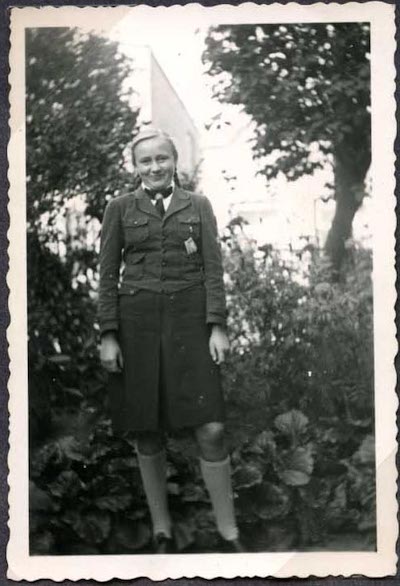
photo - Photograph of a girl wearing the uniform of the League of German Girls, circa 1940. Donated by Peter N. Moogk
Photograph of a girl wearing the uniform of the League of German Girls, circa 1940. Donated by Peter N. Moogk. (photo from VHEC)

Many of the materials featured in this exhibition will be new to visitors, such as family photographs, Nazi youth magazines and anti-Roma youth fiction. Other artifacts will be instantly recognizable, like the infamous children’s books on display at the VHEC for the first time: The Poisonous Mushroom (Ernst Hiemer, Der Giftpilz, Nuremberg: Stürmerverlag, 1938) and Trust No Fox (Elvira Bauer, Trau keinem Fuchs auf grüner Heid und keinem Jud auf seinem Eid [Trust No Fox on his Green Heath and No Jew on his Oath], Nuremberg: Der Stürmer Verlag, 1936). Age of Influence is designed to encourage active engagement with these artifacts and images. Throughout the exhibition, questions prompt visitors to critically analyze materials on display and identify common techniques used to disseminate both positive and negative propaganda.

The exhibition’s storyline begins in the early 20th century, when youth in Germany started defining themselves as a distinct socio-cultural group, attracting the attention of parties across the political spectrum. Popularized by youth-led groups like the Wandervogel, the German youth movement sought independence from adult authority and embraced communal and back-to-nature ideals. Their activities focused on hiking, survival skills and group pursuits in nature. Against this backdrop, the Nazi party emerged and cast itself as the future-facing “movement of youth.” With its Hitler Youth organization, the Nazi party tapped into the German youth movement and set its sights on this demographic to shape the future of a “racially pure” and physically fit national community.

Age of Influence examines how the Hitler Youth became the regime’s most effective tool to indoctrinate children and teens in Nazi ideology. It offered German youth a powerful group identity and appealed to adolescent yearnings such as the desire to belong, the quest for action and adventure, a sense of purpose and independence from parents. With separate organizations for boys and girls, Hitler Youth glorified gender roles. Boys were prepared for military and leadership responsibilities while girls were groomed to become wives, mothers and caregivers for the nation.

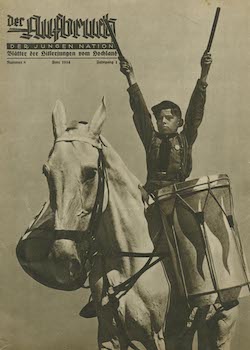
image - June 1934 issue of Der Aufbruch, a Hitler Youth magazine. Donated by Joseph Tan
June 1934 issue of Der Aufbruch, a Hitler Youth magazine. Donated by Joseph Tan. (image from VHEC)

An array of Nazi youth magazines from 1934 to 1943 are featured in Age of Influence, as well as family photographs, collectible cigarette cards, video clips and Hitler Youth paraphernalia. Visitors can browse the pages of Nazi youth magazines to discover for themselves the eye-catching fonts, unique graphics and captivating images, which were carefully designed to attract young audiences. At its height, the Nazi youth press published 57 different magazine titles for children.

While participation in Hitler Youth was compulsory for most children, Jewish youths were banned from membership. Their experience is given voice in the exhibition by local survivors. In video testimony clips, Serge Vanry, Jannushka Jakoubovitch and Judith Eisinger describe their feelings of fear, shame and rejection as Jewish children confronted with pervasive antisemitic propaganda and excluded from the activities of their non-Jewish peers.

Perhaps the best-known propaganda tactic used by the Nazis was the creation of common enemies. Antisemitism and racism were key educational goals in the Nazi German school system, where students were taught that the health of the German nation was threatened by “inferior” groups like the Jews, Roma and individuals with disabilities. By demonizing and scapegoating these groups, the Nazis created a climate of hostility and indifference toward their treatment. Age of Influence depicts this process with reference to artifacts such as children’s books and instructional posters used in German schools.

Contextualizing Nazi propaganda within a broad historical framework is essential. For this reason, Age of Influence has been mounted in conjunction with In Focus: The Holocaust through the VHEC Collection. In Focus presents a thematic history of the Holocaust, illustrated by artifacts donated to the VHEC by local survivors and collectors. A curated selection of antisemitica in this exhibition conveys the long-held perceptions and representations of Jews through time.

This history is also important as we navigate escalating antisemitism and racism around the globe and in Canada, where reports of antisemitic incidents have reached record levels. The use of digital media has amplified hate, and the ease with which disinformation can be spread on social media platforms perpetuates Holocaust distortion and denial. In this milieu, it is imperative to equip students with the media literacy skills required to critically evaluate information they encounter. Age of Influence will assist educators to promote key curricular objectives such as digital literacy, critical thinking and social responsibility.

For more information on Age of Influence and In Focus, visit vhec.org.

Lise Kirchner has worked with the Vancouver Holocaust Education Centre since 1999 in the development and delivery of its educational programs. She was part of the exhibition team that developed Age of Influence: Youth & Nazi Propaganda, along with Tessa Coutu, Franziska Schurr and Illene Yu. This article was originally published in the VHEC’s Spring 2023 issue of Zachor.

Posted on April 28, 2023April 26, 2023Author Lise KirchnerCategories LocalTags antisemitism, education, exhibits, Holocaust, Nazis, propaganda, Vancouver Holocaust Education Centre, VHEC
RJDS celebrates 30 years

RJDS celebrates 30 years

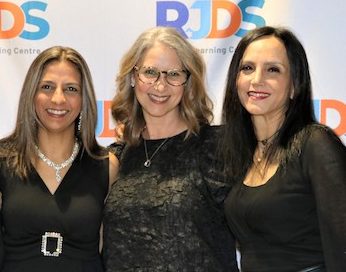
Founding RJDS society members with their original photo: Cindy Rozen, left, Marvin Lithwick and Marilyn Jordan. (photo by Lianne Cohen Photography)

On March 19, the Richmond Jewish Day School (RJDS) gymnasium became a fancy ballroom as students, alumni, school parents past and present, staff and others reconnected and shared stories of the “small community school with big dreams” as RJDS marks its 30th anniversary. The event was one of a series this spring to celebrate the special year.

According to Cindy Rozen, who helped start RJDS, the impetus to build a Jewish day school in Richmond sprang from a 1989 report by the Jewish Federation of Greater Vancouver, which identified such a need in the southwest metropolitan area. A group of parents in Richmond convened and planned to implement a shared vision that their children should receive both a quality secular and Jewish education, believing it vital to reinforce Jewish values and traditions.

“Starting a day school is fraught with many major challenges, such as finding funding, a location, students, hiring teachers, designing a curriculum, etc.,” Rozen said. “But, with the hard work and determination of the founding board members, the support of the Jewish community in Richmond and Jewish Federation – and, in particular, Ted Zacks and Bernard Pinsky – RJDS opened its doors.”

As Shael Wilder, the first school board president, said in a short movie created by Heirloom Films in 2013 about RJDS’s early days, “We used to joke we were planning to open a Jewish day school with the minor obstacles of having no premises, no prospective students, no teachers, no administrative staff and no money.”

RJDS’s first classes were taught in September 1992 in a single modular building situated in the parking lot of Congregation Beth Tikvah. There were 52 students, and it went from kindergarten through Grade 3. The school’s founders – which included Rozen, Wilder, Joan Cohen, Beverly Imerman, Bev Davis, Marilyn Jordan, Rabbi Martin Cohen, Marilyn Berger, Rozanne Kipnes, Marvin Lithwick and Faye Elias – were dedicated to seeing RJDS continue to grow.

In 1998, the school moved to its current location on No. 5 Road, with more grades added in subsequent years. The modular building was brought to the site as well and, today, renovated and refurbished, it houses the RJDS Early Learning Centre.

Throughout its history, the school has welcomed hundreds of students from diverse backgrounds and experiences, added new programs and services, and transformed in ways that could not have been imagined 30 years ago.

photo - Left to right: principal Sabrina Bhojani, Reesa Pawer and Batsheva Michaeli. Szeplabi, Pawer and Michaeli are part of the 30th birthday planning committee
Left to right: principal Sabrina Bhojani, Reesa Pawer and Batsheva Michaeli. Szeplabi, Pawer and Michaeli are part of the 30th birthday planning committee. (photo by Lianne Cohen Photography)

“Through it all, the school has remained steadfast in our commitment to our core values. We believe that every student has the potential to achieve greatness, and we are dedicated to helping them reach their full potential by providing them with the tools, resources and support they need to succeed, in a caring and collaborative environment,” said RJDS principal Sabrina Bhojani in a speech at the March celebration. “Additionally, our commitment to Jewish values and traditions has remained a constant. Through a strong Jewish education, students can develop a deep and meaningful connection to their personal identity, the Hebrew language and the traditions and customs of their culture.”

Bhojani emphasized, “We believe that a strong and supportive community is essential to the success and well-being of our students, and we work hard to foster this sense of community through our haimish [homey] environment each and every day.”

From weekly Shabbat celebrations to annual school-wide holiday events, Bhojani said RJDS is continually exploring means to bring students, staff and families together in relevant and purposeful ways. “We believe that these connections are not only important for our students’ academic success, but also for their emotional and spiritual well-being. Over the years, this community has cared for one another through good times and bad. We have watched our students grow and thrive, and we have celebrated their achievements and milestones as if they were our own children,” she said.

photo - Alumni students at the cocktail party, left to right: Matan Pawer, Adrian Freedman, Sydney Freedman, Zach Moss, Devin Gorski and Trevin Keil
Alumni students at the cocktail party, left to right: Matan Pawer, Adrian Freedman, Sydney Freedman, Zach Moss, Devin Gorski and Trevin Keil. (photo by Lianne Cohen Photography)

Looking ahead, Bhojani said the school is excited to keep building on the strong foundation it has established over the past 30 years. “We are committed to staying at the forefront of educational innovation, to providing our students with the tools and skills they need to succeed in a rapidly changing world, and to fostering a strong sense of community and connection to Jewish values and identity,” she said.

“Although those first students did not have a proper building, gym or even computers, they all continued on to higher education,” noted Rozen. “Today, they are contributing to communities, both here in Canada and around the world – in the U.S., Israel, Europe and even India. We are so proud that, 30 years later, RJDS continues to enrich the lives of so many children who are our future.”

Reesa Pawer served as co-chair for the RJDS 30th birthday planning committee, with Batsheva Michaeli, Lisa Altow and Rinata Yaffe as committee members.

Sam Margolis has written for the Globe and Mail, the National Post, UPI and MSNBC.

Format ImagePosted on April 28, 2023December 10, 2023Author Sam MargolisCategories LocalTags anniversary, Cindy Rozen, Richmond Jewish Day School, RJDS, Sabrina Bhojani
Giving back to others

Giving back to others

Courtney Cohen delivers donations to Jewish Family Services as part of this year’s Rose’s Angels. (photo from Rose’s Angels)

Since 2012, Rose’s Angels has donated more than 7,000 care packages to date in honour of Rose Lewin and Babs Cohen, Courtney Cohen’s grandmothers.

Rose’s Angels falls under the umbrella of the Kehila Society of Richmond, where co-founders Courtney Cohen and Lynne Fader, co-executive director of the Kehila Society, established the passion project together.

A Holocaust survivor, Rose Lewin met the love her life, Joseph Lewin, in Vancouver, where they started a family. She raised her children and grandchildren with love and support, instilling the importance of giving back to those in need.

“Every Sunday, dinner was hosted at my grandmother’s home and it was an open door policy for bringing whoever we wanted…. There was never a shortage of home-cooked food to be had and love to be shared,” said Cohen.

With the support of donors and community members, Rose’s Angels was able to donate to 13 not-for-profit agencies this year. Some of the recipient agencies were Turning Point Recovery, Heart of Richmond AIDS Society, Mamas for Mamas, Pathways Clubhouse, Richmond Family Place, Jewish Family Services and Chimo Community Services.

With inflation, agencies are seeing more and more families needing support for basic items. Every year, the agencies are asked what their clients would like to receive and, this year, the consensus for what was most-needed included personal hygiene items, baby formula, and gift cards to grocery stores or pharmacies – gift cards allow Rose’s Angels recipients the freedom to purchase what they need on their own.

Organization of this year’s event began in January, with donation letters sent out to partner agencies, family friends and community members. In February, monetary and physical donations were collected, Richmond Jewish Day School hosted a hygiene collection drive and grocery gift cards were purchased. Last month, all the donations were delivered with the help of volunteers.

“Giving back can set a positive example for others in the community, particularly children and youth. It can inspire others to get involved and make a difference in their own way. Having given birth to a daughter this past year, it has made me more aware of why community events like ours are so important to continue,” said Cohen. “Donating to those in need can make a significant difference in someone’s life. It can provide hope, support and a sense of community for those who may be struggling.”

Rose’s Angels hopes to bring back its in-person packaging event in 2024. To learn more or donate to Rose’s Angels, email [email protected] or call the Kehila Society at 604-241-9270.

– Courtesy Rose’s Angels

Format ImagePosted on April 28, 2023April 26, 2023Author Rose’s AngelsCategories LocalTags Courtney Cohen, Kehila Society, Lynne Fader, tikkun olam

Positives of being older

While some seniors see growing old as a negative, it really is an adventure, said clinical psychologist Miguel Mendez, a facilitator for the Jewish Seniors Alliance of Greater Vancouver’s Peer Support Services program.

Mendez was the featured speaker at the March 28 JSA-Snider Foundation Empowerment Series lecture, which took place over Zoom. His theme? The “Positive Adventures of Being an Older Adult.”

The program was cosponsored by JSA, Jewish Family Services and the Peretz Centre for Secular Jewish Culture. It was opened by Gyda Chud, coordinator of the JSA’s program committee, and concluded with a Q&A facilitated by Tamar Stein, coordinator of the seniors group at JFS.

Mendez shared how he was close to his grandmother and how well she had organized the last 10 years of her life: she volunteered at a stationery shop, loved to dance with her grandchildren and to travel and visit family; she was passionate about talking with people.

How should we feel about growing older? he asked. Should we be afraid, uncertain, reluctant or should we interpret the changes in a positive way? To get to the answers of these questions, he asked another: What is the difference between an emotion and a feeling? The difference is in the interpretation, he said.

The cultural value placed on beauty and youth contrasts with the wisdom and guidance that comes with aging, Mendez argued. All of us will die eventually and ageism ignores this fact, he said. In his view, we need to regard aging as a gift and an opportunity to age with vitality. Seniors definitely experience loss of energy and of physical abilities, he admitted, but they can maintain vitality with friends and family.

Purpose is the most important part of aging (and life overall), said Mendez. If we lose purpose, we can lose our sense of well-being. Currently, there is an epidemic of loneliness among seniors that can lead to physical and cognitive decline. To try and avoid this decline, Mendez suggested “the three Gs”: grow friendships, good relationships and get along well. We should continue making new friends and developing worthwhile relationships, he said. We need to laugh, have fun and enjoy life – take risks. These efforts will give purpose to life, he said, and attitude follows purpose in making life enjoyable.

In the Q&A, Grace Hann, JSA senior peer support services trainer and supervisor, asked about combating ageism. Mendez said that ageism is learned behaviour and that we should listen to our own values and not societal ones.

Tammi Belfer, JSA board president, asked about strategies to keep a person engaged and participating. While Mendez suggested that people should make an effort to participate in activities, because it is, generally, good for them, people should also make sure to give themselves breaks from taking part, ie. take some days off.

Larry Shapiro, an immediate past president of JSA, stressed that there should be purpose in people’s activities and that people shouldn’t do things just to keep busy. We need to feel fulfilment, he said.

Stein wrapped up the event, thanking the speaker and the 60 participants. She noted that the talk had been recorded and would be on JSA’s website in May.

Shanie Levin is a Jewish Seniors Alliance Life Governor. She is also on the editorial committee of Senior Line magazine.

Posted on April 28, 2023April 26, 2023Author Shanie LevinCategories LocalTags aging, education, health, Miguel Mendez, peer support, seniors
Decline of Polish Jewry

Decline of Polish Jewry

Dr. Kamil Kijek of the University of Wrocław, in Poland. (photo from University of British Columbia)

For Polish Jews who survived the Holocaust, the question of where to begin life anew after the cataclysm was not as clear as it might seem in hindsight.

Looking back at the successive tragedies of postwar life for Jews in Poland, it might seem obvious that the blood-soaked homeland held little hope for the future. The choices for survivors limited their options, though, and the faith that, surely, the worst had passed played a role in the decision by tens of thousands to try rebuilding their families on the soil of their ancestors.

The disastrous history of Jews in postwar Poland was the subject of a special presentation at the University of British Columbia by Dr. Kamil Kijek, an assistant professor in the Jewish studies department at the University of Wrocław, in Poland. Speaking virtually from Poland to students in-class and to a wider audience online, Kijek addressed the decision faced by Polish Jewish communities to stay in or leave post-Holocaust Poland. He was speaking to a class led by Dr. Ania Switzer, a sessional lecturer at UBC, who was born in communist Poland and who is a translator and historian specializing in Jewish studies and Holocaust education.

“Most of Poland did not become the desert of Jewish life right away,” said Kijek. “It happened over time.”

About 50,000 Jews survived the Holocaust in Polish territory. In early 1946, about 136,000 Polish Jews returned from the Soviet Union, where they had survived the war, and a few thousand others found their way back from other parts of Europe. By July 1946, there were about 200,000 Jews in Poland, compared with about 3.3 million in 1938.

The vast majority of Jews who remained in or returned to Poland after the war did not take up life in the places they had been born. The borders of the country had shifted enormously, with the Soviets taking large swaths of what had been eastern Poland and Poland being compensated with formerly German lands in the west. Jews, along with other displaced Poles, were encouraged to take up residency in these newly acquired places in the west of the country, replacing Germans who were expelled.

“It is almost impossible to understand the tragedy of the people the moment when they are freed,” said Kijek. “We need to understand that the end of the war and so-called freedom actually was a time of psychological collapse for most of these people.… These people, when they come back to the places [of their origin], they see their whole communities destroyed and it’s the first time they are sure that most of their friends and family were killed.”

Significant American and other Western funds flowed into the Jewish communities of the country, intended to rebuild Jewish society there. Hebrew schools, synagogues and other institutions were constructed and supported by the Jewish Joint Distribution Committee and other international Jewish welfare and aid agencies.

The postwar period saw continuous upheaval in Poland, with civil war between pro- and anti-communist forces. It was not immediately clear that Poland would fall to communism, nor was it apparent at the time that, even if that did transpire, an Iron Curtain would fall across the continent. Polish Jews in the immediate aftermath of the war maintained close and supportive personal and institutional connections with family and Jewish organizations abroad. A degree of political pluralism revived before the country fell into the Soviet orbit.

Government oppression was not the only concern, though. On July 4, 1946, a pogrom in the southern Polish city of Kielce saw 42 Jews murdered and more than 40 injured. This was just the most deadly and well-known of a series of attacks against Jewish survivors after the war. The immediacy of antisemitic violence by their Polish neighbours disabused many Jews of the hope that they could rebuild a life in the country of their birth.

An exodus followed, but Kijek noted that, while contemporary observers might have seen abandoning Poland as an obvious choice, for people then, there were many considerations. They may not have had any money to facilitate relocation. At middle age or later, it might be natural to resist relocating to a place where one’s language is not spoken and one’s work experience is not transferable. And the prewar barriers that left European Jews to their fate remained largely in place: Western countries still did not open their borders to refugees.

Events unfolded quickly as the communists gained the upper hand in the country, the Cold War arose and the state of Israel was founded, providing at least a place where fleeing Polish Jews could find a welcome.

About 100,000 Jews were still in Poland in 1948, when an estimated 30,000 made aliyah. There was a tremendous amount of judgment, even suggestions of sedition, toward Jews who remained in Poland when Israel existed as an alternative, said Kijek.

“For Zionist leaders, any decision to stay in Poland was an act of a kind of national treason or an act of not understanding the lessons of the Holocaust,” he said, adding that those who remained were not all driven by ideological commitment to communism. The remaining Polish Jews represented a cross-section of Jewish society, including Orthodox, socialist and Zionist individuals. Eventually, even Zionist organizations accepted that not all Jews would make aliyah.

About one-third of Polish Jews who survived the war remained in Poland by 1950, but the emergence of the Cold War isolated them from Jews worldwide.

“All these ties are suddenly cut off in the end of 1948 and 1949,” said Kijek. The burgeoning of Hebrew schools and Jewish cultural organizations was stanched by a communist crackdown on “Zionist” institutions. The state nationalized much of the Jewish community’s remaining assets.

A liberalization occurred after the Stalin era and a number of Jews were able to flee Poland in the late 1950s. Those Jews who remained in Poland into the 1960s were, to a large extent, living a non-Jewish life and may have believed that their identity was no longer a barrier to whatever success they could attain in the country. However, following the 1967 Six Day War, in which Soviet-backed Arab countries were defeated by Israel, and 1968 student demonstrations that posed a genuine threat to the continued dominance of the communist regime, the scapegoat of “Zionism” emerged again, with Jews being accused of disloyalty to Poland, some being forced from their jobs, and the final mass exodus of Polish Jews occurred.

When the communist regime fell, in 1989, there were an estimated 5,000 to 10,000 Jews in Poland, the last remaining of a millennia-old civilization.

Format ImagePosted on April 28, 2023April 26, 2023Author Pat JohnsonCategories Local, WorldTags antisemitism, emigration, history, Holocaust, Kamil Kijek, Poland, UBC, University of British Columbia, University of Wrocław

Hope as commitment

Rabbi Suzanne Singer of Temple Beth El in Riverside, Calif., ended the 2022-23 Hineini lecture series in April on a distinctly positive note. Her Zoom talk, hosted by the Victoria congregation Kolot Mayim, focused on “finding hope in a world of unending problems.”

photo - Rabbi Suzanne Singer
Rabbi Suzanne Singer (photo from endoflifechoicesca.org)

Singer began with the story of the golden calf. When Moses is delayed on Mount Sinai, the people, fearing he won’t return, make an idol to worship – a terrible sin. However, said Singer, God was prepared for this transgression and offered a means to repentance: instructions for the tabernacle.

“The Mishkan was built as a place for God to dwell and to bring God’s presence back among the people,” she said. “By offering the Israelites the opportunity to use their gold for a higher purpose, God is giving them the opportunity to redeem themselves and to resume their intimate relationship to God.”

Yet, she pointed out, the instructions for the tabernacle were given before the calf appears. Among the possible explanations for the inverted order is the notion of hope.

“It’s almost a 100% certainty that, at some point, every human being is going to commit a transgression,” said Singer. “But God is prescient enough to understand this, so, underlying God’s instructions for the Mishkan is the reality of sin. God knows that people are going to sin, but God wants to guarantee that there’s always a possibility of redemption, that there’s always a tabernacle available for every golden calf.”

According to Singer, this knowledge can allow us to live our lives understanding we have the ability to make amends. With all the problems in the world – climate change, wars, economic disruption, gun violence – people need to remember that the tools are there to repair the world (and the soul).

“God is telling us that we can transform our idolatry, our egoism, our greed, our thirst for power into something sacred,” said Singer.

Singer defines hope as a commitment that allows us to picture the future and provides us the energy to build it. Hope requires action and a stubborn determination to produce a positive outcome.

She cited several examples in which hope persevered against extraordinary odds, from the pear tree outside the World Trade Centre that survived the Sept. 11, 2001, terror attacks to the Ethiopian Jews who trekked through dangerous terrain to reach the airlifts to Israel.

“Resilience is linked to the belief that we can make a difference in our lives and the lives of others. Hope really gives us the will to not only heal ourselves, but to make the world a better place,” she said.

The rabbis of our tradition, said Singer, tell us that, when we arrive in heaven, we will be asked seven questions: the most important one is, did you live with hope?

Using the words of Rabbi Jonathan Sacks, Singer noted that Judaism is the only civilization whose golden age is in the future. “If we don’t like what we see in our society or in our world, we have the capacity to make things better,” Singer said. “The Exodus story tells us that our circumstances do not define us, and that we can change those circumstances for a better future.”

Quoting Sacks again, she added, “To be a Jew is to be an agent of hope. In a world serially threatened by despair, every ritual, every mitzvah, every syllable of the Jewish story is a protest against escapism, resignation or the blind acceptance of fate.”

Even in the polarized political climate of our age there is hope, Singer said, offering Derek Black as an example. A decade ago, Black was a rising figure in the white supremacist movement. After engaging with and getting to know an ethnically diverse group of students during Shabbat dinners at a Florida university, he renounced his racist worldview.

Acknowledging that many serious problems exist, Singer noted that war is rarer now, genocides are fewer, life expectancy is higher and hunger has diminished.

“No one knows the wars that don’t happen, the family members who aren’t claimed by disease, the children who don’t die in infancy,” she said.

“Hope is a strategy, not a feeling, and it’s within our power to call it forth,” she concluded. “One needs to believe in and build a future, even if we may not be there to experience it.”

Singer, who was a student rabbi at Kolot Mayim in the early 2000s, is active on many fronts. She serves as a member of the Reform movement’s Commission on Social Action and as president of Pacific Area Reform Rabbis.

Sam Margolis has written for the Globe and Mail, the National Post, UPI and MSNBC.

Posted on April 28, 2023April 26, 2023Author Sam MargolisCategories LocalTags Hineini, hope, Judaism, Kolot Mayim, lifestyle, Suzanne Singer

Posts pagination

Previous page Page 1 … Page 133 Page 134 Page 135 … Page 666 Next page
Proudly powered by WordPress