Perry Ehrlich’s ShowStoppers at Jack Poole Plaza (photos by David P. Feng)
Perry Ehrlich’s ShowStoppers performed at Jack Poole Plaza on Canada Day – it was Ehrlich’s 29th year celebrating Canada Day at Canada Place.
ShowStoppers is a glee troupe that performs in concert, on radio and television, and at galas, awards shows, conventions, corporate and charitable events. Previous shows include with Barry Manilow and Eric Church at Rogers Arena; with the group Foreigner at various venues; at the Pacific National Exhibition; on the Variety Club Telethon; and singing the national anthems at Vancouver Canucks games. The troupe’s repertoire includes everything from Motown and disco medleys to Canadian favourites and pop songs like “Let’s Get Loud” and “Shut Up and Dance.”
This article is a respite from my previous piece, “Living under fire of missiles” (Jewish Independent, May 26), which was about the Islamic Jihad missile that hit a house just around the corner from me during Israel’s most recent flare up with Gaza. It was cathartic writing that article, as it was this one – moving on, as we Israelis do. So, here’s something a bit lighter.
First, a call out to Burton Cummings about Israel’s first flute festival, held at the beginning of June in Tel Aviv. Unfortunately, Burton – who effortlessly played a beautiful sounding flute solo in the Guess Who’s hit song “Undone” – didn’t attend. OK, he was probably unaware of the event. But I suggest that Mattan Klein, founder and artistic director of the festival, reach out to the legendary Canadian singer, songwriter, Guess Who lead and flutist to arrange for his attendance at next year’s festivities. I’ll be first in line for tickets.
***
The definition of irony? Israel, the Jewish state, is facing a critical shortage of doctors. According to a recent OECD report, Israel has 10% fewer doctors per 1,000 people compared to other developed nations. That’s 3.3 doctors versus a 3.7 OECD average. No wonder I must wait so long to see a specialist. Anyway, I guess “my child the doctor” is bragging rights reserved for the diaspora Jewish parent.
***
Speaking of bragging rights. According to the Naturist Society, Israel’s Metsoke Dragot Beach is considered one of the 20 best nudist beaches – in the world! Along with Wreck Beach in Vancouver. Metsoke Dragot is located somewhat off the beaten track, along the western shore of the Dead Sea. A black mud rubdown anybody? And, speaking of irony, it’s only a half hour drive from Jerusalem, the world’s holiest city.
***
Speaking of clothes. Or lack thereof. First off, kudos to Noa Kirel, who came third in this year’s Eurovision song contest. Her performance was simply spectacular as she sang her new hit song, “Unicorn.” Is the song’s meaning related to Israel’s standout status as a “unicorn” nation? Unicorns being high-tech startups worth more than a billion dollars!
Or, does it relate to how much of the world may perceive us? To wit, Kirel sings: “Hey, you don’t like the way I’m talking / Hey, so you stand there keep on callin’ me names / No, I’m not your enemy…. Hey, do you wanna check my DNA? / Older stories, time to go away / And believe in fairytales…. I’m gonna stand here like a unicorn / Out here on my own / I got the power of a unicorn / Don’t you even learn?” The song goes on to say that we don’t have to be caught in a loop, that we “can write a new book / Don’t you wanna change it now?”
But back to Noa’s attire. The day after her stunning performance in Liverpool, England, esteemed United Torah Judaism lawmaker Member of the Knesset Moshe Gafni, had the chutzpah to comment on her wardrobe. Telling – no, lecturing – the Knesset that he is considering donating her some clothes, clearly insinuating she was not modestly enough attired during her performance. Give me a break, Gafni!
***
Speaking of modesty…. While every community has the right to define its own standards, I think the pharmacy in the ultra-Orthodox city of Bnei Brak went too far by covering the faces of women models on boxes of hair dye with purple stickers. They could have at least used stickers reflecting the colour of the dye. But no. That was not the purpose. It was to comply with extreme definitions of modesty. And, in a modern, high-tech country with more unicorns than most other nations – if not ironic, then just down right inappropriate. Fortunately, the pharmacy changed tack and removed the stickers a week later.
***
Back again to clothes. Welcome, Lululemon, the Vancouver sports apparel retailer that just opened its first Israeli branch in the high-end Ramat Aviv Mall, north of Tel Aviv. If all goes to plan, Lululemon will open seven more stores across Israel over the next three years. Can’t wait to see those shapely joggers in high-quality, skin-tight Lululemon outfits highlighting their muscular legs … and other parts of the anatomy. Unless, of course, the joggers are running along a path in Bnei Brak or have the benefit of being given alternative attire by Moshe Gafni.
***
Finally, looping back to a much earlier piece I wrote (JI, March 24). Remember that Hebrew Bible, the one dating back 1,000 years, which, according to Sotheby’s, was the most important document ever auctioned. This leather-bound, handwritten parchment on 792 sheepskin pages – known as the Codex Sassoon – sold for $38,100,000 US. The buyer was former U.S. ambassador Alfed H. Moses, who will graciously house the scrolls at the ANU Museum of the Jewish People in Tel Aviv. Well, I have my next museum outing planned.
Bruce Brown is a Canadian and an Israeli. He made aliyah … a long time ago. He works in Israel’s high-tech sector by day and, in spurts, is a somewhat inspired writer by night. Brown is the winner of the 2019 AJPA Rockower Award for excellence in writing, and wrote the 1998 satire An Israeli is…. Brown reflects on life in Israel – political, social, economic and personal.
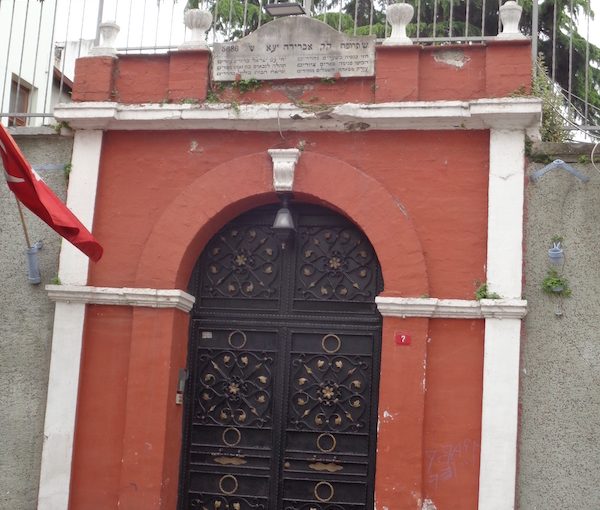
Ahrida Synagogue is one of the two still-functioning synagogues in the Balat neighbourhood of Istanbul. (photo by Deborah Rubin Fields)
On my first trip to Israel just after graduating high school, I met a similar-aged Turkish Jew. He was also visiting Israel. He spoke no Hebrew or English, so I tried my then-proficient Spanish. Surprisingly, he responded, although not all the words he used were familiar to me. I didn’t know then that he was speaking Ladino, or Judeo-Spanish. Slow forward several years to May 2023, when I finally visited Istanbul for the first time.
While I only recently “made it” to Turkey, Jews have been there for a very long time. If you take a biblical approach, you know that, when the flood ended, Noah’s ark rested on Mt. Ararat, near Anatolia, Turkey. If you take an historic approach, Jews have lived in what is now Turkey since Roman times.
While most members of the Jewish community in Istanbul today trace themselves back to the Jews who were forced out of Spain and Portugal in the late 1400s and early 1500s, there have also been communities of Karaites, Jews who do not accept rabbinic law, but rely solely on what is written in the Hebrew Bible. As of 2014, they numbered less than 100 in Istanbul.
Sultan Beyazid II welcomed the Jews from Spanish-speaking countries – when Spain expelled its Jews and Muslims in 1492, Beyazid sent his navy to evacuate them to Ottoman lands.
Among the Jews in Turkey in the 1500s was widowed businesswoman Doña Gracia (1510-1569). Originally from Portugal, which ordered Jews to convert to Catholicism a handful of years after Spain’s decree, she moved to Istanbul so she could openly practise her Judaism. Having been a “conversa” (forced convert), she was keen to help others in the same situation. She established yeshivot and synagogues in Istanbul. She also was the first woman printer and publisher in the Ottoman Empire. She lived in the European quarter of Galata.
Doña Gracia was not the only Jew to do well in Turkey. A number of Jews had successful businesses. Many dealt with precious metals and stones; others were money changers or lenders. In the 1500s, Hekim Jacob served as Sultan Mehmed II’s personal physician – by 1800, Jews would make up 27% of all licensed physicians in Istanbul. Even today, Balat’s 120-bed Jewish Hospital or Yahudi Hastanesi is still functioning, although the patients aren’t usually Jews.
In 1666, the false messiah Shabbtai Tzvi made an appearance in Istanbul. He had visited other countries when there was the breakdown of the social order or the economy was on the decline. The opinion of Jews in Istanbul (then called Constantinople and the capital of Turkey) was divided, but the majority feared his appearance would be the cause for actions against Jews in general. When those who were attracted by his messianic enthusiasm went out to meet him and pay him homage, opponents informed the grand vizier and he ordered Shabbtai Tzvi’s arrest. After Shabbtai Tzvi’s conversion, the communal leadership decided on a course of damage control, downplaying the false messiah incident, including by attempting to prevent discussion on the subject.
At the beginning of the 20th century, the Jewish population in Istanbul was 100,000. Today, there are fewer than 20,000 Jews in all of Turkey and a new wave of emigration has started. Contributing factors are President Recep Tayyip Erdogan’s tumultuous 20-year rule, with its up-and-down relationship with Israel, rising antisemitism, perceived threats to the personal security of Jews and rising anti-Jewish discrimination from Turkish society, as well as the country’s unabated inflation. Altogether, since Israel became a state, some 100,000 to 150,000 Jews have left Turkey for Israel.
In Istanbul’s Balat neighbourhood, for example, where, at one point, more than half the population was Jewish, the Turkish bath or cavus Hammami (el bano de Balat in Ladino) that was frequented by Jews in the neighbourhood is apparently still running but most synagogues have closed. In Balat, only two are still functional: Ahrida Synagogue, with its unusual bima in the shape of the prow of a boat, and Yanbol Synagogue.
Today, most of Istanbul’s Jews are Sephardi, with only about 600 individuals who identify as Ashkenazi. Yet, Etz HaHaim Synagogue, also known as Ortakoy Synagogue (for the neighbourhood in which it is situated) holds combined services for both Sephardim and Ashkenazim.
Istanbul’s Ortakoy Synagogue, also known as Etz HaHaim, holds combined services for both Sephardim and Ashkenazim. (photo by Deborah Rubin Fields)
Istanbul’s Neve Shalom Synagogue (and mikvah) has been the site of two major terrorist attacks. In September 1986, Arab terrorists staged an attack with guns and grenades on worshippers in the synagogue, killing 23. In November 2003, a car bomb exploded outside the synagogue during a bar mitzvah service. Hundreds of people – mostly Turkish Muslims who lived or worked in the area – were wounded and over a dozen were killed. For security, there is now a guard post in front of the synagogue and the adjacent Jewish museum and those interested in visiting must show proper identification.
As far as eating in Turkey, aubergines (eggplants) are plentiful in the summer, so most meals include either fried, baked or stuffed aubergines. Empanadas, as they are called in Spain, are usually referred to as börekas or börekitas in the Sephardi cuisine in Turkey, using the word börek for the same type of Turkish pastries. A tapada is prepared in a pie fashion, baked in a tray with a variety of fillings – best, of course, with aubergines.
Food expert Claudia Roden whose grandmother came from Istanbul, offers a recipe for prasifouchi, a creamy leek pâté that was traditionally served as a dairy evening meal in Turkey during Pesach. It is made with leeks, potatoes, eggs, kashkaval cheese, nutmeg, salt and pepper and sunflower oil. (See The Book of Jewish Food: An Odyssey from Samarkand to New York, page 527.)
There are at best two kosher restaurants in Istanbul. While not at all fancy, there is also a centrally located vegan café.
If you visit Turkey, güle güle gidin, may you leave with lots of laughter, ie. with a smile on your face, having had a good time.
Deborah Rubin Fieldsis an Israel-based features writer. She is also the author of Take a Peek Inside: A Child’s Guide to Radiology Exams, published in English, Hebrew and Arabic.
The marvelous children’s stories in Ilse Weber’s Mendel Rosenbusch: Tales for Jewish Children (illustrated by P. John Burden) are fascinating in their own right, as is translator Hans Fisher’s discovery of this book. He and his wife, Ruth, have brought Weber’s book, first published in 1929, from the original German to English.
Let’s get to stories first; then we’ll talk about how this book was discovered.
Ilse Herlinger Weber was born 1903 in Witkowitz, now in Czechia, and, after a period of time in Theresienstadt with her husband and son, was deported to and murdered in Auschwitz in October 1944. She was a Czech poet and writer who, like Kafka, wrote in German, and is best known for Mendel Rosenbusch: Tales for Jewish Children.
The title character is an older man (pictured with a white beard and wearing a black yarmulke) who gets a coin that enables him to become invisible whenever he wishes, and he uses this gift to help his neighbours anonymously. Mendel plays a beneficent role in most of the stories, including magically arranging that a stubborn father permits his son to marry the girl of his choice, and is beloved by all the children in Weber’s stories.
One of my favourites – perhaps because he reminds me of a combination of Tom Sawyer and Huck Finn, with a blend of some of the rascals in Sholem Aleichem’s stories – is “Uri, the Rascal.” Uri is a lad who always gets into trouble, always plays pranks. But, when a poor, sickly boy, the son of a needy widow, becomes his seatmate in school, Uri does his best to help and defend him, and even comes up with an idea on Purim to help the mother and son.
Another charming tale is “Simcha, the Liar,” about a boy who cannot stop telling fibs – until, one day, he suffers a punishment (purple patches on his face) for his uninterrupted stream of untruths. But, here again, Mendel Rosenbusch comes to the rescue and Simcha never tells another lie again.
These are typical of the heart-warming, ethically pointed stories in this book. Now to its (re)discovery.
When Hans Fisher, who taught at Rutgers University in New Jersey for many years, visited Santiago, Chile, for his mother-law’s funeral, he discovered in her vast library a book of children’s stories in German that he had read as a child in Germany 60 years earlier, before immigrating to the United States to escape the Nazi slaughter of Jews. Like Proust’s biscuit, which brings a flood of memories to the author as he remembers the past, so with Fisher. Seeing this old, torn book brought back memories of wonderful, gentle stories that, in Fisher’s words, “transported me to my own boyhood in Breslau.”
It is with love and devotion and the translators’ writerly skills that Ruth and Hans Fisher have restored these wonderful tales and made them accessible to a new generation of readers.
Curt Leviantalso recently made a literary discovery of his own. He found a neglected novel by the famous Yiddish humourist Sholem Aleichem, Moshkeleh the Thief, which he translated into English: for a review, see jewishindependent.ca/a-rediscovered-novella. Leviant’s 12th novel, Me, Mo, Mu, Ma & Mod; Or Which Will It Be, Me and Mazal or Gila and Me?, was published in 2021.
The quality of our lives seems to contain alternating waves of good and bad, hard and soft, light and shade. If we are lucky enough to appreciate that this is the nature of existence, we can bear much better with the shady parts of our lives. We can have faith that, whatever challenges we are facing, no matter how painful, the good times will roll around again. And the good times can be so good, so full of richness, pleasure, joy, lightness and brightness, that they are worth the price we may ultimately have to pay for the good fortune we have the luck to be earning.
The dilemma is that sometimes we do not realize that what we are passing through are the bright times, the good times, the best times. That often comes only with retrospection.
I remember that I left home at the age of 18 to spend a year of work and study in Israel. I did not think to ask for the permission of my parents, I just made my plans and informed them of those plans. I never thought to do otherwise, and I was never questioned. I saved up the money I needed from the odd jobs I performed as I wended my way through my high school years. I applied for the assignment, gathered my pennies and off I went, traveling across the globe.
I was a part of a group, but I felt very much alone. I remember that, being alone, on the ship sailing across the ocean, my mind brimming full of speculations about the nature of the world. I wrote incessantly about that on every scrap of paper I could find.
I have some of those scraps in a file I have kept to this day. So much of it, seems to me today, to be a load of nonsense. The gist of it was that I was a solitary sailor afloat on the sea of life and that life was incredibly sweet. I was full of wants. I wanted to find a true companion. I wanted a country of my own. I wanted to save the world. I was going to do it all myself if I had to. At the time, I could read it all in the palm of my hand, and it was all going to happen. I was totally free from obligations, except those that I chose to lay upon myself – and included in those was responsibility for creating the perfect world. All of us are heroes in our own eyes, and we have to try as hard as we can to live up to that image of ourselves.
How was that not the most superlative moment of my life to that date? I had not the merest clue as to the nature of the importance of those moments in my existence. I was unconsciously writing an agenda for my life.
I am no different from others, and all of you have had those moments in your lives, those moments whose importance is only appreciated by you with the passage of time and the gleanings of experience.
I remember holding a child of mine in my arms, and feeling like I would burst with joy. I remember when I was leaving my first job, hearing that my superiors were frantic about who they could find to fill the hole I was leaving. I remember when I realized that I had succeeded in resolving a dilemma that would yield years of success at a seemingly impossible task that I had taken on. I remember the instant when I recaptured the love of my heart after 50 long years of disappointment when I had not found the companionship I longed for. I remember the moments when I began to understand what elements of my behaviour prevented my Bride from feeling the depth of my love for her. All these events, which cast other parts of my life in the shade where they belonged, I could only truly appreciate in retrospect. The thrill they yield when I recall them I relive over and over again. So it must be for so many of you, when you recall your own experiences.
Surely there are lessons to be learned by sentient beings from these experiences. Don’t they help us, when we find ourselves in periods when there is shade all around us, know that the moments we hope for and will cherish all the days of our lives will surely arrive for us if we carry on? Just as day follows night, won’t our turn at good fortune arrive if we put in the necessary effort to survive what may seem to us to be the worst of times, and if we are lucky enough to have the good health and fortune to do so? Isn’t that the secret, that we try, and try again, to confront the challenges we face, and we never, never, give up?
Max Roytenbergis a Vancouver-based poet, writer and blogger. His book Hero in My Own Eyes: Tripping a Life Fantastic is available from Amazon and other online booksellers.
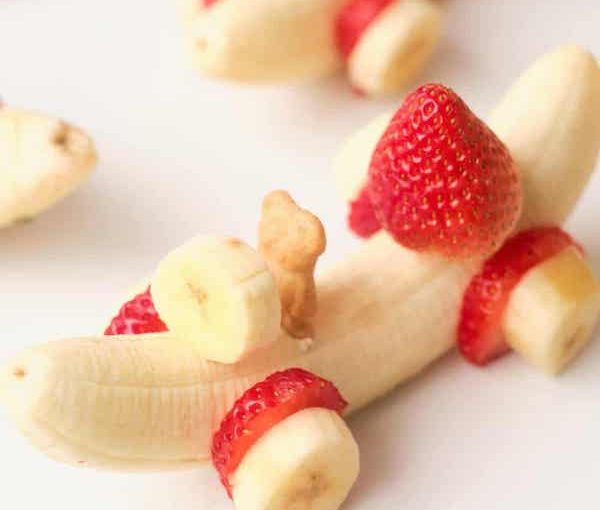
Healthy food can make for a fun snack. The website hello, Yummy has lots of ideas about cooking for and with kids. This banana car with strawberry wheels and a graham cracker bear driver is but one option. (photo from helloyummy.co)
If I had a dollar for every time I heard a parent tell their kid to stop playing with their food, I’d be a very rich woman. I might even be able to afford a kosher prime rib roast. That being said, I’m here to tell you that sometimes it’s perfectly acceptable to play with your food. Like when there’s a banana strawberry car involved. Or maybe some peanut butter.
Anticipating the visit of my grand-nephew and grand-niece got me thinking about how we could have some fun together in the kitchen – without sending anyone to hospital or having to move afterwards. The 3-year-old, Raphael, loves to help his mom cook and bake, so I figured this would be the perfect way to bond with him. His 1-year-old sister, Ariel, might not be adept enough for the culinary process, but I’m sure she’ll eagerly participate in the finished product.
I think we can all agree that food is more fun when you can play with it. It brings out the inner kid in us, the one who’s just dying to squish mashed potatoes through our teeth. Unseemly behaviour for an adult? Sure. Have we all done it? You betcha. And who among us hasn’t rolled Wonderbread into soft little balls? The fact that edible toys are, for the most part, healthy, is a win-win. You just need to make good food choices.
For the super-fun banana car snack I found online (helloyummy.co) all you need is a banana, a couple of strawberries, some peanut butter to attach the “wheels” to the body of the banana car and a graham cracker “driver” (an animal cracker hippo or elephant works perfectly well, too). As for the strawberry “wheels” you could replace them with thick slices of kiwi, mango or even grapes. If you really want to get decadent, you could dip the banana wheels into melted chocolate, add a red licorice tailpipe, or tuck some raisins or blueberries into the “wheels” to simulate hubcaps. The possibilities are truly endless.
While the original recipe calls for using toothpicks to attach the wheels to the body of the car, I’m hesitant to do that, considering there’s a 3-year-old and a 1-year-old involved. It’s a foregone recipe for disaster.
Instead, I’m sticking with peanut butter as the adhesive (a glob of cream cheese could also work in a pinch). And, yes, I checked with their mom first to make sure neither of them is allergic to peanuts. Given that both kids were practically weaned on Bamba (the peanut-flavoured melt-in-your-mouth Israeli snack food), I figured I was safe on that count, but it’s always good to check with the parents.
Since I’m not sure of the practical play factor of these banana car snacks, there won’t be any makeshift racetracks as part of this edible experiment. (Will the wheels even turn? I doubt it.) Although I did see lots of great ideas on Google and Instagram.
Lucky for me that little Raphael and Ariel are the opposite of picky eaters. In fact, they’ll pretty much devour anything in sight. It doesn’t matter how esoteric, spicy, slimy, crunchy or smelly it is, they’re game to try it. And, if you transform the food into some kind of insect, animal or character they recognize, even better. All it takes is a bit of ingenuity and some basic foodstuffs. The look of sheer wonder on a kid’s face when they see an insect made out of celery, apples and pretzels, and then you tell them they can eat it – well, nothing beats that.
So, go ahead and play with your food, make mealtime and snack time fun, and let your imagination soar. It’s unquestionably a healthier choice than plopping kids down in front of a screen, plus it encourages innovation, resourcefulness and artistic expression.
Aside from fun food snacks, I’m a bit addicted to Instagram for all the cool DIY toys you can make for toddlers and preschoolers using nothing more than leftover paper towel rolls, ping pong balls, a plastic straw, a bit of tape and some kids scissors. As a former children’s librarian, I have all sorts of craft tricks up my sleeve, and I love the uniqueness of homemade toys. But I definitely need a craft refresh now and again.
I’m always a little disheartened by the number of adults whose go-to gifts involve ordering overpriced toys online. I know that not everyone has the time or inclination to make a gift, but I sometimes think our culture has just gotten lazy. And how many times have you seen a well-intentioned adult (with a lot of disposable income) buy a 2-year-old a $75 toy only to have the kid show more interest in the box or the bubble wrap? Expensive does not always equate to fabulous toys. Put some time and thoughtfulness into it, and I guarantee your DIY gift will be memorable.
The second summer of the pandemic, I made a bunch of felt animals for then-2-year-old Raphael and, according to his parents, he loved them. He’d stick them on any surface within reach, and they were a great way to learn animal names and have fun doing it. I’m not saying they were newsworthy, but they were all handmade with love.
And making them was not as onerous as you might think. Just find some free templates on Google, print them out, buy some felt and glue at the dollar store, do some tracing, and boom – you’ve got yourself some mighty fine felt board animals. Aside from putting them on surfaces throughout the house, you can cover a poster-size piece of corrugated plastic with felt (again, dollar store material) and use the animals to make up stories on the board.
It’s my belief that, if you make it, they will come. If you buy it, they may just play with the box instead. See you at the grocery or dollar store.
Shelley Civkin, aka the Accidental Balabusta, is a happily retired librarian and communications officer. For 17 years, she wrote a weekly book review column for the Richmond Review. She’s currently a freelance writer and volunteer.
My family enthusiastically eats huge salads at dinnertime in the summer. We love to celebrate the fresh local lettuce and other vegetables we receive from our community-supported agriculture (CSA) share. A CSA is a membership/subscription service that allows farms to directly market to customers. A CSA membership pays the farmer in advance to buy seeds and cover other costs. In exchange, the member gets a share of the farm’s products. Most CSAs are for vegetables in season. There are also many other sorts of CSAs, including for grain, meat, cheese, eggs, and more.
We’ve had a farm share nearly every summer for more than 20 years. Some weeks, our share is huge, full of delicious seasonal delights. Perhaps we get tomatoes, basil, peppers and eggplant at the height of summer, or enormous heads of springtime lettuce. This membership model depends on relationships between the farmer, the customers and the growing season, with a bit of luck sprinkled in. Sometimes, the CSA enables us to experience the challenges of a farm’s drought or flood. Other years, we’ve eagerly distributed rhubarb, beets, or squash around our neighbourhood when we’ve been overwhelmed with produce.
We also buy a “freezer lamb” and a quarter of beef (a quarter of a steer), along with farm-raised chicken. This is where our “eat local” mantra conflicts with traditional Jewish practice. Everyone used to depend on local butchers. Having a kosher butcher nearby meant eating local foods that were butchered according to the laws of kashrut. As modern health regulations and slaughterhouses developed, small-scale butchers, including local kosher butchers, became less common. Now, it’s nearly impossible to get fresh kosher meat anywhere outside of large urban areas with a big Jewish population.
In the Jewish community of Winnipeg, where we live, the city’s kosher butchers were well-known. According to historians Arthur Chiel, Allan Levine and Rabbi Moishe Stern, there was even a congregation here, Beth Judah, or “the Butcher’s Shul,” from 1937 to 1971. The butchers, and their Retail Kosher Butchers’ Association, had a lot of power in the 1930s and 1940s, occasionally running into conflicts with Winnipeg’s rabbis.
Given this history, it’s sad that there are no longer any kosher butchers here. A few years ago, a newcomer shochet (butcher) friend from Hungary collaborated with the Winnipeg Chabad. They butchered turkeys to provide fresh kosher meat. It was a difficult proposition, even though the provincial regulators tried to help. We were one of the families who tried to support him by buying a kosher-butchered turkey. It didn’t become an ongoing business venture.
Jewish diets worldwide have been shaped by what’s available locally, what’s affordable and how to make it kosher or maybe just “kosher style.” Traditional or noteworthy food choices change over time. Our diets are influenced by our families and communities of origin, even beyond issues of kashrut. Whether our relatives came to Canada from Russia, Ethiopia or Yemen, kashrut is part but not all of our cultural food choices.
As a younger married couple, we ate lots of local fruits and vegetables, even growing some ourselves. A few years after we married, we heard scary family news. My husband’s first cousin was younger than we were, but her (also young) husband had been rushed to the hospital for an emergency medical procedure. He had serious blockages in his arteries that needed immediate intervention. We lived far away and weren’t sure how to help. We discussed it over dinner and formulated a plan.
The family of this “cousin-in-law” kept kosher. He ate a steady diet of Eastern European specialities. Lots of holiday meat meals, plenty of dairy, very well-cooked vegetable side dishes. Salads were heavy on fattening dressings. This young guy also ate well. (Jewish grandmothers approved!) We looked at the summertime salads and vegetarian meals in front of us – as undergraduates, we attended Cornell University, in Ithaca, N.Y., where the famous Moosewood Collective has specialized in vegetarian cuisine for many years. I ordered a bunch of Moosewood cookbooks to be sent to this cousin’s house with a get well note.
Twelve years ago, we gathered in Florida for a family vacation meal. I was pregnant with twins and surrounded by this couple’s young kids. We heard that the medical intervention probably saved his life. They changed their diet entirely to be more “heart healthy.” The cookbooks helped.
Integrating a foodie’s enthusiasm with locally produced, healthy foods with Jewish practice can result in discord, though. I’ve been told that the “only way” to get some special items is to arrive at the farmer’s market early on Saturday morning. There’s no alternative if I’m going to synagogue instead. I shrug and suggest that they consider other sales venues, too. At the same time, my choice of locally raised (but not kosher-butchered) meat results in divisions around the Shabbat table, too, as some people won’t eat at my house, even if I only serve vegetarian foods to them.
For those whose level of kashrut is very strict, some won’t eat fresh berries or broccoli due to the chance of ingesting a bug, which would not be kosher. My husband is a biology professor who studies bugs. We’ve had some interesting conversations about this. One of our favourite consultations involves a busy Chabad rabbi and his wife who run wonderful youth programming. Occasionally, they send my professor husband photos of insects to ask, “What is this?” and “How should I get rid of it? Should I throw away the flour?” as they manage their kosher home.
Embracing ethical food choices can be an important expression of one’s Jewish practice. It goes beyond kashrut, whether it’s choosing to donate to Mazon Canada (the Jewish response to hunger) or foodbanks, growing a garden or buying local produce. We express our values through what we eat, as well as care for our health and the earth. That effort feels like an important (and Jewish) thing to do. Finally, the Israeli thing to do would be to wish you a hearty appetite or b’tayavon! May you enjoy whatever you eat!
Joanne Seiff has written regularly for CBC Manitoba and various Jewish publications. She is the author of three books, including From the Outside In: Jewish Post Columns 2015-2016, a collection of essays available for digital download or as a paperback from Amazon. Check her out on Instagram @yrnspinner or at joanneseiff.blogspot.com.
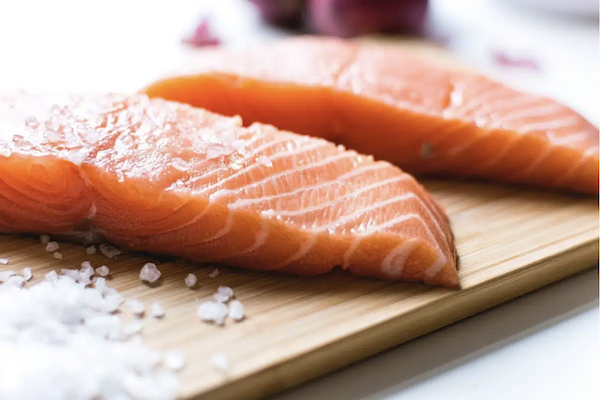
Salmon makes for a nice main course. Besides being high in protein, iron, Vitamin D and potassium, it is high in omega-3 fatty acids. It can be served with so many things. Healthy sides include steamed vegetables or a salad. But potatoes also mesh well, especially when the recipes include Parmesan cheese. Here are a few salmon options, and a couple of potato sides.
ROASTED SALMON WITH OLIVE-MUSTARD BUTTER AND ORZO (This recipe by Michelle Anna Jordan is from an April 2001 Bon Appétit magazine. It makes 8 servings.)
1/2 cup butter 12 Kalamata or other pitted, chopped olives 1 chopped shallot 1 tbsp chopped Italian parsley 2 tsp Dijon mustard salt and pepper olive oil 8 6- to 8-ounce salmon fillets, 1.25 to 1.5 inches thick 2 1/2 cups orzo whole Kalamata olives fresh Italian parsley sprigs
Mix butter, chopped olives, shallot, parsley and mustard in processor until blended but slightly chunky. Season with salt and pepper and transfer to small bowl.
Preheat oven to 400°F. Brush a large, rimmed baking sheet with olive oil. Place salmon on sheet. Sprinkle with salt and pepper. Roast 14 minutes.
Cook orzo in a large pot of boiling, salted water until tender but firm. Drain and return to pot. Add half of olive-mustard butter and toss.
Divide orzo among eight plates. Top each with a salmon fillet. Place a small dollop of olive-mustard butter atop each fillet. Garnish with whole olives and parsley.
BROILED SALMON (This recipe by Simone Zarmati Diament appeared in the Jerusalem Post in 2015. It makes 6-8 servings.)
Cover a large, shallow baking pan with foil and grease or spray with oil. Fifteen to 30 minutes before cooking, place fish, skin side down, on the pan. Spread soy sauce, liquid smoke and garlic evenly over fish.
Broil or bake at 400°F for 10 to 12 minutes. Transfer to a platter and serve.
BAKED SALMON FILLETS (4 servings)
4 portions salmon fillets 2 tsp dry oregano 4 minced garlic cloves pepper to taste 2 thinly sliced tomatoes 2 small thinly sliced onions 1/4 cup chopped parsley 1/2 cup dry breadcrumbs 2 tbsp vegetable oil
Preheat oven to 450°F. Spray a shallow baking pan with non-stick oil. Place fish in pan and sprinkle with oregano, garlic and pepper. Layer with tomatoes, onions and parsley. Mix breadcrumbs with oil and sprinkle on top of fillets. Bake for eight to 10 minutes.
CHANTILLY POTATOES WITH A PARMESAN CRUST (This recipe is by the late Maria Guarnaschelli. It makes 6 servings.)
2 pounds cut and peeled potatoes, cut into 2-inch chunks salt to taste 1/2 cup cold milk 7 tbsp unsalted butter pepper to taste 1 cup heavy cream 1/2 cup freshly grated Parmesan cheese
Put potatoes in a large saucepan, cover with water, add salt and bring to a boil. Reduce heat and simmer 12 minutes. Drain and shake to dry in a ricer, then transfer to a bowl and beat in milk and six tablespoons of butter. Season with salt and pepper.
Preheat oven to 400°F. Butter a rectangular baking dish.
In another bowl, whip cream to soft peaks. Beat into potatoes one-third at a time. Scrape into baking dish. Dot with one tablespoon butter and the Parmesan cheese. Bake for 25 minutes, then broil two minutes, until brown. Let stand 10 minutes and serve.
PARMESAN FRENCH FRIES (4 servings)
4 potatoes cut into sticks ice water 1/4 cup margarine onion or garlic salt to taste paprika to taste1/4 cup Parmesan cheese
Place potatoes in a bowl. Cover with ice water and let sit 30 minutes. Drain and dry.
Preheat oven to 450°F. Melt margarine and add to baking dish, then add the potatoes sticks, coating them well. Sprinkle with onion or garlic salt and paprika. Bake for 25 minutes or until tender and brown. Remove from oven and sprinkle with Parmesan cheese.
Sybil Kaplan is a Jerusalem-based journalist and author. She has edited/compiled nine kosher cookbooks and is a food writer for North American Jewish publications. She leads walks of the Jewish food market, Machaneh Yehudah, in English.
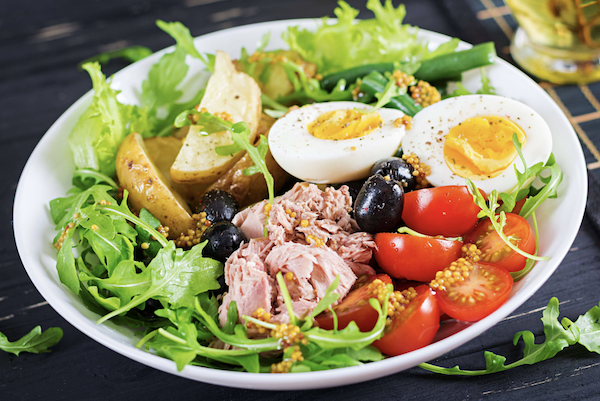
Salad Niçoise can be made and plated in a variety of ways. (photo from pxhere.com/MariaPolna)
Summer meals should be easy and, ideally, quick to make after a long day at work or having fun – or when it’s really hot outside. When you don’t want to spend a lot of time in the kitchen, salads and pasta are perfect options.
SALADE NIÇOISE (6 servings)
1/2 cup olive oil 1/4 cup vegetable oil 1/4 cup red wine vinegar 1 tsp sugar salt and pepper to taste 1 pound trimmed green beans 2 cups arugula (optional) 1 thinly sliced red onion 2 tomatoes cut into wedges (or equivalent in cherry tomatoes) 1/2 cup pitted ripe olives 1 2-oz can anchovy fillets 2 7-oz cans drained tuna, broken into chunks 2 sliced hard-boiled eggs
For the dressing, place the olive oil, vegetable oil, red wine vinegar, sugar, salt and pepper in a jar, close the lid and shake vigorously.
For the salad, place green beans in a saucepan with small amount boiling, salted water, cover and cook 17-20 minutes. Drain. Turn into bowl. Add half cup of dressing, toss, cover and refrigerate two hours.
After the two hours, turn beans into a salad bowl or plate layered with some arugula (if using). Add a few onion slices, tomato wedges, olives and anchovy fillets. Add tuna and egg slices. Garnish with rest of onion. Drizzle remaining dressing.
CAESAR ON THE LIGHT SIDE (This Food & Wine recipe is by Jamie Oliver. It makes 4 servings.)
1/3 cup low-fat or nonfat Greek-style yogurt 2 mashed anchovy fillets (optional) 1 minced garlic clove 2 tbsp fresh lemon juice 2 tsp Worcestershire sauce 2 tbsp extra-virgin olive oil 1/4 cup freshly grated Parmigiano-Reggiano cheese, divided salt and pepper to taste 1 large head romaine lettuce, torn into bite-size pieces
In a small bowl, whisk yogurt with anchovies (if using), garlic, lemon juice and Worcestershire sauce. Whisk in the oil and half the cheese. Season with salt and pepper.
Toss the romaine in a large bowl with half the dressing and the remaining cheese. Serve, with the other half of the dressing on the table, for guests who would like a little more.
Oliver turns this into a main course by adding broiled salmon or, if you don’t keep kosher, grilled chicken breast.
CHEESY MEDITERRANEAN ARTICHOKE PASTA (8 servings)
8 oz cooked and drained penne pasta 1 14.5-oz can drained diced tomatoes\ 1 14-oz can drained, quartered artichoke hearts 1 2.25-oz. can sliced, ripe, pitted olives 1/4 cup olive oil 1/4 cup shredded Parmesan cheese
Place tomatoes, artichoke hearts and olives in a saucepan. Add olive oil and hot pasta and warm until thoroughly heated, about five minutes. Add cheese and serve immediately.
TWO-CHEESE PENNE (4 servings)
3 to 4 tbsp olive oil 2 or 3 minced garlic cloves or 2/3 cup chopped onion or both 3 1/2 cups or so chopped ripe tomatoes pepper to taste 4 1/2 cups penne 3 tbsp chopped fresh basil 3/4 to 1 cup grated Parmesan cheese 3/4 cup cubed mozzarella cheese
Heat three to four tablespoons olive oil in a frying pan. Sauté garlic for 15 seconds. If using onion, sauté for five minutes.
Add tomatoes and salt and cook 10 to 15 minutes. Remove one-third of sauce to a bowl. Add one tablespoon basil to frying pan and stir it in.
Bring a large pot of salted water to a boil. Add penne and cook eight or nine minutes. Drain and add to frying pan. Coat with sauce.
Remove from heat and add one tablespoon basil and the grated Parmesan cheese. Mix well. Add mozzarella and toss until it starts to melt. Pour into a bowl and add remaining oil and pepper.
Toss gently and add the remaining one tablespoon of basil. Serve immediately.
Sybil Kaplanis a Jerusalem-based journalist and author. She has edited/compiled nine kosher cookbooks and is a food writer for North American Jewish publications. She leads walks of the Jewish food market, Machaneh Yehudah, in English.
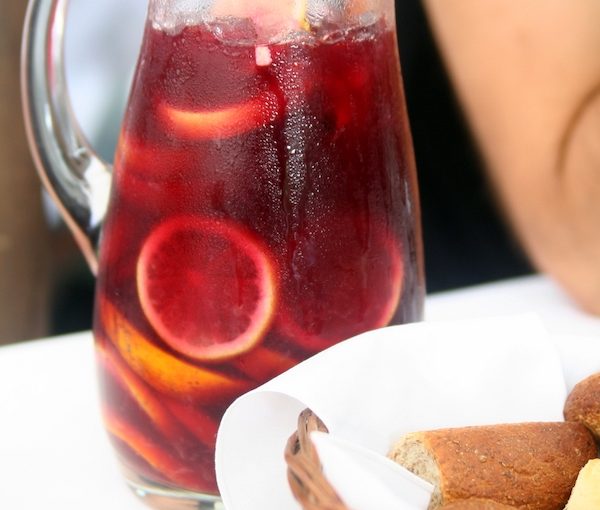
Cool down with some mock sangria. (photo from commons.wikimedia.org/Ilker Ender)
Whether you’re inviting friends over or just having a quiet evening at home, try these mocktails, non-alcoholic drinks, with snacks or appetizers.
MOCK SANGRIA (12 servings)
8 cups grape juice 2 cups orange juice 2 cans lemon-lime soda 1 sliced orange 1 sliced lemon 1 1/2 cups drained maraschino cherries
In a pitcher, combine grape juice, orange juice and lemon-lime soda. Add orange slices, lemon slices and cherries and mix gently. Serve in fancy glasses over ice.
MOCK CHAMPAGNE (6-8 servings)
1 1/3 cups sugar 1 1/3 cups water 2 cups grapefruit juice 1 cup orange juice 6 tbsp grenadine 7 cups ginger ale
Combine sugar and water in a saucepan and bring to a boil for 10 minutes then let cool. Add grapefruit juice and orange juice to syrup and chill. To serve, put syrup in a pitcher, add grenadine and ginger ale and mix gently. Serve in champagne glasses.
SPARKLING APPLE PUNCH (8 servings)
1 cup sugar 1 cup water 24 minced mint leaves 1 cup lime juice 4 cups apple juice 1/2 tsp salt seltzer or club soda
Dip fancy glass rims in lemon juice then in sugar and chill. In a saucepan, boil sugar and water for eight minutes. Place mint leaves in a large pitcher and pour syrup over. Let cool. Add lime juice, apple juice and salt. Pour into glasses. Add seltzer or club soda.
Sybil Kaplan is a Jerusalem-based journalist and author. She has edited/compiled nine kosher cookbooks and is a food writer for North American Jewish publications. She leads walks of the Jewish food market, Machaneh Yehudah, in English.


 ShowStoppers is a glee troupe that performs in concert, on radio and television, and at galas, awards shows, conventions, corporate and charitable events. Previous shows include with Barry Manilow and Eric Church at Rogers Arena; with the group Foreigner at various venues; at the Pacific National Exhibition; on the Variety Club Telethon; and singing the national anthems at Vancouver Canucks games. The troupe’s repertoire includes everything from Motown and disco medleys to Canadian favourites and pop songs like “Let’s Get Loud” and “Shut Up and Dance.”