
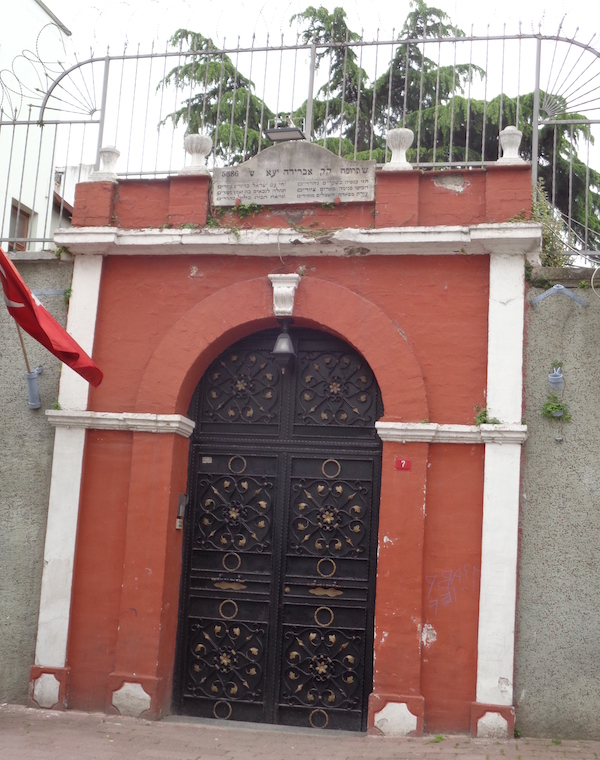

Ahrida Synagogue is one of the two still-functioning synagogues in the Balat neighbourhood of Istanbul. (photo by Deborah Rubin Fields)
On my first trip to Israel just after graduating high school, I met a similar-aged Turkish Jew. He was also visiting Israel. He spoke no Hebrew or English, so I tried my then-proficient Spanish. Surprisingly, he responded, although not all the words he used were familiar to me. I didn’t know then that he was speaking Ladino, or Judeo-Spanish. Slow forward several years to May 2023, when I finally visited Istanbul for the first time.
While I only recently “made it” to Turkey, Jews have been there for a very long time. If you take a biblical approach, you know that, when the flood ended, Noah’s ark rested on Mt. Ararat, near Anatolia, Turkey. If you take an historic approach, Jews have lived in what is now Turkey since Roman times.
While most members of the Jewish community in Istanbul today trace themselves back to the Jews who were forced out of Spain and Portugal in the late 1400s and early 1500s, there have also been communities of Karaites, Jews who do not accept rabbinic law, but rely solely on what is written in the Hebrew Bible. As of 2014, they numbered less than 100 in Istanbul.
Sultan Beyazid II welcomed the Jews from Spanish-speaking countries – when Spain expelled its Jews and Muslims in 1492, Beyazid sent his navy to evacuate them to Ottoman lands.
Among the Jews in Turkey in the 1500s was widowed businesswoman Doña Gracia (1510-1569). Originally from Portugal, which ordered Jews to convert to Catholicism a handful of years after Spain’s decree, she moved to Istanbul so she could openly practise her Judaism. Having been a “conversa” (forced convert), she was keen to help others in the same situation. She established yeshivot and synagogues in Istanbul. She also was the first woman printer and publisher in the Ottoman Empire. She lived in the European quarter of Galata.
Doña Gracia was not the only Jew to do well in Turkey. A number of Jews had successful businesses. Many dealt with precious metals and stones; others were money changers or lenders. In the 1500s, Hekim Jacob served as Sultan Mehmed II’s personal physician – by 1800, Jews would make up 27% of all licensed physicians in Istanbul. Even today, Balat’s 120-bed Jewish Hospital or Yahudi Hastanesi is still functioning, although the patients aren’t usually Jews.
In 1666, the false messiah Shabbtai Tzvi made an appearance in Istanbul. He had visited other countries when there was the breakdown of the social order or the economy was on the decline. The opinion of Jews in Istanbul (then called Constantinople and the capital of Turkey) was divided, but the majority feared his appearance would be the cause for actions against Jews in general. When those who were attracted by his messianic enthusiasm went out to meet him and pay him homage, opponents informed the grand vizier and he ordered Shabbtai Tzvi’s arrest. After Shabbtai Tzvi’s conversion, the communal leadership decided on a course of damage control, downplaying the false messiah incident, including by attempting to prevent discussion on the subject.
At the beginning of the 20th century, the Jewish population in Istanbul was 100,000. Today, there are fewer than 20,000 Jews in all of Turkey and a new wave of emigration has started. Contributing factors are President Recep Tayyip Erdogan’s tumultuous 20-year rule, with its up-and-down relationship with Israel, rising antisemitism, perceived threats to the personal security of Jews and rising anti-Jewish discrimination from Turkish society, as well as the country’s unabated inflation. Altogether, since Israel became a state, some 100,000 to 150,000 Jews have left Turkey for Israel.
In Istanbul’s Balat neighbourhood, for example, where, at one point, more than half the population was Jewish, the Turkish bath or cavus Hammami (el bano de Balat in Ladino) that was frequented by Jews in the neighbourhood is apparently still running but most synagogues have closed. In Balat, only two are still functional: Ahrida Synagogue, with its unusual bima in the shape of the prow of a boat, and Yanbol Synagogue.
Today, most of Istanbul’s Jews are Sephardi, with only about 600 individuals who identify as Ashkenazi. Yet, Etz HaHaim Synagogue, also known as Ortakoy Synagogue (for the neighbourhood in which it is situated) holds combined services for both Sephardim and Ashkenazim.
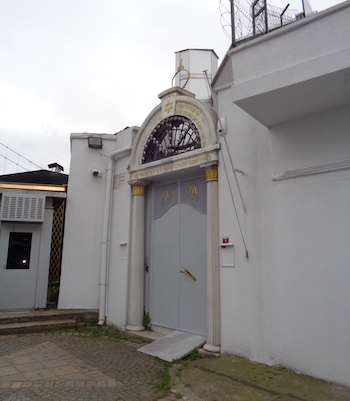
Istanbul’s Neve Shalom Synagogue (and mikvah) has been the site of two major terrorist attacks. In September 1986, Arab terrorists staged an attack with guns and grenades on worshippers in the synagogue, killing 23. In November 2003, a car bomb exploded outside the synagogue during a bar mitzvah service. Hundreds of people – mostly Turkish Muslims who lived or worked in the area – were wounded and over a dozen were killed. For security, there is now a guard post in front of the synagogue and the adjacent Jewish museum and those interested in visiting must show proper identification.
As far as eating in Turkey, aubergines (eggplants) are plentiful in the summer, so most meals include either fried, baked or stuffed aubergines. Empanadas, as they are called in Spain, are usually referred to as börekas or börekitas in the Sephardi cuisine in Turkey, using the word börek for the same type of Turkish pastries. A tapada is prepared in a pie fashion, baked in a tray with a variety of fillings – best, of course, with aubergines.
Food expert Claudia Roden whose grandmother came from Istanbul, offers a recipe for prasifouchi, a creamy leek pâté that was traditionally served as a dairy evening meal in Turkey during Pesach. It is made with leeks, potatoes, eggs, kashkaval cheese, nutmeg, salt and pepper and sunflower oil. (See The Book of Jewish Food: An Odyssey from Samarkand to New York, page 527.)
There are at best two kosher restaurants in Istanbul. While not at all fancy, there is also a centrally located vegan café.
If you visit Turkey, güle güle gidin, may you leave with lots of laughter, ie. with a smile on your face, having had a good time.
Deborah Rubin Fields is an Israel-based features writer. She is also the author of Take a Peek Inside: A Child’s Guide to Radiology Exams, published in English, Hebrew and Arabic.



