Skip to content
  • Home
  • Subscribe / donate
  • Events calendar
  • Business Directory
  • FAQ
  • News
    • Local
    • National
    • Israel
    • World
    • עניין בחדשות
      A roundup of news in Canada and further afield, in Hebrew.
  • Opinion
    • From the JI
    • Op-Ed
  • Arts & Culture
    • Performing Arts
    • Music
    • Books
    • Visual Arts
    • TV & Film
  • Life
    • Celebrating the Holidays
    • Travel
    • The Daily Snooze
      Cartoons by Jacob Samuel
    • Mystery Photo
      Help the JI and JMABC fill in the gaps in our archives.
  • Community Links
    • Organizations, Etc.
    • Other News Sources & Blogs
  • JI Chai Celebration
  • JI@88! video

Recent Posts

  • Or Shalom reopens its doors
  • JFS from past to future
  • Need holistic approach
  • Sharing stories, advice
  • Journalist shares fears
  • Skills to live together
  • Road to independence
  • Cutting grass with scissors
  • Zionism as a solution
  • Deceit, desire & the divine
  • Reclaiming sacredness
  • Creative project ideas
  • Summer squares and cobbler
  • Thou shalt … summer commandments
  • Legal help for students
  • Revisiting myth of Lilith
  • Wrong person rebuked
  • Canada’s mixed messages
  • Questions for museum
  • Symposium on antizionism
  • Making soccer political
  • CJPAC lauds Pulver’s impact
  • City recognizes Vrba’s legacy  
  • Organ donation saves lives
  • Theodore’s March premiere
  • A healing Shabbaton
  • Supplying healthy food
  • A chime of metal tags
  • Yellowknife seder a first
  • Ishai energizes, unifies
  • A Lag b’Omer to remember
  • Expanding the healing
  • Hannah Senesh – a unique hero
  • Community milestones … May 2026
  • Деньги до зарплаты на карту Займ до зп онлайн за 5 минут 2026
  • Микрокредит онлайн в Казахстане Микрозайм в Акшамат

Archives

Follow @JewishIndie
image - The CJN - Visit Us Banner - 300x600 - 101625

Category: World

Israel joins the fruit-fly fight

Israel joins the fruit-fly fight

Biofeed’s Nimrod Israely, top centre, with mango growers in Karnataka, India. (photo from Biofeed via Israel21c)

Shortly before Indian Prime Minister Narendra Modi’s visit to Israel in early July, Indian diplomats in Israel heard about a revolutionary no-spray, environmentally friendly solution against the Oriental fruit fly (Bactrocera dorsalis) made by Biofeed, a 10-employee ag-tech company. They invited Biofeed to be one of six innovative Israeli companies meeting with Modi and Israeli Prime Minister Binyamin Netanyahu.

The company’s founder and chief executive officer, Nimrod Israely, who has a PhD in fruit-fly ecology, told the two leaders that Biofeed’s product can protect Indian farmers against fruit flies like the Iron Dome system protects the people of Israel against missiles. The Oriental fruit fly has been decimating 300 fruit species in India and in 65 other countries in Asia, Africa and the Americas and is considered to be the most destructive, invasive and widespread of all fruit flies.

Biofeed’s lures, hung on trees, contain an organic customized mix of food, feeding stimulants and control or therapeutic agents delivered by a patented gravity-controlled fluid release platform. Attracted by the odour, the fly takes a sip and soon dies – without any chemicals reaching the fruit, air or soil.

The launch of Biofeed’s first-in-class attractant for female Oriental fruit flies results from 15 years of development of the core platform and more than a year of development and testing in Israel and Karnataka, India. Mango farmers on four Indian orchards saw an overall decrease of fruit-fly infestation from 95% to less than five percent.

“We were hoping to bring a solution that will replace spraying and increase productivity by 50%,” Israely told Israel21c. “I am excited by the results, demonstrating the future potential for some farmers to bring about 900 times more marketable produce to market.”

photo - A fruit fly feeding in a Biofeed lure
A fruit fly feeding in a Biofeed lure. (photo from Biofeed via Israel21c)

One farmer in the Biofeed pilot explained that previously he had used a trap that attracted only male fruit flies, with limited success. “If you cut 25 fruits, we were getting only one good fruit; 24 were infected,” he said.

K. Srinivas Gowda, president of the 70,000-farmer Karnataka Mango Growers Association, wrote in a letter presented to Modi and Netanyahu that he “would like to have this [Biofeed] technology implemented to all the mango farmers through the government of India. This technology can be used to develop pest-free zones in the mango-growing belts in India.”

The pilot project started after Biofeed won a Grand Challenges Israel grant last year from the Israel Innovation Authority and the Foreign Ministry’s international development agency, Mashav.

“We don’t have the Oriental fruit fly in Israel. However, until now there was no solution for this problem. So, we took the challenge and chose to focus on India,” Israely said. The company worked with Kempmann Bioorganics in Bangalore to carry out the trial.

Biofeed’s products are used in many Israeli fruit orchards against the Mediterranean fruit fly and other common pests, including the olive fruit fly and the peach fruit fly (Bactrocera zonata).

“Bactrocera zonata is the number two pest in India. There are three main pests in India, so now we’ve given, within two years, a solution for the two most devastating fruit flies in India and in other parts of the world,” said Israely.

“We are the only company in the world with a solution for those two pests and both solutions are harmless to the environment,” he added. “We estimate the annual market potential of these two pest segments to be well over $1 billion.”

The Biofeed platform is effective with as few as 10 units per hectare and for a period of nearly a year before the dispenser needs replacing.

Biofeed, founded in 2005, also has a formula targeting mosquitoes that bear viruses such as Zika.

“Evolution has given insects an elaborate sense of smell, which they utilize to find mates, food, egg-laying sites and more,” Israely told Israel21c last year. “The company has developed a liquid formula that ‘knows’ how to tie different kinds of smells to other materials, as the need arises. The result is a special ‘decoy’ that draws the target insect through smell. The decoy is slow-released from a device over the course of a year. The insect is drawn to the decoy, feeds off it and dies shortly after.”

Headquartered in Kfar Truman, Biofeed sees the future of agriculture in developing countries such as India and China.

“We want to bring something that is extremely easy to use: you don’t need tractors, you don’t need to remember to spray once a week, you don’t need to put yourself in danger with sprays, there’s no safety equipment. This is something that can make a dramatic change in agriculture and human health,” said Israely.

For more information, visit biofeed.co.il/enhome.

Israel21c is a nonprofit educational foundation with a mission to focus media and public attention on the 21st-century Israel that exists beyond the conflict. For more, or to donate, visit israel21c.org.

Format ImagePosted on September 15, 2017September 14, 2017Author Abigail Klein Leichman ISRAEL21CCategories WorldTags ag-tech, agriculture, environment, farming, India, Israel, science, technology, tikkun olam
A rabbi’s dream come true

A rabbi’s dream come true

New York Rabbi Aaron Laine first arrived at Beth El, an Ashkenazi congregation in the Panama subdivision of Paitilla, 23 years ago. (photo by Lauren Kramer)

Imagine being a rabbi at the helm of a community where Judaism is actively embraced. A city where Jews enthusiastically attend synagogue and classes, keep Shabbat, send their kids to Jewish day school and honour the laws of kashrut. A rabbi’s dream, right? Then Panama City is that dream come true.

photo - Congregation Beth El
Congregation Beth El (photo by Lauren Kramer)

New York Rabbi Aaron Laine first arrived at Beth El, an Ashkenazi congregation in the Panama subdivision of Paitilla, 23 years ago. “Ninety-five percent of the community keeps kosher,” said the rabbi with pride. “On Sukkot, there used to be 10 sukkot built in the whole city but today everyone has a sukkah. And, where we once brought just 185 sets of lulav and etrog, we now bring in 1,700!”

Panama City’s 15,000 Jews can choose from six synagogues, three Jewish day schools, two large kosher grocers and 25 kosher restaurants. Laine’s congregation of 400 families boasts two sanctuaries, a massive social hall, two mikvahs, classrooms and a football court on the roof. On Shabbat in Paitilla, Jews are so conspicuous you have to look hard to find anyone non-Jewish.

I attended services in July with my family, watching from the women’s section as male congregants embraced their rabbi, joining hands as they sang and danced their way around the bimah in a spontaneous, joyful celebration of Shabbat. Accustomed to a very different tradition in Vancouver, I asked Laine how the community had become so religious.

“It’s a predominantly Sephardi community here and there’s much less assimilation than there is in North America,” he reflected. “Adults are engaged in Jewish learning and their kids are raised in a very traditional environment in Panama. Almost all go to Jewish day schools, where they get a traditional outlook on life that automatically brings less intermarriage. And the community also uses the old system of pressure to make sure kids marry Jewish.”

In a country of 4.1 million, Jews are very influential in Panama. The past 60 years have seen two Jewish presidents: Max Delvalle, who served for just under a month in 1968, and, later, from 1985 to 1988, his nephew, Eric Arturo Delvalle. Jews play a heavy role in tourism, retail and construction, and have financed many of the gleaming high-rise buildings and condominium towers in Paitilla.

“We feel greater in number than 15,000,” noted Allan Schachtel, whose family-owned companies include a major tourism firm, the cruise ship port and the ferry boats that deliver tours of the Panama Canal. Laine summed it up succinctly. “Take away the Jewish investment in construction in Panama and the country would still look like a shtetl,” he observed.

photo - The Plaza de Francia in Panama City recalls the 22,000 French workers lost to malaria and yellow fever in the 1880s
The Plaza de Francia in Panama City recalls the 22,000 French workers lost to malaria and yellow fever in the 1880s. (photo by Lauren Kramer)

In some places, it does. There’s a stark transition between the new, well-heeled Panama, with its tall, contemporary hotels, casinos and expansive malls, and the old. In Casco Viejo, the old city, we peeked inside Iglesia de San Jose to marvel at a massive altar flaked with gold that stretches 25 feet high. It’s the only thing that was saved in 1671 when the English pirate Henry Morgan ransacked and destroyed the city, burning it to the ground and making off with the loot. Local legend has it that a Jesuit priest painted the altar black to disguise it, and then told Morgan the original altar had been stolen by a different pirate. Today, supplicants still pray at the altar, four centuries after it was built.

Casco Viejo is full of charming passageways and ancient buildings that have only recently been gentrified. These days, they’re being transformed to house boutiques, gelato shops, galleries and restaurants, and the area buzzes with youthful energy and a vibrant night life. But there’s sadness here, too.

Iglesia de San Jose in Casco Viejo was the only thing saved when, in 1671, the English pirate Henry Morgan ransacked and destroyed the city, burning it to the ground. (photo by Lauren Kramer)

At the southern point of the quarter, the Plaza de Francia pays tribute to the French role in the construction of the Panama Canal. The French were the first to try and build the 80-kilometre canal in 1881, but their efforts were confounded by engineering troubles, bad planning and mosquito-born illness. Malaria and yellow fever felled 22,000 before the French gave up on the job. The Panama Canal Museum tells more of this story in a beautifully restored old-quarter building once home to the French Canal Company.

Back in Paitilla, life is good for the Jews of Panama City. Laine’s Spanish has grown fluent as he’s watched the community grow – not just in observance, but also in number. It’s swelled by Jews immigrating from Venezuela, Argentina, Uruguay and Peru. At a Chabad Friday night table, we met Israelis and Canadians who have chosen the city as their home and love its Jewish opportunity and spiritual warmth. This is a sweet life for a rabbi, Laine affirmed. “The Jews in Panama are good Yiddishe Neshamas,” he said, “they’re warm, traditional and deeply committed to family life.”

Lauren Kramer, an award-winning writer and editor, lives in Richmond. To read her work online, visit laurenkramer.net. This article was originally published by CJN.


Format ImagePosted on September 15, 2017September 14, 2017Author Lauren KramerCategories WorldTags Judaism, Panama, travel
Hockey career recognized

Hockey career recognized

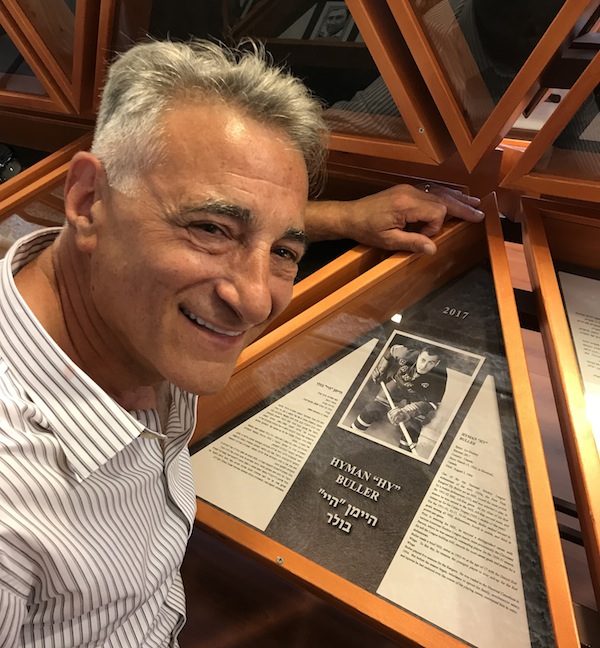
Jeff Buller at the induction ceremony for his father, the late Hy Buller, into the International Jewish Sports Hall of Fame in Netanya, Israel. (photo by Diane Buller)

These remarks were delivered on July 4 as part of the International Jewish Sports Hall of Fame induction ceremony at the Wingate Institute, in Netanya, Israel, for my late uncle, Hy Buller, who played for the New York Rangers hockey team from 1950 to 1954.

Ihave a photo hanging in my office of a curious little boy playing outdoors – a photo of me at 3 years old. In this photo, I’m proudly wearing a New York Rangers cardigan sweater, a loving gift from my Uncle Hy.

My Uncle Hy died in 1968, when I was still a teenager and, for much of my youth, he and his family lived in Cleveland, far from my hometown of Vancouver. I really got to know him best while penning an article about him for The Scribe, the journal of the Jewish Museum and Archives of British Columbia. This article, aptly titled “A mensch on defence,” was published in 2002.

In writing “A mensch on defence,” I reconnected with Hy’s three sons, Bob, Bruce and Jeff, who provided valuable information about their father. My cousins also put me in touch with legendary hockey players who had shared the ice with Hy: “Mr. Hockey” Gordie Howe, “Terrible” Ted Lindsay and goalie Johnny Bower. Each had warm memories of Hy and spoke highly of his abilities.

Winters in Saskatoon were devoted to hockey. Like many boys his age, Hy spent most of his time outside of school hours vying to be king of the ice on his uncle’s vacant lot, flooded and frozen each year.

A natural athlete, Hy quickly rose up the ranks and caught the eye of local coaches and scouts. When it was too warm for hockey, Hy never stopped moving, and was active year-round in football, baseball, basketball, golf, swimming and track and field, earning many awards.

In the 1940s and 1950s, there were only six teams in the National Hockey League. Most of the players on these teams came from the Canadian Prairies, with the majority coming from the small towns of Saskatchewan. From the time they were old enough to hold a hockey stick, youngsters in these hinterlands developed a fierce love for the game and a burning desire to be one of the 120 favoured players that made up the six NHL teams.

After an illustrious eight-year stint in the American Hockey League, Hy was traded to the New York Rangers at the close of the 1950-51 season, where he played with distinction until retirement in 1954.

A newspaper commented that, in street clothes, Hy Buller, with his mild, scholarly appearance, glasses and receding hairline, looked like someone who spent a lot of time in a library and knew from which end to read a book. But, once on ice with a hockey stick in his hand, something happened to Hy – a kind of Clark Kent into Superman transformation in which he changed from a studious-appearing bookworm to a formidable, hard-checking defenceman who seemed to be everywhere at once. He was admired not only for his solid plays but also for his good sportsmanship.

Hy’s type of playing in many respects resembled the kind of hockey played in Europe, depending more on clever stick-handling and skating than on the rough-and-tumble brand played in North America. His style and ability earned him the admiration of his fellow players.

I’m honoured to be accepting this award on behalf of my uncle and my family, 23 of whom have traveled from far and wide to share in this special moment. It’s a tribute to how well loved and respected he was that so many have journeyed to be here. I’d specifically like to note Hy’s sons Jeff and Bob, who have come with their wives, Diane and Sandie, and children.

On behalf of the family, I’m pleased to express our gratitude to the International Jewish Sports Hall of Fame for their induction of Hy Buller. My sincerest thanks.

To read David Schwartz’s 2002 article “A mensch on defence,” visit jewishmuseum.ca/publication/scribe-volume-22-mensch-defense. For more information on Hy Buller, visit en.wikipedia.org/wiki/hy_buller.

Format ImagePosted on August 25, 2017August 22, 2017Author David SchwartzCategories WorldTags Hy Buller, Israel, New York Rangers, NHL, sports
Trump equivocates

Trump equivocates

Format ImagePosted on August 18, 2017August 16, 2017Author Steve GreenbergCategories WorldTags antisemitism, Charlottesville, Nazis, racism, Trump
Commemorating Yom Hazikaron

Commemorating Yom Hazikaron

Left to right, Canadian Defence Attaché Col. Tony Lovett, Canadian Ambassador to Israel Deborah Lyons and Israel Defence Forces Widows and Orphans chief executive officer Yuval Lipkin light a memorial candle. (photo from IDFWO)

Canadian Ambassador to Israel Deborah Lyons, who attended a memorial lighting at Israel Defence Forces Widows and Orphans’ (IDFWO’s) office in Givat Shmuel to commemorate Yom Hazikaron, said, “Having had the opportunity to learn about the IDFWO and attend the bar and bat mitzvah in Jerusalem early after my arrival in Israel last year, I was, and remain, very impressed by the number of programs provided to support the widows and orphans of Israel’s fallen soldiers.”

The connection between Canada and IDFWO is at many levels. Every year, Canadian families open their homes to IDFWO orphans as they visit Toronto as part of the B’nai Mitzvah North America trip. And, as part of Toronto’s Bnei Akiva Schools’ effort to experience the Holy Land from a variety of perspectives, IDFWO organized for them to meet with the Israel Air Force at Sde Dov airport, where the pilots spoke about IDF orphans and the price they paid to protect the state of Israel.

For more information on IDFWO, visit idfwo.org/eng.

Format ImagePosted on August 18, 2017September 18, 2017Author IDF Widows and OrphansCategories WorldTags Canada, IDFWO, Israel, orphans, widows
NCSY at Sheba centre

NCSY at Sheba centre

Dr. Amit Segev gets his heart checked out by one of the participants in NCSY Canada’s Jewish Journeys summer program. Segev gave all the teens a stethoscope to commemorate their visit to Sheba Medical Centre. (photo from SMC)

More than 30 teenage participants from NCSY Canada’s Jewish Journeys summer program were recently treated to a VIP tour of Sheba Medical Centre’s Olga and Lev Leviev Heart Centre.

Dr. Amit Segev, director of Sheba Medical Centre’s cardiac division, showed the group a short presentation of how the heart can malfunction and what doctors can do to save patient’s lives in such instances. As there is nothing like a dose of reality to enhance the experience, Segev showed the teens a live view of a medical procedure being performed on a patient suffering from a heart malfunction.

As a token of appreciation for their visit – and perhaps spur their interest in a future medical career – Segev gave each participant a Sheba Medical Centre stethoscope.

Format ImagePosted on August 18, 2017August 16, 2017Author Sheba Medical CentreCategories WorldTags Canada, health care, Israel, NCSY, Sheba Medical Centre
Increasing inclusivity

Increasing inclusivity

Jay Ruderman (photo by Noam Galai)

The Ruderman Family Foundation is working to reshape societal attitudes about people with disabilities. Established in 2000 in Boston, the foundation attempts to foster inclusion by way of example, with a special focus on the Jewish community.

Jay Ruderman, a lawyer who spent nine years in Israel, has been at the helm of the foundation since 2008.

“Our first major initiative was including children with disabilities in the day school system in Boston,” Ruderman told the Independent. “We got into this issue of disability and inclusion out of a sense of fairness – principles within our family – that everyone deserves a fair shake.

“In terms of Jewish day schools, even within the same family, we began to ask why some kids were being included and enjoyed a Jewish education while others were not. Then, when I took over – my background is law and the civil rights aspect appealed to me – I began to see a broader picture and thought there was a vacuum in the Jewish community,” that advocacy was missing.

“You should know that people with disabilities are the largest minority in the world. And, not only that, they are also the poorest minority in the world and the most segregated [because of] stigmas and so forth.”

Initially, the foundation operated as a reactionary organization, wherein people would approach Ruderman’s parents for support. But, Jay Ruderman did not see this as a good way to make a positive impact.

He said that, traditionally, disability has been approached from the viewpoint of charity, and that a majority saw people with disabilities as unfortunate and in need of help. The “help” given usually led to segregation – separate schools, separate housing and separate work.

According to Ruderman, a transformation of perception was in order – the focus needed to be about each individual’s rights. He started his work to change views by doing a lot of outreach to the media, as well as awareness-raising and developing strategic working partnerships with major Jewish organizations.

“We are all connected to disability,” he said. “Everyone has a child, parent, sibling, neighbour with some sort of disability. For us, initially, we thought we didn’t really have a personal connection, but then, of course, like everyone else, I had a nephew born with autism – and my father developed a debilitating disability. It’s a widespread issue. But yet, I think the way we approached it was somewhat unique…. We’ve been doing this for a long time. It takes a long time to change attitudes.”

Within the Boston Jewish community, the foundation created an employment initiative called Transitions to Work, which has employed hundreds of people with disabilities and seen more than 100 employers hire people with disabilities. The foundation has also engaged in a community-wide synagogue inclusion project, which has spurred congregations from various denominations to be more inclusive and accepting of people with disabilities and their families.

In Israel, the foundation’s major effort has been a partnership with the government of Israel and the American Jewish Joint Distribution Committee to create a more inclusive society.

“That’s been a partnership with the Ministry of Finance, the Ministry of Health and the Ministry of Welfare, and we’ve engaged in that for many years,” said Ruderman. “Then, we began getting more involved nationally in the U.S. and looked for influential partners in the Jewish community. We developed partnerships across different streams of Judaism, the Foundation for Jewish Camp and Jewish Federations of North America.

“Internationally, we’ve had a prize called the Ruderman Prize in Inclusion, which has been awarded to communities and organizations excelling in inclusion, anywhere from Argentina to Uruguay, Mexico, all across the U.S. and Canada, England, Israel, South Africa, Australia and many different places around the world.”

Over the last few years, the foundation has developed an advocacy branch that has so far put out six white papers, garnering attention from the general media, including the New York Times, Washington Post and LA Times.

“The first paper we did was on police brutality and the fact that half the people in the country killed by the police have some form of a disability,” said Ruderman. “That’s gotten a lot of attention because, unfortunately, since the papers have come out, there’s been more people killed by the police and we’ve commented on those cases.

“We did a white paper on Hollywood and TV, as we found out that 95% of the characters with disabilities that you see on TV are played by able-bodied actors, and that really tapped into a diversity conversation in Hollywood that’s mainly focused on race. We injected disability into that conversation.”

The foundation also created the Ruderman TV Challenge, where they challenge creators to include more people with disabilities in new TV shows.

Elections are another area the foundation has examined – studying voting accessibility – as was self-driving cars and the transformative impact they could have on people with disabilities.

“People with disabilities should be thought of as these technologies develop,” said Ruderman.

The foundation also issued a paper about the murder of people with disabilities. “On average,” said Ruderman, “once a week, someone with a disability is killed by a caretaker – whether a family member or a professional.”

The foundation’s latest endeavour is called Rapid Response, where they try to respond to events more quickly, as they did when Donald Trump was running for president and mocked a reporter with a disability.

“We’ve done this too with Israeli officials and celebrities – mainly to shine a light on derogatory ways of acting or speaking about disability. So, we tend to speak out, and have developed a very active social media presence. We are now a combo of funding innovation in inclusion and doing a great deal of advocacy.”

Ruderman has found most Jewish institutions and synagogues to be very open to looking at ways of increasing inclusion, but also has heard many stories of people with disabilities and their families having been turned away by inaccessible or unwelcoming synagogues.

“I think rabbis know this is an issue,” said Ruderman. “What most don’t understand is that most solutions for accommodation are already available and, while the Ruderman Family Foundation doesn’t engage in capital financing, most communities have other foundations that do.

“I’ve always believed, we live in North America, in the wealthiest Jewish communities in the world, [and] the challenge with disability inclusion is that of willingness and awareness. To welcome a child with autism and their family, it takes some willingness to have a service that maybe is not as quiet as some congregants might like or be open to. Physical access for people using a wheelchair may be needed or, if someone is blind, they may need a Braille siddur. There are all sorts of different disabilities, but I find that when rabbis and community leaders are open, solutions can be found.

“Older generations tend to look at people with disabilities, even those in their own family, as separate and undeserving of being part of the community, but I think younger generations accept more diversity.

“My impression of Canada – I have spent some time, mainly in Eastern Canada – is that Canadians are very open-minded and progressive and there’s opportunity to find some real leadership that can reverberate across the world.”

For more information, visit rudermanfoundation.org.

Rebeca Kuropatwa is a Winnipeg freelance writer.

Format ImagePosted on August 18, 2017August 16, 2017Author Rebeca KuropatwaCategories WorldTags advocacy, disabilities, inclusion, Ruderman Family Foundation
The future of Jewish learning

The future of Jewish learning

A picture from Smart Money, a study intended to help the Jewish community navigate the high-tech world. (photo by Lewis Kassel courtesy of Moishe House)

By day, Liora Brosbe is the family engagement officer for the Jewish Federation of the East Bay in Berkeley, Calif., where she reaches out to the community with a menu of opportunities for “connecting to Jewish life and each other.” But when she’s not at work, Brosbe’s main job is raising three kids, ages 2, 6 and 8. Their home? A laboratory for Jewish learning strategies.

“Yes, they’re little Petri dishes,” their mom, who is also a psychotherapist, said with a laugh. “Like most families, screen time is a huge issue at our house, both for time and content, but I tell families it’s also an amazing opportunity for low-barrier Jewish engagement.”

With the avalanche of new technologies – many of them being tapped for Jewish learning – educators, funders and parents are often befuddled about where to invest their money and their kids’ or students’ time. A recent report on the implications of the wave of educational technology and digital engagement is designed to guide the Jewish community through this complex space.

Sponsored by the Jim Joseph Foundation and the William Davidson Foundation, Smart Money: Recommendations for an Educational Technology and Digital Engagement Investment Strategy examines many of these innovations and provides suggestions for navigating the high-tech world. The study’s recommendations include using virtual and augmented reality (a user could, for example, experience the splitting of the Red Sea); creating games based on alternative scenarios for “Jewish futures,” such as rebuilding Jewish life after the Roman destruction of the Second Temple; offering opportunities for students to learn coding and other technological skills, which can foster connectedness among Jewish youths and introduce them to Israeli high-tech companies; and increasingly using video, music, podcasting and other platforms.

The report is garnering far more attention than expected, according to the sponsors.

“We did not originally intend for this to be a public report,” said Barry Finestone, president and chief executive officer of the Jim Joseph Foundation, “but the substance of the findings and recommendations really challenge us, as funders, to think strategically, creatively and collaboratively about how we can utilize educational technology and digital engagement to advance our Jewish educational missions.”

For the report, Lewis J. Bernstein and Associates interviewed 50 experts, investors and educators from both the Jewish and non-Jewish worlds to create the recommendations.

“It’s a huge media marketplace out there and most Jews are exposed to the same information as the rest of the world,” said Lewis J. Bernstein, a former producer of Sesame Street and the report’s lead researcher. “Parents and educators have difficult choices to make, and Jewish learning and wisdom compete with the secular world.”

Read more at jns.org.

Format ImagePosted on August 18, 2017August 16, 2017Author Deborah Fineblum JNS.orgCategories WorldTags continuity, education, Jim Joseph Foundation, Judaism, technology
Getting closer look at Jupiter

Getting closer look at Jupiter

This JunoCam image highlights Oval BA. (photo from nasa.gov)

The U.S. National Aeronautics and Space Administration (NASA) recently released the first findings of the Juno research spacecraft, which entered Jupiter’s atmosphere last year.

The Weizmann Institute of Science’s Dr. Yohai Kaspi is a senior member of the Juno mission team. The reason why this research is so important, he said, is because it will allow us to better understand how the solar system was formed.

“To do that, we really need to understand Jupiter and how it was formed because, then, we can understand earth, in sequence,” said Kaspi.

photo - Dr. Yohai Kaspi of the Weizmann Institute of Science
Dr. Yohai Kaspi of the Weizmann Institute of Science. (photo from WIS)

For Kaspi, the fascination with space came at the early age of 7, when his dad shared some pictures of the Voyager I and II and took him stargazing. His interest grew from there, including when he was navigating in the Negev while in the Israel Defence Forces.

“My hobby growing up was competitive sailing,” said Kaspi. “That drew my interest into meteorology and understanding why the wind blows the way it does. Growing up in Nahariya, which borders Lebanon … all kinds of stuff [are] coming from Lebanon – currents, trash. It was very obvious where the wind or current was coming from and that connected to sailing.”

Kaspi studied math and physics at Hebrew University before heading to the United States, seeking adventure and a doctorate at Massachusetts Institute of Technology. Soon after, he was recruited to be a professor at the Weizmann Institute of Science.

While at MIT, Kaspi became connected to the Juno mission, developing instruments to help measure atmospheric conditions on Jupiter.

“I was interested in space and the weather,” said Kaspi. “I studied meteorology, as it kind of brings them together … [with] planetary science. We have planets, which resemble earth in some aspects, but we don’t understand their features and circulation.”

While Jupiter is by far the biggest planet in the solar system (11 times the diameter of earth) and has the greatest mass (300 times that of earth), it is a gas planet (i.e. it has no liquid or solid parts). Kaspi has studied Jupiter’s different weather zones and deltas.

“I developed a theory for understanding how deeply they extend,” said Kaspi. “When you look at Jupiter, you have this red and white belt, or zone. That’s all at the cloud level, so it condensates at the same temperature. But, we have no information what’s happening underneath them. What we needed was a global way to survey what was happening underneath the cloud layer. And that’s exactly what Juno is.

“During my PhD, I developed a new method to relate between the gravity field of the planet and the flows underneath this cloud layer. To understand Jupiter, we need to understand what’s happening in its interior.”

Kaspi has been involved with Juno since 2008, along with 30 to 40 other scientists who form the core of the mission, developing and designing the experiments, and interpreting the data.

photo - This enhanced colour view of Jupiter’s south pole was created by citizen scientist Gabriel Fiset using data from the JunoCam on NASA’s Juno spacecraft
This enhanced colour view of Jupiter’s south pole was created by citizen scientist Gabriel Fiset using data from the JunoCam on NASA’s Juno spacecraft. (photo from nasa.gov)

“We’re trying to deduce the depths of the flows from the gravity measurements of the planet,” explained Kaspi. “The purpose is to see what’s happening inside the planet. It has nine instruments and each one probes in different ways what is happening in the planet’s interior.

“One is a gravity instrument…. We send a beam from the spacecraft to earth. The beam travels 800 million kilometres and reaches earth. A desert in California captures that beam.

“We try to see the accelerations and decelerations of the spacecraft around the planet … trying to understand … the flow field and the gravity field of Jupiter.”

It was only when we first saw earth from space that we were able to understand the changing atmospheric conditions that are part of what is largely considered part of climate change, said Kaspi.

“We’d be able to understand how the solar system was formed, including earth,” he said of one of the project’s possible results. “For example, it’s really important for us to know if there’s a core inside Jupiter. A planet with a big or small core would have a different effect on the gravity field. When we measure the gravity field, we can deduce what’s happening deep inside the planet, which would lead us to different theories of how the solar system was formed.

“The connection to earth is we see the objects of Jupiter’s atmospheres … we don’t understand their strengths, how wide they are and how deep they are. We don’t have theories for that. If you want to have a good understanding of objects on earth, you have to look at the sister planet.”

The data-collecting portion of the Juno mission will come to a close at the end of this year. After 10 years of research and six orbits, the data will be analyzed to determine the direction of the mission going forward.

“We have already a lot of good data and we’re reaching a point where we can have significant results for understanding the structure, depths and composition of the atmosphere, but it’s a process,” said Kaspi. “Basically, we have one measurement every 53 days. So, every 53 days, I get my stuff and go to the U.S. and stay there for a week, analyzing the data and analyzing it for the rest of the 45 days, and then go back.”

Regardless of the results, Kaspi will continue the work he is doing at the Weizmann Institute on climate change and working on an instrument that will be sent to Jupiter on board the 2022 spacecraft being built by the European Space Agency.

“It will be the first Israeli instrument that will go beyond earth’s orbit,” said Kaspi. “That’s exciting. So, we’re involved in that and a variety of projects, trying to achieve fundamental understanding.”

As far as space exploration for the purpose of finding another planet fit for human dwelling, Kaspi said, “I’m just going to say that, if there is life in the solar system, it might be in the moons of Jupiter … because they have liquid water, a deep ocean, tens to hundreds of kilometres deep. Maybe there is life there.”

The public can follow the Juno mission on Facebook at facebook.com/nasajuno.

Rebeca Kuropatwa is a Winnipeg freelance writer.

Format ImagePosted on July 14, 2017July 11, 2017Author Rebeca KuropatwaCategories WorldTags Israel, Juno, Jupiter, NASA, science, space, Weizmann Institute
The two sides of surrogacy

The two sides of surrogacy

Jennifer Clarke with three of her children. (photo from Jennifer Clarke)

By the time Cyrus and Pam Mizrahi met in the summer of 2015, Pam had already gone through menopause, yet they wanted to have kids. After getting married in December of that year, the couple decided to explore their options.

“We both wanted to have children and Pam was not in a condition to have babies, so it was adoption or a surrogating program,” said Cyrus.

They chose surrogacy, Cyrus explained, because with “surrogacy you have all sorts of options when it comes to having your own kids or children. Adoption is different. You take babies from another parent.”

The Mizrahis did some research and opted for an agency in their home city of Boston, called Circle Surrogacy, an established firm that connected them with a surrogate from the City of Surprise, Ariz. Though they would have loved to have found a Jewish surrogate, none was available at the time. They consulted their rabbi.

“We contacted the rabbi who officiated our wedding,” said Cyrus. “He approved it and said it was a great idea. He said that what is more important is how we bring up our babies – providing Jewish education and raising them Jewish, if we want them to maintain a Jewish identity. It’s certainly important, of high importance, to us.”

The next step was working with the laboratory to produce the embryos. The Mizrahis wanted a boy and a girl. Luckily, both embryos took, and the twins were born on May 17, 2016.

“The first thing we did when the babies were born was we had the bris for the boy, of course,” said Cyrus. “I’ve taken them to shul a number of times and I’ll continue doing that. We have a kosher kitchen at home. We’re not Orthodox, but we observe to some degree. We’re hoping to send them to Jewish school and provide them with a Hebrew education.”

He said, “We named them after my parents’ Hebrew names. Our son is named Sol for Solomon (but only Sol) and our daughter is named Alexa. Sol is after my father – we have the tradition that we can name him after someone who is alive – and his middle name is Michael, named after my wife’s uncle. Alexa is a Hebrew name, named after my mom.” (It is an Ashkenazi custom to not name a child after a living person.)

The connection with the surrogate was very positive and strong. She has come to visit the twins and new parents three times within the past year.

“She lives far away, but she comes from time to time to visit us,” said Cyrus. “We’re always welcoming and it’s fine with us. We want to keep her as a friend in the family.”

With Cyrus having many relatives in Israel, he is anxious to take his kids for a visit there – and he and Pam are planning to do so when the twins turn 4 or 5 years old. “I have many cousins, first and second cousins,” said Cyrus. “A whole tribe. They are all over Israel – Petah Tikva, Jerusalem, Kfar Saba, all over.”

As for the surrogate, her name is Jennifer Clarke. She teaches high school Spanish just outside Surprise, which is a suburb of Phoenix.

For Clarke, the idea of surrogacy arose a few years back when she saw an ad at her church posted by a couple who could not have their own children. They were seeking a surrogate, and Clarke thought to herself, “I can have babies so easily…. I have four. I’ve never had any problems or complications, and others can’t and really want kids. So, I thought I’d offer to do that if she’d cover the medical expenses…. I talked my then-husband into it – he did think I was crazy … but he was used to my crazy ideas and eventually was accepting of it. I approached the girl about it and they had just received confirmation of getting two children from Mexico, a 3-year-old and a 5-year-old, so they didn’t need a service like that any longer.”

But, as Clarke already had made up her mind to help, she began doing some research, looking for someone else she might be able to assist. Clarke found a few companies that provide surrogacy service and went through the extensive application process.

“They want to make sure you’re mentally stable and that you’re financially sound,” she said. “You can’t be doing this if you want money … they don’t offer very much. It’s mostly just expenses plus a bonus. You can’t be in it for the money.”

The application took about two hours to complete over the phone. The company also screens the surrogacy applicant’s friends and spouse (if there is one). Everyone gets at least one hour-long phone call, to try and ensure that the surrogate has a strong support system and that there will not be an issue with the spouse or anyone else close to the surrogate. If the applicant qualifies – including being given the green light by their doctor and obstetrician/gynecologist – a profile is created of her, which is shown to “intended parents” (IPs).

The company selects some potential surrogates who match what the IPs are seeking – including factors such as how much communication they want with the surrogate, what the surrogate’s habits are (for example, diet, activity level, etc.) – and shows their files to the potential parents. “They sort of match you like a dating service,” said Clarke. “It might take a couple of interviews to find someone who fully suits you, but then you get matched and start the process of hormone treatments, implantation and such.”

Having Our Baby: The Surrogacy Boom, a documentary by Vancouver filmmaker Nick Orchard, aired recently on the Documentary Channel in Canada. While there are some differences between Canada and the United States when it comes to surrogacy, it seems that both countries’ systems work to ensure that the surrogate is entering the arrangement with mainly altruistic rather than monetary aims.

According to Orchard, infertility is often a “disability, for lack of a better word,” that couples hide. Therefore, he said, “most people are unaware of how, for some couples, it’s a real problem – conceiving and having a child of their own. So, it’s a situation where couples and gay couples and, every now and again, some single people really want to have a child, but they can’t do it without help from someone else. That’s when they reach out.”

He said, “The surrogates are doing this because they very much want to help someone. What they are doing is incredibly selfless – to put their … in many cases … own lives on the line. There are dangers involved in having a baby and to do all of that, I find it quite incredible. That was one of the things that first drew me to the topic.”

Some of the costs involved in hiring a surrogate in Canada, according to Orchard, include $10,000 to an agency; $20,000 for a surrogate’s expenses; $30,000 in fees for the clinics doing the transfers, developing the embryos, and so on; and $30,000 in legal fees for agreements drawn up between the surrogate and the IPs, to reduce the risks of having a surrogate change her mind and keep the baby once the process is done.

“You have to really want to have a child and, of course, it’s never a sure thing either,” said Orchard. “You can pay that money and you create the embryo … you might have to get the eggs from an egg donor … who you cannot pay [it is illegal]. You can get the embryos created and implant them, but, in many cases, they don’t take on the first go-around. So, you’ve just lost $10,000 and you have to start all over again.”

For more information on Orchard’s documentary and some of the facts about surrogacy in Canada, visit cbc.ca/documentarychannel/docs/having-our-baby.

Rebeca Kuropatwa is a Winnipeg freelance writer.

Format ImagePosted on July 7, 2017July 5, 2017Author Rebeca KuropatwaCategories WorldTags family life, infertility, Judaism, surrogacy

Posts pagination

Previous page Page 1 … Page 16 Page 17 Page 18 … Page 33 Next page
Proudly powered by WordPress