Skip to content
  • Home
  • Subscribe / donate
  • Events calendar
  • Business Directory
  • FAQ
  • News
    • Local
    • National
    • Israel
    • World
    • עניין בחדשות
      A roundup of news in Canada and further afield, in Hebrew.
  • Opinion
    • From the JI
    • Op-Ed
  • Arts & Culture
    • Performing Arts
    • Music
    • Books
    • Visual Arts
    • TV & Film
  • Life
    • Celebrating the Holidays
    • Travel
    • The Daily Snooze
      Cartoons by Jacob Samuel
    • Mystery Photo
      Help the JI and JMABC fill in the gaps in our archives.
  • Community Links
    • Organizations, Etc.
    • Other News Sources & Blogs
  • JI Chai Celebration
  • JI@88! video

Recent Posts

  • Or Shalom reopens its doors
  • JFS from past to future
  • Need holistic approach
  • Sharing stories, advice
  • Journalist shares fears
  • Skills to live together
  • Road to independence
  • Cutting grass with scissors
  • Zionism as a solution
  • Deceit, desire & the divine
  • Reclaiming sacredness
  • Creative project ideas
  • Summer squares and cobbler
  • Thou shalt … summer commandments
  • Legal help for students
  • Revisiting myth of Lilith
  • Wrong person rebuked
  • Canada’s mixed messages
  • Questions for museum
  • Symposium on antizionism
  • Making soccer political
  • CJPAC lauds Pulver’s impact
  • City recognizes Vrba’s legacy  
  • Organ donation saves lives
  • Theodore’s March premiere
  • A healing Shabbaton
  • Supplying healthy food
  • A chime of metal tags
  • Yellowknife seder a first
  • Ishai energizes, unifies
  • A Lag b’Omer to remember
  • Expanding the healing
  • Hannah Senesh – a unique hero
  • Community milestones … May 2026
  • Деньги до зарплаты на карту Займ до зп онлайн за 5 минут 2026
  • Микрокредит онлайн в Казахстане Микрозайм в Акшамат

Archives

Follow @JewishIndie
image - The CJN - Visit Us Banner - 300x600 - 101625

Category: World

Jews under the rule of Timur

Jews under the rule of Timur

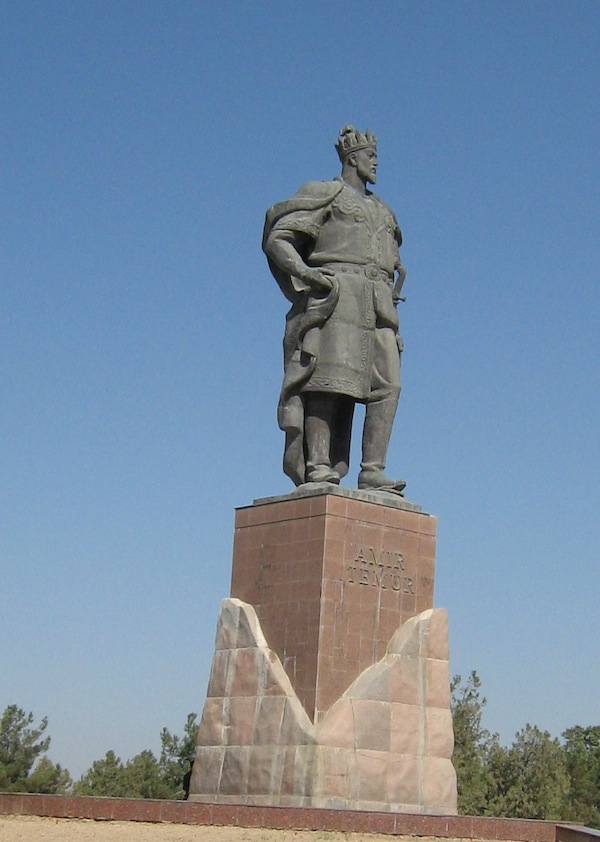
A statue of Amir Timur. (photo by Deborah Rubin Fields)

The 14th century was not a great time for European Jewry, to say the least – there were various kinds of persecution, including forced conversions, expulsions and massacres, especially in Western Europe. Yet, the Jews of what is now Uzbekistan got through this period relatively unmolested.

Turko-Mongol military leader Timur (Iron), who ruled from 1370 to his death in 1405, is also known historically as Tamerlane, from the Persian Timur-i lang (Timur the Lame), and Amir Timur (or Temur).

Timur conquered central Asia and parts of India – today’s Iraq, Iran, Afghanistan, Pakistan, Azerbaijan, Georgia, Uzbekistan, Turkmenistan, Tajikistan, Kyrgyzstan, large chunks of Turkey and Syria, and the northwestern portion of India. While it is estimated that his armies killed 17 million people, about five percent of the global population at the time, it seems he left Jews alone.

“Over the years, the moral justification for [Timur’s] campaigns … had evolved into a formality,” writes Justin Marozzi in Tamerlane: Sword of Islam, Conqueror of the World. “If the objects of his attentions happened to be Muslim, as they almost invariably were, then they had become bad Muslims. If they were infidels, so much the better.” Yet Michael Shterenshis, in Tamerlane and the Jews, contends that Timur did not consider Jews as infidels, at least not infidels needing to be violently eliminated, perhaps because they had no political ambitions and all they sought was Timur’s protection.

It would seem that Timur’s Jews were of more service alive than dead – which is a good thing, as Timur once reportedly constructed 28 towers from 70,000 of his enemies’ skulls, each tower consisting of 2,500 heads. According to Shterenshis, the ruler primarily used his Jewish subjects as taxpayers and skilled artisans. Jewish weavers and dyers contributed greatly to his efforts to rebuild the region and to reinstitute the abandoned Silk Road, which connected Europe to Asia.

Yu Datkhaev’s The Bukharan Jews is mentioned in Alanna E. Cooper’s Bukharan Jews and the Dynamics of Global Judaism. According to Cooper, Datkhaev argues that the term “Bukharan Jews” came to be after Timur moved several hundred Jewish families from Bukhara to Samarkand to assist in overhauling Samarkand, his designated capitol. These Jews reportedly lived near Timur’s recently rehabilitated and stunning Registan.

Timur’s Jewish subjects appear to have been loyal followers. Indeed, while Jews are not mentioned in his court history, there is a preserved letter from Herat physicians who ask the permission of Shah Rukh (one of Timur’s sons) to treat Timur’s injured soldiers. Significantly, they are offering their services to the state army, notes Shterenshis.

photo - Timur depicted on Uzbekistan’s 500 som note
Timur depicted on Uzbekistan’s 500 som note. (photo by Deborah Rubin Fields)

Timur seemingly responded in kind. He never issued anti-Jewish proclamations, laws, orders or restrictions. He never oppressed the Jews for being Jews, says Shterenshis. Under Timur, he adds, Jews were able to own houses and land, and they could be farmers – the regime did not impose upon Jews the role of moneylenders.

Jews under Timur’s reign were better off than the Jews of Europe and those in the Mamluk Sultanate, but were worse off than those who lived under the Mongols of China. Under Timur, Jews enjoyed a legal, but inferior status, writes Shterenshis. In contrast to their appointed role in other countries, Timur’s Jews were not particularly used as translators or envoys and their main occupations seem to have been as artisans, local merchants and doctors, says Shterenshis, noting that Jewish doctors under Timur did not enjoy the enhanced status they had previously, from the 10th to 12th centuries. Nonetheless, in local Jewish legends, Tamerlane is painted in a favourable light, says the historian, and is even supposed to have moved the Prophet Daniel’s remains to a tomb in Samarkand.

Some sources indicate that the Jewish presence in Samarkand pre-dates Timur’s rule. Tenth-century Samarkand (as well as Khorezm, Osh and Kokand) apparently hosted famous Jewish scholars, known in the singular as khabr, a word derived from the Hebrew chaver (friend or colleague), “which they used to distinguish themselves from ‘commoners,’” writes Irena Vladimirsky in “The Jews of Kyrgyzstan” (bh.org.il/jews-kyrgyzstan).

Indeed, the notion that Jews had been living in Central Asia prior to Timur’s rise to power is reinforced by the late-12th-century traveling Jewish chronicler Binyamin M’tudela (Benjamin of Tudela), who described this community as having as many as 50,000 members, among them “wise and very rich men.” Furthermore, the Samarkand community apparently appointed someone as nasi (head) of their community, who collected the requisite taxes of a recognized ahl al-demma (protected group).

In that period, Jews reportedly made Samarkand a major Jewish centre, and community members contributed to the construction of Samarkand’s aqueduct.

In the centuries after Timur, Jews came to dominate the region’s textile and dye industry, according to historian Giora Pozailov.

Uzbekistan’s aging Jewish population is now mainly concentrated in the cities of Tashkent, Samarkand and Bukhara. Even before the demise of the Soviet Union, Uzbek Jews began leaving, mainly for the United States and Israel. As the JTA article “Dwindling at home, Central Asia’s Bukharian Jews thrive in

Diaspora,” which can be found at ucsj.org, notes, Bukhara’s two synagogues almost never open at the same time, so that at least one of them has a minyan.

Deborah Rubin Fields is an Israel-based features writer. She is also the author of Take a Peek Inside: A Child’s Guide to Radiology Exams, published in English, Hebrew and Arabic.

Format ImagePosted on June 23, 2017June 21, 2017Author Deborah Rubin FieldsCategories WorldTags Diaspora, history, Tamerlane, Temur, Timur, Uzbekistan
Helping one village at a time

Helping one village at a time

With solar panels, Innovation: Africa – founded by Sivan Ya’ari, centre – is helping bring light and water to African villages. (photo from Sivan Ya’ari)

“Growing up in Israel, we were a poor family,” recalled Sivan Ya’ari, founder of Innovation: Africa. “But the poverty I saw in Africa was true poverty. We can’t compare.”

Ya’ari spent part of her childhood in France, which later helped her land a job with Jordache, a jeans manufacturing company based in the United States that had some factories in French-speaking African countries.

“After spending time in villages and traveling to other countries, I realized that the main challenge in Africa, the main reason why Africa is still in poverty, is the lack of energy,” she told the Independent. “Because there is no energy, they can’t get access to medicine, vaccines – because there is no refrigeration. Because there is no energy, people don’t get access to good education. But, most importantly, people don’t have access to water.”

Ya’ari had imagined Africa to be a continent with little water, but she discovered there is actually plenty of water in Africa. However, the water is located in aquifers and, to get to it, you need to pump it – and to do that, you need energy.

“Growing up in Israel, I remember seeing solar panels on every building,” she said. “So, when I came and learned a bit more about energy, I thought, maybe we just need to transfer some of the knowledge and some of the technology to remote villages to give them a chance to access water and education.”

Ya’ari enrolled in Columbia University’s master’s in energy program and began fundraising to bring energy solutions to Africa.

As a student, Ya’ari started in one village, and then another, continuing to the point that, today, she has brought the technology – a large pump run by solar panels – to about 140 villages, and counting. The water is pumped into a large holding tank and then, with the help of gravity, flows to different taps that are installed throughout a village.

“Usually, we’re putting one tap two kilometres from the water pump system, another tap four kilometres from it and another … in all directions,” said Ya’ari. “So, with one water pump system, we’re able to reach many villages and people.”

Once the concept proved successful, Ya’ari founded Innovation: Africa, which operates in seven African countries. “In every country, we have an office with a local manager,” she said. “In Uganda, for example, we have seven full-time local people working who have all been trained. They are managing and doing the work on the ground.

“We first hire a company that does geological surveys. This provides information about how deep the aquifers are, how much water we can find and where would be best to drill. Then we hire a drilling machine company and have local contractors do the rest – installing the pump, the water tank, involving the community (meaning, the villagers) who decide where to instal the different taps.

“Once this is all installed, sometimes, in some villages, we instal an extra tank – only for irrigation technology (Netafim) that we bring from Israel – and then we provide irrigation pipes to the village.”

Each pump provides 30,000 litres on average per day per system.

Innovation: Africa recently received an award from the United Nations for their remote monitoring system – another technology that came from Israel.

“It’s off-grid, remote monitoring, so, at any point, we are able to remotely know how much water we’re pumping into every village,” explained Ya’ari. “If something breaks, meaning a pump hasn’t pumped water in 24 hours, we are notified about it by the system; not only us, but the local contractors and the local managers.”

Most of the funding has come from individuals and foundations, often with one individual or family sponsoring a village. On Innovation: Africa’s website (innoafrica.org), there is information about how to become a sponsor.

“We have a bar or bat mitzvah … choosing an orphanage to adopt and then they are traveling with their parents to be there when the kids get light for the first time,” said

Ya’ari. “We have families adopting villages. It’s very transparent, personal and concrete. The donors appreciate that they also have access to the remote monitoring. At any point on their phone, they are able to see how much energy was produced or consumed and how much water was pumped. They also know if something breaks. They are connected to the villagers. They go back and visit.”

According to Ya’ari, many children, especially girls, are kept out of schools in Africa so that they can walk the great distances necessary to get water.

“I believe that the best return on the investment is when we bring water to a village,” said Ya’ari. “What we found is that people are spending hours a day looking for water. Most of the time, the water they find is dirty and is not good for drinking. Once we bring clean water, the people are healthier. The changes we see … the children are going to school. We see a lot more girls going and getting an education. We see that they are growing food.

“What inspires me is the number of businesses villagers are able to grow with access to water. They are able to grow food and sell it in the market. They are making bricks and making their homes, no longer made with mud. We see livestock…. They are making more money.

“And, for the medical centres, it’s tremendous,” she said. “Once we provide a little energy and we buy a small fridge, then people come in from the capital to the village to help. The doctor, with energy, she can actually work.”

When it comes to the cost to make this happen, it is about $5,000 to light a classroom and $18,000 to light a whole school, including the homes of the teachers. To bring water to a entire village, it costs around $50,000.

No governments are involved in these projects. It is all about people on one end of the world helping out people on another end.

“Unfortunately, there is no shortage of villages waiting,” said Ya’ari. “In the seven countries that we operate, we have a long list of schools needing light and water centres. It has a lot to do with funding and people to adopt the villages. We have the people on the ground and the technology.”

Rebeca Kuropatwa is a Winnipeg freelance writer.

Format ImagePosted on June 16, 2017June 29, 2017Author Rebeca KuropatwaCategories WorldTags Africa, innovation, Israel, Sivan Ya’ari, solar energy, tikkun olam
Interfaith efforts recognized

Interfaith efforts recognized

The winners of the 2017 King Abdullah II World Interfaith Harmony Week Prize with King Abdullah, centre, at Al Husseiniya Palace in Amman, Jordan. (photo from worldinterfaithharmonyweek.com)

On April 30, the leaders of the Calgary Interfaith Council were in Amman, Jordan, to receive the 2017 King Abdullah Award for World Interfaith Harmony’s first prize from the king himself.

The council’s co-chairs – Rabbi Shaul Osadchey of Beth Tzedec Congregation, Debra Faulk of the Unitarian Church of Calgary and Imam Fayaz Tilley, a chaplain at the University of Calgary and board member of the Muslim Council of Calgary – were invited to attend the ceremony at the Royal Hashemite Palace. They were presented with the award by King Abdullah II. It included a cheque for $25,000 US to put toward their continuing work in Calgary.

Osadchey described the experience as “memorable, momentous, impactful.”

“The Calgary Interfaith Council (CIC) was reconstituted in February as part of the launch of the United Nations World Interfaith Harmony Week program,” Osadchey told the Independent. “The CIC is now the amalgamated body of five or six other smaller interfaith organizations in Calgary. It was launched as the central voice of the interfaith community here, so we decided to première that with the United Nations World Interfaith Harmony Week.

“We organized a week of programs that highlighted interfaith cooperation and strength of the community. We did a program that began with an opening ceremony at city hall. The mayor had issued a proclamation for the city that designated the week of Feb. 1st to the 7th as UN World Interfaith Harmony Week in Calgary, and he personally came and spoke.”

They had 15 different religious communities involved in the festivities, which included interfaith breakfasts, a weekend open house, and people were welcomed into various congregations for workshops and tours. There were also two “build days,” where participants volunteered to build a house with Habitat for Humanity.

“We raised $15,000 for the Habitat project,” said Osadchey. “It was a program with depth.”

The Calgary Interfaith Council submitted what they did to the website that oversees the worldwide program of activities, said Osadchey. “There were over 1,000 events worldwide and we were selected as the outstanding program for 2017 and won first prize, the gold medal. What that meant was that they asked us to send three representatives to receive the award in Jordan, along with the second- and third-place winners – the second-place winners were from Bosnia and the third-place winners were from London, England. We were flown to Jordan and spent three days there.”

According to the prize’s press release, the International Forum Bosnia’s Centre for Interfaith Dialogue was honoured “for their efforts toward dialogue and cooperation among ethnic and religious groups in Bosnia and Herzegovina” and the London-based nonprofit PL84U Al Suffa for “providing meals and services to the homeless, elderly and others in need in an atmosphere of interfaith respect and cooperation.”

At the Sunday morning awards ceremony, both King Abdullah II and Prince Ghazi ibn Muhammad were in attendance, with the latter giving a talk. Osadchey was asked to give a three-minute speech on behalf of the winning delegation.

Osadchey was the first Jew and rabbi to be part of one of the award ceremonies. “They were very respectful, very interested and engaged in the conversation about Judaism and about the Jewish experience in the interfaith arena,” he said. “Both the king and the prince were pleased to have me as a delegate and acknowledged that the interfaith dimension of the program had taken a significant expansion by having Jews included.

“I was looking forward to being able to convey some comments to the king. I began by reciting the brachah [blessing] that is said when you’re in the presence of the king or head of state. I recited it to the king in Hebrew and then translated it into English. And my comments were about how religious literacy is a necessary component for creating interfaith harmony.

“I suggested to the king that the World Interfaith Harmony Initiative develop a youth component that would focus on religious literacy among the youth of the world. And, when I received the medal from him and we had a few moments to exchange some words, he asked me to follow up on that proposal, as did the prince.”

Osadchey said he is in the process of writing a proposal to create this youth component, and added that he is looking forward to running a youth interfaith harmony week in Calgary. He hopes that others will use his model and do likewise in their communities.

“I think it’s important that not only adult leaders engage in creating relationships, but that we begin developing those among the next generation,” he said. “If we can do that, then the road to true harmony will be a lot easier to create.”

Since the world interfaith award was created in 2010, said Osadchey, there have been two other Canadian cities that have won awards – Toronto and Halifax, both achieving third place in their respective years.

The Calgary Interfaith Council is hoping to inspire a national designation of Feb. 1-7 as World Interfaith Harmony Week across the country and to bring other Canadian cities and communities into the picture. They are starting with their home province, encouraging their leaders to issue a proclamation designating it throughout Alberta. “We’re pretty close to getting that done,” said Osadchey. “Then, we’ve got an MP that’s working in Ottawa to do the same.”

Osadchey returned from Jordan full of hope and was impressed by the respect, interest and welcoming response of the Jordanian people he encountered. Nonetheless, he thought that, while interfaith activity might take place among the upper echelons of Jordanian society, he suspected that the general population is likely not as open or accepting. “That would have to do with probably lower levels of literacy, education, just in general,” he said.

He added, “The fact that their neighbour is Israel – and even though they have a fairly good relationship with Israel – it is still tinged with the Palestinian issue as well. I don’t think the ‘man on the street’ really cares about interfaith relationships in Jordan, but the leadership and the king certainly are trying to push the country more toward an acceptance of that.”

In Jordan, dialogue is mainly with the Christian world and does not seem to have any links with the Jewish world, but Osadchey is hopeful it may happen as a consequence of his visit.

“We’ll see how that takes place, but they’re reaching out,” he said. “The fact that the king of Jordan is the one responsible for this initiative…. They are trying to project a different image internationally.

“It’s really been very positive…. It’s had a positive effect on the Calgary community, both Jewish and non-Jewish, seeing this as a great recognition of our efforts in the interfaith community. It’s garnered a lot of recognition locally and spurred people to get more involved in our program, so that’s been a really positive benefit.”

For more information and to see more photos from the ceremony in Jordan, visit worldinterfaithharmonyweek.com/2017-prize-awarding-ceremony.

Rebeca Kuropatwa is a Winnipeg freelance writer.

Format ImagePosted on June 9, 2017June 7, 2017Author Rebeca KuropatwaCategories WorldTags Calgary, interfaith, Jordan, King Abdullah, religion, Shaul Osadchey, tikkun olam
Grodzka Gate Lublin reunion

Grodzka Gate Lublin reunion

A photo from Lublin: Faces of a Nonexistent City, likely taken by taken by Abram Zylberberg. (photo from Grodzka Gate – NN Theatre Centre)

From July 3-7, the Grodzka Gate – NN Theatre Centre in Lublin (Osrodek Brama Grodzka – Teatr NN), Poland, will host the Lubliner Reunion – the first international meeting of Jewish inhabitants of the city and their descendants in 70 years.

Grodzka Gate – NN Theatre Centre is an organization run by non-Jews dedicated to preserving Jewish memory. It has been actively pursuing this mission for 25 years, and its program includes meetings, discussions, sightseeing tours, commemorations and artistic events. The reunion will constitute an important element of the celebrations, which mark 700 years since the founding of the city of Lublin, and is designed to emphasize the significance of the Jewish community for the history of the city.

The history of Jews has been intertwined with that of Lublin for several hundred years, and has helped shape its identity. The story of Lublin has been enriched with, among other things, the presence of a well-known yeshivah (Yeshivat Chachmei Lublin), the meetings of the Council of Four Lands (Vaad Arba Aratzot), the activities of local rabbis and social organizations and the work of writer and Nobel-laureate Isaac Bashevis Singer.

Just before the Second World War broke out, the 43,000 Jewish citizens of Lublin constituted one-third of the city’s population. The majority of Lublin’s Jewish inhabitants were murdered during the Holocaust and one of the German death camps, Majdanek, was located on the outskirts of Lublin. The story of Lublin cannot be told without the stories of its Jewish inhabitants, which is why, during the festivities organized to celebrate the 700-year-long history of the city in 2017, the presence of their descendants is vital and symbolic.

“The Lubliner Reunion is a way to build a bridge across time,” said Tomasz Pietrasiewicz, founder and director of Grodzka Gate. “It’s meant as a meeting in which both the people and their stories are important. Grodzka Gate is engaged in protecting the ‘memory of the place.’ We want to preserve what is left of Lublin’s Jewish community. The Lubliner Reunion will allow us to share knowledge and fill the blank spaces in the stories about Lublin and its inhabitants.”

photo - Grodzka Gate in Lublin, Poland
Grodzka Gate in Lublin, Poland. (photo from Grodzka Gate – NN Theatre Centre )

The program of the reunion covers meetings devoted to the history and culture of Jewish Lublin, workshops in genealogy, walks along tourist trails, commemorations and a variety of artistic events. One of the central features of the reunion will be presentations of Lubliner family stories. Guests will have a chance to get to know both historical and contemporary Lublin, visit the former Jewish district and meet non-Jews working to preserve the memory of the Jews of Lublin for generations to come.

Apart from sightseeing within Lublin, Grodzka Gate is also planning tours of the region – Zamosc, Kazimierz Dolny, Belzec and Wlodawa, among other places. Apart from these excursions, all events are free of charge for participants. The inauguration of the reunion will take place on July 3 in the Museum at the Lublin Castle.

“We want to get in touch with and invite all those whose families come from Lublin,” underlined reunion coordinator Monika Tarajko. “We already have participants coming from Israel, the United States, France, Belgium and Great Britain. However, we are still striving to reach as many prospective participants as possible and inform them about the reunion. We are expecting more than 100 people to visit Lublin as part of this special event. Feel welcome to join us!”

For reunion registration and information, visit lubliners2017.teatrnn.pl or contact Tarajko (48-606-687-367, [email protected]) or the American ambassador to Grodzka Gate, Leora Tec (1-781-862-4976, [email protected]).

Grodzka Gate’s other projects include Lublin: Memory of the Holocaust, a trail commemorating the Jewish inhabitants of Lublin who perished in the Holocaust; The Mysteries of Memory, an artistic happening involving a piece of the city with its specific topography, history and technical infrastructure; and Henio Zytomirski: The “Letters to Henio” Project, where, on April 19 (Holocaust Remembrance Day in Poland) every year, citizens of Lublin send letters to Henio Zytomirski, a Jewish boy who was born in 1933 in Lublin and was murdered by the Nazis in a gas chamber, probably in November 1942.

Grodzka Gate’s Lublin: Memory of the Place Exhibition is dedicated to Lublin before the war. A considerable part of the former Jewish district today has been covered with concrete, under which the foundations of Jewish buildings and the memory of those who once lived there are buried. Over the years, Grodzka Gate has become a place where old photographs, documents and testimonies can be preserved for posterity.

As well, there is Lublin: Faces of a Nonexistent City. In May 2012, Grodzka Gate received a collection of 2,700 glass plate negatives found in the attic of the house at Rynek 4 by workmen doing repairs. The photographs were taken between 1914 and 1939 and were, based on Grodzka Gate’s research and recent findings, taken by Abram Zylberberg.

Grodzka Gate’s website is teatrnn.pl/en.

Format ImagePosted on June 9, 2017June 7, 2017Author Grodzka Gate – NN TheatreCategories WorldTags continuity, Grodzka Gate, Holocaust, Lublin, memory, Poland
Trump supporters meet

Trump supporters meet

Left to right, Larry Elder, Dennis Prager and Hugh Hewitt at the Unite Inland Empire Conservative Conference on April 30. (photo by Dave Gordon)

Eight hundred supporters of U.S. President Donald Trump gathered in a Los Angeles-area venue recently – before the controversy this week over Trump’s sharing of classified information with Russia – to hear four major U.S. media figures discuss why, in their opinion, the president had thus far made impressive executive choices.

The April 30 event – the fourth annual Unite Inland Empire Conservative Conference – was entitled Trump’s First 100 Days.

Panelists were talk radio hosts Larry Elder, Hugh Hewitt and Dennis Prager and senior editor-at-large of Breitbart News, Joel Pollak.

Trump was praised by all speakers for his Supreme Court choice of Neil Gorsuch, his strike on Syria, his efforts to overturn Obamacare and the newest Iran sanctions. The two Jewish speakers – Prager and Pollak – told the Independent that the president has, in a very short time, done much for Israel.

Appointing a U.S. ambassador to the United Nations who is critical of the world body’s treatment of the Jewish state should be seen as significant in itself, Prager said. “Why isn’t Nikki Haley enough for a Jew?” he asked.

The author of seven books, including the recently released Ten Commandments: Still the Best Moral Code, Prager said Trump should divest the United States entirely from the UN, however.

“It is a morally bad organization. It does more harm than good,” he said. “You can have aid agencies without the UN. Think we need UN peacekeepers? You can talk about Rwanda. What good has the Security Council done? It is the most anti-Jewish institution in the world. What more do you need to know? My whole life I have understood Jew-hatred as the barometer of the world’s health.”

In terms of reported rising Jew-hatred in the United States, Prager said some of it is fabricated and some is an imminent threat.

“All of the Jewish centres’ bomb threats – this was hysteria – all because of a black radical and a disturbed Jewish kid in Israel. It wasn’t 40 antisemitic incidents; but maybe one or two.”

To those who accuse the president of attracting those who bear ill will towards the Jews, Prager added, “It’s a world of lies that Trump has increased antisemitism and that he is an antisemite and that he has let antisemites in his administration.”

The true menace, he said, was “the transformation of the university to the most Israel-hating institution in America. Jews don’t want to acknowledge this because they adore the university.”

Antisemitism might be among the reasons Trump has waffled on his promise to move the U.S. embassy to Jerusalem, Prager said, adding, “I 100% excuse him on it.”

It is Prager’s belief that Israel may be reticent, at this point, to deal with the potential blowback.

“The Arab world is a passion-based, hate-filled world,” he said. “The hatred of Israel is the food of the Arab world. There’s no joy in saying this.”

However, it was important that Trump said that while campaigning, argued Prager. “I believe [the promise] didn’t say, ‘I am going to open an embassy in Israel.’ It said, ‘I care about Israel,’ unlike the previous president.”

photo - Joel Pollak, senior editor-at-large at Breitbart News, addresses the conference
Joel Pollak, senior editor-at-large at Breitbart News, addresses the conference. (photo by Dave Gordon)

Meanwhile, Pollak thinks that the president may follow through with moving the embassy to Jerusalem at some point in the future.

“I don’t see it as a back pedal,” said Pollak. “David Friedman [U.S. ambassador to Israel] is going to live in Jerusalem, even though the embassy is in Tel Aviv. It indicates which of the two cities the U.S. considers is Israel’s capital.”

In terms of the peace process, the new administration will not be mirroring that of Barack Obama, who “took the Palestinian side, and that was destabilizing,” said Pollak.

On the UN, Pollak said it was a forum for enemies to hash out their differences, but its Human Rights Council – where many dictatorships have representatives – should be dismantled.

In agreement with Prager, he said the pressing danger to U.S. Jews is the surge of university-based antisemitism.

“Students are being exposed to anti-Israel activities that they’re ill-equipped to counter,” said Pollak. “It has gotten so bad that now discrimination is happening on religion, not just for supporting Israel.”

Last year, U.S. campuses saw a 45% increase in anti-Jewish sentiments, according to Tel Aviv University researchers and the AMCHA Initiative, which investigates antisemitism on college campuses.

The issue will worsen, Pollak said, as more young people remain ignorant of the Holocaust – a tragedy all-too-often invoked and misused by those who compare the Final Solution to the Palestinian situation.

For attendee Evan Sayet, author of Kindergarten of Eden, the “single most important thing” for American Jews to do is to rebuke government-funded universities, “twisting the screws against the lies and antisemitism in the guise of academia.”

He said, “You might not think of American campuses, because it doesn’t seem like an existential threat. You might think academia is just a place of words. Obviously, this is the next generation who are infused with antisemitism. It bodes ill for the Jews. Antisemitism is an evil that is placated in the Arab world and, now, other places in the world, including Europe.”

Dave Gordon is a Toronto-based freelance writer whose work has appeared in more than 100 publications around the world.

Format ImagePosted on May 19, 2017May 17, 2017Author Dave GordonCategories WorldTags antisemitism, Dennis Prager, Joel Pollak, politics, Trump, United States
HIPPY ventures into Asia

HIPPY ventures into Asia

HIPPY, developed in 1969, is being used by some 20,000 families in various countries. (photo from HIPPY International)

For the first time ever, HIPPY (Home Instruction for Parents and Preschool Youngsters) will be setting up offices in Southeast Asia.

HIPPY is an early learning program developed by researchers in 1969. It is already being used by 20,000 families in Argentina, Australia, Austria, Canada, Germany, Israel, Liberia, New Zealand and the United States.

As explained on the HIPPY Canada website, the program “delivers a curriculum based on the needs of children to become school-ready; recognizes role-play as the method of teaching the skills needed to implement the child-centred curriculum; and features a peer home visitor system that enables mothers, who may be hard to reach due to social isolation, poverty, language or other cultural issues, to feel comfortable participating in the program.”

“HIPPY has the same core program across the world. In each country, it is adapted to the cultural and linguistic context,” Miriam Westheimer, director of HIPPY International, told the Independent.

In addition to its Southeast Asia offices, other HIPPY news includes a major expansion in Argentina, progress with the program’s digitization and the development of a HIPPY app.

As well, HIPPY’s program in Liberia continues to grow and is now a part of the government’s early childhood strategic plan. The program was originally funded by Friends of Liberia, a group comprised of former Peace Corps volunteers. For the past three years, it has been funded through the Open Society Foundation and is now a ministry of education program.

In Korea and China, HIPPY will introduce a fee for the program, creating a revenue stream Westheimer hopes will allow for more programs in developing countries.

“Typically, once we start a pilot program in a new country, we can then attract policy-makers and funders to help sustain and grow the program,” she said. “What’s interesting is that the models in Korea and China are the first programs working with a higher-education parent population and the pilot project starting there sells the program to upper-middle-income families who can purchase it.”

It’s HIPPY’s first for-profit venture. Typically, the program is free-of-charge and relies on volunteers and community participation, but the agencies and organizations in Korea and China that approached HIPPY wanted to do this as an entrepreneurial project.

“We see it as an opportunity to raise some money so we can do this in countries where we haven’t been able to work yet, developing countries,” said Westheimer. “There are several African countries very interested and we don’t have the start-up [funds] to be able to start working there. We’re looking at this as a model for how we can benefit from the sale of the program, if it does indeed take off, to raise funds to support other new countries in the network.”

“We just started a pilot in Asia,” said Westheimer. “We started with 60 families. Now, we are working with 120 families. We hope to double or triple this next year, but it’s growing slowly. The idea is that it could become part of the ministry of education’s plan and we’re laying the groundwork for it to become a national program.

“We started the same way in Argentina. We started in a few shantytowns in Buenos Aires. It started in a Jewish community, through AMIA, the Jewish community centre in Buenos Aires, and then, several other groups, childcare centres, built in these shantytowns around Buenos Aires.

Because of its success, the federal government has given a grant to expand to six provinces. They started 100 families in each of the six provinces.”

The model is also working well in a few European countries, such as Austria and Germany, where they have something they call “HIPPY-inspired programs.” For these programs, they take the basic concept of working with parents in the home, with home visits or group meetings, but not using the HIPPY-developed curriculum.

“They have their own curriculum,” said Westheimer. “So, we have HIPPY-inspired programs in Finland, Sweden, Turkey and Holland. The Turkey program is … the most remotely connected to the HIPPY network. The other ones are really part of our international network.”

The program in Turkey has been running for about 30 years, she said. While it began as a small HIPPY program, it has evolved into an independent one with really no connection to HIPPY.

For more information about HIPPY Canada, visit hippycanada.ca or call its office in Vancouver at 604-676-8250.

Rebeca Kuropatwa is a Winnipeg freelance writer.

Format ImagePosted on May 19, 2017May 17, 2017Author Rebeca KuropatwaCategories WorldTags education, HIPPY

Resolution on full inclusion

The Reconstructionist Rabbinical Association, during its annual meeting, on March 28, overwhelmingly approved an expansive resolution affirming the full inclusion, equality and welcoming of all transgender, non-binary and gender non-conforming individuals.

The resolution commits the RRA to work for “full inclusion, acceptance, appreciation, celebration and welcome of people of all gender identities in Jewish life and in society at large.” The document also “strongly advocates for the full equality of transgender, non-binary and gender non-confirming people and for equal protections for people of all gender identities under the law, at all levels of government, in North America and Israel.”

In keeping with the ethos of Reconstructionist Judaism, the resolution’s passage followed a democratic and deliberative process. Over the past year, representatives from Reconstructionist congregations, as well as the board of governors of the Reconstructionist Rabbinical College, approved similar resolutions. All of the central organizational bodies representing Reconstructionists have now raised their collective moral voice.

The RRA vote comes about a year and a half after the Union for Reform Judaism passed its Resolution on the Rights of Transgender and Gender Non-Conforming People. The RRA is pleased to join the ranks of a growing number of Jewish religious and cultural institutions formally affirming transgender inclusion and establishing new policy guidelines.

The resolution aims to be a blueprint for action. Already, the Reconstructionist Rabbinical College has graduated rabbis who identify as transgender, non-binary or gender non-conforming. Individually, congregations have been taking steps toward the full inclusion of people of all gender identities. Congregation Bet Haverim in Atlanta, for example, is in the process of creating a fully inclusive chevra kadisha (burial society) that will ensure that Jews of all genders will have access to respectful and traditional rites throughout their entire lifecycle. Other congregations have been experimenting with methods of calling people up to Torah using non-binary and gender-neutral language.

Under the March resolution, efforts will be made to aggregate and share these innovations among the approximately 100 congregations and 350 rabbis of the Reconstructionist movement. In addition, the movement’s website for ritual resources, ritualwell.org, will be expanding its existing resources giving expression to all-gender-inclusive values.

The full resolution can be found at jewishrecon.org.

Posted on May 5, 2017May 3, 2017Author Reconstructionist Rabbinical AssociationCategories WorldTags equality, inclusion, Judaism, Reconstructionist, transgender
Dialogue needed

Dialogue needed

Robert Singer, chief executive officer of World Jewish Congress, addressed more than 100 Jewish Federation of Greater Vancouver donors at an event hosted by Gary Averbach and sponsored by Garry Zlotnik of ZLC Financial. (photo from WJC)

The professional head of World Jewish Congress says Diaspora Jews and Israelis are too wrapped up in their own worlds and need to strengthen the dialogue between the two components of the global Jewish community.

Speaking to the Independent during his first-ever visit to Vancouver, Robert Singer said relations remain strong in terms of Diaspora support for Israeli organizations. Programs like Birthright, through which young Jews experience Israel, and Masa, which offers young adults gap-year, study-abroad and other opportunities, also enhance connections. But there must be more person-to-person contacts like these, he said, which foster real conversations across the divide.

“I’m not sure that both sides are talking,” said Singer. “I think both sides are busy with their own stuff. Israelis are busy with stuff in Israel and Diaspora Jews are today busy with their survival, in many cases, both financial and community survival.”

World Jewish Congress is an organization that can facilitate dialogue, he added.

WJC was founded in Geneva in 1936 and now represents Jews in 100 countries, focusing on issues including protecting the memory of the Holocaust, advocating for the recognition of the experiences of Jews from Arab lands, combating antisemitism and encouraging interfaith dialogue. The Congress is headed by Ronald Lauder, president of the executive committee. Singer, who has been the chief executive officer of WJC since 2013, previously served 14 years as the director general and CEO of World ORT, one of the largest nongovernmental education and training providers in the world. Singer was born in Ukraine and made aliyah at age 15.

While in Vancouver, Singer met with rabbis, representatives of the Centre for Israel and Jewish Affairs, Jewish Federation of Greater Vancouver and other communal organizations. He also met with Russian-speaking members of the community and said he was impressed with Vancouver’s flourishing Jewish life. He acknowledged that British Columbia’s Jewish community faces challenges common to many similar-sized communities.

“The main thing that struck me is the issue of assimilation and how to deal with this,” he said. “Being more inclusive, bringing more people of non-Jewish faith into the community, issues of education, issues of fighting BDS and antisemitism on campuses, and issues of relations between Israel and the Diaspora.”

Interviewed days after many young Jews blockaded the AIPAC conference in Washington, D.C., Singer rejected the idea that younger Jews are alienated from Zionism.

“It’s very different,” Singer said of the way young Jews relate to Israel. Previous generations, he said, were Holocaust survivors or their descendants who knew a world without Israel. “For somebody who is now 20 years old, all this is now either history or they just don’t remember the situation where there was a world without a Jewish state.” This generation cannot be expected to have the same visceral connection to Zionism, he said. “I think it’s just a different approach. Different technologies, different approach.”

He compared the suggestion of declining Zionism with the situation among young Israelis.

“In Israel all the time they say that the previous generation was much more patriotic,” he said. Yet, when young people are conscripted into the Israel Defence Forces today, more – not fewer – are requesting assignment to the most difficult combat and elite units, he said.

“It shows that this generation of young Israelis is at least as good as the people before them and I think it’s the same in the Diaspora,” Singer said, citing the Jewish Diplomatic Corps, a WJC program of about 200 young adults from 43 countries, including international lawyers, businesspeople, parliamentarians, professors and others who meet with government leaders and international agencies.

“They are outstanding young people,” said Singer. “I’m sure that, on an intellectual, Jewish and pro-Zionist level, they are at least as good as the leadership of the people who went before.”

On external threats, Singer said it is too soon to make a determination about long-range impacts of contemporary antisemitism. A new WJC study indicates an antisemitic comment is posted to social media every 82 seconds.

“It’s very bad,” he said. But, he added, it may be less a matter of growing antisemitism than attitudes that were already there merely finding expression.

The situation in Europe is concerning, he said. Antisemitic and neo-Nazi parties are seeing unprecedented public support in France, Germany, Hungary and Greece. “This is a real danger,” Singer said.

On the impacts of U.S. President Donald Trump’s policies, Singer said it is too soon to judge. He is impressed, however, that Trump’s appointee as U.S. ambassador to the United Nations, Nikki Haley, has adopted a very different approach from her recent predecessors.

While the United Nations General Assembly is a wasteland at present, Singer said, Canada and the United States should remain active there, “because there is a stage there and you can have some influence.”

Of the new Canadian government, Singer said he is pleased that relations between Israel and Canada remain close and that this is something that transcends politics.

Format ImagePosted on April 21, 2017April 20, 2017Author Pat JohnsonCategories WorldTags antisemitism, Diaspora, Israel, WJC

Israeli authorities arrest teen

A Jewish teenager with dual Israeli and American citizenship living in the southern Israeli city of Ashkelon was arrested March 23 in connection to the more than 100 bomb threats against Jewish community centres and other Jewish institutions across North America since the beginning of 2017.

The suspect, 19, was arrested by Israel’s Lahav 433 police unit in the wake of a months-long investigation by Israeli authorities, who worked alongside the FBI and other international law enforcement agencies. Authorities did not release the suspect’s name. Additionally, police detained the suspect’s father on suspicion that he knew of his son’s activities.

Authorities believe the suspect was also behind a bomb threat against two Delta Airlines flights between New York and Tel Aviv in January 2015, the Times of Israel reported.

The JCC Association of North America said on March 23 that it is “gratified by the progress in this investigation” and praised law enforcement agencies’ “commitment and leadership.” But the umbrella organization for the community centres added that it is “troubled to learn that the individual suspected of making these threats … [is] Jewish.”

During a raid on the suspect’s home, authorities found an advanced computer lab with sophisticated equipment, including voice-altering technology, encryption methods and a large antenna that he likely used to phone and email bomb threats to Jewish institutions in the United States, Canada, Australia, New Zealand and Israel.

It is believed the suspect has lived in Israel for several years, and that the Israel Defence Forces refused to draft him “on personal grounds after finding him unfit for service,” Haaretz reported.

Israel Police spokesman Mickey Rosenfeld said this arrest was part of a coordinated international operation. “This specific investigation was complex in terms of the suspect and its nature, and there was a significant breakthrough in the investigation, which led us to make the arrest of the suspect, who lives in southern Israel,” he told the Jerusalem Post.

Rosenfeld added that “he was the main suspect behind the numerous amount of threats which were made to different Jewish communities and organizations around the world.” Investigators, he said, will continue to “see if and how he was connected to the different Jewish communities in the U.S. That directs the investigation to the American connection. We are looking to see if there was an incident which triggered him to carry out threatening those communities.”

Israeli Public Security Minister Gilad Erdan congratulated police on the arrest and expressed his hope that it would bring an end to the threats against Jewish institutions.

U.S. Attorney General Jeff Sessions, meanwhile, said the Department of Justice “is committed to protecting the civil rights of all Americans, and we will not tolerate the targeting of any community in this country on the basis of their religious beliefs. I commend the FBI and Israeli National Police for their outstanding work on this case.”

Earlier this month, U.S. authorities arrested Juan Thompson, a 31-year-old former news reporter from St. Louis, in connection with eight bomb threats against Jewish institutions. At the time, law enforcement officials said Thompson was not believed to be the main suspect behind the threats, an assertion that is purportedly confirmed by the latest arrest.

Following the March 23 arrest in Israel, Anti-Defamation League chief executive officer Jonathan Greenblatt said that, even though “it appears that the main culprit behind the majority of these attacks has allegedly been identified, antisemitism in the U.S. remains a very serious concern.”

He said, “No arrests have been made in three cemetery desecrations [that occurred in early 2017] or a series of other antsemitic incidents involving swastika graffiti and hate fliers. JCCs and other institutions should not relax security measures or become less vigilant.”

– for more international Jewish news and opinion, visit JNS.org

***

Canadian reactions

“We are relieved and grateful that authorities have located the individual believed to be responsible for these false threats. At the same time, we are shocked and outraged to learn that the alleged perpetrator of these crimes, which terrorized our community, is a Jewish dual American-Israeli citizen. He appears to have acted alone, and we unequivocally condemn his behaviour.

“While Israeli authorities deserve credit for arresting this individual, he was apprehended following a lengthy and complex global investigation that included Canadian and other global law enforcement partners. We remain deeply appreciative of the work of Canadian government, police and security agencies in supporting our community.

“While these threats proved to be false, the Jewish community remains a target of hate. We encourage communal institutions to remain vigilant and follow their existing security protocols.”

– David J. Cape, Centre for Israel and Jewish Affairs

“If the allegations are true, it would prove to be shameful and disheartening.”

– Avi Benlolo, Canadian Friends of Simon Wiesenthal Centre


Posted on March 31, 2017March 31, 2017Author Sean Savage JNS.ORGCategories WorldTags antisemitism, bomb threats, JCC
Team Israel’s fairytale run

Team Israel’s fairytale run

Josh Zeid during the game against Japan. (photo from worldbaseballclassic.com)

Team Israel had a great run at the World Baseball Classic tournament. The ballplayers with a David vs. Goliath approach came out swinging hard and stunned the world with four consecutive wins in the preliminary and second rounds. But two losses in a row – an 8-3 loss to Japan March 15 and a 12-2 clobbering by the Netherlands on March 13 – made advancing to the finals a dream for the next global tournament.

The March 15 game started with five scoreless innings, but Japan blew open a lead in the sixth with five runs and added three more for good measure in the eighth. Israel scored all its runs in the top of the ninth.

The World Baseball Classic is a tournament in which the best baseball players in the world compete. Team Israel had bookers betting against it even making the main event, but the blue-and-white uniformed ballplayers, who were ranked 41st going into the Classic, not only made it to the preliminary rounds but won an astounding four in a row at the tournament.

Dubbed the Cinderella team of the contest, Team Israel stunned Cuba 4-1 in the first WBC quarterfinal game at the Tokyo Dome and, before that, swept the first round of games by beating South Korea, Taiwan and the Netherlands.

Only three of Team Israel’s 28 players are Israeli; the rest are Jewish Americans. According to WBC rules, anyone eligible to hold citizenship in a country can play for its national team. There are other teams with players who do not hold passports for the country for which they’re playing.

“The players love playing for Israel,” Israel Association of Baseball president Peter Kurz told Israel21c. “A lot of them want to come and visit after the tournament or after they retire.”

photo - Mensch on a Bench – the Israeli team’s mascot – waits for the game to begin
Mensch on a Bench – the Israeli team’s mascot – waits for the game to begin. (photo from worldbaseballclassic.com)

For fans, that the ballplayers are proud to wear “Israel” on their uniforms and represent the country is more than enough.

“I am a lifelong baseball fan, and it’s thrilling to see Israel competing on a world stage. But Israel’s participation in the World Baseball Classic is about so much more than baseball,” said Elie Klein, an associate partner at Finn Partners Israel who calls himself a “rabid New York Mets fan.”

“While baseball fans around the globe have taken notice of Team Israel due to their surprising athletic prowess, Jews around the world – many of whom have never watched a single inning of baseball – are drawn to Team Israel out of deep Jewish pride. Not because they are Israelis, but because they aren’t – they are largely American Jews who have decided to wear uniforms emblazoned with the Jewish star and don kippot during Hatikvah, to identify as Jews in such a public way,” said Klein.

American rapper Kosha Dillz (Rami Matan Even-Esh) even made up a song about Team Israel. And Team Israel will also be remembered for its mascot, Mensch on a Bench, a stuffed doll that was the Jewish answer to the popular Christmas toy and story Elf on the Shelf.

On March 22, the United States team beat Team Puerto Rico to win the championship.

Israel21c is a nonprofit educational foundation with a mission to focus media and public attention on the 21st-century Israel that exists beyond the conflict. For more, or to donate, visit israel21c.org.

Format ImagePosted on March 31, 2017March 31, 2017Author Viva Sarah Press ISRAEL21CCategories WorldTags baseball, Israel, Mensch on a Bench, sports

Posts pagination

Previous page Page 1 … Page 17 Page 18 Page 19 … Page 33 Next page
Proudly powered by WordPress