Skip to content
  • Home
  • Subscribe / donate
  • Events calendar
  • Business Directory
  • FAQ
  • News
    • Local
    • National
    • Israel
    • World
    • עניין בחדשות
      A roundup of news in Canada and further afield, in Hebrew.
  • Opinion
    • From the JI
    • Op-Ed
  • Arts & Culture
    • Performing Arts
    • Music
    • Books
    • Visual Arts
    • TV & Film
  • Life
    • Celebrating the Holidays
    • Travel
    • The Daily Snooze
      Cartoons by Jacob Samuel
    • Mystery Photo
      Help the JI and JMABC fill in the gaps in our archives.
  • Community Links
    • Organizations, Etc.
    • Other News Sources & Blogs
  • JI Chai Celebration
  • JI@88! video

Recent Posts

  • Or Shalom reopens its doors
  • JFS from past to future
  • Need holistic approach
  • Sharing stories, advice
  • Journalist shares fears
  • Skills to live together
  • Road to independence
  • Cutting grass with scissors
  • Zionism as a solution
  • Deceit, desire & the divine
  • Reclaiming sacredness
  • Creative project ideas
  • Summer squares and cobbler
  • Thou shalt … summer commandments
  • Legal help for students
  • Revisiting myth of Lilith
  • Wrong person rebuked
  • Canada’s mixed messages
  • Questions for museum
  • Symposium on antizionism
  • Making soccer political
  • CJPAC lauds Pulver’s impact
  • City recognizes Vrba’s legacy  
  • Organ donation saves lives
  • Theodore’s March premiere
  • A healing Shabbaton
  • Supplying healthy food
  • A chime of metal tags
  • Yellowknife seder a first
  • Ishai energizes, unifies
  • A Lag b’Omer to remember
  • Expanding the healing
  • Hannah Senesh – a unique hero
  • Community milestones … May 2026
  • Деньги до зарплаты на карту Займ до зп онлайн за 5 минут 2026
  • Микрокредит онлайн в Казахстане Микрозайм в Акшамат

Archives

Follow @JewishIndie
image - The CJN - Visit Us Banner - 300x600 - 101625

Category: World

Water expertise helps

Water expertise helps

During an installation of a solar water pumping system at Nyanza Village, Uganda, Innovation: Africa’s engineer and project manager celebrate as clean water flows. (photo from Innovation: Africa via Israel21c.org)

Using ingenuity to overcome its serious water challenges, Israel has become the go-to expert for a world facing an impending water crisis. To celebrate World Water Day on March 22, Israel21c took a look at 10 of these innovative water projects, and Israel’s leadership role.

This year’s WATEC expo and conference, to be held in September in Tel Aviv, is expected to attract 10,000 stakeholders from 90 countries seeking Israeli solutions for water issues. Israel exports $2.2 billion annually in water technology and expertise. In addition, these commodities are shared on a humanitarian basis through training courses, consultations and projects. Keren Kayemeth L’Israel-Jewish National Fund (KKL-JNF) often hosts delegations from around the world – most recently, from California, Argentina and the European Policy Centre – to see how Israel’s system of treatment facilities and 230 reservoirs has achieved the world’s highest ratio of wastewater reuse. About 92% of Israeli wastewater gets treated and 75% is used for agricultural irrigation. Israel plans to recycle 95% of its wastewater for irrigation by the end of 2025.

“During the 1980s, recycling wastewater was a revolutionary concept and many people were skeptical. Today, nearly half of the irrigation in Israel comes from recycled wastewater,” said KKL-JNF development project director Yossi Schreiber.

Israeli water-tech companies are planning and building agricultural and municipal water infrastructure in countries including Angola, Ghana, Serbia, China, Spain and the United States. Here are 10 recent examples.
1. The nonprofit group Innovation: Africa won a United Nations award for transforming lives in seven African countries using Israeli technologies, such as Netafim irrigation systems, that enable farmers to grow more crops with less water; and solar energy systems that pump water from aquifers, saving villagers (mostly women and children) countless hours previously spent finding and fetching water.

2. IsraAID launched its WASH (Water, Sanitation and Hygiene) project about four years ago to tailor-make solutions for communities from Fiji to Haiti to Myanmar.

In the rain-dependent South Pacific island nation of Vanuatu, a March 2014 cyclone contaminated reservoirs and destroyed water-harvesting systems. Among other steps, IsraAID strategized the engineering of a low-tech gravity system, built and maintained by locals, to bring water from mountain springs down into two villages encompassing more than 600 people and one school. IsraAID is working with the World Bank to construct three more gravity systems.

In Kenya’s Kakuma Refugee Camp and Uganda’s Gulu township, which struggle with waterborne disease and water contamination, IsraAID trains unemployed or underemployed people to be water technicians. Graduates work with local nongovernmental organizations or water companies, or start their own businesses, to contribute their new expertise in anything from drilling wells and building latrines to teaching hygiene.

3. A massive landslide in September 2015 damaged a major irrigation canal partially built by Israeli NGO Tevel b’Tzedek in an impoverished Nepali village. Tevel staff repaired the damage with funding from the Rochlin Foundation and Jewish Coalition for Disaster Relief, and worked with the local water council to strengthen the canal walls, reestablishing and assuring water supply to 224 households (about 1,300 people) and subsistence farmers.

Also in Nepal, Tevel is fighting the effects of flash floods – which deplete water available for drinking and irrigation – by building irrigation pools and setting up zero-water-waste systems enabling villagers to conserve water through Israeli methods, including drip irrigation learned by Tevel’s native Nepal director at Ben-Gurion University of the Negev. Tevel also is teaching village farmers less water-intensive professions, such as beekeeping.

4. Israel’s Ministry of Foreign Affairs (MFA) has partnered with Caesarea-based GAL Water Technologies to provide free water-treatment products to African nations for more than 20 years. In 2016, MFA donated GAL mobile water purification, storage and distribution vehicles to drought-stricken Papua New Guinea and to the Pacific Marshall Islands.

5. Earlier this month, the MFA’s MASHAV-Israeli Agency for International Development Cooperation established the Kenya Israel Drought Resilience Agriculture Centre to help in capacity-building with the latest Israeli irrigation and water-resources management know-how.

6. MASHAV’s special envoy for water and food security went to Swaziland this month with the director of overseas training, programs and research at MASHAV-affiliated Centre for International Agricultural Development Cooperation to conduct a water survey by request of Swaziland’s prime minister. The experts are identifying possible areas of cooperation in combating drought and a shortage of water for agriculture.

7. Following a May 2016 earthquake in Ecuador, IsraAID brought a new Israeli water-purification technology from NUFiltration to several affected villages. Instead of having to buy bottled drinking water, residents can use the NUF system to turn washing water into purified drinking water without electricity. NUF was first piloted by the company in Ghana as a humanitarian project to prevent diseases from contaminated water.

8. The Tel Aviv University chapter of Engineers without Borders designed and built a rainwater collection and purification system in a Tanzanian village where the drinking water had dangerously high amounts of fluoride. Since the project was finished in 2014, it has been supplying safe drinking water to more than 400 children daily.

9. The Technion Engineers without Borders chapter designed and implemented a safe drinking-water system serving more than 600 Ethiopian schoolchildren in a rural village with no reliable source of water for drinking and handwashing. The Israelis taught the older children how to maintain the system and treat the water, and continue to provide support to assure a safe and sustainable water supply.

10. In June 2015, the Israeli Ministry of Economy committed $500,000 to the World Bank Group’s Water Global Practice to help developing countries overcome complex water security challenges. The agreement has included two years of study tours and other activities for World Bank staff and officials of various governments.

Israel21c is a nonprofit educational foundation with a mission to focus media and public attention on the 21st-century Israel that exists beyond the conflict. For more, or to donate, visit israel21c.org.

Format ImagePosted on March 31, 2017March 31, 2017Author Abigail Klein Leichman ISRAEL21CCategories WorldTags Israel, tikkun olam, water
Working to get to Olympics

Working to get to Olympics

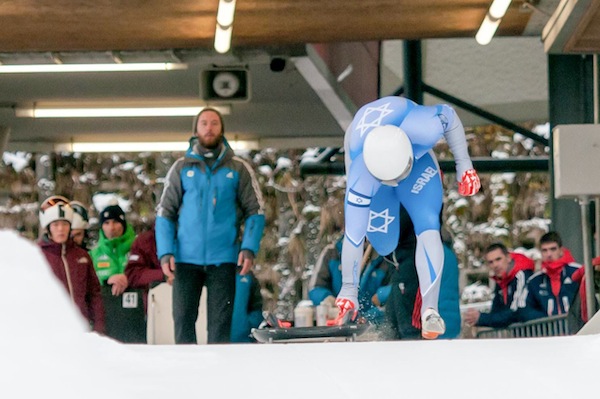
Joel Seligstein is one of four Israeli skeleton athletes aiming for the 2018 Olympic Games in PyeongChang, South Korea. (photo by Erin Murphy)

What began as a dream 15 years ago – when David Greaves helped establish an Israeli presence in the bobsled and skeleton world – finally received the approval, recognition and support of the Israeli Olympic Committee this past December.

Greaves was a member of the Israeli bobsled team that fell short of qualifying for the Olympics in 2006, although they did compete in two world championships.

“When I retired from the sport,

I felt I wanted to continue in some capacity,” Greaves told the Independent in an interview earlier this year. “So, I took over as head of the federation, of which I’m now the president. It’s called Bobsled Skeleton Israel, which is the Israeli bobsled skeleton federation.

“I wanted to stay involved in the sport and to try to provide an opportunity for other Jewish athletes to experience something of what I did – the pride of wearing the Magen David on your jacket and competing for Israel internationally.”

The experience changed the trajectory of Greaves’ life – he was working in the sales and high-tech industry. It also made him realize what was important for him as a Jew and an Israeli.

“I came back from that experience deciding I wanted to leave the world of high-tech and focus my efforts on Jewish community and working for Israel,” he said. “That led me to volunteering for the Jewish Federation of Winnipeg. This soon led to me working on a contract basis for them, which turned into a full-time role. I became a fundraiser for the Jewish community.”

Greaves spent 10 years fundraising for Winnipeg’s federation and then for the Jewish Foundation of Manitoba, before starting his own business in 2014. Called Protexia, it helps nonprofits and charitable organizations fundraise.

With the refocus in his professional life also came a refocus in his involvement with Bobsled Skeleton Israel. As the organization’s volunteer president, he is in regular contact with the Israeli Olympic Committee as they gear up for the Winter Olympics in PyeongChang, South Korea, in 2018.

“The challenge was finding an athlete interested, sometimes from another program … the American program, whatever it happened to be. Some of the bigger programs are so deep, you can be a great athlete … but may not have an opportunity to make the big leagues and would likely not ever get the opportunity that they have now … to compete at the highest level, for a smaller nation,” said Greaves. “But now, I have four athletes competing at different levels around the world … and that’s more than most small nations have.”

While many people compete for Israel from around the world, most are not directly connected to the Israeli Olympic Committee, but, with the completion of the process in December, Bobsled Skeleton Israel is now an official Olympic sport under its umbrella. Last September, the committee had accepted Greaves’ recommendation to recognize the criteria established by the International Bobsled and Skeleton Federation as the Israeli criteria.

“It was almost anticlimactic,” said Greaves. “I was working on this for 13 years and I’d never had the opportunity to present to the Israeli Olympic Committee before, with the opportunity of them possibly accepting our recommendation. Needless to say, I was over the moon and ecstatic.

“So, now, I feel confident talking about our future, because the only step left for us to be competing at the Olympics is for one of my athletes to qualify. If we have an athlete that qualifies, then we’ll be going to Korea for the Games, as he will have met the criteria.”

To get to the Olympics, the athletes will need to be in the top 60 internationally. For the current season, the goal is to get two athletes into the top 75 world ranking, which would position them for next year. They currently only have one.

All of the Israeli athletes in the federation are competing on their own in skeleton.

“It’s been easier for us to find skeleton athletes from a budgetary standpoint, because we don’t fund our athletes,” said Greaves. “We’d love to have a bobsled team, too, but it’s a bit more work for us to really develop that program. Given I’ve got a full-time day job and we don’t at the moment have any prospects for bobsled athletes, our efforts have solely focused on developing our skeleton program.”

Israeli skeleton athlete Bradley Chalupski in action
Israeli skeleton athlete Bradley Chalupski in action. (photo from Bradley Chalupski)

Bobsled Skeleton Israel is a nonprofit in the United States, enabling them to fundraise there for their athletes. These athletes can fundraise within their circles and the organization can provide a tax receipt to donors.

“We’ve been pretty successful in the last few years in raising more money than we have in the past,” said Greaves. “It’s been allocated out to the athletes based on need. Essentially, they get reimbursed, in very small part, for their costs. If we have $5,000 or $10,000 in the bank, so to speak, and an athlete has just come back from a week of training, then they can submit a portion of their expenses. But, it’s very modest.

“We’re looking to have a fundraiser this spring in Winnipeg. There’s also now – because we’re now officially a member within the Olympic movement in Israel – the possibility for funding from the state if an athlete qualifies for funding.”

In that case, the athlete will be eligible for a few Israeli shekels a month. Even so, about 95% of the money spent in this sport by Israeli athletes is money that they themselves have raised, either through their own personal supporters or their own savings. According to Greaves, his athletes have given up the last two or three years of their lives to compete and train.

Contributions are deductible in Israel and the United States, and there is an Indiegogo campaign currently underway. Greaves is in discussion with a few Jewish organizations with the hope that they may be able to assist in accepting Canadian donations.

“We want people to understand we’re in this because of a love for Israel and a love for sport,” he said. “Our ultimate dream is to walk into the Olympic stadium with the Israeli flag. There’s such a pride that’s hard to convey. We do this out of a sense of pride and love for Israel.

“I once was asked in an interview years ago, when I was competing, if I had a choice to compete for Canada or for Israel, who would I pick? I’m a dual citizen. I said, without a doubt, I’d want to do it for Israel. There’s a special connection between my Jewishness, my connection to Israel and my Zionism. The other guys on my team feel the same way as well. Am Yisrael might make this a different experience than other athletes might have … not to take away from how amazing it would be for any athlete to represent their country.”

For more information and to follow the athletes – Bradley Chalupski, Adam (A.J.) Edelman, Joel Seligstein and Larry Sidney – visit facebook.com/israelibobsledandskeletonfederation. To contact Greaves, email [email protected].

Rebeca Kuropatwa is a Winnipeg freelance writer.


Format ImagePosted on March 31, 2017March 31, 2017Author Rebeca KuropatwaCategories WorldTags David Greaves, Israel, Olympics, skeleton, sports
Ackerman keeps on winning

Ackerman keeps on winning

Estee Ackerman wins gold at the 2016 Junior Olympics in Houston. (photo from Estee Ackerman)

A Jewish Orthodox New Yorker is quickly becoming a legend – and she is not even 15 years old yet. Her name is Estee Ackerman and she is currently one of the hottest names in table tennis.

In 2013, Ackerman even beat one of the world’s greatest tennis players – Rafael Nadal – in an exhibition table tennis match during the American Open. Nadal went on to win the American Open that year. “So, I could say I was the only one who beat him in New York,” joked Ackerman.

A sophomore at Yeshivah University High School for Girls, also known as Central, Ackerman is a nationally and internationally ranked table tennis star.

Her passion for the sport began at a young age, as a fun way for her and her family to pass the time on Saturday afternoons in their basement.

“My dad wanted to do something fun with my brother, Akiva, and I that did not involve electronic gadgets,” Ackerman told the Independent. “He says everyone is looking down [at their gadgets] these days. We figured, what can we do? In the wintertime, we can’t go out so much and we were young kids at the time … we can’t do wrestling, we’re not tall enough for basketball.

“My dad started with my brother, Akiva, who is also now an amazing player. They really just had a fun family activity, as we had a table in our basement. One day, I went down and I said, ‘Let me give this a try.’ I was about 8 years old at the time and I was also so little that they just saw the racket going back and forth … I was under the table.

“Just playing with them about an hour each night was how it began. After doing this for a few months, a few days a week, we saw improvement. From there, we took it to the next level. We went to professional ping pong clubs. I compare it to how some people get piano lessons … I got the ping pong lessons, with top coaches from China.”

Ackerman recalls feeling “star struck” when she entered these clubs. “I was definitely at the bottom in the club leagues,” she said. “But, as the coaches said I had talent and that I should continue, I went to them a few times a week, and that’s how we saw much improvement to keep going.”

Balancing school and play is no easy feat, but, with Ackerman’s success, Central was willing to accommodate her traveling for tournaments, sometimes missing a week of school at a time.

“I would say that when I get back from these weekly tournaments, all the teachers are so happy … they’re so willing to sit down with me and catch me up on the notes I missed,” said Ackerman.

“Besides my friends wanting to know how I did in the tournaments, they’re eager to sit down with me, because they know that missing 11 classes a day for a week is not so easy to catch up on. But, I’m happy to say that Central is very supportive in all I do.”

Ackerman’s dad takes her to all the tournaments and practices, and ensures she has whatever she needs.

As for Ackerman’s fellow table tennis playing brother, he has put the sport on hold in order to continue his Torah studies in Israel. But, he may return to ping pong in the future, as he has plans to study at Yeshivah University after his time in Israel.

photo - Estee Ackerman in action
Estee Ackerman in action. (photo from Estee Ackerman)

In Ackerman’s professional career to date, she has already achieved successes that few even dare to dream about, including winning the Nationals in Las Vegas in 2015.

“This probably is one of my biggest accomplishments,” she said about those games, “as I was competing against 250 players in that event – transferring from the round robin group all the way to the single elimination matches.”

Last summer, Ackerman entered the U.S. Open playing hardbat. “That is like the old school way,” she explained. “If you know, a ping pong racket is usually made with smooth rubber, but a hardbat is usually made with pimples [an outer layer of rubber covered in dots]. I had never played in tournaments with hardbats [before that].

“Believe it or not, I did win the Women’s Open hardbat event. I came in second in the mixed doubles hardbat event. And, I won the gold medal in the women’s doubles hardbat event. So, I can definitely say that, in America, I’m the best female hardbat player.”

In February 2016, Ackerman was one of 16 women invited to the American Rio Olympics trials. But, as she could not play on Shabbat, she was not able to get enough wins to make the team.

“Being at the Olympic tryouts was already great enough to me,” she said. “Me being with the best players in our country – warming up with them, seeing them in the locker room – it doesn’t get better than that. I was playing on the biggest stage of my life.”

Now, Ackerman has her sights set on 2020 in Tokyo. But, in the meantime, she is busy accomplishing other feats, such as winning gold in the Junior Olympics, for girls under the age of 16 in singles and for girls under the age of 16 in doubles.

Ackerman is also thinking about whether or not she will go to the Maccabiah Games or stay in the local circuit for now. And, of course, she is focusing on graduating in 2019.

As it happens, Ackerman’s first trip out of the United States was in 2014 for a tournament in Markham, Ont. “I was representing the United States competing against Canada in the Junior Cadet Open,” she said. “As that was the first time I left the country, I was very excited, especially to be representing America.

“We did hear of a tournament taking place two weeks ago in Vancouver, but, as it was only a two-day event and one of the days was on Shabbat, we didn’t go. Other tournaments are four days or a week long, so just to compete for one day is a little much for the amount of travel.”

Asked if she has any advice for other young sport hopefuls, Ackerman said, “One should always dream big and just believe. I know that if one can put in countless hours and hard work, and they really love what they do, they can accomplish their goals. If they really want to be the best they can be, they have to put in the amount of hours that it takes.

“Although I love the sport of table tennis, I always say it’s my second priority. My religion, Judaism, is my first priority.”

As far as playing ping pong on Shabbat, Ackerman feels it is totally OK when her friends come over to have fun. But, when it comes to competing in a national tournament – with the uniform, with the media – she does not feel that it is right to participate on Shabbat.

Ackerman recently made it onto the world ranking. She is 466th in the world and 171st for her age group of under 18. To follow her career, visit teamusa.org/usa-table-tennis.

“I know to be really up there in the world rankings, you really have to travel worldwide – to France, Poland and Switzerland,” said Ackerman. “As I am in yeshivah, it’s a little tough. But, as I get any opportunity, I’d love to be there.”

Rebeca Kuropatwa is a Winnipeg freelance writer.

Format ImagePosted on March 31, 2017March 31, 2017Author Rebeca KuropatwaCategories WorldTags Estee Ackerman, ping pong, sports, table tennis

Anti-BDS legislation

Israel’s Knesset last week passed legislation against the boycott, divestment and sanctions (BDS) movement, representing just one of several setbacks this month for BDS around the world.

The Israeli bill, which passed its third and final reading with a 46-28 vote, grants the interior minister authority to deny entry visas to non-Israeli citizens who actively support boycotts of the Jewish state.

Conveying the rationale for the anti-BDS measure, Member of Knesset David Amsalem (Likud), chairman of the Knesset Interior Committee, said that, “if someone demeans me, I do not let them into my home.” Responding to critics of the legislation, Amsalem said the new law is not intended to stifle free speech, but was implemented to combat antisemitism and enemies of the Jewish state. These opponents of Israel, he said, “are not talking about boycotting only the settlements; they are talking about boycotting the state as a state, without any distinction. We are talking about antisemites here.”

One of the bill’s initiators, MK Bezalel Smotrich (Jewish Home), expressed similar sentiments, saying, “In recent years, a new antisemitic front has been initiated against Israel. Our enemies carry out a campaign to delegitimize and boycott Israel. Banning BDS supporters that come here to harm us from within is the minimum we can do against those Israel-haters.”

Left-wing Knesset members and several American Jewish organizations, including the Anti-Defamation League and the Reform and Reconstructionist movements, were highly critical of the new anti-BDS law. MK Tamar Zandberg (Meretz) said the law “is against freedom of expression” and “is meant to silence people.” The American Jewish lobby group J Street claimed the law “damages Israel’s democracy and helps the BDS movement.” The American Jewish Committee said it is “troubled” by the legislation.

Despite the controversy, Israel’s new law represents just one of several recent setbacks for the global BDS movement….

Read more at jns.org.

Posted on March 17, 2017March 14, 2017Author Adam Abrams JNS.orgCategories WorldTags BDS, boycott, Israel
High-tech, fashionable art

High-tech, fashionable art

Fashion designer Noa Raviv (photo by Ryan Duffin)

Avant-garde fashion designer Noa Raviv says her award-winning fashions were triggered by her interest in the power of mistakes.

Born in Tel Aviv in 1987, Raviv is currently developing her couture brand in New York City, after achieving global industry recognition for her Hard Copy garments combining hand-sewn, 3D-printed polymer synthetic tulle with laser-cut appliqués.

“Hard Copy was a really long process that came out of my thinking about the concept of originals and copies in our era,” she told Israel21c. “When I started working with 3D software and printing, I was intrigued by the mistakes I made. If you input a command that can’t be executed, you get unexpected results. It was kind of magical to me. I was fascinated by mistakes created by a perfect machine and started exploring how it could be my answer to designing something original – because a mistake is something you can’t replicate.”

Hard Copy features ribbed polymer shapes printed out on a Stratasys Objet Connex multi-material machine and stitched to voluminous pleated tulle, silk and organza.

Named Fashion Designer of the Year 2014 at the 3D Printshow in London, Raviv has exhibited in Carrousel du Louvre, Paris; Old Billingsgate, London; New York’s Metropolitan Museum of Art; and Boston’s Museum of Fine Arts, among other venues.

In November 2015, Raviv gave a keynote talk on The Power of Mistakes, at Futurescan 3, a conference organized by FTC (Association of Degree Courses in Fashion and Textile) at Glasgow School of Art in Scotland. She spoke on the same topic at the Museum of Design in Atlanta, Ga.

Raviv was one of four innovative Israeli women honoured at the 10th annual Israel Day at the New York Stock Exchange, Nov. 10, 2016.

Raviv, who appeared on Forbes Israel’s 2016 “30 Under 30” list, said she is “fascinated by the tension between harmony and chaos, tradition and innovation,” and wants to continue experimenting with technology.

Her current collection, Off-Line, was released in spring/summer 2016.

photo - Noa Raviv’s Off-Line collection was released in spring/summer 2016
Noa Raviv’s Off-Line collection was released in spring/summer 2016. (photo by Ryan Duffin)

Though it’s not 3D-printed, Off-Line combines elements of complex handwork and machine work, beginning with graphic design software and topped off with Swarovski crystals.

Raviv’s collaboration with Swarovski involves sending design files to Austria, where the company custom-makes molds from which millions of tiny crystals are applied onto a flexible transparent material and sent back to New York for finishing.

“Once every crystal is in the right place, they’re applied by heat to organza,” said Raviv, acknowledging that the more complicated pieces take a few weeks to complete.

“Hard Copy explored computers and digital errors. Off-Line explores the more intimate side of the creation process,” she said.

Most of the pieces in Off-Line are ready to wear and others can be made to order. Prices start at $1,800 US.

“My collections are not meant for the masses,” she admitted. “I’m still establishing my clientele – women who appreciate art, fashion and quality and care a lot about uniqueness.”

Neither is 3D fashion for the masses. In fact, Raviv doesn’t believe it will be available on the retail level anytime soon.

“Maybe in the very far future,” she said. “Fashion is far too complex to make in one machine, technique or material. There are so many nuances and the technology isn’t there yet to create what people want to wear. For now, it’s a romantic idea.”

A 3D dress made by another Israeli designer, Danit Peleg, was worn in a dance performance by U.S. snowboarder Amy Purdy at the opening ceremony of the recent Paralympics in Rio.

An intuitive choice

Always captivated by art and fashion, Raviv wavered between art school and fashion school after two years of army service and another 12-plus months pursuing other interests, including learning to speak Spanish – a very practical skill, as she is married to an Argentine-born startup entrepreneur.

“At the last minute, I intuitively went for fashion,” she said.

Raviv graduated in 2014 from Israel’s Shenkar College of Engineering and Design. Hard Copy was her senior project. Her designs also were included in 2013’s Here Comes the Bride exhibition, which opened at Beit Hatfutsot-Museum of the Jewish People in Tel Aviv and traveled to other countries.

Raviv moved to the New York City borough of Queens a little more than a year ago and is getting used to the more formal work culture in the United States.

“Israel is very small and the fashion scene is small, and it’s hard to manufacture in Israel,” she explained. “It’s important for me to be very close to the development and production of my designs.”

For more information, visit noaraviv.com.

Israel21c is a nonprofit educational foundation with a mission to focus media and public attention on the 21st-century Israel that exists beyond the conflict. For more, or to donate, visit israel21c.org.

Format ImagePosted on March 10, 2017March 8, 2017Author Abigail Klein Leichman ISRAEL21CCategories WorldTags 3D printing, fashion, Israel, New York, Noa Raviv, Swarovski, technology
2017 Dan David Prize winners

2017 Dan David Prize winners

Author Jamaica Kincaid is among the Dan David Prize winners this year. (photo from TAU via Ashernet)

Tel Aviv University (TAU) has announced the winners of this year’s Dan David Prize, which will be awarded at a ceremony at TAU on May 21. Sometimes referred to as “Israel’s Nobel Prize,” this year’s recipients are Swedish biologist Prof. Svante Pääbo, American geneticist Prof. David Reich, American author Jamaica Kincaid, Israeli author A.B. Yehoshua, American astrophysicists Prof. Neil Gehrels and Prof. Shrinivas Kulkarni, and Polish astronomer and astrophysicist Prof. Andrzej Udalski.

The prize is named after the late Dan David, an international businessman and philanthropist.

Born in Romania in 1929, David worked for Romanian TV and later became a press photographer. In 1960, he settled in Israel. A year later, he traveled to Europe. With a loan from a cousin, he won the franchise for the Photo-Me automated photography booths in certain countries, and opened branches in several European countries, as well as in Israel, and eventually took over the company.

In 2000, he founded the Dan David Foundation with a $100 million endowment. The first time the annual prize was awarded was in 2002. David’s aim was to reward those who have made a lasting impact on society and to help young students and entrepreneurs become the leaders and scholars of the future.

David died in London, England, in September 2011.

Format ImagePosted on February 17, 2017February 15, 2017Author Edgar AsherCategories WorldTags A.B. Yehoshua, Andrzej Udalski, astronomy, astrophysics, biology, Dan David Prize, David Reich, genetics, Israel, Jamaica Kincaid, literature, Neil Gehrels, Shrinivas Kulkarni, Svante Pääbo
The complexities of terrorism

The complexities of terrorism

Dr. Tami Jacoby, associate professor at the University of Manitoba, has been studying Middle East politics and international relations for nearly 20 years. (photo from Tami Jacoby)

Dr. Tami Jacoby, associate professor at the University of Manitoba, has been studying Middle East politics and international relations for nearly 20 years. She not only shares her expertise with students at the university, but the broader community as well, via books and lectures. She is currently teaching an eight-week class at Winnipeg’s Rady JCC called Terrorism and Political Violence.

After working toward her undergrad degree at the Hebrew University, Jacoby finished her studies at U of M. She then went back to Hebrew U for her master’s degree in political science and international relations. At that time, Jacoby made aliyah and started a family and life in Israel. Later, she moved to Toronto to do a doctorate in political science at York University. She eventually returned to Winnipeg, where she currently resides.

While doing her PhD, Jacoby traveled back and forth regularly between Canada and Israel, and did field work in Israel, conducting interviews and research on women’s protest movements.

Over the years, Jacoby has written several books, including Women in Zones of Conflict: Power and Resistance in Israel (McGill-Queen’s University Press, 2005). Using the framework of “a case study of three women’s political movements in Israel: Women in Green, the Jerusalem Link and the lobby for women’s right to fight in the Israel Defence Forces,” the book, according to the publisher’s description online, “challenges the traditional view, which suggests a natural connection between women and pacifism, based on the feminine qualities of caring, cooperation and empathy.”

“What I did was a number of years of interviews and research on women’s protest movements … and the book that came out was a book on the diversity of feminism in Israel, but as a level of extremism,” Jacoby told the Independent. “I was interested in how women in one national context could have such radically different views on the same things, like feminism, the Arab-Israeli conflict and just run-of-the-mill party politics.”

One of the interesting things Jacoby found was that many women on the left were interested in things like dialogue with the Palestinians about a two-state solution, and feminism. In contrast, right-wingers’ idea of dialogue with the Palestinians was through protest, the media and policy.

“They were very driven by their fear of not only losing the state of Israel, but of losing their identity as Jews, as Israelis,” said Jacoby. “And the left-wing portion of the Israeli women’s movement was very interested in dialogue with Palestinian women. They wanted to get together with them and have cultural programs and social events. They wanted to listen to and get to know the stories of Palestinian women, to be able to walk in their shoes and completely understand them.”

The class that Jacoby is teaching at the Rady JCC – which started last week and runs to March 21 – looks at terrorism in Canada and the legal and political/social aspects of it.

“This class I’m teaching at the JCC is, in a sense, piggybacking on other research and teaching that I’m doing right at the moment,” she told the Independent before the course began. “So, I’d assume the people in the class will be interested in the kind of terrorism that Canada and Israel deal with…. But the class takes a step back and looks at the phenomenon of terrorism as a philosophical and structural issue….”

While Jacoby is teaching the class, she is also a student of sorts, as she is interested in hearing what people have to say.

“People have a lot to say and it’s not just off the cuff; it’s substantiated by empirical evidence and anecdotes that are based on experience,” she said. “What I try to do is open a little window on something that I’ve been very heavily researching … and open a discussion about things that people may not have thought of before … so people can bring things to the table and we can work to enlighten ourselves about the topic.”

Touching a little on what will be examined in the course, Jacoby said, “One of the things I’ve come to realize about terrorism is that it has a particular dynamic to it, no matter where it is and what period of history it is in. And that is, you have a small group of people trying to terrorize, make afraid, a large group of people … so they start to feel their life is untenable and then pressure the government to act. That’s the case with literally every terrorist group, regardless of their philosophy, background or tactics. That’s the logic of terrorism. I’m interested in seeing how case studies fit into that logic.”

Another topic will be how to pair counterterrorism with policies like multiculturalism, democracy and liberalism.

“The human tendency is to look for people who might look like them, causing a whole range of Islamophobia, antisemitism, racism and xenophobia,” explained Jacoby. “These are the kinds of problems not specific to any one particular form of terrorism, but that fuel a broader understanding of terrorism in general.”

Jacoby sees political violence like terrorism as a way in which people express themselves at the extreme end of the spectrum. “Political violence is quite broad,” she said. “It could be something quite innocuous, like threatening someone or inciting someone to violence … or, it could be throwing a fist or a bomb, or using nuclear weapons as a scare tactic.”

The Middle East will likely be discussed in terms of the ongoing cold war between Iran and Saudi Arabia and their backers, as well as both American and Russian policies.

“One thing that people seem to not understand nowadays is that people may oppose a terrorist group’s tactics, but they may also support the underlying goals … which can be quite honourable,” said Jacoby. “For example, terrorists might use violence to press their point about Muslim victims in the Middle East, [while] a moderate person might say they are against and shocked by the high casualty rate of Muslim victims. There are a lot of divisions out there, of which terrorists only represent a very small group … [an] active, vocal, radical, but miniscule, minority. While we may not like the tactic, many people may support the ultimate goals, which include justice and peace. The reason we can’t see the ultimate goals is because terrorism destroyed them … [and] in the end, makes it worse.”

As for possible solutions to terrorism, Jacoby said it “is one of the most difficult tasks to respond to.”

She explained, “I would say this: the effect of terrorism is more psychological than anything else. Fewer people die from terrorist attacks every year than from faulty wiring or furniture falling on them when they sleep. But, because of the media and the dramatic nature of its coverage of terrorism (pervasiveness, images, taboos, fear), people spend more time worrying about terrorism than any other more concrete and actual danger to their lives. My suggestion is we, as a society, need to be more ‘comfortable’ with the psychological discomfort that comes with terrorism. We must continue to be vigilant, but also live our lives to the fullest so that the terrorists won’t ultimately win.”

Rebeca Kuropatwa is a Winnipeg freelance writer.

Format ImagePosted on January 27, 2017January 26, 2017Author Rebeca KuropatwaCategories WorldTags Canada, Israel, terrorism
Syrians speak in Israel

Syrians speak in Israel

From left to right, at Hebrew University’s Truman Institute Jan. 17: Issam Zeitoun, Sirwan Kajjo and Ksenia Svetlova. (photo by Reuven Remez/Truman Institute)

“You are living in a paradise in comparison to the Syrian people. Shame on you. We are being killed,” said Issam Zeitoun, who lives in the Syrian portion of the Golan Heights, in response to Arab-Israeli students who accused him of being a traitor because he was speaking in Israel.

Zeitoun was one of two Syrian opposition figures who addressed Israelis Jan. 17 at Hebrew University’s Harry S. Truman Research Institute for the Advancement of Peace in Jerusalem. The Syrians shared their plight and vision, and overcame an attempt to disrupt their message. A third Syrian opposition member gave remarks in a video message.

Moderated by Member of Knesset Ksenia Svetlova (Zionist Union), the event featured Sirwan Kajjo, a Syrian-Kurdish author and journalist from the city of Qamishili in northeastern Syria, where his family still resides, and Zeitoun, who is from the village of Bet Jan, which is situated minutes from the border with Israel.

Since the outbreak of the Syrian civil war about six years ago, Zeitoun has served as a liaison between rebel groups (such as the Free Syrian Army) and international players, including Israel. He maintains daily contact with rebel commanders in southern Syria.

Zeitoun’s address was interrupted by four Arab-Israeli students who were sitting in the audience and began protesting the willingness of the Syrians to visit Israel and address the public here. They heckled Zeitoun and shouted slogans against “the Israeli occupation” of the Golan Heights.

Svetlova attempted to restore order, telling the hecklers, “You are welcome to protest outside the event. If you wish to remain, you are welcome to do so if you are silent and let our guests finish the session.”

Kajjo, a refugee living in the United States who regularly visits Syria illegally, is wanted by Syrian President Bashar al-Assad’s regime. He was in Syria as recently as last July, and maintains contact with Kurdish armed groups such as the YPG, which is on the frontline in the war against Islamic State.

Speaking to JNS.org after the event, Kajjo said he is in touch with a network of activists in the northeast Kurdish area of Syria, and that he is keen to tell the Israeli people about what is happening in his homeland.

The Kurds have succeeded in securing most of their areas and ridding them of Islamic State, he said, and are currently trying to push into the de facto Islamic State capital of Al-Raqqah. “This is important strategically, to capture Raqqah with Arab partners and to ensure that there is no threat to the Kurdish areas,” he said. Kurdish fighters, backed by the United States and the international coalition against Islamic State, have been extremely effective in beating back the jihadist terror group, Kajjo said.

“This fight will only continue, because the Kurds are determined to eliminate ISIS…. It’s true that the Kurds are Muslims, but moderate Muslims. This is a different form of Islam – completely different from what exists in other parts of Syria. It is very important to keep ISIS and its ideology out of Kurdish areas,” he stated.

Read more at jns.org.


Format ImagePosted on January 27, 2017January 26, 2017Author Yaakov Lappin JNS.orgCategories WorldTags Hebrew University, Israel, Syria, terrorism
Congratulating Trump

Congratulating Trump

President Donald Trump gives his inaugural speech Friday. (photo from YouTube)

Israeli and American-Jewish leaders congratulated President Donald Trump on his swearing-in Friday, Jan. 20, as the new Republican commander-in-chief promised an “America First” agenda in his inaugural speech.

“Congrats to my friend President Trump,” Israeli Prime Minister Binyamin Netanyahu wrote on Twitter. “Look forward to working closely with you to make the alliance between Israel and the United States of America stronger than ever.”

Israeli Ambassador to the United Nations Danny Danon also warmly welcomed Trump, saying, “A true friend of Israel will enter the White House today. Thank you, President Trump for your unequivocal support. We look forward to welcoming you to our capital of Jerusalem.”

Referring to December’s Resolution 2334, which condemned Israel’s settlement policy and passed after the Obama administration’s refusal to veto the measure, Danon said, “After the shameful resolution that was adopted by the Security Council, Israel looks forward to strengthening our most important alliance and leading together towards a new era at the UN.”

In his inaugural speech, Trump echoed many of the populist themes from his campaign, in which he promised to restore American jobs, manufacturing and prestige.

“From this moment on, it’s going to be America first, America first,” Trump said. “Every decision on trade, on taxes, on immigration, on foreign affairs, will be made to benefit American workers and American families.”

Following Trump’s address, Rabbi Marvin Hier of the Simon Wiesenthal Centre delivered a benediction for the administration.

“Eternal God, bless President Donald J. Trump and America, our great nation,” Hier said. “Dispense justice for the needy and the orphan, for they have no one but their fellow citizens. A nation’s wealth is measured by its values and not its vaults.”

Leaders of the Conference of Presidents of Major American Jewish Organizations, a coordinating body on international and national concerns for 52 national Jewish groups, said they “look forward to working with President Trump and his administration to deepen the historic special relationship between the U.S. and Israel, enhance the safety and security of the Jewish state and its people, and on other issues of vital importance to the American Jewish community.”

“Among these [issues] are the multiple threats posed by Iran, promoting peaceful resolutions wherever possible, standing forcefully against terrorism and its backers, and fighting antisemitism and racism,” said Stephen M. Greenberg, chair, and Malcolm Hoenlein, executive vice-chair and chief executive officer, of the Conference of Presidents.

Zionist Organization of America leaders said they “appreciate our new president’s determination to eliminate the scourge of radical Islam, and his quote of one of our favourite lines from Psalm 133, often sung by the Jewish people, about dwelling together in unity.”

Trump said in his speech, “We will shine for everyone to follow. We will eradicate radical Islamic terrorism from the face of the earth. When you open your heart to patriotism, there is no room for prejudice. The Bible tells us, ‘How good and pleasant it is when God’s people live together in unity.’”

For more international jewish news and commentary, visit jns.org.

Format ImagePosted on January 27, 2017January 26, 2017Author JNS.ORGCategories WorldTags Trump, United States
New discoveries at Sobibor

New discoveries at Sobibor

The remains of the Sobibór extermination camp. (photo from Israel Antiquities Authority via Ashernet)

In a recent discovery made at the site of former Nazi extermination camp Sobibór – where more than 250,000 Jews were killed – remains were uncovered in what is believed to be the location where victims undressed and their heads were shaved before being sent into the gas chambers. The findings were discovered by Polish archeologist Wojciech Mazurek and Israel Antiquities Authority archeologist Yoram Haimi with their Dutch associate, archeologist Ivar Schute.

The archeological excavations, underway since 2007, are underwritten by the steering committee for the international project to establish a new museum and memorial site in the former German Nazi extermination camp, in coordination with Yad Vashem’s International Institute for Holocaust Research. The extermination camp was located near the village and railway station of Sobibór, in the eastern part of the Lublin district in Poland.

photo - A pendant with the Hebrew words “mazal tov” and the date July 3, 1929, and its opposite side (below)
A pendant with the Hebrew words “mazal tov” and the date July 3, 1929. (photo from IAA via Ashernet)

The remains of the building unearthed by the archeologists are located on the “Pathway to Heaven,” the path along which Jewish victims were forced to tread to the gas chambers. The personal items found in the foundations of the building probably fell through the floorboards and remained buried in the ground until they were discovered this past fall.

Among the personal items found in the area were a Star of David necklace, a woman’s watch and a metal charm covered in glass with an etching of the image of Moses holding the Ten Commandments; on the reverse side of the charm is the inscription of the essential Jewish prayer, Shema. Also found was a unique pendant, probably belonging to a child from Frankfurt who was born on July 3, 1929, which bears the words “mazal tov” written in Hebrew on one side and, on the other side, the Hebrew letter hey (God’s name), as well three Stars of David.

photo - The opposite side of the pendant, with the Hebrew letter hey (God's name), as well three Stars of David
The opposite side of the pendant, with the Hebrew letter hey (God’s name), as well three Stars of David. (photo from IAA via Ashernet)

Leading experts at Yad Vashem, the World Holocaust Remembrance Centre, together with Haimi, revealed in an announcement on Jan. 15 that the pendant discovered in Sobibór bears close resemblance to one owned by Anne Frank, who was murdered in the Holocaust and is well known for the diary she wrote while in hiding in Amsterdam. Through the use of Yad Vashem’s online pan-European deportation database, Transports to Extinction, they were able to ascertain that the pendant might have belonged to a girl by the name of Karoline Cohn. Dr. Joel Zissenwein, director of the Deportations Database Project, found that Cohn, born on July 3, 1929, was deported from Frankfurt to Minsk on Nov. 11, 1941. While it is not known if Cohn survived the harsh conditions in the Minsk ghetto, her pendant reached Sobibór sometime between November 1941 and September 1943, when the ghetto was liquidated and the 2,000 Jewish prisoners interned there were deported to the death camp. There, along the path to the gas chambers of Sobibór, the pendant belonging to 14-year-old Cohn was taken, dropped and remained buried in the ground for more than 70 years.

photo - A metal locket covered by glass with the image of Moses holding the Ten Commandments painted on it. (photos from IAA via Ashernet)
A metal locket covered by glass with the image of Moses holding the Ten Commandments painted on it. (photo from IAA via Ashernet)

Additional research reveals that, aside from similarities between the pendants, both Frank and Cohn were born in Frankfurt, suggesting a possible familial connection between them. Researchers are currently trying to locate relatives of the two families to further explore this avenue.

Over the past decade, the archeological excavations at Sobibór under the guidance of Yad Vashem have made several important discoveries, including the foundations of the gas chambers, the original train platform and a large number of personal artifacts belonging to victims. Among the unique items are metal discs attached to charm bracelets typically worn by children. Engraved on the discs was contact information in case the child went missing.

The most recent excavations have uncovered the remains of the building where victims undressed and their heads were shaved, as well as other areas bearing signs of the use of mechanical equipment to dismantle the camp. In one specific location are imprints left in the ground where trees were planted in order to conceal evidence of the camp.

photo - The locket’s opposite side has the Shema printed on it
The locket’s opposite side has the Shema printed on it. (photo from IAA via Ashernet)

Prof. Havi Dreifuss, head of the Centre for Research on the Holocaust in Poland at Yad Vashem’s International Institute for Holocaust Research, said, “These recent findings from the excavations at Sobibór constitute an important contribution to the documentation and commemoration of the Holocaust, and help us to better understand what happened at Sobibór, both in terms of the camp’s function and also from the point of view of the victims.”

photo - The face of a woman's watch
The face of a woman’s watch. (photo from IAA via Ashernet)

According to Haimi, “The significance of the research and findings at Sobibór grows with every passing season of excavation. Every time we dig,” he said, “we reveal another part of the camp, find more personal items and expand our knowledge about the camp. In spite of attempts by the Nazis and their collaborators to erase traces of their crimes, as well as the effects of forestation and time, we enhance our understanding of the history previously known to us only through survivor testimonies. In this way, we ensure that the memory of the people killed there will never be forgotten.

“This pendant,” he continued, “demonstrates once again the importance of archeological research of former Nazi death camp sites. The moving story of Karoline Cohn is symbolic of the shared fate of the Jews murdered in the camp. It is important to tell the story, so that we never forget. I wish to thank my Polish partner Wojciech Mazurek and the researchers at Yad Vashem for their dedication to the project, as well as Tel Aviv University for supporting the project, and the Polish-German Foundation who made the excavations possible.”

Relatives of Karoline Cohn, or any member of the public who can assist with details regarding her family or Sophie Kollmann, who filled out Pages of Testimony in April 1978 for Richard Else Cohn and Karoline Cohn, are requested to contact Haimi via email [email protected].


Format ImagePosted on January 27, 2017January 27, 2017Author Yad VashemCategories WorldTags archeology, history, Holocaust, Karoline Cohn, Sobibór

Posts pagination

Previous page Page 1 … Page 18 Page 19 Page 20 … Page 33 Next page
Proudly powered by WordPress