Skip to content
  • Home
  • Subscribe / donate
  • Events calendar
  • News
    • Local
    • National
    • Israel
    • World
    • עניין בחדשות
      A roundup of news in Canada and further afield, in Hebrew.
  • Opinion
    • From the JI
    • Op-Ed
  • Arts & Culture
    • Performing Arts
    • Music
    • Books
    • Visual Arts
    • TV & Film
  • Life
    • Celebrating the Holidays
    • Travel
    • The Daily Snooze
      Cartoons by Jacob Samuel
    • Mystery Photo
      Help the JI and JMABC fill in the gaps in our archives.
  • Community Links
    • Organizations, Etc.
    • Other News Sources & Blogs
    • Business Directory
  • FAQ
  • JI Chai Celebration
  • JI@88! video

Recent Posts

  • Sharing her testimony
  • Fall fight takes leap forward
  • The balancing of rights
  • Multiple Tony n’ Tina roles
  • Stories of trauma, resilience
  • Celebrate our culture
  • A responsibility to help
  • What wellness means at JCC
  • Together in mourning
  • Downhill after Trump?
  • Birth control even easier now
  • Eco-Sisters mentorship
  • Unexpected discoveries
  • Study’s results hopeful
  • Bad behaviour affects us all
  • Thankful for the police
  • UBC needs a wake-up call
  • Recalling a shining star
  • Sleep well …
  • BGU fosters startup culture
  • Photography and glass
  • Is it the end of an era?
  • Taking life a step at a time
  • Nakba exhibit biased
  • Film festival starts next week
  • Musical with heart and soul
  • Rabbi marks 13 years
  • Keeper of VTT’s history
  • Gala fêtes Infeld’s 20th
  • Building JWest together
  • Challah Mom comes to Vancouver
  • What to do about media bias
  • Education offers hope
  • Remembrance – a moral act
  • What makes us human
  • המלחמות של נתניהו וטראמפ

Archives

Follow @JewishIndie
image - The CJN - Visit Us Banner - 300x600 - 101625

Byline: The Editorial Board

Not a voice for peace

The American organization Jewish Voice for Peace claims as its mission the achievement of “a lasting peace for Palestinians and Jewish Israelis based on equality, human rights and freedom.”

As anyone living in 2017 knows, words are occasionally empty vessels, and can at times even express the opposite of what they appear to convey. JVP’s mission is an example.

The JVP website equivocates on whether a one-state or two-state solution is desirable for Israelis and Palestinians. “We support any solution that is consistent with the full rights of both Palestinians and Israeli Jews, whether one binational state, two states, or some other solution. It is up to Israelis and Palestinians to reach a mutually agreed upon solution,” it reads. But a new campaign by the organization is making waves – and showing JVP’s true aims.

The group is calling on young Jews to reject the offer of a free trip to Israel through Birthright. The campaign’s hashtag – #ReturnTheBirthright – underscores JVP’s nonchalance about Jewish self-determination.

Posters for the campaign ask: “How was your trip to Israel? The 5,149,742 Palestinian refugees are curious.”

We could split hairs about the number 5,149,742. Palestinian refugees are defined unlike any other refugees in the world. Thanks to the perpetual Palestinian statelessness created and maintained by the Arab world since 1947-48, and a United Nations definition that makes refugee status an inherited Palestinian birthright, the number of Palestinian “refugees” grows larger by the year.

Explaining the campaign, the group’s website says, “we must acknowledge that the modern state of Israel is predicated on the ongoing erasure of Palestinians. Taking a Birthright trip today means playing an active role in helping the state promote Jewish ‘return’ while rejecting the Palestinian right of return. It is not enough to accept this offer from the Israeli government and maintain a critical perspective while on the trip. We reject the offer of a free trip to a state that does not represent us, a trip that is only ‘free’ because it has been paid for by the dispossession of Palestinians. And, as we reject this, we commit to promoting the right to return of Palestinian refugees.… There are other ways for us to strengthen our Jewish identities, in community with those who share our values. Israel is not our Birthright.”

The campaign invites young Jews to sign a promise declaring: “We are Birthright-eligible Jews between the ages of 18 and 26. We pledge that we will not go on a Birthright trip because it is fundamentally unjust that we are given a free trip to Israel, while Palestinian refugees are barred from returning to their homes.”

There is a host of problems with JVP’s approach. Almost everyone acknowledges that a final agreement between Israelis and Palestinians will include some accommodation for Palestinian refugees. But even top Palestinian officials have acknowledged this is likely to be some sort of compensation or exchange, not a literal and complete right of return that would effectively eliminate Israel’s Jewish majority. By demanding precisely that – a complete and literal right of return for Palestinians, ignoring all the nuance, history, practicalities and implications of such a move – JVP is calling for an end to Israel, despite talk about wanting Israelis and Palestinians to reach a mutually agreed upon solution.

Moreover, if “a lasting peace for Palestinians and Jewish Israelis based on equality, human rights and freedom” is JVP’s genuine objective, they are going about it all wrong. The inevitable outcome of the right of return that is endorsed by JVP would be a Palestinian-majority region between the Jordan and the Mediterranean.

There is plenty to criticize in Israel’s approach to Palestinians, particularly by the current government. But, by polarizing the discussion, encouraging Palestinians to expect complete victory without compromise, groups like JVP make things worse, not better.

When both sides compromise and acknowledge that the other has rights, the potential for peaceful coexistence will emerge. Campaigns that deny the Jewish people’s right to sovereignty in their indigenous homeland do not advance a resolution to Palestinian statelessness; they prolong it.

In the meantime, as Jewish university students return to classes this month, we encourage them to travel to Israel, whether on Birthright or another program, and take the opportunity to open their eyes to the world, to look at it critically and refuse entreaties to bury their heads in the sand.

Posted on September 8, 2017September 5, 2017Author The Editorial BoardCategories From the JITags Israel, Israeli-Palestinian conflict, JVP, peace

How we memorialize the past

The most recent racist conflagration in the United States was ignited, ostensibly, by the removal (or threatened removal) of Confederate commemorative statues and plaques. We say ostensibly because it seemed some people were just itching for a fight and this issue popped up.

Each community, or each society, must determine who and what it commemorates. It is understandable that African-Americans, among others, would be offended by statues and other historical monuments that adulate those who defended slavery in the U.S. Civil War. Those who decry their removal as an “erasing of history” seem to be unfamiliar with the concept of libraries and museums, which are among the foremost repositories of history. Remembering history is different from venerating it. For example, a statue of Confederate General Robert E. Lee in front of a courthouse is an affront to equality before the law. The same statue in a museum could provide an opportunity for reflection and discussion.

Outside Budapest is a curious outdoor museum featuring dozens of statues and monuments from the communist era. It is a kitschy museum but it invites guests to ponder the propaganda of earlier eras, even admire some of it from a perspective of artwork, but it is decidedly not a place of veneration. It is a clear statement that such works, if they are to be publicly displayed, should be positioned in a way that does not esteem the ideas that inspired them, but instead invites observers to reflect on their meanings and the often catastrophic outcomes of their ideologies.

Similarly, the preservation of Auschwitz and other places of Nazi terror was not done in honour of that terrible time and the evil that defined it, but for the opposite reason: to ensure that future generations face the reality of that history and to inspire people to seek a better future. Context is crucial.

While Americans battle their demons, some Canadians have taken issue with our history and how it is commemorated. The government of Sir John A. MacDonald, Canada’s first prime minister, was responsible for implementing the residential schools system, a past with which most Canadians are only now beginning to grapple. Last month, the Ontario elementary teachers’ union said MacDonald’s name should be stripped from the nine schools in that province that are named for him. By that logic, we would eliminate his visage from our $10 bills and remove his statues and other likenesses from our public spaces.

Should we? Well, if Canadians had a thoroughgoing national discussion on the subject and a consensus clearly emerged that what was bad about MacDonald outweighs that which was good, then yes. But we should not jump in willy-nilly, thoughtlessly applying the values of today upon people of the past. To be clear: the residential schools system was an atrocity and a national disgrace; we know this now. How we attempt to rehabilitate our country and make amends for this awful history is a discussion in which we are immersed. The veneration of figures who were party to that history invites a legitimate and thoughtful reconsideration – neither those whose knee-jerk reaction is to tear down statues, nor those who reflexively balk at the very idea, are exhibiting the sort of approach we need. Ontario’s elementary school teachers, for example, may have missed the mark. If ever there were a teaching opportunity, it would be to engage young Canadians in critical thinking about why their school is named for the first prime minister, why some people think that’s problematic, and how empathy toward minorities is key to a better future.

But we should be careful in determining the measuring stick we apply. In considering the legacies of any public figure who lived more than a couple of decades ago, we would be hard-pressed to find one who would measure up to today’s standards on the rights and roles of Canadian indigenous peoples, Jews, women, gay people, or really any minorities. One might even argue: Who are we to judge? Are we assuming this generation has reached the moral summit of civilization? The state of the world today suggests we have much left to do to advance tikkun olam. Future generations will not likely give us any great kudos for perfecting humanity.

In the end, we cannot fathom how our descendants will view us and our behaviours. If, as now seems tragically inevitable, human-created climate change wreaks havoc on our world, future generations may look at our car driving, energy consumption and jet vacations as the direct cause and remove the names and likenesses of even the best of our generation from their schools and public squares.

By all means, we should consciously consider representations of our past and whether they are appropriate or inappropriate for our times. It is a discussion worth having, but we should have that discussion before we go racing around tearing down monuments and renaming schools.


Posted on September 1, 2017August 30, 2017Author The Editorial BoardCategories From the JITags Charlottesville, history, memorial, racism
Progress on anti-racist front

Progress on anti-racist front

An estimated 4,000 to 5,000 people showed up at Vancouver City Hall Aug. 19 to protest a planned racist rally. (photo by Cynthia Ramsay)

A week after the tragedy in Charlottesville, Va., British Columbians faced the prospect of a clash between racist, anti-immigrant and neo-Nazi activists and their opponents.

An estimated 4,000 to 5,000 people showed up at Vancouver City Hall Aug. 19 to protest a planned racist rally. Among those at the counter-rally were members of the Jewish community, including several wearing kippot and at least one draped in an Israeli flag.

For those in attendance, it was an odd and strangely uplifting time. As it turned out, most attendees never came in contact with those they came to protest. Many left the event thinking that the other side never showed up. For all intents, they didn’t. Apparently, a couple of extremists appeared at one point but their voices were quickly drowned out. The counter-rally turned out to be the main event.

Since the sound system at the gathering was terrible, most of the crowd couldn’t hear the words of the pro-diversity speakers. For the record, the event was organized by an ad hoc group and the speakers included Vancouver Mayor Gregor Robertson, Ravi Kahlon, the parliamentary secretary for sport and multiculturalism in the new B.C. government, several indigenous representatives and people from a range of faith and multicultural organizations, including Independent Jewish Voices. (Anyone complaining that their own particular views were not represented on the official roster of speakers should bear in mind that we are all free to organize our own rallies, as this ad hoc group did, and those who organize such events are free to invite whoever they like to speak.)

There were concerns by some that the sort of anti-Zionist (and arguably antisemitic) undertones that pervaded some “progressive” events in the United States recently might pop up here, but there appeared to be nothing of the sort. One speaker – one of the few who could be heard, because she led the group in a boisterous chant – specifically identified Jews as brothers and sisters. It was reassuring and welcome.

The crowd was wonderfully diverse, including people of apparently every culture, religion and identity, milling about enjoying witty and positive handmade signs and running into old and new friends. It is probably safe to say that those who attended left feeling encouraged by the show of solidarity in the face of hatred, while social media responses suggest those who did not attend believe the crowd of thousands made the province and the country proud.

A similar event – on an even grander scale – was taking place at roughly the same time in Boston, with roughly as positive an outcome. Elsewhere in America, however, wildfires of hatred fanned by winds directly from the West Wing of the White House continued to spread, with one incident of particular concern to Jews.

Richard Spencer, one of the emerging leaders of white supremacism in the United States, told an Israeli TV interviewer that his “white nationalism” is essentially the same as Zionism.

Jonathan A. Greenblatt, head of the Anti-Defamation League, writing online at the Forward, summarized the stupidity of this comparison.

“Richard Spencer’s movement is based on hate, racism, negativity and exclusion,” wrote Greenblatt. “Zionism, the national liberation movement of the Jewish people in the Jews’ historic homeland, is based on providing for equal opportunity for the Jewish people, like others, to have sovereignty in their land while still fully protecting the rights of minorities who live within Israel. At its core, Zionism is a positive movement and is not intended to be ‘against’ anyone.”

Of course, as Churchill said, a lie gets halfway around the world before the truth has a chance to get its pants on. The equation of Zionism with racism is an idea we have been battling for four decades. Originating from the Muslim bloc at the United Nations, it has been happily incorporated by many organizations of the left.

But things are changing quickly. In just the past week, while the U.S. president has effectively endorsed the Charlottesville racists (or, at the very least, equivocated between good and evil), a new urgency has emerged among anti-racist advocates.

Sometimes, something good comes out of something terrible and, as we said last week in this space, Charlottesville may be a turning point.

In another example, the March for Racial Justice – potentially one of the most significant such rallies in recent U.S. history – has been scheduled for Washington, D.C., on Yom Kippur. The sadness, disappointment and anger expressed by Jews over this timing resulted in what appears to be a deeply heartfelt, apologetic and, honestly, beautiful response from organizers, including the observation: “Our mistake highlights the need for our communities to form stronger relationships.”

This incident is a reminder, much needed, perhaps, not to write off potential allies. We are experiencing an unprecedented lack of moral leadership from what was once deemed the leadership of the free world. That moral vacuum will be filled. As the battle for space in this time of change proceeds, we must continue to make the case for our place in a multicultural society and for Israel’s place in the world.

Format ImagePosted on August 25, 2017August 22, 2017Author The Editorial BoardCategories From the JITags anti-racism, antisemitism, Charlottesville, racism, Vancouver
Charlottesville a turning point?

Charlottesville a turning point?

(photo by Ryan M. Kelly via cbc.ca)

Last weekend, in Charlottesville, Va., hundreds of white supremacists, Ku Klux Klanners, neo-Nazis and other racists and antisemites rallied and brought violence to the hometown of Thomas Jefferson.

The images that emerged are bone-chilling. Men (mostly) carrying torches, swastikas and Confederate flags, screaming the ugliest epithets imaginable against African-Americans, gays and Jews. When the city of Charlottesville eventually ordered the racists to disperse (the racists were authorized to rally until things got violent), one of them got in his car and rammed it through a crowd of counter-demonstrators, killing one young woman and injuring many. The violence could have been infinitely worse, it should be noted, as scores of racists in battle fatigues were seen carrying combat weapons on their way to the rally, as is their Second Amendment right in that open-carry state.

Anyone who spent any time on social media or watching cable news in the succeeding days knows that the events and the issues raised by the rally and the preceding march through the University of Virginia have been assessed from multiple angles. The delayed and impotent response of President Donald Trump has been singled out as among the more worrying aspects.

The president of the United States responded by blaming “many sides” for the violence, an appalling equivocation that diminishes the office even further than the depths to which he has debased it in the past eight months. Items of Trump paraphernalia, notably “Make America great again” caps, were prominent among the racist ralliers and some commentators think the president’s remarks were tempered so as not to upset a political base that includes the very worst elements in American society.

David Duke, the former head hood of the KKK, said the rally was a step toward fulfilling Trump’s promises and, after Trump’s bland statement on events, Duke crowed that, essentially, his guy is in the White House. Meanwhile, Maxine Waters, an African-American congresswoman and outspoken critic of Trump, dubbed it the White Supremacists’ House.

The American Civil Liberties Union advocated for the right of the racists to express themselves and, while Canada has different laws and customs around this, we would not contest the idea of racists expressing themselves peacefully, primarily because suppression can metastasize bad ideas the way mold grows in darkness. The answer to bad speech, we have been arguing in this space for decades, is not no speech, but more speech. Indeed, many Americans and others have been motivated by their revulsion at events in Charlottesville to recognize the racial and cultural problems it represents, and have engaged in the civil discourse on the side of good.

We admit, though, that free speech works best when decent people are in leadership. So, for instance, when white supremacists and neo-Nazis rally and murder, a U.S. president should arouse the country’s best instincts as the leading voice for unity in diversity and basic human decency. That didn’t happen after Charlottesville.

Also, police preparations may have been inadequate. When African-Americans have peacefully marched in recent years, militaristic counter-measures have been put in place, as in Ferguson, Mo., after the shooting death of Michael Brown. In Charlottesville, gun-swinging, fatigue-festooned, swastika-waving white people were met with limited police presence, to the extent that they were permitted to physically attack counter-protesters.

An additional factor – perhaps the only one not adequately hashed over – is the subdued reaction to the antisemitism permeating the event. The poster for the rally featured a Magen David about to be smashed by a sledgehammer. A recurring chant at the rally, premised on the idea of white culture being subsumed, was “You will not replace us … Jew will not replace us!” Seig heil salutes and chants of “blood and soil,” a Nazi slogan, were part of the show.

The president notwithstanding, most American leaders have condemned the racism of the event, but condemnations of antisemitism in particular have been far less prominent in the aftermath. Hopefully, people feel that their statements against bigotry encompass antisemitism; less optimistically, perhaps there is a feeling that, while other forms of hatred are anathema to American ideals, displays of antisemitism are less surprising and, therefore, less requiring of explicit denunciation. This is something that needs further consideration and discussion.

If, as former president Barack Obama was fond of saying (quoting Dr. Martin Luther King, Jr.), “the arc of the moral universe is long but it bends toward justice,” Charlottesville may turn out to be a positive turning point in a long and tragic history of racism, antisemitism and xenophobia in America. Optimists among us hope that the political awareness of erstwhile apathetic Americans will be awakened by the sight of torch-wielding Nazis in American streets – and spurred to action by the fact that this reality doesn’t elicit swift and strong condemnation from the most powerful person in the country and, indeed, in the world.

As Canadians, we have our own shameful history of racism and antisemitism to reckon with and should not allow ourselves any smugness when assessing our neighbour’s current spasm of hate. The passing of German-Canadian Holocaust-denier and Nazi-sympathizer Ernst Zundel this month in Germany – to which he was extradited in 2005 and convicted for inciting racial hatred – and a scan of Canadian web commenters around these subjects remind us that we remain far from some bigotry-free beacon to the world.

Still, it is only when these things are out in the open that they can be challenged and debunked. So, as debilitating as it may be to see and hear these ugly ideas and actions, it gives us the opportunity to counter them – if, unlike the president of the United States, we choose to do so sincerely.

Format ImagePosted on August 18, 2017August 16, 2017Author The Editorial BoardCategories From the JITags antisemitism, Charlottesville, Nazis, racism, Trump, United States
Celebrating community

Celebrating community

The Jewish Independent begins its three-week summer break now, and we wish you a relaxing and rejuvenating time in the sun. You can stay in touch by visiting our website and, if you do not already, please follow us on Facebook, Twitter and Instagram. While we are away, we have a favour to ask – we would love it if you would help us identify some of the young people in our community who are doing amazing things.

The Independent is planning a Chai Celebration on Dec. 6, marking the 18th year of the current era of the paper’s almost nine-decade history. It has been 18 years since Cynthia Ramsay became publisher of the paper, and we are marking the occasion by recognizing a new generation of community leaders, movers, shakers, thinkers, doers and all-around awesome people under the age of 36 who are contributing to the well-being and growth of our community, Israel and/or working toward making the world a better place.

A central component of the Chai Celebration is the 18 Under 36 awards, and we are asking you to help identify 18 young people who deserve recognition in a variety of endeavours. Nominations will be reviewed by a panel and 18 individuals will be selected in categories that include philanthropy and volunteering, business and technology, education and continuity, arts and culture, health and wellness. (Additional suggestions are welcome.) Nominees must be residents of British Columbia and either be Jewish or be making positive contributions to the Jewish community or Israel.

In addition to identifying excellent nominees, there are more ways for you to be involved in this exciting celebration. We are seeking sponsors for nomination categories and awards, and for other components of the event. We are requesting silent-auction, raffle and prize donations.

You know that this is a challenging time for print media. The Jewish Independent is a vital community forum, a place that reflects and represents the diverse identities, ideas, denominations and issues that make our community what it is. We are able to do this because we are not a nonprofit organization that represents one group’s particular interests. We are a small business that strives to serve each and every organization and member of the community, and we depend on readers and advertisers – and those who have generously answered our occasional calls for donations – to do so.

If there are times when what you read in these pages challenges your assumptions or expands your horizons, or even unsettles you from time to time, then part of our mandate has been fulfilled. But, in addition to challenging assumptions and encouraging new ways of thinking about ideas ancient and fresh, the paper is also, we hope, a community message board, a few minutes a week with a trusted friend, an entertainment guide, a neighbourhood chat and more. We hope that you regard the paper as an important institution in our community.

We sometimes hear you say that you wish there were more pages in a given week. We wish that, too. The number of pages reflects the revenue generated through advertising. We want to offer you the best product possible and want to partner with community businesses and organizations to bring you the best reporting and most informative community news. It is advertising revenue that allows us to pay writers, meet rent, buy equipment, print the paper, mail and distribute the issue, and develop the digital components that allow us to advance in a changing media landscape. When revenues are lower, we must reduce our costs, hence, those smaller-than-average issues.

This December’s celebration is an invitation for our community to come together and support independent Jewish media in British Columbia – as well as to celebrate our community, enjoy a great show and have some fun. We hope you will be a part of it.

For more information, email Ramsay at [email protected]. To nominate someone you know under the age of 36 (as of Dec. 7, 2016) who deserves recognition, email Ramsay or message the JI via one of our social media platforms and tell us a bit about your nominee and why they should be the winner. And please spread the word – #18under36 is underway!

Format ImagePosted on July 21, 2017July 19, 2017Author The Editorial BoardCategories From the JITags #18under36, Chai Celebration, Cynthia Ramsay, Jewish Independent

On restitution

The government of Canada has apologized to Omar Khadr and awarded him $10.5 million in damages. Khadr is a Canadian citizen whose parents took him as a child to Afghanistan and Pakistan. Fifteen years ago, on July 27, 2002, a firefight took place in which Khadr, then 15, was wounded and a U.S. soldier, Sgt. First Class Christopher Speer, was killed.

Khadr was arrested and incarcerated at the U.S. prison in Guantanamo Bay, Cuba, where he pleaded guilty to throwing the grenade that killed Speer. Khadr later said he confessed falsely in the hope of returning to Canada. However, the facts of the firefight, whether Khadr was guilty or not guilty, whether he was a terrorist or a coerced child soldier-victim, are not relevant to the apology or the compensation.

The decision to apologize and pay Khadr millions of dollars is a result of a $20 million civil suit that Khadr launched after the Supreme Court of Canada unanimously determined that the Canadian government’s interrogation of Khadr while he was at Guantanamo “offends the most basic Canadian standards about the treatment of detained youth suspects.” The civil suit claimed that Canadian officials violated his rights, interrogating him when he was a minor, in the absence of legal representation. He also claims to have been subjected to torture, which would be consistent with the history of Guantanamo and evidence in the public realm.

The decision to apologize and compensate turns on this point: even if Khadr were guilty, the government of Canada did not adequately protect the rights and well-being of one of its citizens; indeed, it was complicit in their violation and acted outside of the rule of our own nation’s laws.

We can all make our own assessment of right and wrong in this case. But the Supreme Court of Canada made the key judgment about the legal foundation of Khadr’s case and the federal government – facing the alternative of almost certain failure in defending itself in the civil case, resulting in a much greater cost to taxpayers – opted to pay Khadr $10.5 million.

Whether it is First Nations land claims and residential schools payouts, symbolic payment to the Chinese-Canadian community for the head tax on their ancestors or compensation to Japanese-Canadians who were deprived of their property and forcibly sent to internment camps during the Second World War, money and an apology are poor substitutes for justice.

Money and an apology will not return lost years or family members. They cannot heal physical or mental wounds, though the money can help pay for medical and psychological treatment. Apologies and reparations cannot undo the harm done. But they can help hold our government and society accountable and, ultimately, that serves us all well.

Posted on July 14, 2017July 11, 2017Author The Editorial BoardCategories From the JITags Canada, civil rights, Omar Khadr, reparations, restitution, terrorism, torture

Express your opinion

The good news is we’re again debating “who is a Jew.” This is good news, of course, only because it’s a topic that divides Jews mostly when external threats abate enough to allow the luxury of pilpul around denominational rights and definitions.

We can only assume that the state of the world – the Iranian threat, the unhinged American administration, Syria in collapse – looks fine enough from the Israeli prime minister’s office that we have the freedom to indulge in family squabbles.

A year-and-a-half ago, the Israeli government finally agreed to create an egalitarian prayer space at the Western Wall. The Charedim who legally control Israel’s Jewish religious character, including practices at the Wall, have imposed a strict gender division on prayer and ritual at the holy site. This has sent the message to Conservative, Reform and other non-Orthodox Jews that the holy site is not wholly theirs and, by extension, that their forms of Judaism are not authentic or proper. The creation of an egalitarian section was hailed as putting an end to a painful and divisive aspect of Israeli-Diaspora relations.

An egalitarian space would permit families to visit the Kotel together, allow girls to read from the Torah during their bat mitzvahs and give women the right to pray out loud, rather than following the existing rules by which women must pray quietly so that their voices may not be heard by men on the other side of the divided plaza. The agreement for a new egalitarian space would not alter the existing men’s and women’s areas, but rather add a new, third space, south of the traditional prayer areas.

At the time the agreement was reached, Anat Hoffman, chair of the board of Women of the Wall, a group that has been at the fore in advancing the goal of an egalitarian space and whose members are routinely arrested for praying at the Kotel with prayer shawls, said the decision by Israel’s cabinet was an acknowledgment “that there is more than one way to be Jewish.”

Last week, the Netanyahu government changed its mind and decided there is not.

Bending to pressure from the ultra-Orthodox members of his coalition, the proverbial tail that so often wags the dog in Israel’s political system, Netanyahu called a snap vote on whether the decision taken in January 2016 to create the egalitarian space should indeed proceed. Ministers who last year voted in favour last week voted against.

In for a penny, in for a pound, the government at the same time advanced a bill that would reinstate the Orthodox monopoly on conversions and lifecycle events, including marriage and burials. Among the implications is that Jews not converted under the auspices of the Chief Rabbinate – in other words, by Conservative, Reform or other non-Orthodox rabbis – would not be recognized as Jews.

On most issues, Israel should take Diaspora concerns into consideration only secondarily to what is right for Israel. We have said in this space before, for instance, that Israeli defence policies should be determined with the security of Israelis as the priority, not the comfort of Diaspora Jews who have to live with the political consequences, but not the life-and-death consequences facing Israelis.

This is different. Rules regarding prayer at the Western Wall – who, where and how – should be made with the interests of the Jewish people – not just Israelis – foremost in mind. Of course, if the rules were made with the majority of Israelis in mind, they would reflect the diversity of religious observance both in Israel and in the Diaspora. Instead, what we have is a narrow reflection of ultra-Orthodox priorities that is more a result of political realities in the Knesset than religious reality anywhere outside that chamber.

Ultimately, these decisions are a result of political, not religious, considerations. The political needs of the Netanyahu government’s coalition appear to be superseding the Jewish state’s respect for diversity and pluralism within the global Jewish peoplehood.

“We believe in Jewish unity, not uniformity,” states a letter to Netanyahu signed by scores of Canadian rabbis. “The spectrum of Jewish practice is diverse, but it need not lead to divisiveness. Our differences are eclipsed by all that unites us: millennia of shared history and a shared future. What happens to Jews today – no matter where they live or where they attend synagogue – invariably affects us all.… We are an indivisible people, which is why we are deeply concerned by these and any other actions that unnecessarily foment division within amcha.”

Most of us do not have a vote in Israel, but each of us has a voice. The Centre for Israel and Jewish Affairs is urging each of us to contact the Israeli embassy to express our views on this vital matter. Please do.

Posted on July 7, 2017July 5, 2017Author The Editorial BoardCategories From the JITags Centre for Israel and Jewish Affairs, CIJA, Conservative, Diaspora, discrimination, equality, identity, Israel, Kotel, Netanyahu, non-Orthodox, Reform, religion, ultra-Orthodox, women
Happy Canada Day 150!

Happy Canada Day 150!

The Hon. Jody Wilson-Raybould, minister of justice and attorney general of Canada (MP for Vancouver Granville), at the Canada Day celebration in Douglas Park, which is in JI publisher Cynthia Ramsay’s neighbourhood. (photo from twitter.com/puglaas)

photo - George Heyman, MLA for Vancouver-Fairview, was also at hand at the Douglas Park party. He is seen here speaking with David Berson, left, and Mary Gillis
George Heyman, MLA for Vancouver-Fairview, was also at hand at the Douglas Park party. He is seen here speaking with David Berson, left, and Mary Gillis. (photo by Franco Pante)
photo - The JI’s Pat Johnson, right, helped represent the Regional Animal Protection Society in the Steveston Salmon Festival Parade on Canada Day
The JI’s Pat Johnson, right, helped represent the Regional Animal Protection Society in the Steveston Salmon Festival Parade on Canada Day. (photo by Alan Marchant)
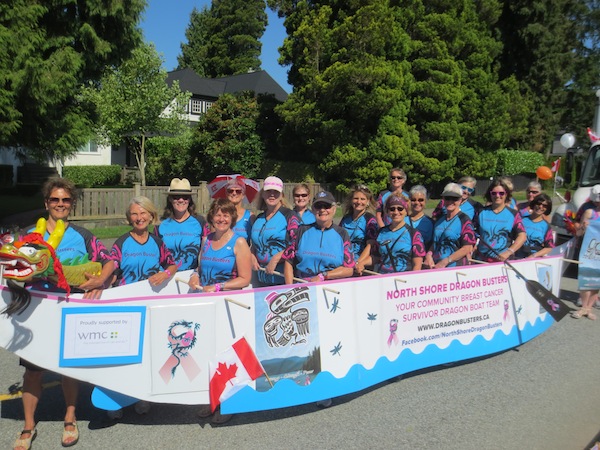
photo - The JI’s Leanne Jacobsen (in the baseball cap) participated in the North Vancouver Canada Day Parade with her North Shore Dragon Busters teammates
The JI’s Leanne Jacobsen (in the baseball cap) participated in the North Vancouver Canada Day Parade with her North Shore Dragon Busters teammates. (photo by Jonathan Ross)
photo - PADS puppy-in-training Pika, in the care of JI production manager Josie Tonio McCarthy, heads out to celebrate Canada Day
PADS puppy-in-training Pika, in the care of JI production manager Josie Tonio McCarthy, heads out to celebrate Canada Day. (photo by Josie Tonio McCarthy)
Format ImagePosted on July 7, 2017July 5, 2017Author The Editorial BoardCategories Celebrating the HolidaysTags animal protection, Canada, Dragon Busters, Jewish Independent, PADS

Prejudiced reasoning

On June 24, as part of gay pride festivities taking place in cities around the world, an incident occurred at a “dyke march” in Chicago that rightfully caught the attention of people everywhere. A group of Jews who were attending the event with rainbow pride flags emblazoned with the Star of David were asked to leave.

There are at least two galling aspects to this incident. The first and most obvious is the unabashed bigotry of throwing people out of what is ostensibly a human rights march because they belong to an identifiable group. The second is the misrepresentation of victim and victimizer – Jews were asked to leave because some other participants might feel “triggered” or “unsafe.”

To understand the reasoning, such as it is, we need to recognize how concepts of minority and human rights have altered in recent years – and how these changes bode ill for Jews.

Among the varied forms of antisemitism is one that sees Jews as the embodiment of privilege. This is because antisemitism differs from many other forms of discrimination in part by how the perpetrators view their target. White supremacy, which also seems to be having a renaissance in the United States, is a strain of discrimination that allows the perpetrator to feel better about themselves by positioning themselves (in their minds) above members of another group. Antisemitism, at present at least, differs in that the perpetrators often attribute to Jews a sense of superiority. Review the comments section of almost any news story involving Jews and see how ubiquitous the term “Chosen people” is in the screeds of antisemites. There is a prevalent idea that Jews think they are better than other people – and deserve to be brought down a notch.

In Chicago, people who see themselves as victims turned what limited power they had onto a group that they miscategorized through a crude and racist ideological lens: the powerful Jews may oppress Palestinians and control Hollywood, Washington, the banks, the media and what not, but, at the very least, we can promote equality and justice by kicking them out of our dyke march. There is actually a logic to it, if you recognize the prejudiced reasoning behind it.

Economic inequality experienced by minorities, police violence, systemic discrimination, growing social intolerance, a rise of open racism and xenophobia and a vast range of other problems are real. The idea that anyone was “unsafe” because Jews were present in a lesbian march is not. This type of thinking diminishes the credibility of these movements. It also undermines the foundation of the entire social justice movement, which talks constantly about “allies.” When it comes to Jews, it seems, talk is all it is.

Posted on June 30, 2017June 29, 2017Author The Editorial BoardCategories From the JITags antisemitism, Chicago, dyke march, intersectionality, prejudice, racism

Canada, Israel, Jews

When Canada belatedly opened its door to Jewish refugees – to some of the surviving remnant after the Holocaust – it did so not out of an abundance of humanitarianism but because of economic necessity, the need for skilled and unskilled workers in a booming economy.

Regardless of the motivation, that influx of refugees redefined Jewish identity in Canada. The increased Jewish population and the institutions they spawned essentially built the community we know today.

As former Vancouverite Adara Goldberg described in her book Holocaust Survivors in Canada: Exclusion, Inclusion, Transformation, 1947–1955, the institutions that we now see as the organized Jewish community were created for and by the refugees and immigrants who came after the war. By contrast, those who came to the United States after the war were greeted by and largely assimilated into a strong Jewish community already in progress.

This has had several corollaries. The worldview of Canadian Jewish institutions – and, though not easily verifiable, probably a majority of Jewish Canadians individually – is imbued with the understandable anxieties imprinted on those who witnessed the rise of fascism and lived through it.

On the flip side, the Canadian Jewish community as we know it can be said to have been born almost contemporaneously with the state of Israel. Again, while Zionism is entwined with the American Jewish community, that community had many other preexisting cultural and political dimensions. In Canada, the rebirth and survival of the Jewish state occurred at the most impressionable period in the community’s history. As well, the idea of Jewish self-determination as the surest path to individual and collective security resonated powerfully with a community disproportionately made up of survivors of the Shoah. Moreover, Canada’s approach to multiculturalism, especially after 1967, differed from the American “melting pot” and suspicion of “dual loyalties.”

So, the nature of Diaspora-Israel relations is different for Canadians versus Americans. Yet, some of the challenges are the same.

A new essay by David Hazony, editor of the American Jewish magazine The Tower, takes a new tack on the topic of American Jewry’s existential challenges. The Jewish population is not only declining, he notes, but changing. The only demographic that is flourishing is the Orthodox, which is not necessarily reflective of what would have been recognized as “American Jewry” in the 1950s and ’60s. The two most-recognized paths to avoid assimilation, he says, are currently orthodoxy and aliyah – but he suggests a third way.

Hazony posits that the answer to challenges facing American Jews right now is a little more Israel. The essay reviews concerns that American (read: Diaspora) Jews and Israelis are talking across a widening divide. Hazony’s suggestion is that Americans, who have for generations viewed Israel as a political cause, begin to integrate Israeliness as a cultural characteristic and embrace it as the future of their Diaspora identity. For instance, he says, Diaspora Jews immersing ourselves in Israeli cinema, even with subtitles, will give us a remedial entry point into the culture.

Language – not an easy thing to learn, particularly for notoriously unilingual Americans, Hazony acknowledges – is another important entry point.

“Without Hebrew,” he writes, “any approach to Israeliness will be like walking into an enormous library in a foreign language but relegated to the tiny English-language section.”

He suggests a network of Hebrew language and culture centres modeled on the French example. How many times have you driven by the Alliance Française building south of Oakridge?

Finally, travel. Just 27% of Americans have visited Israel more than once, he notes. To understand a place, you have to go there.

The essay is fascinating and offers ideas that could both strengthen Diaspora communities and narrow the gap between us and our Israeli cousins.

As Canada Day festivities unfurl in the coming days, we will see the familiar dictum “The world needs more Canada.” In some ways, we can proudly say, the world would indeed be a more peaceful, cooperative and respectful place if Canadian models were emulated elsewhere. Like any country, we have our flaws, our oppressive history and current inequalities. But, as countries go, we’re pretty good.

Hazony is taking a similar tack, arguing that Diaspora Jews need a little more Israeliness.

In Vancouver, we are very fortunate that our Jewish community centre has, for longer than we can remember, recognized the vital importance of connections with Israel. A plethora of other Israel-related organizations keep these bonds strong.

While pondering what is great about Canada in the coming week, we might also reflect on the value of integrating more Israeli culture into our lives. It can enrich us individually and enhance Canadian multiculturalism, too.

Posted on June 23, 2017June 21, 2017Author The Editorial BoardCategories From the JITags Canada, David Hazony, Diaspora, Israel, multiculturalism

Posts pagination

Previous page Page 1 … Page 30 Page 31 Page 32 … Page 49 Next page
Proudly powered by WordPress