Skip to content
  • Home
  • Subscribe / donate
  • Events calendar
  • News
    • Local
    • National
    • Israel
    • World
    • עניין בחדשות
      A roundup of news in Canada and further afield, in Hebrew.
  • Opinion
    • From the JI
    • Op-Ed
  • Arts & Culture
    • Performing Arts
    • Music
    • Books
    • Visual Arts
    • TV & Film
  • Life
    • Celebrating the Holidays
    • Travel
    • The Daily Snooze
      Cartoons by Jacob Samuel
    • Mystery Photo
      Help the JI and JMABC fill in the gaps in our archives.
  • Community Links
    • Organizations, Etc.
    • Other News Sources & Blogs
    • Business Directory
  • FAQ
  • JI Chai Celebration
  • JI@88! video

Recent Posts

  • Sharing her testimony
  • Fall fight takes leap forward
  • The balancing of rights
  • Multiple Tony n’ Tina roles
  • Stories of trauma, resilience
  • Celebrate our culture
  • A responsibility to help
  • What wellness means at JCC
  • Together in mourning
  • Downhill after Trump?
  • Birth control even easier now
  • Eco-Sisters mentorship
  • Unexpected discoveries
  • Study’s results hopeful
  • Bad behaviour affects us all
  • Thankful for the police
  • UBC needs a wake-up call
  • Recalling a shining star
  • Sleep well …
  • BGU fosters startup culture
  • Photography and glass
  • Is it the end of an era?
  • Taking life a step at a time
  • Nakba exhibit biased
  • Film festival starts next week
  • Musical with heart and soul
  • Rabbi marks 13 years
  • Keeper of VTT’s history
  • Gala fêtes Infeld’s 20th
  • Building JWest together
  • Challah Mom comes to Vancouver
  • What to do about media bias
  • Education offers hope
  • Remembrance – a moral act
  • What makes us human
  • המלחמות של נתניהו וטראמפ

Archives

Follow @JewishIndie
image - The CJN - Visit Us Banner - 300x600 - 101625

Byline: The Editorial Board

Boost defence of peace

Pierre Trudeau once compared living next to the United States to sleeping with an elephant. “No matter how friendly and even-tempered is the beast, if I can call it that, one is affected by every twitch and grunt,” Trudeau told the Washington press in 1969.

The former PM’s son, current Prime Minister Justin Trudeau seems to be recognizing that, under the leadership of President Donald Trump, the beast is as uneven-tempered as it has been in living memory.

The United States is currently led by a man whose foreign policy compass swings from tweet to tweet. There is no way to predict what position he will take next, having repeatedly besmirched NATO and other agencies of internationalism. The European powers have explicitly or implicitly taken the once-unthinkable position of deeming the United States no longer a dependable ally.

In successive major policy speeches last week, Foreign Affairs Minister Chrystia Freeland and Minister of National Defence Harjit Sajjan laid out somewhat new directions for the Canadian government, both seeming to concur, at least implicitly, that the United States is not the reliable ally it once was.

Sajjan promised a $62 billion boost to defence spending over 20 years, which would seem to be good news for Trump, who has criticized NATO member-nations for not pulling their weight. However, it came on the heels of Freeland’s speech a day earlier, in which she expressed concern that Americans seem prepared to “shrug off the burden of world leadership.”

It is easy to criticize American leadership – under any administration – and, admittedly, while the possibility of U.S. intervention might have given some dictators and oppressors cause for pause, American power has also strengthened dictators and oppressors when it has been in their interests. Nonetheless, the abdication of American leadership creates a frightening vacuum.

Jewish tradition includes the value of lo ta’amod al dam rei’echa, the prohibition against passivity in the face of violence to others. This rather universal concept seems likely to be diminished under the Trump presidency.

“The fact that our friend and ally has come to question the very worth of its mantle of global leadership puts in sharper focus the need for the rest of us to set our own clear and sovereign course,” Freeland told MPs. “To say this is not controversial: it is a fact.” She added: “To put it plainly: Canadian diplomacy and development sometimes require the backing of hard power.”

This is a stark shift in Canadian policy of the past 40 or so years. Without openly saying so, Canadians have been happy to keep military budgets low, knowing that our neighbour would have our back if push came to shove. Canada has little to fear in the form of foreign invasion, although our sovereignty in the Arctic could come under threat by Russia (or even the United States) at almost anytime.

More immediately, what our deflection of military might has created is a limited ability to act in ways on the world stage that reflect Canada’s stated values, which include the pursuit of justice (in Jewish tradition, bakesh shalom v’rodfehu) and the protection of human dignity. Again, when faced with Russian aggression in Ukraine and the Middle East, or with the barbarity of ISIS, or civil war in Syria, or countless other tragic flashpoints globally, Canada has been satisfied to allow our closest ally to set the terms on the ground.

We have been able to have our cake and eat it, too, for many years, calling our approach “soft power,” which means moral suasion based on a degree of global respect Canada has achieved, while leaving “hard power” to our NATO allies. Our role in Afghanistan is an exception, and a source of pride for those who believe that the people of that country should live free from oppressive entities.

This is an imperfect example, of course, since Afghanistan remains riven by terrorism and political division. That average Afghanis, particularly women and minorities, are better off now than under the Taliban is unquestionable. While our presence there has had tangible results, in the global context, it is a somewhat symbolic engagement. Our military has limited capacity to engage similarly in another theatre and would certainly be stretched to the limit if we were to be called into two or more conflicts.

Canada does not – and should not – aspire to be a global military powerhouse. But to maintain self-defence capabilities and to act on our values in a difficult world – at a time when the great power we counted on to do this on our behalf is recanting – requires us to make financial commitments.

We must balance these commitments with our ability to fund social programs and other policies of national pride. Any increased international role should be focused on trying to prevent conflicts, supporting peace efforts and on providing humanitarian and other economic aid.

Posted on June 16, 2017June 15, 2017Author The Editorial BoardCategories From the JITags Canada, foreign policy, military, United States
Check out JI’s Summer Celebration calendar!

Check out JI’s Summer Celebration calendar!

Click here to check out the 2017 JI Summer Celebration calendar

Format ImagePosted on June 16, 2017June 28, 2017Author The Editorial BoardCategories LocalTags events, summer, Vancouver

Ignorance and power

Rebecca Katzman is graduating from the School of Social Work at Ryerson University in Toronto this spring. Now that she is leaving the institution, she has decided to go public with an incident that happened when she applied for a field education placement at a Jewish agency.

The story emerged recently and Katzman shared the experience firsthand in the Canadian Jewish News last week.

For her third-year work experience placement, she asked the school’s coordinator to investigate possible opportunities at UJA Federation or the Prosserman Jewish Community Centre. The school official responsible, Heather Bain, denied Katzman’s request, telling her that her choices were incompatible with the values of the school.

“I did not follow up with Prosserman JCC or UJA because after looking into them, some of their values seem to be in opposition to the values of the school,” Bain wrote in an email to Katzman, adding that the agencies both appear to have a “strong anti-Palestinian lean.” Later, Katzman said, Bain suggested that Katzman could work with the Jewish organizations only if she came in with an agenda to “bring a critical awareness to the setting.”

“It seemed that she implied that I could only work at these agencies if I came in with an anti-Israel agenda,” Katzman wrote in CJN.

When pressed by Katzman, Bain acknowledged that she did not do her own investigation into the organizations, but relied on the advice of colleagues who are members of Jews Against Israeli Apartheid. She added that she might change her position if she discovered that “both agencies (were) supporters of Palestinian solidarity movements.”

It turns out Bain may have underestimated who she was dealing with. Katzman was not only active in student organizations supporting Israel and opposing antisemitism on campus, she was a StandWithUs Emerson Fellow, part of what is described as a “prestigious one-year fellowship program that recruits, trains, educates and inspires pro-Israel college students to become an elite cadre of leaders on college campuses across North America.”

StandWithUs provided Katzman with pro bono legal counsel. Even so, despite legal assistance and a history of involvement in Jewish activism, Katzman did not go public until her time at Ryerson was over. How many students in Canada have had similar experiences but lacked the resources or fortitude to stand up to it?

It is clear that Bain’s extraordinary decision was based on almost complete ignorance of the reality of the organizations she besmirched, having been arrived at on the advice of individuals who come from an extreme anti-Israel position. For a person in a position of power to set policies, this is disgraceful.

It takes courage to stand up to this sort of injustice. Those who choose – or who, like Katzman – are forced to confront it deserve our encouragement, support and gratitude.

Posted on June 9, 2017June 9, 2017Author The Editorial BoardCategories From the JITags anti-Israel, antisemitism, Heather Bain, Israel, Rebecca Katzman, Ryerson
The year it all changed

The year it all changed

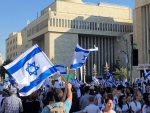
On May 24, Israelis celebrated the 50th anniversary of the reunification of Jerusalem in the streets around the Jerusalem Great Synagogue. (photo from Ashernet)

Everything changed in 1967. Fifty years ago, Canada celebrated its 100th birthday, hosting an Expo in Montreal and, at least in the narrative we like to tell ourselves, came into our own as a country.

We became a country in 1867, “came of age,” historians tell us, at Vimy Ridge, in 1917, gained full autonomy from Britain’s Parliament in 1931, and adopted our very own constitution in 1982. But 1967 is when we stopped being a baby-country and became a confident, adult-like state on the world stage.

It’s possible that few Canadians pinpoint 1967 as a particular turning point. The various measures of Canadian pride – the U.S. exchange rate, hockey titles, military engagements, pop cultural contributions – have ebbed and flowed in the successive decades. National unity saw multiple flashpoints, from the October Crisis just three years after the euphoria of the Centennial, to the referenda of 1980 and 1995, the latter of which almost ended the nation. Free trade and globalization altered us once again.

“Canadianness” itself changed dramatically in this half-century, from a concept rooted in British heritage to a recognition of “two founding nations” to celebrating multiculturalism and a belated recognition of the rights and tragic history of indigenous peoples resulting directly from our national project. In this time, too, Canada has gone from a staid, comparatively conservative place to one of the most liberal countries in the world. Institutionalized antisemitism, which was still rife in the Canada of 1967, has become almost entirely absent (although incidents and acts of antisemitism, like much else, continue to occur).

While nothing really substantive changed overnight, 1967 is a symbolic moment in Canadian history.

For Israel, 1967 had symbolism but, in very real, tangible and irreversible ways, it was a year when everything changed. While it didn’t happen overnight, it did take a mere six days. The Six Day War, which began June 5, 1967, literally and figuratively reshaped Israel, the Middle East, Diaspora Jewry and global diplomacy.

In its early years, Israel experienced exponential population growth like almost no country on earth has seen. It went from the proverbial desert to a blooming success, first through innovations in agriculture and, later, in technology and almost every other sector of human endeavour. A successful nation was born. But the Jewish state was never accepted by the neighbours it defeated in 1948-’49 and, in 1967, war came again.

Yet the result was so quick and so decisive that some viewed it as a sign of Divine intervention or evidence of chosenness. More realistically, it was a people holding their ground because there was no alternative.

The experience affected not only Israelis but Jews everywhere. Canadian Jews and others in the Diaspora volunteered, sent money, prayed and organized. Less than two decades after it had begun, Jewish self-determination in the ancient land and modern state of Israel hung by a thread. And then victory.

The anxiety before and jubilation after transformed into something new and unexpected. The control by Israel over the West Bank (formerly part of Jordan) and the Gaza Strip (which had been under Egyptian control) led to a new dynamic in Israel – and in the world’s approach to Israel. Having been seen as the underdog, Israel in 1967 transformed – in the eyes of the world and, to an extent, in the eyes of Israelis themselves – into a powerful regional force.

The occupation has been the defining foreign policy concern for Israel for half a century now and affects the way Israel is treated on the global stage. Jerusalem, reunified under Israeli control during the war, is a flashpoint of local and international conflict over competing claims. Israelis will likely be forced to reckon with the legacy of 1967 for many years to come, as it seeks to protect both the democratic and Jewish natures of the state, as well as reaffirming its commitment to minority rights and to pluralism.

Despite this overarching conflict and its associated violence and threats, Israel has developed an economy and culture that is a human-made miracle of the modern world. The list is familiar and endless: scientific and academic achievement, technological innovation, global emergency response, lifesaving medical advancements. Even Israel’s intelligence capabilities, born of necessity, are so advanced that the president of the United States foolishly can’t help bragging to adversarial foreign despots that he has insider intel.

Amid all these challenges and hard work, Israelis self-report in international studies to be among the happiest people on the planet. (Canadians also rank high.) Even with room for improvement, this reality is perhaps the greatest achievement of all.

Format ImagePosted on June 2, 2017May 31, 2017Author The Editorial BoardCategories From the JITags Canada, Confederation, Israel, Six Day War

When peace comes

Speaking at the Israel Museum in Jerusalem Tuesday, U.S. President Donald Trump quoted Theodor Herzl. “Whatever we attempt there for our own benefit will redound mightily and beneficially to the good of all mankind,” Herzl said.

This is not Herzl’s most famous quote, but the words were well chosen. In seven decades, Israel has contributed such an immense amount to the knowledge and culture of the world that Herzl himself could probably not have foreseen it in his wildest imagination – and he had a wild imagination.

The only barrier to the great redounding of which Herzl spoke has been the rejection of Israeli people, knowledge, technology and existence, first by those who would have benefited most – the country’s nearest neighbours in the Middle East – and latterly by many around the world, from the United Nations to college campuses across the West, where boycotting all things Israeli has become almost a rite of passage.

Trump also said Tuesday: “I had a great meeting this morning with President Mahmoud Abbas and I can tell you that he is ready to reach a peace deal.”

The president’s reputation is founded on his deal-making abilities and this is perhaps why he made it his first order of foreign business to travel to the Middle East, site of the world’s most elusive deal. But, telling an audience of Israelis, and global observers who have far deeper knowledge of the situation than Trump does, that Abbas is ready to reach a peace deal displays a degree of naiveté, to say the least.

Herzl’s vision of Israel as an oasis of excellence sharing its knowledge and advancements with neighbours was unquestionably imbued with the colonial attitudes of his era. But it was also founded on assumptions of enlightened self-interest.

“Israel is a thriving nation,” Trump said, “and has not only uplifted this region, but the entire world.” True enough, but it could have done so much more uplifting if others in the region had not rejected most of what the state has had to offer.

When the Arab Spring had its limited expression, it seemed that the peoples of the region might finally be rising up against not just the leaders who oppressed them, but the very scapegoating ideologies and miseducation that kept them down. One by one, most of the oppressors regained the upper hand and the greatest hope for Israeli-Arab peace – that the people and leaders would see coexistence as synonymous with self-interest – faded again.

If Trump thinks he has the magic beans to succeed where so many have failed, may he go from strength to strength.

Posted on May 26, 2017May 24, 2017Author The Editorial BoardCategories From the JITags Israel, Israeli-Palestinian conflict, Middle East, peace, Trump
Unceremonious end

Unceremonious end

(photo by Andrew Shiva / Wikipedia)

Israel’s government shut down the country’s public broadcaster last week, an act so contentious that it has the potential to bring down the government and spark fresh elections.

The Israel Broadcasting Authority was widely viewed as a dysfunctional and wasteful structure that Israeli observers from across the spectrum agreed needed reform. But the manner in which the deed was done – which involved both blatantly political motives and insensitivity to long-time employees – has turned the situation into a potential political firestorm.

The country’s press council expressed fears that media freedom in Israel is “at risk.” The country’s president, Reuven Rivlin, weighed in, saying, “Without public broadcasting, there is no democracy.… Without public broadcasting, the state of Israel isn’t the state of Israel.”

The incident inspired beastly analogies from journalists, with one saying, “They not only killed us, but they gave us a donkey’s funeral,” and another commentator declaring: “One does not close an institution the way one drives a stray dog out of the house…. One does not give an ignominious burial to what used to be the leading light of Israeli broadcasting.”

“This is a blow to the most important part of democracy – the news,” said Yitzhak Herzog, the opposition leader.

From the government side, there was little effort to deny the evidence of political interference.

“It can’t be that we’ll set up a broadcasting authority and not control it,” said Miri Regev, the Likud culture minister.

Neither does it appear to be an ad hoc effort to change the media dynamic in support of the Netanyahu government. Prime Minister Binyamin Netanyahu appointed himself communications minister and, in forming his coalition, he exacted from every party the promise to support whatever changes he introduced regarding the media.

The fact is there is still a state broadcaster in Israel. A new entity was created to replace the IBA, and some of the IBA’s staff – apparently somewhat less than half –have been hired by the new national agency that will replace the defunct broadcaster. But many of Netanyahu’s critics suspect the new channel is designed specifically to be more amenable to intervention from those with political power.

The print media in Israel has also experienced a shakeup that raises questions of political interference. American billionaire Sheldon Adelson has invested millions to produce the free daily Israel Hayom, which quickly rose to become the largest-circulation daily in the country, at least partly because it is free. Adelson is a strong supporter of Netanyahu, and the paper has been accused of being a mouthpiece for the Likud government.

Netanyahu has a relationship with the media that bears some resemblance to that of Donald Trump, the U.S. president. He picks personal quarrels with reporters with whom he disagrees and even used the term “fake news” recently in referring to CNN and the New York Times, echoing a familiar refrain from the head of the American government.

It was not only the action of shutting the IBA that has caused outrage, but the crassness with which the whole thing was handled.

The 49-year-old flagship TV news program was given one hour’s notice before its final airing, leaving on-air personalities in tears as they said their goodbyes. The program – and the channel – was slated for closure May 14 and the show was planning a farewell episode for Sunday night with nostalgic and historical clips and reflections. The sudden decision to shut it down on May 10 was seen as an unnecessary indignity.

Officials in the prime minister’s office insisted Netanyahu did not know that the abrupt end was planned and agreed that is was disrespectful.

Canada’s public broadcaster has not been above political interference – successive governments have cut funding in what is one of the most destructive forms of interference – but there has been nothing to compare with what has happened to Israel’s state broadcaster.

Israel has a reputation for a disputatious and vibrant media and public discourse. It will not be felled by one government. But recent developments are not encouraging and their impacts will be closely watched to see what effects they have on politics and society in Israel. There are also, of course, independent private media outlets in the country and, we may see – in the way that the loss of one sense results in greater acuity in another – the private broadcasters rise to keep the government effectively in check.

Format ImagePosted on May 19, 2017May 17, 2017Author The Editorial BoardCategories From the JITags free speech, IBA, Israel, Netanyahu, politics, public broadcasting

Unnecessarily divisive

Donald Trump’s first international trip as president of the United States will include Israel, Saudi Arabia and the Vatican. This breaks a longstanding tradition of a new U.S. president shuffling north or south to drop in on one of America’s nearest neighbours.

The snub of Mexico, if that’s what it is, is not surprising. Trump has built his political career on demonizing Mexicans. If his first official foreign visit is also a snub of Canada, that also should not surprise, given Trump’s recent extemporaneous attacks on our supply management system and his general beefs with NAFTA.

Trump’s choice of Israel and Saudi Arabia is strategic. He is signaling support for the countries he sees as America’s leading allies in the war on terror. Of course, while Saudi Arabia produces its share of terror (including most of the 9/11 perpetrators), it is officially a close ally of the West, in spite of its atrocious human rights record, in part because it is the regional bulwark against Iran. On Israel, Trump has been bombastic, insisting when he was still Candidate Trump: “I’m going to be great for Israel.” Israel’s Prime Minister Binyamin Netanyahu has hit it off better than most world leaders have with Trump, so the coming visit will probably cement that chummy relationship. (The Vatican? God only knows what that meeting will produce.)

Israel and Saudi Arabia, for their vast differences, are the most important allies of the United States in the Middle East. With Saudi Arabia, the friendship is certainly a matter of pragmatism over principle. The West needs their oil and the stability and counterbalance they provide in the region.

The Israeli relationship is quite different. While American politicians and diplomats will focus on military and intelligence cooperation, as with Saudi Arabia, they also salute Israel’s democracy and our shared values. The long history of friendship between the United States and Israel also frequently comes up. What is less prominent in words of friendship is Israel’s Jewishness. This is common even among pro-Israel voices. We extol Israel’s democracy, diversity, the immense contributions to science and medicine, technology, culture, foreign aid – even Tel Aviv’s funky nightlife. But we don’t always emphasize the foremost case for Israel’s existence: that the Jewish people deserve and require self-determination in our ancient and modern homeland.

This is an interesting tendency. Are we acknowledging that, perhaps, Israel’s democracy, scholarship, vibrancy and beaches are all great selling points, but its Jewishness is not? Maybe we are. And maybe we’re right. But, by not continually promoting Israel’s right to exist as the Jewish homeland, we undercut the most important case we can make and, in the process, probably bend our position somewhat to suit the tastes of casual antisemites.

We need to make the case forcefully that Israel is the homeland of the Jewish people and deserves to exist for that reason – first among the many reasons Israel deserves to exist and be respected. However, there is an effort afoot in Israel to affirm its Jewishness in a way that is divisive, exclusionary, even possibly racist.

On Monday, Netanyahu threw his support behind a so-called “nation-state” bill proposed by Likud Knesset member Avi Dichter that would enshrine Israel as “the national home of the Jewish people.” This statement is undeniable – or it should be. But the bill goes on to declare that “the right to realize self-determination in the State of Israel is unique to the Jewish people” and would revoke Arabic as an official language in Israel. These latter aspects of the bill deliberately insult and diminish the rights of non-Jewish citizens of Israel.

Here is the difference between the case we made about Israel’s Jewishness and the bill’s intent: Israel is the homeland of the Jewish people – but Israel is also the homeland of people who are not Jewish, up to one-quarter of the population. These two things need not be exclusive, but the bill would make it so and, in the process, expressly deny the equality of minority populations.

The prime minister called the bill “the clearest answer to all those who are trying to deny the deep connection between the People of Israel and its land.” This is a morsel of red meat for hungry Zionists because we are tired of people diminishing or outright denying the right of Jewish people to live in Israel. So, the bill might deliver a frisson of delight for those of us who bristle at the latest United Nations nonsense or campus apartheid week.

Yet, whatever the merits of such a bill, it is an unnecessary and intentional hot stick in the eye of Israeli minorities – and indeed those of us in the Diaspora who make the case for Israel as a diverse, welcoming, multicultural and multifaith place. Though the comfort of Diaspora Zionists should not direct Israeli policy, this example is merely harming Israel’s cause with no commensurate upside.

That said, one person who would see this kind of exclusionary, divisive, unnecessarily nasty bill as a good idea is going to be visiting there soon: the president of the United States.

Posted on May 12, 2017May 9, 2017Author The Editorial BoardCategories From the JITags Adath Israel, Middle East, Netanyahu, Trump, United States

The future we seek

A different approach to Yom Hazikaron took place Sunday in Tel Aviv. An alternative form of marking Israel’s remembrance day for fallen soldiers – bringing together Israelis and Palestinians who have lost family members to decades of conflict – was the 12th annual such gathering.

About 4,000 participants crowded into an arena for the ceremony convened by Combatants for Peace and Parents Circle-Families Forum, a grassroots organization of bereaved Palestinians and Israelis with the slogan, “It won’t stop until we talk.” Regardless of one’s politics, their website – theparentscircle.com – is a testament to the ability of families who have suffered the worst imaginable tragedy to get beyond anger and try to find or create something constructive in the aftermath.

On the other hand, whatever one’s politics, one should condemn the behaviour of a few dozen apparently far-right thugs who protested outside and disrupted the proceedings. Screaming “traitor,” “enemies” and “Nazis,” the protesters threw sand and spat at attendees, including a member of the Knesset. According to a report in the Jerusalem Post, one individual shouted at those entering the arena: “I hate Hitler – not for what he did but for not finishing the job and killing you.”

Across whatever divides exist among Jews, there should be a clear consensus that language and behaviour like this has no justification.

Yet, while 50 or so individuals with no sense of decency made the experience shockingly unpleasant, remember that 4,000 people came together across lines of race, religion and experience based on two things they share in common: grief and the certainty that something has to change if our respective peoples are to ever know lasting peace.

We can argue whether what the participants did helps advance that ideal future, but we can’t argue that everything done before has achieved it, because it has not.

After hundreds of community members filed out of the Chan Centre at the University of British Columbia Monday night following an uplifting and uncontroversial celebration of Yom Ha’atzmaut, anyone tuned to CBC Radio One heard an interview with David Grossman, re-broadcast from 2010. Grossman, considered one of Israel’s preeminent authors as well as a leading voice for peace, spoke about losing his son Uri, in the 2006 war in Lebanon against Hezbollah, about the necessity of Israeli military strength and about the efforts by then-U.S. president Barack Obama to broker some sort of peace in the region.

The interview was, sadly, timeless. There has not been a U.S. president who has not tried and failed to find peace between Israelis and Palestinians. There is not an Israeli parent who has not feared for their child in the Israel Defence Forces or when a terror attack strikes. One does not need to be a victim who has lost a family member, Grossman said, to be victimized by the circumstance where that kind of anxiety hovers over every day.

There is no doubt it is controversial for the parents, children or other loved ones of dead Israeli soldiers and the parents, children and other loved ones of Palestinians who have died in the conflict to come together. There is a whole range of reasons why many people would find this idea threatening, profane or wrong. But those who came together for the event should be granted by everyone the most minimal acknowledgement: it’s worth a try.

It might not work. But everything else has failed.

It is arrogant in the extreme to assume that we have the only answer. It is equally arrogant to assume there is no solution just because we ourselves can’t conceive of one.

If the current generation – of Israeli leaders, of U.S. presidents, of Diaspora leaders, commentators, activists, diplomats and anyone else – does not have solutions to this conflict, there is one encouraging light. There are young Israelis, Palestinians, Canadians and others who are trying new things. These ideas, too, might not work. But we have to keep trying.

At the local Yom Ha’atzmaut celebration Monday, children – some even toddlers – participated in songs of peace. Children of all ages danced and, even when they weren’t on stage as part of the performance, they filled the aisles with exuberant moves. The main musical attraction, the young Israelis who form the uplifting musical group Jane Bordeaux, chose to spend Yom Ha’atzmaut in Vancouver – their first concert outside Israel.

Will these young people hasten the future we seek?

Posted on May 5, 2017May 3, 2017Author The Editorial BoardCategories From the JITags Israel, Israeli-Palestinian conflict, Jane Bordeaux, peace, Yom Ha'atzmaut, Yom Hazikaron

A light on good news

When encouraging news emerges from the too-frequent darkness of current events, we should shine a light on it and take some solace. A couple of encouraging events happened this week.

The first is tentative, but positive. French voters on Sunday advanced then-National Front leader Marine Le Pen to the second round of the French presidential elections. This is not good news in itself – Le Pen is a far-right extremist who just days ago refuted French complicity in one of the most notorious roundups of Jews during the Nazi era. What is encouraging is the response of her political opponents and much of French society in the wake of her success.

Le Pen will face Emmanuel Macron, a political neophyte who is described as a centrist and around whom many French seem determined to coalesce in order to reject Le Pen’s divisive and xenophobic rhetoric and policies. The defeated candidate of the Socialist party immediately urged his supporters to back Macron, saying he recognizes the differences between a political opponent and “an enemy of the republic.”

Another bright spot in the results was that, despite polls that tightened the race into a four-way contest in recent days, there is, in Macron, a voice for moderate, pro-European, liberal policies. A nightmare scenario – avoided by only a couple of percentage points in the popular vote – would have seen Le Pen face off against far-left extremist Jean-Luc Mélenchon. As it is, all polls and pundits (for what any of those are worth) predict Le Pen will suffer a landslide trouncing on par with that her father experienced when he reached the runoff in 2002, as moderate French of all stripes lined up behind Le Pen’s opponent.

This positive milestone follows the unexpectedly poor showing of the far-right party in the recent Dutch elections.

Closer to home, another bright spot was an exclusive interview in Monday’s National Post with Ibrahim Hindy, the imam at a Mississauga, Ont., mosque.

Hindy has become a voice of reason against extremism in the Canadian Muslim community and he comes with unique experience. As a younger man, he was invited into a web that could have led to radicalization. However, his own understandings of Islam as a merciful worldview contradicted what he was hearing from the people he had fallen in with in Pakistan. Later, meeting Jews and people of African descent at university, Hindy realized that, contrary to what he had been told by some of his would-be mentors, Muslims were not the only minority facing challenges in the world. His tolerant, empathetic approach has earned the 33-year-old clergyman a respected role among Canadian anti-extremist activists, as well as police, and, more importantly, among young people in his own community.

At the same time, Hindy has seen very close up the level of extremism in Canada aimed at Muslims. As controversy swirled around an Ontario school district’s accommodation of Friday Muslim prayers on school premises, Hindy and his mosque were on the receiving end of grotesque and threatening messages. His Islamic centre was described in one message as “one of many Satan safe houses that need to be burned to the ground.”

Incidents of hatred and violence are not to be tolerated – and they have not been. In addition to law enforcement agencies taking action, Canadian Jews, Muslims and others have been brought closer together and intercultural connections have been strengthened. Interfaith events in Vancouver, including one at a mosque, one at a synagogue and another at the Jewish Community Centre of Greater Vancouver, are just a few occasions that have confounded those who are determined to sow distrust, hatred and division.

At the same time, we do hear the view expressed that moderate Muslims must speak up and condemn extremism among their co-religionists. So those voices that call for just this sort of expression and activism should waste no time in commending it when we hear it, as we have from Hindy.

Likewise, all Canadians should look into our own hearts and at views expressed in our own communities and consider whether we are judging groups of people based on the actions of a few. Discrimination and extremism exist in different forms and we should be vigilant not only when it is directed at us, but also when it is directed at others.

Posted on April 28, 2017April 26, 2017Author The Editorial BoardCategories From the JITags elections, France, Ibrahim Hindy, Muslims

Beyond the binaries

The concept of intersectionality recognizes that multiple forms of oppression and discrimination can impact individuals at the same time. For example, African-Americans experience systemically and socially both economic disadvantage and racial discrimination. Black women face an addition layer of intersectional oppression and black LGBTQ people add homophobia to the mix.

Intersectionality can be problematic for the Jewish community. As we have discussed in this space previously and will again, despite historical realities, Jewish people are often perceived by others as an advantaged, rather than a disadvantaged, minority. It does not take long on the sort of online forums where the term intersectionality is commonly used before stereotypes of Jewish power show up. Similarly, Zionism is seen by some not as the realization of an indigenous rights movement for self-determination that it is, but rather as a form of colonialism.

In one of the most self-evident examples of intersectionality’s potential blind spots, the intersection of Palestinian rights and gay rights begets ludicrousness like Queers Against Israeli Apartheid, which makes common cause with extremists who throw homosexuals off roofs in order to condemn the perceived colonialism and myriad other “sins” of Zionism. Very frequently, in the discourse found in some far-left circles, antisemitism is dismissed because it does not fit the ideology of those who determine where the intersections are. Or, rather, it is made to not fit.

This is too bad, because selecting which humans are eligible for inclusion in a human rights movement based on immutable characteristic is, by definition, a human rights movement founded on false premises.

Of course, social theory and the real world are disparate points on a spectrum. A beautiful real-world example of something we might term intersectionality took place last week here in Vancouver.

Bernard Richard, British Columbia’s Representative for Children and Youth, spoke at the ceremony for the awarding of this year’s Janusz Korczak Medal for Children’s Rights Advocacy. He observed that it might be difficult for some people to see the parallels between a Jewish Pole who died in the Holocaust and a social worker and activist who is a Canadian First Nations woman. But the inspiring intersection of these two lives makes eminent sense.

Dr. Janusz Korczak, as regular readers know, was a hero of the Holocaust who chose to accompany the 200 children in the care of his orphanage to their deaths in Treblinka, despite the Nazis offering him a reprieve. But he is a hero not only for the way he died, but for the work of his life. Seen as the originator of the children’s rights movement, Korczak insisted on the recognition of children’s innate humanity – rather than merely their potential – and insisted on seeing children as individuals fully deserving of respect and self-determination.

Far away in time and place, Dr. Cindy Blackstock insisted on the rights of indigenous Canadian children. A human rights complaint she initiated, which took nine years to wend its way through the byzantine structures of federal institutions, resulted in a January 2016 decision that Canada has consistently discriminated against the 165,000 aboriginal children who live on reserves, and their families, by systemically underfunding services to those children and youth based solely on their identities.

Blackstock was awarded the annual Korczak medal for exemplifying the values of Korczak in advancing children’s rights.

In her acceptance speech, Blackstock spoke of walking in the footsteps of ancestors and others who came before. Korczak and Blackstock are both models for all who seek to advance the condition of children in the world. It is impossible to imagine what future greatness may be inspired by their examples. A Polish Jewish man, Korczak effectively invented a concept that is now entrenched in United Nations testaments to the rights of the child, affecting the lives of potentially every child on earth. An indigenous Canadian woman, Blackstock shepherded a human rights challenge that will improve the lives of every child living on reserves in Canada, and their families.

Someday, who knows when or where, these two examples will inspire some other individual to stand up where injustice and inequality intersect with some other group of people. Then that individual will themselves become a model for others.

Posted on April 21, 2017April 20, 2017Author The Editorial BoardCategories From the JITags antisemitism, children's rights, First Nations, Holocaust, intersectionality, Janusz Korczak

Posts pagination

Previous page Page 1 … Page 31 Page 32 Page 33 … Page 49 Next page
Proudly powered by WordPress