
Skip to content
  • Home
  • Subscribe / donate
  • Events calendar
  • News
    • Local
    • National
    • Israel
    • World
    • עניין בחדשות
      A roundup of news in Canada and further afield, in Hebrew.
  • Opinion
    • From the JI
    • Op-Ed
  • Arts & Culture
    • Performing Arts
    • Music
    • Books
    • Visual Arts
    • TV & Film
  • Life
    • Celebrating the Holidays
    • Travel
    • The Daily Snooze
      Cartoons by Jacob Samuel
    • Mystery Photo
      Help the JI and JMABC fill in the gaps in our archives.
  • Community Links
    • Organizations, Etc.
    • Other News Sources & Blogs
    • Business Directory
  • FAQ
  • JI Chai Celebration
  • JI@88! video

Recent Posts

  • Sharing her testimony
  • Fall fight takes leap forward
  • The balancing of rights
  • Multiple Tony n’ Tina roles
  • Stories of trauma, resilience
  • Celebrate our culture
  • A responsibility to help
  • What wellness means at JCC
  • Together in mourning
  • Downhill after Trump?
  • Birth control even easier now
  • Eco-Sisters mentorship
  • Unexpected discoveries
  • Study’s results hopeful
  • Bad behaviour affects us all
  • Thankful for the police
  • UBC needs a wake-up call
  • Recalling a shining star
  • Sleep well …
  • BGU fosters startup culture
  • Photography and glass
  • Is it the end of an era?
  • Taking life a step at a time
  • Nakba exhibit biased
  • Film festival starts next week
  • Musical with heart and soul
  • Rabbi marks 13 years
  • Keeper of VTT’s history
  • Gala fêtes Infeld’s 20th
  • Building JWest together
  • Challah Mom comes to Vancouver
  • What to do about media bias
  • Education offers hope
  • Remembrance – a moral act
  • What makes us human
  • המלחמות של נתניהו וטראמפ

Archives

Follow @JewishIndie
image - The CJN - Visit Us Banner - 300x600 - 101625

Byline: The Editorial Board

Trump’s golden idol status

When Moses went up Mount Sinai, the Israelites grew restless and constructed a golden calf to worship. Every Jew and everyone with any theological literacy knows what happened next. So it came to pass that, last weekend at the annual convention known as the Conservative Political Action Conference in the United States, a giant golden statue of Donald Trump was wheeled around, drawing adulation and selfies. With an apparent absence of irony, the defeated president was transformed into a literal golden idol.

CPAC has been an annual shindig for Christian and other religious conservatives, libertarians, right-leaning economic thinkers and a big tent of the country’s centre-right. As evidenced by last weekend’s iteration, it is now, like so much of that country’s political establishment, in thrall to Donald J. Trump.

This is the latest in an avalanche of evidence that, despite losing the election, Trump maintains a stranglehold on the Republican party and much of the country. The literal idolatry he inspires deserves fresh consideration. It is the inevitable end-point (we hope) of a trend that was predictable.

It is easy – and not wrong – to view the perpetrators of the Jan. 6 insurrection at the U.S. Capitol as domestic terrorists who threatened the very foundation of American democracy. But these people view themselves – or, at least, some do, based on interviews after the incident – as saviours of democracy. They (or, at least, many of them) genuinely believe that the election of Joe Biden was a result of a rigged process; that millions of votes were stolen or some other jiggery-pokery ensured that the true voice of the people was thwarted.

They believe this because they have been told, repeatedly and as recently as last Sunday at CPAC, by Trump, the man they believe won the election, that the process was rigged, that American democracy has already collapsed and that the election was stolen. Thus, we observe people attempting to steal a free and fair election carrying signs demanding, “Stop the steal.”

Certainly, some recognize that the election was fair but hop on a bandwagon arguing otherwise simply because they dislike the outcome. But there are many who are absolutely convinced that corruption and trickery unjustly deprived Trump of a second term. More alarmingly, a subset apparently believes in an entirely alternate reality, in which Trump is still president, operating the “legitimate” government from his Mar-a-Lago retreat or, even more fancifully, that a series of events is yet to unfold in which the election will be proven wrong and Trump will triumphantly return to the White House.

Listening to the comments of some Americans on cable TV or in online sources is chilling. It is hard to decide whether the scarier position is the one that winks at the truth, as many Republican members of Congress do, claiming disingenuously that they merely want to investigate to make sure the election process was fair, or the one that is rooted in thin air, asserting, despite all evidence and scores of court decisions, that Trump was cheated.

There is much talk of the political polarization that the United States and other countries are experiencing, a result in part of a refraction of the media universe. We are now all capable of consuming a diet of news and information that completely reinforces our prejudices. Combined with a charismatic (to many, anyway) leader who repeats lies endlessly while stoking a narrative of grievances, this refraction has led not to differences of opinion but to incongruities about the very facts of history and current events. To use a condescending and clichéd construction, the people who are convinced Trump won are themselves victims of their leaders’ lies.

This is not to let either side entirely off the hook in this time of division. Much has been made of perceived snobbery that dismisses or diminishes the intelligence or goodwill of Trump supporters. Terms like “wokeness,” which suggest one side has awakened to incontrovertible truth while the rest of the world is mired in somnambulant ignorance, do not leave much room for constructive dialogue. The certainties of the left are visible online and on cable news as well, if for now at least founded more sturdily on a foundation of reality.

There is much talk of healing the divided society that Biden has inherited. Even this elicits disagreement, however, with some demanding accountability for the egregious oversteps of the Trump era before moving on to making nice.

This challenge runs deeper than politics. The United States may be an urgent example but all societies must confront the divisions created by the diffusion of information and contested ideas of “truth” in the internet era. This is a challenge for educators, for elected officials, for thinkers and activists and, significantly and problematically in a free society, for media.

A society requires some shared understanding of reality. When we are literally arguing over the definition of truth, when terms like “alternative facts” are uttered without a smirk, we have a problem. To say nothing of a chunk of the population who reject science, including denial around whether a virus that has killed more than 500,000 Americans actually exists. This is a desperately urgent, possibly existential, challenge for democratic societies. The first step may, as in other cases of human behaviour, be acknowledging we have a problem.

Trump exploited, and continues to exploit, a situation in which it is possible to convince large swaths of people that up is down and black is white. But, while he makes excellent use of the ambiguity of our time, he is a product of it. Whether Trump remains an influential figure or not, we have inherited a world where others like him will emerge from a miasma of mistruth unless we find some common foundations of fact.
Posted on March 5, 2021March 4, 2021Author The Editorial BoardCategories From the JITags Conservative Political Action Conference, CPAC, idol worship, internet, politics, Trump, United States

Silence can’t be an option

The entire federal cabinet – save the foreign affairs minister – was absent Monday when the House of Commons unanimously voted to characterize the Chinese government’s treatment of its Muslim Uyghurs and other ethnic minorities in the northwest part of China as “genocide.”

In the absence of the prime minister and all his cabinet colleagues, Marc Garneau, the foreign minister, stood and declared, “I abstain on behalf of the Government of Canada.”

The vote was on a nonbinding resolution brought forward by the Conservative party and, ultimately, was supported by all parties, receiving a unanimous vote by those members in the house and participating remotely. An amendment, brought by the Bloc Quebecois, also passed, calling on the International Olympic Committee to move the games scheduled for Beijing in 2022 unless the genocide stops.

According to international law, genocide is the “intent to destroy, in whole or in part, a national, ethnical, racial or religious group.” The United States, at the tail end of the Trump regime, became the first country to name China’s behaviour genocide.

The Chinese government is perpetrating mass incarceration of millions of Uyghur Muslims and ethnic Kazakhs in northwestern China, operating concentration camps, separating families, committing forced sterilization, using slave labour and employing indoctrination apparently aimed at breaking the victims’ adherence to Islam and promoting obeisance to the communist regime.

The Chinese state barely disguises their intent, acknowledging that they are operating “re-education camps” or “counter-extremism centres.” An Australian study last year posited that there are 380 such facilities in the northwestern province of Xinjiang, where most of the 12 million Uyghurs live. The area produces a large proportion of the world’s cotton and the BBC has reported that an estimated 500,000 people are being employed in forced labour picking cotton. Some who have escaped the camps report physical and mental torture, including mass rape and sexual abuse.

An argument could – indeed should – be made that the use of the term “genocide” must be applied carefully in order to avoid diminishing the significance of the language. We have seen the misuse of the term applied to Israel. But there is a great difference between using caution out of respect for the magnitude of the allegation and avoiding the term out of some political expediency or fear of diplomatic retaliation.

Whether what is happening in China right now fits the definition of genocide as we understand it in contexts like the Holocaust, Darfur, Rwanda or Bosnia is not immaterial. But there can be no question that what is happening are crimes against humanity on a massive, blood-chilling scale. Censure of the most extraordinary sort is absolutely justified.

Of course, discretion plays a role. In every decision and position the government takes relating to foreign parties, there are multiple domestic, diplomatic and practical considerations. No country’s foreign policy is pristine or unsullied by what we might consider pure self-interest or unprincipled motives. Fears of repercussions are legitimate.

China is a bully. In response to Canada’s rightful arrest of Huawei executive Meng Wanzhou on a U.S. extradition request, the regime effectively kidnapped two Canadian citizens, Michael Kovrig and Michael Spavor, who have now been incarcerated for more than 800 days.

As we have said in the context of Canada’s support for Israel, elected officials should exercise immense caution in employing foreign policy as a wedge issue. Certainly there are legitimate differences of opinion among parties and individuals on various international topics.

Objectively, O’Toole and his party did the right thing. They were accompanied by MPs from all parties, including Liberal backbenchers. We would hope that the motion and the unanimous support is a symptom of a genuine Canadian commitment to fighting evil in the world. However, it is difficult not to see some partisan calculation at play. O’Toole and his party have been effective and vocal in raising the Uyghur issue (as well as other Chinese government atrocities and human rights abuses) for some time. By contrast, the Trudeau government has appeared to waffle, hemming and hawing over the definition of genocide and appearing reticent to offend the Chinese regime; their approach to China in general has been scattershot and incoherent.

It is within the realm of reason that the Conservatives saw a chance to embarrass and divide the Liberal government and took it. But the bigger issue is, even if the Conservatives were motivated by some hope of political gain, the Liberal government could have muted any such benefit by simply doing the right thing – as Liberal MPs and those of other parties did.

O’Toole, after the vote, decried an absence of leadership. Fair enough.

If the Canadian government has a reason to not characterize Chinese actions as genocide, we’d like to hear them. By simply refusing to show up, the Trudeau government did not take a stand on one of the crucial global issues of the day.

When a people is facing genocide, the very least the victims and Canadian citizens should expect is for Canada’s government to speak up. Too many times in history we have seen the consequences of silence.

Posted on February 26, 2021March 30, 2021Author The Editorial BoardCategories From the JITags Canada, China, Conservatives, genocide, human rights, O'Toole, Trudeau

What’s in a definition?

The International Holocaust Remembrance Alliance, in 2016, adopted a so-called Working Definition of Antisemitism. Given the complexity and pervasiveness of this ancient bigotry, the statement itself is remarkably succinct at a mere 38 words.

It reads: “Antisemitism is a certain perception of Jews, which may be expressed as hatred toward Jews. Rhetorical and physical manifestations of antisemitism are directed toward Jewish or non-Jewish individuals and/or their property, toward Jewish community institutions and religious facilities.”

It is innocuous and hardly debatable. Where controversy has arisen is in the accompanying 11 examples, seven of which make reference to Israel. Examples provided of antisemitic manifestations include: accusing Jews as a people, or Israel as a state, of inventing or exaggerating the Holocaust; accusing Jewish citizens of being more loyal to Israel, or to the alleged priorities of Jews worldwide, than to the interests of their own nations; applying double standards by requiring of Israel a behaviour not expected or demanded of any other democratic nation; drawing comparisons of contemporary Israeli policy to that of the Nazis; and holding Jews collectively responsible for actions of the state of Israel.

Opponents of the definition, including a majority of Vancouver’s city council, which voted against adopting the definition in 2019, claim it could stifle free expression in the form of criticism of Israel – this despite the fact that the definition self-defines as “non-legally binding.” In a world where any individual with access to a computer has more power than even the most powerful figures in history to disseminate their views to a global audience, it is notable that “Zionists” are imagined to have the power to control what others think, do and say. The criticism is perhaps, ironically, a manifestation of the problem itself.

To their credit, the new U.S. administration has said it “embraces and champions” the definition. The previous administration also endorsed the definition. (Canada and 28 other countries, as well as scores of cities and other jurisdictions and organizations have similarly endorsed it.) But the Trump administration’s support was a component of a broader politicization of ostensible support for the Jewish community. By allowing Israel’s right to exist in peace to become a partisan tool, we risk polarizing politicians and the public, driving supporters to their corners on a topic where less polarization should be encouraged.

If there are problems inherent in the terminology, it is perhaps in the chutzpah of attempting to define it at all. It is almost universally acknowledged that antisemitism is uniquely capable of metastasizing as required by the perpetrator. It is, above all, a pathology of the antisemite, with more to do with the eye of the beholder than with Jewish people themselves. Antisemitism is very often (if not always) a projection of someone’s (or some society’s) own problems directed toward an empty vessel in the form of “Jews.” Note that antisemitism is most rampant in the places where Jews are fewest – or nonexistent.

Antisemitism differs from other prejudices and bigotries as well in the typical responses it engenders. We have unlearned a tendency to deflect blame for misogyny back onto its victims; we do not accept that violence against women is in anyway justified by, say, what a victim was wearing. We recognize racism as a flaw of it perpetrators and we do not accept that racism against people of colour is based on the behaviour or innate characteristics of the victims. Homophobia is a pathology of the homophobe; it is not nurtured or provoked by LGBTQ+ people. Yet how many times do we see people respond to antisemitic violence or words with a variation on the question: What did the Jews do to deserve it?

Last week, that formulation was hinted at by a Democratic member of the U.S. Congress, Rep. Andy Levin, of Michigan. “Injustice anywhere is an injustice everywhere,” Levin said during a webinar. “Unless Palestinian human rights are respected, we cannot fight antisemitism.”

This false equivalency and conflation – coming from a Jewish elected official, no less – is a picture-perfect illustration of why the IHRA was created.

As the new administration in Washington begins repairing the unprecedented social and economic damage done to the country over the past four years, it is encouraging to see one of its first acts being an explicit and enthusiastic commitment to the battle against antisemitism.

Posted on February 12, 2021February 11, 2021Author The Editorial BoardCategories From the JITags antisemitism, free speech, IHRA, International Holocaust Remembrance Alliance, United States, Vancouver

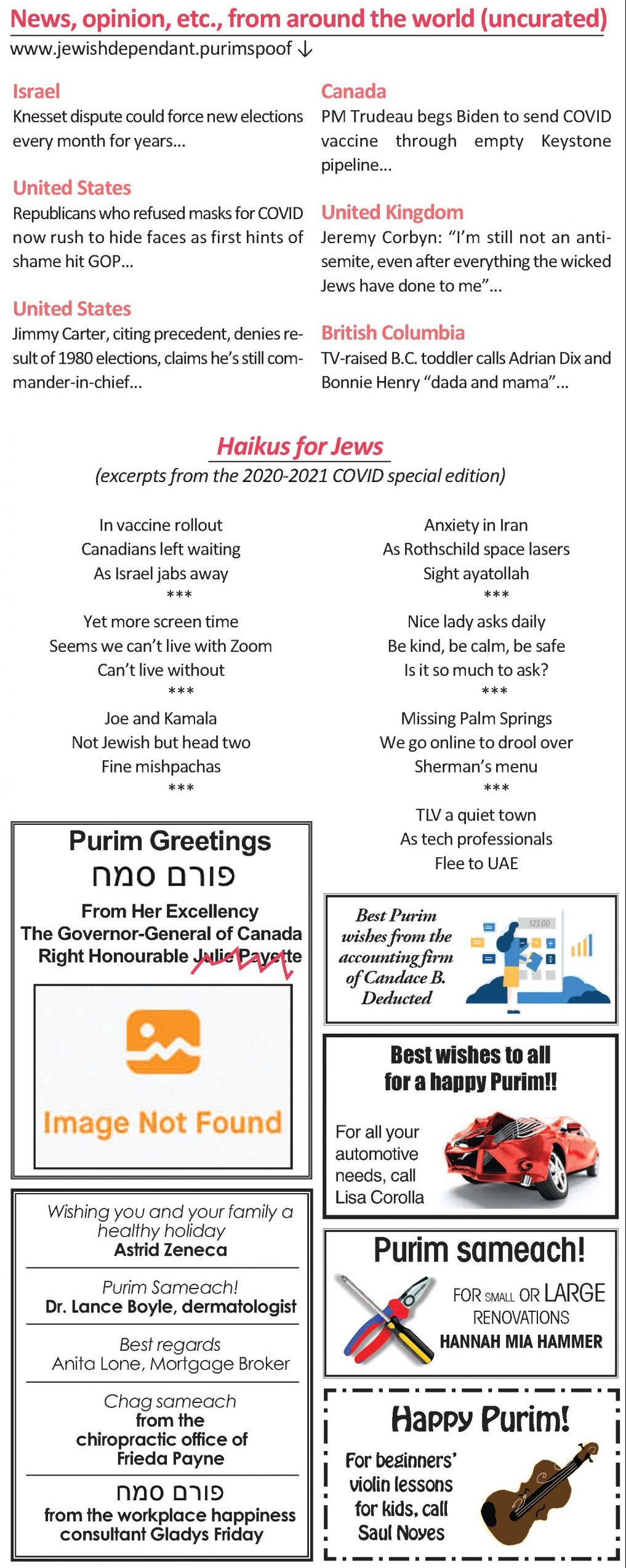
Purim sameach!

image - JI Purim 2021/5781 Spoof page

Posted on February 12, 2021February 11, 2021Author The Editorial BoardCategories Celebrating the HolidaysTags groaners, Purim, satire, silliness, spoof

Hope in the presidency

There is no perfection in human affairs. We are imperfect beings and our creations are always flawed. But this does not stop us from striving for perfection, knowing that our reach should exceed our grasp.

The preamble to the United States Constitution begins with, “We the People of the United States, in Order to form a more perfect Union …” and then sets forth the things that the founders agreed to aspire toward, knowing that perfection is unreachable but that aiming for a “more perfect” future is still an ideal to pursue.

This idea is central to Judaism also, that the world was created imperfect and unfinished because it is the role of humanity to complete that work – or, rather, to advance in the direction of completion/perfection even knowing it is unattainable.

This theme appeared also in the poem by Amanda Gorman, the first United States National Youth Poet Laureate, at the inauguration last week of President Joe Biden. “Somehow we’ve weathered and witnessed / a nation that isn’t broken / but simply unfinished,” she said.

That day, Inauguration Day, felt to many like a collective swerve away from an abyss. After the violence at the Capitol two weeks earlier, after four years of chaos and cruelty at the top of the U.S. administration, and at what we hope is the beginning of the end of the pandemic of our lifetimes, it felt like a move in the right direction, a reversal from the trajectory of spiraling rancour. The violence at the Capitol on Jan. 6, so horrific and deadly, may have been the wakeup call that enough Americans needed to recognize the destination to which the “Trump train” was always headed.

The most fundamental component of a democratic society – the peaceful transition of power – was assaulted on Jan. 6, a day most of us never dreamed we would see, an experience that people in autocratic societies know too well but we hoped we never would. We may never know how close the United States came to genuinely losing its democracy but we can hope that the shock of the violence and the widespread refusal to accept the outcome of a properly run election opened enough eyes to the dangers of that approach. As President Biden said, “enough of us have come together to carry all of us forward.”

Regardless of party affiliation, the transfer of power seemed to many like a return to the project of a more perfect union.

By the skin of their teeth, the Democratic party held the House of Representatives and reclaimed the White House and the Senate. The new Biden administration better reflects the diversity of the country’s racial, religious, gender and other components, not least of which is exemplified by the first female vice-president and the first one who is not white.

The refusal of the outgoing president and his wife to adhere to longstanding decorum and decency and their petulant retreat to Florida before the inauguration was a slap in the face for the very idea of democracy itself. To the credit of the vice-president, Mike Pence, he stepped up where the president would not. So, too, did all the living former presidents, three of them in person at the inauguration and the fourth, Jimmy Carter, calling Biden the night before the inauguration to offer wishes of support. This was a powerful show of respect for the office that Trump never exhibited when he held it and which he further despoiled while leaving it. But he is gone now from there, ideally forever, and we trust that a less divisive and corrupt government will carry that country forward.

It is notable that our hopes for 2021 focus so much on a vaccine. The idea of this science – that injecting a dose of a virus into a body to develop an antibody to a more destructive manifestation – might be extrapolated into our body politic. The virus of extremism, tyranny and violence that we saw on Jan. 6 may have inoculated some Americans to combat the spread of such threats. As we strive for herd immunity in our public health, we can perhaps seek a similar degree of protection in our public life. There will always be bad people and bad ideas. Ensuring that they are kept in check and not permitted to reach pandemic levels is as close to perfection as we can possibly attain. We can hope that, in the spirit of Biden’s words, enough people will come together in defence of the great values that country was founded on to carry all of us forward.

Posted on January 29, 2021January 27, 2021Author The Editorial BoardCategories From the JITags Biden, coronavirus, hope, politics, racism, Trump, United States
Chapter soon behind us

Chapter soon behind us

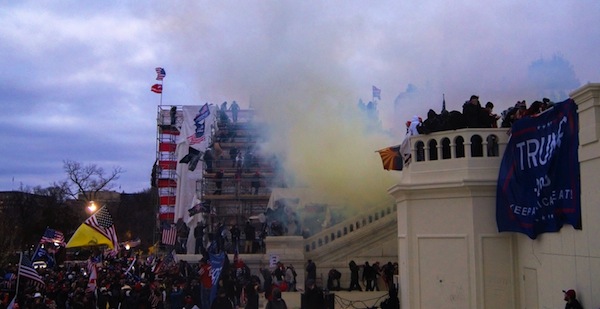
The violence at the U.S. Capitol on Jan. 6. (photo by Tyler Merbler/flickr)

Elect a clown, expect a circus. That has been a recurring meme over the past four years. As the reality show that is the Donald Trump presidency staggers into its final few days, the full fruit of the president’s years of bellicosity and violent language expressed themselves at the U.S. Capitol Jan. 6. Incited by the president, who repeated his utterly baseless claims of a stolen election, thousands of people marched on the seat of America’s democracy, smashed windows, stormed the building, threatened lawmakers and defaced and desecrated the premises.

Some observers, including many Republicans, expressed shock at a turn of events that was almost entirely predictable. After years of the most irresponsible rhetoric imaginable from the so-called leader of the free world, and after two months of undermining the most sacred facet of American democracy, the peaceful transition of democratically elected administrations, violence was a surprise only to those who have not being paying attention – or who observe through ideological blinders.

It seems to be a turning point. A growing, though still far too small, number of Republicans are finally saying they have had enough of the outgoing president’s petulance and possibly criminal irresponsibility. Listening to some, it appears they were looking for an opportune moment to break with their leader, and the violence – which killed five people – provided the ideal opening.

It is not enough for apologists to pretend that these elements are in any way peripheral to Trumpism. He has encouraged, abetted and refused to condemn the most evil strains in the American body politic, from the Ku Klux Klan to Proud Boys, referring to “very fine people on both sides” at Charlottesville – when one side was white supremacists with a sprinkling of neo-Nazis and anti-democratic thugs. Faced with the destruction his words and his supporters wrought at the Capitol, Trump uttered the least a president could possibly say, calling on the rioters to go home, while also repeating the lies that led to the violence in the first place. Then he added: “We love you. You’re very special.” He just can’t help himself.

Among the insurrectionists at the Capitol were overt Nazis, including at least one wearing a shirt with “Camp Auschwitz” emblazoned on it and another with the acronym “6MWE,” meaning “six million wasn’t enough.” These are the very special people Trump loves. Jews and others who were taken in by an embassy move and other ostensibly “pro-Israel” acts should know now the fire with which they were playing.

There must be accountability. At the top, those who abetted and encouraged the worst actions of the past years should be held criminally liable, if that is the extent of their culpability. At a lesser level, those who tacitly or explicitly permitted what has happened – Republican senators, congress members and party officials – will ideally suffer at the ballot box at the next opportunity. Among ordinary people, including some in Canada who have expressed support for this extremist and white nationalist approach, we should seek introspection around how we may have been drawn into a political disease that we should have recognized for what it was – yet let proceed along a path that almost inevitably led to the loss of human life and the shattered glass at the U.S. Capitol last week.

We might also hope that leaders of other countries will look at the American case as an instruction in the dangers of oratorical brinksmanship, division and scapegoating. One of Trump’s greatest allies, Israel’s Prime Minister Binyamin Netanyahu, is in an election (again) and it will be illuminating to see if his style softens at all. In Europe, where far-right populism is seeing a resurgence, perhaps the warning shots from Washington will inspire a little more moderation.

Barring more violence on Inauguration Day, God forbid, this chapter will soon be behind us. Joe Biden was not everyone’s first choice for president, he was more of a compromise pick. Based on decades of experience, he has been charged with picking up the pieces of a society shattered by four years of negligent and confrontational executive leadership. It doesn’t hurt that he has a grandfatherly demeanour and a history of consensus-building. While the outgoing president will not attend the swearing in – more proof that he abhors the core principles of democracy – beside Biden will be Kamala Harris, the first woman and the first Black and Asian person to assume the vice-presidency.

No humans are perfect. The Biden-Harris administration will make mistakes and we will criticize them. But we can rejoice in the arrival of a new future, led by people of goodwill, intelligence and moderation, who know the difference between right and wrong, between neo-Nazis and very fine people.

Format ImagePosted on January 15, 2021January 13, 2021Author The Editorial BoardCategories From the JITags antisemitism, Capitol, democracy, Donald Trump, elections, Joe Biden, Kamala Harris, politics, racism, violence

Cautiously optimistic

The good diplomatic news keeps coming. Morocco and Israel have announced that they will begin normalizing bilateral relations. This comes on the heels of similar announcements between Israel and the United Arab Emirates, Bahrain and Sudan. There are rumours of more announcements to come.

More than 10% of Israel’s population has family roots in Morocco, adding to the emotional impact of the latest announcement.

In a year that has strained credulity in so many ways – few of them cheery – these diplomatic moves have been a bright spot. Even some longtime international observers and commentators are dumbfounded by the speed of the developments. For decades, the conventional wisdom of Middle East watchers has been that Arab recognition of and peace with Israel rests on a resolution of the Palestinian issue. Bypassing that step is a massive about-face for the countries that have made nice with Israel, and it is galling to the Palestinians and their representatives.

In most cases, the thaw in relations is a de jure recognition of de facto relations that have been in progress for years. Under-the-radar visits and economic ties have existed between Israel and some of these states long before they were officially acknowledged and celebrated. Bringing these relations out in the open was eased by a little self-interest, with a degree of cajoling and likely backroom dealing from the U.S. president and his administration.

The incentives for Arab and Muslim states to warm the cold shoulders they have given Israel include realities of geopolitics – countering the regional designs of Iran and Turkey – as well as the basket of inducements presented by the Americans. For example, the latest announcement – between Morocco and Israel – involves American recognition of Moroccan sovereignty over disputed territories of Western Sahara and American promises of billions of dollars of investments in the Moroccan economy.

Similarly, the American-brokered relationship between Israel and Sudan hinged on Sudan’s removal from the U.S. list of state sponsors of terrorism (contingent on Sudan’s provision of $335 million in compensation for victims of the Sudanese-related terrorist bombings against American interests and citizens).

The UAE and Bahrain agreements also had carrots attached. In exchange for their acquiescence, the UAE may obtain valuable American F-35 fighter jets.

All the states launching fresh relations with Israel open the opportunity for potentially lucrative deals with Israeli businesses and investors. In other words, the diplomatic thaw is not a consequence of a sudden awakening to the benign presence of what has been known by most of these states until recently as the “Zionist entity.” The trading of economic and military incentives – as well as the seemingly nonchalant abrogation of self-determination for the people of Western Sahara – suggest as much self-interest as affection for Israel.

The diplomatic isolation of Israel that began at the moment of its rebirth in 1948 was founded primarily on the rejection of the idea of Jewish self-determination – at least in the Jewish people’s ancient and modern homeland. The opposition to Israel’s existence was not premised on economic or diplomatic reasoning but, to a much greater extent, on anti-Jewish animus.

Israel’s isolation represented an abandonment of self-interest on the part of Arab and Muslim countries. Ghettoizing their own economies from the economic powerhouse of the region has been harmful to all people in the region. None have been harmed more than the Palestinians themselves, who have something to gain materially from good neighbourliness with Israel.

The series of announcements on diplomatic relations are not a result of any altruism. At least in part, they came about through old-fashioned horse-trading, including some morally questionable trade-offs, such as the forgiveness of terrorism and an internationally contentious occupation of a foreign territory, and weapons sales.

After 72 years of nearly universal rejection of Israel by its neighbours, a thaw motivated by self-interest is still a thaw. And it’s something about which to be cautiously optimistic. But it’s only a start, and there is much to be done to build the region into one that’s united in peace. It might be naive, but we still cling to the hope of Isaiah that all those weapons will eventually be exchanged for ploughshares and pruning hooks that, one day, the world over, “nation shall not lift up sword against nation; neither shall they learn war anymore.”

Posted on December 18, 2020December 16, 2020Author The Editorial BoardCategories From the JITags Bahrain, economics, Israel, military, Morocco, peace, politics, Sudan, trade, UAE, United Arab Emirates, United States

Better choice needed

Yad Vashem holds an almost sacred place in the Jewish world. The foremost repository of materials relating to the Holocaust, and Israel’s official memorial to the victims of Nazism, the centre is practically an obligatory destination for visiting diplomats and foreign dignitaries. It is a solemn place dedicated to the terrible past, but with an explicit vision for a future without hatred and genocide.

Yad Vashem is rightly focused on the Jewish particularity of the Shoah. We take for granted the logic of Yad Vashem being located in Jerusalem. The capital of Israel and, spiritually, of the Jewish people seems a logical place to remember this massive cataclysm in Jewish history. But it commemorates a history that took place thousands of kilometres away, in Europe. Its presence in the Jewish state is itself a statement about Jewish particularism. But this does not erase the universal lessons Yad Vashem advances.

Since its founding in 1953, it has been a model for the world in commemorating and educating about the worst chapters in human history. The events of the 20th century that necessitated the invention of the word “genocide” did not end with the Holocaust. Genocides have occurred since 1945 – and before. Educators and others who strive to preserve and transmit these histories and their lessons struggle over the balance between respecting the very specific characteristics of the Holocaust, for example, with the broader messages for all humanity. At a time when antisemitism is experiencing a resurgence, it is essential that the role of Jew-hatred be addressed and confronted, at least in part with the recent past as a warning for the dangers of complacency.

While the struggle between universality and particularism is challenging, all can probably agree that Yad Vashem stands as a monument to human rights and the dignity of all people – and as a lesson to those in societies where those values are compromised. At the same time, the existence and focus of Yad Vashem safeguards the particular and monumental horrors of the genocide against the Jews.

This is why there is rightful concern over the proposed appointment of former brigadier general Effi Eitam as head of Yad Vashem. His proponents – including Prime Minister Binyamin Netanyahu, who nominated him for the position – contend that Eitam’s career has been spent defending the Jewish state. And among the lessons many people take from the exhibits of Yad Vashem is the necessity of a Jewish state as a bulwark against a world that has yet to cure itself of antisemitism.

But Eitam’s military record is more than troubling, and this is the main reason for concerns about his appointment. During the First Intifada, he brutally instructed his troops to break the bones of a 21-year-old Palestinian prisoner, Ayyad Aqel. The soldiers beat the young man to death. Four of Eitam’s soldiers were court-martialed and the Military Advocate General reprimanded Eitam and recommended he never be promoted. (He was.) In addition to his military career, he served two terms in the Knesset representing various religious parties, and held several cabinet portfolios.

Beyond Eitam’s record of heinous action is a record of deeply concerning and racist ideas. He has referred to Arab Israelis as a “cancer” and promoted ethnic cleansing of West Bank Palestinians: “We’ll have to expel the overwhelming majority of West Bank Arabs from here and remove Israeli Arabs from political system,” he said in 2006.

Referring to human beings with terms like “cancer” is precisely the sort of dehumanization that can be a precondition to genocide. In any society – including one as open as Israel, where diverse views and expressions are the norm – these statements must preclude someone from a role like head of the world’s foremost research centre about, and memorial to, the Shoah. Eitam’s military service – he was part of the raid on Entebbe, among other things – can be seen as evidence that a strong Israel is the best defence for the Jewish people in a world capable of genocide. But Eitam’s statements cannot be justified from the mouth of one who seeks to advance the lessons, particular or universal, that Yad Vashem is expected to convey.

The nomination is threatening to create yet another schism in the government, as Netanyahu’s coalition partner Benny Gantz opposes Eitam’s appointment. Ideally, a more suitable leader will be found for this important role, one who stands as a defender of the sanctity of the Shoah and its lessons for humanity.

Posted on December 4, 2020December 2, 2020Author The Editorial BoardCategories From the JITags Effi Eitam, genocide, Holocaust, Israel, particularism, politics, racism, universality, Yad Vashem

Scientific breakthroughs

Scanning Israeli news this week has a feel of a sci-fi fantasy. Most eye-catching of all is the assertion by a Tel Aviv University researcher, in a peer-reviewed article, that hyperbaric oxygen therapy can “reverse aging” by lengthening telomeres, the structures found at the ends of chromosomes, by more than 20% on average.

“This means we can start to look at aging as a reversible disease,” Prof. Shai Efrati said, as reported in the Times of Israel. Some gerontologists are skeptical of the claims and some suggest it could open a Pandora’s box of related health issues, but, from ancient times through the 16th-century conquistador Juan Ponce de León to, apparently, contemporary Israel, humankind has dreamed of and sought out a figurative or literal fountain of youth. Whether Efrati’s research will fulfil that dream will be watched closely.

And there are other scientific headlines this week.

Also coming out of Tel Aviv University is news that scientists have destroyed cancerous cells in mice by pinpointing affected cells with “tiny scissors,” while leaving everything around them intact and with no side effects. With trials possibly to begin in humans within two years, they are hopeful that this could be a revolution that could effectively cure cancer.

A third scientific bombshell comes from Israelis in Canada. Eliav Shaked and Roy Kirshon, expatriate biomedical engineers working in Toronto, are developing a speedy, non-invasive diagnostic for patients who are likely decades away from showing symptoms of dementia. While there is no cure yet for dementias like Alzheimer’s disease, the pair believe that an early diagnosis will not only permit individuals to prepare for eventual care but allow doctors to study the progression of the disease and thereby gain valuable insights.

In these pages, we frequently highlight Israeli technological and medical advancements but the news this week really seemed like a dream sequence from a futuristic utopia. Of course, none of these initiatives is a sure bet but they read like a hat trick against some of the most damning health challenges facing our generations.

Is it a coincidence that these are all emerging from Israel? It is no secret that the tiny state is a locus of a massively disproportionate amount of the world’s achievements in a range of fields.

Some books, like Start-up Nation: The Story of Israel’s Economic Miracle, by Dan Senor and Saul Singer, and many other observers have posited that Israel’s successes are achieved not in spite of the adversities the country and its people have faced, but as a direct result of them. So many of the scientific, social and economic advances that have come out of Israel in recent decades are civilian benefits redounding from military research and development, though Israel is by no means the only country for which this is case.

No less significant are the social impacts of compulsory service in a national defence force that some have called the least hierarchical in the world. Individuals who made life-and-death choices for themselves and their colleagues at age 19 or 20 may be less timid in taking major entrepreneurial or other life risks at 25 or 30 than an average North American or European at that age. Not to discount the value of peace and all the benefits it would bring, the circumstances in which Israel exists have created a thoroughly unique social and economic environment.

Coincidentally or not, also in the news this week was a vote at the United Nations in which 163 countries, including Canada, voted for a condemnatory resolution against Israel; five voted against. It is one of 17 resolutions expected in this General Assembly session targeting Israel, while just seven country-specific resolutions are expected to be aimed at condemning every other injustice on the planet. Canadian Jewish organizations and pro-Israel commentators are furious at Canada’s vote, which directly contradicts pledges made by Prime Minister Justin Trudeau, including during the last election campaign.

While many are appalled at the hypocritical obsession with Israel, and certainly Israeli diplomats are in the fray denouncing the vote, average Israelis, it is safe to say, remain sanguine. They have seen far worse attacks than that by the world community in the comparatively impotent global parliament that the UN General Assembly has become.

While it would be nice if the world judged Israel with moral measuring sticks commensurate with those we use for every other country, in the end it doesn’t seem to make much difference, thankfully. Even through the pandemic, Israelis have continued to try and turn science fiction into scientific reality. This week’s news alone included the possibility of cures for cancer, dementia and aging itself. And the benefits of such research do not accrue solely to Israelis, but to all of us – whether the nations of the world at the General Assembly recognize and appreciate that fact or not.

Posted on November 27, 2020November 25, 2020Author The Editorial BoardCategories From the JITags aging, Alzheimer's, anti-Israel, antisemitism, dementia, Eliav Shaked, health, Israel, Justin Trudeau, Roy Kirshon, science, Shai Efrati, technology, Tel Aviv University, United Nations

Seek humility, wisdom

It has been a particularly reflective and momentous week. The U.S. elected Joe Biden as its 46th president and Kamala Harris as vice-president, the first Black woman and first woman of Asian and Indian descent elected to that high office. Around the world, there were nearly audible sighs of relief and cries of jubilation as the count trickled in and it became clear that president-elect Biden had cleared the 270 Electoral College threshold, even as the counting of ballots continues and results are not certified until early in December. More solemnly, this week was the commemoration of the 82nd anniversary of Kristallnacht and of Remembrance Day. And, right at the dawn of this emotional week, we learned of the passing of Rabbi Lord Jonathan Sacks. Britain’s former chief rabbi, Sacks died of cancer on Shabbat at age 72.

Formally called chief rabbi of the United Hebrew Congregations of the Commonwealth, Sacks held the role from 1991 to 2013, during which time his scholarship in philosophy helped him elucidate Jewish theology to general audiences as a regular guest on BBC Radio. He was admired and his death lamented by leading figures in British society, not least the heir apparent to the throne, Prince Charles. He was good friends with now-retired Anglican bishop George Carey, who was the head of the Church of England, strengthening interfaith relations.

Sacks’s time in leadership was not without controversy. He has been viewed by some as too accommodating of orthodoxy and not adequately inclusive of progressive or liberal strains of Judaism. Sacks skipped the 1996 funeral of Rabbi Hugo Gryn, the leading figure in Reform Judaism, drawing rebukes from liberals. In contrast, a book Sacks authored, The Dignity of Difference, implied that all religions and streams therein are equally valid, a thesis that was deemed too ecumenical by some British Orthodox Jews. One rabbi accused him of “heresy.”

In other words, Sacks leaves behind a mixed legacy, though few among us in this generation have left such a lasting mark on contemporary Judaism. The sort of centralized religious leadership that British Jewry and others in Europe have is unfamiliar to North American Jews. But anyone in a position of responsibility in the Jewish community knows the perils of presuming to speak on behalf of all – or most – Jews. Anyone in a job like Sacks’s would draw admirers and detractors. Chief rabbi is, of course, not a political role, but it must be a profoundly political one nonetheless, to elicit an accusation of heresy.

The concept of heresy seems to have seeped from the theological into the political realm in recent years. Fanaticism and extreme loyalty have always played a part in politics. But, in the highly polarized situation we see in the United States and many other places, differences of opinion are magnified into civilizational, even existential, divisions. This certainly seemed to be the case in the U.S. elections. Not everyone likes the incumbent President Donald Trump but, to paraphrase a beer commercial, those who like him like him a lot. While Biden won the support of a vast majority of Jews, surveys suggest that somewhere between 20% and 30% of American Jews voted for Trump’s reelection, a higher vote for a Republican than in many of the last presidential elections. The vehemence of opinion on both sides – some decry Trump as antisemitic while others claim he is the most pro-Israel president ever – would be confusing to the proverbial Martian.

We are assimilating this news in a week where we reflect on the destruction of European Jewry in the Holocaust, the world wars, the bloody history of the 20th century and all the conflict and misery and bloodshed it wrought. The 21st century seems similarly full of divisions and conflicts. Political polarization in democratic countries, as well as growing authoritarian tendencies in several democracies, call for a response.

Biden ran as a unifying figure bent on restoring a sense of moderation and respect to public discourse. Whether one individual can alter the trajectory of a divided society will be seen as the president-elect navigates a narrowly divided House and Senate to shepherd his legislative vision into reality. The unexpected tightness of Republican-Democratic splits in both chambers may exacerbate his challenge. A small tail of far-left Democrats and of far-right Republicans could wag the dog that is their respective party. On the other hand, this challenge could present an opportunity, if there are those willing to fight for what is right and to compromise across the aisle when appropriate and necessary. Such a shift from the failure of bipartisanship in recent years would be monumental indeed. But it could effectively reduce the influence of extremes.

Perhaps what these disparate events illustrate is that conflict – from the cataclysmic to the mild awkwardness of politics at the Shabbat table – is innate to humans. But so is confronting conflict and difference intellectually and with open hearts. Seeking moderation and compromise has lost currency in the age of social media and 24/7 cable news. Nuance is blurred and enlightenment darkened by ideological certainty.

We should seek understanding wherever we might find it and avoid elevating mere mortals to unattainable standards or demonizing them beyond all reasonable recognition. In our spiritual and political realms, in our daily work and home life, we can all commit to some additional humility, to deeper listening and to finding wisdom wherever it might be, even in unexpected places.

Posted on November 13, 2020November 11, 2020Author The Editorial BoardCategories From the JITags Britain, democracy, elections, Jonathan Sacks, Kristallnacht, leadership, politics, United States

Posts pagination

Previous page Page 1 … Page 13 Page 14 Page 15 … Page 49 Next page
Proudly powered by WordPress