Skip to content
  • Home
  • Subscribe / donate
  • Events calendar
  • News
    • Local
    • National
    • Israel
    • World
    • עניין בחדשות
      A roundup of news in Canada and further afield, in Hebrew.
  • Opinion
    • From the JI
    • Op-Ed
  • Arts & Culture
    • Performing Arts
    • Music
    • Books
    • Visual Arts
    • TV & Film
  • Life
    • Celebrating the Holidays
    • Travel
    • The Daily Snooze
      Cartoons by Jacob Samuel
    • Mystery Photo
      Help the JI and JMABC fill in the gaps in our archives.
  • Community Links
    • Organizations, Etc.
    • Other News Sources & Blogs
    • Business Directory
  • FAQ
  • JI Chai Celebration
  • JI@88! video

Recent Posts

  • Sharing her testimony
  • Fall fight takes leap forward
  • The balancing of rights
  • Multiple Tony n’ Tina roles
  • Stories of trauma, resilience
  • Celebrate our culture
  • A responsibility to help
  • What wellness means at JCC
  • Together in mourning
  • Downhill after Trump?
  • Birth control even easier now
  • Eco-Sisters mentorship
  • Unexpected discoveries
  • Study’s results hopeful
  • Bad behaviour affects us all
  • Thankful for the police
  • UBC needs a wake-up call
  • Recalling a shining star
  • Sleep well …
  • BGU fosters startup culture
  • Photography and glass
  • Is it the end of an era?
  • Taking life a step at a time
  • Nakba exhibit biased
  • Film festival starts next week
  • Musical with heart and soul
  • Rabbi marks 13 years
  • Keeper of VTT’s history
  • Gala fêtes Infeld’s 20th
  • Building JWest together
  • Challah Mom comes to Vancouver
  • What to do about media bias
  • Education offers hope
  • Remembrance – a moral act
  • What makes us human
  • המלחמות של נתניהו וטראמפ

Archives

Follow @JewishIndie
image - The CJN - Visit Us Banner - 300x600 - 101625

Byline: The Editorial Board

Know Hatzaad Harishon?

Journalist and author Sybil Kaplan, who is a regular contributor to the Jewish Independent’s special holiday issues, was, in her younger years, the first leader of Hatzaad Harishon, a Jewish youth group that was formed in the 1960s in New York. She led the group for five years. At some stage in the 1970s, the organization ceased to exist.

Kaplan has written a book about Hatzaad Harishon but would like to augment it with the memories of more of its former members. She is hoping that they would share some of their recollections. If you or someone you know is familiar with Hatzaad Harishon or you were a member and would like to connect with Kaplan, she can be reached at [email protected].

Posted on April 8, 2022April 7, 2022Author The Editorial BoardCategories From the JITags Hatzaad Harishon, Sybil Kaplan

Canada’s new direction?

Jewish Canadians were instrumental in building the Canadian labour movement and, by extension, the Cooperative Commonwealth Federation, which would go on to become the New Democratic Party.

Political scientists and others have observed that, as immigrant communities integrate into their new societies and become more economically secure, their voting patterns and ideological outlooks tend to move across the spectrum. While Canada has seen a small but steady growth of Jewish immigration in recent decades – with spikes during significant events like the end of the Soviet empire – the community, as a whole, is now firmly established.

Canadian Jews, like other groups that have deep roots in our relatively new country, have experienced economic and social success. Individual Jewish households, of course, face every range of economic and social challenge, issues that are addressed by a network of social service agencies guided by the principle Kol Yisrael arevim zeh bazeh, all Israel is responsible for one another. While there is a sacred instruction for Jews to care for our own, Jewish values have also played a role in the actions of Jewish Canadians in relation to the broader Canadian society. Through individual and collective activism, from individuals like David Lewis in the last century to groups like the Centre for Israel and Jewish Affairs today, Canadian Jews have influenced public policy and made the country better and more welcoming for all.

Despite whatever economic advances Canadian Jews have made as a group, it is often noted that, as a community, Jews tend to remain politically progressive. In a practical sense, this has been complicated by positions taken by some on the left, including trade unions, the New Democrats and the Green party. Jewish Canadians are overwhelmingly Zionist and, over the past 50 years, picking up steam in the past two decades, the left has become less and less supportive of Israel and Jewish self-determination. The debate about where anti-Zionism ends and where antisemitism begins is for another day. Stated simply, many Canadian Jews are progressive voters who, due to foreign policy issues, find themselves politically homeless. (The pro-Israel stands of the Stephen Harper government also shook many Jews away from their traditional political allegiances.)

With this context in mind, the surprise announcement Tuesday that the federal Liberal government has signed a supply and confidence agreement with the New Democrats may allow some progressive Zionist voters to have their cake and eat it too.

Under this deal – the same kind of agreement that the NDP and Greens in British Columbia signed to topple the B.C. Liberals in 2017 – the parties have agreed to advance things that have long been on the NDP agenda, such as a national dental care program and national pharmacare. It will apparently enhance ongoing reconciliation work through investments in Indigenous housing and continuing to confront the tragedy of missing and murdered Indigenous women and girls. Changes to the tax system and reducing barriers to participation in elections are also among the points released Tuesday.

The thorny issue of affordable housing will also be part of the mix – although what any government can successfully and substantively do on this issue remains a big question mark.

The provision of affordable universal child care – a promise made repeatedly by the Liberals and still not realized – is another marquis issue, as is addressing climate change and supporting workers.

The deal hearkens back to a similar one between then-prime minister Paul Martin, a Liberal, and the New Democrats, under Jack Layton, which buoyed a minority Liberal government in exchange for a $4.6 billion injection of federal funds into social programs.

For Canadian Jews who remain committed to progressive political values, the rather sudden announcement this week could be very welcome. Canada will (presumably) get a raft of new legislation on issues from environmental protections to economic justice, without subjecting Canadian foreign policy to the whims of a party that has signaled disregard to Jewish Canadians’ familial, historical and emotional ties to the state of Israel.

For those Canadian Jews who do not subscribe to this agenda, well, there is an opportunity for shaping an alternative. The federal Conservative party is in the early stages of what will be, it appears, a fight for the ideological soul of the party. The response to the Liberal-NDP deal by interim Conservative leader Candice Bergen was predictably skeptical. She called it a “power grab” by Trudeau, though time will tell whether a three-year reprieve from a snap election will allow the new Tory leader to cement their role before facing voters.

In any event, the battle lines for the next several years are being drawn. A Liberal-NDP agenda on one side and a possible new approach at the head of the Conservative party on the other.

We hope that Canada avoids the level of polarized partisanship we see in the United States and some other countries. It is, in fact, Canada’s history of moderation and compromise that has made it a welcoming place for Jews and other minority communities. However, it is always healthy in a democracy to have clear, definable choices.

The NDP and Liberals will be laying out their apparently ambitious agenda for the coming years. Those vying for the Conservative party leadership will now have a plethora of fresh policy initiatives to sink their teeth into to define themselves in contrast with this unexpected new informal coalition.

Posted on March 25, 2022March 24, 2022Author The Editorial BoardCategories From the JITags Canada, Conservative, Liberals, NDP, politics, social programs, Trudeau, Zionism

Hoping sanctions work

The world’s economies have never been more integrated or interdependent. This is most immediately evident in the fact that a war halfway around the world sends gasoline prices skyrocketing in Metro Vancouver.

But that interdependence has also permitted the most dramatic, swift and merciless sanctions ever seen – as a response to that very war. Within days of Russia’s invasion of Ukraine, a jaw-dropping catalogue of economic penalties was slammed against the Russian regime. Not only that, but the sanctions have taken aim at individual millionaires and billionaires who exist in a symbiotic, mafia-like relationship with the Russian dictator, Vladimir Putin. Every day, the news is filled with one company after another cutting ties with Russian businesses, stopping trade with Russian producers and withdrawing their products and services from Russian consumers.

Cultural boycotts have also been swift. The Vancouver Recital Society canceled a scheduled event with the Russian piano wunderkind Alexander Malofeev and scores or hundreds of similar cancellations have taken place in the classical music arena and other cultural sectors. International sporting competitions have barred Russian participation.

The combined effects of these thousands of individual actions are intended to put pressure on Russian citizens who will then, the plan goes, turn on their leader who will then, perhaps, alter his murderous invasion and withdraw or, better still, be ousted in favour of a return to the nascent democracy Russia was nurturing before Putin put his boot heel on its neck.

If these sanctions work, it could be a turning point in human history – nonviolent economic retribution outmanoeuvring brute force. (In addition to economic sanctions, Western countries have also supplied Ukraine with military equipment and other supports, while stopping short of meeting the entreaties of Ukraine’s President Volodymyr Zelensky that the West get more directly involved, including by implementing a no-fly zone over his country, which would equate to a direct military conflict between Russia and the West.)

Events are unfolding by the minute, with more than two million refugees flooding neighbouring countries in the course of just 10 days and horrific images of destruction and death flowing out to the world. Amid all this, a few observations stand out.

Israel’s Prime Minister Naftali Bennett traveled to Moscow after Zelensky implored him to act as an intermediary. Israel has fraught, complex and deep historical and contemporary connections with both countries, including a massive chunk of Israel’s population that came from Russia and Ukraine in the past 30 years and another large proportion with older roots in the region. Bennett and Zelensky are, it has been noted, the only two Jewish heads of government in the world. Zelensky’s steadfastness during these weeks of war has inspired the world, perhaps especially Jews worldwide, who now see him as a David defending both his homeland and democracy itself from the Goliath of Putin’s military. It would be remarkable if the prime minister of Israel were able to play a part in brokering the end to war and restoring national integrity to Ukraine.

In this space, we have been critical of cultural boycotts that target Israeli performers, athletes and others. Cultural interactions between citizens of diverse countries are the lifeblood of global civilization. In the case of real or proposed sanctions against Israel, the end-goal is ambiguous. Depending on the proponent, movements to boycott Israel aim to variously sanction particular policies, end the occupation or end Israel (as the term “anti-Zionist” implies). They are, for all intents, a punishment without end, given that the end-goal is vague. In the case of Russia, the hope is that the short, sharp shock of sanctions will lead to a satisfactory resolution and then we will ideally again soon welcome Russian performers and athletes, to say nothing of a return to trade with one of the world’s largest economies. The clarity of the call – leave Ukraine alone! – is critical to success. Unlike the undefined or obscured goals of BDS, the campaign against Russia is clear. If Russia retreats, sanctions will be peeled back.

There is another issue worth considering. It is notable that countries guilty of egregious crimes, such as the Chinese government’s imprisonment of hundreds of thousands of its Uyghur Muslim citizens and others, have not brought down the near-unanimous wrath of the West. Perhaps this is proof of the dictum that white lives elicit greater global concern than lives of people of colour. It may also be that the world understands that the invasion of Ukraine might be a precursor to greater territorial ambitions. It is also unavoidable that, for the Western collective memory, war in Europe evokes the gravest ghosts of the 20th century.

We will soon know whether the most comprehensive sanctions ever imposed (undergirded by materiel support) can end this conflict without the worst case scenario – direct conflagration between nuclear powers, Russia and the West – coming to pass. If they are successful, it would signal a new age in which concerted economic influence, rather than boots on the ground, can turn the tide of history.

Posted on March 11, 2022March 10, 2022Author The Editorial BoardCategories From the JITags conflict, Russia, sanctions, Ukraine, war

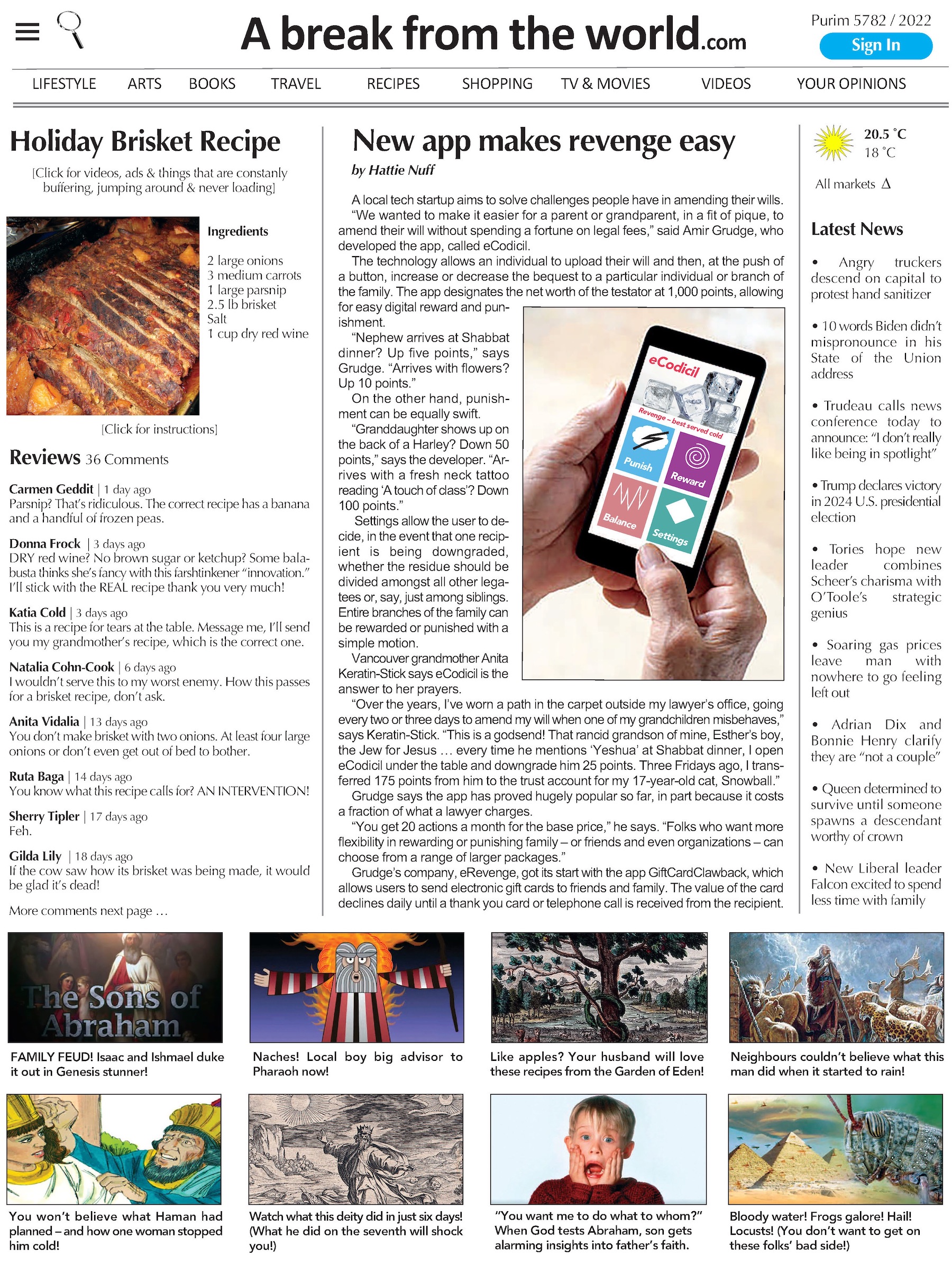
Happy Purim 5782 / 2022!

image - JI Purim Spoof 2022

Posted on March 11, 2022March 10, 2022Author The Editorial BoardCategories From the JITags fake news, Purim

Ukraine in the balance

At our press time, the people of Ukraine were waiting, as they have for weeks, to see what fate has in store for them. Vladimir Putin, the Russian despot, has been threatening to invade the country – again. Under Putin, Russia has already illegally occupied the Crimean peninsula and two enclaves in eastern Ukraine. Pro-Russian extremists are also in control in Transnistria, a breakaway entity to the west of Ukraine that the world community recognizes as part of Moldova. In the Russian countryside surrounding the parts of Ukraine that Russia has not already occupied, an estimated 190,000 Russian troops are poised to attack.

Putin’s designs on Ukraine are ostensibly about his concerns over Ukraine potentially joining NATO, which some Russians view as a step too far in the incremental loss of Russian dominance over what was once the Soviet Union and, before that, the Russian Empire. He is also motivated by his own desire for power and expanding his influence. Along with other Russian nationalists, Putin views Ukraine as more than a neighbouring country but rather an integral part of a sacred Eurasian (Russian-dominated, of course) land.

Western powers have warned and cajoled Putin, who seems to revel in tormenting his adversaries. He is almost certainly aware that no one (save, perhaps, himself) wants war. The United States, having just catastrophically escaped a military debacle in Afghanistan, has no interest in continuing their role as the world’s policeman. The leaders of France, the United Kingdom, Germany and other Western powers have warned of serious consequences if Putin follows through on what appear to be unconcealed ambitions to invade, but none of those countries will risk the lives of their young people to defend Ukrainian sovereignty. It was precisely occasions like this for which the United Nations was envisioned, but the ideals of its founders have run aground on the rocks of realpolitik.

Genuine threats of reprisals are limited to economic sanctions. Here, too, Putin knows that embargoes and other economic penalties would be devastating not only for his country but for the economies of the West. Western Europe depends on Russian oil and anything – military instability or international sanctions – could send fuel and heating costs, which are already at record highs in many places, further through the ceiling. At a certain point, that could threaten the stability of some Western governments. More worrying is the fact that Ukraine has always been, and remains, the “breadbasket” of the region. Military or economic disruptions that harm Ukraine’s ability to get products to market could lead to food shortages. The possibilities are bleak.

Canada is home to one of the Ukrainian diaspora’s largest populations. More than 1.3 million Canadians are from, or descended from, the place. A significant proportion of North America’s Jewish population, too, is from that area and an even larger proportion departed to the new world through Ukraine’s Black Sea ports.

Ukraine has somewhere between 43,000 and 200,000 Jews. Definitions of “who is a Jew” are complicated by nearly a century of enforced atheism and centuries more of rampant antisemitism. The 200,000 estimate is the number who would qualify for Israeli citizenship under the Law of Return.

According to the New York Times, synagogues have hired Israeli security guards and hired buses for rapid evacuations. The Jewish Agency is said to have evacuation plans at the ready.

For all Ukrainians, the past 100 years have been a series of tumults. Jewish Ukrainians have been especially vulnerable during these times of upheaval – and the older Jews today, and those with any sense of history, may rightly understand they have more to fear than other potential victims of a Russian invasion.

Israeli government officials have been remarkably tight-lipped on the subject, other than to urge the 12,000 Israelis in Ukraine to come home as soon as possible – reportedly only 4,000 have so far done so.

It is easy, understandable even, to suggest the time has come for Jews in Ukraine and other places where life is especially difficult, to leave for Israel or elsewhere. Certainly, we are thankful that Jews with nowhere else to go have a Jewish state ready to take them in.

But Ukraine is their home. There are hundreds of Jewish organizations and institutions in Ukraine, a place where Jewish civilization goes back 1,200 years and where a vast amount of Jewish culture emerged in the past several centuries, including important streams of Hasidism and many noted authors and artists.

As the world waits on Putin, the latest in far too long a line of Russian tyrants, we watch with a sense of helplessness, knowing that people are afraid and suffering. And we hope that those in power pull back from the brink.

Posted on February 25, 2022February 23, 2022Author The Editorial BoardCategories From the JITags NATO, politics, Russia, Ukraine, war
When to call in, call out

When to call in, call out

Truckers and others ostensibly contesting government pandemic responses have laid siege to downtown Ottawa. In reality, the protesters seem to have a panoply of grievances, many of which manifest as antisemitic, racist, sexist and just plain obnoxious.

Those noxious traits spread across the country last weekend, as satellite protests took place in Vancouver and other cities. In Toronto, a handbill was distributed declaring that “every single aspect of the COVID agenda is Jewish,” followed by a litany of other antisemitic declarations. This is on the heels of the appearance of swastikas and confederate flags at protests, the appropriation of Holocaust imagery by anti-vaxxers and other inappropriate expressions from COVID skeptics.

The defence, such as it is, from organizers and supporters is that these cases are incidental, represent a minority within the movement and, in effect, should be ignored.

Racism, antisemitism and other forms of hatred should never be dismissed or overlooked. Ideas and images like these must be identified, isolated and removed from any movement that wants to be taken seriously by Canadians. It is no less abhorrent to march alongside people carrying a swastika flag than it is to carry a swastika flag.

Some cases, like waving the Nazi flag, are clear cut and easy to call out and condemn as antisemitism. Other cases, like (we suspect) Whoopi Goldberg’s, are more nuanced. Goldberg’s statement that the Holocaust was not “about race” set off a frenzy. As if more fuel was needed, a jokey recipe she submitted to a cookbook decades ago, called Jewish American Princess Fried Chicken, conveniently resurfaced. All of this seems to have opened a floodgate of previously muted concerns about Goldberg’s appropriation of a Jewish last name and even Jewish identity. Goldberg was called out and suspended for two weeks by her producers.

In fact, Goldberg may have been expressing some combination of contemporary “progressive” understandings of race, which sees a hierarchy of oppression based on skin colour. Before we get too self-righteous about the state of racial dialogue today, remember that a couple of generations of Jewish Americans and Canadians have spent a great deal of effort to downplay differences between ourselves and the (white) majority. There is genuine confusion about Jewishness as a religion, a peoplehood and a racialized group. While it should not always fall on minority communities to school others on issues of identity, neither should our default be to assume ill-will when confusion or ignorance remain possibilities.

While people who wave swastikas may be irredeemable, people like Goldberg – who has expressed solidarity with the Jewish community to the extent that she has said, “I just know I am Jewish” – are a different story. She may be misguided about where Jews fit into today’s conceptions of race and identity, among other things, but her flailing in the midst of the controversy suggests she is confused, not hostile.

There is an alternative to “calling out.” There is a term – “calling in” – through which the opportunity is taken to educate someone who has made an unfortunate remark, to encourage them to learn and adjust their outlook. The process has the potential for turning enemies (or perceived enemies) into allies – and it has worked wonders in countless cases.

Acknowledging intent is critical. Goldberg’s words were poorly chosen and she needs some education. People who wave swastika flags are on another level. Putting on a yellow star because you are asked to vaccinate for the health of yourself and others is contemptible. Handing out flyers blaming COVID on the Jews is as antisemitic as words get. There is a time for calling in and a time for calling out.

The organizers and supporters of the trucker protests need to call out the bad seeds among them. The legitimacy of any movement – whether it be against vaccines, for the rights of a group of people, for protection of the environment, or for whatever other cause – depends on well-intentioned members acknowledging and addressing the presence of those who are motivated by less well-intended objectives, not ignoring them.

And this brings us back to us. It is fine, indeed correct, to call out the hypocrisies of our critics and those with whom we disagree. But we have all been in conversations around the dinner table, on social media, in private messages and emails, where our friends, relatives or guests have expressed unacceptable ideas about others, including fellow Jews who look different or who practise Judaism differently. Racism exists in every community.

If we ask other groups to be vigilant about intolerance in their communities – and to be willing to “call out” or “call in” various comments and actions – we should make sure our own house is in order. We cannot demand that others do this if we do not practise it ourselves. It applies to our critics and enemies. It also applies to ourselves and our friends.

Format ImagePosted on February 11, 2022February 10, 2022Author The Editorial BoardCategories From the JITags antisemitism, protests, racism, truckers, Whoopi Goldberg
A blind view of terror

A blind view of terror

Another violent attack on a North American synagogue, this one in Texas, has undermined the feelings of security among Jewish people everywhere.

It is important to see the incident in perspective. Thankfully, the rabbi and three other hostages survived the 11-hour ordeal and the only physical casualty was the perpetrator himself. Second, although such incidents happen too frequently, it must be remembered that, in the context of the many Jewish institutions in North America, this remains a highly unusual phenomenon. Third, the community – Jewish and non-Jewish – locally and internationally condemned the attack and celebrated the escape of the hostages. This differs from situations we have seen in other times and places in which those in power – police, political leaders, the general public – were either complicit or indifferent. A service of healing two days after the incident brought a thousand people of many religious and demographic backgrounds together in response. Police, interfaith leaders and elected officials were united in their expressions of condolence and solidarity.

As Rabbi Charlie Cytron-Walker noted in a presentation with the Anti-Defamation League (click here for story), Jewish community organizations benefit from the (sadly necessary but well-developed) security protocols created and implemented in partnership with Jewish organizations and law enforcement officials. These precautions are familiar to anyone who has set foot in a Jewish institution in recent decades. The visible presence of security can be a reassurance but also is a reminder of the potential for such an attack for people entering a synagogue for services or a Jewish community centre for a workout or sending their children to a Jewish day school. However, another byproduct of this increase in security and comfort for some Jews is the discomfort and lack of safety these protocols elicit in racialized Jews and others who experience more harm from policing. The answer to the problem of a lack of security cannot only be addressed by ever-increasing security, be it walls, cameras, guards, or bollards.

It is perhaps one of the most enduring cognitive disconnects that, while almost any Jew has, at least in the back of their mind, the potential for attack, whenever such an incident does take place, a seemingly opposite reaction occurs among some non-Jewish observers.

In the Texas case, it was exemplified by Matthew DeSarno, the FBI agent in charge of the case, who, in the midst of the crisis, told media that the perpetrator “was singularly focused on one issue, and it was not specifically related to the Jewish community, but we are continuing to work to find motive.”

Even without knowing the details of the individual perpetrator or his motivations, the idea that an official would insist that an attack on a synagogue is unrelated to the Jewish community is jaw-dropping. Unfortunately, it is a common response.

The most celebrated example was after terrorists in Paris targeted a kosher supermarket in 2015, when then-U.S. president Barack Obama condemned those who “randomly shoot a bunch of folks in a deli in Paris.” If the Islamist terrorists who perpetrated the attacks on multiple Jewish targets that day didn’t know that Hypercacher was a kosher supermarket with a primarily Jewish clientele, it was an incredibly lucky coincidence for them.

This refusal to see explicit attacks on Jews as explicit attacks on Jews may be a psychological phenomenon beyond our realm to unravel. Yet there seems to be some socio-psychological need to search for any alternative explanation than plain old antisemitism when a synagogue or other Jewish institution is attacked.

To be kind, perhaps it is wishful thinking. Decent people might search for a rationale that alleviates the fear that the oldest prejudice is as alive today as ever. More realistically, there is a web of conscious and, probably more commonly, unconscious biases that blind people to the blatantly obvious.

As we learned more about the perpetrator, we discovered that he subscribed to a form of conspiracy thinking that sees Jews as having unparalleled power – in this case, the ability to induce the American government to release an imprisoned terrorist. Nevertheless, because the perpetrator was using Jews as an avenue meet his objectives, rather than being motivated solely by a desire to attack Jewish people, the FBI agent eliminated antisemitism as a motive – a truly confounding perspective from a law enforcement official standing outside a synagogue where Jews were being held hostage.

This reaction happens too frequently to be dismissed as a coincidence. There is something baked into the Western imagination that makes denial and deflection the default response to an attack on Jewish people.

One explanation may be that the very ideas that the Texas assailant held – that Jews are inordinately powerful – although rarely expressed so crudely, is actually held by a large swath of the general public, perhaps leading people to conclude that, no matter what befalls an individual Jew or two, “the Jews,” as a people, still hold all the cards or will be just fine.

Other obfuscations dismiss clear and unequivocal attacks on Jews as mere “political statements” on Middle East affairs. Interestingly, those who sometimes explicitly blame Israel or Israeli policies for overseas antisemitic incidents are playing into another familiar and ancient trope about Jews: whatever befalls them, they have brought upon themselves.

It is never bad advice for Jews to be vigilant about our individual and collective security and each violent attack is a timely reminder. But what we need to see are more non-Jews, especially those in positions of authority, addressing the blindness they have as individuals and institutions to what is, to Jewish eyes, absolutely obvious.

Format ImagePosted on January 28, 2022January 27, 2022Author The Editorial BoardCategories From the JITags antisemitism, Charlie Cytron-Walker, FBI, security, terrorism, Texas

The light of democracy

Tomorrow is Black Excellence Day. The day is adjacent to the birth date of Martin Luther King Jr. and is being recognized in at least 20 B.C. school districts.

Founded last year to draw attention to the lack of Black history being taught in Canadian schools and to highlight the struggles of racialized Canadians, it was originally named Black Shirt Day. The name followed the pattern of other social justice days, such as Pink Shirt Day (anti-bullying) and Orange Shirt Day (truth and reconciliation). Unfortunately, the name Black Shirt Day carries unintentional connotations. The Blackshirts were fascist paramilitary thugs in Italy, akin to the German Nazi Brownshirts.

Many people in the Jewish community expressed concern over the name, as did the B.C. Human Rights Commission. Among the Jewish groups that spoke with the Ninandotoo Society, whose members initiated the commemoration last year, were the Vancouver Holocaust Education Centre and the Centre for Israel and Jewish Affairs (CIJA). In an interview with CBC, Geoffrey Druker, Pacific region chair of CIJA, said, “We were kind of gutted. It was painful because we still have Holocaust survivors among us and anybody who suffered from fascism and black shirts would have been hurt.”

In response to the comments, the Ninandotoo Society created Black Excellence Day, which still focuses on the ongoing civil rights struggle of Black and racialized Canadians and the need for a mandatory curriculum on Black history.

Kamika Williams, president of the society (“nina ndoto” means “I have a dream” in Swahili), told CBC, “For us, it wasn’t a matter of should we change the name, it was what should we change the name to. It would be very hypocritical of us to fight against racism within the Black community and then turn the other cheek when other racialized groups inform us of the racist nuances within their community.”

She said most of the discussions focused on “building solidarity … how do we move forward, how do we work together, how do we stay unified and combat racism together.”

Despite the fascist connotations, however, another group, Anti-Racism Coalition of Vancouver, is still going ahead with a Black Shirt Day, with the imprimatur of Independent Jewish Voices of Canada, among others.

Black Excellence Day (Jan. 15) and Martin Luther King Day (this year on Jan. 17 though his actual birthday is Jan. 15) fall just over a week after Jan. 6. This year, Jan. 6 was a time of widespread reexamination of the insurrection at the U.S. Capitol a year earlier. CNN, MSNBC and other mainstream networks provided exhaustive reviews of the events of that day and insights into the larger meaning for its victims – Capitol police, elected officials, staffers, their families and so forth – while right-wing media perpetuated their line that the attempted coup was nothing more than rambunctious tourists.

The Atlantic magazine’s current issue, with the cover story “January 6 was practise,” devotes almost every word in the magazine to the events of that day and what it means for the future. Relatively obscure civil servants and elections administrators were, in some instances, the main bulwark against Trump’s efforts to subvert the will of voters in states like Georgia, Arizona and elsewhere. But, argues the Atlantic, supporters of the insurrection and the “big lie” that Trump won and the election was stolen are now taking their places at the most sensitive (if least understood) nexus of the election bureaucracy. The alarming, pessimistic tone of the magazine’s issue could be summed up as: American democracy has about three years to live.

Various media have raised alarms about these attempts to grab the election levers – and revisited how it was not so much institutions or constitutional niceties that prevented Trump’s coup attempt from succeeding but a very small number of stiff-backed individuals, including then-vice president Mike Pence, who provided the frail barricade around the will of the country’s voters.

The health and survival of American democracy, put mildly, is not a matter of concern for Americans only. Its demise would eliminate what moral suasion the country holds in the world – to say nothing of the potential for misuse of military power. For Canadians, chaos on the other side of the world’s longest undefended border would be cause for serious concern. And any threat to democracy is a threat, foremost, to the most vulnerable and marginalized, Jews included.

Sadly and scarily, this phenomenon is not exclusive to the United States – illiberal strains are gaining ground in various places in Europe, Latin America and elsewhere. What is needed (among many other things) is a mass cultural movement recognizing these dangers and ensuring the health of democracy – or at least giving it a fighting chance if a chunk of the population rejects the outcome of future elections.

While the United States, Canada and pretty much every democracy have not always lived up to their promise – indeed, they have failed in serious ways – democracy is our collective best chance to achieve just societies. For countless Jews, and millions of others yearning to breathe free, America has been a beacon, despite its flaws. We must not just hope, but take action to help make sure its light – and that of other democracies – does not go out.

Posted on January 14, 2022January 13, 2022Author The Editorial BoardCategories From the JITags anti-racism, Black Excellence Day, Blackshirts, Canada, civil rights, democracy, fascism, history, Kamika Williams, Ninandotoo Society, politics, racism, United States

Faux freedom fighters

Last week, a cluster of protesters, including at least two medical doctors, demonstrated on the lawn of the B.C. Legislature, reciting the now-boring litany of justifications for putting others at risk by refusing to be vaccinated against the coronavirus.

Griping from anti-vaxxers has become routine online and, for the most unfortunate among us, in family discussions and among friends. Invoking high ideals of freedom and dredging up quotes from great people in history to reinforce their narrative, many anti-vaxxers claim victimhood, driven either by ignorance of science or obstinacy.

What happened at the legislature last week was more galling than other such incidents, however. On a spectrum from the fairly innocuous act of an individual making ignorant remarks on social media to the atrocious behaviour of impeding emergency vehicles and making a ruckus outside hospitals, this one fell somewhere in the middle.

The demonstration was organized by Common Ground, a free distribution magazine originally focused on natural health and wellness but which has lately gone down conspiracy rabbit holes. The most recent issue warns: “Parents – Protect your children.” The sage advice on how to protect your kids includes rejecting the advice of every legitimate medical professional in North America.

There is also a rambling, full-page open letter to B.C. Attorney-General David Eby from anti-gay activist Kari Simpson, who runs  a group called Culture Guard, which seems determined to guard a culture that most of us would prefer to see vanish. A centrefold of the Canadian Charter of Rights and Freedoms, along with multiple calls for the preservation of free speech, position conspiracy theorists as downtrodden voices of reason and goodness pluckily standing up to tyranny.

And here is where the Common Ground crowd goes particularly off course. The demonstration was specifically linked to the 75th anniversary of the Nuremberg trials. The unsubtle messages at the protest were that modern medical experts and those who follow their advice are ideological descendants of the Nazis and those who refuse the vaccines are defenceless voices of righteousness and reason, equivalent to the victims of the Holocaust.

The demonstrators hanged in effigy Health Minister Adrian Dix, Solicitor General and Public Safety Minister Mike Farnworth and Premier John Horgan. The effigies were a nod to the fact that, as a result of the Nuremberg trials, nine Nazi doctors were hanged for their participation in medical experimentation and other atrocities. Common Ground is, and the protest was, rife with assertions that the vaccines are a form of human medical experimentation. As one doctor who addressed the crowd said, the anti-coronavirus vaccines are “the most dangerous injection in the history of vaccination.” Uh-huh.

The invocation of the Holocaust and Nazism has been a pandemic within a pandemic. People have donned yellow stars to portray their perceived victimization and have shamelessly exploited the language and imagery of that epoch.

In an era when cultural appropriation is a cancelable offence, it seems Jewish history remains the ethical equivalent of public domain. Note that the grievous historical experiences of other peoples with traumatic histories are rarely, if ever, trotted out in quite this way.

If privileged, sanctimonious North Americans wanted to find a reason for justifiable indignation, they wouldn’t have to pick at the scabs of Jewish trauma. They could look at the real tragedy and injustice in the world today: global inequality in vaccination status. While many Canadians now expect a third dose, there are 1.4 billion people in Africa and only 7.8% are double-vaxxed.

But why focus on genuine, contemporary atrocities when one can play a victim in the crudest historical reenactment of the Holocaust and, somehow, incredibly, face the mirror and see a freedom fighter?

Posted on December 17, 2021December 16, 2021Author The Editorial BoardCategories From the JITags anti-vaxxers, antisemitism, B.C. Legislature, Common Ground, COVID, health, Holocaust, Nuremberg trials, pandemic, protesters, vaccination

Antisemitism allowed?

An ongoing controversy in Canada’s largest school district took a more bizarre turn this week.

Last spring, the student equity advisor of the Toronto District School Board compiled and released a compendious assemblage he called “resources to educators.” The materials, issued via email by Javier Davila, were a hodgepodge of anti-Israel propaganda, and included outright antisemitic content and the glorification of suicide bombings.

The “resources,” for example, claim that Palestinians “have been legitimately resisting racism, colonization, and genocide since the 1920s to the present day by any means necessary: general strikes, demonstrations, armed struggle, and martyrdom operations (called ‘suicide bombing’ by Zionists).” Davila’s materials also included a link to the website of the Popular Front for the Liberation of Palestine, a group that is banned in Canada. Bibliographical recommendations include children’s books that characterize Israelis as thieves and murderers.

The materials Davila distributed are intended to guide teachers in educating students about the Arab-Israeli conflict. They were not vetted by senior officials in the school board and, when controversy ensued, Davila was put on leave but then reinstated. Despite the absence of even a slap on the wrist, he moderated a panel in June with the tagline “How can we educate about Palestine if we can’t even say it?”

Not only is Davila free to “say” Palestine, he is also, evidently, free to distribute whatever material he chooses to Toronto teachers. Which brings us to this week.

Alexandra Lulka is a Toronto school trustee who is Jewish and represents a heavily Jewish district of the city.

“I was outraged to discover that some of this material justifies suicide bombings and other forms of terrorism,” she wrote on social media during the conflict in the spring between Israel and Hamas in Gaza. “This is reprehensible. These materials were provided by an employee from the TDSB equity department, the very department that should be countering antisemitism and violence, not fanning the flames.”

The school board’s integrity commissioner investigated Davila’s materials and found they did indeed contain antisemitic content and promote terrorism – and then called for Lulka to be censured because, the commissioner’s investigation declares, it was the purview of the school board, not Lulka, to determine whether the content was unacceptable. The commissioner went further, condemning Lulka for not pointing out positive aspects of Davila’s “resources.”

The Centre for Israel and Jewish Affairs criticized this part of the situation in particular.

“It is astonishingly unreasonable to compel a Jewish trustee calling out Jew-hatred to also highlight positive elements in the resources. The recommendation to censure her for not doing so is misguided and must be rejected,” said CIJA’s vice-president Noah Shack in a statement. “Punishing Trustee Lulka is contrary to the values of an educational institution purporting to engender learning and mutual respect.”

Friends of the Simon Wiesenthal Centre also drew a contrast between what should have happened and what did happen.

“This outrageous process against TDSB Trustee Alexandra Lulka is just the latest manifestation of the institutional antisemitism afflicting the TDSB,” said Jaime Kirzner-Roberts, the centre’s director of policy. “Not only is the investigation and its findings unjust, but it’s ridiculous that the person who calls out a transgression is being punished but the person responsible for the transgression was not.”

We are familiar, by now, with antisemitism being downgraded by the very people who are appointed (or self-appointed) to monitor and combat racism and bigotry. The Toronto case, which presumably will have been decided Wednesday (after the Independent goes to press), is a step beyond. It threatens to condemn the very people who stand up against antisemitism, even as a perpetrator of what the integrity commissioner acknowledges was anti-Jewish racism gets off scot-free.

This outcome is problematic, not only for the potential danger it presents to Jewish students in Canada’s largest school district. It encourages teachers to miseducate students on a sensitive and complex international issue with very real consequences for intercultural harmony here at home.

Editorial Note: After the Jewish Independent went to press, the TDSB voted to not censure Lulka. For the full story, see thecjn.ca/news/alexandra-lulka-tdsb.

Posted on December 10, 2021December 10, 2021Author The Editorial BoardCategories From the JITags Alexandra Lulka, antisemitism, Centre for Israel and Jewish Affairs, CIJA, Friends of Simon Wiesenthal Centre, FSW, Israeli-Palestinian conflict, Javier Davila, Jew-hatred, politics, TDSB, Toronto, Toronto District School Board

Posts pagination

Previous page Page 1 … Page 10 Page 11 Page 12 … Page 49 Next page
Proudly powered by WordPress