
Skip to content
  • Home
  • Subscribe / donate
  • Events calendar
  • Business Directory
  • FAQ
  • News
    • Local
    • National
    • Israel
    • World
    • עניין בחדשות
      A roundup of news in Canada and further afield, in Hebrew.
  • Opinion
    • From the JI
    • Op-Ed
  • Arts & Culture
    • Performing Arts
    • Music
    • Books
    • Visual Arts
    • TV & Film
  • Life
    • Celebrating the Holidays
    • Travel
    • The Daily Snooze
      Cartoons by Jacob Samuel
    • Mystery Photo
      Help the JI and JMABC fill in the gaps in our archives.
  • Community Links
    • Organizations, Etc.
    • Other News Sources & Blogs
  • JI Chai Celebration
  • JI@88! video

Recent Posts

  • SFU honours Gloria Gutman
  • Lifting people’s spirits
  • Wedding a ray of light
  • Indigeneity and Zionism
  • Rule of law broken: councilor
  • Football and its roles
  • The burden of defence
  • Fish Café returns after fire
  • All right in what goes wrong
  • Nuns & mermaids at TUTS
  • Camp offers holiday retreat
  • Students and mentors inspire
  • Once-in-a-lifetime trip
  • 100 dancers, one heart
  • Money for the sciences
  • What “Jewish food” means
  • Have a cookie, schnitzel too
  • Federation now across BC
  • Israel fighting for its existence
  • Deal strengthens Iran
  • Patriotic belonging diminishes
  • A campaign to engage
  • Upstanders’ first live event
  • Responding to Carney
  • Having your own home
  • Music a family tradition
  • Musical to warm heart
  • Community milestones … June 2026
  • Sharing her passion for Israel
  • Or Shalom reopens its doors
  • JFS from past to future
  • Need holistic approach
  • Sharing stories, advice
  • Journalist shares fears
  • Skills to live together
  • Road to independence

Archives

Follow @JewishIndie
image - CJN box ad Rockowers 2026

Byline: Mira Sucharov

Summer, sun … melanoma

A public service video produced a few years ago and making the rounds again this year hits me close to home. Produced by the David Cornfield Melanoma Fund and called Dear 16-Year-Old Me, the video warns of the dangers of melanoma and the importance of sun smarts and mole checks.

When I was 21, I had just recently returned from a year living in Israel, where I attended Hebrew University. One morning in Vancouver as summer was winding down, I was flipping through the Vancouver Sun at my parents’ kitchen table and paused on a full-page feature about melanoma.

I glanced over at my right forearm. I had long had a mole there, but now I noticed the mole contained one of the warning signs of melanoma: rather than being a uniform brown, it had a darker spot on a medium-brown background. Overcoming my fear of needles and scalpels, I insisted that my family doctor remove the mole.

A week later, back in Montreal for my final year of university at McGill, I received a call from my parents that I should make an appointment with a plastic surgeon as soon as possible. The biopsy results had come back and I indeed had malignant melanoma, thankfully only to a depth of 0.4 millimetres – so far. I was more scared than I’d ever been. One of my best friends scooped me up that evening for a distracting sojourn on St. Laurent Boulevard.

A few days later, I left my flat in the McGill Ghetto and went to the Jewish General Hospital. My surgeon, the late Dr. Jack Cohen, was a much-admired member of the medical profession in Montreal. He was also an excellent amateur whistler, and I asked him to whistle through the surgery to help calm my nerves. He warmly complied before leaving me with a formidable scar: a small price to pay for saving my life.

That night, swaddled and bandaged, I walked over to the McGill Arts Building to hear Canadian author Michael Ondaatje read from his latest novel. As the evening closed, the painkillers began to wear off.

My friends and family know that because of my melanoma history, I am much less fancy-free when it comes to summer fun than many of my fellow Canadians who are desperate for sunlight after our country’s seemingly endless winters.

I take care to wear hats and sunscreen (I seek out favorite brands and stick to them). I constantly seek out shade. I don’t sunbathe. I don’t turn my face to the sun and quip about needing vitamin D; instead, I take oral supplements.

As for sun-smart clothes, this season’s “maxi dress” fashion trend has helped a little. And, with the recent development of vitiligo on parts of my body, my vanity helps me want to avoid the sun for the cosmetic goal of keeping an even skin tone, as well.

When I’m feeling sarcastic, I joke that my Zionism – given the first of three years I spent in Israel – gave me melanoma. Sometimes, I look wistfully at the last photograph of my pre-surgery arm, my near-deadly mole visible as I sport a large backpack, smiling for the camera while waiting for the Egged bus from Jerusalem to take me to kibbutz Urim, one of my favorite weekend hangouts.

When I’m feeling ironic, I think about how the religious laws of modesty that I often privately disdain are actually very prudent for protecting the body from the dangers of the sun’s rays. It is for the reason of modest dress, researchers have inferred, that Palestinian citizens of Israel develop melanoma at lower rates than that of Jewish Israelis.

When I’m feeling especially cautious – which is always, when summer comes – I’m careful to apply sunscreen to my kids each morning. No one said that the sticky, daily ritual was fun. But it’s important.

I try not to saddle my kids with more fear than they deserve to have in their innocent years. Life is scary, and we need to protect ourselves where we can.

Mira Sucharov is an associate professor of political science at Carleton University. She blogs at Haaretz and the Jewish Daily Forward. This article was originally published in the Canadian Jewish News.
Posted on July 10, 2015July 8, 2015Author Mira SucharovCategories Op-EdTags cancer, melanoma

Choosing the side of hope

When focusing on Israeli-Palestinian relations, as I do for a living, it’s nice to have a good news story to relay once in awhile. On June 22, the annual Victor J. Goldberg Prize for Peace in the Middle East (run by the New York-based Institute of International Education) was awarded to Yehuda Stolov and Salah Aladdin, two leaders of the Interfaith Encounter Association (IEA). To many outsiders, inter-ethnic encounter experiences seem a no-brainer when it comes to grassroots, peace-building efforts. But not everyone is so convinced, particularly the “anti-normalization” faction of the Palestine solidarity movement.

The Goldberg Prize recognizes “outstanding work being conducted jointly by two individuals, one Arab and one Israeli, working together to advance the cause of peace in the Middle East … [by] bringing people together and breaking down the barriers of hatred toward ‘the other.’” It comes with $10,000 US.

IEA brings together Israelis and West Bank Palestinians to engage with one another in an “interactive, interfaith encounter” context. The organization has run 1,900 programs over 13 years, with 4,000 individuals participating in 2014 alone. Stolov is executive director of IEA, and Aladdin has taken on various leadership roles in the organization, most recently as assistant director.

The so-called “anti-normalization” movement is amplified by elements of the Palestine solidarity movement who associate with BDS (boycott, divestment and sanctions). For example, the Palestinian Campaign for the Academic and Cultural Boycott of Israel guidelines urge that Israeli-Palestinian encounter-type initiatives be boycotted under the rubric of “anti-normalization.” The guidelines go on to suggest that “events, projects, publications, films or exhibitions that are designed to bring together Palestinians/Arabs and Israelis so they can present their respective narratives or perspectives, or to work toward reconciliation, ‘overcoming barriers,’ etc., without addressing the root causes of injustice and the requirements of justice” be boycotted.

The anti-normalization tendency may be understandable as a philosophical commitment, particularly if one believes – as those BDS activists do – that justice points to the amelioration of only one side’s lot. But even if one believes that the only justice to be served is that of the Palestinians, the anti-normalization tendency is a misguided way to hope to achieve it.

Psychologists have long shown the importance of the “contact hypothesis” for reducing intergroup prejudice. Recent studies have even shown that even “imagining a positive interaction” with an outgroup member can be just as powerful in reducing prejudice as face-to-face encounters can be. And the first step in getting Israelis to realize the power their country wields over Palestinian life and dignity is to render the Palestinian experience visible.

Stolov agrees. The only way to end the occupation, Stolov explained when I reached him by phone in Israel, is to increase the sense of human connection between Israelis and Palestinians. Aware of the anti-normalization pressures some participants may feel, participation in IEA is kept “under the radar,” press access is restricted and meeting spots are chosen so the events can appear as inconspicuous as possible.

As the lead Palestinian drafter of the 2003 Geneva initiative, which sought to lay out a two-state plan for Israeli-Palestinian peace, Ghaith al-Omari has every reason to be jaded. And having advised the Palestinian negotiating team from 1999 to 2001, al-Omari knows firsthand how little has emerged from the halting peace process. Still, he has recently declared his opposition to the anti-normalization movement in a moving essay in Fikra Forum, reprinted on the Third Narrative website (thirdnarrative.org/israel-palestine-articles/ills-of-anti-normalization), where I serve as co-director of its scholars for Israel and Palestine affiliate group. People like al-Omari and the founders of IEA and even the Goldberg peace prize visionaries realize the possibilities inherent in hope rather than cynicism. And if you have to choose among them – as it seems you do these days – I’d rather be on the side of hope.

Mira Sucharov is an associate professor of political science at Carleton University. She blogs at Haaretz and the Jewish Daily Forward. This article was originally published in the Canadian Jewish News.

Posted on July 3, 2015July 3, 2015Author Mira SucharovCategories Op-EdTags anti-normalization, BDS, Ghaith al-Omari, Goldberg Prize, Israeli-Palestinian conflict, peace, Salah Aladdin, Yehuda Stolov

Teaching on the Holocaust

One of the most powerful books I read as a preteen was Fran Arrick’s Chernowitz. A young adult novel about bullying and antisemitism, I recently revisited it as I read it aloud to my own kids. Told mostly in flashback form, the novel leads up to an episode of revenge by the victim to the antisemitic bully, followed by a school assembly about the Holocaust led by the school principal as an attempted antidote. While the victim goes through tremendous personal growth as he realizes the limits of vengeance, his tormenter is portrayed as blinded by bigotry and beyond redemption.

I wondered how the themes would hold up a generation later and in the context of my own kids’ lives. Given that at the time I first read it I attended Jewish day school and was surrounded by almost all Jewish friends, I wondered how my kids – who are one of only a few Jewish kids at their large public elementary school – would react. I like to think that their Jewish identity is solid and their friendships nurturing enough to feel secure from the ignorance from which racism and prejudice stems. On this, time will tell.

The theme of revenge is also apt in today’s political climate, where cycles of violence are all too prevalent on a global scale. While it can taste sweet at the time, revenge – rather than justice-seeking – all too often leaves a bitter aftertaste. The book succeeds in mining this ethical complexity. I also appreciate the author’s unvarnished treatment of bigotry and the lesson around how important and sometimes challenging it is to keep parent-child communication open and flowing.

But the book’s final scene – that of the school assembly where graphic Holocaust footage is shown to the students – left me wondering. Assuming empathy and awareness are good antidotes to all kinds of prejudice including antisemitism, how much exposure is too much, particularly when it comes to images of Nazi atrocities?

My own kids know that their paternal grandfather was a survivor of Auschwitz. They have heard of Hitler – he is a common word in their vocabulary, for better or worse, and they know something of the Holocaust. But, as I read the final pages of Chernowitz to them aloud, I found myself omitting much of the excruciatingly graphic imagery, which included references to Mengele’s victims.

When it comes to Holocaust education, the consensus now seems to be that graphic imagery should be used “judiciously,” in the words of the U.S. Holocaust Memorial Museum – and “only to the extent necessary to achieve the lesson objective. Try to select images and texts that do not exploit the students’ emotional vulnerability or that might be construed as disrespectful to the victims themselves,” the museum advises educators on its website.

Julie Dawn Freeman, a professor of history, has warned that exposing students to too much graphic imagery can backfire in multiple ways: it can desensitize students to the subject, it can provide students with a sense that classroom trust has been violated, it can unwittingly provide a voyeuristic experience and it can dehumanize as well as stereotype the victims.

On all of these counts, the fictional principal’s shocking assembly, while well-intentioned, probably failed.

For these and other reasons, many of us have tended to focus on individual perspectives. In this vein, Anne Frank’s diary has, of course, had great impact. And many educators have made wonderful use of direct survivor testimony. When my father-in-law Bill Gluck was younger, he made a point to visit Vancouver schools and community centres to share his tale of survival. I have been fortunate to host Ottawa’s David Shentow in my course at Carleton. But, as we know, and as my own family experienced firsthand this year with the loss of my father-in-law, our own loved ones in the form of Holocaust survivors won’t be around forever.

Prejudice, hatred, suffering and revenge are heady themes for kids and preteens. Whatever our methodology for getting students to think ethically, at the very first, we can work our hardest to get them to think about basic impulses like kindness.

Mira Sucharov is an associate professor of political science at Carleton University. She blogs at Haaretz and the Jewish Daily Forward. This article was originally published in the Ottawa Jewish Bulletin.

Posted on June 26, 2015June 25, 2015Author Mira SucharovCategories Op-EdTags Bill Gluck, Chernowitz, David Shentow, Fran Arrick, Holocaust

Camp’s decision misguided

In March, Young Judaea’s Camp Solelim made headlines for turning away a prospective camper because he’s not Jewish. Before having made their final decision, I wish they would have spoken to Aaron Ingram. A Winnipeg-based real estate and corporate commercial lawyer, Aaron is by all accounts a leader in the Jewish community. He sits on the board of directors of Camp Massad of Manitoba as well as the Shalom Residences; he is a member of the Jewish Federation’s Community Relations Committee, he is a Jewish Federation donor and, as he describes it, is “a longtime supporter of the Jewish community and the state of Israel.”

Did I mention that Aaron is not Jewish?

Let’s back up to when Aaron was a chubby-cheeked, blond 5-year-old in 1989. That summer, he accompanied his mom who had taken a job as the head cook at Camp Massad in Winnipeg Beach, the Hebrew immersion camp that I also attended. Fast forward 18 years, and Aaron had logged 10 years as a camper and eight summers as a counselor, including two as assistant director. (His mom, Marilyn, is still head cook.)

A very agreeable kid with a big personality, as a youngster Aaron quickly landed leads in the camp plays. With no formal Hebrew background, his lines were transliterated for him. Soon enough, he acquired the services of a Hebrew tutor during the school year. By the time Grade 5 rolled around, he was enrolled in one of Winnipeg’s half-day Hebrew-immersion schools. In grades 7 and 8, he attended Joseph Wolinsky Collegiate, the Jewish high school, where he earned a spot in the highest Hebrew level. He recalls being able to finally read the camp play scripts in Hebrew letters as a “big moment” for him.

“As a child growing up in the disadvantaged North End of Winnipeg,” Aaron told me in an e-mail interview, “my experiences in the Winnipeg Jewish community, being immersed in the wonderful environment that is Camp Massad, a world of creativity and intelligence, and the lifelong friendships that I have developed … have heavily influenced me.”

I asked Aaron whether he feels Jewish. Not religiously, he tells me; he is an atheist. (That there are Jewish atheists is admittedly a bit of complexity we didn’t get into.) But he considers himself culturally Jewish, and certainly a part of the Jewish community. “I have cried tears of despair in the death camps in Poland,” he tells me, “and have cried tears of joy upon my arrival in Israel.”

And were he to meet and marry a Jewish woman who wanted him to convert, he says he would do so “without hesitation.”

Aaron recalls his early experiences with daily and Shabbat prayers at Massad. “When I was a young camper, participating in the daily prayers and Shabbat tefillah, it felt like being handed the keys to a secret world that was welcoming me. I loved singing the prayers. I still know most, if not all, by heart.”

For his part, Aaron thinks Solelim’s decision to bar access to Tyler Weir is seriously misguided. As a board member at Camp Massad, he personally extended Tyler an invitation to join the Camp Massad community and offered to personally fundraise to offset the cost of airfare from Toronto to Winnipeg.

It’s clear that there’s a value clash between the particularist and insular dimensions of Jewish programming, and especially Jewish camp – fueled, no doubt, by the fear of intermarriage. On one hand is the need to inculcate culturally rich and rigorous experiences in our youth. On the other is the desire to fit in with Canadian multicultural values of openness and pluralism. Even there, though, multiculturalism relies on robust transmission of cultural identity, something that can most easily be achieved in a culturally homogeneous context, some would argue.

Yet, people like Aaron – and I join him in this sentiment – would claim that opening the windows a crack to those who might have their own reasons for wanting to partake of our rich communal traditions may yield unexpected benefits not only for them, but also for the communities of which they may seek to be a part.

Mira Sucharov is an associate professor of political science at Carleton University. She blogs at Haaretz and the Jewish Daily Forward. This article was originally published in the Canadian Jewish News.

Posted on June 5, 2015June 3, 2015Author Mira SucharovCategories Op-EdTags Aaron Ingram, Camp Solelim, Tyler Weir, Young Judaea

Committed to translating Israel

What someone writes clearly says a lot about a person. And so do the books one chooses to translate. For Israeli books that make it abroad to an English-speaking audience, an important and sometimes overlooked subset of Israeli literary society is the translators themselves.

Himself an accomplished author based in Chicago (his newest book is a young adult novel called Me Being Me is Exactly as Insane as You Being You), as a translator, Todd Hasak-Lowy sees it as his mission to bring excellent and innovative literature to English speakers. Motti by Asaf Schurr (which also includes an afterword by Hasak-Lowy) is a good example. “You could change 30 words of it and you wouldn’t know it’s an Israeli book. It challenges what people think of about Israeliness. That’s a book I want Americans to read because it’s great Hebrew literature, someone who’s a product of that society, but it’s not Amos Oz.”

As an American who never made Israel his permanent home, Hasak-Lowy spent a year in Israel after high school, took some Hebrew in college, and then pinned himself to a seat in the library in graduate school deepening his Hebrew knowledge, before spending some additional time in the country. “When I graduated high school, I knew around 300 Hebrew words from summer camp; when I got to grad school, I was able to crawl through an early [A.B.] Yehoshua novel over 30 months,” and now he’s a sought-after translator who thinks carefully about which projects he seeks to take on.

Haim Watzman is a translator’s name I had long known, staring at me from the inside front page of some of the most formative books I read about Israel when I was younger, including David Grossman’s first two non-fiction books, The Yellow Wind and Sleeping on a Wire. The first in-depth look at the Palestinian experience of being under Israeli military occupation, The Yellow Wind brought the Palestinian narrative to an Israeli – and then to a worldwide – audience; Grossman’s follow-on treatment of Palestinian citizens of Israel was similarly path-breaking.

Watzman and I spoke by Skype, as he and his wife, Ilana, prepared to celebrate their 30th wedding anniversary with a trip to the Netherlands. In talking to Watzman about politics, style, culture and translation, there are some technical points I was reminded of. First, English translations of Hebrew books tend to run about 30% longer. The economics of this for publishers can be daunting, so sometimes translators suggest editorial cuts. Second, because of the gendered nature of the language, Hebrew can afford both more passive tense and longer, meandering sentences. As Hebrew writers have become accustomed to using the passive voice that English writers now eschew as being a bad habit, translators have to take on an editing role: fact-checking and at times asking the writer “who” did what, exactly? And as for long, drawn-out sentences, English readers prefer theirs short and breezy.

About The Yellow Wind, Watzman describes it as his “rookie” assignment, which he was fortunate to land. As an undergraduate at Duke University, Watzman had written a thesis on Palestinian citizens of Israel, and as a correspondent for the Chronicle of Higher Education covering Palestinian colleges in the West Bank, he felt it important to bring the Palestinian story abroad. And while he’s careful to insist that these are the author’s works, not his own, today he says he’d do some things differently in the translation. Though he thinks “the translation came out fine – the public loved it; the editors loved it,” he says he “was more deferential then. I’d probably be more demanding of the author today, in terms of needling him for clarifications and suggestions.” Stylistically, he pushed to change Grossman’s present tense to the past, and he chose to keep some Arabic terms in the English translation.

It wasn’t until years later and subsequent translation gigs – including Grossman’s (and other authors’) political petitions published in newspapers – that Grossman finally asked him whether he agrees with the thrust of his political messages. For the most part, Watzman does.

I couldn’t help but be intrigued by the fact that Watzman leans left-liberal while being Orthodox in his religious outlook. (His Twitter profile photo, for example, is a sketch of Grossman working with Watzman, the latter’s kippa dominating the foreground.) Watzman explains that he came to religious observance “gradually,” having been “very taken by Shabbat and the intellectual component, including the debate over texts.” Two things “didn’t work for him,” however: orthodoxy’s attitude towards women, and the tendency within the Orthodox community towards right-wing politics. “I wasn’t going to give up my political principles for religion.” In Jerusalem’s Baka neighborhood, Watzman eventually found a like-minded community called Kehilat Yedidya.

And, while Watzman is committed to liberal democracy and human rights, he is no pacifist. Having tragically lost his son Niot in a military accident four years ago, Watzman tells me how he understands the military to be a necessity. Yet, while “Israel has to be vigilant and defend itself,” the country should be searching for peace through “accommodation and understanding.” He believes that “you can be both a Jewish nationalist and a liberal humanist. Not only is it possible, it is essential.” One could say that reading Israeli books, including new literature as well as the kind of searing non-fiction works that Grossman, Tom Segev and others have produced, captures this dualism perfectly: a nation committed to writing in its own land in its own language, while keeping tough questions in the foreground.

Mira Sucharov is an associate professor of political science at Carleton University. She blogs at Haaretz and the Jewish Daily Forward. A version of this article was originally published on haartez.com.

Posted on May 29, 2015May 27, 2015Author Mira SucharovCategories Op-EdTags Asaf Schurr, David Grossman, Haim Watzman, Israel, Todd Hasak-Lowy, Tom Segev, translation

Consider the maps we use

I always enjoy seeing my kids bring home assignments from Hebrew school, and last week was no exception. On a map of Israel were labeled five major cities whose names the students had to write in Hebrew. For my part, I delighted in reminding my son that we have relatives or friends in Jerusalem, Tel Aviv and Haifa, and near Be’er Sheva. There was only one problem with the map, I noticed. There was no Green Line. So, to the untrained eye, it looked like Israel’s borders span from the Mediterranean Sea to the Jordan River.

As I often do when I want to tease out a political conundrum, I took to social media. On my public Facebook page, I offered to donate $36 to charity for the first person who can show me a Green-Line-indicated map of Israel currently being used in any Jewish educational setting. Laurie MacDonald Brumberg wrote that a Washington, D.C., Jewish day school has a National Geographic map containing the Green Line hanging in the classroom. Karin Klein of Chicago showed me a Green Line map she said was used at a Schechter day school. And from Gabriel T. Erbs I learned that J Street U has launched an initiative to circulate Green Line maps to educational institutions. Apparently, URJ President Rabbi Rick Jacobs has agreed to champion this among URJ camps and Hebrew schools, according to a March 22 article published on JewSchool by David A.M. Wilensky. Gila Miriam Chait added that Yachad, a pro-Israel, pro-peace group in the United Kingdom, is following suit.

What is at stake in the mapping debate? We all know that Middle East maps are heavily invested with the symbolism of legitimacy and delegitimization. The Palestinians have long been accused of erasing Israel from their school maps of Palestine – both from the Palestinian Authority and from Hamas. An article in the current online Jewish virtual library makes precisely this point. It’s clearly ironic that we are doing the same thing we accuse our adversaries of doing.

Some might argue, however, that since the Green Line is an armistice line, not a border, that there is no need for Israel to include it. It is true that it is not a border, but neither does Israel’s international territory extend eastward from Jerusalem all the way to the Jordan River. The point is, the West Bank is under occupation – whether one sees the occupation as justified or not – and maps should reflect this geopolitical reality.

Now, beyond simply making more accurate and, therefore, educationally useful maps, what might a more politically informed Israel curriculum entail? From my kids, I have heard about the ingenious ways that Israel foiled the Egyptian invasion of 1948, including placing stones in irrigation pipes to create noise simulating artillery. My 8-year-old was impressed. I know that for Yom Ha’atzmaut, their Hebrew school served falafel, and I hoped and expected that my kids will learn some Israeli folk songs. Some folk dancing would be great, too. What I remain less certain about, however, is how much complexity about Israel’s future our kids’ schools are willing to impart. Will kids learn who the “Palestinians” are? I know that I am guilty of frequently muttering to them about “Israel and the Palestinians” without proper context. While narratives of inter-state war can be much simpler to impart, when it comes to the Palestinian civilian aspect of Israel’s founding, and the current military occupation over millions of Palestinians, it’s difficult to know where to begin.

When we learn about the past, it’s equally important to consider the future. In fact, no one knows more about the importance of historical memory in shaping today’s collective political outlook as the Jewish community. As Wilensky writes in the context of the maps, “it’s unpleasant for many to hear, but the final status of a two-state solution – if such a thing can ever be achieved – is going to rely heavily on the Green Line. Putting visual depictions of that reality before the eyes of American Jewry will go a long way toward showing them the somewhat unpleasant truths that will help build a more absolutely pleasant future.”

As for the J Street U’s map initiative, given that Jacobs has pledged to roll them out at Reform schools, I hope he will make Ottawa’s very own Reform Judaism supplementary school an early stop.

Mira Sucharov is an associate professor of political science at Carleton University. She blogs at Haaretz and the Jewish Daily Forward. This article was originally published in the Canadian Jewish News.

Posted on May 22, 2015May 21, 2015Author Mira SucharovCategories Op-EdTags education, Israel, maps, Palestinians
A universalist tikkun olam

A universalist tikkun olam

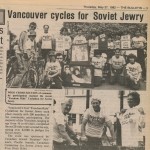
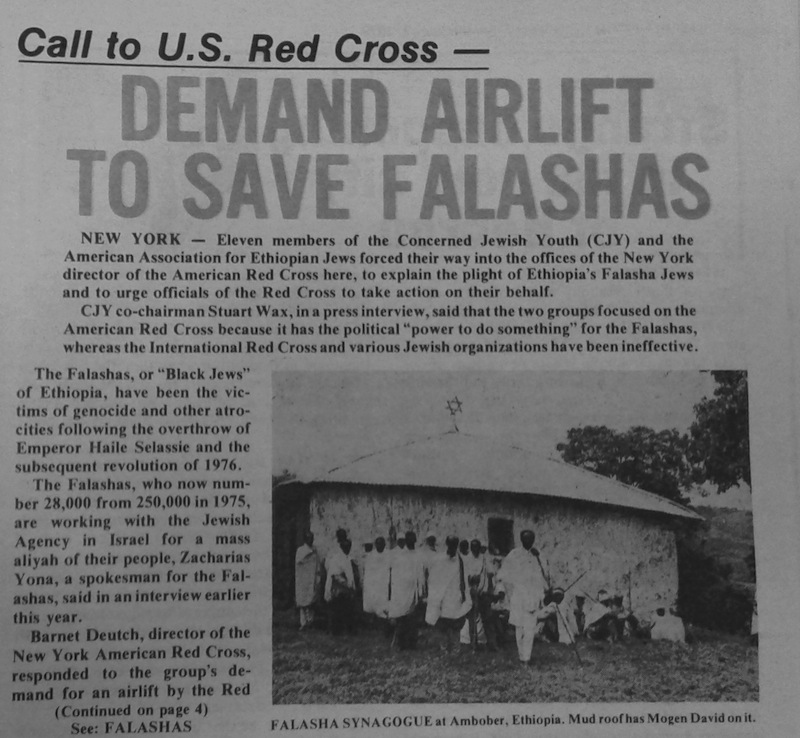
Growing up, the writer was involved in community campaigns to help free Soviet and other Jews suffering state-sponsored, organized persecution. These campaigns were international and Vancouver youth also participated in them. Here are but two of the many items in the JWB about these causes: top one is from 1982; below, from 1976.

I was recently reminded of a fashion-activist item many Jewish teens of my generation wore: the stainless-steel Soviet Jewry bracelet. Etched with the name and date of arrest of a single Jewish dissident in the Soviet Union, each bracelet transmitted to the wearer a deep and penetrating sense of social justice and tribal consciousness. I wore mine proudly, and recall being equally pleased to be selected from my seventh grade class to present handmade cards of encouragement to Avital Sharansky, the wife of jailed activist Anatoly Sharansky (later Israeli politician Natan Sharansky), when she visited Vancouver in the mid-1980s on her global campaign to secure his release.

Growing up, the writer was involved in community campaigns to help free Soviet and other Jews suffering state-sponsored, organized persecution. These campaigns were international and Vancouver youth also participated in them. Here are but two of the many items in the JWB about these causes: this is from 1976.

With the last of the Jewish communities having been freed from state-sponsored, organized persecution (other campaigns as my generation was growing up included the freeing of Ethiopian and Syrian Jews), there is little in the way of that Soviet Jewry bracelet campaign to bind today’s Jewish teens together in such a single, uncontroversial way. The modern state of Israel represents an ongoing cause, of course, but that issue is much more fraught: should a Jewish teen wear a bracelet etched with the name of a fallen Jewish soldier, or the name of one of the 182 Palestinian children currently (as of February 2015) being held in Israel detention – according to data provided by Defence for Children International? When it comes to social justice and activist solidarity, the issue of Israel is clearly complex.

I decided to poke around to see what Jewish teens these days are concerned with when it comes to issues and activism. What I found was a dizzying array of causes. From the website of the Orthodox NCSY (National Conference of Synagogue Youth), I found reports of teens volunteering with Habitat for Humanity and with Oklahoma tornado victims. Both USY (Conservative Judaism’s United Synagogue Youth) and NFTY (the Reform movement’s North American Federation of Temple Youth) select an annual theme to guide their social action and tikkun olam efforts: for 2014, USY chose “a focus on acceptance and tolerance including but not specific to gender, special needs, LGBTQ and racial equality,” according to its website. NFTY chose a similar theme for 2014-15: sexuality and gender equality. Habonim-Dror, which has various active local chapters, or kenim (nests), included a Maryland referendum initiative, for example, to campaign for undocumented high school graduates to become eligible to pay in-state university tuition fees.

Other Jewish educators I polled from the Jewish educators’ network JEDLAB reported that their teens are involved in various issues, including suicide prevention, food banks, poverty, water issues, peace/conflict resolution, mental health awareness and advocacy, women’s rights and empowerment, LGBTQ activism, medical marijuana, vaccines, human trafficking, transgender acceptance, orphans in western Kenya and child soldiers.

A report from the Jewish Teen Funders network attempts to aggregate data from 71 Jewish teen foundations in the United States and Canada during 2013-14, showing where the total of nearly $1 million in philanthropic dollars went. Across 362 grants awarded, the top five issue-areas in descending order were: youth, education, special needs, chronic illness and poverty.

And none of this even begins to capture the array of charitable and social awareness efforts represented in today’s mitzvah projects popular among 12- and 13-year-olds marking their bat and bar mitzvahs, a trend that was absent in my generation, as I recall, anyway. As a complement to that, here in Ottawa, my own shul has been running a monthly b’nai bitzvah class by Cantor Jeremy Burko, which has been including discussion of Jewish-history-informed social justice topics, such as labor conditions in the fashion industry.

What’s the takeaway from this big picture? On one hand, there is no longer a single cause (if there ever was one) that unifies Jewish teens. And that means that tribalism is likely being replaced by a sense of universalism: the sense that social justice must necessarily cross ethnic and religious boundaries. On the other hand, today’s Jewish teens are no doubt indeed being united in the very belief that through Jewish social action, they can repair the world in a global, nuanced and holistic sense. So, while I admit to feeling some nostalgia for the simplicity of the worldview embodied in the Soviet Jewry bracelet I wore with pride and even some excitement, I think we should feel buoyed by the youthful energy and optimism in our midst that the world is ours – and theirs – for the repairing.

Mira Sucharov is an associate professor of political science at Carleton University. She blogs at Haaretz and the Jewish Daily Forward. This article was originally published in the Ottawa Jewish Bulletin.

Format ImagePosted on May 15, 2015May 14, 2015Author Mira SucharovCategories Op-EdTags Soviet Jewry, tikkun olam, youth

A long wait for redemption


We were fortunate to be guests at two warm and spirited seders this year. As designated song-leader, I tried to ensure that the singing was fulsome and sufficiently rowdy to rescue late-night flagging energy levels. One heartfelt moment was singing Ani Ma’amin. Based on Maimonides’ 13 Principles of Faith, the song declares, “I believe, with complete faith, in the coming of the Messiah.” It’s a song familiar to attendees of Jewish summer camp and Holocaust remembrance ceremonies. It’s beautiful and haunting and, with its concise lyrics, contagious for group sing-alongs.

There was an Israeli-Canadian couple at the seder and so, after singing about the Messiah’s hoped-for arrival, I grabbed the opportunity to insert another song from my favorite genre: Israeli ’70s and ’80s pop music. Shalom Hanoch’s 1985 hit, “Waiting for the Messiah,” launched onto the Israeli music scene an iconoclastic cry of frustration: “The Messiah isn’t coming – and neither is he phoning.” The few at the seder who knew it sang and air-banded for a bit before turning solemn as we wound down the seder with Hatikvah.

In Ani Ma’amin there is the belief that the world will one day improve, if only we are patient. Hanoch’s song, by contrast, is an attempt at hard-edged realism.

In 1985, Israel was gripped by hyperinflation. “The stock market crashed,” he sang. “People jumped from the roof; the Messiah also jumped, and they announced that he was killed….” Serious political ills were also ramping up, with the Lebanon War fresh in the memory of an increasingly restless nation. And, with the intifada breaking out two years later, more would follow.

Even in the absence of belief, messianiam is an ever-present notion in Jewish culture. In the 17th century, there was Shabbetai Tzvi, known as the false Messiah; later, there was the rejection of modern Zionism among the ultra-Orthodox who believed – and still do – that the experiment in Jewish sovereignty should wait for the Messiah’s arrival. Then there is the belief of some within the Chabad movement that the Rebbe, Rabbi Menachem Mendel Schneerson may himself have been the Messiah. For my part, given that I speak only Hebrew to my kids, I’m stuck with phrases that I normally wouldn’t use in English – and which don’t always reflect my worldview – phrases like “what are you waiting for – the Messiah to come?” when my then toddlers would rest in a snowbank between their JCC preschool and the parking lot.

But what really struck me that night at the seder as we sang Hanoch’s lyrics was a two-fold question. First, which stance better fulfils the Judaic imperative of tikkun olam: the traditional belief in messianic redemption, or the belief that it is all up to us? And second, how can we agree on what of the many problems in the world are deserving of fixing in the first place?

Clearly, the world is in disrepair. Just within the last few weeks, for example, two infants died in unregulated South Tel Aviv day cares serving African refugees; Islamic militants of the al-Shabab Somali group slaughtered 148 Christian students at a university in Garissa, Kenya; bloodshed continues in Syria and Yemen; antisemitic attacks are on the rise, especially in France; and, in Canada, according to Make Poverty History, one in 10 children here lives below the poverty line.

Certainly, none of us in our lifetime will solve all the world’s ills, and with humanity’s imperfections, including our own mental and emotional flaws, our lust for power and the natural drive for accumulation amid scarcity, it’s hard to believe that widespread suffering will ever be overcome. Some believe that messianic yearnings lead to passivity; others that it spurs us to action.

But perhaps the biggest conundrum is how to agree on which of the world’s ills we should actually care about. For some, the criterion is whether the problem is local; for others it is the perception of how the solution will implicate their own well-being; for others it hinges on whether they think the problem is actually the fault of the sufferer. Whether or not one believes in the possibility of messianic redemption, or whether one believes that it is up to us mortals to repair the world, we would do well to start with something that is hard to contest: the importance of compassion for suffering wherever it is found.

Mira Sucharov is an associate professor of political science at Carleton University. She blogs at Haaretz and the Jewish Daily Forward. This article was originally published in the Ottawa Jewish Bulletin.

Posted on May 1, 2015April 29, 2015Author Mira SucharovCategories Op-EdTags Ani Ma'amin, Messiah, Passover, Shalom Hanoch, tikkun olam

Nostalgia’s place in progress

There were no doubt many emotions surrounding the Israel Prize this year: disdain over Prime Minister Binyamin Netanyahu intervening to disqualify some judges apparently on ideological grounds, pride for the winners and disappointment among those forgotten. Even Chaim Topol, this year’s Israel Prize winner for lifetime achievement, said he had mixed feelings about his victory since other deserving candidates have been shut out in recent years. And for those who think about Topol in what is his most popular role, that of Tevye in the 1971 film (and some of the stage productions of) Fiddler on the Roof, there is likely one other emotion: nostalgia.

Nostalgia often gets a bad rap when it is talked about in the context of social maturity. But as I’ve argued elsewhere, the collective experience of nostalgia can also be a source of psychological sustenance for mourning an apparently simpler past in order to embrace a more complex present. In 20th-century Jewish popular culture, nowhere has this been more apparent than in the case of Fiddler on the Roof.

This was a time of emerging feminism and rising divorce rates. Races, religions and ethnicities were mixing as never before. The nature of Jewish religious practice was becoming viewed as a personal choice – something that Steven M. Cohen and Arnold M. Eisen have described as the emergence of a “Jewish sovereign self.” On this backdrop, Fiddler’s audiences were given a “safe space” – in today’s parlance – to mourn patriarchy, cultural homogenization, and collective adherence to folkways and cultural conventions.

Consider the dream sequence. In presenting his concocted reverie as a divine omen in order to convince Golde that Tzeitel should marry Motel, Tevye pulls a trick out of the bag of shtetl superstition. And the conceit works. Though we know it’s a ruse, we become caught up in the ghoulish spin of the costumes, choreography and music. For a few minutes, we bid farewell to outmoded beliefs and traditions without feeling that we are abandoning our past commitments outright.

Or the ironic and comical number “Matchmaker, Matchmaker,” where the comfort of convention is as thrilling for the daughters initially in the show, as is their fierce independence by the end.

Or Tevye conceding in the prologue that he doesn’t know the origin of some of the community’s customs. As Judaism becomes increasingly infused with contemporary values – the ecological dimension of powering down on Shabbat; the blending of new food politics with kashrut and the search for personal spirituality – Tevye’s proverbial wink directed at the audience allows us to keep one foot in the present of personal autonomy and choice, while the other dips into the comfortable past where automatic adherence to Jewish tradition formed the bonds of community.

American Jewish writer Cynthia Ozick complained that Fiddler portrayed Sholem Aleichem’s stories as “naive,” with “the occasion of a nostalgia for a sweeter time, pogroms notwithstanding.” Fiddler’s Broadway director and choreographer Jerome Robbins was concerned about the play appearing overly nostalgic, writing to his costume designer that he didn’t want audiences viewing the characters “through the misty nostalgia of a time past….”

For allowing Americans to come to terms with a changing America, however, and for American Jews to reflect on the rapid changes within their own communities, the nostalgia in Fiddler has been important. As Stephen J. Whitfield has written in his history of the show, Fiddler “had the advantage of distance: play-goers were far enough removed to memorialize without honoring any particular claims it might make, and without submitting to any moral mandates it might demand.”

Thinking about the role of Fiddler in today’s Jewish landscape, I think about the constant tensions between history and tradition on one hand, and modernity and contemporary values on the other. This has been especially important in how Jewish communities negotiate difference.

From the ashes of the Holocaust, the Zionist struggle for sovereignty and postwar North American Jews fighting against prejudice and discrimination, Jewish concerns now include many additional tensions. There’s intermarriage – how to broaden the tent enough to include intermarried families who may wish to be part of the Jewish people, but not so much that the meaning of being Jewish is lost; increased women’s ritual participation in North American synagogues and in public space in Israel; and LGBTQ Jews looking to take their place in Jewish communities. For their part, Israelis struggle – not hard enough, perhaps – to honor their state’s Jewish identity while extending full equality to the Palestinian minority and contending with the ongoing occupation, all while confronting the difficult plight of African refugees and asylum-seekers.

With Passover just behind us – and, for many, its nostalgia-drenched experience of gathering around the seder table – we might pause to consider how to navigate the uncertain waters of change while being anchored by tradition. And yes, a little nostalgia now and then might just help.

Mira Sucharov is an associate professor of political science at Carleton University. She blogs at Haaretz and the Jewish Daily Forward. A version of this article was originally published on haartez.com.


Posted on April 24, 2015April 23, 2015Author Mira SucharovCategories Op-EdTags change, Fiddler on the Roof, tradition

Conversation with Dr. Ruth

It was election week in Israel when I had the chance to speak with Ruth Westheimer. Though the noted sex therapist and celebrity Manhattanite served in the Haganah pre-state militia and is planning a trip to Israel in May, she didn’t want to talk politics. “It’s OK,” I told her on the phone, “just know that, as a political scientist, I don’t typically write about sex.”

She giggled in her contagious way, through her thick German accent – which, she told me, she’s lucky to have, since radio listeners always knew when Dr. Ruth was speaking.

Westheimer doesn’t like to talk politics, but in many parts of the world – and even in corners of North America – her topic of choice is a highly politicized issue. While completing her PhD in education and before training as a sex therapist, she worked at Planned Parenthood, an organization positioned on the front lines in the reproductive-choice wars in America.

Indeed, she had just returned from addressing a Planned Parenthood convention in Las Vegas when we spoke a few weeks ago. She said she was adamant that kids need to talk more about menstruation – especially since the onset of puberty is coming earlier for some – and nocturnal emissions. (Side note for the parents out there: My own personal introduction to the topics of periods and wet dreams was through Judy Blume’s excellent books.)

Talking is, of course, key to Westheimer’s trade – and she sees talking about sex as essential to overall sexual literacy. We’ve made great strides, she told me. In the United States and Israel, for example, there are now fewer women who are left unsatisfied due to not being able or willing to communicate their sexual needs to their partner. And, for men, premature ejaculation is also on the decline. Did she want to share advice for readers on that particular problem? It’s in her books, she told me. For those who are interested, I poked around (no pun intended) and found this entry on Dr. Ruth’s online encyclopedia of sex. Hint: It has to do with getting intimate with one’s “moment of inevitability.”

She had some strong words for the founder of psychoanalysis, Sigmund Freud, a favorite punching bag for postmodern intellectuals. “Freud said that any woman who doesn’t have an orgasm during intercourse is an immature woman,” said Westheimer. “He did not know that the clitoris needs to be stimulated in order to have an orgasm.” Instead, she added, “Freud should have taken a class with me.”

As she prepared to give a talk at the Israel Bar Association convention in Eilat, she said she was keeping in mind a talmudic adage: “A lesson taught with humor is a lesson retained.” She was pleased that after the seriousness of discussing legal matters, the conference delegates will be able to have some fun. But she “probably will not tell them to have good sex that night,” because “I don’t think they are there with their partners. I am old-fashioned and a square, and I’ve remained that way.”

Her squareness extends to trends like casual sex, which, she argues is not in people’s best interest, pointing to the increased risk of contracting HIV and other sexually transmitted diseases: “It’s dangerous.”

Yet, there is one area in which critics might call her politically incorrect: the hot-button issue of seeking overt consent before engaging in sexual activity.

“I do not believe that when partners are naked they can say at any time ‘I changed my mind,’” Westheimer planned to tell the lawyers at the convention. “In the Talmud, they say, when that part of the male anatomy is aroused, the brain flies out of the head.” In other words, she added: “It’s nonsense to suddenly, at the height of sexual arousal, say ‘I changed my mind.’ It will lead to many more problems. The idea of consent is nonsense – except consent before they are naked in bed.”

I didn’t press her on this point, except to ensure I’d heard correctly. But I did pause to mull over the current wave of youthful activism on this topic in my own province of Ontario, where a couple of teen spokespeople have been pushing the premier – with an apparently positive response so far – to add issues of consent to the new sex-ed curriculum.

Approaching 87, Dr. Ruth wants the world to know that she “feels great.” She has three new books coming out and she continues to teach courses at Columbia University, following a stint at Princeton.

What is her proudest accomplishment?

I ask. Her four grandchildren, she tells me. “Hitler lost, and I won.”

Mira Sucharov is an associate professor of political science at Carleton University. She blogs at Haaretz and the Jewish Daily Forward. A version of this article was originally published on haartez.com.

Posted on April 3, 2015April 1, 2015Author Mira SucharovCategories WorldTags Dr. Ruth, Ruth Westheimer, sex

Posts pagination

Previous page Page 1 … Page 3 Page 4 Page 5 Page 6 Next page
Proudly powered by WordPress