Skip to content
  • Home
  • Subscribe / donate
  • Events calendar
  • News
    • Local
    • National
    • Israel
    • World
    • עניין בחדשות
      A roundup of news in Canada and further afield, in Hebrew.
  • Opinion
    • From the JI
    • Op-Ed
  • Arts & Culture
    • Performing Arts
    • Music
    • Books
    • Visual Arts
    • TV & Film
  • Life
    • Celebrating the Holidays
    • Travel
    • The Daily Snooze
      Cartoons by Jacob Samuel
    • Mystery Photo
      Help the JI and JMABC fill in the gaps in our archives.
  • Community Links
    • Organizations, Etc.
    • Other News Sources & Blogs
    • Business Directory
  • FAQ
  • JI Chai Celebration
  • JI@88! video

Recent Posts

  • Zionism wins big in Vegas
  • Different but connected
  • Survival not passive
  • Musical celebration of Israel
  • Shoppe celebrates 25 years
  • Human “book” event
  • Reclaiming Jewish stories
  • Bema presents Perseverance
  • CSS honours Bellas z”l
  • Sheba Promise here May 7
  • Reflections from Be’eri
  • New law a desecration
  • Resilient joy in tough times
  • Rescue dog brings joy
  • Art chosen for new museum
  • Reminder of hope, resilience
  • The national food of Israel?
  • Story of Israel’s north
  • Sheltering in train stations
  • Teach critical thinking
  • Learning to bridge divides
  • Supporting Iranian community
  • Art dismantles systems
  • Beth Tikvah celebrates 50th
  • What is Jewish music?
  • Celebrate joy of music
  • Women share experiences 
  • Raising funds for Survivors
  • Call for digital literacy
  • The hidden hand of hate
  • Tarot as spiritual ritual
  • Students create fancy meal
  • Encouraging young voices
  • Rose’s Angels delivers
  • Living life to its fullest
  • Drawing on his roots

Archives

Follow @JewishIndie
image - The CJN - Visit Us Banner - 300x600 - 101625

Author: Pat Johnson

Survivors’ immense impact

Survivors’ immense impact

Holocaust survivors who came to Canada after the Second World War remade this country’s Jewish community.

Before survivors arrived in numbers, beginning in 1947, Canada’s Jewish community had a few poorly resourced social service agencies. The demands created by thousands of new arrivals – many with significant emotional and physical challenges – spurred the growth of Jewish communal organizations across the country. In turn, those survivors have had an impact on the community in the successive seven decades that is incalculable. The impact of the Holocaust – and the arrival of its survivors – is perhaps the defining factor in the development of Canada’s Jewish community.
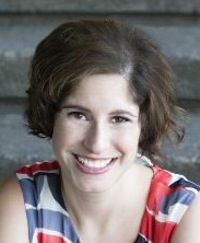
photo - Adara Goldberg
Adara Goldberg (photo from Cherie Smith JCC Jewish Book Festival)

“The Holocaust is a watershed moment and the scale of this watershed resettlement was unprecedented,” said Adara Goldberg, a Vancouverite and author of Holocaust Survivors in Canada: Exclusion, Inclusion, Transformation, 1947–1955. “Many of the agencies across Canada only came to be as a result of the Holocaust. Jewish Immigrant Aid Services [JIAS] did exist, but this was a small organization that only dealt with small numbers up to this point. Having some 35,000 people come in, in less than a 10-year span, really trampled the organizations.”

Survivors who moved to the United States joined a vibrant Jewish community already in progress, while those who came to Canada found a Jewish community with little infrastructure. What exists of the Jewish community and its social service agencies today was built, in large part, for the survivors and, subsequently, by them.

To an extent, there was an unwillingness among Canada’s existing Jewish community to address the Holocaust experiences of the newcomers – those who did not experience the Holocaust may have been afraid of opening wounds or been unwilling to hear the horrors others experienced. There was also a history in Canada of immigrants getting off the boats and throwing themselves instantly into building a new life, leaving the past behind.

Still, Goldberg said, there was a recognition by people like the head of JIAS that these immigrants had some very particular needs.

“The problem was availability,” she said. “This is uncharted territory. Social workers themselves and the Canadian Jewish community were only learning with the survivors about how to treat victims of trauma … the idea of post-traumatic stress didn’t really exist.”

Getting the newcomers integrated was not only a matter of meeting social needs, she added.

“There is also a legal element to that,” Goldberg said. “The fact is, refugees who came to Canada under the auspices of either the Canadian Jewish Congress, or who received support from JIAS or who had relatives sponsor them, were liabilities. If they didn’t find work, if they didn’t have a home, if they became dependent, they risked deportation. They risked becoming a drain on the existing Jewish community, which was already really reaching its max in terms of what they could do.”

A symbol of success is that very few fell through the cracks, although many of the case studies in the book indicate that some survivors were miserable in their assigned living conditions or workplaces.

There was a realization after the war, as the magnitude of what would come to be called the Holocaust dawned, that Canada had failed the imperiled Jews of Europe in the 1930s, when there was still time.

“After the war, relationships changed and there was significant international pressure on Canada to help do its part in relieving the postwar refugee crisis of Jewish and also non-Jewish displaced persons,” Goldberg said. “On the one hand, we can say this was a humanitarian gesture.… There’s also a practical element that we can’t overlook in that Canada stood to gain something from allowing in the Holocaust survivor refugees. There was a need for skilled laborers and this is how most survivors did come in, they came in for skilled labor posts, so Canada benefited.”

The equation of immigration and Canada’s need for labor is underscored by the fact that there was no ministry of immigration at the time – until 1950, Canada’s immigration policy was administered by the ministry of mines and resources. The influx of Jewish and non-Jewish refugees postwar familiarized the Canadian government and public to the concept of receiving refugees on humanitarian grounds. The first major instance of this reconsideration came in 1956 after the Soviet Union crushed the democratic uprising in Hungary. Canada admitted 37,000 refugees in the course of a year.
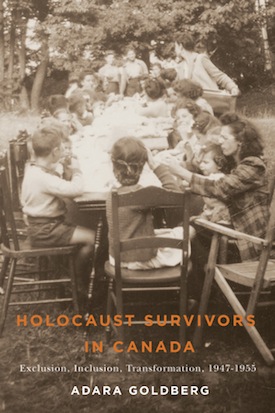
book cover - Holocaust Survivors in Canada: Exclusion, Inclusion, Transformation, 1947–1955Goldberg’s book begins with a refresher on Canada’s abominable record in the prewar period. Chapters then take on topics such as the unique requirements of young orphaned refugees; the double-edged sword of interned “enemy aliens” – Jews from enemy states, mostly Germany and Austria, whose nationality, in the eyes of Britain and its Canadian dominion, trumped their status as endangered victims of Nazism; the various programs under which refugees were admitted to Canada and how established Jewish communities, especially their women’s organizations, cared for refugees’ personal needs; the creation of social clubs and synagogues by and for survivors; the development of an ultra-Orthodox and Chassidic community here; and “transmigrants,” those who came to Canada after a sojourn elsewhere, often in Israel. She has included the stories of survivors who didn’t want to be found; those whose experiences in Europe led them to hide their Jewishness and their past as they began a new life in Canada. It is a monumental work.

A Toronto native, Goldberg wrote the book in fulfilment of her PhD at Clark University in Massachusetts and, while there are differences between the dissertation and the book, which was published in September by University of Manitoba Press, the book avoids the academic jargon that can exclude ordinary readers.

“As a social history that was created with the research that I did both in archives as well as through interviews and other sources, it was written with a wide readership in mind,” she said.

Goldberg eschews statistics in favor of personal case studies both from in-person interviews and records of social service agencies from decades past. The result is an introduction to hundreds of individuals and their stories, as well as a testament to the resilience of the survivors and the history of a small Jewish community rising – not always flawlessly – to the challenge of welcoming tens of thousands of co-religionists who had suffered unspeakable horrors.

The dissertation took about three years to complete and, after Goldberg moved to Vancouver, where she worked for three years as education director at the Vancouver Holocaust Education Centre, she took the opportunity to do additional research that incorporates more local content. The book is enriched by her background as a trained social worker, which underpins a deep analysis of the successes and failures of social service agencies in those early years.

Refugees are the top global news story today and Goldberg sees lessons for the present in her book.

“It’s a very different crisis,” she said. “I think what we can do is, without trying to compare individual experiences, to remember the risk of nativist attitudes and what happened when Canada had very discriminatory, restrictive immigration policies 75 years ago. Canada accepted the fewest number of Jewish refugees of any country in the Western world … Canada had an opportunity at that time to distinguish itself, to take a very restrictive policy and widen the gates. They could have done this and they elected not to. What we can do now is reflect on the result of this inaction. History does not need to repeat itself. Canada can distinguish itself as a world humanitarian leader.

“Similarly,” she continued, “Holocaust survivors have contributed to all aspects of Canadian society. I imagine that so, too, do other refugees to Canada and so will other waves that come in the future. There is so much that we can gain.”

The Vancouver launch of Adara Goldberg’s book takes place on Nov. 25, 5:30 p.m., at the Vancouver Holocaust Education Centre, as part of the Cherie Smith JCC Jewish Book Festival. Admission is free.

 

Format ImagePosted on November 13, 2015November 11, 2015Author Pat JohnsonCategories BooksTags Cherie Smith JCC Jewish Book Festival, community, Holocaust, immigration, survivors, Syria
Life-changing lecture

Life-changing lecture

Avrum Nadigel (photo from Avrum Nadigel)

Not only is there no quick fix to making a relationship work, but there’s no quick fix for absorbing the main points of Avrum Nadigel’s Learning to Commit: The Best Time to Work on Your Marriage is When You’re Single. Its lessons can’t be summed up in a few bullet points – you’re going to have to read it.

That being said, Nadigel will have to make the audience at the Cherie Smith JCC Jewish Book Festival “fall in love with” his book in less than 180 seconds. He’s part of the event A Literary Quickie, which takes place on Nov. 22, 10 a.m., at the Jewish Community Centre of Greater Vancouver. The brunch event lineup includes authors Richa Dwor, A.D. Gentle, Rosa Harris, Revital Shiri-Horowitz, Paula Hurwitz, June Hutton, Evelyn H. Lazare, Olga Medvedeva-Nathoo and Marina Sonkina. Admission is by donation.

Nadigel has been a therapist for more than 15 years. He received his master’s of social work from McGill University in Montreal in 1997, and did post-graduate training with the Western Pennsylvania Family Centre, which teaches Bowen family systems theory. He also received supervision via Skype from author and family therapist Dr. David Freeman (who died in 2010). In Learning to Commit, Nadigel doesn’t just offer theories, but advice gained from personal and professional experience. Advice that changed his life, and he’s hoping it’ll help others.

Though Nadigel only lived in Vancouver for about six years, from 1999 to 2005, it was here that he first encountered Freeman, who was speaking at a singles event at the J. His words had a profound impact on Nadigel.

“For all I thought I knew about relationships (I was a practising therapist at that time), Freeman debunked many of my own assumptions, for example, that poor communication is the cause of relationship problems,” writes Nadigel. “He introduced novel ideas about romantic love, providing subtle warnings that the very things that cause a young lover’s heart to flutter can, down the road, be the catalyst of dissatisfaction and divorce. He encouraged us to focus on our own interests, because the more interesting we are to ourselves, the more we have to bring to the table in our relationships.”

Nadigel had come out west, lured by the Rocky Mountains. “From that moment on,” he said, “I knew I had to live near mountains, but also in close proximity to a Jewish community. Vancouver was an easy choice.”

He told the Independent, “It was a total ‘head west young man’ move. I was 30 years old. I sold everything I owned, loaded all of my guitars, some clothes and CDs (remember those?) and headed west. No job, no family, no relationship and only one friend in B.C.

“For money, I worked as a child protection worker, and then as an addiction therapist and family therapist…. Most importantly, I took courses at Emily Carr, composed music for films and learned how to mountain bike.”

He also came here to meet a local Jewish woman but, he said, “true to [his] commitment-phobic self,” he “couldn’t find anyone in Vancouver (or Victoria, Seattle or Calgary) to settle down with.” Eventually, on frumster.com, he met the woman who would become his wife, Dr. Aliza Israel – from Richmond. At the time, she was living and studying in Toronto. “Anyway, we dated long-distance (perfect for a commitment-phobe), and then I agreed to move wherever her residency would be. She was accepted into the Toronto psychiatry program, and the rest is history.”

The two were married in June 2007 at the J here because that’s where Nadigel first heard Freeman, which led to his rethinking about marriage and other things. “The JCC in Vancouver holds a very special place in my heart,” he said.

And so still does Freeman, one of the people to whom Learning to Commit is dedicated, “for providing me with a lighthouse; a way to navigate the rocky seas of my relationships.”

At least one of the ideas in the book seems counterintuitive – the admonition to not compromise.

“Too many relationship books/ speakers assume that compromise is the key to a successful relationship, and so our culture embraces this opinion – and that’s all it really is. And good people use this to avoid growing … discomfort, fear, etc.,” explained Nadigel. “Compromise is no virtue if it’s the first thing you reach for to avoid difficult discussions or situations. Now, more mature people are able to compromise without feeling like they’re betraying their values/principles, because they’re clear on what they stand for, and what they won’t put up with. They won’t compromise on big-ticket items, and will be willing to face the sting/consequence of staying true to their principles.”

book cover - Learning to CommitIn Learning to Commit, Nadigel writes, “According to Dr. Murray Bowen, togetherness and individuality are two opposing forces that we are all born with. We spend the rest of our lives trying to reconcile their often-contradictory impulses.” A well-differentiated person – someone who is confident of their values and principles, and doesn’t change their opinion or action “just to defuse tension” is able to balance those opposing forces.

“Differentiation is not selfishness,” stressed Nadigel. “It is not about a focus on my needs, damn everyone else. It’s about living a life guided by well-thought-out principles, some of which will address who I want to be/act/think with my partner, children, parents, colleagues, friends, etc. It’s about balancing feelings with good, clear thinking. Actually, one could say that immature, high-feeling-centric people are so fragile that the mere thought of considering another person’s point of view is crushing, whereas higher differentiated people can choose to be guided by their partner’s best interest. But the key here is choice!”

The lessons in Nadigel’s book are relevant for all relationships – in fact, he writes, “one of the main tenets of family systems theory [is]: ‘You will only succeed in future relationships in ways you have already succeeded with your parents, siblings and/or extended families.” They are also useful in dealing with controversy or difficult issues, in developing the ability to hear what you need to hear, even though you may not want to hear it.

To remain open, he explained, “you need two things – curiosity and (if possible) playfulness. These things are very hard to come by in high-tense situations, i.e. acrimonious marriage, Middle East discussions, anything involving high emotions mixed with perceived/real threats. Which is why I believe, as a blogger recently noted while discussing my book: ‘Doing some self-examination and exploration … while we are single might be the best marital therapy we’ll ever have.’ Curiosity and playfulness is much more likely when we’re single, or dating, than when mired in the marital muck of resentment, etc…. I think the best that one can do – in any area – is to share your thoughts as clearly as possible, and without any expectation that people are going to support your thinking or applaud your efforts. When you think about the qualities of great leaders/leadership, these attributes apply.”

For the full book festival schedule, visit jewishbookfestival.ca.

Format ImagePosted on November 13, 2015November 13, 2015Author Cynthia RamsayCategories BooksTags Avrum Nadigel, Bowen family systems, Cherie Smith JCC Jewish Book Festival, marriage, self-help
Chabad expands in Victoria

Chabad expands in Victoria

Chabad of Vancouver Island Rabbi Meir and Rebbetzin Chani Kaplan at the Aug. 23 groundbreaking. (photo from lubavitch.com)

Announced in April 2014, Chabad’s plans to build a centre in Victoria proved a relevant and exciting development for locals. The day after he shared his vision with the community, Chabad of Vancouver Island’s Rabbi Meir Kaplan got a call from a local woman. “I was up all night thinking about how much the building will change Jewish life on the Island for my daughter, compared to the way it was when I was growing up,” she told the rabbi.

Two hundred and fifty guests turned out to celebrate the groundbreaking of the centre on Sunday, Aug. 23, and all that represents for the Jewish community led by Kaplan and his wife Chani. Then-prime minister of Canada, Stephen Harper, sent greetings: “The new larger Chabad, with its expanded facilities for worship, study and family activities, will help meet the needs of your growing community for many years to come. I commend everyone responsible for making this day possible.”

His words were echoed by many who joined, among them Mayor Lisa Helps, members of Parliament and the Legislature.

“The vision was ours, but so many helped us bring it to fruition,” said Kaplan, grateful for the steady support of local community members. Ahead of the groundbreaking, various individuals offered to participate in the fundraising campaign and share their enthusiasm with others.

George Gelb escaped Hungary with his family in 1956, and was welcomed into Canada. In retrospect, he was impressed that his parents sought out a synagogue in Toronto after surviving Auschwitz. When they later moved to Vancouver Island, they discovered the Kaplans and found a family in Chabad. “This is the second synagogue in 150 years on Vancouver Island,” he said, referring to Congregation Emanu-El, which was built in 1863. “It’s a very historic event that I feel really quite privileged to participate in. It’s sort of like carrying on a family legacy.”

photo - An artist's rendering of the new Centre for Jewish Life and Learning. The building’s east wall, facing a main street, will feature a permanently illuminated menorah
An artist’s rendering of the new Centre for Jewish Life and Learning. The building’s east wall, facing a main street, will feature a permanently illuminated menorah. (photo from lubavitch.com)

The projected $3.5 million project is slated for completion in time for the 2016 High Holidays. The building plot at 2995 Glasgow St. is located on a quiet street, close to a popular area park. It will be a home to a library, an industrial-sized kosher kitchen, new offices, synagogue, community hall and a mikvah, giving Chabad the ability to expand all of its current projects and begin new ones, according to the community’s needs. It will also include a facility for the Jewish preschool and Hebrew school, currently housed in the annex of a local school building.

“History is in the making as we gather in this place at this moment. You are now an integral part of this auspicious and historic occasion,” said community member Lindy Shortt at the groundbreaking event. “The Centre for Jewish Life and Learning, Chabad of Vancouver Island and the Kaplan family will be right here for you and your children and your children’s children, G-d willing, for generations to come.”

The building’s east wall, facing a main street, will feature a permanently illuminated menorah. Dedicated by the sponsors to victims of the Holocaust, it promises to radiate Jewish pride and raise the profile of Jewish life on the Island, proving yet again, as the Lubavitcher Rebbe, Rabbi Menachem Mendel Schneerson, insisted, that living as a Jew is possible and relevant everywhere. Even on an island.

The original version of this article was published on lubavitch.com. The version here has been edited to reflect the time that has passed since the orginal’s publication on Aug. 26, as well as a local readership.

Format ImagePosted on November 13, 2015November 11, 2015Author Etti KrinskyCategories LocalTags Chabad, Chani Kaplan, Meir Kaplan, Vancouver Island
More than Slim Peace

More than Slim Peace

Filmmaker Yael Luttwak spoke at Choices Nov. 1. (photo from jewishvancouver.com)

A film that brings Palestinian and Israeli women together in a weight-loss group. Who would have thought that was possible? American-Israeli Yael Luttwak did, and she made it happen. Luttwak, the keynote speaker at Choices, Jewish Federation of Greater Vancouver’s annual women in philanthropy event, held on Nov. 1 at Congregation Beth Israel, captivated the audience with her story.

“The idea came to me at a time when

I was attending Weight Watchers in Tel Aviv,” said Luttwak. “The peace process had broken down and Ariel Sharon had been hospitalized and I had this image of Sharon and [Yasser] Arafat jogging together on the beach and working it all out. It struck me, as I listened to women in my group who were uninhibited in sharing their struggles with health and weight and body image, that there was so much humanity in that room. What if we could capture this humanity and bring together women who otherwise would never have an opportunity to meet?”

She set out to find women who would be willing to participate in this social experiment. She approached Orthodox women, West Bank Muslims, American-born settlers and Bedouins. Fourteen women agreed to get involved. The Jerusalem Cinémathèque in East Jerusalem became the meeting place. Filming took six weeks.

The women metamorphosed during the process, as they started to come to the meetings in nicer clothes and make-up, and they began to share their thoughts (and recipes). “This was the first opportunity for Arab women to meet Jewish women that were not soldiers, and for Israeli women to meet Arabs that did not want to kill them. At the beginning, everyone was nervous, but very polite (unusual for the Middle East) but, within a few hours, they were all talking and sharing stories.”

The women found common ground on many issues that emphasized their similarities. Even when there was political turbulence, violence on the streets of Jerusalem and curfews, the Arab women would cross the checkpoints to attend the meetings. When Luttwak asked what it was about the group that kept them coming, they answered that it was their only opportunity for hope. And so, the 2007 documentary A Slim Peace came to be. It premièred at the Tribeca Film Festival in New York and screened in the United States on Sundance Channel.

While promoting the film, Luttwak was approached by English philanthropist Dame Hilary Blume, who offered to seed fund more women’s groups. She told Luttwak, “Don’t waste your talent on films. You have hit on something. You are building bridges. This is your destiny.” As a result, the nonprofit Slim Peace developed and, over the past eight years, it has opened 33 groups in six cities and two countries. Luttwak said, “It’s a train I cannot stop.” She has also been able to keep making films about contemporary issues. Her final messages – we all have to do our part for tikkun olam (repair of the world) and to never give up hope.

Prior to Luttwak’s talk, Ricki Thal addressed the audience: “My name is Esther Zuckerman Kaufman and I was born in Warsaw, Poland, on Oct. 11, 1920. I was one of the Jews on Schindler’s List.” Everyone’s attention caught, Thal then told the story of her grandmother and grandfather, Leon, both saved by Oskar Schindler. They never spoke about their wartime experiences and the family had no idea that they were Schindler Jews until they all went to see Steven Spielberg’s movie. That moment changed Thal’s life. It led her to explore her family’s history, to participate in March of the Living on two occasions, as a student and as a chaperone, and to become involved in the Jewish community. Kaufman died in 1999 but not before she appeared in New York on The Phil Donahue Show to tell her story to television audiences. Thal finished almost as she began: “My name is Ricki Thal and I was born in Vancouver in 1979 and I am proud to be the granddaughter of Esther and Leon Kaufman.”

CBC television personality Belle Puri emceed the night, co-chair Debbie Jeroff gave opening remarks and Stephen Gaerber brought greetings from Federation. Two video presentations, a raffle and a meal catered by Susy Siegel completed the night, and then 500 Jewish women went out into the rain inspired, full of good food and hope.

To donate to Federation’s annual campaign, visit jewishvancouver.com.

Tova Kornfeld is a Vancouver freelance writer and lawyer.

Format ImagePosted on November 13, 2015November 11, 2015Author Tova KornfeldCategories LocalTags A Slim Peace, campaign, Israeli-Palestinian conflict, Jewish Federation of Greater Vancouver, JFGV, tikkun olam, Yael Luttwak
Stories that empower

Stories that empower

Shanie Levin brought Sholem Aleichem’s stories to life with Al Stein. (photo by Binny Goldman)

Tell me a story, please…. Which one of us has not made this request of a mother, a father, a zayda or bubbie?

On Oct. 30, almost 70 people gathered at the Peretz Centre for Secular Jewish Culture, where they were welcomed by Peretz president Gene Homel, who shared some of the activities that the centre hosts, including the Sholem Aleichem speaker series (SASS, or “SASSY,” as they call it). The Tuesday night event was held by Jewish Seniors Alliance of Greater Vancouver in partnership with SASSY.

Gyda Chud of both JSA and Peretz introduced the first session of this year’s JSA Elders Empowering Elders series, which focused on storytelling.

photo - Myrna Rabinowitz
The audience sat enraptured as they listened to Myrna Rabinowitz. (photo by Binny Goldman)

The audience sat enraptured, traveling back to their kinder yorn, childhood years, as they listened to Myrna Rabinowitz. She sang several Yiddish songs. Among her original compositions was one that she had composed for the birth of her grandson.

From stories told in song, to those spoken, Shanie Levin and Al Stein read stories that came alive with their interpretations of the text and their excellent delivery. Enhanced by the clever use of minimal but appropriate costuming, and done with humor, the characters and the way of life of Shayneh Shayndel and Menachem Mendel became real to those listening, as did the ongoing dilemma that they each faced. As Sholem Aleichem once famously stated, “You can take the Jew out of the shtetl but you cannot take the shtetl out of the Jew.”

In thanking the performers, Chud quoted Stein, who had said in his preface to reading his first story: “In keeping with the Narodnik movement (Power to the People), the young Russian intelligentsia at the time and not the elite, Sholem Rabinovitch chose the name Sholem Aleichem, the common Jewish greeting, as his pen name, ‘Peace be unto you.’” Chud commented on the fact that Power to the People motivated Sholem Rabinovitch to change his name, and that the theme of JSA’s Empowerment series is “Elders Empowering Elders.”

photo - Al Stein, with Shanie Levin, entertained with their lively storytelling
Al Stein, with Shanie Levin, entertained with their lively storytelling. (photo by Binny Goldman)

Ken Levitt, one of JSA’s vice-presidents, rose to the occasion by thanking the performers partly in Yiddish, having researched the phrasing on the internet. He explained that he hadn’t grown up in a Yiddish-speaking household, although Yiddish had been used as a secret language between his parents. His valiant effort endeared Levitt to all the Yiddish-speakers in the audience.

The session ended with eppes zees mit a Yiddish taam, something sweet with a Jewish taste, accompanied by hot drinks. To quote one of the characters in the story that Levin read: “If you have a piece of bread, take your eyes off the cake!”

Volunteers of both JSA and SASSY helped make the event a success, as did JSA staff Karon Shear and Rita Propp.

Es eez given a mechayeh, it was a pleasure and an oisgetzaichent, outstanding and enriching time together.

For more on JSA and future events, visit jsalliance.org.

Binny Goldman is a member of the Jewish Seniors Alliance of Greater Vancouver board.

Format ImagePosted on November 13, 2015November 11, 2015Author Binny GoldmanCategories LocalTags Al Stein, Jewish Seniors Alliance of Greater Vancouver, JSAGV, Myrna Rabinowitz, Peretz Centre, Shanie Levin, Sholem Aleichem, storytelling
Hot off holiday press

Hot off holiday press

In the last couple of months, three new Chanukah-themed picture books have been published. Most recently, out of Mahone Bay, N.S., is Hanukkah Lullaby. Out of New York City are Oskar and the Eight Blessings and The Parakeet Named Dreidel. All three are delightful.

Hanukkah Lullaby, written by Ruth Abrams and illustrated by Tia Mushka, is part of a series of books from Baby Lullaby Publishing. Until this holiday edition, the series – the books of which have various authors and illustrators – has focused only on places: in Canada, Newfoundland and Labrador, Nova Scotia, Prince Edward Island, Saskatchewan, and Alberta; in the United States, Hawaii and Alaska. Each book, intended for a 0-to-6-year-old audience, has a link to its own song and video. The music for Hanukkah Lullaby was composed by Keith Andrews and the video was made by Jonah Peveril, both of whom have contributed to other lullabies in the series.

Hanukkah Lullaby follows one family’s celebration: enjoying the winter snow, making dreidels, lighting the chanukiyah, dreaming of the Maccabees, eating all the fried treats, spending time with Baba and Zayda, singing songs, telling the Chanukah story and having a lantern parade. The last two pages of the 18-page board book offer a very brief overview of the holiday’s symbols and rituals, and a paragraph summarizing the story of the Maccabees. Abrams’ lyric text and Mushka’s bold, colorful artwork make for a lovely read.

***

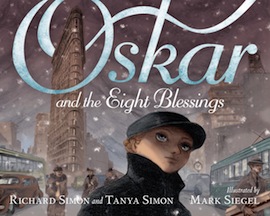
Oskar and the Eight Blessings (Roaring Brook Press), written by husband-wife team Richard Simon and Tanya Simon and illustrated by Mark Siegel, is for somewhat older readers, ages 4-8.

book cover - Oskar and the Eight Blessings It begins, “Oskar’s mother and father believed in the power of blessings. So did Oskar … until the Night of Broken Glass. His parents put him on a ship to America. He had nothing but an address and a photo of a woman he didn’t know – ‘It’s your Aunt Esther.’ – and his father’s last words to him: ‘Oskar, even in bad times, people can be good. You have to look for the blessings.’”

When Oskar arrives in New York, it is the seventh day of Chanukah and he wants to reach his aunt’s – 100 blocks away – before she lights the chanukiyah. Along Broadway Avenue, he encounters a woman feeding some pigeons, a newsstand vendor, Count Basie, boys having a snowball fight, First Lady Eleanor Roosevelt and a Christmas tree seller. He is treated with kindness at every turn, and is able to reciprocate on more than one occasion. Siegel’s rich illustrations beautifully capture the darkness and the hope of Oskar’s journey.

In the author’s note that follows the story, Richard Simon writes about the inspiration for the book and its 1938 setting, including a bit about the real people the fictional Oskar meets along the way.

“Oskar has lost everything,” he writes, “but from his despair he awakens to his freedom: the choice to see the good in his new world. I like to think that this orientation of optimism is the key to our survival, as individuals and as a species. It is how we, as American Jews, have made a place for ourselves beyond the shadow of darkness that tried to destroy us.”

***

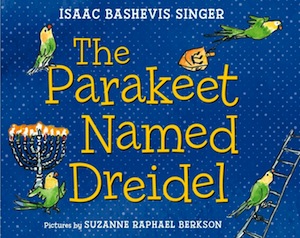
The playful and imaginative watercolor illustrations by Suzanne Raphael Berkson dovetail perfectly with Isaac Bashevis Singer’s story in The Parakeet Named Dreidel (Farrar, Straus and Giroux).

book cover - The Parakeet Named DreidelIntended for kids age 5 to 8, the title character loses his way. As David and his parents celebrate Chanukah, David notices the yellow-green bird outside their window. A cold Brooklyn night, they quickly move aside the chanukiyah (so the bird won’t get burned by its candles), open the window and welcome it in. Initially frightened, the bird settles down, eats some millet, drinks some water, plays a little dreidel – and speaks some Yiddish! “Zeldele, geh schlofen.” (“Zeldele, go to sleep.”)

Despite posting notices around the neighborhood, no one claims the lost bird, who the family names Dreidel. The “photo” montage of Dreidel and David growing up together is wonderful. The bird really does become part of the family.

When, years later, David meets a woman named Zelda at college, it turns out that she is Dreidel’s Zeldele. But lest readers worry that Dreidel leaves David’s parents, the bird becomes part of a larger family when David and Zelda get married, their families come together, and the couple decides to start a family of their own.

All of three of these books are available from chapters.indigo.ca and their respective publishers in hard copy and electronic formats. Hanukkah Lullaby will be available at the Cherie Smith JCC Jewish Book Festival, Nov. 21-26, at the Jewish Community Centre of Greater Vancouver.

Format ImagePosted on November 13, 2015November 11, 2015Author Cynthia RamsayCategories BooksTags Cherie Smith JCC Jewish Book Festival, Hanukkah Lullaby, Isaac Bashevis Singer, Mark Siegel, Oskar and the Eight Blessings, Parakeet Named Dreidel, Richard Simon, Ruth Abrams, Suzanne Raphael Berkson, Tanya Simon, Tia Mushka
Children make film by selves

Children make film by selves

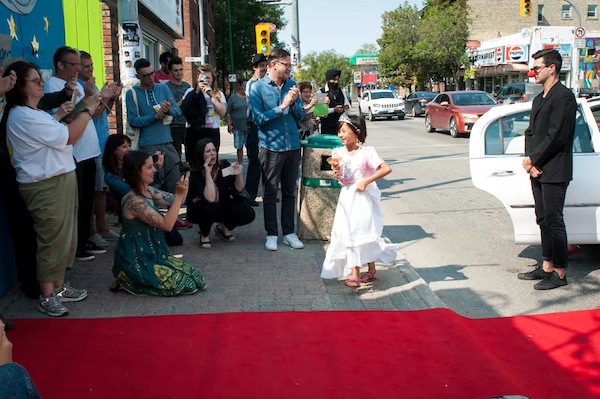
From filming and acting, to walking the red carpet, a group of 5-to-7-year-olds were filmmakers this summer. Their creation? The short Odd Life of Dr. Tooth. (photos from Art City)

It’s not every day that a group of 5-to-7-year-olds creates a movie. But that’s just what happened in Winnipeg this summer at Art City.

Art City was founded in 1998 by local artist Wanda Koop. She saw a need for engaging programming for kids and youth and, being an artist, she thought it would be great if there were a place where they could go to make art for free.

Since its opening, Art City has been providing after-school programs. In the summer, they run all day, from 9 a.m. to 8 p.m.

“Part of our model is that our staff and volunteers are mostly all artists,” said Josh Ruth, Art City managing director. “We also hire guest artists to come in and lead workshops, bringing their own art practice, perspectives and methods into the context of our community.”

One of the summer drop-in programs is Green Art, which is held at the park behind Art City. The idea of creating a movie came from the coordinator’s consultation with the kids about what they wanted to do this year. Art City invited as a guest filmmaker Noam Gonick.

“We all know him from his reputation as a filmmaker and he’s sort of a local art star,” said Ruth. “I asked if he would be interested in helping us out and he was really keen. He said the only reason he’d never done anything with Art City before was because he’d never been asked.”

Art City puts the kids’ ideas at the forefront of everything they do. In this case, participants wrote the script, developed the characters, made the costumes and sets – basically, they steered the whole creative process.

photo - From filming and acting, to walking the red carpet, a group of 5-to-7-year-olds were filmmakers this summer“The kids obviously developed their skills in terms of storytelling and understanding how to convey the message they are trying to get across to an audience,” said Ruth. “We feel it has some strong implications in terms of helping to grow literacy – not just reading and writing, but social literacy, and all those sorts of things, and working together in a team. Collaborating in that way always takes patience and problem-solving.

“In terms of working with Noam, he brings a huge amount of expertise, certainly in filmmaking, but in art-making in general. For example, I was in the office one day during the shoot and I overheard him talking to one of the participants who, for whatever reason, didn’t like what he was suggesting they do. And I heard him tell her, ‘You know, if you take direction well, people say you’re easy to work with, and then you’re more likely to get more work in the future. If you don’t take direction well, then people say you’re difficult to work with and that can be bad for your career. So, just keep that in your back pocket.’

“I thought that was a great way for him to shoot straight with the participants, even at such a young age, about the fact there are times when you get to do what you want and other times when you need to follow direction.”

Ruth felt the kids did an amazing job and that Gonick did a great job directing. As well, those involved in the post-production work were also invaluable, people like Ryan Simmons who edited the film along with Gonick, and Andy Rudolph who did the sound production.

photo - From filming to walking the red carpet, a group of 5-to-7-year-olds were filmmakers this summerRuth and staff created a première screening of the film that included the stars getting dropped off in a limo, walking down a red carpet, and enjoying champagne glasses full of gummy bears.

“The kids got out of the limo one by one and walked the red carpet,” said Ruth. “Then, they came into Art City, where we had set up a big screen and the kids had made their own VIP lounge passes. I was the security guard.”

Gonick said he felt a little lost at times, due to how Art City runs and the fact that he had very little control over many aspects of the film.

“They were looking for someone to mentor them, but not to bring an original concept to the table, just to help the kids realize their idea,” said Gonick. “Mostly, the shooting process, editing and, really, the idea came out of a workshop that Art City staff and kids did on their own.

“I was mostly just given their script. They cast it themselves and did all the designing ahead of time…. It was like being a director for hire and having 7-year-old producers. Given some of the producers I’ve worked with, the 7-year-old mindset was just par for the course.”

For Gonick, the experience was all about ensuring that everybody felt empowered, had fun and was involved. “You know, you don’t want children to be traumatized,” he said. “So, you just kind of make sure everyone gets to participate and that the ideas are fluid enough that everybody gets a part.”

There was a core group of six 5-to-7-year-olds but, on the morning of the first day of shooting, a seventh child joined the group, so a new role and scenes had to be created on the spot.

Gonick was at ease working with the kids, as he has been working with young stars as of late. “They are like any other group of actors,” said Gonick. “Everybody has their own needs and abilities. You just have to be responsive in the moment and get out of them what you can. The difference between this and working in a professional environment with kids is that I was conscientious that I didn’t push them too much.”

The 10-minute film, Odd Life of Dr. Tooth, is a surreal, non-linear story that follows the main character, who is a dentist. It begins with the dentist working on someone’s mouth and commenting on their poor dental hygiene. Then, suddenly, the camera closes in on the mouth of the patient and transports the viewer to outer space. Gonick incorporated this concept of traveling to outer space and animal kingdoms via patients’ mouths as a way to connect the disparate ideas that the kids had. The movie can be viewed at vimeo.com/138120558. For more on Art City, visit artcityinc.com.

Rebeca Kuropatwa is a Winnipeg freelance writer.

Format ImagePosted on November 13, 2015November 11, 2015Author Rebeca KuropatwaCategories TV & FilmTags Josh Ruth, Noam Gonick, Odd Life of Dr. Tooth, tikkun olam
הקשרים עם ישראל

הקשרים עם ישראל

שר החוץ הקנדי החדש סטפן דיון. (צילום: twitter.com/HonStephaneDion/media)

ממשלת טרודו תפעל לחזק את הקשרים עם מדינות ערב וזה יבוא על חשבונה של ישראל

הממשלה הליברלית החדשה בראשות ראש הממשלה, ג’סטין טרודו, תפעל לחזק את הקשרים בין קנדה למדינות ערב. זאת לעומת תקופת שלוש הממשלות של ראש הממשלה לשעבר, סטיבן הרפר, בהם הקשרים בין קנדה למדינות ערב הלכו ונחלשו, בזמן שהקשרים עם ישראל הלכו והתחזקו. מנהיגי מדינות ערב והפלסטינים האשימו את ממשלות הרפר בכך שהן נוטות בברור לטובת ישראל, וקנדה אינה יכולה לשמש מתווכת מאוזנת בין הצדדים. אך כאמור ממשלת הליברלים עומדת להנהיג מדיניות חדשה בכל התחומים, כולל יחסי החוץ ולהתקרב מחדש למדינות ערב. מדיניות חדשה זו צפויה לפגום ביחסים עם ישראל או לפחות להקטין מכוחם.

שר החוץ הקנדי החדש, סטפן דיון, אמר בסוף שבוע שעבר כי קנדה מבקשת לחזור לתפקידה המסורתי (לפני עידן הרפר), ולהיות מתווך הוגן בין הצדדים במזרח התיכון, תוך חיזוק הקשרים עם מדינות ערב. לפי הערכת פרשנים קנדה של טרודו לא תתמוך יותר אוטומטית בישראל בכל עניין ועניין כפי שעשה שלטונו של הרפר, וכל מקרה יבחן לגופו. הממשלה החדשה צפויה להשמיע גם ביקורת קשה יותר על ההתנחלויות של ישראל.

דיון מציין כי “ישראל היא ידידה, בת ברית, אבל כדי שנהיה בני ברית אפקטיביים, אנו צריכים לחזק את היחסים עם שותפים לגיטימיים אחרים במזרח התיכון”. דיון מתח ביקורת על הדרך שבה הרפר ניהל את המדיניות כלפי ישראל, כיוון שהוא הפך את הנושא לעניין כחלק מקפיין הבחירות שלו, ופגע בעוצמת היחסים של קנדה וישראל.

מחקר חדש מפתיע: מומלץ לבדוק לחץ דם בבית או בבית המרחקת אך לא במרפאות או ליד רופאים

לפי מחקר רפואי חדש ומפתיע לא מומלץ בכלל לבדוק את לחץ הדם אצל הרופא המשפחתי, או במרפאה מקומית. אלה לבחור במקום שקט ורגוע יותר כמו בבית או בבית המרקחת. ההנחיות החדשות שעולות מהמחקר התפרסמו לאחרונה בקנדה וארה”ב. וזאת כדי לגרום לשיפור משמעותי באיכות בדיקות לחץ דם וכן להביא לתוצאות נכונות יותר של הבדיקות.

ההנחיות מתבססות על ניסיון מצטבר בקרב הרופאים המשפחתיים ועל-פיהן, רבים מבין הפציינטים שמתבקשים לבדוק את לחץ הדם במרפאותיהם, נמצאים ליד הרופאים דווקא במצב של לחץ רב וחוסר שקט נפשי. או כפי שהתופעה נקראת בקרב הרופאים בהגה המקצועית שלהם, כי בעצם הפציינטים לוקים “בתסמונת החלוק הלבן”, דבר שבדרך כלל מהשפיע לרעה על תוצאות הבדיקה ויכול לתת תמונה שגויה על מצבם הבריאותי האמיתי. לפי הערכה מקצועית כשליש מהפציינטים בקנדה לוקים “בתסמונת החלוק הלבן”, ותוצאות שגויות של בדיקות לחץ הדם שלהם יכולה לגרום לשימוש בתרופות שלא לצורך.

על פי ההנחיות של המחקר החדש מומלץ עוד לבדוק את לחץ הדם במשך עשרים וארבע שעות ברציפות באמצעות שרוול מיוחד, שמולבש על ידו של הפציינט. בעזרת אותו שרוול לחץ הדם של הפציינט נבדק כל עשרים עד שלושים דקות. קיימת אופציה נוספת והיא לבדוק את לחץ הדם באמצעות התחברות למכשיר אוטומטי בפעם ביום במשך שבוע שלם. עלות המכשיר האוטומטי בקנדה נאמדת בסביבות שישים דולר.

אין זה חדש מחקרים רפואיים רבים מראים כי לחץ דם גבוה הוא גורם סיכון בריאותי משמעותי ביותר, ויש לו קשר ישיר להתקפות לב וכן לשבץ מוחי. כיום לאחד מתוך חמישה תושבי קנדה יש לחץ דם גבוה. בפועל מדובר על כך שכתשעה עשר אחוז מהאולוסיה המקומית לוקה בלחץ דם גבוה. חומר למחשבה.

Format ImagePosted on November 11, 2015November 11, 2015Author Roni RachmaniCategories עניין בחדשותTags blood pressure, Israel, Justin Trudeau, Palestinians, Stéphane Dion, ג'סטין טרודו, חץ דם, ישראל, סטפן דיון, פלסטינים
Meet authors at book festival

Meet authors at book festival

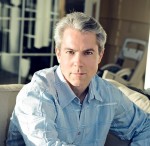
Assaf Gavron (photo from JCC Jewish Book Festival)

As it does every year, the 31st annual Cherie Smith JCC Jewish Book Festival offers readers the chance to meet some of their favorite authors. Sean Michaels, the 2014 Scotiabank Giller Prize winner, starts it all off on Nov. 21 at the Jewish Community Centre of Greater Vancouver’s Rothstein Theatre. Among the festival’s many highlights are Israeli writer Assaf Gavron and American writer Nomi Eve, to whom the Independent had a chance to e-speak recently.

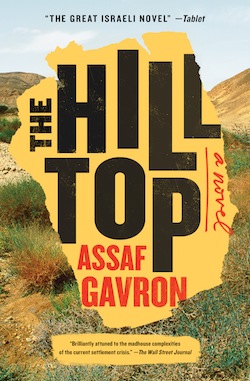
image - The Hilltop book coverGavron’s latest novel, The Hilltop (translated into English from Hebrew by Stephen Cohen), deals with one of the most contentious and emotion-laden aspects of the Israeli-Palestinian conflict: the settlements in the West Bank. It does so with humor and humanity – and an even eye, examining the larger societal issues through the troubled relationship of two troubled brothers. Family, bureaucracy, unintended consequences, and more, factor into the story.

JI: What is it about fiction that allows it to communicate controversial ideas or speak to controversial topics in a way that seems to be more easily received than other media, such as journalism, academia, documentary film?

AG: I think that usually when ideas are termed “controversial,” it is on a simplistic level – when you can sum it up in a sentence or two, it is easy to annoy, or touch a nerve, or whatever. The other forms of media you mention, like journalism or documentary, are also susceptible to this superficiality. Fiction gives you more time, and depth, to really get to the story and to the people behind it. And, whatever the subject is, it can’t remain on the simplistic level. Yes, hopefully it causes more thinking and a better understanding of complexities. I like that about reading fiction, but as to the reason why I choose to write, I think that, over the years, I learned that it is the kind of storytelling I am best at, and most comfortable with.

JI: When I used to ask my grandmother how she was doing, her response often was that she still had her sense of humor – once she lost that, then…. What purpose does humor serve in your writing, or is it “just” a matter of style?

AG: That’s how I write, it is part of me, part of how I communicate. I can identify with your grandmother. I think that it is important, and sane, not to take things too seriously. And not less so, probably more so, in situations that are perceived as sad and difficult and tragic. We must be able to smile. In writing, it is mainly entertainment. It is more fun and enjoyable to read something that makes you laugh. In my books, I would like to entertain as much as anything else, like making a point, educating, etc.

JI: Not everyone can put themselves into someone else’s shoes, something you seem to have mastered in your writing, including your latest novel, The Hilltop. Does that openness and empathy extend into your “real” life? What is it in your personal “toolkit” that allows you to at least write from multiple viewpoints with sincerity?

AG: I disagree. I think everyone can put themselves in someone else’s shoes. This is why people read books, go to movies, read newspapers or even just talk to each other – they are curious about the experiences of others and, when they hear or read or watch them, they are always imagining if it was them, what would they do, how would they react. But it is true that people are reluctant to identify or see the world through eyes of people they perceive as an enemy, or as very different, as an “other,” in the real life. Sure, I hope I’m as open in real life. I think it is crucial to fundamentally accept that there are others, and to attempt to get to know them. I guess that it is no more than this belief that is my “toolkit.”

JI: You write books, translate, create videogames, are in a band … could you share a little bit about your background and how you came to your expertise in these areas?

AG: First and foremost I’m a fiction writer. But I’m also a curious person, like to keep myself interested … so I tend to do other things as well. The band, for example, is a lifelong project of three friends, who decided to do this for the long run, with little interference to our “daily” life. This is why we release an album every six years and not more frequently. Translating and teaching I do sometimes for income and sometimes for interest. The computer game was a one-off project.

JI: Your write-up on Wikipedia notes that you were in Vancouver in 1997, studying “new media.” Do you still have Vancouver connections?

AG: I do! My first cousin lives there with her family. Having family was part of the reason I came, and what I heard and imagined of the city and the school, which offered what I was interested in studying at the time. I had a great year in Vancouver, had a lovely apartment in Kitsilano. That year, I also wrote what would be my second book. I have been back only once since then, in 2003, I think, so it’s been awhile. I’m really looking forward to this visit, my first as a writer.

JI: Where are you and your family currently based?

AG: We are in Omaha, Neb. I have been teaching here for the past year. I’m moving to your time zone, San Diego, in January for six months, and then next summer back home to Israel.

***

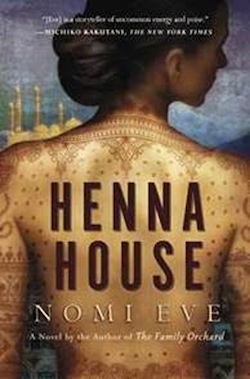
The main character in Nomi Eve’s second novel, Henna House, is Adara, born in Yemen in 1918, the year that Imam Yahya took control of the region. He passed many restrictive decrees, including the Orphans Decree, calling “for any Jewish child to be confiscated, converted and quickly adopted by a Muslim family if a father died,” writes Eve. When the story begins, Adara’s father is already ill.

image - Henna House book coverThe bulk of the novel follows Adara and her family – notably, two cousins – from the 1920s in Yemen to the early years of Israel, briefly touching upon Operation On Wings of Eagles, better known by its nickname Operation Magic Carpet, when almost 50,000 Yemenite Jews were airlifted to Israel between June 1949 and September 1950.

JI: Research is an essential part of your creative process, but you also said in one interview that reality limits your creativity. How did you navigate the need for both research/reality and imagination in your two novels, seeing as both are rooted in “real” historical spaces?

NE: History is much more than a backdrop in my fiction. It also provides soul and substance. But I never let myself feel straightjacketed by history. I make things up and let my readers know that this is fiction, not academic research that they are reading. In Henna House, the fact that I have a first-person narrator also helped me navigate this terrain. My narrator uses her memory and imagination to construct her own version of the past. Memory is porous, and doesn’t always hold truth. Memory is powerful and often finds truth in unlikely places.

JI: Have you reached your 100 Book Clubs goal?

NE: I did book club #143 tonight – it was a Skype visit to Toronto. I love my book club visits. Readers are my wildest dream, and I feel lucky each time I get to chat with a new group.

photo - Nomi Eve
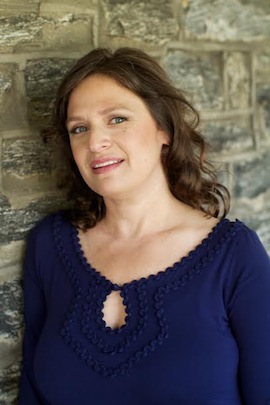
Nomi Eve (photo from JCC Jewish Book Festival)

JI: In Henna House, you write about Mizrahi Jews. What is your background? Did you have a mix of traditions growing up, given that your father was from Israel?

NE: My family is Ashkenazi, but I have a Yemenite aunt. It is from her that I learned to love Yemenite Jewish culture. But most of what I learned about the history of the Jews of North Yemen and Aden I learned through my own research. The most fascinating things that I learned were about henna traditions, and the Orphan’s Decree. Both of these things became central to the plot of my book.

JI: Your two novels are both set in the past. What appeals to you about the past and imagining what it might have been like?

NE: I find it easier to write about the past than about the present. The past feels multi-dimensional to me, whereas the present feels one-dimensional. I think that I am attracted to the fierce power of memory and the perspective gained by the passage of time.

Assaf Gavron in conversation with Marsha Lederman takes place Sunday, Nov. 22, 8 p.m.; tickets are $18. Nomi Eve speaks with Israeli-Canadian writer Ayelet Tsabari on Tuesday, Nov. 24, at an intimate gathering at 6:30 p.m. ($16) and to a book club and book-lovers event at 8 p.m. ($18); to attend both, the price is $30. For tickets to these and other festival events, call 604-257-5111 or drop by the J in person. For tickets and the full festival lineup, visit jewishbookfestival.ca.

Format ImagePosted on November 6, 2015November 4, 2015Author Cynthia RamsayCategories BooksTags Assaf Gavron, Cherie Smith JCC Jewish Book Festival, Henna House, Hilltop, Nomi Eve
Community campaign

Community campaign

Neil Pollock, chair of the Jewish Federation annual campaign. (photo from Jewish Federation of Greater Vancouver)

There’s just under one month left to contribute to the Jewish Federation of Greater Vancouver annual campaign, which supports dozens of local community organizations, as well as partner agencies in Israel and overseas. The Jewish Independent spoke to this year’s campaign chair Neil Pollock via email about his reasons for being involved, and the importance of the campaign to the community.

JI: You’ve taken over the general chair position from Harvey Dales. I know you’ve done so much community work, but did he offer you any advice specific to the campaign that you could share?

NP: Harvey is a good friend, and working as his wingman for a few years before succeeding him as campaign chair was a tremendous learning experience for me. Harvey is, as we all know, a terrific leader and great asset to this community. In fact, if I recall correctly, it was at one of his last meetings as chair that Harvey inspired the concept for our new face-to-face incentive, which has been so well supported by donors and canvassers.

This year, every time a donor meets with their canvasser in person, an additional $500 will be donated to the campaign. It’s an important way we’re engaging in genuine conversations about our community and its needs, as well as donors’ values and interests. It’s also a key way in which we’re growing the campaign. If anyone reading this wants to meet face to face, but doesn’t have a canvasser, just contact the Federation office and they’ll set it up for you.

JI: What motivated you to take on the position of general chair?

NP: I thought I might be able to help out the community a little, and I was honored to be asked to serve. My wife, Michelle, and I have made a very conscious effort to live and practise our Jewish values – especially tikkun olam, chesed and tzedakah. We do this through our volunteer work in the community, and in our home with our children. It’s made our kids more aware of the responsibility we all share in building a better, stronger community, and of all of us being responsible for each other.

JI: The campaign theme is “Securing Our Future.” What does that mean to you in terms of the Jewish community?

NP: The theme has a few meanings. In one sense, it’s about community continuity and engaging the next generation – two of the priority areas for our work. We need to continue to fund young adult programming through Hillel and Axis. We also need to support innovative new Jewish education programs that will reach the more than 850 children in underserved areas who aren’t currently receiving any Jewish education. We live in this incredible city, but the cost of living is so high that many people are struggling with how they can stay connected Jewishly. Nearly half of community members are living outside the city of Vancouver, and funding new programs that reach them where they live is critical to their community involvement.

In a very literal sense, it’s about making sure everyone in our community feels safe. Our Federation has been very proactive in terms of security, conducting a community-wide training program and providing grants for security upgrades, but security is an ongoing need in our community. We need to increase funding for our community institutions so they remain safe, and ensure emergency preparedness.

What some people might not realize is that, every year, Jewish Federation receives more requests for support than there is funding available. On top of that, there are critical programs and services that need more funding than they currently receive. If we want to secure our community’s future, we need to close these gaps while at the same time addressing the issues of affordability and accessibility.

JI: Are there any special projects/ causes that the campaign is hoping to fund?

NP: We’re seeing a real shift in our community that’s creating issues of affordability and accessibility. More and more families are moving to underserved communities outside of the city of Vancouver. It’s just too expensive for them here. When they move, they become beyond the reach of most of our community institutions. We need to find new ways to make community accessible for them. For many of those who live close to the centre of Jewish community life, the cost of doing so is creating other barriers, notably affordability. The high cost of living here has a direct impact on the ability of regular families to engage in Jewish life. These are the issues Federation is addressing through the campaign and in coordination with its partner agencies.

JI: What is the campaign goal this year?

NP: Last year, we reached a record result of $8 million – and we are determined to surpass that. As community needs continue to grow and evolve, so must our response, so must the campaign.

JI: Until when does the campaign run?

NP: The campaign runs from September through to the end of November, which is very short, compared to other communities. One of the reasons we’re able to raise funds in such a condensed period is the incredible work of our canvassers. Supporting them in their work is something I’m passionate about, and we’re putting special emphasis on that this year. We’ve worked with a group of generous supporters to develop a new incentive: for every new canvasser who joins our team, an extra $1,000 will be donated to the campaign. Twice the mitzvah!

For more information and to donate, visit jewishvancouver.com.

Format ImagePosted on November 6, 2015November 4, 2015Author Cynthia RamsayCategories LocalTags campaign, Jewish Federation of Greater Vancouver, Neil Pollock

Posts pagination

Previous page Page 1 … Page 546 Page 547 Page 548 … Page 663 Next page
Proudly powered by WordPress