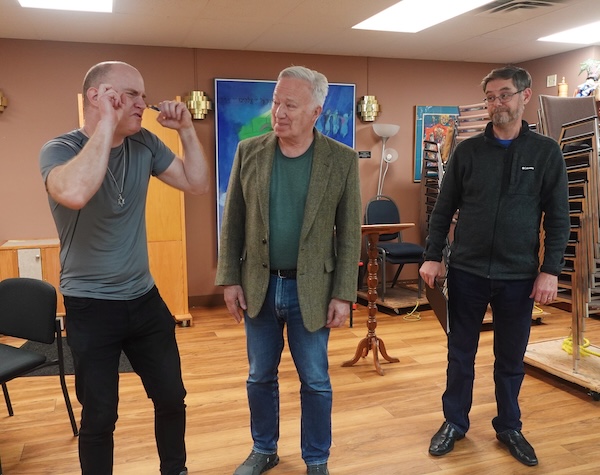
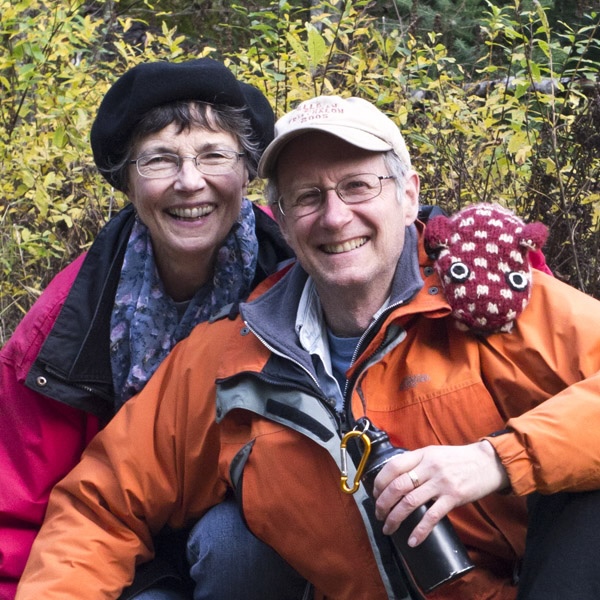
Leo Franken, left, with Manny (the mannequin) and David Downing. The community is invited to join the 25th anniversary open house at the store on April 15. (photo from Spectacle Shoppe)
On April 15, the Spectacle Shoppe will host an open house in celebration of Leo Franken’s 25 years as owner.
Franken, an optician, bought the Kerrisdale store in 2001. The location has been an optical shop since the 1960s, its name changing from Western Optical to the Spectacle Shoppe in 1999.
Born in Amsterdam, Holland, he moved to Montreal with his family when he was 4 years old. His father was an optician as well and his mother helped in their store a few days a week, eventually getting her optician’s licence. His older brother was in the teaching profession, working within the Orthodox Jewish community in Toronto.
“My dad was an optician, and the idea was that I would take over the business,” he told the Independent. “I enjoyed the field and, when he passed away in 1970, I was put in a position of keeping the practice afloat.”
Franken moved to Vancouver in 1978, because of the political instability in Quebec. At the time, the threat of the province separating from Canada was a real possibility.
In Vancouver, he became a member of Congregation Schara Tzedeck and the Jewish Community Centre of Greater Vancouver, and he worked at various places before the Spectacle Shoppe came up for sale.
“It resembled the kind of store that my dad had and in a community that was similar to where I grew up in Montreal,” he explained of why he seized the opportunity to buy it.
“It took a long time,” he said of learning the commercial side of owning a shop. “I still think it is my greatest weakness,” he admitted, “but I just love the business and that is what keeps it going.”
And that love is what keeps him going, as well. Now officially semi-retired, he said he’s working on retirement, but, “it turns out, as long as I am healthy, I will be in the store at least one to two days a week.”
His wife, Marlene, has made the transition into retirement, after a career as an occupational therapist specializing in the psychiatric field. The couple has two sons, Sheldon and Josh, but each of them decided on a different career path.
(photo by Cynthia Ramsay)
David Downing is the primary optician at the Spectacle Shoppe. He has more than 20 years’ experience in the industry, and is also the store’s eyewear-fitting specialist. Visitors to the open house will want to say hi to him and Franken, as well as the rest of the staff, Denisa and Gabriele.
They can learn more about the many types of frames the shop carries, including Ray-Ban Meta smart glasses, which “blend technology with everyday style,” said Franken, noting that the “glasses discreetly integrate features that allow you to capture moments and stay connected, without compromising on design.” The frames are available in a range of women’s, men’s and unisex styles.
From April 15 to 18, the shop will feature the complete lines of frame brands LA Eyeworks (“high-quality and design from Japan”), Etnia Barcelona(“colourful and youthful look from Spain”) and Lool (“lightweight metal and plastic models for a softer look,” also from Spain).
“It is a business that makes people happy,” he said when asked his main thought about his 25-year milestone. “If the client is happy, they refer more people. To see my clients keep coming back while their family grows, I share in the joy of continuing growth all around.”
He is grateful for all the support he has received, including from the Jewish community.
“It has been our privilege serving Kerrisdale and beyond,” he said. “We thank you for your trust and support throughout the years. We are grateful for the many customers who have ‘grown up’ with us over the past quarter-century. We look forward to many more years of being an integral part of Kerrisdale and its community.”
The April 15 open house will take place from noon to 8 p.m. at the store, which is located at 5683 West Blvd.
At Richmond Public Library’s Human Library® event April 12, people will be able to choose from about a dozen “books,” people who will share their personal stories. (photo from RPL)
Join the conversation at Richmond Public Library’s fourth annual Human Library® event. Taking place on April12, from 1 to 4 p.m.,there will be approximately a dozen “book” topics to check out.
The Human Library® is a nonprofit organization that began with its first event in Denmark in 2000. It has established itself as a global learning platform with an initiative to create safe spaces for dialogue between human “books” and their “readers.” The conversations between books and readers can help challenge prejudices and stereotypes, and can contribute more broadly to greater cohesion across social, ethnic and religious divisions.
During a Human Library® event, readers will see a variety of available book titles and be able to select one to “borrow” for a 20-minute reading slot. Readers and books will then have a one-on-one conversation, where books will introduce themselves and readers will have the opportunity to ask questions. At previous Human Library® events held at RPL, books have shared stories of their struggles with such things as mental illness, homelessness, and integrating to life in Canada as a newcomer.
This is a drop-in event, so no pre-registration is required. It is also free to attend. Participants will be invited to borrow books on a first-come, first-served basis until “last call” at 3:30 p.m. The event is appropriate for a teen, adult or senior audience. To find out more, go to yourlibrary.bibliocommons.com/events.
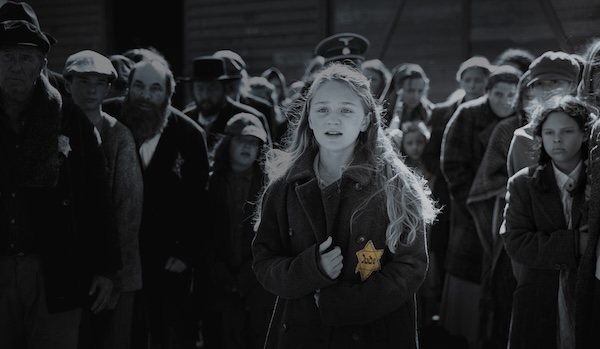
Alix West Lefler plays Frida in The Fast Runner. (photo from thefastrunnerfilm.com)
The Fast Runner, a 15-minute short from director David Bercovici-Artieda is about a young girl’s courage during the Holocaust. (See jewishindependent.ca/balancing-education-and-art.) The film screens April 19, 7 p.m., at the Rothstein Theatre, as part of the event Out of the Shadows: Reclaiming Jewish Stories.
The screening will be followed by a discussion with the filmmaker, Bercovici-Artieda, playwright Mark Leiren-Young and Simon Fraser University professor Dr. Lilach Marom; author and Globe & Mail columnist Marsha Lederman is moderator. The event is co-presented by Chutzpah! Plus and Pacific Legal Education & Outreach Society, with partial proceeds supporting the Antisemitism Legal Hotline (antisemitismlegalhelp.org). For tickets ($18/$36/$54), go to chutzpahfestival.com/out-of-shadows.
Co-stars Evan Roberts, left, Jerry Callaghan, centre, and Carl Powell in rehearsal for Bema Productions’ presentation of Perseverance, April 22 to May 3. (photo by Becca Elliot)
Jerry Callaghan and Andrea Eggenberger (photo by Becca Elliot)
Bema Productions in Victoria presents Perseverance, by L.E. McCullough, from April 22 to May 3. The play is adapted from the 2019 memoir One Holocaust Survivor’s Journey from Poland to America, written by Melvin Goldman and his daughter, Lee Goldman Kikel. It brings to the stage a timely story of healing and renewal.
Few visitors to the G&S Jewelry Store in Pittsburgh’s Squirrel Hill neighbourhood during the 1960s and 1970s were aware that the cheerful proprietor, Melvin (né Mieczyslaw) Goldman, had spent his teens enduring the horrors of Auschwitz before arriving in postwar America as a penniless refugee intent on reclaiming his life and reshaping his family’s destiny. The play depicts Goldman’s irrepressible spirituality and unflagging love for humanity as he worked to replace darkness with light, one piece of handcrafted jewelry at a time.
Angela Henry and Jerry Callaghan (photo by Becca Elliot)
Bema Productions’ mounting of Perseverance stars Jerry Callaghan, Andrea Eggenberger, Carl Powell, Angela Henry and Evan Roberts. All performances take place in Bema’s Black Box Theatre at Congregation Emanu-El. For tickets ($25), go to ticketowl.io/bemaproductions.
The Bellas family, left to right: Oksana, Aliza, Yaakov, Maya and Matthew. (photo from Camp Solomon Schechter)
When Camp Solomon Schechter (CSS) hosts their annual Spark fundraiser event at Beth Israel Synagogue May 3, it might be a more emotional gathering than it has been in past years.
That’s because the honouree, Matthew Bellas, z”l, who passed away last year at age 49 from health complications, left a powerful mark on both the Vancouver and CSS community.
“It means everything,” said Bellas’s daughter, Maya, of her aba (dad) being the focus of the local event. “You can’t put into words the impact he had just walking into a room with his positivity, his passion and his light, and how that inspired others.”
Honouring him, she said, “means that those opportunities for him to continue teaching and passing on his ethics and his education are not lost, and we can continue to pass that spark on to more people.”
Maya said her dad had a special relationship with CSS as a child.
“Camp was where he could express most sides of himself in the silliest way possible,” she recalled. “At camp, he was able to be playful, be an athlete, be artistic and do different visual arts, and sing and dance, while also expressing his religious side.”
She recalled her dad saying that he found his calling to be a rabbi while he was leading prayers (tefillot) as an 8-year-old. “Getting to practice Judaism and [Jewish] traditions was key to who he would become. He had lots of nostalgia and gratitude [to CSS] for that,” she said.
Rabbi Bellas grew up in the Vancouver Jewish community, attending CSS as a camper and participating in Oded, the junior counselor program. He became bar mitzvah and got married to his wife, Oksana, at Beth Israel. The couple raised three children here – Maya, Yaakov and Aliza – before moving to Olney, Md., in 2014.
While studying to become a rabbi at the Jewish Theological Seminary, Bellas returned to camp in 2001 and 2002 as “Rabbi Matt,” writing curriculum and making other contributions. After receiving ordination in 2004, he continued to build a distinguished career in Jewish education, serving as school rabbi at Brandeis School in Lawrence, NY, and at Vancouver Talmud Torah. He spent the last decade of his life as a principal at Charles E. Smith Jewish Day School in Rockville, Md., where he apparently coined the daily reminder: “Ask a good question, learn something new, and be kind to everyone.”
Camp Solomon Schechter’s annual Spark event celebrates the camp’s legacy, community and future, with simultaneous events in Vancouver, Portland and Seattle, bringing together alumni, supporters and friends from across the region. This year’s theme – Body, Mind and Spirit – reflects the camp’s commitment to nurturing the whole person through meaningful experiences, relationships and Jewish values.
Matthew Bellas with his son Yaakov at Camp Solomon Schechter. (photo from Camp Solomon Schechter)
Bellas is being recognized for the Spirit element of the event.
“He was so passionate about Jewish continuity,” Maya said of the spirit her dad brought to his work, including his time at CSS. “He wanted to create that experience for other youth and families. He knew that the continuation of our traditions and people relies on joyful, immersive and strong Jewish communities, and that Judaism is a community and family-based activity.
“At Schechter, along with the Judaics team, he created an experience that was fun, engaging and hands on,” she said. “Creating the Jewish memories for the campers that he had as a kid.”
Maya and Yaakov also both attended CSS as campers, while Maya continued her staffing journey there as a young Jewish leader, serving as the director of Oded the past two summers.
“When we started going to camp, being part of this lineage of going to camp, we got to talk about how it evolved over time,” she said. “We are a part of this history and story of camp, and it’s something that connected us, and that’s something that he appreciated, too.”
Maya said witnessing her dad’s legacy has led her to seriously consider her own impact and the work she did at CSS.
“To see the mark he’s left on the world and on the people he’s come across, at my age, it definitely makes me start to think about what I’m going to leave behind me,” she said. “I just hope it’s a warmer, safer, connected place and I hope this event helps camp [provide] that for many more kids.”
For the Vancouver event co-chairs, Lisa Boroditsky and Sandy Hazan, Bellas’s aunt, honouring Rabbi Matt is extra special.
“First and foremost, it is a true honour to be connected to Matthew Bellas, z”l, as part of our extended mishpachah [family] through the Switzer family clan,” said Boroditsky. “To have the opportunity to carry on what was so truly important to Matt is a meaningful way for me to honour his legacy.
“I also strongly believe in the profound impact that Jewish summer camp has on young people,” she said. “It helps shape identity, build community and instil a lasting love for Jewish life and tradition. Being part of an event that both honours Matthew’s legacy and supports something that was so important to him and our shared beliefs is incredibly meaningful.”
Hazan said her nephew taught them all what it means to be proud of being Jewish and loving our traditions.
“His impact in fostering love of Judaism and showing Jewish pride was felt in every aspect of his professional and personal life,” she said. “He also loved bringing people together and Schechter Spark is an opportunity for the Vancouver Jewish community to gather and celebrate Matthew’s spirit and the Jewish values we all hold so dear. These past years have shown us all that we are stronger together.”
Boroditsky made a point of noting Bellas’s impact on those around him, and how that made him an especially appropriate honouree for this year’s event.
“He touched hundreds of lives through his teachings, kindness, leadership and unwavering spirit,” she said. “By honouring him at the Spark event this year, the community comes together not only to remember him, but to celebrate the legacy he leaves behind.”
The Schechter Spark events this year will also recognize Debbi and Alan Montrose in Portland, Ore., as the Body honourees, and Cindy and Bob Strauss in Seattle, Wash., as the Mind honourees.
“As we celebrate another year of impact, Spark is a time to honour our past, celebrate our present and invest in our future,” said Zach Duitch, executive director of Camp Solomon Schechter. “We are especially grateful to honour Rabbi Bellas’s memory and the spiritual legacy he leaves within our community.”
For more than 70 years, CSS has been a cornerstone of Jewish life in the Pacific Northwest and Canada. Spark reflects the soul of camp, bringing people together in gratitude, remembrance and hope. Registration and sponsorship opportunities are still available. For more information, visit campschechter.org/spark or contact Leah Conley at [email protected].
Kyle Berger is Jewish Community Centre of Greater Vancouver sports coordinator, and a freelance writer living in Richmond.
On May 7, in Vancouver, Dr. Noya Shilo, director of Sheba Medical Centre’s Back to Life Clinic, will share firsthand insights into the journey from trauma to healing. (photo from Sheba Medical Centre)
Following the success of last September’s event featuring Sheba Medical Centre’s Prof. Amitai Ziv, Canadian Friends of Sheba are returning to Vancouver with the Sheba Promise Journey: From Trauma to Recovery, taking place May 7.
The special evening in support of Sheba Medical Centre will feature Dr. Noya Shilo, director of the centre’s Back to Life Clinic and a global leader in trauma recovery. Having led the care of returned hostages – work recognized internationally, including at the White House – Shilo will share rare, firsthand insights into the journey from trauma to healing, and how Sheba’s care extends far beyond the bedside. Additional voices from Sheba will also contribute to the evening’s conversation.
At a time when the need for mental health support is greater than ever, Sheba is leading critical initiatives, including the establishment of a clinic for children in northern Israel who are suffering post-traumatic stress disorder. Proceeds from the May 7 event will support these efforts, as well as the Bibas Healing Gardens – therapeutic environments inspired by Yarden Bibas, a survivor of the Oct. 7, 2023, Hamas attacks on Israel. Bibas was held hostage for 484 days, separated from his wife and two young children, who were murdered by Hamas during their captivity.
The Bibas Healing Gardens will support women and children through counseling, emotional care and nature-based healing. These restorative spaces will serve hundreds of families each year as part of their long-term rehabilitation journey.
The Sheba Promise Journey event will begin with an exclusive VIP reception and meet-and-greet, followed by a curated theatre-style program designed to inspire, inform and connect. Sponsorship opportunities and tickets are available, and everyone is invited to join the event and/or support the initiatives. The Sheba Promise Journey also takes place in Toronto (May 4) and Montreal (May 5).
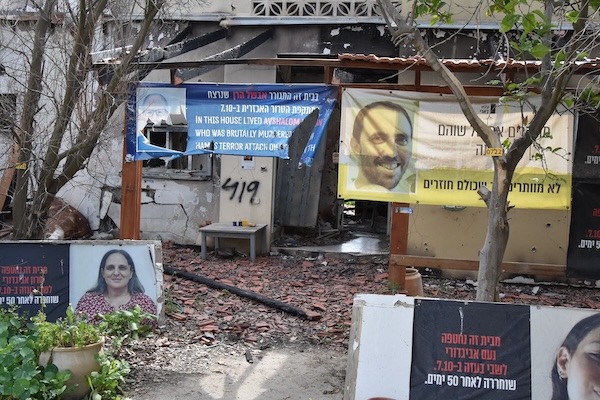
Hundreds of terrorists entered Kibbutz Be’eri. Of the 1,000-plus residents, 101 kibbutz members were killed, 30 people were abducted and one-third of the houses were severely damaged or destroyed. (photo by Larry Barzelai)
My wife and I frequently travel to Israel to visit our three grandchildren. Our interest in Be’eri comes from its special connection with Kibbutz Hatzerim, the birthplace of our daughter-in-law. I feel that the story of Be’eri is a paradigm for the story of the Jewish people, the story of building something magnificent, experiencing a great
destruction and rebuilding afterwards to create something even better. It also illustrates how, when people work together, they can accomplish greater things.
Through a mutual friend, I arranged to meet Yaron, a lifelong member of Kibbutz Be’eri and one who had survived the Oct. 7 massacre. He graciously took me on a tour of the kibbutz as he described the events of that day. Much of what follows are descriptions of the events in his own words. He’s given me permission to share them with you.
On the evening of Oct. 6, Yaron and other kibbutzniks were celebrating the anniversary of the founding of Kibbutz Be’eri. Sharing drinks later with some of his closest friends, they started planning a summer hiking trip in the French Alps.
At 6:30 in the morning of Oct. 7, Yaron heard unusual noises, as he slept with his wife and two young children – both under 5 years old. It sounded like shelling and bombing. When the red alert siren went off, they ran to join their kids in their home’smamad (reinforced security room), which is also the kids’ bedroom.
Initially, Yaron wasn’t too concerned, even after receiving a text that the kibbutz may have been infiltrated by enemies. “OK, I guess we’ll be cooped up in here for a couple of hours,” he thought.
“Messages in the different kibbutz WhatsApp groups start reporting about terrorists walking inside Be’eri,” he writes. “It is close to 8 a.m. Someone writes a message that she hears gunshots.”
Shortly after that, someone reports hearing “terrible screams from the apartment above her, then silence.” Another says that one of the houses in the kibbutz is burning.
Yaron tries to stay calm. The power goes off. Their dog, who is not inside the room, is unusually silent. They hear that someone is in their house.
“They get to the room and try to open the door. I fight over the handle, heart pounding,” writes Yaron. “They don’t succeed! Every time they try, I swing the door handle back to the upright, ‘Safe’ position.”
Eventually, the terrorists give up on opening the mamad. Yaron ignores the calls in Arabic and English to come out of the room. He and his family listen, as the terrorists sing, while wrecking the house. First, there is the smell of gasoline, then smoke enters the room.
A neighbour advises them, via Yaron’s phone, that they should close the gap under the door with wet clothes.
“I take the sheet from my daughter’s bed, pour the bucket of urine on it and jam it under the door,” Yaron writes. “Outside the room, the fire grows fierce, it consumes five years of our lives in minutes…. We are in a closed room, we have no electricity, the children are coughing. I realize that the fire in our home is probably so crazy that even those inhumane monsters can’t still be waiting outside the door. I let go of the handle and I take a deep breath and feel some oxygen flow to my brain. So far, it was the pressure and fear of the terrorists that was suffocating me, but now the smoke is becoming the main problem.”
Yaron’s wife continues to text with neighbours, calling emergency team members repeatedly.
“All of our children’s books are burning outside,” Yaron shares. “Amidst all the terror we hear one of our favourites, a sound book of Arik Einstein songs, catching fire. The fire makes it play, chillingly, one of the happiest songs we know: ‘It’s Saturday morning, a beautiful day….’”
Suffocating on the smoke, the family has no choice but to open a window of their second-floor apartment. Despite the fear of what awaits them outside, the smoke is too much and they climb out onto the metal awning below.
“The four of us are sitting on the metal. We can breathe but we are exposed 2.5 metres (eight feet) above the ground. OK, now what?” Yaron recalls.
They can’t reach the emergency team, so they jump to the ground and hide in a nearby shed. Yaron jumps first, his wife hands him the kids, then follows.
A house identical to Yaron’s, which has been demolished, that gives an idea of the window of the family’s safe room and the challenge of jumping to the ground from the second storey. (photo by Larry Barzelai)
“Another neighbour reaches out, ‘Come to my place.’ I call him. I ask him to risk his life, leave his mamad and open his house for us. He does this while we’re on the phone. We are hesitant to come outside, we are debating with our eyes, and can’t decide if we should stay hidden in an unsafe shed or try to reach a safer place but risk exposure. I ask him to risk his life even more, to take a look outside and verify there are no terrorists in sight. He bravely obliges and says it’s clear. We were in the shed for maybe five, maybe 10 minutes, maybe it was two years, who knows. The kids are silent…. My heart is racing, I open the shed door and we sprint to the neighbour’s house.”
The fire has consumed their own home, and their beloved dog. Temporarily safe at the neighbours’, Yaron sees that the fire might cross over to where they are hiding. “We decide we need to evacuate,” he writes. “At a distance, we spot a few IDF soldiers. A small company or a team…. They escort us to a nearby building where my brother lives. We contact him and he let us in together with two more kibbutz members who had gotten stuck in a similar situation.”
Around 11 p.m., soldiers returned to Yaron’s brother’s place. “They helped us out, they asked us to cover our children’s eyes to shield them from the horrors on the kibbutz lanes and they escorted us to the yellow gate.”
“We made it out,” he writes. “We made it out.”
Most of Yaron’s extended family survived the massacre, except for an aunt who was murdered. In total, hundreds of terrorists entered the kibbutz. Of the 1,000-plus residents, 101 kibbutz members were killed, 30 people were abducted and one-third of the houses were severely damaged or destroyed.
Another victim of the massacre was Winnipeg-born Vivian Silver, who had, prior to Oct. 7, driven patients from the Erez border crossing to hospitals in Israel. She learned Arabic so that she could better communicate with her Bedouin neighbours. She truly believed in a peaceful future between the residents of Israel and the Palestinians of Gaza. Sadly, she was killed on Oct. 7. Her remains were so badly burned that it took weeks to identify her by DNA analysis.
Eli Sharabi, another resident of Be’eri, was kidnapped and taken to Gaza. In his book Hostage, he describes 491 tortuous days in Hamas captivity. He was looking forward to reuniting with his family once he was freed. Instead, upon his release, he discovered that his wife and daughters had been killed on Oct. 7. He cried at their gravesites for two hours, before making the decision that he had to move forward.
Immediately after Oct. 7, Yaron and his family spent many months living in an apartment in the Dead Sea area. They were alive and they were safe, relatively free from missile attacks, but life was far from normal. To say nothing of the trauma they were dealing with, reestablishing a kibbutz lifestyle, while living in a crowded hotel with none of the amenities that glue kibbutzniks together, was challenging.
The family has since relocated to a temporary custom-built village adjacent to Kibbutz Hatzerim. Be’eri and Hatzerim are sister kibbutzim, both founded in 1946. Be’eriwas named for Berl Katznelson, a founding father of Labour Zionism, whose nickname was Be’eri; Hatzerim, after a verse in Deuteronomy (2:23) that mentions hatzerim (farms/enclosures) “as far as Gaza.”
Be’eri and Hatzerim are both traditional socialist kibbutzim, populated mainly by people on the left of the political spectrum. Thus, it was natural for Kibbutz Hatzerim to offer to build a temporary kibbutz adjacent to them for people from Be’eri to live until their kibbutz was rebuilt over a two-year period.
The new neighbourhood on Kibbutz Be’eri, where Yaron and his family are planning on living. The rebuilding of the kibbutz is expected to take two years. (photo by Larry Barzelai)
Most former residents of Be’eri are now living in the temporary kibbutz. Some facilities, such as medical clinics and administrative offices, are shared by the two kibbutzim. Otherwise, the temporary Be’eri has its own houses, schools and offices. Hatzerim expanded its dental clinic, seniors lounge and grocery store to accommodate the increased needs of the larger population. In typical kibbutz fashion, members of both communities met many times to jointly plan this project.
Every day, Yaron leaves his family on the temporary Kibbutz Be’eri to commute 45 minutes to the original. About 60 kibbutz members are living there now, while it’s being rebuilt, and the plan is for most members to return by the start of the school year this September. A printing factory and agriculture are the two sustaining industries on Be’eri.
Yaron’s home, along with 140 others, was destroyed on Oct. 7. Recently, members of Kibbutz Be’eri made a collective decision to tear down all the damaged buildings. They want to try and wipe away the terrible memories of Oct. 7 and build anew. As one part of the construction work, the kibbutz is building a new subdivision, where Yaron and his family are planning to live.
But Yaron isn’t sure that he wants to return. He was born on Be’eri and has lived most of his life there. However, the memory of the trauma of Oct. 7 is very strong. He’s not sure he wants to move back to this place, where so much death and destruction happened. He confided that he may want to live outside of Israel, somewhere he can anticipate a more peaceful future for his children.
Larry Barzelai is a Vancouver family physician, specializing in care of the elderly, who travels to Israel frequently to visit his three grandchildren there. He is presently co-chair of the Jewish Medical Association of British Columbia.
Israeli Minster of National Security Itamar Ben G’vir holds up a champagne bottle in the Knesset on March 30, toasting the passage of Israel’s new death penalty law. (screenshot)
On March 30, two days before erev Passover, Israeli Minister of National Security Itamar Ben-Gvir celebrated the passing of his racist, dangerous, vengeful and unjust death penalty law by raising a champagne bottle and drinking to victory. The customary toast in Jewish tradition, of course, is to exclaim “L’chaim!” (“To life!”) Partly for this reason, the name chosen for the Jewish anti-death penalty group I co-founded, which now includes thousands of members in Israel and abroad, is “L’chaim! Jews Against the Death Penalty.” Those members of the Knesset who support this law have upended the phrase meant to evoke Judaism’s core life-affirming principles.
While Ben-Gvir claims to be a pious and observant Jew, his actions once again reveal his blatant disregard for Jewish values, and an essential mockery of Jewish ritual symbolism. He might as well have screamed “Lamavet” (“To death”) for his celebratory toast. Make no mistake: the passage of this death penalty law will certainly bring death for both convicted terrorists and innocent Israelis and Jews across the world. It is an abomination that will prove disastrous for multiple reasons.
Wine at Passover
One of the most well-known facts about the Passover seder, which both Jews and many non-Jews are keenly aware of, is that it traditionally involves drinking four cups of wine or grape juice. These four cups are a mandatory rabbinic commandment, representing the four expressions of redemption God used in Exodus 6:6-7 to promise freedom to the Israelites. Consumed at specific intervals in the seder, they symbolize freedom, joy, and key stages of liberation, from slavery to becoming a nation.
Perhaps one of the most widely understood reasons for drinking wine on Passover, as on Purim and on any Jewish holiday, is its symbolism of life, joy, sanctification, and transformation used to elevate holy moments like Shabbat, holidays and weddings. It signifies “cheering the heart,” redemption (specifically the four cups at Passover) and divine blessing, while also serving as a reminder of the need for temperance and balance. By lifting a glass for death just ahead of Passover, Ben-Gvir has effectively desecrated this sacred tradition with inverted, grotesque symbolism.
Another tradition of the Passover seder highlights the extent of the sacrilege of Ben-Gvir’s celebration. It is customary for seder-goers to remove 10 drops of wine, one for each of the plagues they chant, symbolizing how the suffering that each affliction produced for our people’s enemies diminishes our joy. This list culminates in the 10th plague of the death of the firstborn of Egypt at the hands of Malakh Hamavet, the Angel of Death. Instead of honouring this Passover ritual, Ben-Gvir profaned it by using wine to glorify killing.
The 10 Plagues
It is most fitting, with Passover only recently having ended, for L’chaim to use the 10 Plagues – with which God cursed the Egyptians in response to Pharaoh’s “hardened heart” – as symbols of the many reasons to oppose the death penalty. We align these biblical maladies with 10 damning strikes against the death penalty to highlight that capital punishment itself is a plague on any society that enacts it. Capital punishment condemns any government that wields it, including Israel now, infinitely more so than any of the individuals it condemns to death.
Dam (Blood): Israel’s death penalty law could increase terrorism, making it more enticing to would-be martyrs (shahids).
Tzifatdeiya (Frogs): It will undoubtedly endanger Jews worldwide.
Kinim (Lice): From Adolf Hitler to Donald Trump, Machiavellian politicians wield the death penalty as a political tool, particularly for election campaigns, and that is the case with this law. Consider the recent examples in Israel of Ben-Gvir’s noose-shaped lapel pin and his video promoting the death penalty law, illicitly filmed at a gallows museum in Jerusalem, as well as Limor Son Har-Melech’s Nazi-inspired Purim costume featuring an injection syringe.
Arov (Wild Animals): Jewish tradition makes the death penalty virtually impossible to carry out. Passage of this law has betrayed the life-affirming core of that tradition.
Dever (Pestilence): Terms like “deterrence,” which is a fallacious delusion when applied to the death penalty, and “retributive” or “proportional” justice, are veils for vengeance. Unequivocally, revenge does not bring closure for murder victims’ loved ones.
Sh’chin (Boils): The death penalty is racist, and this law in particular is viciously discriminatory.
Barad (Hail): The death penalty inherently violates the human right to life. Relatedly, it often results in physical torture, and always is psychological torture, for individuals counting down to their execution day. There is no humane way to execute human beings against their will.
Arbeh (Locusts): Many execution methods are direct Nazi legacies, including firing squad, gassing and lethal injection.
Choshech (Darkness): Capital punishment will traumatize the executioners within the Israel Prison Service. This law also risks placing anyone involved in contravention of human rights treaties.
Makat Bechorot (Death of the Firstborn):The death penalty inevitably risks executing the innocent.
Onward toward repeal
On March 30, the same day that the Knesset passed this barbaric law, a vast coalition of Jewish organizations across Israel and the world immediately petitioned the Israeli Supreme Court to repeal it. The next day, the Supreme Court ordered that the state must respond to the petition and the request for an interim injunction by May 24. The members of L’chaim, together with Jews of good conscience and all of civilized humanity, will continue to do all we can to support this vital, sacred effort.
None other than death penalty abolitionist Elie Wiesel (1928-2016) aptly referred to capital punishment as the “Angel of Death.” It is high time to banish this medieval plague from Israel once and for all. The final uplifting song of the Passover seder is “L’shanah haba’ah b’Yerushalayim” (“Next year in Jerusalem”). It is our consummate hope and intention that next Passover, Jerusalem will see the repeal of this monstrous legislation.
Cantor Michael Zoosmanis a certified spiritual care practitioner and received his cantorial ordination from the Jewish Theological Seminary of America. He sits as an advisory committee member at Death Penalty Action and is co-founder of L’chaim! Jews Against the Death Penalty. Zoosman is a former Jewish prison chaplain and psychiatric hospital chaplain. He lives with his family in Vancouver.
A few days ago, our beloved, big, senior dog had a limp. We went to the vet, on short notice. Our regular vet was away. It was icy and snowy. I got the dog into my 23-year-old car, backed it out of the 123-year-old garage. We made it there on time. The dog got help for what is maybe arthritis or an injury, perhaps from the ice. Driving home, I wondered if I should run an errand but decided, nope, it was windy and raw. The dog should be warm and cozy at home again.
I parked the car in the driveway, got the dog inside and then returned to put my car into our narrow garage. I heaved open the left garage door, planting it into the ice. I hoped the prairie winds wouldn’t slam it shut again. When I got back into the car, it was completely dead. Wouldn’t start.
Then I realized that the heavy garage door had come off its bottom hinge. Huge screws were hanging halfway out. I closed it as best I could and locked it. Inside again, I nearly keeled over because I’d missed eating lunch.
When I warmed up, ate, triaged my work and called the Canadian Automobile Association, I anticipated the worst. The day hadn’t gone as planned.
Yet, CAA help arrived quickly. Miraculously, the fix was simple. A terminal needed to be replaced on my battery. At that moment, the raw day tempered by a cup of hot tea and a moment to think, I was seized with gratitude. What if my car had died on a busy street, with the dog inside? What if we’d been stuck at the vet? What if I’d stopped to run an errand and then been stuck with a car that wouldn’t start and a dog hurting too much to walk home?
Back inside, I looked again at a garage door photo I’d taken. It could have been even worse. What if I hadn’t noticed the screws hanging off the hinge? What if I’d shoved the heavy door and it crushed me underneath it instead? The possibilities were far worse once I’d thought about what happened. This has a happy ending. My husband will repair the hinge when that ice melts. My car now starts. My dog is on medicine and will hopefully be better soon. Gratitude felt like the only answer here.
This was midweek, and we stayed close to home through the weekend. Though we live near downtown Winnipeg, where the national NDP convention took place, we steered clear. At synagogue, one kid played baritone sax for the family service on Shabbat, as little kids danced along in their seats. My other kid greeted families in the lobby as they arrived. Before the wiggly kids got there, we spent a few moments at the main service and did the Birchot Hashachar, the morning blessings, where we thank G-d repeatedly for the good things, the everyday basics, happening in our lives.
On Sunday, our teens spent time on science fair preparation and on helping deliver Passover hampers for those in need, and we adults worked on the household. My husband cleaned steadily but managed to burn something in the microwave, break a pencil sharpener and a cereal bowl. I began to worry again about this weird bad luck, when I thought of the Birchot Hashachar. I remembered what to do. Being resilient meant pausing and finding gratitude instead.
Emergency services had to be called to the high school earlier this week for a student, but, this weekend, my kids are safe, healthy and doing productive things. Though I walked past slogans calling for radical protests at the NDP convention and a woman attendee wearing a keffiyeh at the café right near home, we’re safe, for now.
This year’s celebration of Israel’s birthday feels emotionally like a larger, more difficult version of our small misadventures. War is no joke. Israel is really going through it right now. Via social media, I see these extended family members in my tribe, my community, running for bomb shelters and fighting. Yet, I’m so impressed by the way Israelis strive for beauty and everyday normalcy – trips to the park, surfing and making music – with so much violent disruption. It’s been scary to watch, and I’m not there. That said, maybe the lesson in this birthday is seeing how, after these horrible, life-shattering events, it’s possible to practice that mind shift. The gratitude one, where strangers care for one another in bomb shelters, sharing food, music and space while struggling with what could have happened.
It’s unsettling to be Jewish near a Canadian political convention peddling antisemitic tropes. I’m reeling from seeing a premier who lives near me, who is also a parent I’ve spoken to on the playground, say deeply unsettling words on the NDP stage. Even if Wab Kinew’s “Epstein class” comment wasn’t intended to be antisemitic, his words, about this “dumb war” horrified me.
Jewish tradition teaches that all lives are valuable. Premier Kinew said North American lives shouldn’t be lost – to stop a repressive regime that has already killed thousands of its citizens. Our lives are no more valuable than theirs. Iranians deserve help, as do all the people harmed by the horrible regime and its terror proxies.
In precarious times, it’s helpful to seek the good. To remember that heavy garage door, still dangling off its hinge, the car that died, thankfully, in the driveway and was fixed, and the veterinary help that came when needed. Being grateful and practising joy, even when it’s a strain, is complicated. I want to be happy on Israel’s birthday, but it’s a complicated emotion, too. It requires practising gratitude and celebration even when times are tough, but that’s what we’re “commanded” to do sometimes.
This year, I wish for peace and everything good for everyone in Israel and its neighbours, as well as in other places where conflict reigns. Thank goodness Israel exists, as a place of refuge for all Jews, but it’s OK to wish for safer times at home in the diaspora, too. May the year ahead be an easier one, without war or complication; one in which we can all embrace less fear and more simple joy.
Joanne Seiff has written regularly for the Winnipeg Free Press and various Jewish publications. She is the author of three books, including From the Outside In: Jewish Post Columns 2015-2016, a collection of essays available for digital download or as a paperback from Amazon. Check her out on Instagram @yrnspinner or at joanneseiff.blogspot.com.
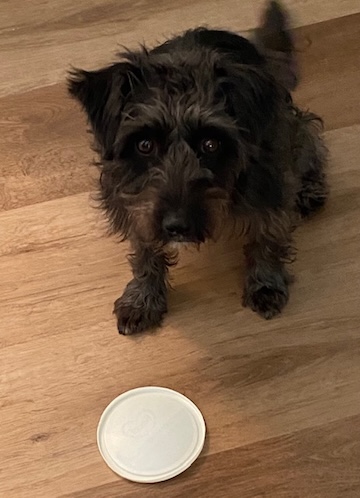
Bo begs for more cabbage. A rescue dog, he is slowly learning to trust humans. (photo by Susan Kars)
My friend Susan Kars recently got a male rescue dog from Chile so, of course, I volunteered to come over and speak to him in Spanish. As my husband and I walked into her apartment, we were greeted by a small, black 2-year-old dog with a big growl. And then, all of a sudden, he fell asleep.
“Ihave always been a proponent of animal rescue,” my friend told the Jewish Independent. “I don’t feel that people should buy dogs when there are so many rescues out there … and rescue dogs show a different level of gratitude.”
Susan began walking dogs in 2008 for friends and recently felt that it was time for her to get her own. She believes that healing is part of Judaism. She is a member of Or Shalom, a Jewish Renewal synagogue. She started going there when Rabbi Laura Duhan-Kaplan was the congregation’s spiritual leader.
“Rabbi Laura was amazing. She was really connected to a lot in the universe,” said Susan, who attended the celebration earlier this year of Duhan-Kaplan’s appointment as dean of the ALEPH Ordination Program, the Jewish Renewal seminary.
Susan decided that her new dog’s Spanish name, Bom Bom, wouldn’t work, that calling “Bom Bom” out in a park would sound too much like “Bomb! Bomb!” So, she named him Bo.
My friend volunteers at a supermarket for financially challenged folks and walks with Bo and one other dog once a day.
She tried the Spanish doggie commands I gave her with Bo and had some success. She was and is very determined to heal this dog.
When we met Bo, the poor thing had just spent 30 hours on an airplane and this was his second night in his new home. Susan got him from an organization called Homeless Pets Canada. Unmentionable things had been done to him by humans and he was very suspicious of us.
I asked Susan what kind of dog he was and she exclaimed, laughing: “He’s a mutt!” And that’s what he looked like until she gave him a haircut and a very long bath. Now, I’d say he looks like a very long terrier of some sort, but no one really knows.
Susan has found that training a rescue dog is the most time-consuming thing she’s ever done.
“I left him twice in one day and came home to a full roll of toilet paper shredded all around the apartment. But you can’t get angry at them because they don’t do it to hurt you.”
That same day, Bo “took out a piece of the wall” by pulling at the leash that was hanging on the hook.
Susan put this down to separation anxiety and fear of being in a new place but, weeks later, she also acknowledged that Bo is mischievous. For example, a few weeks after our initial encounter, I was sitting in Susan’s kitchen while she was loading the dishwasher. When she opened a cabinet near the floor, Bo didn’t miss a beat. He grabbed a small plastic funnel in his mouth and marched out into the hallway.
“He’s a sly dog,” Susan said.
Bo also acted up later in the evening. At first, everything was fine. He let me pet him for a long time, licked my hands and even sat down when I said “sientate,” which means “sit down” in Spanish. Then, I threw one of his toys for him to retrieve and all hell broke loose. He started barking and growling and trying to nip me.
Clearly this dog has post-traumatic stress disorder, I thought. And Susan agrees. But she is not allowing this to defeat her. She says it takes three days for a rescue animal to “decompress” and start to realize that they might be OK. It takes another three weeks for their personality to emerge and three months more for them to realize that they are safe and at home with a new life.
Bo already has started to give back. Recently, he comforted one of Susan’s friends whose dog was run over by a car and didn’t survive. Bo sat with the friend on the couch for a very long time.
Susan’s advice to others who adopt a rescue animal is that they should know “this is a major life decision.” She is spending about $500 a month on a long list of items, including vet fees, insurance, food, toys, bowls, mats, a blanket, puppy pee pads, poop bags, leashes, grooming, treats for training and a camera to see what he’s doing when she’s away. Bo has a bad knee, so Susan has had to buy him joint supplements and a set of dog staircases.
It’s not only costly, but time-consuming to care for Bo. But, it’s also so rewarding.
“I smile every day,” she said. “I have something to smile about. When he’s in his round bed and he gives this big release of breath at the end of the day, it’s so satisfying to hear.”
And, my husband and I have something to be happy about, too, since we’ve officially been made Bo’s adopted aunt and uncle.
Since Bo can be a fierce little dog, Susan said she will be training him as a K9 for Israeli intelligence – just kidding! He’s most definitely a Jewish dog though, said Susan, because he goes “berserk” over challah buns. They are definitely his most favourite treat. She left one on a plate for her neighbour and Bo snuck behind her and scarfed it down in seconds.
If you want to adopt a rescue dog, “just know that the hard work is worth it,” said Susan. “You are saving a life and, by taking a dog into your home, there is room for another dog in the rescue centre.”
When she was volunteering for Vancouver Orphan Kitten Rescue Association (VOKRA) about 15 years ago, Susan made T-shirts that said, “Open your heart and empty a cage.”
And that’s exactly what she’s done.
If you can’t adopt a rescue, Susan suggests donating to Homeless Pets Canada, the Society for the Prevention of Cruelty to Animals, VOKRA or other such organizations.
Cassandra Freeman is a freelance journalist and improv comedy performer living in Vancouver.