Skip to content
  • Home
  • Subscribe / donate
  • Events calendar
  • Business Directory
  • FAQ
  • News
    • Local
    • National
    • Israel
    • World
    • עניין בחדשות
      A roundup of news in Canada and further afield, in Hebrew.
  • Opinion
    • From the JI
    • Op-Ed
  • Arts & Culture
    • Performing Arts
    • Music
    • Books
    • Visual Arts
    • TV & Film
  • Life
    • Celebrating the Holidays
    • Travel
    • The Daily Snooze
      Cartoons by Jacob Samuel
    • Mystery Photo
      Help the JI and JMABC fill in the gaps in our archives.
  • Community Links
    • Organizations, Etc.
    • Other News Sources & Blogs
  • JI Chai Celebration
  • JI@88! video

Recent Posts

  • Legal help for students
  • Revisiting myth of Lilith
  • Wrong person rebuked
  • Canada’s mixed messages
  • Questions for museum
  • Symposium on antizionism
  • Making soccer political
  • CJPAC lauds Pulver’s impact
  • City recognizes Vrba’s legacy  
  • Organ donation saves lives
  • Theodore’s March premiere
  • A healing Shabbaton
  • Supplying healthy food
  • A chime of metal tags
  • Yellowknife seder a first
  • Ishai energizes, unifies
  • A Lag b’Omer to remember
  • Expanding the healing
  • Hannah Senesh – a unique hero
  • Community milestones … May 2026
  • Sharing her testimony
  • Fall fight takes leap forward
  • The balancing of rights
  • Multiple Tony n’ Tina roles
  • Stories of trauma, resilience
  • Celebrate our culture
  • A responsibility to help
  • What wellness means at JCC
  • Together in mourning
  • Downhill after Trump?
  • Birth control even easier now
  • Eco-Sisters mentorship
  • Unexpected discoveries
  • Study’s results hopeful
  • Bad behaviour affects us all
  • Thankful for the police

Archives

Follow @JewishIndie
image - The CJN - Visit Us Banner - 300x600 - 101625

Author: Rebeca Kuropatwa

Getting closer look at Jupiter

Getting closer look at Jupiter

This JunoCam image highlights Oval BA. (photo from nasa.gov)

The U.S. National Aeronautics and Space Administration (NASA) recently released the first findings of the Juno research spacecraft, which entered Jupiter’s atmosphere last year.

The Weizmann Institute of Science’s Dr. Yohai Kaspi is a senior member of the Juno mission team. The reason why this research is so important, he said, is because it will allow us to better understand how the solar system was formed.

“To do that, we really need to understand Jupiter and how it was formed because, then, we can understand earth, in sequence,” said Kaspi.
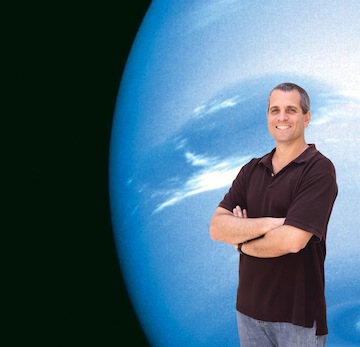
photo - Dr. Yohai Kaspi of the Weizmann Institute of Science
Dr. Yohai Kaspi of the Weizmann Institute of Science. (photo from WIS)

For Kaspi, the fascination with space came at the early age of 7, when his dad shared some pictures of the Voyager I and II and took him stargazing. His interest grew from there, including when he was navigating in the Negev while in the Israel Defence Forces.

“My hobby growing up was competitive sailing,” said Kaspi. “That drew my interest into meteorology and understanding why the wind blows the way it does. Growing up in Nahariya, which borders Lebanon … all kinds of stuff [are] coming from Lebanon – currents, trash. It was very obvious where the wind or current was coming from and that connected to sailing.”

Kaspi studied math and physics at Hebrew University before heading to the United States, seeking adventure and a doctorate at Massachusetts Institute of Technology. Soon after, he was recruited to be a professor at the Weizmann Institute of Science.

While at MIT, Kaspi became connected to the Juno mission, developing instruments to help measure atmospheric conditions on Jupiter.

“I was interested in space and the weather,” said Kaspi. “I studied meteorology, as it kind of brings them together … [with] planetary science. We have planets, which resemble earth in some aspects, but we don’t understand their features and circulation.”

While Jupiter is by far the biggest planet in the solar system (11 times the diameter of earth) and has the greatest mass (300 times that of earth), it is a gas planet (i.e. it has no liquid or solid parts). Kaspi has studied Jupiter’s different weather zones and deltas.

“I developed a theory for understanding how deeply they extend,” said Kaspi. “When you look at Jupiter, you have this red and white belt, or zone. That’s all at the cloud level, so it condensates at the same temperature. But, we have no information what’s happening underneath them. What we needed was a global way to survey what was happening underneath the cloud layer. And that’s exactly what Juno is.

“During my PhD, I developed a new method to relate between the gravity field of the planet and the flows underneath this cloud layer. To understand Jupiter, we need to understand what’s happening in its interior.”

Kaspi has been involved with Juno since 2008, along with 30 to 40 other scientists who form the core of the mission, developing and designing the experiments, and interpreting the data.

photo - This enhanced colour view of Jupiter’s south pole was created by citizen scientist Gabriel Fiset using data from the JunoCam on NASA’s Juno spacecraft
This enhanced colour view of Jupiter’s south pole was created by citizen scientist Gabriel Fiset using data from the JunoCam on NASA’s Juno spacecraft. (photo from nasa.gov)

“We’re trying to deduce the depths of the flows from the gravity measurements of the planet,” explained Kaspi. “The purpose is to see what’s happening inside the planet. It has nine instruments and each one probes in different ways what is happening in the planet’s interior.

“One is a gravity instrument…. We send a beam from the spacecraft to earth. The beam travels 800 million kilometres and reaches earth. A desert in California captures that beam.

“We try to see the accelerations and decelerations of the spacecraft around the planet … trying to understand … the flow field and the gravity field of Jupiter.”

It was only when we first saw earth from space that we were able to understand the changing atmospheric conditions that are part of what is largely considered part of climate change, said Kaspi.

“We’d be able to understand how the solar system was formed, including earth,” he said of one of the project’s possible results. “For example, it’s really important for us to know if there’s a core inside Jupiter. A planet with a big or small core would have a different effect on the gravity field. When we measure the gravity field, we can deduce what’s happening deep inside the planet, which would lead us to different theories of how the solar system was formed.

“The connection to earth is we see the objects of Jupiter’s atmospheres … we don’t understand their strengths, how wide they are and how deep they are. We don’t have theories for that. If you want to have a good understanding of objects on earth, you have to look at the sister planet.”

The data-collecting portion of the Juno mission will come to a close at the end of this year. After 10 years of research and six orbits, the data will be analyzed to determine the direction of the mission going forward.

“We have already a lot of good data and we’re reaching a point where we can have significant results for understanding the structure, depths and composition of the atmosphere, but it’s a process,” said Kaspi. “Basically, we have one measurement every 53 days. So, every 53 days, I get my stuff and go to the U.S. and stay there for a week, analyzing the data and analyzing it for the rest of the 45 days, and then go back.”

Regardless of the results, Kaspi will continue the work he is doing at the Weizmann Institute on climate change and working on an instrument that will be sent to Jupiter on board the 2022 spacecraft being built by the European Space Agency.

“It will be the first Israeli instrument that will go beyond earth’s orbit,” said Kaspi. “That’s exciting. So, we’re involved in that and a variety of projects, trying to achieve fundamental understanding.”

As far as space exploration for the purpose of finding another planet fit for human dwelling, Kaspi said, “I’m just going to say that, if there is life in the solar system, it might be in the moons of Jupiter … because they have liquid water, a deep ocean, tens to hundreds of kilometres deep. Maybe there is life there.”

The public can follow the Juno mission on Facebook at facebook.com/nasajuno.

Rebeca Kuropatwa is a Winnipeg freelance writer.
Format ImagePosted on July 14, 2017July 11, 2017Author Rebeca KuropatwaCategories WorldTags Israel, Juno, Jupiter, NASA, science, space, Weizmann Institute
Artists’ work complementary

Artists’ work complementary

Artists Michael Abelman and Victoria Scudamore share the walls at Zack Gallery in the exhibit Sea to Sky. (photo by Olga Livshin)

In the exhibit Sea to Sky at Zack Gallery, the artists’ works complement each other. Michael Abelman’s seascapes and floral compositions lean towards the pensive and are a little wistful, while Victoria Scudamore’s abstract paintings add splashes of colour and joy to the gallery walls.

“I’ve always liked crafts, since I was a child,” Scudamore said in an interview with the Independent, “but I could never draw. I was a realtor for 30 years. Then, seven years ago, I fell off my bike and broke a wrist. A month later, I decided to take an art class. I thought: I couldn’t draw anyway, I would just have fun.”

image - “Chakra Forest” by Victoria Scudamore
“Chakra Forest” by Victoria Scudamore.

She did have fun. But, also during that class, she discovered the style of intuitive, abstract painting and fell in love with it. “It resonated with me,” she recalled. She started taking more classes. “Art became a real passion of mine,” she said. “Now I have to paint every day. I don’t feel whole if I don’t paint. This is my first show, and I’m very excited about it.”

Her elation is unmistakable as she talks about her creative process.

“I’m an abstract expressionist. I try to capture emotions in my paintings,” she explained. “I want to show movement, colours in motion, to show connections. To paint abstract, I need to be in a dreamy space. I often listen to ’70s rock music and sometimes I dance when I paint. Once, I accidentally knocked off a bottle of ink onto one of my paintings, but I didn’t throw it away. I saw something in the pattern of the ink stains and painted over it, used it.”

Scudamore feels adventurous in her approach to art, ready to respond to any stimulus, be it a forest, a seashore, a flower, a bird, an ink stain or a stray thought. “I often paint two paintings at a time,” she said. “I feel freer to explore this way. Like a scientist, I experiment with colours, shapes and textures. Sometimes, I fall in love with a certain palette and do a series based on those colours. It’s all intuitive. I never know where I’ll end up when I start a painting. The beginning is the most exciting moment for me, a mystery. I’m child-like when I paint. I’m in the realm of fun.”

Her happiness in creating art makes her brave and self-confident. “I don’t compare myself with other artists,” she said. “Sure, Michael [Abelman] has been painting for 20 years; he has much more experience than I do, but I think artists shouldn’t compare with each other. It steals joy. We are all on different paths, our own paths.”

Abelman agrees with that sentiment. “I’ve been painting for 20 years but only showing for five years,” he said. “Like Victoria, I don’t compare myself with other artists, only with myself. My art is changing, evolving.”

Sea to Sky is Abelman’s second show at the Zack. His solo show in 2014 was a rainbow explosion of flowers but, this year, his paintings demonstrate a different level of maturity. Although half of his paintings are still flowers, their colours are more pastel and the ambience more contemplative. “It feels like another stage in my art and in my life,” he said. “Maybe I’m getting older.”

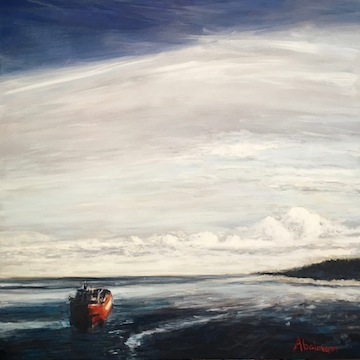
image - “Red Ship Entering Bay” by Michael Abelman
“Red Ship Entering Bay” by Michael Abelman.

Half of his exhibited paintings this year are ships: in winter and in summer, in the morning mist and in the glowing sunset. “I painted ships before but, recently, I find myself drawn to them. My ship paintings are quiet, while the flowers are always louder, exuberant with colours. I still paint flowers, but I wanted more. If you could find beauty in a tulip you could find beauty in a ship, too. I wanted to show it.”

Abelman said ships reflect a sense of exploration but also of loneliness. “A ship is always alone amid the vast ocean, and even near the shore,” he said. “You could see lots of ships in Vancouver. They arrive and depart daily. I take pictures of them when I walk along the waterline, then I take different things from different photos for my paintings.”

He constantly works on improving his skills and widening his range of expression. “Professionally,” he said, “I’m an accountant, but I never tried so hard in accounting as I do in art; never enjoyed accounting so much either. In art, I’m driven. I want to succeed, to be better. I don’t care if I sell, but I want to paint better. I’ve been taking art classes for years, and the more I learn, the more I realize how much I still need to learn.”

Like Scudamore, he paints every day but, unlike his partner in the show, his deep immersion in art doesn’t come easily. “Painting is hard for me,” he admitted. “You go into your own world for hours at a time. It’s a form of meditation. I have to focus, so no music for me when I paint. Sometimes, I listen to the news, but mostly I concentrate on my art.”

The exhibit Sea to Sky continues until July 30. For more information, check out the artists’ websites: victoriascudamore.com and michaelabelmanpaints.blogspot.ca.

Olga Livshin is a Vancouver freelance writer. She can be reached at [email protected].

Format ImagePosted on July 14, 2017July 11, 2017Author Olga LivshinCategories Visual ArtsTags art, Michael Abelman, painting, Victoria Scudamore, Zack Gallery
Instilling responsibility

Instilling responsibility

Vancouver Talmud Torah head of school Cathy Lowenstein Lowenstein addresses those gathered for the closing of this year’s Mitzvah of Valuing Philanthropy program. (photo by Jennifer Shecter-Balin)

On June 15, Grade 7 students at Vancouver Talmud Torah celebrated the close of the year’s Mitzvah of Valuing Philanthropy (MVP) program. Started by the late Sari Zack Weintraub Greenberg nine years ago, MVP integrates a curriculum of tikkun olam (repairing the world), rooted in traditional Jewish teachings, into the students’ educational experience.

Head of school Cathy Lowenstein said Greenberg’s work “revolutionized the school’s tikkun olam curriculum.” Greenberg encouraged the students to “lovingly expand their universe of obligation,” said Lowenstein. The program is something that the kids look forward to in their Grade 7 year, she continued, noting that “tikkun olam is a cornerstone of the school.”

Since its inception, the MVP program has raised a total of $220,000. This year’s 39 Grade 7 students raised an impressive $27,000. On top of this fundraising record, this year’s Tzedakah Project has also contributed $10,000 as a grant to “motivate and inspire” the kids to develop their passion for tzedakah (charity/justice) and chesed (loving kindness).

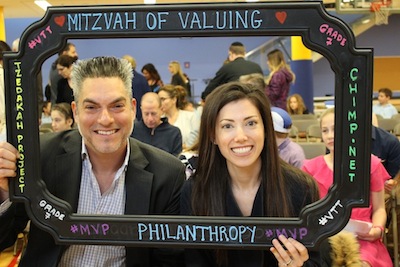
photo - VTT MVP Ariel Lewinski and Judy Boxer of Chimp
VTT MVP Ariel Lewinski and Judy Boxer of Chimp. (photo by Jennifer Shecter-Balin)

The MVP group expressed thanks to Cambridge Uniforms for their ongoing support of the program. This year also saw the involvement of Chimp representatives Judy Boxer and Ariel Lewinski, who offered support via the company to this generation of philanthropists. Boxer and Lewinski gave gift cards totaling $10,000 out to the members of the audience on June 15. Each card could be used to donate $100 to a charity of the recipient’s choice.

The MVP program is support by the Irma Zack MVP Endowment Fund, established by Dr. David Zack – Greenberg’s father – in memory of his late wife, and the original seed funding was donated by Sylvia and the late Lorne Cristall. It is through these funds that the school has been able to run MVP and other such initiatives.

The MVP students followed a careful process of selection of charities to support. They picked ethical commandments to work with, such as healing the sick, helping others in difficulty, or feeding the hungry. They researched the agencies that satisfied these criteria and found contacts with whom to work. Having interviewed these contacts, the kids then had 20 minutes to convince their class to contribute to their agencies, turning classrooms into boardrooms for allocation meetings.

Funds were donated to 24 different organizations this year, including household names like UNICEF and Magen David Adom, and local beneficiaries like the Vancouver Aquarium and Big Sisters. Students also selected Down Syndrome Research and CEASE, an agency that supports women victims of sexual exploitation and domestic violence.

Several students offered their perspectives on the MVP initiative to the Jewish Independent.

Asher Teperson described how “we assumed the roles of principal researchers, primary investigators, bankers and lawyers to assess the needs in our community and respond to them in concrete ways.” For the MVP students, this was a rite of passage. “We had a taste of what it means to become an adult in the eyes of the Jewish community,” said Asher.

Estie Kallner echoed these sentiments: “How often are 12- and 13-year-olds asked to make phone calls to strangers, conduct interviews in corporate offices, request clarification on financial matters and pester agency executives on their overhead costs?”

Julia Huber closed the program remarks with a reflection on how much they had grown through the experience. She described a group of “restless, nervous and confused” kids at the start of the program. However, she said, “with support and encouragement, not only did we embrace the challenge, but we exceeded even our own ambitious goals.”

As another student, Isabella Leipsic, observed, the program left them with a profound sense of their own “strength” in “moral decision-making.” She added, with thanks to the program, “our lives will never be the same.”

Shula Klinger is an author, illustrator and journalist living in North Vancouver. Find out more at niftyscissors.com.

Format ImagePosted on July 14, 2017July 11, 2017Author Shula KlingerCategories LocalTags education, Judaism, mitzvah, tikkun olam, Vancouver Talmud Torah, VTT

On restitution

The government of Canada has apologized to Omar Khadr and awarded him $10.5 million in damages. Khadr is a Canadian citizen whose parents took him as a child to Afghanistan and Pakistan. Fifteen years ago, on July 27, 2002, a firefight took place in which Khadr, then 15, was wounded and a U.S. soldier, Sgt. First Class Christopher Speer, was killed.

Khadr was arrested and incarcerated at the U.S. prison in Guantanamo Bay, Cuba, where he pleaded guilty to throwing the grenade that killed Speer. Khadr later said he confessed falsely in the hope of returning to Canada. However, the facts of the firefight, whether Khadr was guilty or not guilty, whether he was a terrorist or a coerced child soldier-victim, are not relevant to the apology or the compensation.

The decision to apologize and pay Khadr millions of dollars is a result of a $20 million civil suit that Khadr launched after the Supreme Court of Canada unanimously determined that the Canadian government’s interrogation of Khadr while he was at Guantanamo “offends the most basic Canadian standards about the treatment of detained youth suspects.” The civil suit claimed that Canadian officials violated his rights, interrogating him when he was a minor, in the absence of legal representation. He also claims to have been subjected to torture, which would be consistent with the history of Guantanamo and evidence in the public realm.

The decision to apologize and compensate turns on this point: even if Khadr were guilty, the government of Canada did not adequately protect the rights and well-being of one of its citizens; indeed, it was complicit in their violation and acted outside of the rule of our own nation’s laws.

We can all make our own assessment of right and wrong in this case. But the Supreme Court of Canada made the key judgment about the legal foundation of Khadr’s case and the federal government – facing the alternative of almost certain failure in defending itself in the civil case, resulting in a much greater cost to taxpayers – opted to pay Khadr $10.5 million.

Whether it is First Nations land claims and residential schools payouts, symbolic payment to the Chinese-Canadian community for the head tax on their ancestors or compensation to Japanese-Canadians who were deprived of their property and forcibly sent to internment camps during the Second World War, money and an apology are poor substitutes for justice.

Money and an apology will not return lost years or family members. They cannot heal physical or mental wounds, though the money can help pay for medical and psychological treatment. Apologies and reparations cannot undo the harm done. But they can help hold our government and society accountable and, ultimately, that serves us all well.

Posted on July 14, 2017July 11, 2017Author The Editorial BoardCategories From the JITags Canada, civil rights, Omar Khadr, reparations, restitution, terrorism, torture

It takes work to be your better self

Ever had one of those days? Or weeks? When things just fall to pieces around you? Sometimes it’s just stuff – a plumbing disaster or a flat tire. Sometimes it’s an interaction with another person that is so miserable that it ruins your day. For me, at least, those emotions of anger, hate, shame and embarrassment can completely knock me down into a bad place. It’s only natural, but it takes a lot of inner work to get myself on the right track.

I think of this as an inner struggle, which I am sure many of us have. It’s so hard not to take out your negative feelings on someone else. That’s why I think the Torah portion for last week, Balak (Numbers 22:2-25:9), is interesting. It’s not an easy text to study. There’s a lot in it, which is quickly summarized by the reformjudaism.org Torah study website as follows:

“Balak, the king of Moab, persuades the prophet Balaam to curse the Israelites so that he can defeat them and drive them out of the region. However, Balaam blesses the Children of Israel instead and prophesies that Israel’s enemies will be defeated. (22:2-24:25)

“G-d punishes the Israelites with a plague for consorting with the Moabite women and their god. The plague is stayed after Pinchas kills an Israelite man and his Midianite woman. (25:1-9)”

This summary contains some detail, but skips the part where G-d stops Balaam in his tracks and keeps him from cursing Israel. It involves a talking donkey. (This is definitely a portion that you should re-read if you have forgotten it.) The donkey refuses to budge because an angel, sent by G-d, blocks its way. Balaam, a prophet, ends up blessing the Israelites, instead of cursing them, because he can speak only what the angel says he will put in his mouth. G-d tells Balaam what to say.

Is Balaam really a changed man when his curses become blessings? Is someone so filled with hate and curses able to turn things around for good? Or is this amazing blessing that he offers only happening because the Almighty intervenes?

I have a hard time believing in a personal form of the Divinity that pops down and fills our mouths with blessings. Some people do have that kind of faith, and believe that the right thing will arrive, heaven-sent, to save the day. For me, this portion is perhaps about something else.

Balak and Balaam are filled with hate and prejudice when they see the Israelites, who are in some sense, refugees. They are the “other” – strangers who are passing through, and many people find reasons to fear or hate the “other” in their midst.

Yet, just like those days when we have inner struggles, we need to have our better selves win out over feelings of negativity. Sometimes we can rise above our fear, anger or other feelings. When we do, sometimes we can observe the beauty of someone or something that is different and special. We can learn from that new experience.

I’m always knocked out by the beauty of Balaam’s blessing. Whenever I sing “Ma Tovu” – “How beautiful are your tents, Oh Jacob, Your dwelling places, Israel” – which comes directly from this Torah portion, I feel the awe and wonder in the words. Rashi points out that the tents were placed so that their door flaps faced outwards. Even though in the encampment everyone was close together, they were able to maintain a sort of tidy privacy, and a space for separate families by placing their entrances away from one another.

I’ve felt overwhelmed by the hate speech, terrorism, starvation and war that are happening around us. Yet, sometimes, we see a little hope in the media reports. There are amazing people of all faiths who rise up to help. There are even people who capture a terrorist or criminal but conquer their own yetzer hara, or evil inclination, manage to find their best selves and keep that person from harm until the police arrive.

Why does this portion begin with a curse that turns to a blessing, and end with a plague and punishment? I have a hard time with this sort of literal punishment, but it seems like a powerful metaphor. Perhaps it is a way of reminding us that even when we are tempted, and struggle with curses and acts of violence, we must find our best selves and behave morally. We must offer blessings to others. We have to open ourselves up to the “other.” We can learn from and admire their ingenuity. We also need to stick to our beliefs, and guard against being led astray. We can avoid that part inside ourselves that seeks to do harm, and try to help others control that urge to harm, too.

In a practical, positive sense, most Canadian Jews are lucky, our communities are diverse, full of newcomers and people who have been here generations – we are from all over the world. We can open ourselves up to enjoying a diversity of Jewish customs, practices and ideas that enrich our institutions and celebrations. Further, we can enjoy the diversity of the wider community, which is also intensely rich.

We can be different than those who seek tit-for-tat vengeance. Tempted to fight back during a negative exchange, or to cut someone off in a fit of road-rage? Step back.

Think about that talking donkey. Imagine if your car did that to you! Smile. Be the better person. You have that yetzer hatov, the good inclination, right there. Let it out. Be a blessing.

Joanne Seiff, a regular columnist for Winnipeg’s Jewish Post and News, is the author of a new book, From the Outside In: Jewish Post Columns 2015-2016. This collection of essays is available for digital download, or as a paperback from Amazon. See more about her on joanneseiff.blogspot.com.

Posted on July 14, 2017July 11, 2017Author Joanne SeiffCategories Op-EdTags Balaam, Balak, Torah, yetzer hara, yetzer hatov
Telling our stories with food

Telling our stories with food

Michael Schwartz, director of community engagement at the Jewish Museum and Archives of British Columbia, speaks to guests at a Chosen Food Supper Club gathering. (photo from JMABC)

This spring, the Jewish Museum and Archives of British Columbia began airing the podcast The Kitchen Stories. The series, which is focused on Jewish food, is the brainchild of Michael Schwartz, the museum’s director of community engagement.

“A podcast is not so different from a museum exhibit,” said Schwartz in an interview with the Independent. “It is a way to present a story…. It doesn’t have a visual component but, unlike a museum exhibit, people can take a podcast with them, listen to it whenever they have the time.”

While podcasts have evolved on and from the internet, Schwartz considers the format a renaissance of a much older type of media – the radio talk show. “Like radio, a podcast is an audio presentation, but on a different technological level. In the past couple of years, there have been some creative and innovative podcasts, and we’re trying to add to their number.”

The idea of a food-related podcast came to him after he experimented with a couple of other topics. “My role at the museum is to make people, both Jews and non-Jews, more aware of our museum. I tried several different themes – architecture, photography – but food seems to be universal. Everyone is interested in food, especially in Vancouver. We are a foodie city, so it seemed appropriate to ride that momentum, to let people tell their stories about food. That’s what a museum does: it lets people tell their stories. Ideally, the museum staff should be invisible.”

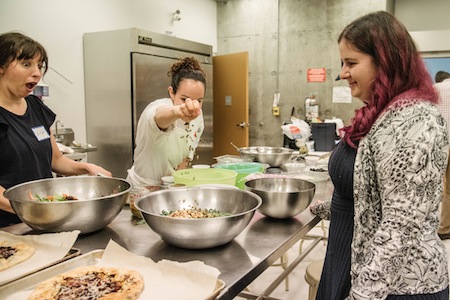
The Kitchen Stories concept, as well as the museum’s Chosen Food Supper Club – a dinner series where people meet each other, learn about and enjoy the food being served – crystallized for Schwartz simultaneously. “We started the podcasts a bit earlier, in March, and the supper club in April…. Lots of storytelling happens during the club meetings,” he explained. “Like the podcasts, each club meeting has a theme. Sometimes, it is geographical: food from different parts of the globe. Sometimes, thematic, like holiday food.”

photo - Chef Lior Ben-Yehuda puts the finishing touches on a salad as Erika Balcombe, left, and JMABC archivist Alysa Routtenberg look on
Chef Lior Ben-Yehuda puts the finishing touches on a salad as Erika Balcombe, left, and JMABC archivist Alysa Routtenberg look on. (photo from JMABC)

A similar variety of themes characterizes the podcasts. To date, shows have examined food links to family dynamics and worldwide migrations, climate and gender roles, cultural customs and regional culinary quirks.

“We brainstormed the possible themes as we listened to other podcasts, read books on culinary history. We tried to pinpoint what is missing and use those points as our guidelines. One of the underlying themes in our podcasts is the tension between traditional and modern. How people adapt to the local food sources when they move, how the familiar recipes change with times and places. How those recipes diverge when members of one family move to different countries, or continents, and the usual ingredients become unavailable.”

Schwartz believes that the museum has to be open to the stories of all Jews, regardless of their religiosity, affiliation or geographic roots. “The museum’s role is not to provide answers but to discuss a question, to open a forum for conversation. In The Kitchen Stories, food is a medium of telling stories. We explore healthy food choices and how they change with generations: what our grandmothers thought healthy and what we think healthy could be different. We talk about kosher food and organic food. And, of course, when people talk about food, everyone has an opinion.”

The topics are approached often from an historical perspective. “Food is a way to keep history alive,” Schwartz said. “When a kid asks his parents or grandparents why do you cook this way, stories emerge. We wanted to showcase those stories. Food is also a way towards peace and harmony. When we share food with friends, we talk and try to understand each other. Food is a means of communication.”

Schwartz doesn’t create the podcasts alone. Co-producer April Thompson has been working for the museum for the past year.

“I do research on the theme we select, I conduct the interviews,” Thompson said. “Sometimes we interview people in their homes or their businesses. Other times, they come here to the museum; we use a quiet room for the interviews. The museum has had an oral history program for decades, so we use the existing museum equipment for recording. Then I do the editing, choose the music. After I’m done, Michael listens to my material. He records the narration, inserts special terminology sometimes, or we move the pieces around to structure the story better.”

“April is very important to the series,” said Schwartz. “She is not Jewish, and that fact has given her an interesting angle on the project. She brings necessary curiosity to some things those of us within the Jewish community take for granted.”

“Yes,” Thompson agreed. “I’m like a child. I ask: why do you do this, because I don’t know. I want to know. I’m now working on a podcast about [dealing with] grief through food, about the Jewish shivah custom. It’s different from many other cultures.”

All of the podcasts can be found at jewishmuseum.ca/the-kitchen-stories.

Olga Livshin is a Vancouver freelance writer. She can be reached at [email protected].

Format ImagePosted on July 14, 2017July 11, 2017Author Olga LivshinCategories LocalTags culture, food, Jewish museum, JMABC, Michael Schwartz, podcasts
Galilee as a food-tech hub

Galilee as a food-tech hub

Former chief scientist of Israel Avi Hasson, left, and MK Dr. Erel Margalit. (photo from Noa Yaar)

Having the Upper Galilee be the world’s food-tech hub is the dream of Israeli Member of Knesset Erel Margalit, who recently announced he will run for leadership of the Labour party. And the work has started in the form of Israel Initiative 2020 (ii2020).

Leading the establishment and development of the food-tech hub in Kiryat Shmona is Michal Drayman, a partner and chief financial officer of Jerusalem Venture Partners (JVP). She has 11 years of high-tech experience and 14 years’ experience in the agro-bio medical activity area of investment.

For Drayman, ii2020 is her volunteer job, and she describes her role as “vice-chairman.” The initiative started up nearly four years ago, focusing much of its work in Israel’s upper north and south.

“We decided to focus on agri-food development in the Eastern Galilee, which is made up of a group of 22 municipalities, from Tiberius in the south, up to Metula in the north and the Golan Heights in the east,” she told the Independent.

They began working with the region in January 2014, holding brainstorm sessions and doing about six months of research with 10 leaders from the region to pinpoint a focus, which became agriculture.

“Anything that can be grown on earth can be grown in the Eastern Galilee,” said Drayman. “Because of the difference in height, climate, water and land, it allows them to grow anything from tropical things to cherries, apples and everything in between.

“We also discovered that the area already has a lot of activity when it comes to agro-bio research – in particular, with Migal, a foundation founded in the early ’70s that has about 115 employees, 65 PhDs and about 50 laboratories developing food and agro-bio activity.”

With Tel-Hai College to develop the academic focus – most of its 5,000 students are studying agriculture, bio-technology, food and nutrition – the region is well-positioned in the field.

As Drayman and team sought an even more specific focus, they decided on medical food, which means any food promoting health and preventing illness. “With this, we’re taking into consideration modified food, functional food, macro-bio activities, and how it will affect us concerning nutrition going forward,” said Drayman.

While work in this field is being done on a large scale by the Volcani Centre, as well as by other institutions throughout Israel, it has rarely reached the market. It took Drayman only six months to get consensus from area municipalities that medical food would be their focus, after which she began on the year-long process of writing up a plan.

“Bio-technology and health, there’s so much to do that, with the right investment, we see the potential of growing something significant in that area,” she said. “In food tech, there’s a lot of innovation and research, but not a lot of invested money. Much of the work that is done is void of being able to monetize it. That’s true of the world, not just in Israel.”

Looking at how food companies impact health by what they put into the food they make – ingredients such as sugar and salt, for example – Drayman and team are working with the industry to change regulations, especially food labeling. The goal is to give customers clear information about the nutrition content in the product they are buying.

“The idea is that companies cannot just [add] sugar whenever they don’t have another ingredient and want to fill [the product] with something very cheap,” said Drayman. “We’re going to show … a red stop light on food. If it has too much salt or sugar, it will be identified on the wrapping.

“The food industry is going through significant change,” she added. “Regulations, GDP talks, and the fact that people are more educated and understanding about what we’re eating, will affect how we’ll be when we get older. If we’re going to make sure we’re eating proper nutrition, then probably we’re going to affect a lot of the illnesses and reduce the amount of obesity.”

Exactly three years from the initiation of the project, with the 22 municipalities participating, the government approved about 80% of Drayman and team’s submitted budget. Next, they will speak with various multinational companies to see if they will invest in research and development in the area.

“One of the things that’s already in process is the movement of the Volcani Centre that is currently in the Tel Aviv area to the Galilee,” said Drayman. “It was declared, but I’m less optimistic about how fast it will happen. But it was declared it will happen, which is huge, because we’re talking about 5,000 scientific people doing research. So, moving that kind of activity would be significant.”

The municipality of Kiryat Shmona has allocated a building to house the new food innovation centre and funds are being collected to allow for the renovations, with Jewish National Fund picking up half of the $6 million tab.

“Basically, we want it to be an iconic building in the centre of Kiryat Shmona, something that will be visible from the road,” said Drayman. “It will have an accelerator for food-tech activities and activities with kids and education – trying to have two percent of top-tier students working together with the accelerator, incubator and entrepreneurship … being part of a success story.

“We’re going to also have music, because we don’t want to have it only as a high-tech building. We want to make sure we have regular people being part of it, living the scene, and not isolating this kind of activity.”

To raise the remainder of the needed funds, Drayman is working to create a consortium of five multinational companies that would run the accelerator and, subsequently, create and run an incubator.

“The accelerator, as opposed to regular accelerators that only do mentoring and primarily help when you’ve started to build a theme … we want to do proof of concept with our accelerator,” said Drayman. “We’d like to invest money, not only time and support, from high-tech people. We want to actually invest money and run the project for four to 12 months to identify an actual R&D project or research and bring it to commercialization.

“Assuming it’s able to be commercialized, then we’d like to take it into the space of an incubator and invest larger amounts of money to be able to run the project until an actual company is created.”

As of press time, IBM was considering providing data analytics.

For more information or to get involved with ii2020, contact Noa Yaar at [email protected] or 1-781-530-8025.

Rebeca Kuropatwa is a Winnipeg freelance writer.
Format ImagePosted on July 14, 2017July 11, 2017Author Rebeca KuropatwaCategories IsraelTags food, high-tech, ii2020, Israel, Kiryat Shmona, technology
Homemade shakshuka

Homemade shakshuka

Shakshuka is a combination of flavours, aromas and colours that appeals to all our senses. (photo from Café FortyOne)

Choosing a dish that defines us gastronomically is an impossible task because Jewish cuisine comprises a long and varied history of aromas and flavours fused by our many journeys around the world. But, if we narrow our task to discussing a representative Israeli dish, then shakshuka might be it.

Although there are many variations, shakshuka is generally made with stewed tomatoes, spices and eggs. It is one of the foods most loved by Israelis and it is a dish that has been enjoyed by countless tourists to the country. It is said that its secrets were brought to Israel by Jewish immigrants from North Africa but, for me, it also has a taste of home. My parents used to prepare it to pamper us, using the recipe of my grandparents from Turkey and giving it an Argentine touch. And there is nothing like shakshuka as an example of how certain foods have traveled with us throughout our history and to the different countries in which we have settled.

Shakshuka means “a mixture.” It is a combination of flavours, aromas and colours that appeals to all our senses. In Israel, it is often eaten for breakfast, a bright and spicy way to start the day. But it is also an excellent dish for lunch or for a special brunch.

Like many great dishes, there are as many versions of shakshuka as there are cooks who have made it, and it can be found on café and restaurant menus throughout the world. Modern culinary interpretations enhance the basic dish with salsa, with all kinds of vegetables, including eggplant and kale, and with cheeses such as feta. Some even incorporate meat into the recipe, modifying it according to personal taste. Some variations replace the tomatoes entirely – for example, there is a version that replaces the tomato sauce with one of spinach and cream.

Although there are many ways to cook shakshuka, from the Mexican version called huevos rancheros to the Turkish menemen, my shakshuka cuts to the traditional. The recipe below will give you a lovely shakshuka, rich in flavour. Once you have mastered the basics, you can add your own touch by using other ingredients that you like. However, this dish has one must: it must be accompanied by pita, challah or one of your favourite breads. Why? Simply because the sauce is really delicious and you will not want to leave a drop of it in the pan.

But, enough talk. This recipe I’m sharing is special – it is the one my family uses and which has given us many beautiful memories. It makes enough for two people.

SHAKSHUKA

5 ripe large tomatoes
1 large chopped onion
1 red pepper
4 garlic cloves (if you find it too strong, remove the centre)
2 tbsp extra virgin olive oil
4 eggs
touch of kosher sea salt
2 tbsp paprika
pinch of cumin
chopped parsley for decoration
tomato paste or concentrated tomato (optional, for a stronger taste)

  1. Pour the olive oil in a frying pan over medium heat. Add the onions and sauté until lightly softened, stirring occasionally. Add the red pepper and garlic, frying for a few minutes until they are soft and lightly browned.
  2. Add chopped tomatoes, paprika, cumin and salt. Stir until all ingredients are well mixed, then cover and simmer for about 10 minutes. The idea is for the tomatoes to become soft.
  3. Once the tomatoes are cooked, stir and then make two holes with a spoon in the surface of the sauce. Break an egg into each one of the holes. Arrange the eggs and the surrounding sauce so that the egg whites are below the surface of the sauce.
  4. Cover and let simmer for five to seven minutes, until the egg whites are cooked but the yolk is still runny.
  5. Sprinkle with chopped parsley and serve immediately in the pan it was cooked in, along with pita (or other bread), hummus and an Israeli salad.

Yamila Chikiar co-owns Café FortyOne with her husband, Daniel Presman.


Format ImagePosted on July 14, 2017July 11, 2017Author Yamila ChikiarCategories LocalTags Café FortyOne, Diaspora, food, Israel, shakshuka
From Sybil’s kosher kitchen

From Sybil’s kosher kitchen

(photo by Cynthia Ramsay)

It’s summer – time to enjoy the fresh local produce and some cool meals, treats and drinks. Here are several of my favourite (kosher) recipes, from soups to salads to cakes and cobblers, plus a few icy desserts and drinks.

GAZPACHO
8 servings

12 small or 16 cherry tomatoes
6 kirby cucumbers
2 small onions
2 green peppers
2 red peppers
2 garlic cloves
4 cups tomato juice
1/4 cup olive oil
1/4 cup red wine vinegar
1 1/2 tsp Worcestershire sauce
2 tbsp chopped parsley
6 ribs celery
salt and pepper to taste

  1. Place half the tomatoes, cucumbers, onions, peppers, garlic, tomato juice, oil, vinegar, Worcestershire sauce, parsley and celery in a food processor or blender and blend. Pour into a large jar.
  2. Place remaining ingredients in food processor or blender and blend. Add to jar and refrigerate until ready to serve.

 
MOM’S BEET BORSCHT
3-4 servings

1/2 tsp sour salt or 1 to 1 1/2 tbsp lemon juice
1 tsp salt
3 tbsp sugar
4 cups water
2 cups grated beets
1 egg yolk

  1. In a saucepan, bring to a boil sour salt or lemon juice, salt, sugar and water.
  2. Add beets and boil 10 minutes.
  3. Beat egg yolk with a little cold water and add slowly to soup.
  4. Cool and serve.

 
COLD CUCUMBER AND SPINACH SOUP
I adapted this from a recipe I found from a café in Evanston, Ill. It serves 4.

1 tbsp margarine or oil
2/3 bunch chopped scallions
2 diced cucumbers
2 cups pareve chicken soup
1/3 pound cleaned spinach
1/3 cup sugar-free whipping cream
3 tbsp non-dairy creamer
1 tsp lemon juice
salt and pepper to taste

  1. Melt margarine or heat oil in a soup pot. Cook scallions until tender.
  2. Add cucumbers and sauté five minutes. Add chicken soup and bring to a boil. Simmer 15 minutes. Add spinach and cook four to five minutes.
  3. Add whipping cream and non-dairy creamer. Cool.
  4. Purée in food processor. Add lemon juice, salt and pepper. Chill.
  5. To serve, pour into bowls and garnish with sliced cucumbers, radishes or scallions.

 
ZUCCHINI SALAD
4 servings

2 cups zucchini, cut in matchsticks
1/2 cup green pepper, cut in matchsticks
1/4 cup chopped tomatoes
1/2 cup shredded yellow cheese
1/4 cup minced parsley
4 cut-up black olives
1 large minced onion

dressing
2 tbsp lemon juice
2 tbsp olive oil
1 1/2 tsp wine vinegar
1 1/2 tsp anchovy paste (optional)
1/2 tsp chopped dill
pinch oregano

  1. In a salad bowl, combine zucchini, green pepper, tomatoes, cheese, parsley, olives and onion.
  2. In a jar, combine lemon juice, olive oil, wine vinegar, dill and oregano. Close and shake well.
  3. Refrigerate salad until ready to serve. Pour dressing on top and toss.

 
PEACH SALAD
4 servings

4 large peaches, sliced in half
cottage cheese
1 cup sour cream
2 tbsp confectioners sugar
1/4 tsp nutmeg
1/8 tsp almond extract

  1. Place two peach halves in each salad bowl. Add a dollop of cottage cheese.
  2. Combine sour cream, confectioners sugar, nutmeg and almond extract.
  3. Pour into a small bowl or pitcher and serve on the side.

 
WALDORF PEACH SALAD
4 servings

1/2 cup sliced celery
1/2 cup sliced grapes
1/2 cup chopped apples
1/4 cup chopped nuts
4 sliced peaches
4 pieces Romaine lettuce
1 tbsp brown sugar

dressing
1/2 cup mayonnaise
1 cup whipped cream or pareve whip
1 tsp grated orange rind

  1. In a mixing bowl, combine celery, grapes, apples and nuts. Toss lightly.
  2. Place one piece of lettuce on each plate and add a sliced peach. Spoon one-quarter of the salad on top of each peach. Sprinkle with brown sugar. Place plates in refrigerator.
  3. In a bowl, combine mayonnaise, whipped cream and orange rind.
  4. Remove peach salad from refrigerator before serving and spoon dressing on each.

 
CHOCOLATE ZUCCHINI CAKE
This recipe came from Laurel, an old friend from my Kansas City, Mo., and Overland Park, Kan., days.

3/8 cup margarine
1 cup sugar
2 eggs
1 1/4 cups flour
1 1/4 tsp baking powder
5/8 tsp baking soda
1/2 tsp cinnamon
1/4 cup cocoa
1 tsp vanilla
1 cup shredded, unpeeled zucchini
1/4 cup milk or non-dairy creamer
1/2 cup chopped nuts

  1. Preheat oven to 350°F. Spray a loaf pan with vegetable spray.
  2. Cream margarine and sugar. Beat in eggs.
  3. Combine flour, baking powder, baking soda, cinnamon and cocoa and add to creamed mixture.
  4. Add vanilla, zucchini, milk or non-dairy creamer and nuts. Spoon into greased loaf pan. Bake for 40-50 minutes or until a toothpick inserted into the middle comes out clean.

 
REVERSE STRAWBERRY COBBLER
Can be made with peaches, plums, cherries and apples.

4 cups hulled strawberries
1/4 cup + 2 tbsp oil
1 cup milk or non-dairy creamer
1 cup flour
1 1/2 tsp baking powder
1 cup sugar
1/4 tsp cinnamon

  1. Preheat oven to 350°F. Grease a glass round pie plate.
  2. Pour oil into pan. Add milk, flour, baking powder, sugar and cinnamon and stir until mixed.
  3. Stand up strawberries, tips pointed up, around batter; fill in centre.
  4. Bake 25 minutes.
  5. Serve warm with whipped cream on top.

 
QUICKY STRAWBERRY PIE

1 cup mashed strawberries
1/3 cup sugar
1 tbsp cornstarch
2 tsp lemon juice
1 cup mashed strawberries
pie shell

  1. Preheat oven to 450°F.
  2. Place one cup strawberries with sugar and cornstarch in a saucepan. Cook for five minutes.
  3. Stir in lemon juice and additional cup of strawberries. Pour into pie shell and bake for 10 minutes. Reduce temperature to 350°F and bake another 40 minutes.

 
PAREVE PEACH PUDDING CAKE
4-5 servings

5/8 cup flour
3/4 tsp baking powder
1/4 cup sugar
1/4 cup pareve margarine or 3 tbsp vegetable oil
1/2 tsp vanilla extract
1/8 tsp almond extract
1/4 cup non-dairy creamer or pareve almond milk
1 egg
3 peaches
1/2 cup pareve whipping cream
1/2 package vanilla instant pudding mix

  1. Preheat oven to 350°F. Grease a pan.
  2. In a mixing bowl, mix flour, baking powder and 1/4 cup sugar.
  3. In a saucepan, melt margarine (if using oil, place it in a bowl). Add vanilla and almond extracts, 1/4 cup sugar and egg and blend. Add to flour mixture and pour into pan. Bake 20-25 minutes until top springs back when touched with finger. Remove from oven and cool.
  4. Peel and coarsely chop one peach. Toss with 1 1/2 teaspoons sugar.
  5. Beat whipping cream until stiff peaks form. Prepare vanilla pudding using 1/2 cup non-dairy creamer or almond milk. Fold whipped cream into pudding. Fold in chopped peach.
  6. Make a well in the cake and spoon pudding, whipped cream, peach into the well.
  7. Slice remaining two peaches and toss with 1 1/2 teaspoons sugar. Arrange slices on top of pudding mixture.

 
STRAWBERRY-LEMON WHIP DRINK
4 servings

2 cups sliced strawberries
3/4 cup lemon juice
3/4 cup lemon syrup
2 cups water
ice cubes

  1. In a blender or food processor, blend strawberries, cold water, lemon juice, lemon syrup and ice cubes until mixture is smooth.
  2. Pour into tall chilled glasses.

 
BLENDER PEACH ICE CREAM
8 servings

7 medium peaches, sliced and pits removed
2 tbsp lemon juice
3/4 cup sugar
1/4 tsp almond extract
1 cup sour cream

  1. Place peaches, lemon juice, sugar and extract in blender. Whirl until pureed.
  2. Add sour cream and whirl until smooth. Pour into a metal pan. Freeze about two hours. Turn into a bowl. Beat until smooth. Return to pan, cover tightly and freeze until firm.

 
FROZEN PEACH YOGURT
3-4 servings

1 cup sliced ripe peaches
1/3 cup sugar or sugar substitute
dash of salt
1/8 tsp almond extract
1 1/2 cups plain yogurt

  1. Puree peaches in blender or food processor.
  2. Mix with sugar or sugar substitute, salt and almond extract.
  3. Stir in yogurt. Pour into a tray with a lid, cover and freeze for two hours.
  4. Remove 15-20 minutes before serving.

 
STRAWBERRRY YOGURT POPSICLES
6 servings

6 wooden sticks
6 waxed paper cups
1 cup sliced strawberries
2 cups plain yogurt
1/4 cup honey

  1. Combine strawberries, yogurt and honey in a bowl.
  2. Spoon into paper cups and freeze for 20 minutes.
  3. Add sticks and freeze until firm. Peel off cups before serving.

Sybil Kaplan is a journalist, lecturer, book reviewer and food writer in Jerusalem. She created and leads the weekly English-language Shuk Walks in Machane Yehuda, she has compiled and edited nine kosher cookbooks, and is the author of Witness to History: Ten Years as a Woman Journalist in Israel.

Format ImagePosted on July 14, 2017July 11, 2017Author Sybil KaplanCategories LifeTags food, recipes
Purifying water

Purifying water

photo - In February 2015, Gal Water Technologies Co., from nearby Caesarea, launched the mobile water purification systemOn July 10, at Givat Olga, Indian Prime Minister Narendra Modi, centre-left, and Israeli Prime Minister Binyamin Netanyahu sample water that has just been purified to the World Health Organization standard in the Galmobile. In February 2015, Gal Water Technologies Co., from nearby Caesarea, launched the mobile water purification system. The small vehicle, the first of its kind in the world, weighs 1,540 kilograms, operates on a 12-volt electric supply and can be set up in less than half an hour. It can connect to almost any water source. (photos from Ashernet)

Format ImagePosted on July 14, 2017July 11, 2017Author Edgar AsherCategories IsraelTags Galmobile, high-tech, technology, water

Posts pagination

Previous page Page 1 … Page 435 Page 436 Page 437 … Page 669 Next page
Proudly powered by WordPress