Skip to content
  • Home
  • Subscribe / donate
  • Events calendar
  • Business Directory
  • FAQ
  • News
    • Local
    • National
    • Israel
    • World
    • עניין בחדשות
      A roundup of news in Canada and further afield, in Hebrew.
  • Opinion
    • From the JI
    • Op-Ed
  • Arts & Culture
    • Performing Arts
    • Music
    • Books
    • Visual Arts
    • TV & Film
  • Life
    • Celebrating the Holidays
    • Travel
    • The Daily Snooze
      Cartoons by Jacob Samuel
    • Mystery Photo
      Help the JI and JMABC fill in the gaps in our archives.
  • Community Links
    • Organizations, Etc.
    • Other News Sources & Blogs
  • JI Chai Celebration
  • JI@88! video

Recent Posts

  • Legal help for students
  • Revisiting myth of Lilith
  • Wrong person rebuked
  • Canada’s mixed messages
  • Questions for museum
  • Symposium on antizionism
  • Making soccer political
  • CJPAC lauds Pulver’s impact
  • City recognizes Vrba’s legacy  
  • Organ donation saves lives
  • Theodore’s March premiere
  • A healing Shabbaton
  • Supplying healthy food
  • A chime of metal tags
  • Yellowknife seder a first
  • Ishai energizes, unifies
  • A Lag b’Omer to remember
  • Expanding the healing
  • Hannah Senesh – a unique hero
  • Community milestones … May 2026
  • Sharing her testimony
  • Fall fight takes leap forward
  • The balancing of rights
  • Multiple Tony n’ Tina roles
  • Stories of trauma, resilience
  • Celebrate our culture
  • A responsibility to help
  • What wellness means at JCC
  • Together in mourning
  • Downhill after Trump?
  • Birth control even easier now
  • Eco-Sisters mentorship
  • Unexpected discoveries
  • Study’s results hopeful
  • Bad behaviour affects us all
  • Thankful for the police

Archives

Follow @JewishIndie
image - The CJN - Visit Us Banner - 300x600 - 101625

Author: Cynthia Ramsay

Help finish new thriller

Help finish new thriller

Richard Harmon stars in Crypto, written and directed by Jon Silverberg. (photo from Red Castle Films)

Enjoy watching a psychological thriller? Well, now you can help make one. At least, finance one. Starring Vancouver actor Richard Harmon – most recently John Murphy in the Warner Brothers series The 100 – and written and directed by local Jewish community member Jon Silverberg, the feature film Crypto has been shot but needs funding for the finishing touches.

“Crypto is my first feature film, and has been a struggle to complete on personal and private resources so far – this is why we’re now turning to crowdfunding to help finish it!” wrote Silverberg in an email to the Jewish Independent.

“We’ve shot and edited the film, but need the completion funds for VFX [visual effects], sound design and our festival and marketing rollout,” he said in an interview. “We have some really awesome perks to give back to fans in exchange for their donations – from a production diary, to merchandise, to an advance screening gala planned for early 2018.”

The film is described as “a psychological thriller, which follows drug-addicted photojournalist Jake (played by Harmon) who, after taking a job at a wilderness lodge, sets up a darkroom where the photos he develops begin to reveal unsettling apparitions of the future.”

“I enjoy watching lighter films, but the stories that I revisit in my mind long after I watch them are the ones that explore the darker more mysterious aspects of life – especially inside the human mind,” said Silverberg. “In Crypto, we explore the effects of isolation on an already troubled soul, and even the fantastical elements of the story are as much an allegory for the main character’s internal struggle,” as they are entertaining.

The crowdfunding press release talks about the film being Harmon’s “passion project,” but it is also Silverberg’s. “It’s been a longtime goal of mine to direct a feature film and I felt strongly about developing my own material,” he said. “I had been writing the script for Crypto for nearly three years by the time the cameras started rolling.”

Filming took place in Port McNeil, on Vancouver Island, over 11 days in February 2017, with a crew totaling 16, said Silverberg. “My producer, Andy Hodgson, was the other main driving force behind the film, and also served as cinematographer and camera operator on set.”

In the press release, Hodgson notes, “We need about $20,000 to finish the film and get it out to international festivals, which, comparatively speaking, is a very small amount in a world of multimillion dollar movies.”

Born in Montreal and raised on Vancouver Island, Silverberg moved to Vancouver in the early 2000s for film school, “and also for the overall film industry infrastructure. There wasn’t much happening for film on Vancouver Island at the time,” he said.

Silverberg is co-owner of Red Castle Films with producer/cinematographer Hodgson and business manager Nolan Smith. His bio on the site notes that he “grew up fascinated by cinema, and began to shoot photos and develop them in the darkroom by age 6. He attended Capilano University’s film program in 2003, and went on to shoot hundreds of episodes of internationally broadcast documentary television – from the waters of Alaska to the jungles of Mexico – before he settled in Metro Vancouver. More recently, Jon premièred his short film Disappeared at the 2015 San Francisco Indie Fest and is currently preparing to shoot his first feature film Crypto, a sci-fi/thriller set in the Haida Gwaii.”

Silverberg shared with the Independent that, not only was he raised in a semi-observant Jewish home, but that his company’s name, Red Castle Films, and its logo “was chosen in honour of the regional flag of my family’s former home in Poland.”

Crypto is scheduled for release in 2018 through festivals and other distribution. To see a trailer of the film, visit redcastlefilms.com/project/features-crypto. For more information and to donate – perhaps becoming a producer yourself – visit crypto-movie.com.

Format ImagePosted on October 6, 2017October 5, 2017Author Cynthia RamsayCategories TV & FilmTags Andy Hodgson, Crypto, Jon Silverberg, Red Castle Films, Richard Harmon, thrillers
Poetry inspired by abstract art

Poetry inspired by abstract art

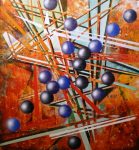
On Sept. 25, a group of writers gathered to write and share poems sparked by the paintings of Waldemar Smolarek, now on display at Zack Gallery. (photo by Olga Livshin)

Poetry events at the Sidney and Gertrude Zack Gallery have become a regular feature in the last few years. Every couple of months, writers of Pandora’s Collective meet at the gallery to read their poems inspired by the art. They held their latest gathering on Sept. 25.

The abstract paintings currently on display at the Zack seem to have been created to inspire poetry. Waldemar Smolarek’s work is known to gallery patrons. Smolarek’s first show at the Zack, in 2012, was posthumous – he died in 2010 – but his art is alive, infused with vibrant colours and the artist’s unique frenetic energy.

Smolarek, a proponent of purely abstract compositions, filled his canvasses with dynamic currents. His lines, in every imaginable hue, fly like arrows. His multicoloured balls dance like polka dots. His vivid splashes of blue and peach flow into each other, seemingly at random, but there is logic in the twists and turns of the artist’s brush. His art invites people to delve into their own psyche, and the poets of the evening responded to the paintings’ visual challenge with a wide variety of works: long and short, light-hearted and lamenting. Some poems were inspired by one specific painting, while other rhyming flights of fancy encompassed the entire gallery.

As the event was a collaboration between the Zack Gallery and the Isaac Waldman Jewish Public Library, Helen Pinsky, the head librarian, gave a short introduction before passing the microphone to Leanne Boschman, the host of the evening.

Although it was her first time as host, Boschman has participated in the Zack Gallery poetry evenings twice before. “The first time, the exhibition included the artist’s journal and sketches, and I found it fascinating to see the artistic journey in progress,” she told the Independent. “The second time, it was a show of abstract photographs…. I like abstract art in connection to my poetry. I can play loosely with colours and shapes and words. It’s harder when the art shows specific people or places. With abstract art, the poet is free to follow her own associations. Sometimes, it’s a story; sometimes, a feeling or a question.”

Most of the participating poets agreed with her assessment, and Smolarek’s art was a rich source for many pieces. The audience, although not large, was extremely generous in support of anyone at the mic, both the listed readers and the brave volunteers who took part in the open mic portion of the event. The friendly atmosphere, combined with the bright paintings and Boschman’s humorous but factual introductions of every reader, made the evening a joyful celebration of colours and words.

The first poet who read, Suzy Malcolm, has been writing poetry since she was a teenager. “It’s my fifth time at the Zack,” she said. “I prefer abstract art for my poetry. It feels like a gift to write about colours and shapes.” She writes poetry for children as well as adults, and her poems at this event reflected both sides of her poetic endeavours.

Eva Waldauf, the next reader, started writing poetry when she was around 40. “I’m a visual artist,” she said. “Once, I had to write a poem for a class, and I liked it. I thought it was fun; thought, ‘I could do it,’ so I began writing poetry.” Her poems were not written on the spot. “I visited the gallery last week to see the paintings, so I would have time to write and edit my poems. I like to come prepared.” Although she admitted to always being nervous before reading her poems, one wouldn’t have guessed it from her performance. Her reading, relaxed and expressive, enhanced by expansive gestures, revealed a good actress as well as an original poet.

The next presenter, David Geary, staged his poems as letters to Smolarek. His presentation was comical. As if playing a game, he strode around the gallery and enrolled everyone in the audience and all the paintings as his willing and laughing playmates.

As a counterpoint to his irreverent show, Sita Carboni’s poetry resonated with mournful tunes. One of the co-founders of Pandora’s Collective, Carboni noted that, with art like Smolarek’s, a poet is free to explore in any direction. Her poetry, contemplative and deep, included a goodbye to someone she lost recently, and she couldn’t finish her reading because of the tears that choked her.

Warren Dean Fulton also prefers abstract art for his poetry. “Abstract art allows you to project your own feeling and emotions. It is speaking to your subconscious. The poet is much less free with portraits or landscape.”

Fulton has participated in the poetry readings at the Zack before. “It is interesting to hear how the same paintings could inspire such different interpretations,” he mused. As he likes to improvise with his poetry, he hadn’t seen Smolarek’s work before that evening.

The last poet of the night, Amanda Wardrop, is also an experienced writer and reader. A schoolteacher, Wardrop said she finds poetry everywhere: in her interactions with students, in figurative art and in abstract art. “Different poetry, that’s all,” she said. “Figurative art often results in a narrative, while abstract art pushes one to a more emotional response.” She did her research before coming to the reading that night, and her poetry touched on the artist’s technique: layers and textures, as they related to our lives.

The night concluded with a lively musical performance by Kempton Dexter, who played his guitar, sang and joked to the delight of the audience.

Olga Livshin is a Vancouver freelance writer. She can be reached at [email protected].

***

Balls collide and come apart,
Lines zigzag and soar,
Feeding moxie to my heart
Fields awash with colour.

Reds and blues and greens explode
Shards and doodles frolic,
Polka dots in quirky mode,
Joyful and symbolic.

– Olga Livshin, inspired by the artwork of Waldemar Smolarek


Format ImagePosted on October 6, 2017October 5, 2017Author Olga LivshinCategories Performing Arts, Visual ArtsTags abstract art, Pandora's Collective, poetry, Waldemar Smolarek, Zack Gallery
Spotlight on the Sylvia

Spotlight on the Sylvia

Advah Soudack and Anna-Mae Wiesenthal rehearse the song “Building a Dream” for Two Views from the Sylvia, which runs Nov. 8-12. (photo by Adam Abrams)

With the upcoming theatrical production of Two Views from the Sylvia, author Diana Stevan interviewed Sue Cohene, a founder of the show’s producers, Kol Halev Performance Society. The new play, based on the Sylvia Hotel, runs Nov. 8-12 at Waterfront Theatre on Granville Island.

DS: What inspired you to do the play?

SC: The answer is insanity.

DS: Tell me more about that. How did you get the idea?

SC: About five years ago, I was attending one of our monthly Jewish psychology network meetings. During our introductions, welcoming new attendees, I did a quick version of my background as a psychotherapist and the latest news about Kol Halev. After the introductions, Marsha Ablowitz, another psychotherapist, who I had known for many years, came up to me and said, “Do you want to do a story about my aunt?”

My response was, “Your aunt?”

She said, “Yes, my Aunt Sylvia.”

Not particularly keen, I replied, “Your Aunt Sylvia?”

“Yes, Aunt Sylvia of the Sylvia Hotel.”

I was hooked and said, “Tell me more.”

DS: So she told you the story of her aunt. Was there anything you were surprised about?

SC: Yes, but you have to come see the play to find out. But, I have to say, the Jewish Vancouver backstory is quite fascinating. I’ll tell you one tidbit. There was a connection between Sylvia Goldstein Ablowitz and another legendary Vancouver figure, Joe Fortes, the lifeguard at English Bay.

DS: Interesting. I’ve heard about him. I understand from the title of your play, that there are two views from the Sylvia. Can you tell me more about that?

SC: One view is from the outside, from English Bay, looking in; the other is from the inside, looking out. And those are just the literal views I’m talking about.

DS: I understand there’s some music. Is this a musical?

SC: We have two one-act plays. The first one, named Sylvia’s Hotel, is a musical about the building of the hotel by the family and the obstacles they found. The second one-act play, named The Hotel Sylvia, is a play with music, focusing on the period of time after the hotel was built.

DS: I heard that the Jewish Museum and Archives of British Columbia showed an interest.

SC: Yes, the Jewish Museum is one of our partners in this project. They will be presenting a historical photography exhibit at the theatre.

For tickets ($28) to Two Views from the Sylvia, visit kolhalev.ca or tickets.theatrewire.com.

Diana Stevan is a writer, who previously worked as a family therapist, teacher, model, actress and freelance writer broadcaster for CBC TV’s Sports Journal. Her novels – A Cry from the Deep, a romantic mystery/adventure, and The Rubber Fence, psychological fiction – and her coming-of-age novelette, The Blue Nightgown, draw on both her experience and imagination. This interview was published by Theatrewire.

Format ImagePosted on October 6, 2017October 5, 2017Author Diana StevanCategories Performing ArtsTags Kol Halev, musical theatre, Sylvia Hotel
Memorial inaugurated

Memorial inaugurated

An artist’s rendering of the newly inaugurated National Holocaust Monument in Ottawa. (photo from holocaustmonument.ca)

On Sept. 27, Prime Minister Justin Trudeau inaugurated the National Holocaust Monument in Ottawa. The monument serves to honour the victims and survivors of the Holocaust, and the important lessons it so painfully taught us.

The Holocaust was the mass extermination of more than six million Jews and millions of other victims, and one of the darkest chapters in human history. The National Holocaust Monument commemorates the millions of people who suffered such atrocities at the hands of the Nazi regime, and pays tribute to those whose stories must never be forgotten.

The monument also stands as a testament to the resilience and courage of Holocaust survivors. Many found a home in Canada, and profoundly shaped our country and society.

In honouring the victims of the Holocaust, we recognize their humanity, which no human act can erase. The National Holocaust Monument reminds us that it is our collective and vital responsibility to stand against antisemitism, racism and hatred, and to bring meaning to the solemn vow, “never again.”

The monument is located at the corner of Wellington and Booth streets in Ottawa, near the Canadian War Museum.

“This monument, so close to our Parliament and Supreme Court, is a reminder of the devastating cost of allowing hatred and tyranny to overcome openness, inclusion and freedom,” said Trudeau. “Today, we reaffirm our unshakeable commitment to fight antisemitism, racism, xenophobia and discrimination in all its forms, and we pay tribute to those who experienced the worst of humanity. We can honour them by fighting hatred with love, and seeking always to see ourselves in each other.”

“This monument is a powerful tribute to the millions of Jewish men, women and children and other victims whose lives were extinguished during one of the darkest chapters in human history,” added the Hon. Mélanie Joly, minister of Canadian Heritage. “As we reflect and honour their memory, we also pay tribute to the courage and strength of the survivors who came to Canada following the Holocaust. Their stories are a powerful reminder of our responsibility to stand against antisemitism and prejudice in all its forms and to never allow intolerance and hate to take root in our communities. We will never forget.”

The design of the monument, entitled “Landscape of Loss, Memory and Survival,” was developed by Team Lord of Toronto and depicts a stylized star, created by the confluence of six triangular shapes, or “volumes,” that are organized around a large gathering space for ceremonies. The design uses architecture, landscaping, art and interpretation to communicate the hardship and suffering of victims, while conveying a powerful message of humanity’s enduring strength and survival. For more information, visit holocaustmonument.ca.

Format ImagePosted on October 6, 2017October 5, 2017Author Prime Minister’s OfficeCategories NationalTags Holocaust, monuments, Ottawa
Rosh Hashanah market

Rosh Hashanah market

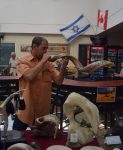
(photo by Shula Klinger)

Paul Harnett shows off his wares at the recent open house and market at the Jewish Community Centre of Greater Vancouver. (For more on Harnett, see jewishindependent.ca/time-for-new-shofar.) The JCC Rosh Hashanah Marketplace took place Sept. 12-14 and 18 and featured several vendors – of jewelry, art, glassware, clothing, hats and more – and some community organizations also had stands.

Format ImagePosted on October 6, 2017October 5, 2017Author Shula KlingerCategories LocalTags Jewish Community Centre, Paul Harnett, Rosh Hashanah, shofars
ספריה מתורבת

ספריה מתורבת

ספריה מתורבת: צפייה בפורנוגרפיה מותרת אך להירדם על הכיסא או לדבר בקול אסור (צילום: ParentingPatch)

המדיניות של הספריות הציבוריות הפרושות ברחבי קנדה נראית לפעמים קצת מוזרה, בעיקר עבור הורים לילדים. זאת כיוון שמותר ואפשרי למי שמבקר בספריות לגשת לאחד מעמדות המחשבים הפנויות ולצפות בחומרים פונגרפיים. פשוט וקל.

אמא לשתי ילדות קטנות הופתעה לדעת כי בספריה הציבורית “גרין בורו” באוטווה הבירה הצפייה בפורנוגרפיה, חופשית, שרירה וקיימת. ג’ניפר סנט-פייר לקחת את בנותיה (אחת בת 11 והשנייה בת 13) אל הספריה הציבורית כדי שישאלו מספר ספרים לקריאה. אחת הבנות בדרכה לבחור את הספרים הבחינה פתאם שמישהו שיושב ליד המחשב, צופה במשהו “לא ראוי ומטריד” כדבריה. היא קראה לאמה שנעמדה מאחורי הבחור ונדהמה לראות שהוא צופה בחומר פונוגרפי. האם המופתעת הוציאה את שתי בנותיה מהספריה ונסעה הישר הבייתה. לאחר מכן היא החלה לחקור את הנושא לעומקו והופתעה עוד יותר לדעת שהנהלת ספריית “גרין בורו” מודעת לתופעה, והיא אינה מתכוונת לנקוט בשום פעולה כנגד למי שיושב ליד עמדות המחשבים וצופה בחומרים פונוגרפיים, כל עוד הוא לפחות בגיל 18. וכל עוד לא מדובר בפעילות שהיא נגד החוק כמו פורנוגרפיה קשה, התעללות, ניצול ילדים או חומרי שינאה.

סנט-פייר אמרה: “אני מאוד מופתעת ומאוכזבת שהנהלת הספריה מאפשרת לצפות בפורנוגרפיה. עלינו לשמור על הילדים שלנו שמבקרים בספריות ולמנוע את חשיפתם לחומרים מסוג כזה. אני מקווה לפחות שהנהלת ספריית “גרין בורו” תרחיק את עמדות המחשבים מספרי הילדים, או לחילופין שתבנה קיר הפרדה ביניהם. הפרשה הזו אילצה אותי לפתוח בדיאלוג עמוק ולא פשוט עם בנותי על מהות החומרים הפונוגרפיים ומדוע אנשים צופים בהם. אני מציעה להורים אחרים להיות מודעים על מה שקורה בספריות בהן מבקרים ילדיהם ולפעול באחריות”.

בהנהלת ספריית “גרין בורו” מציינים כי זה לא מתפקידם להיות הצנזורים לגבי מה שמותר או מה אסור לצפות בו. ההנהלה מנסה לשמור על איזון בין הזכות לפרטיות וחופש המידע האינטלקטואלי, לבין הביטחון והבטיחות ברחבי ספריה ובעיקר כלפי ילדים. בהנהלה מודעים כי לפעמים נוצר מצב שקשה לשמור על האיזון בין השניים, זה לא שטח של שחור או לבן אלא של אפור, ולא כולם יסכימו עם המדיניות הזו. חשוב להדגיש כי מחובתה של הספריה לאפשר נגישות הציבור למידע חופשי ללא שום צנזורה. בהנהלה אמרו עוד כי הם מצפים מהורים לילדים קטנים שמבקרים בספריה, שיגיעו ביחד עם מבוגרים כדי שישמרו עליהם. אז האפשרות להעמיד את הילדים במצב של סיכון תרד משמעותית.

ספריות אחרות בקנדה בהן למשל בערים כמו טורונטו והליפקס מנהיגות מדיניות דומה לזו של הספריה באוטווה, ולא מפעילות צנזורה על החומרים הנצפים באינטרנט כל עוד הם חוקיים. בהנהלת ספריה בטורונטו אומרים כי הפעלת צנזורה על החומרים הנצפים באינטרנט, יכולה למשל למנוע מהציבור הרחב לקרוא על סרטן השד. החוק הפלילי בקנדה לא מתעסק ישירות עם הנושא, אלא מתייחס לספריות כמו לכל גוף ציבורי אחר, והוא מאפשר להנהלות להפעיל שיקול דעת ומעניק להן חופש פעולה מלא בנושא, תוך שמירה על חופש המידע ללא צנזורה, כל עוד ילדים לא נחשפים לכך ולא מדובר בחומרים אסורים.

כתב החדשות שפרסם את הידיעה בדבר האם ובנותיה, בדק את תקנון ספריית “גרין בורו” ומצא כי אכן מותר לצפות בחומרים פונגרפיים. לעומת זאת בהתאם לתקנון מי שמרעיש או מרים את קולו, נרדם על הכיסא או משתמש בתרסיסים חזקים על גופו, יחוייב לעזוב את הספריה.

Format ImagePosted on October 4, 2017October 3, 2017Author Roni RachmaniCategories עניין בחדשותTags libraries, pornography, ספריות, פורנוגרפיה
Wosk, Lederman honoured

Wosk, Lederman honoured

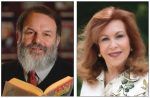
ORT Vancouver will honour Rabbi Dr. Yosef Wosk and Shelley Lederman on Oct. 18 at Congregation Schara Tzedeck. (photos from ORT)

For nearly 140 years, ORT has been equipping people around the world with skills to succeed. The history of the organization in Canada is being celebrated at a gala luncheon next month honouring Rabbi Dr. Yosef Wosk and Shelley Lederman.

The Vancouver region of ORT began in the 1970s and was led by Lederman, who served successive terms as president of the local region and later became co-president of ORT Canada. Carrie Katz, who was Lederman’s co-president, will be the keynote speaker at the event on Wednesday, Oct. 18.

ORT (a Russian-language acronym sometimes translated as the Organization for Rehabilitation through Training) is the world’s largest Jewish education and vocational training nongovernmental organization. Beginning in Russia in 1880, World ORT now operates in 37 countries and engages 300,000 students per year. Originally focused on developing skilled trades among the people, the organization now focuses on high-tech education.

It is ORT’s origin and history – and his own family’s roots – that attracted Wosk to support the organization.

“My father’s family is from Odessa, so I felt a personal connection to the history of the organization and the people they help,” Wosk told the Independent. “Also, the appreciation for the memory of the Jewish community who would not abandon others who needed assistance.”

ORT is founded on the axiom that if you give a man a fish he will eat for a day but if you teach him how to fish he will eat for a lifetime. This is another factor that appealed to Wosk.

“What I was impressed with historically was that it’s not just giving funds,” he said. “It was also educating the people, whether in agriculture or trades and other skills, so that they would be able to eventually help take care of themselves and sustain themselves.”

Local regions, like Vancouver’s, raise funds for ORT educational initiatives in Metro Vancouver, in Israel and around the world.

When Lederman was founding president of the region, there were actually three local branches created, including a Hebrew-speaking group and a Spanish-speaking cohort.

“We created a very strong organization here in Vancouver,” said Lederman, adding that local regions support vital initiatives worldwide, projects that change according to needs over time.

“When people were under duress in Europe during the war and they couldn’t sustain themselves, ORT teachers taught them how to survive as tailors, electricians, as plumbers,” Lederman told the Independent. “And then, in Israel, ORT schools continue to do the same thing. They are teaching those who weren’t going to university but who wanted to come out of high school and be able to support themselves and their families. ORT schools provide education plus trade teachings.”

While she herself did not go to an ORT school, she saw the good works the organization does while growing up in Israel. Being honoured by the organization now means a lot, she said.

“It means a lot because being recognized by your friends and fellow members is really a recognition of all of us,” she said. “By recognizing one person, it’s recognizing the many people who contributed to the success of ORT in Vancouver.”

photo - The honourary chair of the Oct. 18 ORT gala is Dr. Saul Isserow
The honourary chair of the Oct. 18 ORT gala is Dr. Saul Isserow. (photo from ORT)

The theme of the gala is Building Minds Through Inspiration. While ORT began as an educational body teaching skilled trades and crafts, it is now a leader in high-technological training and education. Keeping with this commitment, a percentage of the revenue from the gala will support an ongoing Smart Classrooms initiative at Richmond Jewish Day School (RJDS), as well as provide scholarships for students at the Technological College of Beersheva, in Israel.

Smart Classrooms integrate learning technologies that allow increased interactivity. “The investment by ORT is about allowing Jewish day schools and Jewish schools in Israel to keep pace with technology,” said Abba Brodt, principal of RJDS. “It allows us to marry the best of educational practice with the best of technology for the best possible outcome for students.”

Without the Smart Classrooms funded by ORT, he said, “our students will get a great education but would not be as technologically literate as they should or could be, and they would not be keeping up with changes.”

The gala luncheon takes place at on Oct. 18, 11 a.m., at Congregation Schara Tzedeck. Honourary chair is Dr. Saul Isserow. Master of ceremonies will be Howard Jampolsky. Tickets are available from 604-276-9282 or [email protected].

Pat Johnson is on the organizing committee for the ORT gala.

Format ImagePosted on September 29, 2017September 28, 2017Author Pat JohnsonCategories LocalTags education, ORT, Shelley Lederman, Smart Classrooms, technology, tikkun olam, Yosef Wosk
New look for campaign

New look for campaign

(image courtesy of Jewish Federation of Greater Vancouver)

Jewish Federation of Greater Vancouver’s annual campaign has a brand new look this year, one that will hopefully convey an important message to the community.

“We’d exhausted photographic resources we’ve used in past years and things weren’t looking fresh anymore,” said Alvin Wasserman, a volunteer on Federation’s working cabinet.

Past years have featured photography, but finding those photographs had always presented a challenge. “When you’re talking about housing or food security, people are naturally reticent to be shown,” he explained. “Often we were scrambling for stock photography or images that other federations have used, and that wasn’t as representative of our community as we wanted it to be.”

When the cabinet read the campaign brief that Federation put together this year, the group realized the theme was the existential issues our community is facing. “The brief was about people’s inability to connect with Jewish life because of the high cost of living or because they were moving further outside of the core,” Wasserman told the Independent. “It was about Jewish people having to make serious choices about buying groceries or being involved in Jewish life, so we decided the new look for the campaign should be an illustration, which is an allegory through which you can tell stories.”

This is a pivotal year for the community, added Al Szajman, who has served as marketing chair for the past nine campaigns and helped develop the marketing and communications strategy. “Certainly, the different look helps draw attention to our very focused messaging this year.”

The messaging centres on the importance of maintaining our Jewish community, particularly in the face of the cost of living in Vancouver. “Everybody who resides locally understands that, if you’re living in Vancouver, costs are crazy,” Szajman said. “It’s very hard for many in our community to deal with those costs, plus having the incremental costs of trying to live Jewish and be connected to the community through various services and events. This campaign is about finding ways to help our partner agencies provide services to people locally and make opportunities available at lower rates than otherwise might be available.”

He noted that up to half of the Jewish community of the Lower Mainland now lives outside of Vancouver in cities including Surrey, Delta, Langley, Burnaby, Maple Ridge and Coquitlam. “A lot of these areas don’t have easy access to Jewish services, a Jewish connection. This whole notion of affordability and access is critical,” he noted. “If we’re not a community, what are we? We’re nothing.”

Shelley Rivkin, Jewish Federation of Greater Vancouver vice-president, said the campaign exists to fund solutions that keep people connected. “If we want to have a strong community, we need to make it easy for people to participate, whether they’re living in places like Abbotsford or Squamish and come to the programs we and our partners now offer there, or whether they’re overwhelmed by the cost of living in Vancouver and need more robust subsidies. At the heart of it, there is a sense that we as Jews need each other and we are meant to be a part of a community. That’s what we needed to convey this year.”

Illustrator Paul Gill created the illustration, a Star of David comprised of a community where a couple of people are falling off the edge of one of the triangles. “It describes the issue in a really interesting manner,” said Wasserman, who worked with a creative team that included Kelsey Dundon, Camilla Coates and Becky Saegert. The video in honour of Federation’s 30th anniversary, which was screened at the campaign launch Sept. 13, was produced by Eli Gorn. For more information, to watch the video or to donate to the campaign, visit jewishvancouver.com.

Lauren Kramer, an award-winning writer and editor, lives in Richmond. To read her work online, visit laurenkramer.net.

Format ImagePosted on September 29, 2017September 28, 2017Author Lauren KramerCategories LocalTags affordability, Al Szajman, Alvin Wasserman, annual ca, Jewish Federation
Krembo Wings unites

Krembo Wings unites

Members of Krembo Wings’ Kiryat Shmona branch enjoy one of the weekly activities. (photo from Krembo Wings)

Claudia Koby co-founded Krembo Wings, the only youth movement open to all youth, regardless of ability level. It was her son, Kfir, who inspired her – seeing him battle severe disabilities and his intense desire to be part of society at large.

Kfir’s friendship with a girl without disabilities changed his and his family’s life to such a degree that his mother decided to find a way to give other kids with disabilities and their families the same simple but incredible gift.

Krembo Wings was established in 2002, growing to 11 branches serving 300 kids by 2010. That was when Merav Boaz (affectionately nicknamed “Boozy”) joined as vice-president. To date, the movement has 61 chapters.

“I knew I could give a lot from my knowledge and experience, to make the movement known in the public eyes and ears … a new idea that was not in existence in Israeli society before,” Boaz told the Independent. “I wanted everybody to know what the Krembo Wings are doing, to see how well they change the world and society. It was like a fire in my heart.

“When I joined, almost no one knew about Krembo Wings…. Today, the movement has 6,000 kids involved – from the special needs kids to the able kids that help them be part of a life-changing movement.

“It’s the kids who run the branches, guided by adults. We give them the power to do so. It’s a lot of thinking to make it happen – to do the seminars really productively, to make them understand they can create their own reality. I think that, because of the kids, we’ve made this breakthrough, this change. From a local initiative, we became a national youth movement.”

When someone has a child with a disability, said Boaz, one of the parents usually stops working and starts taking care of the child, “they look for treatment and doctors to make things better.”

When the parents take their child to register in kindergarten, she said, “They tell you he doesn’t fit, that he can’t be with other children – the ‘regular,’ ‘normal’ children – because of the disability. From this point on, you have a kid who leads a different life within the shawl of society. They don’t belong and are not a part of the kids’ society – don’t go to school with their brothers and sisters, don’t enjoy the after-school programs…. A lot of the parents don’t take the kids outside to the mall or to cafés because of their different behaviour, like slapping hands or making noises. You feel that it’s not right that you’re there…. All of a sudden, you have a kid who doesn’t have a right to take part.”

Often, children in this situation are sent to a different school. In Israel, the school is usually not in the same neighbourhood or city where they live. So, they do not make many friends and, when they become adults, few people will hire them, because no one knows them.

“Why are we so surprised that no one will hire a person with a disability?” asked Boaz. “They don’t know how, were never shown how. We want to change that one day.

“I think the next school established in Israel will be a school with kids of all abilities. We won’t have special education schools separated…. We want the kids to go to the same school and do after-school programs…. When they grow together, they will live together in the same community and care for one another. Then, it won’t be hard for a hospital, for example, to hire a secretary who is blind.”

The disability does not need to – and should not – define the person, she said. And this is where Krembo Wings helps.

“It’s good for them to know other kids, to know and develop social skills, and be part of society,” said Boaz. “How would they know how to behave in a café or at a playground if they’ve never even tried it, practised it, because they’re separated?”

Boaz shared the story of a dad from Krembo Wings’ summer camp who has twin girls, one of whom was born with cerebral palsy and has difficulty walking, so she uses a wheelchair.

“When they go out together, nobody would even notice or try to talk to the twin in the wheelchair, because – automatically – people think she’s not well in her brain,” said Boaz. “Nobody is patient enough to talk to her. No kid stops to get to know her. But, at Krembo Wings, everyone knows her. She has so many friends now, but never in her life did she have friends before. She says, ‘Krembo Wings is my life. It’s where I’m loved by other kids.’”

When kids come to Krembo Wings once a week, they feel a sense of belonging, they sing songs and play together.

“When you accept, you don’t hate. When you don’t judge, you’re tolerant of others, you become more forgiving.”

“You can see how they don’t judge, they include – not because the teacher told them and not because they read it on the walls of the school,” said Boaz. “They practise it and it becomes a part of their souls, lives and values. When you accept, you don’t hate. When you don’t judge, you’re tolerant of others, you become more forgiving.”

The children without disabilities help ensure that their mentees take part in activities. “They learn to be creative, to work with the ability that each person has,” said Boaz, and this “improves their skills and their school success. They are better friends to … friends, to their parents. It’s amazing. Imagine them as grown adults in society – they will care more.”

Parents of children who aren’t able to communicate at Krembo Wings say how big the impact is – their kids do better at school, have more self-esteem and improved communication – from being in an environment of acceptance.

“I had a 16-year-old counselor, able-bodied, who wrote an email saying that, at school, they asked him to write an essay about the person who has influenced his life the most,” said Boaz. “And, he was thinking of his grandfather, a Holocaust survivor, who was a kid when the Nazis came to Poland. He lost all of his family, but he survived. Then he thought about his mom, who had breast cancer – a survivor, too. But, he decided to write about [another] person who influenced his life, because he learned from him what the meaning of being a hero is – of knowing how to deal with tough situations, to be resourceful, smart, full of life and always positive. That person’s name is Don and he’s 10 years old. He has severe cerebral palsy. He tries every day to get up and walk. He tries to practise how to talk with a speech therapist every day, because he wants to be understood. The 16-year-old said that Don taught him the most how to be a hero – disability or not.”

For brothers and sisters of children with special needs who are in Krembo Wings, Boaz said, “They say that, for them, it’s the first time they’re not ashamed to be the brother or sister of a kid with a disability. One girl wouldn’t invite people to her house. Her brother would make gestures no one could understand. She said she prevented her friends from coming to her house. She didn’t want them to know. With Krembo Wings near her house, the youth came to meet him and she saw two girls her age, able-bodied, good-looking, popular, talking to her brother, communicating. She said she was shocked. When her brother started going to Krembo Wings, he came back so relaxed, so happy, like he had had a break. She felt it – the missing piece in his life was filled…. When she came to Krembo Wings and joined in, she had members to mediate activities and, through her connections to another mentee child, she got closer to her own brother…. She learned how to communicate, to be tolerant, to listen – and that it’s OK if he’s like that…. She now knows he has the right to be a part of society and she has the tools to help change things…. More than they have a right, there’s so much they can give to society.

“We believe this change starts with kids. But, it also changes the parents … these same parents who had problems finding a kindergarten. As one of the mothers shared, for the past 15 years, she has been told how her kid does not fit in anywhere, yet no one could tell her where he does fit. All of a sudden, there are Krembo Wings … kids pleading with her to let them take her son to an activity. We pay for transportation, pick them up for three hours and return him satisfied, happy.

“I saw a mother crying, saying the counselor told her she could go do whatever she wanted to do, that they would take care of her kid. She said, ‘I don’t remember what I like to do, how to be alone without her … I’m always taking care of everything … I don’t have friends anymore.’ It changes [a] parent’s life as well.”

“This platform is not only good with or without special needs, it’s good for any society. If it’s not Jewish and Arab, it’s Bedouin and Christian. The kids get tools and values they need. It just happens. It’s more natural for kids than separation.”

When Krembo Wings wanted to open a branch in Lod, city officials recommended they open two branches to avoid mixing Arabs and Jews, but Krembo Wings refused, saying they do not believe in separation of any kind. The city officials conceded and said they could try, but to not expect it to work.

“We opened one and it was a big success,” said Boaz. “So, this platform is not only good with or without special needs, it’s good for any society. If it’s not Jewish and Arab, it’s Bedouin and Christian. The kids get tools and values they need. It just happens. It’s more natural for kids than separation.”

The Vancouver connection

The Kiryat Shmona branch was started in the nearby mechina (pre-army training program) in kibbutz Maayan Baruch before the Jewish Federation of Greater Vancouver took it under its wing, providing space in Kiryat Shmona’s Beit Vancouver for the branch to run its activities. The Federation has also provided funding of $26,000 a year for the last two years.

“They were so sensitive toward the kids’ needs and really understood,” said Boaz. “When you have donors, sometimes the donor – out of good will – starts interfering with the way you deal with the activity or the money or whatever – but Vancouver never did that.”

According to Candace Kwinter, chair of Jewish Federation’s Israel and overseas committee, “Krembo Wings is an incredible program. It enables every child living with any type of disability to take part in enjoyable social interactions between one another and their able-bodied peers and become part of community life in Israel. As a federation, we’re proud to support this program, which is based in Beit Vancouver, and empower both the participants and the volunteers.”

Kwinter quoted one of the mothers of Krembo Wings in Kiryat Shmona, whose daughter has Rhett syndrome. “When Tom was invited to join Krembo Wings,” said the mother, “I tried to explain to the young counselors that it’s difficult to interact with her…. She doesn’t speak and interactions are complicated…. They continued smiling and said that they believe it will be worth our while, that the activities are fun and there are a lot of other children and youth at the branch, with and without disabilities. I said yes, even though I was confident they would give up quickly.

“Today, after Krembo Wings has been in our lives for almost two years, I can confidently say that, where therapists and professionals failed, a group of motivated youth filled with faith and love have succeeded. They have filled Tom’s life with happiness, friends, laughter and songs – and have made our lives infinitely better…. It is an essential part of our family.”

Even with a budget of 22 million shekels (more than $7.7 million Cdn) and 61 branches, Krembo Wings has long waiting lists and not enough money to open new branches. Half of its revenue comes from the Israeli government and municipalities and the fees they collect from members who are able to pay; they subsidize everyone who cannot pay. The other half of the budget comes from fundraising. For more information, visit e.krembo.org.il.

Rebeca Kuropatwa is a Winnipeg freelance writer.

Format ImagePosted on September 29, 2017September 28, 2017Author Rebeca KuropatwaCategories Israel, LocalTags Candace Kwinter, disabilities, inclusion, Israel, Jewish Federation, Krembo Wings, Merav Boaz

Merkel’s election win

Angela Merkel was returned for a fourth term as Germany’s chancellor on Sunday, defeating her main Social Democrat opponent, as well as a seemingly global surge toward populism. However, while she succeeded, her vote share declined – and the footnote of the election turns out to be the bigger story.

The far-right Alternative for Germany (AfD) party came third, taking about 13% of the vote and entering parliament for the first time. The result was as good as any polls had predicted, meaning that some people who voted for them probably didn’t feel comfortable sharing their voting intentions with pollsters. The party was formed just four years ago, amid an anti-immigrant and anti-refugee backlash in response to Merkel’s liberal approach to the crisis caused by the Syrian civil war. In response, Merkel reined in her liberal approach somewhat, possibly saving her party from defeat. Just a few months ago, Merkel’s reelection appeared to be in doubt.

The success of Merkel’s conservative bloc is a sign that, when push comes to shove, German voters trust her steady hand at a time when the European Union and the world is in upheaval. While immigration remained a central issue in the election, its potentially negative impact on Merkel’s chances may have been blunted by the overarching desire for stable government.

In the face of Brexit and various economic crises in EU member states over recent years, Merkel emerged as the unequivocal leader of the vision of European unity. German voters endorsed her overall approach. But the emergence of AfD is worrying, though not surprising. Extremist parties have been burgeoning all over Europe – and extremism is flourishing in the United States. It would have been stunning if Germany completely avoided this trend.

For their part, the Social Democrats had been in a governing agreement with Merkel’s conservatives and, as is often the case in such scenarios, found themselves at a disadvantage in differentiating themselves from the incumbent government when putting their case to voters. They may choose to rebuild their party from the opposition side, rather than form another coalition with Merkel. However, if they choose to cooperate with the conservatives, that will put the third-party AfD in the enviable position of official opposition. This would give the radical right grouping even greater prominence than their 13% vote share would seem to justify.

“We will change this country,” declared Alexander Gauland, a co-leader of the AfD, on Sunday night. These are eerie words coming from the leadership of a group that promises a return to traditional German “volk” values, glorifies the Nazis and has been accused of racism and antisemitism.

The extremists will have an unprecedented platform (at least in the postwar era) in German politics and, even lacking legislative power, will be able to give voice to ideas that have largely been taboo in the German body politic for the past 70 years.

Yet, we should not allow the dark lining to obliterate the silver cloud. The election secured a stable, reliable and moderate direction for Germany that is good for Europe, the world and, not incidentally, Israel.

In its manifesto, Merkel’s party acknowledged a “special responsibility of Germany toward Israel” and earlier equated the BDS (boycott, divestment and sanction) movement with the Nazi campaign to boycott Jewish businesses. Under Merkel’s leadership, Germany has continued and strengthened its very close alliance with the Jewish state. The German government has been a bulwark, to the extent that a single government can be, against the anti-Israel movements at the EU and the United Nations.

In election after election in Europe over the past year, worst-case scenarios have been avoided. Extremist parties have made inroads, but generally less than anticipated. The AfD’s relative success may be seen as a protest vote, in which case we may be seeing its zenith. In any case, Germans will now get a clear view of what the party stands for – and will have the opportunity to stand up in opposition to the divisive and xenophobic policies the AfD promotes.

Posted on September 29, 2017September 28, 2017Author The Editorial BoardCategories From the JITags Angela Merkel, antisemitism, democracy, elections, Germany, politics, racism

Posts pagination

Previous page Page 1 … Page 422 Page 423 Page 424 … Page 669 Next page
Proudly powered by WordPress