Skip to content
  • Home
  • Subscribe / donate
  • Events calendar
  • News
    • Local
    • National
    • Israel
    • World
    • עניין בחדשות
      A roundup of news in Canada and further afield, in Hebrew.
  • Opinion
    • From the JI
    • Op-Ed
  • Arts & Culture
    • Performing Arts
    • Music
    • Books
    • Visual Arts
    • TV & Film
  • Life
    • Celebrating the Holidays
    • Travel
    • The Daily Snooze
      Cartoons by Jacob Samuel
    • Mystery Photo
      Help the JI and JMABC fill in the gaps in our archives.
  • Community Links
    • Organizations, Etc.
    • Other News Sources & Blogs
    • Business Directory
  • FAQ
  • JI Chai Celebration
  • JI@88! video

Recent Posts

  • Sharing her testimony
  • Fall fight takes leap forward
  • The balancing of rights
  • Multiple Tony n’ Tina roles
  • Stories of trauma, resilience
  • Celebrate our culture
  • A responsibility to help
  • What wellness means at JCC
  • Together in mourning
  • Downhill after Trump?
  • Birth control even easier now
  • Eco-Sisters mentorship
  • Unexpected discoveries
  • Study’s results hopeful
  • Bad behaviour affects us all
  • Thankful for the police
  • UBC needs a wake-up call
  • Recalling a shining star
  • Sleep well …
  • BGU fosters startup culture
  • Photography and glass
  • Is it the end of an era?
  • Taking life a step at a time
  • Nakba exhibit biased
  • Film festival starts next week
  • Musical with heart and soul
  • Rabbi marks 13 years
  • Keeper of VTT’s history
  • Gala fêtes Infeld’s 20th
  • Building JWest together
  • Challah Mom comes to Vancouver
  • What to do about media bias
  • Education offers hope
  • Remembrance – a moral act
  • What makes us human
  • המלחמות של נתניהו וטראמפ

Archives

Follow @JewishIndie
image - The CJN - Visit Us Banner - 300x600 - 101625

Author: Helen Mintz

Opportunity for healing

This article was originally presented as a d’var Torah called “Healing our relationship, as Jewish Canadians, with Ukraine and Ukrainians.” It was delivered at Or Shalom Synagogue on Shabbat, 14th of Tevet, 5783; Jan. 7, 2023. It is intended as a beginning of a conversation about how we, as Canadian Jews, can heal our relationship with Ukrainians and Ukraine.

When many of us Canadian Jews think about Jewish experience on Ukrainian territory, we think of antisemitic violence. We think of pogroms, of rape, of plunder. And, ultimately, of either escape or death. For those of us with personal ancestral history in the territory of Ukraine, this pairing of the land with violence is particularly acute. One Or Shalom member told me, with raw emotion, about his father’s experiences at the hands of brutal Ukrainian guards in various Nazi concentration camps. My Uncle Leo referred to Easter as pogrom season in the town of Yavorov, the town presently in western Ukraine, called Yavariv in Ukrainian, where he lived until the age of 11. He spoke to me of his childhood as a past from which he had, thankfully, escaped.

It is not uncommon for individuals to seek escape from a painful childhood past. However, we are learning from contemporary trauma theory that, as much as we may want to leave the past behind us, it lives on within us. Ukraine lives on in the deep psychic life of many of us and in the psychic life of the Canadian Jewish community with its extensive roots on Ukrainian territory.

As we are all aware, the Ukrainian people are heroically resisting a brutal assault by Russian forces. As well as eliciting fear, horror and outrage, this situation presents us with an invitation to move beyond our feelings of separation from our history on Ukrainian soil and from the Ukrainian people. The war provides us with the opportunity to claim our own legacy and place in the new, complex, multiethnic, multiracial, democratic Ukraine, with all its triumphs, challenges and contradictions. This is an opportunity for healing.

I want to share some of what I have learned that has helped me on this healing path.

If we look at the historic record of Jewish life on Ukrainian territory, we see that Jewish-Ukrainian coexistence was deep, complex and multi-dimensional. Demographically, Ukrainian territory was one of the main centres of Jewish life for more than 400 years. On the eve of the Holocaust, there were more than two-and-a-half million Jews in that area.

There were periods of horrific violence and crippling antisemitism against Jews on Ukrainian territory, as well as periods of ongoing systematic prejudice. These realities must not be overlooked or minimized. But we also see many examples of interconnection between Ukrainian Jews and ethnic Ukrainians. We see many examples of shared music with similar melodies and even bilingual songs; of similar folk stories; and of similar folk remedies and folk healing practices, with Jewish Ukrainian and ethnic Ukrainian folk healers sharing their remedies with each other and tending to both populations.

And there is considerable similarity in those quintessential Jewish activities – food preparation and consumption. This past summer, I made pickles with my Ukrainian-Canadian friend Beverly Dobrinsky, using an old family recipe of hers. The next day, I discovered the exact same recipe, grain of salt per grain of salt, in my own disordered family recipe collection.

Looking at literary translation, one of my passions, we find many examples of the translation of works between Yiddish and Ukrainian and between Ukrainian and Yiddish. In the late 1920s, Ukrainian writer Yuriy Budiak wrote two bird-themed children’s books that have been described as delightful and playful. Shortly thereafter, the books were published in Yiddish translation and enjoyed by Yiddish-speaking Jewish children. These books were recently published by Naydus Press in the United States in a trilingual edition – Ukrainian, Yiddish and English – to raise funds for the Ukrainian war effort.

During the 1930s, both Yiddish and Ukrainian writers experienced repression by the Stalinist Soviet government and experienced difficulty publishing their own writing. In response, they began translating one another’s work and the work of Soviet-sanctioned writers from one another’s cultures. The esteemed Yiddish poet Dovid Hofshteyn translated the work of Taras Shevchenko, known as “the national bard of Ukraine.” The Yiddish writer Leib Kvitko taught Yiddish to the Ukrainian writer Pavlo Tychyna, who went on to translate a number of Yiddish writers into Ukrainian.

As Prof. David Fishman from the Jewish Theological Centre in New York points out, all these similarities and interconnections‚“only happen with close contact.”

Moving into the present, by focusing solely or predominantly on past violence and persecution, we fail to take into account the cataclysmic changes Ukraine has undergone, notably since the breakup of the Soviet Union and the country’s emergence in 1991 as an independent nation with a sizable contemporary Jewish population. David Klion estimated, in Jewish Currents, that the Jewish population of Ukraine at the time of the Russian invasion in February of 2022 was more than 100,000 people.

Since independence, Ukrainians have been redefining what it means to be Ukrainian, moving from an ethnic category of belonging based on ethnic and religious identity to a civic category based on citizenship. This is an important issue for all Ukrainians, but particularly for the many individuals, including Jews, who are not ethnically Ukrainian.

Last April, I had the enormous privilege of hearing a Zoom talk organized by the Vancouver Holocaust Education Centre and given by Dr. Magda Havryshko, a Ukrainian academic. Havryshko spoke of two different national narratives in Ukraine, an ethnocentric narrative focusing on the country as the homeland of the Ukrainian people, and a multiethnic narrative “that priorizes examining Ukraine’s difficult history in relation to Jews.” Havryshko shared information about several inspiring initiatives undertaken in Ukraine in relation to its Jewish population. I will outline three of these initiatives here: during the celebration of Ukrainian independence in 2021, Holocaust history and memory was central; the history of the Holocaust on Ukrainian territory is now taught in all schools beginning at the elementary level; and, lastly, President Volodymir Zelensky and his government have set out a definition of antisemitism, introducing legal punishments for antisemitic acts.

Prof. Amelia Glaser, who studies and teaches comparative literature and translation, has spoken about a desire among contemporary Ukrainian writers to “look very closely at past moments of history and of ethnic violence as Ukrainian tragedies‚” rather than solely as Jewish tragedies. The book-length poem “Babyn Yar in Voices‚” by Marianna Kiyanovska, a non-Jewish Ukrainian, about the 1941 slaughter of Jews in a ravine outside Kyiv, was recently published in English translation by Oksana Maksymshuk. Further, several works by Ukrainian Yiddish writers have been recently translated into Ukrainian, including the fabulous avant-garde Yiddish poetry of Debora Vogel and Sholem Aleichem’s Tevye, which many of you know as Fiddler on the Roof. By the way, Sholem Aleichem lived most of his adult life in Kyiv, a city that he loved.

Without in any way discounting the violence and antisemitism against Jews on Ukrainian territory, I hope I have provided a little forshpayz, an appetizer, about areas of cooperation and interconnection between Ukrainian Jews and ethnic Ukrainians. I have focused on translation and literature, two of my passions, but I encourage you to look for examples of interconnection in the areas of your own interest.

When I think about healing my relationship with Ukraine, it helps me to think about the complexity of my own identity and experience. I am the granddaughter of Jewish immigrants who fled poverty and persecution in different parts of the former Russian Empire, including Ukrainian territory, at the beginning of the 20th century. My maternal grandparents settled in Montreal; my paternal grandparents, in New York. It is telling that I do not know the specific history of the Indigenous nations in the areas in which my grandparents settled but I think I can assume that the lands had been forcibly taken from the Indigenous inhabitants. Two generations later, I continue to live on unceded (that is – stolen) territory, that of the Squamish (Sḵwx̱wú7mesh), Tsleil-Waututh (səlilwətaɬ), Musqueam (xʷməθkʷəy̓əm) and Kwikwetlem (kʷikʷəƛ̓əm) First Nations.

Canadian society is involved in a collective process of teshuvah, of redefining the relationship between us settlers and the Indigenous peoples on this land. Like all settlers, as Canadian Jews, we are challenged to take responsibility for our active involvement or silent complicity in the ongoing Canadian genocidal project against our country’s Indigenous inhabitants. Can we see our commonality with Ukrainians as we both address our brutal oppression of “the other”? Are we, as Canadian Jews, willing to embrace the complexity of our lived experience, to look both at our privilege, especially when it is experienced at the expense of others, as well as at our own painful experience of victimization? Can we hold both at once with integrity?

I finish by sharing the wisdom spoken by an Indigenous man, whose name I unfortunately did not get, at Grandview Park at this past year’s Orange Shirt Day. “When you take a step to heal, you also heal the ancestors. You heal the ones behind and the ones ahead.”

I welcome ongoing dialogue on the issues raised in this talk. Thank you for your kind and open attention.

Helen Mintz’s translation of Vilna My Vilna: Stories by Abraham Karpinowitz (Syracuse University Press, 2016) garnered three literary awards, and her translation of Janusz Korczak: Teacher and Child Advocate by Zalmen Wassertzug is under consideration by the University of Poznan Press. Mintz’s translations have appeared in In Geveb, Jewishfiction.net and Pakn Treger, and her writings about translation in Words without Borders and BC Studies. Her website is helenmintz.net.

Posted on February 10, 2023February 9, 2023Author Helen MintzCategories Op-EdTags healing, history, Holocaust, Ukraine
My Way Bikery expands

My Way Bikery expands

My Way Bikery owners Moshe and Leah Appel. (photo from My Way Bikery)

Vancouver Island’s only kosher bakery started the new secular year with new owners, Moshe and Leah Appel, and a slightly new name. What was formerly known as the Bikery is now My Way Bikery. The Victoria location, at 8-1701 Douglas, inside the Public Market at the Hudson, remains the same, though the selection has expanded to include more than baked goods.

Certified pareve kosher by Kosher Check and supervised by Rabbi Meir Kaplan from Chabad of Vancouver Island, My Way Bikery encourages customers to “challah” at them anytime. The bakery also delivers to customers and businesses all around Victoria, and people throughout Greater Victoria can place orders using SkipTheDishes, DoorDash and Uber Eats. Beyond Victoria, the bakery delivers as far up Island as Parksville and Qualicum Beach every Friday, with a minimum order of $25 placed by 5 p.m. on Wednesday.

“I’m the baker,” Leah Appel told the Independent.

“I’m everything else,” followed Moshe Appel.

photo - My Way Bikery lemon poppyseed muffins
My Way Bikery lemon poppyseed muffins (photo from My Way Bikery)

Originally from Montreal, the couple have known each other since they were 7 years old, but only got together after being in and out of each other’s lives for decades.

“My background is essentially in call centre work – inbound sales, inbound customer service and inbound security, things like that. But I’m extremely active in the Jewish community here in B.C., especially since first moving to Nanaimo,” said Moshe Appel.

“The idea for the business really didn’t come to fruition until I reunited with my childhood friend (and now wife), who is a classically trained baker and someone who has been in market research and management. Coming from Montreal as we both have, we were shocked at the lack of good Jewish food in B.C., and on the Island in particular.”

The Appels, who have always enjoyed cooking traditional Jewish recipes for their friends and family, started selling their goods at local markets a couple of years ago. The realization soon struck that they would need a larger space for their production. Serendipitously, they came across an opportunity last year when their friend Markus Spodzieja, founder of the Bikery, announced his intention to sell the business. The Appels purchased it, merging their original bakery name (My Way Bakery) with the Bikery to, as they say, “keep the nostalgia of Markus’s brand alive while adding our own recipes to the mix.”

According to the Appels, Spodzieja will be moving home to Nova Scotia to care for his grandmother.

The business obtained its first name, the Bikery, in 2017, when Spodzieja sold baked goods out of a 250-pound mobile vending bicycle as part of a pilot project for the City of Victoria’s Mobile Bike Vending Permit. It moved to its present location in 2021.

photo - My Way Bikery challah
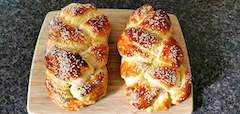
My Way Bikery challah (photo from My Way Bikery)

“I met Markus when he first opened the Bikery and I was one of his first customers, but it was purely luck that I asked his advice for starting a business in Nanaimo and he handed us the business in Victoria. Unwilling to miss this G-d-given opportunity, we jumped on the chance,” Moshe Appel recalled.

“We are keeping much of the same menu as Markus did, but expanding it to include soups, salads, more breads and Jewish dishes and, in a few months, plan to expand it to include cholov Yisroel dairy products as well.”

The menu lists dozens of items. There are savoury pastries and shakshuka, halva and combos (including pita and Leah Appel’s hummus). Some of the popular items are the My Way Sandwich, potato salad, kimmel rye, peanut butter cookies and Israeli salad. A current hit is Those Darn Cookies, a sweet made with chocolate chips and almonds.

photo - My Way Bikery tahini cookies
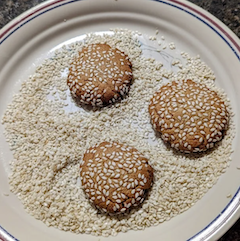
My Way Bikery tahini cookies (photo from My Way Bikery)

Among the new touches are jelly chal-nuts, Leah Appel’s take on a jelly donut; challah dough stuffed with sweet jelly and topped with raw cane sugar; and Oyvegg, a roll with Daiya “cheese,” an egg, garlic aioli, lettuce and tomato.

The Appels are even offering goodies for canines – Dunstan Donuts. “Named after Dunstan, who was a very good boy,” the menu reads, “these certified-kosher pareve dog treats are made with oats and bananas and taste amazing! Dunstan’s Donuts are delicious enough for you, but made just for your four-legged friend!”

Favourites from the Bikery, including numerous varieties of pretzels and bagels, lemon-poppyseed muffins and challah in all shapes, sizes and flavours, are still available.

The Appels say they are in preliminary talks to open a storefront location in Nanaimo.

My Way Bikery is located toward the back of Victoria’s Public Market, which is situated close to City Hall and Centennial Square – a few blocks away from the Empress Hotel and Parliament – in a building that operated for several decades as a Hudson Bay department store. It is open Monday to Thursday, 7 a.m.-11 p.m., Friday, 7 a.m.-3 p.m.; and Sunday, 11 a.m.-6 p.m. Friday hours will be extended in the spring, as the days grow longer.

For more information or to place an order, visit mywaybikery.ca, call 778-430-2453 or email [email protected].

Sam Margolis has written for the Globe and Mail, the National Post, UPI and MSNBC.

Format ImagePosted on February 10, 2023February 9, 2023Author Sam MargolisCategories LocalTags bakery, British Columbia, business, kosher food, Leah Appel, Moshe Appel, My Way Bikery, Nanaimo, Vancouver Island, Victoria
Creating functional artworks

Creating functional artworks

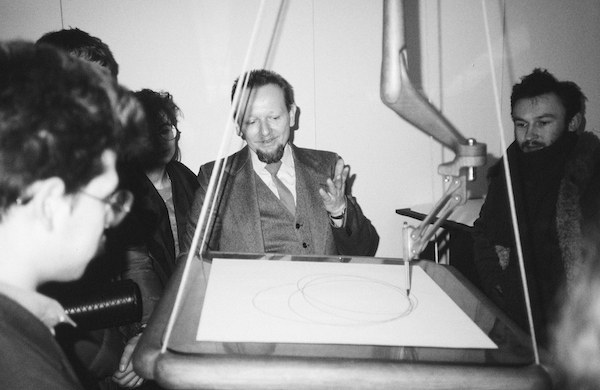
An archival photograph of Andrzej Jan Wroblewski explaining the mechanics of one of his kinetic sculptures, a predecessor of Opus 6. (photo from cicavancouver.com)

During the six decades of his professional life, industrial designer Andrzej Jan Wroblewski contributed to almost every area of artistic expression and human consumption. A list of his works includes cutlery for an airline, an excavator, tapestries, computer software, children’s books, kinetic sculptures, an iron, and a portable shower in a suitcase. His retrospective show, Andrzej Jan Wroblewski: Invisible Forces of Nature in Art and Design, opened Jan. 26 at the Centre of International Contemporary Art (CICA) in Vancouver.

Wroblewski graduated from the Academy of Fine Arts in Warsaw, Poland, in 1958. A year before, as a student, he participated in his first major sculpture competition – for the Auschwitz-Birkenau Memorial. The committee received 426 entries from many countries. Wroblewski and his friend, architecture student Andrzej Latos, designed a way for a visitor to walk through the camp’s horrors, to understand them on a visceral level. Their design used the existing landscape, while the authors acted as composers of the visitors’ experience.

“Our submission was one of only seven selected for the short list,” Wroblewski said in an interview with the Independent. “Before I submitted, I didn’t even tell my sculpture professor. I thought he might have submitted his own concept and I didn’t want him to think I was competing with him, especially if I didn’t win. I was right. He did submit his own proposal and he was one of the seven shortlisted as well.”

After that, there was no more hiding. “But my professor was a wonderful man,” Wroblewski recalled. “He told me that my presentation was so good, I should use it as my diploma project. He also offered me the position of his assistant after my graduation.”

Wroblewski started teaching sculpture, but he doubted the artistic medium would be his future. “After my project didn’t win the Auschwitz competition, someone tried to comfort me,” he said. “They said I could use the idea for some other project, and it made me angry. Re-using that idea felt wrong. The whole concept was created for a special place and purpose; it didn’t belong elsewhere. And that led me to thinking that maybe sculpture wasn’t what I wanted to do. Artists rarely decide what happens to their creations; bureaucrats decide. But if I switched to industrial design, I would have many more chances to give my creations to people: industrial designers create with their users in mind.”

He switched to industrial design and became one of the pioneers in the field in Poland. He submitted proposals for several international competitions and worked on many objects on contract with production companies. An excavator, a scooter, and a set of thin steel cutlery for a Polish airline all originated from that period of his life. He became the first dean of the faculty of industrial design of his alma mater.

“Industrial design changes our behaviour,” he said. “If I design a cup and it goes into production, it could change how people drink. Good industrial design is supposed to make our lives easier.”

Wroblewski was one of the first industrial designers in Poland to use a computer, and even developed special software to help other industrial designers. By 1987, he was a rector of the Academy of Fine Arts in Warsaw. Cracks in the Iron Curtain were already emerging, and the academy started cooperating with one of the best schools of industrial design in the United States. In 1988, Wroblewski received an invitation to teach at the University of Illinois.

“I taught there for 13 years, before I retired,” he said. “After retirement, in 2000, my wife and I moved to Vancouver. Our daughter was already here, working at UBC. I taught at Emily Carr, but for one semester only. I still had too many ideas, too many projects in my head, and I wanted time. Retirement gave me that time.”

Some of his ideas are on display at the CICA gallery. All of these installations employ various forces of nature, which lent the show its name. “In the past,” Wroblewski said, “the division in the arts was much more rigid. You either did sculpture or you painted or you drew. Now, the dividing lines are dissolving. The artist uses what he needs to express himself. One installation might involve several artistic forms in various combinations.”

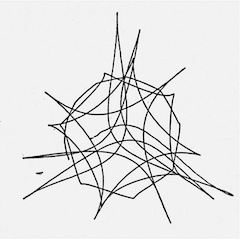
One of the pieces is an interactive kinetic sculpture called Opus 6. It explores kinetic energy and gravity. There is a moving part with a tablet and a stationary part with a suspended pen. If you put a piece of paper on the tablet and give it a nudge, it begins swinging, and the pen produces a unique abstract drawing on the paper underneath.

photo - A doodle created by Andrzej Jan Wroblewski’s Opus 6
A doodle created by Andrzej Jan Wroblewski’s Opus 6. (photo from Andrzej Jan Wroblewski)

For Wroblewski, Opus 6 was a reconstruction. His original installation was called Opus 5 and it was bought by a museum in Poland. “I decided it was much cheaper to build it from scratch here, in Vancouver, than to transport the original from Poland and back,” he said.

Another installation explores gravity and viscosity and concentrates on water. “I studied music before the art academy [and] I used my own music for the water installation,” the designer shared. “I also built a special maze of Plexiglass to be able to see how a drop of water flows, and then I recorded it all in a light projector and created a video. This installation is a tribute to water, one of the most powerful forces of nature.”

In a separate corner, made dim by the enclosed walls, Wroblewski situated a series of light sculptures. His chandeliers hang from the ceiling or stand on the floor, their radiance interweaving. The shapes and sizes are all different, but the material used is the same: paper-thin strips of light-coloured wooden veneer.

Wroblewski’s desire to explore new materials and new approaches for his work always drove him towards experimentation, towards the unknown. “When I came to the States, I was fascinated by computers,” he said. “I used a program called Paintbrush to create some abstract compositions, but, at that time, there were no printers big enough to give me the large size I wanted. I decided that a tapestry would be the best medium to enlarge those digital paintings. I built a special loom and made a tapestry for each of those paintings. Every pixel in the digital paintings corresponds exactly to one knot in the tapestry. It took me about six months to complete each of the large tapestries. It is how I operate. When I have an idea, I find a way to achieve it.”

Demonstrated side by side with the printouts of his digital paintings on standard-sized paper, his couple-metre-wide tapestries look impressive.

One of his most recent projects is a series of 10 children’s picture books. Each book is about a specific animal, with the amusing pictures by Wroblewski and the text by his daughter, University of British Columbia professor Anna Kindler. “We did it when my great-granddaughter was born, three years ago,” he said.

His latest sculpture dates from about the same period, 2019. “I saw a tree grown through a fence, as if the wires sprouted from inside the tree. It was near UBC. I cut it down and installed it in a wooden frame. It demonstrates how nature could absorb civilization.”

In 2018, for his lifetime contributions to the field of industrial design in Poland, Wroblewski was awarded the Officer’s Cross of the Order of Merit of the Republic of Poland. He was also named one of the three most influential Polish designers of the 20th century.

The retrospective runs until March 3. For more information, visit cicavancouver.com.

Olga Livshin is a Vancouver freelance writer. She can be reached at [email protected].

Format ImagePosted on February 10, 2023February 14, 2023Author Olga LivshinCategories Visual ArtsTags Andrzej Jan Wroblewski, Centre of International Contemporary Art, CICA, industrial design, Poland
Dutch survivor shares his story

Dutch survivor shares his story

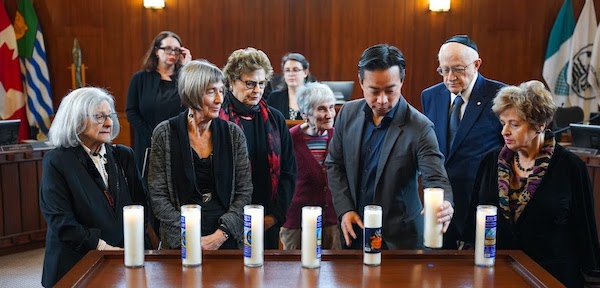
Vancouver Mayor Ken Sim (third from right) lit memorial candles with Holocaust survivors (from left) Rita Akselrod, Amalia Boe-Fishman, Marie Doduck, Claude Romney, Peter Suedfeld and Ella Levitt. Behind are Nina Krieger of the Vancouver Holocaust Education Centre and Cantor Shani Cohen of Temple Sholom. (photo from VHEC)

Until 1943, Amsterdam’s Hollandsche Schouwburg theatre was used by the Nazis as a deportation centre for Dutch Jews. The youngest children were placed in a Jewish orphanage across the street. A tram would come at 10-minute intervals, providing a brief window of time during which the Nazi guards outside the theatre would lose sight of the orphanage.

The Dutch underground, in cahoots with the nurses at the orphanage, would smuggle babies and toddlers out of the orphanage during this fleeting moment. A member of the resistance would ride by on a bicycle pulling a garbage can and a nurse would pass a child through a ground-floor window into the receptacle and replace the lid.

One of those children was Peter Voormeij, who shared his Holocaust survival experience with a standing-room audience at the Bayit in Richmond, Jan. 29, marking International Holocaust Remembrance Day.

“My mother’s family were Orthodox Jewish and my father’s Roman Catholic,” he said at the event. Both families were against the union, partly due to the religious differences but perceived differences in social status were also a factor. “In any case, they got married and I was a result of their union.”

Soon after Peter was born, in late 1940, his father was arrested by the Nazis, suspected of being a spy, and was incarcerated at a Gestapo facility in Berlin.

Peter’s mother’s extended family fled into hiding, but his mother mistakenly believed that her marriage to a Catholic man, even an accused spy, provided her some security from deportations.

“She refused to wear the yellow star as was demanded of the Jews,” Voormeij recalled. “But a girlfriend of hers told the local police that she was a Jew, they confronted her and insisted that she should wear the yellow star. She did and, as a result, I clearly remember that we were not allowed in the park playground, which I was so looking forward to. No Jews allowed.”

He was only 2-and-a-half when he was separated from his mother. She was taken to Westerbork, the Nazi transit camp in the Netherlands, and transported by cattle car to Sobibor. “I often think of her alone, without her little boy, to have her beautiful blond hair cut and forced into a shower with many other women,” said Voormeij. “But no shower – gas.”

At the end of the war, Voormeij’s father returned to the Netherlands. Through his connections in the underground, he located his son, who had survived in hiding – and who, not yet 5, didn’t know he was a Jew.

Peter was raised for a few years by his beloved paternal grandmother. “There, I grew up in a Catholic household, went to a school attached to the church,” he said. “My memories of the time are reasonably good, albeit one time I was sexually molested by a [Catholic] brother – what else is new?”

When Peter was 12 years old, his grandmother died. He then returned to his father’s home, but now had a stepmother who he detested – and the feeling was mutual. One day, during a row, she yelled at him: “You are a typical Jew!”

“From that moment on, my life changed,” he said. “I realized that I am indeed a Jew. I looked at the church in a different way and I couldn’t understand why the Jews were persecuted and killed.”

However, he understood the implications of his new identity. “I became afraid of being a Jew and kept my mouth shut from then on,” he said. “Nobody will ever know that I’m a Jew.”

He indeed kept his identity largely secret. He excelled in school and received a scholarship to art school in Adelaide, Australia – four years with all expenses covered. He became a noted painter and art teacher, completing a master’s degree at what would become Concordia University, in Montreal, and later moving to New York City and back to the Netherlands. A turning point came in the early 1980s, during a conversation with a Dutch gallery owner who was to exhibit some of Voormeij’s work.

“She told me she despised the Jews,” he recalled. “At that point, something broke in me and I told her I was a Jew and left the gallery for good.”

He contacted his uncle, a brother of his mother who had survived by escaping to Switzerland. “My uncle introduced me to what it was like to be a Jew,” he said. “He gave me my first kippah and taught me some Jewish prayers. He also took me on my very first visit to a synagogue.”

At times, when he was alone with his uncle, he would ask about his mother. “I was dying to know more about her,” he said. “He was the only one that could remember. There was nobody else I could ask. Each time I brought her up, he would cry and I would cry with him while holding his hand.”

Eventually, Voormeij and his wife moved to British Columbia and he met a member of the Child Survivors Group that operates out of the Vancouver Holocaust Education Centre (VHEC). He joined and found a place among fellow child survivors.

The Jan. 29 event was the fourth annual commemoration of International Holocaust Remembrance Day in Richmond. It was co-sponsored by the Kehila Society of Richmond, the VHEC and the Jewish Federation of Greater Vancouver.

Rabbi Levi Varnai emceed the ceremony and spoke as a child of a survivor, noting that his grandfather was murdered when he was younger than Varnai is now. Cantor Yaakov Orzech recited the memorial prayer El Moleh Rachamim.

Parm Bains, member of Parliament for Steveston-Richmond East, brought a message from Prime Minister Justin Trudeau and the federal government. Kelly Greene, member of the B.C. Legislature for Richmond Steveston, brought greetings from Premier David Eby and the provincial government. Members of the Legislative Assembly, Henry Yao and Teresa Wat, were also in attendance. Richmond Mayor Malcolm Brodie spoke and four councilors – Bill McNulty, Chak Au, Andy Hobbs and Laura Gillanders – also attended.

Pascale Higham-Leisen, VHEC program coordinator, introduced Voormeij. Bayit president Keith Liedtke introduced the mayor, who noted that the day of the commemoration – Jan. 29, two days after the official International Holocaust Remembrance Day – was also the sixth anniversary of the mass shooting at a Quebec City mosque, in which six worshippers were murdered.

A smaller, invitation-only ceremony was held Jan. 27 at Vancouver City Hall. Vancouver Mayor Ken Sim lit memorial candles with six Holocaust survivors: Rita Akselrod, Amalia Boe-Fishman, Marie Doduck, Ella Levitt, Claude Romney and Peter Suedfeld. He also expressed condolences for a terror attack that happened earlier in the day at a Jerusalem synagogue, where seven people were killed. Bridges and buildings around the province were illuminated in yellow that evening to mark the memorial day.

Nina Krieger, executive director of the VHEC, which partnered with the Centre for Israel and Jewish Affairs and the Jewish Federation of Greater Vancouver to organize the civic event, thanked the assembled city councilors for recently adopting the International Holocaust Remembrance Alliance Working Definition of Antisemitism. Cantor Shani Cohen of Temple Sholom recited El Moleh Rachamim.

Format ImagePosted on February 10, 2023February 9, 2023Author Pat JohnsonCategories LocalTags Amsterdam, Holocaust, Peter Voormeij, survivor, Vancouver Holocaust Education Centre, VHEC
Survivor receives ovation

Survivor receives ovation

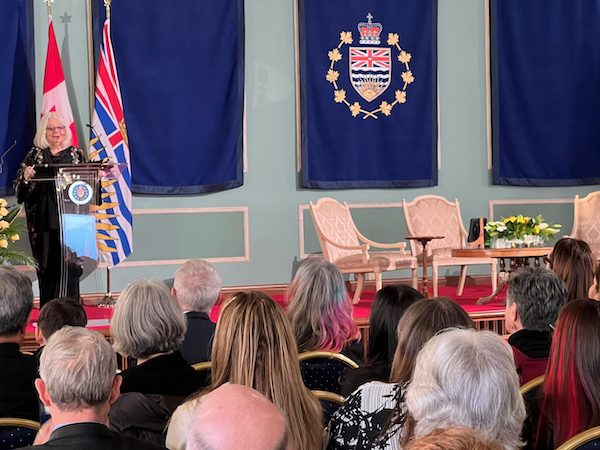
Lillian Boraks-Nemetz speaks at Government House on Jan. 19. (photo from ltgov.bc.ca)

On Jan. 19, Lillian Boraks-Nemetz received a standing ovation for her speech at an event hosted by the lieutenant governor of British Columbia, Janet Austin, at Government House in Victoria.

In a mere 12 minutes, Boraks-Nemetz took the audience through the horrors she suffered during the Holocaust: the rise of anti-Jewish laws, the killing of her younger sister, the escape from the Warsaw Ghetto, the separation of family and the loss of identity – each with its own devastating consequences. She also spoke about the trauma that accompanied her after moving to Canada.

She began by quoting the words of Janusz Korczak, the Polish doctor, educator and head of an orphanage in Warsaw, who was killed with his charges at Treblinka in 1942. He wrote, “the well-being of a country is as good as the well-being of its children.”

To that quote, Boraks-Nemetz added, “When you look around, it seems that the world itself is not in good standing on this issue. I know this to be true as a childhood witness of the Holocaust and as an adult witnessing the present lives of strife for many children in various countries: fighting wars, poverty and hunger.

“My own childhood ended the day Nazi Germany invaded Poland and World War II began. Our happy lives ended and I became an adult at the age of 6. All Jewish children were automatically sentenced to death by Hitler and the Third Reich, and I was one of them. A million and a half Jewish children were murdered in the Holocaust – among them almost all my cousins and my sweet little sister.”

Boraks-Nemetz described her experiences as both a First and Second Generation survivor. She spoke of bearing not only her legacy, but the legacies of her parents, who survived the Holocaust but were not the same parents as before, mourning the loss of their young child and other tragedies. She discussed the interval following the war to the time the barbarity of what occurred began to register.

“The hidden child gnawed at my soul wanting to get out. I chose to live for many years like a good Canadian housewife and mother, but when I reached the age of 40, all hell broke loose. I fell apart and there was no help,” Boraks-Nemetz said.

“Trauma,” she added, “leaves behind a deep wound that, when unhealed, will eventually begin to start creating an emotional pain which won’t let you cope with an ordinary life. [It’s] a pain that few understand.”

The ensuing breakup of her family, she recounted, took many years to repair. At a certain point, she was able to put the pieces back together and begin to understand the root of her pain through telling her story to students and adult groups, and through writing novels and poetry. Boraks-Nemetz is the author of several books, including The Old Brown Suitcase, Mouth of Truth and, most recently, Out of the Dark, a collection of poetry.

“I wanted to understand how the past shaped my present and, above all, I wanted to mend my relationships with my children of whom I am so proud – my Second Generation children who also bore the brunt of my pain and whose forgiveness and understanding mean more to me than life,” she concluded.

The moment Boraks-Nemetz finished speaking, the crowd rose to its feet.

Titled Reconciliation and Holocaust Remembrance: Conversations on Intergenerational Trauma and Healing in Jewish and Indigenous Communities, the evening included short presentations by Nina Krieger, executive director of the Vancouver Holocaust Education Centre, and Chief Robert Joseph, ambassador for Reconciliation Canada and a former member of the National Assembly of First Nations Elders Council.

Afterwards, Austin led a dialogue between panelists Marsha Lederman, arts correspondent for the Globe and Mail and author of Kiss the Red Stairs: The Holocaust Once Removed, and Carey Newman, a multi-disciplinary Indigenous artist, master carver, filmmaker and author. Their discussion explored experiences of healing across communities that have suffered intergenerational trauma from the Holocaust, residential schools and racism.

“I am grateful for the courage of these survivors and their children for the gift of their stories and sharing such intensely personal experiences so generously. In the pursuit of truth, we must deepen understanding and seek to connect in our hearts, to heal together,” said Austin.

“It is always my honour to sit with Holocaust and residential school survivors, as well as distinguished advocates for hope, help, healing and reconciliation. Acknowledging and addressing trauma is the key to better health and recovery. A good friend of mine once said to me: ‘We must always work together in dialogue and never compare trauma,’” said Joseph.

The Government House event was held in partnership with the Jewish Federation of Greater Vancouver, and the Jewish Federation of Victoria and Vancouver Island.

“With discrimination and racism on the rise here in B.C. and around the world, it is now more important than ever that the experiences and lessons learned from the Holocaust, residential schools and other forms of discrimination and racism remain present in the public mind so that history does not repeat itself,” said Ezra Shanken, chief executive officer of Vancouver’s Jewish Federation. “Only by learning from the past can we prevent such hatred and atrocities in the future.”

Sam Margolis has written for the Globe and Mail, the National Post, UPI and MSNBC.

Format ImagePosted on February 10, 2023February 9, 2023Author Sam MargolisCategories LocalTags Holocaust, Janet Austin, Lillian Boraks-Nemetz, reconciliation, Robert Joseph, survivor
JDC’s Ukraine efforts

JDC’s Ukraine efforts

Marina Sonkina shares her experiences as a volunteer with the JDC in Poland last year, helping Ukrainian refugees. (photo by Masumi Kikuchi)

This year’s annual Raoul Wallenberg Day in Vancouver honoured the American Jewish Joint Distribution Committee (JDC) for “its courageous support for Ukrainian refugees.”

“In addition to vast internal displacement, from a population of 41 million Ukrainians, eight million (mostly women and children, and some seniors) have fled to Europe and other parts of the world,” said Alan Le Fevre in his opening remarks.

Le Fevre is on the board of directors of the Wallenberg-Sugihara Civil Courage Society, which hosts the Wallenberg Day commemorations. This year, the event was presented in partnership with Congregation Beth Israel, and it took place at the synagogue on Jan. 22.

The JDC’s work helping Ukrainian refugees “continues its illustrious history,” said Le Fevre, noting that, “since its founding in 1914, the JDC has provided support for refugees whenever and wherever needed, propelled by Jewish values and a commitment to mutual responsibility.”

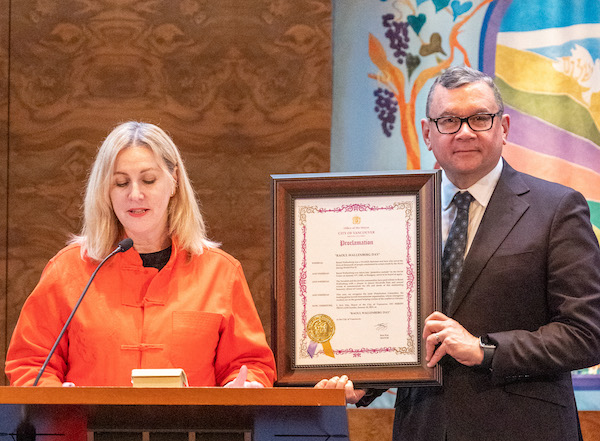
The City of Vancouver’s proclamation of this year’s Wallenberg Day was read by Deputy Mayor Sarah Kirby-Yung, attending on behalf of Vancouver Mayor Ken Sim. She was joined by Councilor Mike Klassen.

Kirby-Yung had helped celebrate the start of the Lunar New Year that morning, and still had on the red jacket she had worn for that event because the Asian community “has suffered much in the past few years, [with] anti-Asian hate and, sometimes, that plight has been very analogous to what our Jewish community has suffered” and one of the best things about the city, and what she sees in the work of the JDC, is “communities and cultures, and people of different faiths and backgrounds, who come together to stand against injustice and to support each other.”

photo - Vancouver Deputy Mayor Sarah Kirby-Yung reads the city’s proclamation of this year’s Wallenberg Day, the framed copy of which is being held by Councilor Mike Klassen
Vancouver Deputy Mayor Sarah Kirby-Yung reads the city’s proclamation of this year’s Wallenberg Day, the framed copy of which is being held by Councilor Mike Klassen. (photo by Masumi Kikuchi)

WSCCS board member George Bluman introduced the afternoon’s guest speaker, Dr. Marina Sonkina, a local educator and writer. “Soon after Russia attacked Ukraine, Marina applied to volunteer with the Jewish Joint Distribution Committee, as someone who speaks Russian, Ukrainian and other languages and as someone who has been a refugee herself,” he said. “Almost immediately, she was accepted and flew to Poland at the end of March.

“After arriving in Warsaw, about five hours later, Marina was at the Polish-Ukrainian border, where she served in a camp as a frontline responder, offering fleeing refugees medical and psychological support.”

Sonkina, who has relatives in Russia and Ukraine, said most of her family is out of Russia at this point.

“If we are talking about why didn’t Russians resist,” she said, “I think those more than one million people who left Russia when the draft, conscription, was announced, that is the only accessible form of not revolt, but saying no to Putin. Otherwise, it is pretty much a fascist state.”

While Putin is the person who launched the war, she wondered about others’ culpability: all those who overlooked Putin’s actions over the 22 years of his being power, which has seen him poison his opponents and annex Crimea, among other things. What was the West’s role, she asked, as they worked with Putin as a business partner first, putting his authoritarianism second?

In Warsaw, Sonkina was one of the people who met Holocaust survivors being extracted from Ukraine, to be housed in Germany. The next day, she worked in a refugee camp, where there were already more than two million refugees. (For more on Sonkina’s experience in Poland, read her account at jewishindependent.ca/helping-ukrainian-refugees.)

JDC helped everybody, said Sonkina. A moral responsibility to repair the world, tikkun olam, is part of JDC’s mandate and she saw this responsibility in action. She remarked on the goodwill of people from around the world, of a range of ages, who were helping in different ways, including taking refugees into their homes. The strength and independence of the refugees also left an impression on Sonkina – they didn’t want to take handouts, she said, and they wanted to know whether they could get jobs in the country that harboured them.

“One of the things that I quickly realized – a part of persuading them to go to this country or that was just the human contact that was so important,” she said. The refugees she met had experienced such trauma, and her acknowledgement of what they had gone through allowed some of them to cry. “It was sometimes hard,” Sonkina admitted, visibly emotional. “But there were also funny stories,” she added, sharing a couple of those stories before WSCCS board member Gene Homel took the podium.

An historian teaching about Europe in the 20th century for many years, Homel had been in Ukraine eight or nine years ago, and he echoed what Sonkina had said about Ukrainians’ “intense loyalty” – “the attachment to the land, culture and language” – but, he said, “I want to make the point that, in Ukraine today, the focus of loyalty is a civic one, it’s on the national state rather than ethnicity, it’s a pluralistic and multiethnic society that’s being created, forged largely as a result of Russia’s criminal attack on Ukraine.”

Homel provided a brief overview of the JDC’s work from its founding in 1914 to its current work with Ukrainian Jews and non-Jews, and he introduced businessman and philanthropist Gary Segal, who became familiar with JDC’s work in 2007, on a Jewish Federation of Greater Vancouver trip to Ethiopia, led by JDC professionals. He’s been a board member since 2012.

“I marvel at the compassion, intelligence, resourcefulness and resolve with which the dedicated staff and volunteers carry on their sacred work,” said Segal, noting that JDC helps communities of all backgrounds and faiths, and doesn’t just respond to acute situations, but also to endemic poverty, food insecurity and the plight of refugees, as well as antisemitism.

“Since 1914, we’ve rescued more than one million Jews in danger, from places like Ethiopia, Yemen, Bosnia and Herzegovina, and Ukraine,” said Segal, who spoke about various JDC initiatives, including its medical programs in countries like Ethiopia.

photo - Gary Segal, a board member of the American Jewish Joint Distribution Committee, speaks about JDC’s history and his involvement with the organization
Gary Segal, a board member of the American Jewish Joint Distribution Committee, speaks about JDC’s history and his involvement with the organization. (photo by Masumi Kikuchi)

It was on that 2007 trip that Segal met Dr. Rick Hodes, JDC’s medical director in Ethiopia, whose care for kids with severe spinal deformities (with Ghanaian spine surgeon Dr. Oheneba Boachie-Adjei) inspired Segal to get involved, too. He brought a young Ethiopian to Vancouver for back surgery and established in Vancouver the organization Bring Back Hope, which has raised some $3 million to support spine surgeries, preventative screening, and more. (See jewishindependent.ca/oldsite/archives/jan11/archives11jan14-02.html and several articles on jewishindependent.ca.)

Returning to JDC’s work in Ukraine since the war began, Segal noted that, to date, the organization “has cared for 35,000 vulnerable and elderly poor; it evacuated 13,000 Jews from Ukraine; provided over 40,000 refugees with food, medicine, trauma support; received over 19,000 incoming calls at the emergency centre; and provided over 1.3 million pounds of humanitarian assistance.”

Segal then brought his talk around to Raoul Wallenberg, Sweden’s special envoy to Hungary in 1944, who saved tens of thousands of Jews from deportation and death. “The original fund of $100,000 that [Wallenberg] received from the War Refugee Board came from the American Joint Distribution Committee and, when that was finished, he received additional funds from the JDC,” said

Segal, who concluded, “I would say, so much of what JDC does is giving hope. Hope is a powerful word, an essential element in everyone’s life…. Hope can give us the strength and the will to continue in our darkest moments, to aspire and believe that things can and will be better.”

On behalf of the JDC, Segal accepted, with thanks, the Wallenberg-Sugihara Civil Courage Award from Le Fevre.

Other components of the afternoon included a few words from Beth Israel’s Rabbi Jonathan Infeld, a short documentary on Norwegian Fridtjof Nansen, who received the 1922 Nobel Peace Prize for his work on behalf of displaced persons after the First World War, and a compilation of JDC’s work in Ukraine since the Russian invasion.

WSCCS board member Judith Anderson introduced the videos, giving more of Nansen’s background and achievements, including “the repatriation of 450,000 prisoners of war, mostly held in Soviet Russia” and “[in] response to a severe famine in Soviet Russia, Nansen directed relief efforts that saved between seven million and 22 million people from starvation.”

Anderson said, “The Nansen story is directly relevant to Ukraine. The headquarters for Nansen’s mission to Russia was in Ukraine’s Kharkiv, and Nansen donated part of his Nobel Peace Prize money to establish a major agricultural project in Ukraine.”

She thanked the Norwegian Refugee Council and the Nobel Peace Centre for permission to show the videos about Nansen and JDC staff members and directors – Shaun Goldstone, Solly Kaplinski and Alex Weisler – for compiling the material for the Ukraine Crisis video.

The Wallenberg-Sugihara Civil Courage Society is named after Wallenberg for his actions during the Holocaust, and Chiune Sugihara, who, as vice-consul in Lithuania for Japan during the war, issued transit visas that allowed thousands of Jews from Poland and Lithuania to escape. For more information on the society and to see videos of the Jan. 22 event, visit wsccs.ca.

Format ImagePosted on February 10, 2023February 9, 2023Author Cynthia RamsayCategories LocalTags Alan Le Fevre, American Jewish Joint Distribution Committee, Gary Segal, Gene Homel, George Bluman, JDC, Judith Anderson, Marina Sonkina, refugees, Sarah Kirby-Yung, Ukraine, Wallenberg-Sugihara Civil Courage Award, Wallenberg-Sugihara Civil Courage Society, war
Unique testimony on stage

Unique testimony on stage

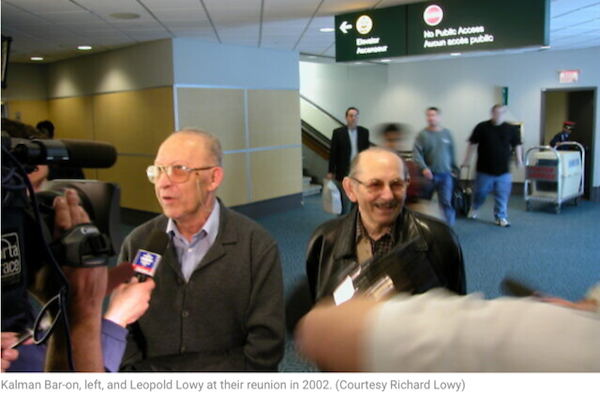
Kalman Bar-On, left, and Leopold Lowy at their reunion in 2002. (photo from Richard Lowy)

An SS guard walked down the line of prisoners gathered for roll call at Auschwitz-Birkenau in 1944 and randomly picked two boys out of the line. Kalman Braun and Leopold Lowy would spend the next six-and-a-half months together working as servants in a guard shack, giving them a unique viewpoint on what was happening in that place during some of the final months of the Second World War.

The boys, who each had twin sisters and were, therefore, of interest to the infamous Nazi doctor, Josef Mengele, would survive the Holocaust, as would their sisters. Lowy moved to Canada and settled in Vancouver, Braun moved to Israel and became Kalman Bar-On – the two would not see each other again for more than half a century.

Their story was shared at the Rothstein Theatre Jan. 26, the eve of International Holocaust Remembrance Day, the 78th anniversary of the liberation of Auschwitz-Birkenau. Richard Lowy, son of the late Leopold (or Leo) Lowy, presented an immersive experience that included first-person testimony, with Richard Lowy speaking the words, variously, of Bar-On, Leo Lowy and himself, as the son of Canada’s last surviving “Mengele twin,” who passed away in 2002, just a few months after he reconnected with Bar-On. Next year, Lowy intends to release a book based on hours of interviews he did with Bar-On.

The testimony, which Lowy presented last year in a similar format in Tel Aviv, is extremely rare, he contends, because of the unique vantage point his father and Bar-On had on concentration camp operations for half a year.

“This is these two Jewish kids, 15 years old,” Lowy told the Independent before the presentation, “cleaning the [SS] barrack, staring over the shoulders of the SS guards, at the front window looking out into the camp and watching the things that are going on, the selections, the liquidation of the Gypsy camp, the uprising of Crematorium IV, which is about 100 yards away from them. They can hear the fire pit and the people screaming.”

The reunion of Lowy and Bar-On, 57 years after liberation, almost didn’t happen. Richard Lowy had produced a documentary on his father’s Holocaust experiences, called Leo’s Journey. (This film and a shorter one about the reunion are available at leosjourney.ca.) The program aired on the National Geographic Channel in Israel and Bar-On happened to see it. He didn’t recognize the older Lowy, who he knew only as “Lippa,” but when a photo of the younger Leopold flashed across the screen, Bar-On was astounded.

“He’s looking at the screen and saying, ‘It’s my Lippa, it’s my Lippa,’” Richard Lowy said. Bar-On, who credited Leo Lowy for helping him survive the Holocaust, made a few calls and, before long, the telephone rang in the Lowy condo in Richmond. By this time, Leo was experiencing some dementia and it took time for him to realize who he was speaking with.

A reunion was quickly planned and Bar-On flew to Vancouver, where TV cameras captured the emotional meeting. As Bar-On shared his recollections, Lowy’s memories were also sparked. Subsequently, the younger Lowy recorded hours of testimony at Bar-On’s home in Tel Aviv.

“Kalman has a crystal clear memory of dates, times, places,” said Lowy. “By the month, by the week, by the day, by the hour, by the minute of things that were going on.… The guards treated them like mice.”

The teenagers witnessed and overheard things that they then shared with others in their barracks, where they returned at night from the comparative comfort of the heated guard shack.

“It put them in a very unique situation, but still dangerous,” said Lowy. “Think about it. You’re in a guard shack with SS guards. You do something they don’t like, they beat the crap out of you. But they do it in such a way that they are not going to break your arm, they are not going to kill you, because you are a ‘Mengele twin.’”

The building where the boys were assigned was particularly central.

“Leopold and Kalman’s guard shack was right at the top of the camp, outside of the hospital, right beside Kanada [where valuables stolen from prisoners were stored], right beside Crematorium Number IV, and you are able to see and hear all the different comings and goings,” he said. “Kalman gives us an overview of an area of the camp, the hospital camp, that I have never really read before.”

Leopold protected Kalman by, for instance, covering for his friend at work when Kalman could not move an arm after being injected with an experimental substance.

Bar-On has provided videotaped testimony to Yad Vashem, said Lowy, but it is about 35 minutes long, like many other survivor testimonies.

“I have about 14 hours of testimony,” said Lowy, “which basically takes me back to the time he was born, what his family was like, what it was like going to the yeshivah.”

Organizations like Yad Vashem that collect survivor testimonies do not have the resources to go into the depth with each individual that Lowy did with Bar-On, he said.

“I’m not interviewing thousands of people,” he said. “I don’t see how it would be possible to get 14 hours of interviews from every single survivor. I think that would just be an incredibly difficult challenge.”

Individual stories, though, are critical to understanding the Holocaust experience, said Lowy, noting monographs written by people like Elie Wiesel and Primo Levi, the more than 100,000 hours of testimony assembled by the USC Shoah Foundation, which was founded by Steven Spielberg, and films such as Sophie’s Choice, The Pianist and Schindler’s List.

At the event last month, projected images and video footage illustrated the narrative, while Lowy spoke, accompanied by violinist Cameron Wilson and cellist Finn Manniche.

The event was presented by Ward McAllister and Michelle Kirkegaard of the development firm Ledingham McAllister, who are friends of Lowy’s and funded the production. Volunteers from Na’amat Canada helped with the logistics.

Format ImagePosted on February 10, 2023February 9, 2023Author Pat JohnsonCategories LocalTags Auschwitz-Birkenau, film, Holocaust, Kalman Bar-on, Leo Lowy, memoirs, Richard Lowy, survivor, testimony

An intense, urgent read

A formula for survival for a child in the Holocaust: “Don’t trust anyone; never speak unless spoken to; never give your real last name; if you see your brothers and sisters, don’t run to them: cross over to the other side of the street. Don’t cry and don’t get sick; just survive.”

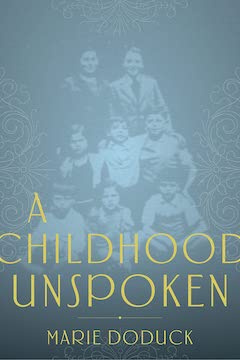
This is how the character of Mariette Rozen of Brussels, Belgium, aka Marie Doduck of Vancouver, Canada, was fashioned during her formative years between the ages of 6 and 11 during the Holocaust, beginning in 1940. Those words of caution from her older brother Jean, painfully scoured from the mists of Marie’s memory, have become a kind of coat that one takes off in polite company, but it is a mantle that never left her, even in her 80s, as Marie looks back in her memoir on her two lives: a child Holocaust survivor and a Canadian with a lifetime of achievement in the arts, family life, business and service to her community.

image - A Childhood Unspoken book coverEntitled A Childhood Unspoken, this book of only 138 pages is a powerhouse! Co-authored and researched by Simon Fraser University history professor Lauren Faulkner Rossi, the memoir is written in two authentic voices: Marie Doduck the Canadian citizen, 86-year-old mother, grandmother and great-grandmother who, while recollecting her past, slips back into Mariette Rozen, being hunted or hiding in Belgium in the 1940s or transitioning to a new life in Vancouver in the 1950s. I began reading the first chapter silently. Then, the urgency and honesty of the voices behind the prose came alive. I wound up reading the entire book aloud to my partner Ruth, who grew up with Marie and shares high school memories with her.

It was an intense experience. There is in the book an urgency to at last speak the unspoken repressed memories of her traumatic childhood, to unearth and – most importantly – to verify the truth of Marie’s memory about where Mariette had been, with whom and where she lived as she was bounced from one location in Belgium to another while running from the Nazis. Marie wondered: did Mariette really see her mother and brother snatched from a Brussels street by the Nazis or did that happen in a dream? Did she have grandparents? This and much more was verified through Faulkner Rossi’s research. Marie’s memory grew clearer, however, when she described the frustration of Mariette the teenaged refugee whose lack of English drove her to draw pictures in order to communicate with her Vancouver foster parents, the Satanoves.

But Mariette desperately wanted to catch up on her education, to fit into the Kerrisdale schools of Vancouver. To become a Canadian. Very quickly, and to the amazement of other children, she not only learned English but even seized leading singing roles in school operettas. As a married woman, the same talent, grit, brains and determination guided Marie to leadership roles in her children’s schools, in her synagogue, in Jewish charities and in business with her husband, Sidney Doduck. She gained such a wide reputation as a Holocaust witness and survivor that she was invited to address the German parliament, which she refused.

Several of the Shoah episodes retold by the Doduck-Rossi team bear repeating here. In a Belgian orphanage where Mariette’s Jewish origins had been carefully guarded, one of the nuns told the Nazis about her but then confessed it to the Mother Superior, who quickly opened a sewer for Mariette and banged the metal plate closed over her. Mariette waited for hours, terrified in the black sewer while rats crawled over her and the boots of Nazi soldiers clanged on the metal plate above. The Nazis left empty-handed.

Chased by Nazis, Mariette took shelter in a Belgian barn but knew that she couldn’t hide in a loose haystack because they would be probing them with pitchforks, so she chose a tightly-bound bale, dug a hole for herself, crawled in and pulled the hay in behind her. Sure enough, a Nazi came and began probing the loose stacks with a pitchfork. As he left, he stuck the fork into Mariette’s bale and pierced her hand. When the farm housewife came to rescue her, she found blood all over and took the child into the kitchen for repairs. “Who is doing all the screaming?” Mariette wondered out loud. “It’s you,” said the woman as she disinfected and bandaged the wound.

Although Mariette saw much brutality and death, there were some good people. Among her many saviours was a “good” German soldier. Mariette had been swept up on a Brussels street along with many other Jews and non-Jews, packed into a cattle car and transported to a concentration camp overnight. When the doors slid open at the camp, a Nazi soldier screamed in German, “What is my sister doing on this train?” Without hesitation, Mariette began screaming back the few German words she knew and the Nazi soldier took her off the train, put her into a motorcycle sidecar, drove her to the outskirts of town and dropped her off.

I was inspired by Marie’s Judaism. There is also much to be admired about her lack of hate and her anti-hate philosophy, her lack of self-pity and the life force that drove her to accomplish so much and to give back so much. Yet this book is also a tribute to Marie’s brothers and sisters and to all of those approximately 1,200 traumatized Jewish children who were brought to Canada after the war and strove to fit in and to make themselves a new life. It’s a memoir that Marie’s children, grandchildren and great-grandchildren can proudly cherish as a history of their ancestor who is one of this country’s great Jewish Canadians.

Stan Goldman is a retired English teacher who lives in Richmond.

Posted on February 10, 2023February 9, 2023Author Stan GoldmanCategories BooksTags Holocaust, Lauren Faulkner Rossi, Marie Doduck, memoirs, survivor
JP’s legal correspondent

JP’s legal correspondent

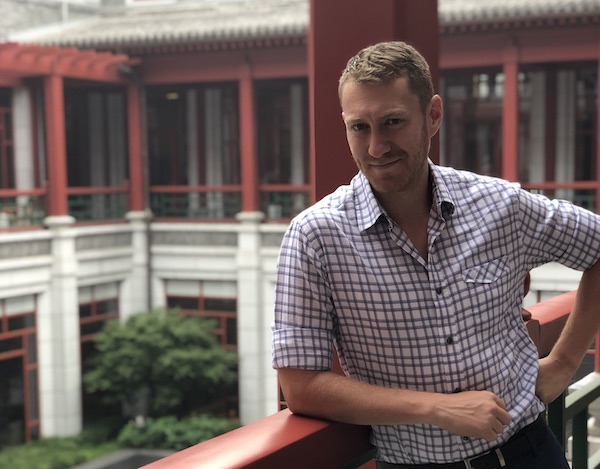
Michael Starr (photo from Michael Starr)

Canadian Michael Starr, who joined the Jerusalem Post in 2021, started a new position last month: that of legal correspondent.

Starr was born and raised in Toronto, but has a B.C. connection. His parents, Steven Starr and Iris Green-Starr, both doctors, moved the family to Victoria, where they still live, “because it is a lovely place and there is more nature there.” It was in Victoria that Starr attended high school.

Starr made aliyah at the age of 18 and joined the Israel Defence Forces later in the year, at the age of 19, serving in the infantry from 2009 to 2012.

“I grew up in a religious and Zionist household, and Israel was a large part of my cultural heritage,” he told the Independent about why he made aliyah. “My grandmother was born in Israel and my grandfather served in the Haganah and IDF. Further, there comes a time in every young man’s life in which he needs to leave his father’s home and put himself in a new environment to truly allow him to become himself.”

His brother, Joseph, came in 2012 and served in the Israeli army; today, he is in the Canadian military. Starr’s younger brother, Sam, is currently part of the IDF’s Golani Brigade.

Starr received a bachelor’s degree, majoring in government studies, and a master’s in terrorism and counterterrorism operations from Reichman University in Herzliya. (Reichman is Israel’s first and only private university, founded in 1994 as the IDC or Interdisciplinary Centre, a private college, before being rebranded in 2021.)

When a friend mentioned that there was a job opening at the Jerusalem Post, he applied and got the job.

“I never set out to be a journalist,” he said. “My interests are security and diplomacy.”

In March of 2021, he started writing for the Jerusalem Post magazine and the Post itself. From March 2020 through December of last year, he was on the breaking news desk.

“When the legal affairs correspondent position opened up, the end of November, I accepted because I wanted to be a journalist and it was a promotion, a step up,” he said. “I also like writing and this would be an opportunity to do more.”

On Jan. 1, Starr started that new position, “where I am reporting on the judicial reforms, which are not just one proposal but many different provisions. It was lucky I studied international law; this is a new field for me.”

Although Starr admits, “I’m a bit of a workaholic,” he runs for enjoyment and takes long walks.

Sybil Kaplan is a Jerusalem-based journalist and author. She wrote Witness to History: Ten Years as a Woman Journalist in Israel, set against the history of Israel in the 1970s, and Hatzaad Harishon, A “First Step” Love Story, relating her experiences as the first youth leader of the first black Jewish youth group in New York. She has edited/compiled nine kosher cookbooks and is a food writer for North American Jewish publications.

Format ImagePosted on February 10, 2023February 9, 2023Author Sybil KaplanCategories IsraelTags Israel, Jerusalem Post, journalism, judicial reform, Michael Starr
Integration policy misguided

Integration policy misguided

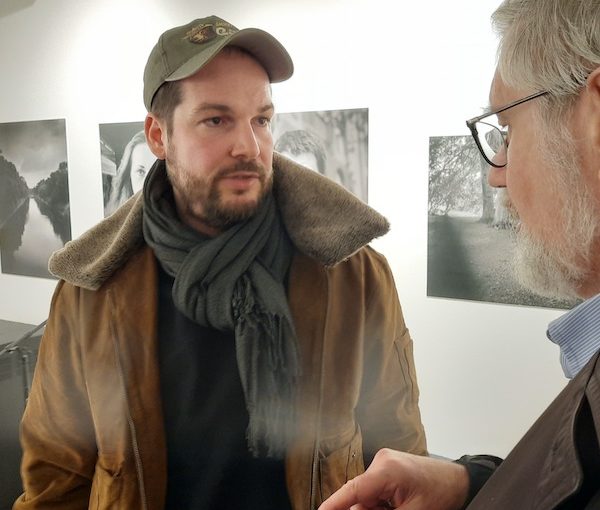
Max Czollek, left, speaks with Prof. Chris Friedrichs, after Czollek launched his new book here Jan. 19. (photo by Pat Johnson)

German attempts to create a cohesive national narrative into which newcomers must integrate is a mistake – and the role Jewish Germans play in this “Theatre of Memory” is especially problematic, according to Max Czollek, a provocative thinker who was hosted by the Cherie Smith JCC Jewish Book Festival last month.

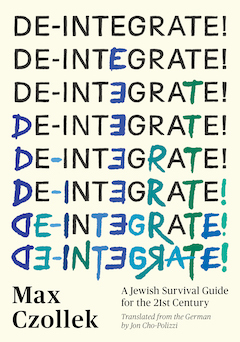
Czollek visited Vancouver Jan. 19, the only Canadian stop on a North American tour promoting the English translation of his book De-integrate: A Jewish Survival Guide for the 21st Century. He excoriated the German integration process as an ideological disaster.

“The only integration Germany has done well is the integration of old Nazis,” he said, explaining that about 99% of Nazi core perpetrators never met justice and, in fact, often succeeded in postwar Germany despite their wartime activities. By contrast, he notes in his book, those who challenged the Nazi regime were often viewed in the postwar context as politically untrustworthy: “[A]fter all, they had already revealed themselves as willing to resist the structures of the German state before.”

While the failure of the larger integration scheme is a theme of Czollek’s book, his main thesis is that Jews are being used to cover up the atrocities of the past. In the contemporary German narrative of integration, newcomers to the country are expected to assimilate into a vaguely defined “guiding culture” (Leitkultur) and not misbehave, Czollek told an audience in the Zack Gallery. But, despite that the vast majority of German Jews are migrants, too, that expectation is not imposed on them. Instead, Jewish Germans are assigned a different and unique role in a German narrative that seeks a return to a normality that was shattered by the Nazi era.

Positioning German Jews collectively as bit players in a larger narrative of redemption reduces them to a cover for the history of their own destruction, he argued: “Because, as long as there are Jews in Germany, then Germans can’t be Nazis.” He later said, “We don’t feel this is our function – making Germans feel good again.”

Czollek, who was born in East Berlin in 1987, two years before the reunification of Germany, explained the different postwar experiences of the tiny Jewish populations of East Germany and West Germany. Numerically, though, these experiences are overwhelmed by those of post-Soviet Jews: 90% of German Jews are migrants from the former Soviet Union or their descendants, he said. And these migrants (or, in the term used for their children and grandchildren, “postmigrants”) are excluded from the burdens placed on other newcomers, especially Muslims. In fact, said Czollek, Muslim immigrants play a role in this narrative, too, in which “good Germans” must now protect Jews against perceived threats from Muslims.

image - De-integrate book coverThe author looks with a particularly jaundiced eye at German Jews who subscribe to this narrative, such as those who vote for the far-right Alternative for Germany party (AfD) based on anti-Muslim and anti-immigrant policies. “Maybe the next time the mosques are going to burn first, but then the synagogues are going to be next,” Czollek said. “We know if the Muslims won’t be able to live safe in Germany, then the Jews won’t either.”

The very idea of a German “guiding culture” is flawed, Czollek argues, not only because the unification of Germany in the 19th century brought together diverse tribes and groupings into what is now purveyed as a unitary nation, but because the postwar immigration of diverse peoples has made such a unified culture unworkable. “Because, given its current state of social diversity, arriving at an ethnically and culturally homogeneous Germany would simply require ethnic and cultural cleansing,” Czollek writes.

A central flaw in the integration narrative, he argues, is that, no matter how long someone named Mohammad has lived in Germany, they will be subject to different criteria of good citizenship. Neo-Nazis who commit arson against refugee shelters or march down the street chanting “Heil Hitler” are not accused of failing to integrate into the German culture, he noted.

“[A]t what point are you no longer considered an immigrant who refuses to integrate [Integrationsverweigerer], but simply a frustrated German?” he asks.

Czollek contends that the narrative of a prevailing German culture (and integration into it) has seeped from the far-right across the spectrum. “Not a single democratic party platform neglects to centre this term in discussions of social belonging,” he writes. “No discussion panels about migration are complete without someone underscoring the importance of integration.”

Czollek argues for a live-and-let-live approach, but suggests the advocates of integration aren’t interested.

“They can eat weisswurst with sweet mustard for lunch and drink at least one litre of beer a day,” he writes. “I have no problem with that and neither do my friends. And that’s precisely the point that fundamentally separates those of us who would defend a concept of radical diversity from those proponents of German guiding culture: we want to create a space in which one can be different without fear, while the other side wants to implement cultural criteria for belonging that by necessity exclude those who don’t align with their concept.”

The original German version of Czollek’s book was published in 2018, shortly after the far-right AfD had become the third-largest party in the Bundestag. Rather than spurring a backlash against extremism, other politicians took a page from the playbook, he argues, with the parties of the right, centre and left warning of the perils of nonintegrated newcomers.

Czollek views the AfD’s rise as a symptom as much as a cause – “Suddenly things everywhere are staining Nazi brown,” he writes – and he sees a different avenue for political success in the face of the far-right surge.

“I don’t believe Germany will win the fight against the New Right without the votes of (im)migrant, postmigrant, Jewish and Muslim citizens,” he writes. “And this critical – if perhaps unfamiliar – new alliance requires strong narratives, the willingness to accept self-criticism from all sides, and a political vision for a society beyond the current integration paradigm.”

Czollek has a doctorate from the Centre for Antisemitism Research at the Technical University of Berlin, has published books of poetry, and is a co-editor of Jalta, a journal of contemporary Jewish culture. He has been involved in political and multicultural theatre in Berlin for many years but with this, his first nonfiction book (translated into English by Jon Cho-Polizzi), he burst on the scene as a contentious public intellectual. The opposition to his work evoked not just political challenges but also public efforts to discredit him based on his identity as a patrilineal Jew.

Czollek’s presentation, in conversation with Markus Hallensleben, associate professor in the department of Central, Eastern and Northern European studies at the University of British Columbia, was opened by book festival director Dana Camil Hewitt. The main festival runs Feb. 11-16.

Format ImagePosted on February 10, 2023February 9, 2023Author Pat JohnsonCategories BooksTags assimilation, Germany, governance, Holocaust, integration, Max Czollek, policy

Posts pagination

Previous page Page 1 … Page 145 Page 146 Page 147 … Page 667 Next page
Proudly powered by WordPress