Skip to content
  • Home
  • Subscribe / donate
  • Events calendar
  • News
    • Local
    • National
    • Israel
    • World
    • עניין בחדשות
      A roundup of news in Canada and further afield, in Hebrew.
  • Opinion
    • From the JI
    • Op-Ed
  • Arts & Culture
    • Performing Arts
    • Music
    • Books
    • Visual Arts
    • TV & Film
  • Life
    • Celebrating the Holidays
    • Travel
    • The Daily Snooze
      Cartoons by Jacob Samuel
    • Mystery Photo
      Help the JI and JMABC fill in the gaps in our archives.
  • Community Links
    • Organizations, Etc.
    • Other News Sources & Blogs
    • Business Directory
  • FAQ
  • JI Chai Celebration
  • JI@88! video

Recent Posts

  • Legal help for students
  • Revisiting myth of Lilith
  • Wrong person rebuked
  • Canada’s mixed messages
  • Questions for museum
  • Symposium on antizionism
  • Making soccer political
  • CJPAC lauds Pulver’s impact
  • City recognizes Vrba’s legacy  
  • Organ donation saves lives
  • Theodore’s March premiere
  • A healing Shabbaton
  • Supplying healthy food
  • A chime of metal tags
  • Yellowknife seder a first
  • Ishai energizes, unifies
  • A Lag b’Omer to remember
  • Expanding the healing
  • Hannah Senesh – a unique hero
  • Community milestones … May 2026
  • Sharing her testimony
  • Fall fight takes leap forward
  • The balancing of rights
  • Multiple Tony n’ Tina roles
  • Stories of trauma, resilience
  • Celebrate our culture
  • A responsibility to help
  • What wellness means at JCC
  • Together in mourning
  • Downhill after Trump?
  • Birth control even easier now
  • Eco-Sisters mentorship
  • Unexpected discoveries
  • Study’s results hopeful
  • Bad behaviour affects us all
  • Thankful for the police

Archives

Follow @JewishIndie
image - The CJN - Visit Us Banner - 300x600 - 101625

Month: April 2019

Synchronizing rhythms

Synchronizing rhythms

Dr. Shimon Amir researches circadian rhythms and clock genes. (photo from Shimon Amir)

When our circadian rhythm is disrupted, it can cause a brain disorder that manifests in a series of detrimental conditions too numerous to list, but that includes insomnia, depression and Parkinson’s disease.

“Circadian rhythms are daily observations in behavioural, physiological and metabolic processes,” explained Dr. Shimon Amir, professor of psychology, Concordia University in Montreal, and director of the university’s Centre for Studies in Behavioural Neurobiology. “In fact, everything you can measure in an organism follows a daily rhythm – a 24-hour cycle generated by internal clocks present in each and every cell in our bodies. And they are synchronized with the environmental light cycle. So, there is tuning between the internal rhythms and the solar cycle. Those are the rhythms.

“Most people might think that rhythms are driven by the light-dark cycle, but that’s not the case. They are generated by a clock that is present in every cell. The clocks are made of a set of genes called ‘clock genes’ and they oscillate – form feedback logs that last each cycle, with each cycle lasting about 24 hours.”

Amir was born and raised in Israel and moved to Montreal for his PhD. He went back to Israel to work at the Weizmann Institute of Science, but later returned to Montreal to teach and do research on circadian rhythms and now, too, clock genes.

According to Amir, circadian rhythms allow organisms like flies, rats, monkeys, humans and even plants to anticipate and respond to the demands of their environment.

“Rhythms can be disrupted by various means,” he said. “Ones that are most common are traveling across time zones, working shift work and eating at the wrong times. But, the main reason for the disruption is movement across time zones. Your clock is synchronized to your location. So, if you move from, say, Vancouver to Montreal, the clock has to be advanced, as you’ll wake up in Montreal three hours earlier, right? That takes time and the mismatch between environment and internal cycles causes various metabolic, behavioural, cognitive and other problems.”

While there are clocks in every cell of the body, all these clocks report to the master clock in the brain. That clock receives input from the eyes – light information that resets the master clock daily.

When we use lights at night, the master clock gets disrupted. “The clock is very sensitive to light at night,” said Amir. “Say you’re asleep and you want to go to the bathroom in the middle of the night. You turn on the light and that causes a disruption of the clock. Another way to disrupt the clock is the time that you eat. Eating should occur during the day.

“The reason light is so disruptive at night is that one arm of the clock is a hormone called melatonin. Melatonin is exceedingly sensitive to light. It is secreted during the night and is suppressed during the day. But, if you turn on the light at night – even very brief exposure to light at night – it suppresses the melatonin rhythm.”

Amir suggested using a sleep mask to keep light away, as well as learning to use the washroom at night without turning on a light. “You can adapt to the dark very quickly and be able to see,” he said.

While Amir’s initial research interest was in circadian rhythm, over the last 10 years, he has expanded his focus to other clocks in the brain – those that control different types of behaviours and pathological conditions, such as depression, anxiety, drug addiction and diseases like Parkinson’s.

Through experiments with mice and rats, Amir has been working to configure which brain clock controls, or affects, how the rodents handle stimulation and what happens if these clocks are turned off or disrupted.

“So, the clocks are made of several particular genes called clock genes,” said Amir. “We have various molecular, genetic and viral tools to manipulate those genes directly … in different regions of the brain…. We’re seeing what happens when an animal that has a brain region that doesn’t have a clock or particular clock gene that stops the clock … how the animal behaves and what are some of the pathological consequences of this condition.”

Amir and team use various animal models of disease, looking into what happens when you take out the clock and if it correlates with enhanced depression and anxiety.

“The circadian rhythm is really a very fundamental system that you can say controls everything,” said Amir. “When the system is disrupted, it has important implications for varied disorders.”
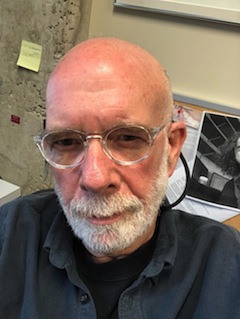
photo - Dr. Shimon Amir
Dr. Shimon Amir (photo from Shimon Amir)

The main goal is to understand the evolutionary function of the clocks and what they do to enable adaptation of organisms to their surroundings. But, also, the hope is that, by having better understanding, it will help in identifying new avenues of therapies.

With jet lag being such a hot topic in regards to circadian rhythm, Amir suggested a few ways to keep it at bay. “There are some ways to shorten jet lag, but there’s no way to avoid it,” he said.

“When you go east, you have to be exposed to light in the morning, in order to readjust to the new time zone. When you are exposed to light early in the morning, it induces in the clock a ‘face advance,’ it advances the clock. But, if you go west, you have to be exposed to light at night, early night. The transition between the evening and night, that’s where you have to be exposed to light, and that’s where it is ‘face delay.’ It will delay the face of the clock, because you have to wake up later when you go west.

“You need to be intentionally exposed to light in the evening or have light exposure a bit longer before you go west … or wake up very early, be exposed to light early in the morning, if you go east.

“Going through jet lag is very unhealthy,” he said. “If you do it very often, it will affect you in various ways, negatively, of course. Except, you can’t avoid it … as you go see family and grandchildren, and others, in Israel.”

Rebeca Kuropatwa is a Winnipeg freelance writer.
Format ImagePosted on April 12, 2019April 10, 2019Author Rebeca KuropatwaCategories WorldTags circadian rhythm, science, sleep
Joining a recent church tour

Joining a recent church tour

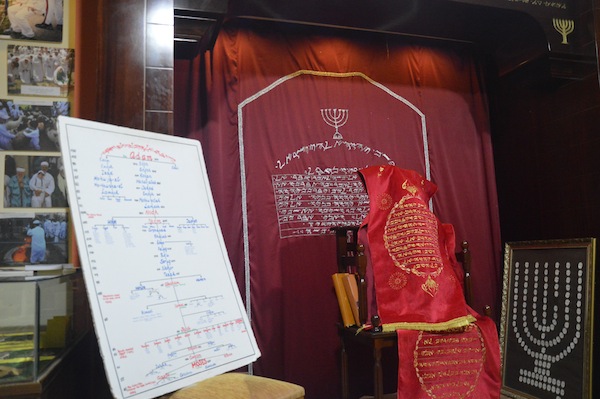
Inside the Samaritan Museum. (photo by Barry Kaplan)

It was one of the worst winter days I could remember – freezing temperatures, high winds and streets turned into rivers from the rain. Our friend, the pastor of the Jerusalem Baptist Church, had invited us to come on their church trip to Judea-Samaria.

Judea-Samaria is the area on the west bank of the Jordan River, approximately 30 miles wide, 70 miles long, not quite 2,000 square miles in area. Judea was the southern kingdom of the country with Jerusalem as its capital, and Samaria was the capital of the northern kingdom. To call this area Judea-Samaria makes clear the Jewish biblical and historical connection, but it is contentious. However, the other term for this area, the West Bank, is also a matter of contention, as that description negates the Jewish connection.

In 1922, 80% of the area of Palestine, as defined by the League of Nations (predecessor to the United Nations), was removed and became Transjordan, which was occupied then by Bedouin. During the British Mandate (1922-1948), Judea-Samaria was an integral part of the Jewish homeland and described by the British as Judea-Samaria.

In 1946, the British granted independence to Transjordan and Abdullah bin Al-Hussein was crowned king.

Jordan occupied the west bank of the river until 1950, when it annexed it to the Hashemite Kingdom. King Abdullah named it the West Bank and ruled over the area from 1950 to 1967.

Our adventure begins

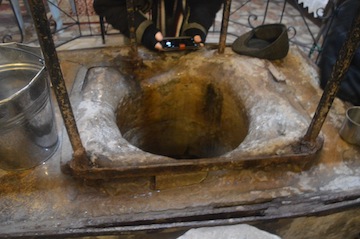
Our first stop was Jacob’s Well, which is in St. Photini Church in Nablus, or Shechem. Jewish, Samaritan, Christian and Muslim traditions all associate Jacob with a well, which lies within the monastery complex of the Greek Orthodox Church. The well is not specifically mentioned in the Hebrew Bible, but Genesis 33:18-20 states that, when Jacob returned to Shechem from Paddan Aram, he camped “before” the city, bought the land on which he pitched his tent and erected an altar. Biblical scholars contend that the plot of land is where the well was constructed.

photo - Jacob’s Well, which is in St. Photini Church in Nablus, or Shechem
Jacob’s Well, which is in St. Photini Church in Nablus, or Shechem. (photo by Barry Kaplan)

Today, Jacob’s Well is about 250 feet from the archeological ruins of ancient Shechem, which has a long history in Jewish tradition and was the first capital of the northern kingdom of Israel.

The well has been venerated by Christian pilgrims since the early fourth century CE. In the Greek Orthodox tradition, a Samaritan woman’s story at Jacob’s Well with Jesus was so powerful that many listeners became followers of Jesus, including her five sisters and two sons. The disciples heard of her experience with Jesus and came to baptize her, giving her the name Photini, meaning, “Enlightened One.” Thus, the name of the church in Nablus.

Abuna Ioustinos, a Greek Orthodox priest in Nablus, spearheaded the reconstruction project that saw Jacob’s Well restored and a new church built within the grounds of the Bir Ya’qub monastery, modeled on the designs of the Crusader-era church. Visitors access the well by entering the church and descending the stairs to the crypt.

Joseph’s Tomb is located just north of Jacob’s Well in an Ottoman-era building marked by a white dome. We could go inside the gate but no further. The tomb lies inside Area A of the West Bank, which is officially under Palestinian Authority control and the Israel Defence Forces bars Israeli citizens from entering the area without prior authorization. The site is venerated by Jews, Christians and Muslims, and has often been a flashpoint for violence. Jewish pilgrims are usually only allowed to visit the tomb once a month under heavy armed guard.

There is one synagogue in downtown Nablus, two on Mount Gerizim and two in Holon.

The Samaritans

Arriving on Mount Gerizim, our bus drove around Kiryat Luza, a village on the mountain ridge where Samaritans live. Mount Gerizim forms the southern side of the valley in which Shechem is located. On the northern side is Mount Ebal.

We stopped at the Samaritan Museum, where the grandson of the high priest and another young woman explained their history before the current high priest – the 137th generation – came to talk to us.

In 721 BCE, the Assyrians invaded, destroyed and exiled the population of the Northern Kingdom. Samaritans believe that those who remained are descendants of the original Israelites. However, when the Jews returned from exile in Babylon, they did not accept the Samaritans, so the Samaritans separated and settled near Mount Gerizim, which they believe G-d chose as his only holy place.

Samaritans say they are descendants of the Northern Kingdom’s tribes, while rabbinical sources regard them as descendants of the Assyrian colonizers who converted to Judaism. Either way, their name, Shomronim, comes from the Hebrew word shomrim, “keepers of the law.”

Today, Samaritans number about 800, half living in Kiryat Luza, half in the Neveh Marque neighbourhood of Holon, a suburb of Tel Aviv. All Samaritans are citizens of the state of Israel, and those in Holon serve in the IDF and speak Hebrew as their main language.

Shechem is mentioned in the Book of Genesis after Abraham arrives and offers a sacrifice to G-d at Alon Moreh. Jacob then came, pitched his tent and bought the land here, and Joshua made it a city of refuge. The bones of Joseph were brought here from Egypt for burial.

The three holiest places to Samaritans are where Abraham took Isaac to be sacrificed, where Joshua placed 12 stones when the Israelites entered Canaan and where the Israelites re-erected the Tabernacle. According to the Samaritans, these events all took place on Mount Gerizim.

Samaritans believe in G-d, Moses and the Torah, and base their traditions on the Torah. They speak ancient Hebrew; however, their mother tongue is Arabic. They practise ritual circumcision. They observe dietary laws. They can marry non-Samaritan women who convert, provided they are virgins when they marry. They observe biblical holidays but not post-biblical holidays, such as Purim or Chanukah. They await the Messiah.

Samaritans observe Passover, and I once attended one of their Passover celebrations. They keep alive the tradition of the Passover sacrifice, as described in the Hebrew Bible. Prior to 1967, the Jordanians only allowed them to ascend Mount Gerizim for the Passover celebration. Since the Six Day War in 1967, the Israelis have allowed them free access to the mountain.

Our trip winds up

Our adventure ended in a church in Taybeh for lunch, where we arrived cold and wet. Due to a power outage, caused by the rain, a long grill with burning charcoal was brought out so that we could warm our hands. Taybeh is the last all-Christian community in the West Bank and the home of Taybeh Brewery, one of the few breweries in Palestine.

We returned to Jerusalem around 6 p.m.

Hopefully, another trip to Shechem will take place in the spring, after the rains end.

Sybil Kaplan is a journalist, lecturer, book reviewer and food writer. She created and leads the weekly English-language Shuk Walks in Machane Yehuda, she has compiled and edited nine kosher cookbooks, and is the author of Witness to History: Ten Years as a Woman Journalist in Israel. She also writes stories about kosher restaurants on janglo.net for which her husband, Barry Kaplan photographs.

Format ImagePosted on April 12, 2019April 10, 2019Author Sybil KaplanCategories Israel, TravelTags Judea-Samaria, West Bank
A tour full of misinformation

A tour full of misinformation

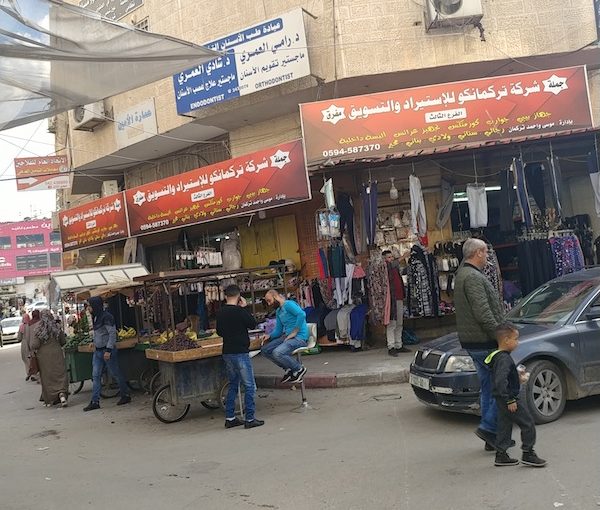
The market in Jenin. (photo by Dave Gordon)

Everything is political in Israel; there’s no escaping it. Pick a corner, a street sign, a building, there’s potential for argument. So, you can imagine what it’s like to take a tour of an area as contentious as the West Bank, which, thankfully, was quiet with respect to violence when we visited. Not surprisingly, our guide almost took on the role of spokesperson for the Palestinian Authority.

Abraham Hostel, in the heart of Jerusalem, offers a three-day West Bank tour. The tours include Nablus (biblical Schechem), Jenin and the refugee camp that borders it, Jericho, Ramallah and Bethlehem.

It was eye-opening for me. For one, the media frequently portrays Palestinians in the West Bank as living in squalor, often involved in conflicts with the Israel Defence Forces. We saw bustling markets, shopping centres, corporate plazas, sports cars, and plenty of American restaurant franchises, such as KFC and Pizza Hut.

Our tour guide was a wannabe biblical scholar and archeologist. “Personally,” he told us, “there could never have been a Jewish Temple.” It’s impossible, apparently, to build on top of solid rock, he explained.

He gave a brief history of the term Palestine, correctly stating that Roman invaders, Vespasian and Titus, in the first century, renamed the region from Israel/Judah. But why, particularly, call it Palestine? “Hmm,” he said, taking a moment to think. “Because they liked the name.” Not, as many scholars believe, because the Romans sought to call the area after the Jews’ sworn enemy, Philistines, to rub salt in the wounds.

While at Bethlehem’s Church of the Nativity, our guide gave his take on the Gospels, contending that it wasn’t the case that Jesus’s mother, Mary, couldn’t find a room at an inn – rather, the Jews forbade Mary to have a room because she was ritually unclean after childbirth. And that, he said, was the unwritten explanation of the manger/barn scenario.

He then proffered his views on Jews. “Since anyone can become a Jew,” he said, “they’re not really tied to the land.” Meaning that anyone who has converted, or was born to converts, has no connection to Israel.

And, he added, since the parcel of land called Judah, from which the name “Jew” was derived, was only a fraction of modern Israel, today’s Jews should only have rights to those ancient borders.

Quoting the Torah – “if you bless Israel, you are blessed; if you curse Israel, you will be cursed” (Genesis 12) – our guide insisted that the “Israel” referred to in this verse has never meant “the nation of Israel” (which it does), but only refers to the patriarch Jacob, who was later named Israel. The underlying message was that there was no concern about being cursed if you curse Jews.

For good measure, he asked, pointing toward the refugee camp, “Doesn’t it say ‘love your fellow’ in the Torah? That’s one of the top commandments.”

Almost no tour anywhere is complete without the commercial aspect – wandering through the souvenir shops and markets.

At the ice cream shop, our guide claimed, “Palestinian ice cream is made with real cream, not like the Israeli version!” At the spice store, he spoke about how Israelis use cheap ingredients in their Zaatar, but not Palestinians. And, he said, “Even Israelis agree that Palestinian beer is better than the sewer water in a can they make.”

photo - Yasser Arafat mausoleum in Ramallah
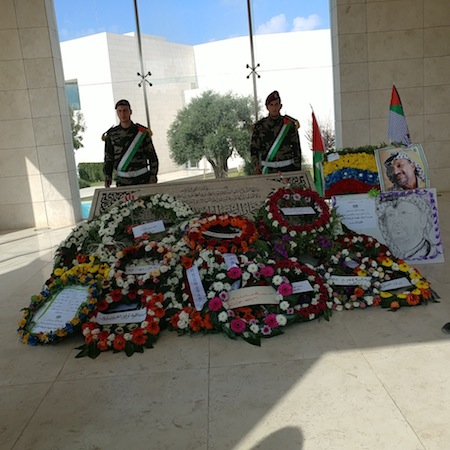
Yasser Arafat mausoleum in Ramallah. (photo by Dave Gordon)

The hero worship of Yasser Arafat was astounding. Virtually every street corner in Ramallah had a wall-sized poster of him. My trip was in November, so these displays were likely timed for the anniversary of his death. Schoolchildren took a field trip to his tomb in Ramallah for a commemoration and photo opportunities.

Our guide made every effort to politicize the tour, down to the free lunch. He said there wasn’t such thing as “Israeli couscous,” only co-opted “Arab-Palestinian couscous.” Scholars and culinary experts differ, saying that Israeli couscous was created in the 1950s in response to food rationing. Alas, more was still to come from our guide.

While he had our attention, he showed us illustrations of how Palestine in 1947 comprised modern Israel and the West Bank, while today, the Palestinians only have small, scattered autonomous dots in the Palestinian Authority. As for the Palestinian part in this development, he said, “just a couple of bus bombs” derailed the peace process, but only temporarily.

Dave Gordon is a Toronto-based freelance writer whose work has appeared in more than 100 publications around the world.

Format ImagePosted on April 12, 2019April 10, 2019Author Dave GordonCategories Israel, TravelTags Judea-Samaria, West Bank
Siblings return to Kochi

Siblings return to Kochi

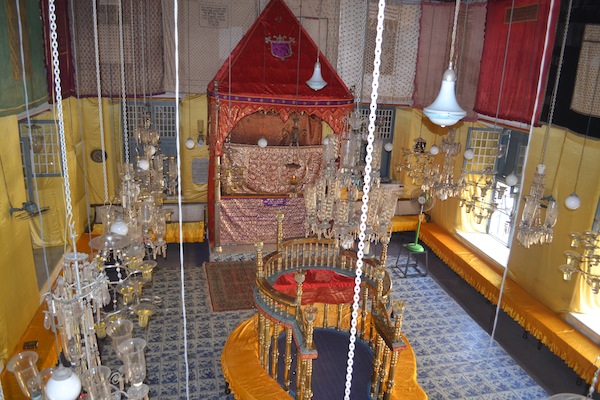
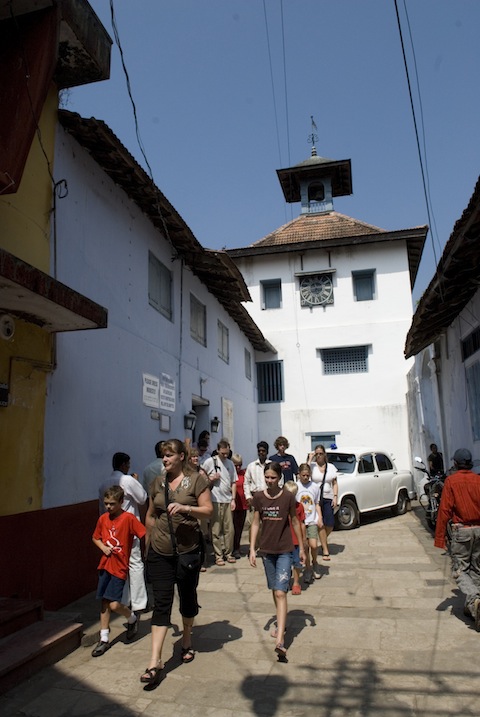
The interior of Paradesi Synagogue in Kochi, India. (photo by Lauren Kramer)

Dec. 6 marked an emotional homecoming for Canadian siblings Linda Hertzman and Kenny Salem. The pair were among some 180 Jews who returned to their birthplace in Kochi, India, to mark the 450th anniversary of the Paradesi Synagogue in the neighbourhood known as Jew Town. Three generations of families gathered from Israel, Australia, Canada and England to celebrate the milestone. They walked the ancient stone pathway of Synagogue Lane, spoke their native tongue of Malayalam and congregated in the synagogue for a festive celebration of the Jewish life that once flourished in this corner of southern India.

The festivities were tinged with sadness, however. For many, it would be their final visit to the beautiful Paradesi Synagogue. The shul is unique for its colourful oil lamps and a Torah scroll decked in a gold crown that was gifted to the community in 1802 by the maharaj of Cochin. (Kochi is the preferred term for the city formerly called Cochin.) The handpainted Chinese tiles on the synagogue floor have long since emptied of worshippers and the Jewish community of Jew Town now numbers just five – the oldest of them age 96. It’s tourists that stand beneath the oil lamps these days, visiting from dawn to dusk to marvel at the ancient Jewish history and try to comprehend its relevance. Opportunities for congregational prayer have been rare since most of the community left for other parts of the world from 1948 onwards.

On the Shabbat following the 450th anniversary, however, tourists were turned away from the Paradesi Synagogue and the sanctuary again echoed with Jewish prayer. The pews were filled with women in colourful dresses, reaching out to touch the ancient Torah scrolls as they were lifted joyfully from the aron hakodesh (holy ark) for morning prayers. Tears streamed down the faces of Jews for whom the synagogue was filled with rich memories. There were children who were seeing their families’ history for the first time and elders who were stepping into the synagogue for the last time. Adults in their 60s recalled their childhood memories of watching their parents pray in the synagogue, of riding their bicycles around the narrow roads of Mattancherry and of the warm, deeply religious and meaningful Jewish life that existed in Jew Town.

photo - Paradesi Synagogue, also known as Mattancherry Synagogue, is the building in the back
Paradesi Synagogue, also known as Mattancherry Synagogue, is the building in the back. (photo by Lauren Kramer)

The vibrant hub of Jewish life in Kochi, Jew Town was home to three synagogues, each serving different segments of the community. The “synagogue in the middle,” with a star of David still etched in its concrete, is now a repurposed building, while the southernmost shul is a ramshackle 900-year-old structure, its rafters occupied by nesting pigeons. Indentations on the side of many of the doors of homes and businesses in Jew Town mark the spot where mezuzot used to announce a Jewish home and the large Jewish cemetery a few minutes’ walk from the shul is unlikely to be filled with many more graves as the years roll by. The Jewish life that flourished here has become a lucrative business for antique dealers and souvenir shops selling scarves and trinkets, retailers loitering outside and using all their powers of persuasion to bring shoppers in.

Hertzman, who lives in Richmond, B.C., and Salem, from Richmond Hill, Ont., were the first guests to check into what was their family home, recently transformed into a boutique hotel called A.B. Salem House. It was named for their late grandfather, Abraham Barak Salem, an attorney known as the “Jewish Gandhi” for his negotiations with Israel that enabled the Jews of Kochi to make aliyah.

Kenny Salem left Kochi at age 25 in 1987 and returns to the city annually to see his childhood friends. “It was good to have everyone back here in Jew Town,” he said. “Friends and family were walking in and out of our house all day long, just like old times, when my mother had her door open to everyone. But the sad part is that, in the aftermath of the celebrations, Jew Town is silent once again.”

There are plans to fill that silence in the near future. David Hallegua, a spokesperson for the Cochin Synagogue Trust, announced plans to build a museum dedicated to the history of the Kochi Jews in the hall above the synagogue.

“It’s a dwindling community,” admitted Salem. “So, when there are no longer any Jews living here, we will hand the management of the synagogue and cemetery over to the Archeological Department of India. We need to tell the story of the Jewish community that once lived here and pass on this message to future generations.”

Lauren Kramer, an award-winning writer and editor, lives in Richmond. To read her work online, visit laurenkramer.net.

Format ImagePosted on April 12, 2019April 10, 2019Author Lauren KramerCategories TravelTags history, India, Judaism, Kochi, Mattancherry, Paradesi Synagogue
Miriam’s legacy of drumming

Miriam’s legacy of drumming

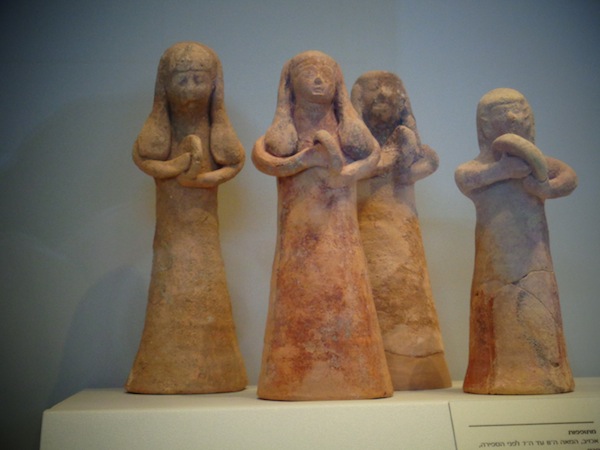
Female hand drummers from the Iron Age II (eighth to seventh century BCE), found at the site of what was Achzib, on the Mediterranean coast of northern Israel. From the Israel Museum collection. (photo by Deborah Rubin Fields)

In February, an Israeli ultra-Orthodox bride got lots of media attention for playing drums before a mixed (male and female) crowd of wedding guests. Putting aside issues of religious modesty and political clout, does Jewish law restrict females from playing drums?

Significantly, there is a biblical precedent for female drum playing. It dates back to Miriam the Prophetess. Having just crossed a miraculously dry channel in the Red Sea, Miriam felt compelled to celebrate. She and the other Israelite women who had just experienced the Exodus play drums, referred to in Hebrew as tof miryam. (See Exodus 15:20.)

In a 2009 article in Jewish Women: A Comprehensive Historical Encyclopedia, Prof. Carol Meyers notes, “The Bible mentions … only one percussion instrument … the tof, or hand drum, even though other kinds of drums were known elsewhere in the biblical world. Whenever this word is found, it is quite likely that the presence of female instrumentalists is implied.”

Meyers explains that this hand drum consisted of an animal skin stretched over a hollow body of any shape or size. Moreover, although tof miryam is sometimes rendered in English as a tambourine, it is not, given that it has no rattle or bells. Meyers further reports that the tambourine was not authenticated before the 13th century CE.

Additionally, Meyers points out that female figures predominate in unearthed Iron Age terracotta statutes, holding what appear to be hand drums. These women are plainly dressed, hence they appear to be ordinary people, rather than gods or members of the elite.

Few terracotta statues have been discovered in Palestine or Israel. Yet, from the biblical references of Exodus, Judges 11:34, I Samuel 18:6 and Jeremiah 31:4, we are left to understand that there was a tradition of female hand drum players.

Moreover, citing I Samuel 18:6-7, S.D. Goitein states in a 1988 article in Prooftexts, that a woman’s duty was to welcome the returning fighters and to praise them.

Of what importance were these female drums? Meyers elaborates that female public performance would (1) assume a level of competence based upon practice, (2) indicate that, in ancient Israel, there were groups of women performers and (3) imply that leaders and other members of the community acknowledged and appreciated the expertise of these women performers.

Not only that, but, in the book Miriam’s Tambourine: Jewish Folktales from Around the World (1988), edited by Prof. Howard Schwartz, Miriam’s drum had magical abilities. Relying on a 19th-century Eastern European folktale, Schwartz writes that the music from Miriam’s drum drove off serpents and kept Miriam herself in eternal life.

According to Rabbi Allen Maller’s interpretation of the Mechilta and Pirkei d’Rabbi Eliezer, while in Egypt, Miriam taught all the Israelite women how to play the drum. Moreover, he writes on blogs.timesofisrael.com, once the plagues started, Miriam repeatedly reminded the women of all that she had taught them and that, as a sign of their faith in G-d, they should all take at least one drum per family with them when it was time to leave.

Still it is not clear from whom Miriam learned to play. Did Miriam’s mother, Yocheved, teach her to play the hand drum? Or did Miriam learn from Egyptian women?

Broadcaster and writer Eva Dadrian states in her 2010 article “Let there be music!” that ancient Egyptian musicians realized percussion was basic to their orchestras. Thus, they played drums of different sizes. Drums were particularly associated with sacred ceremonial events, but they were also used during battles to rally the troops or to spread panic among the enemy forces.

Dadrian adds that, in spite of the richness of the documentation, our knowledge of pharaonic music remains limited: without theoretical treaty or musical score, it is particularly difficult to do an archeology of music. The two main membranophones used by ancient Egyptians were the single membrane drum mounted on a frame and the barrel-shaped drum with two membranes.

In the University of California, Los Angeles Encyclopedia of Egyptology, Music and Musicians (2013), Egyptologist Sibylle Emerit claims the single membrane drum is documented in Egypt’s Old Kingdom (2575 BCE to 2150 BCE) in a scene carved in the solar temple of Niuserra in Abu Ghurab. She relates that the non-epigraphic material from the East Cemetery of Deir el-Medina, dating to the 18th dynasty, indicates that the owners of the musical instruments buried in this tomb belonged to a modest social class attached to the service of local noblemen. Thus, Emerit confirms Meyers’ assertion about the plain appearance of female Iron Age II drummer statues.

Music researcher, lecturer and performer Veronica Doubleday notes in a 1999 Ethnomusicology article that plentiful evidence shows women played the frame drum in the Egyptian New Kingdom (1570-947 BCE) dynasties. There were musical troupes in temple rituals, as well as solo drum players.

Over the centuries, Islam, Christianity and Judaism marginalized woman’s public drum playing. In a PhD dissertation (2006), Mauricio Molina writes that early leaders of the Christian religion, for example, condemned the frame drums because of their connection with the fertility cults, which the Church was struggling to banish.

Aside from Miriam, Jewish (and non-Jewish) females might have been told that it is not lady-like to play drums, as drummers need to sit with their legs spread apart and drummers sometimes “let loose” to play.

Nonetheless, today, the number of female drummers – including Jewish female drummers – is growing. As the recent bride story reveals, the numbers are increasing even within the Orthodox and ultra-Orthodox community. In Jerusalem, for example, the school Mayever LaMusica (Beyond Music) offers separate drum lessons for girls and women.

Among those who grew up Orthodox are Temim Fruchter, former drummer in the Shondes, and Dalia Shusterman, who drummed in an all-female Chassidic alternative rock group. Elaine Hoffman-Watts, who died two-and-a-half years ago at the age of 85, was a klezmer drummer – many klezmer bands refused her talents because she was a woman; it wasn’t until her father (also a klezmer musician) intervened that she got work as a drummer.

Other notable Jewish female drummers with Israeli backgrounds are Meytal Cohen, Mindy Abovitz (who is also founder and editor-in-chief of the drum magazine Tom Tom), Iris Portugali and Yael Cohen.

So, the beat goes on and, after a long respite, women are again helping to produce it.

Deborah Rubin Fields is an Israel-based features writer. She is also the author of Take a Peek Inside: A Child’s Guide to Radiology Exams, published in English, Hebrew and Arabic.

Format ImagePosted on April 12, 2019April 12, 2019Author Deborah Rubin FieldsCategories Op-EdTags antiquity, archeology, drumming, history, Israel, music, women

Enjoy these Pesach desserts

In Jerusalem, as soon as Purim is over, everyone begins to get ready for Pesach. Two-and-a-half weeks ahead, macaroons are already in the stores, as well as various other products for the holiday. Here are a few desserts you can make at home, from traditional to unusual.

CLASSIC ALMOND MACAROONS
Makes 20 macaroons. This recipe is adapted from an American food magazine (not sure which).

1 1/2 cups blanched almonds
1/4 cup sugar
2 egg whites
1/4 tsp almond extract
3/4 cup sugar
4 tsp confectioners sugar

  1. Place almonds in a pan, cover with water and bring to a boil. Boil 10 seconds. Remove one almond and see if it slips out of its skin. If not, boil a few seconds more. Spread on paper towels and pat dry once ready.
  2. Preheat oven to 325 °F. Line a baking sheet with parchment or wax paper.
  3. Grind almonds with 1/4 cup sugar in processor. Add egg whites and extract and blend 20 seconds. Add the 3/4 cup sugar in two batches, blending 10 seconds after each addition.
  4. Roll one tablespoon of mixture between moistened palms into ball. Repeat until all mixture is used, spacing cookies one inch apart on the prepared cookie sheet. Flatten each to half-an-inch high. Brush each with water. Sift confectioners sugar over each. Bake for 25 minutes.
  5. Lift one end of parchment paper and pour two tablespoons water onto cookie sheet. Lift other end and pour two tablespoons water under. Tilt to spread water. When water stops boiling, remove macaroons.

CHOCOLATE BISCOTTI
3/4 cup margarine or butter
2 1/8 cup sugar
6 eggs
2 tbsp vanilla extract
3 1/2 cups matzah flour
1 1/4 cups potato flour
3/4 cup cocoa
1 tbsp Passover baking powder
5/8 cup ground almonds
2 cups chocolate chips

  1. Preheat oven to 375°F. Spray a cookie sheet.
  2. In a bowl, cream margarine or butter and sugar. Add eggs and vanilla.
  3. In another bowl, combine matzah flour, potato flour, cocoa and baking powder. Gradually add to batter.
  4. Add nuts and chocolate chips and combine.
  5. Form into two logs and place on cookie sheet. Bake for 30 minutes. Let cool.
  6. Slice. Return slices to cookie sheet and bake 15 minutes.

TOFFEE MATZAH
This is my favourite sweet for Pesach but this version is an Andrew Zimmern contribution from Food & Wine magazine with a few of my changes.

1 cup salted butter or margarine
5 pieces of matzah
1 cup packed brown sugar
2 cups chocolate chips
1 cup mixed chopped nuts

  1. Preheat oven to 350°F. Line a cookie sheet with foil and spray with vegetable spray. Line with parchment paper and spray again.
  2. Arrange a layer of matzah on the sheet.
  3. Melt butter or margarine with brown sugar in a saucepan. Cook five minutes. Pour over matzah. Bake five to eight minutes, until bubbling.
  4. Remove from oven and spread chocolate chips on top, letting them melt for five minutes. Sprinkle nuts on top. Let cool or refrigerate to cool. Break into pieces.

MARILYN’S CHOCOLATE BRANDIED CANDY
Marilyn is a longtime friend of mine who came from the Boston area and has lived in Israel since 1949.

3 1/2 ounces bittersweet chocolate (a candy bar works fine)
1 cup raisins, soaked in cherry brandy
1 cup chopped walnuts
1 cup matzah pieces

  1. Melt chocolate in a saucepan. Add raisins, walnuts and matzah and mix well.
  2. Drop by tablespoon into small cupcake papers. Refrigerate.

Sybil Kaplan is a journalist, lecturer, book reviewer and food writer in Jerusalem. She created and leads the weekly English-language Shuk Walks in Machane Yehuda, she has compiled and edited nine kosher cookbooks, and is the author of Witness to History: Ten Years as a Woman Journalist in Israel.

Format ImagePosted on April 12, 2019April 10, 2019Author Sybil KaplanCategories Celebrating the HolidaysTags baking, biscotti, macaroons, matzah, Passover, recipes

The great matzah ball debate

What food eaten during Pesach causes the most debates? If you guessed matzah balls, you’re right. Should they be hard or light? Big or small? What secret ingredient should be added to them?

From where did matzah balls, or kneidlach, originate? German Jews had a dumpling that they put into their soup called knodel. From this came the Yiddish term kneydl, singular, or kneydlach, in the plural. In Czech, it is known as knedliky. Dumplings have been in Central European cookery since the Middle Ages and then they came to Germany and Eastern Europe later.

So, just how many ways are there to make matzah balls?

Joan Nathan, a friend of mine, who has written a number of cookbooks and is considered a maven of American Jewish cooking, proposes adding chicken fat or vegetable oil plus seltzer, club soda or chicken broth, to make them light and airy. In Jewish Cooking in America, she also relates that some matzah balls, originating in Lithuania, use chicken fat or vegetable shortening and contain a filling made of onion, oil or chicken fat, matzah meal, egg yolk, salt, pepper and cinnamon. The filling is then placed in the middle of the matzah ball before they are cooked in salt water. After cooking in salt water, they are baked 30 minutes then placed in the soup for serving. Joan also has a recipe for matzah balls made in the southern United States, using pecans. In my research, I discovered that some Louisiana Jews add green onions and cayenne pepper.

In her cookbook Quiches, Kugels and Couscous: My Search for Jewish Cooking in France, Joan explains that, in France, matzah balls are called boulettes de paque, krepfle or kneipflich. They are the size of walnuts and not fluffy. They are made from stale bread or matzah soaked in water and dried, and they contain rendered goose fat, vegetable oil or beef marrow, eggs, water or chicken broth, matzah meal, salt, pepper, ginger and nutmeg.

In The New York Times Passover Cookbook, edited by Linda Amster, among the recipes for matzah balls is one by Mimi Sheraton, Times food critic at the time, who used chicken fat and cold water. Another is from Joan’s cookbook Jewish Holiday Kitchen, and she uses ginger and nutmeg. The winning recipe for the first Matzah Bowl contest in New York at the time the Times cookbook was published used vodka and club soda. A low-fat, low-salt version is made with egg whites and vegetable oil. Another style, which is airy, is made with beef marrow, instead of chicken fat, plus nutmeg.

Refrigeration and the temperature of the liquid seem to be key common denominators in many recipes.

Nina Rousso, an Israeli, in her book The Passover Gourmet, uses beaten egg yolks, lukewarm water, melted margarine, salt, parsley, matzah meal and stiffly beaten egg whites folded in. The mixture is refrigerated two hours before making.

In Passover Lite, Gail Ashkenazi-Hankin, an American, combines egg yolks, onion powder, salt, pepper, matzah meal, water and beaten egg whites and chills the mixture 30 minutes.

Zell Schulman, the American author of Let My People Eat, says the key to making light, melt-in-your-mouth, floating matzah balls is to beat egg whites until stiff then fold into the yolks with salt, pepper, cinnamon, matzah meal and optional parsley and refrigerate 15 minutes. A second version combines matzah meal with only the beaten egg whites until they hold peaks, plus parsley, cinnamon, grated carrot and oil, but no egg yolks.

Susan Friedland, the American author of The Passover Table, combines whole eggs with seltzer, salt, pepper, matzah meal and schmaltz, which she refrigerates for one hour. The schmaltz adds the flavour.

Marlene Sorosky, American author of Fast and Festive Meals for the Jewish Holidays, provides a recipe using ground almonds, ginger and chopped parsley. She chills the matzah balls for one hour.

Edda Servi Machlin, whose family has 2,000-year-old roots in Italy, says her family serves a mix between Italian Passover soup and Ashkenazi chicken soup. Her matzah balls are made of chopped chicken, egg, broth, olive oil, salt, pepper, nutmeg and matzah meal. The batter is refrigerated one hour before making.

Other Italian Jews, who call the matzah balls gnocchi di azzaima, add onions or mashed potatoes to the dough or grated lemon rind.

An aside: In 2001, Ariel Toaff, a professor at Bar-Ilan University, who is the son of Rome’s chief rabbi, came out with a book called Mangiare alla Giudia (Eating the Jewish Way). He devotes a chapter to Passover traditions, and writes that matzah was so popular that the Catholic authorities banned Jews from selling matzah to non-Jews and banned Christians from eating it.

Italian bakers also baked different kinds of matzah: plain for intermediate days, shmurah matzah for the sederim, and matzah made with white wine, eggs, sugar, anise and goose fat for those with more rich tastes.

Jews of Italy even developed sfoglietti or foglietti, a kosher-for-Passover pasta made with flour and eggs, which was then quickly dried and baked in a hot oven and served in soup or with a sauce.

Joyce Goldstein, an American fascinated by Italian Jewish cuisine, describes, in Cucina Ebraica, a combination of ground chicken, egg, matzah meal, salt, pepper and cinnamon, which she refrigerates before cooking in soup, but she does not say for how long.

Sonia Levy, a native of Zimbabwe, wrote a cookbook of her community, called Traditions. She describes luft kneidlach, light matzah balls, made with matzah meal, water, salt, nutmeg, cinnamon or ginger, eggs and oil. These must be refrigerated at least half a day. She adds that you can also make a pit with a finger and insert chopped meat that has been mixed with fried onions and spices. Another Zimbabwe version uses egg, cold water, chicken fat, salt, pepper, ginger and matzah meal.

Ruth Sirkis, an Israeli, in A Taste of Tradition, says “air” matzah balls have eggs, matzah meal, salt, chicken soup and chicken fat and are refrigerated two hours.

Another version, by Anya von Bemzen and John Welchman in Please to the Table: A Russian Cookbook, has walnut balls for soup, which are made by the Georgian Jews using ground walnuts, onion, egg, matzah meal, oregano, salt, pepper and a froth egg white.

A couple of last pieces of matzah ball trivia. In 2008, a New York kosher delicatessen held its annual matzah ball-eating competition to raise money for a shelter for the homeless. The winner ate 78 matzah balls in eight minutes. Although not in the Guinness Book of World Records, a few years ago, the largest matzah ball was measured at 17.75 inches across and weighed more than 33 pounds.

And, lastly, among some ultra-Orthodox Jews, matzah balls are not eaten because they expand when they cook, and they consider this reaction a form of leavening.

Regardless of the style of matzah balls you prefer, just make plenty for your guests!

Sybil Kaplan is a journalist, lecturer, book reviewer and food writer in Jerusalem. She created and leads the weekly English-language Shuk Walks in Machane Yehuda, she has compiled and edited nine kosher cookbooks, and is the author of Witness to History: Ten Years as a Woman Journalist in Israel.

Posted on April 12, 2019April 10, 2019Author Sybil KaplanCategories Celebrating the HolidaysTags books, cooking, culture, history, matzah, Passover
Pesach: story of a people’s birth

Pesach: story of a people’s birth

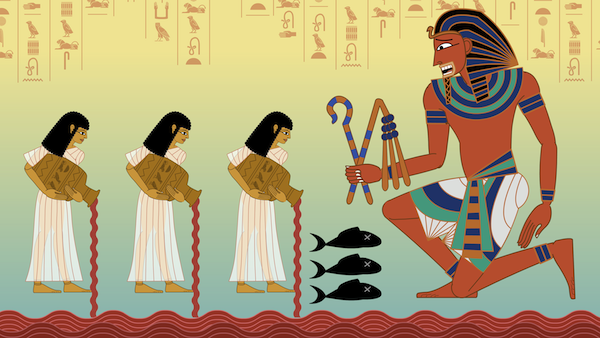
God Almighty Herself induces Egypt to give birth. We simply need to listen for the birth mother’s screams in the delivery room. We hear the screams throughout the plagues, as they become increasingly intensive, starting with the first plague, blood. (illustration by Nina Paley)

The idea of the Exodus as a birth story begins as Shemot (Exodus) begins. The first chapter brings us into the atmosphere of a giant delivery room. Things have gotten out of control: “And the Israelites were fruitful and increased abundantly and multiplied and grew exceedingly strong and the land was filled with them.” (Shemot 1:7)

The Israelites are having children all the time. There’s this anonymous, collective mass of people that are steadily spreading out. The only two figures mentioned by name are the midwives, Shifra and Pua, and there’s a reason for that. The book is telling us: “Pay attention, readers. We are entering a delivery room, and so the most important figures are the midwives. You will feel this sense of birth.”

If one didn’t get this sense from Chapter 1, take a look at Chapter 2. It begins with the personal birth story of Moses, the story of a natural, biological birth, in which a woman becomes pregnant and has a son. A few verses later, the mother places the baby in an ark, or basket, and, when Pharaoh’s daughter comes by, she takes him in and becomes his adoptive mother. She, too, has a birth story. There’s a womb – the ark. There’s water – the Nile. She sees the womb, the ark. She opens it and she sees the baby. She, too, is portrayed as having given birth. If we saw a portrait of the natural, biological birth by the Hebrew mother, we also have a portrait of the Egyptian adoptive mother who takes the child.

This “birth” mindset will intensify and be actualized through this grand metaphoric story we call the story of the Exodus from Egypt. There was a famine in Canaan, so the Israelites went to Egypt to buy grain and find seed. They stayed. Scripture tells us how they “were fruitful and increased abundantly and multiplied and grew exceedingly strong, and the land was filled with them.”

This little nucleus, the embryo that first descended, is developing within this large Egyptian womb, Israel’s “surrogate mother,” which nourishes this fetus. The time comes for the birth. As in any case of surrogate motherhood, there is difficulty. On one hand, it’s not my baby. I want it out. On the other hand, there’s emotional difficulty. I nourished that child. He’s part of my body.

From the perspective of the child, there will be problems, or challenges, of attraction and repulsion toward the surrogate mother in whom he developed. The Children of Israel grew and developed in that womb, and it must be taken out. But the Egyptian mother refuses to begin the birthing process.

Enter the most powerful midwife imaginable – God Almighty Herself. She induces Egypt to give birth. The entire story is described in this manner. We simply need to listen for the birth mother’s screams in the delivery room. We hear the screams throughout the plagues, as they become increasingly intensive. Blood. Frogs. Lice. Beasts. Pestilence. Boils.

We’re standing next to the birth mother, saying, “Push! Push! Scream! Scream! Let this baby out!” Just before the birth, a moment before the Children of Israel emerge, they are commanded to paint the doorposts with blood. Soon after, this people will pass through this doorway.

They will reach the waters. And the waters will descend, as well. Then the sea will split in two, and the Children of Israel will pass through the waters on dry land, through the birth canal that has opened for them. At the end of the birth canal, who will be waiting for them? The midwife, ready to grasp them and teach them to walk.

This story, this birth story, is the powerful story of the birth of a people. But, beyond the importance of hearing this story, it can also explain what happens later, during their travels in the desert.

Like any newborn baby, the people will cry and scream for their most immediate needs – water, food. Moses and God will provide for them because that’s how you take care of an infant. You give water and food. You can’t expect anything else. Slowly but surely, he will be taught to walk. Slowly, he will learn rules. He will be given laws to follow.

When we meet this child in Bamidbar (Numbers), once he has grown, he will make the same requests that he made in Shemot as an infant: water and food. But God’s response will be different, because we don’t have the same expectations of a little baby that we have from a growing child. We expect something different.

How do we connect this to the seder night? The Exodus, first, is a story. There is a strong emphasis on telling the story. It has all the detail it needs, and all the drama we want. These are what make this story a foundational story, one that can be transmitted generation after generation.

We sit around and tell our birth as a people. We try to impart it to the next generation. When we tell the story with all its detail, it excites us once more. But why is this done over matzah?

God planned the Exodus from the time of Abraham: “Know that your seed will be a sojourned in a land not theirs; they will serve them and be tormented by them for 400 years. But then they will go out with great wealth.”

It’s all planned, down to the moment. God tells them to have their loins girded, their bags packed and their food prepared and, when I say so, leave. Everything had been planned. So what happened? Why couldn’t the dough rise? Why couldn’t they have fresh rolls?

This is a precise dramatization of a birth story. If you want it to be credible, it has to be exact. As in the story of any birth, everything is planned. There’s a due date. There’s a packed suitcase, a list of phone numbers to call. If it’s not the first birth, there are arrangements for the older kids.

Yet labour will always be unexpected. It’s always sudden. The water breaks suddenly. Contractions come suddenly. Suddenly, it’s time to go. That’s birth. Everything is planned, but the moment arrives suddenly. This is the meaning of eating matzah. It’s as if we are saying, everything was there, everything was planned. This birth was a major event and, like every other birth, it was unexpected. Despite all the preparations, we had to run, we had to leave. The dough did not have a chance to rise. All that could be made from it was matzah.

Ilana Pardes’s book The Biography of Ancient Israel describes this as the story of a collective persona, the people of Israel: “The Israelites are delivered collectively out of the womb of Egypt. National birth, much like individual births (and all the more so in ancient times), takes place on a delicate border between life and death. It involves the transformation of blood from a signifier of death to a signifier of life. It also involves the successful opening of the womb, the prevention of the womb’s turning into a tomb…. God performs a variety of wonders in Egypt (the 10 plagues in fact are perceived as such), but the parting of the Red Sea seems to surpass them all. It marks the nation’s first breath – out in the open air – and serves as a distinct reminder of the miraculous character of the birth. Where there was nothing, a living creature emerges all of a sudden….”

As we sit around the seder table, around the matzah, telling the story of our birth each year, you may want to read from the poem, “Miracles,” by Yehuda Amichai: “From a distance everything looks like a miracle / But up close even a miracle doesn’t appear so. / Even someone who crossed the Red Sea when it split only saw the sweaty back of the one in front of him.”

Ask every participant at the seder to think of something that happened to them during the year, something that, because the individual was part of it, they “only saw the sweaty back of the one in front of him.” If we were to take a step back and look at things from a distance, we could have said to ourselves: “I’m living through a miracle. I’m passing through the sea, on dry land. I’m undergoing the process of birth, right now.”

It is worthwhile, and it even brings joy, to mention this miracle and think about it at this event celebrating the great miracle of the nation’s birth.

Dr. Orit Avnery is a research fellow at the Shalom Hartman Institute. She received her PhD in Bible studies at Bar-Ilan University. Her dissertation is entitled The Threefold Cord: Interrelations between the Books of Samuel, Ruth and Esther. This article is based on a talk she gave in Hebrew. Articles by Avnery and other institute scholars can be found at shalomhartman.org.

Format ImagePosted on April 12, 2019April 10, 2019Author Dr. Orit Avnery SHICategories Celebrating the HolidaysTags childbirth, history, Judaism, Passover, Shalom Hartman Institute, women
On the value of stubbornness

On the value of stubbornness

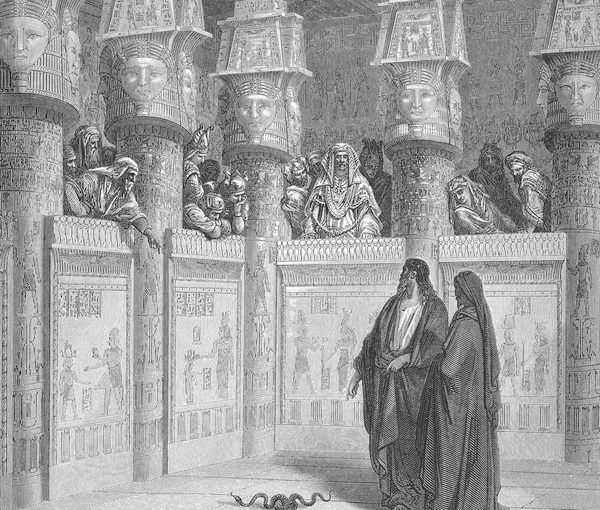
“Moses and Aaron Appear before Pharaoh,” from Gustave Doré’s English Bible, 1866. (image from Wikimedia Commons)

Stubbornness is a complex and harsh characteristic. It is no surprise, then, that Pharaoh, who is considered to be one of the most wicked characters in the Torah, is shown as being very stubborn. We see Pharaoh repeatedly refusing to engage with the reality that he is faced with and, stubbornly, over and over, refusing to send the Israelites out of Egypt.

Pharaoh is the paradigmatic stubborn person in the Exodus story, yet parashat Vayeira also points to other characters in the story who are not considered wicked in any way but who are nevertheless portrayed with this characteristic of stubbornness. This implies that perhaps stubbornness is not all bad. What can we learn about this character trait from our parashah and when it might make sense to employ it?

We’ll start with Pharaoh, the paradigm of stubbornness. Repeatedly, we see him refusing to yield, to listen to Moses and Aaron’s pleading, as the text says: “Pharaoh’s heart stiffened and he did not heed them.” (Exodus/Shemot 7:13) He appears equally stubborn in the conversations between God and Moses: “And God said to Moses, ‘Pharaoh is stubborn; he refuses to let the people go,’” (7:14) and in his response to the first plague: “Pharaoh turned and went into his palace, paying no regard even to this.” (7:23) Again and again, Pharaoh’s stubbornness – at least at a particular stage – is portrayed as having been almost thrust or forced upon him. God says as much to Moses: “But I will harden Pharaoh’s heart … and he will not heed you….” (7:3-4)

Indeed, as events are taking place and described, it appears that God is actively strengthening or hardening Pharaoh’s heart: “God stiffened the heart of Pharaoh, and he would not heed them, just as God had told Moses.” (9:12) This strengthens our resolve to discover what this stubbornness is really about, why it is so critical and what role it plays in the story.

Samson Raphael Hirsch suggests that this stubbornness or “hardening” that Pharaoh experiences can be divided into three types, based on the language that the Torah uses to describe it: “I will harden,” “I will make heavy” and “I will strengthen.”

1) Hard: being rigid, without registering any influences, without being influenced by anything that passes us.

2) Heavy: being a person of weight, able to be influenced, but with a significant gap between the actual impression and the willingness to act based on it. Sluggish.

3) Strong: steadfast, fully opposing to submit despite a full recognition, totally obliterating the influence.

Hirsch describes the three different, but similar, forms of this attribute and how it manifests itself in Pharaoh.

The first is characterized by rigidity, that is characterized itself by an ignoring of the environment, a rigidity that blocks any outside influences. This kind of behaviour can be seen when Pharaoh is completely unimpressed and unmoved by Moses’s pleading, the suffering of Israel, or even the plagues that affected him and his people directly.

The second is characterized by heaviness. This heaviness is not about ignoring – someone whose heart is heavy can absorb information from his surroundings, but this is insufficient to influence him, to get him to act upon those potential influences. They don’t propel him to act in the direction where the information points. This phenomenon is evident in the way that Pharaoh reacts to the second plague of frogs. This plague is described in all of its gross and gory details:

“If you refuse to let them go, then I will plague your whole country with frogs. The Nile shall swarm with frogs, and they shall come up and enter your palace, your bedchamber and your bed, the houses of your courtiers and your people, and your ovens and your kneading bowls.… The frogs died out in the houses, the courtyards and the fields. And they piled them up in heaps, until the land stank.” (7:27-8:10)

Despite this horrifying scene, Pharaoh is unfazed: “But when Pharaoh saw that there was relief, he became stubborn….” (8:11) He is not moved to eject the Israelites from Egypt. Instead, he is weighed down (perhaps wilfully) and unmoved.

Lastly, Pharaoh exhibits strength. According to Hirsch, behaviour that is defined by strength is self-aware and defiant. The lack of change in it is not defined by being weighed down or passive inertia, but rather an active refusal to be moved. He is aware that he doesn’t want to move or change because these actions are perceived by him as giving in. For example, during the third plague of lice (kinim):

“Then God said to Moses, ‘Say to Aaron, hold out your rod and strike the dust of the earth, and it shall turn to lice throughout the land of Egypt.’… The magicians did the like with their spells to produce lice, but they could not … and the magicians said to Pharaoh, ‘This is the finger of God!’ But Pharaoh’s heart stiffened and he would not heed them.…” (8:12-15)

Even when Pharaoh’s people tell him explicitly that they are all witnessing the finger of a mighty god, and all that Pharaoh needs to do to resolve the situation is let the people go, Pharaoh digs in his heels and will not give up and will not give in.

Pharaoh is not alone in his stubbornness, in his unwillingness to accept that the slavery is ending and the exodus is immanent. Even without a divine hardening of their hearts, the Israelites also show a stubbornness. It says about Pharaoh, “he didn’t heed” (e.g. 7:10-13) and it also says about the Israelites, “and they did not heed.” (6:9)

Even though it seems that Pharaoh and the Israelites are exhibiting the same behaviour – they both are stubborn in refusing to accept the reality that God is going to redeem the Israelites through Moses’s leadership – the contexts for their behaviour are quite different, almost opposite. Pharaoh is holding onto the Israelites and enslaving them. He is insisting on a continuation of the suffering and backbreaking labour, which he initiated. The Israelites, on the other hand, are described as refusing to listen because they themselves are suffering, “their spirits crushed by cruel bondage.” (6:9)

Pharaoh is mired in a lack of morality; Israel is mired in a lack of faith. What they have in common is that they refuse to accept what seem like the futile fantasies of Moses about the Israelites leaving Egypt with him, and moving from bondage to freedom.

Israel needs to be convinced that this idea of the exodus, of actually leaving Egypt, is real, implementable and viable. They need to believe in it. While deep in the heart of slavery, it’s hard for the Israelites to imagine a different reality. Their insistence on relying on the here and now as opposed to a promise for the future stems from despair. How much hope are they supposed to keep?

Pharaoh also refuses to accept the future as described by Moses and, in this way, his stubbornness, in all its strength, weight and difficulty, is close to the Israelites’ despair. Pharaoh refuses to see what the Israelites cannot.

In contrast to both of these images of stubbornness, Pharaoh’s refusal and the Israelites’ despair, there is a third image. This third character needs to be even more stubborn, strong and resolute – this character is God. God’s stubbornness is characterized by steadfastness, insistence and resoluteness in the face of those who don’t believe in his presence and his promise. God needs to stand against those who refuse him, who repeatedly reject the vision of the future that He presents.

At the very beginning of the story, God makes a promise: “God spoke to Moses.… ‘I appeared to Avraham … and I have remembered My covenant. Say, therefore, to the Israelite people: I am God. I will free you … and deliver you … I will redeem you … and I will take you … and I will bring you into the land….’” (6:2-8)

A few verses later, God speaks to Moshe again: “Go and tell Pharaoh, king of Egypt, to let the Israelites depart from his land.” (11)

God is always responded to with negativity and refusal. “The Israelites would not listen to me, how then should Pharaoh heed me?” (12) God continues with his own steady perseverance: “So God spoke to both Moses and Aaron in regard to the Israelites and Pharaoh, king of Egypt, instructing them to deliver the Israelites from the land of Egypt.” (13)

God’s stubbornness is instructive and holds a lesson for all of us who dream of a world that looks different than the one we now inhabit. Maybe anyone who dreams about a different reality, anyone who believes that it is truly possible that our existence can be transformed, needs a form of stubbornness. They need to be unrelenting and steadfast in holding onto their dreams, rejecting the people who resist change, on the one hand, and who are too beaten down to have faith, on the other.

God’s character in the story emerges for the benefit of dreamers, to call us to be constant and steadfast in our faith that, indeed, tomorrow can be different. And, if we are not dreamers but rather are those who listen, God’s voice is charging us to bear the difficulty, the heaviness, the strength of those who are dreamers. Because it is in the merit of those divine representatives, such as Moses and Aaron, that we became able, we became brazen enough, to imagine what a life beyond slavery would look like, to see it and even live it.

Rabbi Avital Hochstein is president of Hadar Israel and a research fellow at the Shalom Hartman Institute. She received rabbinic ordination from the institute in 2016. Articles by Hochstein and other institute scholars can be found at shalomhartman.org.


Format ImagePosted on April 12, 2019April 10, 2019Author Rabbi Avital Hochstein SHICategories Celebrating the HolidaysTags Haggadah, Judaism, Passover
הסכם ליישום

הסכם ליישום

(international.gc.ca)

הדיון הצעת החוק של הסכם יישום הסחר החופשי בין קנדה ישראל נמשך בימים אלה. בפועל מדובר בתיקון לחוק “סי-שמונים וחמש”.

לינדה פרום (מהמפלגה השמרנית) אמרה את הדברים הבאים בדיון בהצעת החוק: אני תומכת מאוד בחקיקה זו, שלדעתי מייצגת את קונצנזוס כללי בקנדה בשני נושאים: הראשון – חוק “סי-שמונים וחמש” מייצג את הערך של הסכמי סחר חופשי בקידום השגשוג של קנדה. השני – החקיקה הזאת מדגישה את חשיבות היחסים הבילטראליים הרחבים יותר של קנדה עם מדינת ישראל. על הצד המסחרי, קנדה חתמה על הסכם סחר חופשי עם ישראל לפני כעשרים שנה. מאז סחר הסחורות בין קנדה לישראל גדל פי שלושה. לפני כשנתיים הערך הכולל שלו הגיע למיליארד ושבע מאות מיליון דולר. עיקר היצוא והיבוא של קנדה לישראל נמצא במגזרים הבאים: מכונות תעשייתיות, מטוסים וחלקים, מוצרי פרמצבטיקה, ציוד חשמלי ואלקטרוני, אבנים יקרות, מכשירים מדעיים ומדויקים. מרבית היצוא הסחורות ומהיבוא הם בענפי הטכנולוגיה העילית. ואכן, קשרי המסחר של קנדה עם ישראל אופייניים ליחסים הקיימים בין שתי המדינות המתועשות והמתקדמות מבחינה טכנולוגית.

מספר מחוזות בקנדה זיהו את ההזדמנויות הטכנולוגיות הקיימות ביחסי המסחר שלנו עם ישראל. אין זה מפתיע כי נובה סקוטיה, ססקצ ‘ואן, אונטריו וקוויבק חתמו על הסכמי מדע, טכנולוגיה וחדשנות דו-צדדיים עם ישראל.

המשק הישראלי מעניק לקנדה שוק חשוב במזרח התיכון. סך היצוא הקנדי לישראל עמד על כארבע מאות מיליון דולר בשנה, בין השנים 2015 ל-2017. במקביל יבוא של כמיליארד ושלוש מאות מיליון לקנדה מקורו בישראל.

המשק הישראלי חזק וממשיך להתרחב, עם צמיחה של שלושה וחצי אחוזים אשתקד. לכן טבעי כי קנדה תבקש להפיק תועלת נוספת ממסחר זה. לפני כחמש שנם יזמה הממשלה הקונסרבטיבית לשעבר דיונים עם ישראל, להרחיב את הסכם הסחר הדו-צדדי שלנו. מו”מ זה הושלם בחודש יולי לשנה לאחר מכן, עם עדכון ארבעה פרקים בהסכם המקורי ובהרחבת הסכם הסחר החופשי, כך שיכללו שבעה פרקים חדשים. מדובר פרקים בנושאי מסחר אלקטרוני, קניין רוחני, אמצעים סניטריים ופיטו-סניטריים, חסמים טכניים סחר, סחר וסביבה, מסחר ועבודה, וכן סיוע במסחר. לאחר שהחוק החדש יהיה בתוקף מלא, קרוב למאה אחוז מהחקלאות הקנדית, החקלאות, הייצוא והדגים מישראל, ייהנו מטיפול תעריפי מועדף. זהו שיפור של תשעים אחוז לעומת המצב היום. יהיו גם הזדמנויות חדשות עבור חברות קנדיות בתחומי התעופה והחלל, טכנולוגיות החיים ומדעי החיים, וכן מגזרי האנרגיה. תחום התעופה והחלל, בפרט, מייצג שוק פוטנציאלי משמעותי עבור חברות קנדיות. קיימות הזדמנויות לחברות קנדיות באווירונאוטיקה, במערכות תקשורת, בכלי טיס בלתי מאוישים ובמערכות אחרות.

בכל הנוגע לטכנולוגיה נקייה ולאנרגיה בת קיימא, יש גם הזדמנויות משמעותיות. מגזרים אלה לצד ניהול מים יעיל, הם סדרי עדיפויות מרכזיים עבור ישראל ועבור התעשייה הישראלית. בניגוד לקנדה, לישראל אין משאבי מים ואנרגיה משמעותיים. חברות קנדיות הפועלות בתחום הטכנולוגיה הסולארית, אחסון אנרגיה, דלקים ביולוגיים, טכנולוגיות חיטוי מים, גילוי דליפות ושימוש חוזר בשפכים, מעניקות כיום הזדמנויות משופרות בשוק הישראלי.

עם זאת יש יותר הזדמנויות ביחס לחינוך ולמחקר. מוסדות חינוך על-תיכוניים קנדיים וישראלים נהנים באופן משמעותי משיתוף פעולה בין-לאומי, המבוסס על הסכמי מוסד-מוסד. וכן על תוכניות חילופי סגל וסטודנטים. לפני כשנתיים למדו בקנדה כשבעה מאות סטודנטים מישראל. ובמקביל קנדה קידמה בברכה יותר משבעים ושמונה אלף מבקרים מישראל באותה שנה. בכיוון ההפוך, כמעט כמאה אלף קנדים ביקרו בישראל לפני כשלוש שנים.

Format ImagePosted on April 10, 2019April 10, 2019Author Roni RachmaniCategories עניין בחדשותTags Canada, Israel, trade, ישראל, סחר, קנדה

Posts pagination

Previous page Page 1 … Page 4 Page 5 Page 6 Next page
Proudly powered by WordPress