Recent graduates of Jewish Seniors Alliance’s peer support counseling training program. (photo from JSA)
On the evening of March 6, Jewish Seniors Alliance honoured the recent graduates of its peer support counseling training program with the presentation of certificates and a dinner.
Fourteen peer counselors completed the program, which consisted of 14 weeks of training for four hours on Sundays. The certificates were presented by Ken Levitt, president of JSA, and the program’s trainer, Grace Hann, and social worker, Charles Leibovitch. Hann and Leibovitch also serve as support workers for the counselors. They match them with clients and stay involved with their progress and offer help when needed.
Currently, JSA has 100 trained counselors volunteering to help isolated and/or homebound seniors. The counselors are usually seniors themselves and many have impressive education and experience in various fields.
The graduation evening began with Hann and Leibovitch welcoming everyone. This was followed by comments from Levitt and Serge Haber, founder and president emeritus. Three of the graduates – Nancy Bell, Lorraine Drossis and Tessie (Fatima) Rebello – spoke about how much they had learned during the classes. They all mentioned that learning empathy and active listening had contributed to their personal growth. They thanked Hann for her getting them involved and participating in the program and with one another.
Ruby Boychuk, senior peer counselor, offered remarks about seniors helping seniors and Nancy Bennett, another volunteer, was acknowledged for her contributions to the program.
Speakers from the community thanked JSA for the extensive help that its peer counseling offers. Dr. Beverly Pitman of United Way spoke of the significance of the program to the community and emphasized the importance of lobbying the provincial government for more funding. Shelley Rivkin of the Jewish Federation of Greater Vancouver talked about the positive effects of the program and how it corresponded to the Jewish values of tikkun olam (repair of the world). Dorothy Leclair of Burnaby Seniors Outreach continued on the theme of the value of helping seniors and spoke about the Burnaby program.
The final speaker was Kathryn Patterson of Vancouver Coastal Health. She asked the audience to close their eyes and hold hands, then to give one another a hug. It had the effect of relaxing everyone and making them feel as if they knew one another better.
The ceremony and speakers were followed by a buffet dinner, and music and song by David and Julie Ivaz. Many of the graduates got up and danced. As they were leaving, some of the participants remarked that they had had a wonderful evening.
Shanie Levinis an executive board member of Jewish Seniors Alliance and on the editorial board of Senior Line magazine.
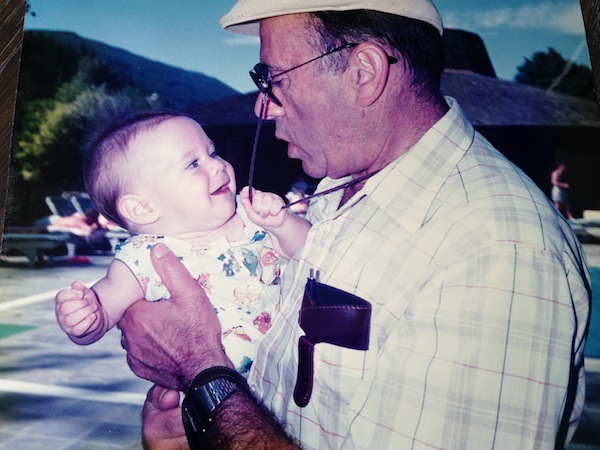
The writer with her grandfather, George Wertman. (photo from Becca Wertman)
I believe it was in Grade 6 at Vancouver Talmud Torah that we had to do a project about a “Jewish hero.” I remember other students wrote about Theodor Herzl, the founder of modern Zionism; Golda Meir, the first female Israeli prime minister; and Hannah Senesh, the Palmach paratrooper who was executed by Nazis while attempting to save Hungarian Jews. I wrote about my zaida.
My zaida, George Wertman, was born on May 17, 1921, in Lwów, Poland (now Lviv, Ukraine), and passed away on March 25, 2019, in Vancouver. He was a Holocaust survivor, yet that alone is not why I consider him my hero – it is because of how he survived and what he managed to accomplish in his life.
In fall 1941, Zaida was taken to a forced labour camp, Camp Winniki, where he became an assistant steamroll engineer, enslaved to build roads for the Nazis.
Zaida always marched in the first group of three during the 12-to-14-kilometre trek from the camp to the work site. One day, he lined up in the third group and, on that same day, two individuals escaped the camp. As was the “camp policy,” three people were shot for every person who escaped. The SS officer selected the first two rows and took them into the forest to their deaths. Zaida survived by sheer luck.
On other occasions, it was more than just luck that saved his life – it was his reputation as being a hard worker. In his second year in the camp, Zaida became ill with typhoid and was taken to the camp’s infirmary. An SS officer and a Ukrainian policeman came to the infirmary to select sick Jews to be shot for, as Zaida explained to me, why would Nazis spend scarce resources on healing sick Jews? The SS officer yelled to my zaida, “Out!” but the Ukrainian insisted that Zaida was his best worker and to save him.
In July 1943, Zaida’s determination to live motivated him to run when an SS officer came to his barracks in the middle of the night and told him to get dressed and, again, “Out!” Zaida preferred dying on his own terms – while doing everything he could to survive – and, therefore, jumped out of the window and ran. He ran through puddles to trick the scent dogs and eventually outsmarted the Nazis, managing to escape to “safety.” The rest of the camp was liquidated and sent to their deaths.
“Safety” meant reuniting with my great-grandfather in his hiding spot in a secret room located in a building where German officers lived. For one year, Zaida spoke in whispers and did not see the sun.
Zaida was liberated in summer 1944, but his story of survival by no means ended there. He met my grandmother (my baba, who I call Babi), and she, Zaida and my great-grandfather began a “business” of necessity – smuggling goods across one European border and the next. They would hollow out suitcases, fill the frames with gold and give them to my 20-year-old grandmother to carry across the border.
They eventually made enough money to get visas to Canada and, in July 1949, arrived in Vancouver.
The money they had made in Europe was invested in property, including a piece of land bought from the Canadian Pacific Railway that became my dad’s childhood (and current) house and a property that housed George Wertman Ltd., Zaida’s coat hanger factory.
Zaida worked extremely hard to succeed in Canada, making wire coat hangers and doing everything to ensure that his three children and eight grandchildren would never have to suffer.
His retirement largely consisted of wining, dining and drinking coffee throughout Vancouver. From the age of 91 to 96, he could be found daily at the Hotel Georgia’s Bel Café sharing a grilled cheese sandwich with Babi.
As the granddaughter of Holocaust survivors, I have unique childhood memories. I remember my family parking at least a 15-minute walk away, usually more, from the best restaurants in Vancouver in order to not pay for parking and to “save a buck”; of eating chicken soup in bowls of gold-rimmed china that my grandparents brought from Allied-occupied Germany; and of always asking Zaida to tell me stories, like the ones above.
In Zaida’s Holocaust survivor testimony to the University of Southern California Shoah Foundation, he explains that his philosophy is that you “have to work to get somewhere” and that he believes in “honesty, hard work and, once in awhile, if you can do a mitzvah,” do it. Indeed, hard work saved his life and being an honest businessman in Canada allowed him to give his family everything they needed.
As Zaida also instructs in his testimony, “Try to make a better world. If you cannot make a better world, do not make it worse.”
This is why he was, is, and will always be, my hero and my inspiration for how I live. I hope his story, summarized here, will inspire others as well. May his memory be a blessing.
Becca Wertmangrew up in Vancouver and currently lives and works in Jerusalem.
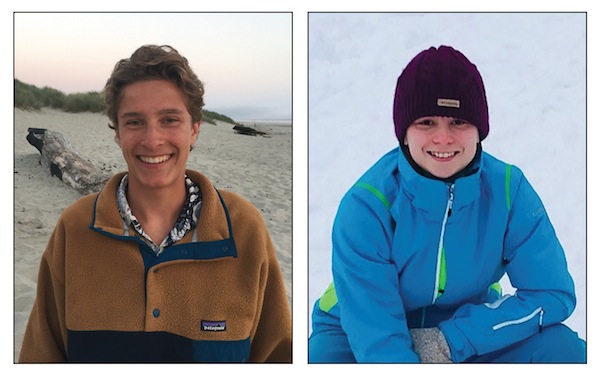
Sam Albert, above, and Liana Gerber are co-winners of this year’s Temple Sholom Teen Tikkun Olam Awards. (photos from Temple Sholom)
The Dreamers and Builders gala event May 5 provides Temple Sholom the opportunity to present its third annual Tikkun Olam Awards. The awards are the dream child of Rabbi Dan Moskovitz, and are funded by Michelle and Neil Pollock.
In addition to highlighting exemplary dreamers and builders like honourees Susan Mendelson and Jack Lutsky, this year’s gala will recognize two among the many amazing teens in the community. These youth see the needs in the world and work hard to address those needs, with creativity and compassion.
The application process for the 2019 Tikkun Olam Awards produced eight applicants and two co-winners: Sam Albert and Liana Gerber.
Sam, 17, is in Grade 11 and already recognizes the power of the pen – he plans to study journalism. His parents, Jennifer Tater and David Albert, have encouraged his devotion to community involvement. He is the youngest of three and has two older sisters. His interest is protecting the planet and preventing climate change. He is involved in many local organizations and has spent a lot of his spare time working to clean Metro Vancouver’s beaches. He is so well-known in the world community that he has been invited to attend a climate change conference in Bonn, Germany, this summer.
Liana, also 17, is a Grade 12 student. The daughter of Michelle and Martin Gerber, Liana has a twin and a younger sister. Next year, Liana plans to start studying interior design and also hopes to become a paramedic one day. For several years, on a volunteer basis, she has baked for the kids who enter Ronald McDonald House. In the process of doing this, she has spoken with and persuaded the manager of her local grocery store to provide reduced prices for the grocery items required. She also has fundraised to ensure that meals are provided for families when they enter the home, so that they may focus on the needs of their child and not worry about feeding themselves. While traveling in the United States, Liana found a Ronald McDonald House and baked for the residents there. How basherte it is that Liana is a co-winner the year that Temple Sholom recognizes Mendelson, a founder of the Lazy Gourmet catering company, among other accomplishments, for all of her work and devotion to tikkun olam.
Temple Sholom is proud and honoured to recognize excellence among its teens. On June 7, at the Shabbat evening service at the synagogue, all of the Tikkun Olam Award candidates will be acknowledged and celebrated with a special presentation. The entire community is invited to participate.
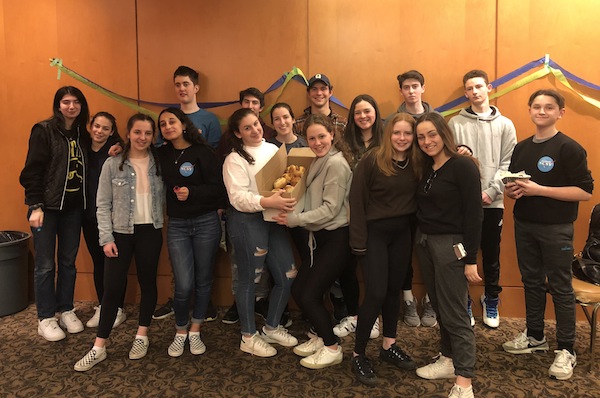
Teens from CTeens, NCSY and BBYO joined together for the Not Your Bubbies’ Babka Bake at Congregation Schara Tzedek on March 7. (photo from CTeens)
On March 17, teens from three local organizations – CTeens (Chabad Teens), NCSY (National Conference of Synagogue Youth) and BBYO (B’nai B’rith Youth Organization) – joined together for a mitzvah. Around 30 teens from Richmond and Vancouver gathered for the Not Your Bubbies’ Babka Bake at Congregation Schara Tzedek, where they learned how to braid challah and make chocolate babka.
This wasn’t an ordinary get-together, it was a mitzvah event, timed to help celebrate Purim. The challot went to seniors in the Light of Shabbat Program, and the teens took the babkas home.
The Light of Shabbat Program is run by Chabad Richmond, in partnership with the Kehila Society. Every other week, a group of volunteers makes and delivers full kosher meals, along with Shabbat candles and grape juice, to Richmond seniors who are alone on Friday nights. To find out more about the program, visit chabadrichmond.com/lightofshabbat. Part of the meal is homemade challah, which was made by these teens as part of the mishloach manot (also referred to as shalach manot), or Purim food baskets, given on the holiday.
It’s a mitzvah and tradition for adults to send a gift basket of ready-to-eat foods to at least one friend during the day of Purim. The baskets should include at least two foods, often hamantashen, chocolate, fruit, cookies or candy. The source of mishloach manot is the Megillah, or Book of Esther, which talks about “sending portions one to another, and gifts to the poor.” The idea of sending gifts of food on Purim is to strengthen our bonds of friendship with fellow Jews, as one theme of Purim is friendship and unity.
Aiden, a 15-year-old CTeen, said the reason he joined the Not Your Bubbies’ Babka Bake event was to meet other Jewish teens, and help out. “I love to bake,” he said, “and it makes me feel good knowing that the challahs we’re baking are going to seniors in our community.”
A CTeen for two years, Aiden wanted to feel more connected to the Jewish community, so he started going to shul at Chabad Richmond. Then he met Rabbi Chalom Loeub, who leads the CTeen program. Among other things, the CTeens get together every Sunday to bake cookies and cakes for seniors. Aiden also mentioned going to the CTeen International Shabbaton in New York, which he said was “incredible.” He’s now trying to get other Jewish teens involved in CTeen, too.
Jillian Marks, 17, was another participant in the challah and babka bake. She came to the event through her involvement with BBYO. As a youth leader for the Vancouver chapter, she wants to create “a pluralistic environment for everyone who wants to meet other Jews and feel safe and be whoever they want to be.” BBYO holds different events, all of which have some Jewish element to them. For this particular event, BBYO joined with CTeens and NCSY to “work together, not compete. You can be in all of the groups, not just in one of them,” said Marks.
Each of the youth groups emphasizes leadership skills, and many of their events are teen-run initiatives. Marks added that “the purpose of this challah/babka bake was not just to meet other Jewish teens, but also to volunteer and help out the community.”
All the teens echoed the same sentiments – that making challah for seniors is a mitzvah and that it feels good to volunteer. It’s a nice perk, they said, that they also get to meet other Jewish teens, adding that they would “get the word out” to their friends.
Several teens from NCSY, including Neer, 16, Jessie, 17, and Romy, 16, also attended the challah and babka bake. They run Live to Give, a social action outreach program for the local NCSY chapter. One of their projects is to take homemade baking to Louis Brier Home and Hospital residents. One of the teens said, “For seniors who have no family, or very little, it’s special for them, and it brings a lot of light to their life.”
Members of the NCSY chapter also make and deliver food to people in Oppenheimer Park. “It’s a great opportunity to help out in the community and it’s very rewarding,” said the teen.
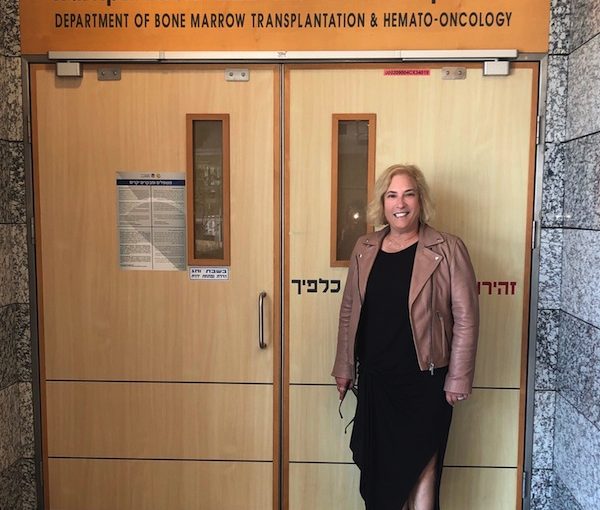
The writer at the bone marrow transplant ward at Ichilov Hospital in Israel. (photo from Ariella Stein)
Fashion is one of my many passions, as regular readers of the Jewish Independent will know by now. So, when I turned 50 this year, a milestone birthday, I decided to pursue a longtime dream – to create a fashion tract for bone marrow transplant survivors.
When I was 17 years old, I was diagnosed with Hodgkin’s lymphoma. At the time, I was in Grade 12, studying in Israel. My parents’ first reaction was for me to return to Vancouver, where they felt I should start my treatments. There was no time to waste, as it was at an aggressive stage. However, after much persuasion, I convinced my parents that I should stay in Israel. As part of the deal I made with them, I was to head back to Vancouver upon graduation and resume the next cycle of treatments.
I started chemotherapy. I had the most loving care from the staff at Tel Hashomer Hospital. I was on the road to recovery when I returned home.
After a few more bouts with chemo and some courses in radiation, however, we were given the devastating news that I had to undergo an autologous bone marrow transplant. The procedure had to start immediately. I lost the little hair I had left in just one day, couldn’t hold down any food or drink, and was separated from any ounce of humanity because I had no immunity. But I was getting better, thanks to the staff and doctors at the British Columbia Cancer Agency.
During the horrifying three-month stay in my isolated hospital room I was, paradoxically, injected with the poisonous chemo cocktail expected to cure me and the benevolent rays of light and love of my family. The support made me stronger and gave me courage. I had so much to look forward to. My two older sisters had countless discussions on having children for me if I couldn’t conceive, my father tried to grant me not just one star but the whole galaxy, my mother never left my side and my then-boyfriend-now-husband showered me with tenderness. The love in my room spread throughout the ward. Through the tears, we remembered to laugh and dream.
The writer, at 18 years old, two months after being released from the hospital for treatment of Hodgkin’s lymphoma. (photo from Ariella Stein)
When it was time to go home, I was nervous about leaving my protected environment but full of excitement to start my new life. All I wanted was to feel and look healthy again. I bade farewell to my dull uniform of pajamas and welcomed my new outfit, especially chosen for me. On the door, it was waiting for me, as if knowing how I was craving to look like a girl again. I fondly remember stepping out in my blue leather mini skirt, black cashmere sweater and black knee-high boots, handpicked with care by my mom, a true fashionista. I looked fabulous and felt euphoric on the 10-minute ride home, the only place I was headed for the time being.
Fast forward some 30 years, and I am the mother of two miraculous children, Daniel and Natalie, who bring me the greatest happiness and naches, spoken like a true Yiddishe Mame. I am grateful every day for my blessed life. There have been bumps along my journey, of course. I have often wondered if other women had the transformational experience I did leaving the ward. I knew the day would come for me to help other survivors in my own way. Splitting my time between Israel and Canada, I chose to initiate a fashion project in Israel.
I reached out to the head of the bone marrow transplant unit in Ichilov Hospital (Tel Aviv Sourasky Medical Centre) and, to my astonishment, within minutes was told they were on board. My dream was becoming a reality.
My mission is to offer patients, upon their release, an outfit of their wishes to raise their spirit, as my mother’s fashion choices had raised mine. I wrote letters to as many clothing stores as I could, looking to find sponsors, hoping they would donate new outfits to recipients. I received a few replies saying nice idea, good luck; some never replied. But some did reply with open hearts, willing to contribute to the project.
Getting started has been challenging, one step forward and a few back. Frustrating as it is, I understand that it will take time but, among the obstacles, I will not give up. As the writer Paulo Coelho said, “When you want something, all the universe conspires in helping you achieve it.” I have named my project Lalas Wings. Lala is a nickname, dubbed by my niece and nephew 35 years ago.
I was taught to dream big by my mentor, my father, Karl Stein. Hopefully, by sharing my dream, I can make a significant contribution to many bone marrow transplant patients, starting in Israel and eventually reaching hospitals in more and more places. My experience leads me to believe that the seemingly externally focused gift of clothing is part of a perfect beginning to the complex healing process.
If anyone has any questions about Lalas Wings, I can be reached by email at ariellastein@hotmail.com.
Ariella Stein is a mother, wife and fashion maven. A Vancouverite, she has lived in both Turkey and Israel for the past 25 years.
Harvey’s charoset pyramid. (photo by Shelley Civkin)
As the Torah commands us, we tell the story of Passover and the Israelites’ exodus from slavery in Egypt to our children and ourselves every year, by reading from the Haggadah. Coming from a secular home, I don’t recall our family owning a single Haggadah. Instead, my father had a little black notebook in which he wrote down the story of Passover and the Jews’ exodus from Egypt. It took about five minutes for Dad to read it, and then we had our seder. It wasn’t particularly traditional, but it was meaningful nonetheless.
On the all-encompassing journey called Yiddishkeit, preparing for Passover scores about an 18/10 on the commitment scale. Between the feathers and flashlights, flourless sponge cakes and briskets, a balabusta has her work cut out for her. And then some.
As an accidental balabusta and relative neophyte to traditional Passover preparations, I want to get with the program as much as possible. I scared myself the other day though, by reading articles about what goes into getting ready for this significant holiday. One such article – called “Cook your Pesach while you sleep” – was particularly troubling. It seems to me that a Pesadik balabusta requires at least 36 hours in every day to prepare her food for the seder, a month ahead of time. She might also require a housekeeper to do all the laundry and clean the house while she’s tethered to the kitchen, cutting, peeling, blanching, baking and roasting the eight-course meals she’ll serve to her 42 guests over the two nights of Passover. Oh, and did I mention the other two minor meals she needs to organize daily for her family during the eight days of the holiday? Holy flourless kugel, Batman!
And then there’s the issue of finding and removing all the chametz from your home. Let me confess something right from the get-go: I am not an observant Jew in the strict sense of the word. I do observe certain things, like going to synagogue every Shabbat, lighting Shabbat candles, doing the odd mitzvah, and studying a little Torah. That’s about the extent of it. I refrain from eating chametz during Pesach, but I have never actually removed all the chametz from my home before the holiday. And I don’t keep kosher. However, I do eat matzah religiously during Pesach. And I kind of have a crush on shmurah matzah.
As for that age-old shmurah versus Manischewitz matzah debate … I wholeheartedly throw my vote behind shmurah. Yes, it’s expensive, but it’s so worth it. Having visited Kfar Chabad on our trip to Israel last year, we went to their shmurah matzah factory and witnessed how the matzah is made by hand. Seeing the meticulous precision with which everything is measured, timed and baked, it was a fascinating and educational experience. And did I mention its unique flavour and round shape? Sure, parts of it can be burnt, but that just enhances the taste. Once you go shmurah, you’ll never go back.
I’m the kind of accidental balabusta that, instead of making matzah ball soup, brisket, tzimmes and macaroons for Pesach, I’m inclined to make hotel reservations in Whistler and call it a day. There’s no need for me to be Jewish Wonder Woman. Gal Godot has that covered. I know, not every woman who prepares for Pesach considers herself Wonder Woman. But, given the magnitude of preparation that must get done in advance – and done to rigorous standards – I’m pretty sure that devotedly observant women qualify for that title. As for me, I’ll do the best I can to honour the traditions, prepare a welcoming and tasty seder for my family, then enjoy a plotzfest.
Preparing for Pesach can be dangerous though. A couple of years ago, I decided to forgo the store-bought chrain (horseradish) and make my own. I found a recipe, then went out and bought the fresh horseradish root. It looked innocent enough. From a distance. Nobody told me that taking a close-up whiff of newly pulverized horseradish root is akin to inhaling mustard gas. I thought I’d burned my lungs. Sure, it produced that unrivaled heat I always admire in a memorable horseradish. However, it almost knocked me out. This Pesach, I plan to simplify the process by buying horseradish. And saving my lungs for more important things … like breathing.
On the topic of food … my husband Harvey makes the ultimate Passover crowd-pleaser: a visually stunning, delicious pyramid-shaped charoset. He got the recipe decades ago from the L.A. Times. It never fails to impress guests. Here’s the recipe.
HARVEY’S CHAROSET PYRAMID
1 unpeeled pear, cored and chopped roughly 1 unpeeled apple, cored and chopped roughly 1 cup chopped walnuts 1 cup chopped almonds 1 cup chopped hazelnuts 1 cup chopped pistachios 1 cup chopped pitted dates 1 cup chopped raisins 2 tsp ground cinnamon 2 tsp grated fresh ginger 1 tbsp apple cider vinegar sweet wine, preferably Manischewitz (about 1/4 cup) extra dates to decorate the plate
Put all the nuts in food processor and chop, but not too finely. Place in a bowl.
Put dates and raisins in food processor and chop, but not too finely. Place in separate bowl.
Core and roughly chop apple and pear by hand, then put in the food processor, along with the nuts, and the raisin and date mixture. Add cinnamon, ginger, apple cider vinegar and wine. Chop till it’s all mixed together. Be careful not to overdo it – you don’t want it mushy.
Remove it all from the food processor and shape it into a pyramid with a spatula. Then use a small, sharp knife to lightly make “brick” shapes in the pyramid. Refrigerate. Put whole dates around the outside before serving.
For another Passover culinary experience, check out Jamie Geller’s recipe for potato kugel cups at joyofkosher.com/recipes/potato-kugel-cups. You can YouTube it, too. If you’re not afraid of hot oil in a 425°F oven, this recipe will knock your Pesach socks off. Personally, scorching hot oil makes me a bit skittish. But the result is potato heaven.
As Pesach approaches, it’s a time to clean house, both literally and spiritually. It’s a time to remember how blessed we are in our freedom as Jews today. And it’s a time to hold close our traditions, pass along the story of our exodus from Egypt to the younger generation, and be thankful for where we are now.
So, eat the matzah and bitter herbs and drink those four cups of wine. Then go out and buy lots of Metamucil. Because you’re going to need it after eight days of matzah. But check with your rabbi first to make sure Metamucil is kosher for Pesach.
Wishing you all a meaningful and freilach Pesach.
Shelley Civkin, aka the Accidental Balabusta, is a happily retired librarian and communications officer. For 17 years, she wrote a weekly book review column for the Richmond Review, and currently writes a bi-weekly column about retirement for the Richmond News.
Most people know there is AIDS in Africa but few people comprehend the scope of the pandemic. In the past 30 years, 30 million people have died and 17 million children have been orphaned. Grandmothers have buried their own beloved children and are parenting again, with few resources. Vancouver’s Tikun Olam Gogos, together with other supporters of the Grandmothers to Grandmothers Campaign of the Stephen Lewis Foundation, are hosting two pledge events for African grandmothers caring for children orphaned by AIDS.
The first pledge event is For the Love of Grandmothers Fitness Challenge. Here’s how it works: you design a fitness challenge for yourself. The event period began March 8, International Women’s Day, and you must complete your self-challenge by Sept. 8, Grandparents’ Day. Choose something you enjoy and do it harder, faster or more often. Your commitment will help you reach your fitness goals.
You can do it once in a big event or work on it day by day. Then, dedicate your challenge to a grandmother you love. Examples of fitness challenges include the Sun Run, Tough Mudder, spinning 100 kilometres in a day or a month, walking or running three times a week for six months, etc. Whatever you imagine, you can do as part of this challenge – register at fortheloveofgrandmothers.weebly.com.
The second fitness challenge, back for the third year, is Solidarity Cycle, on Sept. 8. This ride is open to people of all ages. It has three track options: the Classic is a 100-kilometre cycle from White Rock to Yarrow. The Easy 50 kilometres goes from the lunch stop in Aldergrove over mostly flat, rural roads to Yarrow, and the 100-kilometre loop starts and ends in Yarrow. Stops along the way are hosted by cheering grandmothers offering refreshments and moral support. There is a celebration at the end of the ride with chili and a corn roast in Yarrow for all participants. Registration for Solidarity Cycle opens on May 1, with training and team-building rides offered throughout the summer. For more information, see solidaritycycle.weebly.com.
For both events, participants set up a secure fundraising page and ask their friends and families for contributions. Funds raised will support vital services and programs, from grief counseling to training for income-generation to support for school fees and uniforms
Moses and Aaron lead the Israelites to the Red Sea in this still from Nina Paley’s feature-length animated film Seder-Masochism, which screened at the Vancouver International Film Festival last year and is available to view for free online at archive.org/details/sedermasochism. Being in the public domain means that all of Paley’s animation and images are free for anyone to use. Nonetheless, the Jewish Independent requested and received her blessing to run the images from the film that grace the cover of this issue and its Passover section.
According to sedermasochism.com, the film “loosely follows the Passover seder story, with events from the Book of Exodus retold by Moses, Aharon, the Angel of Death, Jesus and the director’s father. The film puts a twist on the traditional biblical story by including a female deity perspective – the Goddess – in a tragic struggle against the forces of patriarchy.”
The feature was “in the works since 2012, when Paley first animated a scene called This Land Is Mine, a parody about never-ending conflict in the Levant, which has been viewed over 10 million times on various online channels.” Paley has written and designed a companion book, The Seder-Masochism: A Haggadah and Anti-Haggadah, which can be purchased through Amazon.
Paley is also the creator of the animated musical feature film Sita Sings the Blues, which, her bio at palegraylabs.com notes, “has screened in over 150 film festivals and won over 35 international awards.” It continues: “Her adventures in our broken copyright system led her to join questioncopyright.org as artist-in-residence in 2008. Prior to becoming an animator, Nina was a syndicated cartoonist. A 2006 Guggenheim Fellow, she also produced a series of animated shorts about intellectual freedom called Minute Memes. Nina began quilting in 2011 as a way to do something real with her hands after years of pushing pixels.”
Dr. Laura Beth Cohen (photo from Dr. Laura Beth Cohen)
Although the Srebrenica genocide – the killing of more than 8,000 Bosnian Muslims by Bosnian Serb forces in July 1995 – occurred more than 20 years ago, it still affects the people of Bosnia and Herzegovina every day, according to Dr. Laura Beth Cohen, director, Kupferberg Holocaust Centre, Queensborough Community College, City University of New York.
Cohen was in Winnipeg on March 8 to speak as part of the Mauro Centre for Peace and Justice: Brown Bag Lecture series. She spoke on the topic Conflicted Walls: Untangling Transitional Justice and Traumatic Memories at Bosnia’s Memorial.
“There was an opportunity to participate in the first fellowship called Summer University Srebrenica and so I decided to go,” Cohen told the Independent. “I learned very quickly – that was in the summer of 2010 – that, to really understand Bosnia, it was not enough to take a course and learn about it from books. It’s very important to understand what’s actually happening there, and the best way to do that is to actually go there. It’s a place with intense beauty, legacy and a wonderful history of different ethnic groups coming together, living in harmony.”
But, the legacy of the last war, which lasted from 1992 to 1995, is still very much present. In fact, she said, the current government is debating about it.
“Here, in America, we talk about the Second World War as if it’s confined to the past,” said Cohen. “But, in many places in Europe, the Second World War, that memory, is very much alive. And, once you’re in an environment like that, it really starts to help you, not only sort out what has taken place, but you can see … because you’re not part of that country, or you don’t belong to that population … you can start to see different ways that those memories of the past are interacting in contemporary life, and are incredibly problematic.”
When Cohen was in Srebrenica, she was taken by how much the memory of the genocide affects the surviving population, how much it is fought over. The country and government are split into two ethnic entities that are a result of the Dayton Accord, which was signed after the massacre in Srebrenica. One side was deemed the perpetrator; the other, the victim.
“It is not a big surprise there are very different perspectives between the sides over what happened in Srebrenica,” said Cohen. “The RS [Republika Srpska] government in the last month has created a new commission on Srebrenica to, once again, reexamine the facts and evidence to determine whether or not genocide took place … even though genocide took place and was proven multiple times, and especially in the international criminal tribunal. So, this debate over what happened and denial over what happened is still occurring within Bosnian society, as well as, particularly, in Srebrenica.”
This, of course, makes it very difficult for the residents of Srebrenica and the region to move forward, she said.
“It’s a place that would really benefit from having a lot of people just step away … and allowing the population to just live, move forward, and gain attention for things that they really need support with – economic relevance, additional support for education, and rebuilding parts of the community,” said Cohen. “But, with the memory so volatile and kept alive, it really overshadows what’s taking place there. You can imagine trying to raise your family, regardless of your ethnicity, in a place where the past is constantly looming, and it’s a grotesque past. How do you bring your children up in that world?”
According to Cohen, the constant and continued fight over the politics and memory of what happened at Srebrenica does not allow people to learn about what happened or why, and that this is preventing coping mechanisms from being put into place; mechanisms that could help stop other massacres from happening.
“We only focus internationally once a year – on July 11, during the annual commemoration of the Srebrenica genocide that takes place at the memorial – so we often don’t understand what’s taking place there the other 364 days of the year,” said Cohen.
“People visit the 9/11 memorial in downtown Manhattan. They visit Auschwitz-Birkenau in Poland. They visit Kigali Genocide Memorial [in Rwanda]. These memorials serve as an educational component. For local residents and national citizens of these countries, they also serve as places of memory making,” she said.
In Srebrenica, Cohen hopes to eventually see ways of involving the local community in dialogue initiatives that facilitate the creation of memorials, ones that speak to the locals, helping them repair their communities.
“While we, as Jews, have a view of what Auschwitz-Birkenau is, to the people of Poland, it’s a German extermination camp on Polish soil,” said Cohen. “And, to the local people in Oswiecem, which is the Polish name of the town that the camp was built by, they struggle with having that kind of site in their community.”
When it comes to Srebrenica, she said, “We get stuck in the conversation of the politics over the genocide and what happened. What then happens is, a lot of these issues play out at the memorial. Part of this conversation is theoretical, but part of it is to help us understand that these are not static locations. They are very much interactive places, where memories are not only being promoted, but shaped by the larger discourse where they are situated.”
Cohen said the part of Bosnia, Herzegovina and Srebrenica that has always drawn her is “not only the friends I’ve made, but a vibrancy of life in Bosnia that gets lost in the discussion. The culture is beautiful, the people are beautiful, the relationships that people have with each other are beautiful. And, despite all of the horror of the last war, and despite all the history, and the Second World War and before that, it’s a place where there’s a lot of love and a lot of hope. That’s something that keeps, especially, international activist scholars engaged in what’s taking place there … and that, we can’t lose sight of when we talk about all the politics and things that aren’t going well.”
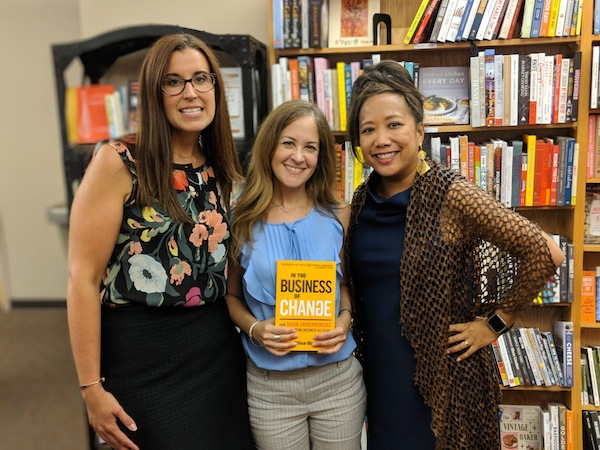
Elisa Birnbaum, centre, with Laura Zumdahl of Bright Endeavors, left, and Maria Kim of Cara Chicago. (photo from Elisa Birnbaum)
Toronto-based Elisa Birnbaum, editor-in-chief of SEE Change magazine, aims to inspire and give hope in many ways. Her book In the Business of Change: How Social Entrepreneurs are Disrupting Business (New Society Publishers, 2018) is but one of those ways.
“I’m a lawyer by training, but was always a writer on the side, enjoying writing and storytelling,” said Birnbaum, who was born and raised in Montreal in an Orthodox Jewish family. “I decided to try writing out for a little bit and to go back to law after. That was 15 years ago. I never went back to it.
“I was writing a lot about the nonprofit and charitable sector in Canada, as well as in the U.S., and I was also writing a lot about business, a strong interest of mine, too. I noticed how there was a melding of the two – how a lot of challenges in the nonprofit and charitable sector … how they could be helped through business and through business savvy…. So, when I saw what social enterprise was all about and how it was using business to solve social challenges, I realized the importance of that. I became really intrigued and interested. It was an area that, I thought, ‘Hey, this is something I really want to explore further.’”
Birnbaum started pitching stories about social enterprises to any editor who would listen. While some of her work went out via mainstream media, Birnbaum felt more was needed, so she co-founded SEE Change, which is devoted to telling the stories of social and environmental enterprises.
“I thought they symbolized a new way at looking at business,” she told the Independent. “I really felt this was the future, with how we work with business and how communities can tackle social challenges through business, and these types of savvy-ness and skills.”
After years of publishing the magazine, Birnbaum wanted to put together a book of such stories, both to delve more deeply into the phenomenon and, hopefully, to inspire and teach readers how to take on the task of starting a social enterprise.
“A lot of times, I’d get some young people or even older people who were interested in social entrepreneurship themselves, and they’d like advice and tips, and were constantly looking for more information from anyone who’d done it before,” she said. “So, I thought, I could also provide lessons learned, tips, advice and resources … so, a bit of storytelling, as well as a resource for those who are starting up or looking to start their own.”
As far as the response to the book so far, Birnbaum said she has been asked by schools and organizations to speak about the topic. “There were people who had never heard about it before and are now really inspired by the storytelling, which is great,” she said. “There are other people…. I was at a couple of universities recently, and some students there said they picked up the book and were now interested in starting their own social enterprise.”
According to Birnbaum, a very broad definition of a social enterprise is a business, whether nonprofit or for-profit, that has a social or environmental mission at its core, as opposed to a business that has profitability and sustainability at its core. The unique aspect of social entrepreneurship, she said, is that it approaches business in a new way.
In her book, Birnbaum makes a point of highlighting a large array of social enterprises from around the world, including a few in British Columbia. For example, Saul Brown’s Saul Good Gift Co. (itsaulgood.com) creates gift boxes filled with locally made artisan food that people can give their loved ones across Canada, and Reena Lazar’s Willow (willoweol.com) helps with end-of-life planning.
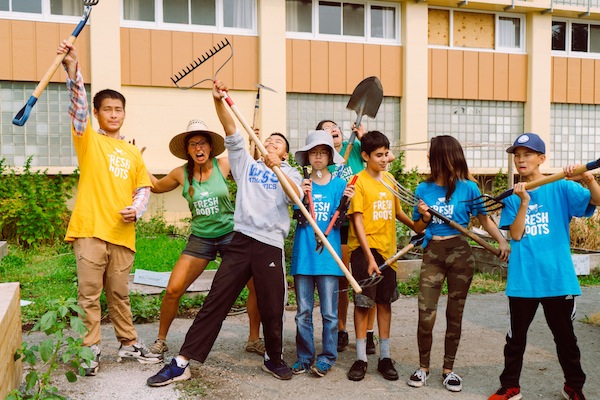
Fresh Roots offers students experiential learning opportunities. (photo from Fresh Roots)
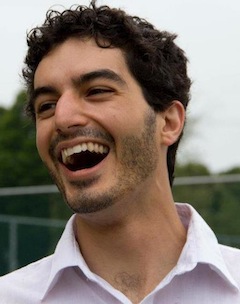
Marc Schutzbank, director of Fresh Roots (freshroots.ca), grew up in the United States and moved to Vancouver to finish his education at the University of British Columbia 10 years ago on a Fulbright scholarship, looking at the economic viability of urban farming. This line of study led him to an organization called Plant to Plate, in Pittsburgh, Penn., where he attended University of Pittsburgh.
“As part of my research, I was looking at urban farms in Vancouver – if they were growing, how much food they grow, who they’re sharing it with,” Schutzbank told the Independent. “I have a finance degree, so I was looking at if they were making any money. As I was doing that, there were a couple of people who were doing work in the social space. So the goal wasn’t to grow and sell food; the goal was to share it or to reduce barriers to employment. And so, as I was getting to know them, Fresh Roots was moving from backyards into school grounds.”
One particular backyard caught Schutzbank’s attention. He wanted to know how much food was being grown in such a small space. He discovered, to his amazement, that this one backyard could feed three families. As they expanded to eight backyards, they could feed 35 families.
One of those backyards was adjacent to an inner-city elementary school with a rundown garden plot. The school invited Fresh Roots to develop the plot. As they did, the students, teachers and parents became increasingly interested. The teachers began using the garden as part of their curriculum, as a place to build learning capacity.
“It turns out that, when kids are outside growing food, their academic confidence increases,” said Schutzbank. “They are able to find some success, and this is often in places with kids that are having a hard time finding success inside the classroom [in straight rows]…. Learning like that doesn’t work for everyone.”
Marc Schutzbank, director of Fresh Roots. (photo from Fresh Roots)
Another benefit of this was that bullying decreased at the school, as kids had a positive physical outlet. As well, Schutzbank found that, as the saying goes, “If you grow it, you eat it.”
Other schools picked up on what was happening and asked Fresh Roots to do the same at their schools. Fresh Roots is now at four high schools and one elementary school.
Fresh Roots also started a salad bar program for students – twice a week, all of the students get to eat the produce from the garden.
“In Canada, we are the only G7 nation that doesn’t have a federal meal program,” explained Schutzbank. “It’s a bit crazy that Canada doesn’t have that. All those kids without lunches are hungry, regardless of how much food is at home. It’s really critical for learning, to have food…. So, at Fresh Roots, our vision is good food for all – so everybody has access to healthy land, food and community.”
In addition to the food they grow, Fresh Roots supports and encourages teachers to have classes outside in the garden. “They need to touch, taste and feel,” said Schutzbank of the students. “Those are really critical parts of our senses and a really important way of learning.”
As well, Fresh Roots provides employment – especially in the summer – for youth who are struggling.
Schutzbank said you can’t grow food without eating and sharing it, so Fresh Roots’ philosophy is “around sharing all the food back through the programs and everything we are doing.”