Making discourse civil

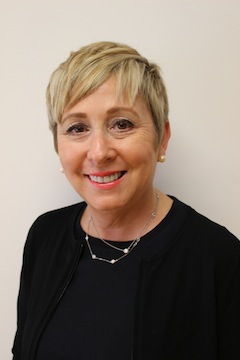
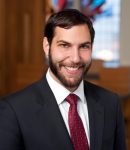
Rabbi Jay Henry Moses will speak at FEDtalks on Sept. 13. (photo from Rabbi Jay Henry Moses)

While hate groups and their opponents across North America rally, and sometimes brawl, proponents of civil discourse are teaching people to communicate effectively across divides.

However, Rabbi Jay Henry Moses, who will speak in Vancouver this month, admits that those at the extremes may not be fertile soil for seeding civil discussion. It’s the vast majority in the middle of the bell curve he is interested in, the great number of people of goodwill who wish to debate agreeably but sometimes lack the skills to do so.

Moses is vice-president of the Wexner Foundation, which was founded by Ohio philanthropist Les Wexner in the 1980s to focus on the development of Jewish professional and volunteer leaders in North America, and public leaders in Israel. Moses will visit here as one of five speakers at FEDtalks, the opening event of the Jewish Federation of Greater Vancouver’s annual campaign, on Sept. 13.

The Wexner Foundation has an upcoming summit on civil discourse and the topic permeates everything the organization does.

“The topic is of particular interest to us because, built into the fabric of all the programs that we run for leaders is the element of diversity,” he told the Independent in a telephone interview. “We have, since the very beginning of our work, always been very clear that we serve the entire Jewish people and the entire state of Israel and that the leaders who go through the programs that we run will be stronger and better leaders for having encountered those with different viewpoints, and learn from them. It’s actually long been part of the secret sauce of what makes our program successful … that we’ve managed to be able to bring together people who disagree with each other about important things but who share a common mission of one type or another. We’ve been able to bring them together and have the resulting cohorts be greater than the sum of their parts precisely because of that diversity.”

Nurturing an openness to diversity of opinion, particularly in the frequently contentious realm of Jewish and Israeli leadership, allows alumni of Wexner’s varied programs to bring some of that wisdom to the other circles of influence they occupy, he explained.

Inside and outside of the Jewish world, there are challenges and opportunities around civil discourse, Moses said.

“I am optimistic in the long run but realizing in the short run the hill that we have to climb is pretty steep,” he said. In the aftermath of Charlottesville and other conflicts, the chasm between the ideal and the real is evident.

“The ideal may be that everybody will be able to participate in conversations with people they disagree with and do so in the spirit of openness and learning and growth and not necessarily agree, but at least be able to occupy the same space and have the spirit of open-mindedness in their conversations and maybe get to better solutions because of talking with people who are speaking differently and so on,” he said. “That’s the ideal that we are working towards. The reality is that we have extremes on both ends. We have people whose adherence to their worldview and ideology is so extreme and so rigid that they have no interest in, nor ability to, engage in conversation – civil conversation – with people they disagree with.”

Focusing on these extremes is not a recipe for success, said Moses.

“We have to start by not focusing on them, [and] actually focus on those in the middle of the bell curve who may be on one side or another of any given ideological divide, but who are not closed off entirely to engaging with people they disagree [with],” he said. “I think the vast majority of North American Jews, if you want to talk about the universe that we are mostly influencing, are mostly in the middle of that bell curve somewhere. They are not extremists and [are] candidates for the kind of experiences that can enrich them, and enrich our community, by bringing people together who disagree in the right way.”

Providing people with the tools to express themselves and to listen to those with whom they disagree is an art, not a science, and Moses acknowledges he doesn’t have the silver bullet. But working toward civil discourse may be more urgent now, in the age of social media.

“When conversation is left to its own devices, especially in an era of social media, we often lead with less than our best selves,” said Moses, dryly. “So, having a structure within which to safely and carefully and slowly approach sensitive topics is really important. Letting it unfold organically, as it often does in social media is, in many cases, a recipe for miscommunication and breakdown of civil discourse.”

Bad experiences on social media, Moses fears, have actually made people more wary of having potentially difficult conversations in person.

“They are more hesitant to have conversations in person because they’ve seen online how quickly it can devolve into personal attacks or other really uncomfortable and difficult situations,” he said. “I think we are encountering people we disagree with all the time but I feel like we’re actually talking to them less because we feel we have nothing to talk about. We don’t know how to start those conversations, or we have had them end badly. We’ve had personal relationships damaged and much of that damage has happened online because things happen more quickly and at a greater distance. So, face-to-face conversation is suffering as a result.”

The essence of his message to the Vancouver audience will be that struggling to communicate civilly is not a new phenomenon, but it is made more urgent by contemporary developments.

“This problem is not new – it’s been part of our community’s challenge for centuries,” he said. “At the same time, we are in a moment where, because of a combination of a lot of these factors, it’s a crisis, you have a level of urgency that it may not have had before. I want to make the point that, although unhealthy disagreement has a long history in Jewish life, we also have baked into the fabric of our tradition amazing resources and a time-tested recipe for creating a culture of dissent that allows us to engage in a healthy way as a community. I’d like to address some of the ways we can use those principles from our tradition and from our history, sort of repurpose them for the 21st century, and create a new model for how we can rebuild that culture of healthy dissent using our own DNA and adapting it to our day.”

Before becoming vice-president of the Wexner Foundation, Moses was head of the Wexner Heritage Program. Originally created as a stand-alone foundation, and now based within the larger foundation, the Wexner Heritage Program’s mission is “to expand the vision of Jewish volunteer leaders, deepen their Jewish knowledge and confidence, and inspire them to exercise transformative leadership in the Jewish community.”

“As the director of that program for many years,” he said, “I worked with Jewish communities across North America to identify and then train volunteer leaders – high potential, promising, up-and-coming volunteer Jewish leaders who engage in a two-year program of study of Jewish history and Jewish thought and also of Jewish leadership. We basically are investing in these leaders to give them knowledge and inspiration to go back to their Jewish communal volunteer work with broader vision, more confidence, a deeper network and a sort of bolder vision of what the Jewish future can be and their own sense of responsibility for bringing us toward that future.”

There are several connections between the Wexner Foundation and other speakers at FEDtalks, Moses noted. Also at the Chan Centre podium will be Eric Fingerhut, president of Hillel: The Foundation for Jewish Campus Life, of which the Wexner family has been very supportive. He also noted that Ruth Wasserman Lande, another speaker (profiled in the Independent Aug. 18), is a Wexner alumna.

Moses has a request for the Vancouver audience: “Judge me kindly if I’m sharing the stage with Ruth, who is an extraordinarily impressive and charming person.”

For the full speaker list and to purchase tickets, visit jewishvancouver.com.

Talmud Torah celebrates 100

Vancouver Talmud Torah’s expanded new campus includes many collaborative spaces. (photo from VTT)

On Sept. 17, Vancouver Talmud Torah will mark its centenary, celebrating “its humble beginnings as an afterschool cheder to the VTT of today – a modern, state-of-the-art facility with the capacity to educate generations of Jewish children in the decades to come, just as we have been doing for the past 100 years,” head of school Cathy Lowenstein told the Independent.

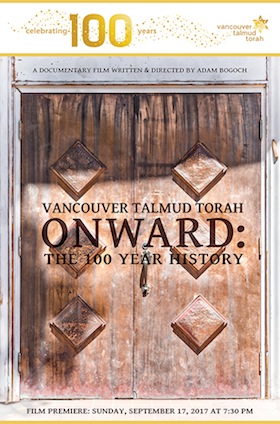
The focal point of the celebratory evening is the documentary Vancouver Talmud Torah Onward: The 100-Year History, written and directed by Adam Bogoch. The event sold out in three hours, said David Bogoch, Adam Bogoch’s father and chair of the VTT Alumni Fund, which supported the project.

David Bogoch was on the VTT board for seven years. He served as alumni chair when he was a board member and it’s a position he retains.

“It is my hope that anyone who attended the school could reconnect with the school and their classmates through the alumni organization,” he said in an interview with the Independent. “It is not an association, nothing formal, just a large family of friends, past students and parents of students.”

The alumni fund, he said, “receives donations and, in turn, makes gifts to the school. Over the last few years, the alumni fund installed an alumni garden at the corner of Oak and 26th, purchased band instruments for the students of the school, and purchased display cases for use in the hallway of the school.

“In an effort to get more people excited about reconnecting with the school, I felt it was necessary to document the 100-year history of the school, and to celebrate the 100th anniversary of the school appropriately. It is important for future parents, board members, staff and administration, and the community at large, to know how much of a struggle it is to keep the school open, paid for, able to properly care for and educate the children who walk in the door. It takes great effort from many individuals, and the full support from the entire community to keep Talmud Torah doing its best.

“We must also recognize all of the leaders of the past and the people who helped the school become what it has become,” he added, “so the documentary was a natural fit. The film is a permanent reminder and a wonderful gift to the school.”

The film was produced independently from the school, said Lowenstein. While they knew an historical piece was being made, she said, “the fact that it was completed to coincide with VTT’s 100th anniversary year was sheer good fortune. Many of us were interviewed, but we actually had no idea how and when it would all come together.”

photo - Vancouver Talmud Torah head of school Cathy Lowenstein
Vancouver Talmud Torah head of school Cathy Lowenstein. (photo from VTT)

Lowenstein said the production of the film “is close to the heart of David and Adam, who are the son and grandson of the late Dr. Al Bogoch, z’l, a former VTT board chair who, through passion and conviction, single-handedly engaged our community to burn our last mortgage. Adam is a wonderful storyteller and he does his family proud through the recounting of Talmud Torah’s fascinating story. VTT Onward is a vitally important historical record of our school.”

Some members of the VTT leadership team were shown a rough cut of the film and, said Lowenstein, “while we might not endorse everything that’s said in the film, it would be an honour to kick off VTT’s 100th year by showing it to our community.”

The title of the film, she said, captures “the very essence of what our school is about. We are always looking to fulfil our mission of academic excellence and nurturing lifelong learners. We have a responsibility to look ahead, to plan and vision forward to ensure that we are offering the best possible in core academics and Judaic studies to our students and families.”

But looking back is also necessary. “The film relies on archival photographs and live interviews with some of the very community leaders who ensured that the school remained strong and viable through some exceedingly difficult periods,” she said. “I appreciated learning about different perspectives from many community stakeholders. It is not often that one has the opportunity to hear so many different points of view from those who have been intimately connected to the school.

“The challenges our predecessors faced are the very same challenges we also face today – and that Jewish day schools across North America confront as well. I found it encouraging to see the ebb and flow and highs and lows of this institution, yet with the reassurance that VTT is a treasured community asset that is vital to the growth, strength and future of our community.”

Stressing her pride in the school’s faculty, Lowenstein said, “Although our expanded new campus allows us to do things we never imagined possible, what happens inside the four walls of the classroom (and now in our many collaborative spaces) is still our top priority. I have a team of key professionals dedicated to ensuring that the academic and Jewish experience at VTT remains relevant and vibrant. We are continuously looking to improve our offerings, and each new school year brings new ideas and new innovations. This, to me, is the hallmark of a responsive and reflective school.”

As for some of the current challenges, Lowenstein said, “As the community knows, we have just completed the building of a magnificent new campus and now we must finish paying for it. Paying down the interest on our loan is one of our key priorities to remain financially sustainable. One of our greatest challenges – and it applies to almost every independent school on Vancouver’s West Side – is the decreasing number of school-age children in the catchment due to Vancouver’s high housing costs. This is an issue that VTT, [Jewish] Federation and so many other Jewish community agencies are exploring and trying to address. Our board of directors is also committed to ensuring VTT remains an affordable option to middle-income families.

“Ultimately, our goal is to ensure we meet the diverse needs of our VTT families. We want students to receive their Jewish education at VTT from the early years until they become proud graduates in Grade 7.”

“For 100 years,” said David Bogoch, “the school has been a focal point of the Jewish community. Students make lifelong friends from their years there. They learn so much about being Jewish and what that means. The students become successful leaders throughout the entire community as they grow up, and the entire community benefits from the school.”

The making of VTT Onward

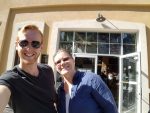
Adam Bogoch and Cynthia Ramsay at Main Street Brewery, where they discussed, among other things, Adam’s documentary film about Vancouver Talmud Torah. (photo by Adam Bogoch)

As I watched filmmaker and writer Adam Bogoch briefly consider jaywalking across Main Street to meet me at Brassneck Brewery, I held my breath. Thankfully, he decided to cross at the lights and, together, all body parts intact, we headed into the crowded tasting room and found two places at the bar.

We had lots to talk about that sunny, humid day in July – he was excited to share with me, and Jewish Independent readers, news of a commercial project he was just completing. The final product, Vancouver Talmud Torah Onward: The 100-Year History, will première on Sept. 17 at Rothstein Theatre. While the event has sold out, there will be other opportunities for community members to see it.

“… there have always been community-minded individuals who have been ready to step forward and guide the Talmud Torah onward, and keep the light of Jewish learning alive.”

Adam chose to frame the work with an article from the Jewish Western Bulletin, the predecessor of the JI. Written by Harry Wolfe, the short item appeared in the Sept. 2, 1948, issue of the JWB, which was dedicated to the imminent opening of the then-new building at 26th Avenue and Oak Street, and featured a lengthy history of the school’s first 30 years. What is interesting about Wolfe’s quote – and Adam’s decision to use it – is that it recognized both the numerous (recurring) problems that faced the school, as well as the fact that “there have always been community-minded individuals who have been ready to step forward and guide the Talmud Torah onward, and keep the light of Jewish learning alive.” Hence, the name of the film.

“It’s extremely challenging to create a documentary on an institution that doesn’t feel like a puff piece. Honestly, that was the first obstacle to overcome,” said Adam in an email interview. “I have my own personal perspectives on religion and community politics that I didn’t want clashing with the mission of the movie. So, the only way I could get around this was to locate the heart, that something that we can all relate to.

“Luckily, this was almost instantaneous. While going through the archives, I found a superb article in the Jewish Western Bulletin … written by Harry Wolfe in 1948…. It perfectly encapsulated the trials and tribulations of the school and how the success or failure of the institution was, and still is, solely on the backs of the community. It also stated that, despite major setbacks, there have always been those willing to put their tucheses on the line for VTT.

“The reasons they did this were numerous and we explore some of them in the movie,” he said. “But, even when I went to VTT, there was a love that pervaded the halls of the school. No matter where you fell on the religious, financial or political spectrum, there was a place for you. That’s an institution worth talking about and one worth fighting for.

“That’s not to say that it’s perfect. Nothing is, and the movie doesn’t shy away from that, which, aside from being a vital part of storytelling, is part of the fun of it. But, hopefully, the film helps to keep the school (and the community) on the right track.”

It certainly kept Adam on track, making “sifting through hundreds of hours of footage far easier. If it didn’t fall under the umbrella idea, it got cut.”

The film project was funded, said Adam, “by the generosity of Syd Belzberg and by multiple donations made to the VTT Alumni Fund.” It took more than three years to complete – and that was after years of discussing the idea of a documentary. It was a concept for which his father, David Bogoch, in his capacity as alumni chair, advocated “with many different boards.”

“Frankly, it took awhile for excitement to build,” said Adam. “At first, only my dad, who’s a wealth of information on the topic, truly saw a story worth telling. By the time we knew the school would be celebrating its 100th anniversary, things really began to take shape. Past board members and individuals in the administration embraced my dad’s ideas and he convinced me to helm the project.”

In addition to funding the documentary, the VTT Alumni Fund has been financing the digitization of the archives, said Adam.

“I spent the first two years of this project doing research. This included the expansive VTT archives, the Jewish Western Bulletin, the Jewish Museum and Archives of B.C. and Rozanne Feldman Kent’s book The Vancouver Talmud Torah: 1913-1959 and Beyond.”

While he did most of the legwork himself, he received “some significant assists” from his dad. “As well,” he said, “I was lucky enough to work with a small crew on certain days. So much visual content came from [VTT’s] Jennifer Shecter-Balin, and she simply must be praised.” He gave a lion’s share of the credit to film editor Thomas Affolter. “The broad strokes of the project may have been due to my experience as a writer,” said Adam, “but he has a director’s mind that added a real sense of professionalism and cleanliness that is immediately evident on screen.”

The decision of who to interview was a collaboration between Adam and his dad. “We had suggestions given to us by [VTT head of school] Cathy Lowenstein, as well as by staff members, but most of the 46 faces featured were our decision,” said Adam.

“… we have an all-star lineup of community members of all different ages, occupations, experiences and perspectives. It’s like the Ocean’s Eleven of the Jewish community.”

In his 1948 article, Wolfe wrote, “We have attempted to give credit where it is due, but many will have to remain unmentioned because of modesty or because research could not uncover names.” Adam said he faced the same challenge and is expecting to receive “a few remarks on missing faces. But, it’s important to note that some people were unavailable or had no interest in being on camera. The movie also couldn’t be unbearably long, so we had to cap at a certain number of individuals. But, we have an all-star lineup of community members of all different ages, occupations, experiences and perspectives. It’s like the Ocean’s Eleven of the Jewish community.”

This is Adam’s favourite aspect of the documentary, “that it provides voices from all corners of the community. Sure, we could have always featured more. There will always be factions that we didn’t include. However, we have 46 featured faces. Each with their own perspective. Some of which are in conflict with one another. But all of them are shooting for the same goal – a prosperous Jewish day school that welcomes everyone.”

Adam gave the school credit for its hands-off approach to the content. “Some of these opinions [in the film] are not what the school endorses. But they understand that they are just opinions. Informed discussion is vital for growth, and we can’t shy away from it. At the end of the day, we had very little interference from the school; and what little we did have made the project stronger, kinder and still just as honest.”

He added, “The board and admin have been so supportive of this journey, and they must be acknowledged for their bravery in embracing something that wasn’t completely shiny and beautiful. That tells me that they’re confident in the quality of their school.

“Another thing that interested me about VTT Onward,” he said, “was that I was honouring my family roots. My grandfather, Dr. Abraham (Al) Bogoch was a giant in the community, especially when it came to VTT. My dad has followed in his footsteps in a way that I think exceeds my grandfather’s influence. My connection is different, but this is one way that I can contribute to something that’s been integral to the Bogoch family.”

Adam himself is a VTT alumnus – class of 2005. By the time I first met him, he had moved to the next level of his Jewish education and was at King David High School. The reason for that meeting, in 2009, was the screening of his first feature film, Avoid Confrontation – he was 17!

From April 2010 through March 2011, we ran a series in the JI that that followed the production process of his second feature film, Complexity, from concept to completion. And I interviewed Adam in July 2011 about the short film Eye of the Beholder, co-written by David Kaye and Vanessa Parent, which he directed.

When we were organizing our beer-tasting and informal interview this summer, I was shocked how long it had been since I’d written about his work. It wasn’t like we hadn’t kept in touch. We get together every so often to catch up on each other’s lives, though generally over coffee and pastry.

The idea for the beer-tasting interview originated in the spring, while we were at Thomas Haas café on West Broadway. There, Adam made an offhand comment about having to come back another time to take a proper photo of the cappuccino (it might have been a latte). Lo and behold, he writes about coffee for the food blog Hidden Gems Vancouver.

While he initiated that blogging gig, and does enjoy content writing immensely – blogs, websites, ghost-writing – he said, “ultimately, I do it to supplement my other works.”

His resumé includes “writing and rewriting film outlines and treatments, as well as penning works for the visions of others,” but his passion remains screenwriting.

“Writing and directing two feature films as a teenager, before I could truly comprehend what story really is, was the best training for what I do now. But it’s a constant learning experience,” he said. “I’ve also been lucky to have been trained by some of Hollywood’s most influential writers and professors. Experiences I’ll never forget.”

At Brassneck, we discussed how to construct a plot, as well as successful and not-so-successful adaptations of books to the screen. Our beer choices oddly echoed our personalities, with me tending toward the darker beers, only accidentally ordering the aptly named Klutz Kolsch, a blonde ale, and Adam ordering the likes of Hibiscus Wit (which he has in abundance), Wingman (I’m sure he makes a great one) and Sunny Disposition (which he also has, both in temperament and in looks, with his broad smile and ginger locks).

image - Vancouver Talmud Torah Onward: The 100-Year History film screening posterAs we took our interview and beer-tasting to Main Street Brewing on East 7th Avenue – and had some much-needed food – we talked about VTT Onward, the Jewish Independent’s upcoming Chai Celebration (don’t make any other plans for the night of Dec. 6!), more about film adaptations and a bit about the challenges we each face being self-employed in the arts.

“At the end of the day,” said Adam, “I’ve picked a profession that is highly competitive and doesn’t operate in any way like ‘mainstream’ careers. It’s a constant barrage of rejection and uncertainty. But I’ve been extremely fortunate to have signed with a tornado of a manager, Liz Hodgson. She’s been responsible for the careers of some notable A-list talent, both in front of and behind the camera. She’s been mentoring me consistently – one of the most common ways for writers to break into the industry on a significant level – and is currently representing my next two projects, one of which I’ve been rewriting for over six years.”

This latter script has almost been made four times, and has received multiple offers, said Adam. “I’ve taken none. This is because there’s always been something that has kept me from releasing it. That, or the deals haven’t been right.

“Recently, I’ve been working with my manager on a rewrite that will hopefully allow me to let it go…. Without over-talking it, Between Me (current title) is about a teenager battling his three personality projections who seek to push and pull him towards utterly catastrophic directions.”

We decided that Brassneck’s Bivouac Bitter could possibly represent the teenager’s negative id, its Raspberry Changeling (which was sour, not sweet) his super ego. To describe his whole character, Adam thought Main Street’s Old Knights Pale might be appropriate. We found the teen’s positive id at 33 Acres Brewing on East 8th Avenue, in Nirvana, appropriately enough.

Despite having a little more to eat at 33 Acres, the beer-tasting was having an effect on me. After more discussion about life, the VTT film screening, which was then only in the planning stages, and the JI, which Adam described at one point as the “printed record of history,” we parted ways. He was decidedly more peppy, but I slowly made my way safely home. When I looked at my watch, I couldn’t believe that six hours had gone by.

A real tête-à-tête had obviously been overdue and the beer-tasting a good idea – at least for deep conversation. As for an interview, not so much. While I took the odd note, all of the material for this article comes from an email interview after the fact.

I will next see Adam at the Sept. 17 première of VTT Onward. Even though I’ve seen it, I’m looking forward to it. I’m not the only one who was impressed by the rough cut. A few others have seen it.

“I’m blown away by the response,” said Adam. “I had no clue it would be received as well as it has been so far. I’m now confident that the community at large will find something in it that moves them and, therefore, I’m thrilled to be able to share it.

How we memorialize the past

The most recent racist conflagration in the United States was ignited, ostensibly, by the removal (or threatened removal) of Confederate commemorative statues and plaques. We say ostensibly because it seemed some people were just itching for a fight and this issue popped up.

Each community, or each society, must determine who and what it commemorates. It is understandable that African-Americans, among others, would be offended by statues and other historical monuments that adulate those who defended slavery in the U.S. Civil War. Those who decry their removal as an “erasing of history” seem to be unfamiliar with the concept of libraries and museums, which are among the foremost repositories of history. Remembering history is different from venerating it. For example, a statue of Confederate General Robert E. Lee in front of a courthouse is an affront to equality before the law. The same statue in a museum could provide an opportunity for reflection and discussion.

Outside Budapest is a curious outdoor museum featuring dozens of statues and monuments from the communist era. It is a kitschy museum but it invites guests to ponder the propaganda of earlier eras, even admire some of it from a perspective of artwork, but it is decidedly not a place of veneration. It is a clear statement that such works, if they are to be publicly displayed, should be positioned in a way that does not esteem the ideas that inspired them, but instead invites observers to reflect on their meanings and the often catastrophic outcomes of their ideologies.

Similarly, the preservation of Auschwitz and other places of Nazi terror was not done in honour of that terrible time and the evil that defined it, but for the opposite reason: to ensure that future generations face the reality of that history and to inspire people to seek a better future. Context is crucial.

While Americans battle their demons, some Canadians have taken issue with our history and how it is commemorated. The government of Sir John A. MacDonald, Canada’s first prime minister, was responsible for implementing the residential schools system, a past with which most Canadians are only now beginning to grapple. Last month, the Ontario elementary teachers’ union said MacDonald’s name should be stripped from the nine schools in that province that are named for him. By that logic, we would eliminate his visage from our $10 bills and remove his statues and other likenesses from our public spaces.

Should we? Well, if Canadians had a thoroughgoing national discussion on the subject and a consensus clearly emerged that what was bad about MacDonald outweighs that which was good, then yes. But we should not jump in willy-nilly, thoughtlessly applying the values of today upon people of the past. To be clear: the residential schools system was an atrocity and a national disgrace; we know this now. How we attempt to rehabilitate our country and make amends for this awful history is a discussion in which we are immersed. The veneration of figures who were party to that history invites a legitimate and thoughtful reconsideration – neither those whose knee-jerk reaction is to tear down statues, nor those who reflexively balk at the very idea, are exhibiting the sort of approach we need. Ontario’s elementary school teachers, for example, may have missed the mark. If ever there were a teaching opportunity, it would be to engage young Canadians in critical thinking about why their school is named for the first prime minister, why some people think that’s problematic, and how empathy toward minorities is key to a better future.

But we should be careful in determining the measuring stick we apply. In considering the legacies of any public figure who lived more than a couple of decades ago, we would be hard-pressed to find one who would measure up to today’s standards on the rights and roles of Canadian indigenous peoples, Jews, women, gay people, or really any minorities. One might even argue: Who are we to judge? Are we assuming this generation has reached the moral summit of civilization? The state of the world today suggests we have much left to do to advance tikkun olam. Future generations will not likely give us any great kudos for perfecting humanity.

In the end, we cannot fathom how our descendants will view us and our behaviours. If, as now seems tragically inevitable, human-created climate change wreaks havoc on our world, future generations may look at our car driving, energy consumption and jet vacations as the direct cause and remove the names and likenesses of even the best of our generation from their schools and public squares.

By all means, we should consciously consider representations of our past and whether they are appropriate or inappropriate for our times. It is a discussion worth having, but we should have that discussion before we go racing around tearing down monuments and renaming schools.


Delving into the past

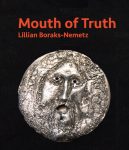
Lillian Boraks-Nemetz’s newest book, Mouth of Truth (Ekstasis Editions, 2017) is not an easy, escape-from-reality read, but it’s an interesting and important read. What does it mean to be a survivor? How does one person’s trauma affect those around them? Is healing possible? These are but a few of the many questions that Mouth of Truth elicits.

The novel is based on the experiences of Boraks-Nemetz, who is a Holocaust survivor. Born in Warsaw, Poland, she escaped the Warsaw Ghetto, and survived the war by hiding under a false identity.

“My life’s story is, of course, similar to the book’s,” Boraks-Nemetz told the Independent. “I suffered in childhood, in adolescence, girlhood and womanhood. It is only now, in my senior years, that I have found some degree of peace.”

The protagonist of Mouth of Truth is Batya, who still struggles with Beata (Bea), her wartime identity, even though she has been in Canada for decades. Her Canadian-born husband, Joseph, and their children, Sam and Miriam, have no idea of the trauma with which she is attempting to deal. She drinks to suppress her more feisty Bea personality and their memories – not only of the ghetto, but of abuse by the man entrusted with her care, and others. Though this method of coping isn’t working, Batya manages to keep her nose above water until she accompanies her friend Antonia on a visit to see Antonia’s brother in prison. The visit unleashes recollections of her tragic childhood and Batya can no longer hide from herself or her past. She must confront her dueling identities – and rumours about her father.

Batya finds out that her father might have been one of the Jewish police in the ghetto; not only that, but one who did some awful things, including helping the Nazis round up Jews for deportation. On his deathbed, her father apologizes. But for what? Batya’s mother will not talk about what happened in the ghetto and Batya must find out for herself of what her father was guilty, if anything.

The investigation, as well as Batya’s healing, requires that she leave her family and home in Vancouver. She travels first to Toronto, then to Italy and Poland. In Italy, she meets Grisha, with whom she has an affair, and experiences passion and desire. She initially confuses her feelings with love, but comes to realize the difference as she and Grisha travel together in Poland.

Between her research in Toronto and in Europe, Batya learns much about her father. She is also helped by her mother. When Batya first arrives in Toronto, her mother – who has never wanted to talk about the war – sends Batya a package of her father’s writings. Batya receives a second package when she returns from Europe.

With the first package, her mother writes, “I had always thought that because you were a mere child when all that happened to us, it would not touch you. Could I have been wrong?” Her mother also clearly states, “I have chosen to forget the past and start a new life. I don’t want to go back there either.”

In the note accompanying the second package, her mother concedes, “By shielding you, I may have done more harm than good. No matter what you might think of your father, he was a good man.” She also writes, “It never occurred to me before that I owe you the truth. Maybe I have kept secrets from you for too long.”

Batya, too, has secrets. Though she tried several times, she was not able to tell her children what happened to her during the war. As for her father’s actions, she had no idea herself, until Antonia told her the rumours. In addition to being the bearer of the news, however, Antonia opens the door for Batya to start facing her past, connecting Batya with the son of the woman who supposedly witnessed the actions of Batya’s father.

It is through her relationship with the son, Julian, who lives in Toronto, that Batya comes to tell her story – and start living. He encourages her to give a survivor testimony – “Survivors are no longer silent,” he tells her – and she does. Despite her fears, and with Julian’s support, she invites her children to watch her videotaped testimony. Afterward, they have a much-needed, overdue discussion. “One or even two conversations cannot erase the years of accumulated unhappiness and poor communication,” acknowledges Batya. “But today was a start.”

To read the first chapter of Mouth of Truth, visit lillianboraks-nemetz.com. To buy the book ($26.95), visit ekstasiseditions.com. Boraks-Nemetz will read from the novel and participate in a Q&A on Sept. 14, 2 p.m., at Waldman Library. She will also be participating in this year’s Cherie Smith JCC Jewish Book Festival, which takes place Nov. 25-30.

Thrilled by community

Rabbi Philip Gibbs is the new spiritual leader of Congregation Har El. (photo from Rabbi Philip Gibbs)

Rabbi Philip Gibbs, who took up the pulpit at Congregation Har El / North Shore Jewish Community Centre in July, had an unusually straight path to Judaism in many ways, at least for someone living outside the Orthodox world.

“Judaism was always part of my life,” Gibbs told the Independent.

Growing up in Marietta, Ga., he attended a Reform synagogue, went to Hebrew school and lived in a home life structured by Judaism. He found Judaism both comforting and intellectually engaging. He loved the thorny moral questions of Jewish tradition and studying Torah stories for guidance about how to live in the world. By the time he finished high school, he was on the regional board of the Reform Jewish Youth Movement (NFTY).

Being a leader in NFTY helped Gibbs see what it meant to bring others to and through the experience of Judaism – and the seed of a rabbinic calling was planted.

Gibbs went to college at Washington University in St. Louis, Mo., and graduated in 2012 with a double major in Hebrew and the humanities. He also attended summer programs for intensive Talmud study and, as he settled into “that place of serious learning about Judaism,” he felt at home. He was enamoured by how the Jewish community supported each other in times of crisis and celebration, giving a wider sense of meaning to even happy moments.

Gibbs attended the Jewish Theological Seminary (JTS), attracted “by its academic emphasis and its acknowledgment of the evolution of Judaism.” It also fit his personal level of observance.

He focused on Talmud and halachah (Jewish law) at the seminary and became the secretary of the committee on Jewish law and standards. He became passionate in his interest in halachah, both theoretically and as a “road to values.” He enjoyed taking ritual practice and explaining “the goal and meaning of it from a place of depth.”

Gibbs graduated with a master of arts in Talmud and received his rabbinic ordination earlier this year.

As a rabbinical student, he was engaged with global social justice and human rights issues, and became a member of Rabbis Without Borders. In his second year, after touring Hebron with T’ruah, a rabbinic human rights organization, he was featured in an article in the Forward about younger rabbis willing to grapple fully with the moral complexity of life in Israel.

Gibbs connected to Congregation Har El, which has been without a permanent spiritual leader for just over a year, through the JTS matching process for new rabbis. He had been to Vancouver before and looked forward to flying out for the interview.

“B.C.’s wilderness and outdoors activities are a big draw for me,” said Gibbs, who led the Jewish Outdoor Leadership Institute camp Ramah in the Rockies and is looking forward to the hiking and skiing opportunities available in the Vancouver area. “I grew up doing a lot of hiking in the southeast and led backpacking trips with Conservative movement summer camps. When I got here, I was also thrilled to find a community of very nice and caring people, a place that wanted depth in what they were doing.”

Gibbs said his main priority right now is getting to know the community before he begins putting together any new ideas. He is also getting to know Vancouver.

“It’s great,” he said. “One of the first things I did was get a bike – it’s a city very easy to get around in. My first view was before the forest fire smoke came in, and it was absolutely beautiful.”

Matthew Gindin is a freelance journalist, writer and lecturer. He writes regularly for the Forward and All That Is Interesting, and has been published in Religion Dispatches, Situate Magazine, Tikkun and elsewhere. He can be found on Medium and Twitter.

Dramatic Fringe work

Jewish community membersGina Leon and Michael Germant co-star in Island Productions’ presentation of Gruesome Playground Injuries at the Vancouver Fringe Festival Sept. 8-17. (photo by Jayme Cowley)

Playwright Rajiv Joseph describes Gruesome Playground Injuries as being “about missed love, it’s about pain and regret. These are things that almost everyone in humanity has some experience with.”

Jewish community member Michael Germant, who co-stars in Island Productions’ presentation of Gruesome at the Vancouver Fringe Festival with fellow community member Gina Leon, also highlights the universal elements of Joseph’s play.

“Everyone has either wanted to be in, or has been in, or has come out of a relationship, therefore, there is something for everyone to relate to,” Germant told the Independent. “The show is rich in humour, empathy and tenderness. Internal and external pain are a measure of everything vulnerable when it comes to intimacy, timing and love.”

Gruesome Playground Injuries is part of the Fringe’s Dramatic Works Series celebrating playwrights of Asian descent. Germant said that he and Leon – who together produced and performed the play A Weekend Near Madison in the 2015 Fringe’s Dramatic Works Series – “had read Gruesome Playground Injuries a few years ago and I think it’s always been in the back of our minds to do it one day, and so this turned out to be the perfect opportunity.”

The press material calls the play “a harrowing and humorous story about love.” The description reads, “Over the course of 30 years, the lives of Kayleen and Doug intersect at the most bizarre intervals, leading the two childhood friends to compare scars and the physical calamities that keep drawing them together.”

It seems like pretty heavy fare for the Fringe, or is it?

“The foundation of the Fringe usually is to do experimental and challenging work,” said Germant. “Gruesome Playground Injuries’ non-linear structure, raw subject matter, and bloody and bruised characters – both figuratively and literally – we feel are representative of the aims of the festival. We chose the play because of the way we felt about this unique perspective of a love relationship. The play is realized through humour and drama.”

The humour, which is dark, “is expressed through the naivety of the characters and the comedy of misconnection,” he said.

In his remarks on Island Productions’ website, director Mel Tuck notes that the play “demanded much from the actors.”

“The demands of the play are numerous, reconnecting with a prism of memories,” Leon told the Independent. “What’s it like to be a child, a teenager, a young adult; how does one authentically play it? This part is close to the bone for me, and giving myself permission to be vulnerable – really vulnerable, and go to all the places I need to, to bring Kayleen to life – that’s scary and exciting.”

For Germant, “I’ve never experienced the physical injuries of Doug, but I do have emotional and psychological parallels. My challenge has been to open myself up to express these psychological and emotional injuries.”

Working on his character, said Germant, “has caused me to confront my own behaviour and address some of my foibles. I’ve learned to laugh at myself.”

Both Leon, who was born in Johannesburg, and Germant, who was born in Moscow, know what it is like to be an immigrant, to straddle more than one culture. They can relate to Gruesome’s theme of alienation.

“Growing up in Montreal as a Russian-Jewish immigrant, I realized very early how different and apart I was,” said Germant. “As such, I viscerally know alienation and separateness. Doug is experiencing being separate and alienated throughout the play – we play these characters from ages 8 to 38 – and he suffers from self-esteem issues because of it. He feels obligated to perform for approval, which, in his case, causes gruesome injuries.”

Gruesome Playground Injuries runs at the Cultch’s Vancity Culture Lab Theatre Sept. 8-17. For tickets ($14) and the whole Fringe lineup, visit vancouverfringe.com.

Helping out new immigrants

Sol and Shirley Kort (photo from Alisa Kort)

The Kort family – in an initiative led by sisters Beverley and Alisa – has established a scholarship in their parents’ names with the National Council of Jewish Women. The award will provide education funding to two newcomer women each year.

Beverley and Alisa’s parents, Shirley and Sol Kort, have both passed away. They met, said the sisters, in Shirley’s hometown of Edmonton at a Shabbat dinner event organized by the local Jewish community for the American Jewish soldiers stationed there – this included Detroit-native Sol, who was then in the U.S. army.

The couple moved to Vancouver in the 1940s and Sol started up the business Kent Chemicals with a fellow American who relocated to Vancouver.

Of Kent Chemicals, Beverley said, “He did that for many years, until the 1960s. Then, he sold his business and went into continuing education at UBC. On the side, he was leading and developing a lecture series called Search for Meaning, and more. He decided that, instead of being a chemist, he’d become an adult educator in the humanities.”

Sol was in his 40s when he changed career paths. In his new endeavour, he enjoyed connecting with people who were pushing the boundaries of understanding philosophy, science and psychology – people questioning the world.

Beverley recalled going to her father’s lectures, along with other kids, starting in her early teens. “I’d sometimes leave school and go to those lectures,” she said. “People came and stayed at our house. I was exposed to all sorts of interesting perspectives, like Buddhism and different types of spirituality, levels of consciousness, and ideas. I was already curious about human nature and this catapulted me onto the level of, ‘Oh, my God! Wow. What’s going on?’”

Meanwhile, Beverley’s mom, Shirley, was busy doing her own work, serving on the board of the Jewish Community Centre of Greater Vancouver for many years and being involved in National Council of Jewish Women (NCJW), among other pursuits. Later, Shirley helped form Shalom Vancouver, a welcoming service for newcomers to Vancouver.

“This was very important to her,” recalled Beverley. “People would describe her as one of the most welcoming, supportive people. When we did a special kind of presentation about my mom for the NCJW after she passed away, people got up and spoke about their relationship with her, especially young women who moved to Vancouver when she was quite involved in the council. They just found there wasn’t anything she wouldn’t do to help them get settled – connecting with people, coming to our house for dinner. Our whole family has this culture of, come for dinner, how can I help you connect, that kind of thing.”

Alisa added, “My mother was also on the board of the Volunteer Bureau of Canada and had been a president of the Vancouver chapter of the NCJW a number of times, [as well as being] involved in their mobile hearing testing project, HIPPY and Shalom Vancouver. My father was involved with the Vanier Institute of Canada and was director of humanities and science in continuing education at UBC.”

Alisa noted that one of her father’s good friends, author Ted Roszak, wrote of Sol that “he was ‘a bright, inquiring and caring educator who wanted to bring every leaping mind he could find to his school.’”

When Sol passed away, the Kort family established a fund in his name at the Isaac Waldman Jewish Public Library, as he was an avid reader. They also sponsored the Sol and Shirley Kort Author Series, the opening night of the Cherie Smith JCC Jewish Book Festival, for many years.

photo - Shirley and Sol Kort
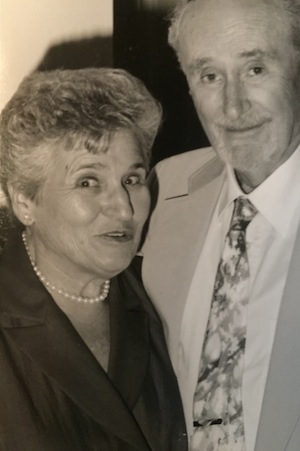
Shirley and Sol Kort (photo from Alisa Kort)

“My mom, during her life with my dad, was always hosting events and having people come and speak, and dealt with the behind-the-scenes things, organizing and being social,” said Beverley. “For her, hosting the author series in her and my dad’s name was a nice continuation of that. We did that for many years. They would come to our house the night before. And, the author would come, and my mom would meet him and talk. We named it after both of them because we always wanted to do something for both of them together.”

When Shirley passed away, the family wanted to find a way to further commemorate both of their parents’ lives, and looked to the NCJW, even though Sol wasn’t a member of the council.

“He was like a feminist more than his own daughters were, and he was an educator and a mentor,” said Beverley. “He was always finding people who needed mentoring. We were hosts for a Bosnian family who we’re still good friends with. After retiring, they set up weekly sessions with him to talk about books. He led speaking series for seniors and was always looking for ways to teach.”

Among the NCJW initiatives that were important to Shirley was HIPPY (Home Instruction for Parents of Preschool Youngsters), said Beverley, and she talked about it “a lot during the last three years of her life, as she struggled with dementia. HIPPY is about mentoring women and furthering their education. We wanted to do something that would further education and make a difference in someone’s life – that’s why we chose the scholarship.”

The Shirley and Sol Kort scholarship provides $2,500 per year to two newcomer women toward their education.

“HIPPY is a way of keeping my parent’s memory alive and supporting something that represents the essence of what they found important in the world, which is welcoming people, furthering education, being supportive and being larger than the Jewish community,” said Beverley.

According to Alisa, her parents were interested in people, above all – they were passionate about education and in helping newcomers to the Jewish community and beyond. Beverley and Alisa also are inspired in what they do by their late grandmother, who informally adopted one of the young children who made their way to safety via the Kindertransport.

Regarding the HIPPY scholarship, Alisa said, “It seemed to embody all that our parents held dear and it also seemed very important to support women, particularly women with children struggling to find a new life in a new country after having to let go of so much of what made them who they are.”

The initial recipients of the award, said Alisa, “were both very highly motivated and articulate about their experiences as immigrant women and mothers in Canada, and how … being involved in HIPPY has factored into their journey and continues enriching their lives. They’re multicultural in background. One of the women intends to complete her bachelor of social work and the other wants to get her social work diploma.”

Past president of NCJW’s Vancouver chapter, Debbie Altow, said, “Shirley Kort inspired us all in council. Besides working to bring HIPPY to Canada, she led the way – she was the first in our membership to use a computer; she worked tirelessly to pilot a hearing testing program for preschoolers (a project taken over by Vancouver’s health department); she hosted so many meetings that daughter, Beverley, printed up a neat collection of her recipes; and she had family and friends all over Western Canada, especially in Edmonton and Winnipeg.

For more information about NCJW in Vancouver, visit ncjwvancouver.org.

Rebeca Kuropatwa is a Winnipeg freelance writer.

Recalling our history

An architectural rendering of the proposed Jewish Legion Centennial Pavilion to be built in Windsor, N.S. (image from MacKay-Lyons Sweetapple Architects Ltd.)

David Ben-Gurion and Yitzhak Ben-Zvi will be among more than 1,000 men remembered when the 100th anniversary of the Jewish Legion is commemorated next year in Windsor, N.S.

These two prominent Jewish community leaders, who became the first prime minister and second president of the state of Israel, respectively, were part of the legion, which was approved by the British War Office as a Jewish military contingent for active duty during the First World War. Ben-Gurion and Ben-Zvi, as members of the training squad, earned 50 cents a day and slept in a bell tent on Nova Scotia earth.

photo - David Ben-Gurion, taken in Windsor, N.S., in 1918
David Ben-Gurion, taken in Windsor, N.S., in 1918. (photo from West Hants Historical Society)

Jewish recruits from across Canada and the United States assembled at the Imperial Recruits Depot, located at Windsor’s Fort Edward, in 1918. Fort Edward served as a basic training centre and point of departure for all North American recruits of the Jewish Legion. Once their training was complete, they went to England, where they joined other Jewish battalions for the last phases of the campaign against the Ottoman Turks. This Jewish fighting force, which included the 38th, 39th, 40th and 42nd battalions of the Royal Fusiliers, would become known as the Jewish Legion.

In a letter to Windsor’s mayor in 1966, Ben-Gurion wrote, “In Windsor, one of the great dreams of my life, to serve as a soldier in a Jewish unit to fight for the liberation of Israel, became a reality. I will never forget Windsor, where I received my first training as a soldier and where I became a corporal.”

The Jewish Legion Centennial Society, chaired by former Atlantic Jewish Council executive director Jon Goldberg and guided by Sara Beanlands, principal of Boreas Heritage Consulting Inc., is commemorating the centennial of the training of the Jewish Legion in Windsor. In conjunction with the town of Windsor, West Hants Historical Society and the Atlantic Jewish Council, events are planned for the town in May and September of 2018. As well, a distinct earthworks Centennial Pavilion will be built, with considerable private funding, near Fort Edward. Names of the more than 1,000 North American Jewish trainees will be listed on a Wall of Honour at the pavilion.

To donate to the Centennial Pavilion or for further information, contact Goldberg at jongoldberg46@gmail.com or 1-902-221-2174. For historical information or to include a name of a Jewish Legion soldier, contact Sara Beanlands at sbeanlands@boreasheritage.ca or 1-902-483-7999.

An Israeli internet hit

Renny Grinshpan’s videos have gained quite an audience. (photo from Renny Grinshpan)

Born and raised in Toronto, Renny Grinshpan is the daughter of an Israeli-born dad and a Toronto-born mom. Her sister, Eden, works as a host on the food scene in Canada and the United States and recently hosted Top Chef Canada. For her part, Grinshpan is a bit of a celebrity herself – in Israel.

After finishing high school in Toronto, Grinshpan moved to New York City, where she studied history at New York University before heading to Columbia University to pursue her master’s in journalism. After six years in New York, she moved to Tel Aviv to be with her Israeli partner, Hadar Amar, and they still live there. This past June, the couple was married.

“Hadar and I met through a mutual friend at a bar in Tel Aviv,” she said. “We now live together in Tel Aviv. He works in strategic consulting.”

Grinshpan has been in Tel Aviv for about three years. “When I came here,” she said, “I worked as a content writer for Tross Creative House for a year. My boss there, Yaniv Tross, encouraged me to quit and start on-camera work, so I did. He cast me in my first video – a crowdfunding video for a start-up product that works against period cramps (Livia). Since then, I’ve been working as a freelance host, content creator and actor.”

Grinshpan became known in Israel’s comedy scene for her role on HaIsraeliot (the Israeli Girls), a Facebook page with female Israeli comedians, including Leah Lev and Meital Avni.

“I don’t do live shows,” said Grinshpan. “I tried stand-up comedy and realized it’s the scariest thing ever … and I am no adrenaline junkie!”

In her Facebook videos, Grinshpan delves into different aspects of Israeli culture from a Canadian perspective. As a relatively new olah (immigrant), these observations come naturally for her.

“I think my main audience is Israeli women,” she said. “It makes sense to me that Israelis are my biggest audience, because I think everyone enjoys hearing about themselves the most, especially from an outsider’s perspective.”

Grinshpan gained experience in video during her journalism studies at Columbia, where she focused on video journalism and learned how to film, edit and build a narrative visually.

“I made several short documentary-style videos that year and the year following,” she said. “When I worked at Tross, I got experience writing creatively for the first time – writing scripts for product and crowdfunding videos for start-ups.

“When I started freelancing after Tross, I worked not only as an actor and host, but also continued working as a content writer and videographer behind the scenes. I also worked as a model and voiceover actor – anything to earn a living in the creative video realm!”

Grinshpan has spent some time as a visitor in Vancouver and had much good to say about the experience. “I love Vancouver!” she said. “Thank you for giving me some of the best times!

“Being a tourist in Vancouver made me feel like I’m really athletic, which could not be farther from the truth! I found that, in touring the city, I was biking through Stanley Park (it’s a forest!), hiking up a waterfall in North Van, trying out long-boarding for the first time and canoeing again (like in my childhood). I was so active just by being there, which, again, is not reflective of my standard state.”

Looking ahead, Grinshpan said she dreams of co-hosting a food and travel talk show across Israel or Canada with her big sister one day.

To follow or see more of Grinshpan, visit facebook.com/heyitsrenny or check out youtube.com/watch?v=d9pPtsFplaI and youtube.com/watch?v=nYKvpVlOVmU.

Rebeca Kuropatwa is a Winnipeg freelance writer.