Skip to content
  • Home
  • Subscribe / donate
  • Events calendar
  • News
    • Local
    • National
    • Israel
    • World
    • עניין בחדשות
      A roundup of news in Canada and further afield, in Hebrew.
  • Opinion
    • From the JI
    • Op-Ed
  • Arts & Culture
    • Performing Arts
    • Music
    • Books
    • Visual Arts
    • TV & Film
  • Life
    • Celebrating the Holidays
    • Travel
    • The Daily Snooze
      Cartoons by Jacob Samuel
    • Mystery Photo
      Help the JI and JMABC fill in the gaps in our archives.
  • Community Links
    • Organizations, Etc.
    • Other News Sources & Blogs
    • Business Directory
  • FAQ
  • JI Chai Celebration
  • JI@88! video

Recent Posts

  • Sharing her testimony
  • Fall fight takes leap forward
  • The balancing of rights
  • Multiple Tony n’ Tina roles
  • Stories of trauma, resilience
  • Celebrate our culture
  • A responsibility to help
  • What wellness means at JCC
  • Together in mourning
  • Downhill after Trump?
  • Birth control even easier now
  • Eco-Sisters mentorship
  • Unexpected discoveries
  • Study’s results hopeful
  • Bad behaviour affects us all
  • Thankful for the police
  • UBC needs a wake-up call
  • Recalling a shining star
  • Sleep well …
  • BGU fosters startup culture
  • Photography and glass
  • Is it the end of an era?
  • Taking life a step at a time
  • Nakba exhibit biased
  • Film festival starts next week
  • Musical with heart and soul
  • Rabbi marks 13 years
  • Keeper of VTT’s history
  • Gala fêtes Infeld’s 20th
  • Building JWest together
  • Challah Mom comes to Vancouver
  • What to do about media bias
  • Education offers hope
  • Remembrance – a moral act
  • What makes us human
  • המלחמות של נתניהו וטראמפ

Archives

Follow @JewishIndie
image - The CJN - Visit Us Banner - 300x600 - 101625

Month: June 2017

Mourning, traveling, celebrating – Israel in photos

Mourning, traveling, celebrating – Israel in photos

Prime Minister Binyamin Netanyahu with David Malka, father of Border Police officer Hadas Malka, who was stabbed to death by a Palestinian terrorist outside Jerusalem’s Old City on June 16. (photo by Kobi Gideon / Israel Government Press Office via Ashernet)

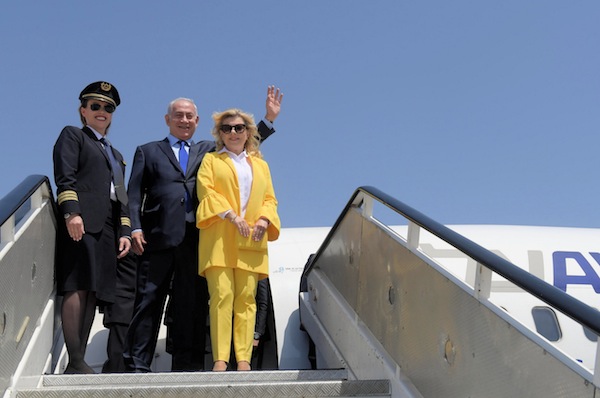
photo - Prime Minister Netanyahu and his wife Sara, with El Al’s first ultra-Orthodox female pilot, Nechama Spiegel Novak, as they set out to Salonika, Greece, on June 14
Prime Minister Netanyahu and his wife Sara, with El Al’s first ultra-Orthodox female pilot, Nechama Spiegel Novak, as they set out to Salonika, Greece, on June 14. (photo from IGPO via Ashernet)
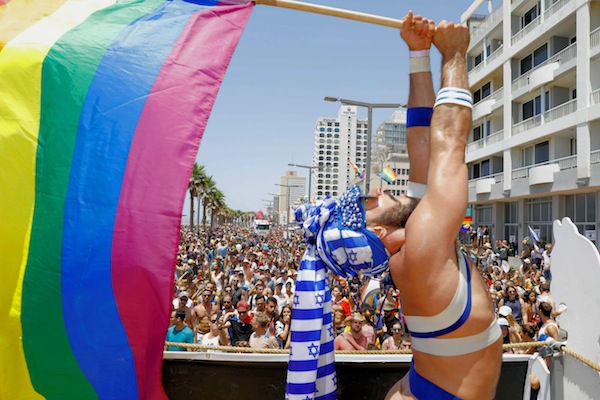
photo - More than 200,000 people attended the Tel Aviv Gay Pride Parade June 9
More than 200,000 people attended the Tel Aviv Gay Pride Parade June 9. (photo by Guy Yechiely via Ashernet)
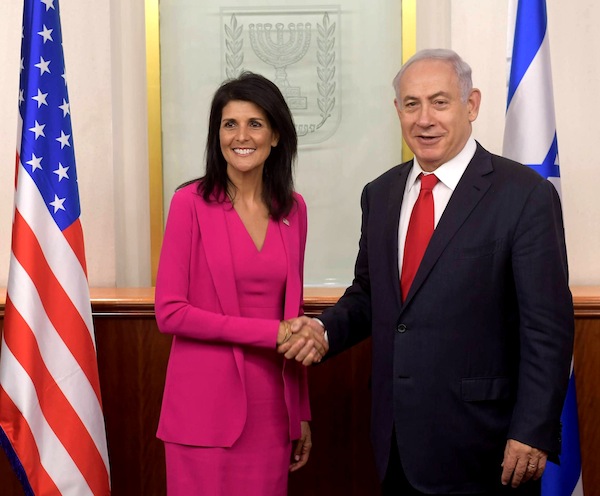
photo - Netanyahu in his office June 7 with U.S. Ambassador to the United Nations Nikki Haley
Netanyahu in his office June 7 with U.S. Ambassador to the United Nations Nikki Haley. (photo by Amos Ben Gershom / IGPO via Ashernet)
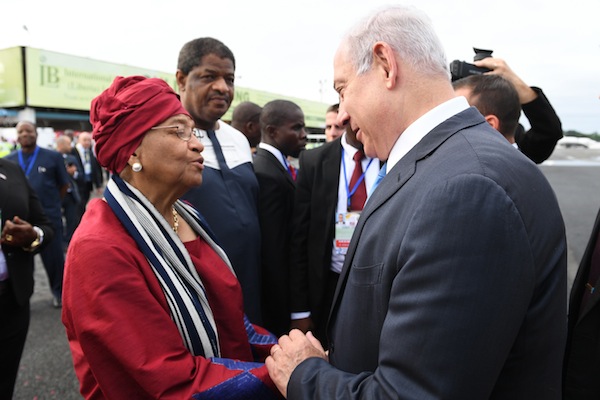
photo - Netanyahu is welcomed to Monrovia by Liberian President Ellen Johnson Sirleaf on June 4
Netanyahu is welcomed to Monrovia by Liberian President Ellen Johnson Sirleaf on June 4. (photo by Kobi Gideon / IGPO via Ashernet)
Format ImagePosted on June 23, 2017June 21, 2017Author Edgar AsherCategories IsraelTags Binyamin Netanyahu, David Malka, Ellen Johnson Sirleaf, Hadas Malka, Israel, LGBTQ, Liberia, Nechama Spiegel Novak, Nikki Haley, Pride, Sara Netanyahu, terrorism, United States
טיסות זולות

טיסות זולות

מלזיה ראשונה במדד המדינות שהטיסות בהן הזולות ביותר. ישראל במקום החמישים ושישה וקנדה במקום השישים וחמישה. (צילום: Laurent Errera)

אתר קיווי.קום לחיפוש טיסות זולות מפרסם זו השנה השנייה את רשימת המדינות בהן הטיסות הן הזולות ביותר. המדד לשנת 2017 כולל שמונים מדינות מהמתוירות ביותר ברחבי העולם. את הרשימה מובילה מלזיה, ישראל ממוקמת רק במקום החמישים ושישה וקנדה אף מאחוריה במקום השישים וחמישה. את הרשימה סוגרת במקום השמונים בלגיה. המדד מבוסס על עלות כרטיסי טיסה בממוצע למאה ק”מ של כמיליון טיסות. הוא כולל מספר פרמטרים ובהם: טיסות קצרות, טיסות ארוכות, עונות חמות, עונות שקטות, טיסות זולות וטיסות עם שירות מלא. כל המרות המטבעות של הטיסות נכונים ל-25 באפריל השנה.

להלן עשרת המדינות שמחירי כרטיסי הטיסה בהן הם הזולים. במקום הראשון מלזיה (אשתקד היא הייתה במקום השני). במקום השני בולגריה (אשתקד היא הייתה במקום השניים עשר). במקום השלישי הודו ( אשתקד היא הייתה במקום הראשון). במקום הרביעי טורקיה (אשתקד היא הייתה במקום החמישים ושמונה). במקום החמישי רומניה (אשתקד היא הייתה במקום העשרים ושבעה). במקום השישי אינדונזיה (אשתקד היא הייתה במקום החמישי). במקום השביעי פורטוגל (אשתקד היא הייתה במקום הרביעי). במקום השמיני תאילנד (אשתקד היא הייתה במקום העשרים ואחד). במקום התשיעי שבדיה (אשתקד היא היתה במקום העשירי). ובמקום העשירי ספרד (אשתקד היא הייתה במקום השלושה עשר).

להלן מדינות בולטות אחרי העשירייה המובילה. במקום האחד עשר דרום אפריקה (אשתקד היא הייתה במקום השביעי). במקום השלושה עשר יפן (אשתקד היא היתה במקום השבעים ואחד). במקום הארבעה עשר רוסיה (אשתקד היא הייתה במקום השלישי). במקום החמישה עשר פולין (אשתקד היא הייתה באותו מקום). במקום השבעה עשר ניו זילנד (אשתקד היא הייתה במקום העשרים וארבעה). במקום העשרים אוקראינה (אשתקד היא הייתה במקום הארבעה עשר). במקום העשרים ואחד איטליה (אשתקד היא הייתה במקום העשרים ושש). במקום העשרים ושניים פינלנד (אשתקד היא הייתה במקום השבעים וארבעה). במקום העשרים ושלושה איראן (אשתקד היא הייתה במקום הארבעה ושלושה). במקום העשרים וחמישה מקסיקו (אשתקד היא הייתה במקום העשרים ושניים). במקום העשרים ושבעה בריטניה הגדולה (אשתקד היא הייתה במקום השלושים ושניים). במקום העשרים ושמונה סין (אשתקד היא הייתה במקום האחד עשר). במקום השלושים ארצות הברית (אשתקד היא הייתה במקום השבעה עשר). במקום השלושים ואחד צ’כיה (אשתקד היא הייתה במקום העשרים וחמישה). במקום השלושים ושתיים יוון (אשתקד היא הייתה במקום התשעה עשר). במקום השלושים וארבעה צרפת (אשתקד היא הייתה במקום העשרים ושמונה). במקום השלושים ושבעה קולומביה (אשתקד היא הייתה במקום החמישים ושתיים). במקום הארבעים ושישה מצרים (אשתקד היא הייתה במקום השלושים ושמונה). במקום הארבעים ושמונה ברזיל (אשתקד היא הייתה במקום השמונה עשר). במקום החמישים גרמניה (אשתקד היא הייתה במקום השישה עשר). במקום החמישים ואחד נורווגיה (אשתקד היא הייתה במקום הארבעים). במקום החמישים ושניים ונצואלה (אשתקד היא הייתה במקום השישים). במקום החמישים ושישה כאמור ישראל (אשתקד היא הייתה במקום הארבעים וחמישה). במקום החמישים ושמונה ירדן (אשתקד היא הייתה במקום הארבעים ותשעה). במקום השישים ואחד שוויץ (אשתקד היא הייתה במקום השישים ושישה). במקום השישים ושלושה ארגנטינה (אשתקד היא הייתה במקום החמישים). במקום השישים וחמישה כאמור קנדה (אשתקד היא הייתה במקום השבעים). במקום השישים ושישה דנמרק (אשתקד היא הייתה במקום השישים ושמונה). במקום השישים ושבעה טאיוואן (אשתקד היא הייתה במקום החמישים וחמישה). במקום השישים ושמונה דרום קוריאה (אשתקד היא הייתה במקום הארבעים ואחד). במקום השישים ותשעה אוסטרליה (אשתקד היא הייתה במקום השישים וארבעה). במקום השבעים מרוקו (אשתקד היא הייתה במקום הארבעים ושבעה). במקום השבעים ושלושה אוסטריה (אשתקד היא הייתה במקום השישים ושבעה). במקום השבעים ותשעה הולנד (אשתקד היא הייתה במקום השבעים ושניים). ובמקום השמונים והאחרון בלגיה (אשתקד היא הייתה במקום השישים ותשעה).

Format ImagePosted on June 21, 2017June 21, 2017Author Roni RachmaniCategories עניין בחדשותTags airline, flights, חברת תעופה, טיסות
Ultimate Frisbee and peace

Ultimate Frisbee and peace

Stratford Hall Sabres and Ultimate Peace leaders-in-training in action this past April. (photo from Ultimate Peace)

Ultimate Peace uses team sports – specifically Ultimate Frisbee – as a vehicle for peace education in the Middle East (and beyond). It starts with throwing a Frisbee but leads to friendship, trust, shared leadership opportunities and powerful life lessons in communities where conflict is rife.

Founded on the core principles of mutual respect, friendship, non-violence, integrity and fun, a group from Ultimate Peace embarks on a North American Friendship Tour every year. Karym Barhum is the Middle East regional director for UP. Originally from Ein Rafa, an Israeli Arab village about 15 kilometres northwest of Jerusalem, he described this year’s cohort of 14 Israelis as “Arab, Jewish, Muslim and Christian youth living in very close proximity. They don’t go to the same schools, they just live in [separate] communities: Arabs with Arabs, Jews with Jews.”

This year, Ultimate Peace added a Vancouver leg to their usual itinerary. Following a stop in Seattle, a group of 15-to-18-year-olds was in Vancouver April 11-16. This part of the tour was made possible by Danie Proby and Ari Nitikman, co-founders of and head coaches at UltiPros; both are alumni of Stratford Hall school on Commercial Drive. Working with their connections, Proby and Nitikman set the ball rolling for an extraordinary experience for both the visitors and their hosts.

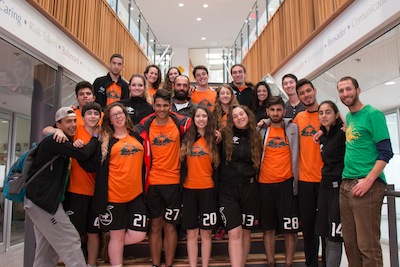
photo - Ultimate Peace leaders-in-training and staff
Ultimate Peace leaders-in-training and staff. (photo from Ultimate Peace)

UP alumni and leaders visit schools, community centres, places of worship, homes and universities to spread awareness of UP’s Leaders-in-Training program. Barhum said it is a tremendous opportunity to see people “accepting everybody no matter who you are. We hope they’ll come back to the Middle East as ambassadors of UP, so they can educate others on how to accept differences.”

Samantha Gayfer, director of community development at Stratford Hall, said the school teaches students “they have a responsibility to give back and make a difference.”

Having arranged for Stratford Hall to host the UP event, families from the school billeted the 14 visiting students, who also spoke at other schools during their time here.

Gayfer described the billeting experience as “outstanding.”

“Arrangements were made for kosher and halal diets,” she said, “and the Jewish players had Passover while they were here. They organized a full meal with cultural and religious understanding.”

The impact of this gesture was not lost on her. “These are kids from families who live three miles from each other but never visit each other’s homes. Now they’re good friends.”

Naturally, there were questions. Gayfer asked the Arab students what their parents thought about their involvement in Ultimate Peace. The answer was always, “My family supports this.”

While she conceded that liberal parents are the most likely to enrol their kids in programs like this, it doesn’t take away from the power of showing Canadian kids what is possible, even in troubled regions. If such friendships are possible among Arabs and Jews in Israel, what can’t we achieve here in peacetime? she asked. “The more families you touch, the better,” she said, “to show that it’s not an insurmountable challenge, that we could live cohesively together.”

During their stay, Ultimate Peace won a tournament – a highlight of their trip. Gayfer said it was “an amazing experience for the kids.”

UP is an opportunity for youth to educate others about life in Israel. In talking about how one can be part of positive change by learning about multiple perspectives, they are also modeling new kinds of relationships: relationships that are necessary before conflict can diminish on a larger scale.

Stratford Hall student Matthew Chiang said he had an “awesome and unforgettable” experience with Ultimate Peace. “The kids were awesome, super-enthusiastic, funny and kind,” he said. “Personally, the two kids that stayed over at my house, Ohad and Faris, had a lot of common interests with me, such as ping pong, Rubik’s Cubing, playing cards, Ultimate, and even shopping. I had never met a person from Israel and I had no idea that they were so similar to me.”

Asked what he thought of the group as a whole, he described it as strong and cohesive. “The Jewish and Muslim students seemed like great friends who got along really well…. My family and I talked to them about their culture and religion. They seemed open and spoke without conflict,” he said.

“Kids involved in this program can send a message to adults that, although there is heavy conflict and anger here, in the end, we are all people who share interests and hobbies,” he said. “Ultimate really breaks the barrier in that conflict and embraces two different ideas and shares one common goal – to have fun.”

He added, “I think Ultimate Peace has strengthened the bond between Jewish and Muslim people and has started to break the barrier between them.”

As well as promoting physical and mental fitness, Ultimate Peace teaches life skills like leadership and communication and reinforces the importance of hope, kindness and collaboration.

“I thoroughly enjoyed how kind they were and how many common interests we had,” said Chiang. “Ultimate Peace is such a great organization with such an important purpose. I’m glad that I had the opportunity to be a part of their journey and I hope that I see them again.”

Barhum is already seeing the impact of UP’s tour on the students. “Many of them are making plans for a twinning program between schools in North America and schools in Israel. This would allow the Israeli kids to take turns playing host to overseas students.” Not satisfied with a single trip to Canada, he said, “They are looking to develop a stable program.”

None of this would be possible with the UP infrastructure behind it. Barhum described a spirit of openness and optimism in the leadership of the program.

“The board of directors trust and allow me and my staff to do things differently, always trying out new ideas,” he said. “They allow us to be open, to learn from others and to be able to change if necessary. This is one of the big things that inspires me and keeps me doing my job.”

The Vancouver stop, he said, was “a highlight – seeing our kids learning new stuff, recognizing that it is possible to live and share their lives with others from a different culture or religion.”

To learn more about and to contribute to Ultimate Peace, visit ultimatepeace.org.

Shula Klinger is an author, illustrator and journalist living in North Vancouver. Find out more at niftyscissors.com.

Format ImagePosted on June 16, 2017June 15, 2017Author Shula KlingerCategories LocalTags Frisbee, Israel, Middle East, peace, sports, youth

Boost defence of peace

Pierre Trudeau once compared living next to the United States to sleeping with an elephant. “No matter how friendly and even-tempered is the beast, if I can call it that, one is affected by every twitch and grunt,” Trudeau told the Washington press in 1969.

The former PM’s son, current Prime Minister Justin Trudeau seems to be recognizing that, under the leadership of President Donald Trump, the beast is as uneven-tempered as it has been in living memory.

The United States is currently led by a man whose foreign policy compass swings from tweet to tweet. There is no way to predict what position he will take next, having repeatedly besmirched NATO and other agencies of internationalism. The European powers have explicitly or implicitly taken the once-unthinkable position of deeming the United States no longer a dependable ally.

In successive major policy speeches last week, Foreign Affairs Minister Chrystia Freeland and Minister of National Defence Harjit Sajjan laid out somewhat new directions for the Canadian government, both seeming to concur, at least implicitly, that the United States is not the reliable ally it once was.

Sajjan promised a $62 billion boost to defence spending over 20 years, which would seem to be good news for Trump, who has criticized NATO member-nations for not pulling their weight. However, it came on the heels of Freeland’s speech a day earlier, in which she expressed concern that Americans seem prepared to “shrug off the burden of world leadership.”

It is easy to criticize American leadership – under any administration – and, admittedly, while the possibility of U.S. intervention might have given some dictators and oppressors cause for pause, American power has also strengthened dictators and oppressors when it has been in their interests. Nonetheless, the abdication of American leadership creates a frightening vacuum.

Jewish tradition includes the value of lo ta’amod al dam rei’echa, the prohibition against passivity in the face of violence to others. This rather universal concept seems likely to be diminished under the Trump presidency.

“The fact that our friend and ally has come to question the very worth of its mantle of global leadership puts in sharper focus the need for the rest of us to set our own clear and sovereign course,” Freeland told MPs. “To say this is not controversial: it is a fact.” She added: “To put it plainly: Canadian diplomacy and development sometimes require the backing of hard power.”

This is a stark shift in Canadian policy of the past 40 or so years. Without openly saying so, Canadians have been happy to keep military budgets low, knowing that our neighbour would have our back if push came to shove. Canada has little to fear in the form of foreign invasion, although our sovereignty in the Arctic could come under threat by Russia (or even the United States) at almost anytime.

More immediately, what our deflection of military might has created is a limited ability to act in ways on the world stage that reflect Canada’s stated values, which include the pursuit of justice (in Jewish tradition, bakesh shalom v’rodfehu) and the protection of human dignity. Again, when faced with Russian aggression in Ukraine and the Middle East, or with the barbarity of ISIS, or civil war in Syria, or countless other tragic flashpoints globally, Canada has been satisfied to allow our closest ally to set the terms on the ground.

We have been able to have our cake and eat it, too, for many years, calling our approach “soft power,” which means moral suasion based on a degree of global respect Canada has achieved, while leaving “hard power” to our NATO allies. Our role in Afghanistan is an exception, and a source of pride for those who believe that the people of that country should live free from oppressive entities.

This is an imperfect example, of course, since Afghanistan remains riven by terrorism and political division. That average Afghanis, particularly women and minorities, are better off now than under the Taliban is unquestionable. While our presence there has had tangible results, in the global context, it is a somewhat symbolic engagement. Our military has limited capacity to engage similarly in another theatre and would certainly be stretched to the limit if we were to be called into two or more conflicts.

Canada does not – and should not – aspire to be a global military powerhouse. But to maintain self-defence capabilities and to act on our values in a difficult world – at a time when the great power we counted on to do this on our behalf is recanting – requires us to make financial commitments.

We must balance these commitments with our ability to fund social programs and other policies of national pride. Any increased international role should be focused on trying to prevent conflicts, supporting peace efforts and on providing humanitarian and other economic aid.

Posted on June 16, 2017June 15, 2017Author The Editorial BoardCategories From the JITags Canada, foreign policy, military, United States

How to slow climate change

President Donald Trump has received well-deserved condemnation from, among others, leaders of many nations, many governors, mayors, environmentalists, corporate chief executive officers and Jewish and other religious organizations for withdrawing the United States from the 2015 Paris climate change pact that was agreed to by all the 195 nations that attended, including Israel, Canada and the United States. How should Jews respond to the U.S. withdrawal?

First, Jews should become very familiar with the issues involved. Ten important climate-related factors are:

  1. Science academies worldwide, 97% of climate scientists and 99.9% of peer-reviewed papers on the issue in respected scientific journals argue that climate change is real, is largely caused by human activities and poses great threats to humanity. All 195 nations at the December 2015 Paris climate change conference agreed that immediate steps must be taken to combat climate change.
  2. Every decade since the 1970s has been warmer than the previous decade and all of the 17 warmest years since temperature records were first kept in 1880 have been since 1998. The year 2016 was the warmest globally since 1880, breaking the record held before by 2015 and previously by 2014, meaning we now have had three consecutive years of record temperatures.
  3. Polar icecaps and glaciers worldwide have been melting rapidly, faster than scientific projections. This has caused an increase of elevation in oceans worldwide, with the potential for major flooding.
  4. There has been an increase in the number and severity of droughts, wildfires, storms and floods.
  5. California has been subjected to so many severe climate events (heat waves, droughts, wildfires and mudslides when heavy rains occur) recently that its governor, Jerry Brown, stated, “Humanity is on a collision course with nature.” California serves as an example of how climate change can wreak havoc.
  6. Many climates experts believe that we are close to a tipping point due to feedback loops, when climate change will spiral out of control, with disastrous consequences, unless major positive changes soon occur.
  7. While many climate scientists think that 350 parts per million (ppm) of atmospheric CO2 is a threshold value for climate stability, the world reached 400 ppm in 2014 and the amount is increasing by two to three parts per million per year.
  8. While climate scientists hope that temperature increases can be limited to two degrees Celsius (3.6 degrees Fahrenheit), largely because that is the best that can be hoped for with current trends and momentum, the world is now on track for an average increase of four to six degrees Celsius, which would result in great human suffering and significant threats to human civilization.
  9. The Pentagon and other military groups think that climate change will increase the potential for instability, terrorism and war by reducing access to food and clean water and by causing tens of millions of refugees fleeing from droughts, wildfire, floods, storms and other effects of climate change.
  10. The group ConservAmerica, formerly known as Republicans for Environmental Protection, is very concerned about climate change threats. They are working to end the denial about climate threats by the vast majority of Republicans, but so far with very limited success.

Second, Jews should consider Judaism’s powerful teachings that can be applied to environmental sustainability. These include:

  • “In the hour when the Holy One, Blessed be He, created the first man, he took him and let him pass before all the trees in the Garden of Eden and said to him: ‘See my works, how fine and excellent they are. Now, all that I created, I created for your benefit. Think upon this and do not corrupt or destroy my world. For, if you destroy it, there is no one to restore it after you.” (Midrash: Ecclesiastes Rabbah 7:28)
  • Genesis 2:15 indicates that the human role is to work the land but also to guard and preserve it. Jews are mandated to be shomrei ha’adama, guardians of the earth, co-workers with God in working for tikkun olam, healing and repairing the world.
  • Judaism teaches: “Who is the wise person? The one who considers the future consequences of his or her actions.”
  • The Jewish sages expand Deuteronomy 20:19-20, prohibiting the destruction of fruit trees in wartime to build battery rams to overcome an enemy fortification, to make a general prohibition against unnecessarily destroying anything of value.

Jews should be on the forefront of efforts to help avert a climate catastrophe. We should try to significantly reduce our individual carbon footprints by recycling, using efficient light bulbs and other items, eating less meat, reducing our use of automobiles by walking, biking, sharing rides and using mass transit, when appropriate, and in other ways. We should support efforts to increase efficiencies of automobiles and other items, shift to renewable sources of energy and make societal steps that reduce greenhouse emissions.

We should try to arrange programs on climate change at synagogues, Jewish centres and other Jewish venues, write letters to editors, speak to family members, friends, neighbours and co-workers, and take other steps to increase awareness of the seriousness of climate threats and how applying Jewish values can help reduce them. We should do everything possible to reduce climate change and to help shift our imperiled planet onto a sustainable path.

Richard H. Schwartz, PhD, is professor emeritus, College of Staten Island, president emeritus of Jewish Veg and president of the Society of Ethical and Religious Vegetarians. He is the author of several books, including Judaism and Vegetarianism and Who Stole My Religion? Revitalizing Judaism and Applying Jewish Values to Help Heal Our Imperiled Planet, and more than 250 articles at jewishveg.org/schwartz. He was associate producer of the documentary A Sacred Duty: Applying Jewish Values to Help Heal the World.

Posted on June 16, 2017June 15, 2017Author Richard H. SchwartzCategories Op-EdTags climate change, environment, Judaism, Trump
Shalhevet celebrates its 10th

Shalhevet celebrates its 10th

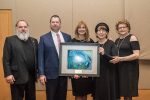
Shalhevet Girls High School founding board members, left to right: Rabbi Yosef Wosk, Terrance Bloom, Vivian Claman, Tannis Boxer and Marie Doduck. (photo from Shalhevet)

On March 16, Shalhevet Girls High School celebrated its 10-year anniversary with a gala at Schara Tzedeck Synagogue. The event paid tribute to the many accomplishments that this small school has made in the last decade.

Shalhevet works to educate and prepare their students in both Judaic and general studies as strong, grounded and proud Jewish women. The students are taught a sense of community activism and encouraged from Grade 8 to take an active role in their Jewish community. With these tools, the alumni of Shalhevet will be able to create Jewish homes and communities where there is an appreciation of the value of Torah, community and education.

Shalhevet alumni have been leaving their mark worldwide. In Israel, New York, France, Toronto, San Diego and here in Vancouver, these graduates are active members of their Jewish communities. As they continue their higher education in the universities of their choice, they are finding places to make kiddush Hashem (glorification of G-d’s name), making Shalhevet, along with the Greater Vancouver Jewish community, proud.

At the gala, the five founding board members of Shalhevet were honoured. These remarkable individuals are Rabbi Yosef Wosk, Marie Doduck, Vivian Claman, Terrance Bloom and Tannis Boxer. This group came together and made their dream of creating Shalhevet a reality – a flourishing place of academia and growth. They created yesh me’Ayin, something concrete from the imagined, and it is because of their hard work and dedication that Shalhevet can celebrate 10 successful years.

Shalhevet is excited for what the future holds, as the school continues to grow and add depth and diversity to their program. The board, staff, students, parents and other school supporters are all looking forward to many more years of service to the Vancouver Jewish community.

Format ImagePosted on June 16, 2017June 15, 2017Author Shalhevet Girls High SchoolCategories LocalTags education, Judaism, Shalhevet
Be a part of the solutions

Be a part of the solutions

Shabbat Dîner en Blanc attendees, left to right: Dana Troster, Brent Davis, Eliane Nevares and Emily Holzman. (photo by Ori Nevares)

On June 2, approximately 90 Jewish young adults from the Greater Vancouver area gathered for Shabbat Dîner en Blanc at VanDusen Botanical Garden. People came dressed in their finest whites, enjoyed the gardens and mingled with new people. Although a wonderful opportunity to schmooze and unwind, the event had a bigger purpose.

The dinner was an introduction to a new initiative coming to Vancouver at the end of this month. On June 25, Vancouver will host its first Community Hackathon. Modeled after Hackathon events in tech companies that use software and inter-professional efforts to solve problems in a short period of time, the Community Hackathon will tackle pertinent issues facing our community and try to solve them collaboratively.

The project will be facilitated by UpStart, an organization based in San Francisco that aims to inspire and advance innovative ideas that contribute to the continued growth and vitality of Jewish life. More than 20 cities in North America applied to have a Community Hackathon and Vancouver, along with Portland and San Diego, were fortunate enough to be granted the opportunity.

The Hackathon will be a full-day event where young Jewish adults will use design thinking to generate project ideas. The top three projects, as determined by a panel of judges, will receive seed grants of $3,200 each, as well as training and mentorship from UpStart over the months to follow.

This is a rare opportunity for younger community members to meaningfully engage in positive and sustainable change. If you are in your 20s and 30s and are interested in participating in the Hackathon, which will take place at Museum of Vancouver June 25, 9 a.m.-5 p.m., go to jewishvancouver.com and click on “YVR’s Community Hackathon.” For more information, email Eliane Nevares at [email protected].

Format ImagePosted on June 16, 2017June 15, 2017Author Axis VancouverCategories LocalTags Axis Vancouver, Federation, Hackathon, young adults
Helping one village at a time

Helping one village at a time

With solar panels, Innovation: Africa – founded by Sivan Ya’ari, centre – is helping bring light and water to African villages. (photo from Sivan Ya’ari)

“Growing up in Israel, we were a poor family,” recalled Sivan Ya’ari, founder of Innovation: Africa. “But the poverty I saw in Africa was true poverty. We can’t compare.”

Ya’ari spent part of her childhood in France, which later helped her land a job with Jordache, a jeans manufacturing company based in the United States that had some factories in French-speaking African countries.

“After spending time in villages and traveling to other countries, I realized that the main challenge in Africa, the main reason why Africa is still in poverty, is the lack of energy,” she told the Independent. “Because there is no energy, they can’t get access to medicine, vaccines – because there is no refrigeration. Because there is no energy, people don’t get access to good education. But, most importantly, people don’t have access to water.”

Ya’ari had imagined Africa to be a continent with little water, but she discovered there is actually plenty of water in Africa. However, the water is located in aquifers and, to get to it, you need to pump it – and to do that, you need energy.

“Growing up in Israel, I remember seeing solar panels on every building,” she said. “So, when I came and learned a bit more about energy, I thought, maybe we just need to transfer some of the knowledge and some of the technology to remote villages to give them a chance to access water and education.”

Ya’ari enrolled in Columbia University’s master’s in energy program and began fundraising to bring energy solutions to Africa.

As a student, Ya’ari started in one village, and then another, continuing to the point that, today, she has brought the technology – a large pump run by solar panels – to about 140 villages, and counting. The water is pumped into a large holding tank and then, with the help of gravity, flows to different taps that are installed throughout a village.

“Usually, we’re putting one tap two kilometres from the water pump system, another tap four kilometres from it and another … in all directions,” said Ya’ari. “So, with one water pump system, we’re able to reach many villages and people.”

Once the concept proved successful, Ya’ari founded Innovation: Africa, which operates in seven African countries. “In every country, we have an office with a local manager,” she said. “In Uganda, for example, we have seven full-time local people working who have all been trained. They are managing and doing the work on the ground.

“We first hire a company that does geological surveys. This provides information about how deep the aquifers are, how much water we can find and where would be best to drill. Then we hire a drilling machine company and have local contractors do the rest – installing the pump, the water tank, involving the community (meaning, the villagers) who decide where to instal the different taps.

“Once this is all installed, sometimes, in some villages, we instal an extra tank – only for irrigation technology (Netafim) that we bring from Israel – and then we provide irrigation pipes to the village.”

Each pump provides 30,000 litres on average per day per system.

Innovation: Africa recently received an award from the United Nations for their remote monitoring system – another technology that came from Israel.

“It’s off-grid, remote monitoring, so, at any point, we are able to remotely know how much water we’re pumping into every village,” explained Ya’ari. “If something breaks, meaning a pump hasn’t pumped water in 24 hours, we are notified about it by the system; not only us, but the local contractors and the local managers.”

Most of the funding has come from individuals and foundations, often with one individual or family sponsoring a village. On Innovation: Africa’s website (innoafrica.org), there is information about how to become a sponsor.

“We have a bar or bat mitzvah … choosing an orphanage to adopt and then they are traveling with their parents to be there when the kids get light for the first time,” said

Ya’ari. “We have families adopting villages. It’s very transparent, personal and concrete. The donors appreciate that they also have access to the remote monitoring. At any point on their phone, they are able to see how much energy was produced or consumed and how much water was pumped. They also know if something breaks. They are connected to the villagers. They go back and visit.”

According to Ya’ari, many children, especially girls, are kept out of schools in Africa so that they can walk the great distances necessary to get water.

“I believe that the best return on the investment is when we bring water to a village,” said Ya’ari. “What we found is that people are spending hours a day looking for water. Most of the time, the water they find is dirty and is not good for drinking. Once we bring clean water, the people are healthier. The changes we see … the children are going to school. We see a lot more girls going and getting an education. We see that they are growing food.

“What inspires me is the number of businesses villagers are able to grow with access to water. They are able to grow food and sell it in the market. They are making bricks and making their homes, no longer made with mud. We see livestock…. They are making more money.

“And, for the medical centres, it’s tremendous,” she said. “Once we provide a little energy and we buy a small fridge, then people come in from the capital to the village to help. The doctor, with energy, she can actually work.”

When it comes to the cost to make this happen, it is about $5,000 to light a classroom and $18,000 to light a whole school, including the homes of the teachers. To bring water to a entire village, it costs around $50,000.

No governments are involved in these projects. It is all about people on one end of the world helping out people on another end.

“Unfortunately, there is no shortage of villages waiting,” said Ya’ari. “In the seven countries that we operate, we have a long list of schools needing light and water centres. It has a lot to do with funding and people to adopt the villages. We have the people on the ground and the technology.”

Rebeca Kuropatwa is a Winnipeg freelance writer.

Format ImagePosted on June 16, 2017June 29, 2017Author Rebeca KuropatwaCategories WorldTags Africa, innovation, Israel, Sivan Ya’ari, solar energy, tikkun olam
Saint-Paul transforms

Saint-Paul transforms

Paul Shore gets a little help from his daughter at a recent book signing. (photo from Paul Shore)

Cultural pastimes, like pétanque, “recharge our joie de vivre, our delight in being alive; they free our minds; and they fuel our chutzpah for adventure. We must protect these beautiful little gifts, tie a bow around them, love and keep them safe,” writes Paul Shore in Uncorked: My Year in Provence Studying Pétanque, Discovering Chagall, Drinking Pastis and Mangling French (Sea to Sky Books, 2016).

book cover - UncorkedThe title pretty much describes the basic content of this delightful 164-page book, and gives a hint of the light touch with which Shore writes. His story will make readers reflect on their own pivotal life journeys, if they have been lucky enough to have them. Perhaps it will also make us recommit to what we’ve learned from such experiences – the need to stop and smell the proverbial roses, for example, and the joy and fulfilment that can come from opening ourselves up to new places, people, cultures – the list goes on.

It was his job that took Shore to Saint-Paul in 1999. When the Vancouver-based software company with which he worked opened an “outpost in the Nice area” of France – with him “as its sole initial employee” – he leapt at the opportunity. Telling his firm he wanted to live in a “cute small town,” he found himself in Saint-Paul de Vence.

“Little did I realize,” he writes, “that I was about to take up residence in a village that could be best described in summer as ‘gaudy tourist central’ because it was so famous and magical…. Nor did I know that the brilliant modernist painter Marc Chagall had lived, worked and was buried in my soon-to-be-surrogate hometown. Nor did I have a clue that Saint-Paul was tantamount to a holy site for an odd game called pétanque.”

“I lived in Saint-Paul for almost exactly one year – from January 1999 to late December 1999,” Shore told the Independent. “I had visited Nice the year before on a short business trip and dreamed about the possibility of someday spending a longer stint in the region. And I had been in the south of France years earlier, in 1990, as a Euro-Railing new university grad.”

Shore grew up in Ottawa, but has called Vancouver and its environs home for many years. He, his wife, Talya, and their two children have lived in Whistler since 2003.

“We are longtime members of Temple Sholom,” he said. “In Whistler, we get together with Jewish friends for major holidays and we visit Temple Sholom and family in Vancouver from time to time, too.”

There are a few Jewish terms and references in Uncorked and a pivotal exchange between Shore and a woman named Adele, the manager of an art gallery in Saint-Paul – she is the one who informs Shore that Chagall had lived and painted in the village. She also shares with him that Chagall was a Russian Jew and that she, too, is Jewish and her family came from Russia. “Comme ma famille [Like my family],” writes Shore, who explores his heritage further in the latter half of the book.

While there are various entertaining and touching tangents, the focus of Uncorked is Shore’s quest to learn the mysteries of pétanque, which he describes “for the uninitiated,” as looking “a little like the Italian game of bocce, or the British game of lawn bowling, or even the winter sport of curling that is popular in Canada,” though, he advises readers “not to suggest such similarities out loud while standing on French soil, unless you have no desire to try to play the game, no desire to be welcomed into a café, no desire to gain the friendship of a local, and you desire to have the nickname Monsieur Con – the polite translation of which is ‘village idiot.’”

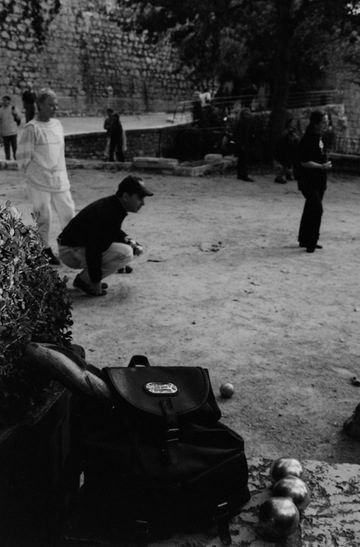
photo - Paul Shore in action on the pétanque field
Paul Shore in action on the pétanque field. (photo from Paul Shore)

Shore was determined to “gain entry into the arcane world of this ancient game with its half-understood rituals and ancient codes.” With help from a friend (Hubert) and a lot of practise, he works his way up from spectator to furtive nighttime learner to solid daylight player to confident owner-of-his-own-ball-set player. He knows he has been accepted fully into Saint-Paul life when he is invited into Le Cercle (The Circle), “the private bar that was off limits to everybody except registered pétanque players of Saint-Paul,” and receives his member card.

Unfortunately, by that time, his work was going to need him back in Vancouver. In talking with one of his friends in France a couple of weeks before his return to Canada, Shore vows, “I’ll swim in the fast lane awhile longer … but not forever … France has taught me it’s not worth the personal sacrifice.”

“When I returned to accept a new role with Broadcom in Vancouver, I unfortunately couldn’t swim in a slower lane for the seven years I stayed with the company,” Shore admitted to the Independent. “I worked ridiculously hard, traveled too much for business, while being within the core of the high-tech industry and spending a lot of time in Silicon Valley during those years. It was exciting and I learned a lot, but it troubled me that I wasn’t able to apply what I had absorbed during my year in France about living a well-balanced lifestyle…. Since I departed Broadcom in 2007, I have lived differently – working hard in intense environments at times, though not for long periods of time and with far more varied interests and time off to vacation and to help raise a young family.”

For the past year, he said, “I’ve been doing a little business consulting, while focusing on marketing my book and pursuing new interests in the renewable energy world. I also manage a vacation rental property that we own on the northern Sunshine Coast in the town of Lund – we call it ‘The Shores at Lund.’”

He has returned to Saint-Paul with his wife a couple of times. “And we plan to visit again next June – the first time with kids, ours are 9 and 5,” he said. “I will definitely bring my pétanque balls back to play there again. I have always stayed in regular contact with Hubert, even though I haven’t seen him in person since 2006. I have a couple other French friends who I speak to less often, though we also stay in touch – one now lives in Montreal and we have seen her a few times over the years.”

Shore has played pétanque in Whistler on Bastille Day, though not lately. “I will definitely teach my kids,” he said, “once they can safely handle the heavy metal projectiles.”

As for his motivation to write this book almost 20 years after his stint in Saint-Paul, Shore said, “I have wanted to try my hand at writing for ages, though I never seemed to make the time. On the flight home in 2003, I made some notes about my year in France four years earlier, just so I wouldn’t forget all the humorous and fond memories. Those notes sat in my desk drawer at home until the spring of 2015 when I had a surgery that caused me to be immobile for several weeks. My wife brought me the notes to my lawn chair in the middle of the living room and told me that now was the time to write – and so it began.

“I wrote a lot for about two months and then set it aside until the next spring, when I departed a job and had a health scare around the same time. I then picked up the writing again, determined to finish. I didn’t know if I’d ever publish it, until I was with a friend named Joel Solomon at a workshop at Hollyhock (on Cortes Island) and he encouraged me to get it out there one way or another. Joel introduced me to a small firm, named Page Two Strategies (co-founder is Jesse Finkelstein), who I hired to assist me with the pursuit of a self-publishing path.”

Shore is obviously tenacious.

“I encourage people to pursue challenges and not to accept ‘no’ for answer,” he said. “‘Why not try?’ is a philosophy that I have attempted to live by for my entire adult life.”

Format ImagePosted on June 16, 2017June 15, 2017Author Cynthia RamsayCategories BooksTags France, Paul Shore, pétanque, Provence
Israeli food evolution

Israeli food evolution

Chef David Polivoda (photo from David Polivoda)

When people reflect on Israel’s transformation since the establishment of the state in 1948, they often focus on geographic, political, economic and social changes. Slightly less tumultuous, but no less dramatic, has been Israel’s culinary development. In a country where people like to eat, and to eat a lot, the past 69 years has witnessed an amazing transition in Israeli food habits.

In the first years of statehood, for example, salad fixings were hard to come by, largely due to Israel’s tzena, or austerity program (1949-1959). Yet, even well after the lifting of the tzena, a salad meant finely chopped tomatoes and cucumbers, maybe with some onion and parsley, with a little lemon juice and olive oil. And this remains a classic Israeli salad. However, the days of such limited ingredients have come and gone.

While certain fruits and vegetables are, of course, seasonal – when you see ample supplies of strawberries and artichokes, you know Pesach is on the way – there is no end to the variety now available. Israeli farmers seem to have mastered the ability to grow just about everything. And this is just the tip of the iceberg, as former chef David “Poli” Polivoda explained about the evolution of Israeli food and palates.

First, a bit about Polivoda’s professional background. He began cooking shortly after his army service. Back then, he lived on a kibbutz by the Dead Sea, where he was part of a soldiers’ group that settled in the area. After his discharge, he studied carpentry and animation, but discovered – to the chagrin of the animation studio director – that his true vocation was cooking. He began his career in the Kibbutz Ein Gedi kitchen and, afterward, in its guesthouse.

Since then, Polivoda has worked in Jerusalem corridor guesthouses, on Magic One cruise ships, at the Osem food conglomerate, at various elite Jerusalem hotels, including the King David, and has done chef stints in Europe and in the United States. He also has been a restaurant inspector and now gives culinary tours of Jerusalem’s Mahane Yehuda.

photo - Chef David Polivoda’s sculpted fruit bowl
Chef David Polivoda’s sculpted fruit bowl. (photo from David Polivoda)

When he first started out, cooking as a profession was not highly regarded. Nowadays, there are countless cookbooks, culinary websites and workshops, televised cooking shows and chef competitions – his chosen profession has earned a “wow” rating. In Israel, Polivoda said there are several places to learn to be a professional chef and there are certificates and national (government) achievement-based licences, as well as more than one association of Israeli chefs.

When he was starting out, a typical meal in a nice hotel meant a steak dinner. Meat was, and still is, relatively expensive, and much of it is imported. Back then, there were few restaurants and the average Israeli’s financial situation did not permit dining out. At home, Israelis typically ate an evening meal of bread, salad, eggs, cheese and plain yogurt (pretty close to what people ate for breakfast).

Polivoda said kashrut limitations have resulted in a lot of creativity as far as food preparation is concerned. For example, Italian cooking has become very popular with Israelis, despite the prohibition against mixing milk and meat – in downtown Jerusalem alone there are at least six kosher Italian dairy restaurants. Israeli chefs have learned to successfully produce tasty meatless Italian dishes.

With respect to hotel meals, Polivoda said the meals are generally much larger than those most Israelis would eat at home. He said in a hotel restaurant, people eat at least a third more. In hotels, buffets are set up for breakfast, lunch and dinner and the focus is on a display of abundance, he explained. Salads were, and remain, an important part of the buffet, but, according to Polivoda, an economic reason lies behind the plentiful spread – a buffet means less wait staff is needed.

He explained that, while hotel management seeks a high level of prepared food, it wants to have it made as cheaply as possible. Thus, restaurants might lower their costs by using cheaper raw ingredients. Two examples of this are Israeli mock chopped liver made from eggplant, rather than from liver, and “Ben-Gurion rice” or ptitim, which are really tiny pieces of hard wheat, that is, pasta.

Still, Polivoda said it is the chef who makes the lasting impression on guests, not the eatery’s manager. And, he said, when people eat out today, they expect more than they did in the past.

Eating habits in Israel have changed for a variety of reasons.

First, Israel is economically better off overall. Many Israelis can afford to travel abroad and those who do come back want to re-experience the tastes they enjoyed during their travels.

As well, Israel now imports a wide range of food products, so people are exposed to more variety. Additionally, the Israeli food industry not only services the increasingly cosmopolitan local population, but has made major inroads in exporting agricultural products.

Finally, Polivoda noted that, on the one hand, Israelis are proud of their cultural background while, on the other hand, they try to turn everything into a business. One result is a broader diversity of choices, with more ethnic restaurants trying to cater to an increasingly diverse population.

However, it’s a tough industry, and Polivoda predicted that many restaurants would come and go, as there are people who go into the business without understanding how hard it is to stay afloat. Meals will become somewhat less plentiful, he said, also noting that there is much waste in the industry.

He presented two optimistic points: prices for dining out will decrease and, as the in-gathering of exiles continues, with newcomers wanting to enjoy something from their roots, ethnic food will continue to have a place in Israeli cuisine.

Deborah Rubin Fields is an Israel-based features writer. She is also the author of Take a Peek Inside: A Child’s Guide to Radiology Exams, published in English, Hebrew and Arabic.

Format ImagePosted on June 16, 2017June 15, 2017Author Deborah Rubin FieldsCategories IsraelTags food, history, Israel

Posts pagination

Previous page Page 1 Page 2 Page 3 Page 4 … Page 6 Next page
Proudly powered by WordPress