Skip to content
  • Home
  • Subscribe / donate
  • Events calendar
  • News
    • Local
    • National
    • Israel
    • World
    • עניין בחדשות
      A roundup of news in Canada and further afield, in Hebrew.
  • Opinion
    • From the JI
    • Op-Ed
  • Arts & Culture
    • Performing Arts
    • Music
    • Books
    • Visual Arts
    • TV & Film
  • Life
    • Celebrating the Holidays
    • Travel
    • The Daily Snooze
      Cartoons by Jacob Samuel
    • Mystery Photo
      Help the JI and JMABC fill in the gaps in our archives.
  • Community Links
    • Organizations, Etc.
    • Other News Sources & Blogs
    • Business Directory
  • FAQ
  • JI Chai Celebration
  • JI@88! video

Recent Posts

  • Sharing her testimony
  • Fall fight takes leap forward
  • The balancing of rights
  • Multiple Tony n’ Tina roles
  • Stories of trauma, resilience
  • Celebrate our culture
  • A responsibility to help
  • What wellness means at JCC
  • Together in mourning
  • Downhill after Trump?
  • Birth control even easier now
  • Eco-Sisters mentorship
  • Unexpected discoveries
  • Study’s results hopeful
  • Bad behaviour affects us all
  • Thankful for the police
  • UBC needs a wake-up call
  • Recalling a shining star
  • Sleep well …
  • BGU fosters startup culture
  • Photography and glass
  • Is it the end of an era?
  • Taking life a step at a time
  • Nakba exhibit biased
  • Film festival starts next week
  • Musical with heart and soul
  • Rabbi marks 13 years
  • Keeper of VTT’s history
  • Gala fêtes Infeld’s 20th
  • Building JWest together
  • Challah Mom comes to Vancouver
  • What to do about media bias
  • Education offers hope
  • Remembrance – a moral act
  • What makes us human
  • המלחמות של נתניהו וטראמפ

Archives

Follow @JewishIndie
image - The CJN - Visit Us Banner - 300x600 - 101625

Tag: Yiddish

Sandler a superb storyteller

Sandler a superb storyteller

Red Shoes for Rachel: Three Novellas, and its author, Boris Sandler. (photo from Syracuse University Press)

When I read and valued the unique style and flavour of Boris Sandler’s story “Studies in Solfege,” in Ezra Glinter’s anthology of short stories, Have I Got a Story for You, gathered from the Yiddish Forward, I wondered if there were any other fictions available in English by this talented, inventive writer. It was heartening and encouraging to see that, in the parentheses where age is given, there was no other number besides his year of birth. To my delight, I soon learned that Syracuse University Press was planning to issue Red Shoes for Rachel.

In talking about Yiddish writers, we usually are dealing with those long gone, like Sholem Aleichem, I.L. Peretz, Avraham Reisen or Chaim Grade – it is a distinct pleasure to review a book by a living Yiddish writer.

In Red Shoes for Rachel, we meet Sandler’s fellow Jews from Bessarabia. During the Second World War, the Jews there suffered under the Germans and the pro-German Romanian fascists. But then, soon after being liberated by the Red Army, they fell under the rule of rigorous Soviet dictatorship. In these three novellas, we meet perceptively drawn men, women and children as they live their bumpy lives and dream their hopes in the Soviet Union, in Israel and in the goldeneh medineh (golden land), Brooklyn, more specifically, Brighton Beach.

Sandler’s style, unlike that of most other writers in the Yiddish literary canon – almost all of whom write in the late 19th-, early-20th-century realistic style – hovers between realism and magic realism (think of writers like Jorge Luis Borges, Italo Calvino and Mario Vargas Llosa) with surprising effect. Time zones elide. Scenes shift, via recall, from years past to the present. Arching over this are believable, vibrant human beings who are vivified through description, dialogue and interior monologue.

From the first line of “Karolina-Bugaz” – “Bella woke from sleep as if she had been driven out of it” – one sees at once a writer who uses his tools – words – with verve and imagination. On the 30th anniversary of her marriage, Bella goes to a bakery to pick up a special cake she has ordered. But she comes home to find a note that her husband, Mark, has left her. He is now on a cruise, alone, and, on an island near where the ship has docked, he meets a young woman who has the same name as his wife.

In realism, a reader knows where he is, and which character is breathing in his presence. In magic realism, the borders between true and make believe are blurred and the reader is never really sure. Reality in such fiction is a slippery slope.

In the beginning of “Halfway Down the Road Back to You,” we see an 80-year-old woman in Israel preparing dozens of slices of dried white bread, which are scattered all over her apartment – she considers this an obligatory present when visiting.

The woman had spent 73 of her years in Beltsy, Bessarabia. For the past seven, she has lived in her small apartment in Nazareth, where there is a windowless security room stored with food, “just in case.” Both her children are abroad; there is no indication she has any friends, except for a twice-a-week aide. Via memories, we relive her days in the Romanian ghetto during the Second World War, where she risked being shot by slipping out once in awhile to beg for food for her family. It is only toward the end of the tale that we suspect she might be bringing all those crusts she has prepared into that security room, though we can’t be sure.

Red Shoes for Rachel contains one of the most beautiful and moving stories of middle-aged love I’ve ever read. Rachel, the only American-born protagonist in the collection, lives near the Coney Island boardwalk and selflessly tends to her wheelchair-bound mother. One day, when she bumps into Yasha, a divorced immigrant from Moldavia, her life turns around and achieves a spark. In separate chapters, we learn of Yasha’s Holocaust experiences and also those of Rachel’s parents. With delicacy and warmth, the relationship develops. By the end, the two lonely souls have formed a bond.

Occasionally, in translations of Yiddish literature, there is a wide gap between knowledge of Yiddish and knowledge of Yiddishkeit (Judaism), with errors regarding some obvious points in the latter. One story depicts “a Sabbath lunch with songs and putting on of phylacteries” (tefillin), which is done during morning prayers on weekdays and certainly not during lunch. Another has a mistranslation of the Hebrew/Yiddish exclamation, “Borukh Hashem,” which does not mean, “blessed be His name,” but “blessed be God” or, actually, “thank God.” Elsewhere, a woman “blesses the Sabbath candles.” Jewish women do not bless objects and, in this case, would recite a blessing to God over the candles. These comments aside, Barnet Zumoff’s translation is splendid, natural and effortless. It meets the gold standard of translation – reading this book one assumes the stories in it were written in English.

Read Red Shoes for Rachel and you will discover a superb storyteller, a modern master of prose.

Curt Leviant’s most recent books are the critically acclaimed novels King of Yiddish and Kafka’s Son.

Format ImagePosted on September 15, 2017September 14, 2017Author Curt LeviantCategories BooksTags Boris Sandler, short stories, Yiddish
Six weeks in Ottawa

Six weeks in Ottawa

This graphic designed by Andrea Schwartz represents Yiddish as growing and dynamic. It serves as the graphic for all of University of Ottawa’s Yiddish activities.

Yiddish is the language of a thousand years of European Jewish civilization and the shared language of most of the Jewish immigrants who settled in Canada. Over the last century, Yiddish has evolved a rich literature, musical tradition, theatre and cinema. Today, there are many innovative initiatives to explore Yiddish, including the digitization of all of Yiddish literature and new movies and television. As part of this Yiddish renaissance, the University of Ottawa is offering an opportunity to learn and engage with the language and culture in a Yiddish Summer Institute.

Running daily from May 1-June 13, this introductory course in Yiddish language and culture will allow diverse students to learn to speak, read, write, sing and explore Yiddish literature and culture in an intensive format that is unique in Canada. The program consists of daily Yiddish language classes in the mornings plus weekly cultural activities including theatre workshops, film screenings and performances. It concludes with a fieldtrip to Yiddish Montreal, including a visit to Yiddish-speaking Chassidic neighbourhoods and a live theatre performance.

Students who have successfully completed the course will receive six university credits and be able to hold a basic conversation like a native speaker; read a Yiddish newspaper or other text with the help of a dictionary; write about a variety of topics and in multiple formats (letters, poetry, short film scripts, etc.); and know at least 20 Yiddish songs. They will also be familiar with many aspects of Yiddish culture, from Eastern Europe through present-day Canada, including music, literature, theatre and film.

The course is open to all students – university students as well as mature students – and no previous background is required aside from a willingness to work hard in a rigorous university class. It will be of particular interest to students who require Yiddish language reading knowledge for their research; are interested in Yiddish performance of theatre or music; who want to learn more about Eastern European Jewish culture; who wish to be able to translate out of or into Yiddish; who seek to be creative in Yiddish; who enjoy learning new languages or for whom Yiddish is a family or heritage language. For students coming from outside of the Ottawa area, on-campus housing is available, as is funding to offset the cost of travel. As a bonus, the course takes place at the University of Ottawa’s downtown campus during the city’s Tulip Festival, as well as the country’s 150th birthday celebrations.

As a scholar and instructor of Yiddish with more than 20 years’ experience teaching Yiddish to children and adults in university and community settings including New York’s YIVO summer program and the Yiddish Book Centre in Amherst, Prof. Rebecca Margolis, Vered Jewish Canadian Studies Program, University of Ottawa, is excited to be able to offer this intensive course at her home university.

All information regarding the program, registration, financial support and housing is found at yiddishottawa.com. Registration opens at the end of March, first-come, first-served. For more information, contact Margolis, the coordinator and instructor of the course, at [email protected].

Format ImagePosted on February 24, 2017February 21, 2017Author University of OttawaCategories NationalTags education, Rebecca Margolis, Yiddish

Beautifully produced book

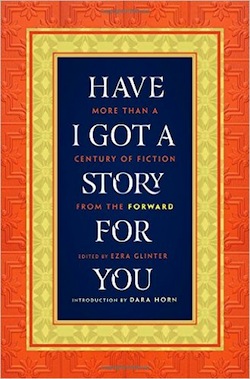
It must have been a prodigious effort by editor Ezra Glinter to look through countless Yiddish Forward microfilms going back more than 100 years and come up with the superb collection of short fiction Have I Got a Story for You: More than a Century of Fiction from the Forward (W.W. Norton, 2016).

Unlike contemporary American newspapers, Yiddish papers, both here and in Europe, published fiction. Readers looked forward to the weekend editions, where they could find stories by their old favourite authors and newly emerging writers.

This new variegated collection, which begins with 1907 and ends in 2015, with contributions by 20 talented translators, including Glinter, has many of the famous names in 20th-century Yiddish belles lettres – Sholem Asch, David Bergelson, Avraham Reyzen, Israel Joshua Singer, Isaac Bashevis Singer and Chaim Grade. And, though even the lesser-known names were familiar for decades to the loyal Forward audience, they may not be so anymore, and the volume contains cogent and insightful introductions to each writer.

book cover - Have I Got a Story for You: More than a Century of Fiction from the ForwardHave I Got a Story for You is a beautifully produced book, from the stunning, colourful cover, the fine introductions by Glinter and novelist Dara Horn and, of course, the lively fiction. Even the clever title, Have I Got a Story for You, resonates with Yiddish braggadocio.
The anthology begins with a story by Rokhl Brokhes, Golde’s Lament, published in 1907, about a woman who is tormented with jealousy because her husband has sailed to America with another woman posing as his wife, and concludes with a 2015 story, Studies in Solfege, by the current Yiddish Forward editor, Boris Sandler, about which I’ll tell you later.

First, we read stories about the immigrant experience, including one by Abe Cahan himself, the guiding spirit of the Forward (known in Yiddish as the Forverts) from 1903 to 1946, and humorous sketches by B. Kovner, who wrote for the paper for nearly 70 years of his 100-year life (1874-1974).

Some of the book’s most powerful pages, whose sheer force of imaginative and vivid prose overwhelms the reader, were written in Russia under wartime circumstances. Here we see gripping stories by Asch, Bergelson and I.J. Singer. Obviously, tales with such stress and suspense make New York-based fiction about collecting rent or about a lovelorn seamstress pale by comparison.

It is also noteworthy that, whereas stories by Yiddish masters like Peretz, Sholem Aleichem and Reyzen invariably pertained to Jewish life, in this collection, Yiddishkeit is at a minimum. One story by the very secular daughter of Aleichem, Lyala Kaufman, speaks of a woman who prays daily but doesn’t particularly like her assimilated son and daughter-in-law. She closes her morning prayer with a wish that “they die a horrible death.” Another story, by Zalman Schneour, tells of a little youngster who is tempted and finally succumbs to tasting pig meat.

In their Eastern European shtetls or cities, the rhythms of Jewish life were central to Jews’ existence. In the United States, with many of the early immigrants not committed to Jewish observance, the secularly minded Yiddish writers writing for a socialist-leaning paper like the Forward did not have Yiddishkeit at the forefront of their creative imagination.

Noteworthy, too, is that not one of the writers included in Have I Got a Story for You was born in the United States. One can understand that, early in the 20th century, the Yiddish writers would be European-born, but, as the decades progressed toward the mid-20th century, one would have expected at least one American-born Yiddish writer to emerge. But none did.

Also, if you look at the years of birth of the contributing writers, only one was born in the 1920s and none was born in the 1930s or 1940s. The two writers who were born in the early 1950s were Russians. This means that most of the writers who contributed to the Forward, at least those selected for this anthology, were born prior to 1910.

In A Treasury of Yiddish Stories (1953), edited by Irving Howe and Eliezer Greenberg, Grade, born in 1910, was the youngest author. And so it is curious to see in this anthology, published in 2016 – 53 years later – that Grade is still among the youngest. There are only three younger than he, Yente Mash (1922), Mikhoel Felsenbaum (1951) and Sandler (1950). Certainly the decimation of Jewry during the Holocaust and the repressive Stalinist regime in Russia had something to do with this gap.

(I should add, if only parenthetically, that in the magazine Afn Shvel, published by the League for Yiddish, one can read American-born Yiddish writers, in their 20s and 30s, publishing fiction and non-fiction.)

Full of Yiddishkeit, however, is the masterful novella by Grade, Grandfathers and Grandchildren. Set in an old Vilna shul between the two world wars, it tells of a group of old men whose children have assimilated. Their lives perk up when little boys come into the shul in the winter to warm up, and the old men start giving them private lessons. During summer, the boys disappear but their lives take on new meaning again when two yeshivah bokhers come into the shul to look for old texts and take on the oldsters as their students.

The last two stories in the anthology are by Russian Yiddish writers. Felsenbaum, now living in Israel, depicts a married Israeli Yiddish writer who goes to a Basel book fair, where he meets and falls in love with a beautiful woman. In the book’s last tale, Sandler focuses on a teenage boy who describes taking singing lessons from a slightly older girl; she also introduces him to the Indian love guidebook, Kama Sutra.

I have resisted quoting delectable lines from this anthology till now, but can resist no longer. When the girl asks the boy if he knows what Kama Sutra is, he says the first thing that comes into his head: “Of course. It’s a type of Japanese wrestling.”

Curt Leviant is the author of two recent novels, King of Yiddish and Kafka’s Son.

Posted on January 27, 2017January 27, 2017Author Curt LeviantCategories BooksTags Forverts, Glinter, Yiddish
A Yiddish writer resurrected

A Yiddish writer resurrected

Tekhiyas ha-meysim, resurrection of the dead, is not an everyday occurrence. But it happens in literature when attention is once again focused on long-neglected authors. Scott Davis, editor and publisher of Storyteller Press, is one of those resurrectors. He has rediscovered the prolific and bestselling 19th-century Yiddish writer, Jacob Dinezon, who was friendly with “the Big Three,” the founding fathers of modern Yiddish literature – Mendele Mocher Seforim, Sholem Aleichem and Y.L. Peretz – and has brought him back.

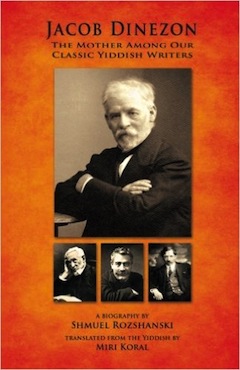
So far, four works by or pertaining to Dinezon have been published by Storyteller Press: Memories and Scenes, a collection of stories and reminiscences (2014); two novels, Yosele (2015) and Hershele (2016); and, now, the 1956 biography Jacob Dinezon: The Mother Among Our Classical Yiddish Writers by Argentine Yiddish writer Shmuel Rozhanski, translated by Miri Koral.

I must confess that, even though I took an advanced degree in Yiddish literature at Columbia University, I had never once heard mention of Dinezon – until Davis came along a couple of years ago and resurrected him. But now, when one scrolls through an internet site for Peretz, one sees not one but two photos of Dinezon; one with Aleichem and Peretz, the other, with Peretz alone.

Dinezon was friendly with Peretz for a quarter of century. In 1890, he published, at his own expense, Peretz’s first book, Bekante Bilder (Familiar Pictures), when it was rejected by all other publishers, and he presented the entire printing to his friend.

Rozhanski’s book is not exactly a biography in the classical sense. In fact, he doesn’t even tell us in what year Dinezon was born. Rather, the author focuses on Dinezon’s books and the interaction between them and the author’s life. It may more properly be called a literary biography, with a summary and gentle analysis and evaluation of Dinezon’s works.

Dinezon, who was born near Kovno, Lithuania, and died in Warsaw in 1919, was one of the most popular Yiddish writers during the 19th century, when Yiddish literature flourished in Eastern Europe. His novel The Dark Young Man sold more than 200,000 copies. Every Jewish household had his books but, because of the sentimental nature of his work, his reputation has fallen into neglect. He was considered passé because critics felt he pandered too much to women readers and other lovers of romances. Today, he might be considered the author of soap operas or pulp fiction. And yet, a respected Yiddish writer placed Dinezon and Aleichem on the same plane, calling the former lachrymose and the latter funny – and both writers of the folk.

In Rozhanski’s book, we learn of the spiritual and linguistic struggle that Yiddish works had to undergo from the middle through late 19th century, when proponents of the Jewish Enlightenment, the Haskalah, sought to highlight Hebrew belles lettres and diminish Yiddish. Among these maskilim were Mendele, who wrote in Hebrew and Yiddish, and Aleichem, who began in Hebrew but then switched to Yiddish.

Dinezon, too, was torn between the two languages, and this inner battle is aptly depicted in one of his letters. There, he states that when he writes in Hebrew and uses phrases from Isaiah or Ezekiel, he feels that the prophets are speaking for him. But, when he writes in Yiddish, he feels that he is speaking for himself and that his protagonists are speaking in their own authentic voices.

This is perhaps the best description of the inner conflict that 19th-century writers who knew both Hebrew and Yiddish had to face. The usual explanation for dropping Hebrew and returning to Yiddish – this was Aleichem’s position, for instance – was the more practical one that the Jewish masses in Eastern Europe knew Yiddish far better than Hebrew and, hence, the readership was very limited. But Dinezon’s literary explanation penetrates the heart of the artistic problem of choosing one or the other of two Jewish languages.

book cover - Jacob DinezonRozhanski calls Dinezon “mother” for his gentle nature. Once, when Peretz devastated a young writer whose short story he had read by telling him, “Enough! You have no talent,” Dinezon, who was present, called the young man aside and told him to try again; perhaps his next effort would be better.

But Dinezon had the courage to criticize Mendele, whom Aleichem called the “zayde,” the grandfather, of Yiddish literature. Dinezon called Mendele too much of a purist regarding use of the Yiddish lanuage. He felt the language of the plain folk should be used. And Rozhanski claims that Dinezon’s goals were more moralistic than artistic; hence, Dinezon criticized Mendele’s satires, regarding them as humor without any moral lesson.

Indeed, it was the moral lesson and a practical uplift of society that Dinezon had in mind when he published Yosele. In this short novel, he criticized the cruel educational methods used by teachers in the small-town cheders. This novel prompted calls for reform, helped modernize pedagogy and led to the inception of more secularly minded schools for youngsters.

The biographer contends that Dinezon’s creativity shouldn’t be measured by his books alone. His work for orphans, his translation of Heinrich Graetz’s History of the Jews from German into Yiddish, even though Graetz didn’t want his work “desecrated” by having it in jargon, and his thousands of letters to writers and social activists – all of these Rozhanski considers part of Dinezon’s creative accomplishments.

So modest a man was Dinezon that, once, at a literary event in honor of Peretz, Peretz pointed to Dinezon in the audience and said, ”My holy soul is this man … this man.” At this, Dinezon rose and denied Peretz’s kind remark by saying that the inspiration comes from within Peretz himself.

Dinezon was a lifelong bachelor. At one point in his life, he was, like Aleichem, a tutor to the daughter of a wealthy man.

Like Aleichem, he fell in love with the girl and the girl’s love was reciprocated. But, whereas Aleichem ended up marrying his pupil, Dinezon was denied his love.

Nevertheless, despite this setback, he continued to serve the wealthy man in other trusted capacities.

In 1913, when Aleichem was ill in Europe – he would immigrate to the United States in 1914 – Dinezon wrote him a letter revealing a plan. When Aleichem would feel better, he would join Peretz and Dinezon and all three writers would go to Palestine and walk the land and write a book about their adventures. “So get well soon,” Dinezon concludes.

This dream was never realized.

For this slim in-depth literary biography, Rozhanski assiduously mined letters, newspapers, magazines, Yiddish writers’ memoirs, critical evaluations, as well as all of Dinezon’s published works, to draw information about the writer, in his own words and in the estimation of others.

Curt Leviant’s most recent books are the novels King of Yiddish and Kafka’s Son.

Format ImagePosted on December 16, 2016December 15, 2016Author Curt LeviantCategories BooksTags Aleichem, Dinezon, Mendele, Peretz, Yiddish
Scholar talks at Peretz

Scholar talks at Peretz

Prof. Ester Reiter, author of A Future Without Hate or Need, points to the U.S. election as a warning that the issues the Canadian Jewish left dealt with are as timely as ever. (photo from Ester Reiter)

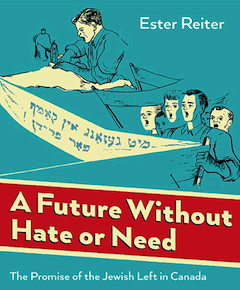
On Dec. 1, Prof. Ester Reiter will speak at the Peretz Centre for Secular Jewish Culture to launch her new book A Future Without Hate or Need: The Promise of the Jewish Left in Canada (Between the Lines, 2016).

Reiter’s book documents “the varied political and cultural activities of those who were part of the secular Jewish left” – the movements in which many Yiddish-speaking immigrants and their children took part during the first half of the last century, made up of Yiddish schools, theatres, choirs, dance troupes, drama groups, sports leagues, union activism, newspapers, women’s groups and summer camps. Their members were animated by a vision of what many of them would have called a shenere, besere velt (a more beautiful, better world). There were groups throughout the country, with the strongest ones in Montreal, Toronto and Winnipeg.

Many of these groups came together nationally in the United Jewish People’s Order (UJPO), founded in 1945. The book launch is being undertaken to commemorate the 90th anniversary of the founding of the Labor League – which later became part of UJPO – in Toronto in 1926. The launch is sponsored by UJPO, and co-sponsored by the Peretz Centre and the Shaya Kirman Memorial Foundation for Yiddish Culture. It will start at the Peretz Centre at 4 p.m.

Reiter, a sociologist by training and a senior scholar at York University in Toronto, grew up in New York in a milieu similar to the one she describes. “I grew up in the New York left, the sister version of the Canadian Jewish left. I was a child in the Yiddish shule [school] in Brooklyn and later the mittlshul [middle school] in Manhattan during the Cold War. Many of my teachers were well known in Canada – they were in the summer camps in Montreal and Toronto, and taught in Canada. The politics were virtually the same and shule materials used in Canada were produced in New York, particularly in the early years, the 1930s.”

This community was at its strongest from the 1920s to the 1950s. Yiddish-speaking immigrants were immersed in the secular Yiddish culture and literature that emerged in the late 19th century. “The Jewish left was the equivalent of a university for working-class women and men. The cultural activities – dance, choirs, orchestras – were accessible to both women and men. People working in the needle trades with no time to learn to read music would sing classical works in the choirs, learning them by heart.”

Reiter says of the Yiddish Arbeter Froyen Fareyn (Jewish Women’s Labor League) that, “the very act of getting together changed many of the women,” particularly in women-only groups, “where women felt more comfortable, they described how they learned to speak in meetings. Their political commitments, which involved activities such as walking picket lines, raising money for various causes, necessitated engaging in public life in a way that required and reinforced self-confidence. This participation in the wider world was empowering. They supported each other, made close friendships and had a lot of fun.”

Jews on the left in Canada, as elsewhere, were diverse – they included social democrats, Bundists, anarchists, Labor Zionists and Marxists. Reiter focuses on those whose outlook was Marxist and supported the Soviet Union after the 1917 October Revolution.

book cover - A Future Without Hate or NeedReiter emphasizes that this sector of the Jewish left had a life of its own distinct from the Communist party. “The leadership were Communist party members, but approximately 95% of the membership of the UJPO and its predecessors were not. One could think and say what one felt in the Jewish left without concern over whether it was the ‘correct’ position. Many people came [to the Jewish left] because of the liveliness of the community, as well as the politics.”

Initially, Yiddish schools saw their purpose as conveying ideological values, but this later shifted to transmitting the Yiddish language and Jewish cultural identity for their own sake, including secularized versions of Jewish holidays and rituals. “In the early period, a Yiddish education in the shule was to ensure that the children learned they were the children of workers, and needed to care about racism and class exploitation. After Hitler came to power and antisemitism was growing, Yiddish was valued as an end in itself, and there was more acceptance of the different ways of identifying as a Jew. The community developed secular ceremonies around the bar/bat mitzvah, the High Holidays, Rosh Hashanah and Yom Kippur.”

The Jewish left experienced government harassment during the Cold War, especially in Quebec under premier Maurice Duplessis. Reiter notes that Canadian Jewish Congress defended civil liberties in the face of repression, but “dealing with pro-communist groups in their midst was a different matter.” UJPO was expelled from CJC in 1952 for dissenting from the Cold War consensus by opposing the postwar rearmament of West Germany and supporting the Stockholm peace petition.

The Jewish left for a long time saw the Soviet Union as a hope for a better society, in its outlawing of antisemitism and support for Yiddish culture in the 1920s, but their hope was shattered by the Stalin regime’s murder of Yiddish artists in the late 1940s and early 1950s. “For many years, people projected their idealism on[to] the USSR. When they found out about Stalin’s suppression of Jewish life, it was shocking. Most of the Jewish [Communist party] leadership from UJPO left the party. However, the rank and file in UJPO were never actually party people, so many felt that, although the USSR under Stalin was terrible, their activities in Canada – helping the unemployed, union support – were important and valuable.”

Reiter describes various factors in the shrinking of the Canadian Jewish left – Cold War persecution, disillusionment with Stalinism, the erosion of Yiddish by assimilation. However, UJPO itself has survived the disappearance of the milieu that gave birth to it, and has even attracted new members. Reiter reflects, “There certainly is a need. Our politics mean that we are inclusive of different kinds of families – gay, straight, trans, mixed racial and religious origin. Yiddish has pretty well disappeared, but the progressive politics remain. With respect to Middle East politics, there are a variety of views in the UJPO, but we all agree that criticizing the actions of the Israeli government does not mean that one is a self-hating Jew. We also continue with trade union support, First Nations solidarity, environmental activism. We exist because we have a community that has a good time together. As the organized Jewish community has moved to the right, we provide a place where one can have a Jewish identity and be progressive. Secular left Jews now have to think about what we have in common, not what separates us.”

Reiter points to the Nov. 8 U.S. election as a warning that the issues the Canadian Jewish left dealt with are as timely as ever. “The struggle against racism, sexism, homophobia and all this meanness and narrowness is an ongoing one – a call to remember and honor and value our own history and where we came from.”

Carl Rosenberg is a member of the United Jewish People’s Order and Independent Jewish Voices Canada. For many years, he edited Outlook: Canada’s Progressive Jewish Magazine.

Format ImagePosted on November 25, 2016November 23, 2016Author Carl RosenbergCategories BooksTags Canada, Judaism, politics, secular left, Yiddish
Yiddish food’s long history

Yiddish food’s long history

Michael Wex, author of Rhapsody in Schmaltz (St. Martin’s Press, 2016), will close the Cherie Smith JCC Jewish Book Festival on Dec. 1.

“Heavy, unsubtle and, once it emerged from Eastern Europe, redolent of an elsewhere that nobody missed, the food of Yiddish speakers and their descendants is a cuisine that none dares call haute, the gastronomic complement to the language in which so many generations grumbled about it and its effects,” writes Michael Wex in the introduction of his latest book, Rhapsody in Schmaltz: Yiddish Food and Why We Can’t Stop Eating It.

“This vernacular food continues to turn up in vernacular form in the mouths of people who have never eaten it, or who don’t always realize the Jewish origin of the strawberry swirl bagel onto which they’re spreading their Marmite,” he writes. “We’ll be looking at the aftertaste of Ashkenazi food as much as at the cuisine itself. But before we can do so, we have to go back to the Bible to see why Jewish food exists and what it really is.”

Toronto-based Wex – who is the author of many books, including Born to Kvetch: Yiddish Language and Culture in All of Its Moods and How to Be a Mentsh (& Not a Shmuck) – will close the Cherie Smith JCC Jewish Book Festival on Dec. 1. His topic, appropriately enough, is Jews and Food.

In Rhapsody in Schmaltz, Wex takes readers from the Exodus from Egypt – “Most national cuisines owe their character to flora and fauna, crops and quarry, domesticated animals and international trade. Jewish food starts off with a plague” – to the modern delicatessen, which “might no longer be the social hub it was for earlier generations, but the food that it serves is still recognized as Jewish, even when the ingredients are combined in ways that can’t help but pain an observant Jew.”

photo - Michael Wex
Michael Wex (photo by Zoe Gemelli / St. Martin’s Press)

While written in a tongue-in-cheek manner, Wex’s love of Yiddish culture, if not of Yiddish (aka Ashkenazi) food, is apparent in every page. And each page is packed with information – that he somehow compiled on his own, without research assistants.

“Although all of my non-fiction is rooted in subjects with which I was already quite familiar, I’ve found that it’s the research itself, the jump from one source to the next, that tends to produce the sparks that lead to the better ideas,” he explained to the Independent of his creative process. “I don’t think summarized works or lists of facts provided by an assistant would allow for the immersion that I, at least, need in order to write a book.

“It generally takes me about a year to research and write a book – maybe 18 months, if you count the preliminary research that usually goes into preparing a proposal for a publisher. I generally start with a specific, if somewhat vague, question and then try to answer it: What makes Yiddish different from other languages? Why do Jewish people go on eating traditional Jewish food even when they spend most of their time finding fault with it and have abandoned the rituals and ceremonies with which such dishes were associated?”

With nine pages of endnotes and a 13-page bibliography, one might assume that Rhapsody in Schmaltz is a dry read. It is anything but – Wex’s style is completely irreverent. For example, in writing about the formation of the dietary laws, he comments, “the Israelites aren’t supposed to feel any more deprived of the right to eat certain creatures than most of us usually do about the right to get high on crystal meth or pee in the street.” He openly discusses over-the-top kosher practices, bodily functions, etc. Perhaps surprisingly, his writing hasn’t ever gotten him into trouble with his religious compatriots.

“The only ‘trouble’ I’ve encountered has arisen from misunderstanding,” he said. “For instance, I received a vehemently condemnatory email from a woman who objected to my having used the phrase ‘goat or kid’ in describing the Passover sacrifice; she was afraid that non-Jews might take the word ‘kid’ as proof that we really murder gentile children and use their blood to bake matzah. Otherwise, though, the response has been quite positive. A number of rabbis – Orthodox, Conservative and Reform – have written to tell me that they’ve used material from my books in their sermons; Born to Kvetch is frequently cited in the language column of Hamodia, an English-language ultra-Orthodox paper published in Brooklyn.

“Most feedback about Rhapsody in Schmaltz has focused either on readers’ memories of the foods mentioned or on the ritual or halachic reasons behind the forms they’ve assumed or the occasions on which they are eaten, including questions relating to their viability in a world in which most Jews are not religiously observant.”

For many readers, some of Rhapsody in Schmaltz will serve as a memory refresher of the origins of certain rules of kashrut or the types of meals that are traditionally prepared for various holidays. But there is much readers will learn and, while Yiddish food may have been a topic with which Wex was familiar before he began his research, there were a few findings that surprised him.

“The whole Crisco-Manischewitz nexus and the things that grew out of it was probably the main thing I learned; I’d known how important Crisco was for kosher marketing, but until I looked into it, had no idea of why,” said Wex. “The other thing that really shocked me when reading through cookbook after cookbook was the surprising popularity of brain latkes at one time – I knew that brains were once popular, but had never heard of consuming them in latke form.”

Tickets to the closing of the book festival, which takes place at the Jewish Community Centre of Greater Vancouver, are $24 and the event features a food reception – brain latkes not included. To order, call 604-257-5111, drop by the JCCGV or visit jewishbookfestival.ca.

Posted on November 25, 2016November 23, 2016Author Cynthia RamsayCategories BooksTags food, JCCGV Jewish Book Festival, Yiddish

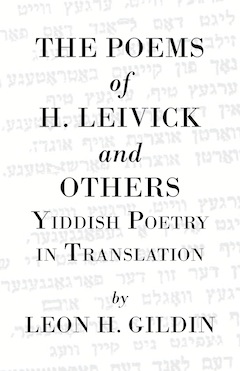
A fine collection of poems

When I saw the table of contents of The Poems of H. Leivick and Others: Yiddish Poetry in Translation by Leon H. Gildin (Finishing Line Press), a lovely little book of translated Yiddish poems by Leivick and other noted poets, two images came immediately to mind. One was a scene with Leivick, a slight figure with a beautiful etched face and a halo of white hair, sitting alone on a circular stone ledge in front of the Hebrew University library, in Jerusalem, seemingly lost in thought. The other, and this goes back decades, is a gathering of Yiddish poets, including almost all the ones collected in this book, in a meeting hall in New York. What a thrill it was for a college boy to be at such a meeting and seeing face-to-face the famous poets he had known before only by name.

book cover - The Poems of H. Leivick and OthersThe poems of Leivick (1886-1962) range in subject matter: a poem about a very small poem “no longer than an epitaph”; the recollection of a birch rod beating given by his father; a prisoner in a cell at night “swallowing as if it were wine the moon’s bright light”; a man looking for work without success. Leivick was a paperhanger when he came to the United States. He was also a noted playwright; his most famous is The Golem, originally produced by Habima Theatre when it was still in Moscow, and later translated into other languages.
Here, too, admirably rendered into English by Gildin, are the voices of other famous American Yiddish poets – all born in Eastern Europe – singing songs of longing, love and the Sabbath. About half the poems are by Leivick: the rest are by luminaries like Chaim Grade, Yakov Glatstein, Avraham Reisen, Itzik Manger, A. Leyeles, Mani Leib and Avraham Sutzkever. Most of the poems here have a modernist lilt regarding imagery and tone, yet all have traditional rhymes.

My only caveat with this fine ingathering of poems is that too much space is devoted to a relatively minor but good poet, Anna Margolin. Where Grade has only one, why six for Margolin? Additional poems by the other poets would have been welcome.

My favorite poems here are those that have a Jewish core. Hence, Grade’s loving poem “The Sabbath,” recalling his war- and postwar-years wanderings in Russia and Europe, resonates, as does Ephraim Auerbach’s prayer-poem “God of Abraham,” which begins with the opening lines of Havdalah – the prayer for the departing of the Sabbath – and takes wing from there.

In his short introduction, Gildin accents the secular aspects of Yiddish poetry but, by so doing, he puts an artificial divide between religiosity and secularism. He says that, while Yiddish was the street language of the Orthodox, the secular Yiddish created a culture. But Gildin neglects to note that Yiddish was used far beyond the street for Orthodox Jews. Religious Jews also used Yiddish in shul, in studying and in translating Chumash and Talmud, and in creating commentaries and translations of the siddur and the machzor, the daily and the holiday prayer books, respectively. Women created their own prayers in Yiddish, which were collected into separate volumes. This same “street language” was used by the secular poet Yehoash in creating his masterpiece: his magnificent translation of the entire Bible into Yiddish.

In Grade’s “The Sabbath” and Auerbach’s “God of Abraham,” the boundaries between piety and secularity are blurred. The distinctions are not as separate as they appear to be. In a classic photo of Yiddish poets sitting at a long dinner table at a wedding, one can see secular poets like Leivick, Grade, Glatstein, Reisen and noted critic Shmuel Niger, all wearing either fedoras or yarmulkes.

Sholom Aleichem was thoroughly secular. He was not observant and did not keep a kosher home. In fact, he spoke Russian, not Yiddish, to his family. Yet, when his son died in Denmark, he went to shul to say Kaddish every day in New York. And, in his will, he asked those who are willing, to say Kaddish for him, too.

Most significantly, the obviously secular translator of this volume, Gildin, along with his brother, founded a university Yiddish department, not in the secular Hebrew University, Haifa University or Tel Aviv University, but at Bar-Ilan University, the only religious-sponsored university in Israel.

For those who know Yiddish poetry, The Poems of H. Leivick and Others revisits old friends; for newcomers, it is a cogent introduction.

Curt Leviant’s most recent books are the novels King of Yiddish and Kafka’s Son.

Posted on November 4, 2016November 3, 2016Author Curt LeviantCategories BooksTags Leivick, poetry, Yiddish
Vilna, the place, its people

Vilna, the place, its people

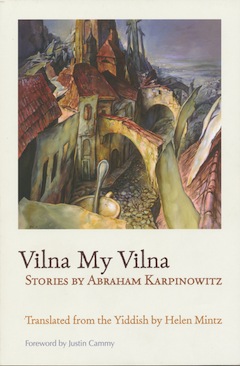
It is a master storyteller who can make you feel like you’ve met someone you never knew, visited a city to which you’ve never been, make you long for a people, place and culture you’ve never experienced but from a generation, location and language once, twice or thrice removed. Abraham Karpinowitz (1913-2004) is such a writer. And, thanks to local master storyteller and translator Helen Mintz, more of us can now visit Karpinowitz’s Vilna – a city full of colorful characters, both real and not, and share in a small part of their lives.

Vilna My Vilna (Syracuse University Press, 2016) is a collection of 13 short stories and two brief memoirs by Karpinowitz, translated from Yiddish into English by Mintz. For context and a better understanding of Karpinowitz and his work – notably one of the main “characters” in his writing, Vilna – there is a foreword by Justin Cammy, an associate professor of Jewish studies and comparative literature at Smith College in Massachusetts, and an introduction by Mintz. These two scholarly essays are invaluable, but if you’re completely unfamiliar with Karpinowitz, perhaps jump ahead and read a few of the stories before heading back to these parts of the book. It’s kind of a Catch-22, in that their insight enhances the enjoyment of the stories, but the stories enhance the understanding of the analysis and history.

book cover - Vilna My VilnaRomantics will appreciate most the linked stories of “The Folklorist” and “Chana-Merka the Fishwife.” In the first tale, Rubinshteyn heads to the Vilna fish market to collect material for YIVO (the Yiddish Scientific Institute) because he knows that, if the “genuine language of the people” is not documented, “it would be a great loss for the culture.” Dedicated to his work, and a dedicated bachelor, he fails to notice that Chana-Merka has fallen in love with him and, once his research is complete, he stops visiting the fish market, much to her – and his – sadness. In the second tale, Chana-Merka heads to YIVO herself to make sure that Max Weinreich, its director, knows from whom all of Rubinshteyn’s material came: she makes lists of curses for Weinreich, such as “May you speak so beautifully that only cats understand you,” and “May you be lucky and go crazy in a more important city than Vilna.”

Weinreich is one of the real people who appear in this collection where fiction and non-fiction meld. Yoysef Giligitsh, a teacher at the Re’al Gymnasium, is another. Most readers will not be able to identify all of these people and, while there will be added realism for those who can, the characters stand on their own. Besides, these people are secondary to the protagonists, who are the fishwives, the prostitutes, the criminals, the poor.

Despite that everyone is trying to eke out an existence, even the criminals follow a moral code. For example, Karpinowitz notes, in “Vilna, Vilna, Our Native City” that the Golden Flag criminal organization’s constitution includes the admonition, “Our members should behave properly and not forget that even though we are who we are, we are still Jews,” and that “[t]here was a directive for the general treasury to provide dowries for poor brides.”

Karpinowitz pokes fun at communism, capitalism, politics in general. His descriptions put readers right into the scene, almost as if they’re standing on the opposite street corner watching events unfold. And he has some wonderful turns of phrase. In “Shibele’s Lottery Ticket,” for example, Sheyndel’s husband goes off to fill the water bucket and never returns: “Sheyndel missed her husband, the shiksa chaser, less than the bucket.”

Or, in one of the two memoirs, “The Tree Beside the Theatre,” Karpinowitz writes about his father’s choice to sell his print shop to run a theatre, “If he’d stayed in the print shop, he’d be a rich man. My mother reminded him of this every time she couldn’t cover expenses. But everything in the print shop, including the machines and the letters, was black, and everything in the theatre was colorful, even the poverty.”

Karpinowitz’s characters have self-dignity and hope. They are not passive, for the most part, but are actively trying to change their situation for the better or to help someone else. Not surprisingly, many of the stories have bleak endings, with the narratives going from charming and/or humorous to horrific, illustrating just how abruptly and brutally this world came to an end.

These stories that turn on a dime are so moving. They emphasize just how little people at the time understood that most of them would soon be murdered. As Karpinowitz writes in “Vilna, Vilna, Our Native City”: “For years, a Jew with blue spectacles stood on Daytshe Street begging, ‘Take me across to the other side.’ His plea was so heartrending that, rather than asking to be taken across the few cobblestones separating Gitke Toybe’s Lane from Yiddishe Street, he sounded like he needed to cross a deep and dangerous abyss. Maybe he was the first Jew in Vilna with a premonition about the Holocaust. Just the name of the street, Daytshe Gas, German Street, drove him from one side to the other. We could all see the little water pump and Yoshe’s kvass stall on the other side of the street, but through his dark spectacles, that Jew saw farther. Fate didn’t take him to the safer side. He ended up in the abyss at Ponar with everyone else.”

Karpinowitz survived the Holocaust in the Soviet Union, having left Vilna in 1937. He briefly returned in 1944 and then, after two years in a displaced persons camp in Cyprus, moved to Israel. Mintz notes that he wrote seven works of fiction, two biographies, a play and five short story collections. He was awarded the Manger Prize (1981), among several other honors.

In the stories of Vilna My Vilna, the geography of the city is integral, and the maps included are useful in situating the action. The glossary is also an essential part of the book: kvass, for example, is a “fermented beverage made from black or regular rye bread.”

Adding even more value to this collection are three illustrations by Yosl Bergner that were in the original 1967 Yiddish publication of Karpinowitz’s Baym Vilner durkhhoyf and the painting “Soutine Street” by Samuel Bak is the cover of Vilna My Vilna. Both artists (and the Pucker Gallery, in the case of Bak’s painting) gave permission for their work to be used at no charge, which is an indication of the translation’s import beyond entertainment.

Mintz’s acknowledgements are many, and that she accepted so much input into the book speaks volumes about her integrity and the quality of her work. “Translating these stories brought me great joy,” she writes. “While never swerving from the truth, Abraham Karpinowitz answered genocide with love: love for his characters and love for his craft as a writer.” With Vilna My Vilna, Mintz adds her love, and that of many others, to ensure that Vilna, its people and its stories will not be forgotten.

Format ImagePosted on April 15, 2016April 13, 2016Author Cynthia RamsayCategories BooksTags Holocaust, Karpinowitz, translation, Vilna, Yiddish, YIVO
Revenge story with humor

Revenge story with humor

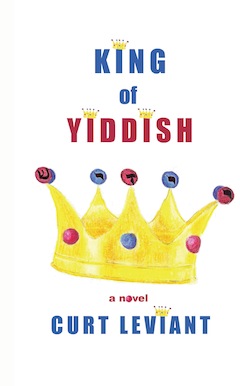
Before you get to the fifth page of text, it will become apparent that you haven’t yet encountered a period. Don’t be put off by that. Curt Leviant’s King of Yiddish (Livingston Press, 2015) is a page-turner. It is a comedic tour de force, interspersed with a detective story that will have you following Shmulik Gafni through Poland in an obsessive pursuit. He is hunting the man he witnessed murdering his father and uncle in Kielce, Poland, a pogrom that occurred 14 months after the end of the Second World War.

Shmulik is described as an “overlyfull professor” of Yiddish at the fictional University of Israel in Jerusalem. The pogrom in Kielce is a well-known tragedy that did occur, but Leviant’s fertile imagination weaves an original tapestry from that terrible time and place.

So, where’s the comedy? The humor centres around a basic human failing: men will be men, and Shmulik falls under the spell of Malina, a Polish Catholic linguist determined to become proficient in Yiddish. She also happens to be half Shmulik’s age and is unbelievably beautiful and well built. Malina is his second obsession.

book cover - King of YiddishThe two stories, solving his father’s murder and getting to the bottom (and the top) of Malina, are interspersed narratives that keep you guessing and entertained. Along the way, the reader encounters a Chassidic un-kosher kidnapping that goes awry (imagine the Marx brothers in black hats) and a bris (kosher or not depending on whether you are Orthodox or Reform) that are grist for Leviant’s mill of linguistic tomfoolery. You meet other academics, letting you in on university rivalries and gossip. Believe it or not, but a cookie with an incredible miniature topping in a Vienna café is an important character in the plot development that might have been written by Kafka, Borges or Nabokov, but it is pure Leviant, plying his considerable art as a fabulist.

Leviant also steps outside the narrative and talks to the reader. At one point, the author says you can skip a chapter. Take my advice: keep reading. As you join Gafni in his quest for justice, you will also find allusions to previous works by Leviant. These, he jokingly attributes to famous Hebrew and Yiddish writers, telling us that other colleagues translated those books. One of these is the Icelandic writer, C. Urtl Eviant, a self-referential invention who also plays a role in King of Yiddish.

Considering all the word play in English, Yiddish and Hebrew, my favorite occurs when a colleague of Shmulik’s is calling 911. He tells the operator he is a linguist with the City University of New York. Propriety in a family publication requires you figure it out for yourself. Revealing any of the other plot twists would spoil the fun.

If you have read Leviant’s other critically acclaimed fiction, you will catch many of the references here. If you haven’t, you may want to back up and read some of his earlier novels. The Yemenite Girl, The Man Who Thought He Was Messiah and Diary of an Adulterous Woman are good places to start. He has produced a body of work that has been widely translated throughout Europe.

John Irving has written that he always composes the last few sentences of his novels before he begins page one. Leviant must have done this with his novel. For those of you who like to look at the end of a book before you begin … please resist. King of Yiddish is a gripping narrative that will fascinate you from the opening paragraph to its surprising last.

Sidney Kessler is a freelance writer in Glen Allen, Va. His most recent articles have appeared in the Wall Street Journal and the Richmond Times-Dispatch.

Format ImagePosted on April 15, 2016April 13, 2016Author Sidney KesslerCategories BooksTags Holocaust, Leviant, Yiddish
Lighting up Lower Mainland

Lighting up Lower Mainland

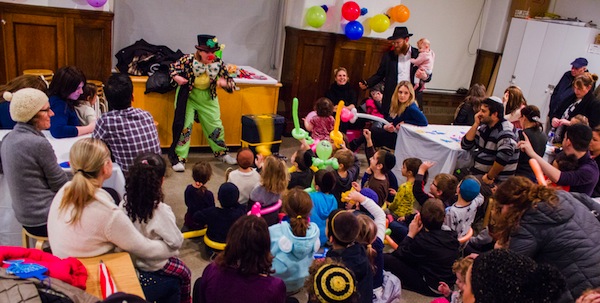
The lighting of the Silber Family Agam Menorah at Vancouver Art Gallery also featured some clowning around. (photos by Glenn S. Berlow)

photo - The lighting of the Silber Family Agam Menorah also featured some clowning around

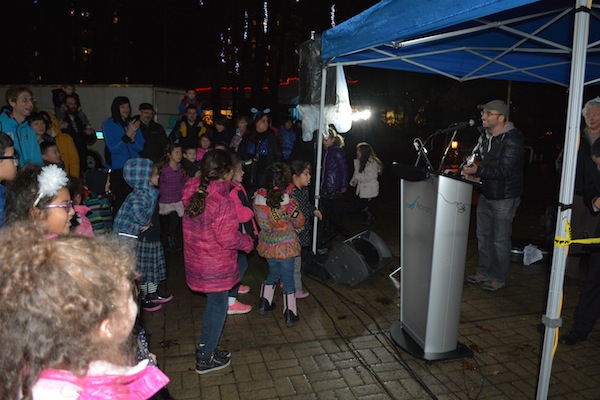
Among the many community celebrations of Chanukah this year were, from the first to fourth night of the holiday, gatherings in Vancouver, Richmond, Surrey and the North Shore.

More than 300 people gathered at Vancouver Art Gallery on the first night of Chanukah, Dec. 6, for the lighting of the tallest menorah in Canada, the Silber Family Agam Menorah. The children enjoyed crafts and entertainment inside the gallery and then everyone went outside (in the pouring rain!) for doughnuts and cocoa. The annual event, which is sponsored by the Silber family in memory of Fred Silber z”l, featured greetings from the dignitaries and politicians who were present, live Chanukah music by Dr. Anders Nerman and the menorah lighting led by members of the Silber family.

***

photo - Gary Averbach, left, and Richmond Mayor Malcolm Brodie light the menorah in Richmond

photos - Gary Averbach, left, and Richmond Mayor Malcolm Brodie light the menorah in Richmond, where there was also live music
Gary Averbach, left, and Richmond Mayor Malcolm Brodie light the menorah in Richmond, where there was also live music by Anders Nerman. (photos from Richmond Public Library)

Approximately 300 adults and kids celebrated the second night of Chanukah with the lighting of a giant menorah, live music by Nerman, magic by Yeeri the Magician, and traditional potato latkes and sufganiyot at the Richmond Library and Cultural Centre.

“Sharing the Jewish Festival of Light with so many people was an incredible community celebration that really expanded cultural awareness,” said Shelley Civkin, library communications officer. Three generations of the Averbach family joined Richmond Mayor Malcolm Brodie in lighting the menorah.

The event was held in partnership with the City of Richmond, Vancouver Kollel, the Richmond Public Library and the Ebco group of companies. “The evening started off with Yeeri the Magician performing his magic for families, then singer and guitarist Anders Nerman played music while the menorah was being lit,” said Civkin. “It was a lively event and there was even a Chanukah miracle – no rain!”

***

photo - Menorah lighting at Centre for Judaism

photo - After the menorah lighting, the Iron Chef Chanukah competition began in Surrey
After the menorah lighting, the Iron Chef Chanukah competition began in Surrey. (photos from Centre for Judaism)

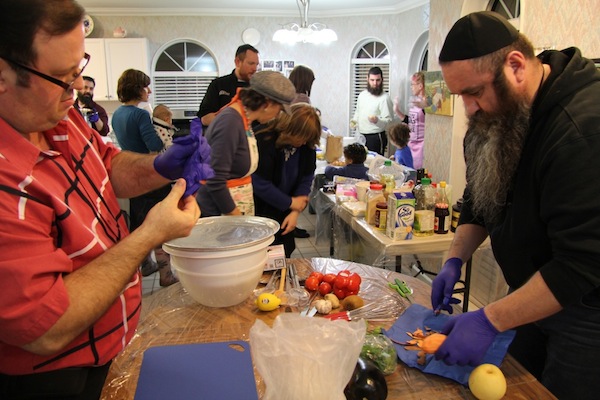
On the third night of Chanukah in Surrey, after the menorah lighting led by Rabbi Falik Schtroks, and a dairy and latke dinner, those who attended the event at the Centre for Judaism, Chabad in White Rock/Surrey, participated in the third Iron Chef Chanukah. Iron chef Marat Dreyshner was helped by sous chefs Ella Dreyshner, Rabbi Nuta Yisroel Shurack and Debbie Cossever. Competing for this year’s title was award-winning pizza chef Aaron Gehrman and culinary expert Rae Friedlander Sank, who worked with sous chefs Nissim Gluck and Avraham Nissan Zabylichinski. Host and director of Iron Chef Chanukah, Rebbetzin Simie Schtroks, said that, although this year was the fiercest competition yet, there was an energetic and fun atmosphere in the Iron Chef kitchen. Many in the audience tried to assist the teams with small tasks or by keeping them entertained with Chanukah songs. Ethan Dreyshner helped the rebbetzin as second emcee and interviewer. Mariasha Schtroks created the rating sheets for the judges. While prizes were earned by all participants, the winning team and their friends will be treated to a five-course gourmet dinner catered by Simie Schtroks. Scores were so close that you will have to attend next year’s Iron Chef to find out which team won.

***

photo - Chabad of North Shore Rabbi Mendy Mochkin speaks at the first-ever menorah lighting at Lonsdale Quay
Chabad of North Shore Rabbi Mendy Mochkin speaks at the first-ever menorah lighting at Lonsdale Quay. (photo by Shula Klinger)

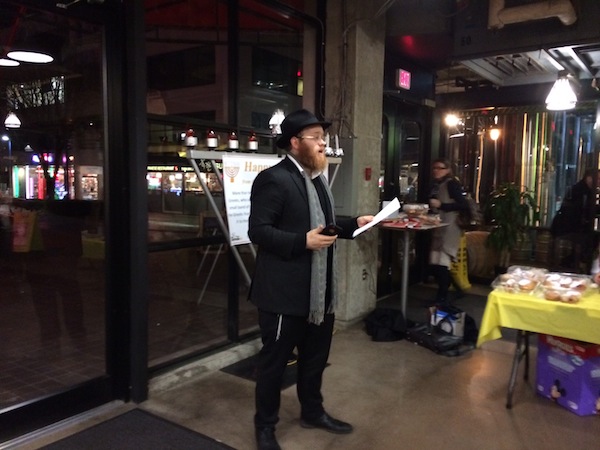
The evening of Dec. 9 saw the first-ever menorah lighting at Lonsdale Quay in North Vancouver. Set against the backdrop of downtown Vancouver, the event was hosted by Chabad of North Shore Rabbi Mendy and Rebbetzin Miki Mochkin and their family.

Rabbi Mochkin opened the occasion with a few words about the meaning of Chanukah. He stressed the importance of standing one’s ground in the face of adversity, and the value of picking oneself up, no matter how hard one has fallen. The menorah was lit by Rabbi Yitzchak Wineberg, executive director of Chabad Lubavitch BC.

Doughnuts were enjoyed by everyone and the kids had a grand time at the impromptu Dreidel Station.

***

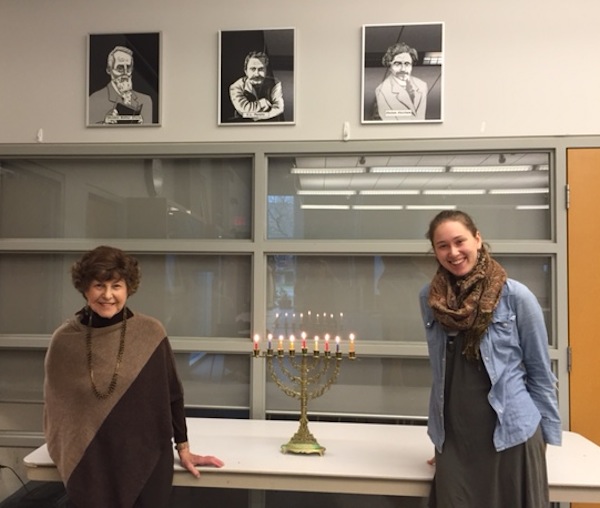
photo - Flora Field, left, and Emily Glass, students learning Yiddish with Haya Newman at the Peretz Centre for Secular Jewish Culture, take time out for Chanukah
Flora Field, left, and Emily Glass, students learning Yiddish with Haya Newman at the Peretz Centre for Secular Jewish Culture, take time out for Chanukah. (photo by Haya Newman)
Format ImagePosted on December 18, 2015December 16, 2015Author Community members/organizationsCategories Celebrating the HolidaysTags Averbach, Centre for Judaism, Chabad of North Shore, Chanukah, Haya Newman, Iron Chef, Mochkin, Peretz Centre, Richmond Public Library, Shula Klinger, Silber, Wineberg, Yiddish

Posts pagination

Previous page Page 1 … Page 3 Page 4 Page 5 Next page
Proudly powered by WordPress