Skip to content
  • Home
  • Subscribe / donate
  • Events calendar
  • Business Directory
  • FAQ
  • News
    • Local
    • National
    • Israel
    • World
    • עניין בחדשות
      A roundup of news in Canada and further afield, in Hebrew.
  • Opinion
    • From the JI
    • Op-Ed
  • Arts & Culture
    • Performing Arts
    • Music
    • Books
    • Visual Arts
    • TV & Film
  • Life
    • Celebrating the Holidays
    • Travel
    • The Daily Snooze
      Cartoons by Jacob Samuel
    • Mystery Photo
      Help the JI and JMABC fill in the gaps in our archives.
  • Community Links
    • Organizations, Etc.
    • Other News Sources & Blogs
  • JI Chai Celebration
  • JI@88! video

Recent Posts

  • SFU honours Gloria Gutman
  • Lifting people’s spirits
  • Wedding a ray of light
  • Indigeneity and Zionism
  • Rule of law broken: councilor
  • Football and its roles
  • The burden of defence
  • Fish Café returns after fire
  • All right in what goes wrong
  • Nuns & mermaids at TUTS
  • Camp offers holiday retreat
  • Students and mentors inspire
  • Once-in-a-lifetime trip
  • 100 dancers, one heart
  • Money for the sciences
  • What “Jewish food” means
  • Have a cookie, schnitzel too
  • Federation now across BC
  • Israel fighting for its existence
  • Deal strengthens Iran
  • Patriotic belonging diminishes
  • A campaign to engage
  • Upstanders’ first live event
  • Responding to Carney
  • Having your own home
  • Music a family tradition
  • Musical to warm heart
  • Community milestones … June 2026
  • Sharing her passion for Israel
  • Or Shalom reopens its doors
  • JFS from past to future
  • Need holistic approach
  • Sharing stories, advice
  • Journalist shares fears
  • Skills to live together
  • Road to independence

Archives

Follow @JewishIndie
image - CJN box ad Rockowers 2026

Tag: women

Honouring others in death

There’s nothing like a tree stump to put things in context. I walk the dog in an area full of mature trees and wildlife. Tucked in a bend of a river, we’ve got a lot of trees here. However, this enormous tree had died. I contemplated its huge stump and growth bands. My impatient dog pulled me towards her usual routine, so I didn’t manage to count the rings to learn just how long it lived, but likely it has existed since long before settlers claimed this land.

One gift I’ve gained from living in Winnipeg, where more than 15% of our population is Indigenous, is a better connection to and respect for the earth and living things. In my urban daily walks with the dog, I’ve seen woodpeckers, ducks, geese, hawks, deer, fox, and more. I’m filled with awe by the wild natural world around us and the contexts offered by Canada’s First Peoples.

However, I’ve also seen the traumas played out through what Canada has done to its Indigenous population. There are unhoused people nearby, living in camps along the riverbank in all kinds of weather. On a warm day, I saw a woman on the ground. I thought she was sleeping and went on my way. Then I struggled, wondering if I should have called for help. Perhaps it was an overdose or something worse. At the time, I promised myself that if she were still there when I returned, I would call for help. The whole walk, I debated whether it was better to involve police or not. Indigenous Canadians aren’t always treated fairly by law enforcement. She was gone by the time I returned. I felt relief because I hadn’t been forced to make a decision. Would sleeping on the ground in an area that was her people’s ancestral land result in an arrest or accusation of criminal behaviour?

This situation, of not being sure if a call to the police was safe, came to mind when hearing the latest news reports regarding the deaths of four women in Winnipeg. These women’s remains were left in multiple garbage bins in May 2022, according to police reports. Some of these dumpsters were sent to Prairie Green landfill on May 16. Jeremy Skibicki is accused of killing these Indigenous women: Rebecca Contois, Morgan Harris, Marcedes Myran and a fourth woman, unidentified, who Indigenous leaders have named Mashkode Bizhiki’ikwe, or Buffalo Woman.

Some of Contois’s remains were found at Winnipeg’s Brady Road landfill in June 2022; her remains were in at least two dumpsters, one of which was spotted before being picked up by the dump truck. The police didn’t find the other women’s remains and declined to do a search for them, saying it would be dangerous and expensive. They have arrested the man they think committed the crimes and said they didn’t need to find the bodies to press charges. Public outcry, along with the families’ voices, forced the government to do a feasibility study regarding a search of the Prairie Green landfill, which has now been released. It says it could take up to three years and $184 million to search for their remains.

Like many Manitobans, I was horrified by how this has unfolded. The idea that these women’s bodies should remain in the trash rather than have a proper, culturally sensitive burial, is abhorrent. I couldn’t imagine why anyone needed a feasibility study to determine that their remains should be found as soon as possible. I, like many others, couldn’t understand why a search didn’t commence immediately in June 2022. I wouldn’t be alone in saying that it seems as though the decision to not recover the bodies promptly seemed inherently flawed and racist.

Unfortunately, this isn’t a new situation. Jewish tradition is rich with historic detail. The Babylonian Talmud, codified by about 500 CE, has already described what to do about it. Even a kohain (priest), who normally must avoid the dead to avoid becoming “defiled” (unable to do Temple sacrifice, during the days when there was a Temple in Jerusalem) is commanded in the Talmud to bury any dead person he finds abandoned on a road. This is called a meit mitzvah. Today, it’s considered a special and important mitzvah (commandment) for all Jews to uphold: if we discover a dead person with no next of kin, we must do the right thing. We must tend to that dead person with respect and bury them properly.

In the Babylonian Talmud Tractate Sotah, on page 45b, we learn that we’re responsible for burying bodies that we find. We must find body parts and bury them together. There’s a rabbinic discussion about what the proper rituals and procedures are “if he was strangled and left in a garbage heap.”

Walking by that enormous tree stump with its yearly growth rings reminds me that we have only a set time here on earth to do the right thing. Jewish tradition teaches us to be upstanding while we’re here. The families who lost their loved ones in these awful crimes deserve to have their rituals around death observed. These include a proper burial and send off of their loved ones’ spirits. Deuteronomy 16:20 reminds us “Justice, justice shall you pursue.” That sometimes requires us to dig at a landfill, i.e. a modern-day garbage heap, to pursue it.

It’s sometimes expensive and hard to do the right thing. It’s even more expensive and harder to correct an error like this one, when someone believes certain bodies on a trash heap are somehow less valuable or important. The police force took an unacceptable approach – to stall, and then find excuses for why we shouldn’t treat every person equally, and value every life taken.

Joanne Seiff has written regularly for CBC Manitoba and various Jewish publications. She is the author of three books, including From the Outside In: Jewish Post Columns 2015-2016, a collection of essays available for digital download or as a paperback from Amazon. Check her out on Instagram @yrnspinner or at joanneseiff.blogspot.com.

Posted on May 26, 2023May 25, 2023Author Joanne SeiffCategories Op-EdTags burial, ethics, First Nations, indigenous, injustice, Judaism, justice, murder, racism, women
Na’amat to gather in Calgary

Na’amat to gather in Calgary

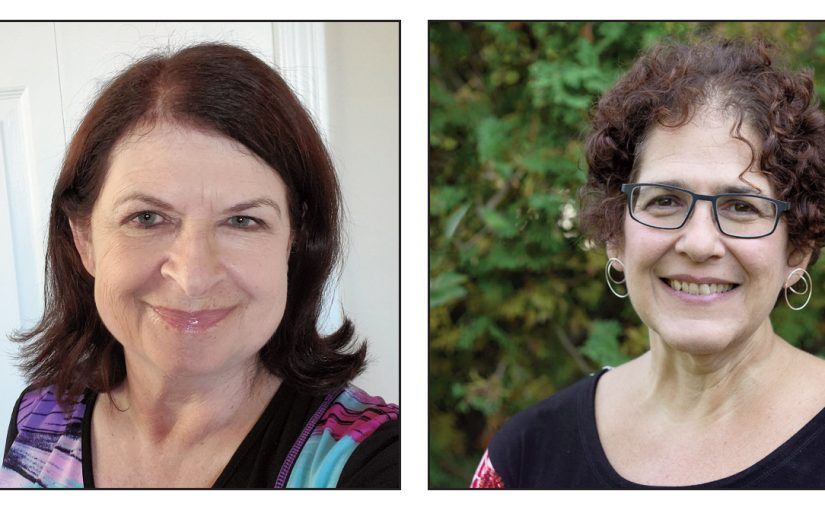
This fall, Susan Inhaber, left, will take over the presidency of Na’amat Canada from Dr. Sandi Seigel. (photos from Na’amat Canada)

Na’amat Canada’s 20th Triennial Convention takes place Oct. 13-15 at the Hilton Garden Inn in Calgary. The event will include a thank you to outgoing president Dr. Sandi Seigel of Hamilton, Ont., and it will welcome new president Susan Inhaber from Calgary, Alta. Inhaber will be the first national president from Western Canada since 1975.

Inhaber became a member of Na’amat Canada Calgary in 2000. “In short order,” she said, “I was president of a new chapter and, a few years later, I became the president of an amalgamated chapter. I served in that role for many years, immersing myself in all of the projects and programs that our group was involved with, including being the bingo chair, casino chair and grocery store gift card chair. My involvement in all activities continues to this day.  As city president, I was a member of the national board, later becoming a member at large and, lastly, the vice-president of Na’amat Canada.”

Inhaber has been to Israel several times with Na’amat. “Everyone who goes always comes back with a renewed sense of energy for the organization,” she said. “We can see the impact that we are making in the lives of others and that is what drives my passion for Na’amat. My next trip will be as the leader of our newest leadership cohort.”

Delegates from across Canada and guests from Israel and the United States will attend the fall convention, and special guests will include Hagit Pe’er, president of Na’amat Israel, and Shirli Shavit, director of the overseas division of Na’amat Israel. There will be speakers on the topics of antisemitism, human rights, breaking the glass ceiling, and more.

“It has been a privilege serving as Na’amat Canada national president since 2020,” said Seigel. “I am most proud that we have supported our organization throughout the pandemic and not only have we survived but thrived. We have built on our relationships with our chaverot internationally and in Israel and have had four successful fundraisers with Na’amat USA.”

Contributing to the success has been the quality of programming, both on Zoom and, more recently, back in-person, she said. “Despite many challenges, we have been able to transmit significant funds to support our work in Israel and continued to maintain important local projects such as our school supplies for kids program.”

Stepping down as president doesn’t mean leaving the organization. “I feel that I have lifelong friends at Na’amat, and it is wonderful to be united in the work that we do on behalf of Na’amat,” said Seigel. “As we near our convention in Calgary, I am excited for the future of our organization as we approach our 100th anniversary in 2025.”

For her upcoming three-year term, Inhaber said she is looking forward to continuing the relationship building that Seigel and, before her, Doris Wexler-Charow brought to the organization. “My main goal is to further grow our membership and donor base,” said Inhaber. “I hope to increase awareness of what Na’amat Canada does in Israel and Canada, especially among Western Canadians.”

For more information, contact Vivian Reisler at [email protected]. To register for the convention, visit naamat.com.

– Courtesy Na’amat Canada

Format ImagePosted on May 12, 2023May 11, 2023Author Na’amat CanadaCategories NationalTags conferences, Diaspora, Israel, Na’amat Canada, philanthropy, Sandi Seigel, Susan Inhaber, women
Creating opportunities

Creating opportunities

The Jerusalem Business Development Centre (MATI) helps people create or expand businesses in Jerusalem. Two leaders of the Israeli organization visit Vancouver on May 11 as part of a Canadian tour. (photo from CFHU Vancouver)

Every year, the Jerusalem Business Development Centre, known in Hebrew by the acronym MATI, helps thousands of people create or expand businesses in Jerusalem. It does this through a range of services – from personal mentoring to training in various fields to the granting of loans – focusing its efforts on new immigrants, the ultra-Orthodox and residents of East Jerusalem.

On May 11, as part of a Canadian tour, Michal Shaul Vulej, deputy chief executive officer of MATI, and Reham Abu Snineh, MATI’s East Jerusalem manager, will be in Vancouver for “a conversation about shared living in Jerusalem, about mentoring and creating entrepreneurial opportunities for women and promoting diversity as strength.”

Abu Snineh joined MATI in 2011, as a project coordinator for a program to promote women’s entrepreneurship in East Jerusalem. Today, she heads the East Jerusalem branch, leading a team of seven employees.

“The beginning was challenging,” she told the Independent. “The decision to join an Israeli organization was inconceivable. I was afraid of the reactions and criticism of those around me. It also took me awhile to get comfortable with the staff. In addition, I did not speak Hebrew. I grew up in East Jerusalem and studied for my law degree and, later, further degrees in Jordan. All of my studies were in Arabic and I had never considered working with an Israeli organization. I realized that, if I ever wanted to really be able to help my community, I had to find a way to move forward and, over time, things settled down and today I feel completely part of the team.”

For Abu Snineh, it’s the social impact of MATI that most excites her – “The feeling that I am helping people in a difficult socioeconomic situation; helping individuals, families and women to improve their economic situation in general.”

For Shaul Vulej, it’s the “combination of social welfare and the entrepreneurship and business development – the stories of the women who manage to start a business, make a living and be financially independent, and even employ other women.”

MATI measures success by the number of participants, the number of businesses that develop, the number of businesses that expand and the number of new jobs that are created in Jerusalem because of its activities. All MATI’s programs include participant feedback, an annual review and an evaluation process.

Abu Snineh and Shaul Vulej shared one of MATI’s success stories with the Independent, that of Hiba, a fashion design instructor. They said Hiba, 36, grew up in East Jerusalem in a traditional Muslim family and was married at age 16. Despite various factors hindering her progress, she studied fashion design and proceeded to hold several jobs. She wanted to establish a sewing and fashion design school, so she joined some of MATI’s programs: the business establishment and management course, a digital marketing workshop and, recently, a program for import/export from Turkey, which will allow her to import fabrics herself. Together with her artisan husband, she rented an apartment and currently trains several groups, as part of a professional training project for teenagers, and promotes her business.

About 60% of MATI’s clientele are women, who have a range of educational backgrounds. The organization focuses on residents of East Jerusalem who are looking for employment, people who want to start a business, and existing business owners who need assistance to take the next step.

Abu Snineh described some of the challenges people living in East Jerusalem face. Difficulty communicating in Hebrew contributes to a “difficulty in being able to develop entrepreneurship and businesses that can be relevant also in Western Jerusalem, a barrier in the ability to market and sell goods and services to the Hebrew-speaking public, a barrier in dialogue with institutions and authorities in the business framework.”

A lack of trust in the Israeli government system, which does not recognize many of the East Jerusalem businesses as legal entities, has “created a situation where legal business owners in the country received grants, [while] many of the businesses in East Jerusalem (mainly small and medium-sized ones) were left without the financial security granted to others,” said Abu Snineh.

Other factors include the political and security situation, digital barriers that make it difficult to market outside of East Jerusalem or online, insufficient knowledge about business laws, “which blocks the ability to make the business legal and granting rights alongside obligations,” and “a lack of domestic and foreign tourism.”

When asked how Vancouverites could help or participate in MATI, Abu Snineh and Shaul Vulej said, “To help us establish the first hub in East Jerusalem…. A hub would provide the appropriate and technology atmosphere similar to other areas in the world.”

Also needed, they said, is support for “all the ongoing programs that provide for the progress of Arab society in East Jerusalem” and for “a program for the advancement of women in East Jerusalem.”

The May 11 event is presented by the Jerusalem Foundation in partnership with Canadian Friends of Hebrew University, and it is sponsored by the Asper Foundation, as well as the Canadian Memorial United Church. It takes place at the Canadian Memorial Centre for Peace, 1825 West 16th Ave., starting at 7 p.m. To reserve a spot, visit cfhu.org/upcoming-events or call 604-257-5133.

Format ImagePosted on April 14, 2023April 12, 2023Author Cynthia RamsayCategories Israel, LocalTags Asper Foundation, business, Canadian Friends of Hebrew University, CFHU, economy, education, equality, Jerusalem, Jerusalem Foundation, justice, MATI, women

Women deserve to be seen

As a mom of twin toddlers about 10 years ago, I was desperate for childcare. Call it preschool, nursery school, daycare or old-fashioned babysitting, it was impossible to come by when we were looking. Every place had long waitlists. I was told by more than one place that I should have put our family on the list for childcare before I gave birth. (An absolute no-go from my position, due to Jewish traditions.) Then I heard about the possibility of spots at a local Chabad preschool.

I am a feminist and, while really invested in Jewish life, I’m on the liberal, egalitarian part of our tradition. I hadn’t even looked at Chabad as an option. I am still amazed by how we were welcomed there and how much help the preschool teachers and other families gave us. Older kids from other families even helped walk my 2-year-olds up and down the stairs to the school when I couldn’t manage. It was a gift when I truly needed a break.

At first, my twins could only manage preschool in the mornings, so I couldn’t get back to work. It allowed me three hours at a time on my own and I used it get long overdue medical support for myself or for one twin at a time. I accomplished basic household needs like grocery shopping or changing bedding. Sometimes, I got to rest. My twins didn’t sleep through the night until they were four-and-a-half years old. Eventually, the kids stayed longer hours at preschool and I worked a little, but it was a challenging time.

While in this sleepless, liminal state, I met Jewish women I’d never encountered before. Moms with more than 10 kids, for instance – a situation I’d scarcely considered before my kids went to this preschool. While some of my extended family made negative comments about my encounters with this pocket of traditional Jewish observance, I marveled, realizing that some parents raised big families with skill and love. Other families struggled with only a child or two. Large families were not inherently “bad” nor small families “good.” I learned many things from these experienced parents. They did not judge us. They helped whenever they could. Their kindnesses were a blessing.

Winnipeg, our city, is crisscrossed by train tracks. It wasn’t uncommon to be stuck at a train crossing going to preschool. I joked about this with a mom who was very involved in the Lubavitch community and had a big family. My twins loved trains, so we unrolled the car windows to hear the horn and the bells and trains rattling on the tracks and enjoyed the moment. She smiled and said she too enjoyed the unexpected wait at train crossings. She used the time to pray. She had a pocket-sized book of tehillim (psalms) and another siddur (prayer book) that she kept in the minivan specifically for occasions like this.

I was flummoxed, impressed by her piety but surprised. This woman, who was so incredibly busy, also invited my family to her kids’ huge birthday parties. She found time at train crossings to pray? Wow.

Afterwards, if her older kids sought me out at a Shabbat dinner or community event, I made room at the table, tried to treat them like I would treat my kids. Her mentorship and thoughtfulness made a deep impression.

I’ve been reminded of this because, lately, Haredi and Modern Orthodox women have been in my social media feed. In recent years, some Haredi publications have stopped using women’s faces or bodies in their photos and advertisements. I follow Chochmat Nashim, an organization that fights to keep images of observant women’s and girls’ images in traditional Jewish publications, so that Jewish women can see themselves in the world around them.

I also read about agunot (chained women), whose husbands will not grant them a get (a Jewish divorce) so that they can remarry. In some cases, these women wait years, are forced to pay large sums of money, or give up custody rights to their children so they can be granted a divorce. Since they observe Jewish law, a secular or civil divorce isn’t enough, and they can’t remarry in their communities without a get. One of the only ways they get “seen” is through loud protests held by other Orthodox women, who stand as allies, trying to bring attention to the situation. Sometimes, this public shaming is the only chance they have to receive a get. Imagine what this allyship means if it is one’s only recourse to escape domestic violence or to be free to remarry.

Another example: a concert was held in London, a special Orthodox women’s-only concert, designed so that Jewish women could sing and other women could attend. (In these parts of the Jewish community, it’s considered alluring and inappropriate for men to hear women sing. This is a way for talented women to perform and other women to enjoy their amazing gifts.) Despite all their precautions, there were rabbis who said that attending this women-only event would be forbidden. Guess what? Women went anyway. The event was sold out.

For me, “seeing” the strong moms of big families as mentors and friends was an eye-opener. They taught me so much, both about their everyday lives and how they viewed Judaism, orthodoxy and Hasidism. Despite a truly overwhelming load of parenting, work, religious and household obligation, they modeled for me how to find time for things that are important. Whether it is helping a kid with learning disabilities or praying at train crossings, they make time for what matters to them.

To some extent, these are all the same women. The ones whose images are banned from publications, who might suffer because they are denied a Jewish divorce, or who might be kept from attending even a women-only concert of religiously acceptable music – they are also perhaps the same mentors who model good parenting, find room for prayer and care for others’ children as their own.

Regardless of our level of religious observance, Jewish women deserve to be seen, loved and treated with respect. This may seem obvious, but it still isn’t happening.

Joanne Seiff has written regularly for CBC Manitoba and various Jewish publications. She is the author of three books, including From the Outside In: Jewish Post Columns 2015-2016, a collection of essays available for digital download or as a paperback from Amazon. Check her out on Instagram @yrnspinner or at joanneseiff.blogspot.com.

Posted on January 27, 2023January 26, 2023Author Joanne SeiffCategories Op-EdTags agunot, Chabad, education, Judaism, parenting, women
The Moaning Yoni returns

The Moaning Yoni returns

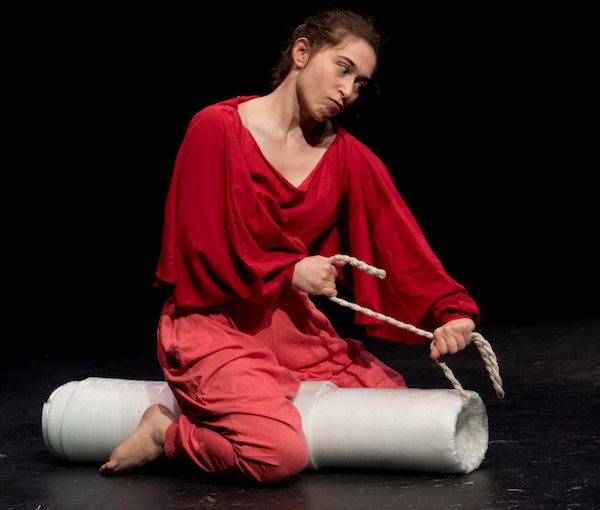
In this scene from their solo physical comedy The Moaning Yoni, Joylyn Secunda is playing the vulva character, Yoni, who is based on the archetype of the Jewish mother (inspired by their own grandmother) – Yoni is strangling the Disembodied Voice of the Patriarchy with a tampon string. (photo by Eric Zennstrom)

Joylyn Secunda is an actor, dancer and puppeteer. In The Moaning Yoni, Secunda brings to life more than a dozen characters to tell the story of a young college student named Zoë who is just trying to fit in, until one day she applies an elixir, and her vulva starts to talk. From Tinder to Tantra, The Moaning Yoni explores the intersection of gender, sexuality and spirituality.

Secunda has performed The Moaning Yoni some 50 times in cities across Canada. Other recent credits include Scrooge in A Wonderheads Christmas Carol (the Wonderheads), Zephyr in Crisis on Planet Z (Monster Theatre), Seek in Pop Pop (Presentation House) and puppeteer in The Breathing Hole (National Arts Centre).

The Moaning Yoni contains mature language and sexual themes. The Feb. 3, 7:30 p.m., show at the NEST on Granville Island will be hosted by drag artist Continental Breakfast. Tickets are $25 and can be purchased from eventbrite.com.

Format ImagePosted on January 27, 2023January 26, 2023Author Joylyn SecundaCategories Performing ArtsTags Joylyn Secunda, Moaning Yoni, performing arts, theatre, women
Supporting each other

Supporting each other

Toby Rubin was invested as the new president of CHW Vancouver on Oct. 16. (photo by Sid Akselrod)

A vast amount of progress has been made in gender equality in recent decades, but organizations where women come together for philanthropic work and social connections remain desirable and necessary, says Toby Rubin, the new president of CHW Vancouver.

Founded by Jewish women in 1917, after a visit from Hadassah founder Henrietta Szold, CHW started out as Hadassah Organization of Canada. In 1921, Canadian Hadassah affiliated with World WIZO and became known Hadassah-WIZO Organization of Canada (later condensed to Canadian Hadassah-WIZO). CHW defines itself as a non-political, non-partisan, national network of dedicated volunteers who believe that excellence and advancement of education, healthcare and social services transcend politics, religion and national boundaries.

Rubin has been a volunteer with the local chapter of the organization for years and was invested as the president at an event Oct. 16 at the Richmond Country Club. In an interview with the Independent, she attempted to dispel some misconceptions.

First and foremost, she said, is the concept that CHW “is a bubbe organization.”

“We have really changed,” she said. A new chapter of 25-to-40-year-old women – including Rubin’s daughter and a cadre of new leaders who were centre-stage at the installation luncheon – has launched and already held their first fundraising event. They raised $5,000 for JOLT, a leadership development curriculum being developed by Young Judaea Canada.

Another misconception, Rubin said, is that all funds from CHW’s philanthropy go to Israel. Rubin and a group of Canadian activists have just returned from a tour of Hadassah projects in Israel, but she stressed that local and Canadian projects are also supported by the chapter’s work. Among the initiatives the group supports is SOS, Starting Over Safely, for victims of domestic violence; scholarships for an LGBTQ+ kids’ camp; and Franny’s Fund.

The latter program was launched by Rebecca Snukal, a Calgary defence lawyer with two decades of experience navigating the legal system and social safety net through some emotionally and administratively perilous cases. But when she and her own family were rocked by crisis, she came to understand how unwieldy the system is – even people with expertise in the field have challenges accessing the legal and psychological supports they require. Snukal was the guest speaker at the October event.

Something that Rubin especially wants to dispel is the idea that CHW’s work is accessible only to Jews. The foremost example, she said, comes from Hadassah Medical Centre in Israel, where triage is based on medical need, to the extent that injured terrorists have been treated based on the severity of their condition alongside victims of their attack.

Also at the meeting, Daniella Givon, a past president, was honoured for her many years of commitment to the organization and the broader community. The meeting also expressed gratitude to outgoing presidents Stephanie Rusen and Sasha Gerson.

photo - Daniella Givon, left, and Sasha Gerson. Givon is a past president of CHW and Gerson is one of the outgoing presidents this year, along with Stephanie Rusen
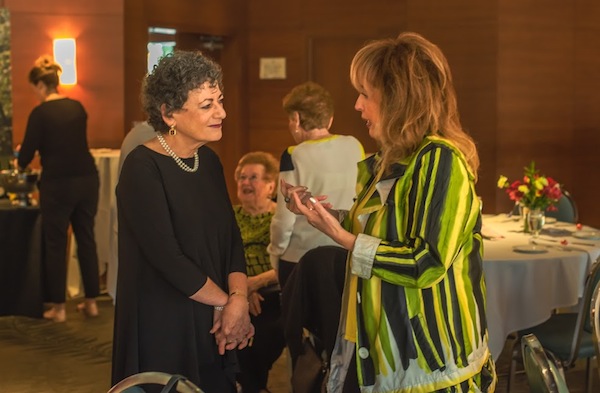
Daniella Givon, left, and Sasha Gerson. Givon is a past president of CHW and Gerson is one of the outgoing presidents this year, along with Stephanie Rusen. (photo by Sid Akselrod)

In addition to her role with CHW, Rubin is co-executive director of Kehila Society of Richmond, which connects Jewish people in Richmond with one another and with businesses, health and social service agencies and community resources. She is also a board member of Jewish Seniors Alliance and Better at Home committee of the City of Richmond.

Rubin comes to CHW naturally – her mother, Linda Hilford, is a member and both her grandmothers, Vera Himelfarb and Rae Moss, were involved on the Prairies back in the day.

The enthusiasm Rubin and other members of the local chapter exhibit is a reflection, she said, of exciting changes at the national level where, under the fresh leadership of national chief executive officer Lisa Colt-Kotler, the organization has seen dramatic progress in the past couple of years.

“She’s just really pumped energy into it and she’s updated it, and is working at making us more mainstream,” Rubin said of Colt-Kotler. Technology has been a boon, she added, allowing members from across the country to conveniently meet regularly without getting on a plane.

Times have changed from when a large proportion of Canadian women did not work outside the home. But those social and economic changes have not altered one fundamental need, said Rubin.

“We are really about bringing women together, to empower them in their philanthropic needs and introduce them and network them with other women,” she said. “We just want them to meet each other, be there, support each other, share their resources. Ultimately, what brought me to this organization 30 years ago – aside from the fact that I have grandparents and a mom who were involved and I love Israel – was women. The ceiling has broken in those 30 years but it’s still there and we need to be there for each other.”

For decades, CHW was most closely associated in the public mind with Hadassah Bazaar, a massive undertaking that ended about 15 years ago. The explosive growth of thrift stores, combined with the immense resources required to execute the annual event, led to the decision to end the tradition. But Rubin said a new initiative is soon to launch nationally that nods to that history – possibly an online version of the bazaar or something similar. Plans are in development.

Things have come a long way, but Rubin said expectations have grown in some ways and getting together with women experiencing similar things is no less valuable than it was in her mother’s or her grandmothers’ time.

“I think women still have a long way to go and we need to support each other and be there for each other, lift each other up,” she said. “I’m trying to be a mom and I’m trying to do a job and I can’t be Superwoman and [it’s good] to know that’s OK – nobody is. I think that’s truly, truly important.”

Format ImagePosted on December 9, 2022December 7, 2022Author Pat JohnsonCategories LocalTags CHW, philanthropy, Toby Rubin, women
Go see Courage Now

Go see Courage Now

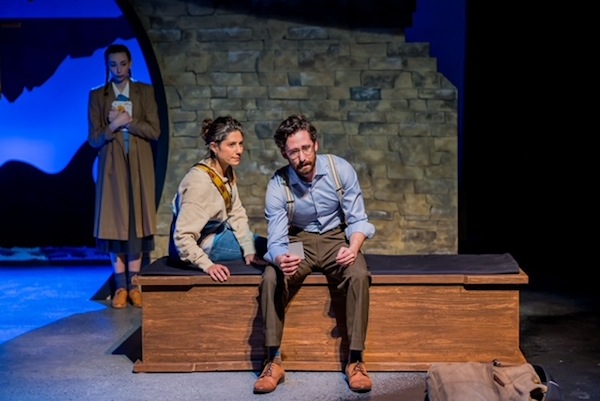
Left to right, Katherine Matlashewski (as Shayna Schneider), Advah Soudack (as Margaret Grant) and Amitai Marmorstein (as Jankl Schneider) in Courage Now, playing at the Firehall Arts Centre until Dec. 4. (photo by Youn Park)

One does not often get a chance to see a world première of a play in Vancouver. After writing my preview article on Courage Now in the last edition of the Independent, I was looking forward with great anticipation to seeing the final product. I was not disappointed.

It is a difficult story to tell but it is done with such sensitivity and style that I highly recommend seeing it. As a child of a Holocaust survivor, any story of courage and heroism arising out of that era resonates with me – this one in particular had me in tears.

From the moment you walk into the intimate Firehall Arts Centre theatre, you know you are about to see something special. The set is austere – a desk, a bench, a lattice-like trellis, an empty wall-mounted picture frame – with a pagoda-style roof and an archway backlit with vibrant colours. (Kudos to set designer Kimira Reddy and lighting designer Itai Erdal.)

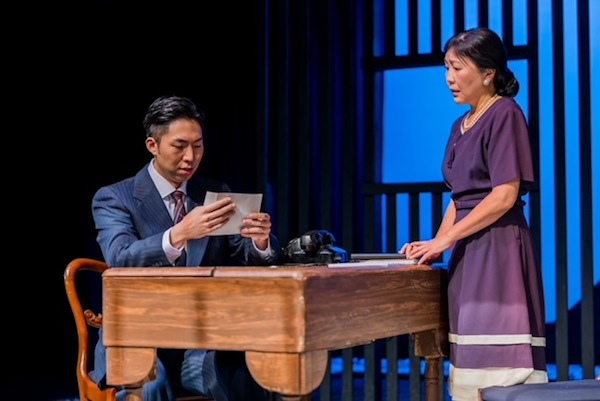
To summarize the backstory, Chiune Sugihara, the Japanese consul in Kaunas, Lithuania, in 1940, against the instructions of his government, issued more than 2,300 handwritten visas in a 30-day period to save Jews trying to leave Poland and Lithuania. He was supported in his decision by his wife, Yukiko, who knew the price the family would pay for going against the government edicts. And a price was paid: career loss, humiliation and Sugihara’s self-imposed postwar exile to Russia for 16 years.

The play follows what appear to be two separate narratives that intersect in an unexpected way in the final scene. In 1986, Yukiko (playwright Manami Hara) is forced to revisit wartime when a visitor from Vancouver, Margaret Grant, born Shayna Schneider (Advah Soudack), comes for answers from Sugihara as to what happened to her father after he put her on a train out of Kaunas when she was 13 years old. She has resented her father through the years, feeling abandoned and betrayed by his sending her off alone; she is also coping with a difficult divorce and her own daughter’s hatred. Sugihara has recently died, however, and Margaret must turn to Yukiko for answers instead.

The play opens with Yukiko waking from a dream where she is visited by the ghost of her husband. Then Margaret enters her garden. She tells Yukiko, “I am a Sugihara Jew, Sempo saved my life.” The play then moves through a series of memory flashbacks, as the audience is transported back and forth between 1940 Kaunas and 1986 Japan.

Katherine Matlashewski plays the teenage Shayna and Amitai Marmorstein plays her father, Jankl. Jankl visits Sugihara (Ryota Kaneko) to plead for visas on behalf of the thousands of Jews who have been lining up every day outside the consul’s office. In a touching and poignant scene, something as simple as a shared cup of coffee gives you a sense of the integrity and honour of these two men as they strive to do the right thing. Kaneko plays Sugihara with a quiet intensity and Marmorstein portrays Jankl with dignity. The scene where he sees Shayna off at the train station is heartbreaking – he watches his only child (his “little mouse,” as he calls her) walk away from him, tattered suitcase in hand, in a fog of smoke and the eerie sound of a train whistle in the distance.

photo - Ryota Kaneko plays Chiune Sugihara and Courage Now playwright Manami Hara takes on the role of Yukiko Sugihara
Ryota Kaneko plays Chiune Sugihara and Courage Now playwright Manami Hara takes on the role of Yukiko Sugihara. (photo by Youn Park)

In many ways, the journeys of the two women are love stories. Yukiko grapples with the grief of losing her husband, moving through the stages towards acceptance, and Margaret comes to the realization that it was her father’s love that put her on that train in 1940. Both characters become conduits for the other’s catharsis. When Yukiko shares her husband’s journal from that time, Margaret says, “My father lives in that journal.”

All five of the actors do credit to their roles in this ensemble piece but Hara and Soudack’s performances are sublime. The play is particularly effective when all five actors are on stage at the same time in the memory flashback vignettes.

My one criticism is that there is quite a bit of Japanese dialogue between Kaneko and Hara and it would have been helpful to have either a reader board translating or a program insert with translations.

Hara has penned a lovely tribute to Sugihara and I, for one, am grateful to her for her work.

Courage Now is at the Firehall until Dec. 4. For tickets, visit firehallartscentre.ca.

Tova Kornfeld is a Vancouver freelance writer and lawyer.

Format ImagePosted on November 25, 2022November 23, 2022Author Tova KornfeldCategories Performing ArtsTags Chiune Sugihara, Courage Now, Firehall Arts Centre, history, Holocaust, Japan, Manami Hara, theatre, women, Yukiko Sugihara
Teaching about charity

Teaching about charity

Ellen Schwartz, founder of Project Give Back. (photo from LinkedIn)

Jewish Federation of Greater Vancouver’s Choices, the largest celebration of women’s philanthropy in the community, takes place Nov. 3 at Congregation Beth Israel. At the event, featured speaker Ellen Schwartz, founder of Project Give Back, will talk about raising a son with a neurodegenerative disease and how her son Jacob helped her “live a more grounded, purposeful and present life.”

Project Give Back is targeted to elementary students in Ontario. Established in 2007 by Schwartz, a Toronto-based teacher, community advocate and mother of three children, it started as a program she created for her fourth grade classroom and it is designed to teach compassion and concern for community. The program, which selects and trains teachers to deliver its specialized curriculum, runs weekly from October to May in partner schools. In it, students help do the teaching by explaining the value of a worthy cause to their fellow classmates. Since its inception, Project Give Back has helped bring awareness to hundreds of charities.

“The beauty about Project Give Back is children teach us about what matters to them, through their involvement with a charity that they or their family are connected to,” Schwartz told the Independent.

Fifteen years after starting the program, Schwartz said many early participants continue to be actively involved in charitable work as they enter into young adulthood.

“We definitely have seen many of our alumni actively giving and making change in their communities,” she said. “Some of our graduates have published books, with proceeds donated to their chosen and personal causes.”

Some of the many grassroots charities to which Project Give Back has recently brought attention are Sending Sunshine, a program directed at curbing loneliness in the elderly population; Nanny Angel Network, which provides free in-home child care in Canada; and the Super Sophia Project, a group whose goal is to offer hope to children and their families battling cancer.

As Project Give Back bases much of its lessons on personal connection and in-class discussions, it, like many organizations, was affected by the pandemic and had to shift its operations accordingly.

“We had to pivot quickly to online learning. All of a sudden, we looked at the windows of the students and we had family members attending lessons as well as pets, grandparents, etc. That was beautiful to see,” Schwartz recalled.

“Unfortunately, there was a tremendous gap in education and, while many schools were able to continue, almost at the switch of a button, others truly struggled. In these schools, often school was a safe place for many children and many didn’t have the opportunity to reset online quickly. We launched Project Give Back Connects during this time. This was a way to connect powerful messages and resources to classroom teachers, which they could access and share with their students.”

For her Vancouver presentation, Schwartz plans to discuss some of the life lessons she learned from her son Jacob, who died in 2019 at the age of 21. Only months after he was born, he was diagnosed with Canavan disease, which damages the brain’s nerve cells. Jacob wasn’t able to walk, talk or see.

“I will share the best piece of advice I was ever given. It was on a folded note left in my mailbox 25 years ago, [and] I still don’t know who left it there,” said Schwartz. “I will touch on tricks and tips to living a life filled with purpose and meaning as well as shaping grief in a manner that allows us to move forward.”

Currently, Project Give Back only operates in Ontario, but Schwartz is eager to investigate operating in Vancouver schools.

“Our plan is to continue to grow slowly and carefully, never compromising on the quality of our program,” she said. “Sometimes, bigger does not mean better. I would rather teach less children and do it well so that spark becomes a flame, rather than teaching more and hoping to ignite a spark.”

Schwartz also co-founded Jacob’s Ladder, Canadian Foundation for the Control of Neurodegenerative Diseases, with her husband Jeff in 1998. In its 21 years of operation, Jacob’s Ladder raised more than $3 million for research, education and awareness of neurodegenerative illnesses, as well as research into treatments.

Ellen Schwartz has written two books: Lessons from Jacob: A Disabled Son Teaches His Mother About Courage, Hope and the Joy of Living Life to the Fullest and Without One Word Spoken. She has been honoured by the Israel Cancer Research Fund, Ve’ahavta, Aish Toronto, Sick Kids Hospital, and Brilliant Minded Women. And she has been awarded a Queen’s Jubilee Medal, a Meritorious Service Decoration by the Governor General of Canada and a Canada 150 Exemplary Canadian Medal.

“I am hoping to make some new friends and inspire your community with a story I am honoured to be able to share,” Schwartz said, when asked about what she expects from her visit.

The community speakers participating in Choices this year are the daughters of Holocaust survivor Robert Krell: Shoshana Lewis, Simone Kallner and Michaela Singerman. They will share how they honour their father’s experience.

Also part of the Nov. 3, 5 p.m., event will be a marketplace including several local vendors.

Tickets for Choices are $60 and include dinner. However, there is a minimum donation of $154 to support the Federation annual campaign and, for first-time Choices attendees, a minimum donation of $36. Register at jewishvancouver.com/choices.

Sam Margolis has written for the Globe and Mail, the National Post, UPI and MSNBC.

Format ImagePosted on October 28, 2022October 26, 2022Author Sam MargolisCategories LocalTags annual campaign, Choices, health, Jewish Federation, neurodegenerative disease, parenting, philanthropy, Project Give Back, tikkun olam, women

How much is your work worth?

Imagine an interview where the interviewer wanders around the office, conducting work while asking intrusive personal questions. The interviewee trails behind. An hour-long appointment stretches into two. Things get further off track. The potential employee, apologizing profusely, gets herself out of the building and into the safety of her car. Cheeks burning, she drives herself home, wondering, “What the heck was that?” Days later, she fields phone calls from the interviewer, asking why she won’t accept an offer that is a dollar or two more than minimum wage. The amount would not likely cover the gas, taxes, work clothes and household/childcare coverage it would take to do the job. Advanced degrees and experience don’t matter, she hears. This is the going rate.

Meanwhile, at home, the same potential employee “works” at the numerous tasks that pop up every day. She self-drafts a clothing pattern, because a kid needs pyjamas of the right size and the pattern she has doesn’t fit. She mends a favourite pair of school pants. She prepares multiple meals in advance, baking bread ahead, too. These tasks are lined up for quick moments to spare amid managing homework and extracurricular activities. She contacts tradespeople to see if they can provide affordable repair quotes, responds to school emails and fits in applying for other jobs or doing her current work as she can. She is sadly behind in keeping up with her friends and family, but doesn’t know when to fit that in.

In between, she walks the dog, meets the kids at the school bus, takes them to medical appointments, or pays bills. She politely tries to get out of volunteer commitments that moms “should” do for the school and community organizations.

This might sound familiar to parents, mostly mothers. It’s all the work that goes unnoticed and is uncompensated in our society. Daring to seek compensation for some of these skills is seen as selfish. After all, these parents (usually mothers) are told, “If you expect to earn anything for your experience or education, you’re mistaken. You ‘chose’ not to stay consistently in the full-time workforce. You chose to have children/get married/study a less-lucrative topic in university….” The list goes on.

Our society functions in many ways because of the unpaid labour. It’s most often women’s physical, emotional, social labour done behind the scenes. It feels new and unfair in every generation, I suspect, even as some things change for women slowly over time.

As I study Ketubot, which is a Babylonian talmudic tractate dedicated, at least in theory, to marriage contracts, I’ve had competing demands on my time. It’s forced me to read aspects of the text differently. When the rabbis debated these issues (1,600 to 2,100 years ago, give or take), women’s roles were more circumscribed. However, some of the basic arguments seem to arise in ways that don’t surprise me.

Some of the takeaway nuggets from this tractate…. When a woman marries, her husband is owed her labour and the fruit from her properties. Even if she brings servants into the marriage, there are certain tasks she must do herself. Her virtue and loyalty are worth a monetary value in the marriage.

There are surprises though. If the husband dies, the woman is owed the price of her marriage contract, or the husband’s heirs must take care of her upkeep. She (or her representatives) may write obligations into the marriage contract that the husband will be required to honour. For instance, if she brings a daughter from a previous marriage with her, she can obligate the new husband to pay for the daughter’s physical support in the contract. (Ketubot 102)

Long story short, smart women can sometimes find ways to protect themselves. This is true even in a rabbinic system that isn’t designed necessarily for them. In these texts, women – and their families – both look out for one another and treat each other unfairly.

What can we draw from all this? I feel less alone when considering that expectations may have changed a bit in 2,000 years, but that many of our sometimes truly overwhelming expectations and commitments remain. Further, clever people have protected themselves whenever they can, throughout the centuries. It’s not new to look out for one’s own interests and avoid being taken advantage of by creating some safe boundaries.

Studying these texts at this point in my life offers me a level of maturity that I didn’t have the first time I went through a bad interview. More than once, I was offered a job that took a lot of skill but offered only a low wage. I remember feeling torn up about these experiences, wondering if I was worth so little. It was also a feeling of desperation. I needed a certain amount to live, and this offer wouldn’t provide it.

One privilege of being older is that women who value themselves aren’t embarrassed to ask for what they’re worth. Earning less than what we need doesn’t do us or our families any favours but, of course, in financial desperation, many women must take those jobs anyway. This is what fuels the cycle of low wage work in the first place.

We aren’t all experts in everything. Drafting a sewing pattern doesn’t make one a professional fashion designer. Finding the right document in a bunch of storage boxes is like finding a needle in a haystack, but it doesn’t make me an archivist or a research librarian. We all have our areas of true expertise. Also, just as the rabbis debated the value of one’s roles and responsibilities in marriage, we do the same. Is our work worth something? Heck, yes.

Tractate Ketubot’s messages about the value of a woman or a wife sometimes seem mercenary, but this, too, is Torah. Sometimes, being mercenary is the way to have our work be seen, valued or compensated appropriately.

Joanne Seiff has written regularly for CBC Manitoba and various Jewish publications. She is the author of three books, including From the Outside In: Jewish Post Columns 2015-2016, a collection of essays available for digital download or as a paperback from Amazon. Check her out on Instagram @yrnspinner or at joanneseiff.blogspot.com.

Posted on October 28, 2022October 27, 2022Author Joanne SeiffCategories Op-EdTags economics, education, Judaism, Talmud, Torah, women, work
Help break the cycle

Help break the cycle

Canadian Hadassah-WIZO’s S.O.S. – Starting Over Safely campaign is 27 hours long, beginning at 9 a.m. PT on Aug. 23. (photo by Mickey Noam Alon)

With the COVID-19 government shutdowns and mandatory quarantines, domestic violence has increased significantly across the globe over the past two years. The drastic increase in intimate partner and domestic abuse has been coined the “Shadow Pandemic” by the United Nations.

In Canada, one woman is killed in a violent act every two-and-a-half days. According to the provincial ministry for public safety and Statistics Canada, every year in British Columbia there are more than 60,000 physical or sexual assaults against women – almost all of them committed by men.

In Israel, the situation is just as critical. In the first year of the pandemic, 20,140 domestic violence complaints were lodged with police, an increase of 12% from the previous year. Twelve women were murdered in the first six months of this year.

In accordance with its mission, Canadian Hadassah-WIZO (CHW) is working to empower women by stepping up emergency support and services at this critical time. CHW is launching the second annual S.O.S. – Starting Over Safely summer campaign, with proceeds helping empower victims of domestic violence in Canada and Israel.

One of the most frightening things about domestic abuse is that half of the women murdered by their partners never experienced physical violence before. Domestic violence can happen to anyone, anywhere, anytime. This year, through a new partnership with Michal Sela Forum, CHW is also promoting an awareness campaign to help women understand the warning signs in a relationship.

S.O.S. – Starting Over Safely 2022 has three campaign priorities, including Franny’s Fund in Canada, and WIZO programs and the Michal Sela Forum in Israel. The following campaign goals are intended to empower at-risk women and children to break the cycle of violence in Canada and Israel:

  • Provide help for parents and families in need of an urgent response;
  • Provide access to critical resources such as legal counsel and counseling services;
  • Provide women and their children with the basic essentials to start over safely;
  • Empower women and their children by providing financial help, social and personal support, employment support, and access to a network of other women in similar circumstances;
  • Provide women and their children with specially trained canine protection; and
  • Fund respite summer camp experiences for at-risk youth.

“CHW strongly believes that every human being deserves the right to achieve their full potential, while living in safety and security. You have the power to empower,” said Lisa Colt-Kotler, CHW chief executive officer.

The 2022 fundraising goal is $350,000. All funds donated will be matched three more times by a community of dedicated donors recognized as “Matching Heroes” during the 27-hour campaign, which kicks off at 9 a.m. PT on Tuesday, Aug. 23, 2022. During the crowdfunding period, each gift donated on the website chwsos.ca is quadrupled.

To donate or learn more, visit chwsos.ca.

– Courtesy Canadian Hadassah-WIZO

Format ImagePosted on August 19, 2022August 18, 2022Author Canadian Hadassah-WIZOCategories Israel, NationalTags CHW, domestic violence, fundraising, tikkun olam, women

Posts pagination

Previous page Page 1 … Page 3 Page 4 Page 5 … Page 15 Next page
Proudly powered by WordPress