Skip to content
  • Home
  • Subscribe / donate
  • Events calendar
  • Business Directory
  • FAQ
  • News
    • Local
    • National
    • Israel
    • World
    • עניין בחדשות
      A roundup of news in Canada and further afield, in Hebrew.
  • Opinion
    • From the JI
    • Op-Ed
  • Arts & Culture
    • Performing Arts
    • Music
    • Books
    • Visual Arts
    • TV & Film
  • Life
    • Celebrating the Holidays
    • Travel
    • The Daily Snooze
      Cartoons by Jacob Samuel
    • Mystery Photo
      Help the JI and JMABC fill in the gaps in our archives.
  • Community Links
    • Organizations, Etc.
    • Other News Sources & Blogs
  • JI Chai Celebration
  • JI@88! video

Recent Posts

  • Federation now across BC
  • Israel fighting for its existence
  • Deal strengthens Iran
  • Patriotic belonging diminishes
  • A campaign to engage
  • Upstanders’ first live event
  • Responding to Carney
  • Having your own home
  • Music a family tradition
  • Musical to warm heart
  • Community milestones … June 2026
  • Sharing her passion for Israel
  • Or Shalom reopens its doors
  • JFS from past to future
  • Need holistic approach
  • Sharing stories, advice
  • Journalist shares fears
  • Skills to live together
  • Road to independence
  • Cutting grass with scissors
  • Zionism as a solution
  • Deceit, desire & the divine
  • Reclaiming sacredness
  • Creative project ideas
  • Summer squares and cobbler
  • Thou shalt … summer commandments
  • Legal help for students
  • Revisiting myth of Lilith
  • Wrong person rebuked
  • Canada’s mixed messages
  • Questions for museum
  • Symposium on antizionism
  • Making soccer political
  • CJPAC lauds Pulver’s impact
  • City recognizes Vrba’s legacy  
  • Organ donation saves lives

Archives

Follow @JewishIndie
image - The CJN - Visit Us Banner - 300x600 - 101625

Tag: theatre

Question that won’t die

Question that won’t die

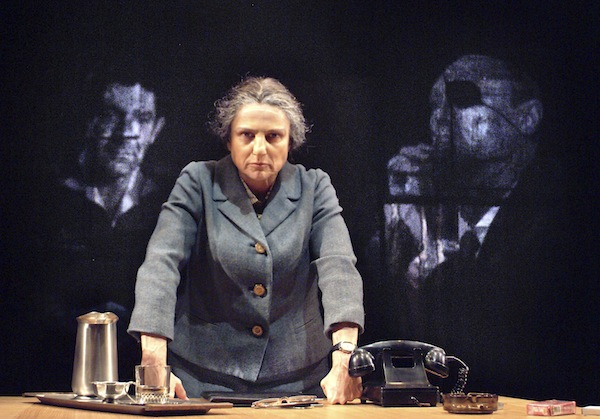
“How does a housewife decide between generals?” asks Golda Meir (played by Tovah Feldshuh) in Golda’s Balcony. In this instance, she must decide between the counsel of David (Dado) Elazar, her chief of staff, left, and Moshe Dayan, her minister of defence. (production still)

Tovah Feldshuh is incredible to watch in Golda’s Balcony, The Film. Not just in her passionate and sympathetic portrayal of Golda Meir, Israel’s prime minister from 1969 to 1974, but in her depiction of all 45 characters in William Gibson’s one-woman play. She’s Meir, David Ben-Gurion, David (Dado) Elazar, her husband Morris, Holocaust survivors and Israeli soldiers, among many others. She moves as easily between the personalities as a child raised in a multilingual household moves between languages. And with powerful effect.

Golda’s Balcony, The Film has two screenings at the Vancouver Jewish Film Festival – March 1, 1 p.m., and March 2, 3:30 p.m., at Fifth Avenue Cinemas. See it. You will have a more nuanced understanding of Meir, as well as of Israel, its origins and the struggles it has faced and will face. Gibson’s text is superb; it is engaging and insightful, with enough humour along the way that you’ll be able to breathe on occasion, as Meir deals with the existential crisis of the Yom Kippur War. Fluidly switching from wartime to other parts of her life, the play depicts, if nothing else, the stressful, heart-wrenching, thankless job that is being prime minister of a country that is constantly under threat.

The film is a recording of the play’s soldout Off-Broadway première on May 4, 2003, at the Manhattan Ensemble Theatre, presented by Issembert Productions. After a four-month soldout run at MET, the show moved to Broadway, and the Helen Hayes Theatre, where it ran for 15 months, making it, apparently, the longest-running one-woman show in Broadway history. It has won countless awards.

The set is relatively simple. A table with a couple of chairs on a tile floor. On the table, a dial telephone, a pitcher and water glass, an ashtray, cigarettes. Light shines on the table from the right, as if from a window. The backdrop is a wall of reddish stone or metal slabs of varying sizes that protrude outward. Images are projected onto the wall or chairs when relevant, giving the audience a visual of the person Meir is talking about, or that Feldshuh is portraying – though it is hard to see these images in the film version. To the side and a step down is a small piece of stage covered in dirt, with a few rocks, which acts as refugee camps in Cyprus, the kibbutz on which Meir lived for a time, Russia when Meir visits on a diplomatic tour, etc. The focal point for the entire production is Feldshuh.

The play begins in darkness, a man chants a prayer, the words “Golda’s Balcony” appear briefly on the wall. Thunder claps, lightning flashes, gunshots ring out, then darkness again, but the sound continues: guns firing, bombs exploding, planes overhead. A housecoat-garbed Golda, sitting at the head of the table, strikes a match and lights a cigarette; the lights rise a bit and calmer music prevails.

“I’m at the end of my story,” says Golda. “I’m old. I’m tired. I’m sick. Dying, the doctors tell me. The picture you have of me as Mamaleh Golde, who makes chicken soup for her soldiers, it’s a nice picture. And I do make chicken soup. But let’s empty it all out for keeps right now because, at the bottom of the pot, is blood. At the bottom of the pot is the question that won’t die. I can do without that music!” she yells. It stops. The lights come on more fully, as Golda then starts to relate the story of her first voyage to Palestine, with her husband, in 1921 – 52 years later, she would become prime minister.

“I remember, starting with a phone call, that woke me up at four o’clock in the morning. Saturday, Yom Kippur, 1973,” she says, as she closes her eyes, looking exhausted, her right arm holding up her head, the left one sliding off the table. The phone rings. Startled, she answers it, hearing the news that Egypt and Syria have attacked Israel. As she takes off the housecoat, Golda is in her familiar muted woolen skirt suit; energy, anger and fear all come to the surface as she relates her generals’ differing views as to what Israel needs to do. Dado: attack! Moshe Dayan: don’t be seen as the aggressor! “How does a housewife decide between generals?” she asks.

Of course, she does decide. But the agonizing and tension-filled process leads her – and Israel – down some very dark paths and the play masterfully depicts her sadness, anxiety and frustration; the sacrifices to her family, her health, as well as to others. Throughout the many narratives, it is the story of the Dimona nuclear facility to which she will get, the story that haunts her, that took her to hell; the story she needs to gather the strength to tell.

Thunder, lightning and gunfire divide the scenes in the whirlwind of action that Golda describes, her domestic life almost as tumultuous as her political life. We see her humanity, but also her toughness. Luckily, she never had to answer the question that “won’t die”: if Israeli forces hadn’t been able to cross the Suez Canal and if the United States had not come through with the needed military aid, would she have ordered the dropping of the nuclear bombs with which she had armed Israel’s planes?

Golda’s Balcony is a must-see in a festival with many excellent films. For the full schedule, visit vjff.org.

Format ImagePosted on February 21, 2020February 19, 2020Author Cynthia RamsayCategories TV & FilmTags Golda Meir, history, Israel, theatre, Tovah Feldshuh, Vancouver Jewish Film Festival, VJFF
Opera urges “never forget”

Opera urges “never forget”

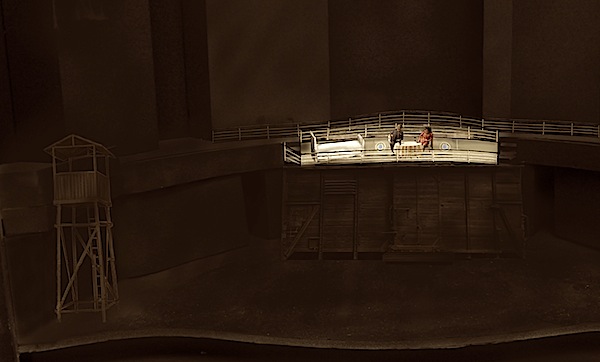
The ship’s cabin in Pasazerka (The Passenger), as envisioned by UBC Opera’s creative team. The opera is part of a series of events at the University of British Columbia marking the 75th anniversary of the liberation of Auschwitz. (photo from UBC Opera)

UBC Opera presents the Canadian première of Mieczyslaw Weinberg’s Pasazerka (The Passenger). Opening Jan. 30 at the Chan Centre for the Performing Arts on the University of British Columbia campus, this will be the first time the work has been presented on any university stage in the world.

The Passenger opens on a luxury liner bound for Brazil. A newly married German woman, Lisa, who, earlier in life, had been an aufseherin, camp guard, at Auschwitz, thinks she recognizes a fellow passenger. The passenger is Martha, a Polish Auschwitz prisoner who was thought to have died at the camp. The effect that their meeting (either actual or imaginary – it’s never made clear) has on the two women, and on Lisa’s marriage to the German ambassador to Brazil, is the subject of this dramatic and powerful opera.

UBC Opera’s production is being created from scratch. The opera has proven so popular no sets or costumes are available for rent; consequently, new sets are being constructed and, at this writing, the students were sewing together dozens of striped prison pajamas for the Auschwitz prisoners’ chorus.

After receiving its world première in 2010 at the Bregenzer Festspiele in Austria, The Passenger has seen frequent performances in various German venues, a highly acclaimed production at the English National Opera in 2011 and, more recently, it has been performed successfully in the United States at the Houston Grand Opera and at the Lyric Opera of Chicago. In spring of last year, it was performed at the new Tel Aviv Performing Arts Centre, and it will be performed in Spain later this year.

The UBC production has received funding from various sources, including the Adam Mickiewicz Institute, which promotes Polish culture around the world, and the Consulate General of the Republic of Poland, as well as Poland’s Department of Public and Cultural Diplomacy and Ministry of Foreign Affairs.

When the president of UBC, Dr. Santa Ono, heard about the project, he committed further funding for the production. Other funding has come from UBC’s dean of arts, Gage Averill, and the David Spencer Endowment Encouragement Fund. The production also has received support from the Vancouver Holocaust Education Centre, Temple Sholom and UBC Hillel House.

“In our time, antisemitism and neo-Nazism has become shockingly prevalent again. Even our own neighbour to the south has witnessed a growing social and political climate which has encouraged disrespect for other human beings and blatant racism,” said Prof. Nancy Hermiston, head of the Voice and Opera divisions at UBC and the director of this production of The Passenger, in a recent interview with the Independent. “In my opinion,” she said, “this has, in part, been released as a result of the behaviour and actions of President Trump. His attitude has given those elements of the world’s population promoting discrimination, hatred, antisemitism and neo-Nazism, a sense that they have a licence to do so. Our opera highlights the consequences of this hatred and racism. Now is the time to remind ourselves of respect and tolerance for others and of our humanity. It is the exact time to remind ourselves of the horror of the systematic extermination of millions of innocent people. Genocides continue to plague our world. Have we learned nothing from the past?

“We can never forget the tragic deaths of those millions of innocent souls nor can we forget those who survived that crime against humanity,” she said. “We cannot let another Holocaust occur.”

The Passenger is sung in Polish, Russian, Czech, French, Yiddish, German and English, which offers a particular challenge to the young singers at UBC. Equally challenging for the singers, according to Hermiston, is the difficulty of dealing emotionally with the subject matter, which, in rehearsal, has led to periods of weeping and feelings of deep sorrow, both for the singers and “even for me,” admitted Hermiston, “especially at the end, when the chorus of prisoners comes downstage and challenges the audience to ‘never forget, never forget.’” (Hermiston has engaged a counseling team to help the singers through their own trauma as they reenact this emotional narrative.)

Performances of The Passenger are set for Jan. 30 and 31 and Feb. 1 at 7:30 pm, and Feb. 2 at 2 p.m. Tickets are available online at music.ubc.ca/opera-pasazerka-the-passenger.

The opera is part of a larger commemoration of the 75th anniversary of the liberation of Auschwitz that is being undertaken by UBC Opera; the UBC Modern European Studies program; the UBC department of Central, Eastern and Northern European studies; the UBC Witnessing Auschwitz International Seminar; and UBC Go Global. During a symposium that runs Jan. 27-30, there will be various symposia and exhibits, and school-outreach programs featuring local survivors and UBC professors and students, as well as the opera The Passenger.

Guest speakers for the symposium include Dr. Michael Berenbaum, Dr. Bozena Karwowska, Dr. Piotr Setkiewicz, Dr. Chris Friedrichs, Aleksander Laskowski, Dr. Richard Menkis, Dr. Dorota Glowacka, Dr. Rima Wilkes, Dr. Anja Nowak, Dr. Peter Suedfeld, Dr. Tricia Logan, Dr. Ilona Shulman Spaar, Janos Benisz, Amalia Boe-Fishman and David Ehrlich, among others. For more information, visit auschwitz75.arts.ubc.ca.

Graham Forst, PhD, taught literature and philosophy at Capilano University until his retirement and now teaches in the continuing education department at Simon Fraser University. From 1975 to 2010, he co-chaired the symposium committee of the Vancouver Holocaust Education Centre.

Format ImagePosted on January 17, 2020January 15, 2020Author Graham ForstCategories Performing ArtsTags Auschwitz, education, Holocaust, Nancy Hermiston, opera, theatre, UBC, UBC Opera, University of British Columbia
Searching for a safe harbour

Searching for a safe harbour

Ben Caplan is narrator and co-creator of Old Stock: A Refugee Love Story, which runs Jan. 24-30 at Frederic Wood Theatre, as part of the PuSh festival. (photo by Stoo Metz Photography)

The 2020 PuSh International Performing Arts Festival opens next week. Among the highlights is Old Stock: A Refugee Love Story, which follows Chaim and Chaya from the pogroms in Romania they are fleeing, to Halifax’s Pier 21, where they meet in 1908, to Montreal, where they end up living. The show, which runs Jan. 24-30 at Frederic Wood Theatre, is narrated and co-created by Halifax-based musician and performer Ben Caplan, with whom the Jewish Independent recently spoke.

JI: How and when did you become involved in the production?

BC: It all started with a phone call from 2b Theatre Company’s artistic co-director Christian Barry in mid-2015. Christian was familiar with my work as a songwriter and performer in the music world and he wondered if I would be interested in collaborating on creating a theatrical production featuring new songs that we would write together.

To be honest, I was skeptical at first. I tend to be a very solitary writer and, though I had a lot of experience in theatre many years ago, it had been a decade since I had performed in theatre. The first few writing sessions were pleasant enough and Christian and I got along great, but we were struggling to find the story that we wanted to tell. As we were searching and exploring to find the substance of what the work would consist of, a confluence of events conspired to show us the story that would become Old Stock.

The first thing was our growing consciousness of the scale of the human tragedy emerging in Syria as a growing number of refugees started trying to find their way out of the violence. Next came Prime Minister Stephen Harper’s comments about “Old Stock Canadians” during the 2015 leadership debate. This othering of “non-Old Stock Canadians” seemed to be vile and absurd. At what point does one get to call themselves “Old Stock”? I am the great-grandson of Jewish immigrants who came to Canada fleeing violence in their own home countries. Was I supposed to think of myself as “Old Stock” or did I fit into some other category in our [then] prime minister’s logic.

Around this time, Christian’s wife, who happens to be the celebrated playwright Hannah Moscovitch, gave birth to their first child, Elijah, and came across the immigration records of her own great-grandparents who immigrated to Canada in 1908 through Pier 2 in Halifax. She realized that, if her great-grandparents hadn’t made the journey to Canada, she would not exist, let alone her infant child. It was then that Hannah asked if she could write the scenes for the show we were trying to create.

With Christian’s vision of the artistic whole, my work as composer and lyricist, and Hannah’s work as playwright, we were off to the races and we worked together to create the show. We thought that the Jewish story from 110 years ago had a striking and tragic resonance with the tragedy unfolding in our own time. I should mention that, of course, the originating cast, musical director Graham Scott, our production manager and designer Louisa Adamson, and many others played a huge role in realizing the vision and bringing the music and the play into the world.

JI: In broad strokes, could you describe how the co-writing process worked?

BC: Christian Barry created the structures and conditions that made it possible for any of these songs to be written. I was probably not always the easiest artist to work with – I tend to desire quiet and solitude when I am writing.

The way it usually worked is that Christian would book a time and a space in whatever city we were able to meet up in (we did writing in Halifax, Montreal, Stratford and Banff) and the day would start with conversations and questions. We would talk, share ideas, listen to music, read texts, Google things, etc.

Out of our conversations and questions, the idea for a song would emerge. The first one we wrote was something for their arrival at Pier 2. We didn’t have a scene or a broader context to work with but, after awhile, Christian would say something like, “We know they are going to come through Pier 2, let’s start there.” I sat at the piano and started mashing out some chords and throwing words into the air. Christian had a wonderfully delicate touch after I got rolling, and would provide helpful comments, critiques, and throw ideas into the room.

JI: What is it about the production that drew you back to performing?

BC: I had stopped performing in the theatre after I became somewhat disillusioned of the possibilities of making a career in theatre. In 2005, the year I did my last theatre performance, I was working on academic pursuits, theatre and my hobby as a singer-songwriter. My life was over-full and something had to give. My logic was something like, in theatre, you need to rely on finding a lot of talented people who are willing to work on a project that takes a lot of time and resources to complete. As a singer-songwriter, there is more room to work solo and bring other people into the project as interest and resources permit. So, that’s the path I chose to express my artistic impulses. I gave up the dream of becoming an actor to focus on the more reasonable and safe path of becoming a songwriter. Ha!

When Christian called me to ask me to make a piece of theatre with him, it was a no-brainer. Being a part of this show has been one of the great privileges of my life. Not only did I get to collaborate with a crazy good team on writing the thing, but I had the opportunity to perform on stages that I wouldn’t have dared to dream of stepping onto when I was making theatre 10 years ago. It’s been an amazing learning experience and one that is sure to influence my work as a performer for the rest of my career.

JI: In what ways does the story and/or themes of Old Stock speak to you as a Canadian in 2020?

BC: What is most meaningful for me about the story and themes of the show is the humanization of the character of the refugee. It has been disturbing to see the ways in which migrants have been portrayed by so many politicians and media outlets around the world. They are often spoken of as hordes, masses and statistics. What is lost are the individual human lives – people with hopes, dreams, fears and trauma searching for a safe harbour.

In Old Stock, we tell the story of Hannah Moscovitch’s great-grandparents coming to Canada. We see their struggles to overcome their past and to generate new and complicated identities. I think that we all, as human beings, have complicated and multi-layered identities. I think that, among other things, this show is about demonstrating layered and sometimes tragic identities with compassion and a healthy dose of humour. That’s basically the most Canadian thing I can think of.

For tickets to Old Stock: A Refugee Love Story and other PuSh shows, visit pushfestival.ca. The soundtrack to Old Stock is available on Spotify, YouTube and elsewhere.

Format ImagePosted on January 17, 2020January 15, 2020Author Cynthia RamsayCategories Performing ArtsTags Ben Caplan, Christian Barry, Hannah Moscovitch, immigration, music, Old Stock, PuSh International Performing Arts Festival, refugees, theatre
Last Cabaret almost sold out

Last Cabaret almost sold out

Joanna Garfinkel is part of the creative team behind the world première production of Berlin: The Last Cabaret, part of the PuSh festival. (photo from the artist)

The world première of Berlin: The Last Cabaret, presented at Performance Works Jan. 23-26 by City Opera Vancouver in association with Sound the Alarm: Music/Theatre, is almost sold out. Part of the PuSh International Performing Arts Festival, the only tickets that remain will be sold at the door, though writer and Jewish community member Joanna Garfinkel told the Independent, “I hope we are able to add more presentation opportunities, as well, since this is truly becoming an exciting and rich production.”

Set in Nazi Germany in 1934, a group of artists must decide whether or not to perform their new political show – which, reads the press release for Berlin, “challenges state media, calls out the Nazi classification of gay individuals as ‘degenerates’ and includes parodic inflection that women are being marginalized” under the new regime – or save themselves.

The opera takes place “two weeks after ‘the Night of Long Knives,’” said Garfinkel, “when the future had been cast, but many were not yet seeing it, including my own family. One thing that interested me a great deal is how people are forced to make compromises under oppression, and even make excuses for what’s happening around them.”

The “Night of the Long Knives” was the June 30, 1934, purge by Hitler of more than 85 members of the Sturmabteilung, the Nazi party’s initial paramilitary wing.

Rather than being a satire itself, Garfinkel explained that Berlin: The Last Cabaret “is more an unearthing of the under-heard Jewish and queer artists who flourished in the Weimar era and were crushed by the Holocaust. The humour we employ is their urgent satire, which feels fresh and relevant with all that is going in the world right now.

“My own family escaped from Berlin to Winnipeg (eventually), so I am both bound to respect and honour the history, and also privy to the dark humour we employ about it.”

City Opera Vancouver approached Garfinkel last spring, she said. They had “heard about me from my dramaturgical work with Playwrights Theatre Centre and the historically based Japanese Problem for my own company, Universal Limited. I was excited by the opportunity to work with an opera company, which would be new to me, but on something quite close to my heart, history and interest.”

The relevance of the opera was one of the reasons she joined its creative team. In regard to choosing projects in general, she said, “Right now, it feels like art must be speaking to the world and on behalf of marginalized voices. Theatre is too much work, and the world too messed up, to work on projects that don’t resonate on an activist level. I am lucky right now to get to choose to work on things that are so resonant.”

Garfinkel, who is billed as librettist for the production, clarified that categorization.

“I contributed story, structure and additional dialogue for this piece,” she said, “but it’s important to note that the songs themselves are historical, written by composers Eisler, Spoliansky, Hollaender and Weil, so I am not, technically, the librettist. However, building a story and play around preexisting songs presents its own challenges. It was of central importance to me that the Jewish/queer and other marginalized artists of the time were centred in our story.

“We were working with excellent (but unavailable!) collaborators in our composers and, together with director Alan Corbishley, music director and historian Roger Parton and choreographer Tara Cheyenne Friedenberg, tried to honour their work and build a vital story around it.”

Cheyenne Friedenberg is also a member of the Jewish community.

Berlin: The Last Cabaret stars actors with a background in music and spoken theatre, rather than traditional opera singers, and each performer, according to the press release, “was involved in the creation of their on-stage characters and storylines.” The production features a live four-person band.

For more information on PuSh, visit pushfestival.ca.

Format ImagePosted on January 17, 2020January 15, 2020Author Cynthia RamsayCategories Performing ArtsTags Berlin, free speech, Hitler, Holocaust, Joanna Garfinkel, LGBTQ+, Nazis, PuSh International Performing Arts Festival, satire, theatre
It’s a Wonderful Life in music

It’s a Wonderful Life in music

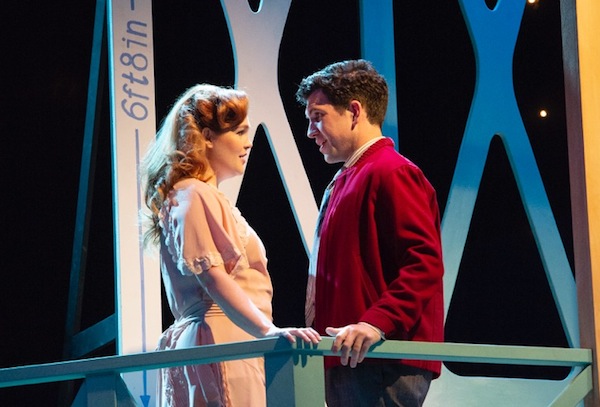
Erin Palm and Nick Fontaine reprise their roles as Mary and George Bailey in Patrick Street Productions’ musical It’s a Wonderful Life. (photo by David Cooper)

So ingrained in popular culture is Frank Capra’s It’s a Wonderful Life that many Jews probably make it an annual tradition to watch the 1946 film. This year, there is also the chance to see a musical adaptation of the classic, in which the angel Clarence is assigned the job of trying to save Bailey Building and Loan owner George Bailey from committing suicide on Christmas Eve, after there is a run on the bank and George faces the possibility not only of financial ruin but of believing his life has been a waste.

Patrick Street Productions presents the musical version by Peter Jorgensen, with arrangements and orchestrations by Nico Rhodes, at the Anvil Centre Theatre in New Westminster from Dec. 19 to Jan. 5. The show is the only ticketed event of Winter Celebrations, free daily performances by professional artists, singers and musicians at the Anvil Centre until Jan. 5.

It’s a Wonderful Life features a few Jewish community members: Erin Palm as George’s wife, Mary; Andrew Cohen as Ernie, who Cohen describes as “everyone’s favourite Bedford Falls cabbie”; and Stephen Aberle playing, in his words, “the ruthless, cold-hearted capitalist Mr. Potter, as well as the Sheriff, and hero George Bailey’s father, Peter.”

“Mr. Potter is the antagonist of the piece,” explained Aberle. “He owns practically everything in the small town of Bedford Falls, other than the little Bailey Building and Loan Society that George Bailey’s father founded and that George continues. Potter hates the Building and Loan and does everything he can to crush it because it helps working people to save and buy their own homes instead of having to rent from him and live in the slums he owns.”

While Cohen and Aberle are new to the show, Palm played Mary in the 2018 Patrick Street production at the Gateway Theatre. As an aside, she said, “I also auditioned for the original production in Chemainus so many moons ago. I am so happy it all worked out the way it did. I truly believe it was the right fit for me at this time in my life. I have so much more personal growth and experience to bring to the role of Mary.”

Never wanting her acting to be a copy of someone else’s work, Palm said she has not seen the movie in its entirety. “I have seen some clips,” she said, “but not enough to develop a multifaceted character. Peter has written a great script and all I need to bring Mary to life is in the text. The musical aspect is completely different from the movie, and I think a beautiful addition.”

About her character, Palm said, “I appreciate Mary’s faith in community and her love for her family. She’s really strong and an anchor for George. When she wants something in her life, she goes after it. She’s the matriarch and heroine of the story. She comes through for her family and for her community when times are at their worst.

“I also appreciate her love of the simple life. In complex times like ours, and when I find my ambition too great, it’s people like Mary that remind me I can be happy and grateful for what I have, what I have worked so hard to create.”

One of Palm’s favourite scenes is “the moment right before we meet Clarence,” she said. “George is on the bridge and he’s deciding the fate of his own life, the same bridge where so many of his life’s highlights happen. It often makes me weep backstage. It’s difficult to think of people who carry the weight of the world with them, feeling isolated and alone, especially around the holidays, but the reality is the troubles of the world do not stop around those times and are in fact amplified for people who are struggling with depression and financial hardship. It’s a beautiful reminder how important it is to reach out to those around you, be a light in their lives. It only takes one person, one gesture to change the outcome of the lives of many.”

For her part, Palm is grateful to be working with the cast and especially Aberle, who happens to be her father-in-law. “Working on a show that has to do with family makes me long for family during the holidays and it is a gift to work with him,” she said.

Of the Christmas aspect of the show, Palm said the story is based in community and, “while we sing some Christmas carols, the heart of the piece is a very human story of how communities can overcome hardship by coming together around the holidays to help those who need it most, to support each other and to celebrate life. It touches on how faith can be a guiding light, but, ultimately, it’s in our own hands. Our daily work, prayer and decisions can change our own lives and people around us.”

While acknowledging that the story “seems to be somewhat synonymous with this season,” Cohen said it’s “the story of a stalwart man who continually puts the needs of his community members above his own. He learns that the value of life is not determined by monetary gain or ambition but rather the positive impact you have made on the lives of others. Even though we like to watch this story around Christmas time, it is not a story about any one holiday, but rather a family man who learns how to be a mensch.”

Aberle echoed his co-stars’ comments, adding more context and noting some Jewish connections.

“It’s a Wonderful Life is about the importance of family, fairness, justice, courage in resistance to oppression and people sticking together in hard times,” he said. “It celebrates the human spirit and the importance of individual action and responsibility. While it’s true that the climactic scenes of the story are set at Christmas time and that our production (like perennial TV broadcasts of the film) is coming out at that time of year, I’d say (with director Frank Capra himself) that it’s not a Christmas story. To quote Capra: ‘I didn’t even think of it as a Christmas story when I first ran across it. I just liked the idea.’ In a 1946 interview, Capra described the film’s theme as ‘the individual’s belief in himself.’

“It happens that several of the writers who were involved with it were Jews, or of Jewish descent,” Aberle added. “The original short story, The Greatest Gift, was by Philip Van Doren Stern, whose father was of Bavarian Jewish extraction, and the writers who contributed to the film screenplay included Clifford Odets and Jo Swerling, both Jewish, and Dorothy Parker, whose father was a Jew.

“A heck of a lot of the music in this adaptation – like a heck of a lot of American musicals in general – is by Jewish composers and librettists, including George and Ira Gershwin, Alan Jay Lerner, Kurt Weill.”

For tickets to It’s a Wonderful Life, call 604-684-2787 or visit patrickstreetproductions.com. The show is recommended for ages 9+.

Format ImagePosted on December 20, 2019December 18, 2019Author Cynthia RamsayCategories Performing ArtsTags Andrew Cohen, Christmas, Erin Palm, musicals, Patrick Street Productions, Stephen Aberle, theatre
Be in on the joke in AI

Be in on the joke in AI

Hannah Everett, left, and Drew Carlson co-star in Artisanal Intelligence, at the Havana Theatre Jan. 14-18. (photo from Spec Theatre)

Drew Carlson and Jewish community member Hannah Everett are reprising their roles in Artisanal Intelligence, which again plays at the Havana Theatre, Jan. 14-18.

Written by Jewish community member Ira Cooper, the show had a limited two-show run this past July at the Havana; both of those performances sold out. It also traveled to a few Fringe festivals, garnering positive reviews.

Carlson plays Barry, a hipster customer-service robot who is filled with esoteric knowledge and mad skills. Everett plays Jane, the entrepreneur who created Barry.

“The content will be the same, aside from a few tweaks and tightens,” Cooper told the Independent about how the January production differs from the summer show. “One of the songs, ‘No Off-Switch for Love,’ will be fully orchestrated, as opposed to the passable version of it that I created on GarageBand with digital instrumentation, so that is exciting and new. I am hoping it will fill out the song more, give it its deserved panache, and get people dancing in and out of their seats. It’s a Boney M.-inspired funk track, so I am really happy that it will finally be given the backtrack it has always longed for.”

photo - Ira Cooper’s Artisanal Intelligence is at the Havana Theatre Jan. 14-18
Ira Cooper (photo from Spec Theatre)

The idea for Artisanal Intelligence took a couple of years to develop.

“In 2017, I went to live in China for a year to teach at a Canadian high school abroad,” said Cooper, who teaches the younger grades English and drama at King David High School. “My partner stayed in Canada and so I was there, in a new city, in a massive apartment, concocting, creating and percolating thoughts, ideas, words and scribbles to fill a void. Artisanal Intelligence was my attempt to write an accessible Fringe show…. Hipsterism just has so much great material to rib and, being that I would self-identify as a ‘hipster,’ I needn’t go too far to do my research. And robots. And AI. All are distinct and widely known, relevant, partaken in and discussed topics, so it seemed like an easy fit with my own personal playwriting aspirations this time around.

“I do not remember much about the writing process for the initial drafts. Knowing myself, it was probably over a three- or four-week period. Then drafts. Collaboration is integral to everything I and Spec Theatre do, so, early on in the process, I had people reading the script and giving me notes. Then it was sitting down with the director, Bronwen Marsden, for more edits. Then with the actors. Then with my partner, who is also the artistic designer for Spec, Ruby Arnold. The more feedback the better. The end result is a deeply heart-filled joint-effort, which we are all proud of and which we all had a part in molding, from the very words on the page outwards.”

Cooper said Artisanal Intelligence lampoons and lambasts hipster culture, as opposed to critiquing it.

“The show uses a lot of recognizable hipster motifs, tropes and allusions, but the audience is consistently in on the joke,” he said. “The show is a discussion on identity, self-perseverance, self-reliance and the impending (or not) robot apocalypse, but in a soft and humorous way.

“I think the show actually exemplifies why culture can be important, how it can bind us to something bigger than ourselves. We are constantly looking for the ‘bigger than ourselves’ entities. And so, with the culture references, the clearly identifiable razzing and fun that takes place in the 55 minutes of Artisanal Intelligence, the audience, who get what the show is alluding to, are part of each joke’s equation – that knowledge links culture, the audience and the performers.”

The performances at the Havana in January will be relaxed, said Cooper, which means “the houselights will never fully dim and people are free, if they need or want, to get up, stretch, move, go for a walk, etc. We want theatre to be accessible to everyone and we respect, acknowledge and cherish the diversity of our audiences. Also, if you’re an artist of any kind, Spec Theatre is always looking to collaborate, to make unique, experimental, new things. Reach out!”

For tickets to Artisanal Intelligence, go to spectheatre.com.

Format ImagePosted on December 20, 2019December 18, 2019Author Cynthia RamsayCategories Performing ArtsTags artificial intelligence, artisanal, Hannah Everett, Havana Theatre, Ira Cooper, theatre

O My God at Emanu-El

Bema Productions presents the Canadian première of the comedy O My God at Congregation Emanu-El Synagogue in Victoria, Jan. 16-26. In O My God by Israeli playwright Anat Gov, God walks into a therapist’s office suffering from depression. The therapist asks, “How long have you felt this way?” God says, “Two thousand, five hundred years. Give or take.” “You’ve been depressed for 2,000 years and only now you’ve come to therapy? What were you waiting for?” asks the therapist. And God says, “I thought time would heal.”

Gov, who died of cancer at 58, was born in 1953, and was a graduate of Thelma Yellin High School of the Arts. She was briefly a student in Tel Aviv University’s theatre department – she dropped out to become a successful playwright and television writer. She also married and was a mother of three and grandmother of two.

The Bema Productions staging of O My God is directed by Zelda Dean and performed by Christine Upright (the therapist), Rosemary Jeffery (God) and Jesse Wilson, who is on the autism spectrum himself, plays the autistic son of the therapist.

Tickets ($23) can be purchased online at ticketrocket.co or at the door.

Posted on December 20, 2019December 18, 2019Author Bema ProductionsCategories Performing ArtsTags Anat Gov, Bema Productions, Emanu-El, philosophy, theatre, Victoria
Green Thumb milestone

Green Thumb milestone

Breanne Harmon at the 41st Annual Business / Arts Awards. (photo from Business / Arts)

On Nov. 7, Vancouver-based Green Thumb Theatre, in partnership with TELUS, was awarded the Community Impact Award sponsored by KPMG at the 41st Annual Business / Arts Awards Gala, held at Meridian Hall in Toronto. The Business / Arts Awards recognizes and celebrates partnerships between business and the arts, and profiles exceptional volunteers and leaders in the business and arts community who have made a significant impact on the arts in Canada.

Breanne Harmon (née Jackson) is general manager of Green Thumb. She was born and raised in Richmond, and was an avid and active member of both Beth Israel USY and Vancouver Hillel at the University of British Columbia, where she graduated with her bachelor of fine arts in theatre production and design.

Since 1975, Green Thumb Theatre has been a staple in many schools across Canada. Each year, they tour to hundreds of schools and communities, and bring professional productions to students who may otherwise have no exposure to theatre in their communities. For the past 13 years, TELUS has been a committed partner, supporting Green Thumb in creating and executing relatable, educational, artistically excellent and relevant theatre for young audiences. Throughout this partnership, TELUS has supported the development of plays that address important social issues, including bullying, homophobia, drug addiction, respectful relationships and consent.

“By bringing live professional theatre that addresses social issues youth face on a daily basis directly into their schools, we can continue to reach thousands of youth with our programming each year, making a lasting impact on those who see our plays,” said Harmon.

Green Thumb Theatre is the third theatre company – and first theatre for young audiences and touring company – to be awarded the Community Impact Award. This is the first time Green Thumb Theatre has been recognized by Business / Arts.

Format ImagePosted on December 20, 2019December 18, 2019Author Community members/organizationsCategories LocalTags Breanne Harmon, business, Green Thumb, TELUS, theatre
Price is a point of view

Price is a point of view

Left to right, Patrick Bahrich, Sjahari Hollands and Christine Iannetta co-star, along with Rob Monk, in United Players’ production of The Price by Arthur Miller, which is at Jericho Arts Centre until Dec. 1. (photo by Nancy Caldwell)

United Players of Vancouver theatre company has a reputation for tackling challenging, thought-provoking material and, with its current production, The Price, by Arthur Miller, it lives up to that reputation.

Playing at Jericho Arts Centre until Dec. 1, The Price is a densely packed play, covering several themes: sibling rivalry, self-perception, filial and spousal duty, memory, modernity, the Depression, materialism, success, failure, and more. In a play where dialogue is the main action, actors Patrick Bahrich, Sjahari Hollands, Christine Iannetta and Rob Monk do an adept job at keeping the audience engaged.

First to enter the scene – a room full of heavy, dated furniture, piled high and seemingly haphazardly – is Victor Franz (Bahrich), a New York City policeman. He slowly and almost lovingly uncovers some of the many items and puts a record on a Victrola – a laugh track of sorts, apparently a popular type of recording, once upon a time.

Victor’s wife Esther (Iannetta) arrives, amid the laughter, which contrasts to the obvious tension between the two. Victor immediately accuses her of being drunk, and she defensively replies, “I had one!”

The furniture belonged to Victor’s family and is being stored on the upper floor of the building in which they lived. His brother Walter (Monk) is supposed to be coming to help him sell it to an appraiser (Hollands), as the building is soon to be demolished.

The Franzes’ marriage could be summarized by the phrase “unfulfilled expectations.” Director Adam Henderson – who is a member of the Jewish community – has chosen to stage the play as a period piece, so that viewers will ponder how the roles of men and women have changed, and how societal norms have evolved (or not), since 1968, when The Price premièred on Broadway. Miller’s opening direction is, “Today. New York.” However, the today of 2019 is very different from that of 50 years ago, as is evident on several occasions, especially in how the men talk to and about Esther, and how her character is written overall.

Eventually, the appraiser stomps and puffs his way up the stairs to home-cum-storage unit. Eighty-nine-year-old Gregory Solomon was expecting there to be only a few pieces to consider and is overwhelmed by the volume of furniture. He also ends up entangled in the volume of resentment and distrust between the brothers, who haven’t spoken to each other for ages. Walter shows up at the end of Act 1, just as Solomon is paying Victor the agreed-upon price for the lot, $1,100, one $100 bill at a time.

Sweeping in, expensively dressed and broadcasting on more than one level his success and confidence, Walter is the brother who managed to escape their controling father and follow his dreams, while self-effacing Victor dropped out of college to take care of their father, who lost almost everything in the Stock Market Crash of 1929. But, as the conversation and argument proceed, it becomes apparent that neither characterization is accurate. Nor is there a clear verdict on what really happened all those years ago, as they are unable to reconcile their recollections of the past or their beliefs about each other and themselves.

Solomon – who has his own regrets in life – tells Victor, “… the price of used furniture is nothing but a viewpoint and, if you wouldn’t understand the viewpoint, it’s impossible to understand the price.”

We do not understand everything we do in life, let alone everything that other people do. The price that we – and others – pay for our choices is as obscure. And time doesn’t allow us to go back and change things; time is an ever-present weight in The Price.

There is no happy ending here, despite the humour that runs throughout, and the fact that the play both starts and ends with the laughter record. Once the Franzes have all left, the deal done, Solomon puts on the record. He flops into one of the big armchairs and laughs and laughs.

The Price will leave you with much to think and talk about. For tickets, visit unitedplayers.com or purchase them at the door.

Format ImagePosted on November 15, 2019November 13, 2019Author Cynthia RamsayCategories Performing ArtsTags Arthur Miller, Jericho Arts Centre, theatre, United Players
History and future combine

History and future combine

Ilana Zackon and Ariel Martz-Oberlander played current-day partisans in the immersive theatre piece Time Machine. (photo from Radix Theatre)

Two Jewish theatre artist-creators, Ariel Martz-Oberlander and Ilana Zackon, teamed up this summer to create an immersive piece based on the Jewish partisan movement, as part of Radix Theatre’s futuristic play Time Machine, set on a boat, the Pride of Vancouver.

The show took place on the yacht over a five-hour journey up Indian Arm (traditionally known as səl̓ilw̓ət) and featured both local emerging and established artists presenting new work of various genres, such as theatre, spoken word poetry, sound installation and more. The artists were asked to create a piece inspired by what Vancouver will look like in the year 2050. Some darker, others playful, the works were all grounded in a strong sense of the artists’ identities.

Martz-Oberlander and Zackon wanted to bring their ancestral roots into their piece. The pair created an immersive show in which they played two rebels helping smuggle climate refugees to safety. The 10-minute piece, which ran on a loop for an hour-and-a-half of the boat ride, took place in the boat’s basement bathroom, which acted as a safehouse. Five to seven audience members at a time were summoned by Zackon, dressed as a soldier, down into the dimly lit bathroom, where they were greeted by a similarly dressed Martz-Oberlander; “Zog Nit Keynmol” (“The Partisan Song”) played in the background.

The invited audience soon discovers they are now refugees who have just escaped fires in California. The soldiers, members of a new wave of partisans called PAP, explain that the refugees are being brought to another safehouse and prepared to enter the new world. The soldiers explain that their resistance cohort has based their movement on the survival lessons of their ancestors, partisan fighters in the forests of occupied Europe. The audience members are given new names, briefed on the types of skills, such as hunting moose, that they will need to survive in their new lives and, eventually, led into a discussion on identity.

“What’s better: start over or remember where you’re coming from?” Martz-Oberlander’s character asks. The two soldiers bicker over their differing views and invite the audience to contribute. After the group has spoken, the soldiers receive word that it is safe to move the refugees. Before leaving, audience members are given the option of writing down “one thing about their identity they don’t want to lose in the new world” on a sticky note. The notes lined the stairwell and, as the loop continued, more and more words were added, creating a tapestry of human identity. The notes lined the bathroom walls for the remainder of the boat ride, and included such items as “curiosity and kindness,” “time to think,” “my favourite berry picking spot,” “my knowledge of languages” and “the giggles of my daughter,” among many others.

photo - Audience members were given the option of writing down “one thing about their identity they don’t want to lose in the new world” on a sticky note
Audience members were given the option of writing down “one thing about their identity they don’t want to lose in the new world” on a sticky note. (photo by Didier Brûlé-Champagne/DBC Photographie)

A number of the boat passengers who attended the piece were Jewish and shared how they connected with their ancestors through remembering their stories. Many non-Jews had never heard of the partisan movement and the two artists felt the work they did helped educate people on an important part of history.

Zackon and Martz-Oberlander also received, from the Jewish Museum and Archives of British Columbia, transcripts of interviews with Jewish refugees coming to Canada during the 1930s and 1940s. These testimonials were hidden around the safehouse and incorporated into the performance. The two artists hope to receive the opportunity to continue developing and expanding this work and to incorporate more of their own personal family stories about immigration to Canada.

Format ImagePosted on November 8, 2019November 6, 2019Author Radix TheatreCategories Performing ArtsTags Ariel Martz-Oberlander, climate change, environment, history, Ilana Zackon, theatre

Posts pagination

Previous page Page 1 … Page 7 Page 8 Page 9 … Page 13 Next page
Proudly powered by WordPress